



Examples and Countermeasures

Sydney WebApps Meetup: Security - March
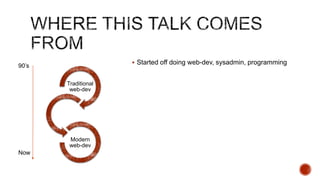
 Started off doing web-dev, sysadmin, programming
90‟s

       Traditional
        web-dev


        Modern
        web-dev
Now
 Started off doing web-dev, sysadmin, programming
90‟s
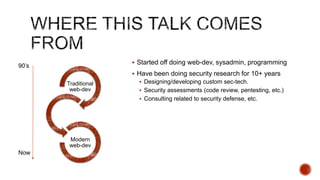
                      Have been doing security research for 10+ years
       Traditional      Designing/developing custom sec-tech.
        web-dev         Security assessments (code review, pentesting, etc.)
                        Consulting related to security defense, etc.


        Modern
        web-dev
Now
 Started off doing web-dev, sysadmin, programming
90‟s
                      Have been doing security research for 10+ years
       Traditional      Designing/developing custom sec-tech.
        web-dev         Security assessments (code review, pentesting, etc.)
                        Consulting related to security defense, etc.

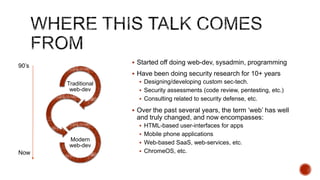
                      Over the past several years, the term „web‟ has well
                      and truly changed, and now encompasses:
                        HTML-based user-interfaces for apps
                        Mobile phone applications
        Modern
                        Web-based SaaS, web-services, etc.
        web-dev
Now                     ChromeOS, etc.
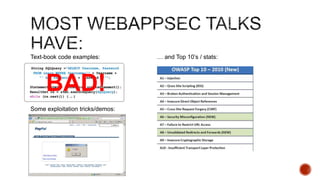
Text-book code examples:          … and Top 10‟s / stats:


     BAD!
Some exploitation tricks/demos:
However:
• Text-book vulnerable code (e.g. SQL injection) is not so common
   •   Flaws are becoming more complicated (or at least abstracted)
However:
• Text-book vulnerable code (e.g. SQL injection) is not so common
    •   Flaws are becoming more complicated (or at least abstracted)


• Showing exploitation of vulnerabilities is useful to illustrate the risk
    •   But also takes away from explaining how these bugs surface
However:
• Text-book vulnerable code (e.g. SQL injection) is not so common
    •       Flaws are becoming more complicated (or at least abstracted)


• Showing exploitation of vulnerabilities is useful to illustrate the risk
    •       But also takes away from explaining how these bugs surface


• Vulnerability statistics can be interesting
        •   But can also be quite misleading
 Provide example flaws based on recent web-related assessments
   Often developers making a small (sometimes understandable) mistake
 Provide example flaws based on recent web-related assessments
   Often developers making a small (sometimes understandable) mistake


 Run through several defensive steps
   A few processes and mitigation methods to consider
   General guidance, recommended reading, etc.
 Provide example flaws based on recent web-related assessments
   Often developers making a small (sometimes understandable) mistake


 Run through several defensive steps
   A few processes and mitigation methods to consider
   General guidance, recommended reading, etc.


 I have only have 20 minutes for this, but I‟ll be touching on quite a lot
   These slides will be put online with all of the references, links, etc.
   Also happy to chat about any of this over a drink 
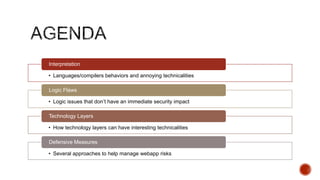
Interpretation

• Languages/compilers behaviors and annoying technicalities

Logic Flaws

• Logic issues that don‟t have an immediate security impact

Technology Layers

• How technology layers can have interesting technicalities

Defensive Measures

• Several approaches to help manage webapp risks
Languages/compilers behaviors and annoying technicalities
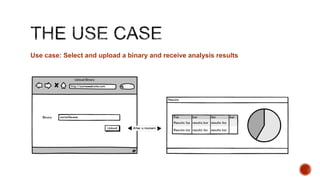
Use case: Select and upload a binary and receive analysis results
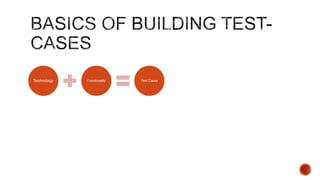
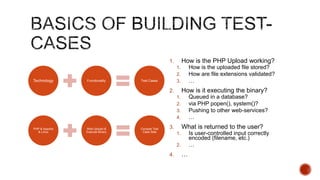
Technology   Functionality   Test Cases
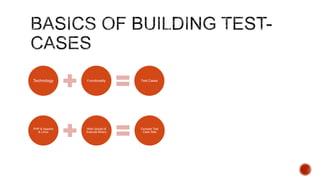
Technology     Functionality    Test Cases


PHP & Apache   Web Upload &     Compile Test
  & Linux      Execute Binary    Case Sets
1.        How is the PHP Upload working?
                                                    1.       How is the uploaded file stored?
                                                    2.       How are file extensions validated?
Technology     Functionality    Test Cases          3.       …
                                               2.        How is it executing the binary?
                                                    1.       Queued in a database?
                                                    2.       via PHP popen(), system()?
                                                    3.       Pushing to other web-services?
                                                    4.       …
PHP & Apache   Web Upload &     Compile Test   3.        What is returned to the user?
  & Linux      Execute Binary    Case Sets
                                                    1.       Is user-controlled input correctly
                                                             encoded (filename, etc.)
                                                    2.       …
                                               4.        …
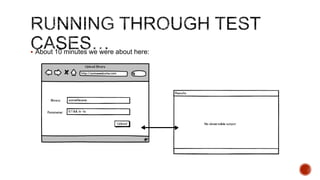
 About 10 minutes we were about here:
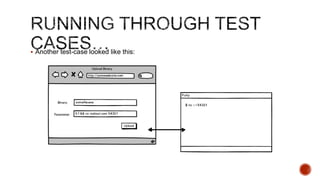
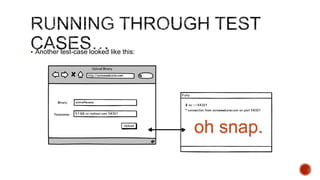
 Another test-case looked like this:


                                        oh snap.
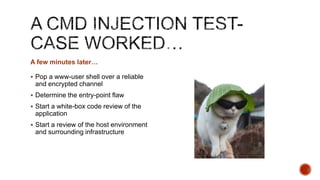
A few minutes later…

 Pop a www-user shell over a reliable
 and encrypted channel
 Determine the entry-point flaw
 Start a white-box code review of the
 application
 Start a review of the host environment
 and surrounding infrastructure
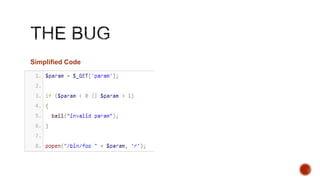
Simplified Code
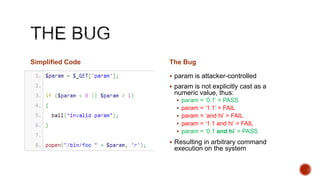
Simplified Code   The Bug

                   param is attacker-controlled
                   param is not explicitly cast as a
                   numeric value, thus:
                     param = „0.1‟ = PASS
                     param = „1.1‟ = FAIL
                     param = „and hi‟ = FAIL
                     param = „1.1 and hi‟ = FAIL
                     param = „0.1 and hi‟ = PASS

                   Resulting in arbitrary command
                   execution on the system
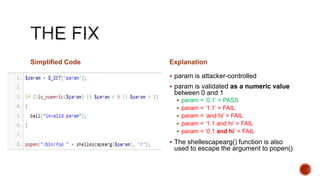
Simplified Code   Explanation

                   param is attacker-controlled
                   param is validated as a numeric value
                   between 0 and 1
                     param = „0.1‟ = PASS
                     param = „1.1‟ = FAIL
                     param = „and hi‟ = FAIL
                     param = „1.1 and hi‟ = FAIL
                     param = „0.1 and hi‟ = FAIL

                   The shellescapearg() function is also
                   used to escape the argument to popen()
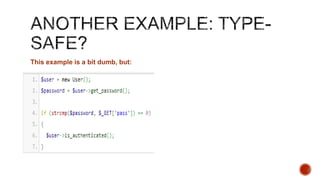
This example is a bit dumb, but:
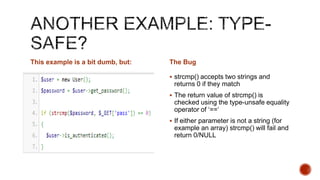
This example is a bit dumb, but:   The Bug

                                    strcmp() accepts two strings and
                                    returns 0 if they match
                                    The return value of strcmp() is
                                    checked using the type-unsafe equality
                                    operator of „==„
                                    If either parameter is not a string (for
                                    example an array) strcmp() will fail and
                                    return 0/NULL
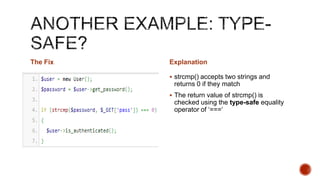
The Fix   Explanation

           strcmp() accepts two strings and
           returns 0 if they match
           The return value of strcmp() is
           checked using the type-safe equality
           operator of „===„
 A lot of higher level languages are quite lax about data-types
   This is dangerous for web-languages and affects many applications
   Be explicit and remove assumptions about data-types
 A lot of higher level languages are quite lax about data-types
   This is dangerous for web-languages and affects many applications
   Be explicit and remove assumptions about data-types


 A common trend is for developers to lower their guard post-validation
   “This user-controlled data is now trusted” is a very dangerous assumption
 A lot of higher level languages are quite lax about data-types
   This is dangerous for web-languages and affects many applications
   Be explicit and remove assumptions about data-types


 A common trend is for developers to lower their guard post-validation
   “This user-controlled data is now trusted” is a very dangerous assumption


 It can be dangerous hopping between programming languages
   Programmers of different backgrounds make various (risky) assumptions
   Get proficient at the languages you spend most time in
   Every single language has its “gotchas” to be aware of
How logic flaws can be much more serious than a security hole
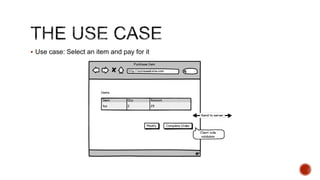
 Use case: Select an item and pay for it
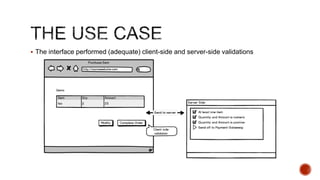
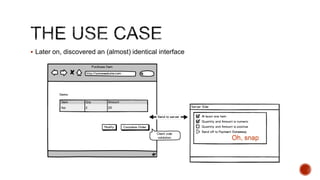
 The interface performed (adequate) client-side and server-side validations
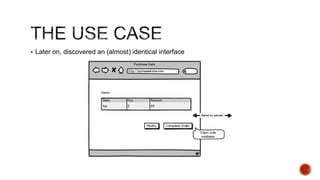
 Later on, discovered an (almost) identical interface


                                                         Oh, snap
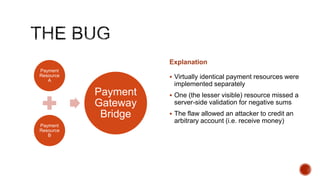
Explanation
Payment
Resource              Virtually identical payment resources were
   A
                      implemented separately
           Payment    One (the lesser visible) resource missed a
           Gateway    server-side validation for negative sums
            Bridge    The flaw allowed an attacker to credit an
                      arbitrary account (i.e. receive money)
Payment
Resource
   B
 “Safe” applications can still suffer from application-specific risks
   This was a relatively well written .NET application with minimal security risks
   Yet, this single logic bug raised more immediate concern than if I had popped a shell
 “Safe” applications can still suffer from application-specific risks
   This was a relatively well written .NET application with minimal security risks
   Yet, this single logic bug raised more immediate concern than if I had popped a shell


 The nature of new software functional requirements should be treated with caution
   Hacked on components/interfaces without proper system and integration analysis
 “Safe” applications can still suffer from application-specific risks
   This was a relatively well written .NET application with minimal security risks
   Yet, this single logic bug raised more immediate concern than if I had popped a shell


 The nature of new software functional requirements should be treated with caution
   Hacked on components/interfaces without proper system and integration analysis


 There are huge risks when critical validation/integration isn‟t centralized
   Often has a higher chance of inconsistent validation rules
   Makes it more expensive and inefficient to both implement and later fix issues
   Less efficient to review critical code when it‟s scattered erratically
How technology layers can have interesting technicalities
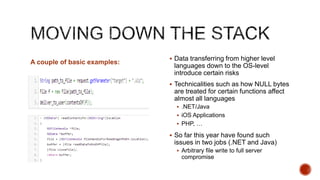
 Data transferring from higher level
A couple of basic examples:
                               languages down to the OS-level
                               introduce certain risks
                               Technicalities such as how NULL bytes
                               are treated for certain functions affect
                               almost all languages
                                 .NET/Java
                                 iOS Applications
                                 PHP, …

                               So far this year have found such
                               issues in two jobs (.NET and Java)
                                 Arbitrary file write to full server
                                  compromise
 XSS is very common and affecting
 more technologies and devices
   UIWebView in iOS, etc.

 Many interesting attacks possible
   Attacking internal network infra.
   Triggering client-side vulnerabilities
   Targeted phishing attacks that are
    executing specific payloads
 Increasingly used for decently
 executed targeted attacks
   Such as using XSS to own apache.org
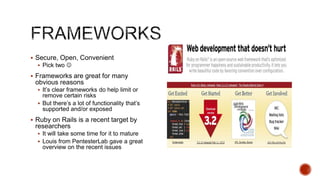
 Secure, Open, Convenient
   Pick two 

 Frameworks are great for many
 obvious reasons
   It‟s clear frameworks do help limit or
    remove certain risks
   But there‟s a lot of functionality that‟s
    supported and/or exposed
 Ruby on Rails is a recent target by
 researchers
   It will take some time for it to mature
   Louis from PentesterLab gave a great
    overview on the recent issues
Methods to help strengthen your web-app security
 Mitigations are about raising the cost
 of an attack
   Try avoiding things that add an attack
    surface (e.g. WAF‟s)
 Explicit inbound/outbound network
 trusts should be part of provisioning
 End-point threats affect almost
 everyone these days
   Review the DSD‟s Top 35

 See what big targets are doing:
   Facebook talk from Ruxcon
Threat Modeling

   It‟s important to spend some time to
    think about your potential adversaries
   Threats aren‟t just bots and kids
    scanning your network and webapps
     People focusing on your apps
     Social engineering (remote or physical)
     Internal staff
     (the list goes on...)
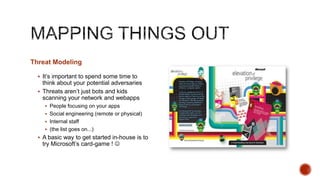
   A basic way to get started in-house is to
   try Microsoft‟s card-game ! 
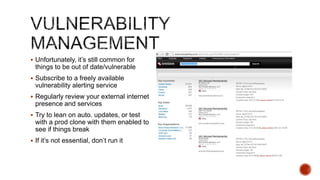
 Unfortunately, it‟s still common for
 things to be out of date/vulnerable
 Subscribe to a freely available
 vulnerability alerting service
 Regularly review your external internet
 presence and services
 Try to lean on auto. updates, or test
 with a prod clone with them enabled to
 see if things break
 If it‟s not essential, don‟t run it
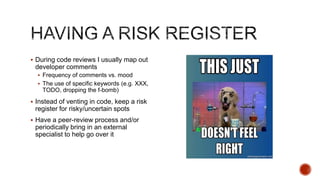
 During code reviews I usually map out
 developer comments
   Frequency of comments vs. mood
   The use of specific keywords (e.g. XXX,
    TODO, dropping the f-bomb)
 Instead of venting in code, keep a risk
 register for risky/uncertain spots
 Have a peer-review process and/or
 periodically bring in an external
 specialist to help go over it
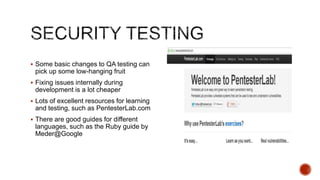
 Some basic changes to QA testing can
 pick up some low-hanging fruit
 Fixing issues internally during
 development is a lot cheaper
 Lots of excellent resources for learning
 and testing, such as PentesterLab.com
 There are good guides for different
 languages, such as the Ruby guide by
 Meder@Google
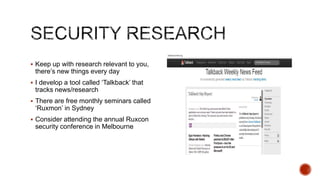
 Keep up with research relevant to you,
 there‟s new things every day
 I develop a tool called „Talkback‟ that
 tracks news/research
 There are free monthly seminars called
 „Ruxmon‟ in Sydney
 Consider attending the annual Ruxcon
 security conference in Melbourne
 Bugs happen. It‟s okay. 
 Dedicate some time to think about:
   Your potential threats
   How you can introduce security tests
      during your development lifecycle
 If you get external security people in
    Think about what you want to get exactly
    Organise it to be as efficient as possible
 Remember that:
    functionality = attack surface
    KISS is a security feature in itself
    The devil is in the details 
matt@volvent.com.au
www.volvent.com.au
twitter: @volvent
https://www.owasp.org/index.php/Category:OWASP_Top_Ten_Project

http://g-laurent.blogspot.com.au/2009/08/wordpress-283-remote-admin-reset.html

http://www.pentesterlab.com

http://portswigger.net/burp/download.html

https://www.owasp.org/index.php/Category:OWASP_Top_Ten_Project

https://pentesterlab.com/talks/Ruxmon_Feb_2013-What_happened_to_Rails.pdf

http://www.dsd.gov.au/infosec/top35mitigationstrategies.htm

https://code.google.com/p/ruby-security/wiki/Guide

http://www.auscert.org.au/render.html?cid=1

https://blogs.apache.org/infra/entry/apache_org_04_09_2010

http://www.microsoft.com/security/sdl/adopt/eop.aspx

http://www.youtube.com/watch?v=vEqu5fk9rlE (Elevation of Privilege)

http://talkback.volvent.org

http://www.ruxmon.com

http://www.ruxcon.org.au

http://www.slideshare.net/mimeframe/ruxcon-2012-15195589

Real-World WebAppSec Flaws - Examples and Countermeasues

  • 1.
    Examples and Countermeasures SydneyWebApps Meetup: Security - March
  • 2.
     Started offdoing web-dev, sysadmin, programming 90‟s Traditional web-dev Modern web-dev Now
  • 3.
     Started offdoing web-dev, sysadmin, programming 90‟s  Have been doing security research for 10+ years Traditional  Designing/developing custom sec-tech. web-dev  Security assessments (code review, pentesting, etc.)  Consulting related to security defense, etc. Modern web-dev Now
  • 4.
     Started offdoing web-dev, sysadmin, programming 90‟s  Have been doing security research for 10+ years Traditional  Designing/developing custom sec-tech. web-dev  Security assessments (code review, pentesting, etc.)  Consulting related to security defense, etc.  Over the past several years, the term „web‟ has well and truly changed, and now encompasses:  HTML-based user-interfaces for apps  Mobile phone applications Modern  Web-based SaaS, web-services, etc. web-dev Now  ChromeOS, etc.
  • 5.
    Text-book code examples: … and Top 10‟s / stats: BAD! Some exploitation tricks/demos:
  • 6.
    However: • Text-book vulnerablecode (e.g. SQL injection) is not so common • Flaws are becoming more complicated (or at least abstracted)
  • 7.
    However: • Text-book vulnerablecode (e.g. SQL injection) is not so common • Flaws are becoming more complicated (or at least abstracted) • Showing exploitation of vulnerabilities is useful to illustrate the risk • But also takes away from explaining how these bugs surface
  • 8.
    However: • Text-book vulnerablecode (e.g. SQL injection) is not so common • Flaws are becoming more complicated (or at least abstracted) • Showing exploitation of vulnerabilities is useful to illustrate the risk • But also takes away from explaining how these bugs surface • Vulnerability statistics can be interesting • But can also be quite misleading
  • 9.
     Provide exampleflaws based on recent web-related assessments  Often developers making a small (sometimes understandable) mistake
  • 10.
     Provide exampleflaws based on recent web-related assessments  Often developers making a small (sometimes understandable) mistake  Run through several defensive steps  A few processes and mitigation methods to consider  General guidance, recommended reading, etc.
  • 11.
     Provide exampleflaws based on recent web-related assessments  Often developers making a small (sometimes understandable) mistake  Run through several defensive steps  A few processes and mitigation methods to consider  General guidance, recommended reading, etc.  I have only have 20 minutes for this, but I‟ll be touching on quite a lot  These slides will be put online with all of the references, links, etc.  Also happy to chat about any of this over a drink 
  • 12.
    Interpretation • Languages/compilers behaviorsand annoying technicalities Logic Flaws • Logic issues that don‟t have an immediate security impact Technology Layers • How technology layers can have interesting technicalities Defensive Measures • Several approaches to help manage webapp risks
  • 13.
    Languages/compilers behaviors andannoying technicalities
  • 14.
    Use case: Selectand upload a binary and receive analysis results
  • 15.
    Technology Functionality Test Cases
  • 16.
    Technology Functionality Test Cases PHP & Apache Web Upload & Compile Test & Linux Execute Binary Case Sets
  • 17.
    1. How is the PHP Upload working? 1. How is the uploaded file stored? 2. How are file extensions validated? Technology Functionality Test Cases 3. … 2. How is it executing the binary? 1. Queued in a database? 2. via PHP popen(), system()? 3. Pushing to other web-services? 4. … PHP & Apache Web Upload & Compile Test 3. What is returned to the user? & Linux Execute Binary Case Sets 1. Is user-controlled input correctly encoded (filename, etc.) 2. … 4. …
  • 18.
     About 10minutes we were about here:
  • 19.
     Another test-caselooked like this:
  • 20.
     Another test-caselooked like this: oh snap.
  • 21.
    A few minuteslater…  Pop a www-user shell over a reliable and encrypted channel  Determine the entry-point flaw  Start a white-box code review of the application  Start a review of the host environment and surrounding infrastructure
  • 22.
  • 23.
    Simplified Code The Bug  param is attacker-controlled  param is not explicitly cast as a numeric value, thus:  param = „0.1‟ = PASS  param = „1.1‟ = FAIL  param = „and hi‟ = FAIL  param = „1.1 and hi‟ = FAIL  param = „0.1 and hi‟ = PASS  Resulting in arbitrary command execution on the system
  • 24.
    Simplified Code Explanation  param is attacker-controlled  param is validated as a numeric value between 0 and 1  param = „0.1‟ = PASS  param = „1.1‟ = FAIL  param = „and hi‟ = FAIL  param = „1.1 and hi‟ = FAIL  param = „0.1 and hi‟ = FAIL  The shellescapearg() function is also used to escape the argument to popen()
  • 25.
    This example isa bit dumb, but:
  • 26.
    This example isa bit dumb, but: The Bug  strcmp() accepts two strings and returns 0 if they match  The return value of strcmp() is checked using the type-unsafe equality operator of „==„  If either parameter is not a string (for example an array) strcmp() will fail and return 0/NULL
  • 27.
    The Fix Explanation  strcmp() accepts two strings and returns 0 if they match  The return value of strcmp() is checked using the type-safe equality operator of „===„
  • 28.
     A lotof higher level languages are quite lax about data-types  This is dangerous for web-languages and affects many applications  Be explicit and remove assumptions about data-types
  • 29.
     A lotof higher level languages are quite lax about data-types  This is dangerous for web-languages and affects many applications  Be explicit and remove assumptions about data-types  A common trend is for developers to lower their guard post-validation  “This user-controlled data is now trusted” is a very dangerous assumption
  • 30.
     A lotof higher level languages are quite lax about data-types  This is dangerous for web-languages and affects many applications  Be explicit and remove assumptions about data-types  A common trend is for developers to lower their guard post-validation  “This user-controlled data is now trusted” is a very dangerous assumption  It can be dangerous hopping between programming languages  Programmers of different backgrounds make various (risky) assumptions  Get proficient at the languages you spend most time in  Every single language has its “gotchas” to be aware of
  • 31.
    How logic flawscan be much more serious than a security hole
  • 32.
     Use case:Select an item and pay for it
  • 33.
     The interfaceperformed (adequate) client-side and server-side validations
  • 34.
     Later on,discovered an (almost) identical interface
  • 35.
     Later on,discovered an (almost) identical interface Oh, snap
  • 36.
    Explanation Payment Resource  Virtually identical payment resources were A implemented separately Payment  One (the lesser visible) resource missed a Gateway server-side validation for negative sums Bridge  The flaw allowed an attacker to credit an arbitrary account (i.e. receive money) Payment Resource B
  • 37.
     “Safe” applicationscan still suffer from application-specific risks  This was a relatively well written .NET application with minimal security risks  Yet, this single logic bug raised more immediate concern than if I had popped a shell
  • 38.
     “Safe” applicationscan still suffer from application-specific risks  This was a relatively well written .NET application with minimal security risks  Yet, this single logic bug raised more immediate concern than if I had popped a shell  The nature of new software functional requirements should be treated with caution  Hacked on components/interfaces without proper system and integration analysis
  • 39.
     “Safe” applicationscan still suffer from application-specific risks  This was a relatively well written .NET application with minimal security risks  Yet, this single logic bug raised more immediate concern than if I had popped a shell  The nature of new software functional requirements should be treated with caution  Hacked on components/interfaces without proper system and integration analysis  There are huge risks when critical validation/integration isn‟t centralized  Often has a higher chance of inconsistent validation rules  Makes it more expensive and inefficient to both implement and later fix issues  Less efficient to review critical code when it‟s scattered erratically
  • 40.
    How technology layerscan have interesting technicalities
  • 41.
     Data transferringfrom higher level A couple of basic examples: languages down to the OS-level introduce certain risks  Technicalities such as how NULL bytes are treated for certain functions affect almost all languages  .NET/Java  iOS Applications  PHP, …  So far this year have found such issues in two jobs (.NET and Java)  Arbitrary file write to full server compromise
  • 42.
     XSS isvery common and affecting more technologies and devices  UIWebView in iOS, etc.  Many interesting attacks possible  Attacking internal network infra.  Triggering client-side vulnerabilities  Targeted phishing attacks that are executing specific payloads  Increasingly used for decently executed targeted attacks  Such as using XSS to own apache.org
  • 43.
     Secure, Open,Convenient  Pick two   Frameworks are great for many obvious reasons  It‟s clear frameworks do help limit or remove certain risks  But there‟s a lot of functionality that‟s supported and/or exposed  Ruby on Rails is a recent target by researchers  It will take some time for it to mature  Louis from PentesterLab gave a great overview on the recent issues
  • 44.
    Methods to helpstrengthen your web-app security
  • 45.
     Mitigations areabout raising the cost of an attack  Try avoiding things that add an attack surface (e.g. WAF‟s)  Explicit inbound/outbound network trusts should be part of provisioning  End-point threats affect almost everyone these days  Review the DSD‟s Top 35  See what big targets are doing:  Facebook talk from Ruxcon
  • 46.
    Threat Modeling  It‟s important to spend some time to think about your potential adversaries  Threats aren‟t just bots and kids scanning your network and webapps  People focusing on your apps  Social engineering (remote or physical)  Internal staff  (the list goes on...)  A basic way to get started in-house is to try Microsoft‟s card-game ! 
  • 47.
     Unfortunately, it‟sstill common for things to be out of date/vulnerable  Subscribe to a freely available vulnerability alerting service  Regularly review your external internet presence and services  Try to lean on auto. updates, or test with a prod clone with them enabled to see if things break  If it‟s not essential, don‟t run it
  • 48.
     During codereviews I usually map out developer comments  Frequency of comments vs. mood  The use of specific keywords (e.g. XXX, TODO, dropping the f-bomb)  Instead of venting in code, keep a risk register for risky/uncertain spots  Have a peer-review process and/or periodically bring in an external specialist to help go over it
  • 49.
     Some basicchanges to QA testing can pick up some low-hanging fruit  Fixing issues internally during development is a lot cheaper  Lots of excellent resources for learning and testing, such as PentesterLab.com  There are good guides for different languages, such as the Ruby guide by Meder@Google
  • 50.
     Keep upwith research relevant to you, there‟s new things every day  I develop a tool called „Talkback‟ that tracks news/research  There are free monthly seminars called „Ruxmon‟ in Sydney  Consider attending the annual Ruxcon security conference in Melbourne
  • 51.
     Bugs happen.It‟s okay.   Dedicate some time to think about:  Your potential threats  How you can introduce security tests during your development lifecycle  If you get external security people in  Think about what you want to get exactly  Organise it to be as efficient as possible  Remember that:  functionality = attack surface  KISS is a security feature in itself  The devil is in the details 
  • 52.
  • 53.
    https://www.owasp.org/index.php/Category:OWASP_Top_Ten_Project http://g-laurent.blogspot.com.au/2009/08/wordpress-283-remote-admin-reset.html http://www.pentesterlab.com http://portswigger.net/burp/download.html https://www.owasp.org/index.php/Category:OWASP_Top_Ten_Project https://pentesterlab.com/talks/Ruxmon_Feb_2013-What_happened_to_Rails.pdf http://www.dsd.gov.au/infosec/top35mitigationstrategies.htm https://code.google.com/p/ruby-security/wiki/Guide http://www.auscert.org.au/render.html?cid=1 https://blogs.apache.org/infra/entry/apache_org_04_09_2010 http://www.microsoft.com/security/sdl/adopt/eop.aspx http://www.youtube.com/watch?v=vEqu5fk9rlE (Elevation ofPrivilege) http://talkback.volvent.org http://www.ruxmon.com http://www.ruxcon.org.au http://www.slideshare.net/mimeframe/ruxcon-2012-15195589