


Archaeological   predictive  model of an  urban  area. The study case of Pisa, Italy Francesca Anichini, Gabriele Gattiglia Università of Pisa,  Department  of  Archaeological   Sciences
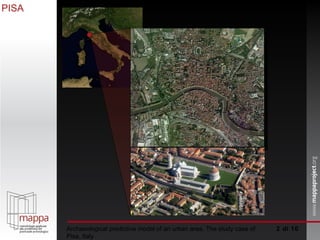
 di 10 PISA Archaeological predictive model of an urban area. The study case of Pisa, Italy
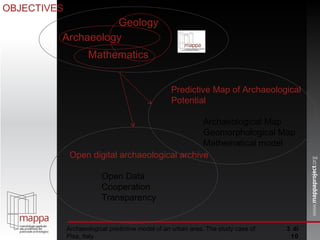
Archaeological predictive model of an urban area. The study case of Pisa, Italy  di 10 OBJECTIVES Predictive Map of Archaeological Potential Archaeological Map Geomorphological Map Mathematical model Open digital archaeological archive Open Data Cooperation Transparency Geology Archaeology Mathematics
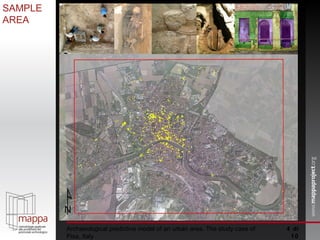
 di 10 SAMPLE AREA Archaeological predictive model of an urban area. The study case of Pisa, Italy
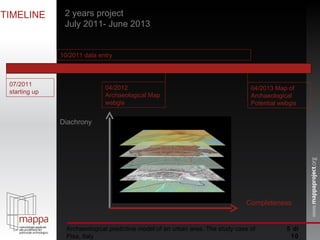
 di 10 TIMELINE 2 years project July 2011- June 2013 Diachrony Completeness Archaeological predictive model of an urban area. The study case of Pisa, Italy 07/2011 starting up 10/2011 data entry 04/2012 Archaeological Map webgis  04/2013 Map of Archaeological Potential webgis
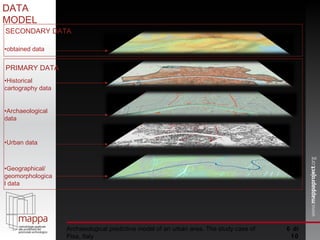
 di 10 DATA MODEL Archaeological predictive model of an urban area. The study case of Pisa, Italy Urban data Historical cartography data Geographical/ geomorphological data Archaeological data PRIMARY DATA obtained data SECONDARY DATA
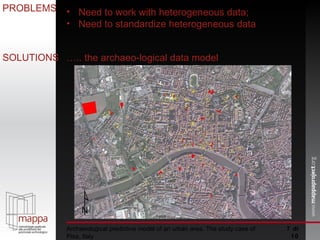
 di 10 Need to work with heterogeneous data; Need to standardize heterogeneous data PROBLEMS … ..  the archaeo-logical data model SOLUTIONS Archaeological predictive model of an urban area. The study case of Pisa, Italy
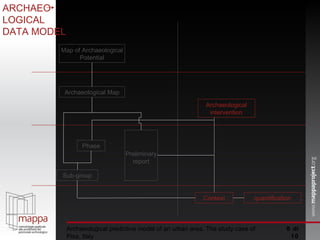
 di 10 ARCHAEO  LOGICAL DATA MODEL Context quantification Sub-group Phase Archaeological intervention Archaeological Map Map of Archaeological Potential Archaeological predictive model of an urban area. The study case of Pisa, Italy Preliminary report
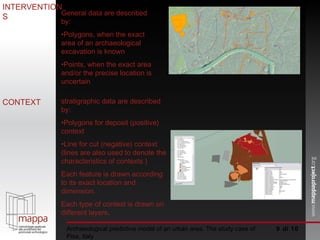
 di 10 Archaeological predictive model of an urban area. The study case of Pisa, Italy stratigraphic data are described by: Polygons for deposit (positive) context Line for cut (negative) context (lines are also used  to  denote  the  characteristics of contexts  ) E ach feature is drawn according to its exact location and dimension. Each type of context is drawn on different layers . General data are described by: Polygons, when the exact area of an archaeological excavation is known Points, when the exact area and/or the precise location is uncertain INTERVENTIONS CONTEXT
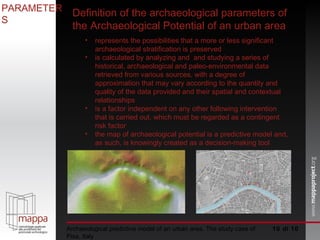
 di 10 Archaeological predictive model of an urban area. The study case of Pisa, Italy Definition of the archaeological parameters of the Archaeological Potential of an urban area represents the possibilities that a more or less significant archaeological stratification is preserved is calculated by analyzing and  and studying a series of historical, archaeological and paleo-environmental data retrieved from various sources, with a degree of approximation that may vary according to the quantity and quality of the data provided and their spatial and contextual relationships is a factor independent on any other following intervention that is carried out, which must be regarded as a contingent risk factor the map of archaeological potential is a predictive model and, as such, is knowingly created as a decision-making tool PARAMETERS
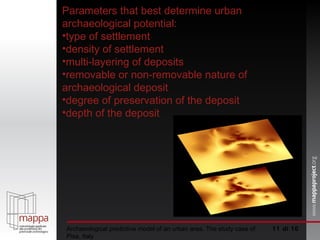
 di 10 Archaeological predictive model of an urban area. The study case of Pisa, Italy Parameters that best determine urban archaeological potential: type of settlement density of settlement multi-layering of deposits removable or non-removable nature of archaeological deposit degree of preservation of the deposit depth of the deposit
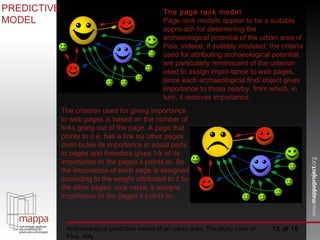
 di 10 Archaeological predictive model of an urban area. The study case of Pisa, Italy The page rank model  Page rank models appear to be a suitable appro­ach for determining the archaeological potential of the urban area of Pisa. Indeed, if suitably modeled, the criteria used for attributing archaeological potential are particularly reminiscent of the criterion used to assign impor­tance to web pages, since each archaeological find/ object gives importance to those nearby, from which, in turn, it receives importance.  PREDICTIVE MODEL The criterion used for giving importance to web pages is based on the number of links going out of the page. A page that points to (i.e. has a link to) other pages distri­butes its importance in equal parts to pages and therefore gives 1/k of its importance to the pages it points to. So the importance of each page is assigned according to the weight attributed to it by the other pages; vice versa, it assigns importance to the pages it points to.
 di 10 Archaeological predictive model of an urban area. The study case of Pisa, Italy To adapt the model to archaeological potential  The subsurface will be modeled as a set of cells in a three-dimensional space; importance will be transferred from one cell to the others on the basis of a (pre­vious) categorization of finds.  The strategy that will be implemented to adapt the page rank model is the following:  A three-dimensional grid will model the subsurface of the urban area of Pisa. The single cell of the grid will act as the web page, and the importance of the cell, will be the archaeological potential;  The archaeological potential available for a cell will be used in a twofold manner: in a relative manner to build the elements of the matrix that controls the transfer of importance of the cells, and in an abso­lute manner, providing a value of importance to the specific cell where an archaeological find is present;  The part regarding the construction of the matrix that controls the transfer of importance will be carried out on the basis of categories used for classifying the archaeological finds;  Finally, the part regarding the specific importance of the single cells will determine the actual value of archaeological potential;  Geological information, regarding the presence of watercourses or specific land configuration, will be used in a binary manner.
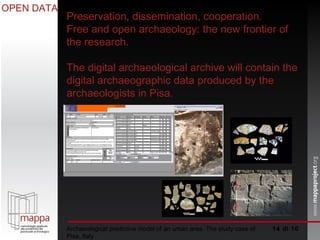
 di 10 Archaeological predictive model of an urban area. The study case of Pisa, Italy OPEN DATA Preservation, dissemination, cooperation. Free and open archaeology: the new frontier of the research. The digital archaeological archive will contain the digital archaeographic data produced by the archaeologists in Pisa.
 di 10 History of the investigation o purpose  o issues  o methodology  o type of archeographic record  o geographical coordinate  o chronology  o Scientific Director / excavation team  o more ...  Sources used to create data  o questioned archives o cartography used for georeferencing data o Previous archaeological investigations  Method and data structure  o creation of the dataset  o georeferencing data  o cartography used for georeferencing data o list of files and their contents  o list of ID assigned  o list of codes and their meaning  o Thesauri  o systems used in data acquisition  o conversions to other formats.  o Staff  o More ...  Reports  o Bibliography  o place of storage of archeographic record o place of storage of findings  METADATA Archaeological predictive model of an urban area. The study case of Pisa, Italy
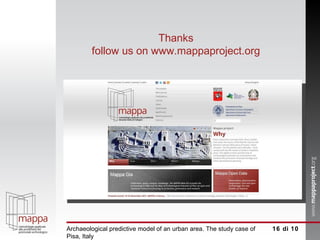
 di 10 Thanks follow us on www.mappaproject.org Archaeological predictive model of an urban area. The study case of Pisa, Italy

Archaeological predictive model of an urban area. The study case of Pisa, Italy

  • 1.
    Archaeological predictive model of an urban area. The study case of Pisa, Italy Francesca Anichini, Gabriele Gattiglia Università of Pisa, Department of Archaeological Sciences
  • 2.
    di 10PISA Archaeological predictive model of an urban area. The study case of Pisa, Italy
  • 3.
    Archaeological predictive modelof an urban area. The study case of Pisa, Italy di 10 OBJECTIVES Predictive Map of Archaeological Potential Archaeological Map Geomorphological Map Mathematical model Open digital archaeological archive Open Data Cooperation Transparency Geology Archaeology Mathematics
  • 4.
    di 10SAMPLE AREA Archaeological predictive model of an urban area. The study case of Pisa, Italy
  • 5.
    di 10TIMELINE 2 years project July 2011- June 2013 Diachrony Completeness Archaeological predictive model of an urban area. The study case of Pisa, Italy 07/2011 starting up 10/2011 data entry 04/2012 Archaeological Map webgis 04/2013 Map of Archaeological Potential webgis
  • 6.
    di 10DATA MODEL Archaeological predictive model of an urban area. The study case of Pisa, Italy Urban data Historical cartography data Geographical/ geomorphological data Archaeological data PRIMARY DATA obtained data SECONDARY DATA
  • 7.
    di 10Need to work with heterogeneous data; Need to standardize heterogeneous data PROBLEMS … .. the archaeo-logical data model SOLUTIONS Archaeological predictive model of an urban area. The study case of Pisa, Italy
  • 8.
    di 10ARCHAEO LOGICAL DATA MODEL Context quantification Sub-group Phase Archaeological intervention Archaeological Map Map of Archaeological Potential Archaeological predictive model of an urban area. The study case of Pisa, Italy Preliminary report
  • 9.
    di 10Archaeological predictive model of an urban area. The study case of Pisa, Italy stratigraphic data are described by: Polygons for deposit (positive) context Line for cut (negative) context (lines are also used to denote the characteristics of contexts ) E ach feature is drawn according to its exact location and dimension. Each type of context is drawn on different layers . General data are described by: Polygons, when the exact area of an archaeological excavation is known Points, when the exact area and/or the precise location is uncertain INTERVENTIONS CONTEXT
  • 10.
    di 10Archaeological predictive model of an urban area. The study case of Pisa, Italy Definition of the archaeological parameters of the Archaeological Potential of an urban area represents the possibilities that a more or less significant archaeological stratification is preserved is calculated by analyzing and and studying a series of historical, archaeological and paleo-environmental data retrieved from various sources, with a degree of approximation that may vary according to the quantity and quality of the data provided and their spatial and contextual relationships is a factor independent on any other following intervention that is carried out, which must be regarded as a contingent risk factor the map of archaeological potential is a predictive model and, as such, is knowingly created as a decision-making tool PARAMETERS
  • 11.
    di 10Archaeological predictive model of an urban area. The study case of Pisa, Italy Parameters that best determine urban archaeological potential: type of settlement density of settlement multi-layering of deposits removable or non-removable nature of archaeological deposit degree of preservation of the deposit depth of the deposit
  • 12.
    di 10Archaeological predictive model of an urban area. The study case of Pisa, Italy The page rank model Page rank models appear to be a suitable appro­ach for determining the archaeological potential of the urban area of Pisa. Indeed, if suitably modeled, the criteria used for attributing archaeological potential are particularly reminiscent of the criterion used to assign impor­tance to web pages, since each archaeological find/ object gives importance to those nearby, from which, in turn, it receives importance. PREDICTIVE MODEL The criterion used for giving importance to web pages is based on the number of links going out of the page. A page that points to (i.e. has a link to) other pages distri­butes its importance in equal parts to pages and therefore gives 1/k of its importance to the pages it points to. So the importance of each page is assigned according to the weight attributed to it by the other pages; vice versa, it assigns importance to the pages it points to.
  • 13.
    di 10Archaeological predictive model of an urban area. The study case of Pisa, Italy To adapt the model to archaeological potential The subsurface will be modeled as a set of cells in a three-dimensional space; importance will be transferred from one cell to the others on the basis of a (pre­vious) categorization of finds. The strategy that will be implemented to adapt the page rank model is the following: A three-dimensional grid will model the subsurface of the urban area of Pisa. The single cell of the grid will act as the web page, and the importance of the cell, will be the archaeological potential; The archaeological potential available for a cell will be used in a twofold manner: in a relative manner to build the elements of the matrix that controls the transfer of importance of the cells, and in an abso­lute manner, providing a value of importance to the specific cell where an archaeological find is present; The part regarding the construction of the matrix that controls the transfer of importance will be carried out on the basis of categories used for classifying the archaeological finds; Finally, the part regarding the specific importance of the single cells will determine the actual value of archaeological potential; Geological information, regarding the presence of watercourses or specific land configuration, will be used in a binary manner.
  • 14.
    di 10Archaeological predictive model of an urban area. The study case of Pisa, Italy OPEN DATA Preservation, dissemination, cooperation. Free and open archaeology: the new frontier of the research. The digital archaeological archive will contain the digital archaeographic data produced by the archaeologists in Pisa.
  • 15.
    di 10History of the investigation o purpose o issues o methodology o type of archeographic record o geographical coordinate o chronology o Scientific Director / excavation team o more ... Sources used to create data o questioned archives o cartography used for georeferencing data o Previous archaeological investigations Method and data structure o creation of the dataset o georeferencing data o cartography used for georeferencing data o list of files and their contents o list of ID assigned o list of codes and their meaning o Thesauri o systems used in data acquisition o conversions to other formats. o Staff o More ... Reports o Bibliography o place of storage of archeographic record o place of storage of findings METADATA Archaeological predictive model of an urban area. The study case of Pisa, Italy
  • 16.
    di 10Thanks follow us on www.mappaproject.org Archaeological predictive model of an urban area. The study case of Pisa, Italy