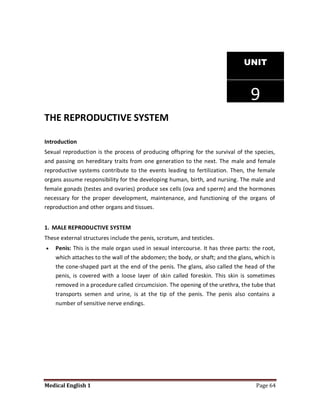
MEDICAL ENGLISH 1


         Autores:

         Verónica Clavijo Bazalar.

         Fernando Cornejo Sánchez.
UNIT


                                                                                    1
Booking a Doctor's Appointment
Receptionist: Doctor's office. Jane speaking. How can I help you?

Caller: I need to make an appointment with Dr. Harris.

Receptionist: Do you know your chart number?

Caller: No, sorry. It's at home and I'm at work right now.

Receptionist: No problem. What's your name, please?

Caller: George Mason.

Receptionist: Okay Mr. Mason. Hold one moment while I grab your chart, please.

Caller: Sure.

Receptionist: Thanks for waiting. Now, what do you need to see the doctor about?

Caller: Well, I am fighting a cold these days, and I think I have a chest infection or something. My
cough is getting worse each day.

Receptionist: Hmm. Doctor Harris is off tomorrow. Do you think it can wait until Wednesday?

Caller: Oh, it is urgent. I feel bad

Receptionist: No problem, I will help you.

Check your understanding

1. Why does the caller phone the doctor's office?

a) He's running late for his appointment.              c) He can't remember his chart number.

b) He's booking an appointment with Dr.                d) His medication ran out.
   Harris.


Medical English 1                                                                              Page 1
2. Which is true about George Mason?

a) He has a bad cold.                          c) His cough is better.

b) He's running a fever.                       d) He's off on a sick day.

SIMPLE PRESENT TENSE

                                       TO HAVE

Affirmative statements

           SUBJECT                      VERB                             COMPLEMENT
I                             have                           fever
You                           have                           a cold stiff neck
We                            have                           a sunburn
They                          have
He                            has                            fever
She                           has                            a cold
It                            has                            a stiff neck


Medical English 1                                                                     Page 2
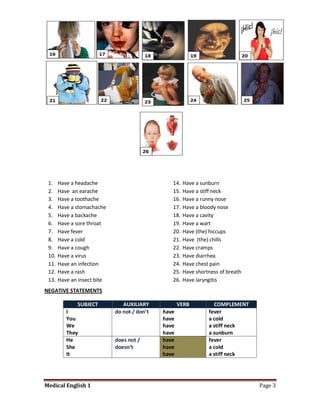
1.    Have a headache                           14.   Have a sunburn
 2.    Have an earache                           15.   Have a stiff neck
 3.    Have a toothache                          16.   Have a runny nose
 4.    Have a stomachache                        17.   Have a bloody nose
 5.    Have a backache                           18.   Have a cavity
 6.    Have a sore throat                        19.   Have a wart
 7.    Have fever                                20.   Have (the) hiccups
 8.    Have a cold                               21.   Have (the) chills
 9.    Have a cough                              22.   Have cramps
 10.   Have a virus                              23.   Have diarrhea
 11.   Have an infection                         24.   Have chest pain
 12.   Have a rash                               25.   Have shortness of breath
 13.   Have an insect bite                       26.   Have laryngitis
NEGATIVE STATEMENTS

              SUBJECT           AUXILIARY            VERB          COMPLEMENT
          I                  do not / don’t   have               fever
          You                                 have               a cold
          We                                  have               a stiff neck
          They                                have               a sunburn
          He                 does not /       have               fever
          She                doesn’t          have               a cold
          It                                  have               a stiff neck


Medical English 1                                                                 Page 3
INTERROGATIVE STATEMENTS

     AUXILIARY          SUBJECT               VERB           COMPLEMENT       QUESTION
                                                                               MARK
Do                  I                  have                 fever            ?
                    you                have                 a cold
                    we                 have                 a stiff neck
                    they               have                 a sunburn
Does                he                 have                 fever            ?
                    she                have                 a cold
                    it                 have                 a stiff neck
  “WH”           AUXILIARY        SUBJECT            VERB         COMPLEMENT   QUESTION
QUESTION                                                                        MARK
 WORDS
How often    do              I                 have           fever          ?
                             you               have           a cold
                             we                have           a stiff neck
                             they              have           a sunburn
When         does            he                have           fever          ?
Why          does            she               have           a cold
                             it                have           a stiff neck


Medical English 1                                                                  Page 4
TO BE


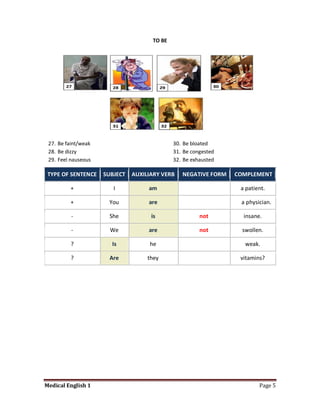
 27. Be faint/weak                           30. Be bloated
 28. Be dizzy                                31. Be congested
 29. Feel nauseous                           32. Be exhausted

 TYPE OF SENTENCE    SUBJECT   AUXILIARY VERB   NEGATIVE FORM   COMPLEMENT

         +              I           am                           a patient.

         +            You           are                          a physician.

          -            She           is                not        insane.

          -            We           are                not        swollen.

          ?            Is           he                             weak.

          ?            Are          they                         vitamins?


Medical English 1                                                       Page 5
OTHER VERBS


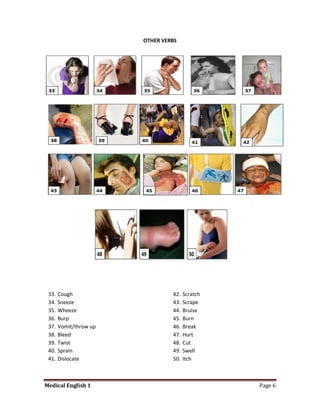
 33.   Cough                     42.   Scratch
 34.   Sneeze                    43.   Scrape
 35.   Wheeze                    44.   Bruise
 36.   Burp                      45.   Burn
 37.   Vomit/throw up            46.   Break
 38.   Bleed                     47.   Hurt
 39.   Twist                     48.   Cut
 40.   Sprain                    49.   Swell
 41.   Dislocate                 50.   Itch


Medical English 1                                Page 6
ACTIVITIES

A.    CHANGE THE FOLLOWING SENTENCES INTO THE APPROPRIATE FORM.


 +           affirmative sentences

 -           negative sentences

 ?           interrogative sentences


1)    She has a cold or allergies (?)

      _______________________________________________________________________

2)    They sneeze every minute (-)

      __________________________________________________________________

3)    My sister doesn’t cough (+)

      ________________________________________________________________________

4)    My husband is dizzy (?)

      ________________________________________________________________________

5)    Does he feel nauseous? (+)

      __________________________________________________________________

6)    His brother is exhausted (-)

      _________________________________________________________________

7)    You aren’t a good dentist (?)

      _______________________________________________________________________

8)    I don’t wait for anybody (+)

      _________________________________________________________________

Medical English 1                                                         Page 7
9)    It itches badly (-)

      _____________________________________________________________________

10)   They aren’t here (+)

      ________________________________________________________________

B.    PUT IN ORDER THE FOLLOWING SENTENCES.

1.    in / friends / I / have / don’t / class/ this / many.

      ________________________________________________________________

2.    hospital / to / go / to / They / the / want.

      _____________________________________________________________________

3.    aren’t / These / your / patients.

      _____________________________________________________________________

4.    need / I / a / don’t / psychologist

      _____________________________________________________________________

5.    burp / he / vomit /?/ Does / and/ often

      _______________________________________________________________

C.    FIND THE MISTAKES IN THE FOLLOWING SENTENCES AND REWRITE THEM.

1.    He don’t eat fish __________________________________________________

2.    The children is tired    _____________________________________________

3.    My patients isn’t there ____________________________________________

4.    We has a sunburn and you feel nauseus ________________________________

5.    Do she work in those medical facility? ____________________________________


Medical English 1                                                                   Page 8
Medical Specialists

Medical specialists are experts in certain fields of medicine. They treat specific parts of the body,
such as the stomach or the heart, or they specialize in certain diseases, such as AIDS. Family
doctors keep a list of local specialists and can help patients choose the right specialist for each
medical issue. In many cases, specialists require a referral from a family doctor before they will see
a patient.

Here is a list of the most common types of specialists. Study the list and then check your
understanding by taking the quiz.


Allergist: specializes in determining food and environmental allergies

Anesthesiologist: specializes in pain prevention during surgery

Cardiologist: heart specialist

Chiropractor: back specialist

Dentist: tooth specialist

Dermatologist: skin specialist

Fertility specialist: helps people who have difficulty getting pregnant

Gynecologist: specializes in women's needs

Massage therapist: specializes in muscle relaxation

Midwife: helps women deliver babies in a natural way

Naturopath: specializes in natural cures and remedies

Neurologist: brain specialist

Obstetrician: specialist for pregnant women

Occupational therapist: specializes in workplace health

Oncologist: tumor specialist, including cancer

Ophthalmologist: specializes in eye diseases

Pediatrician: specialist for babies and children


Medical English 1                                                                             Page 9
Physical therapist: specializes in the body's movement

Podiatrist: foot specialist

Psychiatrist: specialist in mental health

Radiologist: specializes in imaging tests

ACTIVITIES

A.      Read the patient complaints and say which specialist each patient needs.

1. I have a terrible rash on my arms and legs. I think I'm allergic to dairy food, but it also might be
   grass.

a) chiropractor                                         c) allergist

b) ophthalmologist                                      d) psychiatrist

2. My husband and I just took a home pregnancy test, and it came out positive. We want to know
   when we are due and we want to make sure the fetus is healthy.

a) podiatrist                                           c) obstetrician

b) pediatrician                                         d) pharmacist

3. I still can't walk and it's been three months since my accident. I hate being stuck in a
   wheelchair.

a) anesthesiologist                                     c) radiologist

b) physical therapist                                   d) dentist

4. The test results show that I have an advanced form of blood cancer.

a) oncologist                                           c) midwife

b) neurologist                                          d) allergist

5. My left eye has an infection that won't go away and my vision has been blurry for two weeks
   now.

a) podiatrist                                           c) ophthalmologist

b) massage therapist                                    d) radiologist


Medical English 1                                                                              Page 10
6. I don't want to take any drugs that will cause me to become addicted to them, but I do need
   some sort of pain relief.

a) naturopath                                         c) cardiologist

b) dentist                                            d) dermatologist

7. I've been having major chest pains this week. I'm also having trouble breathing.

a) gynecologist                                       c) oncologist

b) cardiologist                                       d) dermatologist

8. I get terrible acne and I have tried all of the products in the pharmacy. I don't know what to do
now.

a) massage therapist                                  c) occupational therapist

b) podiatrist                                         d) dermatologist

9. My baby is not developing properly. She hasn't put on any weight in two months and she keeps
   getting ear infections.

a) anesthesiologist                                   c) midwife

b) pediatrician                                       d) massage therapist

10. My husband and I have been trying to get pregnant for three years. We have tried everything
    that the books suggest.

a) fertility specialist                               c) psychiatrist

b) oncologist                                         d) dentist

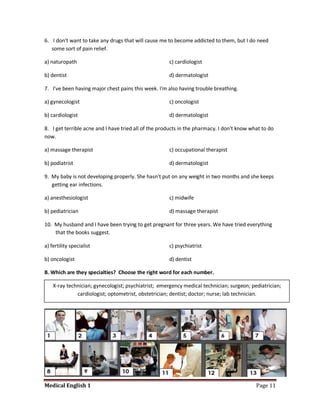
B. Which are they specialties? Choose the right word for each number.

    X-ray technician; gynecologist; psychiatrist; emergency medical technician; surgeon; pediatrician;
              cardiologist; optometrist, obstetrician; dentist; doctor; nurse; lab technician.


Medical English 1                                                                           Page 11
UNIT


Head
                                                                                     2
Read the text below and answer the questions

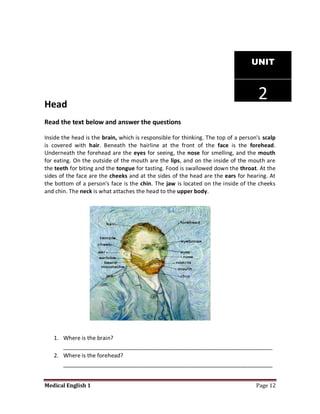
Inside the head is the brain, which is responsible for thinking. The top of a person's scalp
is covered with hair. Beneath the hairline at the front of the face is the forehead.
Underneath the forehead are the eyes for seeing, the nose for smelling, and the mouth
for eating. On the outside of the mouth are the lips, and on the inside of the mouth are
the teeth for biting and the tongue for tasting. Food is swallowed down the throat. At the
sides of the face are the cheeks and at the sides of the head are the ears for hearing. At
the bottom of a person's face is the chin. The jaw is located on the inside of the cheeks
and chin. The neck is what attaches the head to the upper body.


   1. Where is the brain?
      ___________________________________________________________________
   2. Where is the forehead?
      ___________________________________________________________________


Medical English 1                                                                   Page 12
3. Where are the lips?
            __________________________________________________________________
         4. What can you do with your teeth?
            __________________________________________________________________
         5. Where are the ears?
            __________________________________________________________________
         6. Where is the chin located?
            __________________________________________________________________
         7. Where is the jaw located?
            _________________________________________________________________

Present Progressive

We use the present continuous tense to talk about:

             action happening now
             action in the future


         SUBJECT    AUXILIARY VERB          MAIN VERB     COMPLEMENT

+             I           am                 examining       a patient.

+            You          are               prescribing   the medicine

-            She           is         not     sleeping    in the hospital.

-            We           are         not    coughing

?            Is            he               vaccinating    the children?

?            Are          they                 taking        vitamins?


ACTIVITIES

A.           Complete the following sentences with the present continuous.

    1.       The doctors _______________ (vaccinate) the children right now.
    2.       The gynecologist ________________________ (examine) Lucia these days.
    3.       The doctor __________________ (prescribe) medicines right now.
    4.       Listen! Michael_____________________ (cough) a lot.


Medical English 1                                                                    Page 13
5.    I ______________________ (drink) cough syrup at this moment.
 6.    Jake _________________________ (suffer) a terrible disease.
 7.    Doctor, ______________________ you ________________ (cure) Mr. Baker?
 8.    Look! A biologist _____________________ (analyze) a microbe.
 9.    My children __________________________ (catch) a cold.
 10.    _______________ you _______________(arrange ) an appointment?

B.     Decide which of the choices below would best complete the article if inserted in the

       blanks. Circle the appropriate letters.

                                      Too Much Fast Food?

According to a recent survey, these days Hong Kong consumers (1)_______ more money on
convenience foods since the economic downturn. Because companies are trying to make more
with fewer staff, employees (2) ________ harder than ever before. More women (3)__________
the workforce as well. They (4) _________less time to prepare nutritious home-cooked meals for
their families. Instead, families (5)_________ out or (6) ________ convenience foods, such as
frozen pizzas and instant noodles. These foods (7) …………more fat, salt and sugar than home-
cooked meals. Experts say that eating too much of them (8)………… the risk of serious health
problems, including diabetes and heart disease.
However, the current trend towards convenience foods (9) ………benefitting some business
sectors. Supermarkets (10)………….. to the higher demand for quick, easy-to-serve meals by
increasing their selection of convenience and pre-packaged foods. These products (11) ………. for
higher prices than fresh food. Restaurants also (12)…………. from the trend: most Hong Kong
people now (13)………… out at least once a day.
Is convenience food just a fad or is home-cooked food (14)…………. a thing of the past?
How (15) …………………….this trend affecting our health?

1. A are spending                                   3. A joins
   B spends                                            B are joining
   C spend                                             C join

2. A work                                           4. A has
   B works                                             B have
   C are working                                       C had


Medical English 1                                                                       Page 14
5. A are eating                                               10. A respond
   B eats                                                        B responded
   C eat                                                         C are responding

6. A bought                                                   11. A sells
   B buys                                                         B are sold
   C buy                                                          C sell

7. A containing                                               12. A profit
                                                                 B are profiting
     B contains                                                  C profits
     C contain
                                                              13. A eat
8. A increase                                                    B ate
   B increasing                                                  C were eating
   C increases
                                                              14. A become
9. A is                                                           B became
   B are                                                          C becoming
   C be

                                     15. A does
                                         B is
                                          C have

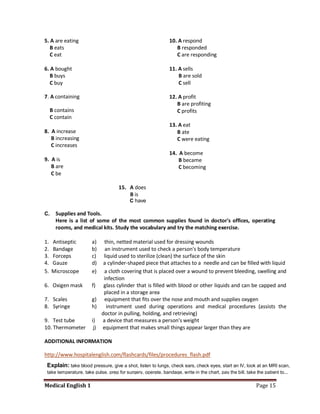
C.     Supplies and Tools.
       Here is a list of some of the most common supplies found in doctor's offices, operating
       rooms, and medical kits. Study the vocabulary and try the matching exercise.

1.   Antiseptic        a)   thin, netted material used for dressing wounds
2.   Bandage           b)   an instrument used to check a person's body temperature
3.   Forceps           c)   liquid used to sterilize (clean) the surface of the skin
4.   Gauze             d)   a cylinder-shaped piece that attaches to a needle and can be filled with liquid
5.   Microscope        e)   a cloth covering that is placed over a wound to prevent bleeding, swelling and
                            infection
6. Oxigen mask         f) glass cylinder that is filled with blood or other liquids and can be capped and
                            placed in a storage area
7. Scales              g) equipment that fits over the nose and mouth and supplies oxygen
8. Syringe             h)    instrument used during operations and medical procedures (assists the
                           doctor in pulling, holding, and retrieving)
9. Test tube           i) a device that measures a person's weight
10. Thermometer         j) equipment that makes small things appear larger than they are

ADDITIONAL INFORMATION

http://www.hospitalenglish.com/flashcards/files/procedures_flash.pdf
 Explain: take blood pressure, give a shot, listen to lungs, check ears, check eyes, start an IV, look at an MRI scan,
 take temperature, take pulse, prep for surgery, operate, bandage, write in the chart, pay the bill, take the patient to...

Medical English 1                                                                                         Page 15
UNIT


                                                                                        3
             Main Structures of the Digestive System
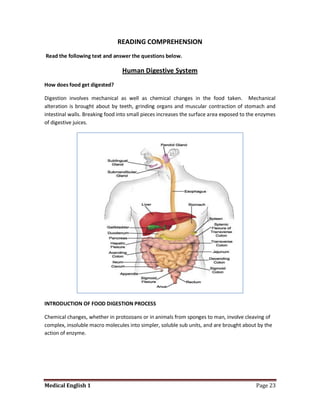
The digestive tract is a long continuous tube that starts with the mouth and ends with the anus. It
includes the mouth, pharynx, esophagus, stomach, small intestine, and large intestine. The tongue
and teeth located in the mouth are accessory structures. The salivary glands, gallbladder, liver, and
pancreas are the other accessory organs of the digestive system that secretes digestive enzymes
into the digestive tract that are involved in the process of digestion.

Mouth: The mouth contains tongue and teeth. With the help of these the food is chewed (broken
into tiny pieces) and mixes with saliva (secreted by salivary glands)

Pharynx: Is a funnel shaped opening through which the food from mouth passes to esophagus.

Esophagus: Is a long tubular structure that with the help of peristalsis movement passes food to
the stomach.

Stomach: A large sac-like structure that holds the food for a while where it gets mixed with the
hydrochloric acid and gastric juice.

Small intestine: It is a long muscular tube that is divisible into the duodenum, the jejunum, and
ileum. Secretions of liver, gallbladder, and pancreas are passed into the small intestine, where the
major part of the digestion occurs.

Large intestine: Minor part of the digestion occurs in large intestine and is divisible into cecum,
colon, and rectum. Reabsorption of water and absorption of food material takes place in large
intestine.

Anus: The indigested food is excreted out through anus.

Liver: Liver is the largest organ of the human body and it is involved in synthesis and secretion of
bile that plays a role in emulsification of fats. Liver secreted from live is stored in gallbladder, from
which it flows into small intestine.

Pancreas: Pancreas secretes pancreatic juice.


Medical English 1                                                                               Page 16
PLURAL FORM OF NOUNS
            CASE              DESCRIPTION OF THE            STRUCTURE                     EXAMPLE
                                       RULE
General rule                 The plural form of         NOUN + “-S”          minute - minutes
                             most nouns is created
                             simply by adding the
                             letter “s” to the end of
                             the word.
When nouns end in            The plural is formed       NOUN + “-ES”         church - churches
-ch, -x, -s, -sh, -z or      by adding “es”                                   box -boxes
s-like sounds                                                                index -= indexes ( also indices)
                                                                              gas - gases
                                                                              bush - bushes
                                                                              ass -asses
                                                                             quiz – quizzes
Nouns ending in “o”          When they are              NOUN + “-ES”         potato - potatoes
                             preceded by a                                   tomato – tomatoes
                             consonant.                                       volcano - volcanoes

                             Except: newly created      NOUN + “-S”          photo - photos
                             words or words with                             piano - pianos
                             Spanish or Italian                              portico - porticos
                             origin.
Noun ending in “y”           When they are              NOUN – “Y” +” IES”   party - parties
                             preceded by a                                   lady - ladies
                             consonant, they drop
                             the “y” and add “ies”

                             When they are              NOUN + “-S”          Boy - boys
                             preceded by a                                   Toy - toys
                             VOWEL, add a “s”                                Ray – rays
Noun ending in “f” or “fe”   Drop the “f” or “fe”       NOUN – “F” + VES     calf – calves
                             and add “ves”                                    half - halves
                                                                              wolf - wolves

                                                        NOUN – “FE” + VES    wife – wives
Nouns ending in “is”         Drop the “-is” and add     NOUN – IS + ES       crisis - crises
                             “-es”                                            hypothesis - hypotheses
                                                                              oasis - oases
Irregular plural             Some nouns change          ODD PLURAL FORM      child - children
                             their structure to form                         ox - oxen
                             their plural form.                              man – men
                                                                             woman - women
                                                                              person - people
                                                                              foot - feet
                                                                             tooth - teeth


    Medical English 1                                                                          Page 17
mouse - mice
                                                                           louse - lice

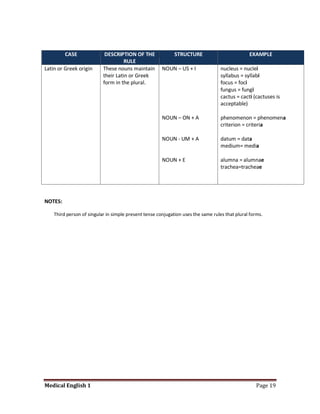
Identical singular and      Some nouns have             NO CHANGE          aircraft - aircraft
plural form                 identical plural and                            fish - fish
                            singular forms,                                 sheep - sheep
                            although they are still                        deer - deer
                            considered to have a                            species - species
                            plural form.                                   headquarters - headquarters
Collective words or nouns   These nouns                 ONLY PLURAL FORM   cattle
associated with two          exist only in the plural                       scissors
parts.                      form and take a plural                          trousers
                            verb.                                           tweezers
                                                                            congratulations
                                                                            pajamas
Compound nouns              In compound nouns           MAIN NOUN + -S     court martial - courts martial
                            the plural ending is                            son-in-law - sons-in-law
                            usually added to the                            passer-by - passers-by
                            main noun.
Uncountable noun            Uncountable nouns           NO PLURAL FORM     advice
                            on the other hand                              information
                            have no plural form                            luggage
                            and take a singular                            headquarters - headquarters
                            verb (is / was ...).                           news - news


   Medical English 1                                                                      Page 18
CASE               DESCRIPTION OF THE               STRUCTURE                          EXAMPLE
                                     RULE
Latin or Greek origin      These nouns maintain        NOUN – US + I               nucleus = nuclei
                           their Latin or Greek                                    syllabus = syllabi
                           form in the plural.                                     focus = foci
                                                                                   fungus = fungi
                                                                                   cactus = cacti (cactuses is
                                                                                   acceptable)

                                                       NOUN – ON + A               phenomenon = phenomena
                                                                                   criterion = criteria

                                                       NOUN - UM + A               datum = data
                                                                                   medium= media

                                                       NOUN + E                    alumna = alumnae
                                                                                   trachea=tracheae


NOTES:

    Third person of singular in simple present tense conjugation uses the same rules that plural forms.


Medical English 1                                                                                   Page 19
ACTIVITIES
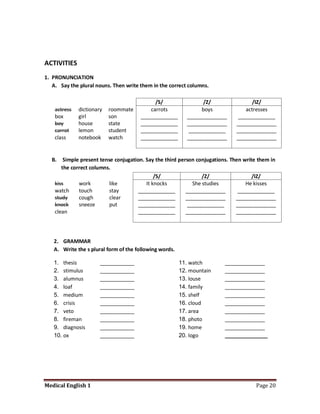
1. PRONUNCIATION
   A. Say the plural nouns. Then write them in the correct columns.

                                             /S/                  /Z/                /IZ/
    actress   dictionary   roommate        carrots               boys             actresses
    box       girl         son         _____________       ______________      _____________
    boy       house        state       _____________       ______________     ______________
    carrot    lemon        student     _____________        _____________     ______________
    class     notebook     watch       _____________       ______________     ______________


  B.    Simple present tense conjugation. Say the third person conjugations. Then write them in
       the correct columns.
                                              /S/                 /Z/                 /IZ/
    kiss      work         like           It knocks           She studies          He kisses
    watch     touch        stay       _____________        ______________       _____________
    study     cough        clear      _____________        ______________      ______________
    knock     sneeze       put        _____________         _____________      ______________
    clean                             _____________        ______________      ______________


   2. GRAMMAR
   A. Write the s plural form of the following words.

   1. thesis           ____________                     11. watch        ______________
   2. stimulus         ____________                     12. mountain     ______________
   3. alumnus          ____________                     13. louse        ______________
   4. loaf             ____________                     14. family       ______________
   5. medium           ____________                     15. shelf        ______________
   6. crisis           ____________                     16. cloud        ______________
   7. veto             ____________                     17. area         ______________
   8. fireman          ____________                     18. photo        ______________
   9. diagnosis        ____________                     19. home         ______________
   10. ox              ____________                     20. logo         _______________


Medical English 1                                                                     Page 20
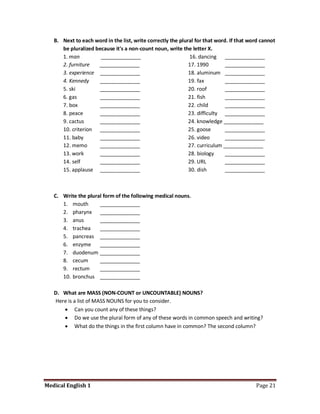
B. Next to each word in the list, write correctly the plural for that word. If that word cannot
      be pluralized because it's a non-count noun, write the letter X.
      1. man          ______________                         16. dancing ______________
      2. furniture   ______________                          17. 1990        ______________
      3. experience ______________                           18. aluminum ______________
      4. Kennedy     ______________                          19. fax         ______________
      5. ski         ______________                          20. roof        ______________
      6. gas         ______________                          21. fish        ______________
      7. box         ______________                          22. child       ______________
      8. peace       ______________                          23. difficulty ______________
      9. cactus      ______________                          24. knowledge ______________
      10. criterion ______________                           25. goose       ______________
      11. baby       ______________                          26. video       ______________
      12. memo       ______________                          27. curriculum ______________
      13. work       ______________                          28. biology     ______________
      14. self       ______________                          29. URL         ______________
      15. applause ______________                            30. dish        ______________


   C. Write the plural form of the following medical nouns.
      1. mouth       ______________
      2. pharynx ______________
      3. anus        ______________
      4. trachea     ______________
      5. pancreas ______________
      6. enzyme      ______________
      7. duodenum ______________
      8. cecum       ______________
      9. rectum      ______________
      10. bronchus ______________

   D. What are MASS (NON-COUNT or UNCOUNTABLE) NOUNS?
   Here is a list of MASS NOUNS for you to consider.
       Can you count any of these things?
       Do we use the plural form of any of these words in common speech and writing?
       What do the things in the first column have in common? The second column?


Medical English 1                                                                        Page 21
wood             oxygen    dancing       English
   cloth            water     soccer        luggage
   ice              milk      hockey        equipment
   plastic          wine      weather       furniture
   wool             beer      heat          experience
   steel            cake      sunshine      applause
   aluminum         sugar     electricity   photography
   metal            rice      biology       traffic
   glass            meat      history       harm
   leather          cheese    mathematics   publicity
   porcelain        flour     economics     homework
   hair             reading   poetry        advice
   dust             boating   Chinese
   air              smoking   Spanish


Medical English 1                                     Page 22
READING COMPREHENSION
Read the following text and answer the questions below.

                                 Human Digestive System
How does food get digested?

Digestion involves mechanical as well as chemical changes in the food taken. Mechanical
alteration is brought about by teeth, grinding organs and muscular contraction of stomach and
intestinal walls. Breaking food into small pieces increases the surface area exposed to the enzymes
of digestive juices.


INTRODUCTION OF FOOD DIGESTION PROCESS

Chemical changes, whether in protozoans or in animals from sponges to man, involve cleaving of
complex, insoluble macro molecules into simpler, soluble sub units, and are brought about by the
action of enzyme.


Medical English 1                                                                         Page 23
Food Digestion Process
Food Intake: Different organisms obtain food in different ways but carry out similar reactions. To
take food, protozoans use pseudopodia, flagella or cilia; sponges and muscles use a current of
water; hydra uses tentacles beset with stinging cells; planarians and earthworms use a muscular
pharynx; flukes and leeches use oral succer.

Digestive System and process: Parts of the body concerned with the uptake and digestion of food
and elimination of indigestible remains from the digestive system, also called elementary system.
The digestive system consists of two sets of organs:

Alimentary canal: It is a tube comprising many specialized organs. It provides and helps in the
process of:

(i)An inlet, the mouth, to ingest food

(ii)A cavity, the lumen, where food is digested

(iii)A surface for the absorption of digested food

(iv)A space where indigestible remains are changed in to faeces

(v)An outlet the anus for elimination of faeces.

 Digestive glands and their function in the process: These are the structures associated with the
different regions of the alimentary canal. They sent into the digestive track their secretions which
contains enzyme and other materials to help in the digestion of food. Most of the alimentary
canal and certain digestive glands are supported and held in place by mesenteries, the double
sheets of peritoneum with a layer of connective tissues in between.

Summary for Food Digestion Process

The digestive system serves three major functions are:

1. Nutrition: The digestive track primarily serves to provide food to the tissues to the body.

2. Breathing: The interior part of the alimentary canal also plays a role in respiration in the
   chordates.

3. Excretion: The digestive system brings about sum excretion too. Excretion is the elimination of
   unwanted materials from the body.


Medical English 1                                                                           Page 24
QUESTIONS
     1. Does digestion only involve mechanical changes?
         __________________________________________________________________________
         ___________________________________________________________________
     2. Why are enzymes important during the digestion process?
         __________________________________________________________________________
         ___________________________________________________________________
     3. Which is the final step of the digestion process?
         __________________________________________________________________________
         ___________________________________________________________________
     4. How is the alimentary canal supported?
         __________________________________________________________________________
         __________________________________________________________________________
2.   Matching
     Match the numbers with the letters

1. Cleave                                          a) excrement
2. Intake                                          b) the cavity of a tubular organ or part
3. Lumen                                           c) tube
4. Faeces                                          d) the amount taken in
5. Canal                                           e) divide

ON-LINE EXERCISES
The following links could provide you further information and resources on plural form.

Find mistakes

      http://www.englishteststore.net/index.php?option=com_content&view=article&id=707:Fi
       nd-Mistakes-Basic-Level-Test-001&catid=117:find-mistakes&Itemid=365

Plural forms

        http://www.learnenglishfeelgood.com/english-grammar-nouns-plural3.html
        http://www.clafoti.com/Imagenes/PLURALNOUNS.htm
        http://grammar.ccc.commnet.edu/grammar/quizzes/cross/plurals_gap.htm
        http://www.caihometype.com/course.html
        http://www.learnenglish.de/grammar/pluraltext.htm#Irregula

Medical English 1                                                                             Page 25
UNIT
THE RESPIRATORY SYSTEM

                                                                                          4
What       is      the     respiratory     system?
Your respiratory system is made up of the organs in
your body that help you to breathe. Remember, that
respiration = breathing. The goal of breathing is to
deliver oxygen to the body and to take away carbon
dioxide.

Parts of the respiratory system

Lungs
The lungs are the main organs of the respiratory
system. In the lungs oxygen is taken into the body
and carbon dioxide is breathed out. The red blood
cells are responsible for picking up the oxygen in the
lungs and carrying the oxygen to all the body cells
that need it. The red blood cells drop off the oxygen
to the body cells, then pick up the carbon dioxide
which is a waste gas product produced by our cells.
The red blood cells transport the carbon dioxide back
to the lungs and we breathe it out when we exhale.


Trachea
The trachea (TRAY-kee-uh} is sometimes called the windpipe. The trachea filters the air
we breathe and branches into the bronchi.


Bronchi
The bronchi (BRAHN-ky) are two air tubes that branch off of the trachea and carry air
directly into the lungs.


Medical English 1                                                                  Page 26
Diaphragm
             Breathing starts with a dome-shaped muscle at the bottom of the lungs called the
             diaphragm (DY-uh-fram). When you breathe in, the diaphragm contracts. When it
             contracts it flattens out and pulls downward. This movement enlarges the space that the
             lungs are in. This larger space pulls air into the lungs. When you breathe out, the
             diaphragm expands reducing the amount of space for the lungs and forcing air out. The
             diaphragm is the main muscle used in breathing.


             FREQUENTLY ASKED QUESTIONS

             Why Do I Yawn?
             When you are sleepy or drowsy the lungs do not take enough oxygen from the air. This
             causes a shortage of oxygen in our bodies. The brain senses this shortage of oxygen and
             sends a message that causes you to take a deep long breath - a YAWN.


             Why Do I Sneeze?

             Sneezing is like a cough in the upper breathing passages. It is the body's way of removing
             an irritant from the sensitive mucous membranes of the nose. Many things can irritate the
             mucous membranes. Dust, pollen, pepper or even a cold blast of air are just some of the
             many things that may cause you to sneeze.

             What Causes Hiccups?

             Hiccups are the sudden movements of the diaphragm. It is involuntary. You have no
             control over hiccups, as you well know. There are many causes of hiccups. The diaphragm
             may get irritated, you may have eaten to fast, or maybe some substance in the blood
             could even have brought on the hiccups.

             Simple Present / Negative and Interrogative Sentences

Type of sentence     Subject             Auxiliary (-)           Base form of the verb   Complement

-                    She                 does not /              operate                 a patient
                     He                  doesn’t


                     They                do not/                 take care               of me
                     You                 don’t


             Medical English 1                                                                   Page 27
Type of sentence         Auxiliary                   Subject                Base form of the           Complement                            Question
                                                                            verb                                                             mark

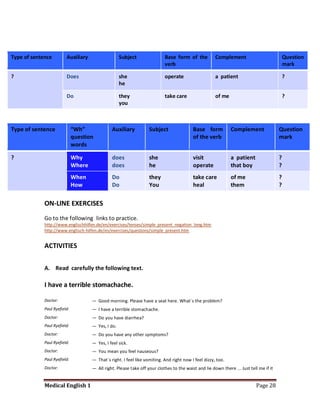
?                        Does                        she                    operate                    a patient                             ?
                                                     he

                         Do                          they                   take care                  of me                                 ?
                                                     you


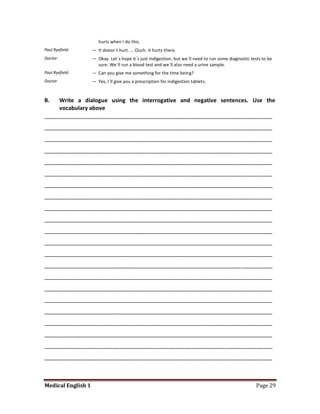
Type of sentence              “Wh”              Auxiliary           Subject                Base form           Complement                Question
                              question                                                     of the verb                                   mark
                              words

?                             Why               does                she                    visit               a patient                 ?
                              Where             does                he                     operate             that boy                  ?
                              When              Do                  they                   take care           of me                     ?
                              How               Do                  You                    heal                them                      ?


             ON-LINE EXERCISES
             Go to the following links to practice.
             http://www.englischhilfen.de/en/exercises/tenses/simple_present_negation_long.htm
             http://www.englisch-hilfen.de/en/exercises/questions/simple_present.htm


             ACTIVITIES


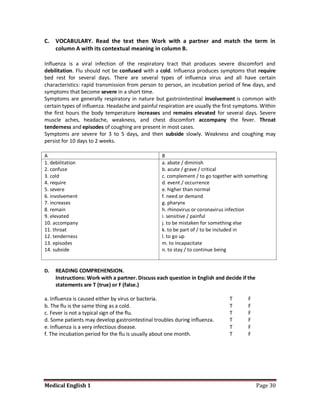
             A. Read carefully the following text.

             I have a terrible stomachache.

             Doctor:                  — Good morning. Please have a seat here. What´s the problem?
             Paul Ryefield:           — I have a terrible stomachache.
             Doctor:                  — Do you have diarrhea?
             Paul Ryefield:           — Yes, I do.
             Doctor:                  — Do you have any other symptoms?
             Paul Ryefield:           — Yes, I feel sick.
             Doctor:                  — You mean you feel nauseous?
             Paul Ryefield:           — That´s right. I feel like vomiting. And right now I feel dizzy, too.
             Doctor:                  — All right. Please take off your clothes to the waist and lie down there ... Just tell me if it


             Medical English 1                                                                                               Page 28
hurts when I do this.
Paul Ryefield:      — It doesn´t hurt. ... Ouch. It hurts there.
Doctor:             — Okay. Let´s hope it´s just indigestion, but we´ll need to run some diagnostic tests to be
                      sure. We´ll run a blood test and we´ll also need a urine sample.
Paul Ryefield:      — Can you give me something for the time being?
Doctor:             — Yes, I´ll give you a prescription for indigestion tablets.


B.   Write a dialogue using the interrogative and negative sentences. Use the
     vocabulary above
_________________________________________________________________________
_________________________________________________________________________
_________________________________________________________________________
_________________________________________________________________________
_________________________________________________________________________
_________________________________________________________________________
_________________________________________________________________________
_________________________________________________________________________
_________________________________________________________________________
_________________________________________________________________________
_________________________________________________________________________
_________________________________________________________________________
_________________________________________________________________________
_________________________________________________________________________
_________________________________________________________________________
_________________________________________________________________________
_________________________________________________________________________
_________________________________________________________________________
_________________________________________________________________________
_________________________________________________________________________
_________________________________________________________________________
_________________________________________________________________________


Medical English 1                                                                                     Page 29
C.   VOCABULARY. Read the text then Work with a partner and match the term in
     column A with its contextual meaning in column B.

Influenza is a viral infection of the respiratory tract that produces severe discomfort and
debilitation. Flu should not be confused with a cold. Influenza produces symptoms that require
bed rest for several days. There are several types of influenza virus and all have certain
characteristics: rapid transmission from person to person, an incubation period of few days, and
symptoms that become severe in a short time.
Symptoms are generally respiratory in nature but gastrointestinal involvement is common with
certain types of influenza. Headache and painful respiration are usually the first symptoms. Within
the first hours the body temperature increases and remains elevated for several days. Severe
muscle aches, headache, weakness, and chest discomfort accompany the fever. Throat
tenderness and episodes of coughing are present in most cases.
Symptoms are severe for 3 to 5 days, and then subside slowly. Weakness and coughing may
persist for 10 days to 2 weeks.

A                                                 B
1. debilitation                                   a. abate / diminish
2. confuse                                        b. acute / grave / critical
3. cold                                           c. complement / to go together with something
4. require                                        d. event / occurrence
5. severe                                         e. higher than normal
6. involvement                                    f. need or demand
7. increases                                      g. pharynx
8. remain                                         h. rhinovirus or coronavirus infection
9. elevated                                       i. sensitive / painful
10. accompany                                     j. to be mistaken for something else
11. throat                                        k. to be part of / to be included in
12. tenderness                                    l. to go up
13. episodes                                      m. to incapacitate
14. subside                                       n. to stay / to continue being


D.   READING COMPREHENSION.
     Instructions: Work with a partner. Discuss each question in English and decide if the
     statements are T (true) or F (false.)

a. Influenza is caused either by virus or bacteria.                            T       F
b. The flu is the same thing as a cold.                                        T       F
c. Fever is not a typical sign of the flu.                                     T       F
d. Some patients may develop gastrointestinal troubles during influenza.       T       F
e. Influenza is a very infectious disease.                                     T       F
f. The incubation period for the flu is usually about one month.               T       F


Medical English 1                                                                            Page 30
UNIT


                                                                                         5
                         THE CIRCULATORY SYSTEM


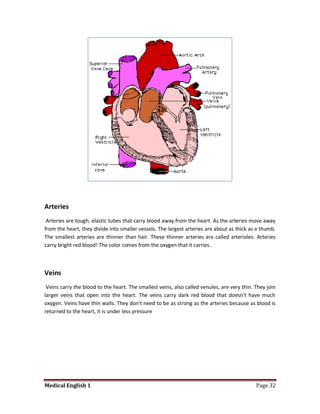
The circulatory system is made up of the vessels and the muscles that help and control the flow of
the blood around the body. This process is called circulation. The main parts of the system are the
heart, arteries, capillaries and veins.


As blood begins to circulate, it leaves the heart from the left ventricle and goes into the aorta. The
aorta is the largest artery in the body. The blood leaving the aorta is full of oxygen. This is
important for the cells in the brain and the body to do their work. The oxygen rich blood travels
throughout the body in its system of arteries into the smallest arterioles.


On its way back to the heart, the blood travels through a system of veins. As it reaches the lungs,
the carbon dioxide (a waste product) is removed from the blood and replace with fresh oxygen
that we have inhaled through the lungs.


Medical English 1                                                                             Page 31
Arteries
 Arteries are tough, elastic tubes that carry blood away from the heart. As the arteries move away
from the heart, they divide into smaller vessels. The largest arteries are about as thick as a thumb.
The smallest arteries are thinner than hair. These thinner arteries are called arterioles. Arteries
carry bright red blood! The color comes from the oxygen that it carries.


Veins
 Veins carry the blood to the heart. The smallest veins, also called venules, are very thin. They join
larger veins that open into the heart. The veins carry dark red blood that doesn't have much
oxygen. Veins have thin walls. They don't need to be as strong as the arteries because as blood is
returned to the heart, it is under less pressure


Medical English 1                                                                            Page 32
Heart
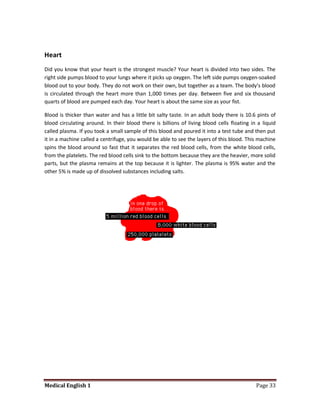
Did you know that your heart is the strongest muscle? Your heart is divided into two sides. The
right side pumps blood to your lungs where it picks up oxygen. The left side pumps oxygen-soaked
blood out to your body. They do not work on their own, but together as a team. The body's blood
is circulated through the heart more than 1,000 times per day. Between five and six thousand
quarts of blood are pumped each day. Your heart is about the same size as your fist.

Blood is thicker than water and has a little bit salty taste. In an adult body there is 10.6 pints of
blood circulating around. In their blood there is billions of living blood cells floating in a liquid
called plasma. If you took a small sample of this blood and poured it into a test tube and then put
it in a machine called a centrifuge, you would be able to see the layers of this blood. This machine
spins the blood around so fast that it separates the red blood cells, from the white blood cells,
from the platelets. The red blood cells sink to the bottom because they are the heavier, more solid
parts, but the plasma remains at the top because it is lighter. The plasma is 95% water and the
other 5% is made up of dissolved substances including salts.


Medical English 1                                                                           Page 33
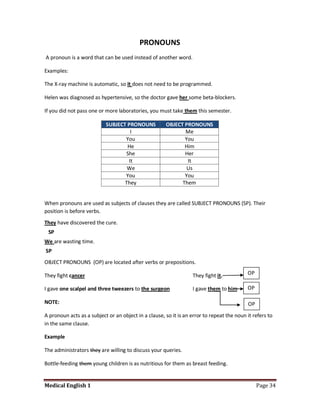
PRONOUNS
A pronoun is a word that can be used instead of another word.

Examples:

The X-ray machine is automatic, so it does not need to be programmed.

Helen was diagnosed as hypertensive, so the doctor gave her some beta-blockers.

If you did not pass one or more laboratories, you must take them this semester.

                           SUBJECT PRONOUNS           OBJECT PRONOUNS
                                    I                        Me
                                  You                        You
                                   He                        Him
                                  She                        Her
                                   It                         It
                                   We                         Us
                                  You                        You
                                  They                      Them


When pronouns are used as subjects of clauses they are called SUBJECT PRONOUNS (SP). Their
position is before verbs.
They have discovered the cure.
 SP
We are wasting time.
SP
OBJECT PRONOUNS (OP) are located after verbs or prepositions.

They fight cancer                                                 They fight it.           OP

I gave one scalpel and three tweezers to the surgeon              I gave them to him       OP

NOTE:                                                                                       OP
A pronoun acts as a subject or an object in a clause, so it is an error to repeat the noun it refers to
in the same clause.

Example

The administrators they are willing to discuss your queries.

Bottle-feeding them young children is as nutritious for them as breast feeding.


Medical English 1                                                                                Page 34
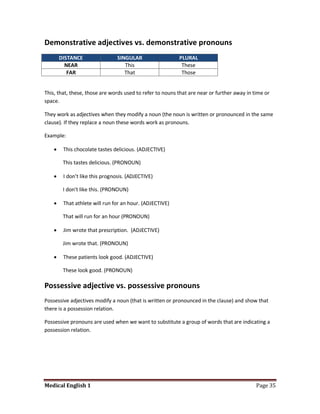
Demonstrative adjectives vs. demonstrative pronouns
        DISTANCE                 SINGULAR                 PLURAL
          NEAR                      This                   These
           FAR                      That                   Those


This, that, these, those are words used to refer to nouns that are near or further away in time or
space.

They work as adjectives when they modify a noun (the noun is written or pronounced in the same
clause). If they replace a noun these words work as pronouns.

Example:

        This chocolate tastes delicious. (ADJECTIVE)

         This tastes delicious. (PRONOUN)

        I don't like this prognosis. (ADJECTIVE)

         I don't like this. (PRONOUN)

        That athlete will run for an hour. (ADJECTIVE)

         That will run for an hour (PRONOUN)

        Jim wrote that prescription. (ADJECTIVE)

         Jim wrote that. (PRONOUN)

        These patients look good. (ADJECTIVE)

         These look good. (PRONOUN)

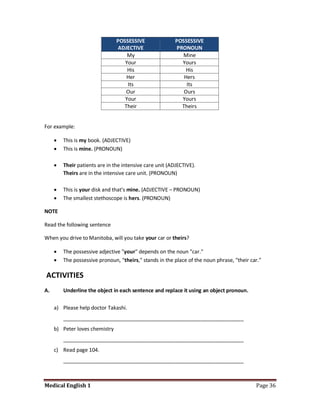
Possessive adjective vs. possessive pronouns
Possessive adjectives modify a noun (that is written or pronounced in the clause) and show that
there is a possession relation.

Possessive pronouns are used when we want to substitute a group of words that are indicating a
possession relation.


Medical English 1                                                                           Page 35
POSSESSIVE                POSSESSIVE
                                ADJECTIVE                 PRONOUN
                                    My                      Mine
                                   Your                     Yours
                                    His                       His
                                   Her                       Hers
                                    Its                       Its
                                   Our                       Ours
                                   Your                     Yours
                                  Their                     Theirs


For example:

        This is my book. (ADJECTIVE)
        This is mine. (PRONOUN)

        Their patients are in the intensive care unit (ADJECTIVE).
         Theirs are in the intensive care unit. (PRONOUN)

        This is your disk and that's mine. (ADJECTIVE – PRONOUN)
        The smallest stethoscope is hers. (PRONOUN)

NOTE

Read the following sentence

When you drive to Manitoba, will you take your car or theirs?

        The possessive adjective "your" depends on the noun "car."
        The possessive pronoun, "theirs," stands in the place of the noun phrase, "their car."

ACTIVITIES
A.       Underline the object in each sentence and replace it using an object pronoun.

     a) Please help doctor Takashi.
         _______________________________________________________________
     b) Peter loves chemistry
         _______________________________________________________________
     c) Read page 104.
         _______________________________________________________________


Medical English 1                                                                           Page 36
d) Ask doctor Huapaya and doctor Carhuancho.
         _______________________________________________________________
     e) Buy five syringes for Miss La Rosa.
         _______________________________________________________________
     B. Unscramble the words groups to write sentences. Use the correct punctuation and
        capitalization.

     a) lend / him / money / some / always / I
         ________________________________________________________________
     b) the / showing / the / something / women / is / man / to.
         ________________________________________________________________
     c) them / she / help / some / gives / rarely.
         ________________________________________________________________
     d) you / tell / the / him / do / ? / answers
         ________________________________________________________________
     e) this / us / does / explain / kind / exercises / of / she / not / to.


C.   Fill in the blanks with the appropriate possessive adjective, then use possessive pronouns
     to replace the group of words expressing possession relation.
     1. What’s the boy’s name? _____________ name is Ben Scott.
         __________________________________________________________________
     2. Debbie has a dog. ____________ dog is very lively.
         __________________________________________________________________
     3. The dog is very lively. _____________ name is Ben.
         __________________________________________________________________
     4. We are at school. _______________ school is very nice.
         __________________________________________________________________
     5. I have a new laptop. _____________ laptop is white.
         __________________________________________________________________
     6. I'm from Chester. Most of ______________ friends are from Chester, too.
         __________________________________________________________________
     7. The Guptas have a restaurant. _____________ restaurant is great.
         __________________________________________________________________


Medical English 1                                                                      Page 37
8. The rabbit is white. ______________ cage is in the garden.
      __________________________________________________________________
   9. You are not English. ______________ name is not an English name.
      __________________________________________________________________
   10. Sandra and Jenny are friends. ________________school is in Chester.
      __________________________________________________________________
   11. The Scotts have a new car. _________________ car is blue.
      __________________________________________________________________
   12. Emma Peel has a brother. ________________ name is Paul.
      __________________________________________________________________
   13. Nick Baker has a sister._______________ name is Debbie.
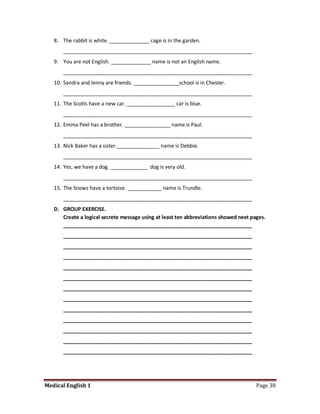
      __________________________________________________________________
   14. Yes, we have a dog. _____________ dog is very old.
      __________________________________________________________________
   15. The Snows have a tortoise. ____________ name is Trundle.
      __________________________________________________________________
   D. GROUP EXERCISE.
      Create a logical secrete message using at least ten abbreviations showed next pages.
      __________________________________________________________________
      __________________________________________________________________
      __________________________________________________________________
      __________________________________________________________________
      __________________________________________________________________
      __________________________________________________________________
      __________________________________________________________________
      __________________________________________________________________
      __________________________________________________________________
      __________________________________________________________________
      __________________________________________________________________
      __________________________________________________________________
      __________________________________________________________________


Medical English 1                                                                     Page 38
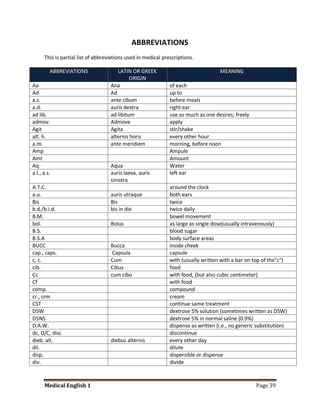
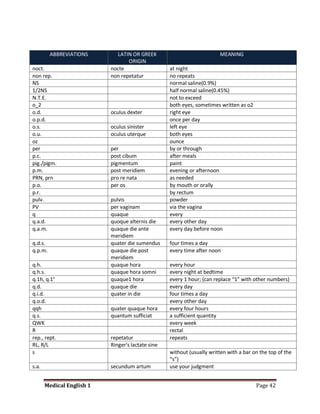
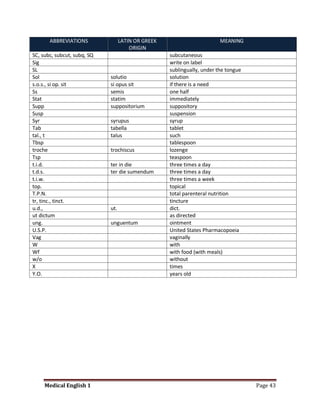
ABBREVIATIONS
      This is partial list of abbreviations used in medical prescriptions.

         ABBREVIATIONS                 LATIN OR GREEK                               MEANING
                                             ORIGIN
Aa                                  Ana                        of each
Ad                                  Ad                         up to
a.c.                                ante cibum                 before meals
a.d.                                auris dextra               right ear
ad lib.                             ad libitum                 use as much as one desires; freely
admov.                              Admove                     apply
Agit                                Agita                      stir/shake
alt. h.                             alternis horis             every other hour
a.m.                                ante meridiem              morning, before noon
Amp                                                            Ampule
Amt                                                            Amount
Aq                                  Aqua                       Water
a.l., a.s.                          auris laeva, auris         left ear
                                    sinistra
A.T.C.                                                         around the clock
a.u.                                auris utraque              both ears
Bis                                 Bis                        twice
b.d./b.i.d.                         bis in die                 twice daily
B.M.                                                           bowel movement
bol.                                Bolus                      as large as single dose(usually intravenously)
B.S.                                                           blood sugar
B.S.A                                                          body surface areas
BUCC                                Bucca                      inside cheek
cap., caps.                          Capsula                   capsule
c, c.                               Cum                        with (usually written with a bar on top of the"c")
cib.                                Cibus                      food
Cc                                  cum cibo                   with food, (but also cubic centimeter)
Cf                                                             with food
comp.                                                          compound
cr., crm                                                       cream
CST                                                            continue same treatment
D5W                                                            dextrose 5% solution (sometimes written as D5W)
D5NS                                                           dextrose 5% in normal saline (0.9%)
D.A.W.                                                         dispense as written (i.e., no generic substitution)
dc, D/C, disc                                                  discontinue
dieb. alt.                          diebus alternis            every other day
dil.                                                           dilute
disp.                                                          dispersible or dispense
div.                                                           divide


      Medical English 1                                                                             Page 39
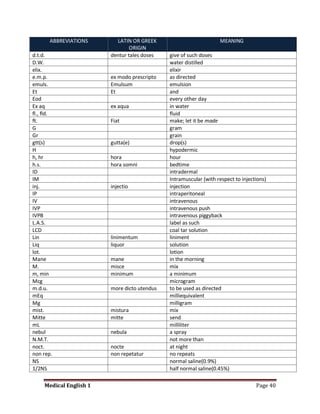
ABBREVIATIONS       LATIN OR GREEK                          MEANING
                                 ORIGIN
d.t.d.                   dentur tales doses   give of such doses
D.W.                                          water distilled
elix.                                         elixir
e.m.p.                   ex modo prescripto   as directed
emuls.                   Emulsum              emulsion
Et                       Et                   and
Eod                                           every other day
Ex aq                    ex aqua              in water
fl., fld.                                     fluid
ft.                      Fiat                 make; let it be made
G                                             gram
Gr                                            grain
gtt(s)                   gutta(e)             drop(s)
H                                             hypodermic
h, hr                    hora                 hour
h.s.                     hora somni           bedtime
ID                                            intradermal
IM                                            Intramuscular (with respect to injections)
inj.                     injectio             injection
IP                                            intraperitoneal
IV                                            intravenous
IVP                                           intravenous push
IVPB                                          intravenous piggyback
L.A.S.                                        label as such
LCD                                           coal tar solution
Lin                      linimentum           liniment
Liq                      liquor               solution
lot.                                          lotion
Mane                     mane                 in the morning
M.                       misce                mix
m, min                   minimum              a minimum
Mcg                                           microgram
m.d.u.                   more dicto utendus   to be used as directed
mEq                                           milliequivalent
Mg                                            milligram
mist.                    mistura              mix
Mitte                    mitte                send
mL                                            milliliter
nebul                    nebula               a spray
N.M.T.                                        not more than
noct.                    nocte                at night
non rep.                 non repetatur        no repeats
NS                                            normal saline(0.9%)
1/2NS                                         half normal saline(0.45%)

     Medical English 1                                                             Page 40
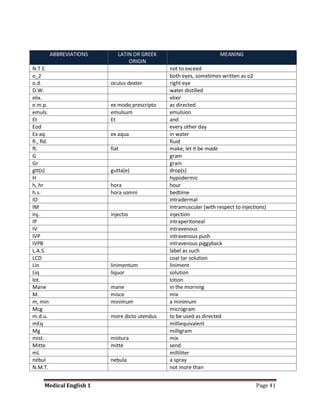
ABBREVIATIONS      LATIN OR GREEK                         MEANING
                                   ORIGIN
N.T.E.                                           not to exceed
o_2                                              both eyes, sometimes written as o2
o.d.                        oculus dexter        right eye
D.W.                                             water distilled
elix.                                            elixir
e.m.p.                      ex modo prescripto   as directed
emuls.                      emulsum              emulsion
Et                          Et                   and
Eod                                              every other day
Ex aq                       ex aqua              in water
fl., fld.                                        fluid
ft.                         fiat                 make; let it be made
G                                                gram
Gr                                               grain
gtt(s)                      gutta(e)             drop(s)
H                                                hypodermic
h, hr                       hora                 hour
h.s.                        hora somni           bedtime
ID                                               intradermal
IM                                               Intramuscular (with respect to injections)
inj.                        injectio             injection
IP                                               intraperitoneal
IV                                               intravenous
IVP                                              intravenous push
IVPB                                             intravenous piggyback
L.A.S.                                           label as such
LCD                                              coal tar solution
Lin                         linimentum           liniment
Liq                         liquor               solution
lot.                                             lotion
Mane                        mane                 in the morning
M.                          misce                mix
m, min                      minimum              a minimum
Mcg                                              microgram
m.d.u.                      more dicto utendus   to be used as directed
mEq                                              milliequivalent
Mg                                               milligram
mist.                       mistura              mix
Mitte                       mitte                send
mL                                               milliliter
nebul                       nebula               a spray
N.M.T.                                           not more than


      Medical English 1                                                               Page 41
ABBREVIATIONS       LATIN OR GREEK                             MEANING
                                  ORIGIN
noct.                      nocte                   at night
non rep.                   non repetatur           no repeats
NS                                                 normal saline(0.9%)
1/2NS                                              half normal saline(0.45%)
N.T.E.                                             not to exceed
o_2                                                both eyes, sometimes written as o2
o.d.                       oculus dexter           right eye
o.p.d.                                             once per day
o.s.                       oculus sinister         left eye
o.u.                       oculus uterque          both eyes
oz                                                 ounce
per                        per                     by or through
p.c.                       post cibum              after meals
pig./pigm.                 pigmentum               paint
p.m.                       post meridiem           evening or afternoon
PRN, prn                   pro re nata             as needed
p.o.                       per os                  by mouth or orally
p.r.                                               by rectum
pulv.                      pulvis                  powder
PV                         per vaginam             via the vagina
q                          quaque                  every
q.a.d.                     quoque alternis die     every other day
q.a.m.                     quaque die ante         every day before noon
                           meridiem
q.d.s.                     quater die sumendus     four times a day
q.p.m.                     quaque die post         every time after noon
                           meridiem
q.h.                       quaque hora             every hour
q.h.s.                     quaque hora somni       every night at bedtime
q.1h, q.1°                 quaque1 hora            every 1 hour; (can replace “1” with other numbers)
q.d.                       quaque die              every day
q.i.d.                     quater in die           four times a day
q.o.d.                                             every other day
qqh                        quater quaque hora      every four hours
q.s.                       quantum sufficiat       a sufficient quantity
QWK                                                every week
R                                                  rectal
rep., rept.                repetatur               repeats
RL, R/L                    Ringer's lactate sine
s                                                  without (usually written with a bar on the top of the
                                                   “s”)
s.a.                       secundum artum          use your judgment


       Medical English 1                                                                Page 42
ABBREVIATIONS               LATIN OR GREEK                        MEANING
                                       ORIGIN
SC, subc, subcut, subq, SQ                          subcutaneous
Sig                                                 write on label
SL                                                  sublingually, under the tongue
Sol                          solutio                solution
s.o.s., si op. sit           si opus sit            if there is a need
Ss                           semis                  one half
Stat                         statim                 immediately
Supp                         suppositorium          suppository
Susp                                                suspension
Syr                          syrupus                syrup
Tab                          tabella                tablet
tal., t                      talus                  such
Tbsp                                                tablespoon
troche                       trochiscus             lozenge
Tsp                                                 teaspoon
t.i.d.                       ter in die             three times a day
t.d.s.                       ter die sumendum       three times a day
t.i.w.                                              three times a week
top.                                                topical
T.P.N.                                              total parenteral nutrition
tr, tinc., tinct.                                   tincture
u.d.,                        ut.                    dict.
ut dictum                                           as directed
ung.                         unguentum              ointment
U.S.P.                                              United States Pharmacopoeia
Vag                                                 vaginally
W                                                   with
Wf                                                  with food (with meals)
w/o                                                 without
X                                                   times
Y.O.                                                years old


     Medical English 1                                                               Page 43
UNIT


HOSPITAL FACILITIES
                                                                                          6
Melissa Memorial Hospital


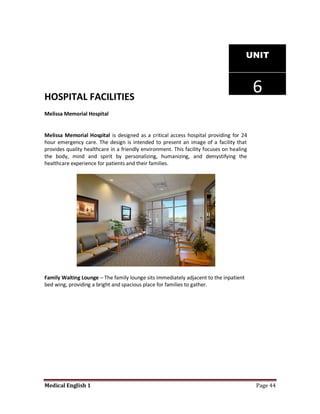
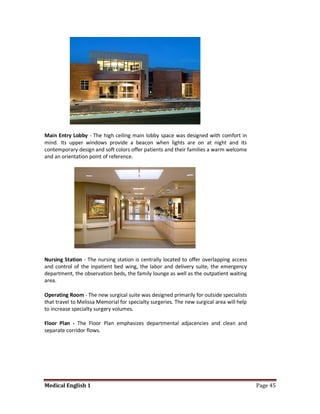
Melissa Memorial Hospital is designed as a critical access hospital providing for 24
hour emergency care. The design is intended to present an image of a facility that
provides quality healthcare in a friendly environment. This facility focuses on healing
the body, mind and spirit by personalizing, humanizing, and demystifying the
healthcare experience for patients and their families.


Family Waiting Lounge – The family lounge sits immediately adjacent to the inpatient
bed wing, providing a bright and spacious place for families to gather.


Medical English 1                                                                         Page 44
Main Entry Lobby - The high ceiling main lobby space was designed with comfort in
mind. Its upper windows provide a beacon when lights are on at night and its
contemporary design and soft colors offer patients and their families a warm welcome
and an orientation point of reference.


Nursing Station - The nursing station is centrally located to offer overlapping access
and control of the inpatient bed wing, the labor and delivery suite, the emergency
department, the observation beds, the family lounge as well as the outpatient waiting
area.

Operating Room - The new surgical suite was designed primarily for outside specialists
that travel to Melissa Memorial for specialty surgeries. The new surgical area will help
to increase specialty surgery volumes.

Floor Plan - The Floor Plan emphasizes departmental adjacencies and clean and
separate corridor flows.


Medical English 1                                                                          Page 45
Pre-operative and Recovery Areas - The hospital provides pre-operative and recovery
areas adjacent to the operating room.


The total refurbishment of Melissa Memorial Hospital will be 2011. The roof will be replaced, the
wards partitioned into individual cubicles to provide privacy for patients, and new nursing stations
were constructed. Ceramic floor tiles give the wards a cool and clean appearance as do the
acoustic ceilings in all the General Wards corridors.

The next major development will be the building of an ultra-modern maternity wing. It will have
eighteen beds, five are sea-facing private rooms, four semi-private rooms and eight general ward
beds. It will also have its own operating theatre, a baby nursery, isolation rooms, delivery rooms,
family planning area, well-baby and well-woman clinics, pediatric cardiology.

The development of the hospital never really stops, because the pace of change always increases
and the hospital must keep up.


Medical English 1                                                                          Page 46
THERE IS/ THERE ARE
Both expressions are used to state the something exists or to point out something in the distance.

There is/There are can be used as the sentences subject.

    1.   "There is" - is used with the following subjects:
        Singular nouns
        Uncountable nouns
        3rd person singular (he, she, my physician, his outpatient, etc.).

         Examples:

         There is my specialist on the corner.

         There is a lot of blood on the highway. There must have been an accident.

         There is a fracture here.

    2. "There are" - is used with the following subjects:
     3rd person plural (they, my doctors, the nurses, the practitioners, etc.)

         Examples:

         There are many nurses in this nursing station.

         There are practitioners there.

         There are three sites on the internet that are really good to study Medical English.


                                          PREPOSITIONS


Medical English 1                                                                               Page 47
ACTIVITIES
A.    THERE IS/THERE ARE. Choose the appropriate expression from the parentheses.

      1. ___________ a fly in that doctor's soup.
      (There is, There are)
      2. ______________many health centers in Huaycan.
      (There isn't, There aren't)
      3. ________________ any viruses in this area.
      (There isn't, There aren't)
      4. _____________________ lots of clinics in big cities.
      (There is, There are)
      5. ______________ a blood bank here?
      (Is there, Are there)
      6. _________________ survivors in the mine?
      (Is there, Are there)
      7. _____________________ a blood donor I can call?
      (Is there, Are there)
      8. _______________ an important surgery tomorrow.
      (There is, There are)
      9. _____________________ 8 students in my Medical English class.
      (There is, There are)
      10._________________________ many inpatients in this hospital.
      (There isn't, There aren't)


Medical English 1                                                                   Page 48
B. GROUP PROJECT. Look at the map below. Then write a description for the plan using
      “there is”, “there are” and prepositions.


   C.  Draw three plans considering the vocabulary below. Then describe the plans using
      “there is”, “there are” and prepositions.
   1. Ultra-modern maternity wing: eighteen beds, five are sea-facing private rooms, four semi-
      private rooms and eight general ward beds; one operating theatre; a baby nursery;
      isolation rooms; delivery rooms; family planning area; well-baby and well-woman clinics;
      pediatric cardiology.
   2. Third floor: two lifts; a four-bed High Dependency Unit; Renal Dialysis Unit; Radiology
      department.
   3. Outpatient Department: Obstetrics; Gynecology; -Ear, Nose and Throat (ENT); -Dental
      Surgery ; Orthopedics; Dermatology; Virology; Urology; Radiation, Oncology; Obstetrics;
      Perinatology Consultation; Cardiology; Pathology; Psychiatry; Pulmonary Services;
      Neurosurgery ; Pediatrics; Internal Medicine; Endocrinology; General Surgery; Geriatrics;
      Gastroenterology; Electrophysiology; Neonatology; Nephrology; Rheumatology;
      Ophthalmology; Plastic Surgery; Otolaryngology; Pathology.


Medical English 1                                                                     Page 49
UNIT


                                                                                       7
                           THE EXCRETORY SYSTEM
Excretion - Excretion is the removal of the metabolic wastes of an organism. Wastes that are
removed include carbon dioxide, water, salt, urea and uric acid. All excreted wastes travel at some
time in the blood.

Organs of the Excretory System

Lungs - removal of excess carbon dioxide

Liver - produces urea and uric acid as a by-product of the breakdown of proteins

Skin - removal of excess water, salt, urea and uric acid

Urinary System - kidneys filter the blood to form urine, which is excess water, salt, urea and uric
acid

THE SKIN

Layers of the skin

Epidermis - outer protective layer without blood vessels

Dermis - inner layer containing blood vessels, sensory nerve endings, sweat and oil glands, hairs,
and fat cells

Functions of the skin

Excretion - Wastes such as excess water, salt, urea and uric acid are removed from the body in
sweat.

Waterproofing - The skin with its oil glands prevents the entry of water into, and loss of water out
of the body.


Medical English 1                                                                          Page 50
Protection from disease - The intact skin prevents invasion of micro-organisms and dust into the
body.

Protection from ultraviolet rays - Pigments reduce the intake of UV rays.

Regulation of body temperature - The thin layer of fat cells in the dermis insulates the body.
Contraction of small muscles attached to hairs forms 'goosebumps' and creates an insulating
blanket of warm air. Also, sweat produced by sweat glands uses excess body heat to evaporate,
providing a cooling effect.

Sensory Detection - The nerve endings or receptors in the dermis detect heat, cold, touch,
pressure and pain.

                                                SOME / ANY
    STATEMENT                                  SOME                                      ANY
Affirmative                   I have some health nuisances.                               _
statement                     They will need some calories

Negative                                         _                   I do not need any blood transfusion.
statements
Interrogative                                    _                   Do you need any help?
statements                                                           Does she have any classmates?
                              Exception:
                              Offer: Would you like some help?
                              Request: Can you lend me some money?


         QUANTIFIERS WITH COUNTABLE AND UNCOUNTABLE NOUNS
Some adjectives and adjectival phrases describe quantity. Some can only go with countable nouns
(nurses, inpatients, outpatients), and some can only go with uncountable nouns (sugar, fat, blood,
advice). However, there are quantifiers that can be used with both countable and uncountable
nouns.

            ONLY WITH                        WITH UNCOUNTABLE              ONLY WITH
        UNCOUNTABLE NOUNS                   AND COUNTABLE NOUNS         COUNTABLE NOUNS
                How much?                   How much? or How many?          How many?

                  a little                           no/none                   a few
                 a bit (of)                          not any                a number (of)
                     -                            some (any)                   several
            a great deal of                           a lot of           a large number of

           a large amount of                         plenty of           a great number of

                     -                                lots of                     -


Medical English 1                                                                              Page 51
Notes:

1.   Much and many are used in negative and question forms.

Example:

How much sugar do you consume?

How many cigarettes do you smoke?

There's not much blood in the blood bank.

There weren't many physicians at the meeting.

2.   They are also used with too, (not) so, and (not) as :

Examples

There were too many physicians at the meeting.

It's a problem when there are so many patients.

There's not so much work to do this week.

3.   In positive statements, we use a lot of:

Examples:

I have a lot of work this week.

There were a lot of physicians at the meeting.

4.     A few (for countable nouns) and a little (for uncountable nouns) describe the quantity in a
       positive way:
Examples:

I have a few patients (= maybe not many, but enough)

I have a little money (= I have enough to live on)

5.       Few and little describe the quantity in a negative way:

Few people visited him in hospital (= he had almost no visitors)

He had little money (= almost no money)


Medical English 1                                                                         Page 52
ACTIVITIES

A.      QUANTIFIERS. In the following sentences, fill in the gaps with one of the following
        quantifiers:


                         much, many, a lot of, most, a little, little, a few, few


1. It seems to me that we haven't had ____________ assignments in English this term.

2. How _______________ material can we be expected to read in one week?

3. I've unfortunately had _________________ headaches already because of stress.

4. Our yard looks awful this summer. There are too _____________ weeds.

5. I didn't use _____________ fertilizer last spring, and that has made a difference.

6. Also, I've paid very_________________ attention to how rain we've had.

7. I'm afraid it's rained ________________ times this summer, and that is why the grass is turning
brown and dying. Farmers are very upset.

8. How _______________ good would it do if we watered the plants ourselves?

9. ________________ advice I have ever received from so-called "experts" has been useless.

10. They said that just _________________ help could make a big difference.

11.________________________ people know as much about computers as Tomas does.

12. It does us _________________________ good when the banking system collapses.


Medical English 1                                                                         Page 53
B.    GROUP PROJECT. You are a doctor who needs to know your patient routine. Write a 30-
      line dialogue using quantifiers in each sentence. Use affirmative, negative and
      interrogative statements.

________________________________________________________________________________
________________________________________________________________________________
________________________________________________________________________________
________________________________________________________________________________
________________________________________________________________________________
________________________________________________________________________________
________________________________________________________________________________
________________________________________________________________________________
________________________________________________________________________________
________________________________________________________________________________
________________________________________________________________________________
________________________________________________________________________________
________________________________________________________________________________
________________________________________________________________________________
________________________________________________________________________________


________________________________________________________________________________
________________________________________________________________________________
________________________________________________________________________________
________________________________________________________________________________
________________________________________________________________________________
________________________________________________________________________________
________________________________________________________________________________
________________________________________________________________________________
________________________________________________________________________________
________________________________________________________________________________
________________________________________________________________________________


Medical English 1                                                                Page 54
UNIT


THE URINARY SYSTEM                                                                       8
Urine

The first nitrogenous waste to be formed from the breakdown of protein is ammonia, a highly
toxic chemical that is quickly converted by the liver to urea and uric acid. These are less toxic than
ammonia and are transported in the blood to the kidneys for excretion in urine. Urine consists of
excess water, excess salt, urea and uric acid.

Parts of the Urinary System


Medical English 1                                                                            Page 55
Renal Arteries

Two renal arteries constantly transport blood to the kidneys.

Renal Veins

Two renal veins return useful nutrients back into the bloodstream.

Ureters

Two ureters carry urine from the kidneys to the urinary bladder.

Urinary Bladder

The urinary bladder temporarily stores urine until it is released from the body.

Urethra

The urethra is the tube that carries urine from the urinary bladder to the outside of the body. The
outer end of the urethra is controlled by a circular muscle called a sphincter.

Kidneys

The human kidneys are the major organs of bodily excretion (see Figure 1.) They are bean-shaped
organs located on either side of the backbone at about the level of the stomach and liver. Blood
always enters the kidneys through renal arteries and leaves through renal veins. Tubes called
ureters carry waste products from the kidneys to the urinary bladder for storage or for release.


 Figure 1. Details of the human excretory system. Position and allied structures of the kidneys (top). A cross section of
the kidney showing the two major portions (left). Details of the nephron, the functional unit of the kidney (right).

Medical English 1                                                                                             Page 56
The product of the kidneys is urine, a watery solution of waste products, salts, organic compounds,
and two important nitrogen compounds: uric acid and urea. Uric acid results from nucleic acid
decomposition, and urea results from amino acid breakdown in the liver. Both of these nitrogen
products can be poisonous to the body and must be removed in the urine.

Nephron

The functional and structural unit of the kidney is the nephron. The nephron produces urine and is
the primary unit of homeostasis in the body. It is essentially a long tubule with a series of
associated blood vessels. The upper end of the tubule is an enlarged cuplike structure called the
Bowman's capsule. Below the Bowman's capsule, the tubule coils to form the proximal tubule, and
then it follows a hairpin turn called the loop of Henle. After the loop of Henle, the tubule coils
once more as the distal tubule. It then enters a collecting duct, which also receives urine from
other distal tubules.

Within the Bowman's capsule is a coiled ball of capillaries known as a glomerulus. Blood from the
renal artery enters the glomerulus. The force of the blood pressure induces plasma to pass
through the walls of the glomerulus, pass through the walls of the Bowman's capsule, and flow
into the proximal tubule. Red blood cells and large proteins remain in the blood.

After plasma enters the proximal tubule, it passes through the coils, where usable materials and
water are reclaimed. Salts, glucose, amino acids, and other useful compounds flow back through
tubular cells into the blood by active transport. Osmosis and the activity of hormones assist the
movement. The blood fluid then flows through the loop of Henle into the distal tubule. Once
more, salts, water, and other useful materials flow back into the bloodstream. Homeostasis is
achieved by this process: A selected amount of hydrogen, ammonium, sodium, chloride, and other
ions maintain the delicate salt balance in the body.

The fluid moving from the distal tubules into the collecting duct contains materials not needed by
the body. This fluid is referred to as urine. Urea, uric acid, salts, and other metabolic waste
products are the main components of urine. The urine flows through the ureters toward the
urinary bladder. When the bladder is full, the urine flows through the urethra to the exterior.


Medical English 1                                                                         Page 57
FREQUENCY ADVERBS
Adverbs of frequency are used to say how often you do something. Adverbs of frequency are often
used with the present simple because they indicate repeated or routine activities.

For example:

They often go out for dinner

The most common frequency adverbs in English are:

                                 Always                     100%

                                 Frequently                 90%

                                 Usually                    80%

                                 Often                      70%

                                 Sometimes                  50%

                                 Occasionally               40%

                                 Seldom                     20%

                                 Rarely                     10%

                                  Never                      0%

Note: The percentages here are rough estimates only.

Frequency adverbs can be placed at various points in the sentence, but are most commonly used
before the main verbs and after the verb to be.

That surgeon always comes to work on time.

Those doctors are seldom home when we call.

He's usually taking her pills at this time.

She's never been to Cayetano Heredia Hospital.

A: Do you come here often?

B: Yes. I'm here occasionally.

A: What do you usually do here?

B: Sometimes I just sit and wait for a blood transfusion.


Medical English 1                                                                      Page 58
Notes:

1.        The adverbs seldom, rarely, never and hardly ever are considered negative.

         A: Do you always carry your medicines?

         B: (Yes,) I usually do.

         No, I usually don't.

         No, I rarely do.

         No, I hardly ever do.

2.       The following expressions are used at the beginning and end of sentences, not before
         main verbs.

         Every day/week /month

         Every other day /week

         Once a week /month/year

         Twice a year / day, etc.

         (Every) once in a while

         Every so often

         Examples:

         Every once in a while I visit my outpatients.

         I visit my outpatients every once in a while.

         I every once in a while visit my outpatients. (Incorrect)

3.       The adverbs regularly (according to schedule), normally (commonly nowadays),
         traditionally (commonly in the past) can come at various points in the sentence:
         Examples:

         I regularly floss my teeth.

         I floss my teeth regularly.

         Traditionally, that was considered child's play.

         I normally get up around 6 o'clock.

         Normally, I get up around 6 o'clock.

Medical English 1                                                                      Page 59
Medical English 1   Page 60
ACTIVITIES
A.      Rewrite the complete sentence using the adverb in brackets in its correct position.
        Example:
        I play tennis on Sundays. (often)
        Answer: I often play tennis on Sundays.

1. He pays attention to the doctor's suggestions. (often)

_____________________________________________________________________________

2. They read a book on Anatomy. (sometimes)

______________________________________________________________________________

3. Pete gets angry. (never)

________________________________________________________________________________

4. Doctor Espinoza is very friendly. (usually)

_______________________________________________________________________________

5. I take sugar in my coffee. (sometimes)

_______________________________________________________________________________

6. Ramon and Frank are hungry. (often)

_______________________________________________________________________________

7. My dermatologist goes for a walk in the evening. (always)

_______________________________________________________________________________

8. Nurses help surgeons in the operating rooms. (usually)

________________________________________________________________________________

9. Patients watch TV after 9 pm. (never)

_______________________________________________________________________________

10. Christine smokes. (never)

_______________________________________________________________________________


Medical English 1                                                                        Page 61
11. Nurse Hellen is upset (frequently)

________________________________________________________________________________

12. My workmates are in a hurry (usually)

_______________________________________________________________________________

B.      FREQUENCY ADVERBS. Read the text below and insert the frequency adverbs from the
        box.

                       usually, normally (2), regularly, always (2), never, sometimes


        Control of kidney function.

        The activity of the nephron in the kidney is ____________ controlled by a person's choices
        and environment as well as hormones. For example, if a person __________ consumes
        large amounts of protein, much urea will be in the blood from the digestion of the protein.
        Also, on a hot day, a body will retain water for sweating and cooling, so the amount of
        urine is reduced.
        Humans ______________ produce a hormone called antidiuretic hormone (ADH), also
        known as vasopressin, which is secreted by the posterior lobe of the pituitary gland. It
        ___________ regulates the amount of urine by controlling the rate of water absorption in
        the nephron tubules.
        _____________ some individuals suffer from a condition in which they secrete very low
        levels of ADH. The result is excessive urination and a disease called diabetes insipidus.
        Another unrelated form of diabetes, diabetes mellitus, is more widespread. Persons with
        this disease ___________ produce sufficient levels of insulin. Insulin _________ transports
        glucose molecules into the cells. But when insulin is not available, the glucose remains in
        the bloodstream. The glucose is _____________removed from the bloodstream in the
        nephron; to dilute the glucose, the nephron removes large amounts of water from the
        blood. Thus, the urine tends to be plentiful.
        Hormones from the cortex of the adrenal glands also control the content of urine. These
        hormones promote reabsorption of sodium and chloride ions in the tubules. Thus, they
        affect the water balance in the body, because water flows in the direction of high sodium
        and chloride content.
     C. TRANSLATION. Translate the text above.

     ___________________________________________________________________

     ___________________________________________________________________

     ___________________________________________________________________


Medical English 1                                                                         Page 62
___________________________________________________________________

   ___________________________________________________________________

   ___________________________________________________________________

   ___________________________________________________________________

   ___________________________________________________________________

   ___________________________________________________________________

   ___________________________________________________________________

   ___________________________________________________________________

   ___________________________________________________________________

   ___________________________________________________________________

   ___________________________________________________________________

   ___________________________________________________________________


   D. Read more: http://www.cliffsnotes.com/study_guide/Human-Excretory-
      System.topicArticleId-8741,articleId-8714.html#ixzz0zWFI53ca


Medical English 1                                                          Page 63
UNIT


                                                                                 9
THE REPRODUCTIVE SYSTEM

Introduction
Sexual reproduction is the process of producing offspring for the survival of the species,
and passing on hereditary traits from one generation to the next. The male and female
reproductive systems contribute to the events leading to fertilization. Then, the female
organs assume responsibility for the developing human, birth, and nursing. The male and
female gonads (testes and ovaries) produce sex cells (ova and sperm) and the hormones
necessary for the proper development, maintenance, and functioning of the organs of
reproduction and other organs and tissues.


1. MALE REPRODUCTIVE SYSTEM
These external structures include the penis, scrotum, and testicles.
   Penis: This is the male organ used in sexual intercourse. It has three parts: the root,
    which attaches to the wall of the abdomen; the body, or shaft; and the glans, which is
    the cone-shaped part at the end of the penis. The glans, also called the head of the
    penis, is covered with a loose layer of skin called foreskin. This skin is sometimes
    removed in a procedure called circumcision. The opening of the urethra, the tube that
    transports semen and urine, is at the tip of the penis. The penis also contains a
    number of sensitive nerve endings.


Medical English 1                                                                  Page 64
   Scrotum: This is the loose pouch-like sac of skin that hangs behind and below the
    penis. It contains the testicles (also called testes), as well as many nerves and blood
    vessels. The scrotum acts as a "climate control system" for the testes. For normal
    sperm development, the testes must be at a temperature slightly cooler than body
    temperature. Special muscles in the wall of the scrotum allow it to contract and relax,
    moving the testicles closer to the body for warmth or farther away from the body to
    cool the temperature.
   Testicles (testes): These are oval organs about the size of large olives that lie in the
    scrotum, secured at either end by a structure called the spermatic cord. Most men
    have two testes. The testes are responsible for making testosterone, the primary
    male sex hormone, and for generating sperm. Within the testes are coiled masses of
    tubes called seminiferous tubules. These tubes are responsible for producing sperm
    cells.
The internal organs of the male reproductive system, also called accessory organs, include
the following:
   Epididymis: The epididymis is a long, coiled tube that rests on the backside of each
    testicle. It transports and stores sperm cells that are produced in the testes. It also is
    the job of the epididymis to bring the sperm to maturity, since the sperm that emerge
    from the testes are immature and incapable of fertilization. During sexual arousal,
    contractions force the sperm into the vas deferens.
   Vas deferens: The vas deferens is a long, muscular tube that travels from the
    epididymis into the pelvic cavity, to just behind the bladder. The vas deferens
    transports mature sperm to the urethra, the tube that carries urine or sperm to
    outside of the body, in preparation for ejaculation.

Medical English 1                                                                     Page 65
   Ejaculatory ducts: These are formed by the fusion of the vas deferens and the seminal
    vesicles. The ejaculatory ducts empty into the urethra.
   Urethra: The urethra is the tube that carries urine from the bladder to outside of the
    body. In males, it has the additional function of ejaculating semen when the man
    reaches orgasm. When the penis is erect during sex, the flow of urine is blocked from
    the urethra, allowing only semen to be ejaculated at orgasm.
   Seminal vesicles: The seminal vesicles are sac-like pouches that attach to the vas
    deferens near the base of the bladder. The seminal vesicles produce a sugar-rich fluid
    (fructose) that provides sperm with a source of energy to help them move. The fluid
    of the seminal vesicles makes up most of the volume of a man's ejaculatory fluid, or
    ejaculate.
   Prostate gland: The prostate gland is a walnut-sized structure that is located below
    the urinary bladder in front of the rectum. The prostate gland contributes additional
    fluid to the ejaculate. Prostate fluids also help to nourish the sperm. The urethra,
    which carries the ejaculate to be expelled during orgasm, runs through the center of
    the prostate gland.
   Bulbourethral glands: Also called Cowper's glands, these are pea-sized structures
    located on the sides of the urethra just below the prostate gland. These glands
    produce a clear, slippery fluid that empties directly into the urethra. This fluid serves
    to lubricate the urethra and to neutralize any acidity that may be present due to
    residual drops of urine in the urethra.



Medical English 1                                                                    Page 66
How does the male reproductive system function?
The entire male reproductive system is dependent on hormones, which are chemicals that
stimulate or regulate the activity of cells or organs. The primary hormones involved in the
functioning of the male reproductive system are follicle-stimulating hormone (FSH),
luteinizing hormone (LH) and testosterone.
FSH and LH are produced by the pituitary gland located at the base of the brain. FSH is
necessary for sperm production (spermatogenesis), and LH stimulates the production of
testosterone, which is necessary to continue the process of spermatogenesis.
Testosterone also is important in the development of male characteristics, including
muscle mass and strength, fat distribution, bone mass and sex drive.


2.   FEMALE REPRODUCTIVE SYSTEM
The main external structures of the female reproductive system include:
    Labia majora: The labia majora enclose and protect the other external reproductive
     organs. Literally translated as "large lips," the labia majora are relatively large and
     fleshy, and are comparable to the scrotum in males. The labia majora contain sweat
     and oil-secreting glands. After puberty, the labia majora are covered with hair.
    Labia minora: Literally translated as "small lips," the labia minora can be very small or
     up to 2 inches wide. They lie just inside the labia majora, and surround the openings
     to the vagina (the canal that joins the lower part of the uterus to the outside of the
     body) and urethra (the tube that carries urine from the bladder to the outside of the
     body).
    Bartholin's glands: These glands are located beside the vaginal opening and produce
     a fluid (mucus) secretion.
    Clitoris: The two labia minora meet at the clitoris, a small, sensitive protrusion that is
     comparable to the penis in males. The clitoris is covered by a fold of skin, called the
     prepuce, which is similar to the foreskin at the end of the penis. Like the penis, the
     clitoris is very sensitive to stimulation and can become erect.


The internal reproductive organs in the female include:
    Vagina: The vagina is a canal that joins the cervix (the lower part of uterus) to the
     outside of the body. It also is known as the birth canal.
    Uterus (womb): The uterus is a hollow, pear-shaped organ that is the home to a
     developing fetus. The uterus is divided into two parts: the cervix, which is the lower

Medical English 1                                                                      Page 67
part that opens into the vagina, and the main body of the uterus, called the corpus.
    The corpus can easily expand to hold a developing baby. A channel through the cervix
    allows sperm to enter and menstrual blood to exit.
   Ovaries: The ovaries are small, oval-shaped glands that are located on either side of
    the uterus. The ovaries produce eggs and hormones.
   Fallopian tubes: These are narrow tubes that are attached to the upper part of the
    uterus and serve as tunnels for the ova (egg cells) to travel from the ovaries to the
    uterus. Conception, the fertilization of an egg by a sperm, normally occurs in the
    fallopian tubes. The fertilized egg then moves to the uterus, where it implants into the
    lining of the uterine wall.


Medical English 1                                                                   Page 68
How does the female reproductive system function?
The female reproductive system is designed to carry out several functions. It produces the
female egg cells necessary for reproduction, called the ova or oocytes. The system is
designed to transport the ova to the site of fertilization. Conception, the fertilization of an
egg by a sperm, normally occurs in the fallopian tubes. The next step for the fertilized egg
is to implant into the walls of the uterus, beginning the initial stages of pregnancy. If
fertilization and/or implantation does not take place, the system is designed to
menstruate (the monthly shedding of the uterine lining). In addition, the female
reproductive system produces female sex hormones that maintain the reproductive cycle.


AFFIRMATIVE STATEMENTS

          SUBJECT                           VERB                         COMPLEMENT
I                               analyzed                        a microbe
You                             removed                         a tumor
We                              caught                          a cold
They                            drank                           a cough syrup
He                              had                             genital herpes
She                             had                             chlamydia
It                              had                             syphilis


Medical English 1                                                                      Page 69
NEGATIVE STATEMENTS

              SUBJECT           AUXILIARY                VERB          COMPLEMENT
       I                                           analyze           a microbe
       You                                         remove            a tumor
       We                                          catch             a cold
       They            did not / didn´t            drink             a cough syrup
       He                                          have              genital herpes
       She                                         have              chlamydia
       It                                          have              syphilis
INTERROGATIVE STATEMENTS

      AUXILIARY          SUBJECT             VERB               COMPLEMENT       QUESTION
                                                                                  MARK
Did                  I                  analyze             the results      ?
                     you                cure                the patient
                     we                 have                a stiff neck
                     they               have                a sunburn
Did                  he                 have                genital herpes   ?
                     she                have                chlamydia
                     it                 have                syphilis
  “WH”            AUXILIARY        SUBJECT           VERB         COMPLEMENT   QUESTION
QUESTION                                                                        MARK
 WORDS
How often     did             I                   analyze       the results      ?
                              you                 cure          the patient
                              we                  have          a stiff neck
                              they                have          a sunburn
When          did             he                  have          genital herpes   ?
Why           did             she                 have          chlamydia
                              it                  have          syphilis


         ADDITIONAL INFORMATION
         For further information go to


         http://www.saberingles.com.ar/curso/lesson14/04.html


Medical English 1                                                                     Page 70
ACTIVITIES
A.    PUT IN ORDER TO MAKE SENTENCES


1.   its 46-Mb / we/ nuclear genome/ sequenced
     _____________________________________________________________________
2.   reviewed / in/ journals/ the/ articles/ authors/ relevant
     ______________________________________________________________________
3.   dysfunction/ patients/ a sexual/ female/ reported
     ______________________________________________________________________
4.   dysfunction/ in/ all/ explored/ men/ studies/ sexual
     ______________________________________________________________________
5.   problem/ dysfunction /an under-recognized/was / sexual/ men/ in
     ______________________________________________________________________
6.   our/ showed/ Georgian population/ degrees of ED/ lesser
     ______________________________________________________________________
7.   mastered/ on / student physicians/ function / information / healthy sexual/
     fundamental
     ______________________________________________________________________
8. an overall improvement/ described/ with long standing UC/ after surgery/function/
    patients/ sexual/ their/in .
   ______________________________________________________________________
B.  COMPLETE THE FOLLOWING TEXT WITH THE WORDS IN THE BOX

                 fetus- genital-ovum- pelvic-reproductive-sperm-testes-zygote


The human male ____________system (or male _________system) consists of a number
of sex organs that are a part of the human reproductive process. In the case of men, these
sex organs are located outside a man's body, around the _________region.


       The main male sex organs are the penis and the ____________which produce
semen and _________, which as part of sexual intercourse fertilize an _________ in a
woman's body and the fertilized ovum (_________) gradually develops into a _________,
which is later born as a child.


Medical English 1                                                                 Page 71
LIST OF VERBS

Los verbos regulares forman el Simple Past y el Past Participle agregando -ed al infinitivo. Los
verbos irregulares no siguen esta regla y deben de ser aprendidos de memoria, estos se
encuentran marcados con (i).

        Infinitive           Simple Past          Past Participle            Spanish


           add                  added                 added                  agregar


         answer               answered               answered               responder


        apologise            apologised             apologised              disculparse


          arrest               arrested              arrested                arrestar


          arrive               arrived                arrived                 llegar


           ask                  asked                 asked                  preguntar


          attack               attacked              attacked                 atacar


          be (i)              was / were               been                     ser


        become (i)             became                become                 convertirse


         begin (i)              began                 begun                  comenzar


         believe               believed              believed                  creer


           boil                 boiled                boiled                  hervir


          book                 booked                 booked                 reservar


         borrow               borrowed               borrowed             tomar prestado


         break (i)              broke                 broken                  romper


         bring (i)             brought               brought                   traer


         build (i)               built                 built                 construir


          buy (i)              bought                 bought                 comprar


         catch (i)             caught                 caught                  atrapar


Medical English 1                                                                         Page 72
carry          carried          carried         llevar


        change         changed          changed        cambiar


         chop          chopped          chopped          picar


         clean         cleaned          cleaned         limpiar


         climb         climbed          climbed         escalar


        collect        collected        collected     colleccionar


        come (i)        came             come            venir


       compose        composed         composed       componer


         cook          cooked           cooked          cocinar


         copy           copied           copied         copiar


         cut (i)         cut              cut            cortar


        dance          danced           danced           bailar


       describe       described        described       describir


        destroy       destroyed        destroyed        destruir


          die            died             died           morir


       discover       discovered       discovered      descubrir


        discuss       discussed        discussed        discutir


         do (i)          did             done            hacer


        draw (i)         drew            drawn          dibujar


       dream (i)    dreamt/dreamed   dreamt/dreamed      soñar


        drink (i)       drank            drunk           beber


        drive (i)       drove            driven        conducir


          dye            dyed             dyed           teñir


Medical English 1                                                    Page 73
eat (i)        ate           eaten         comer


         enjoy        enjoyed        enjoyed       disfrutar


        explode      exploded       exploded       explotar


       extinguish   extinguished   extinguished   extinguirse


         fall (i)       fell          fallen         caer


        feed (i)        fed            fed        alimentar


        feel (i)        felt           felt         sentir


        fight (i)     fought         fought         pelear


        find (i)       found          found       encontrar


         fly (i)        flew          flown          volar


       forget (i)      forgot       forgotten       olvidar


       freeze (i)      froze         frozen        congelar


           fry         fried          fried          freír


        give (i)       gave           given          dar


         go (i)        went           gone            ir


        grow (i)       grew           grown         crecer


        happen       happened       happened       suceder


         hate          hated          hated         odiar


        have (i)        had            had          tener


        hear (i)       heard          heard           oír


         help         helped         helped         ayudar


          hire         hired          hired        alquilar


         hope         hoped          hoped         esperar


Medical English 1                                               Page 74
hunt        hunted     hunted          cazar


        hurt (i)      hurt       hurt        herir, doler


        imagine     imagined   imagined       imaginar


        invent      invented   invented        inventar


         invite      invited    invited         invitar


         jump       jumped     jumped           saltar


        keep (i)      kept       kept          guardar


          kill       killed     killed          matar


        know (i)     knew       known           saber


        leave(i)      left       left           dejar


        lend (i)      lent       lent          prestar


         lie (i)      lay        lain           yacer


          lie         lied       lied           mentir


          lift       lifted     lifted         levantar


          like       liked      liked           gustar


         listen     listened   listened       escuchar


          live       lived      lived            vivir


         look        looked     looked          mirar


        lose (i)      lost       lost          perder


         love        loved      loved           amar


        make (i)     made       made            hacer


        meet (i)      met        met      conocer, encontrar


         miss       missed     missed      perder, extrañar


Medical English 1                                           Page 75
offer        offered      offered         ofrecer


         open         opened       opened            abrir


         pack         packed       packed          empacar


         pass         passed       passed       pasar, aprobar


        pay (i)        paid         paid            pagar


         peel         peeled       peeled           pelar


        phone         phoned       phoned     llamar por teléfono


         plan        planned      planned         planificar


         play         played       played           jugar


         pour         poured       poured           verter


        prefer       preferred    preferred        preferir


        prepare      prepared     prepared         preparar


         push         pushed       pushed          empujar


        put (i)        put          put             poner


         rain         rained       rained           llover


        read (i)       read         read             leer


        reduce       reduced      reduced          reducir


       remember     remembered   remembered        recordar


         rent         rented       rented          alquilar


        rescue       rescued      rescued          rescatar


        return       returned     returned     volver, devolver


        ring (i)       rang         rung      llamar por teléfono


        run (i)        ran          run             correr


Medical English 1                                                Page 76
save        saved      saved      ahorrar


         say (i)      said       said       decir


        search      searched   searched    buscar


        send (i)      sent       sent      enviar


        scream      screamed   screamed     gritar


        see (i)       saw        seen        ver


         sell (i)     sold       sold      vender


        shine (i)    shone      shone      brillar


        shoot (i)     shot       shot     disparar


        shut (i)      shut       shut      cerrar


        sing (i)      sang       sung      cantar


         sit (i)      sat        sat      sentarse


         skate       skated     skated     patinar


           ski       skied      skied      esquiar


        sleep (i)     slept      slept     dormir


         smell      smelled    smelled      oler


         snore       snored     snored     roncar


       speak (i)     spoke      spoken     hablar


       spend (i)     spent      spent      gastar


          start      started    started   comenzar


          stay       stayed     stayed    quedarse


        steal (i)     stole     stolen      robar


          stop      stopped    stopped    detener


Medical English 1                                    Page 77
study         studied      studied       estudiar


        survive        survived     survived     sobrevivir


        swim (i)        swam         swum          nadar


        take (i)         took        taken         tomar


          talk          talked       talked        hablar


        teach (i)       taught       taught       enseñar


         tell (i)        told         told          decir


         thank         thanked      thanked      agradecer


        think (i)      thought      thought        pensar


       throw (i)        threw       thrown         lanzar


         touch         touched      touched        tocar


           try           tried        tried       intentar


          use           used         used           usar


     understand (i)   understood   understood     entender


          visit         visited      visited       visitar


          wait          waited       waited       esperar


         walk          walked       walked        caminar


         want          wanted       wanted         querer


         warn          warned       warned        advertir


         wash          washed       washed          lavar


         watch         watched      watched        mirar


        wear (i)        wore         worn       llevar puesto


         win (i)         won          won          ganar


Medical English 1                                               Page 78
work       worked       worked                       trabajar


        write (i)   wrote        written                      escribir


                             Source: http://www.saberingles.com.ar/lists/verbs2.html


Medical English 1                                                         Page 79

Manual de inglés médico 1

  • 1.
    MEDICAL ENGLISH 1 Autores: Verónica Clavijo Bazalar. Fernando Cornejo Sánchez.
  • 2.
    UNIT 1 Booking a Doctor's Appointment Receptionist: Doctor's office. Jane speaking. How can I help you? Caller: I need to make an appointment with Dr. Harris. Receptionist: Do you know your chart number? Caller: No, sorry. It's at home and I'm at work right now. Receptionist: No problem. What's your name, please? Caller: George Mason. Receptionist: Okay Mr. Mason. Hold one moment while I grab your chart, please. Caller: Sure. Receptionist: Thanks for waiting. Now, what do you need to see the doctor about? Caller: Well, I am fighting a cold these days, and I think I have a chest infection or something. My cough is getting worse each day. Receptionist: Hmm. Doctor Harris is off tomorrow. Do you think it can wait until Wednesday? Caller: Oh, it is urgent. I feel bad Receptionist: No problem, I will help you. Check your understanding 1. Why does the caller phone the doctor's office? a) He's running late for his appointment. c) He can't remember his chart number. b) He's booking an appointment with Dr. d) His medication ran out. Harris. Medical English 1 Page 1
  • 3.
    2. Which istrue about George Mason? a) He has a bad cold. c) His cough is better. b) He's running a fever. d) He's off on a sick day. SIMPLE PRESENT TENSE TO HAVE Affirmative statements SUBJECT VERB COMPLEMENT I have fever You have a cold stiff neck We have a sunburn They have He has fever She has a cold It has a stiff neck Medical English 1 Page 2
  • 4.
    1. Have a headache 14. Have a sunburn 2. Have an earache 15. Have a stiff neck 3. Have a toothache 16. Have a runny nose 4. Have a stomachache 17. Have a bloody nose 5. Have a backache 18. Have a cavity 6. Have a sore throat 19. Have a wart 7. Have fever 20. Have (the) hiccups 8. Have a cold 21. Have (the) chills 9. Have a cough 22. Have cramps 10. Have a virus 23. Have diarrhea 11. Have an infection 24. Have chest pain 12. Have a rash 25. Have shortness of breath 13. Have an insect bite 26. Have laryngitis NEGATIVE STATEMENTS SUBJECT AUXILIARY VERB COMPLEMENT I do not / don’t have fever You have a cold We have a stiff neck They have a sunburn He does not / have fever She doesn’t have a cold It have a stiff neck Medical English 1 Page 3
  • 5.
    INTERROGATIVE STATEMENTS AUXILIARY SUBJECT VERB COMPLEMENT QUESTION MARK Do I have fever ? you have a cold we have a stiff neck they have a sunburn Does he have fever ? she have a cold it have a stiff neck “WH” AUXILIARY SUBJECT VERB COMPLEMENT QUESTION QUESTION MARK WORDS How often do I have fever ? you have a cold we have a stiff neck they have a sunburn When does he have fever ? Why does she have a cold it have a stiff neck Medical English 1 Page 4
  • 6.
    TO BE 27.Be faint/weak 30. Be bloated 28. Be dizzy 31. Be congested 29. Feel nauseous 32. Be exhausted TYPE OF SENTENCE SUBJECT AUXILIARY VERB NEGATIVE FORM COMPLEMENT + I am a patient. + You are a physician. - She is not insane. - We are not swollen. ? Is he weak. ? Are they vitamins? Medical English 1 Page 5
  • 7.
    OTHER VERBS 33. Cough 42. Scratch 34. Sneeze 43. Scrape 35. Wheeze 44. Bruise 36. Burp 45. Burn 37. Vomit/throw up 46. Break 38. Bleed 47. Hurt 39. Twist 48. Cut 40. Sprain 49. Swell 41. Dislocate 50. Itch Medical English 1 Page 6
  • 8.
    ACTIVITIES A. CHANGE THE FOLLOWING SENTENCES INTO THE APPROPRIATE FORM. + affirmative sentences - negative sentences ? interrogative sentences 1) She has a cold or allergies (?) _______________________________________________________________________ 2) They sneeze every minute (-) __________________________________________________________________ 3) My sister doesn’t cough (+) ________________________________________________________________________ 4) My husband is dizzy (?) ________________________________________________________________________ 5) Does he feel nauseous? (+) __________________________________________________________________ 6) His brother is exhausted (-) _________________________________________________________________ 7) You aren’t a good dentist (?) _______________________________________________________________________ 8) I don’t wait for anybody (+) _________________________________________________________________ Medical English 1 Page 7
  • 9.
    9) It itches badly (-) _____________________________________________________________________ 10) They aren’t here (+) ________________________________________________________________ B. PUT IN ORDER THE FOLLOWING SENTENCES. 1. in / friends / I / have / don’t / class/ this / many. ________________________________________________________________ 2. hospital / to / go / to / They / the / want. _____________________________________________________________________ 3. aren’t / These / your / patients. _____________________________________________________________________ 4. need / I / a / don’t / psychologist _____________________________________________________________________ 5. burp / he / vomit /?/ Does / and/ often _______________________________________________________________ C. FIND THE MISTAKES IN THE FOLLOWING SENTENCES AND REWRITE THEM. 1. He don’t eat fish __________________________________________________ 2. The children is tired _____________________________________________ 3. My patients isn’t there ____________________________________________ 4. We has a sunburn and you feel nauseus ________________________________ 5. Do she work in those medical facility? ____________________________________ Medical English 1 Page 8
  • 10.
    Medical Specialists Medical specialistsare experts in certain fields of medicine. They treat specific parts of the body, such as the stomach or the heart, or they specialize in certain diseases, such as AIDS. Family doctors keep a list of local specialists and can help patients choose the right specialist for each medical issue. In many cases, specialists require a referral from a family doctor before they will see a patient. Here is a list of the most common types of specialists. Study the list and then check your understanding by taking the quiz. Allergist: specializes in determining food and environmental allergies Anesthesiologist: specializes in pain prevention during surgery Cardiologist: heart specialist Chiropractor: back specialist Dentist: tooth specialist Dermatologist: skin specialist Fertility specialist: helps people who have difficulty getting pregnant Gynecologist: specializes in women's needs Massage therapist: specializes in muscle relaxation Midwife: helps women deliver babies in a natural way Naturopath: specializes in natural cures and remedies Neurologist: brain specialist Obstetrician: specialist for pregnant women Occupational therapist: specializes in workplace health Oncologist: tumor specialist, including cancer Ophthalmologist: specializes in eye diseases Pediatrician: specialist for babies and children Medical English 1 Page 9
  • 11.
    Physical therapist: specializesin the body's movement Podiatrist: foot specialist Psychiatrist: specialist in mental health Radiologist: specializes in imaging tests ACTIVITIES A. Read the patient complaints and say which specialist each patient needs. 1. I have a terrible rash on my arms and legs. I think I'm allergic to dairy food, but it also might be grass. a) chiropractor c) allergist b) ophthalmologist d) psychiatrist 2. My husband and I just took a home pregnancy test, and it came out positive. We want to know when we are due and we want to make sure the fetus is healthy. a) podiatrist c) obstetrician b) pediatrician d) pharmacist 3. I still can't walk and it's been three months since my accident. I hate being stuck in a wheelchair. a) anesthesiologist c) radiologist b) physical therapist d) dentist 4. The test results show that I have an advanced form of blood cancer. a) oncologist c) midwife b) neurologist d) allergist 5. My left eye has an infection that won't go away and my vision has been blurry for two weeks now. a) podiatrist c) ophthalmologist b) massage therapist d) radiologist Medical English 1 Page 10
  • 12.
    6. I don'twant to take any drugs that will cause me to become addicted to them, but I do need some sort of pain relief. a) naturopath c) cardiologist b) dentist d) dermatologist 7. I've been having major chest pains this week. I'm also having trouble breathing. a) gynecologist c) oncologist b) cardiologist d) dermatologist 8. I get terrible acne and I have tried all of the products in the pharmacy. I don't know what to do now. a) massage therapist c) occupational therapist b) podiatrist d) dermatologist 9. My baby is not developing properly. She hasn't put on any weight in two months and she keeps getting ear infections. a) anesthesiologist c) midwife b) pediatrician d) massage therapist 10. My husband and I have been trying to get pregnant for three years. We have tried everything that the books suggest. a) fertility specialist c) psychiatrist b) oncologist d) dentist B. Which are they specialties? Choose the right word for each number. X-ray technician; gynecologist; psychiatrist; emergency medical technician; surgeon; pediatrician; cardiologist; optometrist, obstetrician; dentist; doctor; nurse; lab technician. Medical English 1 Page 11
  • 13.
    UNIT Head 2 Read the text below and answer the questions Inside the head is the brain, which is responsible for thinking. The top of a person's scalp is covered with hair. Beneath the hairline at the front of the face is the forehead. Underneath the forehead are the eyes for seeing, the nose for smelling, and the mouth for eating. On the outside of the mouth are the lips, and on the inside of the mouth are the teeth for biting and the tongue for tasting. Food is swallowed down the throat. At the sides of the face are the cheeks and at the sides of the head are the ears for hearing. At the bottom of a person's face is the chin. The jaw is located on the inside of the cheeks and chin. The neck is what attaches the head to the upper body. 1. Where is the brain? ___________________________________________________________________ 2. Where is the forehead? ___________________________________________________________________ Medical English 1 Page 12
  • 14.
    3. Where arethe lips? __________________________________________________________________ 4. What can you do with your teeth? __________________________________________________________________ 5. Where are the ears? __________________________________________________________________ 6. Where is the chin located? __________________________________________________________________ 7. Where is the jaw located? _________________________________________________________________ Present Progressive We use the present continuous tense to talk about:  action happening now  action in the future SUBJECT AUXILIARY VERB MAIN VERB COMPLEMENT + I am examining a patient. + You are prescribing the medicine - She is not sleeping in the hospital. - We are not coughing ? Is he vaccinating the children? ? Are they taking vitamins? ACTIVITIES A. Complete the following sentences with the present continuous. 1. The doctors _______________ (vaccinate) the children right now. 2. The gynecologist ________________________ (examine) Lucia these days. 3. The doctor __________________ (prescribe) medicines right now. 4. Listen! Michael_____________________ (cough) a lot. Medical English 1 Page 13
  • 15.
    5. I ______________________ (drink) cough syrup at this moment. 6. Jake _________________________ (suffer) a terrible disease. 7. Doctor, ______________________ you ________________ (cure) Mr. Baker? 8. Look! A biologist _____________________ (analyze) a microbe. 9. My children __________________________ (catch) a cold. 10. _______________ you _______________(arrange ) an appointment? B. Decide which of the choices below would best complete the article if inserted in the blanks. Circle the appropriate letters. Too Much Fast Food? According to a recent survey, these days Hong Kong consumers (1)_______ more money on convenience foods since the economic downturn. Because companies are trying to make more with fewer staff, employees (2) ________ harder than ever before. More women (3)__________ the workforce as well. They (4) _________less time to prepare nutritious home-cooked meals for their families. Instead, families (5)_________ out or (6) ________ convenience foods, such as frozen pizzas and instant noodles. These foods (7) …………more fat, salt and sugar than home- cooked meals. Experts say that eating too much of them (8)………… the risk of serious health problems, including diabetes and heart disease. However, the current trend towards convenience foods (9) ………benefitting some business sectors. Supermarkets (10)………….. to the higher demand for quick, easy-to-serve meals by increasing their selection of convenience and pre-packaged foods. These products (11) ………. for higher prices than fresh food. Restaurants also (12)…………. from the trend: most Hong Kong people now (13)………… out at least once a day. Is convenience food just a fad or is home-cooked food (14)…………. a thing of the past? How (15) …………………….this trend affecting our health? 1. A are spending 3. A joins B spends B are joining C spend C join 2. A work 4. A has B works B have C are working C had Medical English 1 Page 14
  • 16.
    5. A areeating 10. A respond B eats B responded C eat C are responding 6. A bought 11. A sells B buys B are sold C buy C sell 7. A containing 12. A profit B are profiting B contains C profits C contain 13. A eat 8. A increase B ate B increasing C were eating C increases 14. A become 9. A is B became B are C becoming C be 15. A does B is C have C. Supplies and Tools. Here is a list of some of the most common supplies found in doctor's offices, operating rooms, and medical kits. Study the vocabulary and try the matching exercise. 1. Antiseptic a) thin, netted material used for dressing wounds 2. Bandage b) an instrument used to check a person's body temperature 3. Forceps c) liquid used to sterilize (clean) the surface of the skin 4. Gauze d) a cylinder-shaped piece that attaches to a needle and can be filled with liquid 5. Microscope e) a cloth covering that is placed over a wound to prevent bleeding, swelling and infection 6. Oxigen mask f) glass cylinder that is filled with blood or other liquids and can be capped and placed in a storage area 7. Scales g) equipment that fits over the nose and mouth and supplies oxygen 8. Syringe h) instrument used during operations and medical procedures (assists the doctor in pulling, holding, and retrieving) 9. Test tube i) a device that measures a person's weight 10. Thermometer j) equipment that makes small things appear larger than they are ADDITIONAL INFORMATION http://www.hospitalenglish.com/flashcards/files/procedures_flash.pdf Explain: take blood pressure, give a shot, listen to lungs, check ears, check eyes, start an IV, look at an MRI scan, take temperature, take pulse, prep for surgery, operate, bandage, write in the chart, pay the bill, take the patient to... Medical English 1 Page 15
  • 17.
    UNIT 3 Main Structures of the Digestive System The digestive tract is a long continuous tube that starts with the mouth and ends with the anus. It includes the mouth, pharynx, esophagus, stomach, small intestine, and large intestine. The tongue and teeth located in the mouth are accessory structures. The salivary glands, gallbladder, liver, and pancreas are the other accessory organs of the digestive system that secretes digestive enzymes into the digestive tract that are involved in the process of digestion. Mouth: The mouth contains tongue and teeth. With the help of these the food is chewed (broken into tiny pieces) and mixes with saliva (secreted by salivary glands) Pharynx: Is a funnel shaped opening through which the food from mouth passes to esophagus. Esophagus: Is a long tubular structure that with the help of peristalsis movement passes food to the stomach. Stomach: A large sac-like structure that holds the food for a while where it gets mixed with the hydrochloric acid and gastric juice. Small intestine: It is a long muscular tube that is divisible into the duodenum, the jejunum, and ileum. Secretions of liver, gallbladder, and pancreas are passed into the small intestine, where the major part of the digestion occurs. Large intestine: Minor part of the digestion occurs in large intestine and is divisible into cecum, colon, and rectum. Reabsorption of water and absorption of food material takes place in large intestine. Anus: The indigested food is excreted out through anus. Liver: Liver is the largest organ of the human body and it is involved in synthesis and secretion of bile that plays a role in emulsification of fats. Liver secreted from live is stored in gallbladder, from which it flows into small intestine. Pancreas: Pancreas secretes pancreatic juice. Medical English 1 Page 16
  • 18.
    PLURAL FORM OFNOUNS CASE DESCRIPTION OF THE STRUCTURE EXAMPLE RULE General rule The plural form of NOUN + “-S” minute - minutes most nouns is created simply by adding the letter “s” to the end of the word. When nouns end in The plural is formed NOUN + “-ES” church - churches -ch, -x, -s, -sh, -z or by adding “es” box -boxes s-like sounds index -= indexes ( also indices) gas - gases bush - bushes ass -asses quiz – quizzes Nouns ending in “o” When they are NOUN + “-ES” potato - potatoes preceded by a tomato – tomatoes consonant. volcano - volcanoes Except: newly created NOUN + “-S” photo - photos words or words with piano - pianos Spanish or Italian portico - porticos origin. Noun ending in “y” When they are NOUN – “Y” +” IES” party - parties preceded by a lady - ladies consonant, they drop the “y” and add “ies” When they are NOUN + “-S” Boy - boys preceded by a Toy - toys VOWEL, add a “s” Ray – rays Noun ending in “f” or “fe” Drop the “f” or “fe” NOUN – “F” + VES calf – calves and add “ves” half - halves wolf - wolves NOUN – “FE” + VES wife – wives Nouns ending in “is” Drop the “-is” and add NOUN – IS + ES crisis - crises “-es” hypothesis - hypotheses oasis - oases Irregular plural Some nouns change ODD PLURAL FORM child - children their structure to form ox - oxen their plural form. man – men woman - women person - people foot - feet tooth - teeth Medical English 1 Page 17
  • 19.
    mouse - mice louse - lice Identical singular and Some nouns have NO CHANGE aircraft - aircraft plural form identical plural and fish - fish singular forms, sheep - sheep although they are still deer - deer considered to have a species - species plural form. headquarters - headquarters Collective words or nouns These nouns ONLY PLURAL FORM cattle associated with two exist only in the plural scissors parts. form and take a plural trousers verb. tweezers congratulations pajamas Compound nouns In compound nouns MAIN NOUN + -S court martial - courts martial the plural ending is son-in-law - sons-in-law usually added to the passer-by - passers-by main noun. Uncountable noun Uncountable nouns NO PLURAL FORM advice on the other hand information have no plural form luggage and take a singular headquarters - headquarters verb (is / was ...). news - news Medical English 1 Page 18
  • 20.
    CASE DESCRIPTION OF THE STRUCTURE EXAMPLE RULE Latin or Greek origin These nouns maintain NOUN – US + I nucleus = nuclei their Latin or Greek syllabus = syllabi form in the plural. focus = foci fungus = fungi cactus = cacti (cactuses is acceptable) NOUN – ON + A phenomenon = phenomena criterion = criteria NOUN - UM + A datum = data medium= media NOUN + E alumna = alumnae trachea=tracheae NOTES: Third person of singular in simple present tense conjugation uses the same rules that plural forms. Medical English 1 Page 19
  • 21.
    ACTIVITIES 1. PRONUNCIATION A. Say the plural nouns. Then write them in the correct columns. /S/ /Z/ /IZ/ actress dictionary roommate carrots boys actresses box girl son _____________ ______________ _____________ boy house state _____________ ______________ ______________ carrot lemon student _____________ _____________ ______________ class notebook watch _____________ ______________ ______________ B. Simple present tense conjugation. Say the third person conjugations. Then write them in the correct columns. /S/ /Z/ /IZ/ kiss work like It knocks She studies He kisses watch touch stay _____________ ______________ _____________ study cough clear _____________ ______________ ______________ knock sneeze put _____________ _____________ ______________ clean _____________ ______________ ______________ 2. GRAMMAR A. Write the s plural form of the following words. 1. thesis ____________ 11. watch ______________ 2. stimulus ____________ 12. mountain ______________ 3. alumnus ____________ 13. louse ______________ 4. loaf ____________ 14. family ______________ 5. medium ____________ 15. shelf ______________ 6. crisis ____________ 16. cloud ______________ 7. veto ____________ 17. area ______________ 8. fireman ____________ 18. photo ______________ 9. diagnosis ____________ 19. home ______________ 10. ox ____________ 20. logo _______________ Medical English 1 Page 20
  • 22.
    B. Next toeach word in the list, write correctly the plural for that word. If that word cannot be pluralized because it's a non-count noun, write the letter X. 1. man ______________ 16. dancing ______________ 2. furniture ______________ 17. 1990 ______________ 3. experience ______________ 18. aluminum ______________ 4. Kennedy ______________ 19. fax ______________ 5. ski ______________ 20. roof ______________ 6. gas ______________ 21. fish ______________ 7. box ______________ 22. child ______________ 8. peace ______________ 23. difficulty ______________ 9. cactus ______________ 24. knowledge ______________ 10. criterion ______________ 25. goose ______________ 11. baby ______________ 26. video ______________ 12. memo ______________ 27. curriculum ______________ 13. work ______________ 28. biology ______________ 14. self ______________ 29. URL ______________ 15. applause ______________ 30. dish ______________ C. Write the plural form of the following medical nouns. 1. mouth ______________ 2. pharynx ______________ 3. anus ______________ 4. trachea ______________ 5. pancreas ______________ 6. enzyme ______________ 7. duodenum ______________ 8. cecum ______________ 9. rectum ______________ 10. bronchus ______________ D. What are MASS (NON-COUNT or UNCOUNTABLE) NOUNS? Here is a list of MASS NOUNS for you to consider.  Can you count any of these things?  Do we use the plural form of any of these words in common speech and writing?  What do the things in the first column have in common? The second column? Medical English 1 Page 21
  • 23.
    wood oxygen dancing English cloth water soccer luggage ice milk hockey equipment plastic wine weather furniture wool beer heat experience steel cake sunshine applause aluminum sugar electricity photography metal rice biology traffic glass meat history harm leather cheese mathematics publicity porcelain flour economics homework hair reading poetry advice dust boating Chinese air smoking Spanish Medical English 1 Page 22
  • 24.
    READING COMPREHENSION Read thefollowing text and answer the questions below. Human Digestive System How does food get digested? Digestion involves mechanical as well as chemical changes in the food taken. Mechanical alteration is brought about by teeth, grinding organs and muscular contraction of stomach and intestinal walls. Breaking food into small pieces increases the surface area exposed to the enzymes of digestive juices. INTRODUCTION OF FOOD DIGESTION PROCESS Chemical changes, whether in protozoans or in animals from sponges to man, involve cleaving of complex, insoluble macro molecules into simpler, soluble sub units, and are brought about by the action of enzyme. Medical English 1 Page 23
  • 25.
    Food Digestion Process FoodIntake: Different organisms obtain food in different ways but carry out similar reactions. To take food, protozoans use pseudopodia, flagella or cilia; sponges and muscles use a current of water; hydra uses tentacles beset with stinging cells; planarians and earthworms use a muscular pharynx; flukes and leeches use oral succer. Digestive System and process: Parts of the body concerned with the uptake and digestion of food and elimination of indigestible remains from the digestive system, also called elementary system. The digestive system consists of two sets of organs: Alimentary canal: It is a tube comprising many specialized organs. It provides and helps in the process of: (i)An inlet, the mouth, to ingest food (ii)A cavity, the lumen, where food is digested (iii)A surface for the absorption of digested food (iv)A space where indigestible remains are changed in to faeces (v)An outlet the anus for elimination of faeces. Digestive glands and their function in the process: These are the structures associated with the different regions of the alimentary canal. They sent into the digestive track their secretions which contains enzyme and other materials to help in the digestion of food. Most of the alimentary canal and certain digestive glands are supported and held in place by mesenteries, the double sheets of peritoneum with a layer of connective tissues in between. Summary for Food Digestion Process The digestive system serves three major functions are: 1. Nutrition: The digestive track primarily serves to provide food to the tissues to the body. 2. Breathing: The interior part of the alimentary canal also plays a role in respiration in the chordates. 3. Excretion: The digestive system brings about sum excretion too. Excretion is the elimination of unwanted materials from the body. Medical English 1 Page 24
  • 26.
    QUESTIONS 1. Does digestion only involve mechanical changes? __________________________________________________________________________ ___________________________________________________________________ 2. Why are enzymes important during the digestion process? __________________________________________________________________________ ___________________________________________________________________ 3. Which is the final step of the digestion process? __________________________________________________________________________ ___________________________________________________________________ 4. How is the alimentary canal supported? __________________________________________________________________________ __________________________________________________________________________ 2. Matching Match the numbers with the letters 1. Cleave a) excrement 2. Intake b) the cavity of a tubular organ or part 3. Lumen c) tube 4. Faeces d) the amount taken in 5. Canal e) divide ON-LINE EXERCISES The following links could provide you further information and resources on plural form. Find mistakes  http://www.englishteststore.net/index.php?option=com_content&view=article&id=707:Fi nd-Mistakes-Basic-Level-Test-001&catid=117:find-mistakes&Itemid=365 Plural forms  http://www.learnenglishfeelgood.com/english-grammar-nouns-plural3.html  http://www.clafoti.com/Imagenes/PLURALNOUNS.htm  http://grammar.ccc.commnet.edu/grammar/quizzes/cross/plurals_gap.htm  http://www.caihometype.com/course.html  http://www.learnenglish.de/grammar/pluraltext.htm#Irregula Medical English 1 Page 25
  • 27.
    UNIT THE RESPIRATORY SYSTEM 4 What is the respiratory system? Your respiratory system is made up of the organs in your body that help you to breathe. Remember, that respiration = breathing. The goal of breathing is to deliver oxygen to the body and to take away carbon dioxide. Parts of the respiratory system Lungs The lungs are the main organs of the respiratory system. In the lungs oxygen is taken into the body and carbon dioxide is breathed out. The red blood cells are responsible for picking up the oxygen in the lungs and carrying the oxygen to all the body cells that need it. The red blood cells drop off the oxygen to the body cells, then pick up the carbon dioxide which is a waste gas product produced by our cells. The red blood cells transport the carbon dioxide back to the lungs and we breathe it out when we exhale. Trachea The trachea (TRAY-kee-uh} is sometimes called the windpipe. The trachea filters the air we breathe and branches into the bronchi. Bronchi The bronchi (BRAHN-ky) are two air tubes that branch off of the trachea and carry air directly into the lungs. Medical English 1 Page 26
  • 28.
    Diaphragm Breathing starts with a dome-shaped muscle at the bottom of the lungs called the diaphragm (DY-uh-fram). When you breathe in, the diaphragm contracts. When it contracts it flattens out and pulls downward. This movement enlarges the space that the lungs are in. This larger space pulls air into the lungs. When you breathe out, the diaphragm expands reducing the amount of space for the lungs and forcing air out. The diaphragm is the main muscle used in breathing. FREQUENTLY ASKED QUESTIONS Why Do I Yawn? When you are sleepy or drowsy the lungs do not take enough oxygen from the air. This causes a shortage of oxygen in our bodies. The brain senses this shortage of oxygen and sends a message that causes you to take a deep long breath - a YAWN. Why Do I Sneeze? Sneezing is like a cough in the upper breathing passages. It is the body's way of removing an irritant from the sensitive mucous membranes of the nose. Many things can irritate the mucous membranes. Dust, pollen, pepper or even a cold blast of air are just some of the many things that may cause you to sneeze. What Causes Hiccups? Hiccups are the sudden movements of the diaphragm. It is involuntary. You have no control over hiccups, as you well know. There are many causes of hiccups. The diaphragm may get irritated, you may have eaten to fast, or maybe some substance in the blood could even have brought on the hiccups. Simple Present / Negative and Interrogative Sentences Type of sentence Subject Auxiliary (-) Base form of the verb Complement - She does not / operate a patient He doesn’t They do not/ take care of me You don’t Medical English 1 Page 27
  • 29.
    Type of sentence Auxiliary Subject Base form of the Complement Question verb mark ? Does she operate a patient ? he Do they take care of me ? you Type of sentence “Wh” Auxiliary Subject Base form Complement Question question of the verb mark words ? Why does she visit a patient ? Where does he operate that boy ? When Do they take care of me ? How Do You heal them ? ON-LINE EXERCISES Go to the following links to practice. http://www.englischhilfen.de/en/exercises/tenses/simple_present_negation_long.htm http://www.englisch-hilfen.de/en/exercises/questions/simple_present.htm ACTIVITIES A. Read carefully the following text. I have a terrible stomachache. Doctor: — Good morning. Please have a seat here. What´s the problem? Paul Ryefield: — I have a terrible stomachache. Doctor: — Do you have diarrhea? Paul Ryefield: — Yes, I do. Doctor: — Do you have any other symptoms? Paul Ryefield: — Yes, I feel sick. Doctor: — You mean you feel nauseous? Paul Ryefield: — That´s right. I feel like vomiting. And right now I feel dizzy, too. Doctor: — All right. Please take off your clothes to the waist and lie down there ... Just tell me if it Medical English 1 Page 28
  • 30.
    hurts when Ido this. Paul Ryefield: — It doesn´t hurt. ... Ouch. It hurts there. Doctor: — Okay. Let´s hope it´s just indigestion, but we´ll need to run some diagnostic tests to be sure. We´ll run a blood test and we´ll also need a urine sample. Paul Ryefield: — Can you give me something for the time being? Doctor: — Yes, I´ll give you a prescription for indigestion tablets. B. Write a dialogue using the interrogative and negative sentences. Use the vocabulary above _________________________________________________________________________ _________________________________________________________________________ _________________________________________________________________________ _________________________________________________________________________ _________________________________________________________________________ _________________________________________________________________________ _________________________________________________________________________ _________________________________________________________________________ _________________________________________________________________________ _________________________________________________________________________ _________________________________________________________________________ _________________________________________________________________________ _________________________________________________________________________ _________________________________________________________________________ _________________________________________________________________________ _________________________________________________________________________ _________________________________________________________________________ _________________________________________________________________________ _________________________________________________________________________ _________________________________________________________________________ _________________________________________________________________________ _________________________________________________________________________ Medical English 1 Page 29
  • 31.
    C. VOCABULARY. Read the text then Work with a partner and match the term in column A with its contextual meaning in column B. Influenza is a viral infection of the respiratory tract that produces severe discomfort and debilitation. Flu should not be confused with a cold. Influenza produces symptoms that require bed rest for several days. There are several types of influenza virus and all have certain characteristics: rapid transmission from person to person, an incubation period of few days, and symptoms that become severe in a short time. Symptoms are generally respiratory in nature but gastrointestinal involvement is common with certain types of influenza. Headache and painful respiration are usually the first symptoms. Within the first hours the body temperature increases and remains elevated for several days. Severe muscle aches, headache, weakness, and chest discomfort accompany the fever. Throat tenderness and episodes of coughing are present in most cases. Symptoms are severe for 3 to 5 days, and then subside slowly. Weakness and coughing may persist for 10 days to 2 weeks. A B 1. debilitation a. abate / diminish 2. confuse b. acute / grave / critical 3. cold c. complement / to go together with something 4. require d. event / occurrence 5. severe e. higher than normal 6. involvement f. need or demand 7. increases g. pharynx 8. remain h. rhinovirus or coronavirus infection 9. elevated i. sensitive / painful 10. accompany j. to be mistaken for something else 11. throat k. to be part of / to be included in 12. tenderness l. to go up 13. episodes m. to incapacitate 14. subside n. to stay / to continue being D. READING COMPREHENSION. Instructions: Work with a partner. Discuss each question in English and decide if the statements are T (true) or F (false.) a. Influenza is caused either by virus or bacteria. T F b. The flu is the same thing as a cold. T F c. Fever is not a typical sign of the flu. T F d. Some patients may develop gastrointestinal troubles during influenza. T F e. Influenza is a very infectious disease. T F f. The incubation period for the flu is usually about one month. T F Medical English 1 Page 30
  • 32.
    UNIT 5 THE CIRCULATORY SYSTEM The circulatory system is made up of the vessels and the muscles that help and control the flow of the blood around the body. This process is called circulation. The main parts of the system are the heart, arteries, capillaries and veins. As blood begins to circulate, it leaves the heart from the left ventricle and goes into the aorta. The aorta is the largest artery in the body. The blood leaving the aorta is full of oxygen. This is important for the cells in the brain and the body to do their work. The oxygen rich blood travels throughout the body in its system of arteries into the smallest arterioles. On its way back to the heart, the blood travels through a system of veins. As it reaches the lungs, the carbon dioxide (a waste product) is removed from the blood and replace with fresh oxygen that we have inhaled through the lungs. Medical English 1 Page 31
  • 33.
    Arteries Arteries aretough, elastic tubes that carry blood away from the heart. As the arteries move away from the heart, they divide into smaller vessels. The largest arteries are about as thick as a thumb. The smallest arteries are thinner than hair. These thinner arteries are called arterioles. Arteries carry bright red blood! The color comes from the oxygen that it carries. Veins Veins carry the blood to the heart. The smallest veins, also called venules, are very thin. They join larger veins that open into the heart. The veins carry dark red blood that doesn't have much oxygen. Veins have thin walls. They don't need to be as strong as the arteries because as blood is returned to the heart, it is under less pressure Medical English 1 Page 32
  • 34.
    Heart Did you knowthat your heart is the strongest muscle? Your heart is divided into two sides. The right side pumps blood to your lungs where it picks up oxygen. The left side pumps oxygen-soaked blood out to your body. They do not work on their own, but together as a team. The body's blood is circulated through the heart more than 1,000 times per day. Between five and six thousand quarts of blood are pumped each day. Your heart is about the same size as your fist. Blood is thicker than water and has a little bit salty taste. In an adult body there is 10.6 pints of blood circulating around. In their blood there is billions of living blood cells floating in a liquid called plasma. If you took a small sample of this blood and poured it into a test tube and then put it in a machine called a centrifuge, you would be able to see the layers of this blood. This machine spins the blood around so fast that it separates the red blood cells, from the white blood cells, from the platelets. The red blood cells sink to the bottom because they are the heavier, more solid parts, but the plasma remains at the top because it is lighter. The plasma is 95% water and the other 5% is made up of dissolved substances including salts. Medical English 1 Page 33
  • 35.
    PRONOUNS A pronoun isa word that can be used instead of another word. Examples: The X-ray machine is automatic, so it does not need to be programmed. Helen was diagnosed as hypertensive, so the doctor gave her some beta-blockers. If you did not pass one or more laboratories, you must take them this semester. SUBJECT PRONOUNS OBJECT PRONOUNS I Me You You He Him She Her It It We Us You You They Them When pronouns are used as subjects of clauses they are called SUBJECT PRONOUNS (SP). Their position is before verbs. They have discovered the cure. SP We are wasting time. SP OBJECT PRONOUNS (OP) are located after verbs or prepositions. They fight cancer They fight it. OP I gave one scalpel and three tweezers to the surgeon I gave them to him OP NOTE: OP A pronoun acts as a subject or an object in a clause, so it is an error to repeat the noun it refers to in the same clause. Example The administrators they are willing to discuss your queries. Bottle-feeding them young children is as nutritious for them as breast feeding. Medical English 1 Page 34
  • 36.
    Demonstrative adjectives vs.demonstrative pronouns DISTANCE SINGULAR PLURAL NEAR This These FAR That Those This, that, these, those are words used to refer to nouns that are near or further away in time or space. They work as adjectives when they modify a noun (the noun is written or pronounced in the same clause). If they replace a noun these words work as pronouns. Example:  This chocolate tastes delicious. (ADJECTIVE) This tastes delicious. (PRONOUN)  I don't like this prognosis. (ADJECTIVE) I don't like this. (PRONOUN)  That athlete will run for an hour. (ADJECTIVE) That will run for an hour (PRONOUN)  Jim wrote that prescription. (ADJECTIVE) Jim wrote that. (PRONOUN)  These patients look good. (ADJECTIVE) These look good. (PRONOUN) Possessive adjective vs. possessive pronouns Possessive adjectives modify a noun (that is written or pronounced in the clause) and show that there is a possession relation. Possessive pronouns are used when we want to substitute a group of words that are indicating a possession relation. Medical English 1 Page 35
  • 37.
    POSSESSIVE POSSESSIVE ADJECTIVE PRONOUN My Mine Your Yours His His Her Hers Its Its Our Ours Your Yours Their Theirs For example:  This is my book. (ADJECTIVE)  This is mine. (PRONOUN)  Their patients are in the intensive care unit (ADJECTIVE). Theirs are in the intensive care unit. (PRONOUN)  This is your disk and that's mine. (ADJECTIVE – PRONOUN)  The smallest stethoscope is hers. (PRONOUN) NOTE Read the following sentence When you drive to Manitoba, will you take your car or theirs?  The possessive adjective "your" depends on the noun "car."  The possessive pronoun, "theirs," stands in the place of the noun phrase, "their car." ACTIVITIES A. Underline the object in each sentence and replace it using an object pronoun. a) Please help doctor Takashi. _______________________________________________________________ b) Peter loves chemistry _______________________________________________________________ c) Read page 104. _______________________________________________________________ Medical English 1 Page 36
  • 38.
    d) Ask doctorHuapaya and doctor Carhuancho. _______________________________________________________________ e) Buy five syringes for Miss La Rosa. _______________________________________________________________ B. Unscramble the words groups to write sentences. Use the correct punctuation and capitalization. a) lend / him / money / some / always / I ________________________________________________________________ b) the / showing / the / something / women / is / man / to. ________________________________________________________________ c) them / she / help / some / gives / rarely. ________________________________________________________________ d) you / tell / the / him / do / ? / answers ________________________________________________________________ e) this / us / does / explain / kind / exercises / of / she / not / to. C. Fill in the blanks with the appropriate possessive adjective, then use possessive pronouns to replace the group of words expressing possession relation. 1. What’s the boy’s name? _____________ name is Ben Scott. __________________________________________________________________ 2. Debbie has a dog. ____________ dog is very lively. __________________________________________________________________ 3. The dog is very lively. _____________ name is Ben. __________________________________________________________________ 4. We are at school. _______________ school is very nice. __________________________________________________________________ 5. I have a new laptop. _____________ laptop is white. __________________________________________________________________ 6. I'm from Chester. Most of ______________ friends are from Chester, too. __________________________________________________________________ 7. The Guptas have a restaurant. _____________ restaurant is great. __________________________________________________________________ Medical English 1 Page 37
  • 39.
    8. The rabbitis white. ______________ cage is in the garden. __________________________________________________________________ 9. You are not English. ______________ name is not an English name. __________________________________________________________________ 10. Sandra and Jenny are friends. ________________school is in Chester. __________________________________________________________________ 11. The Scotts have a new car. _________________ car is blue. __________________________________________________________________ 12. Emma Peel has a brother. ________________ name is Paul. __________________________________________________________________ 13. Nick Baker has a sister._______________ name is Debbie. __________________________________________________________________ 14. Yes, we have a dog. _____________ dog is very old. __________________________________________________________________ 15. The Snows have a tortoise. ____________ name is Trundle. __________________________________________________________________ D. GROUP EXERCISE. Create a logical secrete message using at least ten abbreviations showed next pages. __________________________________________________________________ __________________________________________________________________ __________________________________________________________________ __________________________________________________________________ __________________________________________________________________ __________________________________________________________________ __________________________________________________________________ __________________________________________________________________ __________________________________________________________________ __________________________________________________________________ __________________________________________________________________ __________________________________________________________________ __________________________________________________________________ Medical English 1 Page 38
  • 40.
    ABBREVIATIONS This is partial list of abbreviations used in medical prescriptions. ABBREVIATIONS LATIN OR GREEK MEANING ORIGIN Aa Ana of each Ad Ad up to a.c. ante cibum before meals a.d. auris dextra right ear ad lib. ad libitum use as much as one desires; freely admov. Admove apply Agit Agita stir/shake alt. h. alternis horis every other hour a.m. ante meridiem morning, before noon Amp Ampule Amt Amount Aq Aqua Water a.l., a.s. auris laeva, auris left ear sinistra A.T.C. around the clock a.u. auris utraque both ears Bis Bis twice b.d./b.i.d. bis in die twice daily B.M. bowel movement bol. Bolus as large as single dose(usually intravenously) B.S. blood sugar B.S.A body surface areas BUCC Bucca inside cheek cap., caps. Capsula capsule c, c. Cum with (usually written with a bar on top of the"c") cib. Cibus food Cc cum cibo with food, (but also cubic centimeter) Cf with food comp. compound cr., crm cream CST continue same treatment D5W dextrose 5% solution (sometimes written as D5W) D5NS dextrose 5% in normal saline (0.9%) D.A.W. dispense as written (i.e., no generic substitution) dc, D/C, disc discontinue dieb. alt. diebus alternis every other day dil. dilute disp. dispersible or dispense div. divide Medical English 1 Page 39
  • 41.
    ABBREVIATIONS LATIN OR GREEK MEANING ORIGIN d.t.d. dentur tales doses give of such doses D.W. water distilled elix. elixir e.m.p. ex modo prescripto as directed emuls. Emulsum emulsion Et Et and Eod every other day Ex aq ex aqua in water fl., fld. fluid ft. Fiat make; let it be made G gram Gr grain gtt(s) gutta(e) drop(s) H hypodermic h, hr hora hour h.s. hora somni bedtime ID intradermal IM Intramuscular (with respect to injections) inj. injectio injection IP intraperitoneal IV intravenous IVP intravenous push IVPB intravenous piggyback L.A.S. label as such LCD coal tar solution Lin linimentum liniment Liq liquor solution lot. lotion Mane mane in the morning M. misce mix m, min minimum a minimum Mcg microgram m.d.u. more dicto utendus to be used as directed mEq milliequivalent Mg milligram mist. mistura mix Mitte mitte send mL milliliter nebul nebula a spray N.M.T. not more than noct. nocte at night non rep. non repetatur no repeats NS normal saline(0.9%) 1/2NS half normal saline(0.45%) Medical English 1 Page 40
  • 42.
    ABBREVIATIONS LATIN OR GREEK MEANING ORIGIN N.T.E. not to exceed o_2 both eyes, sometimes written as o2 o.d. oculus dexter right eye D.W. water distilled elix. elixir e.m.p. ex modo prescripto as directed emuls. emulsum emulsion Et Et and Eod every other day Ex aq ex aqua in water fl., fld. fluid ft. fiat make; let it be made G gram Gr grain gtt(s) gutta(e) drop(s) H hypodermic h, hr hora hour h.s. hora somni bedtime ID intradermal IM Intramuscular (with respect to injections) inj. injectio injection IP intraperitoneal IV intravenous IVP intravenous push IVPB intravenous piggyback L.A.S. label as such LCD coal tar solution Lin linimentum liniment Liq liquor solution lot. lotion Mane mane in the morning M. misce mix m, min minimum a minimum Mcg microgram m.d.u. more dicto utendus to be used as directed mEq milliequivalent Mg milligram mist. mistura mix Mitte mitte send mL milliliter nebul nebula a spray N.M.T. not more than Medical English 1 Page 41
  • 43.
    ABBREVIATIONS LATIN OR GREEK MEANING ORIGIN noct. nocte at night non rep. non repetatur no repeats NS normal saline(0.9%) 1/2NS half normal saline(0.45%) N.T.E. not to exceed o_2 both eyes, sometimes written as o2 o.d. oculus dexter right eye o.p.d. once per day o.s. oculus sinister left eye o.u. oculus uterque both eyes oz ounce per per by or through p.c. post cibum after meals pig./pigm. pigmentum paint p.m. post meridiem evening or afternoon PRN, prn pro re nata as needed p.o. per os by mouth or orally p.r. by rectum pulv. pulvis powder PV per vaginam via the vagina q quaque every q.a.d. quoque alternis die every other day q.a.m. quaque die ante every day before noon meridiem q.d.s. quater die sumendus four times a day q.p.m. quaque die post every time after noon meridiem q.h. quaque hora every hour q.h.s. quaque hora somni every night at bedtime q.1h, q.1° quaque1 hora every 1 hour; (can replace “1” with other numbers) q.d. quaque die every day q.i.d. quater in die four times a day q.o.d. every other day qqh quater quaque hora every four hours q.s. quantum sufficiat a sufficient quantity QWK every week R rectal rep., rept. repetatur repeats RL, R/L Ringer's lactate sine s without (usually written with a bar on the top of the “s”) s.a. secundum artum use your judgment Medical English 1 Page 42
  • 44.
    ABBREVIATIONS LATIN OR GREEK MEANING ORIGIN SC, subc, subcut, subq, SQ subcutaneous Sig write on label SL sublingually, under the tongue Sol solutio solution s.o.s., si op. sit si opus sit if there is a need Ss semis one half Stat statim immediately Supp suppositorium suppository Susp suspension Syr syrupus syrup Tab tabella tablet tal., t talus such Tbsp tablespoon troche trochiscus lozenge Tsp teaspoon t.i.d. ter in die three times a day t.d.s. ter die sumendum three times a day t.i.w. three times a week top. topical T.P.N. total parenteral nutrition tr, tinc., tinct. tincture u.d., ut. dict. ut dictum as directed ung. unguentum ointment U.S.P. United States Pharmacopoeia Vag vaginally W with Wf with food (with meals) w/o without X times Y.O. years old Medical English 1 Page 43
  • 45.
    UNIT HOSPITAL FACILITIES 6 Melissa Memorial Hospital Melissa Memorial Hospital is designed as a critical access hospital providing for 24 hour emergency care. The design is intended to present an image of a facility that provides quality healthcare in a friendly environment. This facility focuses on healing the body, mind and spirit by personalizing, humanizing, and demystifying the healthcare experience for patients and their families. Family Waiting Lounge – The family lounge sits immediately adjacent to the inpatient bed wing, providing a bright and spacious place for families to gather. Medical English 1 Page 44
  • 46.
    Main Entry Lobby- The high ceiling main lobby space was designed with comfort in mind. Its upper windows provide a beacon when lights are on at night and its contemporary design and soft colors offer patients and their families a warm welcome and an orientation point of reference. Nursing Station - The nursing station is centrally located to offer overlapping access and control of the inpatient bed wing, the labor and delivery suite, the emergency department, the observation beds, the family lounge as well as the outpatient waiting area. Operating Room - The new surgical suite was designed primarily for outside specialists that travel to Melissa Memorial for specialty surgeries. The new surgical area will help to increase specialty surgery volumes. Floor Plan - The Floor Plan emphasizes departmental adjacencies and clean and separate corridor flows. Medical English 1 Page 45
  • 47.
    Pre-operative and RecoveryAreas - The hospital provides pre-operative and recovery areas adjacent to the operating room. The total refurbishment of Melissa Memorial Hospital will be 2011. The roof will be replaced, the wards partitioned into individual cubicles to provide privacy for patients, and new nursing stations were constructed. Ceramic floor tiles give the wards a cool and clean appearance as do the acoustic ceilings in all the General Wards corridors. The next major development will be the building of an ultra-modern maternity wing. It will have eighteen beds, five are sea-facing private rooms, four semi-private rooms and eight general ward beds. It will also have its own operating theatre, a baby nursery, isolation rooms, delivery rooms, family planning area, well-baby and well-woman clinics, pediatric cardiology. The development of the hospital never really stops, because the pace of change always increases and the hospital must keep up. Medical English 1 Page 46
  • 48.
    THERE IS/ THEREARE Both expressions are used to state the something exists or to point out something in the distance. There is/There are can be used as the sentences subject. 1. "There is" - is used with the following subjects:  Singular nouns  Uncountable nouns  3rd person singular (he, she, my physician, his outpatient, etc.). Examples: There is my specialist on the corner. There is a lot of blood on the highway. There must have been an accident. There is a fracture here. 2. "There are" - is used with the following subjects:  3rd person plural (they, my doctors, the nurses, the practitioners, etc.) Examples: There are many nurses in this nursing station. There are practitioners there. There are three sites on the internet that are really good to study Medical English. PREPOSITIONS Medical English 1 Page 47
  • 49.
    ACTIVITIES A. THERE IS/THERE ARE. Choose the appropriate expression from the parentheses. 1. ___________ a fly in that doctor's soup. (There is, There are) 2. ______________many health centers in Huaycan. (There isn't, There aren't) 3. ________________ any viruses in this area. (There isn't, There aren't) 4. _____________________ lots of clinics in big cities. (There is, There are) 5. ______________ a blood bank here? (Is there, Are there) 6. _________________ survivors in the mine? (Is there, Are there) 7. _____________________ a blood donor I can call? (Is there, Are there) 8. _______________ an important surgery tomorrow. (There is, There are) 9. _____________________ 8 students in my Medical English class. (There is, There are) 10._________________________ many inpatients in this hospital. (There isn't, There aren't) Medical English 1 Page 48
  • 50.
    B. GROUP PROJECT.Look at the map below. Then write a description for the plan using “there is”, “there are” and prepositions. C. Draw three plans considering the vocabulary below. Then describe the plans using “there is”, “there are” and prepositions. 1. Ultra-modern maternity wing: eighteen beds, five are sea-facing private rooms, four semi- private rooms and eight general ward beds; one operating theatre; a baby nursery; isolation rooms; delivery rooms; family planning area; well-baby and well-woman clinics; pediatric cardiology. 2. Third floor: two lifts; a four-bed High Dependency Unit; Renal Dialysis Unit; Radiology department. 3. Outpatient Department: Obstetrics; Gynecology; -Ear, Nose and Throat (ENT); -Dental Surgery ; Orthopedics; Dermatology; Virology; Urology; Radiation, Oncology; Obstetrics; Perinatology Consultation; Cardiology; Pathology; Psychiatry; Pulmonary Services; Neurosurgery ; Pediatrics; Internal Medicine; Endocrinology; General Surgery; Geriatrics; Gastroenterology; Electrophysiology; Neonatology; Nephrology; Rheumatology; Ophthalmology; Plastic Surgery; Otolaryngology; Pathology. Medical English 1 Page 49
  • 51.
    UNIT 7 THE EXCRETORY SYSTEM Excretion - Excretion is the removal of the metabolic wastes of an organism. Wastes that are removed include carbon dioxide, water, salt, urea and uric acid. All excreted wastes travel at some time in the blood. Organs of the Excretory System Lungs - removal of excess carbon dioxide Liver - produces urea and uric acid as a by-product of the breakdown of proteins Skin - removal of excess water, salt, urea and uric acid Urinary System - kidneys filter the blood to form urine, which is excess water, salt, urea and uric acid THE SKIN Layers of the skin Epidermis - outer protective layer without blood vessels Dermis - inner layer containing blood vessels, sensory nerve endings, sweat and oil glands, hairs, and fat cells Functions of the skin Excretion - Wastes such as excess water, salt, urea and uric acid are removed from the body in sweat. Waterproofing - The skin with its oil glands prevents the entry of water into, and loss of water out of the body. Medical English 1 Page 50
  • 52.
    Protection from disease- The intact skin prevents invasion of micro-organisms and dust into the body. Protection from ultraviolet rays - Pigments reduce the intake of UV rays. Regulation of body temperature - The thin layer of fat cells in the dermis insulates the body. Contraction of small muscles attached to hairs forms 'goosebumps' and creates an insulating blanket of warm air. Also, sweat produced by sweat glands uses excess body heat to evaporate, providing a cooling effect. Sensory Detection - The nerve endings or receptors in the dermis detect heat, cold, touch, pressure and pain. SOME / ANY STATEMENT SOME ANY Affirmative I have some health nuisances. _ statement They will need some calories Negative _ I do not need any blood transfusion. statements Interrogative _ Do you need any help? statements Does she have any classmates? Exception: Offer: Would you like some help? Request: Can you lend me some money? QUANTIFIERS WITH COUNTABLE AND UNCOUNTABLE NOUNS Some adjectives and adjectival phrases describe quantity. Some can only go with countable nouns (nurses, inpatients, outpatients), and some can only go with uncountable nouns (sugar, fat, blood, advice). However, there are quantifiers that can be used with both countable and uncountable nouns. ONLY WITH WITH UNCOUNTABLE ONLY WITH UNCOUNTABLE NOUNS AND COUNTABLE NOUNS COUNTABLE NOUNS How much? How much? or How many? How many? a little no/none a few a bit (of) not any a number (of) - some (any) several a great deal of a lot of a large number of a large amount of plenty of a great number of - lots of - Medical English 1 Page 51
  • 53.
    Notes: 1. Much and many are used in negative and question forms. Example: How much sugar do you consume? How many cigarettes do you smoke? There's not much blood in the blood bank. There weren't many physicians at the meeting. 2. They are also used with too, (not) so, and (not) as : Examples There were too many physicians at the meeting. It's a problem when there are so many patients. There's not so much work to do this week. 3. In positive statements, we use a lot of: Examples: I have a lot of work this week. There were a lot of physicians at the meeting. 4. A few (for countable nouns) and a little (for uncountable nouns) describe the quantity in a positive way: Examples: I have a few patients (= maybe not many, but enough) I have a little money (= I have enough to live on) 5. Few and little describe the quantity in a negative way: Few people visited him in hospital (= he had almost no visitors) He had little money (= almost no money) Medical English 1 Page 52
  • 54.
    ACTIVITIES A. QUANTIFIERS. In the following sentences, fill in the gaps with one of the following quantifiers: much, many, a lot of, most, a little, little, a few, few 1. It seems to me that we haven't had ____________ assignments in English this term. 2. How _______________ material can we be expected to read in one week? 3. I've unfortunately had _________________ headaches already because of stress. 4. Our yard looks awful this summer. There are too _____________ weeds. 5. I didn't use _____________ fertilizer last spring, and that has made a difference. 6. Also, I've paid very_________________ attention to how rain we've had. 7. I'm afraid it's rained ________________ times this summer, and that is why the grass is turning brown and dying. Farmers are very upset. 8. How _______________ good would it do if we watered the plants ourselves? 9. ________________ advice I have ever received from so-called "experts" has been useless. 10. They said that just _________________ help could make a big difference. 11.________________________ people know as much about computers as Tomas does. 12. It does us _________________________ good when the banking system collapses. Medical English 1 Page 53
  • 55.
    B. GROUP PROJECT. You are a doctor who needs to know your patient routine. Write a 30- line dialogue using quantifiers in each sentence. Use affirmative, negative and interrogative statements. ________________________________________________________________________________ ________________________________________________________________________________ ________________________________________________________________________________ ________________________________________________________________________________ ________________________________________________________________________________ ________________________________________________________________________________ ________________________________________________________________________________ ________________________________________________________________________________ ________________________________________________________________________________ ________________________________________________________________________________ ________________________________________________________________________________ ________________________________________________________________________________ ________________________________________________________________________________ ________________________________________________________________________________ ________________________________________________________________________________ ________________________________________________________________________________ ________________________________________________________________________________ ________________________________________________________________________________ ________________________________________________________________________________ ________________________________________________________________________________ ________________________________________________________________________________ ________________________________________________________________________________ ________________________________________________________________________________ ________________________________________________________________________________ ________________________________________________________________________________ ________________________________________________________________________________ Medical English 1 Page 54
  • 56.
    UNIT THE URINARY SYSTEM 8 Urine The first nitrogenous waste to be formed from the breakdown of protein is ammonia, a highly toxic chemical that is quickly converted by the liver to urea and uric acid. These are less toxic than ammonia and are transported in the blood to the kidneys for excretion in urine. Urine consists of excess water, excess salt, urea and uric acid. Parts of the Urinary System Medical English 1 Page 55
  • 57.
    Renal Arteries Two renalarteries constantly transport blood to the kidneys. Renal Veins Two renal veins return useful nutrients back into the bloodstream. Ureters Two ureters carry urine from the kidneys to the urinary bladder. Urinary Bladder The urinary bladder temporarily stores urine until it is released from the body. Urethra The urethra is the tube that carries urine from the urinary bladder to the outside of the body. The outer end of the urethra is controlled by a circular muscle called a sphincter. Kidneys The human kidneys are the major organs of bodily excretion (see Figure 1.) They are bean-shaped organs located on either side of the backbone at about the level of the stomach and liver. Blood always enters the kidneys through renal arteries and leaves through renal veins. Tubes called ureters carry waste products from the kidneys to the urinary bladder for storage or for release. Figure 1. Details of the human excretory system. Position and allied structures of the kidneys (top). A cross section of the kidney showing the two major portions (left). Details of the nephron, the functional unit of the kidney (right). Medical English 1 Page 56
  • 58.
    The product ofthe kidneys is urine, a watery solution of waste products, salts, organic compounds, and two important nitrogen compounds: uric acid and urea. Uric acid results from nucleic acid decomposition, and urea results from amino acid breakdown in the liver. Both of these nitrogen products can be poisonous to the body and must be removed in the urine. Nephron The functional and structural unit of the kidney is the nephron. The nephron produces urine and is the primary unit of homeostasis in the body. It is essentially a long tubule with a series of associated blood vessels. The upper end of the tubule is an enlarged cuplike structure called the Bowman's capsule. Below the Bowman's capsule, the tubule coils to form the proximal tubule, and then it follows a hairpin turn called the loop of Henle. After the loop of Henle, the tubule coils once more as the distal tubule. It then enters a collecting duct, which also receives urine from other distal tubules. Within the Bowman's capsule is a coiled ball of capillaries known as a glomerulus. Blood from the renal artery enters the glomerulus. The force of the blood pressure induces plasma to pass through the walls of the glomerulus, pass through the walls of the Bowman's capsule, and flow into the proximal tubule. Red blood cells and large proteins remain in the blood. After plasma enters the proximal tubule, it passes through the coils, where usable materials and water are reclaimed. Salts, glucose, amino acids, and other useful compounds flow back through tubular cells into the blood by active transport. Osmosis and the activity of hormones assist the movement. The blood fluid then flows through the loop of Henle into the distal tubule. Once more, salts, water, and other useful materials flow back into the bloodstream. Homeostasis is achieved by this process: A selected amount of hydrogen, ammonium, sodium, chloride, and other ions maintain the delicate salt balance in the body. The fluid moving from the distal tubules into the collecting duct contains materials not needed by the body. This fluid is referred to as urine. Urea, uric acid, salts, and other metabolic waste products are the main components of urine. The urine flows through the ureters toward the urinary bladder. When the bladder is full, the urine flows through the urethra to the exterior. Medical English 1 Page 57
  • 59.
    FREQUENCY ADVERBS Adverbs offrequency are used to say how often you do something. Adverbs of frequency are often used with the present simple because they indicate repeated or routine activities. For example: They often go out for dinner The most common frequency adverbs in English are: Always 100% Frequently 90% Usually 80% Often 70% Sometimes 50% Occasionally 40% Seldom 20% Rarely 10% Never 0% Note: The percentages here are rough estimates only. Frequency adverbs can be placed at various points in the sentence, but are most commonly used before the main verbs and after the verb to be. That surgeon always comes to work on time. Those doctors are seldom home when we call. He's usually taking her pills at this time. She's never been to Cayetano Heredia Hospital. A: Do you come here often? B: Yes. I'm here occasionally. A: What do you usually do here? B: Sometimes I just sit and wait for a blood transfusion. Medical English 1 Page 58
  • 60.
    Notes: 1. The adverbs seldom, rarely, never and hardly ever are considered negative. A: Do you always carry your medicines? B: (Yes,) I usually do. No, I usually don't. No, I rarely do. No, I hardly ever do. 2. The following expressions are used at the beginning and end of sentences, not before main verbs. Every day/week /month Every other day /week Once a week /month/year Twice a year / day, etc. (Every) once in a while Every so often Examples: Every once in a while I visit my outpatients. I visit my outpatients every once in a while. I every once in a while visit my outpatients. (Incorrect) 3. The adverbs regularly (according to schedule), normally (commonly nowadays), traditionally (commonly in the past) can come at various points in the sentence: Examples: I regularly floss my teeth. I floss my teeth regularly. Traditionally, that was considered child's play. I normally get up around 6 o'clock. Normally, I get up around 6 o'clock. Medical English 1 Page 59
  • 61.
  • 62.
    ACTIVITIES A. Rewrite the complete sentence using the adverb in brackets in its correct position. Example: I play tennis on Sundays. (often) Answer: I often play tennis on Sundays. 1. He pays attention to the doctor's suggestions. (often) _____________________________________________________________________________ 2. They read a book on Anatomy. (sometimes) ______________________________________________________________________________ 3. Pete gets angry. (never) ________________________________________________________________________________ 4. Doctor Espinoza is very friendly. (usually) _______________________________________________________________________________ 5. I take sugar in my coffee. (sometimes) _______________________________________________________________________________ 6. Ramon and Frank are hungry. (often) _______________________________________________________________________________ 7. My dermatologist goes for a walk in the evening. (always) _______________________________________________________________________________ 8. Nurses help surgeons in the operating rooms. (usually) ________________________________________________________________________________ 9. Patients watch TV after 9 pm. (never) _______________________________________________________________________________ 10. Christine smokes. (never) _______________________________________________________________________________ Medical English 1 Page 61
  • 63.
    11. Nurse Hellenis upset (frequently) ________________________________________________________________________________ 12. My workmates are in a hurry (usually) _______________________________________________________________________________ B. FREQUENCY ADVERBS. Read the text below and insert the frequency adverbs from the box. usually, normally (2), regularly, always (2), never, sometimes Control of kidney function. The activity of the nephron in the kidney is ____________ controlled by a person's choices and environment as well as hormones. For example, if a person __________ consumes large amounts of protein, much urea will be in the blood from the digestion of the protein. Also, on a hot day, a body will retain water for sweating and cooling, so the amount of urine is reduced. Humans ______________ produce a hormone called antidiuretic hormone (ADH), also known as vasopressin, which is secreted by the posterior lobe of the pituitary gland. It ___________ regulates the amount of urine by controlling the rate of water absorption in the nephron tubules. _____________ some individuals suffer from a condition in which they secrete very low levels of ADH. The result is excessive urination and a disease called diabetes insipidus. Another unrelated form of diabetes, diabetes mellitus, is more widespread. Persons with this disease ___________ produce sufficient levels of insulin. Insulin _________ transports glucose molecules into the cells. But when insulin is not available, the glucose remains in the bloodstream. The glucose is _____________removed from the bloodstream in the nephron; to dilute the glucose, the nephron removes large amounts of water from the blood. Thus, the urine tends to be plentiful. Hormones from the cortex of the adrenal glands also control the content of urine. These hormones promote reabsorption of sodium and chloride ions in the tubules. Thus, they affect the water balance in the body, because water flows in the direction of high sodium and chloride content. C. TRANSLATION. Translate the text above. ___________________________________________________________________ ___________________________________________________________________ ___________________________________________________________________ Medical English 1 Page 62
  • 64.
    ___________________________________________________________________ ___________________________________________________________________ ___________________________________________________________________ ___________________________________________________________________ ___________________________________________________________________ ___________________________________________________________________ ___________________________________________________________________ ___________________________________________________________________ ___________________________________________________________________ ___________________________________________________________________ ___________________________________________________________________ ___________________________________________________________________ D. Read more: http://www.cliffsnotes.com/study_guide/Human-Excretory- System.topicArticleId-8741,articleId-8714.html#ixzz0zWFI53ca Medical English 1 Page 63
  • 65.
    UNIT 9 THE REPRODUCTIVE SYSTEM Introduction Sexual reproduction is the process of producing offspring for the survival of the species, and passing on hereditary traits from one generation to the next. The male and female reproductive systems contribute to the events leading to fertilization. Then, the female organs assume responsibility for the developing human, birth, and nursing. The male and female gonads (testes and ovaries) produce sex cells (ova and sperm) and the hormones necessary for the proper development, maintenance, and functioning of the organs of reproduction and other organs and tissues. 1. MALE REPRODUCTIVE SYSTEM These external structures include the penis, scrotum, and testicles.  Penis: This is the male organ used in sexual intercourse. It has three parts: the root, which attaches to the wall of the abdomen; the body, or shaft; and the glans, which is the cone-shaped part at the end of the penis. The glans, also called the head of the penis, is covered with a loose layer of skin called foreskin. This skin is sometimes removed in a procedure called circumcision. The opening of the urethra, the tube that transports semen and urine, is at the tip of the penis. The penis also contains a number of sensitive nerve endings. Medical English 1 Page 64
  • 66.
    Scrotum: This is the loose pouch-like sac of skin that hangs behind and below the penis. It contains the testicles (also called testes), as well as many nerves and blood vessels. The scrotum acts as a "climate control system" for the testes. For normal sperm development, the testes must be at a temperature slightly cooler than body temperature. Special muscles in the wall of the scrotum allow it to contract and relax, moving the testicles closer to the body for warmth or farther away from the body to cool the temperature.  Testicles (testes): These are oval organs about the size of large olives that lie in the scrotum, secured at either end by a structure called the spermatic cord. Most men have two testes. The testes are responsible for making testosterone, the primary male sex hormone, and for generating sperm. Within the testes are coiled masses of tubes called seminiferous tubules. These tubes are responsible for producing sperm cells. The internal organs of the male reproductive system, also called accessory organs, include the following:  Epididymis: The epididymis is a long, coiled tube that rests on the backside of each testicle. It transports and stores sperm cells that are produced in the testes. It also is the job of the epididymis to bring the sperm to maturity, since the sperm that emerge from the testes are immature and incapable of fertilization. During sexual arousal, contractions force the sperm into the vas deferens.  Vas deferens: The vas deferens is a long, muscular tube that travels from the epididymis into the pelvic cavity, to just behind the bladder. The vas deferens transports mature sperm to the urethra, the tube that carries urine or sperm to outside of the body, in preparation for ejaculation. Medical English 1 Page 65
  • 67.
    Ejaculatory ducts: These are formed by the fusion of the vas deferens and the seminal vesicles. The ejaculatory ducts empty into the urethra.  Urethra: The urethra is the tube that carries urine from the bladder to outside of the body. In males, it has the additional function of ejaculating semen when the man reaches orgasm. When the penis is erect during sex, the flow of urine is blocked from the urethra, allowing only semen to be ejaculated at orgasm.  Seminal vesicles: The seminal vesicles are sac-like pouches that attach to the vas deferens near the base of the bladder. The seminal vesicles produce a sugar-rich fluid (fructose) that provides sperm with a source of energy to help them move. The fluid of the seminal vesicles makes up most of the volume of a man's ejaculatory fluid, or ejaculate.  Prostate gland: The prostate gland is a walnut-sized structure that is located below the urinary bladder in front of the rectum. The prostate gland contributes additional fluid to the ejaculate. Prostate fluids also help to nourish the sperm. The urethra, which carries the ejaculate to be expelled during orgasm, runs through the center of the prostate gland.  Bulbourethral glands: Also called Cowper's glands, these are pea-sized structures located on the sides of the urethra just below the prostate gland. These glands produce a clear, slippery fluid that empties directly into the urethra. This fluid serves to lubricate the urethra and to neutralize any acidity that may be present due to residual drops of urine in the urethra.  Medical English 1 Page 66
  • 68.
    How does themale reproductive system function? The entire male reproductive system is dependent on hormones, which are chemicals that stimulate or regulate the activity of cells or organs. The primary hormones involved in the functioning of the male reproductive system are follicle-stimulating hormone (FSH), luteinizing hormone (LH) and testosterone. FSH and LH are produced by the pituitary gland located at the base of the brain. FSH is necessary for sperm production (spermatogenesis), and LH stimulates the production of testosterone, which is necessary to continue the process of spermatogenesis. Testosterone also is important in the development of male characteristics, including muscle mass and strength, fat distribution, bone mass and sex drive. 2. FEMALE REPRODUCTIVE SYSTEM The main external structures of the female reproductive system include:  Labia majora: The labia majora enclose and protect the other external reproductive organs. Literally translated as "large lips," the labia majora are relatively large and fleshy, and are comparable to the scrotum in males. The labia majora contain sweat and oil-secreting glands. After puberty, the labia majora are covered with hair.  Labia minora: Literally translated as "small lips," the labia minora can be very small or up to 2 inches wide. They lie just inside the labia majora, and surround the openings to the vagina (the canal that joins the lower part of the uterus to the outside of the body) and urethra (the tube that carries urine from the bladder to the outside of the body).  Bartholin's glands: These glands are located beside the vaginal opening and produce a fluid (mucus) secretion.  Clitoris: The two labia minora meet at the clitoris, a small, sensitive protrusion that is comparable to the penis in males. The clitoris is covered by a fold of skin, called the prepuce, which is similar to the foreskin at the end of the penis. Like the penis, the clitoris is very sensitive to stimulation and can become erect. The internal reproductive organs in the female include:  Vagina: The vagina is a canal that joins the cervix (the lower part of uterus) to the outside of the body. It also is known as the birth canal.  Uterus (womb): The uterus is a hollow, pear-shaped organ that is the home to a developing fetus. The uterus is divided into two parts: the cervix, which is the lower Medical English 1 Page 67
  • 69.
    part that opensinto the vagina, and the main body of the uterus, called the corpus. The corpus can easily expand to hold a developing baby. A channel through the cervix allows sperm to enter and menstrual blood to exit.  Ovaries: The ovaries are small, oval-shaped glands that are located on either side of the uterus. The ovaries produce eggs and hormones.  Fallopian tubes: These are narrow tubes that are attached to the upper part of the uterus and serve as tunnels for the ova (egg cells) to travel from the ovaries to the uterus. Conception, the fertilization of an egg by a sperm, normally occurs in the fallopian tubes. The fertilized egg then moves to the uterus, where it implants into the lining of the uterine wall. Medical English 1 Page 68
  • 70.
    How does thefemale reproductive system function? The female reproductive system is designed to carry out several functions. It produces the female egg cells necessary for reproduction, called the ova or oocytes. The system is designed to transport the ova to the site of fertilization. Conception, the fertilization of an egg by a sperm, normally occurs in the fallopian tubes. The next step for the fertilized egg is to implant into the walls of the uterus, beginning the initial stages of pregnancy. If fertilization and/or implantation does not take place, the system is designed to menstruate (the monthly shedding of the uterine lining). In addition, the female reproductive system produces female sex hormones that maintain the reproductive cycle. AFFIRMATIVE STATEMENTS SUBJECT VERB COMPLEMENT I analyzed a microbe You removed a tumor We caught a cold They drank a cough syrup He had genital herpes She had chlamydia It had syphilis Medical English 1 Page 69
  • 71.
    NEGATIVE STATEMENTS SUBJECT AUXILIARY VERB COMPLEMENT I analyze a microbe You remove a tumor We catch a cold They did not / didn´t drink a cough syrup He have genital herpes She have chlamydia It have syphilis INTERROGATIVE STATEMENTS AUXILIARY SUBJECT VERB COMPLEMENT QUESTION MARK Did I analyze the results ? you cure the patient we have a stiff neck they have a sunburn Did he have genital herpes ? she have chlamydia it have syphilis “WH” AUXILIARY SUBJECT VERB COMPLEMENT QUESTION QUESTION MARK WORDS How often did I analyze the results ? you cure the patient we have a stiff neck they have a sunburn When did he have genital herpes ? Why did she have chlamydia it have syphilis ADDITIONAL INFORMATION For further information go to http://www.saberingles.com.ar/curso/lesson14/04.html Medical English 1 Page 70
  • 72.
    ACTIVITIES A. PUT IN ORDER TO MAKE SENTENCES 1. its 46-Mb / we/ nuclear genome/ sequenced _____________________________________________________________________ 2. reviewed / in/ journals/ the/ articles/ authors/ relevant ______________________________________________________________________ 3. dysfunction/ patients/ a sexual/ female/ reported ______________________________________________________________________ 4. dysfunction/ in/ all/ explored/ men/ studies/ sexual ______________________________________________________________________ 5. problem/ dysfunction /an under-recognized/was / sexual/ men/ in ______________________________________________________________________ 6. our/ showed/ Georgian population/ degrees of ED/ lesser ______________________________________________________________________ 7. mastered/ on / student physicians/ function / information / healthy sexual/ fundamental ______________________________________________________________________ 8. an overall improvement/ described/ with long standing UC/ after surgery/function/ patients/ sexual/ their/in . ______________________________________________________________________ B. COMPLETE THE FOLLOWING TEXT WITH THE WORDS IN THE BOX fetus- genital-ovum- pelvic-reproductive-sperm-testes-zygote The human male ____________system (or male _________system) consists of a number of sex organs that are a part of the human reproductive process. In the case of men, these sex organs are located outside a man's body, around the _________region. The main male sex organs are the penis and the ____________which produce semen and _________, which as part of sexual intercourse fertilize an _________ in a woman's body and the fertilized ovum (_________) gradually develops into a _________, which is later born as a child. Medical English 1 Page 71
  • 73.
    LIST OF VERBS Losverbos regulares forman el Simple Past y el Past Participle agregando -ed al infinitivo. Los verbos irregulares no siguen esta regla y deben de ser aprendidos de memoria, estos se encuentran marcados con (i). Infinitive Simple Past Past Participle Spanish add added added agregar answer answered answered responder apologise apologised apologised disculparse arrest arrested arrested arrestar arrive arrived arrived llegar ask asked asked preguntar attack attacked attacked atacar be (i) was / were been ser become (i) became become convertirse begin (i) began begun comenzar believe believed believed creer boil boiled boiled hervir book booked booked reservar borrow borrowed borrowed tomar prestado break (i) broke broken romper bring (i) brought brought traer build (i) built built construir buy (i) bought bought comprar catch (i) caught caught atrapar Medical English 1 Page 72
  • 74.
    carry carried carried llevar change changed changed cambiar chop chopped chopped picar clean cleaned cleaned limpiar climb climbed climbed escalar collect collected collected colleccionar come (i) came come venir compose composed composed componer cook cooked cooked cocinar copy copied copied copiar cut (i) cut cut cortar dance danced danced bailar describe described described describir destroy destroyed destroyed destruir die died died morir discover discovered discovered descubrir discuss discussed discussed discutir do (i) did done hacer draw (i) drew drawn dibujar dream (i) dreamt/dreamed dreamt/dreamed soñar drink (i) drank drunk beber drive (i) drove driven conducir dye dyed dyed teñir Medical English 1 Page 73
  • 75.
    eat (i) ate eaten comer enjoy enjoyed enjoyed disfrutar explode exploded exploded explotar extinguish extinguished extinguished extinguirse fall (i) fell fallen caer feed (i) fed fed alimentar feel (i) felt felt sentir fight (i) fought fought pelear find (i) found found encontrar fly (i) flew flown volar forget (i) forgot forgotten olvidar freeze (i) froze frozen congelar fry fried fried freír give (i) gave given dar go (i) went gone ir grow (i) grew grown crecer happen happened happened suceder hate hated hated odiar have (i) had had tener hear (i) heard heard oír help helped helped ayudar hire hired hired alquilar hope hoped hoped esperar Medical English 1 Page 74
  • 76.
    hunt hunted hunted cazar hurt (i) hurt hurt herir, doler imagine imagined imagined imaginar invent invented invented inventar invite invited invited invitar jump jumped jumped saltar keep (i) kept kept guardar kill killed killed matar know (i) knew known saber leave(i) left left dejar lend (i) lent lent prestar lie (i) lay lain yacer lie lied lied mentir lift lifted lifted levantar like liked liked gustar listen listened listened escuchar live lived lived vivir look looked looked mirar lose (i) lost lost perder love loved loved amar make (i) made made hacer meet (i) met met conocer, encontrar miss missed missed perder, extrañar Medical English 1 Page 75
  • 77.
    offer offered offered ofrecer open opened opened abrir pack packed packed empacar pass passed passed pasar, aprobar pay (i) paid paid pagar peel peeled peeled pelar phone phoned phoned llamar por teléfono plan planned planned planificar play played played jugar pour poured poured verter prefer preferred preferred preferir prepare prepared prepared preparar push pushed pushed empujar put (i) put put poner rain rained rained llover read (i) read read leer reduce reduced reduced reducir remember remembered remembered recordar rent rented rented alquilar rescue rescued rescued rescatar return returned returned volver, devolver ring (i) rang rung llamar por teléfono run (i) ran run correr Medical English 1 Page 76
  • 78.
    save saved saved ahorrar say (i) said said decir search searched searched buscar send (i) sent sent enviar scream screamed screamed gritar see (i) saw seen ver sell (i) sold sold vender shine (i) shone shone brillar shoot (i) shot shot disparar shut (i) shut shut cerrar sing (i) sang sung cantar sit (i) sat sat sentarse skate skated skated patinar ski skied skied esquiar sleep (i) slept slept dormir smell smelled smelled oler snore snored snored roncar speak (i) spoke spoken hablar spend (i) spent spent gastar start started started comenzar stay stayed stayed quedarse steal (i) stole stolen robar stop stopped stopped detener Medical English 1 Page 77
  • 79.
    study studied studied estudiar survive survived survived sobrevivir swim (i) swam swum nadar take (i) took taken tomar talk talked talked hablar teach (i) taught taught enseñar tell (i) told told decir thank thanked thanked agradecer think (i) thought thought pensar throw (i) threw thrown lanzar touch touched touched tocar try tried tried intentar use used used usar understand (i) understood understood entender visit visited visited visitar wait waited waited esperar walk walked walked caminar want wanted wanted querer warn warned warned advertir wash washed washed lavar watch watched watched mirar wear (i) wore worn llevar puesto win (i) won won ganar Medical English 1 Page 78
  • 80.
    work worked worked trabajar write (i) wrote written escribir Source: http://www.saberingles.com.ar/lists/verbs2.html Medical English 1 Page 79