Preview Copy
Reiki Manual
 Rajesh Nanoo
Level Three
Copyright © 2015 by Rajesh Nanoo.
All rights reserved. No part of this book may be used or
reproduced by any means, graphic, electronic, or
mechanical, including photocopying, recording, taping or by
any information storage retrieval system without the written
permission of the publisher except in the case of brief
quotations embodied in critical articles and reviews.
For orders and enquires, contact
www.rajeshnanoo.com
mrknowable@gmail.com
Reverence be,
O Prana,
To thee coming,
Reverence to thee going;
Reverence to thee standing &
Reverence, too,
To thee sitting!
Atharva Veda
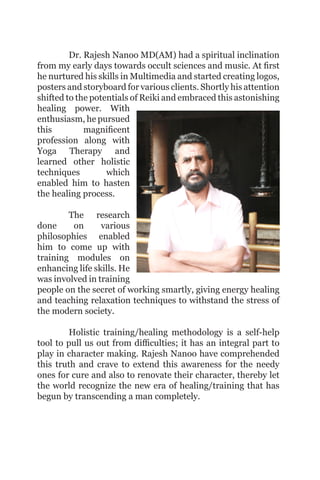
Dr. Rajesh Nanoo MD(AM) had a spiritual inclination
from my early days towards occult sciences and music. At first
he nurtured his skills in Multimedia and started creating logos,
posters and storyboard for various clients. Shortly his attention
shifted to the potentials of Reiki and embraced this astonishing
healing power. With
enthusiasm, he pursued
this magnificent
profession along with
Yoga Therapy and
learned other holistic
techniques which
enabled him to hasten
the healing process.
The research
done on various
philosophies enabled
him to come up with
training modules on
enhancing life skills. He
was involved in training
people on the secret of working smartly, giving energy healing
and teaching relaxation techniques to withstand the stress of
the modern society.
Holistic training/healing methodology is a self-help
tool to pull us out from difficulties; it has an integral part to
play in character making. Rajesh Nanoo have comprehended
this truth and crave to extend this awareness for the needy
ones for cure and also to renovate their character, thereby let
the world recognize the new era of healing/training that has
begun by transcending a man completely.
CONTENTS
1. Ethics Of The Master					 6
2. Food Combination					9
3. Master Symbols						18
4. Nontraditional Symbols		 			 20
5. Reiki Session						25
6. Psychic Surgery 						26
7. Visualizations						30
8. Additional Materials					33
1
Ethics Of The Master
A Reiki master has to fulfill two obligations. First
obligation is towards the lineage so he should indulge on
those things that corrupt it. Second obligation is to pass on
the techniques to the competent student so that this healing
methodology will not be lost again. Only limited ethics are
outlined for a Reiki master because he has reached in a higher
state, which declares, “I am Reiki. It is not an ego-building
statement. It is so because his intellect and Reiki’s intellect
came into a union, only then he is qualified for the coveted
Reiki Master Level. Hence it will be blasphemy to teach him lot
of ethics. Still there is some etiquette to follow:
1.	 Master should act as a synthesis of Reiki teachings, practical
healing and esoteric knowledge.
2.	 Never remain reluctant in giving initiation to a qualified
student.
3.	 Never refrain from initiation due to unnecessary or silly
reasons particularly occurred due to his ego with the
student.
4.	 Never exchange Reiki as a shortcut to be rich. Reiki has
higher values, which cannot be traded by money. Thus the
benefits and its value cannot be measured in the weigh of
money. Hence, never be greedy with money.
5.	 Never make distinction between students by money or
assets they have. Treat every one equally.
6.	 Reiki master should respect each student’s right to choose
their own healing path and their masters.
7.	 Never feel jealousy and become reluctant to admire the
great Reiki masters living around the globe.
Reiki Manual
6
8.	 Never feel jealousy towards his students incase if they
surpass him in mastery of practice and application of
Healing.
9.	 Never think that the student has an obligation to you in
their whole life. We should remain unattached, because the
choice is left to the student whether he admire you or not.
The outcome (good or bad) of the student’s behavior will
solemnly affect the student, thus no need to heed on such
trivial matters.
10.	When a master thinks that, by giving initiation he will loose
his priority over the patients or students is an irrational
thinking and against the ethics of the Reiki. Reiki technique
was lost in olden times because of such selfish thinking.
So it is a prime obligation to Prana and Usui to transfer
our knowledge for the benefit of others. Keep in mind
that we obtained Reiki because Usui transferred to other
competent masters; if Usui were reluctant to transfer then
this technique would have lost again. Similarly the masters
in our lineage too have passed this methodology. Hence it
is our responsibility to transfer this to others.
11.	Never initiate a student if he does not posses faith in it. It
is good to give Reiki session to those who do not have any
faith, after two or three sessions they will understand what
Reiki is, but never teach some one who neither have faith
or respect Reiki.
12.	Give initiation (first and second) only to sincere, honest,
simple and dedicated persons
13.	Students should not be stubborn; they should have
a reasonable understanding and intellect so they can
comprehend the subtle philosophies. I am not saying that
student should be an extraordinary person but he should
be bright enough to understand the procedures of symbols,
sessions.
14.	Give master degree only to those person who are sincere,
honest, and posses enough healing experience. This is very
important because only such a student have the capacity
to transfer energy to other. He should also comprehend
Manual three
7
the procedures and intricacies of attunements and energy
enhancement.
15.	Reiki master should mainly hand over the information
given by Mikao Usui through his lineages. There is no harm
in teaching philosophies that are aligning towards Reiki
methodology. The only criteria are, in such cases the other
materials should be introduced clearly as an additional
from traditional ambit of Reiki teachings.
16.	Always keep the traditional methods intact while adding
new methods in initiation. Other methodologies should
only be add on.
17.	Follow the traditional yardstick of intervals while first,
second and master level initiations.
18.	He should give all the necessary information about Reiki
methodology and also give symbols in its exact form to the
students. Do not hide any information from them so as to
sustain your dominance.
Reiki Manual
8
Proper combination of food is very much important to
keep vital energies intact and also for keeping himself away
from diseases. A Reiki master should always be vigilant about
his food habits and also that of the patients. Upanishad says
Annam Bramheti means - Food is a Creator. This means that
we living beings are creation of food which clearly indicates
that we are what we Eat.
Our diet is an essential factor for the formation of our
body. It is clearly mentioned in classic Ayurvedic text Charak
samhita that consuming improper diet in improper way is the
main cause of disease.
According to Charak samhita: “An appropriate and
suitable diet in a disease is equivalent to hundred drugs
and any quantity of drug hardly compares to good results in
disease without following proper dietetic regimen”. In as far as
diet is concerned, Ayurveda has recommended the following
principles for living full span of life with perfect health.
The intake of diet and what you should take and
should not depends upon a number of factors, among which,
surprisingly includes the desha or territory), kala or season,
and time of the day etc. You should consume foods belonging
to all six rasas or tastes rather than just a few of them so as to
avoid nutritional deficiency disorders. Various tastes provide
you different nutrients.
2
Food Combination
Manual three
9
Ayurveda & Six Tastes (Shad Rasas)
In Ayurvedic method, food is classified by the effect
it has on our body. There are six primary tastes in Ayurvedic
cuisine, each representing different types of foods that play
individual roles in balancing your dosha. Sweet tastes have a
strengthening effect, sour tastes stimulate the digestive system,
salty tastes maintain your water and electrolyte balance,
pungent tastes improve digestion and absorption of nutrients,
astringent tastes also help with absorption and bitter taste
stimulates all other tastes. Understanding them and how they
relate to our individual constitution can help us make better
choices to promote and maintain health.
According to Ayurveda, we are born with a unique
constitution, which is an individual combination of the three
Doshas, or principles that govern the function of our bodies
on the physical, mental and emotional levels. These three
energies are Vata, Pitta & Kapha. Disease is caused by an
imbalance of any of the doshas and by the presence of ama, or
toxic food byproducts (foods which are not digested) According
to Ayurveda, the best preventive medicine and support of
the natural healing process is a diet & lifestyle specific to the
constitutional needs of the individual.
Time of consuming food:
A person should take meal only when he feels hungry.
Lunch should be taken early between 12 noon to 1afternoon;
a time that coincides with the peak pitta period. Pitta is
responsible for the digestion. Lunch should be the largest meal
of the day. The supper should be lesser and lighter than lunch. .
Quantity of food:
Generally half of the capacity of stomach should be
filled with solids, one-fourth with liquids and rest kept empty
for the free movements of body humors. That means you
Reiki Manual
10
Reiki Manual 3

Reiki Manual 3

  • 1.
  • 2.
    Reiki Manual  RajeshNanoo Level Three
  • 3.
    Copyright © 2015by Rajesh Nanoo. All rights reserved. No part of this book may be used or reproduced by any means, graphic, electronic, or mechanical, including photocopying, recording, taping or by any information storage retrieval system without the written permission of the publisher except in the case of brief quotations embodied in critical articles and reviews. For orders and enquires, contact www.rajeshnanoo.com mrknowable@gmail.com
  • 4.
    Reverence be, O Prana, Tothee coming, Reverence to thee going; Reverence to thee standing & Reverence, too, To thee sitting! Atharva Veda
  • 5.
    Dr. Rajesh NanooMD(AM) had a spiritual inclination from my early days towards occult sciences and music. At first he nurtured his skills in Multimedia and started creating logos, posters and storyboard for various clients. Shortly his attention shifted to the potentials of Reiki and embraced this astonishing healing power. With enthusiasm, he pursued this magnificent profession along with Yoga Therapy and learned other holistic techniques which enabled him to hasten the healing process. The research done on various philosophies enabled him to come up with training modules on enhancing life skills. He was involved in training people on the secret of working smartly, giving energy healing and teaching relaxation techniques to withstand the stress of the modern society. Holistic training/healing methodology is a self-help tool to pull us out from difficulties; it has an integral part to play in character making. Rajesh Nanoo have comprehended this truth and crave to extend this awareness for the needy ones for cure and also to renovate their character, thereby let the world recognize the new era of healing/training that has begun by transcending a man completely.
  • 6.
    CONTENTS 1. Ethics OfThe Master 6 2. Food Combination 9 3. Master Symbols 18 4. Nontraditional Symbols 20 5. Reiki Session 25 6. Psychic Surgery 26 7. Visualizations 30 8. Additional Materials 33
  • 7.
    1 Ethics Of TheMaster A Reiki master has to fulfill two obligations. First obligation is towards the lineage so he should indulge on those things that corrupt it. Second obligation is to pass on the techniques to the competent student so that this healing methodology will not be lost again. Only limited ethics are outlined for a Reiki master because he has reached in a higher state, which declares, “I am Reiki. It is not an ego-building statement. It is so because his intellect and Reiki’s intellect came into a union, only then he is qualified for the coveted Reiki Master Level. Hence it will be blasphemy to teach him lot of ethics. Still there is some etiquette to follow: 1. Master should act as a synthesis of Reiki teachings, practical healing and esoteric knowledge. 2. Never remain reluctant in giving initiation to a qualified student. 3. Never refrain from initiation due to unnecessary or silly reasons particularly occurred due to his ego with the student. 4. Never exchange Reiki as a shortcut to be rich. Reiki has higher values, which cannot be traded by money. Thus the benefits and its value cannot be measured in the weigh of money. Hence, never be greedy with money. 5. Never make distinction between students by money or assets they have. Treat every one equally. 6. Reiki master should respect each student’s right to choose their own healing path and their masters. 7. Never feel jealousy and become reluctant to admire the great Reiki masters living around the globe. Reiki Manual 6
  • 8.
    8. Never feeljealousy towards his students incase if they surpass him in mastery of practice and application of Healing. 9. Never think that the student has an obligation to you in their whole life. We should remain unattached, because the choice is left to the student whether he admire you or not. The outcome (good or bad) of the student’s behavior will solemnly affect the student, thus no need to heed on such trivial matters. 10. When a master thinks that, by giving initiation he will loose his priority over the patients or students is an irrational thinking and against the ethics of the Reiki. Reiki technique was lost in olden times because of such selfish thinking. So it is a prime obligation to Prana and Usui to transfer our knowledge for the benefit of others. Keep in mind that we obtained Reiki because Usui transferred to other competent masters; if Usui were reluctant to transfer then this technique would have lost again. Similarly the masters in our lineage too have passed this methodology. Hence it is our responsibility to transfer this to others. 11. Never initiate a student if he does not posses faith in it. It is good to give Reiki session to those who do not have any faith, after two or three sessions they will understand what Reiki is, but never teach some one who neither have faith or respect Reiki. 12. Give initiation (first and second) only to sincere, honest, simple and dedicated persons 13. Students should not be stubborn; they should have a reasonable understanding and intellect so they can comprehend the subtle philosophies. I am not saying that student should be an extraordinary person but he should be bright enough to understand the procedures of symbols, sessions. 14. Give master degree only to those person who are sincere, honest, and posses enough healing experience. This is very important because only such a student have the capacity to transfer energy to other. He should also comprehend Manual three 7
  • 9.
    the procedures andintricacies of attunements and energy enhancement. 15. Reiki master should mainly hand over the information given by Mikao Usui through his lineages. There is no harm in teaching philosophies that are aligning towards Reiki methodology. The only criteria are, in such cases the other materials should be introduced clearly as an additional from traditional ambit of Reiki teachings. 16. Always keep the traditional methods intact while adding new methods in initiation. Other methodologies should only be add on. 17. Follow the traditional yardstick of intervals while first, second and master level initiations. 18. He should give all the necessary information about Reiki methodology and also give symbols in its exact form to the students. Do not hide any information from them so as to sustain your dominance. Reiki Manual 8
  • 10.
    Proper combination offood is very much important to keep vital energies intact and also for keeping himself away from diseases. A Reiki master should always be vigilant about his food habits and also that of the patients. Upanishad says Annam Bramheti means - Food is a Creator. This means that we living beings are creation of food which clearly indicates that we are what we Eat. Our diet is an essential factor for the formation of our body. It is clearly mentioned in classic Ayurvedic text Charak samhita that consuming improper diet in improper way is the main cause of disease. According to Charak samhita: “An appropriate and suitable diet in a disease is equivalent to hundred drugs and any quantity of drug hardly compares to good results in disease without following proper dietetic regimen”. In as far as diet is concerned, Ayurveda has recommended the following principles for living full span of life with perfect health. The intake of diet and what you should take and should not depends upon a number of factors, among which, surprisingly includes the desha or territory), kala or season, and time of the day etc. You should consume foods belonging to all six rasas or tastes rather than just a few of them so as to avoid nutritional deficiency disorders. Various tastes provide you different nutrients. 2 Food Combination Manual three 9
  • 11.
    Ayurveda & SixTastes (Shad Rasas) In Ayurvedic method, food is classified by the effect it has on our body. There are six primary tastes in Ayurvedic cuisine, each representing different types of foods that play individual roles in balancing your dosha. Sweet tastes have a strengthening effect, sour tastes stimulate the digestive system, salty tastes maintain your water and electrolyte balance, pungent tastes improve digestion and absorption of nutrients, astringent tastes also help with absorption and bitter taste stimulates all other tastes. Understanding them and how they relate to our individual constitution can help us make better choices to promote and maintain health. According to Ayurveda, we are born with a unique constitution, which is an individual combination of the three Doshas, or principles that govern the function of our bodies on the physical, mental and emotional levels. These three energies are Vata, Pitta & Kapha. Disease is caused by an imbalance of any of the doshas and by the presence of ama, or toxic food byproducts (foods which are not digested) According to Ayurveda, the best preventive medicine and support of the natural healing process is a diet & lifestyle specific to the constitutional needs of the individual. Time of consuming food: A person should take meal only when he feels hungry. Lunch should be taken early between 12 noon to 1afternoon; a time that coincides with the peak pitta period. Pitta is responsible for the digestion. Lunch should be the largest meal of the day. The supper should be lesser and lighter than lunch. . Quantity of food: Generally half of the capacity of stomach should be filled with solids, one-fourth with liquids and rest kept empty for the free movements of body humors. That means you Reiki Manual 10