Presented by

               Mangesh Naik
                 Roll No. 12
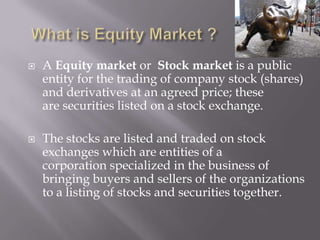
   A Equity market or Stock market is a public
    entity for the trading of company stock (shares)
    and derivatives at an agreed price; these
    are securities listed on a stock exchange.

   The stocks are listed and traded on stock
    exchanges which are entities of a
    corporation specialized in the business of
    bringing buyers and sellers of the organizations
    to a listing of stocks and securities together.
   Market participants include individual retail
    investors, institutional investors such as mutual
    funds, banks, insurance companies and hedge
    funds, and also publicly traded corporations
    trading in their own shares.
   Some studies have suggested that institutional
    investors and corporations trading in their own
    shares generally receive higher risk-adjusted
    returns than retail investors.
   A few decades ago, worldwide, buyers and
    sellers were individual investors, such as wealthy
    businessmen, usually with long family histories
    to particular corporations.
CONTINUED:


   The rise of the institutional investor has
    brought with it some improvements in
    market operations.
   Over time, markets have become more
    "institutionalized"; buyers and sellers are
    largely institutions (e.g., pension
    funds, insurance companies, mutual
    funds, index funds, exchange-traded
    funds, hedge funds, investor groups, banks
    and various other financial institutions).
   There has been a gradual tendency for "fixed" (and
    exorbitant) fees being reduced for all investors, partly
    from falling administration costs but also assisted by
    large institutions challenging brokers' oligopolistic
    approach to setting standardised fees.
   Stock Exchange in India are : National Stock
    Exchange (NSE), Bombay Stock Exchange.

   Bombay Stock Exchange is the 10th largest stock
    exchange in the world by market capitalization,
    Established in 1875, is Asia’s first Stock Exchange.

   BSE’s popular equity index is BSE SENSEX

   The NSE's key index is the NIFTY
   The Equity Market is one of the most
    important sources for companies to raise
    money. This allows businesses to be publicly
    traded, or raise additional financial capital for
    expansion.

    The Equity Market is often considered the
    primary indicator of a country's economic
    strength and development as it indicates social
    mood of the economy.
•As money became a commodity, the money market became a component of
the financial markets for assets involved in short-term borrowing, lending,
buying and selling with original maturities of one year or less.


•Trading in the money markets is done over the counter, is wholesale.

•Various instruments exist, such as Treasury bills, commercial paper, bankers'
acceptances, deposits, certificates of deposit, bills of exchange, repurchase
agreements, federal funds, and short-lived mortgage-, and asset-backed
securities.

• It provides liquidity funding for the global financial system
   Transfer of large sums of money

   Transfer from parties
    with surplus funds to
    parties with a deficit

   Allow governments to raise funds

   Help to implement monetary policy

   Determine short-term interest rates
Participants of
                                   Money Market
•The money market consists of financial institutions and dealers in
money or credit who wish to either borrow or lend. Participants borrow
and lend for short periods of time, typically up to thirteen months.

•Money market trades in short-term financial instruments commonly
called "paper." This contrasts with the capital market for longer-term
funding, which is supplied by bonds and equity.

•The core of the money market consists of interbank lending--banks
borrowing and lending to each other using commercial paper, repurchase
agreements and similar instruments.

• These instruments are often benchmarked to (i.e. priced by reference
to) the London Interbank Offered Rate (LIBOR) for the appropriate term
and currency
Participants of Money Market

• Certain large corporations with strong credit ratings, such
as General Electric, issue commercial paper on their own credit.
Other large corporations arrange for banks to issue commercial
paper on their behalf via commercial paper lines.

•Trading companies often purchase bankers' acceptances to be
tendered for payment to overseas suppliers.
•Retail and institutional money market funds
•Banks
•Central banks
•Cash management programs
•Merchant Banks
   Certificate of deposit - Time deposit, commonly
    offered to consumers by banks, thrift institutions, and
    credit unions.
   Repurchase agreements - Short-term loans—normally
    for less than two weeks and frequently for one day—
    arranged by selling securities to an investor with
    agreement to repurchase them at a fixed price on a fixed
    date.
   Commercial paper - short term usanse promissory
    notes issued by company at discount to face value and
    redeemed at face value
CONTINUED


   Treasury bills - Short-term debt obligations of a
    national government that are issued to mature in
    three to twelve months.

   Money funds - Pooled short maturity, high quality
    investments which buy money market securities on
    behalf of retail or institutional investors.

   Foreign Exchange Swaps - Exchanging a set of
    currencies in spot date and the reversal of the
    exchange of currencies at a predetermined time in
    the future.










Call Market in India







Call Market in India
• The interest rate paid on call money loans, known as the
call rate, is highly volatile.

• It is the most sensitive section of the money market and the
changes in the demand for and supply of call loans are
promptly reflected in call rates. There are now two call rates
in India: the Inter bank call rate and the lending rate of
DFHI.

•The ceilings on the call rate and inter-bank term money rate
were dropped, with effect from May 1, 1989.

• The Indian call money market has been transformed into a
pure inter-bank market during 2006–07. The major call
money markets are in Mumbai, Kolkata, Delhi, Chennai.
   Call markets are helpful in illiquid markets or
    markets where there are few buyers, sellers,
    and shares to trade.
   As such, the buyers and sellers in a call market do
    not have the final say on what the final price is in
    their trades.
   This differs from an auction market, whereby the
    final price is more directly determined
    by market forces.
THANK YOU

Mangesh naik (2)

  • 1.
    Presented by Mangesh Naik Roll No. 12
  • 2.
    A Equity market or Stock market is a public entity for the trading of company stock (shares) and derivatives at an agreed price; these are securities listed on a stock exchange.  The stocks are listed and traded on stock exchanges which are entities of a corporation specialized in the business of bringing buyers and sellers of the organizations to a listing of stocks and securities together.
  • 3.
    Market participants include individual retail investors, institutional investors such as mutual funds, banks, insurance companies and hedge funds, and also publicly traded corporations trading in their own shares.  Some studies have suggested that institutional investors and corporations trading in their own shares generally receive higher risk-adjusted returns than retail investors.  A few decades ago, worldwide, buyers and sellers were individual investors, such as wealthy businessmen, usually with long family histories to particular corporations.
  • 4.
    CONTINUED:  The rise of the institutional investor has brought with it some improvements in market operations.  Over time, markets have become more "institutionalized"; buyers and sellers are largely institutions (e.g., pension funds, insurance companies, mutual funds, index funds, exchange-traded funds, hedge funds, investor groups, banks and various other financial institutions).
  • 5.
    There has been a gradual tendency for "fixed" (and exorbitant) fees being reduced for all investors, partly from falling administration costs but also assisted by large institutions challenging brokers' oligopolistic approach to setting standardised fees.
  • 6.
    Stock Exchange in India are : National Stock Exchange (NSE), Bombay Stock Exchange.  Bombay Stock Exchange is the 10th largest stock exchange in the world by market capitalization, Established in 1875, is Asia’s first Stock Exchange.  BSE’s popular equity index is BSE SENSEX  The NSE's key index is the NIFTY
  • 7.
    The Equity Market is one of the most important sources for companies to raise money. This allows businesses to be publicly traded, or raise additional financial capital for expansion.  The Equity Market is often considered the primary indicator of a country's economic strength and development as it indicates social mood of the economy.
  • 8.
    •As money becamea commodity, the money market became a component of the financial markets for assets involved in short-term borrowing, lending, buying and selling with original maturities of one year or less. •Trading in the money markets is done over the counter, is wholesale. •Various instruments exist, such as Treasury bills, commercial paper, bankers' acceptances, deposits, certificates of deposit, bills of exchange, repurchase agreements, federal funds, and short-lived mortgage-, and asset-backed securities. • It provides liquidity funding for the global financial system
  • 9.
    Transfer of large sums of money  Transfer from parties with surplus funds to parties with a deficit  Allow governments to raise funds  Help to implement monetary policy  Determine short-term interest rates
  • 10.
    Participants of Money Market •The money market consists of financial institutions and dealers in money or credit who wish to either borrow or lend. Participants borrow and lend for short periods of time, typically up to thirteen months. •Money market trades in short-term financial instruments commonly called "paper." This contrasts with the capital market for longer-term funding, which is supplied by bonds and equity. •The core of the money market consists of interbank lending--banks borrowing and lending to each other using commercial paper, repurchase agreements and similar instruments. • These instruments are often benchmarked to (i.e. priced by reference to) the London Interbank Offered Rate (LIBOR) for the appropriate term and currency
  • 11.
    Participants of MoneyMarket • Certain large corporations with strong credit ratings, such as General Electric, issue commercial paper on their own credit. Other large corporations arrange for banks to issue commercial paper on their behalf via commercial paper lines. •Trading companies often purchase bankers' acceptances to be tendered for payment to overseas suppliers. •Retail and institutional money market funds •Banks •Central banks •Cash management programs •Merchant Banks
  • 12.
    Certificate of deposit - Time deposit, commonly offered to consumers by banks, thrift institutions, and credit unions.  Repurchase agreements - Short-term loans—normally for less than two weeks and frequently for one day— arranged by selling securities to an investor with agreement to repurchase them at a fixed price on a fixed date.  Commercial paper - short term usanse promissory notes issued by company at discount to face value and redeemed at face value
  • 13.
    CONTINUED  Treasury bills - Short-term debt obligations of a national government that are issued to mature in three to twelve months.  Money funds - Pooled short maturity, high quality investments which buy money market securities on behalf of retail or institutional investors.  Foreign Exchange Swaps - Exchanging a set of currencies in spot date and the reversal of the exchange of currencies at a predetermined time in the future.
  • 14.
  • 15.
    Call Market inIndia   
  • 16.
    Call Market inIndia • The interest rate paid on call money loans, known as the call rate, is highly volatile. • It is the most sensitive section of the money market and the changes in the demand for and supply of call loans are promptly reflected in call rates. There are now two call rates in India: the Inter bank call rate and the lending rate of DFHI. •The ceilings on the call rate and inter-bank term money rate were dropped, with effect from May 1, 1989. • The Indian call money market has been transformed into a pure inter-bank market during 2006–07. The major call money markets are in Mumbai, Kolkata, Delhi, Chennai.
  • 17.
    Call markets are helpful in illiquid markets or markets where there are few buyers, sellers, and shares to trade.  As such, the buyers and sellers in a call market do not have the final say on what the final price is in their trades.  This differs from an auction market, whereby the final price is more directly determined by market forces.
  • 18.