PRESENTATION 3 OF 24 / 1 
www.axcesscapon.com www.wileyindia.com 
© Noel Capon and Siddharth Shekhar Singh, 2014. All rights reserved. 
Managing Markets Strategically 
Professor Noel Capon 
R.C. Kopf Professor of International Marketing 
Columbia Business School 
New York, NY, U.S.A. 
Professor Siddharth Shekhar Singh 
Director Fellow Programme in Management & 
Associate Professor of Marketing 
Indian School of Business 
Hyderabad & Mohali, India
Managing Markets Strategically 
PRESENTATION 3 OF 24 / 2 
www.axcesscapon.com www.wileyindia.com 
© Noel Capon and Siddharth Shekhar Singh, 2014. All rights reserved. 
Section I: Marketing and the Firm 
Section II: Fundamental Insights for Strategic Marketing 
Chapter 3: Market Insight 
Chapter 4: Customer Insight 
Chapter 5: Insight about Competitors, Company, and Complementers 
Chapter 6: Marketing Research 
Transition to Strategic Marketing 
Section III: Strategic Marketing 
Section IV: Implementing the Market Strategy 
Section V: Special Marketing Topics
PRESENTATION 3 OF 24 / 3 
www.axcesscapon.com www.wileyindia.com 
© Noel Capon and Siddharth Shekhar Singh, 2014. All rights reserved. 
CHAPTER 3 
Market Insight
Insight for Strategic Marketing 
PRESENTATION 3 OF 24 / 4 
Market Insight 
www.axcesscapon.com www.wileyindia.com 
Customer Insight Competitor 
Company 
Complementer 
Insight 
© Noel Capon and Siddharth Shekhar Singh, 2014. All rights reserved.
What Is Insight? 
PRESENTATION 3 OF 24 / 5 
www.axcesscapon.com www.wileyindia.com 
© Noel Capon and Siddharth Shekhar Singh, 2014. All rights reserved. 
Source: Impact Planning Group, by permission
Market Insight 
PRESENTATION 3 OF 24 / 6 
www.axcesscapon.com www.wileyindia.com 
© Noel Capon and Siddharth Shekhar Singh, 2014. All rights reserved. 
Anticipating 
market 
changes 
Market 
insight is 
critical for: 
Identifying 
potential 
opportunities 
Laying a 
foundation 
for 
developing 
Opportunity 
sizing 
Identifying 
areas to 
differentiate
Building Blocks for Securing Market Insight 
PRESENTATION 3 OF 24 / 7 
www.axcesscapon.com www.wileyindia.com 
© Noel Capon and Siddharth Shekhar Singh, 2014. All rights reserved. 
Market 
Structure 
Market 
Insight 
Market and 
Product 
Evolution 
Industry 
Forces 
Environmental 
Forces
Market Structure 
PRESENTATION 3 OF 24 / 8 
www.axcesscapon.com www.wileyindia.com 
© Noel Capon and Siddharth Shekhar Singh, 2014. All rights reserved. 
• Market definition 
A market comprises customers – people and organizations – who require products 
and services to satisfy their needs … and have sufficient purchasing power – and 
interest to buy what firms are offering. 
• Market size factors 
• Population size and growth 
• Population mix 
• Geographic population shifts 
• Income and income distribution 
• Age distribution 
• Beware marketing myopia 
• Approaches 
• Build up 
• SAM, TAM, PAM 
• Hierarchical decomposition
Market Structure 
PRESENTATION 3 OF 24 / 9 
www.axcesscapon.com www.wileyindia.com 
© Noel Capon and Siddharth Shekhar Singh, 2014. All rights reserved. 
Build Up: Illustration – Treating Aneurysms
Market Structure 
PRESENTATION 3 OF 24 / 10 
www.axcesscapon.com www.wileyindia.com 
© Noel Capon and Siddharth Shekhar Singh, 2014. All rights reserved. 
SAM, TAM, PAM
Market Structure 
PRESENTATION 3 OF 24 / 11 
www.axcesscapon.com www.wileyindia.com 
© Noel Capon and Siddharth Shekhar Singh, 2014. All rights reserved. 
Hierarchical Decomposition: Illustration – Entertainment Market
Market Structure 
PRESENTATION 3 OF 24 / 12 
www.axcesscapon.com www.wileyindia.com 
© Noel Capon and Siddharth Shekhar Singh, 2014. All rights reserved. 
Definitions and Distinctions 
Product class: A group of products offered by competing suppliers that 
serve a subset of customer needs in a roughly similar 
manner. 
Product form: Several product forms comprise each product class. 
Products within a product form are more similar in how they 
meet customer needs than products in other product forms. 
Product line: A group of related products that a single firm offers. 
Product item: A subset of the product line that is uniquely identified.
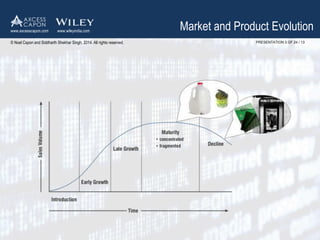
Market and Product Evolution 
PRESENTATION 3 OF 24 / 13 
www.axcesscapon.com www.wileyindia.com 
© Noel Capon and Siddharth Shekhar Singh, 2014. All rights reserved.
Market and Product Evolution 
PRESENTATION 3 OF 24 / 14 
www.axcesscapon.com www.wileyindia.com 
© Noel Capon and Siddharth Shekhar Singh, 2014. All rights reserved. 
Product Class and Product Form Life Cycles
Market and Product Evolution 
PRESENTATION 3 OF 24 / 15 
www.axcesscapon.com www.wileyindia.com 
© Noel Capon and Siddharth Shekhar Singh, 2014. All rights reserved. 
Sales and Profit Margin Life Cycles
Market and Product Evolution 
PRESENTATION 3 OF 24 / 16 
www.axcesscapon.com www.wileyindia.com 
© Noel Capon and Siddharth Shekhar Singh, 2014. All rights reserved. 
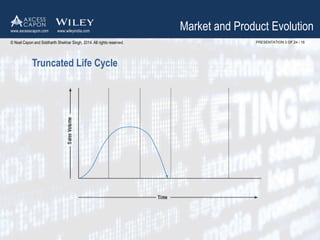
Truncated Life Cycle
Industry Forces 
PRESENTATION 3 OF 24 / 17 
www.axcesscapon.com www.wileyindia.com 
© Noel Capon and Siddharth Shekhar Singh, 2014. All rights reserved. 
Suppliers 
Direct 
THE FIRM 
Competitors 
Indirect 
Competitors 
Buyers 
New Direct 
Entrants
Industry Forces 
PRESENTATION 3 OF 24 / 18 
www.axcesscapon.com www.wileyindia.com 
© Noel Capon and Siddharth Shekhar Singh, 2014. All rights reserved. 
Direct Competitors 
Traditional 
direct 
competitors 
Acquisitions 
and 
divestitures 
Mergers 
Private 
equity
Industry Forces 
PRESENTATION 3 OF 24 / 19 
www.axcesscapon.com www.wileyindia.com 
© Noel Capon and Siddharth Shekhar Singh, 2014. All rights reserved. 
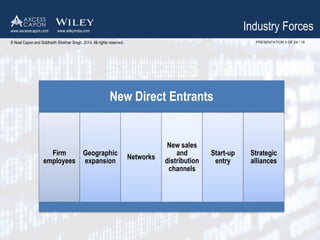
New Direct Entrants 
Firm 
employees 
Geographic 
expansion 
Networks 
New sales 
and 
distribution 
channels 
Start-up 
entry 
Strategic 
alliances
Environmental Forces 
PRESENTATION 3 OF 24 / 20 
www.axcesscapon.com www.wileyindia.com 
© Noel Capon and Siddharth Shekhar Singh, 2014. All rights reserved. 
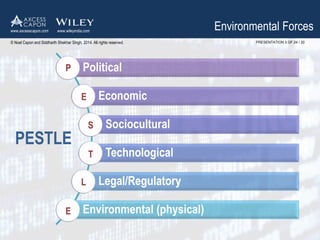
Political 
Economic 
Sociocultural 
Technological 
Legal/Regulatory 
Environmental (physical) 
P 
E 
S 
T 
L 
PESTLE 
E
Environmental Forces 
PRESENTATION 3 OF 24 / 21 
www.axcesscapon.com www.wileyindia.com 
© Noel Capon and Siddharth Shekhar Singh, 2014. All rights reserved. 
Political 
Policy Variable General Goal 
Competition policy Enhance competition 
Employment law Protect employees 
Government spending Implement government policy 
Multinational agreements Enhance trade and investment 
Political stability Enhance investment 
Privatization Enhance competition 
Regulation of financial markets Protect investors 
Taxation policy Redistribute income
Environmental Forces 
PRESENTATION 3 OF 24 / 22 
© Noel Capon and Siddharth Shekhar Singh, 2014. All rights reserved. 
Economic 
Economic Variable Impact on Economic Well-Being 
Balance of payments Negative balance of payments means government must borrow – 
increased pressure for higher taxes 
Exchange rates Value of national currents. Low exchanges rates help exports; high 
exchange rates are better for purchasing foreign goods. 
Disposable income An individual’s income after paying taxes – available for spending and 
saving. Higher is better. 
GDP or GDP per capita The measure of a nation’s output, or output per person. Higher is better. 
Inflation Rate of price increases. Lower is better, but too lows means deflation. 
Interest rates Affect customer spending – especially for durables and business 
investment. Lower is better, but too low may fuel deflation. 
Savings rate Affects interest rates and consumer spending. Higher is better, but too 
high means insufficient consumption. 
Unemployment Population out of work. Lower is better, but too low and labor costs 
increase. 
www.axcesscapon.com www.wileyindia.com
Environmental Forces 
PRESENTATION 3 OF 24 / 23 
© Noel Capon and Siddharth Shekhar Singh, 2014. All rights reserved. 
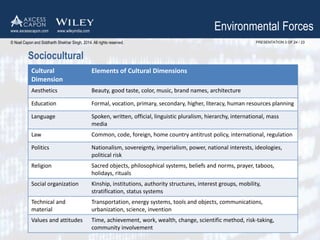
Sociocultural 
Cultural 
Dimension 
Elements of Cultural Dimensions 
Aesthetics Beauty, good taste, color, music, brand names, architecture 
Education Formal, vocation, primary, secondary, higher, literacy, human resources planning 
Language Spoken, written, official, linguistic pluralism, hierarchy, international, mass 
media 
Law Common, code, foreign, home country antitrust policy, international, regulation 
Politics Nationalism, sovereignty, imperialism, power, national interests, ideologies, 
political risk 
Religion Sacred objects, philosophical systems, beliefs and norms, prayer, taboos, 
holidays, rituals 
Social organization Kinship, institutions, authority structures, interest groups, mobility, 
stratification, status systems 
Technical and 
material 
Transportation, energy systems, tools and objects, communications, 
urbanization, science, invention 
Values and attitudes Time, achievement, work, wealth, change, scientific method, risk-taking, 
community involvement 
www.axcesscapon.com www.wileyindia.com
Environmental Forces 
PRESENTATION 3 OF 24 / 24 
www.axcesscapon.com www.wileyindia.com 
© Noel Capon and Siddharth Shekhar Singh, 2014. All rights reserved. 
Sociocultural 
• Cultural and subcultural groups 
• Localization and globalization
Environmental Forces 
PRESENTATION 3 OF 24 / 25 
www.axcesscapon.com www.wileyindia.com 
© Noel Capon and Siddharth Shekhar Singh, 2014. All rights reserved. 
Technological 
Innovations 
since 
World War II 
dry 
copiers 
color 
television 
integrated 
circuits microwave 
ovens passenger 
jet aircraft 
synthetic 
and 
optical 
fibers 
ATMs virtually 
all 
plastics 
computers 
antibiotic 
drugs 
digital 
video 
recorders 
(DVRs) 
communication 
satellites 
cellular 
telephonet
Environmental Forces 
PRESENTATION 3 OF 24 / 26 
© Noel Capon and Siddharth Shekhar Singh, 2014. All rights reserved. 
Technological Forces 
Illustration – Bank Transactions 
Mode Cost/Transaction 
Branch teller $2.50 
Telephone $1.00 
ATM $0.40 
Quasi-personal response $0.24 
Internet $0.10 
www.axcesscapon.com www.wileyindia.com
Environmental Forces 
PRESENTATION 3 OF 24 / 27 
www.axcesscapon.com www.wileyindia.com 
© Noel Capon and Siddharth Shekhar Singh, 2014. All rights reserved. 
Technological 
• Sustaining technologies: improve performance for current products on 
dimensions existing customers value 
• Disruptive technologies: bring new and very different value propositions 
• Firms often ignore or reject disruptive innovations 
• inferior performance 
• firm rewards – potential cannibalization
Environmental Forces 
PRESENTATION 3 OF 24 / 28 
www.axcesscapon.com www.wileyindia.com 
© Noel Capon and Siddharth Shekhar Singh, 2014. All rights reserved. 
Industry Forces 
Suppliers 
Direct 
THE FIRM 
Competitors 
Indirect 
Competitors 
Buyers 
New Direct 
Entrants
Environmental Forces 
PRESENTATION 3 OF 24 / 29 
www.axcesscapon.com www.wileyindia.com 
The Augmented Industry Environment 
Suppliers 
Direct 
The Firm 
Competitors 
Buyers 
New Direct 
Entrants 
Indirect 
Competito 
rs 
Political 
Economic 
Sociocultural 
Technological 
Environmental (physical) 
Legal/Regulatory 
© Noel Capon and Siddharth Shekhar Singh, 2014. All rights reserved.
Market Insight 
PRESENTATION 3 OF 24 / 30 
www.axcesscapon.com www.wileyindia.com 
© Noel Capon and Siddharth Shekhar Singh, 2014. All rights reserved. 
One Final Item 
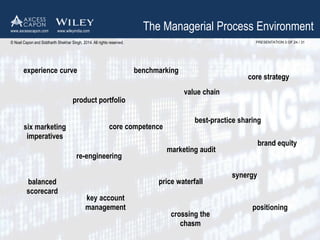
• The managerial process environment: concepts, framework, ideas, and tools 
to lead and manage organizations
The Managerial Process Environment 
PRESENTATION 3 OF 24 / 31 
www.axcesscapon.com www.wileyindia.com 
experience curve benchmarking 
value chain 
core strategy 
best-practice sharing 
product portfolio 
six marketing 
imperatives 
core competence 
marketing audit 
brand equity 
re-engineering 
synergy 
balanced price waterfall 
scorecard 
key account 
management 
crossing the 
chasm 
positioning 
© Noel Capon and Siddharth Shekhar Singh, 2014. All rights reserved.

Strategic Marketing- Fundamental Insights

  • 1.
    PRESENTATION 3 OF24 / 1 www.axcesscapon.com www.wileyindia.com © Noel Capon and Siddharth Shekhar Singh, 2014. All rights reserved. Managing Markets Strategically Professor Noel Capon R.C. Kopf Professor of International Marketing Columbia Business School New York, NY, U.S.A. Professor Siddharth Shekhar Singh Director Fellow Programme in Management & Associate Professor of Marketing Indian School of Business Hyderabad & Mohali, India
  • 2.
    Managing Markets Strategically PRESENTATION 3 OF 24 / 2 www.axcesscapon.com www.wileyindia.com © Noel Capon and Siddharth Shekhar Singh, 2014. All rights reserved. Section I: Marketing and the Firm Section II: Fundamental Insights for Strategic Marketing Chapter 3: Market Insight Chapter 4: Customer Insight Chapter 5: Insight about Competitors, Company, and Complementers Chapter 6: Marketing Research Transition to Strategic Marketing Section III: Strategic Marketing Section IV: Implementing the Market Strategy Section V: Special Marketing Topics
  • 3.
    PRESENTATION 3 OF24 / 3 www.axcesscapon.com www.wileyindia.com © Noel Capon and Siddharth Shekhar Singh, 2014. All rights reserved. CHAPTER 3 Market Insight
  • 4.
    Insight for StrategicMarketing PRESENTATION 3 OF 24 / 4 Market Insight www.axcesscapon.com www.wileyindia.com Customer Insight Competitor Company Complementer Insight © Noel Capon and Siddharth Shekhar Singh, 2014. All rights reserved.
  • 5.
    What Is Insight? PRESENTATION 3 OF 24 / 5 www.axcesscapon.com www.wileyindia.com © Noel Capon and Siddharth Shekhar Singh, 2014. All rights reserved. Source: Impact Planning Group, by permission
  • 6.
    Market Insight PRESENTATION3 OF 24 / 6 www.axcesscapon.com www.wileyindia.com © Noel Capon and Siddharth Shekhar Singh, 2014. All rights reserved. Anticipating market changes Market insight is critical for: Identifying potential opportunities Laying a foundation for developing Opportunity sizing Identifying areas to differentiate
  • 7.
    Building Blocks forSecuring Market Insight PRESENTATION 3 OF 24 / 7 www.axcesscapon.com www.wileyindia.com © Noel Capon and Siddharth Shekhar Singh, 2014. All rights reserved. Market Structure Market Insight Market and Product Evolution Industry Forces Environmental Forces
  • 8.
    Market Structure PRESENTATION3 OF 24 / 8 www.axcesscapon.com www.wileyindia.com © Noel Capon and Siddharth Shekhar Singh, 2014. All rights reserved. • Market definition A market comprises customers – people and organizations – who require products and services to satisfy their needs … and have sufficient purchasing power – and interest to buy what firms are offering. • Market size factors • Population size and growth • Population mix • Geographic population shifts • Income and income distribution • Age distribution • Beware marketing myopia • Approaches • Build up • SAM, TAM, PAM • Hierarchical decomposition
  • 9.
    Market Structure PRESENTATION3 OF 24 / 9 www.axcesscapon.com www.wileyindia.com © Noel Capon and Siddharth Shekhar Singh, 2014. All rights reserved. Build Up: Illustration – Treating Aneurysms
  • 10.
    Market Structure PRESENTATION3 OF 24 / 10 www.axcesscapon.com www.wileyindia.com © Noel Capon and Siddharth Shekhar Singh, 2014. All rights reserved. SAM, TAM, PAM
  • 11.
    Market Structure PRESENTATION3 OF 24 / 11 www.axcesscapon.com www.wileyindia.com © Noel Capon and Siddharth Shekhar Singh, 2014. All rights reserved. Hierarchical Decomposition: Illustration – Entertainment Market
  • 12.
    Market Structure PRESENTATION3 OF 24 / 12 www.axcesscapon.com www.wileyindia.com © Noel Capon and Siddharth Shekhar Singh, 2014. All rights reserved. Definitions and Distinctions Product class: A group of products offered by competing suppliers that serve a subset of customer needs in a roughly similar manner. Product form: Several product forms comprise each product class. Products within a product form are more similar in how they meet customer needs than products in other product forms. Product line: A group of related products that a single firm offers. Product item: A subset of the product line that is uniquely identified.
  • 13.
    Market and ProductEvolution PRESENTATION 3 OF 24 / 13 www.axcesscapon.com www.wileyindia.com © Noel Capon and Siddharth Shekhar Singh, 2014. All rights reserved.
  • 14.
    Market and ProductEvolution PRESENTATION 3 OF 24 / 14 www.axcesscapon.com www.wileyindia.com © Noel Capon and Siddharth Shekhar Singh, 2014. All rights reserved. Product Class and Product Form Life Cycles
  • 15.
    Market and ProductEvolution PRESENTATION 3 OF 24 / 15 www.axcesscapon.com www.wileyindia.com © Noel Capon and Siddharth Shekhar Singh, 2014. All rights reserved. Sales and Profit Margin Life Cycles
  • 16.
    Market and ProductEvolution PRESENTATION 3 OF 24 / 16 www.axcesscapon.com www.wileyindia.com © Noel Capon and Siddharth Shekhar Singh, 2014. All rights reserved. Truncated Life Cycle
  • 17.
    Industry Forces PRESENTATION3 OF 24 / 17 www.axcesscapon.com www.wileyindia.com © Noel Capon and Siddharth Shekhar Singh, 2014. All rights reserved. Suppliers Direct THE FIRM Competitors Indirect Competitors Buyers New Direct Entrants
  • 18.
    Industry Forces PRESENTATION3 OF 24 / 18 www.axcesscapon.com www.wileyindia.com © Noel Capon and Siddharth Shekhar Singh, 2014. All rights reserved. Direct Competitors Traditional direct competitors Acquisitions and divestitures Mergers Private equity
  • 19.
    Industry Forces PRESENTATION3 OF 24 / 19 www.axcesscapon.com www.wileyindia.com © Noel Capon and Siddharth Shekhar Singh, 2014. All rights reserved. New Direct Entrants Firm employees Geographic expansion Networks New sales and distribution channels Start-up entry Strategic alliances
  • 20.
    Environmental Forces PRESENTATION3 OF 24 / 20 www.axcesscapon.com www.wileyindia.com © Noel Capon and Siddharth Shekhar Singh, 2014. All rights reserved. Political Economic Sociocultural Technological Legal/Regulatory Environmental (physical) P E S T L PESTLE E
  • 21.
    Environmental Forces PRESENTATION3 OF 24 / 21 www.axcesscapon.com www.wileyindia.com © Noel Capon and Siddharth Shekhar Singh, 2014. All rights reserved. Political Policy Variable General Goal Competition policy Enhance competition Employment law Protect employees Government spending Implement government policy Multinational agreements Enhance trade and investment Political stability Enhance investment Privatization Enhance competition Regulation of financial markets Protect investors Taxation policy Redistribute income
  • 22.
    Environmental Forces PRESENTATION3 OF 24 / 22 © Noel Capon and Siddharth Shekhar Singh, 2014. All rights reserved. Economic Economic Variable Impact on Economic Well-Being Balance of payments Negative balance of payments means government must borrow – increased pressure for higher taxes Exchange rates Value of national currents. Low exchanges rates help exports; high exchange rates are better for purchasing foreign goods. Disposable income An individual’s income after paying taxes – available for spending and saving. Higher is better. GDP or GDP per capita The measure of a nation’s output, or output per person. Higher is better. Inflation Rate of price increases. Lower is better, but too lows means deflation. Interest rates Affect customer spending – especially for durables and business investment. Lower is better, but too low may fuel deflation. Savings rate Affects interest rates and consumer spending. Higher is better, but too high means insufficient consumption. Unemployment Population out of work. Lower is better, but too low and labor costs increase. www.axcesscapon.com www.wileyindia.com
  • 23.
    Environmental Forces PRESENTATION3 OF 24 / 23 © Noel Capon and Siddharth Shekhar Singh, 2014. All rights reserved. Sociocultural Cultural Dimension Elements of Cultural Dimensions Aesthetics Beauty, good taste, color, music, brand names, architecture Education Formal, vocation, primary, secondary, higher, literacy, human resources planning Language Spoken, written, official, linguistic pluralism, hierarchy, international, mass media Law Common, code, foreign, home country antitrust policy, international, regulation Politics Nationalism, sovereignty, imperialism, power, national interests, ideologies, political risk Religion Sacred objects, philosophical systems, beliefs and norms, prayer, taboos, holidays, rituals Social organization Kinship, institutions, authority structures, interest groups, mobility, stratification, status systems Technical and material Transportation, energy systems, tools and objects, communications, urbanization, science, invention Values and attitudes Time, achievement, work, wealth, change, scientific method, risk-taking, community involvement www.axcesscapon.com www.wileyindia.com
  • 24.
    Environmental Forces PRESENTATION3 OF 24 / 24 www.axcesscapon.com www.wileyindia.com © Noel Capon and Siddharth Shekhar Singh, 2014. All rights reserved. Sociocultural • Cultural and subcultural groups • Localization and globalization
  • 25.
    Environmental Forces PRESENTATION3 OF 24 / 25 www.axcesscapon.com www.wileyindia.com © Noel Capon and Siddharth Shekhar Singh, 2014. All rights reserved. Technological Innovations since World War II dry copiers color television integrated circuits microwave ovens passenger jet aircraft synthetic and optical fibers ATMs virtually all plastics computers antibiotic drugs digital video recorders (DVRs) communication satellites cellular telephonet
  • 26.
    Environmental Forces PRESENTATION3 OF 24 / 26 © Noel Capon and Siddharth Shekhar Singh, 2014. All rights reserved. Technological Forces Illustration – Bank Transactions Mode Cost/Transaction Branch teller $2.50 Telephone $1.00 ATM $0.40 Quasi-personal response $0.24 Internet $0.10 www.axcesscapon.com www.wileyindia.com
  • 27.
    Environmental Forces PRESENTATION3 OF 24 / 27 www.axcesscapon.com www.wileyindia.com © Noel Capon and Siddharth Shekhar Singh, 2014. All rights reserved. Technological • Sustaining technologies: improve performance for current products on dimensions existing customers value • Disruptive technologies: bring new and very different value propositions • Firms often ignore or reject disruptive innovations • inferior performance • firm rewards – potential cannibalization
  • 28.
    Environmental Forces PRESENTATION3 OF 24 / 28 www.axcesscapon.com www.wileyindia.com © Noel Capon and Siddharth Shekhar Singh, 2014. All rights reserved. Industry Forces Suppliers Direct THE FIRM Competitors Indirect Competitors Buyers New Direct Entrants
  • 29.
    Environmental Forces PRESENTATION3 OF 24 / 29 www.axcesscapon.com www.wileyindia.com The Augmented Industry Environment Suppliers Direct The Firm Competitors Buyers New Direct Entrants Indirect Competito rs Political Economic Sociocultural Technological Environmental (physical) Legal/Regulatory © Noel Capon and Siddharth Shekhar Singh, 2014. All rights reserved.
  • 30.
    Market Insight PRESENTATION3 OF 24 / 30 www.axcesscapon.com www.wileyindia.com © Noel Capon and Siddharth Shekhar Singh, 2014. All rights reserved. One Final Item • The managerial process environment: concepts, framework, ideas, and tools to lead and manage organizations
  • 31.
    The Managerial ProcessEnvironment PRESENTATION 3 OF 24 / 31 www.axcesscapon.com www.wileyindia.com experience curve benchmarking value chain core strategy best-practice sharing product portfolio six marketing imperatives core competence marketing audit brand equity re-engineering synergy balanced price waterfall scorecard key account management crossing the chasm positioning © Noel Capon and Siddharth Shekhar Singh, 2014. All rights reserved.