Managing grandparental
involvement in child-rearing in the
context of intensive motherhood
Lisa Sivak,
National Research University ‘Higher School of Economics’, Moscow (Russia)
24th June, 2016
Parenting and Personhood: Cross-cultural perspectives on family-life, expertise,
and risk management, Centre for parenting Culture Studies
Intergenerational conflicts (Clarke et al., 1999)
Intergenerational ambivalence (Luescher, 2011)
Mothers as gatekeepers
(Sims, Rofail, 2013)
Background
Intensive motherhood
Parental determinism
Risk-consciousness
Expert oriented parenting culture
Hays 1998, Füredi 2001, Faircloth 2010, Lee et al.
2014, etc.
Background
Research question
How is this discourse of intensive parenting and
risks transmitted and enacted in familial
relations around raising a child?
How do mothers experience grandparental
involvement and perceive grandparental authority in
childrearing?
How do mothers deal with ‘wrong’ childrearing
practices of grandparents and anxiety over it?
Research questions
Russian context
A rising market of early development centers
Vast industry of childcare advice
Emerging parenting education
Various experts (in babywearing, breast feeding,
attachment theory, etc.)
Russian context: intensive parenting
Russian context
Russian context: grandparenting
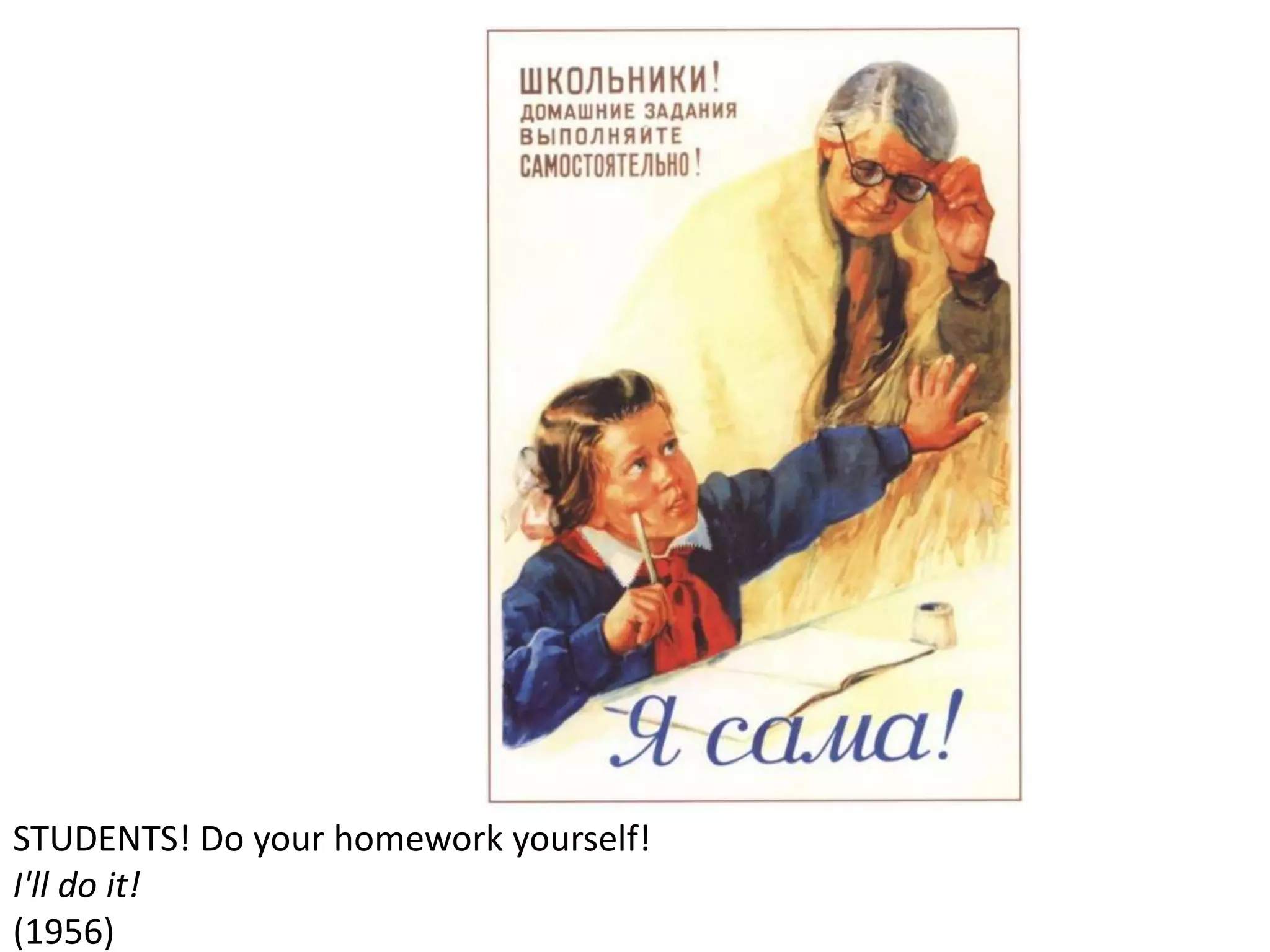
STUDENTS! Do your homework yourself!
I'll do it!
(1956)
Russian context
High rates of co-residing:
30% of multigenerational households in Russia
5% in France
In 37% families with children under 14 grandmother or
grand-grandmother are involved in child-rearing
In 9% grandfather of grand-grandfather
20% of grandparents in France, Germany, Belgium, Austria provide
childcare on an everyday basis (Herlofson & Hagestad 2012)
40% in southern Europe
Russian context: grandparenting
Sample
• 50 interviews with mothers (‘core’ sample – 25
informants), 2014-2015
• At least one child under school age (1-7 years old)
• Recruiting: announcements in online-communities+
snowballing
• Living in Moscow
• High level of education
• Almost all are currently employed
• Almost all married
• On average one or two children
Sample
Results
Undermined grandparental authority
family experience is rejected on both ‘theoretical’
and ‘empirical’ grounds
Bad parenting practices
Parents’ practices are what mothers’ want to
overcome – not adopt
I’ve encountered such behavior [manipulative methods of
education, used by her parents - intimidation, bribery,
etc.], and this has had a negative effect on my self-
esteem and ability to cope with different situations,
including traumatic experiences. I believe that if my
parents had helped me out and shown an ability to deal
effectively with such situations without humiliation,
intimidation, shaming, disgust, and self-pity, then I would
have used many years of my life more effectively – not
on the analysis of this pile of problems. So I want to save
my child from this unnecessary strain
A., 35 years, one child, 3 years
I’m trying to minimize the grandparents’
involvement in child-rearing. Me and my
husband have already experienced it
ourselves, and we agree that, to be honest, it
was not the best parenting. It had some
results, but it was far from perfect. And we
don’t want a repetition of that on our
children.
M., 29 years, one child, 4 years
Results
Undermined grandparental authority
family experience is rejected on both ‘empirical’ and
‘theoretical’ grounds
Bad parenting practices
big impact of small actions
Parents’ practices are what mothers’ want to
overcome – not adopt
Now, since I became involved in psychotherapy,
I’ve let it go. But before that I thought that any
adult who said something to my child in a
‘wrong’ way could ruin everything, could instill
the wrong thoughts.
V., 30 years, one child, 4.5 years
‘a thoughtlessly said casual word can deeply
affect the child’
‘small things are small, but they repeat time after
time’
Results
Undermined grandparental authority
family experience is rejected on both ‘empirical’ and
‘theoretical’ grounds
Bad parenting practices
Parents’ practices are what mothers’ want to
overcome – not adopt
For many years I was afraid to have children. I
was very afraid that I would behave like my
mother, because I had rage attacks on my cat
[laughs]. My confidence in myself as a
mother was undermined, and attachment
theory helped me restore it.
P., 34 years, one child, 3 years
Grandmothers [the child’s grandmothers] have
the arsenal of techniques which were used
even by their parents. I think we are the first
generation who is trying to approach
parenthood consciously, because before that
everything was based on tradition
A., 32 years, one child, 1 year
Results
Strategies of dealing with grandparental
involvement in childrearing
Micro-managing
Education and negotiations
Reformatting of grandparental involvement in child-
rearing
Providing the child with the correct interpretation of that
experience
Counter-stories
I came up with a story [for grandparents] that
we know that grandparents have a lot of things
to do, and I don’t want to bother them, so we
communicate in a framework of just ‘showing
up to visit them’. So, my decision was not to
put them in any position like ‘sitting with the
kids’, where they would need to solve any
problems concerning them.
S., 37 years, three children, from 5 to 11 years old
Results
Strategies of dealing with grandparental
involvement in childrearing
Micro-managing
Education and negotiations
Reformatting of grandparental involvement in child-
rearing
providing the child with the ‘correct’ interpretation of
grandparents’ actions
Counter-stories
My job is simply to tell him, against this
background [the grandmother doing what the
child himself is supposed to do, everything that
the child wants, etc.] that actually it’s not easy for
Grandma to do all these things, and that she has
problems with her back, and that is not normal
that she is crawling here on the floor with him,
and that it’s only because she loves him very
much.
E., 30 years, one child, 4 years
Results
Strategies of dealing with grandparental
involvement in childrearing
Micro-managing
Counter-stories
benefits of a child’s experience of different parenting
practices
Reconsidering grandparents’ influence as less strong then
that of parents
Acknowledging the special role of grandparents
Results
Strategies of dealing with grandparental
involvement in childrearing
Micro-managing
Counter-stories
benefits of a child’s experience of different parenting
practices
Reconsidering grandparents’ influence as less strong then
that of parents (‘I just hope that the moments when I
am with my daughter myself will eliminate all these
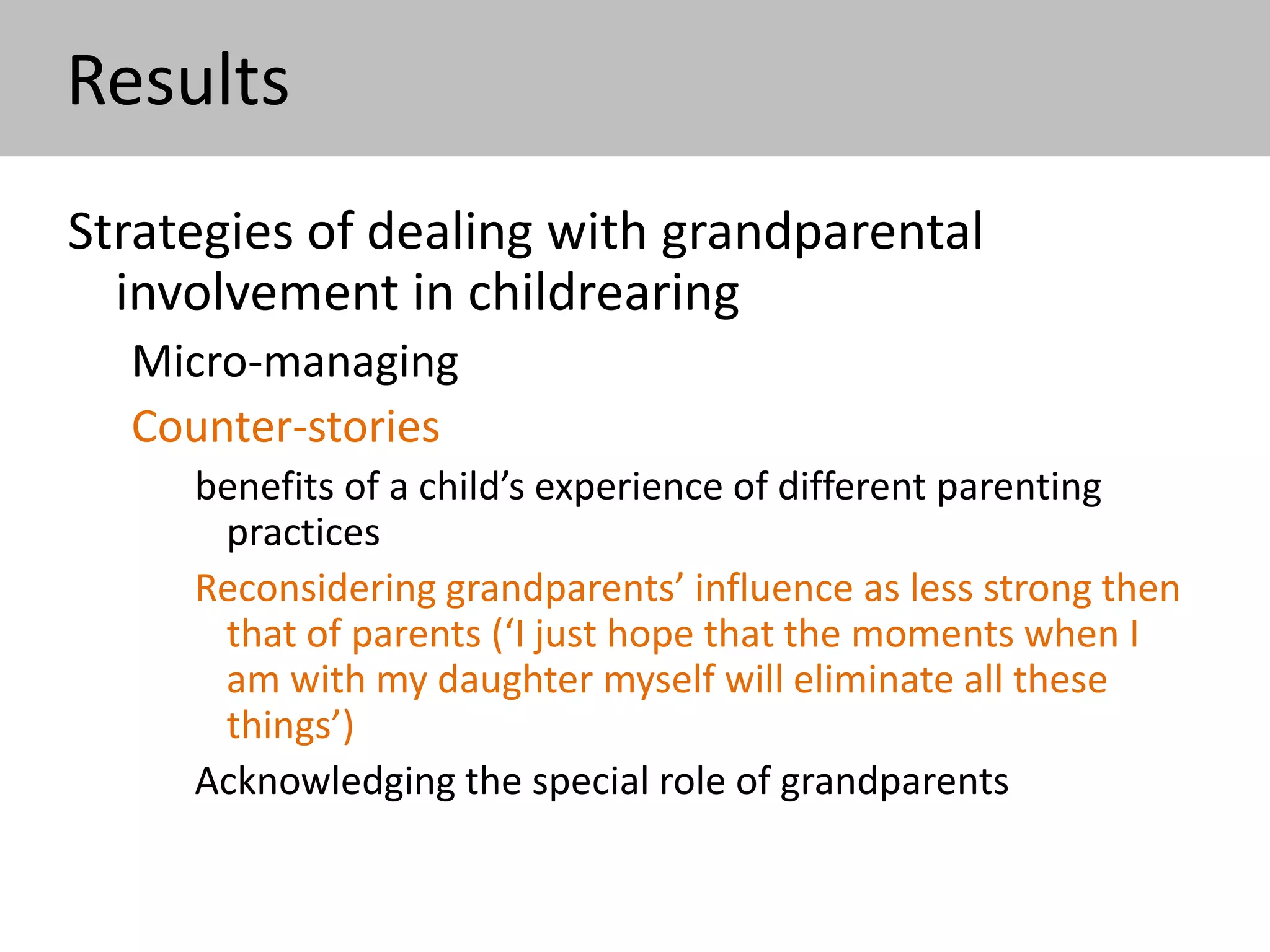
things’)
Acknowledging the special role of grandparents
Results
Strategies of dealing with grandparental
involvement in childrearing
Micro-managing
Counter-stories
benefits of a child’s experience of different parenting practices
Reconsidering grandparents’ influence as less strong then that
of parents
Acknowledging the special role of grandparents (“there should
be such a person in a child’s life, who pampers her,
grandmothers are those who lay the ground of ‘absolute
kindness’, not the parents”)
Conclusions
• Grandparents’ involvement in raising a child may
initially be seen as a possible threat to the child
or interference – not support
• Uncritical belief in experts, a detailed analysis and
critical attitude to grandparents’ knowledge and
practices
• Mothers constantly shape grandparental
involvement, children interpretations of
grandparents’ practices, and their own
perception of grandparental involvement
Conclusions

Managing grandparental involvement

  • 1.
    Managing grandparental involvement inchild-rearing in the context of intensive motherhood Lisa Sivak, National Research University ‘Higher School of Economics’, Moscow (Russia) 24th June, 2016 Parenting and Personhood: Cross-cultural perspectives on family-life, expertise, and risk management, Centre for parenting Culture Studies
  • 2.
    Intergenerational conflicts (Clarkeet al., 1999) Intergenerational ambivalence (Luescher, 2011) Mothers as gatekeepers (Sims, Rofail, 2013)
  • 3.
    Background Intensive motherhood Parental determinism Risk-consciousness Expertoriented parenting culture Hays 1998, Füredi 2001, Faircloth 2010, Lee et al. 2014, etc. Background
  • 4.
    Research question How isthis discourse of intensive parenting and risks transmitted and enacted in familial relations around raising a child? How do mothers experience grandparental involvement and perceive grandparental authority in childrearing? How do mothers deal with ‘wrong’ childrearing practices of grandparents and anxiety over it? Research questions
  • 5.
    Russian context A risingmarket of early development centers Vast industry of childcare advice Emerging parenting education Various experts (in babywearing, breast feeding, attachment theory, etc.) Russian context: intensive parenting
  • 6.
  • 7.
    STUDENTS! Do yourhomework yourself! I'll do it! (1956)
  • 8.
    Russian context High ratesof co-residing: 30% of multigenerational households in Russia 5% in France In 37% families with children under 14 grandmother or grand-grandmother are involved in child-rearing In 9% grandfather of grand-grandfather 20% of grandparents in France, Germany, Belgium, Austria provide childcare on an everyday basis (Herlofson & Hagestad 2012) 40% in southern Europe Russian context: grandparenting
  • 9.
    Sample • 50 interviewswith mothers (‘core’ sample – 25 informants), 2014-2015 • At least one child under school age (1-7 years old) • Recruiting: announcements in online-communities+ snowballing • Living in Moscow • High level of education • Almost all are currently employed • Almost all married • On average one or two children Sample
  • 10.
    Results Undermined grandparental authority familyexperience is rejected on both ‘theoretical’ and ‘empirical’ grounds Bad parenting practices Parents’ practices are what mothers’ want to overcome – not adopt
  • 11.
    I’ve encountered suchbehavior [manipulative methods of education, used by her parents - intimidation, bribery, etc.], and this has had a negative effect on my self- esteem and ability to cope with different situations, including traumatic experiences. I believe that if my parents had helped me out and shown an ability to deal effectively with such situations without humiliation, intimidation, shaming, disgust, and self-pity, then I would have used many years of my life more effectively – not on the analysis of this pile of problems. So I want to save my child from this unnecessary strain A., 35 years, one child, 3 years
  • 12.
    I’m trying tominimize the grandparents’ involvement in child-rearing. Me and my husband have already experienced it ourselves, and we agree that, to be honest, it was not the best parenting. It had some results, but it was far from perfect. And we don’t want a repetition of that on our children. M., 29 years, one child, 4 years
  • 13.
    Results Undermined grandparental authority familyexperience is rejected on both ‘empirical’ and ‘theoretical’ grounds Bad parenting practices big impact of small actions Parents’ practices are what mothers’ want to overcome – not adopt
  • 14.
    Now, since Ibecame involved in psychotherapy, I’ve let it go. But before that I thought that any adult who said something to my child in a ‘wrong’ way could ruin everything, could instill the wrong thoughts. V., 30 years, one child, 4.5 years ‘a thoughtlessly said casual word can deeply affect the child’ ‘small things are small, but they repeat time after time’
  • 15.
    Results Undermined grandparental authority familyexperience is rejected on both ‘empirical’ and ‘theoretical’ grounds Bad parenting practices Parents’ practices are what mothers’ want to overcome – not adopt
  • 16.
    For many yearsI was afraid to have children. I was very afraid that I would behave like my mother, because I had rage attacks on my cat [laughs]. My confidence in myself as a mother was undermined, and attachment theory helped me restore it. P., 34 years, one child, 3 years
  • 17.
    Grandmothers [the child’sgrandmothers] have the arsenal of techniques which were used even by their parents. I think we are the first generation who is trying to approach parenthood consciously, because before that everything was based on tradition A., 32 years, one child, 1 year
  • 18.
    Results Strategies of dealingwith grandparental involvement in childrearing Micro-managing Education and negotiations Reformatting of grandparental involvement in child- rearing Providing the child with the correct interpretation of that experience Counter-stories
  • 19.
    I came upwith a story [for grandparents] that we know that grandparents have a lot of things to do, and I don’t want to bother them, so we communicate in a framework of just ‘showing up to visit them’. So, my decision was not to put them in any position like ‘sitting with the kids’, where they would need to solve any problems concerning them. S., 37 years, three children, from 5 to 11 years old
  • 20.
    Results Strategies of dealingwith grandparental involvement in childrearing Micro-managing Education and negotiations Reformatting of grandparental involvement in child- rearing providing the child with the ‘correct’ interpretation of grandparents’ actions Counter-stories
  • 21.
    My job issimply to tell him, against this background [the grandmother doing what the child himself is supposed to do, everything that the child wants, etc.] that actually it’s not easy for Grandma to do all these things, and that she has problems with her back, and that is not normal that she is crawling here on the floor with him, and that it’s only because she loves him very much. E., 30 years, one child, 4 years
  • 22.
    Results Strategies of dealingwith grandparental involvement in childrearing Micro-managing Counter-stories benefits of a child’s experience of different parenting practices Reconsidering grandparents’ influence as less strong then that of parents Acknowledging the special role of grandparents
  • 23.
    Results Strategies of dealingwith grandparental involvement in childrearing Micro-managing Counter-stories benefits of a child’s experience of different parenting practices Reconsidering grandparents’ influence as less strong then that of parents (‘I just hope that the moments when I am with my daughter myself will eliminate all these things’) Acknowledging the special role of grandparents
  • 24.
    Results Strategies of dealingwith grandparental involvement in childrearing Micro-managing Counter-stories benefits of a child’s experience of different parenting practices Reconsidering grandparents’ influence as less strong then that of parents Acknowledging the special role of grandparents (“there should be such a person in a child’s life, who pampers her, grandmothers are those who lay the ground of ‘absolute kindness’, not the parents”)
  • 25.
    Conclusions • Grandparents’ involvementin raising a child may initially be seen as a possible threat to the child or interference – not support • Uncritical belief in experts, a detailed analysis and critical attitude to grandparents’ knowledge and practices • Mothers constantly shape grandparental involvement, children interpretations of grandparents’ practices, and their own perception of grandparental involvement Conclusions