MONOPOLY
PREPARED BY: MEGHA SHARMA
M.COM SEMESTER-IV
C.R.N-23
MEANING OF MONOPOLY
● Monopoly is associated with two words- ‘mono’ and ‘poly’. ‘Mono’
means single and ‘poly’ means seller.
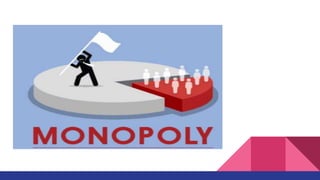
● In simple words we can say that monopoly refers to a market situation
where there is only one seller or producer in the market.
● The producer in monopoly market has full control over the market.
● Monopolist also have full control over the supply.
● He can even charge higher prices.
DEFINITIONS OF MONOPOLY
● In the words of Mc.Connell, “Pure monopoly exists when a single firm is
the sole producer of a product for which there is no close substitutes”.
● According to Marshall, “Monopolist is free to determine the price of his
own choice”.
● According to Mrs. Joan Robinson, “The monopoly is just the reverse
face of perfect competition”.
CHARACTERISTICS OF MONOPOLY
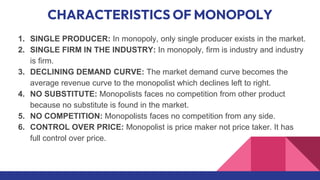
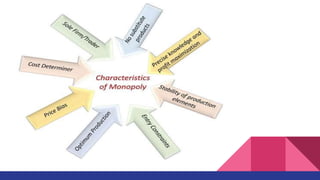
1. SINGLE PRODUCER: In monopoly, only single producer exists in the market.
2. SINGLE FIRM IN THE INDUSTRY: In monopoly, firm is industry and industry
is firm.
3. DECLINING DEMAND CURVE: The market demand curve becomes the
average revenue curve to the monopolist which declines left to right.
4. NO SUBSTITUTE: Monopolists faces no competition from other product
because no substitute is found in the market.
5. NO COMPETITION: Monopolists faces no competition from any side.
6. CONTROL OVER PRICE: Monopolist is price maker not price taker. It has
full control over price.
EQUILIBRIUM CONDITIONS
A monopolist firm will have have equilibrium at a point
where two following mentioned conditions are fulfilled.
● MR=MC
● MC should cut MR from below.
EQUILIBRIUM OF MONOPOLIST FIRM IN SHORT
RUN
Like in perfect competition, there are three possibilities for a firm’s Equilibrium in
Monopoly. These are:
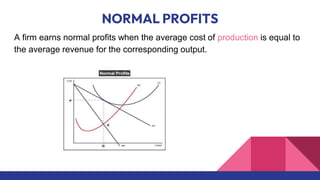
1. The firm earns normal profits – If the average cost = the average
revenue
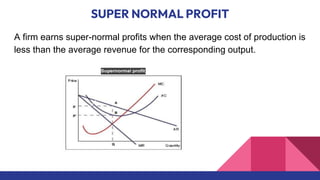
2. It earns supernormal profits – If the average cost < the average revenue
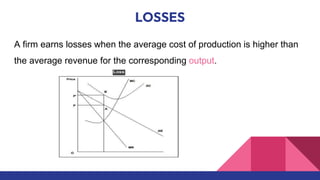
3. It incurs losses – If the average cost > the average revenue
NORMAL PROFITS
A firm earns normal profits when the average cost of production is equal to
the average revenue for the corresponding output.
SUPER NORMAL PROFIT
A firm earns super-normal profits when the average cost of production is
less than the average revenue for the corresponding output.
LOSSES
A firm earns losses when the average cost of production is higher than
the average revenue for the corresponding output.
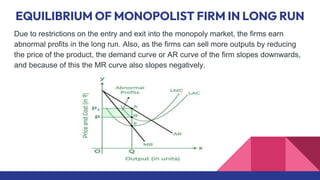
EQUILIBRIUM OF MONOPOLIST FIRM IN LONG RUN
Due to restrictions on the entry and exit into the monopoly market, the firms earn
abnormal profits in the long run. Also, as the firms can sell more outputs by reducing
the price of the product, the demand curve or AR curve of the firm slopes downwards,
and because of this the MR curve also slopes negatively.
PRICE DISCRIMINATION
Price discrimination typically helps increase the monopoly firm's profit by
maximizing its total revenue. A monopolist charges some customers higher prices
rather than a uniform fee for all buyers. Price discrimination among customers with
inconsistent demands can minimize the risk of setting up a uniformly high price.
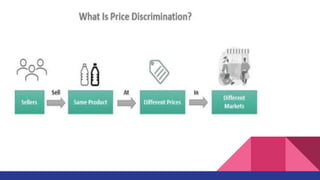
In the words of J.S. Bains, “Price discrimination refers strictly to the practice by a
seller to changing different prices from different buyers for the same goods”.
According to Koutsoyiannis, “Price discrimination exists when the same product
is sold at different prices to different buyers”.
TYPES OF PRICE DISCRIMINATION
● PERSONAL DISCRIMINATION
● PLACE DISCRIMINATION
● TRADE OR USE DISCRIMINATION
● TIME DISCRIMINATION
PERSONAL DISCRIMINATION
Personal price discrimination may refer to price discrimination
based on the individual characteristics of customers. This type of
price discrimination depends on the consumer's income level and
willingness to pay for the product.
For example, when a fruit seller charge higher price from
customers who come by car and lower prices to those who come
by rickshaw.
PLACE DISCRIMINATION
Place discrimination occurs when seller charges different prices for
the same good in different markets.It occurs when prices for goods
or services are higher in some areas and lower in others.
For example, seller may charge higher price in domestic market
and lesser price in foreign market.
TRADE OR USE DISCRIMINATION
Trade or use discrimination occurs when the seller charges
different prices of the same product or service on the basis of the
use to which the product is put.
For example, electricity board charges different rates per unit of
electricity consumed for domestic, agricultural and commercial use.
TIME DISCRIMINATION
When the seller charges the different price for the same
product or service at different times, it is known as time
discrimination.

For example, Airtel may provide the lower dialing rates at
night to its customers in comparison to day-time
ESSENTIAL CONDITIONS OF PRICE
DISCRIMINATION
1. The seller must have some control over the supply of his product. Such
monopoly power is necessary to discriminate the price.
2. The seller should be able to divide the market into at least two sub-markets
(or more).
3. The price-elasticity of the product must be different in different markets.
Therefore, the monopolist can set a high price for those buyers whose
price-elasticity of demand for the product is less than 1.
ESSENTIAL CONDITIONS OF PRICE
DISCRIMINATION (Contd.)
4. Buyers from the low-priced market should not be able to sell the product to
buyers from the high-priced market.
4. There should be lack of perfect knowledge about the existing price
discrimination to the buyers in the buyers in the sub-markets.
BIBLIOGRAPHY
For successfully completing my presentation, I have taken help from the
following website links:
● www.google.com
● www.wikipedia.com
● Youtube
● Google images
● BOOK: Managerial Economics By- Dr. A.K. GARG

MANAGERIAL ECONOMICS POWERPOINT PRESENTATION

  • 1.
    MONOPOLY PREPARED BY: MEGHASHARMA M.COM SEMESTER-IV C.R.N-23
  • 2.
    MEANING OF MONOPOLY ●Monopoly is associated with two words- ‘mono’ and ‘poly’. ‘Mono’ means single and ‘poly’ means seller. ● In simple words we can say that monopoly refers to a market situation where there is only one seller or producer in the market. ● The producer in monopoly market has full control over the market. ● Monopolist also have full control over the supply. ● He can even charge higher prices.
  • 4.
    DEFINITIONS OF MONOPOLY ●In the words of Mc.Connell, “Pure monopoly exists when a single firm is the sole producer of a product for which there is no close substitutes”. ● According to Marshall, “Monopolist is free to determine the price of his own choice”. ● According to Mrs. Joan Robinson, “The monopoly is just the reverse face of perfect competition”.
  • 6.
    CHARACTERISTICS OF MONOPOLY 1.SINGLE PRODUCER: In monopoly, only single producer exists in the market. 2. SINGLE FIRM IN THE INDUSTRY: In monopoly, firm is industry and industry is firm. 3. DECLINING DEMAND CURVE: The market demand curve becomes the average revenue curve to the monopolist which declines left to right. 4. NO SUBSTITUTE: Monopolists faces no competition from other product because no substitute is found in the market. 5. NO COMPETITION: Monopolists faces no competition from any side. 6. CONTROL OVER PRICE: Monopolist is price maker not price taker. It has full control over price.
  • 8.
    EQUILIBRIUM CONDITIONS A monopolistfirm will have have equilibrium at a point where two following mentioned conditions are fulfilled. ● MR=MC ● MC should cut MR from below.
  • 9.
    EQUILIBRIUM OF MONOPOLISTFIRM IN SHORT RUN Like in perfect competition, there are three possibilities for a firm’s Equilibrium in Monopoly. These are: 1. The firm earns normal profits – If the average cost = the average revenue 2. It earns supernormal profits – If the average cost < the average revenue 3. It incurs losses – If the average cost > the average revenue
  • 10.
    NORMAL PROFITS A firmearns normal profits when the average cost of production is equal to the average revenue for the corresponding output.
  • 11.
    SUPER NORMAL PROFIT Afirm earns super-normal profits when the average cost of production is less than the average revenue for the corresponding output.
  • 12.
    LOSSES A firm earnslosses when the average cost of production is higher than the average revenue for the corresponding output.
  • 13.
    EQUILIBRIUM OF MONOPOLISTFIRM IN LONG RUN Due to restrictions on the entry and exit into the monopoly market, the firms earn abnormal profits in the long run. Also, as the firms can sell more outputs by reducing the price of the product, the demand curve or AR curve of the firm slopes downwards, and because of this the MR curve also slopes negatively.
  • 14.
    PRICE DISCRIMINATION Price discriminationtypically helps increase the monopoly firm's profit by maximizing its total revenue. A monopolist charges some customers higher prices rather than a uniform fee for all buyers. Price discrimination among customers with inconsistent demands can minimize the risk of setting up a uniformly high price. In the words of J.S. Bains, “Price discrimination refers strictly to the practice by a seller to changing different prices from different buyers for the same goods”. According to Koutsoyiannis, “Price discrimination exists when the same product is sold at different prices to different buyers”.
  • 16.
    TYPES OF PRICEDISCRIMINATION ● PERSONAL DISCRIMINATION ● PLACE DISCRIMINATION ● TRADE OR USE DISCRIMINATION ● TIME DISCRIMINATION
  • 17.
    PERSONAL DISCRIMINATION Personal pricediscrimination may refer to price discrimination based on the individual characteristics of customers. This type of price discrimination depends on the consumer's income level and willingness to pay for the product. For example, when a fruit seller charge higher price from customers who come by car and lower prices to those who come by rickshaw.
  • 18.
    PLACE DISCRIMINATION Place discriminationoccurs when seller charges different prices for the same good in different markets.It occurs when prices for goods or services are higher in some areas and lower in others. For example, seller may charge higher price in domestic market and lesser price in foreign market.
  • 19.
    TRADE OR USEDISCRIMINATION Trade or use discrimination occurs when the seller charges different prices of the same product or service on the basis of the use to which the product is put. For example, electricity board charges different rates per unit of electricity consumed for domestic, agricultural and commercial use.
  • 20.
    TIME DISCRIMINATION When theseller charges the different price for the same product or service at different times, it is known as time discrimination. For example, Airtel may provide the lower dialing rates at night to its customers in comparison to day-time
  • 21.
    ESSENTIAL CONDITIONS OFPRICE DISCRIMINATION 1. The seller must have some control over the supply of his product. Such monopoly power is necessary to discriminate the price. 2. The seller should be able to divide the market into at least two sub-markets (or more). 3. The price-elasticity of the product must be different in different markets. Therefore, the monopolist can set a high price for those buyers whose price-elasticity of demand for the product is less than 1.
  • 22.
    ESSENTIAL CONDITIONS OFPRICE DISCRIMINATION (Contd.) 4. Buyers from the low-priced market should not be able to sell the product to buyers from the high-priced market. 4. There should be lack of perfect knowledge about the existing price discrimination to the buyers in the buyers in the sub-markets.
  • 23.
    BIBLIOGRAPHY For successfully completingmy presentation, I have taken help from the following website links: ● www.google.com ● www.wikipedia.com ● Youtube ● Google images ● BOOK: Managerial Economics By- Dr. A.K. GARG