CJS Conference Presentation
January 11, 2017
Management
1
Ronni Smith
Vice President, Interim Chief Financial Officer
and Corporate Controller
Bill Foley
Chairman and Chief Executive Officer
Kim Hunter
Treasurer and Vice President, Investor Relations
Material presented at this meeting includes forward-looking
statements about Libbey Inc. These statements are subject to
risks and uncertainties, including market conditions, competitive
pressures, the value of the U.S. dollar and significant cost
increases.
Please refer to the Company’s Form 10-K for
fiscal year-end December 31, 2015, filed on
February 29, 2016, for further information.
Cautionary statement
2
Agenda
3
• Investment Highlights 4
• Company Overview 5 - 10
• Strategic Focus 11 - 17
• Financial Performance 18 - 24
• Appendices
Timeline
Definition and Reconciliation of Non-GAAP
Measures
• Global glass tableware leader: #2 in the world, #1 in the Western
Hemisphere(1)
• #1 U.S. foodservice business drives significant recurring revenue and
profitability(1)
• Established global presence with significant growth potential
• Cost structure optimization coupled with manufacturing innovation creates
significant advantage
• Strategy in place to grow revenue and expand margins
• Simplifying supply chain to improve ROIC
• Strong liquidity and credit profile provide financial flexibility
• Balanced approach to capital allocation aims to deliver 50% of Free Cash
Flow(2) to shareholders
Investment highlights
4
(1) Management estimates
(2) See Appendix: Definition and reconciliation of non-GAAP measures for definition of Free Cash Flow
Libbey at a glance
A global tableware leader selling manufactured and
sourced glass, ceramic and metal tableware.
#2 global glass beverageware position, #1 in the
Americas!(1)
5
Customers include some of North America’s largest
foodservice distributors and most recognized retail
names
$822.3 million of net sales in 2015 sold to
Foodservice, Retail and B2B channels globally
Libbey sells more than 1,100,000,000 glasses
annually
Our products are central to lifestyle and gift
giving at home, in restaurants and in over 100
countries around the world
NYSE MKT: LBY
(1) Management estimate
Libbey competes in four product categories
6
Category Products Manufacturing
Glass
Tableware
• Tumblers, stemware, mugs, bowls,
floral, salt shakers, shot glasses,
canisters, candleholders,
handmade tableware
In-house/
Sourced
Other
Glass
Products
• Bakeware, blender jars, mixing
bowls, floral, candle, and washing
machine windows
In-house
Ceramic
Dinnerware
• Plates, bowls, platters, cups,
saucers, and other tableware
accessories
Sourced
Metalware
• Knives, forks, spoons, serving
utensils, serving trays, pitchers,
and other metal tableware
accessories
Sourced
Libbey goes to market in three key channels
• Extensive network of 500+ of the finest U.S. foodservice distributors who sell
to restaurants, bars, hotels and travel and tourism venues
• #1 glass beverageware supplier and #2 dinnerware and flatware supplier in
the U.S. and Canada(1)
• 90% of foodservice glass tableware sales are replacements, driving a
predictable revenue stream
• ~ 60% market share in U.S. foodservice glass beverageware(1)
• Customers of this diverse channel include:
- Marketers of popular household décor items, like candles and floral applications
- Top household appliance manufacturers purchasing glass blender jars, mixing
bowls and washing machine windows
- Marketers who apply logos to Libbey glassware for resale to breweries,
distilleries, soft drink companies and others
Foodservice
Business-to-
Business (B2B)
• Customers include leading mass merchants, department stores, upscale retailers,
grocers and internet retailers
• Most recognized glass beverageware brand and North America’s #1 retail supplier
of casual glass beverageware; an important driver of profitable factory utilization(2)
• ~40% market share in U.S. casual glass beverageware, branded and private label(2)
7
No single customer accounts for 10% or more of sales
(1) Management estimate
(2) NPD Group Retail Tracking Service and management estimates
Retail
Established industry leadership and global presence
8
Million Total
Square Feet
7 Warehousing /
DCs
8Manufacturing
Facilities
6
West Chicago, IL
Toledo, OH
Shreveport, LA
Monterrey,
Mexico
Laredo, TX
Marinha Grande,
Portugal
Leerdam,
Netherlands Langfang,
China
Manufacturing / Warehousing / Distribution Centers
Warehousing / Distribution Centers
Headquarters
2015 Net Sales by Segment
U.S.
& Canada
75%
Latin
America
20%
EMEA
1%
Other
4%
U.S.
& Canada
61%
Other
4%
Latin
America
20%
EMEA
15%
2015 Segment EBIT (1)
(1) Represents percentage of Segment EBIT only
• The U.S. foodservice market is large and dining out remains popular
in consumer surveys
• Consumer confidence is strong and discretionary income is rising
• Foodservice market leader recognized for excellence by leading
foodservice distributors:
• Strong foodservice network and in-house salesforce sell to both
established restaurants and new entrants throughout the country
• Steady pace of innovation and critical profitability of beverageware
lead to lower price sensitivity; price increases in 42 of last 46 years
• Exceptional depth and breadth of product line and sizeable installed
tableware base provide significant advantage
9
Foodservice channel: positioned for continued strength
• U.S. casual glass beverageware leader; market share at ~40% is more
than twice the next competitor(1)
• Libbey goes to market with highly recognized brands
• Libbey is the favorite U.S. glass beverageware brand and has the
strongest unaided brand recognition(1)
• Established relationships with major retailers provide a platform to
launch innovative products
10
Retail channel: improving competitive positioning
(1) NPD Group Retail Tracking Service, NPD survey and management estimates, includes branded and private label
11
Libbey has three key strategic focus areas:
Growth through Innovation
Customer Focus
Business Simplification
1.
2.
3.
12
Growth through innovation1
• Focus on product innovation to drive growth and margin expansion
• Grow around core foodservice business and in retail and B2B
Drive organic growth and expand into adjacent categories
- Foodservice: underpenetrated categories, adjacent venues
- Retail: adjacent categories; good, better, best offerings
Improve marketing insight and new product development for
competitive advantage
- Trend insight advice and on-trend foodservice and consumer offerings
- Differentiated offerings to meet current consumer needs and preferences
- Expanded footprint in underserved and emerging categories
• We are in early stages of developing an e-commerce strategy
A full line of stemware, tumblers and specialty drinkware
for retail and foodservice channels
13
A reinvention of a classic shape
Subtle design
Harmony and balance
Gentle contours and thick sham
Modern luxury
Extraordinary angles
Free-flowing movement
Dramatic height
Libbey’s ClearFire ® glassware:
“elevates the everyday into art”
Retail Foodservice
1
14
The Artistry Collection1
Exclusive sourced offerings for the entire foodservice tabletop
Travel & Tourism: Global Hotel Chain Win!
15
1
ARTISTRY COLLECTION™
16
Customer Focus2
• Improving customer focus and responsiveness
Focusing on customer feedback and consistent engagement
- Enhancing “top to top” customer relationships
- Increasing time in front of customers to better understand current and
future needs in order to develop customer specific strategies
Adapting operating practices to meet customer needs
- Re-engineered sales compensation system
- New CRM system
- Sales opportunity pipeline measurement tool
- More responsive back-office practices
• Multiple cost reduction initiatives in recent years to remove
non-value-added complexity
• Currently simplifying supply chain to improve ROIC
Product portfolio optimization
- Discontinued underperforming SKUs (20% of global product
portfolio)
- Improved product lifecycle management processes
- Improved sales force focus and reduced costs
Furnace consolidations and technology upgrades in EMEA
and Latin America
- Reduces capital commitments for future furnace rebuilds
- Lowers operating costs
• Reviewing opportunities to further optimize global network
17
Business simplification3
18
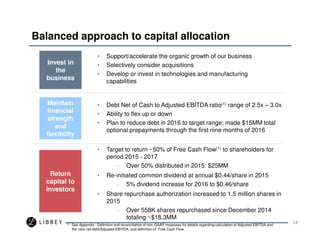
Invest in
the
business
Maintain
financial
strength
and
flexibility
Return
capital to
investors
• Support/accelerate the organic growth of our business
• Selectively consider acquisitions
• Develop or invest in technologies and manufacturing
capabilities
• Target to return ~50% of Free Cash Flow(1) to shareholders for
period 2015 - 2017
- Over 50% distributed in 2015: $25MM
• Re-initiated common dividend at annual $0.44/share in 2015
- 5% dividend increase for 2016 to $0.46/share
• Share repurchase authorization increased to 1.5 million shares in
2015
- Over 558K shares repurchased since December 2014
totaling ~$18.3MM
• Debt Net of Cash to Adjusted EBITDA ratio(1) range of 2.5x – 3.0x
• Ability to flex up or down
• Plan to reduce debt in 2016 to target range; made $15MM total
optional prepayments through the first nine months of 2016
(1) See Appendix: Definition and reconciliation of non-GAAP measures for details regarding calculation of Adjusted EBITDA and
the ratio net debt/Adjusted EBITDA; and definition of Free Cash Flow
Balanced approach to capital allocation
• Flexible capital structure
- $440MM senior secured Term Loan B matures 2021
LIBOR plus 300 bps (currently 3.75%)
No financial covenants
$150MM accordion option
- $100MM ABL facility matures 2019
LIBOR plus 150-200 bps; maturity 2019
• Improved interest coverage
- Significant borrowing rate reductions
- $220MM of Term Loan B swapped to achieve ~50%
floating rate exposure
• Significant deleveraging despite investments to
strengthen the business
• Fully funded U.S. pension in 2012, lowering annual
cash contributions
- ~$9MM estimated global cash contribution in 2016,
approximately all to non-U.S. plan
19
6.4
4.3
3.2 3.0 3.0 2.7 3.1 3.3
2008 2009 2010 2011 2012 2013 2014 2015
1.2 1.4
2.6 2.6
3.5
4.2
5.4
6.3
2008 2009 2010 2011 2012 2013 2014 2015
Adjusted EBITDA(1) / Interest Expense
Debt Net of Cash / Adjusted EBITDA(1)
(1) See Appendix: Definition and reconciliation of non-GAAP measures for details regarding calculation of Adjusted EBITDA and
the ratio net debt/Adjusted EBITDA
Capital structure and leverage policy provide financial
flexibility
Market leadership and business model drive predictable
revenue stream and cash flow
(1) See Appendix: Definition and reconciliation of non-GAAP measures for details regarding calculation of Adjusted EBITDA,
Adjusted EBITDA Margin and Adjusted Operating Cash Flow
20
Historical Cumulative
Adjusted Operating Cash flow (1)
(MM)
$(1)
$105
$176
$233
$358
$432
$558
$624
2008 2009 2010 2011 2012 2013 2014 2015
$810
$749
$800 $817 $825 $819
$852
$822
$85 $90
$116 $113 $132 $135 $123 $116
2008 2009 2010 2011 2012 2013 2014 2015
Net Sales Adjusted EBITDA
10.5%
12.0%
14.5%
13.8%
16.0% 16.5%
14.5% 14.1%
Adjusted EBITDA Margin
Net Sales, Adjusted EBITDA and Margin (1)
(MM)
• Strong cash generation and liquidity
- $43 MM cash on hand at 9/30/16
- $92 MM ABL availability at 9/30/16
• Seasonal trade working capital needs
- Average $30-$35 MM peak to trough swing
in quarter-end trade working capital each
year (1)
• Capital expenditures on average about
equal to depreciation & amortization
- ~$30 MM growth investment for ClearFire®
glass manufacturing technology over 2014-
2015
• Flexibility to selectively pursue M&A
opportunities
• No significant long-term debt due until
Term Loan B in 2021
21
$122
$136
$113
$142 $140
2011 2012 2013 2014 2015
Total of Cash and ABL Availability
(MM)
Cash ABL Availability
0
10
20
30
40
50
60
2011 2012 2013 2014 2015
Capital Expenditures, Depreciation & Amortization
Capital Expenditures Depreciation & Amortization
$Millions
(1) Trade working capital is defined as net accounts receivable plus net inventories less accounts payable as also noted in Appendix:
Definition and reconciliation of non-GAAP measures
Significant liquidity resources and moderate near-term
funding obligations
Long-term financial goals
22
Financial Metrics Long-term Goals
Revenue growth
Sustainable growth –
5% CAGR
Adjusted EBITDA margin(1) 17%
Debt Net of Cash to Adjusted EBITDA(1) 2.5 to 3.0x
ROIC(1) 12% to 14%
TSR Top quartile
(1) See Appendix: Definition and reconciliation of non-GAAP measures for details regarding calculation of Adjusted EBITDA and
Adjusted EBITDA Margin; definition of ROIC
Market Firm Net Sales 2015A Rev. Split '16E Margin FV / EBITDA P / E Net Debt /
Company Cap Value 2016E 2017E N.A. Europe ROW EBITDA EBIT 2016E 2017E 2016E 2017E LTM EBITDA
New ell Brands Inc $21,539 $33,990 $13,405 $15,100 69% -- 31% 18.6% 15.4% 13.6x 12.0x 15.5x 14.9x 5.7x
Tupperw are Brands Corporation2,661 3,381 2,225 2,221 26 26 48 17.8 15.2 8.5 8.2 12.2 11.7 1.8
Helen of Troy Limited 2,354 2,906 1,558 1,593 84 12 4 14.9 11.1 12.5 11.7 13.7 12.8 2.1
Lifetime Brands, Inc. 256 383 589 606 79 14 8 -- -- -- -- 17.4 13.8 2.9
Mean $6,702 $10,165 $4,444 $4,880 64% 18% 23% 17.1% 13.9% 11.6x 10.6x 14.7x 13.3x 3.1x
Median 2,507 3,144 1,891 1,907 74 14 19 17.8 15.2 12.5 11.7 14.6 13.3 2.5
Libbey Inc. $425 $814 $808 $826 61% 15% 25% 14.0% 8.0% 7.2x 6.8x 18.2x 12.6x 3.2x
Libbey & Peer Trading Overview
23
Note: Forward metrics based on consensus Wall Street estimates (FactSet). Market data as of December 31, 2016. Balance sheet data as of Q3 2016.
(1) Revenue split pro forma for 2015 results of Newell Rubbermaid, Jarden and Jostens. Jarden’s acquisition of Jostens was completed on November 2, 2015.
(2) Based on pro forma LTM EBITDA of $2.1bn.
(3) Revenue split based on fiscal year ended February 29, 2016.
($ in millions)
(3)
(2)
(1)
• Global glass tableware leader: #2 in the world, #1 in the Western
Hemisphere(1)
• #1 U.S. foodservice business drives significant recurring revenue and
profitability(1)
• Established global presence with significant growth potential
• Cost structure optimization coupled with manufacturing innovation creates
significant advantage
• Strategy in place to grow revenue and expand margins
• Simplifying supply chain to improve ROIC
• Strong liquidity and credit profile provide financial flexibility
• Balanced approach to capital allocation aims to deliver 50% of Free Cash
Flow(2) to shareholders
Investment highlights
24
(1) Management estimates
(2) See Appendix: Definition and reconciliation of non-GAAP measures for definition of Free Cash Flow
Appendix
We have expanded globally and have a strong
portfolio of brands
Jun 2006: Obtains
remaining 51%
stake in Crisa,
expanding presence
to Monterrey,
Mexico
Jan 2005: Acquires
Crisal, a glassware
manufacturer based
in Portugal
1800s 1990
Jul 2013: Celebrates
125th Anniversary in
Toledo
2002 2006 20112008 20122000
Dec 2002: Acquires Royal
Leerdam, expanding
glassware operations to
Europe
May 2012:
Refinancing
amended $100MM
ABL facility
and issuance of
$450MM 6.875%
Senior Secured
Notes
Apr 2007: Opens
Langfang, China
facility
Aug 1997:
Acquires World
Tableware and
49% of Crisa
2014
Apr 2014:
Refinancing,
including amended
$100MM ABL
Facility and new
$440MM Term
Loan B senior
secured credit
facility
1818: Libbey
founded as New
England Glass
Company in East
Cambridge, MA
s
Jun 1993:
Libbey becomes
a public company
1892:
The company
changes its name
to The Libbey
Glass Company
Oct 1995:
Acquires
Syracuse China
Aug 2011: Bill
Foley becomes
Chairman of the
Board
2015
Jan 2015:
Announce Own the
Moment strategy.
Re-initiate dividend
and share
repurchases
Jan 2016:
Bill Foley
becomes CEO
and Chairman of
the Board
2016
Definition and reconciliation of non-GAAP measures
FY 2016 FY 2015 FY 2014 FY 2013 FY 2012 FY 2011 FY 2010 FY 2009 FY 2008
Net income (loss) 10.1$ 66.3$ 5.0$ 28.5$ 7.0$ 23.6$ 70.1$ (28.8)$ (80.4)$
Add:
Interest expense 20.9$ 18.5$ 22.9$ 32.0$ 37.7$ 43.4$ 45.2$ 66.7$ 69.7$
Provision (benefit) for income taxes 17.7 (38.2) 8.5 13.2 5.7 1.7 11.6 2.7 6.3
Depreciation and amortization 48.5 42.7 40.4 44.0 41.5 42.2 41.1 43.2 44.4
Add: Special items before interest and taxes:    
Restructuring and facility closure charges - - 1.0 6.5 - (0.1) 2.5 3.8 29.1
Severance - - - - 5.1 1.1 - - -
Pension curtailment and settlement charges 0.2 21.7 0.8 2.3 4.3 - - 3.2 -
Loss (gain) on redemption of debt - - 47.2 2.5 31.1 2.8 (58.3) - -
Abandoned property - - - 1.8 - 2.7 - - -
Gain on sale of assets - - - - - (6.8) - - -
Goodwill and intangible impairment charges - - - - - - - - 11.9
Derivatives (1.9) (0.2) 1.2 0.9 (0.3) (0.3) 0.8 - -
Product portfolio optimization 5.7 - - - - - - - -
Other
(1)
8.6 5.3 (3.6) 5.1 - 2.5 2.8 - 4.5
Less: Accelerated depreciation expense included in special
items and also in depreciation and amortization above - - - (1.5) - - - (0.7) (0.3)
Adjusted EBITDA 109.8$ 116.1$ 123.4$ 135.3$ 132.1$ 112.8$ 115.8$ 90.1$ 85.2$
Net sales 793.4$ 822.3$ 852.5$ 818.8$ 825.3$ 817.1$ 799.8$ 748.6$ 810.2$
Adjusted EBITDA Margin 13.8% 14.1% 14.5% 16.5% 16.0% 13.8% 14.5% 12.0% 10.5%
Reconciliation of Net Income (Loss) to Adjusted Earnings Before Interest, Taxes, Depreciation and Amortization (Adjusted EBITDA) and Adjusted EBITDA Margin
(Dollars in millions)
(1) Other FY 2016 includes $4.1 million for work stoppage and $4.5 million for executive terminations. 2015 includes $4.3 million for reorganization charges, $0.9 million for executive termination, and $0.2
million for an environmental obligation. 2014 includes $(4.8) million for furnace malfunction net proceeds, $0.9 million for executive retirement charges, and $0.3 million for an environmental obligation. 2013
includes $4.4 million of furnace malfunction charges and $0.7 million for executive retirement charges. 2011 includes $2.7 million for CEO transition expenses, $(1.0) million for an equipment credit and an $0.8
million write-down of unutilized fixed assets. 2010 includes $2.7 million of fixed asset write-down charges, $1.0 million in expenses related to a secondary stock offering and a $(0.9) million insurance claim
recovery. 2008 includes a $4.5 million fixed asset write-down charge.
Adjusted EBITDA excludes special items that Libbey believes are not reflective of our core operating performance.
Definition and computation of non-GAAP measures
Definitions – Other Non-GAAP Measures
Trade working capital is defined as net accounts receivable plus net inventory less accounts payable.
Return on invested capital (ROIC) is defined as after tax income from operations (using a 30% tax rate), adjusted for special items, over ending trade working capital plus net book value of
property, plant and equipment
Constant currency references regarding net sales reflect a simple mathematical translation of local currency results using the comparable prior period’s currency conversion rate. Constant
currency references regarding Segment EBIT, Adjusted EBITDA and Adjusted EBITDA Margin comprise a simple mathematical translation of local currency results using the comparable
prior period’s currency conversion rate plus the transactional impact of changes in exchange rates from revenues, expenses and assets and liabilities that are denominated in a currency
other than the functional currency. Our currency market risks include currency fluctuations relative to the U.S. dollar, Canadian dollar, Mexican peso, Euro and RMB.
2016 2015 2014 2013 2012 2011 2010 2009 2008
Adjusted EBITDA
(1)
109.8$ 116.1$ 123.4$ 135.3$ 132.1$ 112.8$ 115.8$ 90.1$ 85.2$
Debt
(2)
407.8$ 431.0$ 437.9$ 402.4$ 454.2$ 390.1$ 436.6$ 512.0$ 543.5$
Plus: Unamortized discount, finance fees and warrants
(2)
4.5 5.8 7.0 9.5 12.3 11.6 16.9 5.0 11.4
Less: Carrying value in excess of principal on PIK notes - - - - - - - 70.2 -
Less: Carrying value adjustment on debt related to the Interest
Rate Agreement - - - (1.3) 0.4 4.1 3.3 - -
Gross Debt 412.3 436.9 444.9 413.2 466.1 397.6 450.2 446.8 554.9
Less: Cash 61.0 49.0 60.0 42.2 67.2 58.3 76.3 55.1 13.3
Debt net of cash 351.3$ 387.9$ 384.9$ 371.0$ 398.9$ 339.3$ 373.9$ 391.7$ 541.6$
Debt net of cash to Adjusted EBITDA Ratio 3.2 3.3 3.1 2.7 3.0 3.0 3.2 4.3 6.4
Interest expense 20.9$ 18.5$ 22.9$ 32.0$ 37.7$ 43.4$ 45.2$ 66.7$ 69.7$
Adjusted EBITDA to Interest Expense Ratio 5.3 6.3 5.4 4.2 3.5 2.6 2.6 1.4 1.2
Computation of Adjusted EBITDA to Debt net of cash to Adjusted EBITDA Ratio and Adjusted EBITDA to Interest Expense Ratio
(Dollars in millions)
(1) - See prior page for calculation and reconciliation to net income.
(2) - All years reflect retrospective adoption of ASU 2015-03 and 2015-15, which presents debt issuance costs of senior debt as a reduction to the liability.
NYSE MKT: LBY
Kimberly Hunter
Treasurer and VP, Investor Relations
419-325-2612
email: khunte@libbey.com
Alpha IR Group
Chris Hodges & Sam Gibbons
312-445-2870
email: LBY@alpha-ir.com
Additional Information
visit our website: www.libbey.com

Management Presentation - January 2017

  • 1.
  • 2.
    Management 1 Ronni Smith Vice President,Interim Chief Financial Officer and Corporate Controller Bill Foley Chairman and Chief Executive Officer Kim Hunter Treasurer and Vice President, Investor Relations
  • 3.
    Material presented atthis meeting includes forward-looking statements about Libbey Inc. These statements are subject to risks and uncertainties, including market conditions, competitive pressures, the value of the U.S. dollar and significant cost increases. Please refer to the Company’s Form 10-K for fiscal year-end December 31, 2015, filed on February 29, 2016, for further information. Cautionary statement 2
  • 4.
    Agenda 3 • Investment Highlights4 • Company Overview 5 - 10 • Strategic Focus 11 - 17 • Financial Performance 18 - 24 • Appendices Timeline Definition and Reconciliation of Non-GAAP Measures
  • 5.
    • Global glasstableware leader: #2 in the world, #1 in the Western Hemisphere(1) • #1 U.S. foodservice business drives significant recurring revenue and profitability(1) • Established global presence with significant growth potential • Cost structure optimization coupled with manufacturing innovation creates significant advantage • Strategy in place to grow revenue and expand margins • Simplifying supply chain to improve ROIC • Strong liquidity and credit profile provide financial flexibility • Balanced approach to capital allocation aims to deliver 50% of Free Cash Flow(2) to shareholders Investment highlights 4 (1) Management estimates (2) See Appendix: Definition and reconciliation of non-GAAP measures for definition of Free Cash Flow
  • 6.
    Libbey at aglance A global tableware leader selling manufactured and sourced glass, ceramic and metal tableware. #2 global glass beverageware position, #1 in the Americas!(1) 5 Customers include some of North America’s largest foodservice distributors and most recognized retail names $822.3 million of net sales in 2015 sold to Foodservice, Retail and B2B channels globally Libbey sells more than 1,100,000,000 glasses annually Our products are central to lifestyle and gift giving at home, in restaurants and in over 100 countries around the world NYSE MKT: LBY (1) Management estimate
  • 7.
    Libbey competes infour product categories 6 Category Products Manufacturing Glass Tableware • Tumblers, stemware, mugs, bowls, floral, salt shakers, shot glasses, canisters, candleholders, handmade tableware In-house/ Sourced Other Glass Products • Bakeware, blender jars, mixing bowls, floral, candle, and washing machine windows In-house Ceramic Dinnerware • Plates, bowls, platters, cups, saucers, and other tableware accessories Sourced Metalware • Knives, forks, spoons, serving utensils, serving trays, pitchers, and other metal tableware accessories Sourced
  • 8.
    Libbey goes tomarket in three key channels • Extensive network of 500+ of the finest U.S. foodservice distributors who sell to restaurants, bars, hotels and travel and tourism venues • #1 glass beverageware supplier and #2 dinnerware and flatware supplier in the U.S. and Canada(1) • 90% of foodservice glass tableware sales are replacements, driving a predictable revenue stream • ~ 60% market share in U.S. foodservice glass beverageware(1) • Customers of this diverse channel include: - Marketers of popular household décor items, like candles and floral applications - Top household appliance manufacturers purchasing glass blender jars, mixing bowls and washing machine windows - Marketers who apply logos to Libbey glassware for resale to breweries, distilleries, soft drink companies and others Foodservice Business-to- Business (B2B) • Customers include leading mass merchants, department stores, upscale retailers, grocers and internet retailers • Most recognized glass beverageware brand and North America’s #1 retail supplier of casual glass beverageware; an important driver of profitable factory utilization(2) • ~40% market share in U.S. casual glass beverageware, branded and private label(2) 7 No single customer accounts for 10% or more of sales (1) Management estimate (2) NPD Group Retail Tracking Service and management estimates Retail
  • 9.
    Established industry leadershipand global presence 8 Million Total Square Feet 7 Warehousing / DCs 8Manufacturing Facilities 6 West Chicago, IL Toledo, OH Shreveport, LA Monterrey, Mexico Laredo, TX Marinha Grande, Portugal Leerdam, Netherlands Langfang, China Manufacturing / Warehousing / Distribution Centers Warehousing / Distribution Centers Headquarters 2015 Net Sales by Segment U.S. & Canada 75% Latin America 20% EMEA 1% Other 4% U.S. & Canada 61% Other 4% Latin America 20% EMEA 15% 2015 Segment EBIT (1) (1) Represents percentage of Segment EBIT only
  • 10.
    • The U.S.foodservice market is large and dining out remains popular in consumer surveys • Consumer confidence is strong and discretionary income is rising • Foodservice market leader recognized for excellence by leading foodservice distributors: • Strong foodservice network and in-house salesforce sell to both established restaurants and new entrants throughout the country • Steady pace of innovation and critical profitability of beverageware lead to lower price sensitivity; price increases in 42 of last 46 years • Exceptional depth and breadth of product line and sizeable installed tableware base provide significant advantage 9 Foodservice channel: positioned for continued strength
  • 11.
    • U.S. casualglass beverageware leader; market share at ~40% is more than twice the next competitor(1) • Libbey goes to market with highly recognized brands • Libbey is the favorite U.S. glass beverageware brand and has the strongest unaided brand recognition(1) • Established relationships with major retailers provide a platform to launch innovative products 10 Retail channel: improving competitive positioning (1) NPD Group Retail Tracking Service, NPD survey and management estimates, includes branded and private label
  • 12.
    11 Libbey has threekey strategic focus areas: Growth through Innovation Customer Focus Business Simplification 1. 2. 3.
  • 13.
    12 Growth through innovation1 •Focus on product innovation to drive growth and margin expansion • Grow around core foodservice business and in retail and B2B Drive organic growth and expand into adjacent categories - Foodservice: underpenetrated categories, adjacent venues - Retail: adjacent categories; good, better, best offerings Improve marketing insight and new product development for competitive advantage - Trend insight advice and on-trend foodservice and consumer offerings - Differentiated offerings to meet current consumer needs and preferences - Expanded footprint in underserved and emerging categories • We are in early stages of developing an e-commerce strategy
  • 14.
    A full lineof stemware, tumblers and specialty drinkware for retail and foodservice channels 13 A reinvention of a classic shape Subtle design Harmony and balance Gentle contours and thick sham Modern luxury Extraordinary angles Free-flowing movement Dramatic height Libbey’s ClearFire ® glassware: “elevates the everyday into art” Retail Foodservice 1
  • 15.
    14 The Artistry Collection1 Exclusivesourced offerings for the entire foodservice tabletop
  • 16.
    Travel & Tourism:Global Hotel Chain Win! 15 1 ARTISTRY COLLECTION™
  • 17.
    16 Customer Focus2 • Improvingcustomer focus and responsiveness Focusing on customer feedback and consistent engagement - Enhancing “top to top” customer relationships - Increasing time in front of customers to better understand current and future needs in order to develop customer specific strategies Adapting operating practices to meet customer needs - Re-engineered sales compensation system - New CRM system - Sales opportunity pipeline measurement tool - More responsive back-office practices
  • 18.
    • Multiple costreduction initiatives in recent years to remove non-value-added complexity • Currently simplifying supply chain to improve ROIC Product portfolio optimization - Discontinued underperforming SKUs (20% of global product portfolio) - Improved product lifecycle management processes - Improved sales force focus and reduced costs Furnace consolidations and technology upgrades in EMEA and Latin America - Reduces capital commitments for future furnace rebuilds - Lowers operating costs • Reviewing opportunities to further optimize global network 17 Business simplification3
  • 19.
    18 Invest in the business Maintain financial strength and flexibility Return capital to investors •Support/accelerate the organic growth of our business • Selectively consider acquisitions • Develop or invest in technologies and manufacturing capabilities • Target to return ~50% of Free Cash Flow(1) to shareholders for period 2015 - 2017 - Over 50% distributed in 2015: $25MM • Re-initiated common dividend at annual $0.44/share in 2015 - 5% dividend increase for 2016 to $0.46/share • Share repurchase authorization increased to 1.5 million shares in 2015 - Over 558K shares repurchased since December 2014 totaling ~$18.3MM • Debt Net of Cash to Adjusted EBITDA ratio(1) range of 2.5x – 3.0x • Ability to flex up or down • Plan to reduce debt in 2016 to target range; made $15MM total optional prepayments through the first nine months of 2016 (1) See Appendix: Definition and reconciliation of non-GAAP measures for details regarding calculation of Adjusted EBITDA and the ratio net debt/Adjusted EBITDA; and definition of Free Cash Flow Balanced approach to capital allocation
  • 20.
    • Flexible capitalstructure - $440MM senior secured Term Loan B matures 2021 LIBOR plus 300 bps (currently 3.75%) No financial covenants $150MM accordion option - $100MM ABL facility matures 2019 LIBOR plus 150-200 bps; maturity 2019 • Improved interest coverage - Significant borrowing rate reductions - $220MM of Term Loan B swapped to achieve ~50% floating rate exposure • Significant deleveraging despite investments to strengthen the business • Fully funded U.S. pension in 2012, lowering annual cash contributions - ~$9MM estimated global cash contribution in 2016, approximately all to non-U.S. plan 19 6.4 4.3 3.2 3.0 3.0 2.7 3.1 3.3 2008 2009 2010 2011 2012 2013 2014 2015 1.2 1.4 2.6 2.6 3.5 4.2 5.4 6.3 2008 2009 2010 2011 2012 2013 2014 2015 Adjusted EBITDA(1) / Interest Expense Debt Net of Cash / Adjusted EBITDA(1) (1) See Appendix: Definition and reconciliation of non-GAAP measures for details regarding calculation of Adjusted EBITDA and the ratio net debt/Adjusted EBITDA Capital structure and leverage policy provide financial flexibility
  • 21.
    Market leadership andbusiness model drive predictable revenue stream and cash flow (1) See Appendix: Definition and reconciliation of non-GAAP measures for details regarding calculation of Adjusted EBITDA, Adjusted EBITDA Margin and Adjusted Operating Cash Flow 20 Historical Cumulative Adjusted Operating Cash flow (1) (MM) $(1) $105 $176 $233 $358 $432 $558 $624 2008 2009 2010 2011 2012 2013 2014 2015 $810 $749 $800 $817 $825 $819 $852 $822 $85 $90 $116 $113 $132 $135 $123 $116 2008 2009 2010 2011 2012 2013 2014 2015 Net Sales Adjusted EBITDA 10.5% 12.0% 14.5% 13.8% 16.0% 16.5% 14.5% 14.1% Adjusted EBITDA Margin Net Sales, Adjusted EBITDA and Margin (1) (MM)
  • 22.
    • Strong cashgeneration and liquidity - $43 MM cash on hand at 9/30/16 - $92 MM ABL availability at 9/30/16 • Seasonal trade working capital needs - Average $30-$35 MM peak to trough swing in quarter-end trade working capital each year (1) • Capital expenditures on average about equal to depreciation & amortization - ~$30 MM growth investment for ClearFire® glass manufacturing technology over 2014- 2015 • Flexibility to selectively pursue M&A opportunities • No significant long-term debt due until Term Loan B in 2021 21 $122 $136 $113 $142 $140 2011 2012 2013 2014 2015 Total of Cash and ABL Availability (MM) Cash ABL Availability 0 10 20 30 40 50 60 2011 2012 2013 2014 2015 Capital Expenditures, Depreciation & Amortization Capital Expenditures Depreciation & Amortization $Millions (1) Trade working capital is defined as net accounts receivable plus net inventories less accounts payable as also noted in Appendix: Definition and reconciliation of non-GAAP measures Significant liquidity resources and moderate near-term funding obligations
  • 23.
    Long-term financial goals 22 FinancialMetrics Long-term Goals Revenue growth Sustainable growth – 5% CAGR Adjusted EBITDA margin(1) 17% Debt Net of Cash to Adjusted EBITDA(1) 2.5 to 3.0x ROIC(1) 12% to 14% TSR Top quartile (1) See Appendix: Definition and reconciliation of non-GAAP measures for details regarding calculation of Adjusted EBITDA and Adjusted EBITDA Margin; definition of ROIC
  • 24.
    Market Firm NetSales 2015A Rev. Split '16E Margin FV / EBITDA P / E Net Debt / Company Cap Value 2016E 2017E N.A. Europe ROW EBITDA EBIT 2016E 2017E 2016E 2017E LTM EBITDA New ell Brands Inc $21,539 $33,990 $13,405 $15,100 69% -- 31% 18.6% 15.4% 13.6x 12.0x 15.5x 14.9x 5.7x Tupperw are Brands Corporation2,661 3,381 2,225 2,221 26 26 48 17.8 15.2 8.5 8.2 12.2 11.7 1.8 Helen of Troy Limited 2,354 2,906 1,558 1,593 84 12 4 14.9 11.1 12.5 11.7 13.7 12.8 2.1 Lifetime Brands, Inc. 256 383 589 606 79 14 8 -- -- -- -- 17.4 13.8 2.9 Mean $6,702 $10,165 $4,444 $4,880 64% 18% 23% 17.1% 13.9% 11.6x 10.6x 14.7x 13.3x 3.1x Median 2,507 3,144 1,891 1,907 74 14 19 17.8 15.2 12.5 11.7 14.6 13.3 2.5 Libbey Inc. $425 $814 $808 $826 61% 15% 25% 14.0% 8.0% 7.2x 6.8x 18.2x 12.6x 3.2x Libbey & Peer Trading Overview 23 Note: Forward metrics based on consensus Wall Street estimates (FactSet). Market data as of December 31, 2016. Balance sheet data as of Q3 2016. (1) Revenue split pro forma for 2015 results of Newell Rubbermaid, Jarden and Jostens. Jarden’s acquisition of Jostens was completed on November 2, 2015. (2) Based on pro forma LTM EBITDA of $2.1bn. (3) Revenue split based on fiscal year ended February 29, 2016. ($ in millions) (3) (2) (1)
  • 25.
    • Global glasstableware leader: #2 in the world, #1 in the Western Hemisphere(1) • #1 U.S. foodservice business drives significant recurring revenue and profitability(1) • Established global presence with significant growth potential • Cost structure optimization coupled with manufacturing innovation creates significant advantage • Strategy in place to grow revenue and expand margins • Simplifying supply chain to improve ROIC • Strong liquidity and credit profile provide financial flexibility • Balanced approach to capital allocation aims to deliver 50% of Free Cash Flow(2) to shareholders Investment highlights 24 (1) Management estimates (2) See Appendix: Definition and reconciliation of non-GAAP measures for definition of Free Cash Flow
  • 26.
  • 27.
    We have expandedglobally and have a strong portfolio of brands Jun 2006: Obtains remaining 51% stake in Crisa, expanding presence to Monterrey, Mexico Jan 2005: Acquires Crisal, a glassware manufacturer based in Portugal 1800s 1990 Jul 2013: Celebrates 125th Anniversary in Toledo 2002 2006 20112008 20122000 Dec 2002: Acquires Royal Leerdam, expanding glassware operations to Europe May 2012: Refinancing amended $100MM ABL facility and issuance of $450MM 6.875% Senior Secured Notes Apr 2007: Opens Langfang, China facility Aug 1997: Acquires World Tableware and 49% of Crisa 2014 Apr 2014: Refinancing, including amended $100MM ABL Facility and new $440MM Term Loan B senior secured credit facility 1818: Libbey founded as New England Glass Company in East Cambridge, MA s Jun 1993: Libbey becomes a public company 1892: The company changes its name to The Libbey Glass Company Oct 1995: Acquires Syracuse China Aug 2011: Bill Foley becomes Chairman of the Board 2015 Jan 2015: Announce Own the Moment strategy. Re-initiate dividend and share repurchases Jan 2016: Bill Foley becomes CEO and Chairman of the Board 2016
  • 28.
    Definition and reconciliationof non-GAAP measures FY 2016 FY 2015 FY 2014 FY 2013 FY 2012 FY 2011 FY 2010 FY 2009 FY 2008 Net income (loss) 10.1$ 66.3$ 5.0$ 28.5$ 7.0$ 23.6$ 70.1$ (28.8)$ (80.4)$ Add: Interest expense 20.9$ 18.5$ 22.9$ 32.0$ 37.7$ 43.4$ 45.2$ 66.7$ 69.7$ Provision (benefit) for income taxes 17.7 (38.2) 8.5 13.2 5.7 1.7 11.6 2.7 6.3 Depreciation and amortization 48.5 42.7 40.4 44.0 41.5 42.2 41.1 43.2 44.4 Add: Special items before interest and taxes:     Restructuring and facility closure charges - - 1.0 6.5 - (0.1) 2.5 3.8 29.1 Severance - - - - 5.1 1.1 - - - Pension curtailment and settlement charges 0.2 21.7 0.8 2.3 4.3 - - 3.2 - Loss (gain) on redemption of debt - - 47.2 2.5 31.1 2.8 (58.3) - - Abandoned property - - - 1.8 - 2.7 - - - Gain on sale of assets - - - - - (6.8) - - - Goodwill and intangible impairment charges - - - - - - - - 11.9 Derivatives (1.9) (0.2) 1.2 0.9 (0.3) (0.3) 0.8 - - Product portfolio optimization 5.7 - - - - - - - - Other (1) 8.6 5.3 (3.6) 5.1 - 2.5 2.8 - 4.5 Less: Accelerated depreciation expense included in special items and also in depreciation and amortization above - - - (1.5) - - - (0.7) (0.3) Adjusted EBITDA 109.8$ 116.1$ 123.4$ 135.3$ 132.1$ 112.8$ 115.8$ 90.1$ 85.2$ Net sales 793.4$ 822.3$ 852.5$ 818.8$ 825.3$ 817.1$ 799.8$ 748.6$ 810.2$ Adjusted EBITDA Margin 13.8% 14.1% 14.5% 16.5% 16.0% 13.8% 14.5% 12.0% 10.5% Reconciliation of Net Income (Loss) to Adjusted Earnings Before Interest, Taxes, Depreciation and Amortization (Adjusted EBITDA) and Adjusted EBITDA Margin (Dollars in millions) (1) Other FY 2016 includes $4.1 million for work stoppage and $4.5 million for executive terminations. 2015 includes $4.3 million for reorganization charges, $0.9 million for executive termination, and $0.2 million for an environmental obligation. 2014 includes $(4.8) million for furnace malfunction net proceeds, $0.9 million for executive retirement charges, and $0.3 million for an environmental obligation. 2013 includes $4.4 million of furnace malfunction charges and $0.7 million for executive retirement charges. 2011 includes $2.7 million for CEO transition expenses, $(1.0) million for an equipment credit and an $0.8 million write-down of unutilized fixed assets. 2010 includes $2.7 million of fixed asset write-down charges, $1.0 million in expenses related to a secondary stock offering and a $(0.9) million insurance claim recovery. 2008 includes a $4.5 million fixed asset write-down charge. Adjusted EBITDA excludes special items that Libbey believes are not reflective of our core operating performance.
  • 29.
    Definition and computationof non-GAAP measures Definitions – Other Non-GAAP Measures Trade working capital is defined as net accounts receivable plus net inventory less accounts payable. Return on invested capital (ROIC) is defined as after tax income from operations (using a 30% tax rate), adjusted for special items, over ending trade working capital plus net book value of property, plant and equipment Constant currency references regarding net sales reflect a simple mathematical translation of local currency results using the comparable prior period’s currency conversion rate. Constant currency references regarding Segment EBIT, Adjusted EBITDA and Adjusted EBITDA Margin comprise a simple mathematical translation of local currency results using the comparable prior period’s currency conversion rate plus the transactional impact of changes in exchange rates from revenues, expenses and assets and liabilities that are denominated in a currency other than the functional currency. Our currency market risks include currency fluctuations relative to the U.S. dollar, Canadian dollar, Mexican peso, Euro and RMB. 2016 2015 2014 2013 2012 2011 2010 2009 2008 Adjusted EBITDA (1) 109.8$ 116.1$ 123.4$ 135.3$ 132.1$ 112.8$ 115.8$ 90.1$ 85.2$ Debt (2) 407.8$ 431.0$ 437.9$ 402.4$ 454.2$ 390.1$ 436.6$ 512.0$ 543.5$ Plus: Unamortized discount, finance fees and warrants (2) 4.5 5.8 7.0 9.5 12.3 11.6 16.9 5.0 11.4 Less: Carrying value in excess of principal on PIK notes - - - - - - - 70.2 - Less: Carrying value adjustment on debt related to the Interest Rate Agreement - - - (1.3) 0.4 4.1 3.3 - - Gross Debt 412.3 436.9 444.9 413.2 466.1 397.6 450.2 446.8 554.9 Less: Cash 61.0 49.0 60.0 42.2 67.2 58.3 76.3 55.1 13.3 Debt net of cash 351.3$ 387.9$ 384.9$ 371.0$ 398.9$ 339.3$ 373.9$ 391.7$ 541.6$ Debt net of cash to Adjusted EBITDA Ratio 3.2 3.3 3.1 2.7 3.0 3.0 3.2 4.3 6.4 Interest expense 20.9$ 18.5$ 22.9$ 32.0$ 37.7$ 43.4$ 45.2$ 66.7$ 69.7$ Adjusted EBITDA to Interest Expense Ratio 5.3 6.3 5.4 4.2 3.5 2.6 2.6 1.4 1.2 Computation of Adjusted EBITDA to Debt net of cash to Adjusted EBITDA Ratio and Adjusted EBITDA to Interest Expense Ratio (Dollars in millions) (1) - See prior page for calculation and reconciliation to net income. (2) - All years reflect retrospective adoption of ASU 2015-03 and 2015-15, which presents debt issuance costs of senior debt as a reduction to the liability.
  • 30.
    NYSE MKT: LBY KimberlyHunter Treasurer and VP, Investor Relations 419-325-2612 email: khunte@libbey.com Alpha IR Group Chris Hodges & Sam Gibbons 312-445-2870 email: LBY@alpha-ir.com Additional Information visit our website: www.libbey.com