Management and Provisioning of M2M Devices and Applications
Musa Unmehopa
Technical Plenary Chairman, OMA                          Singapore
Director of Standards, Alcatel-Lucent                 19 June 2012

                                           www.openmobilealliance.org
                                              www.openmobilealliance.org
M2M devices outnumber mobile devices by an
  order of magnitude
  • Analysys Mason: Forecasts that the number of M2M device connections
    will grow to 2.1 billion devices in 2020 [1]
  • Machina Research: Number of M2M connections will grow to 12 billion
    in 2020 [2]
  • GSMA: Estimates that there will be 20 billion devices connected to the
    web by 2020 [3]


 • Another way of looking at this:
      There will be more M2M devices shipped each year than PCs,
      cell phones, tablets, set-top boxes, and gaming platforms put together [4]


Remote device management and provisioning of all these M2M devices
will be a critical aspect to support this tremendous growth opportunity
                                                       www.openmobilealliance.org
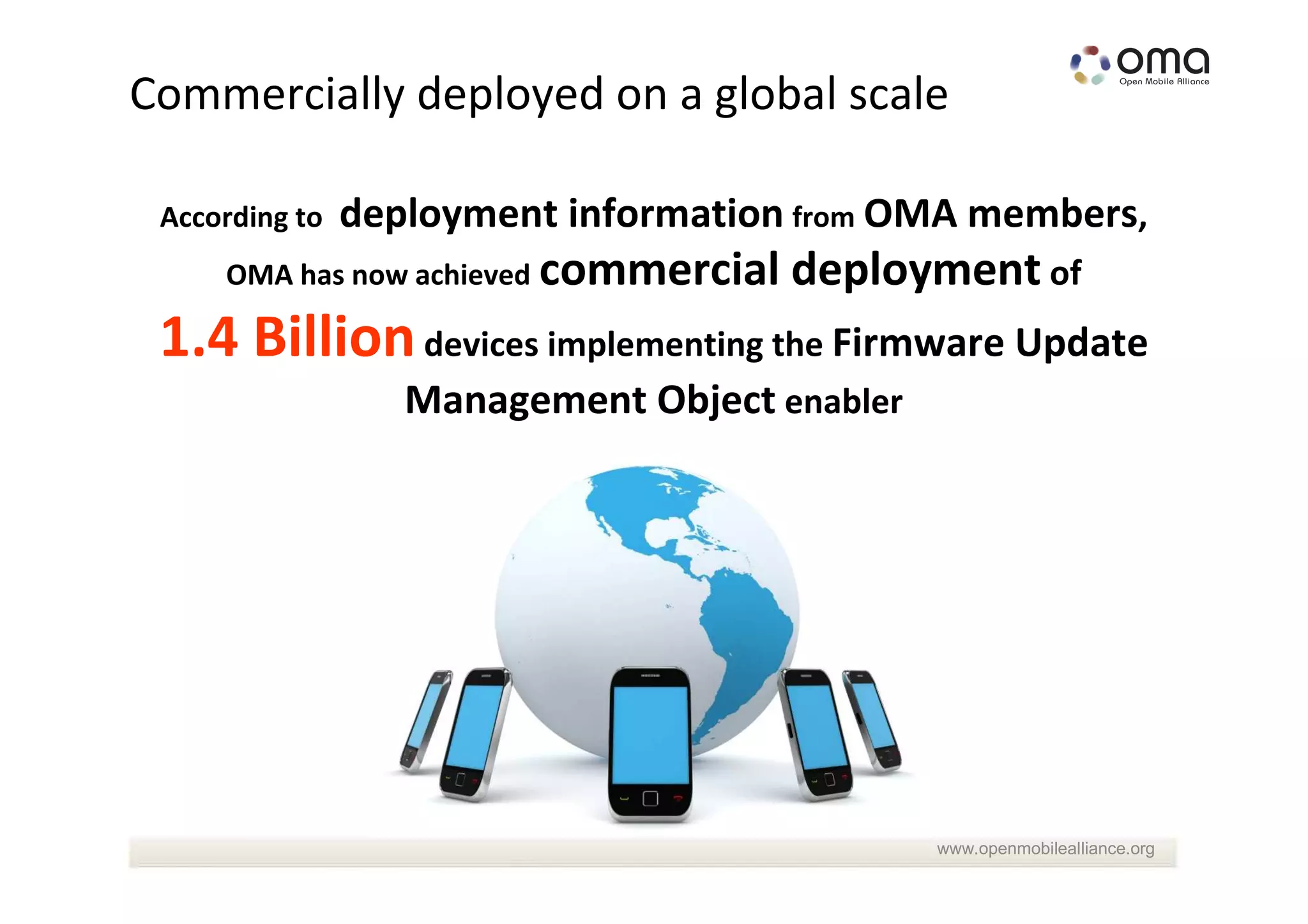
Commercially deployed on a global scale

 According to   deployment information from OMA members,
     OMA has now achieved commercial   deployment of
 1.4 Billion devices implementing the Firmware Update
                   Management Object enabler


                                               www.openmobilealliance.org
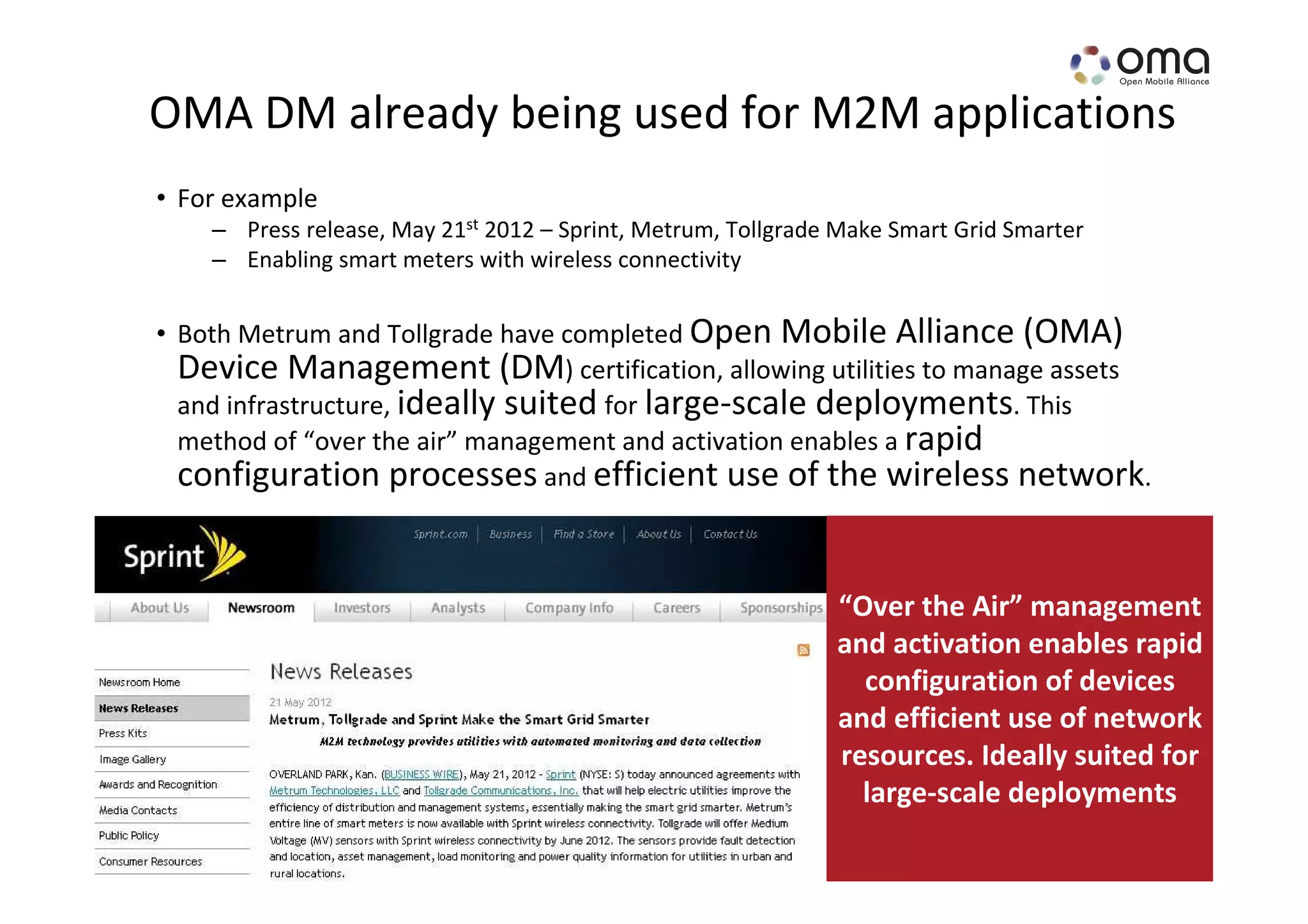
OMA DM already being used for M2M applications
• For example
    – Press release, May 21st 2012 – Sprint, Metrum, Tollgrade Make Smart Grid Smarter
    – Enabling smart meters with wireless connectivity


• Both Metrum and Tollgrade have completed Open Mobile Alliance (OMA)
  Device Management (DM) certification, allowing utilities to manage assets
  and infrastructure, ideally suited for large-scale deployments. This
  method of “over the air” management and activation enables a rapid
  configuration processes and efficient use of the wireless network.


                                                              “Over the Air” management
                                                              and activation enables rapid
                                                                configuration of devices
                                                              and efficient use of network
                                                              resources. Ideally suited for
                                                                large-scale deployments
                                                                        www.openmobilealliance.org
OMA Device Management
                    www.openmobilealliance.org
OMA position and focus – how to manage billions of devices

  OMA recognizes the need for current OMA Device Management technology
    to evolve - first to connect, then to manage application and service layer
    standardization requirements
  •   Technology needs to evolve from traditional mobile devices networks to
      heterogeneous networks that support both mobile and M2M devices
  •   Technology needs to support devices on heterogeneous networks through a
      Gateway
  •   Technology needs to support M2M devices as a gateway for other devices
  •   Technology needs to support provisioning and management protocol for
      constrained devices
  •   Technology needs to support provisioning and management protocol for
      constrained connectivity

  • Provisioning and Management of M2M devices
  • Connecting the Internet to the Physical World


               A natural extension of OMA DM through Gateway
          over lightweight M2M protocol can address these challenges
                                                                 www.openmobilealliance.org
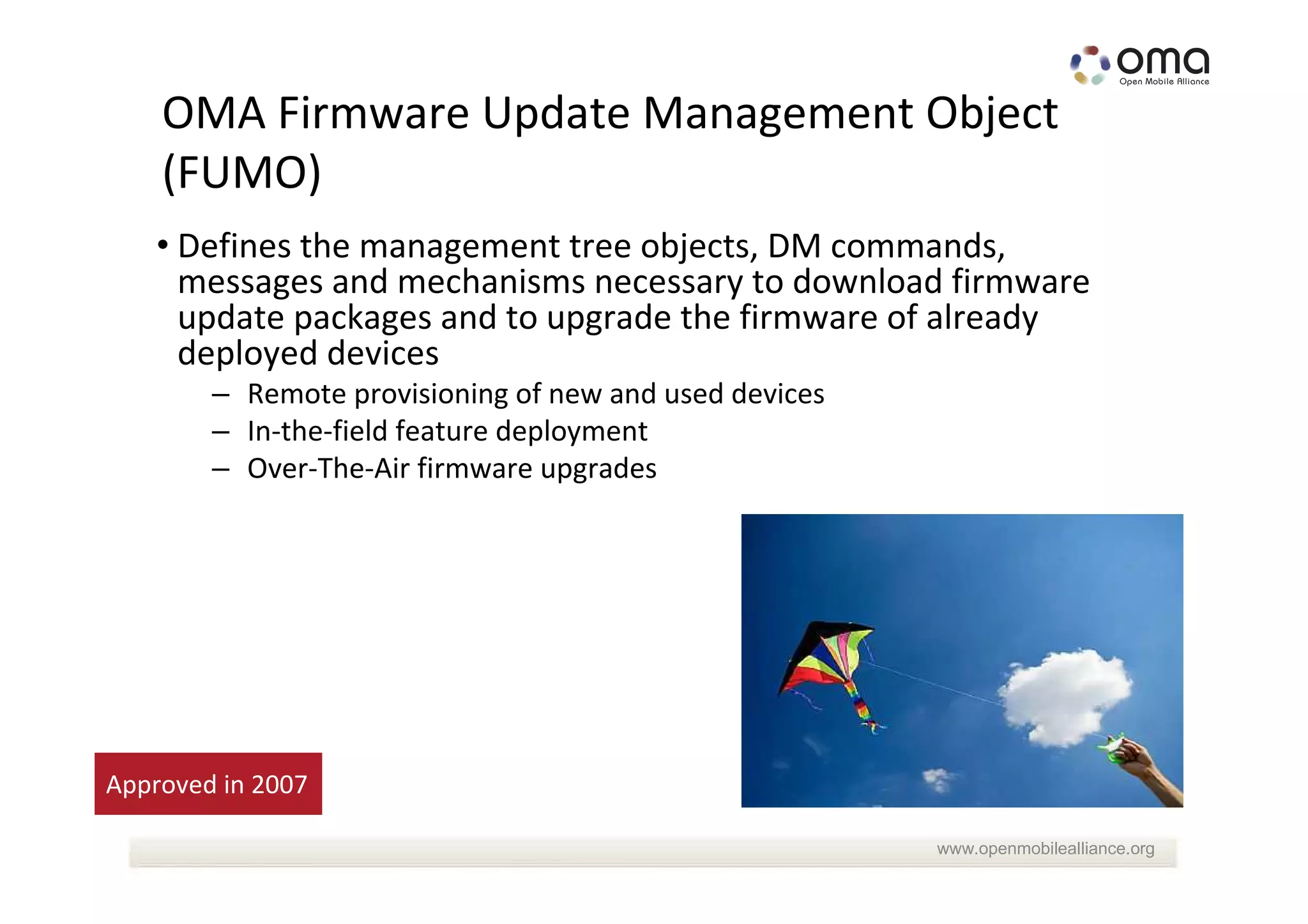
OMA Firmware Update Management Object
    (FUMO)
   • Defines the management tree objects, DM commands,
     messages and mechanisms necessary to download firmware
     update packages and to upgrade the firmware of already
     deployed devices
        – Remote provisioning of new and used devices
        – In-the-field feature deployment
        – Over-The-Air firmware upgrades


Approved in 2007

                                                        www.openmobilealliance.org
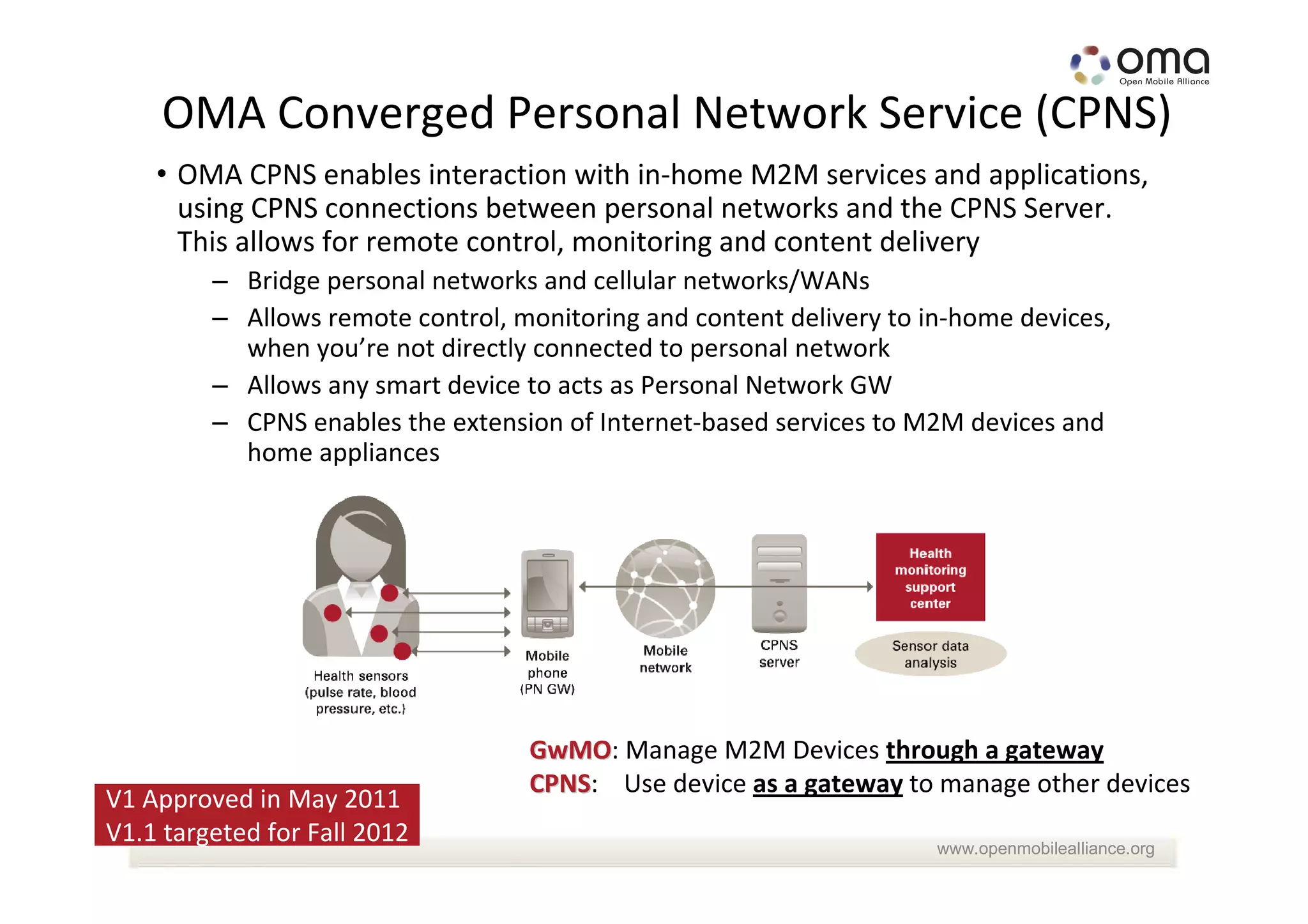
OMA Converged Personal Network Service (CPNS)
    • OMA CPNS enables interaction with in-home M2M services and applications,
      using CPNS connections between personal networks and the CPNS Server.
      This allows for remote control, monitoring and content delivery
         – Bridge personal networks and cellular networks/WANs
         – Allows remote control, monitoring and content delivery to in-home devices,
           when you’re not directly connected to personal network
         – Allows any smart device to acts as Personal Network GW
         – CPNS enables the extension of Internet-based services to M2M devices and
           home appliances


                                   GwMO: Manage M2M Devices through a gateway
                                   GwMO
                                   CPNS: Use device as a gateway to manage other devices
                                   CPNS
V1 Approved in May 2011
V1.1 targeted for Fall 2012                                           www.openmobilealliance.org
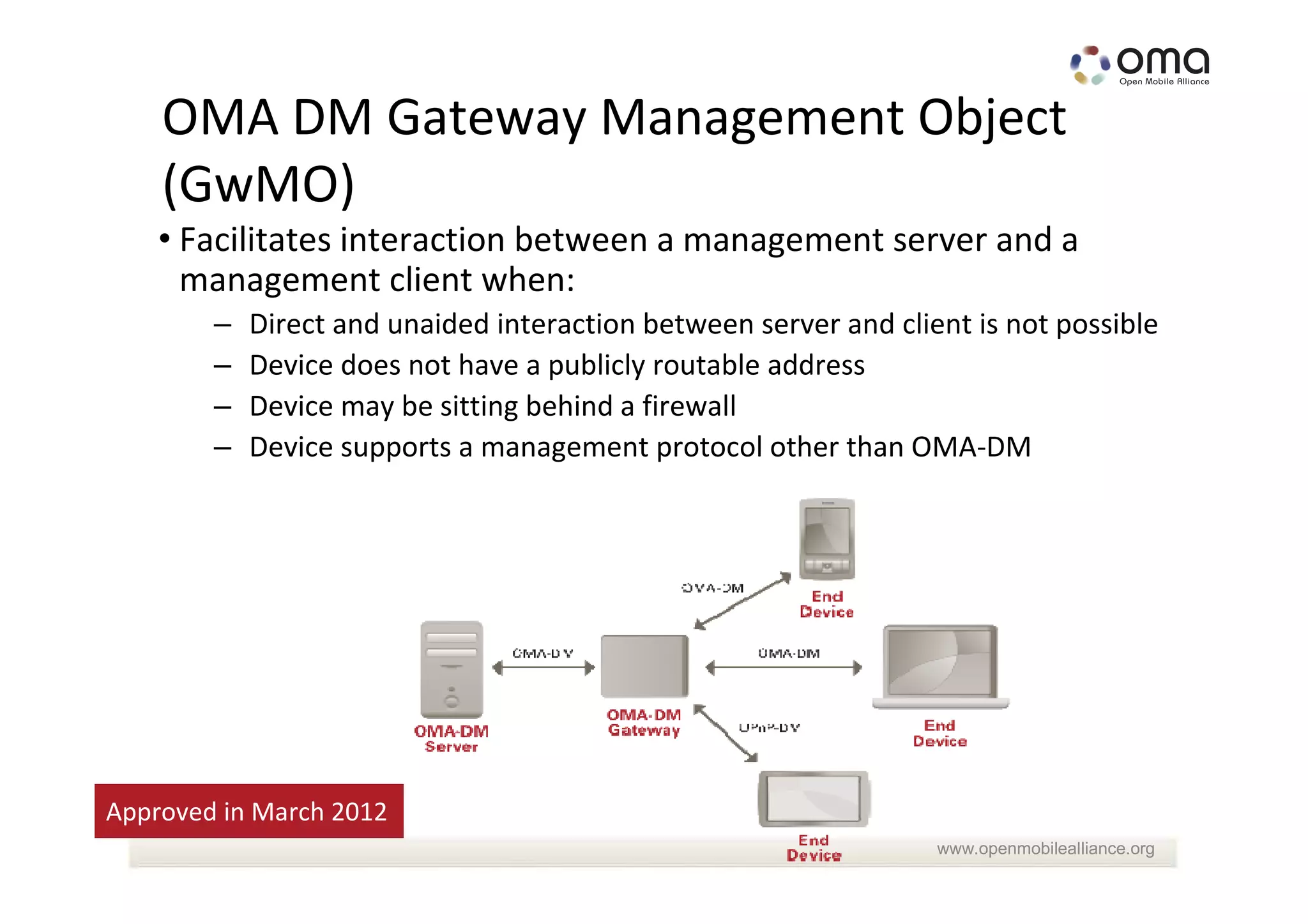
OMA DM Gateway Management Object
    (GwMO)
    • Facilitates interaction between a management server and a
      management client when:
        –   Direct and unaided interaction between server and client is not possible
        –   Device does not have a publicly routable address
        –   Device may be sitting behind a firewall
        –   Device supports a management protocol other than OMA-DM


Approved in March 2012
                                                                  www.openmobilealliance.org
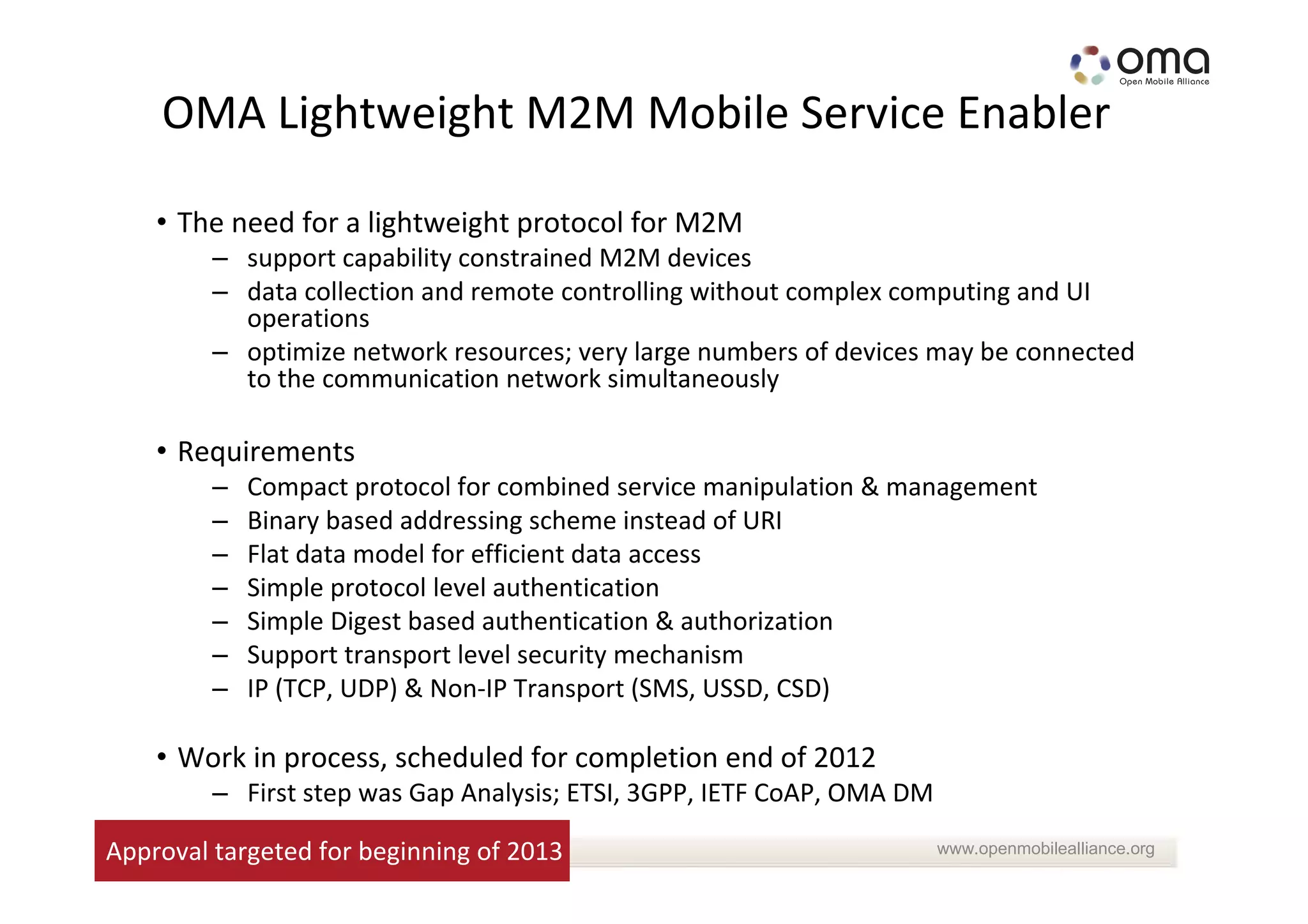
OMA Lightweight M2M Mobile Service Enabler

    • The need for a lightweight protocol for M2M
         – support capability constrained M2M devices
         – data collection and remote controlling without complex computing and UI
           operations
         – optimize network resources; very large numbers of devices may be connected
           to the communication network simultaneously

    • Requirements
         –   Compact protocol for combined service manipulation & management
         –   Binary based addressing scheme instead of URI
         –   Flat data model for efficient data access
         –   Simple protocol level authentication
         –   Simple Digest based authentication & authorization
         –   Support transport level security mechanism
         –   IP (TCP, UDP) & Non-IP Transport (SMS, USSD, CSD)

    • Work in process, scheduled for completion end of 2012
         – First step was Gap Analysis; ETSI, 3GPP, IETF CoAP, OMA DM

Approval targeted for beginning of 2013                                 www.openmobilealliance.org
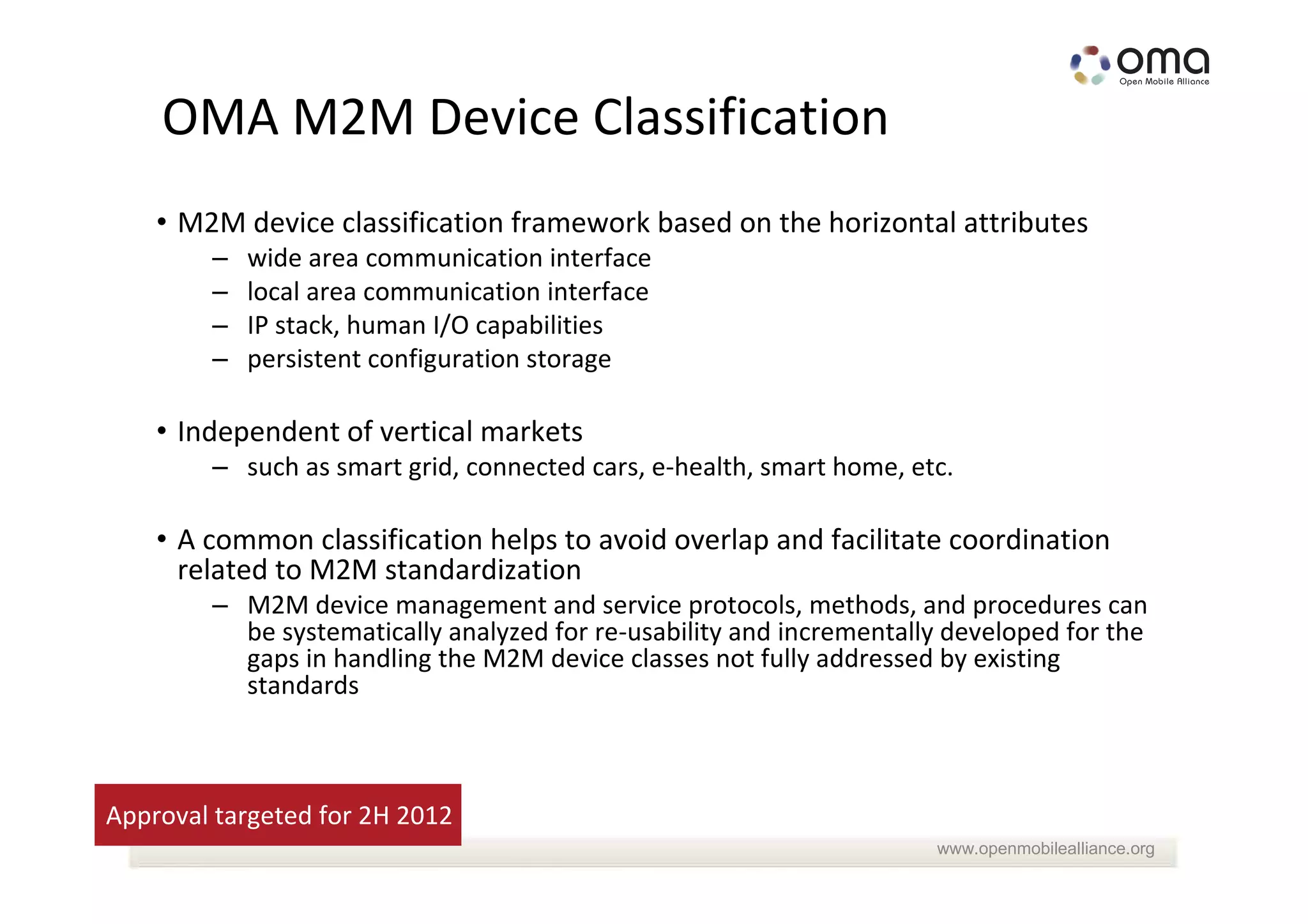
OMA M2M Device Classification
    • M2M device classification framework based on the horizontal attributes
        –   wide area communication interface
        –   local area communication interface
        –   IP stack, human I/O capabilities
        –   persistent configuration storage

    • Independent of vertical markets
        – such as smart grid, connected cars, e-health, smart home, etc.

    • A common classification helps to avoid overlap and facilitate coordination
      related to M2M standardization
        – M2M device management and service protocols, methods, and procedures can
          be systematically analyzed for re-usability and incrementally developed for the
          gaps in handling the M2M device classes not fully addressed by existing
          standards


Approval targeted for 2H 2012
                                                                      www.openmobilealliance.org
OMA Application Programming Interfaces
                              www.openmobilealliance.org
Where does the revenue come from?

            M2M may represent a good growth
               opportunity overall for MNOs –
             but not in terms of traffic revenue
                   M2M generated 1.2% of mobile data revenue in 2010,
                    falling to 0.8% in 2013, before rising to 1.4% in 2020
                                      (Machina Research [2])


Connecting, provisioning and managing
 all these billions of devices will unlock
    tremendous potential to provide
  innovative and exciting applications
                                                                             www.openmobilealliance.org
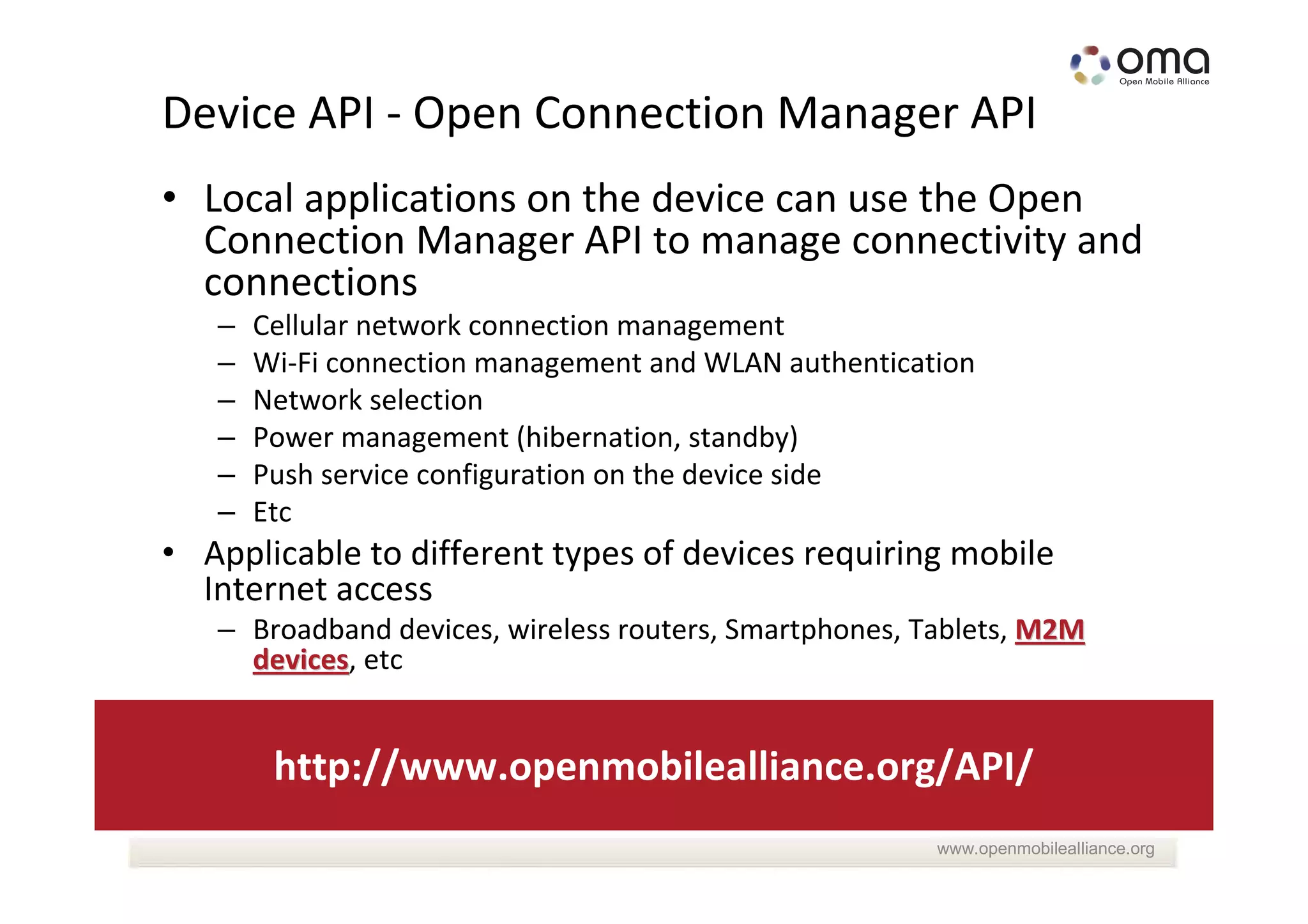
Device API - Open Connection Manager API
• Local applications on the device can use the Open
  Connection Manager API to manage connectivity and
  connections
   –   Cellular network connection management
   –   Wi-Fi connection management and WLAN authentication
   –   Network selection
   –   Power management (hibernation, standby)
   –   Push service configuration on the device side
   –   Etc
• Applicable to different types of devices requiring mobile
  Internet access
   – Broadband devices, wireless routers, Smartphones, Tablets, M2M
     devices, etc
     devices


        http://www.openmobilealliance.org/API/
                                                        www.openmobilealliance.org
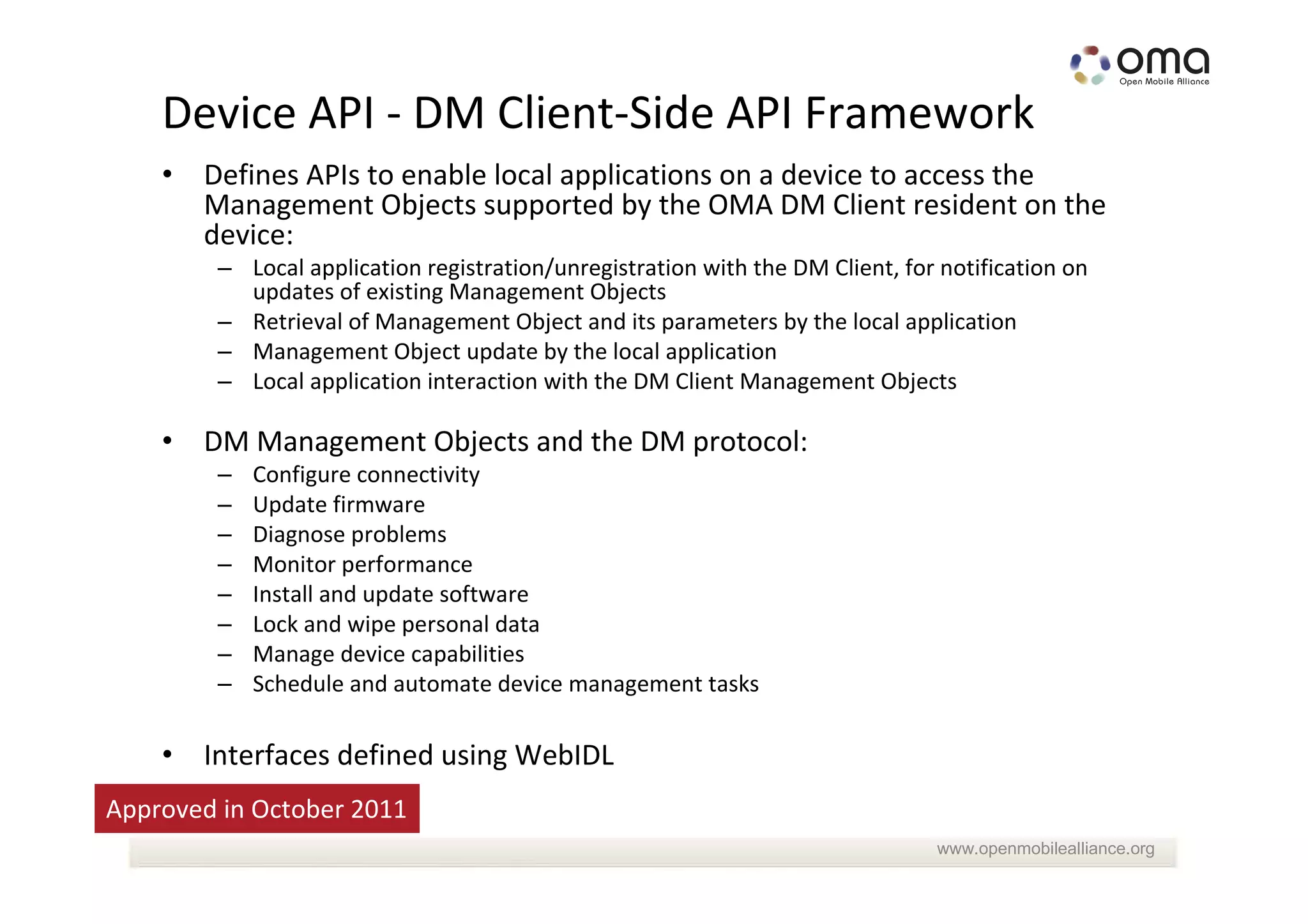
Device API - DM Client-Side API Framework
    • Defines APIs to enable local applications on a device to access the
      Management Objects supported by the OMA DM Client resident on the
      device:
        – Local application registration/unregistration with the DM Client, for notification on
          updates of existing Management Objects
        – Retrieval of Management Object and its parameters by the local application
        – Management Object update by the local application
        – Local application interaction with the DM Client Management Objects

    • DM Management Objects and the DM protocol:
        –   Configure connectivity
        –   Update firmware
        –   Diagnose problems
        –   Monitor performance
        –   Install and update software
        –   Lock and wipe personal data
        –   Manage device capabilities
        –   Schedule and automate device management tasks

    • Interfaces defined using WebIDL
Approved in October 2011
                                                                               www.openmobilealliance.org
OMA and their Industry Partners
                                  www.openmobilealliance.org
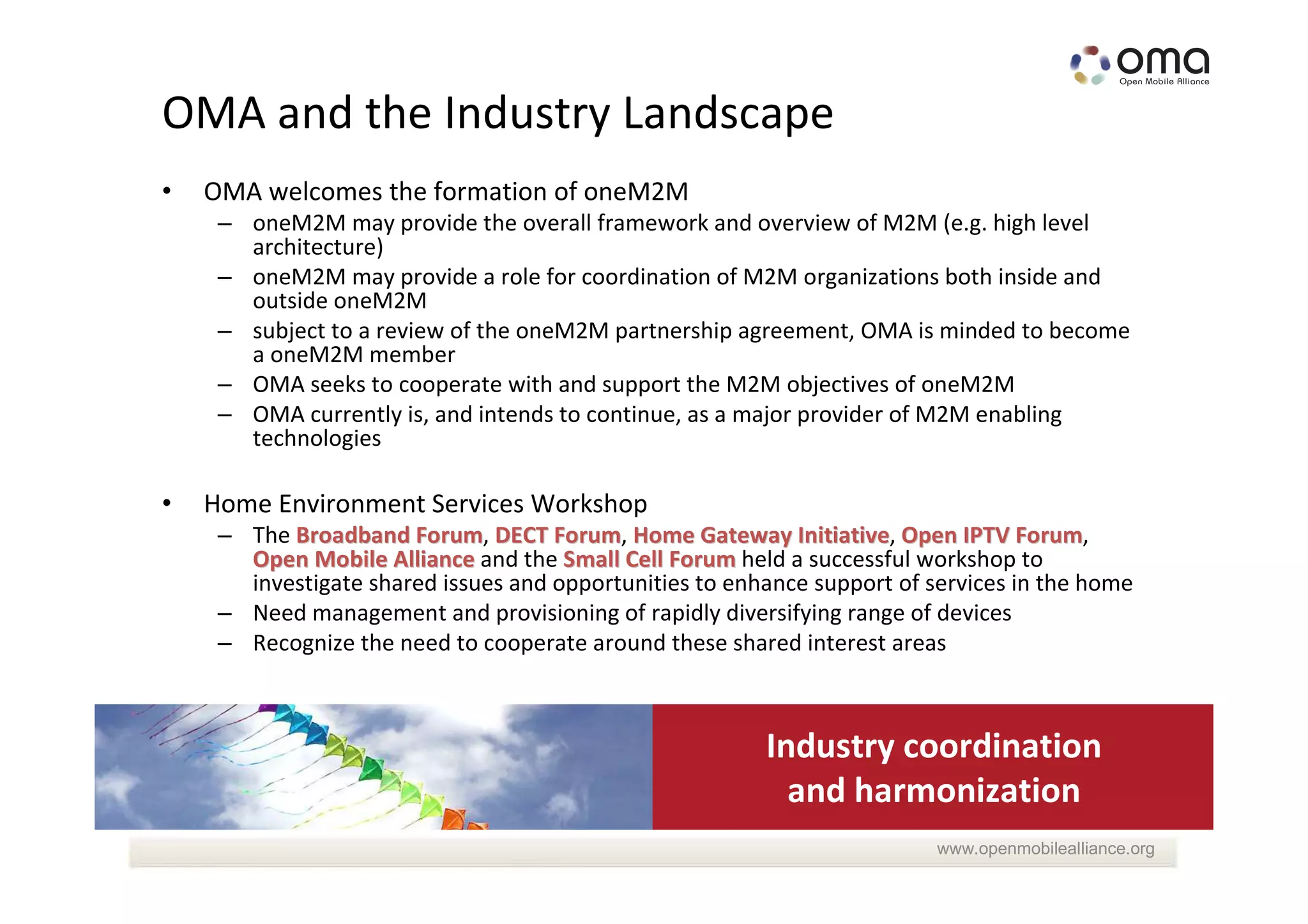
OMA and the Industry Landscape
•   OMA welcomes the formation of oneM2M
     – oneM2M may provide the overall framework and overview of M2M (e.g. high level
       architecture)
     – oneM2M may provide a role for coordination of M2M organizations both inside and
       outside oneM2M
     – subject to a review of the oneM2M partnership agreement, OMA is minded to become
       a oneM2M member
     – OMA seeks to cooperate with and support the M2M objectives of oneM2M
     – OMA currently is, and intends to continue, as a major provider of M2M enabling
       technologies

•   Home Environment Services Workshop
     – The Broadband Forum, DECT Forum, Home Gateway Initiative, Open IPTV Forum,
                       Forum         Forum                  Initiative             Forum
       Open Mobile Alliance and the Small Cell Forum held a successful workshop to
       investigate shared issues and opportunities to enhance support of services in the home
     – Need management and provisioning of rapidly diversifying range of devices
     – Recognize the need to cooperate around these shared interest areas


                                                         Industry coordination
                                                           and harmonization
                                                                          www.openmobilealliance.org
Thank You

        www.openmobilealliance.org
REFERENCES AND BACKUP
                        www.openmobilealliance.org
References

• [1]
  http://www.analysysmason.com/Research/Content/Reports/RRE02_M2M
  _devices_forecast/
• [2] http://www.machinaresearch.com/
     – M2M Global Forecast and Analysis 2010-20
• [3] http://www.gsm.org/index.htm
• [4] http://blogs.windriver.com/m2m/


 Image credits:
 • Jerry Maguire © 1996 TriStar Pictures, Inc. All Rights Reserved.
 • http://www.sparlingkites.com


                                              18                      www.openmobilealliance.org
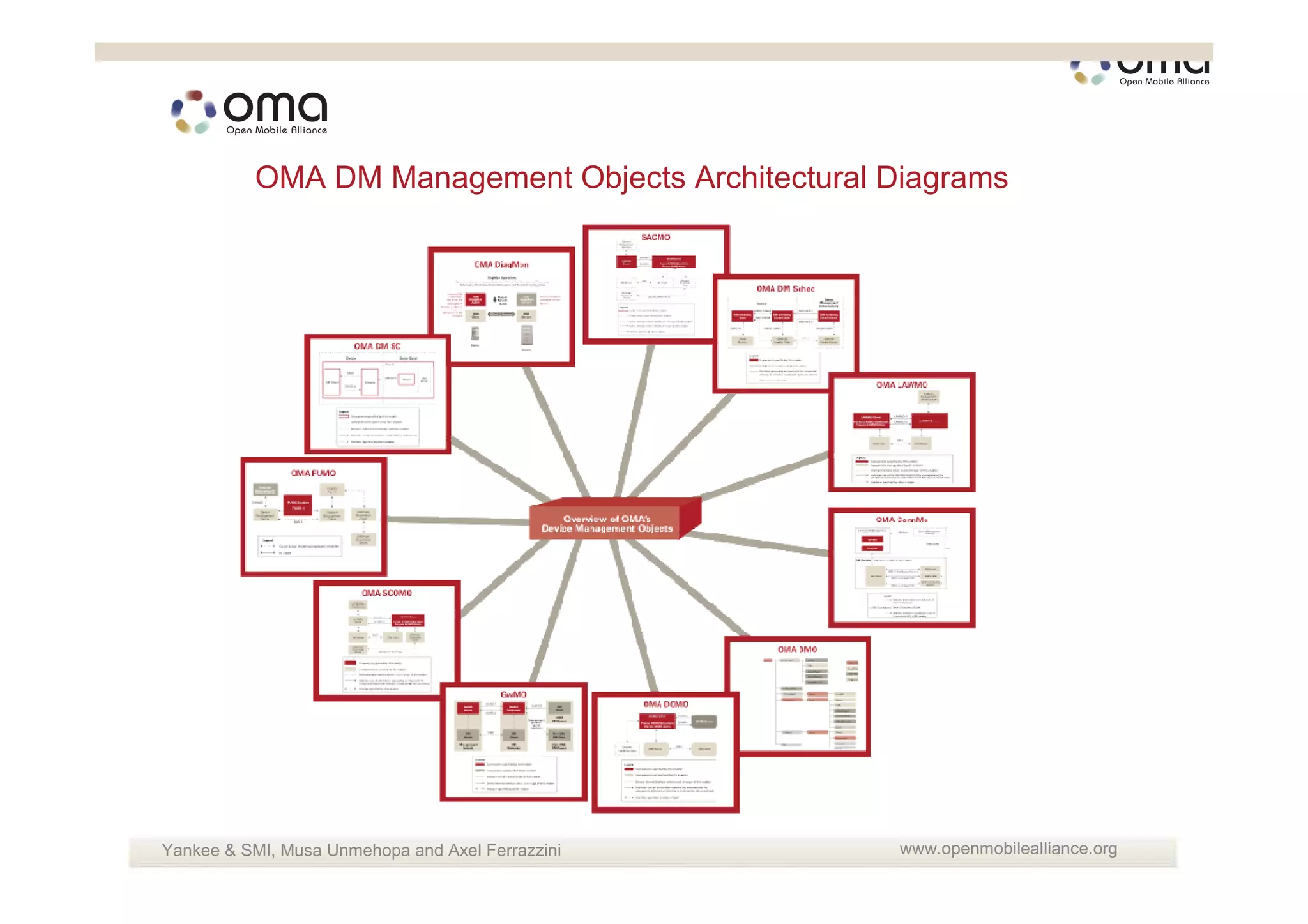
OMA DM Management Objects Architectural Diagrams


Yankee & SMI, Musa Unmehopa and Axel Ferrazzini    www.openmobilealliance.org
                                                      www.openmobilealliance.org
OMA – Overview
More than 135 members from across the mobile value chain
• Founded June 2002
• Operators, terminal and software vendors, content and entertainment providers
Interoperable service enablers across multiple domains
• Architecture, Security, Charging and Network APIs
• Person-to-Person Communications
• Device Capabilities
• Access to Content
• Services Access Interface
• Service Customization
Current and Ongoing Technical Deliverables – more detail in presentation
• 44 service enablers delivered in 2010 with 80 planned for 2011
• Ongoing refinement of interoperability testing program with Test on Demand in Q3 2011
• API Framework—building on success of GSMA OneAPI and Parlay affiliation
• M2M Communications—enabling terminals as gateways and converged personal networks
New and improved organizational structures and efficiencies
• Fast track process for omitting or combining steps and deliverables in OMA Process
• Min Max procedure for an alternative path to traditional testing of every OMA enabler
Collaboration with other bodies—including WAC, GSMA, W3C & ETSI
• Reduce duplication and fragmentation
• New strategic program of liaisons with appointed Board level champions to other bodies
• OMA maintains formal cooperation agreements or frameworks with nearly 50 industry bodies


                                                                                   www.openmobilealliance.org
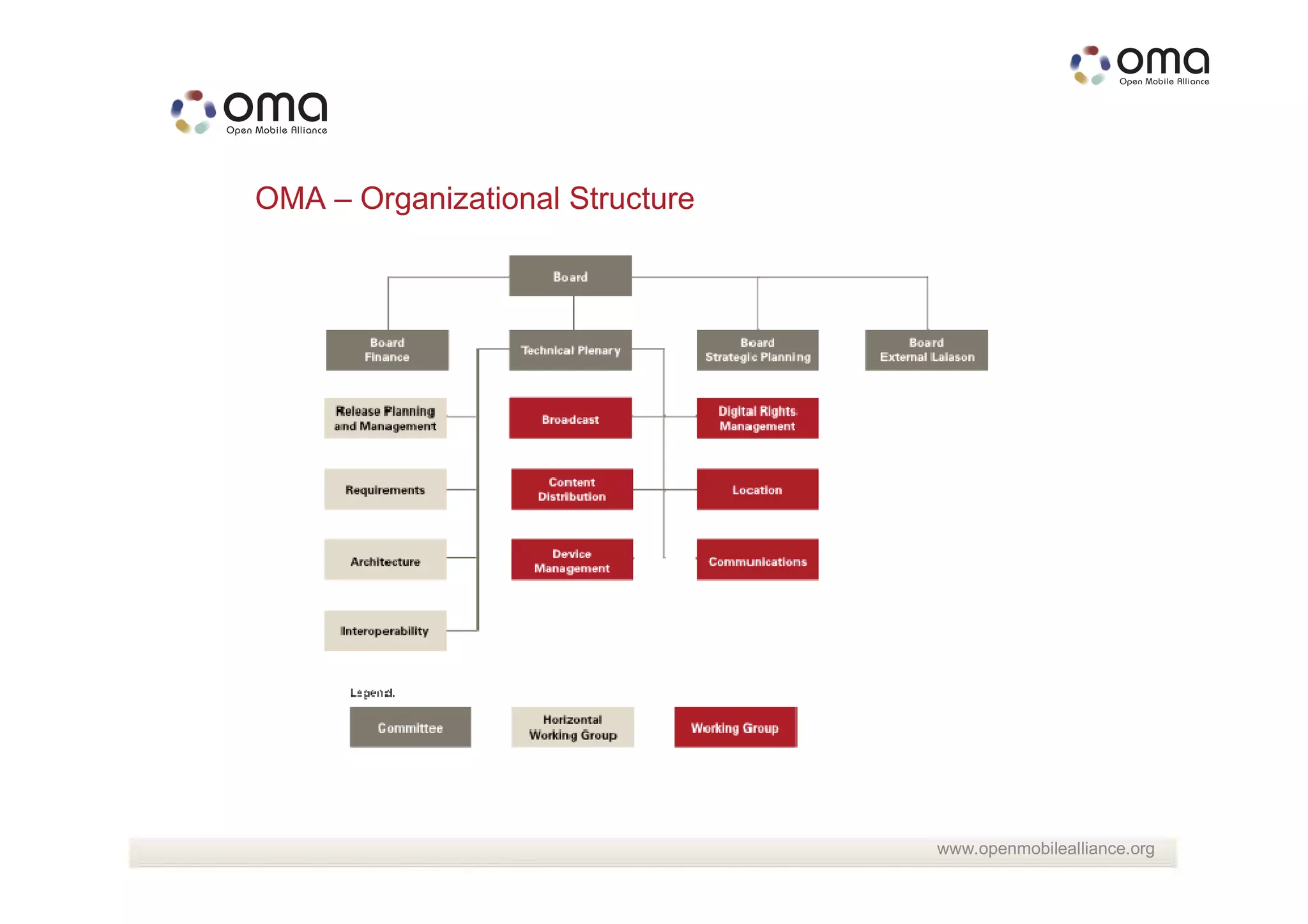
OMA – Organizational Structure


                                 www.openmobilealliance.org

Management and Provisioning of M2M Devices and Applications

  • 1.
    Management and Provisioningof M2M Devices and Applications Musa Unmehopa Technical Plenary Chairman, OMA Singapore Director of Standards, Alcatel-Lucent 19 June 2012 www.openmobilealliance.org www.openmobilealliance.org
  • 2.
    M2M devices outnumbermobile devices by an order of magnitude • Analysys Mason: Forecasts that the number of M2M device connections will grow to 2.1 billion devices in 2020 [1] • Machina Research: Number of M2M connections will grow to 12 billion in 2020 [2] • GSMA: Estimates that there will be 20 billion devices connected to the web by 2020 [3] • Another way of looking at this: There will be more M2M devices shipped each year than PCs, cell phones, tablets, set-top boxes, and gaming platforms put together [4] Remote device management and provisioning of all these M2M devices will be a critical aspect to support this tremendous growth opportunity www.openmobilealliance.org
  • 3.
    Commercially deployed ona global scale According to deployment information from OMA members, OMA has now achieved commercial deployment of 1.4 Billion devices implementing the Firmware Update Management Object enabler www.openmobilealliance.org
  • 4.
    OMA DM alreadybeing used for M2M applications • For example – Press release, May 21st 2012 – Sprint, Metrum, Tollgrade Make Smart Grid Smarter – Enabling smart meters with wireless connectivity • Both Metrum and Tollgrade have completed Open Mobile Alliance (OMA) Device Management (DM) certification, allowing utilities to manage assets and infrastructure, ideally suited for large-scale deployments. This method of “over the air” management and activation enables a rapid configuration processes and efficient use of the wireless network. “Over the Air” management and activation enables rapid configuration of devices and efficient use of network resources. Ideally suited for large-scale deployments www.openmobilealliance.org
  • 5.
    OMA Device Management www.openmobilealliance.org
  • 6.
    OMA position andfocus – how to manage billions of devices OMA recognizes the need for current OMA Device Management technology to evolve - first to connect, then to manage application and service layer standardization requirements • Technology needs to evolve from traditional mobile devices networks to heterogeneous networks that support both mobile and M2M devices • Technology needs to support devices on heterogeneous networks through a Gateway • Technology needs to support M2M devices as a gateway for other devices • Technology needs to support provisioning and management protocol for constrained devices • Technology needs to support provisioning and management protocol for constrained connectivity • Provisioning and Management of M2M devices • Connecting the Internet to the Physical World A natural extension of OMA DM through Gateway over lightweight M2M protocol can address these challenges www.openmobilealliance.org
  • 7.
    OMA Firmware UpdateManagement Object (FUMO) • Defines the management tree objects, DM commands, messages and mechanisms necessary to download firmware update packages and to upgrade the firmware of already deployed devices – Remote provisioning of new and used devices – In-the-field feature deployment – Over-The-Air firmware upgrades Approved in 2007 www.openmobilealliance.org
  • 8.
    OMA Converged PersonalNetwork Service (CPNS) • OMA CPNS enables interaction with in-home M2M services and applications, using CPNS connections between personal networks and the CPNS Server. This allows for remote control, monitoring and content delivery – Bridge personal networks and cellular networks/WANs – Allows remote control, monitoring and content delivery to in-home devices, when you’re not directly connected to personal network – Allows any smart device to acts as Personal Network GW – CPNS enables the extension of Internet-based services to M2M devices and home appliances GwMO: Manage M2M Devices through a gateway GwMO CPNS: Use device as a gateway to manage other devices CPNS V1 Approved in May 2011 V1.1 targeted for Fall 2012 www.openmobilealliance.org
  • 9.
    OMA DM GatewayManagement Object (GwMO) • Facilitates interaction between a management server and a management client when: – Direct and unaided interaction between server and client is not possible – Device does not have a publicly routable address – Device may be sitting behind a firewall – Device supports a management protocol other than OMA-DM Approved in March 2012 www.openmobilealliance.org
  • 10.
    OMA Lightweight M2MMobile Service Enabler • The need for a lightweight protocol for M2M – support capability constrained M2M devices – data collection and remote controlling without complex computing and UI operations – optimize network resources; very large numbers of devices may be connected to the communication network simultaneously • Requirements – Compact protocol for combined service manipulation & management – Binary based addressing scheme instead of URI – Flat data model for efficient data access – Simple protocol level authentication – Simple Digest based authentication & authorization – Support transport level security mechanism – IP (TCP, UDP) & Non-IP Transport (SMS, USSD, CSD) • Work in process, scheduled for completion end of 2012 – First step was Gap Analysis; ETSI, 3GPP, IETF CoAP, OMA DM Approval targeted for beginning of 2013 www.openmobilealliance.org
  • 11.
    OMA M2M DeviceClassification • M2M device classification framework based on the horizontal attributes – wide area communication interface – local area communication interface – IP stack, human I/O capabilities – persistent configuration storage • Independent of vertical markets – such as smart grid, connected cars, e-health, smart home, etc. • A common classification helps to avoid overlap and facilitate coordination related to M2M standardization – M2M device management and service protocols, methods, and procedures can be systematically analyzed for re-usability and incrementally developed for the gaps in handling the M2M device classes not fully addressed by existing standards Approval targeted for 2H 2012 www.openmobilealliance.org
  • 12.
    OMA Application ProgrammingInterfaces www.openmobilealliance.org
  • 13.
    Where does therevenue come from? M2M may represent a good growth opportunity overall for MNOs – but not in terms of traffic revenue M2M generated 1.2% of mobile data revenue in 2010, falling to 0.8% in 2013, before rising to 1.4% in 2020 (Machina Research [2]) Connecting, provisioning and managing all these billions of devices will unlock tremendous potential to provide innovative and exciting applications www.openmobilealliance.org
  • 14.
    Device API -Open Connection Manager API • Local applications on the device can use the Open Connection Manager API to manage connectivity and connections – Cellular network connection management – Wi-Fi connection management and WLAN authentication – Network selection – Power management (hibernation, standby) – Push service configuration on the device side – Etc • Applicable to different types of devices requiring mobile Internet access – Broadband devices, wireless routers, Smartphones, Tablets, M2M devices, etc devices http://www.openmobilealliance.org/API/ www.openmobilealliance.org
  • 15.
    Device API -DM Client-Side API Framework • Defines APIs to enable local applications on a device to access the Management Objects supported by the OMA DM Client resident on the device: – Local application registration/unregistration with the DM Client, for notification on updates of existing Management Objects – Retrieval of Management Object and its parameters by the local application – Management Object update by the local application – Local application interaction with the DM Client Management Objects • DM Management Objects and the DM protocol: – Configure connectivity – Update firmware – Diagnose problems – Monitor performance – Install and update software – Lock and wipe personal data – Manage device capabilities – Schedule and automate device management tasks • Interfaces defined using WebIDL Approved in October 2011 www.openmobilealliance.org
  • 16.
    OMA and theirIndustry Partners www.openmobilealliance.org
  • 17.
    OMA and theIndustry Landscape • OMA welcomes the formation of oneM2M – oneM2M may provide the overall framework and overview of M2M (e.g. high level architecture) – oneM2M may provide a role for coordination of M2M organizations both inside and outside oneM2M – subject to a review of the oneM2M partnership agreement, OMA is minded to become a oneM2M member – OMA seeks to cooperate with and support the M2M objectives of oneM2M – OMA currently is, and intends to continue, as a major provider of M2M enabling technologies • Home Environment Services Workshop – The Broadband Forum, DECT Forum, Home Gateway Initiative, Open IPTV Forum, Forum Forum Initiative Forum Open Mobile Alliance and the Small Cell Forum held a successful workshop to investigate shared issues and opportunities to enhance support of services in the home – Need management and provisioning of rapidly diversifying range of devices – Recognize the need to cooperate around these shared interest areas Industry coordination and harmonization www.openmobilealliance.org
  • 18.
    Thank You www.openmobilealliance.org
  • 19.
    REFERENCES AND BACKUP www.openmobilealliance.org
  • 20.
    References • [1] http://www.analysysmason.com/Research/Content/Reports/RRE02_M2M _devices_forecast/ • [2] http://www.machinaresearch.com/ – M2M Global Forecast and Analysis 2010-20 • [3] http://www.gsm.org/index.htm • [4] http://blogs.windriver.com/m2m/ Image credits: • Jerry Maguire © 1996 TriStar Pictures, Inc. All Rights Reserved. • http://www.sparlingkites.com 18 www.openmobilealliance.org
  • 21.
    OMA DM ManagementObjects Architectural Diagrams Yankee & SMI, Musa Unmehopa and Axel Ferrazzini www.openmobilealliance.org www.openmobilealliance.org
  • 22.
    OMA – Overview Morethan 135 members from across the mobile value chain • Founded June 2002 • Operators, terminal and software vendors, content and entertainment providers Interoperable service enablers across multiple domains • Architecture, Security, Charging and Network APIs • Person-to-Person Communications • Device Capabilities • Access to Content • Services Access Interface • Service Customization Current and Ongoing Technical Deliverables – more detail in presentation • 44 service enablers delivered in 2010 with 80 planned for 2011 • Ongoing refinement of interoperability testing program with Test on Demand in Q3 2011 • API Framework—building on success of GSMA OneAPI and Parlay affiliation • M2M Communications—enabling terminals as gateways and converged personal networks New and improved organizational structures and efficiencies • Fast track process for omitting or combining steps and deliverables in OMA Process • Min Max procedure for an alternative path to traditional testing of every OMA enabler Collaboration with other bodies—including WAC, GSMA, W3C & ETSI • Reduce duplication and fragmentation • New strategic program of liaisons with appointed Board level champions to other bodies • OMA maintains formal cooperation agreements or frameworks with nearly 50 industry bodies www.openmobilealliance.org
  • 23.
    OMA – OrganizationalStructure www.openmobilealliance.org