
Presented by :
Devender ( 032 )
Chandermuni (004)
INTRODUCTION
 According to Gorden MacBeath : manpower planning involves two
stages The first stage is concerned with the detailed “planning of
manpower requirements for all types and levels of employees
throughout the period of the plan,” and the second stage is concerned
with “planning of manpower supplies to provide the organisation with
the right types of people from all sources to meet the planned
requirements.
 According to Vetter : the process by which management determines
how the organisation should move from its current manpower position
to its desired manpower position. Through planning, management
strives to have the right number and the right kinds of people, at the
right places, at the right time, doing things which result in both the
organisation and the individual receiving maximum long-run benefit.
Objectives of Manpower Planning
 Optimum Productivity: Skilled and qualified workers are
recruited or they become so through the training programme provided
by the organization, through the manpower planning. Hence, an
organization can achieve the effective optimum utilization of human
potential, which will result in optimum productivity
 Reduction in labuor cost : Effective use of manpower,
and optimum productivity will reduce the wastage. It will reduce the
labour cost.
 Effective Recruitment and Selection: Right person
can be placed at the right job and at right time through manpower
planning. Because future need can be predicted by manpower
planning. Therefore, effective recruitment and selection can be
achieved so that no need to spend much amount on the training and
labour turnover can be reduced.
Cont…
 Group Satisfaction: By establishing mutually
satisfying work relationship between all the members of
the organization, group satisfaction and team spirit can be
achieved.
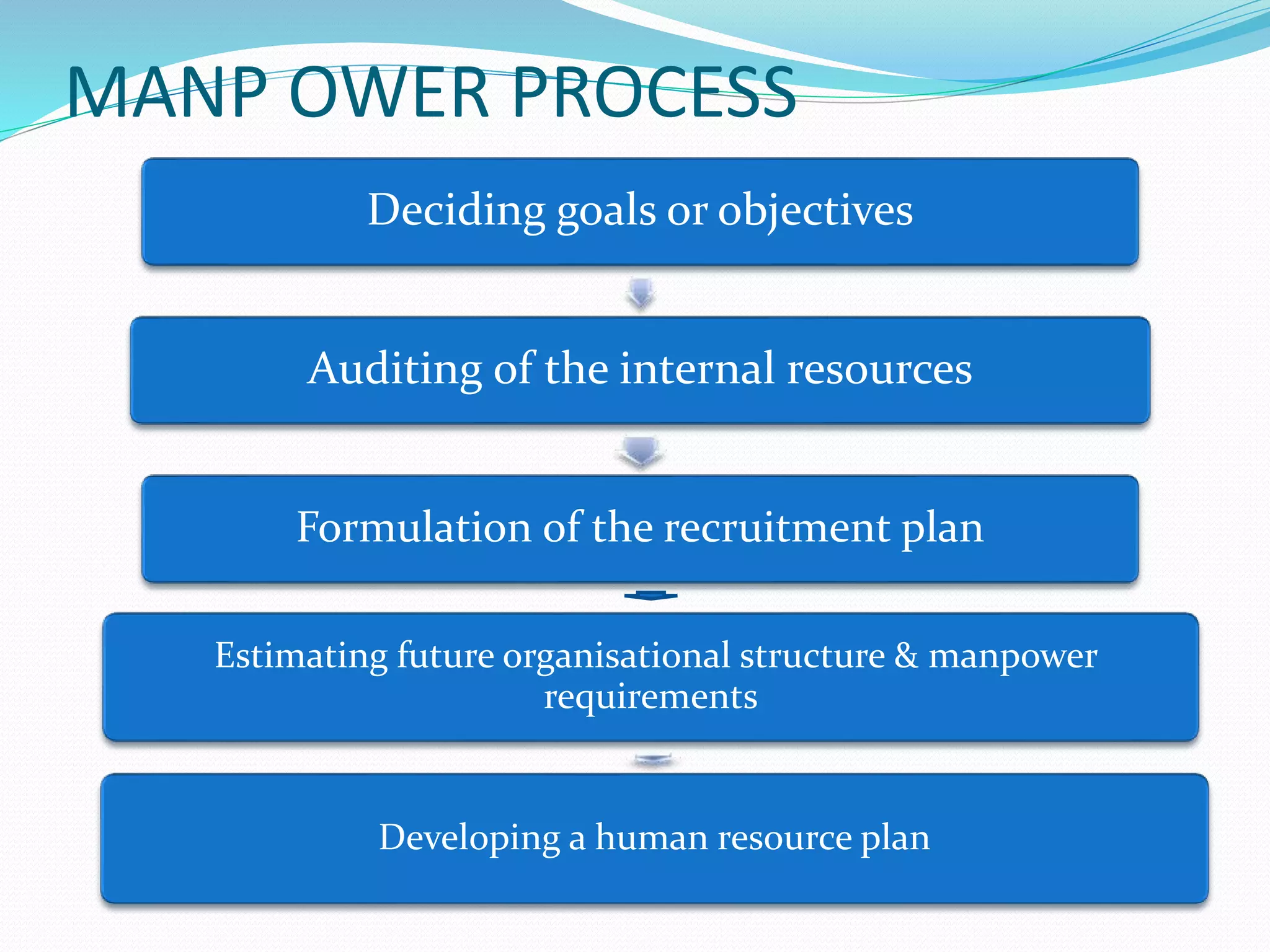
MANP OWER PROCESS
Deciding goals or objectives
Auditing of the internal resources
Formulation of the recruitment plan
Estimating future organisational structure & manpower
requirements
Developing a human resource plan
Factors Affecting Manpower
Planning:
 1. Exciting Stock of Manpower: This is the first basis
of manpower planning and it is the starting point of all
planning processes. On the basis of function,
occupation, level of skill or qualification, we can
analyse the existing stock of manpower.
 2. Wastage:The second basis of manpower planning is
wastage. For a good planning, appropriate adjustment
in the existing stock of manpower
CONT…
 3. Future Manpower Requirement: We can easily
measure the future requirements of manpower, after assessing
the existing stock of manpower and analysing the several factors
of wastage.
 4. Future Withdrawal of Workers: Effective manpower
requires that the human resource manager should take into
consideration decrease in the working force in future due to retirement
demotion.

man power planning

  • 1.
    Presented by : Devender( 032 ) Chandermuni (004)
  • 2.
    INTRODUCTION  According toGorden MacBeath : manpower planning involves two stages The first stage is concerned with the detailed “planning of manpower requirements for all types and levels of employees throughout the period of the plan,” and the second stage is concerned with “planning of manpower supplies to provide the organisation with the right types of people from all sources to meet the planned requirements.  According to Vetter : the process by which management determines how the organisation should move from its current manpower position to its desired manpower position. Through planning, management strives to have the right number and the right kinds of people, at the right places, at the right time, doing things which result in both the organisation and the individual receiving maximum long-run benefit.
  • 3.
    Objectives of ManpowerPlanning  Optimum Productivity: Skilled and qualified workers are recruited or they become so through the training programme provided by the organization, through the manpower planning. Hence, an organization can achieve the effective optimum utilization of human potential, which will result in optimum productivity  Reduction in labuor cost : Effective use of manpower, and optimum productivity will reduce the wastage. It will reduce the labour cost.  Effective Recruitment and Selection: Right person can be placed at the right job and at right time through manpower planning. Because future need can be predicted by manpower planning. Therefore, effective recruitment and selection can be achieved so that no need to spend much amount on the training and labour turnover can be reduced.
  • 4.
    Cont…  Group Satisfaction:By establishing mutually satisfying work relationship between all the members of the organization, group satisfaction and team spirit can be achieved.
  • 5.
    MANP OWER PROCESS Decidinggoals or objectives Auditing of the internal resources Formulation of the recruitment plan Estimating future organisational structure & manpower requirements Developing a human resource plan
  • 6.
    Factors Affecting Manpower Planning: 1. Exciting Stock of Manpower: This is the first basis of manpower planning and it is the starting point of all planning processes. On the basis of function, occupation, level of skill or qualification, we can analyse the existing stock of manpower.  2. Wastage:The second basis of manpower planning is wastage. For a good planning, appropriate adjustment in the existing stock of manpower
  • 7.
    CONT…  3. FutureManpower Requirement: We can easily measure the future requirements of manpower, after assessing the existing stock of manpower and analysing the several factors of wastage.  4. Future Withdrawal of Workers: Effective manpower requires that the human resource manager should take into consideration decrease in the working force in future due to retirement demotion.