Memory Mechanism
Presenter:
Shyam Khadka
B. Tech Ed. (Livestock Extension)
2019th batch TITI Bhaktapur
Kathmandu
University
Date 2020.9.2 1
Objectives of this presentation:
• Define The Meaning of memory.
• Explain Types of memory.
• Explain the Stages of Memory.
• Pattern of different stages of memory
• Processing model of learning memory
2
What is Memory ?
• Ability of acquire, store, retain and
retrieve the information after a
period of time.
• Only few parts of experiences are
stored in the mind for certain
period.
• Recall is called memorized.
• Opposite to process of forgetting.
3
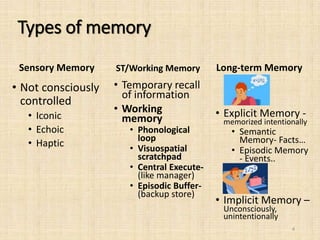
Sensory Memory
• Not consciously
controlled
• Iconic
• Echoic
• Haptic
• Temporary recall
of information
• Working
memory
• Phonological
loop
• Visuospatial
scratchpad
• Central Execute-
(like manager)
• Episodic Buffer-
(backup store)
• Explicit Memory -
memorized intentionally
• Semantic
Memory- Facts…
• Episodic Memory
- Events..
• Implicit Memory –
Unconsciously,
unintentionally
ST/Working Memory Long-term Memory
Types of memory
4
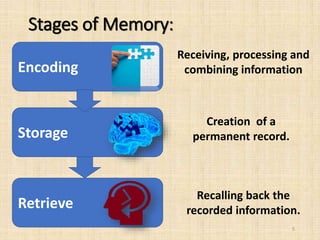
Stages of Memory:
Encoding
Storage
Retrieve
Receiving, processing and
combining information
Creation of a
permanent record.
Recalling back the
recorded information.
5
Patterns of ….
Encoding
Retrieve
Storage
• Visual,
• Acoustic,
• Elaborative,
• Semantic
• Short term-storage
• Long term storage
• Serial Recall
• Free Recall
• Cued Recall
6
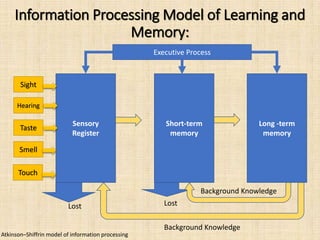
Information Processing Model of Learning and
Memory:
Sensory
Register
Short-term
memory
Long -term
memory
Sight
Hearing
Taste
Smell
Touch
Lost Lost
Background Knowledge
Atkinson–Shiffrin model of information processing
Executive Process
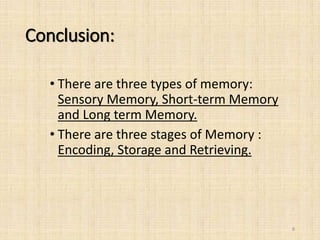
Conclusion:
• There are three types of memory:
Sensory Memory, Short-term Memory
and Long term Memory.
• There are three stages of Memory :
Encoding, Storage and Retrieving.
8
References:
• Website: https://courses.lumenlearning.com/boundless-psychology/chapter/introduction-to-memory
• https://www.simplypsychology.org/working%20memory.html#:~:text=The%20phonological%20loop%20is%20the,
)%20for%201%2D2%20seconds.
• https://courses.lumenlearning.com/boundless-psychology/chapter/step-3-memory-retrieval/
• Robert E. Slavin - Educational Psychology, Theory and Practice (2017, Pearson) - libgen.lc
• https://www.learning-theories.com/information-processing-theory.html
9

Mamory machanism

  • 1.
    Memory Mechanism Presenter: Shyam Khadka B.Tech Ed. (Livestock Extension) 2019th batch TITI Bhaktapur Kathmandu University Date 2020.9.2 1
  • 2.
    Objectives of thispresentation: • Define The Meaning of memory. • Explain Types of memory. • Explain the Stages of Memory. • Pattern of different stages of memory • Processing model of learning memory 2
  • 3.
    What is Memory? • Ability of acquire, store, retain and retrieve the information after a period of time. • Only few parts of experiences are stored in the mind for certain period. • Recall is called memorized. • Opposite to process of forgetting. 3
  • 4.
    Sensory Memory • Notconsciously controlled • Iconic • Echoic • Haptic • Temporary recall of information • Working memory • Phonological loop • Visuospatial scratchpad • Central Execute- (like manager) • Episodic Buffer- (backup store) • Explicit Memory - memorized intentionally • Semantic Memory- Facts… • Episodic Memory - Events.. • Implicit Memory – Unconsciously, unintentionally ST/Working Memory Long-term Memory Types of memory 4
  • 5.
    Stages of Memory: Encoding Storage Retrieve Receiving,processing and combining information Creation of a permanent record. Recalling back the recorded information. 5
  • 6.
    Patterns of …. Encoding Retrieve Storage •Visual, • Acoustic, • Elaborative, • Semantic • Short term-storage • Long term storage • Serial Recall • Free Recall • Cued Recall 6
  • 7.
    Information Processing Modelof Learning and Memory: Sensory Register Short-term memory Long -term memory Sight Hearing Taste Smell Touch Lost Lost Background Knowledge Background Knowledge Atkinson–Shiffrin model of information processing Executive Process
  • 8.
    Conclusion: • There arethree types of memory: Sensory Memory, Short-term Memory and Long term Memory. • There are three stages of Memory : Encoding, Storage and Retrieving. 8
  • 9.
    References: • Website: https://courses.lumenlearning.com/boundless-psychology/chapter/introduction-to-memory •https://www.simplypsychology.org/working%20memory.html#:~:text=The%20phonological%20loop%20is%20the, )%20for%201%2D2%20seconds. • https://courses.lumenlearning.com/boundless-psychology/chapter/step-3-memory-retrieval/ • Robert E. Slavin - Educational Psychology, Theory and Practice (2017, Pearson) - libgen.lc • https://www.learning-theories.com/information-processing-theory.html 9

Editor's Notes

  • #5 Working Memory Model By Saul McLeod, updated 2012 Take-home Messages Working memory is a limited capacity store for retaining information for a brief period while performing mental operations on that information. Working memory is a multi-component system which includes the central executive, visuospatial sketchpad, phonological loop, and episodic buffer. Working memory is important for reasoning, learning and comprehension. Working memory theories assume that complex reasoning and learning tasks require a mental workspace to hold and manipulate information. Atkinson’s and Shiffrin’s (1968) multi-store model was extremely successful in terms of the amount of research it generated. However, as a result of this research, it became apparent that there were a number of problems with their ideas concerning the characteristics of short-term memory. Baddeley and Hitch (1974) argue that the picture of short-term memory (STM) provided by the Multi-Store Model is far too simple. According to the Multi-Store Model, STM holds limited amounts of information for short periods of time with relatively little processing.  It is a unitary system. This means it is a single system (or store) without any subsystems. Whereas working memory is a multi-component system (auditory, and visual). Therefore, whereas short-term memory can only hold information, working memory can both retainin and process information. Fig 1. The Working Memory Model (Baddeley and Hitch, 1974) Working memory is short-term memory. However, instead of all information going into one single store, there are different systems for different types of information. Central Executive Drives the whole system (e.g., the boss of working memory) and allocates data to the subsystems: the phonological loop and the visuospatial sketchpad. It also deals with cognitive tasks such as mental arithmetic and problem-solving. Visuospatial Sketchpad (inner eye) The visuospatial sketchpad is a component of working memory model which stores and processes information in a visual or spatial form. The visuospatial sketchpad is used for navigation. Phonological Loop The phonological loop is a component of working memory model that deals with spoken and written material. It is subdivided into the phonological store (which holds information in a speech-based form) and the articulatory process (which allows us to repeat verbal information in a loop). Phonological Store (inner ear) processes speech perception and stores spoken words we hear for 1-2 seconds. Articulatory control process (inner voice) processes speech production, and rehearses and stores verbal information from the phonological store. Fig 2. The Working Memory Model Components (Baddeley and Hitch, 1974) The labels given to the components (see fig 2) of the working memory reflect their function and the type of information they process and manipulate. The phonological loop is assumed to be responsible for the manipulation of speech based information, whereas the visuospatial sketchpad is assumed to be responsible for manipulating visual images. The model proposes that every component of working memory has a limited capacity, and also that the components are relatively independent of each other. The Central Executive The central executive is the most important component of the model, although little is known about how it functions.  It is responsible for monitoring and coordinating the operation of the slave systems (i.e., visuospatial sketchpad and phonological loop) and relates them to long term memory (LTM). The central executive decides which information is attended to and which parts of the working memory to send that information to be dealt with. For example, two activities sometimes come into conflict, such as driving a car and talking. Rather than hitting a cyclist who is wobbling all over the road, it is preferable to stop talking and concentrate on driving. The central executive directs attention and gives priority to particular activities. The central executive is the most versatile and important component of the working memory system. However, despite its importance in the working-memory model, we know considerably less about this component than the two subsystems it controls. Baddeley suggests that the central executive acts more like a system which controls attentional processes rather than as a memory store.  This is unlike the phonological loop and the visuospatial sketchpad, which are specialized storage systems. The central executive enables the working memory system to selectively attend to some stimuli and ignore others. Baddeley (1986) uses the metaphor of a company boss to describe the way in which the central executive operates.  The company boss makes decisions about which issues deserve attention and which should be ignored.  They also select strategies for dealing with problems, but like any person in the company, the boss can only do a limited number of things at the same time. The boss of a company will collect information from a number of different sources. If we continue applying this metaphor, then we can see the central executive in working memory integrating (i.e., combining) information from two assistants (the phonological loop and the visuospatial sketchpad) and also drawing on information held in a large database (long-term memory). The Phonological Loop The phonological loop is the part of working memory that deals with spoken and written material. It consists of two parts The phonological store (linked to speech perception) acts as an inner ear and holds information in a speech-based form (i.e., spoken words) for 1-2 seconds. Spoken words enter the store directly. Written words must first be converted into an articulatory (spoken) code before they can enter the phonological store. The articulatory control process (linked to speech production) acts like an inner voice rehearsing information from the phonological store. It circulates information round and round like a tape loop. This is how we remember a telephone number we have just heard. As long as we keep repeating it, we can retain the information in working memory. The articulatory control process also converts written material into an articulatory code and transfers it to the phonological store. The Visuospatial Sketchpad the visuospatial sketchpad (inner eye) deals with visual and spatial information. Visual information refers to what things look like. It is likely that the visuospatial sketchpad plays an important role in helping us keep track of where we are in relation to other objects as we move through our environment (Baddeley, 1997). As we move around, our position in relation to objects is constantly changing and it is important that we can update this information.  For example, being aware of where we are in relation to desks, chairs and tables when we are walking around a classroom means that we don't bump into things too often! The sketchpad also displays and manipulates visual and spatial information held in long-term memory. For example, the spatial layout of your house is held in LTM. Try answering this question: How many windows are there in the front of your house? You probably find yourself picturing the front of your house and counting the windows. An image has been retrieved from LTM and pictured on the sketchpad. Evidence suggests that working memory uses two different systems for dealing with visual and verbal information. A visual processing task and a verbal processing task can be performed at the same time. It is more difficult to perform two visual tasks at the same time because they interfere with each other and performance is reduced. The same applies to performing two verbal tasks at the same time. This supports the view that the phonological loop and the sketchpad are separate systems within working memory. Empirical Evidence for Working Memory What evidence is there that working memory exists, that it is made up of a number of parts, that it performs a number of different tasks? The working memory model makes the following two predictions: 1. If two tasks make use of the same component (of working memory), they cannot be performed successfully together. 2. If two tasks make use of different components, it should be possible to perform them as well as together as separately. Key Study: Baddeley and Hitch (1976) Aim: To investigate if participants can use different parts of working memory at the same time. Method: Conducted an experiment in which participants were asked to perform two tasks at the same time (dual task technique) - a digit span task which required them to repeat a list of numbers, and a verbal reasoning task which required them to answer true or false to various questions (e.g., B is followed by A?). Results: As the number of digits increased in the digit span tasks, participants took longer to answer the reasoning questions, but not much longer - only fractions of a second.  And, they didn't make any more errors in the verbal reasoning tasks as the number of digits increased. Conclusion: The verbal reasoning task made use of the central executive and the digit span task made use of the phonological loop. The Episodic Buffer The original model was updated by Baddeley (2000) after the model failed to explain the results of various experiments. An additional component was added called the episodic buffer. The episodic buffer acts as a 'backup' store which communicates with both long-term memory and the components of working memory. Critical Evaluation Strengths Researchers today generally agree that short-term memory is made up of a number of components or subsystems. The working memory model has replaced the idea of a unitary (one part) STM as suggested by the multistore model. The working memory model explains a lot more than the multistore model. It makes sense of a range of tasks - verbal reasoning, comprehension, reading, problem-solving and visual and spatial processing. And the model is supported by considerable experimental evidence. The working memory applies to real-life tasks: - reading (phonological loop) - problem solving (central executive) - navigation (visual and spatial processing) The KF Case Study supports the Working Memory Model. KF suffered brain damage from a motorcycle accident that damaged his short-term memory. KF's impairment was mainly for verbal information - his memory for visual information was largely unaffected. This shows that there are separate STM components for visual information (VSS) and verbal information (phonological loop). Working memory is supported by dual-task studies (Baddeley and Hitch, 1976). The working memory model does not over emphasize the importance of rehearsal for STM retention, in contrast to the multi-store model. Weaknesses Lieberman (1980) criticizes the working memory model as the visuospatial sketchpad (VSS) implies that all spatial information was first visual (they are linked). However, Lieberman points out that blind people have excellent spatial awareness, although they have never had any visual information. Lieberman argues that the VSS should be separated into two different components: one for visual information and one for spatial. There is little direct evidence for how the central executive works and what it does. The capacity of the central executive has never been measured. Working memory only involves STM, so it is not a comprehensive model of memory (as it does not include SM or LTM). The working memory model does not explain changes in processing ability that occur as the result of practice or time. How to reference this article: McLeod, S. A. (2012). Working memory. Simply Psychology. https://www.simplypsychology.org/working%20memory.html APA Style References Atkinson, R. C., & Shiffrin, R. M. (1968). Chapter: Human memory: A proposed system and its control processes. In Spence, K. W., & Spence, J. T. The psychology of learning and motivation (Volume 2). New York: Academic Press. pp. 89–195.
  • #7 Types of Encoding The four primary types of encoding are visual, acoustic, elaborative, and semantic. Visual Visual encoding is the process of encoding images and visual sensory information. The creation of mental pictures is one way people use visual encoding. This type of information is temporarily stored in iconic memory, and then is moved to long-term memory for storage. The amygdala plays a large role in the visual encoding of memories. Acoustic Acoustic encoding is the use of auditory stimuli or hearing to implant memories. This is aided by what is known as the phonological loop. The phonological loop is a process by which sounds are sub-vocally rehearsed (or “said in your mind over and over”) in order to be remembered. Elaborative Elaborative encoding uses information that is already known and relates it to the new information being experienced. The nature of a new memory becomes dependent as much on previous information as it does on the new information. Studies have shown that the long-term retention of information is greatly improved through the use of elaborative encoding. Semantic Semantic encoding involves the use of sensory input that has a specific meaning or can be applied to a context. Chunking and mnemonics aid in semantic encoding; sometimes, deep processing and optimal retrieval occurs. For example, you might remember a particular phone number based on a person’s name or a particular food by its color. Memory Storage Memories are not stored as exact replicas of experiences; instead, they are modified and reconstructed during retrieval and recall. Memory storage is achieved through the process of encoding, through either short- or long-term memory. During the process of memory encoding, information is filtered and modified for storage in short-term memory. Information in short-term memory deteriorates constantly; however, if the information is deemed important or useful, it is transferred to long-term memory for extended storage. Because long-term memories must be held for indefinite periods of time, they are stored, or consolidated, in a way that optimizes space for other memories. As a result, long-term memory can hold much more information than short-term memory, but it may not be immediately accessible. The way long-term memories are stored is similar to a digital compression. This means that information is filed in a way that takes up the least amount of space, but in the process, details of the memory may be lost and not easily recovered. Because of this consolidation process, memories are more accurate the sooner they are retrieved after being stored. As the retention interval between encoding and retrieval of the memory lengthens, the accuracy of the memory decreases. Short-Term Memory Storage Short-term memory is the ability to hold information for a short duration of time (on the order of seconds). In the process of encoding, information enters the brain and can be quickly forgotten if it is not stored further in the short-term memory. George A. Miller suggested that the capacity of short-term memory storage is approximately seven items plus or minus two, but modern researchers are showing that this can vary depending on variables like the stored items’ phonological properties. When several elements (such as digits, words, or pictures) are held in short-term memory simultaneously, their representations compete with each other for recall, or degrade each other. Thereby, new content gradually pushes out older content, unless the older content is actively protected against interference by rehearsal or by directing attention to it. Information in the short-term memory is readily accessible, but for only a short time. It continuously decays, so in the absence of rehearsal (keeping information in short-term memory by mentally repeating it) it can be forgotten. Long-Term Memory Storage In contrast to short-term memory, long-term memory is the ability to hold semantic information for a prolonged period of time. Items stored in short-term memory move to long-term memory through rehearsal, processing, and use. The capacity of long-term memory storage is much greater than that of short-term memory, and perhaps unlimited. However, the  duration of long-term memories is not permanent; unless a memory is occasionally recalled, it may fail to be recalled on later occasions. This is known as forgetting. Long-term memory storage can be affected by traumatic brain injury or lesions. Amnesia, a deficit in memory, can be caused by brain damage. Anterograde amnesia is the inability to store new memories; retrograde amnesia is the inability to retrieve old memories. These types of amnesia indicate that memory does have a storage process. Patterns of Memory Retrieval Memory retrieval can occur in several different ways, and there are many things that can affect it, such as how long it has been since the last time you retrieved the memory, what other information you have learned in the meantime, and many other variables. For example, the spacing effect allows a person to remember something they have studied many times spaced over a longer period of time rather than all at once. The testing effect shows that practicing retrieval of a concept can increase the chance of remembering it. Some effects relate specifically to certain types of recall. There are three main types of recall studied in psychology: serial recall, free recall, and cued recall. Serial Recall People tend to recall items or events in the order in which they occurred. This is called serial recall and can be used to help cue memories. By thinking about a string of events or even words, it is possible to use a previous memory to cue the next item in the series. Serial recall helps a person to remember the order of events in his or her life. These memories appear to exist on a continuum on which more recent events are more easily recalled. When recalling serial items presented as a list (a common occurrence in memory studies), two effects tend to surface: the primacy effect and the recency effect. The primacy effect occurs when a participant remembers words from the beginning of a list better than the words from the middle or end. The theory behind this is that the participant has had more time to rehearse these words in working memory. The recency effect occurs when a participant remembers words from the end of a list more easily, possibly since they are still available in short-term memory.  Free Recall Free recall occurs when a person must recall many items but can recall them in any order. It is another commonly studied paradigm in memory research. Like serial recall, free recall is subject to the primacy and recency effects. Cued Recall Cues can facilitate recovery of memories that have been “lost.” In research, a process called cued recall is used to study these effects. Cued recall occurs when a person is given a list to remember and is then given cues during the testing phase to aid in the retrieval of memories. The stronger the link between the cue and the testing word, the better the participant will recall the words. https://courses.lumenlearning.com/boundless-psychology/chapter/step-3-memory-retrieval/
  • #8 Contributors George A. Miller (1920-2012) Atkinson and Shriffin (1968) Craik and Lockhart (1972) Bransford (1979) Rumelhart and McClelland (1986) Key Concepts The basic idea of Information processing theory is that the human mind is like a computer or information processor — rather than behaviorist notions that people merely responding to stimuli. These theories equate thought mechanisms to that of a computer, in that it receives input, processes, and delivers output. Information gathered from the senses (input), is stored and processed by the brain, and finally brings about a behavioral response (output). Information processing theory has been developed and broadened over the years. Most notable in the inception of information processing models is Atkinson and Shriffin’s ‘stage theory,’ presenting a sequential method, as discussed above, of input-processing-output[2]. Though influential, the linearity of this theory reduced the complexity of the human brain, and thus various theories were developed in order to further assess the inherent processes. Following this line of thought, Craik and Lockhart issued the ‘level of processing’ model[3]. They emphasize that information s expanded upon (processed) in various ways (perception, attention, labelling, and meaning) which affect the ability to access the information later on. In other words, the degree to which the information was elaborated upon will affect how well the information was learned. Bransford broadened this idea by adding that information will be more easily retrieved if the way it is accessed is similar to the way in which it was stored[4]. The next major development in information processing theory is Rumelhart and McClelland’s connectionist model, which is supported by current neuroscience research[5]. It states that information is stored simultaneously in different areas of the brain, and connected as a network. The amount of connections a single piece of information has will affect the ease of retrieval. The general model of information processing theory includes three components: Sensory memory In sensory memory, information is gathered via the senses through a process called transduction. Through receptor cell activity, it is altered into a form of information that the brain could process. These memories, usually unconscious, last for a very short amount of time, ranging up to three seconds. Our senses are constantly bombarded with large amounts of information. Our sensory memory acts as a filter, by focusing on what is important, and forgetting what is unnecessary. Sensory information catches our attention, and thus progresses into working memory, only if it is seen as relevant, or is familiar. Working memory/short term memory Baddeley (2001) issued a model of working memory as consisting of three components[6]. The executive controls system oversees all working memory activity, including selection of information, method of processing, meaning, and finally deciding whether to transfer it to long term memory or forget it. Two counterparts of this system are the auditory loop, where auditory information is processed, and the visual-spatial checkpad, where visual information is processed. Sensory memories transferred into working memory will last for 15-20 seconds, with a capacity for 5-9 pieces or chunks of information. Information is maintained in working memory through maintenance or elaborative rehearsal. Maintenance refers to repetition, while elaboration refers to the organization of information (such as chunking or chronology). The processing that occurs in working memory is affected by a number of factors. Firstly, individuals have varying levels of cognitive load, or the amount of mental effort they can engage in at a given moment, due to individual characteristics and intellectual capacities. Secondly, information that has been repeated many times becomes automatic and thus does not require much cognitive resources (e.g. riding a bike). Lastly, according to the task at hand, individuals use selective processing to focus attention on information that is highly relevant and necessary. Long term memory Long term memory includes various types of information: declarative (semantic and episodic), procedural (how to do something), and imagery (mental images). As opposed to the previous memory constructs, long term memory has unlimited space. The crucial factor of long term memory is how well organized the information is. This is affected by proper encoding (elaboration processes in transferring to long term memory) and retrieval processes (scanning memory for the information and transferring into working memory so that it could e used). As emphasized in Bransford’s work, the degree of similarity between the way information was encoded and the way it is being accessed will shape the quality of retrieval processes. In general, we remember a lot less information than is actually stored there. Additional Resources and References Resources http://ww.edpsycinteractive.og/topics/cognition/infoproc.html. Processing New Information: Classroom Techniques to Help Students Engage with Content (Marzano Center Essentials for Achieving Rigor). References Miller, G. A. (1956). The magical number seven, plus or minus two: Some limits on our capacity for processing information. Psychological review, 63(2), 81. Atkinson, R. C., & Shiffrin, R. M. (1968). Human memory: A proposed system and its control processes. Psychology of learning and motivation, 2, 89-195. Craik, F. I., & Lockhart, R. S. (1972). Levels of processing: A framework for memory research. Journal of verbal learning and verbal behavior, 11(6), 671-684. Morris, C. D., Bransford, J. D., & Franks, J. J. (1977). Levels of processing versus transfer appropriate processing. Journal of verbal learning and verbal behavior, 16(5), 519-533. Rumelhart, D. E., McClelland, J. L., & PDP Research Group. (1988). Parallel distributed processing (Vol. 1, pp. 354-362). IEEE. Baddeley, A. D. (2001). Is working memory still working?. American Psychologist, 56(11), 851.