Universalizing Access
to
Quality Primary Healthcare
Healing Hands
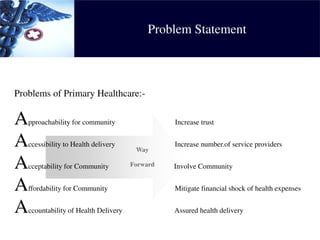
Problem Statement
Problems of Primary Healthcare:-
Approachability for community Increase trust
Accessibility to Health delivery Increase number.of service providers
Acceptability for Community Involve Community
Affordability for Community Mitigate financial shock of health expenses
Accountability of Health Delivery Assured health delivery
Way
Forward
PROPOSED
SOLUTION
P
R
O
P
O
S
E
D
S
O
L
U
T
I
O
N
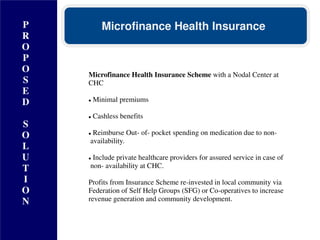
Microfinance Health Insurance Scheme with a Nodal Center at
CHC
 Minimal premiums
 Cashless benefits
 Reimburse Out- of- pocket spending on medication due to non-
availability.
 Include private healthcare providers for assured service in case of
non- availability at CHC.
Profits from Insurance Scheme re-invested in local community via
Federation of Self Help Groups (SFG) or Co-operatives to increase
revenue generation and community development.
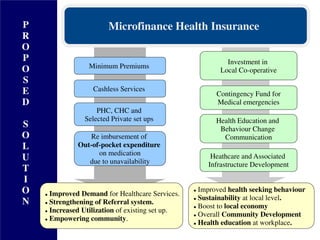
Microfinance Health Insurance
Minimum Premiums
Cashless Services
PHC, CHC and
Selected Private set ups
Re imbursement of
Out-of-pocket expenditure
on medication
due to unavailability
 Improved Demand for Healthcare Services.
 Strengthening of Referral system.
 Increased Utilization of existing set up.
 Empowering community.
Investment in
Local Co-operative
Heathcare and Associated
Infrastructure Development
Contingency Fund for
Medical emergencies
 Improved health seeking behaviour
 Sustainability at local level.
 Boost to local economy
 Overall Community Development
 Health education at workplace.
Health Education and
Behaviour Change
Communication
P
R
O
P
O
S
E
D
S
O
L
U
T
I
O
N
P
R
O
P
O
S
E
D
S
O
L
U
T
I
O
N
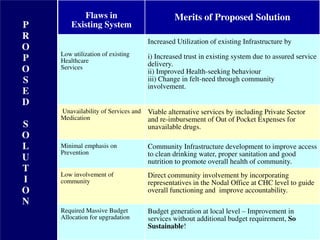
Flaws in
Existing System
Merits of Proposed Solution
Low utilization of existing
Healthcare
Services
Increased Utilization of existing Infrastructure by
i) Increased trust in existing system due to assured service
delivery.
ii) Improved Health-seeking behaviour
iii) Change in felt-need through community
involvement.
Unavailability of Services and
Medication
Viable alternative services by including Private Sector
and re-imbursement of Out of Pocket Expenses for
unavailable drugs.
Minimal emphasis on
Prevention
Community Infrastructure development to improve access
to clean drinking water, proper sanitation and good
nutrition to promote overall health of community.
Low involvement of
community
Direct community involvement by incorporating
representatives in the Nodal Office at CHC level to guide
overall functioning and improve accountability.
Required Massive Budget
Allocation for upgradation
Budget generation at local level – Improvement in
services without additional budget requirement, So
Sustainable!
P
R
O
P
O
S
E
D
S
O
L
U
T
I
O
N
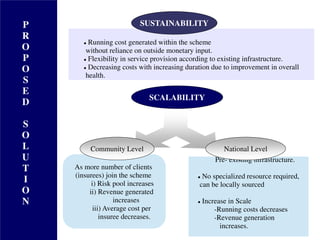
Pre- existing infrastructure.
 No specialized resource required,
can be locally sourced
 Increase in Scale
-Running costs decreases
-Revenue generation
increases.
 Running cost generated within the scheme
without reliance on outside monetary input.
 Flexibility in service provision according to existing infrastructure.
 Decreasing costs with increasing duration due to improvement in overall
health.
SCALABILITY
As more number of clients
(insurees) join the scheme
i) Risk pool increases
ii) Revenue generated
increases
iii) Average cost per
insuree decreases.
Community Level National Level
SUSTAINABILITY
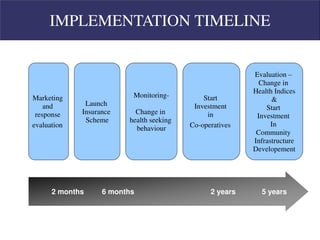
IMPLEMENTATION
Marketing
and
response
evaluation
Launch
Insurance
Scheme
Start
Investment
in
Co-operatives
Monitoring-
Change in
health seeking
behaviour
Evaluation –
Change in
Health Indices
&
Start
Investment
In
Community
Infrastructure
Developement
2 months 6 months 2 years 5 years
IMPLEMENTATION TIMELINE
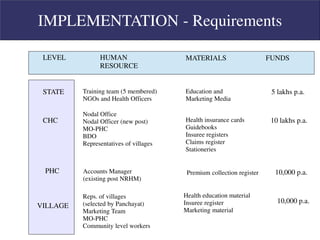
IMPLEMENTATION - Requirements
LEVEL HUMAN
RESOURCE
MATERIALS FUNDS
STATE
CHC
PHC
VILLAGE
Training team (5 membered)
NGOs and Health Officers
Education and
Marketing Media
5 lakhs p.a.
Nodal Office
Nodal Officer (new post)
MO-PHC
BDO
Representatives of villages
Health insurance cards
Guidebooks
Insuree registers
Claims register
Stationeries
10 lakhs p.a.
Accounts Manager
(existing post NRHM)
Premium collection register 10,000 p.a.
Reps. of villages
(selected by Panchayat)
Marketing Team
MO-PHC
Community level workers
Health education material
Insuree register
Marketing material
10,000 p.a.
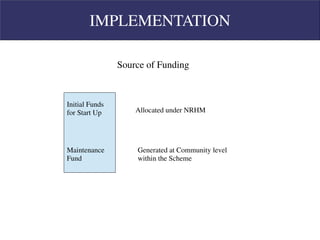
IMPLEMENTATION
Source of Funding
Initial Funds
for Start Up Allocated under NRHM
Maintenance
Fund
Generated at Community level
within the Scheme
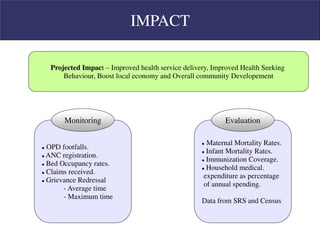
IMPACT
Monitoring and Evaluation
IMPACT
 OPD footfalls.
 ANC registration.
 Bed Occupancy rates.
 Claims received.
 Grievance Redressal
- Average time
- Maximum time
 Maternal Mortality Rates.
 Infant Mortality Rates.
 Immunization Coverage.
 Household medical.
expenditure as percentage
of annual spending.
Data from SRS and Census
Monitoring Evaluation
Projected Impact – Improved health service delivery, Improved Health Seeking
Behaviour, Boost local economy and Overall community Developement
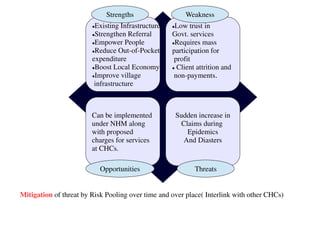
Strength Weakness
Opportunity Threats
Existing Infrastructure
Strengthen Referral
Empower People
Reduce Out-of-Pocket
expenditure
Boost Local Economy
Improve village
infrastructure
Sudden increase in
Claims during
Epidemics
And Diasters
Can be implemented
under NHM along
with proposed
charges for services
at CHCs.
Low trust in
Govt. services
Requires mass
participation for
profit
 Client attrition and
non-payments.
Strengths
ThreatsOpportunities
Weakness
Mitigation of threat by Risk Pooling over time and over place( Interlink with other CHCs)
Thank You
Annexure
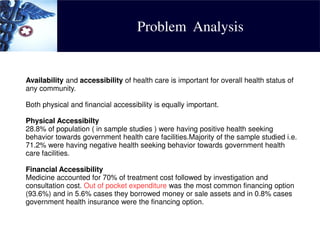
Problem Analysis
Availability and accessibility of health care is important for overall health status of
any community.
Both physical and financial accessibility is equally important.
Physical Accessibilty
28.8% of population ( in sample studies ) were having positive health seeking
behavior towards government health care facilities.Majority of the sample studied i.e.
71.2% were having negative health seeking behavior towards government health
care facilities.
Financial Accessibility
Medicine accounted for 70% of treatment cost followed by investigation and
consultation cost. Out of pocket expenditure was the most common financing option
(93.6%) and in 5.6% cases they borrowed money or sale assets and in 0.8% cases
government health insurance were the financing option.
Problem Analysis
Micro- Insurance for health with involvement of Private healthcare providers solves
issue of physical and financial accessibilty.
Organization of community based health insurance or government insurance with
contribution from public is urgently needed to protect the poor from slipping into
poverty and indebtedness.
References
Raykumar P et al
Health care seeking and treatment cost in a rural community of West Bengal, India ,
[theHealth 2012; 3(3): 67-70]
Mandal S, Kanjilal B, Peters DH, Lucas H.
Catastrophic out-of-pocket pay-ment for health care and its impact on households:
Experience from West Bengal, India.
 Ray TK, Pandav CS, Anand K, Kapoor SK, Dwivedi SN.
Out-of-pocket expenditure on healthcare in a north Indian village.
[Natl Med J India. 2002;15:257-60.]
Rose Ann Dominic et al
Health seeking behavior of rural adults.
[NUJHS Vol. 3, No.3, September 2013, ISSN 2249-7110]
References
 Ghosh et al
Factors affecting the healthcare seeking behaviour of mothers regarding their children in
a rural community of Darjeeling district, West Bengal.
[International Journal of Medicine and Public Health,Jan-Mar 2013,Vol 3,Issue 1 ]
 Programme Evaluation Organisation, Planning Commission,Government of India
Evaluation Study of National Rural Health Mission (NRHM) in 7 States [2011]

MAMC-DOCTORS

  • 1.
  • 2.
    Problem Statement Problems ofPrimary Healthcare:- Approachability for community Increase trust Accessibility to Health delivery Increase number.of service providers Acceptability for Community Involve Community Affordability for Community Mitigate financial shock of health expenses Accountability of Health Delivery Assured health delivery Way Forward
  • 3.
  • 4.
    P R O P O S E D S O L U T I O N Microfinance Health InsuranceScheme with a Nodal Center at CHC  Minimal premiums  Cashless benefits  Reimburse Out- of- pocket spending on medication due to non- availability.  Include private healthcare providers for assured service in case of non- availability at CHC. Profits from Insurance Scheme re-invested in local community via Federation of Self Help Groups (SFG) or Co-operatives to increase revenue generation and community development. Microfinance Health Insurance
  • 5.
    Microfinance Health Insurance MinimumPremiums Cashless Services PHC, CHC and Selected Private set ups Re imbursement of Out-of-pocket expenditure on medication due to unavailability  Improved Demand for Healthcare Services.  Strengthening of Referral system.  Increased Utilization of existing set up.  Empowering community. Investment in Local Co-operative Heathcare and Associated Infrastructure Development Contingency Fund for Medical emergencies  Improved health seeking behaviour  Sustainability at local level.  Boost to local economy  Overall Community Development  Health education at workplace. Health Education and Behaviour Change Communication P R O P O S E D S O L U T I O N
  • 6.
    P R O P O S E D S O L U T I O N Flaws in Existing System Meritsof Proposed Solution Low utilization of existing Healthcare Services Increased Utilization of existing Infrastructure by i) Increased trust in existing system due to assured service delivery. ii) Improved Health-seeking behaviour iii) Change in felt-need through community involvement. Unavailability of Services and Medication Viable alternative services by including Private Sector and re-imbursement of Out of Pocket Expenses for unavailable drugs. Minimal emphasis on Prevention Community Infrastructure development to improve access to clean drinking water, proper sanitation and good nutrition to promote overall health of community. Low involvement of community Direct community involvement by incorporating representatives in the Nodal Office at CHC level to guide overall functioning and improve accountability. Required Massive Budget Allocation for upgradation Budget generation at local level – Improvement in services without additional budget requirement, So Sustainable!
  • 7.
    P R O P O S E D S O L U T I O N Pre- existing infrastructure. No specialized resource required, can be locally sourced  Increase in Scale -Running costs decreases -Revenue generation increases.  Running cost generated within the scheme without reliance on outside monetary input.  Flexibility in service provision according to existing infrastructure.  Decreasing costs with increasing duration due to improvement in overall health. SCALABILITY As more number of clients (insurees) join the scheme i) Risk pool increases ii) Revenue generated increases iii) Average cost per insuree decreases. Community Level National Level SUSTAINABILITY
  • 8.
  • 9.
    Marketing and response evaluation Launch Insurance Scheme Start Investment in Co-operatives Monitoring- Change in health seeking behaviour Evaluation– Change in Health Indices & Start Investment In Community Infrastructure Developement 2 months 6 months 2 years 5 years IMPLEMENTATION TIMELINE
  • 10.
    IMPLEMENTATION - Requirements LEVELHUMAN RESOURCE MATERIALS FUNDS STATE CHC PHC VILLAGE Training team (5 membered) NGOs and Health Officers Education and Marketing Media 5 lakhs p.a. Nodal Office Nodal Officer (new post) MO-PHC BDO Representatives of villages Health insurance cards Guidebooks Insuree registers Claims register Stationeries 10 lakhs p.a. Accounts Manager (existing post NRHM) Premium collection register 10,000 p.a. Reps. of villages (selected by Panchayat) Marketing Team MO-PHC Community level workers Health education material Insuree register Marketing material 10,000 p.a.
  • 11.
    IMPLEMENTATION Source of Funding InitialFunds for Start Up Allocated under NRHM Maintenance Fund Generated at Community level within the Scheme
  • 12.
  • 13.
    IMPACT  OPD footfalls. ANC registration.  Bed Occupancy rates.  Claims received.  Grievance Redressal - Average time - Maximum time  Maternal Mortality Rates.  Infant Mortality Rates.  Immunization Coverage.  Household medical. expenditure as percentage of annual spending. Data from SRS and Census Monitoring Evaluation Projected Impact – Improved health service delivery, Improved Health Seeking Behaviour, Boost local economy and Overall community Developement
  • 14.
  • 15.
    Existing Infrastructure Strengthen Referral EmpowerPeople Reduce Out-of-Pocket expenditure Boost Local Economy Improve village infrastructure Sudden increase in Claims during Epidemics And Diasters Can be implemented under NHM along with proposed charges for services at CHCs. Low trust in Govt. services Requires mass participation for profit  Client attrition and non-payments. Strengths ThreatsOpportunities Weakness Mitigation of threat by Risk Pooling over time and over place( Interlink with other CHCs)
  • 16.
  • 17.
  • 18.
    Problem Analysis Availability andaccessibility of health care is important for overall health status of any community. Both physical and financial accessibility is equally important. Physical Accessibilty 28.8% of population ( in sample studies ) were having positive health seeking behavior towards government health care facilities.Majority of the sample studied i.e. 71.2% were having negative health seeking behavior towards government health care facilities. Financial Accessibility Medicine accounted for 70% of treatment cost followed by investigation and consultation cost. Out of pocket expenditure was the most common financing option (93.6%) and in 5.6% cases they borrowed money or sale assets and in 0.8% cases government health insurance were the financing option.
  • 19.
    Problem Analysis Micro- Insurancefor health with involvement of Private healthcare providers solves issue of physical and financial accessibilty. Organization of community based health insurance or government insurance with contribution from public is urgently needed to protect the poor from slipping into poverty and indebtedness.
  • 20.
    References Raykumar P etal Health care seeking and treatment cost in a rural community of West Bengal, India , [theHealth 2012; 3(3): 67-70] Mandal S, Kanjilal B, Peters DH, Lucas H. Catastrophic out-of-pocket pay-ment for health care and its impact on households: Experience from West Bengal, India.  Ray TK, Pandav CS, Anand K, Kapoor SK, Dwivedi SN. Out-of-pocket expenditure on healthcare in a north Indian village. [Natl Med J India. 2002;15:257-60.] Rose Ann Dominic et al Health seeking behavior of rural adults. [NUJHS Vol. 3, No.3, September 2013, ISSN 2249-7110]
  • 21.
    References  Ghosh etal Factors affecting the healthcare seeking behaviour of mothers regarding their children in a rural community of Darjeeling district, West Bengal. [International Journal of Medicine and Public Health,Jan-Mar 2013,Vol 3,Issue 1 ]  Programme Evaluation Organisation, Planning Commission,Government of India Evaluation Study of National Rural Health Mission (NRHM) in 7 States [2011]