Malvertisement: The Covert Advert
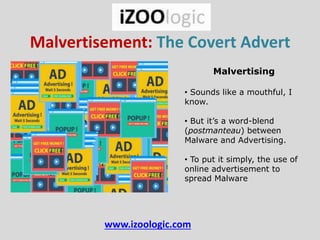
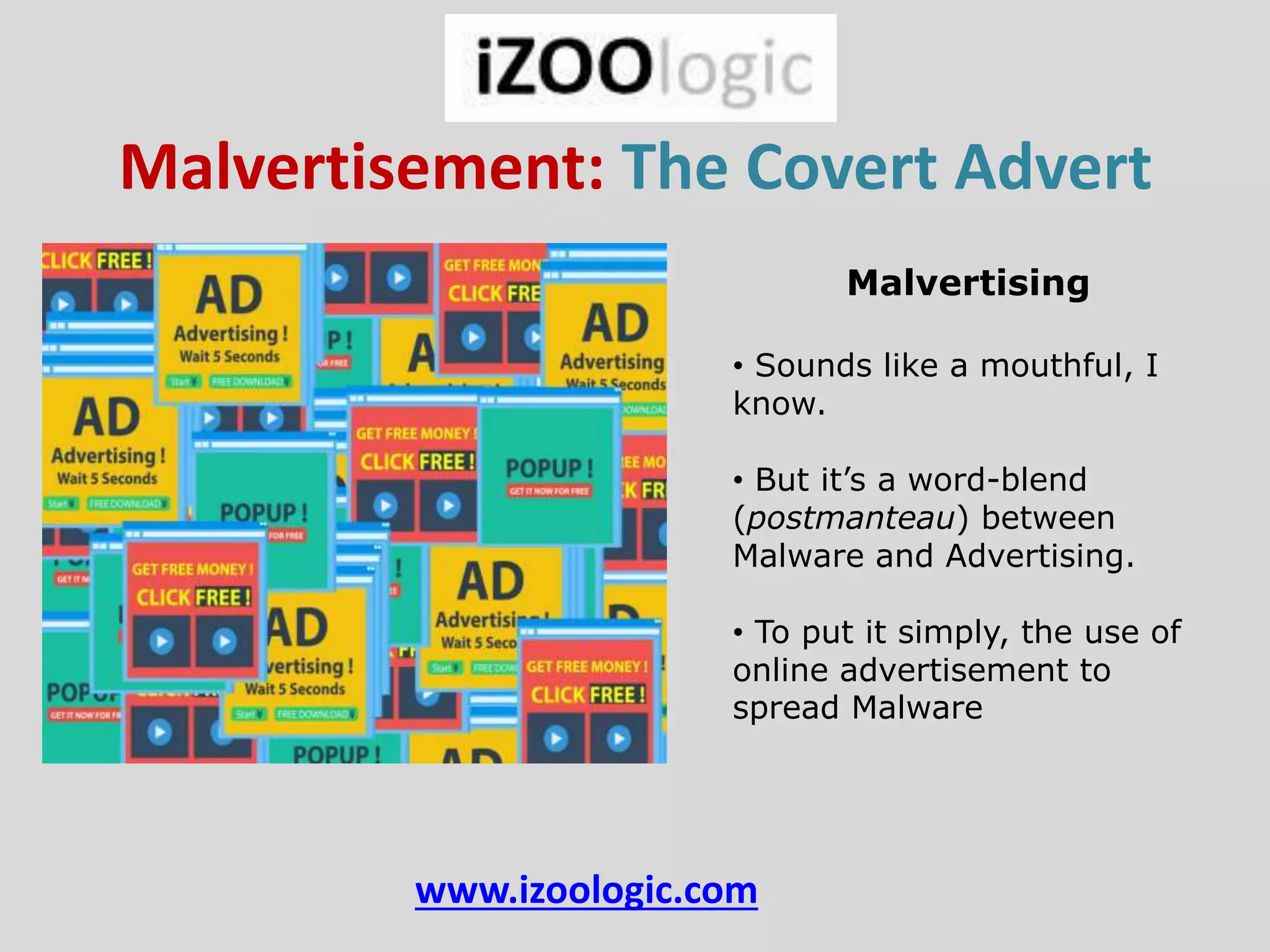
Malvertising
• Sounds like a mouthful, I
know.
• But it’s a word-blend
(postmanteau) between
Malware and Advertising.
• To put it simply, the use of
online advertisement to
spread Malware
www.izoologic.com
Malvertisement: The Covert Advert
www.izoologic.com
• Malvertising is what occurs when online
advertising is used to spread malwares.
• Malvertising is what ensues when attackers
purchase ad spaces in famous or legitimate
websites and inject them with ads that are
loaded with viruses, spywares, malwares and all
sorts of cyber waste out there you’ve never
even heard of.
• Basically, any display advert that delivers a code-based threat to the visitor’s
browsing session can be thought of as a malvertisement.
How Does It Work and Who Are Affected?
• I know, these attackers are quite “sneaky” and that’s true.
That’s how they operate.
• And they don’t really care if the sites are big shots like
Google, Yahoo, Spotify, Ebay or even Reuters.
• The more popular a website is, the more users they can
infect. It provides them with a wider platform to push their
attacks to unsuspecting web users who might not otherwise
see the adverts, due to firewalls, more safety precautions or
the like.
www.izoologic.com
Malvertisement
Malvertisement: The Covert Advert
So what goes down, exactly?
• Attackers attach themselves on trusted, legitimate
websites as bait.
• These attackers aim for clean and reputable websites
specifically those with lots of frequent visitors (e.g.
Youtube, Spotify, NY Times, Yahoo, AOL, NFL, etc.).
• Many websites, especially the large and popular ones
with several thousands or millions of users per day, rely
heavily on third-party vendors and software providers to
display their adverts for them.
This, in turn, reduces direct oversight and the amount of scrutiny that should that
should take place security-wise. This kind of data automation makes online adverts
vulnerable to malvertising.
www.izoologic.com
www.izoologic.com
Malvertisement: The Covert Advert
The websites themselves aren’t
infected, and the advert
publishers have no idea that
they are blasting malicious
content into potentially
thousands and possibly millions
of computers until it’s too late.
Moreover, it has become quite a challenge for cybersecurity experts to properly
identify exactly which adverts carry malicious contents because the adverts on a
certain page change constantly. One user may get infected, but the next five, who
visits the exact same page won’t be.
I’m OK as long as I don’t click those ads, right?
FACT: PCs can be infected pre and post-click.
www.izoologic.com
It is a very common notion that the actual
malware infection happens when visitors to the
infected site begin clicking on a malvertisement.
But that’s not the case. Instances of these pre-click
malwares include being incorporated in main
scripts of the webpage or what we call drive-by-
downloads. These malwares can be programmed
to auto-run, , meaning
it can automatically take a user to a different site entirely and that site could be
potentially malicious. Malwares can also be programmed to execute in the delivery of
an advert – wherein a clean advert that has no infection pre or post click (in its original
design) can still be infected whilst being requested.
Malvertisement: The Covert Advert
www.izoologic.com
Malvertisement: The Covert Advert
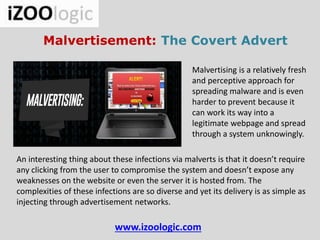
Malvertising is a relatively fresh
and perceptive approach for
spreading malware and is even
harder to prevent because it
can work its way into a
legitimate webpage and spread
through a system unknowingly.
An interesting thing about these infections via malverts is that it doesn’t require
any clicking from the user to compromise the system and doesn’t expose any
weaknesses on the website or even the server it is hosted from. The
complexities of these infections are so diverse and yet its delivery is as simple as
injecting through advertisement networks.
www.izoologic.com
Malvertisement: The Covert Advert
Major companies and websites have had their share of challenges in
battling the growing number of malvertising attacks, which hints
that it’s not going away anytime soon.
www.izoologic.com
OK. How Can We Fend Off These Attacks ?
Unfortunately, with this kind of
attack vector, it’s quite difficult
to defend ourselves against it
head-on.
But, there are a few things that
we can do to possibly protect
ourselves, if not, prevent these
cyber-attacks from happening.
Disable / Turn Off Java : In most cases, you won’t need Flash
too. The less plugins you have installed or enabled, the lesser
potential entry points you’re leaving for malverts.
www.izoologic.com
OK. How Can We Fend Off These Attacks ?
Make sure your plugins are updated
: If you must install plugins, make sure they
are updated for them to be effective.
Developers regularly issues updates to fix
security gaps so make sure you install them.
Make sure your browser is updated with the latest version :
This is a no-brainer. Most cyber-attacks are often introduced via browsers due to
security holes. It pays off to making sure you have the latest security updates
installed.
www.izoologic.com
OK. How Can We Fend Off These Attacks ?
Consider installing an Ad-blocker,
Pop-up blocker or Anti-malware
program :
This is another option to fight off those nasty
pop-ups and other malwares unknowingly
creeping its way to your system.
Get a decent Antivirus Software : Your first line of defense
against viruses, malwares, and other forms of cyber-attacks.
www.izoologic.com
It’s important to keep in mind that at the
end of the day, no matter what kind of
device you use, you just need to be
aware and be mindful of the sites you
visit, the apps or programs you install,
and how it affects your privacy.
Always make sure you are updated and
well-informed with the latest trends and
developments in Cyber Security here at
iZOOlogic.com/blogs.
Vince Luna
iZOOlabs Security Response
Malvertisement: The Covert Advert
www.izoologic.com
Level 1, 444 Castro Street, Mountain View,
California, USA
+1 650 396 3352
sales@izoologic.com

Malvertisement the covert advert

  • 1.
    Malvertisement: The CovertAdvert Malvertising • Sounds like a mouthful, I know. • But it’s a word-blend (postmanteau) between Malware and Advertising. • To put it simply, the use of online advertisement to spread Malware www.izoologic.com
  • 2.
    Malvertisement: The CovertAdvert www.izoologic.com • Malvertising is what occurs when online advertising is used to spread malwares. • Malvertising is what ensues when attackers purchase ad spaces in famous or legitimate websites and inject them with ads that are loaded with viruses, spywares, malwares and all sorts of cyber waste out there you’ve never even heard of. • Basically, any display advert that delivers a code-based threat to the visitor’s browsing session can be thought of as a malvertisement.
  • 3.
    How Does ItWork and Who Are Affected? • I know, these attackers are quite “sneaky” and that’s true. That’s how they operate. • And they don’t really care if the sites are big shots like Google, Yahoo, Spotify, Ebay or even Reuters. • The more popular a website is, the more users they can infect. It provides them with a wider platform to push their attacks to unsuspecting web users who might not otherwise see the adverts, due to firewalls, more safety precautions or the like. www.izoologic.com Malvertisement
  • 4.
    Malvertisement: The CovertAdvert So what goes down, exactly? • Attackers attach themselves on trusted, legitimate websites as bait. • These attackers aim for clean and reputable websites specifically those with lots of frequent visitors (e.g. Youtube, Spotify, NY Times, Yahoo, AOL, NFL, etc.). • Many websites, especially the large and popular ones with several thousands or millions of users per day, rely heavily on third-party vendors and software providers to display their adverts for them. This, in turn, reduces direct oversight and the amount of scrutiny that should that should take place security-wise. This kind of data automation makes online adverts vulnerable to malvertising. www.izoologic.com
  • 5.
    www.izoologic.com Malvertisement: The CovertAdvert The websites themselves aren’t infected, and the advert publishers have no idea that they are blasting malicious content into potentially thousands and possibly millions of computers until it’s too late. Moreover, it has become quite a challenge for cybersecurity experts to properly identify exactly which adverts carry malicious contents because the adverts on a certain page change constantly. One user may get infected, but the next five, who visits the exact same page won’t be.
  • 6.
    I’m OK aslong as I don’t click those ads, right? FACT: PCs can be infected pre and post-click. www.izoologic.com It is a very common notion that the actual malware infection happens when visitors to the infected site begin clicking on a malvertisement. But that’s not the case. Instances of these pre-click malwares include being incorporated in main scripts of the webpage or what we call drive-by- downloads. These malwares can be programmed to auto-run, , meaning it can automatically take a user to a different site entirely and that site could be potentially malicious. Malwares can also be programmed to execute in the delivery of an advert – wherein a clean advert that has no infection pre or post click (in its original design) can still be infected whilst being requested. Malvertisement: The Covert Advert
  • 7.
    www.izoologic.com Malvertisement: The CovertAdvert Malvertising is a relatively fresh and perceptive approach for spreading malware and is even harder to prevent because it can work its way into a legitimate webpage and spread through a system unknowingly. An interesting thing about these infections via malverts is that it doesn’t require any clicking from the user to compromise the system and doesn’t expose any weaknesses on the website or even the server it is hosted from. The complexities of these infections are so diverse and yet its delivery is as simple as injecting through advertisement networks.
  • 8.
    www.izoologic.com Malvertisement: The CovertAdvert Major companies and websites have had their share of challenges in battling the growing number of malvertising attacks, which hints that it’s not going away anytime soon.
  • 9.
    www.izoologic.com OK. How CanWe Fend Off These Attacks ? Unfortunately, with this kind of attack vector, it’s quite difficult to defend ourselves against it head-on. But, there are a few things that we can do to possibly protect ourselves, if not, prevent these cyber-attacks from happening. Disable / Turn Off Java : In most cases, you won’t need Flash too. The less plugins you have installed or enabled, the lesser potential entry points you’re leaving for malverts.
  • 10.
    www.izoologic.com OK. How CanWe Fend Off These Attacks ? Make sure your plugins are updated : If you must install plugins, make sure they are updated for them to be effective. Developers regularly issues updates to fix security gaps so make sure you install them. Make sure your browser is updated with the latest version : This is a no-brainer. Most cyber-attacks are often introduced via browsers due to security holes. It pays off to making sure you have the latest security updates installed.
  • 11.
    www.izoologic.com OK. How CanWe Fend Off These Attacks ? Consider installing an Ad-blocker, Pop-up blocker or Anti-malware program : This is another option to fight off those nasty pop-ups and other malwares unknowingly creeping its way to your system. Get a decent Antivirus Software : Your first line of defense against viruses, malwares, and other forms of cyber-attacks.
  • 12.
    www.izoologic.com It’s important tokeep in mind that at the end of the day, no matter what kind of device you use, you just need to be aware and be mindful of the sites you visit, the apps or programs you install, and how it affects your privacy. Always make sure you are updated and well-informed with the latest trends and developments in Cyber Security here at iZOOlogic.com/blogs. Vince Luna iZOOlabs Security Response Malvertisement: The Covert Advert
  • 13.
    www.izoologic.com Level 1, 444Castro Street, Mountain View, California, USA +1 650 396 3352 sales@izoologic.com