





LEVEL OF AWARENESS REGARDING MALPRACTICE AMONG SELECTED REGISTERED NURSES IN THE DIFFERENT PRIVATE HOSPITALS IN ILIGAN CITYReynel Dan L. GalicinaoMariaLourdes R. BalucanAngeliaT. Galinato
The Problem and Its Scope
A well-grounded understanding of the legal and ethical dimensions of practice provides the foundation for professional nursing.Berman, 2008
It is significant for the nurses to understand legal responsibilities as it applies to nursing practice. Failure to understand these responsibilities and effectively defend himself or herself will result in exposure to legal risk.		(Bellosillo, et al., 2008)
This study aims to seek the level of awareness regarding nursing laws and practices among registered nurses to contribute to the development of nursing practices particularly in response to the rising incidence of malpractice or professional negligence cases and the lack of studies conducted on nursing laws and jurisprudence.
Republic Act No. 9173 (Philippine Nursing Act of 2002) - the main basis for nursing practice that the Filipino nurses can use as it defines the scope of nursing practice in the PhilippinesParagraph D of Section 23, Article 4 - states that “malpractice or negligence in the practice of nursing is a ground for the Professional Regulation Commission (PRC) to exercise its power to revoke and suspend the certificate of registration or professional license and to cancel the special or temporary permit of a nurse”
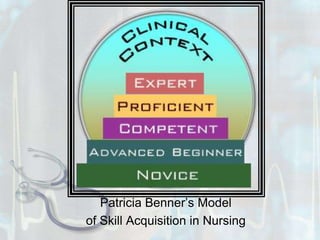
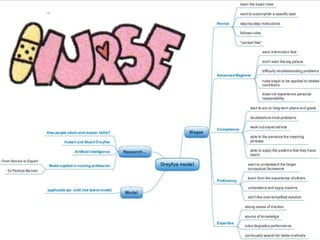
Theoretical FrameworkPatricia Benner’s Model of Skill Acquisition in Nursing (1984)  - the central concepts of Benner’s model are those of competence, skill acquisition, experience, clinical knowledge, and practical knowledge (McEwen, 2007).
Patricia Benner’s Model of Skill Acquisition in Nursing
Conceptual Framework
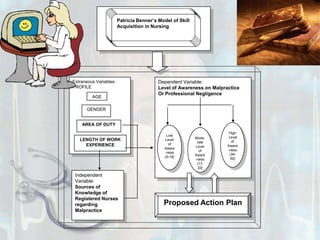
Patricia Benner’s Model of Skill Acquisition in NursingExtraneous Variables: PROFILEDependent Variable:Level of Awareness on MalpracticeOr Professional NegligenceAGEGENDERAREA OF DUTYHigh Level ofAware-ness(34-50)LowLevel of Aware-ness (0-16)Mode-rateLevel ofAware-ness(17-33)LENGTH OF WORK EXPERIENCEIndependent Variable:Sources of Knowledge of Registered Nurses regarding MalpracticeProposed Action Plan
Statement of the ProblemThe goal of the study is to determine the awareness on malpractice or professional negligence among selected registered nurses working in the different private hospitals in Iligan City.
Specifically, it aims to:Gather the profile of the registered nurses of the different private hospitals in Iligan City in terms of their age, gender, area of duty, and length of work experience (Galinato, et al., 2009)
2. Determine the knowledge of the registered nurses of the different private hospitals in Iligan City on malpractice or professional negligence as stated in Article 4, Section 23; paragraph D of Republic Act No. 9173 otherwise known as the Philippine Nursing Act of 2002 in relation to their duties and responsibilities as professionals (Galinato, et al., 2009)
3. Discern the relationship between the length of work experience of the registered nurses of the different private hospitals in Iligan City and their level of awareness on malpractice or professional negligence (Galinato, et al., 2009)
4. Ascertain the relationship between the sources of knowledge and the level of awareness on malpractice or professional negligence of the registered nurses of the different private hospitals in Iligan City (Galinato, et al., 2009)
5. Recognize the relationship between the area of duty and the level of awareness on malpractice or professional negligence of the registered nurses of the different private hospitals in Iligan City.
HypothesesHo1: There is no significant relationship between the respondents’ length of work experience and level of awareness on malpractice or professional negligence of registered nurses working in the different private hospitals in Iligan City.
Ho2: There is no significant relationship between the sources of knowledge and the level of awareness on malpractice or professional negligence of registered nurses working in the different private hospitals in Iligan City.Ho3: There is no significant relationship between the area of duty and the level of awareness on malpractice or professional negligence of registered nurses working in the different private hospitals in Iligan City.
Significance of the StudyHospital AdministratorsProfessional NursesPatientsNursing Education and Regulation Organizations Professional Regulatory Board of Nursing (BON)Professional Regulation Commission (PRC)Commission on Higher Education (CHED)
Professional Nursing Organizations Philippine Nurses Association (PNA)Association of Deans of Philippine Colleges of Nursing (ADPCN)Government Legislators  Senator Loren B. Legarda - Chairperson of the Committee on Health and DemographyCongressman Arthur Pingoy -  Chairman of the Committee on Health, Iligan City Councilor Chonilo Ruiz - Chairman of the Committee on Health and SanitationFuture researchers
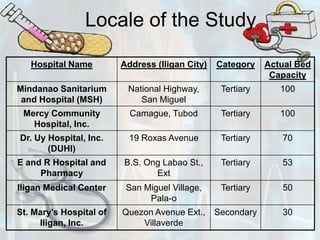
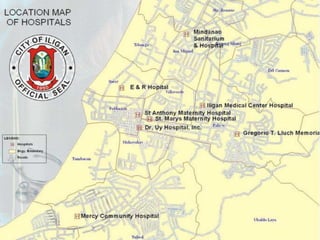
Scope and Limitation6 private hospitals in Iligan CityTertiary Hospitals:Mindanao Sanitarium and Hospital (MSH) Mercy Community Hospital, Inc.Dr. Uy Hospital, Inc. (DUHI)E and R Hospital and PharmacyIligan Medical CenterSecondary HospitalSt. Mary’s Hospital of Iligan, Inc.
Registered Nurse20-65 years oldAt least 1 month of work experience50-item standardized questionnaireJune-July, 2009
Review of Related Literature and Studies
Joint Commission on Accreditation of Healthcare Organizations or JCAHO (2002)Negligence - the failure to use such care as a reasonably prudent and careful person would use under similar circumstancesMalpractice - the improper or unethical conduct or unreasonable lack of will by a holder of a professional or official position; often applied to physicians, dentists, lawyers, nurses and public officers to denote negligent or unskillful performance of duties when professional skills are obligatory
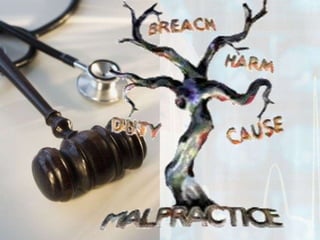
Four Elements of Nursing Malpractice:Standards of Care: "right thing to do at the right time“What a reasonably prudent nurse would do in a similar situation and given the same circumstanceExample: failure to secure an informed consent from a patient prior to a surgical procedure, misuse of medial equipment, medication error, documentation error, and fcailing to perform necessary procedureDutyThe nurse is duty-bound to care for the patient with his or her utmost ability, knowledge, and skillsAssumes a legal duty by taking on the care of the patient
Legal Causation: A causal relationship exists between breach of duty and patient injuryThe breach of the standard of care proximately caused damagesDamages:The result of the substantial neglect or malpractice on the part of the nurseIncludes death, loss of a limb, permanent disability, prolonged pain, deformity, or added cost of hospital stay No injury means no malpractice
Six most common malpractice claims against nursesDeanna L. Reising, PhD, APRN-BC and Patricia N. Allen, MSN, APRN-BC, “Protecting yourself from malpractice claims” American Nurses Association (ANA), February 2007Failure to follow standards of careFailure to use equipment in a responsible mannerFailure to communicateFailure to documentFailure to assess and monitorFailure to act as patient advocate
Ardahan (2008)Knowledge sources used by nurses were often those of evidence not based on research “The information my fellow nurses share” (1st) “What has worked for me for years” (2nd) “The ways that I have always done it” (3rd)Although the nurses were aware that the practices should be based on evidence should be the results of research.
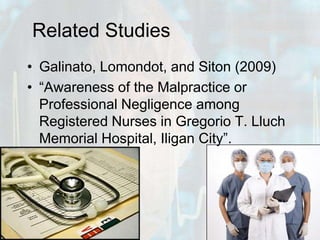
Related StudiesGalinato, Lomondot, and Siton (2009)“Awareness of the Malpractice or Professional Negligence among Registered Nurses in Gregorio T. Lluch Memorial Hospital, Iligan City”.
Based on the results of this study, the nurse respondents are not attuned to Margaret Newman’s Theory of Health as an Expanding Consciousness as they lack participation in continuing their professional education.the nurse respondents’ nursing skills, especially as those related to their awareness of malpractice or professional negligence,did not improve with their experience, a finding not in sync with Patricia Benner’s model.
In short, because of non-participation in continuing their professional education, the nurse respondents of this study were not able to attune themselves to Margaret’s Newman’s Theory of Health as an Expanding Consciousness and Patricia Benner’s Model of Skill Acquisition in Nursing, which would mean that the nurse respondents are vulnerable to malpractice or professional negligence.
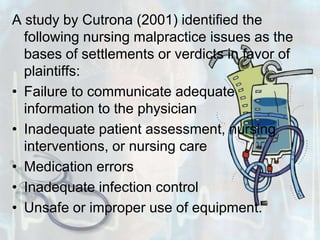
A study by Cutrona (2001) identified the following nursing malpractice issues as the bases of settlements or verdicts in favor of plaintiffs: Failure to communicate adequate information to the physicianInadequate patient assessment, nursing interventions, or nursing careMedication errorsInadequate infection controlUnsafe or improper use of equipment.
Research Methodology
Research DesignDescriptive-correlational DesignUses 50-item standardized questionnaire
Locale of the Study
Data Gathering ProcedurePretest at Gregorio T. Luch Memorial Hospital (GTLMH) with 10 respondentsEnhance the questionnaireRandom sampling based on availability and convenience of 15 RN’s from Mindanao Sanitarium and Hospital (MSH), Mercy Community Hospital, Inc., Dr. Uy Hospital, Inc. (DUHI), E and R Hospital and Pharmacy, Iligan Medical Center, and St. Mary’s Hospital of Iligan, Inc.
Respondents and Sampling ProcedureRegistered NurseWorking in a private hospital in Iligan Cityat least one (1) month of work experience 20-65 years old
3 Parts of the QuestionnaireI. Duties and Responsibilities of a NurseNursing Process:Assessment – 20%Diagnosis – 20%Planning and Outcome Identification – 20%Implementation – 20%Evaluation and Documentation – 20%Level of Cognitive Ability:Analysis – 50%Application – 50%
Client Needs:Physiologic Integrity – 84% Safe and Effective Care Environment – 14% health promotion and maintenance – 2% Content Area:Adult Health (Neurological, Gastrointestinal, Respiratory, Cardiovascular, Integumentary, Renal, Endocrine, Musculoskeletal, Oncology) – 38% Fundamental Nursing Skills – 32%Maternity (Antepartum, Intrapartum, Postpartum) – 12%Pharmacology – 10%Child Health – 6%Prioritizing – 2%
II. Respondents’ sources of knowledgeThe last time the respondents have updated their knowledge regarding thisWhether the clients are taking continuing education and short-term training programs concerning malpractice or professional negligenceIII. Respondents’ profileAgeGenderArea of dutyLength of work experience
Instrument to be used and Its Validity	The said instrument is based on the nursing process, using questions that would test the nurse respondents’ awareness and knowledge of their duties and responsibilities, especially those concerning malpractice or professional negligence
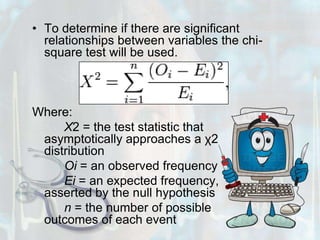
To determine if there are significant relationships between variables the chi-square test will be used.Where:X2 = the test statistic that asymptotically approaches a χ2 distribution		Oi = an observed frequency		Ei = an expected frequency, asserted by the null hypothesis		n = the number of possible outcomes of each event
Statistical Tools to be UsedFrequencies of the respondents’ profile and survey answers will be taken to get the percentage using this formula:			P=ƒ/n x 100%	Where:		P= percentage		ƒ= frequency		n= no. of samples
Thank You…Have a Nice Day!

Malpractice Among RNs Research Proposal

  • 1.
    LEVEL OF AWARENESSREGARDING MALPRACTICE AMONG SELECTED REGISTERED NURSES IN THE DIFFERENT PRIVATE HOSPITALS IN ILIGAN CITYReynel Dan L. GalicinaoMariaLourdes R. BalucanAngeliaT. Galinato
  • 2.
  • 4.
    A well-grounded understandingof the legal and ethical dimensions of practice provides the foundation for professional nursing.Berman, 2008
  • 5.
    It is significantfor the nurses to understand legal responsibilities as it applies to nursing practice. Failure to understand these responsibilities and effectively defend himself or herself will result in exposure to legal risk. (Bellosillo, et al., 2008)
  • 6.
    This study aimsto seek the level of awareness regarding nursing laws and practices among registered nurses to contribute to the development of nursing practices particularly in response to the rising incidence of malpractice or professional negligence cases and the lack of studies conducted on nursing laws and jurisprudence.
  • 7.
    Republic Act No.9173 (Philippine Nursing Act of 2002) - the main basis for nursing practice that the Filipino nurses can use as it defines the scope of nursing practice in the PhilippinesParagraph D of Section 23, Article 4 - states that “malpractice or negligence in the practice of nursing is a ground for the Professional Regulation Commission (PRC) to exercise its power to revoke and suspend the certificate of registration or professional license and to cancel the special or temporary permit of a nurse”
  • 8.
    Theoretical FrameworkPatricia Benner’sModel of Skill Acquisition in Nursing (1984) - the central concepts of Benner’s model are those of competence, skill acquisition, experience, clinical knowledge, and practical knowledge (McEwen, 2007).
  • 9.
    Patricia Benner’s Modelof Skill Acquisition in Nursing
  • 11.
  • 12.
    Patricia Benner’s Modelof Skill Acquisition in NursingExtraneous Variables: PROFILEDependent Variable:Level of Awareness on MalpracticeOr Professional NegligenceAGEGENDERAREA OF DUTYHigh Level ofAware-ness(34-50)LowLevel of Aware-ness (0-16)Mode-rateLevel ofAware-ness(17-33)LENGTH OF WORK EXPERIENCEIndependent Variable:Sources of Knowledge of Registered Nurses regarding MalpracticeProposed Action Plan
  • 13.
    Statement of theProblemThe goal of the study is to determine the awareness on malpractice or professional negligence among selected registered nurses working in the different private hospitals in Iligan City.
  • 14.
    Specifically, it aimsto:Gather the profile of the registered nurses of the different private hospitals in Iligan City in terms of their age, gender, area of duty, and length of work experience (Galinato, et al., 2009)
  • 15.
    2. Determine theknowledge of the registered nurses of the different private hospitals in Iligan City on malpractice or professional negligence as stated in Article 4, Section 23; paragraph D of Republic Act No. 9173 otherwise known as the Philippine Nursing Act of 2002 in relation to their duties and responsibilities as professionals (Galinato, et al., 2009)
  • 16.
    3. Discern therelationship between the length of work experience of the registered nurses of the different private hospitals in Iligan City and their level of awareness on malpractice or professional negligence (Galinato, et al., 2009)
  • 17.
    4. Ascertain therelationship between the sources of knowledge and the level of awareness on malpractice or professional negligence of the registered nurses of the different private hospitals in Iligan City (Galinato, et al., 2009)
  • 18.
    5. Recognize therelationship between the area of duty and the level of awareness on malpractice or professional negligence of the registered nurses of the different private hospitals in Iligan City.
  • 19.
    HypothesesHo1: There isno significant relationship between the respondents’ length of work experience and level of awareness on malpractice or professional negligence of registered nurses working in the different private hospitals in Iligan City.
  • 20.
    Ho2: There isno significant relationship between the sources of knowledge and the level of awareness on malpractice or professional negligence of registered nurses working in the different private hospitals in Iligan City.Ho3: There is no significant relationship between the area of duty and the level of awareness on malpractice or professional negligence of registered nurses working in the different private hospitals in Iligan City.
  • 21.
    Significance of theStudyHospital AdministratorsProfessional NursesPatientsNursing Education and Regulation Organizations Professional Regulatory Board of Nursing (BON)Professional Regulation Commission (PRC)Commission on Higher Education (CHED)
  • 22.
    Professional Nursing OrganizationsPhilippine Nurses Association (PNA)Association of Deans of Philippine Colleges of Nursing (ADPCN)Government Legislators Senator Loren B. Legarda - Chairperson of the Committee on Health and DemographyCongressman Arthur Pingoy - Chairman of the Committee on Health, Iligan City Councilor Chonilo Ruiz - Chairman of the Committee on Health and SanitationFuture researchers
  • 23.
    Scope and Limitation6private hospitals in Iligan CityTertiary Hospitals:Mindanao Sanitarium and Hospital (MSH) Mercy Community Hospital, Inc.Dr. Uy Hospital, Inc. (DUHI)E and R Hospital and PharmacyIligan Medical CenterSecondary HospitalSt. Mary’s Hospital of Iligan, Inc.
  • 24.
    Registered Nurse20-65 yearsoldAt least 1 month of work experience50-item standardized questionnaireJune-July, 2009
  • 25.
    Review of RelatedLiterature and Studies
  • 26.
    Joint Commission onAccreditation of Healthcare Organizations or JCAHO (2002)Negligence - the failure to use such care as a reasonably prudent and careful person would use under similar circumstancesMalpractice - the improper or unethical conduct or unreasonable lack of will by a holder of a professional or official position; often applied to physicians, dentists, lawyers, nurses and public officers to denote negligent or unskillful performance of duties when professional skills are obligatory
  • 28.
    Four Elements ofNursing Malpractice:Standards of Care: "right thing to do at the right time“What a reasonably prudent nurse would do in a similar situation and given the same circumstanceExample: failure to secure an informed consent from a patient prior to a surgical procedure, misuse of medial equipment, medication error, documentation error, and fcailing to perform necessary procedureDutyThe nurse is duty-bound to care for the patient with his or her utmost ability, knowledge, and skillsAssumes a legal duty by taking on the care of the patient
  • 29.
    Legal Causation: Acausal relationship exists between breach of duty and patient injuryThe breach of the standard of care proximately caused damagesDamages:The result of the substantial neglect or malpractice on the part of the nurseIncludes death, loss of a limb, permanent disability, prolonged pain, deformity, or added cost of hospital stay No injury means no malpractice
  • 30.
    Six most commonmalpractice claims against nursesDeanna L. Reising, PhD, APRN-BC and Patricia N. Allen, MSN, APRN-BC, “Protecting yourself from malpractice claims” American Nurses Association (ANA), February 2007Failure to follow standards of careFailure to use equipment in a responsible mannerFailure to communicateFailure to documentFailure to assess and monitorFailure to act as patient advocate
  • 31.
    Ardahan (2008)Knowledge sourcesused by nurses were often those of evidence not based on research “The information my fellow nurses share” (1st) “What has worked for me for years” (2nd) “The ways that I have always done it” (3rd)Although the nurses were aware that the practices should be based on evidence should be the results of research.
  • 32.
    Related StudiesGalinato, Lomondot,and Siton (2009)“Awareness of the Malpractice or Professional Negligence among Registered Nurses in Gregorio T. Lluch Memorial Hospital, Iligan City”.
  • 33.
    Based on theresults of this study, the nurse respondents are not attuned to Margaret Newman’s Theory of Health as an Expanding Consciousness as they lack participation in continuing their professional education.the nurse respondents’ nursing skills, especially as those related to their awareness of malpractice or professional negligence,did not improve with their experience, a finding not in sync with Patricia Benner’s model.
  • 34.
    In short, becauseof non-participation in continuing their professional education, the nurse respondents of this study were not able to attune themselves to Margaret’s Newman’s Theory of Health as an Expanding Consciousness and Patricia Benner’s Model of Skill Acquisition in Nursing, which would mean that the nurse respondents are vulnerable to malpractice or professional negligence.
  • 35.
    A study byCutrona (2001) identified the following nursing malpractice issues as the bases of settlements or verdicts in favor of plaintiffs: Failure to communicate adequate information to the physicianInadequate patient assessment, nursing interventions, or nursing careMedication errorsInadequate infection controlUnsafe or improper use of equipment.
  • 36.
  • 37.
    Research DesignDescriptive-correlational DesignUses50-item standardized questionnaire
  • 38.
  • 40.
    Data Gathering ProcedurePretestat Gregorio T. Luch Memorial Hospital (GTLMH) with 10 respondentsEnhance the questionnaireRandom sampling based on availability and convenience of 15 RN’s from Mindanao Sanitarium and Hospital (MSH), Mercy Community Hospital, Inc., Dr. Uy Hospital, Inc. (DUHI), E and R Hospital and Pharmacy, Iligan Medical Center, and St. Mary’s Hospital of Iligan, Inc.
  • 41.
    Respondents and SamplingProcedureRegistered NurseWorking in a private hospital in Iligan Cityat least one (1) month of work experience 20-65 years old
  • 42.
    3 Parts ofthe QuestionnaireI. Duties and Responsibilities of a NurseNursing Process:Assessment – 20%Diagnosis – 20%Planning and Outcome Identification – 20%Implementation – 20%Evaluation and Documentation – 20%Level of Cognitive Ability:Analysis – 50%Application – 50%
  • 43.
    Client Needs:Physiologic Integrity– 84% Safe and Effective Care Environment – 14% health promotion and maintenance – 2% Content Area:Adult Health (Neurological, Gastrointestinal, Respiratory, Cardiovascular, Integumentary, Renal, Endocrine, Musculoskeletal, Oncology) – 38% Fundamental Nursing Skills – 32%Maternity (Antepartum, Intrapartum, Postpartum) – 12%Pharmacology – 10%Child Health – 6%Prioritizing – 2%
  • 44.
    II. Respondents’ sourcesof knowledgeThe last time the respondents have updated their knowledge regarding thisWhether the clients are taking continuing education and short-term training programs concerning malpractice or professional negligenceIII. Respondents’ profileAgeGenderArea of dutyLength of work experience
  • 45.
    Instrument to beused and Its Validity The said instrument is based on the nursing process, using questions that would test the nurse respondents’ awareness and knowledge of their duties and responsibilities, especially those concerning malpractice or professional negligence
  • 46.
    To determine ifthere are significant relationships between variables the chi-square test will be used.Where:X2 = the test statistic that asymptotically approaches a χ2 distribution Oi = an observed frequency Ei = an expected frequency, asserted by the null hypothesis n = the number of possible outcomes of each event
  • 47.
    Statistical Tools tobe UsedFrequencies of the respondents’ profile and survey answers will be taken to get the percentage using this formula: P=ƒ/n x 100% Where: P= percentage ƒ= frequency n= no. of samples
  • 49.