Malingering
What is it and how do you know?
A review of some commonly used
instruments and assessments.
Yuki J.M. Acs and Karin Celosse
PF717 Forensic Assessment
Fall 2014
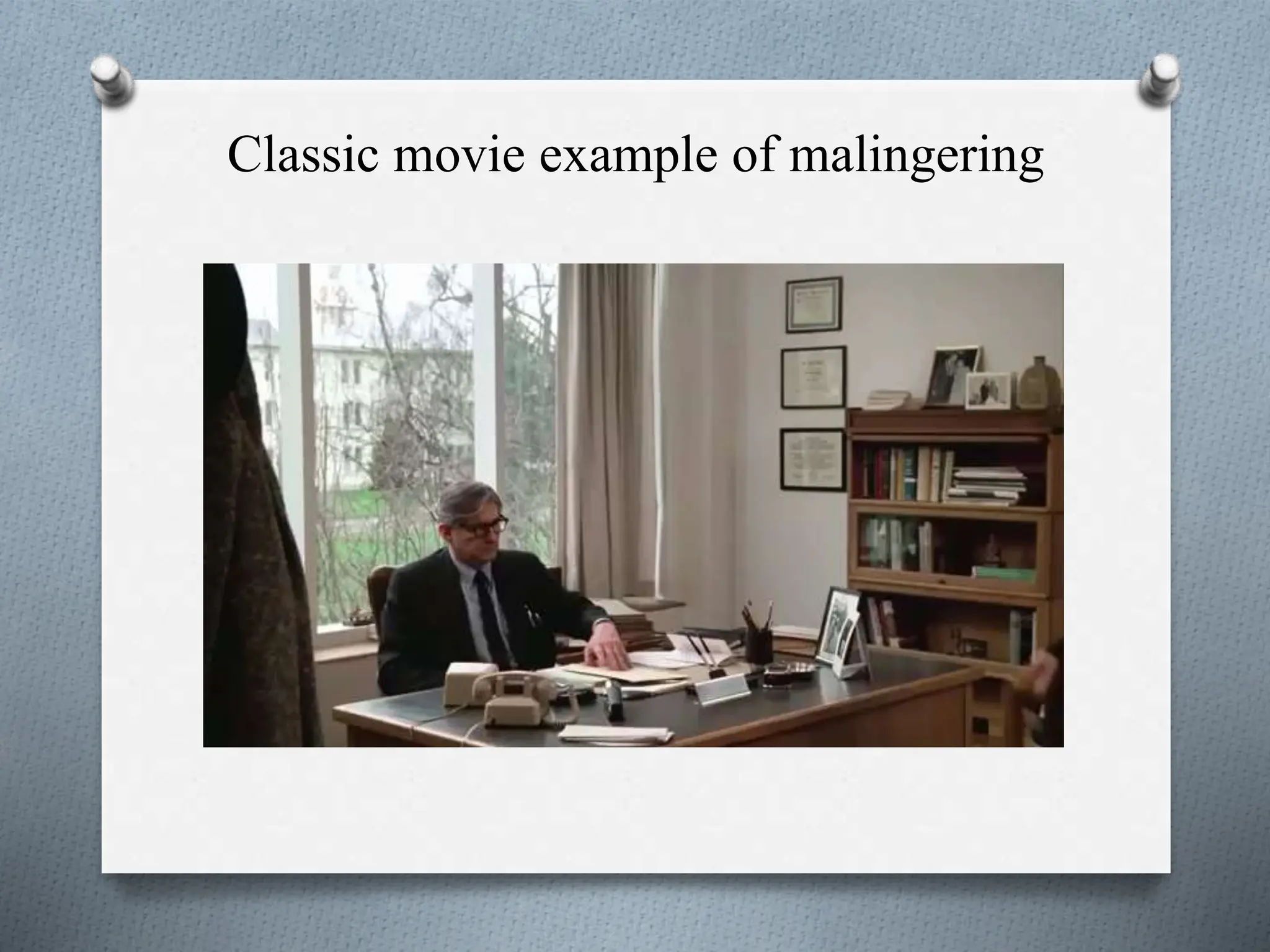
Classic movie example of malingering
Definitions and origins
Plain English Definition:
Oxford English Dictionary
(Verb, no object) To exaggerate or feign illness
in order to escape duty or work.
Back-formation from malingerer, apparently
from French malingre, perhaps formed as
mal- 'wrongly, improperly' + haingre 'weak',
probably of Germanic origin.
Medical definitions (because we all want to
be able to bill for our services, right?)
ICD-9
V65.2 Person feigning illness
Applies to malingerer, peregrinating patient;
disease synonym of drug-seeking behavior
ICD-10
Z76.5 Malingerer
Applies to person feigning illness with obvious
motivation; excludes factitious disorder,
peregrinating patient
The clinical definition according to the
DSM…
O malingering is defined as “…the intentional
production of false or grossly exaggerated physical
or psychological symptoms, motivated by external
incentives...” malingering should be “strongly
suspected if any combination of the following is
noted”: medico-legal context of presentation,
marked discrepancy between self-reported stress or
disability and objective findings, lack of
cooperation during diagnostic evaluation or with
prescribed treatment, or presence of antisocial
personality disorder.
Operative definition
Meyer and Deitsch (1996) suggested that it is
often appropriate to broaden the concept of
malingering to any type of response that distorts
the production of an accurate record.
However,
Rogers (1997) identified false positive rate of
nearly four times as many bona fide patients
mis-categorized as malingerers.
A better operative definition
Feigning ≠ Malingering
Feigning refers to exaggerating or fabricating
psychological problems or symptoms, regardless
of intent.
Malingering is the conscious choice to
intentionally exaggerate or fabricate
psychological problems or for external gain.
DeClue (2002)
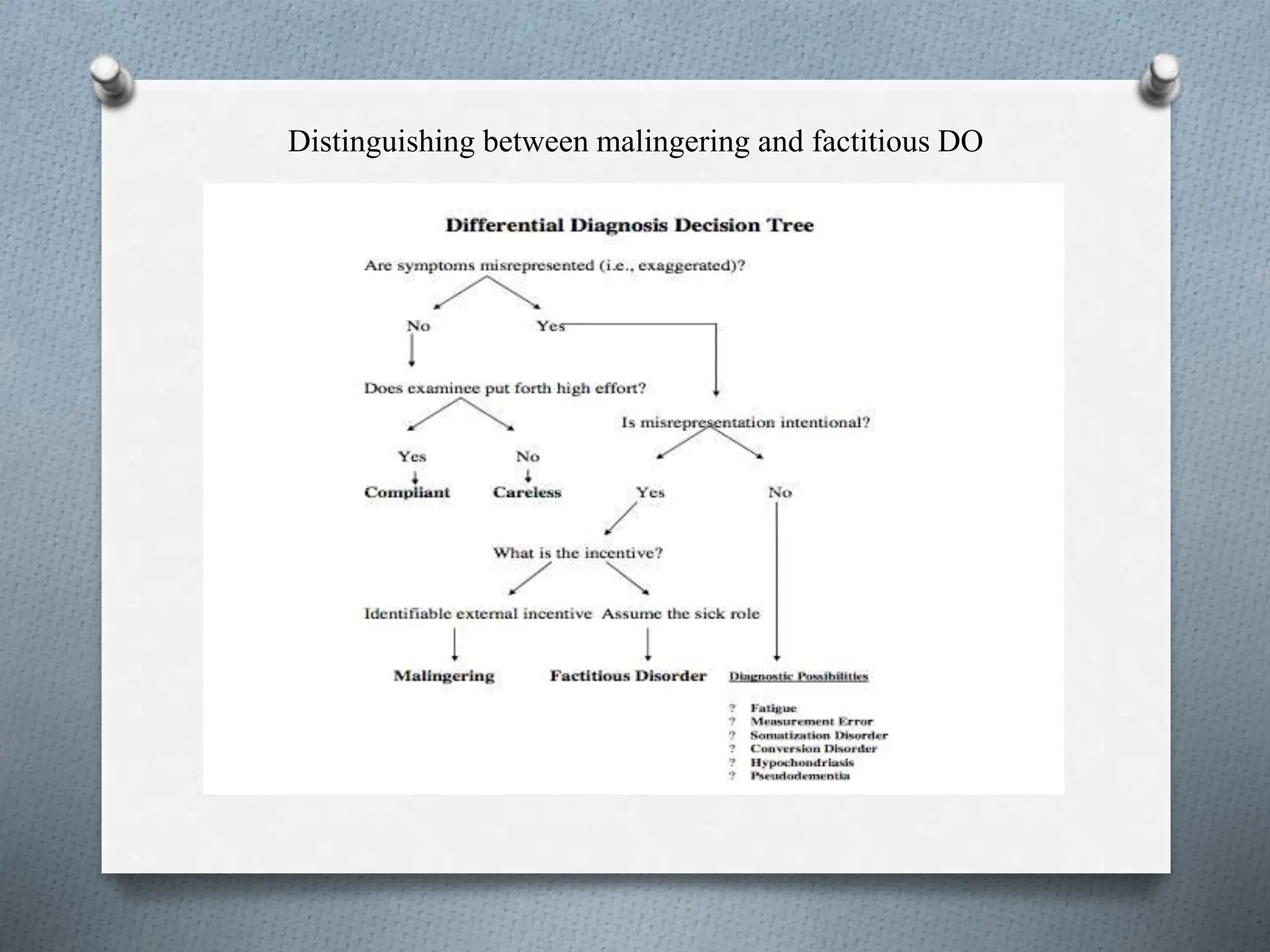
Distinguishing between malingering and factitious DO
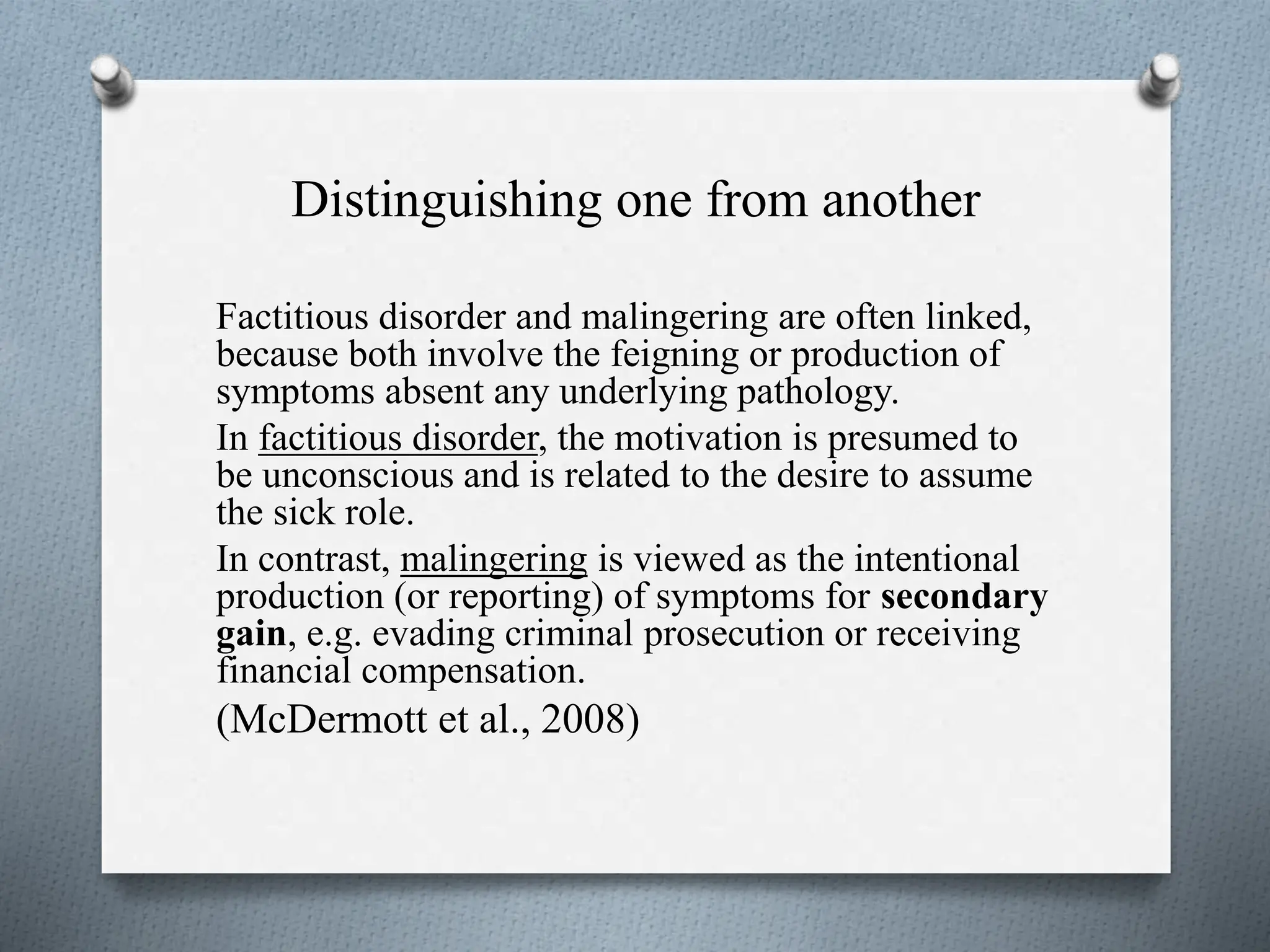
Distinguishing one from another
Factitious disorder and malingering are often linked,
because both involve the feigning or production of
symptoms absent any underlying pathology.
In factitious disorder, the motivation is presumed to
be unconscious and is related to the desire to assume
the sick role.
In contrast, malingering is viewed as the intentional
production (or reporting) of symptoms for secondary
gain, e.g. evading criminal prosecution or receiving
financial compensation.
(McDermott et al., 2008)
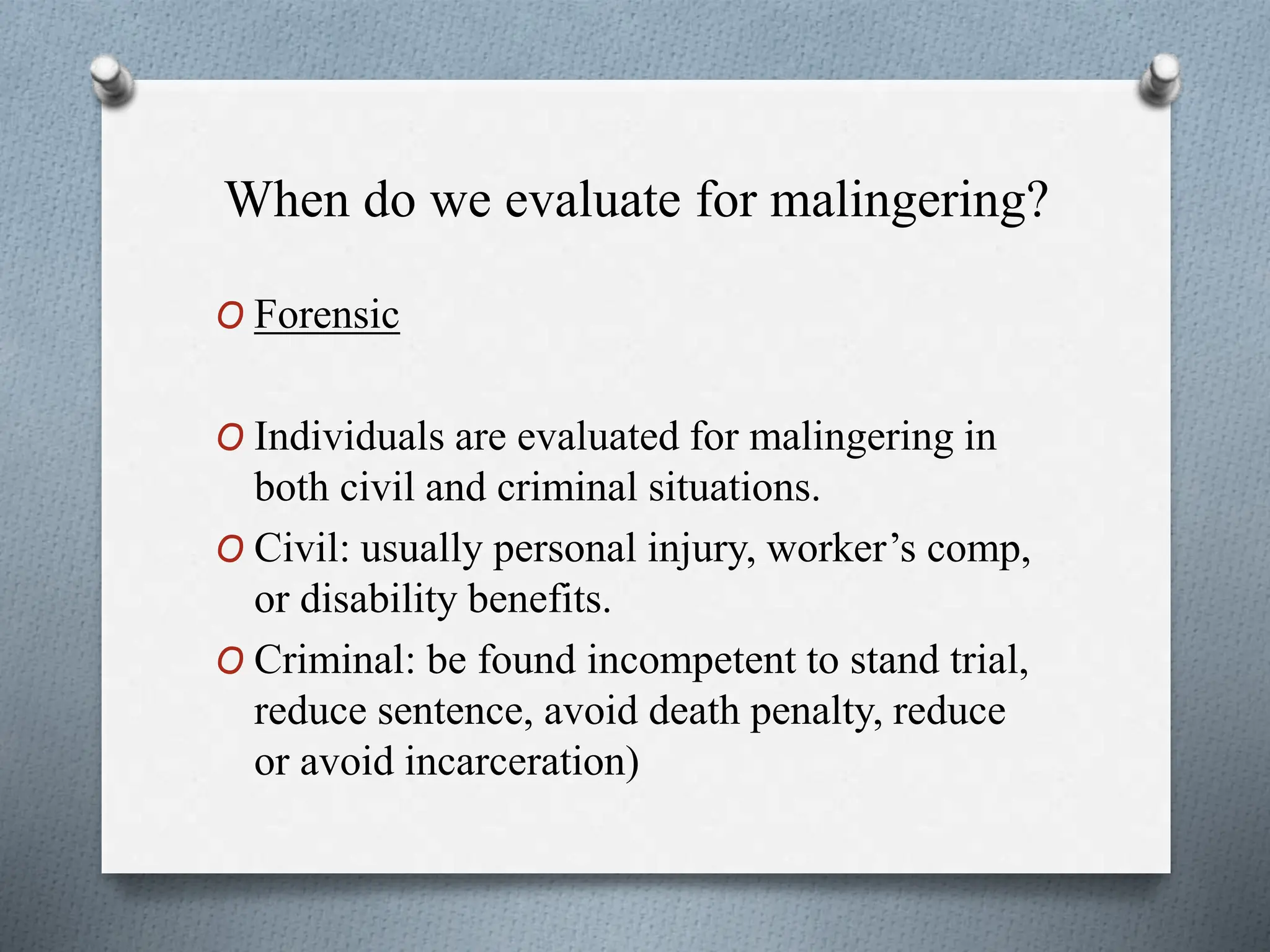
When do we evaluate for malingering?
O Forensic
O Individuals are evaluated for malingering in
both civil and criminal situations.
O Civil: usually personal injury, worker’s comp,
or disability benefits.
O Criminal: be found incompetent to stand trial,
reduce sentence, avoid death penalty, reduce
or avoid incarceration)
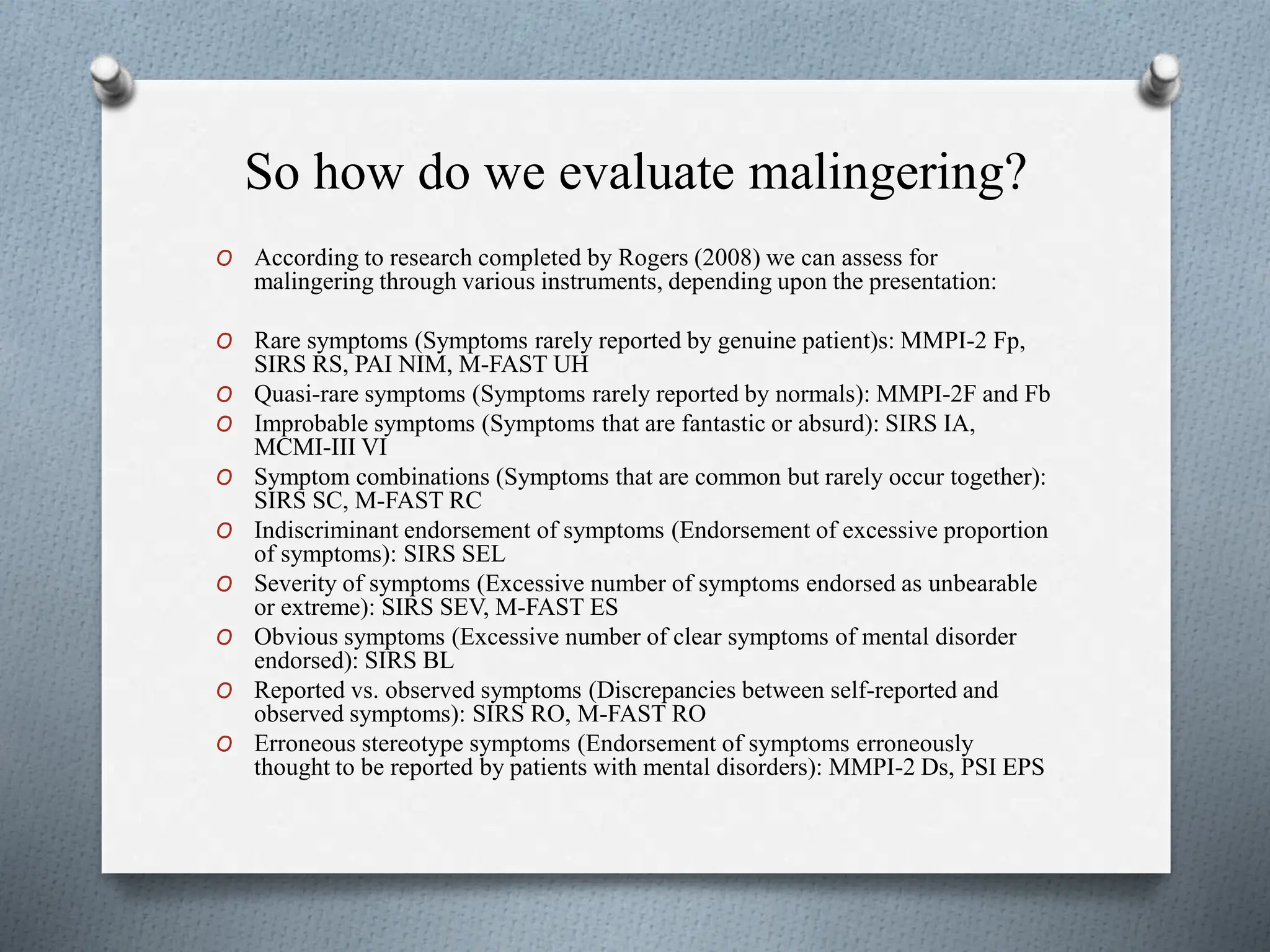
So how do we evaluate malingering?
O According to research completed by Rogers (2008) we can assess for
malingering through various instruments, depending upon the presentation:
O Rare symptoms (Symptoms rarely reported by genuine patient)s: MMPI-2 Fp,
SIRS RS, PAI NIM, M-FAST UH
O Quasi-rare symptoms (Symptoms rarely reported by normals): MMPI-2F and Fb
O Improbable symptoms (Symptoms that are fantastic or absurd): SIRS IA,
MCMI-III VI
O Symptom combinations (Symptoms that are common but rarely occur together):
SIRS SC, M-FAST RC
O Indiscriminant endorsement of symptoms (Endorsement of excessive proportion
of symptoms): SIRS SEL
O Severity of symptoms (Excessive number of symptoms endorsed as unbearable
or extreme): SIRS SEV, M-FAST ES
O Obvious symptoms (Excessive number of clear symptoms of mental disorder
endorsed): SIRS BL
O Reported vs. observed symptoms (Discrepancies between self-reported and
observed symptoms): SIRS RO, M-FAST RO
O Erroneous stereotype symptoms (Endorsement of symptoms erroneously
thought to be reported by patients with mental disorders): MMPI-2 Ds, PSI EPS
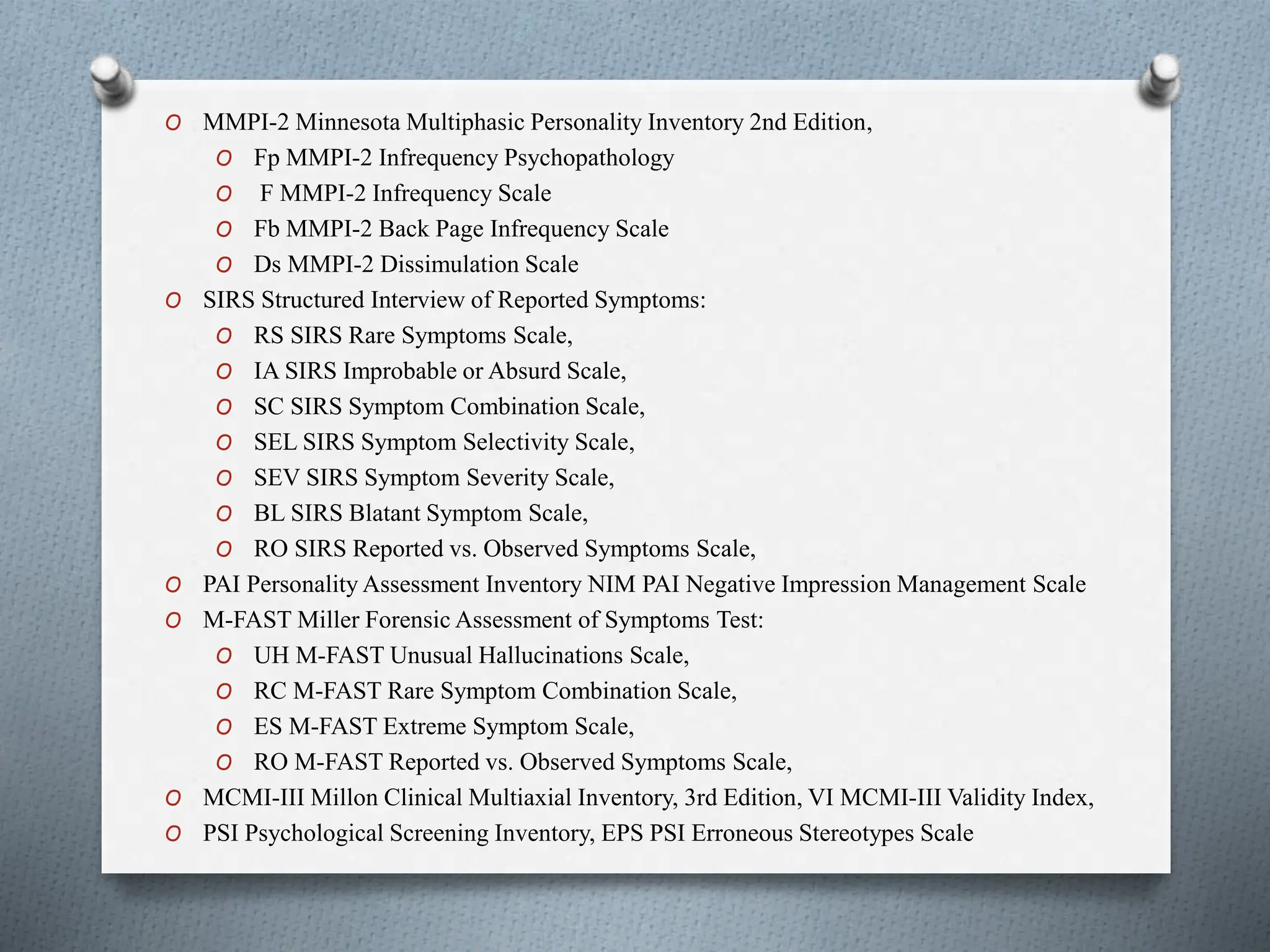
O MMPI-2 Minnesota Multiphasic Personality Inventory 2nd Edition,
O Fp MMPI-2 Infrequency Psychopathology
O F MMPI-2 Infrequency Scale
O Fb MMPI-2 Back Page Infrequency Scale
O Ds MMPI-2 Dissimulation Scale
O SIRS Structured Interview of Reported Symptoms:
O RS SIRS Rare Symptoms Scale,
O IA SIRS Improbable or Absurd Scale,
O SC SIRS Symptom Combination Scale,
O SEL SIRS Symptom Selectivity Scale,
O SEV SIRS Symptom Severity Scale,
O BL SIRS Blatant Symptom Scale,
O RO SIRS Reported vs. Observed Symptoms Scale,
O PAI Personality Assessment Inventory NIM PAI Negative Impression Management Scale
O M-FAST Miller Forensic Assessment of Symptoms Test:
O UH M-FAST Unusual Hallucinations Scale,
O RC M-FAST Rare Symptom Combination Scale,
O ES M-FAST Extreme Symptom Scale,
O RO M-FAST Reported vs. Observed Symptoms Scale,
O MCMI-III Millon Clinical Multiaxial Inventory, 3rd Edition, VI MCMI-III Validity Index,
O PSI Psychological Screening Inventory, EPS PSI Erroneous Stereotypes Scale
MMPI-2 and malingering
O MMPI-2 Minnesota Multiphasic Personality
Inventory 2nd Edition
O Fp MMPI-2 Infrequency Psychopathology,
O F MMPI-2 Infrequency Scale,
O Fb MMPI-2 Back Page Infrequency Scale
O Ds MMPI-2 Dissimulation Scale
SIRS (structured interview of reported symptoms)
O 172-item structured interview which takes
approximately 30–45 minutes to administer. The
SIRS contains eight primary and five
supplementary scales:
O rare symptoms, symptom combinations,
improbable or absurd symptoms, blatant
symptoms, subtle symptoms, severity of
symptoms, selectivity of symptoms, reported vs.
observed symptoms (primary scales)
O direct appraisal of honesty, defensive symptoms,
overly specific symptoms, symptom onset and
resolution, and inconsistency of symptoms
(supplementary scales).
PAI Personality Assessment Inventory NIM PAI
Negative Impression Management Scale
O The PAI NIM scale is a measure of response
exaggeration in the original PAI and is
composed of infrequently endorsed items and
items associated with a very unfavorable self
presentation.
O Evaluation of Competency to Stand Trial -
Revised (ECST-R)
Contains the following six scales:
Consult with Counsel (CWC, 6 items);
Factual Understanding of the Courtroom
Proceedings (FAC, 6 items);
Rational Understanding of the Courtroom
Proceedings (RAC, 7 items); and
Atypical Presentation (ATP, 28 items).
O The ATP scale can be used to screen for
possible feigning in order to inform
determination of malingering
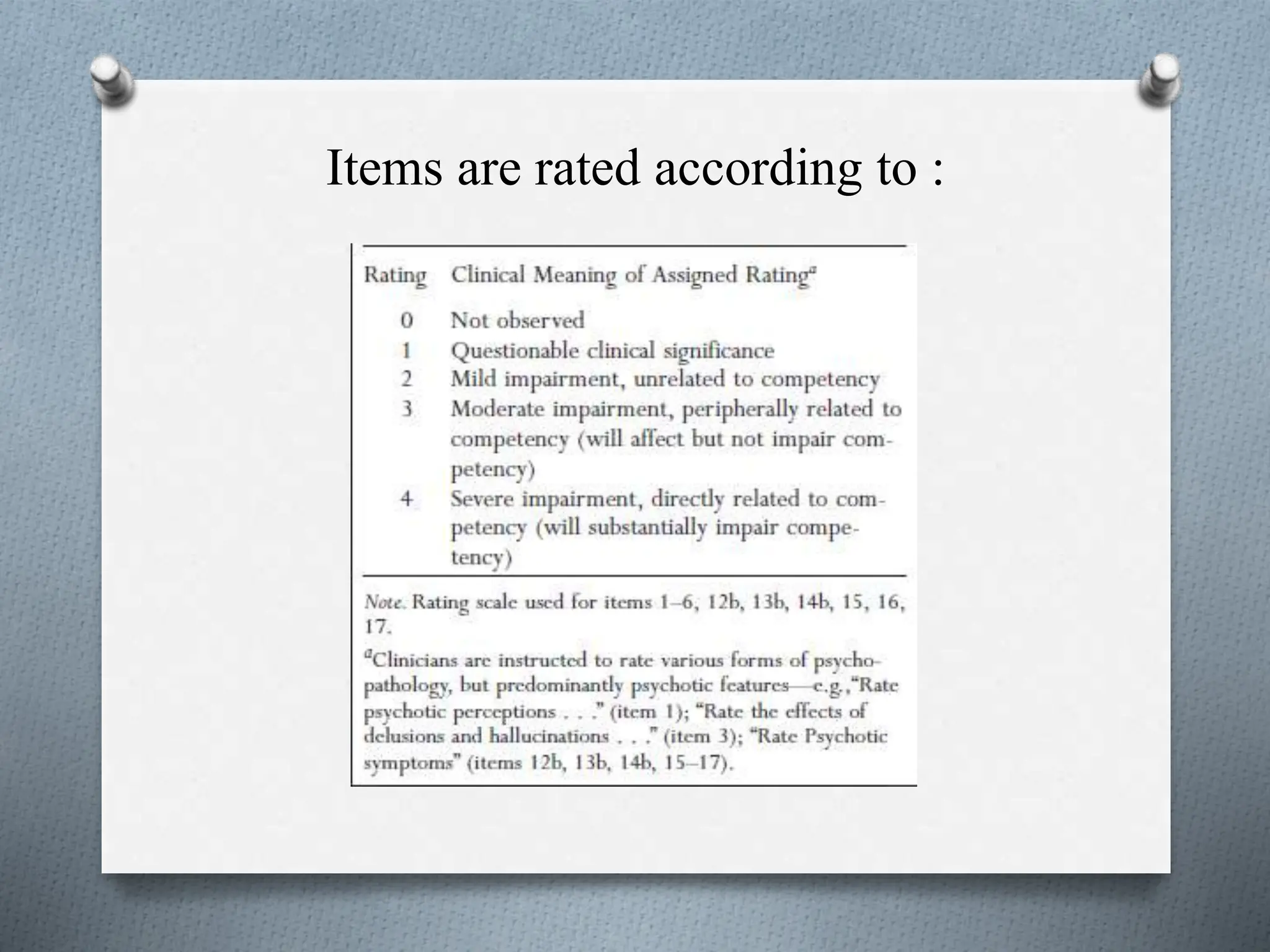
Items are rated according to :
O Effort Testing
O When the referral question deals with intellectual
and memory impairment, a number of tests aimed
at assessing response style can be used, including
O Test of Memory Malingering (TOMM)
O Validity Indicator Profile (VIP)
O Word Memory Test (WMT)
O These measures can contribute to the detection
of malingering. These instruments employ a
two-alternative forced choice design that
allows identification of “worse than chance
performance,” which is considered to be
highly indicative of malingering. In addition,
comparative test scores significantly below
those obtained by impaired persons are also
considered indicative of an attempt to appear
more impaired than is actually the case.
Malingering
O Case study:
References:
O Aguerrevere, L. E., Greve, K. W., Bianchini, K. J., & Ord, J. S. (2011). Classification
accuracy of the Millon Clinical Multiaxial Inventory – III modifier indices in the detection of
malingering in traumatic brain injury, 33(5), 497–504. doi:10.1080/13803395.2010.535503
O Ahmadi, K., Lashani, Z., Afzali, M. H., Tavalaie, S. A., & Mirzaee, J. (2013). Malingering
and PTSD : Detecting malingering and war related PTSD by Miller Forensic Assessment of
Symptoms Test ( M-FAST ).
O American Psychiatric Association. (2013). Diagnostic and statistical manual of mental
disorders (5th ed.). Washington, DC:
Author.
O Berry, D. T. R., & Nelson, N. W. (2010). DSM-5 and Malingering: a Modest Proposal.
Psychological Injury and Law, 3(4), 295–303. doi:10.1007/s12207-010-9087-7
O Boccaccini, M. T., Murrie, D. C., Duncan, S. A., & Penitentiary, U. S. (2006). Screening for
Malingering in a Criminal – Forensic Sample With the Personality Assessment Inventory,
18(4), 415–423. doi:10.1037/1040-3590.18.4.415
O DeClue, G. (2002). Feigning ≠ Malingering: A case study. Behavioral Sciences and the Law,
20, 717-726.
O Farkas, M. R., Rosenfeld, B., Gorp, W. Van, & Ph, D. (2006). Do Tests of Malingering
Concur ? Concordance Among Malingering Measures, 671, 659–671. doi:10.1002/bsl
O Flowers, K. A., Bolton, C., & Brindle, N. (2008). Chance Guessing in a Forced-Choice
Recognition Task and the Detection of Malingering, 22(2), 273–277. doi:10.1037/0894-
4105.22.2.273
O Jelicic, M., Ceunen, E., Peters, M. J. V, & Merckelbach, H. (2011). Detecting Coached
Feigning Using the Test of Memory Malingering ( TOMM ) and the Structured Inventory of
Malingered Symptomatology ( SIMS ) Ã, 67(9), 850–856. doi:10.1002/jclp.20805
References, continued.
O Kucharski, L. T., Toomey, J. P., Fila, K., & Duncan, S. (2007). Detection of
Malingering of Psychiatric Disorder With the Personality Assessment Inventory : An
Investigation of Criminal Defendants
O Mcdermott, B. E., Ph, D., Sokolov, G., & D, M. (2009). Malingering in a Correctional
Setting : The Use of the Structured Interview of Reported Symptoms in a Jail Sample,
765(September), 753–765. doi:10.1002/bsl
O McDermott, B., Leamon, M., Feldman, M., Scott, C. (2008) Factitious disorder and
malingering. The American Psychiatric Publishing Textbook of Psychiatry (5th ed.).
American Psychiatric Publishing: Arlington, VA.
O Memory, A. W., & Study, T. (2013). Detection of Malingered Neurocognitive
Dysfunction Among Patients with Acquired Brain Injuries, 29(4), 253–262.
doi:10.1027/1015-5759/a000154
O Meyer, R. & Deitsch, S. (1996). The Clinician’s Handbook: Integrated diagnostics,
assessment, and intervention in adult and adolescent psychopathology (4th ed.). Allyn
& Bacon: Needham Heights, MA.
O Missouri, W., Health, M., & City, K. (2008). Diagnostic Accuracy of the MMPI – 2
Malingering Discriminant, 90(4), 392–398. doi:10.1080/00223890802108204
O Rogers, R. (1997). Clinical Assessment of Malingering and Deception (2nd ed., pp. 1–
19). New York, NY: Guilford.
O Vitacco, M. J., Rogers, R., Gabel, J., & Munizza, J. (2007). An evaluation of
malingering screens with competency to stand trial patients: a known-groups
comparison. Law and Human Behavior, 31(3), 249–60. doi:10.1007/s10979-006-
9062-8

Malingering presentation for forensic evaluations

  • 1.
    Malingering What is itand how do you know? A review of some commonly used instruments and assessments. Yuki J.M. Acs and Karin Celosse PF717 Forensic Assessment Fall 2014
  • 2.
    Classic movie exampleof malingering
  • 3.
    Definitions and origins PlainEnglish Definition: Oxford English Dictionary (Verb, no object) To exaggerate or feign illness in order to escape duty or work. Back-formation from malingerer, apparently from French malingre, perhaps formed as mal- 'wrongly, improperly' + haingre 'weak', probably of Germanic origin.
  • 4.
    Medical definitions (becausewe all want to be able to bill for our services, right?) ICD-9 V65.2 Person feigning illness Applies to malingerer, peregrinating patient; disease synonym of drug-seeking behavior ICD-10 Z76.5 Malingerer Applies to person feigning illness with obvious motivation; excludes factitious disorder, peregrinating patient
  • 5.
    The clinical definitionaccording to the DSM… O malingering is defined as “…the intentional production of false or grossly exaggerated physical or psychological symptoms, motivated by external incentives...” malingering should be “strongly suspected if any combination of the following is noted”: medico-legal context of presentation, marked discrepancy between self-reported stress or disability and objective findings, lack of cooperation during diagnostic evaluation or with prescribed treatment, or presence of antisocial personality disorder.
  • 6.
    Operative definition Meyer andDeitsch (1996) suggested that it is often appropriate to broaden the concept of malingering to any type of response that distorts the production of an accurate record. However, Rogers (1997) identified false positive rate of nearly four times as many bona fide patients mis-categorized as malingerers.
  • 7.
    A better operativedefinition Feigning ≠ Malingering Feigning refers to exaggerating or fabricating psychological problems or symptoms, regardless of intent. Malingering is the conscious choice to intentionally exaggerate or fabricate psychological problems or for external gain. DeClue (2002)
  • 8.
  • 9.
    Distinguishing one fromanother Factitious disorder and malingering are often linked, because both involve the feigning or production of symptoms absent any underlying pathology. In factitious disorder, the motivation is presumed to be unconscious and is related to the desire to assume the sick role. In contrast, malingering is viewed as the intentional production (or reporting) of symptoms for secondary gain, e.g. evading criminal prosecution or receiving financial compensation. (McDermott et al., 2008)
  • 10.
    When do weevaluate for malingering? O Forensic O Individuals are evaluated for malingering in both civil and criminal situations. O Civil: usually personal injury, worker’s comp, or disability benefits. O Criminal: be found incompetent to stand trial, reduce sentence, avoid death penalty, reduce or avoid incarceration)
  • 11.
    So how dowe evaluate malingering? O According to research completed by Rogers (2008) we can assess for malingering through various instruments, depending upon the presentation: O Rare symptoms (Symptoms rarely reported by genuine patient)s: MMPI-2 Fp, SIRS RS, PAI NIM, M-FAST UH O Quasi-rare symptoms (Symptoms rarely reported by normals): MMPI-2F and Fb O Improbable symptoms (Symptoms that are fantastic or absurd): SIRS IA, MCMI-III VI O Symptom combinations (Symptoms that are common but rarely occur together): SIRS SC, M-FAST RC O Indiscriminant endorsement of symptoms (Endorsement of excessive proportion of symptoms): SIRS SEL O Severity of symptoms (Excessive number of symptoms endorsed as unbearable or extreme): SIRS SEV, M-FAST ES O Obvious symptoms (Excessive number of clear symptoms of mental disorder endorsed): SIRS BL O Reported vs. observed symptoms (Discrepancies between self-reported and observed symptoms): SIRS RO, M-FAST RO O Erroneous stereotype symptoms (Endorsement of symptoms erroneously thought to be reported by patients with mental disorders): MMPI-2 Ds, PSI EPS
  • 12.
    O MMPI-2 MinnesotaMultiphasic Personality Inventory 2nd Edition, O Fp MMPI-2 Infrequency Psychopathology O F MMPI-2 Infrequency Scale O Fb MMPI-2 Back Page Infrequency Scale O Ds MMPI-2 Dissimulation Scale O SIRS Structured Interview of Reported Symptoms: O RS SIRS Rare Symptoms Scale, O IA SIRS Improbable or Absurd Scale, O SC SIRS Symptom Combination Scale, O SEL SIRS Symptom Selectivity Scale, O SEV SIRS Symptom Severity Scale, O BL SIRS Blatant Symptom Scale, O RO SIRS Reported vs. Observed Symptoms Scale, O PAI Personality Assessment Inventory NIM PAI Negative Impression Management Scale O M-FAST Miller Forensic Assessment of Symptoms Test: O UH M-FAST Unusual Hallucinations Scale, O RC M-FAST Rare Symptom Combination Scale, O ES M-FAST Extreme Symptom Scale, O RO M-FAST Reported vs. Observed Symptoms Scale, O MCMI-III Millon Clinical Multiaxial Inventory, 3rd Edition, VI MCMI-III Validity Index, O PSI Psychological Screening Inventory, EPS PSI Erroneous Stereotypes Scale
  • 13.
    MMPI-2 and malingering OMMPI-2 Minnesota Multiphasic Personality Inventory 2nd Edition O Fp MMPI-2 Infrequency Psychopathology, O F MMPI-2 Infrequency Scale, O Fb MMPI-2 Back Page Infrequency Scale O Ds MMPI-2 Dissimulation Scale
  • 14.
    SIRS (structured interviewof reported symptoms) O 172-item structured interview which takes approximately 30–45 minutes to administer. The SIRS contains eight primary and five supplementary scales: O rare symptoms, symptom combinations, improbable or absurd symptoms, blatant symptoms, subtle symptoms, severity of symptoms, selectivity of symptoms, reported vs. observed symptoms (primary scales) O direct appraisal of honesty, defensive symptoms, overly specific symptoms, symptom onset and resolution, and inconsistency of symptoms (supplementary scales).
  • 15.
    PAI Personality AssessmentInventory NIM PAI Negative Impression Management Scale O The PAI NIM scale is a measure of response exaggeration in the original PAI and is composed of infrequently endorsed items and items associated with a very unfavorable self presentation.
  • 16.
    O Evaluation ofCompetency to Stand Trial - Revised (ECST-R) Contains the following six scales: Consult with Counsel (CWC, 6 items); Factual Understanding of the Courtroom Proceedings (FAC, 6 items); Rational Understanding of the Courtroom Proceedings (RAC, 7 items); and Atypical Presentation (ATP, 28 items). O The ATP scale can be used to screen for possible feigning in order to inform determination of malingering
  • 17.
    Items are ratedaccording to :
  • 18.
    O Effort Testing OWhen the referral question deals with intellectual and memory impairment, a number of tests aimed at assessing response style can be used, including O Test of Memory Malingering (TOMM) O Validity Indicator Profile (VIP) O Word Memory Test (WMT)
  • 19.
    O These measurescan contribute to the detection of malingering. These instruments employ a two-alternative forced choice design that allows identification of “worse than chance performance,” which is considered to be highly indicative of malingering. In addition, comparative test scores significantly below those obtained by impaired persons are also considered indicative of an attempt to appear more impaired than is actually the case.
  • 20.
  • 21.
    References: O Aguerrevere, L.E., Greve, K. W., Bianchini, K. J., & Ord, J. S. (2011). Classification accuracy of the Millon Clinical Multiaxial Inventory – III modifier indices in the detection of malingering in traumatic brain injury, 33(5), 497–504. doi:10.1080/13803395.2010.535503 O Ahmadi, K., Lashani, Z., Afzali, M. H., Tavalaie, S. A., & Mirzaee, J. (2013). Malingering and PTSD : Detecting malingering and war related PTSD by Miller Forensic Assessment of Symptoms Test ( M-FAST ). O American Psychiatric Association. (2013). Diagnostic and statistical manual of mental disorders (5th ed.). Washington, DC: Author. O Berry, D. T. R., & Nelson, N. W. (2010). DSM-5 and Malingering: a Modest Proposal. Psychological Injury and Law, 3(4), 295–303. doi:10.1007/s12207-010-9087-7 O Boccaccini, M. T., Murrie, D. C., Duncan, S. A., & Penitentiary, U. S. (2006). Screening for Malingering in a Criminal – Forensic Sample With the Personality Assessment Inventory, 18(4), 415–423. doi:10.1037/1040-3590.18.4.415 O DeClue, G. (2002). Feigning ≠ Malingering: A case study. Behavioral Sciences and the Law, 20, 717-726. O Farkas, M. R., Rosenfeld, B., Gorp, W. Van, & Ph, D. (2006). Do Tests of Malingering Concur ? Concordance Among Malingering Measures, 671, 659–671. doi:10.1002/bsl O Flowers, K. A., Bolton, C., & Brindle, N. (2008). Chance Guessing in a Forced-Choice Recognition Task and the Detection of Malingering, 22(2), 273–277. doi:10.1037/0894- 4105.22.2.273 O Jelicic, M., Ceunen, E., Peters, M. J. V, & Merckelbach, H. (2011). Detecting Coached Feigning Using the Test of Memory Malingering ( TOMM ) and the Structured Inventory of Malingered Symptomatology ( SIMS ) Ã, 67(9), 850–856. doi:10.1002/jclp.20805
  • 22.
    References, continued. O Kucharski,L. T., Toomey, J. P., Fila, K., & Duncan, S. (2007). Detection of Malingering of Psychiatric Disorder With the Personality Assessment Inventory : An Investigation of Criminal Defendants O Mcdermott, B. E., Ph, D., Sokolov, G., & D, M. (2009). Malingering in a Correctional Setting : The Use of the Structured Interview of Reported Symptoms in a Jail Sample, 765(September), 753–765. doi:10.1002/bsl O McDermott, B., Leamon, M., Feldman, M., Scott, C. (2008) Factitious disorder and malingering. The American Psychiatric Publishing Textbook of Psychiatry (5th ed.). American Psychiatric Publishing: Arlington, VA. O Memory, A. W., & Study, T. (2013). Detection of Malingered Neurocognitive Dysfunction Among Patients with Acquired Brain Injuries, 29(4), 253–262. doi:10.1027/1015-5759/a000154 O Meyer, R. & Deitsch, S. (1996). The Clinician’s Handbook: Integrated diagnostics, assessment, and intervention in adult and adolescent psychopathology (4th ed.). Allyn & Bacon: Needham Heights, MA. O Missouri, W., Health, M., & City, K. (2008). Diagnostic Accuracy of the MMPI – 2 Malingering Discriminant, 90(4), 392–398. doi:10.1080/00223890802108204 O Rogers, R. (1997). Clinical Assessment of Malingering and Deception (2nd ed., pp. 1– 19). New York, NY: Guilford. O Vitacco, M. J., Rogers, R., Gabel, J., & Munizza, J. (2007). An evaluation of malingering screens with competency to stand trial patients: a known-groups comparison. Law and Human Behavior, 31(3), 249–60. doi:10.1007/s10979-006- 9062-8

Editor's Notes

  • #3 One flew over cuckoo’s nest, for students not familiar with story go over premise of (book) and movie. Nicholson accused of crime and feigns mental illness in order to get sent to mental institution instead-thinks it will be easier to handle than prison. ----- Meeting Notes (27/09/2014 00:15) ----- Malingering not always what it seems, insurance companies quick to jump to conclusions in their favor. Important to conduct a complete assessment to get a better clinical picture.
  • #6 The basic definition hasn’t changed since the 1980s. There is controversy regarding this, surrounding the adversarial view of and approach to the individual in question. The 3 models of approach have been pathogenic (started off as faking but then became real), criminological (manipulative in nature), and adaptational (trying to make the best of a bad situation, not malicious in intent).
  • #9 Differential diagnosis for determining whether or not a patient may or may not be malingering (factitious disorder is the intentional production of physical or psychological signs or symptoms," which is motivated by a desire to assume the sick role-as opposed to seeking an external incentive such as money or avoiding some unwanted state). Somatic disorders are similar to factitious DO, with the only difference being that they are not in conscious control (whereas factitious DO and malingering are).
  • #12 Individuals are evaluated for malingering in both civil and criminal situations. Civil: usually personal injury, worker’s comp, or disability benefits. Criminal: be found incompetent to stand trial, reduce sentence, avoid death penalty, reduce or avoid incarceration) See next slide for the specific sections of the various assessments
  • #13 These are the specific scales on the various instruments that are used to assess for possible malingering. I will be going over the MMPI-2 as well as the SIRS, and PAI and the scales pertinent to potential cases involving malingering.
  • #14 These scales consist of items endorsed by fewer than 20% of individuals in both normal and psychiatric samples. The scales were designed for applications in settings characterized by high base rates of serious psychopathology, such as psychiatric inpatient units, and as such are deemed to indicate that a “normal” individual may be faking symptoms if they present with high rates of endorsement on these.
  • #15 The supplementary scales are only used in the case that it is not possible to conclude one way or another if the patient is malingering after completing the primary scales. The SIRS is used to assess feigned mental disorders and that employ two general categories: unlikely strategies (i.e., typically bogus symptoms almost never reported by genuine patients) or amplified strategies (i.e., typically legitimate symptoms reported at relatively low levels by genuine patients and much higher levels by feigners).
  • #17 Yuki’s slides start here
  • #21 Yuki will add this