MALE REPRODUCTIVE SYSTEM
• Organs
• Functions
• Pathway of Sperm Cells
Joey Richard V. Dio
B S Accountancy 2
OBJECTIVES
1. Identify the structures and major organs
of the male reproductive system and
describe their functions.
2. Trace the pathway of the sperm cells in
the organ system.
What is the
MALE REPRODUCTIVE SYSTEM?
Male Reproductive System
• Consists of a number sex organs that are a
part of the human reproductive process.
• Produces, stores and releases the male
gametes, or sperm.
*gametes- a sex cell
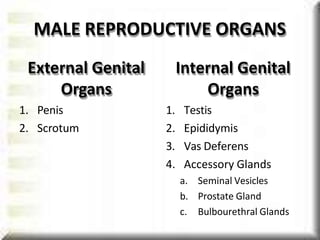
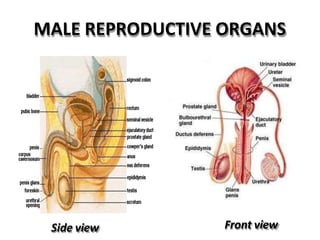
MALE REPRODUCTIVE ORGANS
External Genital
Organs
1. Penis
2. Scrotum
Internal Genital
Organs
1. Testis
2. Epididymis
3. Vas Deferens
4. Accessory Glands
a. Seminal Vesicles
b. Prostate Gland
c. Bulbourethral Glands
MALE REPRODUCTIVE ORGANS
Side view Front view
External Genital Organs
Penis
Scrotum
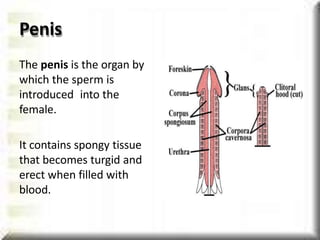
Penis
The penis is the organ by
which the sperm is
introduced into the
female.
It contains spongy tissue
that becomes turgid and
erect when filled with
blood.
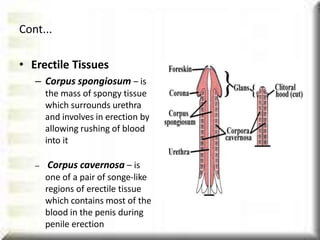
• Erectile Tissues
– Corpus spongiosum – is
the mass of spongy tissue
which surrounds urethra
and involves in erection by
allowing rushing of blood
into it
– Corpus cavernosa – is
one of a pair of songe-like
regions of erectile tissue
which contains most of the
blood in the penis during
penile erection
Cont...
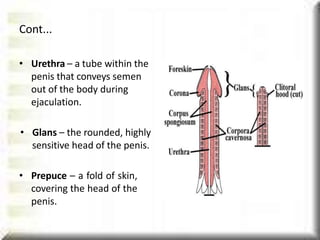
• Urethra – a tube within the
penis that conveys semen
out of the body during
ejaculation.
• Glans – the rounded, highly
sensitive head of the penis.
• Prepuce – a fold of skin,
covering the head of the
penis.
Cont...
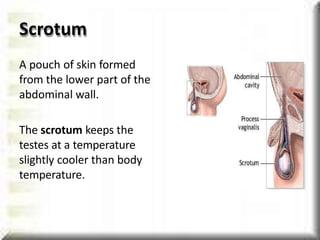
Scrotum
A pouch of skin formed
from the lower part of the
abdominal wall.
The scrotum keeps the
testes at a temperature
slightly cooler than body
temperature.
Testis
Epididymis
Vas Deferens
Internal Genital Organs
Seminal Vesicles
Prostate Gland
Bulbourethral Glands
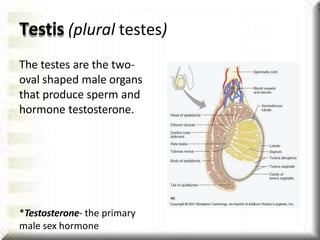
Testis (plural testes)
The testes are the two-
oval shaped male organs
that produce sperm and
hormone testosterone.
*Testosterone- the primary
male sex hormone
Cont…
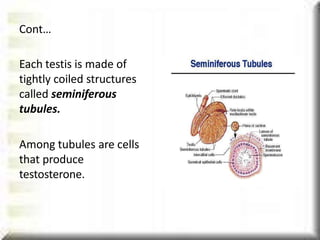
Each testis is made of
tightly coiled structures
called seminiferous
tubules.
Among tubules are cells
that produce
testosterone.
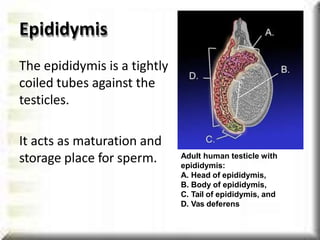
Epididymis
The epididymis is a tightly
coiled tubes against the
testicles.
It acts as maturation and
storage place for sperm. Adult human testicle with
epididymis:
A. Head of epididymis,
B. Body of epididymis,
C. Tail of epididymis, and
D. Vas deferens
Vas Deferens (Ductus Deferens)
The vas deferens is a thin
tube that starts from the
epididymis to the urethra
in the penis.
They transport sperm
from the epididymis in
anticipation of ejaculation.
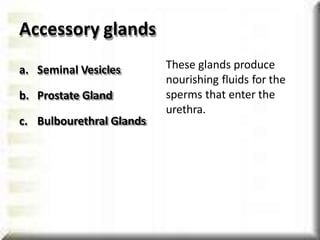
a. Seminal Vesicles
b. Prostate Gland
c. Bulbourethral Glands
These glands produce
nourishing fluids for the
sperms that enter the
urethra.
Accessory glands
Seminal Vesicles
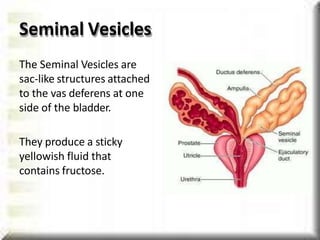
The Seminal Vesicles are
sac-like structures attached
to the vas deferens at one
side of the bladder.
They produce a sticky
yellowish fluid that
contains fructose.
Prostate Gland
The Prostate Gland
surrounds the ejaculatory
ducts at the base of the
urethra, just below the
bladder.
The Prostate Gland is
responsible for making the
production of semen, a liquid
mixture of sperm cells,
prostate fluid and seminal
fluid.
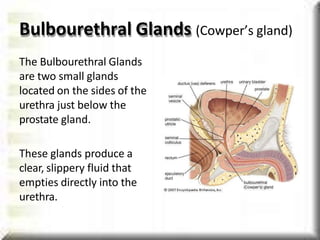
Bulbourethral Glands (Cowper’s gland)
The Bulbourethral Glands
are two small glands
located on the sides of the
urethra just below the
prostate gland.
These glands produce a
clear, slippery fluid that
empties directly into the
urethra.
REVIEW:
• The main function of the Male Reproductive
System is to produce sperm cells and deliver
them to the female reproductive system.
• It consists of external and internal genital
organs which are essential for the continuous
reproduction of life.
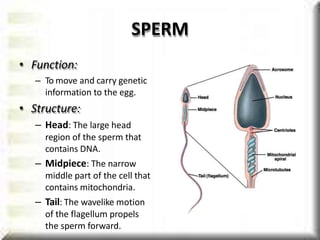
SPERM
• Function:
– To move and carry genetic
information to the egg.
• Structure:
– Head: The large head
region of the sperm that
contains DNA.
– Midpiece: The narrow
middle part of the cell that
contains mitochondria.
– Tail: The wavelike motion
of the flagellum propels
the sperm forward.
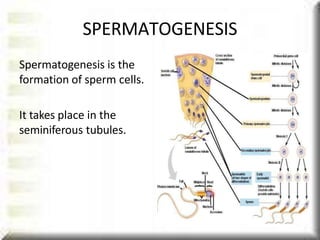
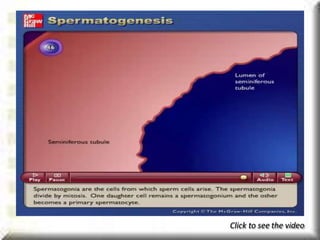
Spermatogenesis is the
formation of sperm cells.
It takes place in the
seminiferous tubules.
SPERMATOGENESIS
SPERMATOGENESIS
Click to see the video
SPERMATOGENESIS
Process:
• Diploid cells that begin the process are located
near the outer wall of the tubules.
These cells multiply constantly by mitosis, and
each day about 3 million of them differentiate
into primary spermatocytes, the cells that
undergo meiosis.
• Meiosis I of a primary spermatocyte produces
secondary spermatocytes, each with the
haploid number of chromosomes (n=23).
The cells are still in their duplicated state, each
consisting of two identical chromatids.
Process:
• Meiosis II then forms four cells, each with the
haploid number of single-chromatid
chromosomes.
Process:
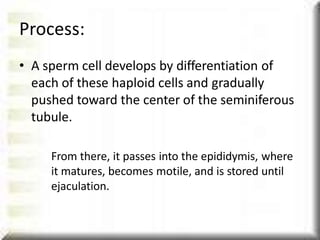
• A sperm cell develops by differentiation of
each of these haploid cells and gradually
pushed toward the center of the seminiferous
tubule.
From there, it passes into the epididymis, where
it matures, becomes motile, and is stored until
ejaculation.
Process:
Click to see the video
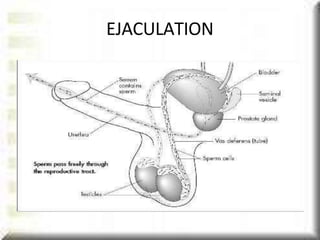
EJACULATION
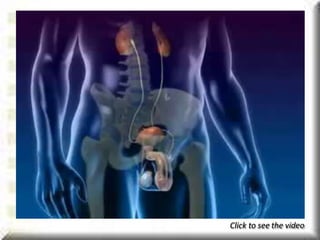
Ejaculation is the discharge of semen from the
penis.
During orgasm, the semen is forcefully expelled
from the body by strong muscular contractions of
sperm ducts.
EJACULATION
Process:
• At the peak of sexual arousal, muscles in the
epididymis, seminal vesicles, prostate gland,
and vas deferens contract.
At the same time, a sphincter muscle at the base
of the bladder contracts, preventing urine from
leaking into the urethra from the bladder.
Another sphincter also contracts, closing off the
entrance of the urethra into the penis.
• In the second stage of ejaculation, the
expulsion stage, the sphincter at the base of
the penis relaxes, admitting semen into the
penis.
Simultaneously, a series of strong muscle
contractions around the base of the penis and
along the urethra expels the semen from the
body.
Process:
Click to see the video
REVIEW:
The pathway of the sperm in the male
reproductive system are the following:
(arrange in chronological order)
Testes Epididymis
Vas
Deferens
Ejaculatory
Duct
Urethra
THAT’S ALL!
You are now ready for the
Evaluation Test…
EVALUATION TEST
1. The mitochondrion is located in which part
of the sperm cell?
a) Head
b) Midpiece
c) Tail
d) Acrosome
Answer: B
2. In which organ of the human male does
the mature sperm stored for a time?
a) Testis
b) Epididymis
c) Vas Deferens
d) Accessory Glands
Answer: B
EVALUATION TEST
3. Arrange the following organs in the correct
sequence for the travel of sperm:
epididymis, testis, urethra, vas deferens.
a) Testis – urethra – epididymis – vas deferens
b) Epididymis – testis – urethra – vas deferens
c) Testis – epididymis – vas deferens – urethra
d) Epididymis – vas deferens – testis – urethra
Answer: C
EVALUATION TEST
CONGRATULATIONS!
You all pass the evaluation test!
THANK YOU FOR PARTICIPATING!
Hope you learn 

malereproductivesystem-121116191244-phpapp01.pptx

  • 1.
    MALE REPRODUCTIVE SYSTEM •Organs • Functions • Pathway of Sperm Cells Joey Richard V. Dio B S Accountancy 2
  • 2.
    OBJECTIVES 1. Identify thestructures and major organs of the male reproductive system and describe their functions. 2. Trace the pathway of the sperm cells in the organ system.
  • 3.
    What is the MALEREPRODUCTIVE SYSTEM?
  • 4.
    Male Reproductive System •Consists of a number sex organs that are a part of the human reproductive process. • Produces, stores and releases the male gametes, or sperm. *gametes- a sex cell
  • 5.
    MALE REPRODUCTIVE ORGANS ExternalGenital Organs 1. Penis 2. Scrotum Internal Genital Organs 1. Testis 2. Epididymis 3. Vas Deferens 4. Accessory Glands a. Seminal Vesicles b. Prostate Gland c. Bulbourethral Glands
  • 6.
  • 7.
  • 8.
    Penis The penis isthe organ by which the sperm is introduced into the female. It contains spongy tissue that becomes turgid and erect when filled with blood.
  • 9.
    • Erectile Tissues –Corpus spongiosum – is the mass of spongy tissue which surrounds urethra and involves in erection by allowing rushing of blood into it – Corpus cavernosa – is one of a pair of songe-like regions of erectile tissue which contains most of the blood in the penis during penile erection Cont...
  • 10.
    • Urethra –a tube within the penis that conveys semen out of the body during ejaculation. • Glans – the rounded, highly sensitive head of the penis. • Prepuce – a fold of skin, covering the head of the penis. Cont...
  • 11.
    Scrotum A pouch ofskin formed from the lower part of the abdominal wall. The scrotum keeps the testes at a temperature slightly cooler than body temperature.
  • 12.
    Testis Epididymis Vas Deferens Internal GenitalOrgans Seminal Vesicles Prostate Gland Bulbourethral Glands
  • 13.
    Testis (plural testes) Thetestes are the two- oval shaped male organs that produce sperm and hormone testosterone. *Testosterone- the primary male sex hormone
  • 14.
    Cont… Each testis ismade of tightly coiled structures called seminiferous tubules. Among tubules are cells that produce testosterone.
  • 15.
    Epididymis The epididymis isa tightly coiled tubes against the testicles. It acts as maturation and storage place for sperm. Adult human testicle with epididymis: A. Head of epididymis, B. Body of epididymis, C. Tail of epididymis, and D. Vas deferens
  • 16.
    Vas Deferens (DuctusDeferens) The vas deferens is a thin tube that starts from the epididymis to the urethra in the penis. They transport sperm from the epididymis in anticipation of ejaculation.
  • 17.
    a. Seminal Vesicles b.Prostate Gland c. Bulbourethral Glands These glands produce nourishing fluids for the sperms that enter the urethra. Accessory glands
  • 18.
    Seminal Vesicles The SeminalVesicles are sac-like structures attached to the vas deferens at one side of the bladder. They produce a sticky yellowish fluid that contains fructose.
  • 19.
    Prostate Gland The ProstateGland surrounds the ejaculatory ducts at the base of the urethra, just below the bladder. The Prostate Gland is responsible for making the production of semen, a liquid mixture of sperm cells, prostate fluid and seminal fluid.
  • 20.
    Bulbourethral Glands (Cowper’sgland) The Bulbourethral Glands are two small glands located on the sides of the urethra just below the prostate gland. These glands produce a clear, slippery fluid that empties directly into the urethra.
  • 21.
    REVIEW: • The mainfunction of the Male Reproductive System is to produce sperm cells and deliver them to the female reproductive system. • It consists of external and internal genital organs which are essential for the continuous reproduction of life.
  • 22.
    SPERM • Function: – Tomove and carry genetic information to the egg. • Structure: – Head: The large head region of the sperm that contains DNA. – Midpiece: The narrow middle part of the cell that contains mitochondria. – Tail: The wavelike motion of the flagellum propels the sperm forward.
  • 23.
    Spermatogenesis is the formationof sperm cells. It takes place in the seminiferous tubules. SPERMATOGENESIS
  • 24.
  • 25.
  • 26.
    Process: • Diploid cellsthat begin the process are located near the outer wall of the tubules. These cells multiply constantly by mitosis, and each day about 3 million of them differentiate into primary spermatocytes, the cells that undergo meiosis.
  • 27.
    • Meiosis Iof a primary spermatocyte produces secondary spermatocytes, each with the haploid number of chromosomes (n=23). The cells are still in their duplicated state, each consisting of two identical chromatids. Process:
  • 28.
    • Meiosis IIthen forms four cells, each with the haploid number of single-chromatid chromosomes. Process:
  • 29.
    • A spermcell develops by differentiation of each of these haploid cells and gradually pushed toward the center of the seminiferous tubule. From there, it passes into the epididymis, where it matures, becomes motile, and is stored until ejaculation. Process:
  • 30.
    Click to seethe video
  • 31.
    EJACULATION Ejaculation is thedischarge of semen from the penis. During orgasm, the semen is forcefully expelled from the body by strong muscular contractions of sperm ducts.
  • 32.
  • 33.
    Process: • At thepeak of sexual arousal, muscles in the epididymis, seminal vesicles, prostate gland, and vas deferens contract. At the same time, a sphincter muscle at the base of the bladder contracts, preventing urine from leaking into the urethra from the bladder. Another sphincter also contracts, closing off the entrance of the urethra into the penis.
  • 34.
    • In thesecond stage of ejaculation, the expulsion stage, the sphincter at the base of the penis relaxes, admitting semen into the penis. Simultaneously, a series of strong muscle contractions around the base of the penis and along the urethra expels the semen from the body. Process:
  • 35.
    Click to seethe video
  • 36.
    REVIEW: The pathway ofthe sperm in the male reproductive system are the following: (arrange in chronological order) Testes Epididymis Vas Deferens Ejaculatory Duct Urethra
  • 37.
    THAT’S ALL! You arenow ready for the Evaluation Test…
  • 38.
    EVALUATION TEST 1. Themitochondrion is located in which part of the sperm cell? a) Head b) Midpiece c) Tail d) Acrosome Answer: B
  • 39.
    2. In whichorgan of the human male does the mature sperm stored for a time? a) Testis b) Epididymis c) Vas Deferens d) Accessory Glands Answer: B EVALUATION TEST
  • 40.
    3. Arrange thefollowing organs in the correct sequence for the travel of sperm: epididymis, testis, urethra, vas deferens. a) Testis – urethra – epididymis – vas deferens b) Epididymis – testis – urethra – vas deferens c) Testis – epididymis – vas deferens – urethra d) Epididymis – vas deferens – testis – urethra Answer: C EVALUATION TEST
  • 41.
    CONGRATULATIONS! You all passthe evaluation test!
  • 42.
    THANK YOU FORPARTICIPATING! Hope you learn 