

While the Straits Settlements were colonies
under direct British rule, the rest of the Malay
States were ruled by Sultans who were
embroiled in various succession disputes in
their respective states. In the tin-rich state of
Perak, succession disputes became
intertwined with disputes between Chinese
secret societies for possession of the rich tin
deposits.





Federated Malay State
-- Perak, Selangor, Negeri Sembilan & Pahang
Unfederated Malay States
-- Perlis, Kedah, Kelantan, Terengganu &
Johor






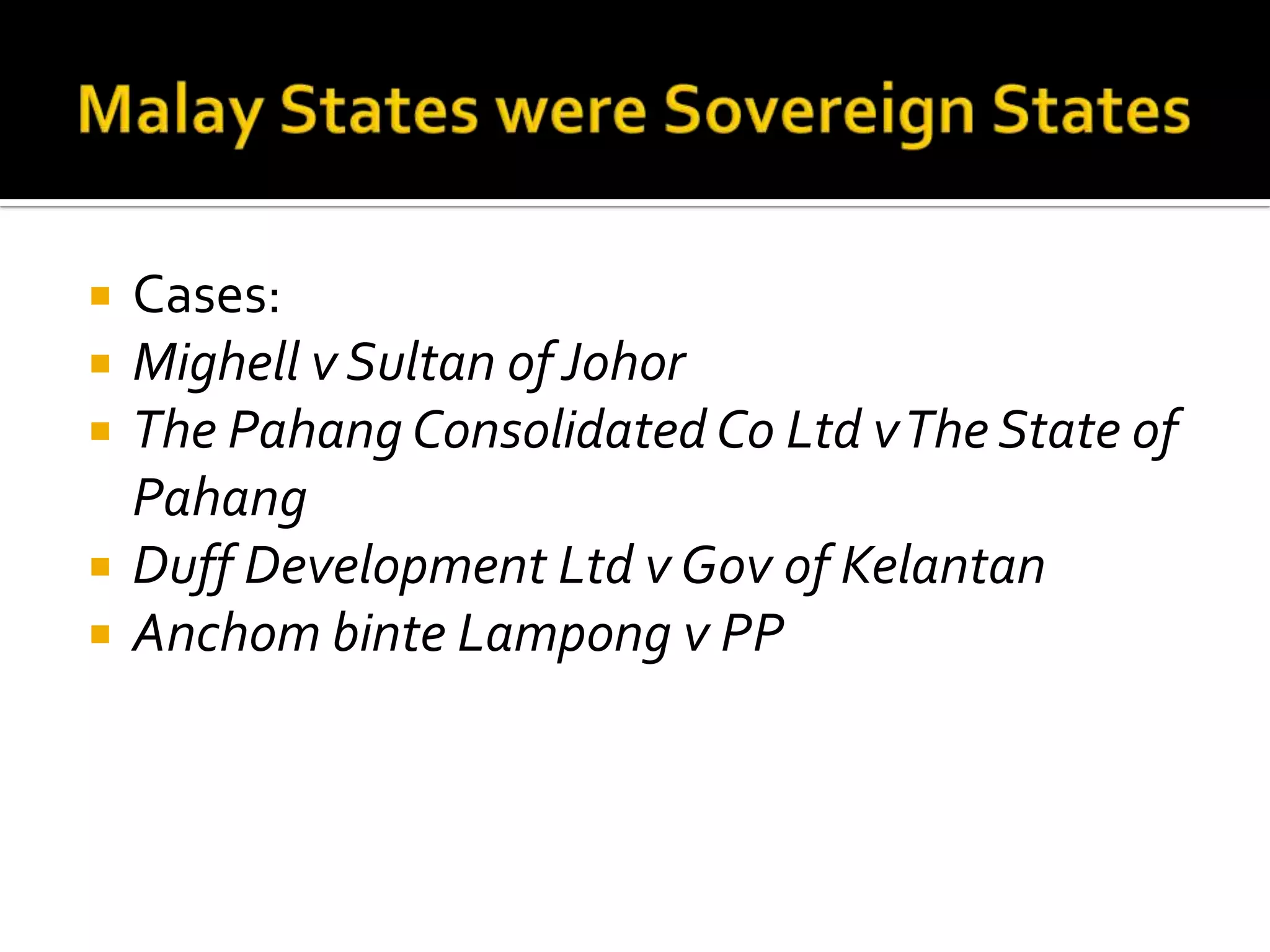
Cases:
Mighell v Sultan of Johor
The Pahang Consolidated Co Ltd v The State of
Pahang
Duff Development Ltd v Gov of Kelantan
Anchom binte Lampong v PP




Breach of promise to marry
Action was filed in a district court in London
Action was struck out because the defendant
was a ruler of an independent state, and
therefore immune from legal proceedings.




Resp. leased out a large piece of land for tin
mining for 77 years.
In 1931, a law was enacted which adversely
affected their tin mining rights.
Appl. Argued that they are not to be affected
by the new law and are entitled to damages
from Resp.


Privy Council acknowledged Kelantan as a
sovereign State
Edmonds JC:
Before the first treaty [the Pangkor Treaty 1874]
the population of these State [FMS] consisted
almost solely of Mohammedan Malays with a
large industrial and mining Chinese community
in their midst.
The only laws at that time applicable to Malays
was Mohammedan modified by local custom




Thorne J said to the effect that Muslim law is
not foreign law, it is the law of the land and
the local law is a matter of which the court
must take judicial notice.




British intervention in these disputes
consolidated British political power in the Malay
states.
Treaties were entered into, whereby, in return
for British protection, it was agreed that the
Sultan “receive and provide a suitable residence
for a British officer, to be called a Resident, who
shall be accredited to his court, and whose
advice must be asked and acted upon all
questions other than those touching upon
Malay religion and custom.”






1873: Death of Raja Ali (Sultan of Perak)
Who will become the new Sultan? Raja
Abdullah or Raja Ismail?
Raja Abdullah became Sultan with the help of
the British.
In return, a British Resident was appointed -JWW Birch.





Many problems
Civil war in Klang
Piracy
1875: British forced Sultan Abdul Samad to
sign an agreement which included the
appointment of a British Resident – JG
Davidson



1888: A British shopkeeper was murdered
near the Sultan’s palace.
British used this issue to compel the Sultan to
accept a British Resident – JP Rodger







1872: Dato Kelana Sendeng dies
The state was divided into two and ruled by
two Malay Chiefs:
Dato Kelana Sayed Abd Rahman, and
Dato Bandar Kulop Tunggal
British suppoerted Dato Kelana Sayed Abd
Rahman
1889: A British Resident was appointed –
Martin Lister.




With the signing of the Treaty of Federation
1895, four states – Perak, Selangor, Negeri
Sembilan and Pahang became “Protected
States” or more commonly known as the
Federated Malay States (FMS).
British Residents came under the Resident
General who was made accountable to the
Governor of the Straits Settlements.



The Residential System
By appointing a British Resident in each State





Advisor to the Sultan on all State matters
except matters pertaining to custom of the
Malays and religion.
As advisors, the Residents introduced many
British Indian statutes into the FMS.
E.g. Penal Code, Contracts Ordinance,
Criminal Procedure Code, Civil procedure
Code



Courts were established and judges were
appointed
Terrel CJ, Mill CJ, Woodward JC, Thorne J,
Edmonds JC




A tort case involving unlawful obstruction of
land belonging to plaintiff.
Woodward JC:
“In dealing with cases of tort, this court has
always turned for guidance, as a fundamental
principle, to English decisions”.



Terrel CJ:
“The courts of the FMS have on many
occasions acted on equitable principles, not
because English rules of equity apply but
because such rules happen to conform to the
principles of natural justice”.



Tort
Court enforced English principles.




Loan transaction, involved a piece of land as
security.
On appeal to Privy Council, Lord Dunedin:
“The learned judge…has been too much
swayed by the doctrine of English equity and
not paid sufficient attention to the fact that
they were here dealing with a totally different
land law…”



Reay CJ:
“Before reliance can be placed on English
decisions, particularly decision on points of
procedure, it is necessary in the first instance
to examine carefully our local law and to
ascertain what it is and in what respects it
resembles or differs from the English law.
This seems a self evident proposition, but it is
nevertheless too often over-looked by
counsel.’


English law was formally introduced into FMS
in 1937 by virtue of the Civil Law Enactment
1937.



Section 2:
“Save so far as other provision has been
made or may hereafter be made by any
written law in force in the Federated Malay
States, the common law of England, and the
rules of equity, as administered in England at
the commencement of this Enactment [12
March 1937] shall be in force in the FMS”



Proviso:
Provided always that the said common law
and rules of equity shall be in force in the FMS
so far only as the circumstances of the FMS
and its inhabitants permit and subject to
such qualifications as local circumstances
render necessary.




English common law and rules of equity
become the governing law in civil,
commercial, criminal matters replacing
custom and religious law.
Local laws (religious and customary law) was
limited to personal matters i.e. family
matters and inheritance.
MALAYSIAN LEGAL SYSTEM Legal history THE MALAY STATES PART 1

MALAYSIAN LEGAL SYSTEM Legal history THE MALAY STATES PART 1

  • 2.
     While the StraitsSettlements were colonies under direct British rule, the rest of the Malay States were ruled by Sultans who were embroiled in various succession disputes in their respective states. In the tin-rich state of Perak, succession disputes became intertwined with disputes between Chinese secret societies for possession of the rich tin deposits.
  • 3.
        Federated Malay State --Perak, Selangor, Negeri Sembilan & Pahang Unfederated Malay States -- Perlis, Kedah, Kelantan, Terengganu & Johor
  • 4.
         Cases: Mighell v Sultanof Johor The Pahang Consolidated Co Ltd v The State of Pahang Duff Development Ltd v Gov of Kelantan Anchom binte Lampong v PP
  • 5.
       Breach of promiseto marry Action was filed in a district court in London Action was struck out because the defendant was a ruler of an independent state, and therefore immune from legal proceedings.
  • 6.
       Resp. leased outa large piece of land for tin mining for 77 years. In 1931, a law was enacted which adversely affected their tin mining rights. Appl. Argued that they are not to be affected by the new law and are entitled to damages from Resp.
  • 7.
     Privy Council acknowledgedKelantan as a sovereign State
  • 9.
    Edmonds JC: Before thefirst treaty [the Pangkor Treaty 1874] the population of these State [FMS] consisted almost solely of Mohammedan Malays with a large industrial and mining Chinese community in their midst. The only laws at that time applicable to Malays was Mohammedan modified by local custom 
  • 10.
     Thorne J saidto the effect that Muslim law is not foreign law, it is the law of the land and the local law is a matter of which the court must take judicial notice.
  • 12.
      British intervention inthese disputes consolidated British political power in the Malay states. Treaties were entered into, whereby, in return for British protection, it was agreed that the Sultan “receive and provide a suitable residence for a British officer, to be called a Resident, who shall be accredited to his court, and whose advice must be asked and acted upon all questions other than those touching upon Malay religion and custom.”
  • 13.
        1873: Death ofRaja Ali (Sultan of Perak) Who will become the new Sultan? Raja Abdullah or Raja Ismail? Raja Abdullah became Sultan with the help of the British. In return, a British Resident was appointed -JWW Birch.
  • 14.
        Many problems Civil warin Klang Piracy 1875: British forced Sultan Abdul Samad to sign an agreement which included the appointment of a British Resident – JG Davidson
  • 15.
      1888: A Britishshopkeeper was murdered near the Sultan’s palace. British used this issue to compel the Sultan to accept a British Resident – JP Rodger
  • 16.
          1872: Dato KelanaSendeng dies The state was divided into two and ruled by two Malay Chiefs: Dato Kelana Sayed Abd Rahman, and Dato Bandar Kulop Tunggal British suppoerted Dato Kelana Sayed Abd Rahman 1889: A British Resident was appointed – Martin Lister.
  • 17.
      With the signingof the Treaty of Federation 1895, four states – Perak, Selangor, Negeri Sembilan and Pahang became “Protected States” or more commonly known as the Federated Malay States (FMS). British Residents came under the Resident General who was made accountable to the Governor of the Straits Settlements.
  • 19.
      The Residential System Byappointing a British Resident in each State
  • 20.
       Advisor to theSultan on all State matters except matters pertaining to custom of the Malays and religion. As advisors, the Residents introduced many British Indian statutes into the FMS. E.g. Penal Code, Contracts Ordinance, Criminal Procedure Code, Civil procedure Code
  • 21.
      Courts were establishedand judges were appointed Terrel CJ, Mill CJ, Woodward JC, Thorne J, Edmonds JC
  • 22.
       A tort caseinvolving unlawful obstruction of land belonging to plaintiff. Woodward JC: “In dealing with cases of tort, this court has always turned for guidance, as a fundamental principle, to English decisions”.
  • 23.
      Terrel CJ: “The courtsof the FMS have on many occasions acted on equitable principles, not because English rules of equity apply but because such rules happen to conform to the principles of natural justice”.
  • 24.
  • 25.
       Loan transaction, involveda piece of land as security. On appeal to Privy Council, Lord Dunedin: “The learned judge…has been too much swayed by the doctrine of English equity and not paid sufficient attention to the fact that they were here dealing with a totally different land law…”
  • 26.
      Reay CJ: “Before reliancecan be placed on English decisions, particularly decision on points of procedure, it is necessary in the first instance to examine carefully our local law and to ascertain what it is and in what respects it resembles or differs from the English law. This seems a self evident proposition, but it is nevertheless too often over-looked by counsel.’
  • 28.
     English law wasformally introduced into FMS in 1937 by virtue of the Civil Law Enactment 1937.
  • 29.
      Section 2: “Save sofar as other provision has been made or may hereafter be made by any written law in force in the Federated Malay States, the common law of England, and the rules of equity, as administered in England at the commencement of this Enactment [12 March 1937] shall be in force in the FMS”
  • 30.
      Proviso: Provided always thatthe said common law and rules of equity shall be in force in the FMS so far only as the circumstances of the FMS and its inhabitants permit and subject to such qualifications as local circumstances render necessary.
  • 31.
      English common lawand rules of equity become the governing law in civil, commercial, criminal matters replacing custom and religious law. Local laws (religious and customary law) was limited to personal matters i.e. family matters and inheritance.