Malaria
An Overview of
Life-cycle, Morphology and
Clinical Picture
Prepared by
Ms.Sapna Rani
MMCP,MM(DU)
Malaria Species
Five species of malaria infect humans:
– Plasmodium falciparum
– Plasmodium vivax
– Plasmodium ovale
– Plasmodium malariae
– Plasmodium knowlesi
Malaria –Endemic Countries
Exo-erythrocytic
(hepatic) cycle
Hypnozoites
Sporozoites
Salivary Gland
LIFE CYCLE OF MALARIA
Gametocytes
Erythrocytic
Cycle
Zygote
Oocyst
Stomach Wall
Pre-erythrocytic
(hepatic) cycle
sporozoites
Components of the Malaria Life Cycle
Mosquito Vector
Human Host
Sporogonic cycle
Infective
Period
Mosquito bites
gametocytemic
person
Mosquito bites
uninfected
person
Prepatent
Period
Incubation Period
Clinical Illness
Parasites visible
Recovery
Symptom onset
CLINICAL
SIGNS &
SYMPTOMS
OF MALARIA
Fever
Chills
Sweating
Plasmodium
falciparum:
Plasmodium
vivax,
Plasmodium
ovale
Plasmodium
malariae:
Chronic Disease
Chronic
Asymptomatic
Infection
Placental
Malaria
Anemia
Infection
During
Pregnancy
Developmental
Disorders;
Transfusions;
Death
Low
Birth weight
Increased
Infant
Mortality
Acute Disease
Non-severe
Acute Febrile
disease
Severe
malaria
e.g.
Cerebral
Malaria
Death
CLINICAL PICTURE
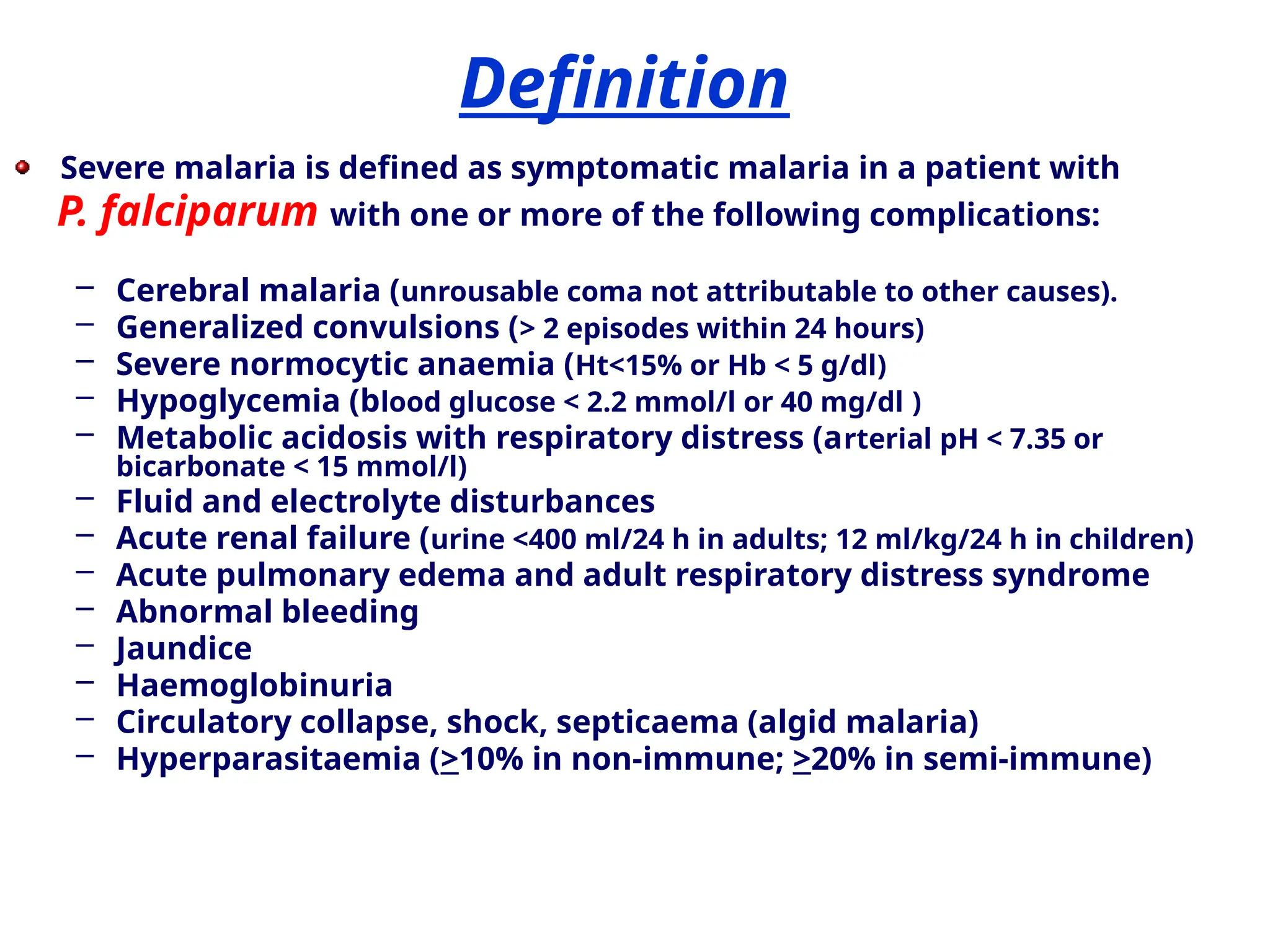
Definition
Severe malaria is defined as symptomatic malaria in a patient with
P. falciparum with one or more of the following complications:
– Cerebral malaria (unrousable coma not attributable to other causes).
– Generalized convulsions (> 2 episodes within 24 hours)
– Severe normocytic anaemia (Ht<15% or Hb < 5 g/dl)
– Hypoglycemia (blood glucose < 2.2 mmol/l or 40 mg/dl )
– Metabolic acidosis with respiratory distress (arterial pH < 7.35 or
bicarbonate < 15 mmol/l)
– Fluid and electrolyte disturbances
– Acute renal failure (urine <400 ml/24 h in adults; 12 ml/kg/24 h in children)
– Acute pulmonary edema and adult respiratory distress syndrome
– Abnormal bleeding
– Jaundice
– Haemoglobinuria
– Circulatory collapse, shock, septicaema (algid malaria)
– Hyperparasitaemia (>10% in non-immune; >20% in semi-immune)
Definition
Uncomplicated malaria is defined as:
Symptomatic infection with malaria parasitemia
without signs of severity and/or evidence of vital
organ dysfunction.
Complications of malaria:
Cerebral malaria
Malarial Paroxysm
cold stage
•feeling of intense cold
•vigorous shivering
•lasts 15-60 minutes
hot stage
•intense heat
•dry burning skin
•throbbing headache
•lasts 2-6 hours
sweating stage
•profuse sweating
•declining temperature
•exhausted and weak → sleep
•lasts 2-4 hours
Complications of malaria:
Pulmonary oedema
Child with severe
malaria anaemia
and no other
malaria
complication
Complications of malaria:
anaemia
Child with severe
malaria anaemia in
conjunction with
acidosis and
respiratory distress
Clinical Picture:
Haemoglobinuria associated with malaria
(“blackwater fever”) is uncommon and
malarial haemoglobinuria usually presents
in adults as severe disease with anemia and
renal failure.
Malarial haemoglobinuria
The two methods common in use:
1: Light microscopy
2: Rapid diagnostic tests (RDTs).
Common methods for parasitological diagnosis of malaria
Microscopy is the gold standard for
diagnosis of malaria
Parasite density
Species diagnosis
Monitoring response to
treatment
CCMOVBD
Plasmodium falciparum CCMOVBD
Plasmodium vivax
CCMOVBD
Plasmodium malariae Malaria Tutorials, Wellcome Trust Plasmodium ovale
Laboratory diagnosis of malaria
Rapid diagnostic tests detect
malaria antigens
Plastic cassette
format of RDT
Rapid diagnostic tests detect malaria antigens
ACTION OF ANTIMALARIAL DRUG IN THE DIFFERENT LIFE
STAGES OF THE MALARIA PARASITE
Wellcome Trust (Modified)
Tissue Schizontocides
• Primaquine
• Pyrimethamine
• Tetracycline
• Proguanil
Anti-relapse (P.vivax)
• primaquine
Blood Schizontocides
• Chloroquine
• Sulfadoxine/Pyrimethamine
• Quinine
• Artemisinins
Gametocyide
Primaquine
Sporontocides
• Primaquine
• Pyrimethamine
• Proguanil
Thankyou

Malaria- Seasonal disease-Pharmacology .