Making Products to
get users “Hooked”
By Gaurav Gupta
Credits: Hooked by Nir Eyal
Everything you see in the slideshow is a summary
of my learnings from the awesome yellow book
called Hooked by Nir Eyal.
I highly recommend that everyone should read it.
Old habits die hard.
- People don’t like to change habits.
- First to mind solution always wins.
- New products fail, even if the benefits
are obvious.
- Example: Bing vs Google.
Did you know?
A new product must be
atleast 9x better than
the previous one to
shake users out of their
old routines.
The ultimate objective
Keep throwing consecutive hooking strategies at your users so that
eventually they lead to unprompted user engagement.
i.e. Users come back on their own, without the need of any advertising
or messaging.
If you achieve that, you have truly made your users “HOOKED”
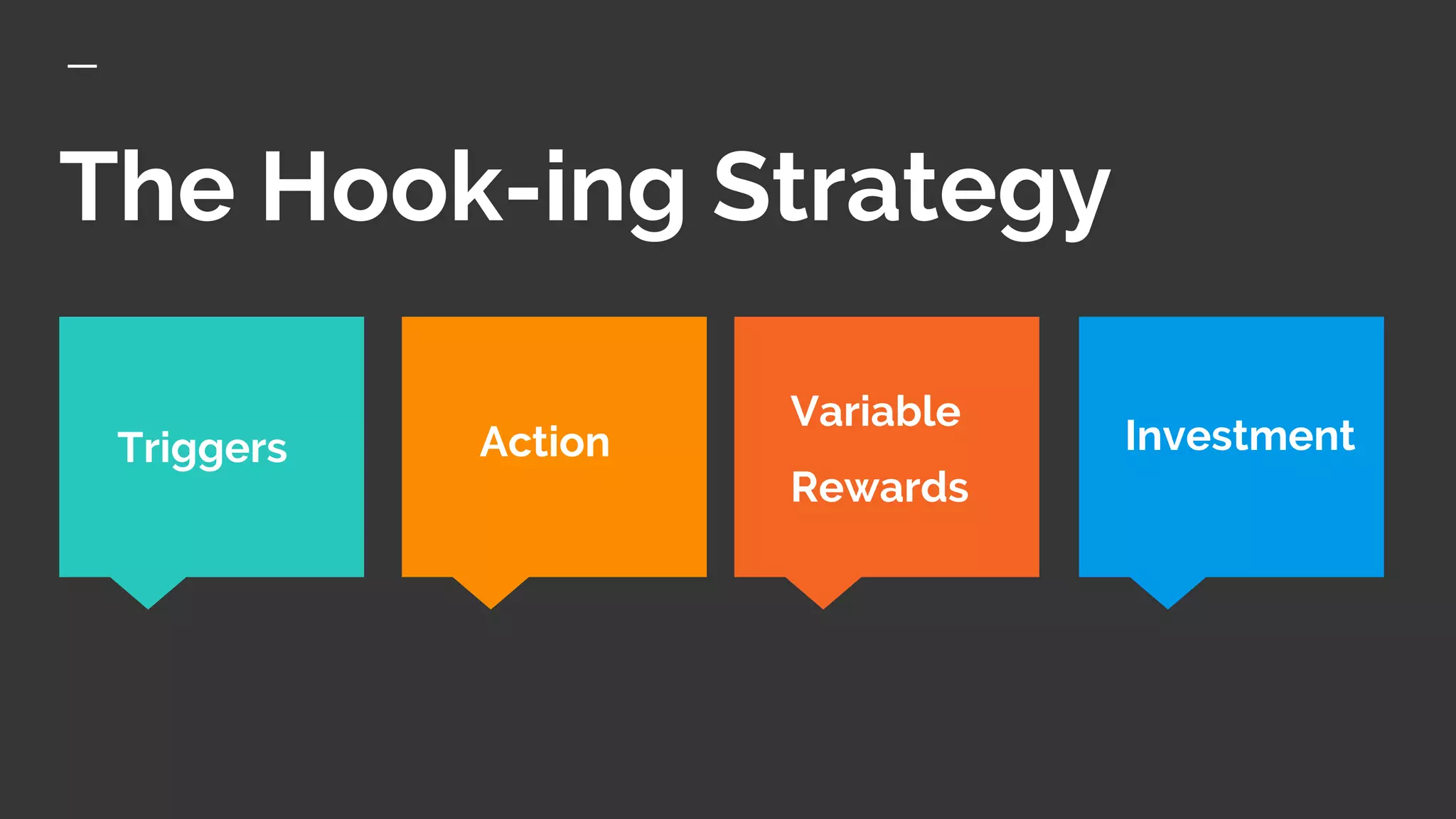
The Hook-ing Strategy
Variable
Rewards
Triggers Action Investment
An external trigger communicates the next
action that the user should take.
Paid: Ads, SEM
Earned Triggers: Press Mentions, Viral
Videos, “Featured Apps”
Relationship Triggers: Virality features,
Word of mouth
Owned Triggers: Notifications/email the
user has subscribed to
1. Triggers - External and Internal
Internal triggers:
Boredom
Need to be entertained etc.
Scratching his itch /
Eliminating pain
Keep repeating external
triggers so much that the
your product forms an
association with an internal
trigger
That’s when a habit has been formed and your users have been hooked.
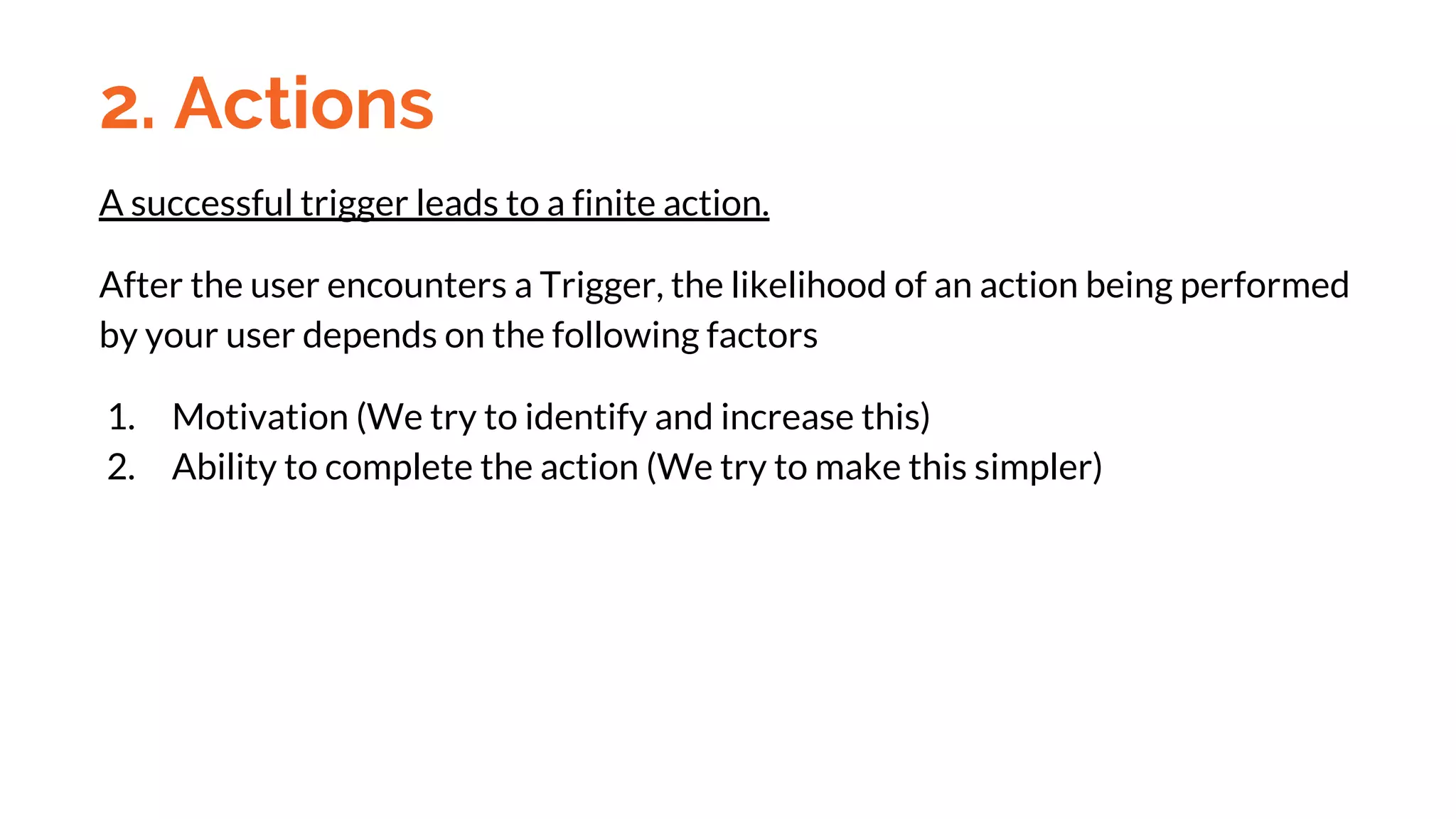
A successful trigger leads to a finite action.
After the user encounters a Trigger, the likelihood of an action being performed
by your user depends on the following factors
1. Motivation (We try to identify and increase this)
2. Ability to complete the action (We try to make this simpler)
2. Actions
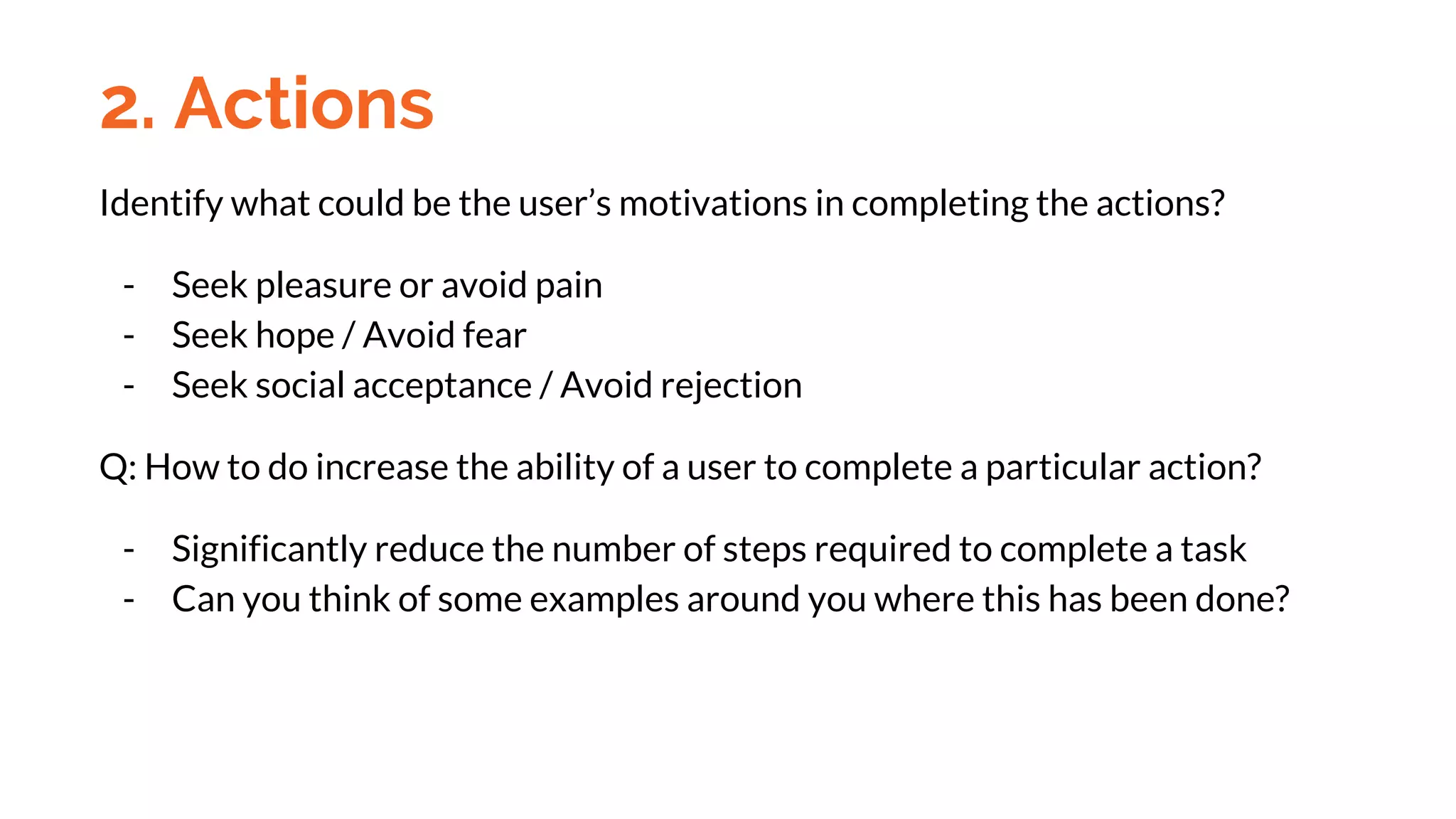
Identify what could be the user’s motivations in completing the actions?
- Seek pleasure or avoid pain
- Seek hope / Avoid fear
- Seek social acceptance / Avoid rejection
Q: How to do increase the ability of a user to complete a particular action?
- Significantly reduce the number of steps required to complete a task
- Can you think of some examples around you where this has been done?
2. Actions
What more can you do to ensure that your users are doing the actions that you
want them to do?
- Scarcity effect
- Framing effect
- Anchoring effect
- Endowed progress effect
2. Actions
The brain does not get activated when the reward is
received. It is activated in the anticipation of the reward!
3. Variable Reward
Types of rewards:
Tribe: Likes and Upvotes
Hunt: Gambling
Self rewards: Playing a game and improving, E-Mail (Inbox Zero), Writing online
code (Instant feedback)
3. Variable Reward
Giving users a feeling that they have “invested” in a product.
- Followers
- Content
- Skill
- Data
- Reputation
4. Investment
Think about it.
The morality of this manipulation. Ethical or not?
Thank you!

Making Products to get users “Hooked”

  • 1.
    Making Products to getusers “Hooked” By Gaurav Gupta
  • 2.
    Credits: Hooked byNir Eyal Everything you see in the slideshow is a summary of my learnings from the awesome yellow book called Hooked by Nir Eyal. I highly recommend that everyone should read it.
  • 3.
    Old habits diehard. - People don’t like to change habits. - First to mind solution always wins. - New products fail, even if the benefits are obvious. - Example: Bing vs Google. Did you know? A new product must be atleast 9x better than the previous one to shake users out of their old routines.
  • 4.
    The ultimate objective Keepthrowing consecutive hooking strategies at your users so that eventually they lead to unprompted user engagement. i.e. Users come back on their own, without the need of any advertising or messaging. If you achieve that, you have truly made your users “HOOKED”
  • 5.
  • 6.
    An external triggercommunicates the next action that the user should take. Paid: Ads, SEM Earned Triggers: Press Mentions, Viral Videos, “Featured Apps” Relationship Triggers: Virality features, Word of mouth Owned Triggers: Notifications/email the user has subscribed to 1. Triggers - External and Internal Internal triggers: Boredom Need to be entertained etc. Scratching his itch / Eliminating pain
  • 7.
    Keep repeating external triggersso much that the your product forms an association with an internal trigger That’s when a habit has been formed and your users have been hooked.
  • 8.
    A successful triggerleads to a finite action. After the user encounters a Trigger, the likelihood of an action being performed by your user depends on the following factors 1. Motivation (We try to identify and increase this) 2. Ability to complete the action (We try to make this simpler) 2. Actions
  • 9.
    Identify what couldbe the user’s motivations in completing the actions? - Seek pleasure or avoid pain - Seek hope / Avoid fear - Seek social acceptance / Avoid rejection Q: How to do increase the ability of a user to complete a particular action? - Significantly reduce the number of steps required to complete a task - Can you think of some examples around you where this has been done? 2. Actions
  • 10.
    What more canyou do to ensure that your users are doing the actions that you want them to do? - Scarcity effect - Framing effect - Anchoring effect - Endowed progress effect 2. Actions
  • 11.
    The brain doesnot get activated when the reward is received. It is activated in the anticipation of the reward! 3. Variable Reward
  • 12.
    Types of rewards: Tribe:Likes and Upvotes Hunt: Gambling Self rewards: Playing a game and improving, E-Mail (Inbox Zero), Writing online code (Instant feedback) 3. Variable Reward
  • 13.
    Giving users afeeling that they have “invested” in a product. - Followers - Content - Skill - Data - Reputation 4. Investment
  • 14.
    Think about it. Themorality of this manipulation. Ethical or not? Thank you!