Making New Moves in
Education & Learning
A!
M!
!
2
Making New Moves in Education and Learning
This book is an outcome of the Erasmus+ strategic cooperation project ‘MoveMakers:
Co-Creating New Ways of Learning’. It is directly tied to the book ‘MoveMakers on the
Move: The Story of Our Learning Journey’ and the documentary about MoveMakers.
Published in 2016.
Find out more:
This book is licensed under a Creative
Commons Attribution ShareAlike 4.0
International.
MoveMakers is co-funded by the
Erasmus+ programme of the
European Union.
movemakers.eu
MoveMakers Lab
facebook.com/movemakerslab
3
Project Partners:
COMMUNITIES
CO CREATING
4
5
Editor
Manuela Hernández Sánchez
Co-editors
Benjamin Kafka
Diederik Bosscha
Mary Alice Arthur
Photos
StepDraw (Dalius Kederys,
Lukas Dun ius).
Sander Hiire
Gertrud Graf
Mary Alice Arthur
Proofreading
Peg Sage Oetjen
Manuela Hernández Sánchez
Contributors
This book was co-created during a three-day 'book
sprint' at Nyenrode Business University in the
Netherlands by a group of MoveMakers in July 2016.
Benjamin Kafka, Ciska Pouw, David Jul,
Diederik Bosscha, Huub Purmer, Justas Kučinskas,
Maaike Madelon Boumans, Manuela Hernández
Sánchez, Melanie Hernández, Piret Jeedas,
Thieu Besselink.
Design
ANDSTUDIO / Domas Mik ys, Augustinas Pauk t
This book is licensed under a Creative Commons
Attribution ShareAlike 4.0 International.
6
CONTENTS
9
14
20
28
34
40
48
56
Introduction
In search for the holy grail -
innovation in education
Piret Jeedas
The mindset of a learning designer
Piret Jeedas
From a source of knowledge to a
source of inspiration
Diederik Bosscha
The necessity of diversity in
a multicultural society
Maaike Madelon Boumans
Holding space for the unknown
Ciska Pouw
Reconnecting to our authenticity
Maaike Madelon Boumans
Movement and stillness in learning
Melanie Hernández, Justas Kučinskas,
Maaike Madelon Boumans
7
62
78
88
96
108
118
Designing learning journeys
David Jul, Benjamin Kafka
The art of prototyping
Benjamin Kafka, Diederik Bosscha
Grassroots education - organising
change fromthe bottom up
Huub Purmer
Personal leadership: the missing link
in education?
Manuela Hernández Sánchez
Changing education
Thieu Besselink
Moving on
You
8
9
Introduction
I N T R O D U C T I O N
This book and you found each other.
This book and you found each
other. We are very curious about
what happens between the two of
you. We hope that you can inspire
each other to learn and grow.
Connected to this book are forty
educators from five different
countries and the various learning
communities that they represent.
During the MoveMakers Learning
Journey, they visited each other's
countries, hosted meaningful
conversations and learned
together.
One of the results of this collective
learning is this book: Eleven
MoveMakers share the inspira-
tion, insights and learnings
gathered during our eighteen-
month learning adventure.
MoveMakers is a playground for
learning and experimentation for
adult education practitioners. With
this book, we want to encourage
you to be bold in taking steps that
bring innovation to the learning
environments that you are part of.
In this way, we can collectively
meet the needs and dreams of
the 21st century learner, of our
organisations, our communities
and the planet.
Why care about
education?
Learning is an important part of
being human. It is a built-in driver
for development and growth. As
far as we know, it is what sets our
species apart from others. No
other animal has evolved as much
through learning or is so
dependent on learning as we are.
We learn by observing and by trial
and error. We constantly grow and
cope with changing situations.
When observing young children,
you can feel their hunger and drive
to learn! They want to stand on
their own feet and to know
everything about the world.
Children often cannot wait to
finally go to school! But, all too
often, soon after starting school,
somehow the system seems to
suppress their love for learning.
What went wrong? Our education
systems still assume that we live in
the industrial age. They are
designed to educate us to have a
job from cradle to grave. They treat
learners like parts of mechanised
processes. They aim to create a
consistent standard of output.
They focus on shaping students
into people who should 'fit in'.
Standardisation and
institutionalisation are valued
more than individual expression.
We are so stuck in our definitions
of what learning is, that learning
itself has become stifled.
On the other hand, things are
shifting. We are in a critical
moment in history. We find
ourselves at breaking points, with
systemic cracks becoming
increasingly visible. We feel the
urgency to access our highest
future potential. We want to be
part of creating a new and
sustainable reality. We need a
complete revision of our
educational practices and
systems. We also require a
different set of values, approaches
and designs.
The field of education is part of
this imminent shift. New forms of
learning are emerging. Old ones
are becoming obsolete. With this
book, we share what we see in this
emerging landscape. We hope that
it can inspire you to co-create a
new learning paradigm with us.
1 0
I N T R O D U C T I O N
MoveMakers is not an organisation. Instead, think of it as something that happens when a group of
dedicated individuals or MoveMakers come together in one place and time. MoveMakers are people who are
shaking the world of education. When MoveMakers meet and connect, they form a support network, a
feedback loop and a movement. In this sense, MoveMakers is the following:
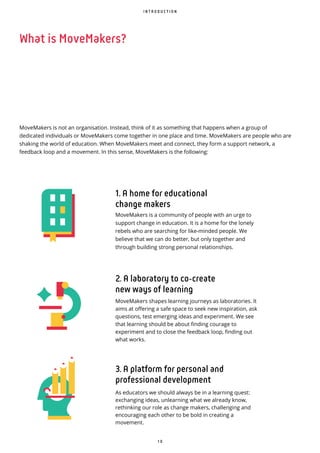
1. A home for educational
change makers
MoveMakers is a community of people with an urge to
support change in education. It is a home for the lonely
rebels who are searching for like-minded people. We
believe that we can do better, but only together and
through building strong personal relationships.
2. A laboratory to co create
new ways of learning
MoveMakers shapes learning journeys as laboratories. It
aims at offering a safe space to seek new inspiration, ask
questions, test emerging ideas and experiment. We see
that learning should be about finding courage to
experiment and to close the feedback loop, finding out
what works.
3. A platform for personal and
professional development
As educators we should always be in a learning quest:
exchanging ideas, unlearning what we already know,
rethinking our role as change makers, challenging and
encouraging each other to be bold in creating a
movement.
What is MoveMakers?
1 1
Why this book?
We consider this book a success if
it supports you in your work as a
MoveMaker and when it inspires
you to see yourself and your work
as a MoveMaker: a person who
makes a move, who shakes things
up and loosens the grip of old
mindsets.
We hope that our insights can
help shape a movement that we
all can feel part of and support
the emergence of new ways of
learning and collaborating
together.
We wrote this book in order to
share our learning and to widen
the circle of our conversation. It
contains some of our thoughts
and work in progress. Consider it
as an ongoing brainstorming
session.
We happily invite you to join us!
I N T R O D U C T I O N
This book is influenced by our
respective working contexts. It is
also shaped by our experience as
adult learners during the
MoveMakers Learning Journey in
2015-2016. Therefore, these
contexts and experiences inform
how we write about education,
learning or innovation.
Will it be relevant for your context?
This, of course, is for you to
decide. Just keep in mind the
principle: 'use your own best
judgement at all times!'
1 2
I N T R O D U C T I O N
We worked on this book in the
same way that we created our own
learning playground. We searched
for an engaging and inspiring way
to write - a task that sometimes
can be ‘tedious’ or ‘lonely’. That is
how we embarked on the
challenge to write this book in a
three-day ‘book sprint’.
During the second week of July of
2016, thirteen MoveMakers gathe-
red at the beautiful campus of
Nyenrode Business University in
the Netherlands: eleven writers, a
story activist and a graphic design
team of two lived and worked
together to co-create this book.
The process was quite experimen-
tal and at times frustrating. We
wanted to say more than time
allowed. Yet, we were able to
express what was present in us at
the time. Afterwards, some of us
continued to work on editing and
proofreading. Others crafted their
articles into more complete
stories. What you are now holding
in your hands is the final result.
The style of this book reflects the
diversity of our team. Some articles
are personal or colloquial while
others are less informal. Other
articles are action-oriented and
hands-on, while others are more
reflective or philosophical.
Writing a book in three days
You can read this book in several
ways: from the beginning until the
end. Or simply follow your
curiosity and read the pages that
trigger you the most. The articles
are illustrated by personal stories,
questions and exercises to enrich
your practice.
Next to publishing this book, you
can find our insights on our blog
at www.movemakers.eu. We invite
you to join us there and continue
our conversation.
During the MoveMakers Learning
Journey, the perspective of ‘what
learning is’ changed for many
participants. As one participant
said: “The MoveMakers Learning
Journey made me look at my own
educational history. I realised now
how much I saw learning as having
to get things done and being able
to show that ‘I did it’.”
We dedicate this book to anyone
willing to explore the field of learn-
ing in all its diversity and contexts.
Whether it is teachers, trainers,
facilitators coaches, professors or
entrepreneurs, this book is for
people who aspire to seeing their
work as being more than just
ticking boxes and saying ‘we did it’.
1 3
I N T R O D U C T I O N
We are very curious about whoyou
are and why this book drewyour
attention. We assume thatyou are
passionate aboutlearning and
that you have arelationship with
education,facilitation and training.
Wehope that this book inspires
youto bring learning back into the
heart of education, to take new
steps, to make a move! And of
course, we would love to get in
touch with you and hear whatyour
bold move is!
Who are you?
1 4
In search for the holy
grail - innovation in
education
1 5
P I R E T J E E D A S
In search for the holy grail -
innovation in education
Is there a way to learn to be wise while bringing change
and innovation into the fields that we care about?
The field of education is under
attack. Educators are suffering from
what is called ‘just-another-change-
fatigue’. The search for the holy grail
in innovation in education is every-
where. Learning is something many
of us deeply care for. We see the
cracks in the education or training
field, and sense the need to 'change'
it. Maybe a different future is
possible. As Seth Godin says: “Oh,
let’s reinvent ourselves so that we
can create better graduates for a
different kind of world” (as cited
in Brown-Martin, 2014. So, is there a
way to learn to be wise while
bringing change and innovation into
the fields that we care about?
The time of big
questions
The landscape of learning and
education is shifting more than
ever: many initiatives around the
world tackle the issue of innovation
in education (e.g. WISE). There are
new schools, programmes, univer-
sities emerging all over the world,
deciding to do things differently.
There are a great many voices,
thinkers, doers and practitioners
who are tackling the challenges of
making teaching, learning and edu-
cation as engaging and as relevant
as they can for what is an uncertain
future (Brown-Martin 2014). At the
core of those changes is the firm
into action. Innovation is a possible
answer to decaying systems.
According to Hassan (2014), innova-
tion is not an efficient process. It is
messy. Innovation arises from a
community of people focused on
trying out lots of things and learn-
ing their way to successful innova-
tion. “It means asking deeply how
badly do we want it. Everything
flows from commitment to play”, ̀
says Hassan. So, are we as educa-
tors committed to play in the field
of the unknown? (see chapter
‘Holding Space for the Unknown’ on
page 40).
As the road is less travelled, some
approaches might be helpful in
designing education. We chose
approaches that entail some form of
structure, and which helped us
to navigate around the messy pro-
cess of innovation. In this sense, we
used two basic architectures for our
learning design: Theory U
(Scharmer, 2009), a framework used
for leading profound change; and
Design Thinking (IDEO, 2016) as a
method to generate ideas and
create new prototypes.
Innovation is a form of art that
benefits from constant practice. As
an educator you could develop a
capacity to be curious, do something
without a map, dare to take risks. It
is the questioning mind asking:
belief that learning can be meaning-
ful, inspiring, relevant and learner-
centred. The people at the core of
new initiatives dare to ask some of
the most fundamental questions of
our time: What is education for?
What is this school, university or
training programme for? Why and
how are we grading our students?
These questions that are explored
by experts, parents, learners or the
wider community, invite us to revisit
the most fundamental assumptions
about the purpose of education. It is
more interesting to witness how the
answers to these questions could be
turned into meaningful
programmes, schools or initiatives.
During the MoveMakers learning
journey at the THNK School of
Creative Leadership in Amsterdam
we found out that the initiative came
alive, inspired by these questions: If
we could create a school we would
like to attend, what would it look
like? What are the questionsyou
need to ask your colleagues and
learners?
Innovation as
a practice
In education, as well as in innova-
tion, there is no ‘one size fits all’
approach. What is innovation in
one context may not translate to
another. To put it briefly, innovation
is the ability to shape bold ideas
1 6
I N S E A R C H F O R T H E H O L Y G R A I L I N N O V A T I O N I N E D U C A T I O N
What is needed now to make
learning meaningful?
Innovation is not a one-time effort,
but a constant search for what
works. It is a practice where you set
out on a journey and build the road
by walking. At the same time, you
stay flexible and responsive to any
changes along the way. And you do
it together with others. You need
the insights, perspectives and the
resources of a number of people in
co-creating the new.
Look for inspiration
As part of an eighteen-month
learning programme, MoveMakers
went on exploratory journeys in
The Netherlands and Denmark,
visiting quite diverse initiatives, pro-
grammes and start-ups to
understand innovation in educa-
tion (e.g. Handshake, B Amsterdam,
Team Academy, Knowmads,
Freedom Lab, Kaospilot, etc.). Here
are some of the things we learned:
• Making mistakes is part of learning.
Therefore, we should cultivate the
spirit of experimentation, the art of
prototyping in all learners and
educators (see chapter ‘The Art of
Prototyping’ on page 78).
• Self-organisation and taking
responsibility for one’s own
learning. In the Knowmads Business
School, fifty per cent of the learning
co-learners’ unique ways in
learning.
• A diversity of methods, project-
based learning, creating a personal
portfolio, engaging facilitators with
diverse backgrounds, changing the
context of learning, traineeships,
and job-shadowing are all elements
of innovative curriculums.
While reading these few insights,
one may wonder, so what makes it
all innovative? Is this what learning
‘should be’ about? Always. We see
more that in some ‘innovative’
programmes or initiatives learning
is addressed in a holistic way. The
innovators take lead in creating
meaningful learning spaces, sens-
ing the emerging future, the needs
of learners and the changing
face of the world. They do not wait
for trends, but create those them-
selves. They ask constantly: What is
the kind of place where I would like
to learn? and then create these
places.
It also seems that innovative
programmes have a very clear
sense of who they are, what they
do and how they are doing it. They
have created a strong DNA of their
programmes and communicated it
to a wider audience. The real
creative challenge of our age starts
now:
is self-organised. It is important to
support taking responsibility for
one’s own learning starting from an
early age.
• Space matters. Materials, technol-
ogy, space, and tools help to take a
hands-on approach to learning, thus
helping to make ideas instantly
visible to others.
• Learning in cooperation and teams.
A team learning approach could be
used to help to solve some of the
challenges faced nowadays.
• Learning beyond borders. The city or
village around you can be a play-
ground of learning.
• Constant reflection as a way to make
sense of one’s learning and learn
more about oneself as a human
being. At Kaospilot, one third of the
programme focuses on analysing,
making sense of one’s experiences.
• Learning in real life and from real
life. Shaping tasks that are relevant
and meaningful for the learners.
creating prototypes, solving real
issues, developing real projects,
organising an event, presenting ideas
are part of assignments to engage
learners. At the Team Academy in
Amsterdam, learning is shaped
around developing one's own
business.
• The 'teacher is a facilitator. A
facilitator gives just enough
guidance, supports reflection, asks
questions to find his/her
1 7
P I R E T J E E D A S
To be a designer of education
and meaningful learning every
single day.
Designing meaningful learning
spaces is about doing something
that matters to us and daring to
say “this might not work” (Godin,
as cited in Brown-Martin, 2014).
Shaping future learning is about
welcoming creativity, playfulness,
experimentation and possible
failure among educators as well
as learners.
1 8
I N S E A R C H F O R T H E H O L Y G R A I L I N N O V A T I O N I N E D U C A T I O N
How to shape changes
and bring innovation
into the field of
education wisely?
Kati Tikenberg is a former teacher
from ‘Back to School’ (Tagasi
Kooli, n.d.). She is still passionate
about the field of teaching and the
importance of education in bring-
ing change in society. She has
brought together a group of peo-
ple to co-design a new teacher
programme that is highly relevant,
meaningful and practical. We
spent a day together, co-creating
the next programme, asking some
of the core questions of curriculum
design: Why is this programme
needed? What change will it bring
to learners? What are the skills and
attitudes one can demonstrate at
the end of the programme? What
are the core values of the
programme? What is the best
approach to reach its aim?
Insights from MoveMakers
Learning Journey were used as a
source of inspiration. We realised
that a more long-term approach is
needed for programme design.
The process showed that curricu-
lum design can be a creative and
engaging process that goes
beyond planning something in an
Excel sheet.
As a follow up activity, interviews
with teachers were carried out to
hear more about their needs and
dreams. These insights will be
incorporated into the programme
design.
- Piret Jeedas
1 9
P I R E T J E E D A S
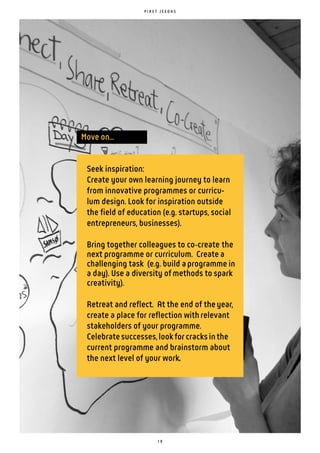
Seek inspiration:
Create your own learning journey to learn
from innovative programmes or curricu-
lum design. Look for inspiration outside
the field of education (e.g. startups, social
entrepreneurs, businesses).
Bring together colleagues to co create the
next programme or curriculum. Create a
challenging task (e.g. build aprogramme in
a day). Use a diversity ofmethods to spark
creativity).
Retreat and reflect. At the end of theyear,
create a place for reflection withrelevant
stakeholders of your programme.
Celebratesuccesses,lookforcracksinthe
current programme and brainstorm about
the next level of your work.
Move on...
2 0
The mindset of a
learning designer
2 1
The mindset of a learning designer
P I R E T J E E D A S
You can influence the field by your
intention and way of being
After meeting a variety of educa-
tors, entrepreneurs, change makers
from different fields of work, I have
started to ponder: WHO is this
person who walks away from the
conventional, starts a journey into
the 'land of unknowing' and creates
something new? I have been
triggered by the question: What is it
that I need to learn or unlearn in
order to do my work for the world?
I have witnessed that learning is a
process that you cannot force upon
anybody. Therefore, as you create
the space for learning, you need to
do it in a very gentle and humble
way. David Bohm, the quantum
physicist, has left us with the follow-
ing thought: you can influence the ̀
field by your intention and way of
being (as cited in Jaworski, 2012). ̀
At some point during the Move-
Makers journey, I became curious:
What is this WAY of being that des-
cribes a person designing learning
experiences? I got curious towards
myself: Can I develop them myself
to do my work as an educator?
A learning designer is a person who
consciously creates meaningful
learning experiences with the
learner at the core. A learning
designer is always searching for
what works to maximise the learn-
ing of an individual or a group.
As I listened to the stories of change
makers, some of the essential
attributes making a great learning
designer stood out. These attributes
may be considered as a mindset
describing a learning designer in
action. Mindset as a philosophy of
life is something that everybody can
cultivate. As educators, we are keen
on new tools or methods, but
cultivating a mindset or your inner
quality of being becomes even more
important.
Dare to ask
questions
Professor Keri Facer from the
University of Bristol and author of
Learning Futures (Facer, 2011) is
emphasising the importance of ask-
ing BIG questions right now: What is
education for? What does it mean to
live well in the world? How do we
create a world where the point of
life is life? (Brown-Martin, 2014). The
paradox of the current time is that
we do not really create space to ask
these fundamental questions. But
asking them is crucial -now more
than ever- if we want to stay on the
edge of constantly learning and de-
signing education that matters. We
also have a tendency to look for the
right answer, something we may
never find. But we can explore
perspectives and be in inquiry.
What are your BIG
questions of today?
Who are the people
you would invite
into exploring your
big questions? How
do you create time
and space to inquire
into the questions
that matter?
Being in inquiry means that you
stay with the question and let the
answer unfold, piece by piece. We
need time and space for meaning-
ful and well hosted conversations
that can lead to new insights,
perspectives or solutions.
Follow your curiosity
Maybe this is the ONE and almost
ONLY essential element of always
being in a quest for learning:
Being curious about oneself, the
others and the world around us.
We are living in a luxurious time,
with so many online and offline
resources to learn from locally
and globally. The pool of resour-
ces is abundant. But the more
opportunities we have, the easier
it is to get lost in files, articles,
books, platforms, etc.
2 2
What is my relation-
ship to failure?
When was the last
time I failed deeply
and what did I learn
from that? How can I
encourage a sense of
experimentation in
myself?
What are you curious
about today? How
and where do you
follow your curiosity?
What do you want to
discover more of?
Following your curiosity is about
looking at the world as an open field
and the people you meet as a
source for inspiration. It is about
looking at how your own questions
guide you closer to possible
answers. During the MoveMakers
Learning Journey we used
Stakeholder Interview as a tool to
follow our curiosity and interview
people related to (adult) education,
the future of learning and innova-
tion (see a Stakeholder Interview
guide on page 25).
Following your curiosity is finding a
source of inspiration that goes
beyond your current field of work.
Curiosity is exploring deeper what
you already know while asking what
is behind or beyond? It is about
looking into the eyes of the learner
with the will to know his or her
story. You need to stay most curious
about yourself, about your suppor-
ting role, your limits as an educator,
your abilities, your craft, etc.
Be mindfully critical
The narrative of the need to
change education is tremendous.
The articles on ‘How to...’, ‘Ten
ways to...’, ‘We need innovations...’
are endless. Although the truth is
out there, it is difficult to find the
‘right way’ when designing
meaningful learning experiences;
or to predict what education will be
like in the future. In your quest for
answers (as you learn, think and
act) it is important to stay mindful
and critical. According to Stephen
Brookfield, critical thinking in
learning means inquiring into your
(and others') assumptions (as cited
in Merriam & Bierema, 2014). You
explore your assumptions from
different perspectives with an open
mind. Part of it is your readiness to
change your perspectives along the
way. How much do we trust the
learners and their perspectives
when designing learning?
T H E M I N D S E T O F A L E A R N I N G D E S I G N E R
Dare to experiment
While designing learning spaces and
experiences we are always in the
'land of unknowing'. We never really
know whether the chosen road will
take us to the desired destination or
if the methods or approaches used
will actually support learning. As a
learning designer, you can see your
work as an endless opportunity to
experiment on the playground of
learning. But it takes courage to try
out new things, invite people to the
unknown, or even admit that you do
not know the answer. We are so used
to knowing the right way. Experimen-
ting is even more challenging when
you dare to do things that you are
not really keen on yourself. Recently,
a teacher admitted that 'I do not like
group work myself, but I need to do it
to support my students’ learning'.
While experimenting, you might also
fail. When we developed the course
Learning Design Lab (MoveMakers
Lab, 2016) in Estonia, we stated in
the invitation that failing could be
part of the prototype. Still, people
came. Failure is usually not part of
our story as educators. But we
made it part of our practice.
2 3
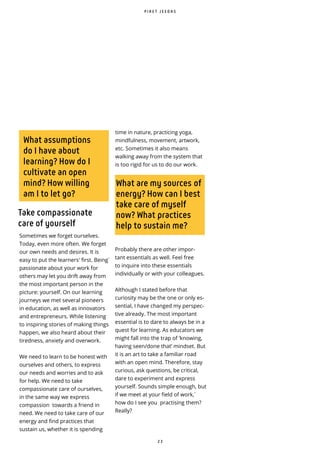
What assumptions
do I have about
learning? How do I
cultivate an open
mind? How willing
am I to let go?
What are my sources of
energy? How can I best
take care of myself
now? What practices
help to sustain me?
Take compassionate
care of yourself
Sometimes we forget ourselves.
Today, even more often. We forget
our own needs and desires. It is
easy to put the learners' first. Being ̀
passionate about your work for
others may let you drift away from
the most important person in the
picture: yourself. On our learning
journeys we met several pioneers
in education, as well as innovators
and entrepreneurs. While listening
to inspiring stories of making things
happen, we also heard about their
tiredness, anxiety and overwork.
We need to learn to be honest with
ourselves and others, to express
our needs and worries and to ask
for help. We need to take
compassionate care of ourselves,
in the same way we express
compassion towards a friend in
need. We need to take care of our
energy and find practices that
sustain us, whether it is spending
time in nature, practicing yoga,
mindfulness, movement, artwork,
etc. Sometimes it also means
walking away from the system that
is too rigid for us to do our work.
Probably there are other impor-
tant essentials as well. Feel free
to inquire into these essentials
individually or with your colleagues.
Although I stated before that
curiosity may be the one or only es-
sential, I have changed my perspec-
tive already. The most important
essential is to dare to always be in a
quest for learning. As educators we
might fall into the trap of ‘knowing,
having seen/done that’ mindset. But
it is an art to take a familiar road
with an open mind. Therefore, stay
curious, ask questions, be critical,
dare to experiment and express
yourself. Sounds simple enough, but
if we meet at your field of work, ̀
how do I see you practising them?
Really?
P I R E T J E E D A S
2 4
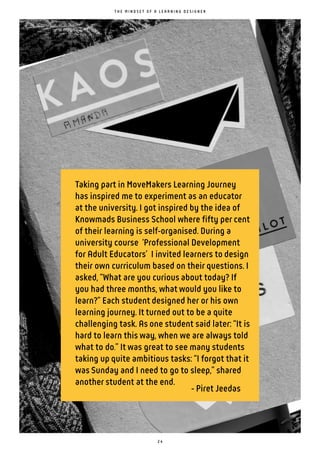
Taking part in MoveMakers Learning Journey
has inspired me to experiment as an educator
at the university. I got inspired by the idea of
Knowmads Business School where fifty per cent
of their learning is self-organised. During a
university course ‘Professional Development
for Adult Educators’ I invited learners to design
their own curriculum based on their questions. I
asked, “What are you curious about today? If
you had three months, what would you like to
learn?” Each student designed her or his own
learning journey. It turned out to be a quite
challenging task. As one student said later: “It is
hard to learn this way, when we are always told
what to do.” It was great to see many students
taking up quite ambitious tasks: “I forgot that it
was Sunday and I need to go to sleep,” shared
another student at the end.
- Piret Jeedas
T H E M I N D S E T O F A L E A R N I N G D E S I G N E R
2 5
Invite a colleague for a
walk with you to
explore the essentials
of a learning designer
and to inquire into
the questions
presented in this arti-
cle. The Stakeholder
Interview guide and
the end of this article
might also be helpful.
An option could be
that you write each
question on a piece of
paper, put them into
an envelope and pull
them out, one by one,
while walking.
If you could design a
curriculum for your-
self to develop or
upgrade the essen-
tials of the learning
designer within the
next year, what would
it look like?
Ask the question and you listen
attentively to his/her thoughts and
reflections.
Access your appreciative listening
(access your open heart): connect
to your interviewee with your mind
and heart wide open. Thoroughly
appreciate and enjoy the story that
you hear unfolding. Try to put
yourself in your interviewee’s
shoes.
Access your ‘listening from the
future’ field (access your open will):
try to focus on the best future
possibility that you feel is wanting
to emerge. What might that best
possible future look like for your
interviewee?
Leverage the power of presence
and silence: one of the most effec-
tive interventions as an interviewer
is to be fully present. Do not to
interrupt your interviewee even
when he or she has a brief moment
of silence. Moments of silence can
serve as important trigger points
for deep reflection. More often
than not, these opportunities go
unused because the interviewer
feels compelled to jump in and ask
the next question.
Move in to action
P I R E T J E E D A S
Guide For Stakeholder
Interviews
A Stakeholder Interview (Presenc-
ing Institute, n.d.) is a conversation
an individual conducts with a per-
son one would like to learn some-
thing from. The interview is based
on Scharmer's U-Process (2009)
and it allows you to step into the
shoes of your interviewee and see
the world from his/her perspective.
This is one way in which you can
learn about yourself and about
what is truly important to you.
Principles Guiding
Stakeholder Interview
Create transparency and trust
about the purpose and the process
of the interview. Establish a
personal connection early on.
Suspend your voice of judgment
(VOJ) to see the situation through
the eyes of your interviewee. What
matters at this point is not whether
you agree with what he or she is
telling you or not. What matters
now is that you learn to see the
situation through the eyes of your
stakeholder. Do not argue with the
interviewee. You are learning from
him/her. Do not teach your
interviewee.
2 6
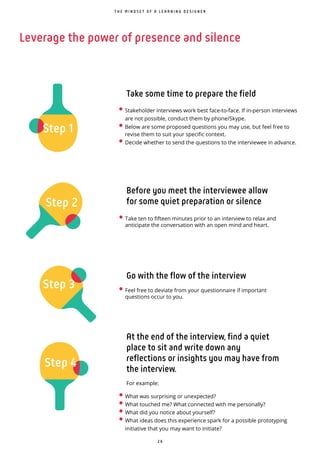
Leverage the power of presence and silence
• Stakeholder interviews work best face-to-face. If in-person interviews
are not possible, conduct them by phone/Skype.
• Below are some proposed questions you may use, but feel free to
revise them to suit your specific context.
• Decide whether to send the questions to the interviewee in advance.
• What was surprising or unexpected?
• What touched me? What connected with me personally?
• What did you notice about yourself?
• What ideas does this experience spark for a possible prototyping
initiative that you may want to initiate?
Step 4
Step 1
Step 3
Step 2
Before you meet the interviewee allow
for some quiet preparation or silence
Go with the flow of the interview
At the end of the interview, find a quiet
place to sit and write down any
reflections or insights you may have from
the interview.
For example:
Take some time to prepare the field
T H E M I N D S E T O F A L E A R N I N G D E S I G N E R
• Take ten to fifteen minutes prior to an interview to relax and
anticipate the conversation with an open mind and heart.
• Feel free to deviate from your questionnaire if important
questions occur to you.
2 7
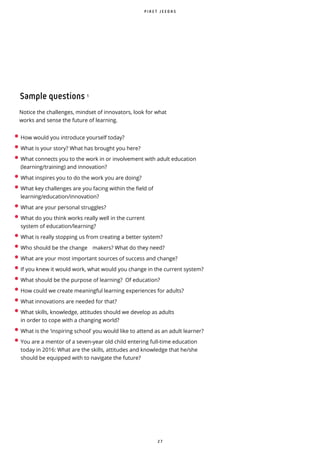
• How would you introduce yourself today?
• What is your story? What has brought you here?
• What connects you to the work in or involvement with adult education
(learning/training) and innovation?
• What inspires you to do the work you are doing?
• What key challenges are you facing within the field of
learning/education/innovation?
• What are your personal struggles?
• What do you think works really well in the current
system of education/learning?
• What is really stopping us from creating a better system?
• Who should be the change makers? What do they need?
• What are your most important sources of success and change?
• If you knew it would work, what would you change in the current system?
• What should be the purpose of learning? Of education?
• How could we create meaningful learning experiences for adults?
• What innovations are needed for that?
• What skills, knowledge, attitudes should we develop as adults
in order to cope with a changing world?
• What is the ‘inspiring school’ you would like to attend as an adult learner?
• You are a mentor of a seven-year old child entering full-time education
today in 2016: What are the skills, attitudes and knowledge that he/she
should be equipped with to navigate the future?
Notice the challenges, mindset of innovators, look for what
works and sense the future of learning.
Sample questions ¹
P I R E T J E E D A S
2 8
A!
From a source of
knowledge to a
source of inspiration
2 9
Schools as living systems
Systems around us are changing
rapidly. For a long time, it seemed
that schools and universities were
safe places of stability, where we
could pretend that the world is ‘out
there’. Reality has caught up with
us: Dropout rates of around fifty per
cent in the first study year are not
unusual, the societal value of a
degree is decreasing, the labor
market is changing constantly and
becoming more flexible, new jobs
are created, others vanish, more
students start their own businesses
and teachers in the Netherlands
experience burnout more often
than people in other sectors (CBS,
2015). We see an ongoing interna-
tionalisation of society and
businesses, growing youth unem-
ployment and worldwide migration
of vulnerable individuals, (Janta,
Ratzmann, Ghez, Khodyakov &
& Yaqub, 2015).
Schools are living systems that are
part of larger systems. As a system
shifts, so do schools too. Schools
should be in constant communica-
tion and collaboration with society
and in an ongoing process of
reinventing themselves. Schools can
activate their learning capacity in
order to survive and thrive in a
changing environment. Why should
we accept these high dropout rates,
or the escalating rates of burnout
What would happen
if universities were
not only adapting to
trends, but actually
created them and
thus influenced the
system from within?
amongst teachers? Trends in
society and the market are not a
threat, but an opportunity to
become leaders in our eld.
We, teachers and students, are
forming these systems and we can
change them. The more complex a
system becomes, the more we
need to connect as humans and
learn from and with each other.
The quality of our relationships de-
termines the success of our evolv-
ing systems.
Take the example of a flock of birds
that moves and creates new
patterns together, at times seem-
ingly moving as one body, without
an individual director organising
the show. An important part of
how birds do this is by monitoring
their spatial relationship to the
other birds.
Therefore, how can we improve the
relationships in our schools and
D I E D E R I K B O S S C H A
From a source of knowledge to a
source of inspiration
Why, in growing complexity, we
need learning communities
universities, so that they can
become learning institutions and
become more relevant to the
challenges we are individually and
collectively facing?
The teacher is a
learner first
A teacher acknowledging that he/
she too has a learning quest makes
all the difference. I have heard many
teachers say (more or less explicitly):
“This is how I do things. Let me just
keep on working in that way. Why
should I change?” Most teachers are
still educated in ‘frontal teaching’, or
teacher-centred instruction (Frontal
Instruction, n.d.). This implies that
the teacher is the main source of
knowledge. Some of these teachers
consider their classrooms as small
kingdoms. Again, times are changing:
today more knowledge is gained
through the internet or social
contexts, but also by trial and error
(e.g. students setting up a business
or organising an event). Due to
technical innovations and diverse
media, knowledge can spread
exponentially. Taking these trends
into consideration, I’m pleading for a
different approach. I challenge
teachers to step into their learning
mode: Find each other -both
teachers and students. Ask for
support. Reinvent and co-create your
work.
3 0
̀
why they teach often go back to very
personal events, to a deep passion
for learning, for sharing stories,
about growing up. These stories are
appreciative and free from daily
frustrations. Tapping into these
personal stories often creates
a spark in the eyes, a new door
opens... transformation starts. Otto
Scharmer (2009) calls the process
towards knowing what your calling is
‘presencing’. This word is a blend of
the words ‘presence’ and ‘sensing’. It
refers to the ability to sense your
needs and bring into the present
the highest future potential either as
an individual or as a group.
In our three-day TOP training (in
Dutch: Toekomstgericht Onderwijs
Praktijk in English: Future Oriented
Education Practices), in which thirty
teachers from the University of Ap-
plied Sciences of Leiden participat-
ed, we asked them these questions
both individually and collectively.
This helped initiate their learning
processes, which resulted in
forming learning communities.
Teachers now find each other in
di erent ways and start collabora-
ting in (re)designing their curriculum
and changing their teaching practice
A participant gave back to us:
“I was a bit cynical at first, but now I
remember why I chose to become a
teacher!” This teacher dared to ask
the ‘tough’ questions and created
F R O M A S O U R C E O F K N O W L E D G E T O A S O U R C E O F I N S P I R A T I O N
The teacher is a learner too, but
what happens when the teacher is
a learner first? And what happens
when your passion for learning
becomes contagious to your stu-
dents? That shifts you from being a
source of knowledge into a source
of inspiration.
Why am I here?
Once a teacher also becomes
aware of being a learner first, the
justification for being in this work
can shift from external (“I am here
so that others learn...”) to internal
(“How can we learn together?”) and
reveals a possible blind spot: Why
am I here and where does my pas-
sion for education originate?
The question “Why am I here?” is
one we are hardly asking our stu-
dents (I recommend you try it, and
observe what that question
provokes!). And we are not asking
this question to ourselves. Why are
you here? Why are you a teacher?
What is your learning drive?
Deep learning starts with asking
ourselves these questions. It will
trigger patterns, beliefs and stories
which are related to our deeper
calling where work is more than ̀
just an assignment, a job, but be-
comes something we feel called to
do. In many conversations I have
had with teachers, stories about
time and space to have a
conversation with his colleagues.
He reopened doors and reclaimed
his sense of fun in learning and
teaching.
From a learning question
to a learning community
A question that intrigues me is how
to move from being a community
of (individual) learners to a com-
munity that learns. The first case is
typical for the old school classroom
and teacher-centred education. The
second is the result of student-
centred or participatory learning.
My sense is that once a system has
started shifting in this way and be-
comes a community that learns, it
becomes able to adapt to new and
challenging situations in an entirely
di erent way.
In a learning community, teachers
start gathering around similar
learning questions and start co-
creating from there. These ques-
tions can be abstract, such as “how
can I teach from my inner source?”
or more concrete, such as “how
can we create a minor about new
economic models?”, or “how can I
improve my daily lessons?”
When you share your learning
questions with your colleagues and
students and actually ask for help
and input (how difficult is that for
3 1
D I E D E R I K B O S S C H A
a teacher!), it creates a culture in
which learning communities are
the norm. Besides that, you create
a fun and excited team of teachers
and students. It will positively affect
the culture amongst ̀teachers and
improve the quality of their work.
Co creating a new
educational reality
When teachers are also learners,
and start to create learning com-
munities, the ground is prepared
for co-creation. I challenge each
learning community to do a
prototype every now and then.
This way you test your learnings in
practice and learn by doing.
Make it tangible, improve. Celebrate
your successes and failures.
Prototypes vary from designing
a new format for your lessons to
running a pilot for a new summer
school. Very important here is that
you dare to make mistakes and that
the management allows you to make
mistakes. Only then you can think of
and try out your wildest educational
fantasies! And only then, a real shift
in educational paradigms can
happen: from educational
organisations to organisations that
learn!
3 2
This article is inspired by my work at
the University of Applied
Sciences Leiden, The Netherlands,
where together with Marien
Baerveldt, I have been facilitating a
process in which teachers are
redesigning their curricula. Over
thirty teachers are involved in this
trajec-tory which has been going on
for more than two years. It has led
to a deeper understanding among
teachers and a different level of
conversations than they were used
to. Colleagues are sharing more
personal stories and creating a safer
environment for collaboration.
F R O M A S O U R C E O F K N O W L E D G E T O A S O U R C E O F I N S P I R A T I O N
What happens when
your passion for
learning becomes
contagious for your
students?
Teachers have started to consult
with each other, apply new
education tools, co-design their
lessons and observe each other in
the classroom.
It is my conviction that the key
element in that success is that
teachers start asking themselves
new questions and are redefining
their passion for learning and
teaching. By doing so, they create
learning communities and together,
they are improving their teaching
practices.
- Diederik Bosscha
Why am I here?
-
What happens when
the teacher is a learner
first?
-
What happens when
universities create
trends instead of
adapting to them?
Move on...
D I E D E R I K B O S S C H A
Part of the success at the University of Leiden is that
this learning movement is stimulated and facilitated
by the management. Teachers are given time to meet.
There is now a feedback system that provides space
for everyone to learn from each other.
However, if you do not have that kind of support, ask
yourself: What small spaces are there within the
system where you can plant a seed for a different
culture? See who else can stand and practise with
you. Find out how you can invite and involve more
teachers and students. Talk to your manager about
your ideas. Ask for space for experimentation and
learning.
And to the manager: How can you create a culture
that encourages people to learn together? There is an
investment needed in working like this, but the
reward is a more robust, flexible and adaptable
learning structure. And more committed teachers and
students.
3 3
3 4
EW
S
The necessity of
diversity in a
multicultural society
3 5
The necessity of diversity in a
multicultural society
Learning how to appreciate the beauty
of diversity in our classrooms
A teacher asked me once to write
down what I do not dare to say
aloud. A highly recommended
exercise by the way, although a
challenging one.
Here is one of the things I struggle
to speak about, so I’m trying to put
it in writing.
Diversity is a broad term and can
be interpreted in many ways. For
me it sparks connotations of race,
colonialism, slavery, discrimination.
The unresolved question of know-
ing how to change patterns that
seem to have settled underneath
my skin, being a white woman in
a privileged Western society. Its
worldviews have penetrated my
language unconsciously. What if in-
stead of ‘blackmailing’, we called it
‘whitemailing’? What if ‘black’ does
not equal ‘threat, bad, danger’?
What if ‘white’ does not equal
‘serenity, peace, safety’?
How can I counteract my own white
privilege? How can I support letting
diversity show itself?
I am trying to become more con-
scious of the ways in which I inhabit
my place in society. The ways in
which it might prevent others from
inhabiting their place. And as I
write these very words, I can hear a
friend, a neighbour, my father, or a
colleague say: “Don’t be so serious,
the situation is not that bad.” But it
seems to me that it is, and has been
for a while. I am definitely not the
only one who thinks so. As I am
writing this, the killing of Afro-
American Alton Sterling by police
officers (on July 5th, 2016) and the
video footage of witnesses have yet
again sparked the debate of police
violence against people of colour in
the US. And even though I live 6000
miles from Louisiana, I feel this issue
touches me deeply. I recognise its
roots and effects in my own society.
The ‘Black Lives Matter’ movement is
a powerful counterforce to the white
supremacy on which our wealth has
been built. Or, more precisely, what
we consider as ours, and what we
consider as wealth. It is a movement
in a history of fighting for equal
rights and justice. The tricky thing is,
that when you are white, you do not
really notice. Just notice the ways in
which institutions are functioning to
serve your needs first, over others.
Notice the ways in which the police
treat people with another skin color
differently. Notice how shop owners
might pay extra attention when you
come in, specially when you are in a
group of young males. Notice how
predominantly white people are
being represented in movies,
in series, in books, in theater plays,
in advertisements. Notice how few
nonwhite men and women make it
to the top of politics, to the top of
large corporations or boards of
directors. If we believed our own
constitutions, this should not be
the case.
Growing up in The
Netherlands
I was born and raised in
Amstelveen, on the outskirts of
Amsterdam in the Netherlands,
Western Europe. While I was grow-
ing up, my neighbourhood was
predominantly white, and I deeply
appreciate that at least a tiny bit of
our Earth’s human diversity is now
radiating some of its richness in my
old neighborhood. Growing up in
the 1990’s and 2000’s, integration
of immigrants, specially from
Morocco and Turkey, was an ‘issue’.
The country was in a heated debate
around the question whether a
multicultural society could ever
work, specially after the murder of
right wing, homosexual politician
Pim Fortuyn on May 6th, 2002.
There was an almost tangible relief
when it became clear that the per-
petrator of Fortuyn was not an im-
migrant, but native Dutch. Tensions
rose again with the murder of Theo
M A A I K E M A D E L O N B O U M A N S
3 6
̀
van Gogh, a filmmaker who was
critical of Islam, on November 2nd,
2004 by a young Muslim man.
Our then prime minister spoke of
cultivating norms and values. We
seemed to struggle with appreciat-
ing different traditions or religious
ideas. The question “Is it possible to
form a society with people so
‘foreign’?” seemed a valid one. It
seems that we have not yet found
an answer. With sixty-five million
refugees worldwide and more
people fleeing their homes in the
coming years, we need to find ways
in which to welcome diversity in our
society. We need to know how to
hold opposing ideas and ideals. We
need to know how to go through
conflict without losing relationship.
Talking about diversity
But the conversation around
diversity is a tricky one to have. It
requires one to recognise one’s own
position and appreciate other
perspectives. Which conversations
should we be having in our class-
rooms about diversity? What are we
not talking about?
Seen from a global perspective,
everybody is different, and yet we
are all the same. We come from
di erent places, speak di erent
languages, are raised with varying
belief systems and diverse sets of
̀traditions. We have different sexes,
which in itself holds di erent con-
notations depending on time and
place. Our interests may vary: from
nature to culture, from technology
to history, from sports to human
rights issues. Some of these inter-
ests might overlap at times. But
other ‘worlds’ never meet.
A painful realisation: some worlds
never meet. People might live a
walking distance away from each
other, but their paths have never
crossed. Their socioeconomic class-
es make them hang out in di erent
bars, shop in different places,
engage in different types of work.
Their kids might not even go to the
same school. People never meeting
each other is not necessarily a bad
thing. After all, with seven billion
people on one planet, it is hard to
meet them all. But it is also not a
good thing for society when people
organise themselves with harsh
divisions between ‘us’ and ‘them’.
What if schools have the
potential to transform
patterns in society that
are built on the notion
of separation and ‘oth-
ering’, patterns we des-
perately need to shift?
Schools and our education system
should celebrate the richness that
exists in diversity: in different
cultures, points of view, traditions,
languages. Education can welcome
the diversity of its students by of-
fering various learning styles: some
learn well through physical activity,
for example, by creating something
with their hands. Others learn best
through listening and telling stories
or reading books. Some need to
work by themselves, others in
groups. We need to recognise the
uniqueness of each student. Only
then can her or his full potential
blossom. Potential that we need.
Learning as living
systems
As human beings we are a living
system. A living system is an open
self-organising living thing that
interacts with its environment. Our
human society, as part of the socio-
ecological system on planet Earth,
is also a living system. It means that
we have the ability to adapt to
changing circumstances. That there
is a natural wisdom that allows dif-
ferent parts of the system to build
on each other in support of the
whole. Every living system thrives
on diversity. Imagine a table full of
different kinds of food: vegetables,
herbs, varieties of rice, pasta and
bread, fruit, nuts, cheese. Imagine
T H E N E C E S S I T Y O F D I V E R S I T Y I N A M U L T I C U L T U R A L S O C I E T Y
3 7
the variety of dishes you can pre-
pare with these di erent ingredi-
ents, feeding different preferences.
Then imagine a table with just one
of these foods: definitely not as
nurturing and much less tasteful.
Just like the table, life at school can
quickly get a little boring when dis-
cussions in the classroom are only
with people who think exactly like
you. There’s not as much oppor-
tunity to learn, to see a situation
from a different point of view, or
be challenged in your thinking.
Plus, to train ourselves in
responding to complex challenges
we actually need a diverse set of
perspectives and skills. After all, a
group is able to solve complex
problems better than an individual
expert. To address a complex
problem like climate change or
global inequality, we need to
understand as much of the system
as we can, in order to make a wise
intervention. Understanding the
system can be achieved by taking
di erent perspectives into account.
One single person, even when he
or she is an expert in their field,
does not have the capacity to
embody all these different pers-
pectives. When we sit in a circle,
none of us can capture the full
story. Only together can we cap-
ture the complexity of the picture.
differently abled people. We might
have been able to more actively
reach out beyond our own commu-
nities. One lesson I personally take
from this is to keep exploring new
places, to keep meeting people that
are not in my circles. If I want to
invite more diversity in my life, I can
actively shape it. For me this means
going to places where I am new,
and where often I am a minority, in
whichever way (gender, skin colour,
education, native language, inter-
est, occupation). It is not always
easy to do, yet deeply enriching.
I hope this little piece of writing has
inspired you to contemplate about
this topic that often goes unmen-
tioned.
M A A I K E M A D E L O N B O U M A N S
Most of all, we need to learn to
value the various interests and
voices in the conversation, be able
to work with things/people/issues
that might make us feel
uncomfortable. Only then will we
actually build the capacity we need
to create a healthy, thriving society.
So how did diversity
show up in our project
& process?
The initial group of MoveMakers
consists of people working in
government, in universities, in
business. We have people in their
twenties and people who are about
to retire. The intergenerational,
cross--cultural learning has been
very rich. Having two women
among us who were either retired
or in the process of retiring broad-
ened our group conversation to
include ‘life after work’. To connect
to what is most important. It even
invited conversations about life and
death. Such vital conversations to
have!
We have been intentional about
inviting as much diversity as we
could. And yet there is so much
more diversity possible, also in our
group. We have very little repre-
sentation of the ethnicities of our
fellow citizens, we have had no
3 8
Or even in your own life?
-
What if schools have the
potential to transform
patterns in society that
are built on the notion of
separation and ‘othering’,
patterns we desperately
need to shift?
When I was little, I made friends
with boys and girls who would
later go into completely different
lifestyles: they did not follow the
route I took of travelling the world,
studying at university and starting
my own company. Instead, they
married their first love, moved into ̀
a house in the same city as they
were born in, got a job at a local
company or became a housewife.
Had I not made friends with them
T H E N E C E S S I T Y O F D I V E R S I T Y I N A M U L T I C U L T U R A L S O C I E T Y
long before we had chosen our
paths, we would have probably
never met, and if we had, there
might have not been the opportu-
nity to form lifelong friendships.
Schools are a unique place for peo-
ple to meet who otherwise would
never cross paths to form relation-
ships and build friendships that are
the fabric of society.
- Maaike Madelon Boumans
What does diversity
mean to you? How do
you embody, express,
or invite diversity in
your classroom?
3 9
Move on...
Invite your students to have a conversa-
tion about diversity and what it means to
them. Do this in groups of maximum four
students. As a prompt, you can ask them to
list all the ways in which they are different
from each other, and then to list all the
things they have in common. Invite them
to share how this enriches the way they
see each other. How can they make more
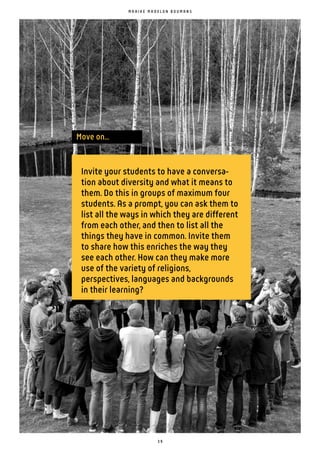
use of the variety of religions,
perspectives, languages and backgrounds
in their learning?
M A A I K E M A D E L O N B O U M A N S
4 0
Holding space for
the unknown
4 1
Introduction
Do you recognise those moments
in life when you just do not have a
clue? When everybody around you
seems to know exactly what they
are doing and when they ask you
‘what are you up to?’, you just do
not know what to answer. You find
yourself caught up in vague
descriptions, mumbling, bumbling,
with a deep wish for some distrac-
tion. Sounds familiar?
Congratulations, you are not the
only one!
I know that I am struggling with
this every now and then. As far as I
know, all my friends and most of
the people I know are struggling as
well. Basically, the question for me
here is how to deal with the uncer-
tainty of life, as a human being, as
a facilitator and educator?
In daily life, specially in Western
Europe, a sense of knowing, the
capacity to envision clear steps
and to communicate directly about
them, is highly regarded. It
provides a comfortable and safe
sense ‘that everything is in its right
order’. And do not get me wrong,
there is a lot of beauty and quality
in clear steps and statements. If
you are driving a car, you should
know what you are doing,
otherwise things can get messy.
In this sense, there are certainly
plenty of areas where knowing the
answers and clear steps are
possible, needed and appreciated.
But this is only half of the story.
There are also plenty of areas in life
where it is simply impossible to
formulate clear answers, results,
etc. And usually these kinds of
areas involve many different opi-
nions, stakeholders, interests,
options and possible next steps. In
general, I feel that in complex
situations and in both individual
and collaborative learning journeys,
this is the case.
Reflection questions
To make it more concrete and
personal, I invite you to reflect on
your own journey as a facilitator in
education and learning processes:
C I S K A P O U W
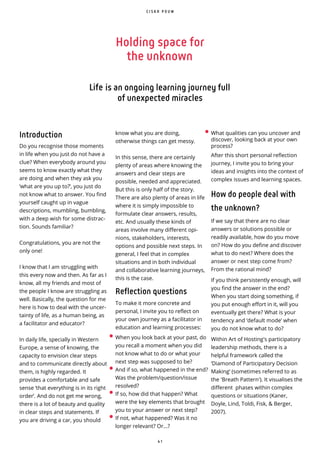
Holding space for
the unknown
Life is an ongoing learning journey full
of unexpected miracles
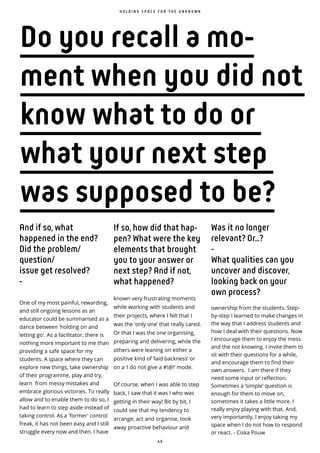
• When you look back at your past, do
you recall a moment when you did
not know what to do or what your
next step was supposed to be?
• And if so, what happened in the end?
Was the problem/question/issue
resolved?
• If so, how did that happen? What
were the key elements that brought
you to your answer or next step?
• If not, what happened? Was it no
longer relevant? Or...?
After this short personal re ection
journey, I invite you to bring your
ideas and insights into the context of
complex issues and learning spaces.
How do people deal with
the unknown?
If we say that there are no clear
answers or solutions possible or
readily available, how do you move
on? How do you de ne and discover
what to do next? Where does the
answer or next step come from?
From the rational mind?
If you think persistently enough, will
you find the answer in the end?
When you start doing something, if
you put enough e ort in it, will you
eventually get there? What is your
tendency and ‘default mode’ when
you do not know what to do?
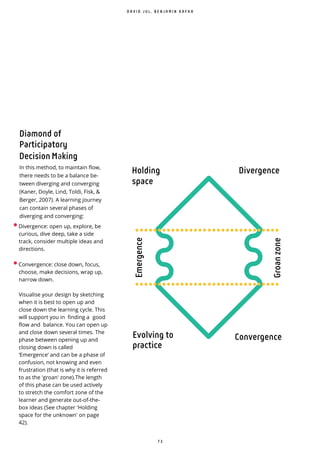
Within Art of Hosting's participatory
leadership methods, there is a
helpful framework called the
‘Diamond of Participatory Decision
Making’ (sometimes referred to as
the 'Breath Pattern'). It visualises the
different phases within complex
questions or situations (Kaner,
Doyle, Lind, Toldi, Fisk, & Berger,
2007).
• What qualities can you uncover and
discover, looking back at your own
process?
4 2
The quality of this tendency is that
you never lose sight of aimed
results. You get your feet pointing in
the same direction. You tackle a
situation and make sure that you
actually get somewhere and deliver
results. The downside is that you
might get the same answers and
solutions repeatedly, because you
missed new insights and ideas.
Emergence
If you love endless chaos, to play
with uncertainty and explore all
sorts of ‘out of the box’ or ‘outer
space’ ideas, you might be the
‘emergent type’. This means that you
have the capacity to hold onto your
nerve when everything is uncertain.
You probably do not even feel these
nerves because you enjoy making
free associations and limitless
visualisation ‘games’. Your 'system'
generates a great variety of
combinations and endless
possibilities.
People from divergent and
convergent tendencies might
experience difficulties in following
your ideas because they are beyond
their mindsets, belief systems and
experiences.
The quality of this tendency is that
H O L D I N G S P A C E F O R T H E U N K N O W N
Divergence
If you are a ‘typically divergent
person’ you enjoy brainstorming
and visualising. You could happily
and easily spend long hours playing
with words, ideas, answers and
solutions. This means that in
situations where you do not see
answers or solutions straight away,
you will probably try to discover
them by looking for as many options
as possible. You explore for a while,
and perhaps for a little while longer.
You are not necessarily interested in
choosing or applying the possibili-
ties to your situation. People usually
find you very creative, but they also
might complain that you are
someone who cannot easily finalise
tasks. The quality of divergence is
openness and curious exploration of
situations. The downside is that it is
difficult to reach your targets and
show results because you always
find something new to play with.
Convergence
If you feel an allergic inner response
to the above description, then you
might be a 'typically convergent' per-
son. Generally, you like to act when
you face difficult questions and
uncertain situations. You appreciate
clear ideas, steps and actions to get
concrete and tangible results.
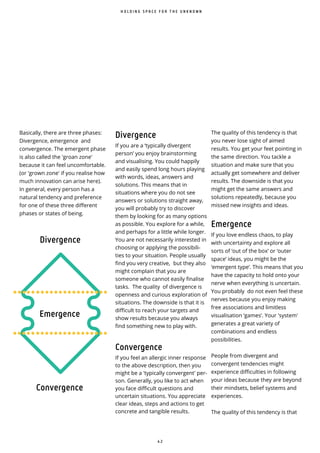
Basically, there are three phases:
Divergence, emergence and
convergence. The emergent phase
is also called the 'groan zone'
because it can feel uncomfortable.
(or 'grown zone' if you realise how
much innovation can arise here).
In general, every person has a
natural tendency and preference
for one of these three different
phases or states of being.
Divergence
Emergence
Convergence
4 3
• If you take these three tendencies
into consideration, in what phase do
you feel most comfortable?
• What is your natural default mode?
• What is your ‘anti-mode’? Where is
your allergy? What phase do you
really find difficult or irritating?
• What is this framework telling you?
• What type of insights can you ex-
tract from these three phases?
If you explore these questions and
place them in your own personal
and professional context, you might
see some examples where the
different phases are clearly visible.
You might also realise that some of
your uncomfortable moments
are (partly) related to a mismatch
between your own preferences and
the preferences and needs of oth-
ers. Now the question is how do you
use this framework professionally?
innovative ideas and new
solutions can easily emerge. One
could say that this is the
'inventor's phase'. A downside
could be that you get lost in
limitless imagined adventures
and never actually choose a clear
direction for answering the
question or solving the issue.
What is your tendency?
'flow of the programme’, to open
up to the phases and to people that
are not so easy for them to 'grasp'.
People are more capable of holding
such discomfort as long as they
know that it has a function AND
that they will have 'their moment'.
The more you get to know yourself
as a facilitator, including your
strengths and your weak points, the
more you can provide and hold
space for others to learn and grow.
If you are capable of exploring and
playing with different phases, you
become increasingly capable of
inviting others to do the same. And
to me, that is a very important
foundation for being an impactful
facilitator.
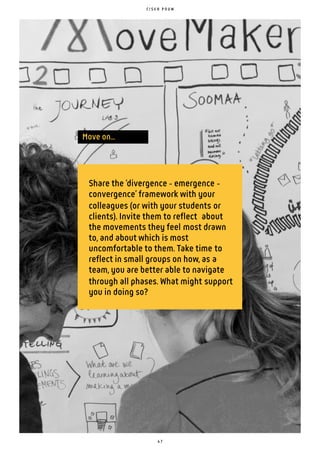
Do you want to know
more on how to
design the flow of a
learning journey?
Read the chapter in
this book: ‘Designing
learning journeys’
C I S K A P O U W
Using the framework
As a facilitator, you probably work
with a great diversity of people.
Therefore, it is really helpful to have
a simple framework in your 'tool
box'. Working with people in
personal and collaborative learning
journeys (or in complex jobs)
requires facilitators who know how
to deal with different personalities
and needs in different situations.
Using the framework ‘Diamond of
Participatory Decision Making’ can
help you in at least two ways:
1. It provides a framework to design
the flow of the learning journey you
want to develop: from divergence
via emergence to con- vergence.
You can choose different exercises
and tools matching the phases of
the learning programme that you
are designing. You can explore
while you practise and play with the
qualities, functions and depth of
every phase (see chapter on
'Designing learning journeys' on
page 62).
2. It helps you to see and recognise
your own preferences and those of
the people whom you work with.
From there you can explicitly invite
them to connect with the overall
4 4
Surfing with the
unknown
There is a clear connection
between your personal capacity to
explore your own ‘not knowing’
and your ability to bring this
quality into your professional life.
This, at the same time is connected
to how capable we are of providing
a safe space for others, so that they
can do the same.
Of course this is an ongoing learn-
ing journey, with wonderful mo-
ments where you feel that
everything is in its right place and
you can surf the flow of the
unknown. But sometimes you can
find yourself in total confusion,
and you have to start all over again!
And that is what learning is about,
isn’t it? It is messy, uncomfortable,
slightly unnerving and very often,
there is a thin line between victory
and tears. Yet, learning is
wonderful, fun, weird, a bit crazy
and sometimes, just plain magical.
Specially when very suddenly
everything starts to make sense!
When you can learn this way
together with others, an entirely
new learning dimension opens up.
H O L D I N G S P A C E F O R T H E U N K N O W N
Playing with my role as a facilita-tor
or seeing the impact of my
interventions is extremely helpful. It
provides me with a greater sense of
what is going on, and therefore it
helps me respond in a constructive
way. Sometimes stepping back is
what is needed while other times it
is stepping in. Both dynamics are
important for the students and the
facilitator. I believe that it is in this
dynamic where learning is possible
because it provides space to
breathe!
A very helpful framework is the
reaction-proaction framework of
Stephen Covey (2004). Basically,
the proactive framework says:
When you are confronted by a
‘stimulus’, then there is ‘the
freedom to choose moment’ and
then there is your ‘response’.
Stimulus > Freedom to
choose > Response
According to Covey, in this ‘freedom
to choose zone’, you have access to
your self-awareness, imagination,
consciousness and independent
will.
Often, in daily life, people (including
myself) do not enter this 'freedom
to choose zone’. They just respond
immediately to the stimulus. Covey
calls these types of reflexes ‘reactive
responses’. You react without
thinking, you just respond from your
‘default mode’. Usually, these types
of reactions are not very
constructive. They can make you
feel unsatisfied, or leave you with an
inner dialogue about ‘what you
should have done or said'. Or, you
find yourself in a situation where
your relationship with ‘the other’ is
under pressure. All of this is
because you are not able to
respond to each other in a way that
both of you feel seen, heard or
taken seriously.
As this chapter is not about ‘be-
coming more proactive and less
reactive’ I will not delve into this
framework. If you want to know
more, you can look into Covey's first
habit ‘Be Proactive’. To connect the
framework with 'surfing with the
unknown’, I feel that the more you
are able to respond from your own
‘freedom to choose zone’, the more
you are capable of sensing what’s
needed from you in a certain
situation: stepping back or stepping
in.
As a last thought on this topic: Have
you noticed that the words
REACTION and CREATION are made
from the same letters? Think of it!
4 5
REACTION or CREATION? your
choice makes a great difference in
how you interact with the world
around you.
Although life can be quite difficult
and dealing with the unknown can
be a struggle every now and then,
perhaps finding the right response
requires just a little ‘switch’ in your
thought pattern. Instead of beating
yourself up when you adopted a
reactive response, you could also
try to smile kindly at yourself and
simply try to react differently next
time.² In the end, life is a continu-
ous journey full of new opportuni-
ties to choose differently.
To end with a comma
instead of a full stop
I could probably fill dozens of
pages on this topic and other
related theories, frameworks,
questions and exercises. I could
also tell you plenty of stories about
my lessons and those of people I
know. But I somehow think that
you now have an image, some
insights and hopefully, some new
ideas.
I usually try to integrate the lessons
that I have learned on ‘holding on
and letting go' in every aspect of
my life. Therefore, I am hoping
(in a kind and nourishing way)
that you find your own journey,
your own lessons, your own
growth and emerging wisdom.
All in all, I wish you a wonderful
journey on your playful quest
in the bumpy ride called life!
Play, mess around and
sometimes, when you know the
answer, try to keep quiet. Be
curious, bold and very
importantly, enjoy the process!
C I S K A P O U W
4 6
H O L D I N G S P A C E F O R T H E U N K N O W N
Do you recall a mo-
ment when you did not
know what to do or
what your next step
was supposed to be?
And if so, what
happened in the end?
Did the problem/
question/
issue get resolved?
-
One of my most painful, rewarding,
and still ongoing lessons as an
educator could be summarised as a
dance between 'holding on and
letting go'. As a facilitator, there is
nothing more important to me than
providing a safe space for my
students. A space where they can
explore new things, take ownership
of their programme, play and try,
learn from messy mistakes and
embrace glorious victories. To really
allow and to enable them to do so, I
had to learn to step aside instead of
taking control. As a 'former' control
freak, it has not been easy and I still
struggle every now and then. I have
If so, how did that hap-
pen? What were the key
elements that brought
you to your answer or
next step? And if not,
what happened?
known very frustrating moments
while working with students and
their projects, where I felt that I
was the ‘only one’ that really cared.
Or that I was the one organising,
preparing and delivering, while the
others were leaning on either a
positive kind of ‘laid backness’ or
on a ‘I do not give a #!@!’ mode.
Of course, when I was able to step
back, I saw that it was I who was
getting in their way! Bit by bit, I
could see that my tendency to
arrange, act and organise, took
away proactive behaviour and
Was it no longer
relevant? Or...?
-
What qualities can you
uncover and discover,
looking back on your
own process?
ownership from the students. Step-
by-step I learned to make changes in
the way that I address students and
how I deal with their questions. Now
I encourage them to enjoy the mess
and the not knowing. I invite them to
sit with their questions for a while,
and encourage them to find their
own answers. I am there if they
need some input or reflection.
Sometimes a ‘simple’ question is
enough for them to move on,
sometimes it takes a little more. I
really enjoy playing with that. And,
very importantly, I enjoy taking my
space when I do not how to respond
or react. - Ciska Pouw
4 7
Move on...
Share the ‘divergence emergence
convergence’ framework with your
colleagues (or with your students or
clients). Invite them to reflect about
the movements they feel most drawn
to, and about which is most
uncomfortable to them. Take time to
reflect in small groups on how, as a
team, you are better able to navigate
through all phases. What might support
you in doing so?
C I S K A P O U W
4 8
Reconnecting to
our authenticity
4 9
Reconnecting to our
authenticity
The power of nature and language
M A A I K E M A D E L O N B O U M A N S
This is a story about the power of
authenticity to give meaning to our
life. A story about the power of lan-
guage, to shape our sense of place.
And how these two intertwine.
Telling someone else’s story is easy.
You ask them good questions, listen
to their answers, notice the choice
of words, the silences in between,
the rhythm in which they speak.
You embody their story, at least for
a little while, when putting it on
paper. But then writing your own
story, now, that is more challenging
(ha ha! not funny, actually). But here
it goes.
The history of
businessmen in suits
I find myself sitting in a kitchen in
an office at the beautiful venue of
Nyenrode Business University, an
old and well-established business
school in the centre of the
Netherlands. We have set ourselves
the task of writing two books in
three days. Fun, definitely. Plus, as
one of us noted yesterday, we have
the practice of meeting in beautiful
places, with nature by our side.
Which makes it even more fun.
The pictures on the walls around
me show men, all dressed in suits
and in serious conversation over
sticky notes and papers in front of
them. The walls have pictures of
women, too, but they are not in
conversation. The photographer
might have not taken them seri-
ously, portraying them as mere
objects with very little clothes on. A
shot from behind, her curves and
naked skin only partially covered by
jewellery. Who would ever wear
jewellery on their back, all the way
down to their ass, without putting
clothes on?
I’m drifting off, I’m sorry. See, that
is what happens when we move
through a society which offers
constant distractions. A place
that bombards us with images and
stories that are not mine, not yours,
not ours. For most of the women I
know are very capable of engaging
in a conversation actually, even
when there’s sticky notes and
papers involved.
A young man in a suit enters the
kitchen. Makes himself coffee. He
looks out of the window as he waits
for it to be ready and sees trees,
bushes, green. I see him thinking to
himself, I wonder what is on his
mind. I hope he uses this time to
see the beauty that surrounds him.
I hope he allows himself to be
touched by it, and thereby be
reminded of the innate beauty that
surrounds us. Recognise that, as a
matter of fact, we can support
more beauty to come forth in the
spaces in which we meet. For
maybe cultivating beauty, creating a
welcoming space, can serve the
individual and collective learning we
need.
I hope he notices his breath in his
belly. Perhaps he does not, per-
haps not now. Hopefully at some
point in time, he will.
What if our life
is our work?
People on their deathbed never say
they wish they had spent more time
working. But then maybe that
depends on our definition of work.
What if work is life? What if it means
tending to abundance, grace, joy,
gratitude, community? What if to
live well is our main job? What then
does it mean to live well, to take
care of oneself and others, and the
Earth we live on?
“See, most of us work until we’re 65,
only then to realise. We only made a
living, we never really lived our lives.”
- Maaike Madelon Boumans
5 0
R E C O N N E C T I N G T O O U R A U T H E N T I C I T Y
5 1
“Because this is life. And this is what life does. It goes by.
With us noticing, sometimes.
And maybe, maybe the practice is to notice a little bit
more.
To step more fully into what this particular day holds.
Embrace how your life the only one you can live wants to
unfold.
To practise to be silent, and to take it in. To allow for the
subtle discomfort, questions not asked, expectations not
met to arise.
To feel the unconditional generosity and joy underneath.
You, we, I, need to slow down to go fast you see.
We’ve been speeding up history to a point where we can
only repeat creating unintended consequences.
And I, I want to be kind.
Yes.
But not too kind. In a way that I need to please, everyone,
all the time. It’s too freaking tiring, and surely not the pur-
pose of life.
Can I be okay with you not liking me, and if not (yet), what
would it take? If the opposite of pleasing could be a deep
trust, can I step into it?
I believe I just did.
Feel a lightness and tenderness in my heart.
Grateful for this planet, for its people, myself and this life I
get to live.”
- Maaike Madelon Boumans, Driebergen,
The Netherlands, April 2nd, 2016
M A A I K E M A D E L O N B O U M A N S
5 2
So how does all of this inform the
way we think about education and
creating learning spaces? If
learning does not only happen in
schools, but is seen as something
that happens everywhere, all the
time, whether we are conscious of
it or not, then how does that
influence the way we engage with
life? How does it shape the kind of
questions we ask?
Most of us are taught to focus on
problems, to fix what is not right.
What if we shift focus and notice
what is there already? The stuff we
have plenty of? Take an
‘Appreciative Inquiry’ approach?
(Cooperrider & Whitney, 1999).
People turn out to be more
resourceful when they are asked
what they have, rather than what
they need. As Bob Stilger (2013)
learned in his work after the Triple
Disaster in Fukushima, Japan: “The
future is not built with master
plans. It is built when people come
together, look at what they have,
and begin to create.”
When instead we grade students’
capacity to repeat information we
already know, but fail to build their
internal muscle to discover the
unknown, we might end up with
smart people, but definitely not
with wise people.
R E C O N N E C T I N G T O O U R A U T H E N T I C I T Y
It seems to me that this time calls
for wise people. Women and men
who have the courage, heart, and
capacity to deal with the complex
global challenges we face. In their
own place. The organisations they
work in, the communities they live
in. What do we need to learn and
unlearn to grow into these women
and men? How do we respond
wisely to distraction, to chaos,
stress, disappointment, not
knowing? What do we need to
practise and cultivate to navigate
the complexity of living in this 21st
century?
For one, it might have something
to do with remembering who we
are, stripped of the layers society
has put on us, layers we have put
on ourselves. Allowing ourselves to
notice what is here. To actually
practise ‘not knowing’ (not sure
what this means? Great, that is the
point!). Practise awareness, genu-
ineness, radical honesty. Practise
asking powerful questions.
To show up to life, be ready to face
it. Without the need to hide, to
fake it or fix it. For when we
reconnect to what is most
meaningful to us, we realise our
meaning of life. We literally find
our place in this world, a solid
ground underneath our feet.
Linking language to
landscape: rooting in
the place we stand
In his book Landmarks, academic
and writer Robert Macfarlane
(2015) explores the strong links
between language and landscape.
He argues for a recognition of the
value of ‘the language of the land’
for creating a sense of connection
and belonging to one’s specific
place, and thereby to planet Earth.
A planet we collectively inhabit with
millions of other species. In an in-
creasingly virtual and digital reality,
and with urgent global issues like
climate change, loss of biodiversity
and fertile soil, water shortage in
one place and massive floods in
another, his message has never felt
more relevant to me.
As Macfarlane (2015) states:
“It is not, on the whole, that natural
phenomena and entities them-
selves are disappearing rather that
there are fewer people able to
name them, and that once they go
unnamed they go to some degree
unseen. Language deficit leads to
attention de cit. As we further de-
plete our ability to name, describe
and figure particular aspects of our
places, our competence for under-
standing and imagining possible re-
lationships with nonhuman nature
5 3
M A A I K E M A D E L O N B O U M A N S
is correspondingly depleted.”
‘Language deficit leads to attention
deficit. What is it you focus on, in
your daily life? Which words do you
use to give expression to this?
Macfarlane (2015) invites us to
realise that the words we use echo
a point of view, and that language
as such, has the power to both
describe but also determine what
we see. It might be worthwhile to
become more reflective about this,
if we want to create a shift in
society’s direction. Not an easy
thing: in the words of J. A. Baker
(2011) "The hardest thing of all to
see is what is really there". But it is
worth the practice and the inquiry.
5 4
What if to live well is
our main job?
-
What do we need to
practise and cultivate
to navigate the
complexity of living in
this 21st century?
“There is something about the way
we use language and the way we
put structures in our lives. We put
structure on ourselves and our
lives, following that language and
becoming inauthentic. Meeting
people in Estonia who are so con-
nected to nature opened my eyes.
We went into the forest and they
showed me this little plant. They
said “Look, it’s happening. It does
not need a lot of protection and a
lot of work. If we put a lot of work
into making this flower bloom, it
may not even work.”
R E C O N N E C T I N G T O O U R A U T H E N T I C I T Y
How can education bloom like that
flower which you do not need to
push into becoming a flower? How
can we be in the sphere of becom-
ing and emergence? How can we
create the space, the conditions
and the relationships where we do
not try to make something of
ourselves and other people, allow-
ing us to bloom when the time is
right?”
- Justas Ku inskas, Interview at
MoveMakers LAB 3
What if work is life?
What if to live well is
our main job?
5 5
Move on...
So if I can leave you and myself with any advice, it
might be this:
Give up all the ways in which you are not honest
with yourself. Let go of the idea of who you are, and
who you are not. Where you belong, and where you
do not. The Earth knows no borders.
Be brave enough to connect to what you do not
know. Allow yourself to settle and to sit still. Dis-
cover a place (new or old): pick up a stone, explore
the soil underneath the concrete, smell the leaves
of a tree. Notice your choice of words and what you
pay attention to. Learn new words to describe what
you see, how you feel, what you think (hell, take the
freedom to make up new words along the way!)
Go ahead and tell your own story.
Hereis a little bunch of questions to ask yourself
regularly: How can I be helpful? What is working?
What help do I need? What do I most deeply and
profoundly love? What am I (secretly) afraid of?
How can I be even more generous? Where is it in my
life that I hold back?
M A A I K E M A D E L O N B O U M A N S
5 6
Movement and
stillness in learning
5 7
Movement and stillness
in learning
Allowing wisdom to emerge
Our current education places a
strong focus on developing the
mind and therefore, usually leaves
the body out of the picture. This
unbalance often continues in our
work life: we spend most of our
time sitting behind a desk during
daytime, and on the couch in the
evening. But our bodies are not
made to sit still! Plus, they hold a
great well of wisdom and offer a
great source of learning.
How can we tap into that wisdom?
How do we integrate movement
into learning? What allows learners
and teachers to connect on a
deeper level of consciousness?
How do we connect to ourselves,
to each other and to the world we
live in? What are the practices that
make deep learning happen; the
type of learning which reflects
actual life experience?
Unfolding a new
perspective
One gateway is physical or kinetic
practices. Human beings experi-
ence life, and the learning that
goes with it, through the senses of
the body. There is extensive
scientific research around the
impact of involving the body in
learning, but we still prefer visual,
mental and oral skills. In the words
of Eric Jensen (2005), educator and
translator of neuroscience into
practical classroom applications:
“It’s truly astonishing that the dom-
inant model for formal learning is
still ‘sit and git.’ It’s not just aston-
ishing it’s embarrassing. Why do ̀
we persist when the evidence that
lecture alone does not cut it is so
strong?”
In some ways, learning is move-
ment itself: whether it is physical
movement, being emotionally
moved or being intellectually
challenged. Learning to experience
your own body consciously can be
a powerful way to integrate learn-
ing. Practices that allow you to be
mindful of your own movement
and body posture eventually lead
to real dialogue and co-creative
decision making; and most
importantly, to fully embody your
own place in life.
Movement can be a powerful way
to study ourselves, others and the
world, specially when it becomes a
common practice of a learning
community. It allows people to
hear and recognise their needs
through the needs of their body
rather than suppressing them.
By being empathic, gentle and
generally aware of our bodies, we
become more sensitive to our own
needs and those of others.
“The way we sit and
stand can change the
way we think and speak.”
(Palmer & Crawford, 2013)
It takes practice to experience the
body as a medium which is con-
stantly moving in and being moved
by the world. Here’s a crucial aspect:
in a fast moving and rapidly
changing world, what we sometimes
need most is to stand still. But it
takes great skill to practise stillness
and to notice it in this continuous
movement. It takes great effort to
develop discipline and courage to
create these moments of stillness. It
takes patience to connect to a
deeper source of knowing and
integrate learning.
We should move no less than we
speak or read to allow a more
complete awareness. Movement
should not be understood as an
extracurricular thing or even a sport,
but recognised as a human need.
Movement should be comprehen-
ded beyond physicality: its energetic
and even spiritual elements should
be taken into account.
How can we get started?
One way to start is to take up any
practice involving body movement
and stillness. Practise it, not for
M E L A N I E H E R N Á N D E Z , J U S T A S K U Č I N S K A S , M A A I K E M A D E L O N B O U M A N S
5 8
They might be surprised at first,
but will denitely ̀appreciate the
change of setting!
As a short break, without too much
distraction: invite your students to
stand up and find a place in the
room where they can move. Invite
them to a few simple stretching
exercises (bring your hands all the
way up in the air, stretch to the left,
stretch to the right, bend down,
turn your wrists, shake your booty,
be playful!).
Ask if any of your students has
a fun, short game to play or an
energiser.
Stepping into practice
During our learning journey we
experimented with movement by
involving all participants in a
prototype. In LAB 1 and 2 we
integrated ‘improvised movement’
into the co–creation process.
We started exploring the question:
“What is my current movement?”
What can we learn from listening
to ourselves, to our whole body
and to whatever wants to emerge
from inside? We first focused our
attention on our inner being. Then
we moved our attention outwards,
perceiving the others and the
room we were in. Exploring both,
we eventually found partners to
engage in a movement dialogue:
in silence, just responding to
movement. This way of engaging in
a ‘conversation’ allowed for experi-
encing different levels of listening.
We eventually found a rhythm of
movement and stillness. We moved
until we collectively sensed our
emerging community and felt co-
nnected by a common movement
and rhythm.
What did we learn from this
experience and how did it affect
our practice as educators? We
became aware of varying dynamics,
speeds and directions (forwards,
backwards, sidewards) as well as
points of reference (on the ground,
climbing up walls and objects).
Seeing somebody move and
explore the space differently than
you do, can contribute to opening
your mind and body for new points
of views and approaches. We
learned to focus our attention and
sharpen our senses (for example,
by moving with closed or open
eyes). We learned to rely on our
senses in order to open up to
dimensions of the world that are
often neglected. There was a sense
of freedom to experience and
(re)discover ourselves and our
surroundings. There was a level of
interconnectedness which led to
mutual responsibility for the indi-
vidual and the communal space.
M O V E M E N T A N D S T I L L N E S S I N L E A R N I N G
for its own sake, but to be
reflective, aware and introspec-
tive into the experiences that
such practice reveals.
• What if we could enrich our learning
experiences through the awareness
of the body and its (inside and
outside) movements?
• What if working with movement,
stillness and the richness of the
body/kinetic experience is a way to
access a deeper level of learning and
awareness?
Here are some simple exercises you
can do in your classroom:
• Invite your students to place their
feet on the ground and sit in a
comfortable, yet straight posture.
Ask them to bring their attention to
their breath and simply follow the
next three breaths they take. They
can close their eyes, or leave them
open. Let them choose whatever
feels more comfortable. As they
follow their breath, invite them to
notice any tension or stress in their
body. Ask ‘what would it be like if I
bring a little more softness to this
tension?’ Take another few seconds
of silence, thank them for partici-
pating, and continue your class.
• If you would like to bring more
energy to your students, here is an
exercise that is very simple and fun:
Turn on a happy song, and start
dancing to it!
5 9
Finally, we learned to play with
balance and imbalance. We were
forced to leave our comfort zone
and learned to enjoy it. Movement
as the constant quest for equili-
brium helped us to experience and
train ‘ rm exibility’. It helped us
build capacity to cope with
uncertainty, with change (or even
transformation) by adapting and
reinventing physical, mental and
spiritual shapes.
It was clear that the exercise was
best embodied when its commu-
nication and collective learning
were extended by:
M E L A N I E H E R N Á N D E Z , J U S T A S K U Č I N S K A S , M A A I K E M A D E L O N B O U M A N S
• a thorough introspection into one’s
own bodily experience (ME),
• the experience of the body non
verbally communicating with others
(US) and finally,
• becoming aware of one’s own
movement within the larger context
of many individuals moving together
in space (THE WORLD AROUND US).
Our experience of experimenting
with movement and stillness in
learning shows that anyone can
integrate both into their teaching
and learning spaces. You can
practise it in various forms and
contexts: from a small classroom
setting to a 300-student lecture
room.
Recognising that students who are
aware of their physical being are
more engaged, hence more
capable of learning, is a powerful
basis for creating a learning space
in which they can thrive. Joining
action (movement) and reection ̀
(stillness) in learning allows for
wisdom to emerge.
6 0
I teach philosophy, but I also used
to be a professional dancer. Recen-
tly, I introduced Camus’ Sisyphus to
my students: Sisyphus was constan-
tly striving to place a stone on the
mountain top. He tried to reach it,
but always failed. He had to come
back all the way down and try again
to make up for his failed attempts.
I tried to make a connection to how
every human being is always in a
state of reaching: We are constantly
in a state of longing. We always try
to achieve something but never
completely achieve it.
This sounded like a nice idea to my
students, but there was one thing
they could not understand. "Why
bother?”, they said. “Why live with
the paradox? If you can’t achieve it,
do not try! If you are trying
something you must be able to
nally achieve ̀ it and feel content!”
M O V E M E N T A N D S T I L L N E S S I N L E A R N I N G
I thought I needed an alternative
explanation. That's when I recalled
the words of my dancing teacher: “Do
not tell me, show me!” So, I asked my
students to stand up in a straight and
upright position. After a minute or
two, I asked whether they knew what
balance was. “Certainly”, someone
said. “We are in balance, we are not
falling.”
I then asked “are you really not
falling?” I invited them to shift their
body weight slightly forward and feel
how the muscles in the back got
engaged to keep the body upright. I
asked them to shift their weight back
past the balance point and notice
how the muscles in the front of the
body got tense. They tilted to the left,
to the right, noticing that comforta-
ble spot precisely in the middle; that
sweet spot where all the muscles of
the body are relaxed and content:
the point of balance. That is how we
all felt what is was like to be in real
balance. Next, I asked them to
remain in that spot for a while. At
some point, my students realised
that IT WAS NOT POSSIBLE TO FIX
THE POINT OF BALANCE. The
perfect balance point could only be
experienced in very short moments
of transition!
Afterwards, some of my students
said: “Balance is only possible in
and because of movement."
“Balance is there, but it’s never
final, we never really achieve it
definitely." “We now know what
perfect balance is and feels like, we
aim for it but we can't fix it, but if
we didn’t aim for it we would not
be able to stand on our feet."
We then walked across the room,
'falling' with each step, catching our
weight with the next. And in this
constant falling and catching, we
walked, in perfect equilibrium.
- Justas Ku inskas
What is my current
movement?
6 1
Remember: in the heat of a discussion or in the
brightest moments of understanding and maximum
attention... Remember, you have a body. You are the
body.
Feel the floor. Breathe in. Breathe out. Shake yourself
loose. Let this be a little exercise and ritual that
reconnects you to yourself, when you are too much in
your head. Experiment: try some small, simple body
movement exercises in your class. Don't be afraid to
fail or for some discomfort to arise.
- Move whenever you feel you need or want to
- Explore, enjoy and love your body
- Feel, sense and experience life through your senses
- Be aware
- Be Alive.
M E L A N I E H E R N Á N D E Z , J U S T A S K U Ć I N S K A S , M A A I K E M A D E L O N B O U M A N S
Move on...
6 2
Designing learning
journeys
6 3
Designing learning
journeys
What are the milestones in your process?
As educators, our role is not only
delivering high quality content.
More and more, it is about creating
good circumstances for learning
to occur. Our methods and ways
of communicating need to support
individual learners in relating to
the content. This is what design-
ing learning journeys is about.
Learning journeys can be all sorts
of processes where we learn. In
this article, we focus on the formal
learning journeys, that are initiated
and planned by someone. It can
be everything from a university
course, a three-year programme,
to a whole school curriculum, or
just a one-hour meeting. We
believe that there are some generic
elements that should be taken into
consideration, when designing all
types of learning journeys.
This article takes a very practical
approach. It is not meant to be a
step-by-step guide to follow strictly.
Use what you nd relevant. First, it
takes you through the process of
preparing a learning journey. Se-
condly, it includes some frameworks
that can help you structure the
journeys you are designing. Finally,
it does not delve into the metaphor
of the hero’s journey. For an
exploration of this metaphor, see
Joseph Campbell’s ‘The Hero with a
Thousand Faces (1949).
•
•
•
D A V I D J U L , B E N J A M I N K A F K A
1. Before you start
Too many courses and program-
mes are born in Word and Excel.
Designing is a creative process that
demands an open mind, and the
will to explore possibilities and go
beyond the usual ways of planning.
Set the right circumstances for
yourself, like time and space and
invite other people to co-design
with you.
Guiding questions:
Who are you designing the learning
journey with? Who can support
you?
How can you get the needed
information to design the learning
journey?
Do you have the right circum-
stances to dive into the designing
process?
2. Clarify your frame
What is your window of opportuni-
ty? Clarify this when you design a
programme, whether it is new or a
redesign. Some frames might be
set, some rules and circumstances
might be non-negotiable. Other
pieces might be negotiable, or may
dissolve when questioned, such as
traditions that nobody holds dear
anymore, or old patterns that are
continued simply due to a lack of
imagination. It is shockingly
• What are the overall frames/
boundaries (time period, amount of
time, physical/online space, formal
requirements, budget, outcomes)?
• What opportunities are there?
• What are you taking for granted
that may not be a given?
Understand the target
group
Learning is an individual process
that happens through the rela-
tionship between the learner, the
educator and the content.
Therefore, we as educators need to
be curious and understand our
students, in order to design
effective learning journeys.
Besides knowing who the students
are, you need to understand their
motivation for learning, and the
context of their current reality. Be
aware that besides the learning
journey you are inviting them into,
they are involved in hundreds of
other processes! In other courses,
at work, maybe, and in social life.
Without the awareness of other
important elements in the learner’s
life, we will have a hard time
actually supporting their learning
and development.
common for people to believe
that they are more constrained by
frames than they actually are.
Guiding questions:
6 4
Guiding questions:
4. Outline the purpose
Most educators are quite good at
stating an intention when writing a
course description, making it clear
why it should be interesting to show
up for a course. But when stating
what the learner can expect to take
away from the course, many
become unclear. Attention to the
specific desired outcomes can make
more visible for the learner what the
takeaways are, and what the
learning journey ideally will enable
them to do. Defining what desired
skills and attitudes the learner will
develop, supports the design of the
whole journey, and makes it easy to
understand why the specific content
is important.
Guiding questions:
5. Align the content?
The content and tasks should be
directly in line with the overall pur-
pose of the learning journey. When
choosing content to be included,
for every piece ask yourself: how
will the chosen content serve the
purpose of the learning journey?
Guiding questions:
The methods should support the
content, so it is easy for the learn-
ers to delve into the content and
be engaged with it. Remember
that learning is a process where
learners co-construct new views
with others. Lectures, PowerPoint
and books might not be the most
effective way to share or work with
content. Alternative formats with
slightly more creative methods can
increase the outcome of the hours
D E S I G N I N G L E A R N I N G J O U R N E Y S
• Who are you designing a learning
journey for?
• What is their motivation for taking
part in this learning journey? How
can you tap into that motivation?
• What is the purpose of this learn-
ing journey?
• What is the reason for starting the
learning journey?
• What should be the outcome for
the participants?
• What attitudes would you like par-
ticipants to develop?
• What skills would you like the
participant to acquire?
• What do the learners already know
or understand about the content?
How can you stretch this?
• Where is the edge in this learning
journey? What in your approach,
content or group of participants
makes this an important learning
journey?
• What foundation can the content
provide? How might it contribute to
stretching current beliefs and
widening the perspective of the
participants?
6. Choose methods
• What methods can support the
content and accelerate learning?
• What kind of knowledge can assist
you? (books, websites, places,
people).
• What tools, frameworks or
approaches can be used to support
the learning process?
• How can you involve the participants
and encourage co-ownership?
• What principles can be useful to get
the most out of the learning journey?
7. Design the flow
Learning journeys need a structure
and balance to flow. Much like any.
journey, they have a beginning, a
middle and an end, they have ups
and downs, challenges and resolu-
tions. With some knowledge about
these structures, we as educators
spent. These might include small-
group conversations, peer-to-peer
teaching, role play, rapid proto-
typing, action research, nonverbal
activities, etc. At the simplest level,
take time after a lesson and invite
students into conversations in
groups, around questions such as:
What have you learned? What can
we do to accelerate learning?
What surprised you? What
questions do you have? Which
idea(s) would you like to explore
further?
Guiding questions:
6 5
•How are you going to structure your
design process? How to explain this
structure in a nutshell? (see
framework: ‘I DO ART’).
•What is the purpose of your learn-
ing journey? Can you express it in
one concise question or sentence?
(see framework: ‘Golden Circle’).
•What are the stepping stones (or
milestones) in your process? (see
framework: ‘Backcasting’).
•Are the activities of your learning
journey clearly linked to this
purpose? (see framework:
‘Backcasting’).
•What are the core elements that the
learning journey consists of
(activities, deadlines, etc.)? In what
order should they be? (see frame-
works: ‘Backcasting’, ‘Learning
Journey Plan’).
•Does your learning journey offer a
balance between asking questions
and providing answers? (see frame-
work: ‘Diamond of Participation’).
• How can you support the learners so
that they can diverge and dive deeply
into the content and explore it on
their own paths? (see frameworks:
'Theory U, 'Double' Diamond).
• Have you reserved time for emerg-
ing elements, based on the needs of
the learners? (see frameworks:
‘Double Diamond’, ‘Theory U’).
• How can you support learners as
they converge and pull out the es-
sential elements? (see framework:
‘Diamond of Participation’).
• When do the learners have time to
reflect on what they are learning and
how they are progressing? In what
way can you support that?
(see frameworks: ‘Learning Journey
Plan’, Theory U).
• How do you make a good be-
ginning? (see framework: 'Theory U’).
• What actions can you take to en-
sure that you are aligned with the
learners? (see framework: ‘I DO ART’,
‘Double Diamond’, ‘Theory U’).
8. Communicate
the design
As Paul Watzlawick (1967) says, you
cannot not communicate! If you
would like your communication to
be in line with your intentions, pay
some attention and intention to it!
Consider the following:
D A V I D J U L , B E N J A M I N K A F K A
can do a better job of designing
learning journeys.
The frameworks at the end of this
article can support you in the
process of designing the learning
flow. These guiding questions
might be helpful, when using the
frameworks given on pages 70-76:
1. Before the learning journey: at
the beginning of every learning
journey there is an invitation.
Reading the course description,
seeing a poster or receiving the
first email about a learning jour-
ney is already staging the learning
experience. This is your shot at
influencing who shows up, and
with what expectations. Clarity of
purpose, outcomes, what methods
to expect, etc. are helpful!
2. During the learning journey:
communicating the design. Letting
your participants know where you
are in the process and what is
expected of them, and how they
should participate, will help them
trust the process. It can help peo-
ple slow down or speed up, it can
help focus on one point at a time
or take a bird’s eye view depend-
ing on what is needed at the time.
3. After the learning journey: close
the loop and wrap up the learn-
ings. Ask your students what they
have learned and collectively point
out learnings, so they are easy to
articulate and easy to convert into
future practice. Ask for feedback
on what worked well and what in
their view could have been better.
Share your own observations as
well.
6 6
D E S I G N I N G L E A R N I N G J O U R N E Y S
• Who would you like to have as
participants? How might you invite
these people?
• Is your course or programme
description / poster etc. clear? Can
your target audience understand it?
• What experience would you like the
learner to have? Is this well-
communicated?
• How are you describing the overall
ow of the learning journey to the
learners? What visual elements
might support it?
• Do you want the programme to be
participatory? If so, how can you
activate the learner in the initial
interaction?
• How can you make visible where
you are on the journey as you go
along?
• How do you want to share the
lessons learnt? What material do
you need to gather as you go along?
Guiding question for communicating
the design:
6 7
D A V I D J U L , B E N J A M I N K A F K A
6 8
How can you use it to
design new learning
journeys? -
What is so important
about your course,
meeting or
programme that
makes it worth
attending? Who else
should you be asking
this question to?
I was a part of designing a training
course for twenty leaders in the
public sector in Denmark. We had a
desire to give them so much
content, that we were too focused
on getting through the programme
and presenting them all the good
material we had found that was so
important for them. It was also
really valuable stuff, but the
schedule was so tight that the
participants were completely
overloaded. What we should have
done was to create a more spacious
programme, and then adapt to the
needs of the group. We exposed
D E S I G N I N G L E A R N I N G J O U R N E Y S
When did you have a
powerful learning
experience? What
were the ingredients?
them to too many tools and
theories. We gave them too many
exercises, instead of giving them
time to dive deeply into a few, and
let them extract learning from that.
What I take away from this expe-
rience is to remember to zoom out,
to remind myself of the intention
of the training and to ask myself
constantly (and sometimes also the
participants): What is needed in
that particular moment? What is
needed to reach the desired
outcome? (which also might have
changed throughout the training).
- David Jul
6 9
D A V I D J U L , B E N J A M I N K A F K A
Give a little extra attention to the next
learning journey that you are a part of
creating: it might just be your meeting
tomorrow. Look at the possibilities you
have for influencing the design and
improve it! Get support for your design by
using one of the presented frameworks
and guiding questions.
Move on...
7 0
D E S I G N I N G L E A R N I N G J O U R N E Y S
I do art
I: Intention
DO: Desired outcome
A: Agenda
R: Rules and roles
T: Time frame
Frameworks to help you
design learning journeys
Here are a few frameworks to
support you in designing learn-
ing journeys. They are not rocket
science, but are visual elements
that can support you in sharpening
your focus on essential elements,
without getting stuck in details.
They are also helpful to use when
presenting or co-designing learning
journeys.
I do art
It is a simple framework, used in
learning design at Kaospilot
business school (Kaospilot, n.d.).
Based on the mnemonic ‘I DO ART’,
it forces you to have a focus on the
overall essential elements. It is valuable
to get the basics and useful when pre-
senting the design. You can perceive
it as an extended agenda that is
relevant for planning meetings and
designing longer programmes.
7 1
D A V I D J U L , B E N J A M I N K A F K A
Why?
How?
What?
The Golden Circle
It is quite simple: Let us be clear on
why we do stu, before we start ̀
planning and doing it. Simon Sinek
(2009) made a simple model he
calls The Golden Circle. He advises
you to start with identifying the
why, before guring out how to do
it and what it exactly should look
like. So instead of starting by
designing a three-week summer
school, ask yourself, why you
should create it in the first place.
That should connect you with the
purpose, and then find the appro-
priate format to support that.
Here are the three levels:
1. Why are we doing something?
This is frame setting: creating
common ground by aligning
why we are together. What is
the purpose of the learning
journey?
2. How do we want to do it? This
is planning: presenting,
discussing, defining and
planning the way we work and
how we work together.
3. What is the content? This is
working: delving into the
learning material and doing
the actual work.
7 2
Backcasting
When using the ‘backcasting
model’ (Hier, Hersted & Lautsen,
2011), you start by identifying what
goal you would like to achieve (e.g.
the desired competencies for the
participants), and then go backwards
to figure out the needed steps to get
there.
In each phase you can identify what
learning elements will apply (what
content? what attitudes? what
practice?). As you transition from
one step to another, you should
consider what type of learning
happens between the phases
(personal reflection, envisioning,
networking, etc.).
D E S I G N I N G L E A R N I N G J O U R N E Y S
WHYGoal
What are the steps to get there?
7 3
Diamond of
Participatory
Decision Making
In this method, to maintain flow,
there needs to be a balance be-
tween diverging and converging
(Kaner, Doyle, Lind, Toldi, Fisk, &
Berger, 2007). A learning journey
can contain several phases of
diverging and converging:
D A V I D J U L , B E N J A M I N K A F K A
DivergenceHolding
space
Groanzone
ConvergenceEvolving to
practice
Emergence
•Divergence: open up, explore, be
curious, dive deep, take a side
track, consider multiple ideas and
directions.
•Convergence: close down, focus,
choose, make decisions, wrap up,
narrow down.
Visualise your design by sketching
when it is best to open up and
close down the learning cycle. This
will support you in finding a good
flow and balance. You can open up
and close down several times. The
phase between opening up and
closing down is called
‘Emergence’ and can be a phase of
confusion, not knowing and even
frustration (that is why it is referred
to as the 'groan' zone).The length
of this phase can be used actively
to stretch the comfort zone of the
learner and generate out-of-the-
box ideas (See chapter 'Holding
space for the unknown' on page
42).
7 4
D E S I G N I N G L E A R N I N G J O U R N E Y S
Discover
Define
Develop
Deliver
The ‘Double Diamond’
Design Process Model
The British Design Council (2005
invented the concept of the ‘Double
Diamond’. It builds on the same
principles of divergence and con-
vergence as the ‘Diamond of Partic-
ipation’. It works with four central
phases:
Discover: What is the initial idea or
inspiration? What are the learning
needs? What are the challenges?
Define: Which ideas from the
previous phase can be best aligned
with the learning purpose? What
concepts are in place? Which
findings best support the learning
design?
Develop: How can we enrich and
test the selected ideas or concepts?
How can we initiate a prototype?
Delivery: What is the final learning
outcome? When is it successful?
How to organise a feedback loop?
Read more in the website of the
Design Council (see reference list
on page 127 and chapter 'Holding
space for the unknown' on page
40).
7 5
Theory U
Otto Scharmer (2009) developed a
framework called 'Theory U’. The
framework has five steps, which
can help shape an individual or
collective learning journey. The
shape of the framework repre-
sents a process of transformation,
aimed at reaching a desired
future. The steps can become
relevant when designing a learning
journey, as it reminds us that
3. Presencing:
5. Co-evolving:
Embody the new in ecosystems that
facilitate seeing and acting from the whole.
4. Co-creating:
Prototype the new. Create a living example
to explore the future by doing.
Connect to the source of inspiration and will. Go to the
place of silence and allow the inner knowing to emerge.
D A V I D J U L , B E N J A M I N K A F K A
learning is not a linear process.
Therefore, we need to make time
and space for what Scharmer
calls ‘presencing’. The word
presencing is a blend of
'presence' and 'sensing'. It refers
to a mindset and quality of being
which allows us to access our
deepest source of inspiration, to
find our call in life and envision
the emerging future.
1. Co-initiating:
Build common intent. Stop and listen
to others and to what life calls you to
do.
2. Co-sensing:
Observe, observe, observe. Go the
place of most potential listen with your
mind and heart wide open.
7 6
It can be tricky to plan the right
flow of activities. This simple
Learning Journey Plan can give you
an overview of all activities (meet-
ups, assignments etc.) on a
timeline. It can help you to sharpen
why they are
Day 1 Day 2 Day 3 Day 4 Day 5
What
Timetable
Who
How
Why
Introduction
session
All
participants
Presentation
Group work
Plenary session
Kick o
To align
participants.
Client
presentation-
Q&A - Group
information
To present the
overall task.
To support
progress and
learning.
To try it out
and get real
experience.
To anchor
learning.
One-hour
sparring
session
Groups decide
what they do.
Appreciative
Inquiry inter-
views - World
caf - Personal
Journaling
All
participants
The
groups
The
groups
All
participants
Assignment
is launched
Coaching Project
execution
Learning
day
Learning Journey Plan
D E S I G N I N G L E A R N I N G J O U R N E Y S
placed where they are. If you start
with sticky notes it is easy to play
around with the design. The
Learning Journey Plan above is
filled out with an example of a
five-day project assignment.
7 7
D A V I D J U L , B E N J A M I N K A F K A
7 8
A!
?
The art of
prototyping
7 9
The art of prototyping
Introduction
Many of us do pioneering work in
the field of education. That means
that often there is no proof of
concept yet. We have to try out our
ideas in experimental spaces. In
pioneering fields prototyping is
helpful. It provides a language and
framework to reframe uncertainty
as opportunity for innovation and
learning. Prototyping is exciting,
because you are testing an idea and
exposing it to feedback; and you do
not know what this feedback will
be. Prototyping is also a relief
because it does not have to be
perfect: it is okay to try again or to
try something else. In this case, it is
iteration that counts. Note the shift
in attention: From the result
(the prototype) to the process
(prototyping) from one point (what
you are trying to achieve), to rela-
tionships (the feedback you get).
This is crucial for understanding the
shift in mindset that prototyping
entails, and why we speak of
prototyping as an art.
We wrote this article in order to
create more understanding about
prototyping, share some of our ex-
periences, and to remind ourselves
of what we need to remember
when stepping into it. Why consider
prototyping in education? Generally
speaking, our education
How to cultivate a
beginner’s mind?
systems value ‘getting it right’ more
than ‘trial and error’. Even where
we allow ourselves some leeway for
mistakes, we put great emphasis on
separating positive from negative
outcomes, rather than seeing all
feedback we receive as equally
valuable information. The inventor
Thomas A. Edison once said, in
talking about his endless
experiments with potential lightbulb
laments: “I have not failed. I’ve just
found 10,000 ways that won’t work.”
Much in this spirit, prototyping is an
invitation to become curious for all
outcomes, regardless of how they fit
to what you were hoping to get.
Changes in education systems are
often orchestrated by central au-
thorities. At systems level, consider
for instance the introduction of BA
and MA degrees at European univer-
sities following the ‘Bologna reforms’
(European Commission, n.d.) , or ̀
the shift from nine to eight years of
secondary school in some German
federal states. Or, at the institution
level, consider the introduction of a
new degree or part of a degree.
These kinds of things are planned
for a very long time, taking into
account many factors and are then
implemented.
The simplest reason for considering
another approach, is that this way of
creating innovation in education
has mixed results, at best. If our
education systems are in need of
signicant changes, then ̀ why not
become more intelligent about how
we support these changes?
Prototyping is an attempt to be
more intelligent in supporting
change.
What is Prototyping?
Prototyping is a practice in human-
centred design and refers to the
process of implementing an idea,
without knowing how it will work
out. It is a way of innovating, a ‘try it
and see’ approach, where you do
not have to be wedded to the out-
come. It is the experimental phase.
Prototyping is an iterative process
of acting, noticing and reecting ̀ on
the feedback, designing a next
action, and acting again. Otto
Scharmer (2009) provides a lan-
guage for broadening and deepen-
ing this process by giving high value
to the moments of ‘not knowing’
and ‘connection to source’.
Think of prototypes as opposed to
pilot projects. This is a small, but
critical mindset di erence. Where-
as the quality of a pilot projects
is measured by its closeness to a
‘ nal product’, the value of a proto-
type is dened by its contribution ̀
to a learning process. This should
also make clear why prototyping is
more of a mindset change than a
B E N J A M I N K A F K A , D I E D E R I K B O S S C H A
8 0
Table: Elements of a Prototyping Mindset
‘tool’.
Wanting to ‘get it right’ is deeply en-
grained in our cultural DNA. We are
so keen on finding the right way or
the right answer that this shift in
mindset can be very challenging to
make, specially for adult learners.
We have practiced this way of
learning and doing things for most
of our lives or even for centuries, if
you consider our various collective
entities. How might this shift? It is a
practice! The more you prototype,
the better you become at it.
When to use
prototyping: learning
in complex systems
When is prototyping helpful? What
is special about prototyping? Pro-
totyping is a way of influencing
change when we do not have all the
information we need in order to get
the desired results. It helps us to
find our way forward and generate
this information as we go along.
This is specially relevant whenever
we need to deal with complexity:
Cyne n model, developed by Welsh
scientist and consultant David
Snowden (2007) might be helpful in
understanding complexity. It
suggests to distinguish between four
different kinds of systems and
proposes different ways of learning
and interacting in and with these
systems.
T H E A R T O F P R O T O T Y P I N G
Common Mindset
One right answer
Getting in right.
Fear of getting it wrong.
Success is manifested only
in the final outcome.
One shot, one goal
Vision is fixed.
The process, pathway
and goal are known.
The person respon-
sible for the
initiative is in charge
of how it unfolds.
Prototyping Mindset
Not knowing
Dare to experiment.
Curiosity to explore.
Success is manifested in the
learning process and the out-
come, though in this context
‘outcome’ is not seen as the
nal result.
Every day is a new day.
Again and again, developing
practice!
Vision is evolving, ready to
celebrate and make use of
unintended outcomes.
We are working in emergence
and what we learn along the
way will influence the process,
pathway and goal.
We are all responsible for how
it unfolds. Everyone involved
in the prototype can be both
teacher and learner.
8 1
coherent piece. While conceptually
anyone can conduct an orchestra,
in the hands of someone who
really knows what they are doing,
the music soars. Snowden calls this
a ‘complicated’ system the realm
of experts.
For a complex system, consider a
group of improvising musicians.
Any rules they follow will be cho-
sen in such a way that they allow
the musicians to serve the piece as
best they can. A good way of join-
ing such a band is by feeling your
way in. You play, but mostly you
listen! Dave Snowden describes this
mode as ‘probe-sense-respond’. In
other words: do something small,
sense the reaction, do something
else, etc.
A birthday party of three-year-olds
equipped with percussion instru-
ments you might call a ‘chaotic
system’. You cannot make out a
pattern and you do not quite know
how to join in. Here you might
either decide to take away the
drums (create a simple situation),
or just join in yourself, in the hope
that a new piece of music might
emerge unexpectedly.
Prototyping is a practice for
complex situations. Maybe some
parts of what you want to change
are more appropriately classified
as ‘complicated’ or ‘obvious’. For
these, you can rely on existing
knowledge. When you find yourself
in chaos then an emergency
response might be more
appropriate.
This is not a four-
quadrant model, but a
five domain model.
At its core is the notion that com-
plex systems require other ways of
planning, acting and learning than
do obvious (or simple), complicat-
ed or chaotic systems.
To get an idea of the difference,
consider a musical example:
The song ‘Happy Birthday’ might be
considered a simple song. It has
one voice with a simple melody and
if you could hear us singing it now,
it would be obvious to you how to
join in: You first sense what song it
is we are singing, quickly categorise
it as ‘Happy Birthday’ and respond
by joining in with your version of
the song. Simple systems, Dave
Snowden (2007) suggests, are the
realm of ‘best practice’ where
there is one right way of doing
things. With music it is a bit of a
stretch to talk about ‘best practice’,
but we hope you still get the point.
Things are different with a piece of
music such as a symphony, where
many specialised instruments and
players come together. While there
is some freedom for the players,
they are guided by a score and a
conductor in producing one
B E N J A M I N K A F K A , D I E D E R I K B O S S C H A
Complex Complicated
ObviousChaotic
Enabling constraints
Loosely coupled
Probe-sense-respond
Emergent practice
Governing constraints
Tightly coupled
Sense-analyse-respond
Good practice
Tightly constrained
No degrees of freedom
Sense-categorise-respond
Best practice
Lacking constraint
Decoupled
Act-sense-respond
Novel practice
8 2
• Create a container, a protective
space that will support the process.
What environment might be most
conducive to prototyping?
• Make failure your friend. Can you
locally create conditions where fail-
ing is allowed, or even encouraged?
How might you do so? For instance,
try celebrating failures. Call atten-
tion to them and ask for applause.
Maybe this can break or at least
dent the failure mindset?
• Cultivate a beginner’s mind. This
is hard, specially if you are not a
beginner! Ask yourself “how else
might I do this?” or ask for ideas
from people who really are begin-
ners in whatever you are doing.
Notice where your mind gets
hooked. Ask yourself “what’s right
about this?”
• Notice and work deliberately with
energy shifts. When are you in a
brainstorming mode? When is play-
fulness required? When is a ‘getting
it done now’ attitude required? Make
use of ‘state change’, by, for
example, shifting from working
in small groups sitting down, to
rotating around ipcharts standing
up, to working in silence, followed
by 1:1 conversation, or a group
conversation. Various ways of in-
teracting with the environment and
process keeps the brain interested,
stimulated and learning.
• Use the secrets of improvisation:
One of the basic principles in
improvisation theatre is the ‘yes,
and...’ principle. Practise it! When-
ever you feel you want to say ‘yes,
but...’, try to genuinely build on the
idea you were going to reject!
The 7 R’s of prototyping
In designing a prototype, let your-
self be guided by the following
seven questions (Scharmer, 2009):
1. Is it relevant? Is the idea going to
attend to the core needs and aspi-
rations of the key stakeholders?
2. Is it revolutionary? Does the idea
have the potential to be a game
changer? Can it bring about or con-
tribute to the kind of changes you
are hoping to achieve?
3. Can it be done rapidly? Will you
receive feedback quickly so that
you can learn and evolve your idea?
4. Is it rough? Can it be done on a
small scale, locally, and with a low
budget?
5. Is it right? Is the idea focusing
on the right issues that underpin
the challenge you are trying to
address?
6. Is it relationally e ective? Will
the idea allow you to make opti-
mum use of resources and rela-
tionships that are available to you?
Is it designed in such a way that
2+2 = 5?
7. Is it replicable? If it works, does
the idea have potential to inspire
others? Could this be relevant in
other settings or could this be
scaled up?
What, after reading this article, do
you feel called to prototype? What
So much of our work in learning,
leading, and collaboration lies
in the realm of the complex. It
depends on multiple players, in
changing situations and in creating
spaces where trust and therefore
trial can exist.
How to prototype?
Our intention is not to provide
a recipe book, but to ground
this section in Robert Chambers’
(2008) wise advice for participa-
tory workshops: “use your own
best judgement at all times.” So, do
not let yourself be distracted by
the following ideas but rather see
them as the beginning of a brain-
storming session!
What principles can help
you in prototyping?
T H E A R T O F P R O T O T Y P I N G
8 3
question, need, or inquiry are you
holding? We hope you will feel in-
spired to step into the adventure of
prototyping. Be brave and bold, re-
member to celebrate your failures,
and let us know what you discover
along the way!
B E N J A M I N K A F K A , D I E D E R I K B O S S C H A
8 4
What is right
about this?
encounter in my city, The Hague.
That is how I learned about his
book ‘Hack your Education (Fritzler,
2015). We then decided to use his
book to create a prototype for the
UAS of Leiden, with a focus on
student engagement and purpose-
driven learning. Our assignment
provider at the university
supported the idea of running this
prototype: they created the right
circumstances for it to happen (e.g.
informing the teachers, getting
permission from the exam
commission to do a pilot with a
small group of students, assigning
three teachers to co-run the
programme with us, finding
money to hire us, etc.). At the
Move-Makers LAB meeting in
Denmark, Jonathan and a group of
Move-Makers had the opportunity
to brainstorm over Skype about
'Hack your Education'. We then
prepared to step into a prototyping
process with our colleagues in
Leiden.
Jonathan and I, together with Kirsten
Diepenbroek, Manuela Fabiao, and
Chris Jan Geugies, co-designed 'Hack
your Education'. It was a ten-week
programme in which students were
invited to find out what was really
important to them and formulate
visions for the future. Inspired by
Fritzler's book, we challenged them
to ‘hack’ their compulsory school
projects, so that the projects become
stepping stones in fulfilling these
visions (rather than just being
tedious tasks). We also invited
students to create their own
‘education strategy’, which helped
them develop more consciousness
about the steps they were taking in
their education at the university. We
invited them to do this with a
prototyping mindset. It was an
inspiring learning journey, both for
the students and for us. Here you
find some of our learnings. This list
was co-created with the students
who participated:
The ‘Hack your
Education’ story
As an example of a (successful)
prototype, I would like to share my
experiences with Hack your Edu-
cation at the University of Applied
Sciences (UAS) in Leiden. As part of
MoveMakers LAB 2, I decided to
work on a challenge that I was
facing in my work at the UAS in
Leiden: Their Law & Business
faculty was experiencing a dropout
rate of almost fifty per cent after
year one. Although this kind of
dropout rate is not uncommon for
Dutch universities, they wanted to
learn more about what was causing
this. How might we assist them in
turning the tide? and how could
students gain more ownership of
their learning?
In April 2015 I met Jonathan Fritzler,
who was on an educational learn-
ing journey through Europe. We
had an inspiring three-day
T H E A R T O F P R O T O T Y P I N G
8 5
B E N J A M I N K A F K A , D I E D E R I K B O S S C H A
8 6
What really worked:
Student projects: In these projects
students experienced that they can
actually start working on a topic that
is of interest to them, while being at
school.
Judgement-free zone: Each person
in the class is unique and deserves
to be treated without judgement.
Creating your own vision: Students
said that they were never asked
before to think of a vision, or to
create strategies to make them
reality.
Gamification: Use games as a way
to engage students and teachers.
Personal Branding: Students created
their own personal brand by
creating YouTube channels, blogs,
websites, LinkedIn pages, and Face-
book groups.
Building a network for the future: It
is important to build tangible work
experience. Projects are key for that.
The Hackathon: This was the final
event, hosted by the students.
Friends, family, teachers and others
came together to learn about what
the students have been doing.
we are in conversations with the
university about how the
programme can continue to be
part of the curriculum and how
we can train more teachers to
make their class ‘hackable’.
I believe that Hack your Education
is much more than a programme.
It became part of a culture shift in
the university, in which the visions
of the students are leading.
In this view, the school is serving
the manifestation of the inner call
of the student, instead of students
blindly accepting the programmes
offered. This, we think, will
decrease the number of dropouts.
We will keep on monitoring that.
We have experienced that
prototyping is an excellent way of
inviting other perspectives and
convincing crucial stakeholders to
do things differently.
- Diederik Bosscha
T H E A R T O F P R O T O T Y P I N G
What we could do
better next time:
Offer a credit-based programme:
The programme lacked a point-
based grading system to increase
accountability to the programme.
Incorporate take interviews:
Interview students that want to
enter the programme and ask for
their motivation to participate.
Incorporate exit interviews:
Interview students and learn from
their reasons to leave the
programme. Interview students
who completed the programme,
and learn from their experiences.
Create an online community: A
place where students and teachers
can meet online. Students that are
interested can visit this community.
Regular communication with
project teachers: More updates
about the HyE-students and the
programme for the teachers who
were doing the regular projects.
From the beginning it was vital for
us to run our prototype with strong
involvement of university teachers.
In this way, the university became
co-owner of the project. Now
8 7
Move on...
B E N J A M I N K A F K A , D I E D E R I K B O S S C H A
Do you want to have some prototyping fun?
Go to a shop, buy some spaghetti, marshmallows,
tape, some strings, paper bags and invite your
colleagues or students to take on the Marshmallow
Challenge: www.marshmallowchallenge.com
Guiding questions to cultivate a beginner's mind:
How can you learn from you daily prototyping
practice? Find a moment to reflect on your day:
What little successes or failures have you
experienced? Take note of these. Celebrate
especially your failures. Now ask yourself: How can
I reframe these as 'feedback' and 'learning opportu-
nities'? How can I harness these opportunities?
What might help me in the future to identify them
more quickly as they arise?
8 8
Grassroots
education-organising
change from the
bottom up
8 9
This article is written for the little
activist inside you. For that one per-
son in the team who tries to think
differently, who tries to stretch
the daily business that education
sometimes is.
It is for your co-workers who exper-
iment on a small scale with new
teaching methods, the manager
who tries to organise curricula by
having faith in the power of her
people. For those MoveMakers
who sometimes (or often have this
feeling that they want to ‘crack the
system, to let the light come
in’ (Free after Leonard Cohen’s
Anthem, 1992.
The central question for this
chapter is: How can this little
activist inside you organise change
and innovation in the academic
system, from the bottom up?
In this chapter I’ll try to explore
some answers on this question.
First from my own perspective,
then from the experience of Move-
Makers as a bottom-up initiative
and finally, and most importantly,
from the voice of the student.
Bottom-up organising
Organising bottom-up innovation
does not have to be a hard process
or require a lot of perseverance. An
example from my years as a
teacher in the Faculty of Applied
Social Sciences and Law at the
Amsterdam University of Applied
Sciences, a short exercise with an
'Appreciative Inquiry' approach
(Cooperrider, 1999) led to a rede-
sign of an entire course. During a
two-day seminar, I introduced the
exercise where sixty teachers inter-
viewed each other in triads on
their most successful or inspiratio-
nal teaching method. It took just
thirty minutes (ten minutes each)
to generate so much energy, that a
group of law lecturers used the
output for a total redesign of their
upcoming course. The team
realised this in a very short time.
With great energy, new ideas and
insights were generated. All this
was done with a student-centred
approach for change in education;
and it happened without an official
decree from the top manager. For
me, a very nice example of bottom-
up innovation.
The teacher as learner
The funny thing is, I am a learner
myself. My passion and curiosity
about this topic have led me on a
PhD research project on social
space making and leadership. My
key question is: How can bottom-
up initiatives in modern society be
led and organised in a meaningful
way?
We live in a world of change, with
many complex challenges. How-
ever, there are interesting and even
hopeful developments of new ways
of organising happening: local
social initiatives emerge from the
gap that is left behind by a busi-
ness world that often does not care
and a withdrawing government
that often does not know
(Mintzberg & Azevedo, 2012).
Coming from the bottom up, these
emerging communities are not
state-owned or privately owned
(i.e. held by shareholders) but ini-
tiated by inspired individuals,
connected by a common concern
for sustainable change. These
initiatives are often value-driven
and led in a new way that does not
come from a place of command
and control or top down distrust.
Seyfang & Smith (2007) have a very
informative website on this topic,
describing grassroots innovations
as...
“... networks of activists and or-
ganisations generating novel
bottom–up solutions for sustain-
able development solutions that ̀
respond to the local situation and
the interests and values of the
communities involved. In contrast
to mainstream business greening,
grassroots initiatives operate in civil
society arenas and involve
H U U B P U R M E R
Grassroots education - organizing
change from the bottom up
A special thanks for this article goes to my
students Barbara, Danyela, Ivelisse, Katja and
Maria for their inspiring insights on this topic.
9 0
committed activists experimenting
with social innovations as well as
using greener technologies.”
As we talk about bottom-up
initiatives, we implicitly also accept
the reality of a top-down approach.
It is perhaps better to use the term
used by Seyfang & Smith and
speak about 'grassroots innova-
tions'. In the end, not much is more
top-down from the grass than the
sun.
Examples of these novel grassroots
innovations are furniture recycling
social enterprises, organic
gardening cooperatives, farmers’
markets and probably many other
initiatives focusing on sustainable
development. One remark needs to
be made: in some circles the term
‘grassroots’ only refers to political
movements. The approach Seyfang
& Smith and other researchers are
taking is much broader, and I like it
in that sense. Innovations coming
from the roots of society, growing
where no other ‘plants’ are growing.
In my talks with initiators of these
kind of innovations, I found a strong
drive around a common purpose,
like empowering the people in my
neighbourhood to boost sustain-
ability by organising ‘urban safaris’,
or to give people in our small town
a sense of belonging and friendship
by organising monthly gatherings
where we sing together, listen to
lectures together and bake cakes
for each other. Most of them are
wanting and willing to improve the
world and they start small. This
strong purpose has a very local
focus, which is more important
than most of us might think. I have
seen a huge empowerment within
people because of the simple fact
that their own area, or even their
own street is being improved. This
does not mean that big visions and
greater dreams do not work,
however starting small and local
gives an instant result, fun and
satisfaction (and connections you
would never expect.
Another aspect that struck me in
participating in these ‘movements’
was the welcoming atmosphere
that these initiatives breathe.
'Whoever comes, are the right
people.' There is an appreciation
for whoever wants to get involved,
as long as you can add your
pleasant talent to the main
purpose or activity that has to be
organised. ‘We are happy that you
are here’, was even illustrated by
one initiative where members of
the core team welcomed people
personally at the front door.
In a nutshell, some striking features
of these grassroots innovations in
society are: having a compelling
purpose, a clear (and local) ‘geogra-
phical’ area of interest and an
inviting atmosphere. Purposeful,
local and radically inclusive.
MoveMakers as a global
grassroots innovation
In the context of these emerging
trends, what are the MoveMakers
then? Maybe the story of the
MoveMakers project is an example
of such a bottom-up initiative.
Encouraging practitioners in
education to take bold and
innovative steps in shifting
education was its main purpose.
Through building relationships and
creating a space for learning and
building a professional identity,
always with the learner in mind.
However, one can question how
local is it really, when five
countries are involved? The
inclusiveness can be debated as
well, when only white, highly
educated people, with a common
background in the Art of Hosting
community join. One thing stood
out: the project was purpose-
driven, daring to make a move in
education. And maybe with having
‘education’ as its focus, it made it
local as well, as it calls us to make
a move in our academies and
universities and our organisations
and communities.
G R A S S R O O T S E D U C A T I O N - O R G A N I S I N G C H A N G E F R O M T H E B O T T O M U P
9 1
Also in MoveMakers, people en-
gaged themselves in action! The
three ‘Labs’ were the magnet of
attraction. Going on a ‘school trip’
to the Netherlands, Denmark and
Estonia, together with like-minded
people to discover the field of edu-
cation. Some countries managed to
have a cohesive team of seven our ̀
Dutch team was very inviting and
grew to twelve members! With the
project manager in Estonia shaking
her head with marvel.
Besides the three education labs
also dissemination events were
being organised in the countries
themselves, inviting even more
people.
Another thing that stood out for
me was that the whole programme
was full of grassroots methods and
participatory methodologies like
Appreciative Inquiry, World Cafe,
Open Space Technology, and so on.
These methods generated group
energy, intrinsic motivation and
personal engagement, which leads
to a sense of collective accountabil-
ity and often leads to breakthrough
solutions and effective action
(Holman, Devane & Cady, 2007).
This means that the key features of
grassroots innovations also apply
to MoveMakers: a compelling
Students have the feeling it is
effective when this representation is
taken seriously (i.e. making real
space for them to be part of making
decisions and a trustful relationship
with the school management).
• Giving students the space to self-
organise is the most striking point.
Two examples stood out. The
students of a Brazilian university got
agitated by the fact that vandals
besmirched one of the walls in their
entrance hall, degrading the learn-
ing atmosphere. Students and sta
were starting to feel uncomfortable
and unsafe. So the students or-
ganised themselves, bought paint,
paintbrushes and even raised
money to contract a professional
painter to coach the group in re-
furbishing their degraded wall and
turning the entrance hall into a nice
environment. The only thing the
teachers and management did was
to let them do their thing, holding in
perspective that it was an impro-
vement to the study environment,
which was at the heart of the
purpose of the students.
• Another example is self-organised
law classes, where older students
plan, prepare and host classes for
younger students. Only the signa-
ture of a professor was needed, to
approve that it was a legal part of
the curriculum. However, the
H U U B P U R M E R
purpose, a focus ‘area of interest’
and an inviting atmosphere.
The greener the grass!
What often bothers me in
discussions about education is
that one factor is missing. The
most important factor: the
students. I have discovered that
they are not always uninterested,
reluctant and bored.
As I was writing this article, I was
hosting a summer course in The
Hague, where I took the opportu-
nity to organise and facilitate an
Open Space Technology session. I
invited my students to have a
conversation around questions
that matter to them, like ‘how can I
boost my personal leadership?’ or
‘how to harvest everything we
learned in this course?’. Five
students engaged in the talk
around the question: How do you
see bottom-up innovations in your
academies? They all came with
beautiful examples, thoughts and
doubts. Below you’ll find some of
the striking points that stood out:
• Next to grassroots organising,
student representation was
mentioned very often by the
students as a meaningful way to
boost innovation in education!
9 2
Does it mean that it
is possible to just
let everything go
and education
should become a
free riders’ space?
The students do not think so.
Teachers who start out of the blue,
with totally new ways of teaching,
without a purpose (e.g. 'let’s do
everything using Facebook') is
even for young students a bridge
too far. Step by step, do it right,
make everybody feel comfortable
with the new approach.
Coming to a conclusion, if you feel
like awakening the little activist
inside you and having the urge to
crack the system to let some light in,
I learn from these stories that it is
good to start with a compelling and
clear purpose.
When answering the question what
are you doing and why do you want
to do it? Keep the following in mind:
• Be inviting so that others join in! Do
not go alone, go with others and get
further.
• Have fun with them by organising
action.
• Use engaging methodologies like
appreciative interviews!
• Start locally.
And finally, engage the students!
Seriously invite their activism into a
conversation that boosts innovation
and makes actual moves.
professor never turns up. But
under ‘the protection’ of this
signature very beautiful things
are blosso-ming. Engaged
students inspire others with
knowledge, literature, examples
of topics in class. On a weekly
basis they meet in circles and
discuss topics important to them.
It became a generational thing,
where later in their studies, first-
year students took over and
inspired new youngsters. Why?
Because they have the freedom
to discuss what they want, the
quality is high and the meetings
are inspiring.
G R A S S R O O T S E D U C A T I O N - O R G A N I S I N G C H A N G E F R O M T H E B O T T O M U P
9 3
H U U B P U R M E R
9 4
How can this little
activist inside you
organise change and
innovation in the
academic system,
from the bottom up?
G R A S S R O O T S E D U C A T I O N - O R G A N I S I N G C H A N G E F R O M T H E B O T T O M U P
9 5
Pick an ugly wall in your building. Share your
ideas about this wall with everybody who might
be interested. Get some paint, put on your
painter shirt. Go ahead, paint that wall and
improve the atmosphere together!
Or, organise an Open Space around the question:
What questions need asking in order to take a
next step in innovating our education? Invite
anyone who feels like a little activist. See where
the energy is going and what brilliant ideas are
flowing. And take wise action! Learn more about
Open Space Technology here:
www.openspaceworld.org
Move on...
H U U B P U R M E R
9 6
Personal leadership:
the missing link in
education?
9 7
Personal leadership: the
missing link in education?
Bringing students’ hearts to the centre of learning.
Why Personal
Leadership?
In October 2007 I had a dinner
conversation with leadership expert
Peter Merry, author of Evolutionary
Leadership (Merry, 2006), at an Art
of Hosting training. I told him of my
discontent with the way students
were treated by the educational
system, and how powerless and
frustrated I felt about it as an
educator and specially, as a mentor.
I experienced that in our educa-
tional system, students felt that
they were just a number. As a
mentor, my role was more akin to a
remedial 911 emergency operator
than someone who holds the
position for meaningful guidance. In
the course of that conversation,
Merry gave me the golden words
that would bring a shift in my work
as an educator. He said:
“It sounds to me that you are
talking about a lack of attention to
students’ Personal Leadership, to
their dreams and passion, to their
capacity for creativity and
resilience. Now, you need to ask
yourself, what kind of leadership
skills are we oering our students?” ̀
(P. Merry, personal communication,
17 October 2007).
I realised that this was exactly what
I was missing in my work at the
university: a closer contact with my
students, a safe space where their
dreams and stories could be
nurtured and hosted and a new
approach that would allow me to
support their success and quests
for their future. I was longing for an
academic space where I could find
a deeper meaning to my role as a
mentor and educator, and most
importantly, I was hungry for a
stage where my students could
become the best and happiest
version of themselves.
I spent the following days of my Art
of Hosting training looking for tools
and approaches that would allow
me to bring light to my many
questions. And that is how I be-
came inspired by new models and
theories such as Appreciate Inquiry
(Cooperrider & Whitney, 2007,
Theory U (Scharmer, 2009, and by
kindred minds with whom I con-
nected in my newly found quest.
I began to think about what
Personal Leadership actually
means in this context. Now I define
like this:
Personal Leadership is a life skill,
that strengthens our capacity for
finding our 'soul purpose', gives us
confidence in our self-resilience
and fuels the actions that bring us
closer to our goals and dreams.
Mindfully embodying Personal
Leadership brings us to a balanced
alignment of head (knowledge,
curiosity), heart (passion, commit-
ment) and hands (action, creati-
vity). It is essential to exercising
self-discipline, to boosting perfor-
mance and innovation, to building
a harmonious relationship with the
self and others, and to bringing
success and happiness to all areas
of our lives (Lightspot, 2016).
So there I was, impatient to get
back to my faculty, with an insight-
ful treasure in my hands, a mind
full of curiosity and a heart willing
to make a change. And so I started
a new chapter in my educational
career, where my own Personal
Leadership would be challenged by
the skepticism of an educational
system which was not completely
ready to embrace students’ hearts
at its heart.
Here is my personal reflection and
account of my experience with
introducing Personal Leadership in
my educational work. It is also part
of my professional quest to create
a good recipe for a successful and
more sustainable integration of
Personal Leadership principles in
learning and education.
M A N U E L A H E R N Á N D E Z S Á N C H E Z
9 8
Pioneering Personal
Leadership at The
Hague University of
Applied Sciences
After following the Art of Hosting
training, and inspired by Theory U
(Scharmer, 2009), I decided to co-
create the course Personal Leader-
ship in a Professional Perspective
(Hernández & Bosscha, 2008) for
my faculty.
The premises for this experience
were based on the assumption that
students have a strong need and
capacity for self-knowledge, to own
their learning choices and to find
clarity about their professional
future. In our intake conversations,
students said that no one had ever
invited them to tap into their pas-
sion, or supported them in explor-
ing their fears of being ambitious
and becoming successful.
In a nutshell, the course invited
students to explore their (profes-
sional) dreams and describe their
'highest future possibility'. By doing
so, they could recognise what limit-
ing beliefs needed to be overcome
in order to be able to access their
highest potential. By means of jour-
naling, lifeline exercise, storytelling,
mind mapping, tandem dialogues,
discussions about freedom and
success, and coaching by the
facilitators, students became aware
that Personal Leadership is an
ongoing thread in their lives. And
that somehow, due to limiting
beliefs, it gets buried far away from
their awareness, becoming a blind
spot that needs to be rediscovered.
In the end, students were able to
sketch a vision of their ideal
professional future by means of
digital storytelling and mind
mapping. They also became more
aware of the barriers that were
keeping them from finding their life
purpose and took steps to approach
their limitations.
The feedback gathered during this
experiment provided enough indi-
cation that students often experi-
ence tremendous lack of attention
directed towards their personal
development, as well as space
for reflection in their student life.
They named their experience with
the course ‘the missing link in our
education’. This statement made me
realise that I was tapping into a huge
and exciting blind spot in our
curriculum. Students also expressed
a wish to be involved in such a
process much earlier in their
study (the first prototype was
offered to second year students).
Most importantly, they expressed a
strong need for meaningful guid-
ance by dedicated mentors, who
were passionate and engaged.
Prototypes have
the power to grow
and ripple
As a result of this prototype, and
extensive lobbying in my faculty,
Personal Leadership became an in-
tegral component in the curriculum
for the programme International
Communication Management-ICM.
It became the first Personal
Leadership course credited and
embedded in a first-year trajectory
at The Hague University of Applied
Sciences and very possibly, in
Dutch higher education in 2008.
This meant that I had the precious
opportunity to design a twelve-
week course for first year students,
and offer them a basis for beco-
ming proactive professionals, and
for owning their learning journey.
In 2012, a comparative research
was conducted by Adela Garabal
and was published in the book
Sustainable Professionalisation
in Higher Education (The Hague
University, 2012). The research
compared the Educational Career
Supervision trajectories of two
faculty programmes (ICM & Eu-
ropean Studies), and how they con-
tribute to students' professional
identity, reflective practice and self-
knowledge. In her conclusion,
P E R S O N A L L E A D E R S H I P : T H E M I S S I N G L I N K I N E D U C A T I O N ?
9 9
Garabal states:
“We should implement ‘Personal
Leadership’ and some other tasks
from the ICM programme in
European Studies, given the
success booked among ICM
students. Both supervisors and
students should follow this course.
And next to it, more training and
intervention should be followed
by supervisors in order to get to
know new counseling approaches,
and learn from each other’s
experiences” (Garabal, 2012).
In 2013, based on Garabal's
research results, Personal Leader-
ship finally gained momentum:
The European Studies programme
incorporated it in their second
year curriculum. Its main objective
was to support students in form-
ing their professional identity and
in finding their learning focus by
exploring what they needed in
order to design their future.
In that same year, I co-initiated the
minor Exploring Leadership (based
on Komives, Lucas & McMahon,
2013), which was further
developed and launched in 2014
by Huub Purmer & Adela Garabal.
The minor brings Personal
Leadership into practice, by
combining project-based work
with finding students' professional
compass.
Guiding principles for
introducing Personal
Leadership in the
curriculum:
•Personal Leadership works best
when it is adopted as a core value,
and integral part of the study
programme: Embedding Personal
Leadership skills in the curriculum
challenges the predominant view
that our very personal stories are
separated from our professional
development. In ICM, when Personal
Leadership was adopted as a core
value, along with ‘excellence’ and
‘courage’, it became part of the
emerging educational culture and
vision, influencing students' learning
trajectory from day one.
•Moving students from the tangent to
the heart of the curriculum supports
the creation of an inclusive
environment, where personal
growth and collaboration are highly
desired and equally valued.
•Reflection is a necessary compe-
tence for young professionals: It is a
known fact that students tend to
show resistance to (personal)
reflection. The truth is that while we
demand that students show the
capacity to reflect, we do not offer
the necessary tools that can enable
them to do it effectively.
By means of in-class dialogue,
storytelling and journaling,
students were able to stay
mindful while voicing out their
learning and progress during the
course (and not afterwards).
• A proactive, student-based
approach is key to mentorship and
personal development: By focusing
on students’ personal development
needs and professional ambitions,
we can tap into their intrinsic
motivation. This requires a certain
degree of exibility in inviting the
student to formulate what works
best for him or for her, and sup-
porting him/her in designing their
course of action. By asking students
to elaborate their Personal
Leadership Project, they were able
to identify their strengths, their
growth areas and the stepping-
stones needed in order to achieve
their personal learning goals.
• We need to create more opportu-
nities for meaningful interaction
and dialogue between students and
their mentors: In order to bring the
student and mentoring to the heart
of any programme, new ways of
facilitating structural and regular
contact between mentors and
students need to be devised. By
designing a Personal Leadership
course where mentors are actively
M A N U E L A H E R N Á N D E Z S Á N C H E Z
1 0 0
facilitating the learning process of
their mentees, a relationship of
trust and mutual recognition has
more chances to be fostered. In
the courses I co-designed, the in-
teractive nature of the workshops
allowed students and mentors to
get to know each other in a more
neutral and spontaneous way. As
a result, students gained more
clarity about the added value of
engaging in such processes, and
about how Personal Leadership
skills contributed to forming their
desired professional identity.
• Students should be invited to
question their choices and course
of action: How does their study
choice contribute (or not) to their
professional happiness? Inviting
students to reflect about their ideal
professional future by working with
their dreams as scenarios, can be
both inspiring and confronting.
Theory U (Scharmer, 2009) was
used to support a process of trans-
formation, where students were
able to understand what they
needed to invite or leave behind in
order to achieve their goals.
In some cases, asking these critical
questions resulted in students
switching study programmes or
simply leaving the university to
pursue other endeavours, such as
becoming a flight attendant, a chef
or even a rock musician. In other
cases, students found ways to
fine-tune their dreams and make
more conscious choices within
their study (e.g. choosing a
minor, an internship placement
or a research topic that aligns
with their interests). Examples of
questions asked were: Why are
you here? What is your dearest
ambition? How can your learning
choices become a solid stepping
stone in realising your dream?
What kind of impact would you
like to create for yourself and
those around you?
• Personal Leadership is not a
lonely, solo journey: The course
was designed with participatory
leadership methods, upon the
assumption that Personal Leader-
ship skills are developed in close
interdependence with others. By
integrating storytelling and
dialogue, students could identify
with the personal narratives of
their peers, often feeling ‘relieved’
that they were not the only ones
struggling with some specific
issues (not feeling good enough,
not knowing where their passion
lies, overdemanding parents, lack
of discipline, diminished motiva-
tion, financial problems, etc. were
common issues mentioned
throughout the course). At the
same time, students were invited
• Pioneering is often the work of
a lone wolf: The hardest part of
introducing Personal Leadership in
the curriculum was to convince the
management to acknowledge its
urgency and invest in it. Just eight
years ago, the notion that the per-
sonal did not belong to the
academic sphere or that leadership
skills were exclusive to management
students, was very prevalent. A great
amount of personal investment
went into weaving my ideas into
every opportunity I had, which was
at times tiring and discouraging.
However, my conviction was strong,
and after prototyping, I engaged in
an intensive search for proof that
Personal Leadership was emerging
as a key competence for the 21st
century professional: I interviewed
educators, students, corporate
managers, experts, etc. I learned
new leadership approaches and
P E R S O N A L L E A D E R S H I P : T H E M I S S I N G L I N K I N E D U C A T I O N ?
to dare to ask for advice from other
peers and important people in their
life on how to approach the Person-
al Leadership challenges that they
chose to resolve during the course.
As a result, students became more
proactive in their quest. In some
cases, they forged meaningful, long
lasting friendships with other peers.
What were the main
challenges experienced?
1 0 1
designed learning materials until I
found a vocabulary & concrete
tools that allowed me to connect to
the management and colleagues.
• Resistance to discuss vulnerabili-
ties: In the process of conducting
my research, and later on, when
training the mentors, I encountered
remarkable resistance. Some of my
colleagues did not believe that
inviting students to discuss per-
sonal challenges in class sessions
was appropriate. They were con-
cerned that the classroom could
become a ‘group therapy’ session,
and that they were not 'shrinks'.
This resistance and bias made me
realise that I needed to put more
emphasis in their facilitation skills,
such as how to create a safe space,
how to conduct in-class reflection
without invading the privacy of the
students, and how to focus on the
positive aspects of investing in such
learning (e.g. better performance,
more motivation, more clarity and
ownership of choices).
I also found this resistance in some
students, specially those who were
struggling with some personal
issues at the moment they were
following the course. In those cases,
mentors were advised to pay extra
attention to those students outside
the classroom, and offer them space
to propose alternative ways to stay
engaged in the course. What
appeared to be a hindrance for
some students, often became an
opportunity to address critical
issues at an earlier stage with their
mentor.
• Disengaged mentors: Unfortunate-
ly, in higher education, allocating
mentoring hours to teachers who
do not have an affinity with guiding
students, is still a common practice.
In fact, these were the mentors that
showed most resistance to facilitat-
ing a Personal Leadership course.
The course exposed this problem
more vividly, which in turn, resulted
in a more conscious selection of
mentors for the subsequent years.
• Influencing the culture of an
increasingly rigid system: Introduc-
ing Personal Leadership as a core
skill and learning value at a time
where the world was at the brink of
crisis, showed me how rigid the
educational system was becoming.
Negotiating investment of hours to
introduce a programme that fo-
cused on soft skills did not seem vi-
able without a business case which
could hint at its potential. In this
case, prototyping before lobbying
proved to be useful, specially in a
moment where a new study pro-
gramme was emerging: one with a
clear wish to be more innovative in
its educational vision by integrating
values that would generate the
• Results are usually tangible on a
longer term: One of the things that
characterises pioneering and inves-
ting in the development of soft skills,
is that it takes time to confirm
results. The quality of acquired
Personal Leadership skills is highly
dependent on the process, and on the
moment that students find
themselves in.
• It was not until 2011, when the first
batch of students graduated from the
ICM programme that the value of this
experience was acknowledged in
some of their final self-evaluations.
Or later on, in 2013, when Garabal’s
research results influenced the
further adoption of Personal Leader-
ship in other faculty programmes.
How to bring innovation
into action?
If you are an educator who feels
compelled to introduce Personal
Leadership or a similar initiative
into your curriculum, my advice is
to start with creating and identify-
ing the conditions that can
facilitate your work:
M A N U E L A H E R N Á N D E Z S Á N C H E Z
desired educational culture. The
programme International Commu-
nication Management was about to
be launched, creating a golden
opportunity for seeding Personal
Leadership in the curriculum.
1 0 2
• Explore alternative, collaborative
learning environments outside your
organisation. Find new approaches,
search for experiences that you want
to see happening in your work. In my
case, getting trained in Art of
Hosting, Theory U and prototyping
learning experiences with kindred
minds was key to feel confident and
acquire tools that I could later use in
my educational work inside and
outside of my organisation.
• We need a tribe to thrive. Find like-
minded people who are as passio-
nate as you are about the change
you want to bring in education. Invite
them to bring in their offer to the
stages that are available to you. Arm
yourself with good questions and
offer your curiosity and vision
whenever possible. Joining
MoveMakers has taught me that our
educational mission should not be a
solo quest. That we should go out
there, and find the collective
resonance that can support you in
the work that needs to be done!
• Grasp the momentum and seek
collaboration opportunities. In the
last eight years, I partnered with
other initiatives outside and inside
my university, which were on a
similar quest. It was in that
momentum of research and co-
sensing that I found allies who
shared my sense of urgency.
That way, I had the chance to
contribute to laying the founda-
tions for emerging initiatives such
as Dock20 and weave my vision
into new learning programmes in
the fields of sustainability and
innovation, career reorientation
and cultural adaptation for
international students. Tapping
into the momentum opens up an
array of possibilities waiting to be
harnessed. You will be surprised
how much is out there waiting for
your contribution when you
decided to make a move!
• Dare to prototype and put your idea
to test. Find ways to make your
ideas tangible. In this case the
prototype Personal Leadership in a
Professional Perspective was key to
creating a concrete experience from
which to draw tangible conclusions
and create a basis for new learning
experiences.
• Use your prototype and its fans to
convince others about what works.
Without the word-of-mouth of en-
thusiastic students, or the curiosity
of colleagues doing research about
the topic, the prototype would have
stayed an isolated successful
experience. In this sense, also
consider the following:
• Maintain a clear vision of the
impact you want to create, voice it
out, gather feedback, and find
illuminators that can support you
in providing proof of impact.
P E R S O N A L L E A D E R S H I P : T H E M I S S I N G L I N K I N E D U C A T I O N ?
• Stay open and receptive to tailor
your work to what the organisation
can support without compromising
your value proposition. The first
edition of the Personal Leadership
course was a little too complex for
first year students. It was also new
to the classroom approach of the
faculty. By involving the feedback
from mentors and students who
participated in the course, its
content and format were adjusted
to what was possible, given the
restrictions of the curriculum (e.g.
time allocated for the course and
teacher training).
• Develop a train-the-trainer
programme along with your course,
so that the mentors can be aligned
with its vision, and foster co-
ownership.
• Always voice out why you are
doing what you are doing.
Activate your vision with
generative listening. Make your
work a collective search by
incorporating the voices of
students and fellow educators in
your quest.
• Be ready to let go of 'exclusively'
owning your 'idea'. Invite others
to tweak it and use it; sharing it
can lead to more impactful
results.
1 0 3
What’s next?
A great deal has changed in the
educational system since 2008. The
systemic crisis in which the world
finds itself nowadays has brought
undeniable urgency to investing in
Personal Leadership. Not only
young (pre professionals are
struggling with finding new ways to
access a productive and fulfilling
professional life, but the traditional
higher education institutions are
failing to provide meaningful learn-
ing and professional preparation
which is suited to today’s demands.
As a result, there seems to be more
openness to incorporate Personal
Leadership in traditional learning
scenarios, but there is still a great
deal of work to be done.
Observing the trends in the last
twenty years of my teaching career, I
would like to point out three specific
areas which I believe need further
exploration:
1. We are moving from Personal
Leadership to Personal &
Collaborative Learningship. With the
current growth of Massive Open
Online Courses (MOOCs), the
increasing costs which hinder access
to higher education for many, and
the ever present need to own our
choices in learning, Learningship
becomes an unmissable craft,
walk hand-in-hand with his or her
pursuit for personal growth and
professional happiness.
2. Personal Leadership e orts need
more space for deep listening &
storytelling. At the beginning of this
article I stated that Personal Lead-
ership is an ongoing thread in life. It
is ubiquitous in all of our successes
and failures, it carries memories of
joy and sadness, it tells stories about
who we were, who we are becoming
and why we made certain choices at
a certain turning point in life. In fact,
storytelling is already becoming a
trend in career supervision
programmes and it is being used in
some universities as a way to
explore one’s professional identity
(Meijers, 2012).
With the growing uncertainty of
rapidly changing work contexts, and
the increasing mismatch between
acquired competences and
professional opportunities, learners
need to be given space to explore
those complexities without
compromising self-con dence. Tap-
ping into personal narratives can
support students in (re)discovering
their strengths and (re)imagining
their future. It gives them a sense of
coherence as it offers opportunities
to find the red threads in their
stories, their deepest values and
what truly matters to them in life.
M A N U E L A H E R N Á N D E Z S Á N C H E Z
which is key to self-actualisation,
collaboration and life-long learning.
In this context, Learningship
means being fully aware about
our personal learning styles, and
about how we learn best. It is about
discovering new ways of learning,
steering our curiosity to alternative
learning paths beyond the estab-
lished institutions. It is about col-
laborating with kindred spirits, and
engaging in learning activities that
match our curiosity with our best
learning modus. It is about
constantly searching for wisdom in
every endeavour we embark on.
Learningship embodies learning as
a mindful, ongoing practice for both
students and teachers. It requires a
strong Personal Leadership basis,
and openness to search for
collaborators in our quest. It builds
on our capacity to lead and design
our learning trajectories. It also re-
quires curricula which is flexible
enough to allow students to design
and steer their own learning. It
comprises the vision that learning,
to be successful and meaningful
does not necessarily need to be
institutionalised.
Finally, it means that Learningship
is a craft and a practice that needs
to be enacted in every learning
stage of every student: it needs to
1 0 4
̀
Finally, storytelling and mentoring
requires appreciative listening
skills. It is in that space of deep
listening where we can connect to
the source of what is being
communicated to us. It offers an
unbiased canvas where stories can
unfold and freely flow, empowering
the teller to find new truths about
what moves him or her in life. If we
want to bring students’ stories to
life, both teachers and students
need to learn how cultivate deep
listening and how to create spaces
where fertile silence can ourish.
3. Personal Leadership for educa-
tors is needed just as much.
I already mentioned that while
developing Personal Leadership
trajectories, I encountered some
resistance from teachers and
mentors. Later on, in dialogue with
other colleagues, I realised that
some of this resistance had to do
with being confronted with their
own personal and professional
challenges and work-related stress.
Teaching is one of the most beau-
tiful and noble ways to serve the
world by being part of the learning
journey of our students. But we
need to find ways to move away
from the ingrained view that
‘sacrifice’ is an intrinsic part of the
job. Nowadays, it is common for
teachers to lose sight of their own
professional development, to feel
stuck in teaching and learning
methods that no longer serve their
passion and intention, to burnout
and lack motivation as a result. In
the midst of this negative spiral,
educators seem to lose touch with
the spark and the courage that
brought them to host a classroom in
the rst place.
In my quest to innovate, I realised
that I too fell into the trap of forget-
ting to host myself, while trying to
o er my best to my students. As a
result, I recently quit my teaching job
of twenty years, and am currently
taking some time to reshape my
vision and refuel my Personal
Leadership practice. Being an edu-
cator and mentor at heart, I often
reply to whomever questions my
decision to make a bold pause in my
work: “I might have left a job, but I
have not abandoned my mission.”
I believe that we need to find new
approaches which can help us re-
define what gives meaning and
energy to what we do. If you
identify with my story, I invite you
to pause and reflect with me with
the help of these questions:
P E R S O N A L L E A D E R S H I P : T H E M I S S I N G L I N K I N E D U C A T I O N ?
• Why do you teach?
• What values guide your work?
• How can you balance self-care
with meaningful giving?
• What is needed to bring the educa-
tor’s heart to the heart of education?
• What can you do? Where to start?
Some final thoughts
As mentioned earlier, the benefits of
practicing Personal Leadership can
take time to be recognised. ike the
work of a patient farmer, it can take
a few seasons before harvesting its
best fruits.
While writing this article, I asked my
ex-student Divya Dimple to reflect
on the fruits of her experience with
Personal Leadership. Now a suc-
cessful communications & sustain-
ability professional at Philips in The
Netherlands, this is what she replied:
“ A corporate strategy is made
by taking into account internal
strengths and capabilities of the or-
ganisation and developing them to
meet the challenges of the external
environment. But what is it then for
individuals? The same. I believe that
the strategy or abilities for indivi-
duals to be able to stay centred,
alert, creative to perform success-
fully despite many challenges is
what Personal Leadership offers.
Personal Leadership classes have
taught me the skills to cultivate the
inner compass or values I have, and
the importance of connecting with
ourselves and others. I think that in
• Feel free to deviate from your questionnaire if important
questions occur to you.
1 0 5
an ever changing world, all (young)
professionals and individuals need
these skills. Our inner compass will
guide us, and the connections we
have with others, both on a busi-
ness level and personal level will
move us forward. After all, how
would one make a difference in
the world without first knowing
how to lead and change oneself? I
believe that the Personal Leader-
ship classes I followed during my
studies in 2008 played significant
role in bringing me where I am
today.” (Divya Dimple, personal
communication, 25th of July, 2016).
Hearing about the positive impact
that we educators can have on our
students is the greatest gift we can
receive. There is nothing more ful-
filling than to end this piece with
giving the last word to all my
students, as they have been at the
centre of my heart during the last
twenty years.
If you have been my student and
happen to read this piece, I invite
you contact me via email
(manuela@mylightspot.com) and
share your thoughts around these
two questions:
• What has Personal Leadership
meant for your personal growth
and professional happiness?
• Can you share a story about how
Personal Leadership skills have
positively manifested in your life?
M A N U E L A H E R N Á N D E Z S Á N C H E Z
1 0 6
What does Personal Leadership mean for
your personal growth and professional
happiness? Can you share a story about
how Personal Leadership skills have
positively manifested in your life?
P E R S O N A L L E A D E R S H I P : T H E M I S S I N G L I N K I N E D U C A T I O N ?
How would one make
a difference in the
world without first
knowing how to lead
and change oneself?
(Divya Dimple, 2016).
1 0 7
In triads, invite your students to have an
‘appreciative campfire conversation’. Ask
them about their dreams. About what is
important to them in life. Inquire about
what they would like to see more of in
their educational path. About what they
are consciously doing to build a learning
bridge towards their dreams. Give each
student ten minutes to elaborate on his/
her story. Invite the other two students to
take notes of what they find moving or
relevant, and to listen attentively to each
other. At the end of the exercise, invite
each group to share their key highlights:
What was surprising? Or inspiring? In
which ways did they feel moved?
Move on...
M A N U E L A H E R N Á N D E Z S Á N C H E Z
1 0 8
Changing
education
1 0 9
Changing education
Towards an education for the world & the
whole human being
Education is, whether we are
aware of it or not, a force for social
change, contributing to collective
flourishing as well as societal disin-
tegration. In this light education is,
and ought to be, very much about
the kind of world we want to live
in. I cannot speak of changing
education without speaking of the
world for which it is a force of
change.
Meeting many MoveMakers has
shown me that there is a growing
number of people from very differ-
ent countries who are consciously
working to reshape education, not
just to improve it, but to allow it to
serve a better world. They are
recognising that a (higher) educa-
tion does not necessarily correlate
with socially and environmentally
sustainable behaviour though.
Often quite the opposite. I believe
there are many such MoveMakers
and that change comes from their
ability to connect like a swarm,
uncoordinated yet self-organised,
and create new infrastructures for
human development. The Move-
Makers project is an example of
such swarming.
When swarming happens we get to
look beyond our horizons and at
the same time recognise that a
new order is developing. Slowly we
see the signs that the success of a
school or university is no longer just
determined by its size, its student’s
scores or the number of diplomas,
but by the value it creates for the
lives of its members and the society
in which it operates. Its success
depends on the outreach and
quality of its network and its ability
to learn. The same is true for every
individual educator, class, or
learning community. These signs
give hope and direction.
Educators and schools are slowly
losing their power to control the
outcomes of the learning process.
They start to recognise that they
can only influence the conditions
for learning to happen. What hap-
pens on this small scale, happens
on a large scale too. Governments
and companies are losing the
power to determine social or
market outcomes. The concept of
change has never been so popular
because on the one hand
everything seems to change so fast,
whilst at the same time we seem to
lack the power to change our own
environments.
In this chapter I want to share my
observations and experiences on
the how and what of change.
In search of new
coordinates
Changing education itself is not
new. In the Netherlands (and
not only), after an initial wave of
innovation in the 70’s -inspired by
the early progressive movement- a
wave of public management and
accountability characterised re-
forms since the 90’s. This was done
in an attempt to relate a changing
educational field back to the public.
Today we are waking up to a world
in which the exponential accelera-
tion of technological developments
equals those of environmental
degradation, and exponential inter-
connectedness of a globalised
economy. The current discourse on
21st century skills takes a reactive
stance towards these develop-
ments. It mainly focuses on
qualifying citizens for the global
economy, touching just the surface
of a deeper matter.
This third wave of reform poses the
deeper questions of the role and
purpose of education. We now ask
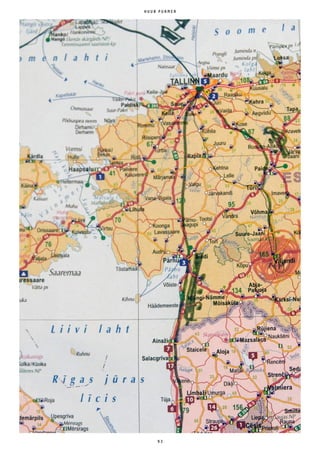
ourselves: for what world we are
educating? We are realising that the
quality and development of edu-
cation should be seen not just on
its own terms, but has to be seen in
its context. The context of a society
with a fragmented worldview,
T H I E U B E S S E L I N K
1 1 0
unable to sustain the wellbeing of
life in our cities and natural
environments.
Schools and universities do not
stand alone therefore. They are
part of wider social economic
structures, cultural expectations,
and societal developments. When
students perform lower in language
skills, this may not be due to bad
teaching, or insufficient resources,
but simply a matter of increasing
diversity in our classrooms,
including greater numbers of
students with non-native back-
grounds. Or on another level, it
may be because the educational
system was never designed to deal
with, or even value diversity. Many
of the issues schools encounter
cannot be resolved solely within the
classroom, or even within the
frame of education.
Conversely, our societies are
experiencing unprecedented chal-
lenges which demand education to
support a new kind of learning for a
new kind of world. And more than
ever it needs to embody and
exemplify that world.
The industrial revolution brought
forth an entirely different way of
understanding and organising the
world, which has produced tremen-
dous wealth and emancipation.
their governance. The internal logic of
the systems world such as that of the
market or bureaucracy, create cir-
cumstances such as an overemphasis
on testing or disciplinary separation
that are blind to human values and
relationships. The question for the
Move Maker is therefore: How to
‘decolonise’ the life world? or how ̀
do we humanise the systems world ?
Connecting the whole
world to the whole human
There is a silent revolution going
on in education. A globalising and
interconnected world forces us to see
the bigger picture, and accept the in-
herently unpredictable nature of
complex and exponential develop-
ments. Our first reaction might be to
try and fight the overwhelming com-
plexity by creating equally complex
mechanisms of control, to make the
uncontrollable controllable, or make
the unpredictable predictable. This
form of shortsightedness is dange-
rous, and causes one reform after the
other, because every solution is a
mere reaction to a symptom. Schools,
teachers and students suffer as a
consequence. The real challenge for
education lies in escaping this sim-
plistic view. Changing education has to
come from a deep, a radical under-
standing of what is going on, both on
a human and institutional level.
C H A N G I N G E D U C A T I O N
It also produced an exhaustive econ-
omy and unsustainable societies
with rising inequity. In the economy
we have found new coordinates for
development in the principles of
People, Planet, Profit, and Purpose
as its latest addition. In education we
are searching for such coordinates
on which to navigate as we feel that
something substantial in society has
changed, and we have not yet found
the right response.
A tentative direction for such coor-
dinates could be to take the “whole
world” and the “whole human being”
as starting points. These are the
broadest terms that MoveMakers
from vastly different contexts can
agree on. From there I can say some-
thing about the kind of change that
MoveMakers are working on. And
finally, I can give some tips for every
MoveMaker out there who is on his
or her way to make such change.
By connecting the whole world and
the whole human being I hope to
create a bridge between what
Habermas (1981) called the “systems
world” and the “life world."
Habermas argues that the “life
world” is based on communication
and human relationships. The eco-
nomic and political systems of the
“systems world” require an instru-
mental rationality that allows for
1 1 1
design are helping to create
embodied learning experiences.
An experimental and iterative
approach allows us to know what
to do when we do not know what
to do. But it also allows for the par-
ticipation of every perspective,
every culture, every affected
person in finding the questions
that matter and the answers that
work for everyone. This is why labs
are such an effective pedagogy for
transformational learning.
Connecting the systems
world and the life world
Our modern desire for mastery
over the natural, social, and eco-
nomic world has generated an
increasing instrumental rationality
of efficiency at the cost of a human
relationality of value. Education
becomes a manufacturing process
that delivers a qualified workforce
to an economy of bene t. Quali-
fications become commodities.
Students become consumers, and
study results return on investment.
We have been living a paradigm of
simplification in which we have
attempted to reduce meaning and
ambiguity of life into measurable
and sellable units of productivity.
It is a form of fundamentalism, just
as the extreme focus on commu-
nity in state communism was or the
religious zeal we find in many
T H I E U B E S S E L I N K
on a more than abstract level what
global interdependency means,
and what its consequences are. We
become part of the world only to
the extent that we experience its
relationships to our lives. It is there-
fore a moral imperative to develop
a systemic sensibility. This means
that one of the main responsibili-
ties of education today is to design
experiences that allow for the
development of such sensibility.
Experiment
The global forces that determine
our lives and societies have be-
come larger, unpredictable, and
therefore uncontrollable. This does
not mean we should feel over-
whelmed, sit back and suffer the
consequences, or that we should
relieve ourselves from responsibil-
ity. If we cannot predict or deter-
mine the outcomes, the sensible
thing that remains for us to do, is
to determine the quality and intent
of our input. From there we experi-
ment and iterate through different
experiences and understandings.
Not in abstract abstractions in the
hope for an ideal theory, but in
embodied experiences. The maker
movement is a great example of an
approach that meets that need.
Tinkering, playing, and working
from creative passion, using
serendipity to come to meaningful
Accept different
forms of knowing
For such an understanding we have
to allow ourselves to broaden our
horizon, and accept all forms of
knowing as valuable contributions
to the partial understanding of
ourselves and the world. We used to
find coherence in our education by
following subjects and disciplines for
instance, but a new coherence will
have to come from interrelation-
ships between all kinds of knowing.
The whole beyond
the parts
An education for a whole world
starts from this position. The
qualities of a whole cannot be
described by the sum of its parts,
and vice versa, the behaviour of the
parts are to some extent always
determined by the whole. What a
student learns and who he or she
becomes therefore, is determined
not only by the content of study, but
much more than that: by the
environment, attitudes, beliefs, pro-
cedures, values, processes, spaces
and relationships involved.
Systemic sensibility
We are living in blissful ignorance
of the devastating origins of our
material wealth, because we have
never truly learned to understand
1 1 2
parts of the world. What Habermas
called the “system world” has col-
onised the “life world”, creating the
sense that the institutions within
which we live are not just bene-
volent, or in our best interest. We
need an economy of human values,
and a school system that puts the
continuous creation of these values
at its centre.
From disciplines to
questions that matter
Disciplinarity at school and work
represents a way of thinking and
organising knowledge in the form
of ever greater specialisation and
separation. The world and our
experience of it is simply not or-
ganised that way. Things get their
meaning in relationship to each
other. Our primary shortcoming in
school and society is not that we
are not good enough at a certain
subject, but that we organise our
knowledge in abstract and simplis-
tic ways, unrelated to what matters
to us or the world around us. Our
solutions to social, economic or
ecological problems are therefore
not only inadequate, but are the
cause of these very problems. We
think it is perfectly normal if an
economist decides over the course
of our economy without reference
to sociology, art, or psychology for
Diversity as learning
Our classrooms have never been so
diverse. They are showing us that
the world is larger than we were
used to, that there are more ways
of living than what we were used to,
and that we are invited to build
bridges between people of di erent
cultures, backgrounds, and beliefs.
Maaike Boumans addresses the
necessity of diversity in a multi-
cultural society (see chapter on
page 34) because educating for the
whole world means inhabiting that
world together, and approaching it
from a developmental point of view.
It is something we need to learn.
Learning for the
whole human
In Jean Piaget’s (1969) theory of
cognitive development, which has
been very influential on our
schools, formal reasoning repre-
sents the highest stage of cognitive
development. While Piaget focused
his work on children, we now know
that development continues in adult
years and that there is more than
development. Our systems, how-
ever are still largely focused on
formal reasoning, and value
abstract and logical thinking over all
other forms. This works perfectly
well for the narrow and formal
purpose of solving well-defined
C H A N G I N G E D U C A T I O N
instance. Rather than organising
education in disciplines, we can
now organise knowledge and activi-
ties around meaningful questions.
Incorporating
incompleteness
We leave school thinking that
the world is well organised, and we
have great confidence in our
understanding of it. Instead,
uncertainty, incompleteness and
not knowing are inherent to the
world and ought to become part of
our models. Learning to fruitfully
facilitate creative disorder, seren-
dipity of learning, and constructive
confusion will have to become a
priority for schools.
We are trained to place different
kinds of knowing opposite of one
another. Nature opposed to
nurture, science against art or
religion, realism opposed to
idealism, subjective opposed to
objective, etc.
In order to understand the world, it
is important to distinguish between
the things we observe. But it is
equally important to see the
pattern that connects them. Our
simplified and extreme focus on
the former has made us blind for
the latter.
1 1 3
problems, where all necessary
information is readily available. But
it is not enough for a full life in a
world of paradox and changing
human values. Only an embodied
learning that engages the whole of
what makes us human makes us
e ective.
What is incoherent learning? We
used to find coherence in edu-
cation through our curricula by
following subjects and disciplines,
but as there are too many things to
know and no curriculum is adept at
dealing with changing
environments, we must find co-
herence in the bodies of
knowledge that spring from an
integrated understanding of
patterns and themes. We need to
see learning as an embodied way of
expanding consciousness to include
ever greater complexity, not the
process of adding more knowledge
and skills to a person’s abilities. The
impulsive relationship to the world
of a child requires a less compre-
hensive awareness of the self
and surroundings than does the
social, self-directed or transforma-
tive relationship with the world that
a developed adult has. Learning is
the meaningful integration there-
fore, of different ways of knowing.
Bildung is not enough. A general
education in the arts and sciences
there, and can only act to instigate a
movement of self-organising rein-
forcement.
What I mean by that is that change is
a by-product of connected initiatives,
people, and ideas that co-evolve and
learn when they work in close
relationship with one another.
In order to change education, we
need to develop the art and process
of educational evolution, harnessing
the collective power of people and
unleashing the potential of many
bottom-up initiatives. We do not
need to start over, we just need to
re-balance the roles and responsi-
bilities of people. This may mean a
stronger role for government or
university boards in some cases, and
a stronger role for students and
teachers in others. It means simpli-
fying regulations and bureaucracy,
enabling people to take a greater
responsibility in the system.
In this chapter I take the position of
the MoveMaker though, and what he
or she can do to change education
so that it can serve the whole world
and the whole human being. Unfor-
tunately, everyone needs to reinvent
their own wheel. Such is the nature
of paradigmatic change. But there
would not be any fun to it if the only
thing to do was 'copy-paste' the
template.
T H I E U B E S S E L I N K
will not make us free citizens of the
world. “Bildung” is usually under-
stood as either a broad classical
education or the development of
the kind of critical thinking that
makes us good citizens. However,
beyond critical thinking, there is the
need for collective creative action
that can shape our society. Learn-
ing for a democracy does not
merely mean knowing how to use
your right to vote, it means having
the ability and the courage to make
that world for the common good,
also if that means standing up to
a dominant narrative or building
unlikely bridges between conicting ̀
groups.
Changing education
People often ask me how they can
change education, but education
as such cannot be changed. There
is no place from which you could
change it, there is no speci c deci-
sion or action that could be taken
to bring about change. In fact, the
question is misleading, because
education is not a thing, nor a hier-
archical system or organisation. It
is a distributed network of relation-
ships between so many people,
ideas, institutions, economies,
cultures, sectors, etc. and it has no
centre from which it is or could be
governed. We are somewhere in
1 1 4
MoveMakers recognise that they
can act, not govern or change, and
see what happens. Listen to what is
needed, and adjust to it. Making
visible and experiential what is
happening in education is the best
way for it to learn from itself.
MoveMakers, whether they know it
of themselves or not, stimulate
unpredictable dynamics by con-
necting people and ideas from dif-
ferent worlds that allow the world
to learn and change. We cannot
know whether we are doing the
right thing, but we do know that we
are building something that wants
to come into being. Something that
serves everyone more completely
than is the case right now.
Vision
A vision for the future is a constant
creative process that MoveMakers
are involved in. Always trying to
find and define new coordinates for
orientation. It is important to have,
since changing education takes
many years. Creating a (shared
vision and scenarios enables
people to feel a tension between
where they are and where they
want to be, and thus allows them
to commit to something larger than
themselves. That is how
MoveMakers connect people to a
mission.
of our sectors, cities or education-
al system. We have to understand
the sector, its policies and econo-
my. The meso level also compri-
ses individual organisations, your
university for instance. The meso
level has its own logic of change.
Finally, there is the micro level,
which concerns your own self in
relation to your own work.
Knowing who are the MoveMakers
at each level here is important if
you want to bring about a change.
Connect to them! What are the
common barriers you encounter?
What is the question that these
MoveMakers are dealing with? In
what international trends do you
find support?
Levels of Learning
Another way of looking at differ-
ent levels, is through the lens of
Bateson’s (1972) levels of learning.
I found it helpful to see change at
the micro, meso and macro level in
parallel to his three levels of learn-
ing. Bateson’s levels are about
transformative learning, which
refers to a qualitative shift in
meaning making on the part of the
learner so that the learner can re-
frame his own assumptions and
thought patterns (Mezirow, 2000).
First order learning here is about
incremental learning. New facts,
C H A N G I N G E D U C A T I O N
Live in different worlds
This is the age of integration.
Transformation happens on many
different levels, in different places,
and across domains and disci-
plines. You have to get to know
them and move between them if
you want to bring about significant
change today. Change makers live
in more than one world. In terms
of language, sector, experience,
culture, etc.
We distinguish between the micro,
meso and macro level, for instance.
The macro level is all about the big
societal developments, the eco-
nomic paradigm, cultural change, or
global environmental issues. These
are hard to influence, but provide
the context for our work. Some of
them are favourable, others run
counter to our efforts. Today the
scale and number of developments
that we are affected by is so large
that we need to choose what story
we want to be a part of. do not
think about how to change the
world, feel what makes you come
alive and connect it to a place and
story that needs you. For this we
need our systemic sensibility and a
good connection to our deepest
aspirations. At the meso level we
find the structural arrangements
1 1 5
skills and information. In a second
order of learning you are able to
change your perspective on the
world. You recognise that meaning
is negotiated for instance, and that
there are different perspectives. It
is often called metacognition, or
learning to learn, and refers to the
awareness that challenges the as-
sumptions underneath the knowl-
edge and skills one learns.
Second order learning often
involves experiences with radical
alternatives, or different ethics, and
may lead you to change your
values and assumptions, and as a
consequence, change your pur-
pose. For example, an experience
leads you to asking yourself the
question of whether effectiveness
and efficiency serve the right goal.
The third order of learning that
Bateson speaks about involves a
change of paradigm and identity. It
questions our epistemology; the
way we know things. This shift of
consciousness is profound and
changes our worldview. Our world-
view, in return, changes the way we
understand things in the second
order.
Why it is so important to look
through these lenses is because
systemic change requires a change
in paradigm. A paradigm does not
T H I E U B E S S E L I N K
change unless people have gone
through a transformative learning
experience of the third order. Sys-
temic change requires enough
people and institutions to go
through third order learning.
Bateson himself thought that only
few people would ever experience
it, but I have seen many cases in the
students and change makers I
worked with. The reason for this, I
believe, is that we have both the
Zeitgeist on our side, and have
advanced in our methods for or-
chestrating transformative learning.
Tips for MoveMakers
These are some of the principles I
learned in the field and are a more
tactical and strategic advice for
change. Systemically, change would
come through defining new values
of measurement, new pedagogies,
new policies, new collaborations,
new roles of educational institu-
tions, new business models for
education, and new modes of pro-
duction/organisation. But I will not
talk about these and instead stay
close to the MoveMaker. These tips
are a good place to start I found.
Start Small
People with big ideals and a large
sense of responsibility want to
make a large impact. It seems
counterintuitive to start small,
therefore. If change were that easy,
we would not be doing this work.
Large initiatives tend to attract
large resistance. And that is fine,
once you are able to withstand or
work with that resistance. Starting
small and invisibly allows you to
develop strength and support.
Create a peer group
If you do not want to feel alone,
which is almost inevitable in
change work, you need to find that
Gideon’s band of enthusiasts. You
may first be seen as amateurs, and
that is perfect. Do not attract too
much attention in large organisa-
tions. Being a working group is
much better than being “the change
agents.” Have people join out of
passion, so keep the budget low.
Find unlikely partners
New solutions often come through
new connections. Who can you find
that may support the change you
are looking for? We are recognising
that many fundamental issues
cannot be addressed within one
organisation or sector alone.
Governments, companies, universi-
ties and civil society are becoming
more and more dependent on one
another, and have to find ways of
working together.
1 1 6
Personal Story
I had the privilege to work on the
design of a teacher training
academy, the Dutch School (De
Nederlandse School). Among the
collaborating partners were
schools, universities, the creative
industry, a publisher, the ministry,
a journalist, a designer, many
teachers and my think tank, The
Learning Lab.
All stakeholders had to get out of
their comfort zone and learn
together by collaborating on a
shared initiative. This way a special
animal was born. It was different
from anything else as it belonged
to many worlds. It thereby became
an effective instrument for change
as it could communicate in many
languages and operate on many
playing fields.
It was key to start with the teacher,
the teacher who wants to make
a change. Around the teacher
we could build a support system
that allowed him or her to make a
difference. Everything that was in
the way had to go. Management
restrictions at school, the lack of
required skills to create change,
funding for training, and the loneli-
ness that pioneering teachers often
encounter all had to be designed
away. You can only do this when
you work together beyond your
own organisation or sector!
hacker will tell you that they do not
need all the complicated code to
get into a highly secured facility.
Instead they may call an employee
pretend-ing to be IT services to ask
for his log in codes. The same is
true for hacking your educational
system. Who makes the decisions
in the end? Whose approval is
needed? What kind of actions
generate respect? Find the white
ravens, they are everywhere, in
every layer of society and any
organisation. Once you understand
the hidden system, it is open for
your hack.
Connect to partners
in their own language
and level
Know what level of awareness and
complexity your partners can deal
with. When connecting to partners,
make sure you relate to them on
the level where they can make the
next step in their development. A
competitive organisation will not be
able to hear a cooperative solu-
tions, unless they come in the form
of an innovation that provides com-
petitive advantage. A bureaucratic
organisation is unable to hear agile
solutions, unless they come with
clear provisions for accountability.
Speaking of investment business to
a value driven NGO is difficult until
they can see how there is a place
C H A N G I N G E D U C A T I O
Sharing
Innovators have to prove them-
selves all the time, create legitimacy
and permission to act. They often
have to sell their story and success
and this makes is hard sometimes
to let go of our ideas and let others
fly with them. The collective is many
times stronger than any one alone,
and it is often us ourselves who are
in the way of allowing the potential
of the collective to work for our
mission. Claiming an idea often
makes people reluctant to join you.
Many of us need the applause, and
understandably so. We work so
hard to make a dierence, often ̀
sacricing much ̀ of ourselves, only
to see that others get the acclaim.
Step over it, and see how successful
your initiative becomes. In the end
this is the biggest sign of
acceptance. Instead of holding on to
your idea, start making coalitions,
connect parties.
Work with the system
to hack the system
Know the system, like a hacker
knows the system better than any-
one else, and use it for your
mission. Insert your ideas in every
procedure or planning cycle. Look
for opportunities. Humans are
often the best hack. A computer
1 1 7
for business and capital initiatives
in the ecosystem of change, as
long as they are aligned on
purpose. The first, second and
third order of learning also apply
here.
Cutting out the
middle man
In every sector we see the same.
The middle man is being dropped
from the equation. Airbnb, Wiki-
pedia and artificial intelligence are
taking the place of many middle
men. In organisations you see a
similar trend. What people like
Ricardo Semler started in the
eighties is now taking a fast flight
in organisa-tional development
(Semler, 1993). Self-organisation
brings the end of the manager as
we know him. The education sector
will not be an exception. Even
though universities are still largely
hierarchically organised in line with
public man-agement principles,
even more so than ten years ago.
This means that organisations feel
the need to keep control, and have
not found alternatives to govern
themselves.
Dealing with the middle is an art in
itself. The middle is there to pre-
serve consistency, and most of the
time that is a good thing. When
creating change, the grassroots,
Embedding is very much about
helping organisations develop a
new worldview and think
differently. Connecting the
initiative to an existing and
preferably high level narrative.
How to change a
worldview?
By making the familiar strange. The
opposite of a truth may be
a lie, but the opposite of a deep
truth is another deep truth. When
the dominant discourse tells us to
personalise learning, you can make
the case for collaborative learning.
By contrasting the two you engage
with the legitimate discourse, but
enable a different thinking.
By systematically turning every-
thing around, and creating an
opportunity out of a problem, you
use the energy of the problem for
something new (Benammar, 2012).
Change requires this radical
rethinking, reframing and ability to
think in paradoxes. Paradoxes are
seemingly opposed positions, and
therefore can and should be trans-
cended. This means being able to
hold up more than one truth at the
same time, and playing with para-
doxical concepts like controlled
freedom or spiritual business.
Reversal is a way to get out of
resistance.
T H I E U B E S S E L I N K
bottom-up movement is often
ready, like you can read in the
chapter on Grassroots education by
Huub Purmer (see page 88).
Also at the strategic level, you will
find angels and supporters of
change. But it is often the middle
that does not feel the benefit. By
Generating concrete alternatives
from the bottom up, and genera-
ting support from the top down,
most organisations move eventually
because this way managers will not
risk their heads.
On the other side, starting self-
organising, distributed networks
across your field or organisation
will eventually create a shift in the
organisation.
Embedding
Embedding your change initiatives
is crucial. Too often, initiatives start
with great energy, but die because
they turned out too fragile to
sustain themselves in an environ-
ment that was not naturally
nurturing for its kind. Embedding
means that the impulse is connec-
ted to larger infrastructures,
developments, policy, or even
products. Something that it can be
attached to, that can carry it beyond
itself. By creating new questions for
education, programs may develop
around them.
1 1 8
Moving on
1 1 9
Moving on
Reflecting forward through personal journaling
At the end of this book, instead of
offering a conclusion, we invite you
to reflect on the journey that we
have taken together. Whether you
read every article or not, or if you
came directly to this page, we invite
you to take some time to explore
these questions: What is present
now? What potential does this
unique moment hold? And how
might you contribute to the
collective unfolding of our stories?
A good way to explore these
questions is through a reflective
practice called Guided Journaling
(Presencing Institute, n.d.). You do
not need to take a long time to do
this, but we suggest that you take
enough time, and most importantly,
quiet time. Start by eliminating dis-
tractions. Turn off your devices, take
a break, gift yourself with at least
thirty to forty-five minutes to write
whatever comes.
Do not spend time thinking about it,
just go with whatever arises in you.
When you have written your
answer, move to the next question.
When you are ready, you can
choose to share it with a friend or
colleague. That can help you to
reflect more deeply. Make your own
decisions about how much you
share.
Guided Journaling Questions:
1. Challenges: Have a look at your
work and life from the outside as if
you were another person. What are
the most important tasks or chal-
lenges your life/work is currently
presenting?
2. Self: What are the three of four
most important achievements or
competencies that you have
developed in your life? What about
in your work? (examples: raising
children, being a good listener,
creating a new educational
programme).
3. Emerging Self: What three or four
aspirations, interests, undeveloped
talents or dreams would you like to
focus on in your future journey?
(examples: creative performance,
taking your work to a new level,
starting a movement).
4. Frustration: What frustrates you
the most in your work or personal
life currently?
5. Energy: What are your most
important sources of energy? What
do you love?
6. Inner resistance: What is holding
you back? Describe two or three
situations in the recent past where
one or more of these voices
stopped you from exploring your
situation more deeply:
a. Voice of Judgement: your mind
closed down by stepping out of
inquiry and into opinion or judge-
ment.
b. Voice of Cynicism: your heart
shut down by disconnecting in-
stead of relating.
c. Voice of Fear: you held onto the
past or got frightened of the future
instead of staying open to the
present.
7. The crack: What new aspects of
yourself have you noticed over the
last few days or weeks? What new
questions and/or themes are com-
ing up now?
8. Your community: Who makes up
your community or tribe? What are
their highest hopes for your future
journey? If you were in their shoes
and looking at your life through
their eyes, what would you hope
for your future? Choose three dif-
ferent examples.
9. Helicopter view: Have a look at
yourself as from a helicopter view.
What are you trying to do in this
stage of your personal and profes-
sional journey?
Y O U
1 2 0
10. Last moments: Imagine you
could fast forward to the last
moments of your life. Look back at
your journey as a whole. What do
you want to be remembered for?
What footprints do you want to
leave behind on the planet?
11. Future advice: From the view of
your future self, the one who is
standing there in your last mo-
ments of this life, looking back at
your legacy, what advice would you
give your present self? Feel and
sense this advice, and then write it
down.
12. Crystalising: Returning to the
present, crystalise your vision for
the next three to five years. What
intention do you have for yourself
and your work? What are some
core elements of the legacy you
want to leave that you could begin
working on now? Describe them as
concretely as possible.
13. Letting go: What would you
need to let go of in order to
bring your vision to life? What
behaviours, thought processes,
worldviews, practices, etc. would
you need to shed?
14. Seeds: What in your current life
or context provides the seeds for
the future you want to create?
Where do you see your future
beginning?
15. Prototyping: If you were to
prototype a microcosm of the ‘new’
future over the next three months,
what would the prototype look like?
16. People: Who could help you turn
your future possibilities into reality?
Who might be your core helpers
and partners?
17. Action : What practical steps can
you take in the next three or four
days to bring your intentions into
reality?
M O V I N G O N : R E F L E C T I N G F O R W A R D T H R O U G H P E R S O N A L J O U R N A L I N G
1 2 1
Y O U
1 2 2
T H A N K S F O R R E A D I N G
Notes
1. The above interview guide was used during the MoveMakers LAB
learning journey, based on the interview guide for a healthcare leader-
ship programme by Benjamin Kafka and inspired by Otto Scharmer's
Theory U (2009).
2. To bring a bit more playfulness into your life and professional
manners, you could also inspire yourself by reading ‘The Dice Man’ by
Luke Rhinehart (1999). If you google ‘dice man’ you’ll find plenty of
material about this man who took up the dice to decide.
3. The Bologna reforms have been critiqued, among other things, for
focusing largely on economic aspects of education, such as cutting
costs and increasing efficiency. For instance, the Slovenian philosopher
Slavoj i ek has referred to the agreement as “an attack on the public
use of reason” and “the end of intellectual life as we know it”
(Frontline Club Exclusive, 2012).
4. The word Cynefin is Welsh and has a quite poetic meaning. It is
‘the place of your multiple belongings, both known and unknown’. It
was chosen by the author of the model, Dave Snowden, to describe the
evolutionary nature of complex systems, including their inherent
uncertainty.
5. This is a principle of Open Space Technology (Open Space World,
n.d.), a participatory leadership method where participants take
responsibility in creating their own agenda and in managing the
parallel working sessions. These sessions are organised around a topic
or issue that is relevant to a group of people.
6. See for instance Robert Kegan’s ‘Constructive Developmental
Framework’ (1982) or Bill Torbert’s work on ‘Action Inquiry’ (Torbert,
n.d.).
1 2 3
T H A N K S F O R R E A D I N G
Email addresses
Thieu Besselink
thieu.besselink@gmail.com
Diederik Bosscha
diederik@dock20.org
Maaike Boumans
maaikeboumans@gmail.com
Melanie Hernández
melanie.hernandez@impuls.net
Manuela Hernández Sánchez
manuela@mylightspot.com
Piret Jeedas
piret@ruumiloojad.ee
David Jul
david@movemakers.eu
Benjamin Kafka
benjamin@impuls.net
Justas Kučinskas
justas@arvi.lt
Ciska Pouw
info@ciscapouw.nl
Huub Purmer
huub@dock20.org
1 2 4
T H A N K S F O R R E A D I N G
Alphabetical Reference list
Baker, J.A. (2011). The Peregrine, The Hill of Summer and Diaries. In: J. Fanshawe,
(Eds.), The Complete Works of J.A. Baker. London, UK: Harper Collins.
Bateson, G. (1972). Steps to an Ecology of Mind. San Francisco, USA: Chandler.
Benammar, K. (2012). Reframing. The art of thinking differently. Amsterdam, NL:
Boom.
Brown-Martin, G. (2014). Learning Reimagined. How the Connected Society is
Transforming Learning. London, UK: Bloomsbury.
Campbell, J. (1949). The Hero with a Thousand Faces. Novato, USA: New World
Library.
Chambers, R. (2008). Revolutions in Development Inquiry. London, UK: Earthscan.
Cooperrider, D.L. & Whitney, D. (1999). Appreciative Inquiry. Collaborating for
Change. Willston, USA: Berrett-Koehler.
Cooperrider, D., & Whitney, D. (2007). Appreciative Inquiry. A Positive Revolution in
Change. In: P. Holman, T. Devane and S. Cady (Eds.), The Change
Handbook (pp. 73-101). San Francisco, USA: Berrett Koehler.
Covey. S. (2004). The Seven Habits of Highly Effective People. Powerful Lessons in
Personal Change. London, UK: Simon & Schuster UK, ltd.
Facer, K. (2011). Learning futures. Education, Technology and Social
Change. Abingdon, UK: Routledge.
Fritzler, J. (2015). Hack your Education. The Student guide to turning projects into
profits and passion into profession. CreateSpace Independent Publishing
Platform.
Garabal, A. (2012). ECS and the quest for professional identity: to
be or not to be? In: Dialoog Doen! Duurzame professionalisering in het
HBO. The Hague, The Netherlands: The Hague University of Applied
Sciences. The Hague: Opmeer publishers.
Godin, S., quoted in: Brown-Martin, G. (2014). Learning Reimagined. How the
Connected Society is Transforming Learning. London, UK: Bloomsbury.
Habermas, J. (1981). Theory of Communicative Action, Volume Two: Lifeworld and
System: A Critique of Functionalist Reason. Translated by Thomas A.
McCarthy. Boston, USA: Beacon Press.
Hassan, Z. (2014). The Social Labs Revolution. San Francisco, USA: Berrett-Koehler.
Hernández Sánchez, M. & Bosscha, D., (2008). Personal Leadership in a
Professional Perspective. Student guide. The Hague, The Netherlands: The
Hague University of Applied Sciences.
1 2 5
H ier, M. O. red , Hersted, L & Laustsen, L. (2011). Kreativ Procesledelse - Nye
Veje til Bedre Praksis. First e-book edition, Dansk Psykologisk Forlag,
Denmark. Retrieved from: http://kreativprocesledelse.dk/docs/
index.php
Holman, P., Devane, T. & Cady, S. (2007). The Change Handbook. The Definitive
Resource on Today's Best Methods for Engaging Whole Systems.
Oakland, USA: Barrett-Koehler.
Ratzmann, N., Ghez, J. J., Khodyakov, D. & Yaqub, O. (2015).
Employment and the changing labour market: Global societal trends to
2030. Retrieved from http://www.rand.org/pubs/research reports/
RR920z5.html
Jaworski, J. (2012). Source. The inner Path of Knowledge Creation. San
Francisco, USA: Berrett-Koehler.
Jensen, E. (2005). Teaching with the Brain in Mind. Alexandria, USA:
Association
for Supervision and Curriculum Development. Retrieved from http://
www.ascd.org/publications/books/104013/chapters/Movement-and-
Learning.aspx
Kaner, S., Doyle, M., Lind, L., Toldi, C., Fisk, S. & Berger, D. (2007). Facilitator’s
Guide to Participatory Decision Making. San Francisco, USA: Jossey-
Bass.
Kegan, R. (1982). The Evolving Self: Problem and Process in Human
Development. Cambridge, USA: Harvard University Press.
Komives, S.R., Lucas, N. & McMahon, T.R. (2013). Exploring Leadership. For
College Students who Want to Make a Difference. San Francisco, USA:
Jossey -Bass.
Macfarlane, R. (2015). Landmarks. London, UK: Penguin Books.
Meijers, F. (2012). Wiens verhaal telt? Naar een narratieve en dialogische
loopbaanbegeleiding. Antwerpen, Belgium: Garant Uitgevers.
Merriam, S.B. & Bierema, L.L. (2014). Critical thinking and critical perspective. In
S. B. Merriam & L. L. Bierema (Eds.), Adult Learning. Linking Theory and
Practice (pp 212-237). San Francisco, USA: Jossey-Bass.
Merry, P. (2009). Evolutionary Leadership: Integral Leadership for an
Increasingly Complex World. California, USA: Integral Publishers.
Mintzberg, H. & Acevedo, G. (2012). Fostering ‘Why not?’ Social Initiatives –
Beyond Business and Governments. In: Development in Practice, 22(7),
895-908.
T H A N K S F O R R E A D I N G
1 2 6
T H A N K S F O R R E A D I N G
Mezirow, J. (2000) Learning as Transformation: critical perspectives on a theory
in progress. San Francisco: Jossey Bass.
Palmer, W. & Crawford, J. (2013). Leadership Embodiment. How the Way We Sit
and Stand Can Change the Way We Think and Speak. San Rafael, USA,
The Embodiment Foundation.
Piaget, J. (1969). The psychology of the child. New York, USA: Basic Books.
Presencing Institute Toolkit (Presencing Institute, Boston: USA, 2015). Retrieved
from https://www.presencing.com/sites/default/files/tools/
PI Tool Prototyping.pdf
Rhinehart, L. (1999). The Dice Man. London, UK: Harper Collings.
Scharmer, O. (2008). Theory U. Leading from the Future as It Emerges. San Francisco,
USA: Berrett Koehler.
Sinek, S. (2009). Start with Why: How Great Leaders Inspire Everyone to Take
Action. New York, USA: Portfolio.
Semler, R. (1993). Maverick!: The Success Story Behind the World's Most Unusual
Workplace is Business. New York, USA: Warner Books.
Senge, P. (2006). The Fifth Discipline: The Art & Practice of The Learning
Organization. New York, USA, Doubleday.
Seyfan, G. & Smith, A. (2007). Grassroots Innovations for Sustainable
Development: Towards a New Research and Policy Agenda. In:
Environmental Politics, 16(7), 584-603.
Sinek, S. (2009). Start With Why: How Great Leaders Inspire everyone to Take
Action. New York, USA, Portfolio.
Snowden, D. J. & Boone, M. E. (2007). A Leader’s Framework for Decision Making.
In: Harvard Business Review. Retrieved from https://hbr.org/2007/11/a-
leaders-framework-for-decision-making
Stilger, B. (2013). Disaster as a Springboard for Resilient Communities. Reflections -
The Society of Organizational Learning Journal, 13(2), 26-34.
The Hague University (2012). Dialoog Doen! Duurzame Professionalisering in het
HBO. The Hague: Opmeer publishers.
Torbert, W. (2012) Action Inquiry Leadership and Action Inquiry Fellowship.
Retrieved from: http://www.williamrtorbert.com/action-inquiry/.
Watzlawick, P., Beavin Bavelas, J. & Jackson, D.D. (1967). Pragmatics of human
communication. A study of interactional patterns,
pathologies, and paradoxes. New York, USA: Norton.
1 2 7
Websites, online articles and other inspiration
Art of Hosting. www.artofhosting.org
CBS: Een op de zeven werknemers heeft burn-outklachten (2015, November
16). Retrieved from https://www.cbs.nl/nl-nl/nieuws/2015/47/cbs-en-
tno-een-op-de-zeven-werknemers-heeft-burn-outklachten
Design Council (2005). A study of the design process. Retrieved from:
http://www.designcouncil.org.uk/sites/default/files/asset/document/
ElevenLessons Design Council%20(2).pdf
European Commission. The Bologna Process and the European Higher
Education Area. Retrieved from: http://ec.europa.eu/education/policy/
higher-education/bologna-processen ̀
Freedom Lab. www.freedomlab.org
Frontal instruction (2014, November 10). Retrieved from https://
en.wikipedia.org/wiki/Frontalinstruction ̀
Frontline Club Exclusive (2012, August 1). Julian Assange in Conversation with
Slavoj i ek. Retrieved from https://www.youtube.com/watch?
v=j1Xm08uTSDQ&feature=youtu.be
Kaospilot. www.kaospilot.dk
Knowmads Alternative Business School. www.knowmads.nl
Lightspot (2016). What is Personal Leadership? Retrieved from:
http://mylightspot.com/professional-happiness/personal-leadership
Movemakers Lab. (2016, June 15). MM Prototype: Learning Design Lab.
Retrieved from: https://www.youtube.com/watch?v=0Tlirr7DFsE
Open Space World. Open SpaceTechnology. Retrieved from:
http://openspaceworld.org/wp2/what-is/
Presencing Institute (n.d.). Stakeholder Interviews. Retrieved July from:
https://www.presencing.com/tools/stakeholder-interviews
Tagasi Kooli (the “Back to School” initiative). https://tagasikooli.ee
The Dutch School. www.denederlandsechool.nl
The Learning Lab. www.thelearninglab.nl
THNK School of Creative Leadership. http://www.thnk.org
WISE Initiative. www.wise-qatar.
T H A N K S F O R R E A D I N G
1 2 8
1 2 9
How is the MoveMaker
in you active now?
Pablo Picasso once wrote:
“I don’t search, I find. Searching, this means starting out from old stock and
a desire to find from that which is already known within the new.
Finding, that is the absolutely new, also in the movement, all paths are
open, and that which is found is unknown.
It is a risk, a sacred adventure. The uncertainty of those risks can only be
taken by those who know themselves safe in the unsafe, who are lead into
the leaderless, who, within the dark, let themselves be abandoned to an
invisible star, who let themselves be determined by the goal and who do not
in a limited and narrow minded human way determine the goal.
This openness for every new insight, for every new discovery, inward and
outward: This is essential in the human being of today, who, within all the
fear of letting go, still experiences the mercy of being held, in the becoming
open for new possibilities.”
Thanks for reading
This book is not about moving others, it is about moving yourself
to move with others. It is a book for MoveMakers. You may
already identify as one or, who knows, you may find yourself
becoming one while reading this book.
If you are interested in supporting learning within educational
institutions and beyond, we hope this book may inspire you to
take bold steps in shifting learning environments to meet the
challenges and opportunities of our time.
In a series of articles, the authors unfold different elements of
learning that they find important. They explore how we can
perceive learning, approach innovation in education and inquire
about conditions and foundations for learning to occur. This
book offers perspectives, questions and ideas, food for
reflection and action. We hope that it becomes relevant for
everyone working with learning, both inside and outside formal
educational institutions.
F O R M O R E I N S P I R A T I O N H A V E A L O O K A T M O V E M A K E R S O N L I N E :

Making new moves in education&learning

  • 1.
    Making New Movesin Education & Learning A! M! !
  • 2.
    2 Making New Movesin Education and Learning This book is an outcome of the Erasmus+ strategic cooperation project ‘MoveMakers: Co-Creating New Ways of Learning’. It is directly tied to the book ‘MoveMakers on the Move: The Story of Our Learning Journey’ and the documentary about MoveMakers. Published in 2016. Find out more: This book is licensed under a Creative Commons Attribution ShareAlike 4.0 International. MoveMakers is co-funded by the Erasmus+ programme of the European Union. movemakers.eu MoveMakers Lab facebook.com/movemakerslab
  • 3.
  • 4.
  • 5.
    5 Editor Manuela Hernández Sánchez Co-editors BenjaminKafka Diederik Bosscha Mary Alice Arthur Photos StepDraw (Dalius Kederys, Lukas Dun ius). Sander Hiire Gertrud Graf Mary Alice Arthur Proofreading Peg Sage Oetjen Manuela Hernández Sánchez Contributors This book was co-created during a three-day 'book sprint' at Nyenrode Business University in the Netherlands by a group of MoveMakers in July 2016. Benjamin Kafka, Ciska Pouw, David Jul, Diederik Bosscha, Huub Purmer, Justas Kučinskas, Maaike Madelon Boumans, Manuela Hernández Sánchez, Melanie Hernández, Piret Jeedas, Thieu Besselink. Design ANDSTUDIO / Domas Mik ys, Augustinas Pauk t This book is licensed under a Creative Commons Attribution ShareAlike 4.0 International.
  • 6.
    6 CONTENTS 9 14 20 28 34 40 48 56 Introduction In search forthe holy grail - innovation in education Piret Jeedas The mindset of a learning designer Piret Jeedas From a source of knowledge to a source of inspiration Diederik Bosscha The necessity of diversity in a multicultural society Maaike Madelon Boumans Holding space for the unknown Ciska Pouw Reconnecting to our authenticity Maaike Madelon Boumans Movement and stillness in learning Melanie Hernández, Justas Kučinskas, Maaike Madelon Boumans
  • 7.
    7 62 78 88 96 108 118 Designing learning journeys DavidJul, Benjamin Kafka The art of prototyping Benjamin Kafka, Diederik Bosscha Grassroots education - organising change fromthe bottom up Huub Purmer Personal leadership: the missing link in education? Manuela Hernández Sánchez Changing education Thieu Besselink Moving on You
  • 8.
  • 9.
    9 Introduction I N TR O D U C T I O N This book and you found each other. This book and you found each other. We are very curious about what happens between the two of you. We hope that you can inspire each other to learn and grow. Connected to this book are forty educators from five different countries and the various learning communities that they represent. During the MoveMakers Learning Journey, they visited each other's countries, hosted meaningful conversations and learned together. One of the results of this collective learning is this book: Eleven MoveMakers share the inspira- tion, insights and learnings gathered during our eighteen- month learning adventure. MoveMakers is a playground for learning and experimentation for adult education practitioners. With this book, we want to encourage you to be bold in taking steps that bring innovation to the learning environments that you are part of. In this way, we can collectively meet the needs and dreams of the 21st century learner, of our organisations, our communities and the planet. Why care about education? Learning is an important part of being human. It is a built-in driver for development and growth. As far as we know, it is what sets our species apart from others. No other animal has evolved as much through learning or is so dependent on learning as we are. We learn by observing and by trial and error. We constantly grow and cope with changing situations. When observing young children, you can feel their hunger and drive to learn! They want to stand on their own feet and to know everything about the world. Children often cannot wait to finally go to school! But, all too often, soon after starting school, somehow the system seems to suppress their love for learning. What went wrong? Our education systems still assume that we live in the industrial age. They are designed to educate us to have a job from cradle to grave. They treat learners like parts of mechanised processes. They aim to create a consistent standard of output. They focus on shaping students into people who should 'fit in'. Standardisation and institutionalisation are valued more than individual expression. We are so stuck in our definitions of what learning is, that learning itself has become stifled. On the other hand, things are shifting. We are in a critical moment in history. We find ourselves at breaking points, with systemic cracks becoming increasingly visible. We feel the urgency to access our highest future potential. We want to be part of creating a new and sustainable reality. We need a complete revision of our educational practices and systems. We also require a different set of values, approaches and designs. The field of education is part of this imminent shift. New forms of learning are emerging. Old ones are becoming obsolete. With this book, we share what we see in this emerging landscape. We hope that it can inspire you to co-create a new learning paradigm with us.
  • 10.
    1 0 I NT R O D U C T I O N MoveMakers is not an organisation. Instead, think of it as something that happens when a group of dedicated individuals or MoveMakers come together in one place and time. MoveMakers are people who are shaking the world of education. When MoveMakers meet and connect, they form a support network, a feedback loop and a movement. In this sense, MoveMakers is the following: 1. A home for educational change makers MoveMakers is a community of people with an urge to support change in education. It is a home for the lonely rebels who are searching for like-minded people. We believe that we can do better, but only together and through building strong personal relationships. 2. A laboratory to co create new ways of learning MoveMakers shapes learning journeys as laboratories. It aims at offering a safe space to seek new inspiration, ask questions, test emerging ideas and experiment. We see that learning should be about finding courage to experiment and to close the feedback loop, finding out what works. 3. A platform for personal and professional development As educators we should always be in a learning quest: exchanging ideas, unlearning what we already know, rethinking our role as change makers, challenging and encouraging each other to be bold in creating a movement. What is MoveMakers?
  • 11.
    1 1 Why thisbook? We consider this book a success if it supports you in your work as a MoveMaker and when it inspires you to see yourself and your work as a MoveMaker: a person who makes a move, who shakes things up and loosens the grip of old mindsets. We hope that our insights can help shape a movement that we all can feel part of and support the emergence of new ways of learning and collaborating together. We wrote this book in order to share our learning and to widen the circle of our conversation. It contains some of our thoughts and work in progress. Consider it as an ongoing brainstorming session. We happily invite you to join us! I N T R O D U C T I O N This book is influenced by our respective working contexts. It is also shaped by our experience as adult learners during the MoveMakers Learning Journey in 2015-2016. Therefore, these contexts and experiences inform how we write about education, learning or innovation. Will it be relevant for your context? This, of course, is for you to decide. Just keep in mind the principle: 'use your own best judgement at all times!'
  • 12.
    1 2 I NT R O D U C T I O N We worked on this book in the same way that we created our own learning playground. We searched for an engaging and inspiring way to write - a task that sometimes can be ‘tedious’ or ‘lonely’. That is how we embarked on the challenge to write this book in a three-day ‘book sprint’. During the second week of July of 2016, thirteen MoveMakers gathe- red at the beautiful campus of Nyenrode Business University in the Netherlands: eleven writers, a story activist and a graphic design team of two lived and worked together to co-create this book. The process was quite experimen- tal and at times frustrating. We wanted to say more than time allowed. Yet, we were able to express what was present in us at the time. Afterwards, some of us continued to work on editing and proofreading. Others crafted their articles into more complete stories. What you are now holding in your hands is the final result. The style of this book reflects the diversity of our team. Some articles are personal or colloquial while others are less informal. Other articles are action-oriented and hands-on, while others are more reflective or philosophical. Writing a book in three days You can read this book in several ways: from the beginning until the end. Or simply follow your curiosity and read the pages that trigger you the most. The articles are illustrated by personal stories, questions and exercises to enrich your practice. Next to publishing this book, you can find our insights on our blog at www.movemakers.eu. We invite you to join us there and continue our conversation. During the MoveMakers Learning Journey, the perspective of ‘what learning is’ changed for many participants. As one participant said: “The MoveMakers Learning Journey made me look at my own educational history. I realised now how much I saw learning as having to get things done and being able to show that ‘I did it’.” We dedicate this book to anyone willing to explore the field of learn- ing in all its diversity and contexts. Whether it is teachers, trainers, facilitators coaches, professors or entrepreneurs, this book is for people who aspire to seeing their work as being more than just ticking boxes and saying ‘we did it’.
  • 13.
    1 3 I NT R O D U C T I O N We are very curious about whoyou are and why this book drewyour attention. We assume thatyou are passionate aboutlearning and that you have arelationship with education,facilitation and training. Wehope that this book inspires youto bring learning back into the heart of education, to take new steps, to make a move! And of course, we would love to get in touch with you and hear whatyour bold move is! Who are you?
  • 14.
    1 4 In searchfor the holy grail - innovation in education
  • 15.
    1 5 P IR E T J E E D A S In search for the holy grail - innovation in education Is there a way to learn to be wise while bringing change and innovation into the fields that we care about? The field of education is under attack. Educators are suffering from what is called ‘just-another-change- fatigue’. The search for the holy grail in innovation in education is every- where. Learning is something many of us deeply care for. We see the cracks in the education or training field, and sense the need to 'change' it. Maybe a different future is possible. As Seth Godin says: “Oh, let’s reinvent ourselves so that we can create better graduates for a different kind of world” (as cited in Brown-Martin, 2014. So, is there a way to learn to be wise while bringing change and innovation into the fields that we care about? The time of big questions The landscape of learning and education is shifting more than ever: many initiatives around the world tackle the issue of innovation in education (e.g. WISE). There are new schools, programmes, univer- sities emerging all over the world, deciding to do things differently. There are a great many voices, thinkers, doers and practitioners who are tackling the challenges of making teaching, learning and edu- cation as engaging and as relevant as they can for what is an uncertain future (Brown-Martin 2014). At the core of those changes is the firm into action. Innovation is a possible answer to decaying systems. According to Hassan (2014), innova- tion is not an efficient process. It is messy. Innovation arises from a community of people focused on trying out lots of things and learn- ing their way to successful innova- tion. “It means asking deeply how badly do we want it. Everything flows from commitment to play”, ̀ says Hassan. So, are we as educa- tors committed to play in the field of the unknown? (see chapter ‘Holding Space for the Unknown’ on page 40). As the road is less travelled, some approaches might be helpful in designing education. We chose approaches that entail some form of structure, and which helped us to navigate around the messy pro- cess of innovation. In this sense, we used two basic architectures for our learning design: Theory U (Scharmer, 2009), a framework used for leading profound change; and Design Thinking (IDEO, 2016) as a method to generate ideas and create new prototypes. Innovation is a form of art that benefits from constant practice. As an educator you could develop a capacity to be curious, do something without a map, dare to take risks. It is the questioning mind asking: belief that learning can be meaning- ful, inspiring, relevant and learner- centred. The people at the core of new initiatives dare to ask some of the most fundamental questions of our time: What is education for? What is this school, university or training programme for? Why and how are we grading our students? These questions that are explored by experts, parents, learners or the wider community, invite us to revisit the most fundamental assumptions about the purpose of education. It is more interesting to witness how the answers to these questions could be turned into meaningful programmes, schools or initiatives. During the MoveMakers learning journey at the THNK School of Creative Leadership in Amsterdam we found out that the initiative came alive, inspired by these questions: If we could create a school we would like to attend, what would it look like? What are the questionsyou need to ask your colleagues and learners? Innovation as a practice In education, as well as in innova- tion, there is no ‘one size fits all’ approach. What is innovation in one context may not translate to another. To put it briefly, innovation is the ability to shape bold ideas
  • 16.
    1 6 I NS E A R C H F O R T H E H O L Y G R A I L I N N O V A T I O N I N E D U C A T I O N What is needed now to make learning meaningful? Innovation is not a one-time effort, but a constant search for what works. It is a practice where you set out on a journey and build the road by walking. At the same time, you stay flexible and responsive to any changes along the way. And you do it together with others. You need the insights, perspectives and the resources of a number of people in co-creating the new. Look for inspiration As part of an eighteen-month learning programme, MoveMakers went on exploratory journeys in The Netherlands and Denmark, visiting quite diverse initiatives, pro- grammes and start-ups to understand innovation in educa- tion (e.g. Handshake, B Amsterdam, Team Academy, Knowmads, Freedom Lab, Kaospilot, etc.). Here are some of the things we learned: • Making mistakes is part of learning. Therefore, we should cultivate the spirit of experimentation, the art of prototyping in all learners and educators (see chapter ‘The Art of Prototyping’ on page 78). • Self-organisation and taking responsibility for one’s own learning. In the Knowmads Business School, fifty per cent of the learning co-learners’ unique ways in learning. • A diversity of methods, project- based learning, creating a personal portfolio, engaging facilitators with diverse backgrounds, changing the context of learning, traineeships, and job-shadowing are all elements of innovative curriculums. While reading these few insights, one may wonder, so what makes it all innovative? Is this what learning ‘should be’ about? Always. We see more that in some ‘innovative’ programmes or initiatives learning is addressed in a holistic way. The innovators take lead in creating meaningful learning spaces, sens- ing the emerging future, the needs of learners and the changing face of the world. They do not wait for trends, but create those them- selves. They ask constantly: What is the kind of place where I would like to learn? and then create these places. It also seems that innovative programmes have a very clear sense of who they are, what they do and how they are doing it. They have created a strong DNA of their programmes and communicated it to a wider audience. The real creative challenge of our age starts now: is self-organised. It is important to support taking responsibility for one’s own learning starting from an early age. • Space matters. Materials, technol- ogy, space, and tools help to take a hands-on approach to learning, thus helping to make ideas instantly visible to others. • Learning in cooperation and teams. A team learning approach could be used to help to solve some of the challenges faced nowadays. • Learning beyond borders. The city or village around you can be a play- ground of learning. • Constant reflection as a way to make sense of one’s learning and learn more about oneself as a human being. At Kaospilot, one third of the programme focuses on analysing, making sense of one’s experiences. • Learning in real life and from real life. Shaping tasks that are relevant and meaningful for the learners. creating prototypes, solving real issues, developing real projects, organising an event, presenting ideas are part of assignments to engage learners. At the Team Academy in Amsterdam, learning is shaped around developing one's own business. • The 'teacher is a facilitator. A facilitator gives just enough guidance, supports reflection, asks questions to find his/her
  • 17.
    1 7 P IR E T J E E D A S To be a designer of education and meaningful learning every single day. Designing meaningful learning spaces is about doing something that matters to us and daring to say “this might not work” (Godin, as cited in Brown-Martin, 2014). Shaping future learning is about welcoming creativity, playfulness, experimentation and possible failure among educators as well as learners.
  • 18.
    1 8 I NS E A R C H F O R T H E H O L Y G R A I L I N N O V A T I O N I N E D U C A T I O N How to shape changes and bring innovation into the field of education wisely? Kati Tikenberg is a former teacher from ‘Back to School’ (Tagasi Kooli, n.d.). She is still passionate about the field of teaching and the importance of education in bring- ing change in society. She has brought together a group of peo- ple to co-design a new teacher programme that is highly relevant, meaningful and practical. We spent a day together, co-creating the next programme, asking some of the core questions of curriculum design: Why is this programme needed? What change will it bring to learners? What are the skills and attitudes one can demonstrate at the end of the programme? What are the core values of the programme? What is the best approach to reach its aim? Insights from MoveMakers Learning Journey were used as a source of inspiration. We realised that a more long-term approach is needed for programme design. The process showed that curricu- lum design can be a creative and engaging process that goes beyond planning something in an Excel sheet. As a follow up activity, interviews with teachers were carried out to hear more about their needs and dreams. These insights will be incorporated into the programme design. - Piret Jeedas
  • 19.
    1 9 P IR E T J E E D A S Seek inspiration: Create your own learning journey to learn from innovative programmes or curricu- lum design. Look for inspiration outside the field of education (e.g. startups, social entrepreneurs, businesses). Bring together colleagues to co create the next programme or curriculum. Create a challenging task (e.g. build aprogramme in a day). Use a diversity ofmethods to spark creativity). Retreat and reflect. At the end of theyear, create a place for reflection withrelevant stakeholders of your programme. Celebratesuccesses,lookforcracksinthe current programme and brainstorm about the next level of your work. Move on...
  • 20.
    2 0 The mindsetof a learning designer
  • 21.
    2 1 The mindsetof a learning designer P I R E T J E E D A S You can influence the field by your intention and way of being After meeting a variety of educa- tors, entrepreneurs, change makers from different fields of work, I have started to ponder: WHO is this person who walks away from the conventional, starts a journey into the 'land of unknowing' and creates something new? I have been triggered by the question: What is it that I need to learn or unlearn in order to do my work for the world? I have witnessed that learning is a process that you cannot force upon anybody. Therefore, as you create the space for learning, you need to do it in a very gentle and humble way. David Bohm, the quantum physicist, has left us with the follow- ing thought: you can influence the ̀ field by your intention and way of being (as cited in Jaworski, 2012). ̀ At some point during the Move- Makers journey, I became curious: What is this WAY of being that des- cribes a person designing learning experiences? I got curious towards myself: Can I develop them myself to do my work as an educator? A learning designer is a person who consciously creates meaningful learning experiences with the learner at the core. A learning designer is always searching for what works to maximise the learn- ing of an individual or a group. As I listened to the stories of change makers, some of the essential attributes making a great learning designer stood out. These attributes may be considered as a mindset describing a learning designer in action. Mindset as a philosophy of life is something that everybody can cultivate. As educators, we are keen on new tools or methods, but cultivating a mindset or your inner quality of being becomes even more important. Dare to ask questions Professor Keri Facer from the University of Bristol and author of Learning Futures (Facer, 2011) is emphasising the importance of ask- ing BIG questions right now: What is education for? What does it mean to live well in the world? How do we create a world where the point of life is life? (Brown-Martin, 2014). The paradox of the current time is that we do not really create space to ask these fundamental questions. But asking them is crucial -now more than ever- if we want to stay on the edge of constantly learning and de- signing education that matters. We also have a tendency to look for the right answer, something we may never find. But we can explore perspectives and be in inquiry. What are your BIG questions of today? Who are the people you would invite into exploring your big questions? How do you create time and space to inquire into the questions that matter? Being in inquiry means that you stay with the question and let the answer unfold, piece by piece. We need time and space for meaning- ful and well hosted conversations that can lead to new insights, perspectives or solutions. Follow your curiosity Maybe this is the ONE and almost ONLY essential element of always being in a quest for learning: Being curious about oneself, the others and the world around us. We are living in a luxurious time, with so many online and offline resources to learn from locally and globally. The pool of resour- ces is abundant. But the more opportunities we have, the easier it is to get lost in files, articles, books, platforms, etc.
  • 22.
    2 2 What ismy relation- ship to failure? When was the last time I failed deeply and what did I learn from that? How can I encourage a sense of experimentation in myself? What are you curious about today? How and where do you follow your curiosity? What do you want to discover more of? Following your curiosity is about looking at the world as an open field and the people you meet as a source for inspiration. It is about looking at how your own questions guide you closer to possible answers. During the MoveMakers Learning Journey we used Stakeholder Interview as a tool to follow our curiosity and interview people related to (adult) education, the future of learning and innova- tion (see a Stakeholder Interview guide on page 25). Following your curiosity is finding a source of inspiration that goes beyond your current field of work. Curiosity is exploring deeper what you already know while asking what is behind or beyond? It is about looking into the eyes of the learner with the will to know his or her story. You need to stay most curious about yourself, about your suppor- ting role, your limits as an educator, your abilities, your craft, etc. Be mindfully critical The narrative of the need to change education is tremendous. The articles on ‘How to...’, ‘Ten ways to...’, ‘We need innovations...’ are endless. Although the truth is out there, it is difficult to find the ‘right way’ when designing meaningful learning experiences; or to predict what education will be like in the future. In your quest for answers (as you learn, think and act) it is important to stay mindful and critical. According to Stephen Brookfield, critical thinking in learning means inquiring into your (and others') assumptions (as cited in Merriam & Bierema, 2014). You explore your assumptions from different perspectives with an open mind. Part of it is your readiness to change your perspectives along the way. How much do we trust the learners and their perspectives when designing learning? T H E M I N D S E T O F A L E A R N I N G D E S I G N E R Dare to experiment While designing learning spaces and experiences we are always in the 'land of unknowing'. We never really know whether the chosen road will take us to the desired destination or if the methods or approaches used will actually support learning. As a learning designer, you can see your work as an endless opportunity to experiment on the playground of learning. But it takes courage to try out new things, invite people to the unknown, or even admit that you do not know the answer. We are so used to knowing the right way. Experimen- ting is even more challenging when you dare to do things that you are not really keen on yourself. Recently, a teacher admitted that 'I do not like group work myself, but I need to do it to support my students’ learning'. While experimenting, you might also fail. When we developed the course Learning Design Lab (MoveMakers Lab, 2016) in Estonia, we stated in the invitation that failing could be part of the prototype. Still, people came. Failure is usually not part of our story as educators. But we made it part of our practice.
  • 23.
    2 3 What assumptions doI have about learning? How do I cultivate an open mind? How willing am I to let go? What are my sources of energy? How can I best take care of myself now? What practices help to sustain me? Take compassionate care of yourself Sometimes we forget ourselves. Today, even more often. We forget our own needs and desires. It is easy to put the learners' first. Being ̀ passionate about your work for others may let you drift away from the most important person in the picture: yourself. On our learning journeys we met several pioneers in education, as well as innovators and entrepreneurs. While listening to inspiring stories of making things happen, we also heard about their tiredness, anxiety and overwork. We need to learn to be honest with ourselves and others, to express our needs and worries and to ask for help. We need to take compassionate care of ourselves, in the same way we express compassion towards a friend in need. We need to take care of our energy and find practices that sustain us, whether it is spending time in nature, practicing yoga, mindfulness, movement, artwork, etc. Sometimes it also means walking away from the system that is too rigid for us to do our work. Probably there are other impor- tant essentials as well. Feel free to inquire into these essentials individually or with your colleagues. Although I stated before that curiosity may be the one or only es- sential, I have changed my perspec- tive already. The most important essential is to dare to always be in a quest for learning. As educators we might fall into the trap of ‘knowing, having seen/done that’ mindset. But it is an art to take a familiar road with an open mind. Therefore, stay curious, ask questions, be critical, dare to experiment and express yourself. Sounds simple enough, but if we meet at your field of work, ̀ how do I see you practising them? Really? P I R E T J E E D A S
  • 24.
    2 4 Taking partin MoveMakers Learning Journey has inspired me to experiment as an educator at the university. I got inspired by the idea of Knowmads Business School where fifty per cent of their learning is self-organised. During a university course ‘Professional Development for Adult Educators’ I invited learners to design their own curriculum based on their questions. I asked, “What are you curious about today? If you had three months, what would you like to learn?” Each student designed her or his own learning journey. It turned out to be a quite challenging task. As one student said later: “It is hard to learn this way, when we are always told what to do.” It was great to see many students taking up quite ambitious tasks: “I forgot that it was Sunday and I need to go to sleep,” shared another student at the end. - Piret Jeedas T H E M I N D S E T O F A L E A R N I N G D E S I G N E R
  • 25.
    2 5 Invite acolleague for a walk with you to explore the essentials of a learning designer and to inquire into the questions presented in this arti- cle. The Stakeholder Interview guide and the end of this article might also be helpful. An option could be that you write each question on a piece of paper, put them into an envelope and pull them out, one by one, while walking. If you could design a curriculum for your- self to develop or upgrade the essen- tials of the learning designer within the next year, what would it look like? Ask the question and you listen attentively to his/her thoughts and reflections. Access your appreciative listening (access your open heart): connect to your interviewee with your mind and heart wide open. Thoroughly appreciate and enjoy the story that you hear unfolding. Try to put yourself in your interviewee’s shoes. Access your ‘listening from the future’ field (access your open will): try to focus on the best future possibility that you feel is wanting to emerge. What might that best possible future look like for your interviewee? Leverage the power of presence and silence: one of the most effec- tive interventions as an interviewer is to be fully present. Do not to interrupt your interviewee even when he or she has a brief moment of silence. Moments of silence can serve as important trigger points for deep reflection. More often than not, these opportunities go unused because the interviewer feels compelled to jump in and ask the next question. Move in to action P I R E T J E E D A S Guide For Stakeholder Interviews A Stakeholder Interview (Presenc- ing Institute, n.d.) is a conversation an individual conducts with a per- son one would like to learn some- thing from. The interview is based on Scharmer's U-Process (2009) and it allows you to step into the shoes of your interviewee and see the world from his/her perspective. This is one way in which you can learn about yourself and about what is truly important to you. Principles Guiding Stakeholder Interview Create transparency and trust about the purpose and the process of the interview. Establish a personal connection early on. Suspend your voice of judgment (VOJ) to see the situation through the eyes of your interviewee. What matters at this point is not whether you agree with what he or she is telling you or not. What matters now is that you learn to see the situation through the eyes of your stakeholder. Do not argue with the interviewee. You are learning from him/her. Do not teach your interviewee.
  • 26.
    2 6 Leverage thepower of presence and silence • Stakeholder interviews work best face-to-face. If in-person interviews are not possible, conduct them by phone/Skype. • Below are some proposed questions you may use, but feel free to revise them to suit your specific context. • Decide whether to send the questions to the interviewee in advance. • What was surprising or unexpected? • What touched me? What connected with me personally? • What did you notice about yourself? • What ideas does this experience spark for a possible prototyping initiative that you may want to initiate? Step 4 Step 1 Step 3 Step 2 Before you meet the interviewee allow for some quiet preparation or silence Go with the flow of the interview At the end of the interview, find a quiet place to sit and write down any reflections or insights you may have from the interview. For example: Take some time to prepare the field T H E M I N D S E T O F A L E A R N I N G D E S I G N E R • Take ten to fifteen minutes prior to an interview to relax and anticipate the conversation with an open mind and heart. • Feel free to deviate from your questionnaire if important questions occur to you.
  • 27.
    2 7 • Howwould you introduce yourself today? • What is your story? What has brought you here? • What connects you to the work in or involvement with adult education (learning/training) and innovation? • What inspires you to do the work you are doing? • What key challenges are you facing within the field of learning/education/innovation? • What are your personal struggles? • What do you think works really well in the current system of education/learning? • What is really stopping us from creating a better system? • Who should be the change makers? What do they need? • What are your most important sources of success and change? • If you knew it would work, what would you change in the current system? • What should be the purpose of learning? Of education? • How could we create meaningful learning experiences for adults? • What innovations are needed for that? • What skills, knowledge, attitudes should we develop as adults in order to cope with a changing world? • What is the ‘inspiring school’ you would like to attend as an adult learner? • You are a mentor of a seven-year old child entering full-time education today in 2016: What are the skills, attitudes and knowledge that he/she should be equipped with to navigate the future? Notice the challenges, mindset of innovators, look for what works and sense the future of learning. Sample questions ¹ P I R E T J E E D A S
  • 28.
    2 8 A! From asource of knowledge to a source of inspiration
  • 29.
    2 9 Schools asliving systems Systems around us are changing rapidly. For a long time, it seemed that schools and universities were safe places of stability, where we could pretend that the world is ‘out there’. Reality has caught up with us: Dropout rates of around fifty per cent in the first study year are not unusual, the societal value of a degree is decreasing, the labor market is changing constantly and becoming more flexible, new jobs are created, others vanish, more students start their own businesses and teachers in the Netherlands experience burnout more often than people in other sectors (CBS, 2015). We see an ongoing interna- tionalisation of society and businesses, growing youth unem- ployment and worldwide migration of vulnerable individuals, (Janta, Ratzmann, Ghez, Khodyakov & & Yaqub, 2015). Schools are living systems that are part of larger systems. As a system shifts, so do schools too. Schools should be in constant communica- tion and collaboration with society and in an ongoing process of reinventing themselves. Schools can activate their learning capacity in order to survive and thrive in a changing environment. Why should we accept these high dropout rates, or the escalating rates of burnout What would happen if universities were not only adapting to trends, but actually created them and thus influenced the system from within? amongst teachers? Trends in society and the market are not a threat, but an opportunity to become leaders in our eld. We, teachers and students, are forming these systems and we can change them. The more complex a system becomes, the more we need to connect as humans and learn from and with each other. The quality of our relationships de- termines the success of our evolv- ing systems. Take the example of a flock of birds that moves and creates new patterns together, at times seem- ingly moving as one body, without an individual director organising the show. An important part of how birds do this is by monitoring their spatial relationship to the other birds. Therefore, how can we improve the relationships in our schools and D I E D E R I K B O S S C H A From a source of knowledge to a source of inspiration Why, in growing complexity, we need learning communities universities, so that they can become learning institutions and become more relevant to the challenges we are individually and collectively facing? The teacher is a learner first A teacher acknowledging that he/ she too has a learning quest makes all the difference. I have heard many teachers say (more or less explicitly): “This is how I do things. Let me just keep on working in that way. Why should I change?” Most teachers are still educated in ‘frontal teaching’, or teacher-centred instruction (Frontal Instruction, n.d.). This implies that the teacher is the main source of knowledge. Some of these teachers consider their classrooms as small kingdoms. Again, times are changing: today more knowledge is gained through the internet or social contexts, but also by trial and error (e.g. students setting up a business or organising an event). Due to technical innovations and diverse media, knowledge can spread exponentially. Taking these trends into consideration, I’m pleading for a different approach. I challenge teachers to step into their learning mode: Find each other -both teachers and students. Ask for support. Reinvent and co-create your work.
  • 30.
    3 0 ̀ why theyteach often go back to very personal events, to a deep passion for learning, for sharing stories, about growing up. These stories are appreciative and free from daily frustrations. Tapping into these personal stories often creates a spark in the eyes, a new door opens... transformation starts. Otto Scharmer (2009) calls the process towards knowing what your calling is ‘presencing’. This word is a blend of the words ‘presence’ and ‘sensing’. It refers to the ability to sense your needs and bring into the present the highest future potential either as an individual or as a group. In our three-day TOP training (in Dutch: Toekomstgericht Onderwijs Praktijk in English: Future Oriented Education Practices), in which thirty teachers from the University of Ap- plied Sciences of Leiden participat- ed, we asked them these questions both individually and collectively. This helped initiate their learning processes, which resulted in forming learning communities. Teachers now find each other in di erent ways and start collabora- ting in (re)designing their curriculum and changing their teaching practice A participant gave back to us: “I was a bit cynical at first, but now I remember why I chose to become a teacher!” This teacher dared to ask the ‘tough’ questions and created F R O M A S O U R C E O F K N O W L E D G E T O A S O U R C E O F I N S P I R A T I O N The teacher is a learner too, but what happens when the teacher is a learner first? And what happens when your passion for learning becomes contagious to your stu- dents? That shifts you from being a source of knowledge into a source of inspiration. Why am I here? Once a teacher also becomes aware of being a learner first, the justification for being in this work can shift from external (“I am here so that others learn...”) to internal (“How can we learn together?”) and reveals a possible blind spot: Why am I here and where does my pas- sion for education originate? The question “Why am I here?” is one we are hardly asking our stu- dents (I recommend you try it, and observe what that question provokes!). And we are not asking this question to ourselves. Why are you here? Why are you a teacher? What is your learning drive? Deep learning starts with asking ourselves these questions. It will trigger patterns, beliefs and stories which are related to our deeper calling where work is more than ̀ just an assignment, a job, but be- comes something we feel called to do. In many conversations I have had with teachers, stories about time and space to have a conversation with his colleagues. He reopened doors and reclaimed his sense of fun in learning and teaching. From a learning question to a learning community A question that intrigues me is how to move from being a community of (individual) learners to a com- munity that learns. The first case is typical for the old school classroom and teacher-centred education. The second is the result of student- centred or participatory learning. My sense is that once a system has started shifting in this way and be- comes a community that learns, it becomes able to adapt to new and challenging situations in an entirely di erent way. In a learning community, teachers start gathering around similar learning questions and start co- creating from there. These ques- tions can be abstract, such as “how can I teach from my inner source?” or more concrete, such as “how can we create a minor about new economic models?”, or “how can I improve my daily lessons?” When you share your learning questions with your colleagues and students and actually ask for help and input (how difficult is that for
  • 31.
    3 1 D IE D E R I K B O S S C H A a teacher!), it creates a culture in which learning communities are the norm. Besides that, you create a fun and excited team of teachers and students. It will positively affect the culture amongst ̀teachers and improve the quality of their work. Co creating a new educational reality When teachers are also learners, and start to create learning com- munities, the ground is prepared for co-creation. I challenge each learning community to do a prototype every now and then. This way you test your learnings in practice and learn by doing. Make it tangible, improve. Celebrate your successes and failures. Prototypes vary from designing a new format for your lessons to running a pilot for a new summer school. Very important here is that you dare to make mistakes and that the management allows you to make mistakes. Only then you can think of and try out your wildest educational fantasies! And only then, a real shift in educational paradigms can happen: from educational organisations to organisations that learn!
  • 32.
    3 2 This articleis inspired by my work at the University of Applied Sciences Leiden, The Netherlands, where together with Marien Baerveldt, I have been facilitating a process in which teachers are redesigning their curricula. Over thirty teachers are involved in this trajec-tory which has been going on for more than two years. It has led to a deeper understanding among teachers and a different level of conversations than they were used to. Colleagues are sharing more personal stories and creating a safer environment for collaboration. F R O M A S O U R C E O F K N O W L E D G E T O A S O U R C E O F I N S P I R A T I O N What happens when your passion for learning becomes contagious for your students? Teachers have started to consult with each other, apply new education tools, co-design their lessons and observe each other in the classroom. It is my conviction that the key element in that success is that teachers start asking themselves new questions and are redefining their passion for learning and teaching. By doing so, they create learning communities and together, they are improving their teaching practices. - Diederik Bosscha Why am I here? - What happens when the teacher is a learner first? - What happens when universities create trends instead of adapting to them?
  • 33.
    Move on... D IE D E R I K B O S S C H A Part of the success at the University of Leiden is that this learning movement is stimulated and facilitated by the management. Teachers are given time to meet. There is now a feedback system that provides space for everyone to learn from each other. However, if you do not have that kind of support, ask yourself: What small spaces are there within the system where you can plant a seed for a different culture? See who else can stand and practise with you. Find out how you can invite and involve more teachers and students. Talk to your manager about your ideas. Ask for space for experimentation and learning. And to the manager: How can you create a culture that encourages people to learn together? There is an investment needed in working like this, but the reward is a more robust, flexible and adaptable learning structure. And more committed teachers and students. 3 3
  • 34.
    3 4 EW S The necessityof diversity in a multicultural society
  • 35.
    3 5 The necessityof diversity in a multicultural society Learning how to appreciate the beauty of diversity in our classrooms A teacher asked me once to write down what I do not dare to say aloud. A highly recommended exercise by the way, although a challenging one. Here is one of the things I struggle to speak about, so I’m trying to put it in writing. Diversity is a broad term and can be interpreted in many ways. For me it sparks connotations of race, colonialism, slavery, discrimination. The unresolved question of know- ing how to change patterns that seem to have settled underneath my skin, being a white woman in a privileged Western society. Its worldviews have penetrated my language unconsciously. What if in- stead of ‘blackmailing’, we called it ‘whitemailing’? What if ‘black’ does not equal ‘threat, bad, danger’? What if ‘white’ does not equal ‘serenity, peace, safety’? How can I counteract my own white privilege? How can I support letting diversity show itself? I am trying to become more con- scious of the ways in which I inhabit my place in society. The ways in which it might prevent others from inhabiting their place. And as I write these very words, I can hear a friend, a neighbour, my father, or a colleague say: “Don’t be so serious, the situation is not that bad.” But it seems to me that it is, and has been for a while. I am definitely not the only one who thinks so. As I am writing this, the killing of Afro- American Alton Sterling by police officers (on July 5th, 2016) and the video footage of witnesses have yet again sparked the debate of police violence against people of colour in the US. And even though I live 6000 miles from Louisiana, I feel this issue touches me deeply. I recognise its roots and effects in my own society. The ‘Black Lives Matter’ movement is a powerful counterforce to the white supremacy on which our wealth has been built. Or, more precisely, what we consider as ours, and what we consider as wealth. It is a movement in a history of fighting for equal rights and justice. The tricky thing is, that when you are white, you do not really notice. Just notice the ways in which institutions are functioning to serve your needs first, over others. Notice the ways in which the police treat people with another skin color differently. Notice how shop owners might pay extra attention when you come in, specially when you are in a group of young males. Notice how predominantly white people are being represented in movies, in series, in books, in theater plays, in advertisements. Notice how few nonwhite men and women make it to the top of politics, to the top of large corporations or boards of directors. If we believed our own constitutions, this should not be the case. Growing up in The Netherlands I was born and raised in Amstelveen, on the outskirts of Amsterdam in the Netherlands, Western Europe. While I was grow- ing up, my neighbourhood was predominantly white, and I deeply appreciate that at least a tiny bit of our Earth’s human diversity is now radiating some of its richness in my old neighborhood. Growing up in the 1990’s and 2000’s, integration of immigrants, specially from Morocco and Turkey, was an ‘issue’. The country was in a heated debate around the question whether a multicultural society could ever work, specially after the murder of right wing, homosexual politician Pim Fortuyn on May 6th, 2002. There was an almost tangible relief when it became clear that the per- petrator of Fortuyn was not an im- migrant, but native Dutch. Tensions rose again with the murder of Theo M A A I K E M A D E L O N B O U M A N S
  • 36.
    3 6 ̀ van Gogh,a filmmaker who was critical of Islam, on November 2nd, 2004 by a young Muslim man. Our then prime minister spoke of cultivating norms and values. We seemed to struggle with appreciat- ing different traditions or religious ideas. The question “Is it possible to form a society with people so ‘foreign’?” seemed a valid one. It seems that we have not yet found an answer. With sixty-five million refugees worldwide and more people fleeing their homes in the coming years, we need to find ways in which to welcome diversity in our society. We need to know how to hold opposing ideas and ideals. We need to know how to go through conflict without losing relationship. Talking about diversity But the conversation around diversity is a tricky one to have. It requires one to recognise one’s own position and appreciate other perspectives. Which conversations should we be having in our class- rooms about diversity? What are we not talking about? Seen from a global perspective, everybody is different, and yet we are all the same. We come from di erent places, speak di erent languages, are raised with varying belief systems and diverse sets of ̀traditions. We have different sexes, which in itself holds di erent con- notations depending on time and place. Our interests may vary: from nature to culture, from technology to history, from sports to human rights issues. Some of these inter- ests might overlap at times. But other ‘worlds’ never meet. A painful realisation: some worlds never meet. People might live a walking distance away from each other, but their paths have never crossed. Their socioeconomic class- es make them hang out in di erent bars, shop in different places, engage in different types of work. Their kids might not even go to the same school. People never meeting each other is not necessarily a bad thing. After all, with seven billion people on one planet, it is hard to meet them all. But it is also not a good thing for society when people organise themselves with harsh divisions between ‘us’ and ‘them’. What if schools have the potential to transform patterns in society that are built on the notion of separation and ‘oth- ering’, patterns we des- perately need to shift? Schools and our education system should celebrate the richness that exists in diversity: in different cultures, points of view, traditions, languages. Education can welcome the diversity of its students by of- fering various learning styles: some learn well through physical activity, for example, by creating something with their hands. Others learn best through listening and telling stories or reading books. Some need to work by themselves, others in groups. We need to recognise the uniqueness of each student. Only then can her or his full potential blossom. Potential that we need. Learning as living systems As human beings we are a living system. A living system is an open self-organising living thing that interacts with its environment. Our human society, as part of the socio- ecological system on planet Earth, is also a living system. It means that we have the ability to adapt to changing circumstances. That there is a natural wisdom that allows dif- ferent parts of the system to build on each other in support of the whole. Every living system thrives on diversity. Imagine a table full of different kinds of food: vegetables, herbs, varieties of rice, pasta and bread, fruit, nuts, cheese. Imagine T H E N E C E S S I T Y O F D I V E R S I T Y I N A M U L T I C U L T U R A L S O C I E T Y
  • 37.
    3 7 the varietyof dishes you can pre- pare with these di erent ingredi- ents, feeding different preferences. Then imagine a table with just one of these foods: definitely not as nurturing and much less tasteful. Just like the table, life at school can quickly get a little boring when dis- cussions in the classroom are only with people who think exactly like you. There’s not as much oppor- tunity to learn, to see a situation from a different point of view, or be challenged in your thinking. Plus, to train ourselves in responding to complex challenges we actually need a diverse set of perspectives and skills. After all, a group is able to solve complex problems better than an individual expert. To address a complex problem like climate change or global inequality, we need to understand as much of the system as we can, in order to make a wise intervention. Understanding the system can be achieved by taking di erent perspectives into account. One single person, even when he or she is an expert in their field, does not have the capacity to embody all these different pers- pectives. When we sit in a circle, none of us can capture the full story. Only together can we cap- ture the complexity of the picture. differently abled people. We might have been able to more actively reach out beyond our own commu- nities. One lesson I personally take from this is to keep exploring new places, to keep meeting people that are not in my circles. If I want to invite more diversity in my life, I can actively shape it. For me this means going to places where I am new, and where often I am a minority, in whichever way (gender, skin colour, education, native language, inter- est, occupation). It is not always easy to do, yet deeply enriching. I hope this little piece of writing has inspired you to contemplate about this topic that often goes unmen- tioned. M A A I K E M A D E L O N B O U M A N S Most of all, we need to learn to value the various interests and voices in the conversation, be able to work with things/people/issues that might make us feel uncomfortable. Only then will we actually build the capacity we need to create a healthy, thriving society. So how did diversity show up in our project & process? The initial group of MoveMakers consists of people working in government, in universities, in business. We have people in their twenties and people who are about to retire. The intergenerational, cross--cultural learning has been very rich. Having two women among us who were either retired or in the process of retiring broad- ened our group conversation to include ‘life after work’. To connect to what is most important. It even invited conversations about life and death. Such vital conversations to have! We have been intentional about inviting as much diversity as we could. And yet there is so much more diversity possible, also in our group. We have very little repre- sentation of the ethnicities of our fellow citizens, we have had no
  • 38.
    3 8 Or evenin your own life? - What if schools have the potential to transform patterns in society that are built on the notion of separation and ‘othering’, patterns we desperately need to shift? When I was little, I made friends with boys and girls who would later go into completely different lifestyles: they did not follow the route I took of travelling the world, studying at university and starting my own company. Instead, they married their first love, moved into ̀ a house in the same city as they were born in, got a job at a local company or became a housewife. Had I not made friends with them T H E N E C E S S I T Y O F D I V E R S I T Y I N A M U L T I C U L T U R A L S O C I E T Y long before we had chosen our paths, we would have probably never met, and if we had, there might have not been the opportu- nity to form lifelong friendships. Schools are a unique place for peo- ple to meet who otherwise would never cross paths to form relation- ships and build friendships that are the fabric of society. - Maaike Madelon Boumans What does diversity mean to you? How do you embody, express, or invite diversity in your classroom?
  • 39.
    3 9 Move on... Inviteyour students to have a conversa- tion about diversity and what it means to them. Do this in groups of maximum four students. As a prompt, you can ask them to list all the ways in which they are different from each other, and then to list all the things they have in common. Invite them to share how this enriches the way they see each other. How can they make more use of the variety of religions, perspectives, languages and backgrounds in their learning? M A A I K E M A D E L O N B O U M A N S
  • 40.
    4 0 Holding spacefor the unknown
  • 41.
    4 1 Introduction Do yourecognise those moments in life when you just do not have a clue? When everybody around you seems to know exactly what they are doing and when they ask you ‘what are you up to?’, you just do not know what to answer. You find yourself caught up in vague descriptions, mumbling, bumbling, with a deep wish for some distrac- tion. Sounds familiar? Congratulations, you are not the only one! I know that I am struggling with this every now and then. As far as I know, all my friends and most of the people I know are struggling as well. Basically, the question for me here is how to deal with the uncer- tainty of life, as a human being, as a facilitator and educator? In daily life, specially in Western Europe, a sense of knowing, the capacity to envision clear steps and to communicate directly about them, is highly regarded. It provides a comfortable and safe sense ‘that everything is in its right order’. And do not get me wrong, there is a lot of beauty and quality in clear steps and statements. If you are driving a car, you should know what you are doing, otherwise things can get messy. In this sense, there are certainly plenty of areas where knowing the answers and clear steps are possible, needed and appreciated. But this is only half of the story. There are also plenty of areas in life where it is simply impossible to formulate clear answers, results, etc. And usually these kinds of areas involve many different opi- nions, stakeholders, interests, options and possible next steps. In general, I feel that in complex situations and in both individual and collaborative learning journeys, this is the case. Reflection questions To make it more concrete and personal, I invite you to reflect on your own journey as a facilitator in education and learning processes: C I S K A P O U W Holding space for the unknown Life is an ongoing learning journey full of unexpected miracles • When you look back at your past, do you recall a moment when you did not know what to do or what your next step was supposed to be? • And if so, what happened in the end? Was the problem/question/issue resolved? • If so, how did that happen? What were the key elements that brought you to your answer or next step? • If not, what happened? Was it no longer relevant? Or...? After this short personal re ection journey, I invite you to bring your ideas and insights into the context of complex issues and learning spaces. How do people deal with the unknown? If we say that there are no clear answers or solutions possible or readily available, how do you move on? How do you de ne and discover what to do next? Where does the answer or next step come from? From the rational mind? If you think persistently enough, will you find the answer in the end? When you start doing something, if you put enough e ort in it, will you eventually get there? What is your tendency and ‘default mode’ when you do not know what to do? Within Art of Hosting's participatory leadership methods, there is a helpful framework called the ‘Diamond of Participatory Decision Making’ (sometimes referred to as the 'Breath Pattern'). It visualises the different phases within complex questions or situations (Kaner, Doyle, Lind, Toldi, Fisk, & Berger, 2007). • What qualities can you uncover and discover, looking back at your own process?
  • 42.
    4 2 The qualityof this tendency is that you never lose sight of aimed results. You get your feet pointing in the same direction. You tackle a situation and make sure that you actually get somewhere and deliver results. The downside is that you might get the same answers and solutions repeatedly, because you missed new insights and ideas. Emergence If you love endless chaos, to play with uncertainty and explore all sorts of ‘out of the box’ or ‘outer space’ ideas, you might be the ‘emergent type’. This means that you have the capacity to hold onto your nerve when everything is uncertain. You probably do not even feel these nerves because you enjoy making free associations and limitless visualisation ‘games’. Your 'system' generates a great variety of combinations and endless possibilities. People from divergent and convergent tendencies might experience difficulties in following your ideas because they are beyond their mindsets, belief systems and experiences. The quality of this tendency is that H O L D I N G S P A C E F O R T H E U N K N O W N Divergence If you are a ‘typically divergent person’ you enjoy brainstorming and visualising. You could happily and easily spend long hours playing with words, ideas, answers and solutions. This means that in situations where you do not see answers or solutions straight away, you will probably try to discover them by looking for as many options as possible. You explore for a while, and perhaps for a little while longer. You are not necessarily interested in choosing or applying the possibili- ties to your situation. People usually find you very creative, but they also might complain that you are someone who cannot easily finalise tasks. The quality of divergence is openness and curious exploration of situations. The downside is that it is difficult to reach your targets and show results because you always find something new to play with. Convergence If you feel an allergic inner response to the above description, then you might be a 'typically convergent' per- son. Generally, you like to act when you face difficult questions and uncertain situations. You appreciate clear ideas, steps and actions to get concrete and tangible results. Basically, there are three phases: Divergence, emergence and convergence. The emergent phase is also called the 'groan zone' because it can feel uncomfortable. (or 'grown zone' if you realise how much innovation can arise here). In general, every person has a natural tendency and preference for one of these three different phases or states of being. Divergence Emergence Convergence
  • 43.
    4 3 • Ifyou take these three tendencies into consideration, in what phase do you feel most comfortable? • What is your natural default mode? • What is your ‘anti-mode’? Where is your allergy? What phase do you really find difficult or irritating? • What is this framework telling you? • What type of insights can you ex- tract from these three phases? If you explore these questions and place them in your own personal and professional context, you might see some examples where the different phases are clearly visible. You might also realise that some of your uncomfortable moments are (partly) related to a mismatch between your own preferences and the preferences and needs of oth- ers. Now the question is how do you use this framework professionally? innovative ideas and new solutions can easily emerge. One could say that this is the 'inventor's phase'. A downside could be that you get lost in limitless imagined adventures and never actually choose a clear direction for answering the question or solving the issue. What is your tendency? 'flow of the programme’, to open up to the phases and to people that are not so easy for them to 'grasp'. People are more capable of holding such discomfort as long as they know that it has a function AND that they will have 'their moment'. The more you get to know yourself as a facilitator, including your strengths and your weak points, the more you can provide and hold space for others to learn and grow. If you are capable of exploring and playing with different phases, you become increasingly capable of inviting others to do the same. And to me, that is a very important foundation for being an impactful facilitator. Do you want to know more on how to design the flow of a learning journey? Read the chapter in this book: ‘Designing learning journeys’ C I S K A P O U W Using the framework As a facilitator, you probably work with a great diversity of people. Therefore, it is really helpful to have a simple framework in your 'tool box'. Working with people in personal and collaborative learning journeys (or in complex jobs) requires facilitators who know how to deal with different personalities and needs in different situations. Using the framework ‘Diamond of Participatory Decision Making’ can help you in at least two ways: 1. It provides a framework to design the flow of the learning journey you want to develop: from divergence via emergence to con- vergence. You can choose different exercises and tools matching the phases of the learning programme that you are designing. You can explore while you practise and play with the qualities, functions and depth of every phase (see chapter on 'Designing learning journeys' on page 62). 2. It helps you to see and recognise your own preferences and those of the people whom you work with. From there you can explicitly invite them to connect with the overall
  • 44.
    4 4 Surfing withthe unknown There is a clear connection between your personal capacity to explore your own ‘not knowing’ and your ability to bring this quality into your professional life. This, at the same time is connected to how capable we are of providing a safe space for others, so that they can do the same. Of course this is an ongoing learn- ing journey, with wonderful mo- ments where you feel that everything is in its right place and you can surf the flow of the unknown. But sometimes you can find yourself in total confusion, and you have to start all over again! And that is what learning is about, isn’t it? It is messy, uncomfortable, slightly unnerving and very often, there is a thin line between victory and tears. Yet, learning is wonderful, fun, weird, a bit crazy and sometimes, just plain magical. Specially when very suddenly everything starts to make sense! When you can learn this way together with others, an entirely new learning dimension opens up. H O L D I N G S P A C E F O R T H E U N K N O W N Playing with my role as a facilita-tor or seeing the impact of my interventions is extremely helpful. It provides me with a greater sense of what is going on, and therefore it helps me respond in a constructive way. Sometimes stepping back is what is needed while other times it is stepping in. Both dynamics are important for the students and the facilitator. I believe that it is in this dynamic where learning is possible because it provides space to breathe! A very helpful framework is the reaction-proaction framework of Stephen Covey (2004). Basically, the proactive framework says: When you are confronted by a ‘stimulus’, then there is ‘the freedom to choose moment’ and then there is your ‘response’. Stimulus > Freedom to choose > Response According to Covey, in this ‘freedom to choose zone’, you have access to your self-awareness, imagination, consciousness and independent will. Often, in daily life, people (including myself) do not enter this 'freedom to choose zone’. They just respond immediately to the stimulus. Covey calls these types of reflexes ‘reactive responses’. You react without thinking, you just respond from your ‘default mode’. Usually, these types of reactions are not very constructive. They can make you feel unsatisfied, or leave you with an inner dialogue about ‘what you should have done or said'. Or, you find yourself in a situation where your relationship with ‘the other’ is under pressure. All of this is because you are not able to respond to each other in a way that both of you feel seen, heard or taken seriously. As this chapter is not about ‘be- coming more proactive and less reactive’ I will not delve into this framework. If you want to know more, you can look into Covey's first habit ‘Be Proactive’. To connect the framework with 'surfing with the unknown’, I feel that the more you are able to respond from your own ‘freedom to choose zone’, the more you are capable of sensing what’s needed from you in a certain situation: stepping back or stepping in. As a last thought on this topic: Have you noticed that the words REACTION and CREATION are made from the same letters? Think of it!
  • 45.
    4 5 REACTION orCREATION? your choice makes a great difference in how you interact with the world around you. Although life can be quite difficult and dealing with the unknown can be a struggle every now and then, perhaps finding the right response requires just a little ‘switch’ in your thought pattern. Instead of beating yourself up when you adopted a reactive response, you could also try to smile kindly at yourself and simply try to react differently next time.² In the end, life is a continu- ous journey full of new opportuni- ties to choose differently. To end with a comma instead of a full stop I could probably fill dozens of pages on this topic and other related theories, frameworks, questions and exercises. I could also tell you plenty of stories about my lessons and those of people I know. But I somehow think that you now have an image, some insights and hopefully, some new ideas. I usually try to integrate the lessons that I have learned on ‘holding on and letting go' in every aspect of my life. Therefore, I am hoping (in a kind and nourishing way) that you find your own journey, your own lessons, your own growth and emerging wisdom. All in all, I wish you a wonderful journey on your playful quest in the bumpy ride called life! Play, mess around and sometimes, when you know the answer, try to keep quiet. Be curious, bold and very importantly, enjoy the process! C I S K A P O U W
  • 46.
    4 6 H OL D I N G S P A C E F O R T H E U N K N O W N Do you recall a mo- ment when you did not know what to do or what your next step was supposed to be? And if so, what happened in the end? Did the problem/ question/ issue get resolved? - One of my most painful, rewarding, and still ongoing lessons as an educator could be summarised as a dance between 'holding on and letting go'. As a facilitator, there is nothing more important to me than providing a safe space for my students. A space where they can explore new things, take ownership of their programme, play and try, learn from messy mistakes and embrace glorious victories. To really allow and to enable them to do so, I had to learn to step aside instead of taking control. As a 'former' control freak, it has not been easy and I still struggle every now and then. I have If so, how did that hap- pen? What were the key elements that brought you to your answer or next step? And if not, what happened? known very frustrating moments while working with students and their projects, where I felt that I was the ‘only one’ that really cared. Or that I was the one organising, preparing and delivering, while the others were leaning on either a positive kind of ‘laid backness’ or on a ‘I do not give a #!@!’ mode. Of course, when I was able to step back, I saw that it was I who was getting in their way! Bit by bit, I could see that my tendency to arrange, act and organise, took away proactive behaviour and Was it no longer relevant? Or...? - What qualities can you uncover and discover, looking back on your own process? ownership from the students. Step- by-step I learned to make changes in the way that I address students and how I deal with their questions. Now I encourage them to enjoy the mess and the not knowing. I invite them to sit with their questions for a while, and encourage them to find their own answers. I am there if they need some input or reflection. Sometimes a ‘simple’ question is enough for them to move on, sometimes it takes a little more. I really enjoy playing with that. And, very importantly, I enjoy taking my space when I do not how to respond or react. - Ciska Pouw
  • 47.
    4 7 Move on... Sharethe ‘divergence emergence convergence’ framework with your colleagues (or with your students or clients). Invite them to reflect about the movements they feel most drawn to, and about which is most uncomfortable to them. Take time to reflect in small groups on how, as a team, you are better able to navigate through all phases. What might support you in doing so? C I S K A P O U W
  • 48.
  • 49.
    4 9 Reconnecting toour authenticity The power of nature and language M A A I K E M A D E L O N B O U M A N S This is a story about the power of authenticity to give meaning to our life. A story about the power of lan- guage, to shape our sense of place. And how these two intertwine. Telling someone else’s story is easy. You ask them good questions, listen to their answers, notice the choice of words, the silences in between, the rhythm in which they speak. You embody their story, at least for a little while, when putting it on paper. But then writing your own story, now, that is more challenging (ha ha! not funny, actually). But here it goes. The history of businessmen in suits I find myself sitting in a kitchen in an office at the beautiful venue of Nyenrode Business University, an old and well-established business school in the centre of the Netherlands. We have set ourselves the task of writing two books in three days. Fun, definitely. Plus, as one of us noted yesterday, we have the practice of meeting in beautiful places, with nature by our side. Which makes it even more fun. The pictures on the walls around me show men, all dressed in suits and in serious conversation over sticky notes and papers in front of them. The walls have pictures of women, too, but they are not in conversation. The photographer might have not taken them seri- ously, portraying them as mere objects with very little clothes on. A shot from behind, her curves and naked skin only partially covered by jewellery. Who would ever wear jewellery on their back, all the way down to their ass, without putting clothes on? I’m drifting off, I’m sorry. See, that is what happens when we move through a society which offers constant distractions. A place that bombards us with images and stories that are not mine, not yours, not ours. For most of the women I know are very capable of engaging in a conversation actually, even when there’s sticky notes and papers involved. A young man in a suit enters the kitchen. Makes himself coffee. He looks out of the window as he waits for it to be ready and sees trees, bushes, green. I see him thinking to himself, I wonder what is on his mind. I hope he uses this time to see the beauty that surrounds him. I hope he allows himself to be touched by it, and thereby be reminded of the innate beauty that surrounds us. Recognise that, as a matter of fact, we can support more beauty to come forth in the spaces in which we meet. For maybe cultivating beauty, creating a welcoming space, can serve the individual and collective learning we need. I hope he notices his breath in his belly. Perhaps he does not, per- haps not now. Hopefully at some point in time, he will. What if our life is our work? People on their deathbed never say they wish they had spent more time working. But then maybe that depends on our definition of work. What if work is life? What if it means tending to abundance, grace, joy, gratitude, community? What if to live well is our main job? What then does it mean to live well, to take care of oneself and others, and the Earth we live on? “See, most of us work until we’re 65, only then to realise. We only made a living, we never really lived our lives.” - Maaike Madelon Boumans
  • 50.
    5 0 R EC O N N E C T I N G T O O U R A U T H E N T I C I T Y
  • 51.
    5 1 “Because thisis life. And this is what life does. It goes by. With us noticing, sometimes. And maybe, maybe the practice is to notice a little bit more. To step more fully into what this particular day holds. Embrace how your life the only one you can live wants to unfold. To practise to be silent, and to take it in. To allow for the subtle discomfort, questions not asked, expectations not met to arise. To feel the unconditional generosity and joy underneath. You, we, I, need to slow down to go fast you see. We’ve been speeding up history to a point where we can only repeat creating unintended consequences. And I, I want to be kind. Yes. But not too kind. In a way that I need to please, everyone, all the time. It’s too freaking tiring, and surely not the pur- pose of life. Can I be okay with you not liking me, and if not (yet), what would it take? If the opposite of pleasing could be a deep trust, can I step into it? I believe I just did. Feel a lightness and tenderness in my heart. Grateful for this planet, for its people, myself and this life I get to live.” - Maaike Madelon Boumans, Driebergen, The Netherlands, April 2nd, 2016 M A A I K E M A D E L O N B O U M A N S
  • 52.
    5 2 So howdoes all of this inform the way we think about education and creating learning spaces? If learning does not only happen in schools, but is seen as something that happens everywhere, all the time, whether we are conscious of it or not, then how does that influence the way we engage with life? How does it shape the kind of questions we ask? Most of us are taught to focus on problems, to fix what is not right. What if we shift focus and notice what is there already? The stuff we have plenty of? Take an ‘Appreciative Inquiry’ approach? (Cooperrider & Whitney, 1999). People turn out to be more resourceful when they are asked what they have, rather than what they need. As Bob Stilger (2013) learned in his work after the Triple Disaster in Fukushima, Japan: “The future is not built with master plans. It is built when people come together, look at what they have, and begin to create.” When instead we grade students’ capacity to repeat information we already know, but fail to build their internal muscle to discover the unknown, we might end up with smart people, but definitely not with wise people. R E C O N N E C T I N G T O O U R A U T H E N T I C I T Y It seems to me that this time calls for wise people. Women and men who have the courage, heart, and capacity to deal with the complex global challenges we face. In their own place. The organisations they work in, the communities they live in. What do we need to learn and unlearn to grow into these women and men? How do we respond wisely to distraction, to chaos, stress, disappointment, not knowing? What do we need to practise and cultivate to navigate the complexity of living in this 21st century? For one, it might have something to do with remembering who we are, stripped of the layers society has put on us, layers we have put on ourselves. Allowing ourselves to notice what is here. To actually practise ‘not knowing’ (not sure what this means? Great, that is the point!). Practise awareness, genu- ineness, radical honesty. Practise asking powerful questions. To show up to life, be ready to face it. Without the need to hide, to fake it or fix it. For when we reconnect to what is most meaningful to us, we realise our meaning of life. We literally find our place in this world, a solid ground underneath our feet. Linking language to landscape: rooting in the place we stand In his book Landmarks, academic and writer Robert Macfarlane (2015) explores the strong links between language and landscape. He argues for a recognition of the value of ‘the language of the land’ for creating a sense of connection and belonging to one’s specific place, and thereby to planet Earth. A planet we collectively inhabit with millions of other species. In an in- creasingly virtual and digital reality, and with urgent global issues like climate change, loss of biodiversity and fertile soil, water shortage in one place and massive floods in another, his message has never felt more relevant to me. As Macfarlane (2015) states: “It is not, on the whole, that natural phenomena and entities them- selves are disappearing rather that there are fewer people able to name them, and that once they go unnamed they go to some degree unseen. Language deficit leads to attention de cit. As we further de- plete our ability to name, describe and figure particular aspects of our places, our competence for under- standing and imagining possible re- lationships with nonhuman nature
  • 53.
    5 3 M AA I K E M A D E L O N B O U M A N S is correspondingly depleted.” ‘Language deficit leads to attention deficit. What is it you focus on, in your daily life? Which words do you use to give expression to this? Macfarlane (2015) invites us to realise that the words we use echo a point of view, and that language as such, has the power to both describe but also determine what we see. It might be worthwhile to become more reflective about this, if we want to create a shift in society’s direction. Not an easy thing: in the words of J. A. Baker (2011) "The hardest thing of all to see is what is really there". But it is worth the practice and the inquiry.
  • 54.
    5 4 What ifto live well is our main job? - What do we need to practise and cultivate to navigate the complexity of living in this 21st century? “There is something about the way we use language and the way we put structures in our lives. We put structure on ourselves and our lives, following that language and becoming inauthentic. Meeting people in Estonia who are so con- nected to nature opened my eyes. We went into the forest and they showed me this little plant. They said “Look, it’s happening. It does not need a lot of protection and a lot of work. If we put a lot of work into making this flower bloom, it may not even work.” R E C O N N E C T I N G T O O U R A U T H E N T I C I T Y How can education bloom like that flower which you do not need to push into becoming a flower? How can we be in the sphere of becom- ing and emergence? How can we create the space, the conditions and the relationships where we do not try to make something of ourselves and other people, allow- ing us to bloom when the time is right?” - Justas Ku inskas, Interview at MoveMakers LAB 3 What if work is life? What if to live well is our main job?
  • 55.
    5 5 Move on... Soif I can leave you and myself with any advice, it might be this: Give up all the ways in which you are not honest with yourself. Let go of the idea of who you are, and who you are not. Where you belong, and where you do not. The Earth knows no borders. Be brave enough to connect to what you do not know. Allow yourself to settle and to sit still. Dis- cover a place (new or old): pick up a stone, explore the soil underneath the concrete, smell the leaves of a tree. Notice your choice of words and what you pay attention to. Learn new words to describe what you see, how you feel, what you think (hell, take the freedom to make up new words along the way!) Go ahead and tell your own story. Hereis a little bunch of questions to ask yourself regularly: How can I be helpful? What is working? What help do I need? What do I most deeply and profoundly love? What am I (secretly) afraid of? How can I be even more generous? Where is it in my life that I hold back? M A A I K E M A D E L O N B O U M A N S
  • 56.
  • 57.
    5 7 Movement andstillness in learning Allowing wisdom to emerge Our current education places a strong focus on developing the mind and therefore, usually leaves the body out of the picture. This unbalance often continues in our work life: we spend most of our time sitting behind a desk during daytime, and on the couch in the evening. But our bodies are not made to sit still! Plus, they hold a great well of wisdom and offer a great source of learning. How can we tap into that wisdom? How do we integrate movement into learning? What allows learners and teachers to connect on a deeper level of consciousness? How do we connect to ourselves, to each other and to the world we live in? What are the practices that make deep learning happen; the type of learning which reflects actual life experience? Unfolding a new perspective One gateway is physical or kinetic practices. Human beings experi- ence life, and the learning that goes with it, through the senses of the body. There is extensive scientific research around the impact of involving the body in learning, but we still prefer visual, mental and oral skills. In the words of Eric Jensen (2005), educator and translator of neuroscience into practical classroom applications: “It’s truly astonishing that the dom- inant model for formal learning is still ‘sit and git.’ It’s not just aston- ishing it’s embarrassing. Why do ̀ we persist when the evidence that lecture alone does not cut it is so strong?” In some ways, learning is move- ment itself: whether it is physical movement, being emotionally moved or being intellectually challenged. Learning to experience your own body consciously can be a powerful way to integrate learn- ing. Practices that allow you to be mindful of your own movement and body posture eventually lead to real dialogue and co-creative decision making; and most importantly, to fully embody your own place in life. Movement can be a powerful way to study ourselves, others and the world, specially when it becomes a common practice of a learning community. It allows people to hear and recognise their needs through the needs of their body rather than suppressing them. By being empathic, gentle and generally aware of our bodies, we become more sensitive to our own needs and those of others. “The way we sit and stand can change the way we think and speak.” (Palmer & Crawford, 2013) It takes practice to experience the body as a medium which is con- stantly moving in and being moved by the world. Here’s a crucial aspect: in a fast moving and rapidly changing world, what we sometimes need most is to stand still. But it takes great skill to practise stillness and to notice it in this continuous movement. It takes great effort to develop discipline and courage to create these moments of stillness. It takes patience to connect to a deeper source of knowing and integrate learning. We should move no less than we speak or read to allow a more complete awareness. Movement should not be understood as an extracurricular thing or even a sport, but recognised as a human need. Movement should be comprehen- ded beyond physicality: its energetic and even spiritual elements should be taken into account. How can we get started? One way to start is to take up any practice involving body movement and stillness. Practise it, not for M E L A N I E H E R N Á N D E Z , J U S T A S K U Č I N S K A S , M A A I K E M A D E L O N B O U M A N S
  • 58.
    5 8 They mightbe surprised at first, but will denitely ̀appreciate the change of setting! As a short break, without too much distraction: invite your students to stand up and find a place in the room where they can move. Invite them to a few simple stretching exercises (bring your hands all the way up in the air, stretch to the left, stretch to the right, bend down, turn your wrists, shake your booty, be playful!). Ask if any of your students has a fun, short game to play or an energiser. Stepping into practice During our learning journey we experimented with movement by involving all participants in a prototype. In LAB 1 and 2 we integrated ‘improvised movement’ into the co–creation process. We started exploring the question: “What is my current movement?” What can we learn from listening to ourselves, to our whole body and to whatever wants to emerge from inside? We first focused our attention on our inner being. Then we moved our attention outwards, perceiving the others and the room we were in. Exploring both, we eventually found partners to engage in a movement dialogue: in silence, just responding to movement. This way of engaging in a ‘conversation’ allowed for experi- encing different levels of listening. We eventually found a rhythm of movement and stillness. We moved until we collectively sensed our emerging community and felt co- nnected by a common movement and rhythm. What did we learn from this experience and how did it affect our practice as educators? We became aware of varying dynamics, speeds and directions (forwards, backwards, sidewards) as well as points of reference (on the ground, climbing up walls and objects). Seeing somebody move and explore the space differently than you do, can contribute to opening your mind and body for new points of views and approaches. We learned to focus our attention and sharpen our senses (for example, by moving with closed or open eyes). We learned to rely on our senses in order to open up to dimensions of the world that are often neglected. There was a sense of freedom to experience and (re)discover ourselves and our surroundings. There was a level of interconnectedness which led to mutual responsibility for the indi- vidual and the communal space. M O V E M E N T A N D S T I L L N E S S I N L E A R N I N G for its own sake, but to be reflective, aware and introspec- tive into the experiences that such practice reveals. • What if we could enrich our learning experiences through the awareness of the body and its (inside and outside) movements? • What if working with movement, stillness and the richness of the body/kinetic experience is a way to access a deeper level of learning and awareness? Here are some simple exercises you can do in your classroom: • Invite your students to place their feet on the ground and sit in a comfortable, yet straight posture. Ask them to bring their attention to their breath and simply follow the next three breaths they take. They can close their eyes, or leave them open. Let them choose whatever feels more comfortable. As they follow their breath, invite them to notice any tension or stress in their body. Ask ‘what would it be like if I bring a little more softness to this tension?’ Take another few seconds of silence, thank them for partici- pating, and continue your class. • If you would like to bring more energy to your students, here is an exercise that is very simple and fun: Turn on a happy song, and start dancing to it!
  • 59.
    5 9 Finally, welearned to play with balance and imbalance. We were forced to leave our comfort zone and learned to enjoy it. Movement as the constant quest for equili- brium helped us to experience and train ‘ rm exibility’. It helped us build capacity to cope with uncertainty, with change (or even transformation) by adapting and reinventing physical, mental and spiritual shapes. It was clear that the exercise was best embodied when its commu- nication and collective learning were extended by: M E L A N I E H E R N Á N D E Z , J U S T A S K U Č I N S K A S , M A A I K E M A D E L O N B O U M A N S • a thorough introspection into one’s own bodily experience (ME), • the experience of the body non verbally communicating with others (US) and finally, • becoming aware of one’s own movement within the larger context of many individuals moving together in space (THE WORLD AROUND US). Our experience of experimenting with movement and stillness in learning shows that anyone can integrate both into their teaching and learning spaces. You can practise it in various forms and contexts: from a small classroom setting to a 300-student lecture room. Recognising that students who are aware of their physical being are more engaged, hence more capable of learning, is a powerful basis for creating a learning space in which they can thrive. Joining action (movement) and reection ̀ (stillness) in learning allows for wisdom to emerge.
  • 60.
    6 0 I teachphilosophy, but I also used to be a professional dancer. Recen- tly, I introduced Camus’ Sisyphus to my students: Sisyphus was constan- tly striving to place a stone on the mountain top. He tried to reach it, but always failed. He had to come back all the way down and try again to make up for his failed attempts. I tried to make a connection to how every human being is always in a state of reaching: We are constantly in a state of longing. We always try to achieve something but never completely achieve it. This sounded like a nice idea to my students, but there was one thing they could not understand. "Why bother?”, they said. “Why live with the paradox? If you can’t achieve it, do not try! If you are trying something you must be able to nally achieve ̀ it and feel content!” M O V E M E N T A N D S T I L L N E S S I N L E A R N I N G I thought I needed an alternative explanation. That's when I recalled the words of my dancing teacher: “Do not tell me, show me!” So, I asked my students to stand up in a straight and upright position. After a minute or two, I asked whether they knew what balance was. “Certainly”, someone said. “We are in balance, we are not falling.” I then asked “are you really not falling?” I invited them to shift their body weight slightly forward and feel how the muscles in the back got engaged to keep the body upright. I asked them to shift their weight back past the balance point and notice how the muscles in the front of the body got tense. They tilted to the left, to the right, noticing that comforta- ble spot precisely in the middle; that sweet spot where all the muscles of the body are relaxed and content: the point of balance. That is how we all felt what is was like to be in real balance. Next, I asked them to remain in that spot for a while. At some point, my students realised that IT WAS NOT POSSIBLE TO FIX THE POINT OF BALANCE. The perfect balance point could only be experienced in very short moments of transition! Afterwards, some of my students said: “Balance is only possible in and because of movement." “Balance is there, but it’s never final, we never really achieve it definitely." “We now know what perfect balance is and feels like, we aim for it but we can't fix it, but if we didn’t aim for it we would not be able to stand on our feet." We then walked across the room, 'falling' with each step, catching our weight with the next. And in this constant falling and catching, we walked, in perfect equilibrium. - Justas Ku inskas What is my current movement?
  • 61.
    6 1 Remember: inthe heat of a discussion or in the brightest moments of understanding and maximum attention... Remember, you have a body. You are the body. Feel the floor. Breathe in. Breathe out. Shake yourself loose. Let this be a little exercise and ritual that reconnects you to yourself, when you are too much in your head. Experiment: try some small, simple body movement exercises in your class. Don't be afraid to fail or for some discomfort to arise. - Move whenever you feel you need or want to - Explore, enjoy and love your body - Feel, sense and experience life through your senses - Be aware - Be Alive. M E L A N I E H E R N Á N D E Z , J U S T A S K U Ć I N S K A S , M A A I K E M A D E L O N B O U M A N S Move on...
  • 62.
  • 63.
    6 3 Designing learning journeys Whatare the milestones in your process? As educators, our role is not only delivering high quality content. More and more, it is about creating good circumstances for learning to occur. Our methods and ways of communicating need to support individual learners in relating to the content. This is what design- ing learning journeys is about. Learning journeys can be all sorts of processes where we learn. In this article, we focus on the formal learning journeys, that are initiated and planned by someone. It can be everything from a university course, a three-year programme, to a whole school curriculum, or just a one-hour meeting. We believe that there are some generic elements that should be taken into consideration, when designing all types of learning journeys. This article takes a very practical approach. It is not meant to be a step-by-step guide to follow strictly. Use what you nd relevant. First, it takes you through the process of preparing a learning journey. Se- condly, it includes some frameworks that can help you structure the journeys you are designing. Finally, it does not delve into the metaphor of the hero’s journey. For an exploration of this metaphor, see Joseph Campbell’s ‘The Hero with a Thousand Faces (1949). • • • D A V I D J U L , B E N J A M I N K A F K A 1. Before you start Too many courses and program- mes are born in Word and Excel. Designing is a creative process that demands an open mind, and the will to explore possibilities and go beyond the usual ways of planning. Set the right circumstances for yourself, like time and space and invite other people to co-design with you. Guiding questions: Who are you designing the learning journey with? Who can support you? How can you get the needed information to design the learning journey? Do you have the right circum- stances to dive into the designing process? 2. Clarify your frame What is your window of opportuni- ty? Clarify this when you design a programme, whether it is new or a redesign. Some frames might be set, some rules and circumstances might be non-negotiable. Other pieces might be negotiable, or may dissolve when questioned, such as traditions that nobody holds dear anymore, or old patterns that are continued simply due to a lack of imagination. It is shockingly • What are the overall frames/ boundaries (time period, amount of time, physical/online space, formal requirements, budget, outcomes)? • What opportunities are there? • What are you taking for granted that may not be a given? Understand the target group Learning is an individual process that happens through the rela- tionship between the learner, the educator and the content. Therefore, we as educators need to be curious and understand our students, in order to design effective learning journeys. Besides knowing who the students are, you need to understand their motivation for learning, and the context of their current reality. Be aware that besides the learning journey you are inviting them into, they are involved in hundreds of other processes! In other courses, at work, maybe, and in social life. Without the awareness of other important elements in the learner’s life, we will have a hard time actually supporting their learning and development. common for people to believe that they are more constrained by frames than they actually are. Guiding questions:
  • 64.
    6 4 Guiding questions: 4.Outline the purpose Most educators are quite good at stating an intention when writing a course description, making it clear why it should be interesting to show up for a course. But when stating what the learner can expect to take away from the course, many become unclear. Attention to the specific desired outcomes can make more visible for the learner what the takeaways are, and what the learning journey ideally will enable them to do. Defining what desired skills and attitudes the learner will develop, supports the design of the whole journey, and makes it easy to understand why the specific content is important. Guiding questions: 5. Align the content? The content and tasks should be directly in line with the overall pur- pose of the learning journey. When choosing content to be included, for every piece ask yourself: how will the chosen content serve the purpose of the learning journey? Guiding questions: The methods should support the content, so it is easy for the learn- ers to delve into the content and be engaged with it. Remember that learning is a process where learners co-construct new views with others. Lectures, PowerPoint and books might not be the most effective way to share or work with content. Alternative formats with slightly more creative methods can increase the outcome of the hours D E S I G N I N G L E A R N I N G J O U R N E Y S • Who are you designing a learning journey for? • What is their motivation for taking part in this learning journey? How can you tap into that motivation? • What is the purpose of this learn- ing journey? • What is the reason for starting the learning journey? • What should be the outcome for the participants? • What attitudes would you like par- ticipants to develop? • What skills would you like the participant to acquire? • What do the learners already know or understand about the content? How can you stretch this? • Where is the edge in this learning journey? What in your approach, content or group of participants makes this an important learning journey? • What foundation can the content provide? How might it contribute to stretching current beliefs and widening the perspective of the participants? 6. Choose methods • What methods can support the content and accelerate learning? • What kind of knowledge can assist you? (books, websites, places, people). • What tools, frameworks or approaches can be used to support the learning process? • How can you involve the participants and encourage co-ownership? • What principles can be useful to get the most out of the learning journey? 7. Design the flow Learning journeys need a structure and balance to flow. Much like any. journey, they have a beginning, a middle and an end, they have ups and downs, challenges and resolu- tions. With some knowledge about these structures, we as educators spent. These might include small- group conversations, peer-to-peer teaching, role play, rapid proto- typing, action research, nonverbal activities, etc. At the simplest level, take time after a lesson and invite students into conversations in groups, around questions such as: What have you learned? What can we do to accelerate learning? What surprised you? What questions do you have? Which idea(s) would you like to explore further? Guiding questions:
  • 65.
    6 5 •How areyou going to structure your design process? How to explain this structure in a nutshell? (see framework: ‘I DO ART’). •What is the purpose of your learn- ing journey? Can you express it in one concise question or sentence? (see framework: ‘Golden Circle’). •What are the stepping stones (or milestones) in your process? (see framework: ‘Backcasting’). •Are the activities of your learning journey clearly linked to this purpose? (see framework: ‘Backcasting’). •What are the core elements that the learning journey consists of (activities, deadlines, etc.)? In what order should they be? (see frame- works: ‘Backcasting’, ‘Learning Journey Plan’). •Does your learning journey offer a balance between asking questions and providing answers? (see frame- work: ‘Diamond of Participation’). • How can you support the learners so that they can diverge and dive deeply into the content and explore it on their own paths? (see frameworks: 'Theory U, 'Double' Diamond). • Have you reserved time for emerg- ing elements, based on the needs of the learners? (see frameworks: ‘Double Diamond’, ‘Theory U’). • How can you support learners as they converge and pull out the es- sential elements? (see framework: ‘Diamond of Participation’). • When do the learners have time to reflect on what they are learning and how they are progressing? In what way can you support that? (see frameworks: ‘Learning Journey Plan’, Theory U). • How do you make a good be- ginning? (see framework: 'Theory U’). • What actions can you take to en- sure that you are aligned with the learners? (see framework: ‘I DO ART’, ‘Double Diamond’, ‘Theory U’). 8. Communicate the design As Paul Watzlawick (1967) says, you cannot not communicate! If you would like your communication to be in line with your intentions, pay some attention and intention to it! Consider the following: D A V I D J U L , B E N J A M I N K A F K A can do a better job of designing learning journeys. The frameworks at the end of this article can support you in the process of designing the learning flow. These guiding questions might be helpful, when using the frameworks given on pages 70-76: 1. Before the learning journey: at the beginning of every learning journey there is an invitation. Reading the course description, seeing a poster or receiving the first email about a learning jour- ney is already staging the learning experience. This is your shot at influencing who shows up, and with what expectations. Clarity of purpose, outcomes, what methods to expect, etc. are helpful! 2. During the learning journey: communicating the design. Letting your participants know where you are in the process and what is expected of them, and how they should participate, will help them trust the process. It can help peo- ple slow down or speed up, it can help focus on one point at a time or take a bird’s eye view depend- ing on what is needed at the time. 3. After the learning journey: close the loop and wrap up the learn- ings. Ask your students what they have learned and collectively point out learnings, so they are easy to articulate and easy to convert into future practice. Ask for feedback on what worked well and what in their view could have been better. Share your own observations as well.
  • 66.
    6 6 D ES I G N I N G L E A R N I N G J O U R N E Y S • Who would you like to have as participants? How might you invite these people? • Is your course or programme description / poster etc. clear? Can your target audience understand it? • What experience would you like the learner to have? Is this well- communicated? • How are you describing the overall ow of the learning journey to the learners? What visual elements might support it? • Do you want the programme to be participatory? If so, how can you activate the learner in the initial interaction? • How can you make visible where you are on the journey as you go along? • How do you want to share the lessons learnt? What material do you need to gather as you go along? Guiding question for communicating the design:
  • 67.
    6 7 D AV I D J U L , B E N J A M I N K A F K A
  • 68.
    6 8 How canyou use it to design new learning journeys? - What is so important about your course, meeting or programme that makes it worth attending? Who else should you be asking this question to? I was a part of designing a training course for twenty leaders in the public sector in Denmark. We had a desire to give them so much content, that we were too focused on getting through the programme and presenting them all the good material we had found that was so important for them. It was also really valuable stuff, but the schedule was so tight that the participants were completely overloaded. What we should have done was to create a more spacious programme, and then adapt to the needs of the group. We exposed D E S I G N I N G L E A R N I N G J O U R N E Y S When did you have a powerful learning experience? What were the ingredients? them to too many tools and theories. We gave them too many exercises, instead of giving them time to dive deeply into a few, and let them extract learning from that. What I take away from this expe- rience is to remember to zoom out, to remind myself of the intention of the training and to ask myself constantly (and sometimes also the participants): What is needed in that particular moment? What is needed to reach the desired outcome? (which also might have changed throughout the training). - David Jul
  • 69.
    6 9 D AV I D J U L , B E N J A M I N K A F K A Give a little extra attention to the next learning journey that you are a part of creating: it might just be your meeting tomorrow. Look at the possibilities you have for influencing the design and improve it! Get support for your design by using one of the presented frameworks and guiding questions. Move on...
  • 70.
    7 0 D ES I G N I N G L E A R N I N G J O U R N E Y S I do art I: Intention DO: Desired outcome A: Agenda R: Rules and roles T: Time frame Frameworks to help you design learning journeys Here are a few frameworks to support you in designing learn- ing journeys. They are not rocket science, but are visual elements that can support you in sharpening your focus on essential elements, without getting stuck in details. They are also helpful to use when presenting or co-designing learning journeys. I do art It is a simple framework, used in learning design at Kaospilot business school (Kaospilot, n.d.). Based on the mnemonic ‘I DO ART’, it forces you to have a focus on the overall essential elements. It is valuable to get the basics and useful when pre- senting the design. You can perceive it as an extended agenda that is relevant for planning meetings and designing longer programmes.
  • 71.
    7 1 D AV I D J U L , B E N J A M I N K A F K A Why? How? What? The Golden Circle It is quite simple: Let us be clear on why we do stu, before we start ̀ planning and doing it. Simon Sinek (2009) made a simple model he calls The Golden Circle. He advises you to start with identifying the why, before guring out how to do it and what it exactly should look like. So instead of starting by designing a three-week summer school, ask yourself, why you should create it in the first place. That should connect you with the purpose, and then find the appro- priate format to support that. Here are the three levels: 1. Why are we doing something? This is frame setting: creating common ground by aligning why we are together. What is the purpose of the learning journey? 2. How do we want to do it? This is planning: presenting, discussing, defining and planning the way we work and how we work together. 3. What is the content? This is working: delving into the learning material and doing the actual work.
  • 72.
    7 2 Backcasting When usingthe ‘backcasting model’ (Hier, Hersted & Lautsen, 2011), you start by identifying what goal you would like to achieve (e.g. the desired competencies for the participants), and then go backwards to figure out the needed steps to get there. In each phase you can identify what learning elements will apply (what content? what attitudes? what practice?). As you transition from one step to another, you should consider what type of learning happens between the phases (personal reflection, envisioning, networking, etc.). D E S I G N I N G L E A R N I N G J O U R N E Y S WHYGoal What are the steps to get there?
  • 73.
    7 3 Diamond of Participatory DecisionMaking In this method, to maintain flow, there needs to be a balance be- tween diverging and converging (Kaner, Doyle, Lind, Toldi, Fisk, & Berger, 2007). A learning journey can contain several phases of diverging and converging: D A V I D J U L , B E N J A M I N K A F K A DivergenceHolding space Groanzone ConvergenceEvolving to practice Emergence •Divergence: open up, explore, be curious, dive deep, take a side track, consider multiple ideas and directions. •Convergence: close down, focus, choose, make decisions, wrap up, narrow down. Visualise your design by sketching when it is best to open up and close down the learning cycle. This will support you in finding a good flow and balance. You can open up and close down several times. The phase between opening up and closing down is called ‘Emergence’ and can be a phase of confusion, not knowing and even frustration (that is why it is referred to as the 'groan' zone).The length of this phase can be used actively to stretch the comfort zone of the learner and generate out-of-the- box ideas (See chapter 'Holding space for the unknown' on page 42).
  • 74.
    7 4 D ES I G N I N G L E A R N I N G J O U R N E Y S Discover Define Develop Deliver The ‘Double Diamond’ Design Process Model The British Design Council (2005 invented the concept of the ‘Double Diamond’. It builds on the same principles of divergence and con- vergence as the ‘Diamond of Partic- ipation’. It works with four central phases: Discover: What is the initial idea or inspiration? What are the learning needs? What are the challenges? Define: Which ideas from the previous phase can be best aligned with the learning purpose? What concepts are in place? Which findings best support the learning design? Develop: How can we enrich and test the selected ideas or concepts? How can we initiate a prototype? Delivery: What is the final learning outcome? When is it successful? How to organise a feedback loop? Read more in the website of the Design Council (see reference list on page 127 and chapter 'Holding space for the unknown' on page 40).
  • 75.
    7 5 Theory U OttoScharmer (2009) developed a framework called 'Theory U’. The framework has five steps, which can help shape an individual or collective learning journey. The shape of the framework repre- sents a process of transformation, aimed at reaching a desired future. The steps can become relevant when designing a learning journey, as it reminds us that 3. Presencing: 5. Co-evolving: Embody the new in ecosystems that facilitate seeing and acting from the whole. 4. Co-creating: Prototype the new. Create a living example to explore the future by doing. Connect to the source of inspiration and will. Go to the place of silence and allow the inner knowing to emerge. D A V I D J U L , B E N J A M I N K A F K A learning is not a linear process. Therefore, we need to make time and space for what Scharmer calls ‘presencing’. The word presencing is a blend of 'presence' and 'sensing'. It refers to a mindset and quality of being which allows us to access our deepest source of inspiration, to find our call in life and envision the emerging future. 1. Co-initiating: Build common intent. Stop and listen to others and to what life calls you to do. 2. Co-sensing: Observe, observe, observe. Go the place of most potential listen with your mind and heart wide open.
  • 76.
    7 6 It canbe tricky to plan the right flow of activities. This simple Learning Journey Plan can give you an overview of all activities (meet- ups, assignments etc.) on a timeline. It can help you to sharpen why they are Day 1 Day 2 Day 3 Day 4 Day 5 What Timetable Who How Why Introduction session All participants Presentation Group work Plenary session Kick o To align participants. Client presentation- Q&A - Group information To present the overall task. To support progress and learning. To try it out and get real experience. To anchor learning. One-hour sparring session Groups decide what they do. Appreciative Inquiry inter- views - World caf - Personal Journaling All participants The groups The groups All participants Assignment is launched Coaching Project execution Learning day Learning Journey Plan D E S I G N I N G L E A R N I N G J O U R N E Y S placed where they are. If you start with sticky notes it is easy to play around with the design. The Learning Journey Plan above is filled out with an example of a five-day project assignment.
  • 77.
    7 7 D AV I D J U L , B E N J A M I N K A F K A
  • 78.
    7 8 A! ? The artof prototyping
  • 79.
    7 9 The artof prototyping Introduction Many of us do pioneering work in the field of education. That means that often there is no proof of concept yet. We have to try out our ideas in experimental spaces. In pioneering fields prototyping is helpful. It provides a language and framework to reframe uncertainty as opportunity for innovation and learning. Prototyping is exciting, because you are testing an idea and exposing it to feedback; and you do not know what this feedback will be. Prototyping is also a relief because it does not have to be perfect: it is okay to try again or to try something else. In this case, it is iteration that counts. Note the shift in attention: From the result (the prototype) to the process (prototyping) from one point (what you are trying to achieve), to rela- tionships (the feedback you get). This is crucial for understanding the shift in mindset that prototyping entails, and why we speak of prototyping as an art. We wrote this article in order to create more understanding about prototyping, share some of our ex- periences, and to remind ourselves of what we need to remember when stepping into it. Why consider prototyping in education? Generally speaking, our education How to cultivate a beginner’s mind? systems value ‘getting it right’ more than ‘trial and error’. Even where we allow ourselves some leeway for mistakes, we put great emphasis on separating positive from negative outcomes, rather than seeing all feedback we receive as equally valuable information. The inventor Thomas A. Edison once said, in talking about his endless experiments with potential lightbulb laments: “I have not failed. I’ve just found 10,000 ways that won’t work.” Much in this spirit, prototyping is an invitation to become curious for all outcomes, regardless of how they fit to what you were hoping to get. Changes in education systems are often orchestrated by central au- thorities. At systems level, consider for instance the introduction of BA and MA degrees at European univer- sities following the ‘Bologna reforms’ (European Commission, n.d.) , or ̀ the shift from nine to eight years of secondary school in some German federal states. Or, at the institution level, consider the introduction of a new degree or part of a degree. These kinds of things are planned for a very long time, taking into account many factors and are then implemented. The simplest reason for considering another approach, is that this way of creating innovation in education has mixed results, at best. If our education systems are in need of signicant changes, then ̀ why not become more intelligent about how we support these changes? Prototyping is an attempt to be more intelligent in supporting change. What is Prototyping? Prototyping is a practice in human- centred design and refers to the process of implementing an idea, without knowing how it will work out. It is a way of innovating, a ‘try it and see’ approach, where you do not have to be wedded to the out- come. It is the experimental phase. Prototyping is an iterative process of acting, noticing and reecting ̀ on the feedback, designing a next action, and acting again. Otto Scharmer (2009) provides a lan- guage for broadening and deepen- ing this process by giving high value to the moments of ‘not knowing’ and ‘connection to source’. Think of prototypes as opposed to pilot projects. This is a small, but critical mindset di erence. Where- as the quality of a pilot projects is measured by its closeness to a ‘ nal product’, the value of a proto- type is dened by its contribution ̀ to a learning process. This should also make clear why prototyping is more of a mindset change than a B E N J A M I N K A F K A , D I E D E R I K B O S S C H A
  • 80.
    8 0 Table: Elementsof a Prototyping Mindset ‘tool’. Wanting to ‘get it right’ is deeply en- grained in our cultural DNA. We are so keen on finding the right way or the right answer that this shift in mindset can be very challenging to make, specially for adult learners. We have practiced this way of learning and doing things for most of our lives or even for centuries, if you consider our various collective entities. How might this shift? It is a practice! The more you prototype, the better you become at it. When to use prototyping: learning in complex systems When is prototyping helpful? What is special about prototyping? Pro- totyping is a way of influencing change when we do not have all the information we need in order to get the desired results. It helps us to find our way forward and generate this information as we go along. This is specially relevant whenever we need to deal with complexity: Cyne n model, developed by Welsh scientist and consultant David Snowden (2007) might be helpful in understanding complexity. It suggests to distinguish between four different kinds of systems and proposes different ways of learning and interacting in and with these systems. T H E A R T O F P R O T O T Y P I N G Common Mindset One right answer Getting in right. Fear of getting it wrong. Success is manifested only in the final outcome. One shot, one goal Vision is fixed. The process, pathway and goal are known. The person respon- sible for the initiative is in charge of how it unfolds. Prototyping Mindset Not knowing Dare to experiment. Curiosity to explore. Success is manifested in the learning process and the out- come, though in this context ‘outcome’ is not seen as the nal result. Every day is a new day. Again and again, developing practice! Vision is evolving, ready to celebrate and make use of unintended outcomes. We are working in emergence and what we learn along the way will influence the process, pathway and goal. We are all responsible for how it unfolds. Everyone involved in the prototype can be both teacher and learner.
  • 81.
    8 1 coherent piece.While conceptually anyone can conduct an orchestra, in the hands of someone who really knows what they are doing, the music soars. Snowden calls this a ‘complicated’ system the realm of experts. For a complex system, consider a group of improvising musicians. Any rules they follow will be cho- sen in such a way that they allow the musicians to serve the piece as best they can. A good way of join- ing such a band is by feeling your way in. You play, but mostly you listen! Dave Snowden describes this mode as ‘probe-sense-respond’. In other words: do something small, sense the reaction, do something else, etc. A birthday party of three-year-olds equipped with percussion instru- ments you might call a ‘chaotic system’. You cannot make out a pattern and you do not quite know how to join in. Here you might either decide to take away the drums (create a simple situation), or just join in yourself, in the hope that a new piece of music might emerge unexpectedly. Prototyping is a practice for complex situations. Maybe some parts of what you want to change are more appropriately classified as ‘complicated’ or ‘obvious’. For these, you can rely on existing knowledge. When you find yourself in chaos then an emergency response might be more appropriate. This is not a four- quadrant model, but a five domain model. At its core is the notion that com- plex systems require other ways of planning, acting and learning than do obvious (or simple), complicat- ed or chaotic systems. To get an idea of the difference, consider a musical example: The song ‘Happy Birthday’ might be considered a simple song. It has one voice with a simple melody and if you could hear us singing it now, it would be obvious to you how to join in: You first sense what song it is we are singing, quickly categorise it as ‘Happy Birthday’ and respond by joining in with your version of the song. Simple systems, Dave Snowden (2007) suggests, are the realm of ‘best practice’ where there is one right way of doing things. With music it is a bit of a stretch to talk about ‘best practice’, but we hope you still get the point. Things are different with a piece of music such as a symphony, where many specialised instruments and players come together. While there is some freedom for the players, they are guided by a score and a conductor in producing one B E N J A M I N K A F K A , D I E D E R I K B O S S C H A Complex Complicated ObviousChaotic Enabling constraints Loosely coupled Probe-sense-respond Emergent practice Governing constraints Tightly coupled Sense-analyse-respond Good practice Tightly constrained No degrees of freedom Sense-categorise-respond Best practice Lacking constraint Decoupled Act-sense-respond Novel practice
  • 82.
    8 2 • Createa container, a protective space that will support the process. What environment might be most conducive to prototyping? • Make failure your friend. Can you locally create conditions where fail- ing is allowed, or even encouraged? How might you do so? For instance, try celebrating failures. Call atten- tion to them and ask for applause. Maybe this can break or at least dent the failure mindset? • Cultivate a beginner’s mind. This is hard, specially if you are not a beginner! Ask yourself “how else might I do this?” or ask for ideas from people who really are begin- ners in whatever you are doing. Notice where your mind gets hooked. Ask yourself “what’s right about this?” • Notice and work deliberately with energy shifts. When are you in a brainstorming mode? When is play- fulness required? When is a ‘getting it done now’ attitude required? Make use of ‘state change’, by, for example, shifting from working in small groups sitting down, to rotating around ipcharts standing up, to working in silence, followed by 1:1 conversation, or a group conversation. Various ways of in- teracting with the environment and process keeps the brain interested, stimulated and learning. • Use the secrets of improvisation: One of the basic principles in improvisation theatre is the ‘yes, and...’ principle. Practise it! When- ever you feel you want to say ‘yes, but...’, try to genuinely build on the idea you were going to reject! The 7 R’s of prototyping In designing a prototype, let your- self be guided by the following seven questions (Scharmer, 2009): 1. Is it relevant? Is the idea going to attend to the core needs and aspi- rations of the key stakeholders? 2. Is it revolutionary? Does the idea have the potential to be a game changer? Can it bring about or con- tribute to the kind of changes you are hoping to achieve? 3. Can it be done rapidly? Will you receive feedback quickly so that you can learn and evolve your idea? 4. Is it rough? Can it be done on a small scale, locally, and with a low budget? 5. Is it right? Is the idea focusing on the right issues that underpin the challenge you are trying to address? 6. Is it relationally e ective? Will the idea allow you to make opti- mum use of resources and rela- tionships that are available to you? Is it designed in such a way that 2+2 = 5? 7. Is it replicable? If it works, does the idea have potential to inspire others? Could this be relevant in other settings or could this be scaled up? What, after reading this article, do you feel called to prototype? What So much of our work in learning, leading, and collaboration lies in the realm of the complex. It depends on multiple players, in changing situations and in creating spaces where trust and therefore trial can exist. How to prototype? Our intention is not to provide a recipe book, but to ground this section in Robert Chambers’ (2008) wise advice for participa- tory workshops: “use your own best judgement at all times.” So, do not let yourself be distracted by the following ideas but rather see them as the beginning of a brain- storming session! What principles can help you in prototyping? T H E A R T O F P R O T O T Y P I N G
  • 83.
    8 3 question, need,or inquiry are you holding? We hope you will feel in- spired to step into the adventure of prototyping. Be brave and bold, re- member to celebrate your failures, and let us know what you discover along the way! B E N J A M I N K A F K A , D I E D E R I K B O S S C H A
  • 84.
    8 4 What isright about this? encounter in my city, The Hague. That is how I learned about his book ‘Hack your Education (Fritzler, 2015). We then decided to use his book to create a prototype for the UAS of Leiden, with a focus on student engagement and purpose- driven learning. Our assignment provider at the university supported the idea of running this prototype: they created the right circumstances for it to happen (e.g. informing the teachers, getting permission from the exam commission to do a pilot with a small group of students, assigning three teachers to co-run the programme with us, finding money to hire us, etc.). At the Move-Makers LAB meeting in Denmark, Jonathan and a group of Move-Makers had the opportunity to brainstorm over Skype about 'Hack your Education'. We then prepared to step into a prototyping process with our colleagues in Leiden. Jonathan and I, together with Kirsten Diepenbroek, Manuela Fabiao, and Chris Jan Geugies, co-designed 'Hack your Education'. It was a ten-week programme in which students were invited to find out what was really important to them and formulate visions for the future. Inspired by Fritzler's book, we challenged them to ‘hack’ their compulsory school projects, so that the projects become stepping stones in fulfilling these visions (rather than just being tedious tasks). We also invited students to create their own ‘education strategy’, which helped them develop more consciousness about the steps they were taking in their education at the university. We invited them to do this with a prototyping mindset. It was an inspiring learning journey, both for the students and for us. Here you find some of our learnings. This list was co-created with the students who participated: The ‘Hack your Education’ story As an example of a (successful) prototype, I would like to share my experiences with Hack your Edu- cation at the University of Applied Sciences (UAS) in Leiden. As part of MoveMakers LAB 2, I decided to work on a challenge that I was facing in my work at the UAS in Leiden: Their Law & Business faculty was experiencing a dropout rate of almost fifty per cent after year one. Although this kind of dropout rate is not uncommon for Dutch universities, they wanted to learn more about what was causing this. How might we assist them in turning the tide? and how could students gain more ownership of their learning? In April 2015 I met Jonathan Fritzler, who was on an educational learn- ing journey through Europe. We had an inspiring three-day T H E A R T O F P R O T O T Y P I N G
  • 85.
    8 5 B EN J A M I N K A F K A , D I E D E R I K B O S S C H A
  • 86.
    8 6 What reallyworked: Student projects: In these projects students experienced that they can actually start working on a topic that is of interest to them, while being at school. Judgement-free zone: Each person in the class is unique and deserves to be treated without judgement. Creating your own vision: Students said that they were never asked before to think of a vision, or to create strategies to make them reality. Gamification: Use games as a way to engage students and teachers. Personal Branding: Students created their own personal brand by creating YouTube channels, blogs, websites, LinkedIn pages, and Face- book groups. Building a network for the future: It is important to build tangible work experience. Projects are key for that. The Hackathon: This was the final event, hosted by the students. Friends, family, teachers and others came together to learn about what the students have been doing. we are in conversations with the university about how the programme can continue to be part of the curriculum and how we can train more teachers to make their class ‘hackable’. I believe that Hack your Education is much more than a programme. It became part of a culture shift in the university, in which the visions of the students are leading. In this view, the school is serving the manifestation of the inner call of the student, instead of students blindly accepting the programmes offered. This, we think, will decrease the number of dropouts. We will keep on monitoring that. We have experienced that prototyping is an excellent way of inviting other perspectives and convincing crucial stakeholders to do things differently. - Diederik Bosscha T H E A R T O F P R O T O T Y P I N G What we could do better next time: Offer a credit-based programme: The programme lacked a point- based grading system to increase accountability to the programme. Incorporate take interviews: Interview students that want to enter the programme and ask for their motivation to participate. Incorporate exit interviews: Interview students and learn from their reasons to leave the programme. Interview students who completed the programme, and learn from their experiences. Create an online community: A place where students and teachers can meet online. Students that are interested can visit this community. Regular communication with project teachers: More updates about the HyE-students and the programme for the teachers who were doing the regular projects. From the beginning it was vital for us to run our prototype with strong involvement of university teachers. In this way, the university became co-owner of the project. Now
  • 87.
    8 7 Move on... BE N J A M I N K A F K A , D I E D E R I K B O S S C H A Do you want to have some prototyping fun? Go to a shop, buy some spaghetti, marshmallows, tape, some strings, paper bags and invite your colleagues or students to take on the Marshmallow Challenge: www.marshmallowchallenge.com Guiding questions to cultivate a beginner's mind: How can you learn from you daily prototyping practice? Find a moment to reflect on your day: What little successes or failures have you experienced? Take note of these. Celebrate especially your failures. Now ask yourself: How can I reframe these as 'feedback' and 'learning opportu- nities'? How can I harness these opportunities? What might help me in the future to identify them more quickly as they arise?
  • 88.
  • 89.
    8 9 This articleis written for the little activist inside you. For that one per- son in the team who tries to think differently, who tries to stretch the daily business that education sometimes is. It is for your co-workers who exper- iment on a small scale with new teaching methods, the manager who tries to organise curricula by having faith in the power of her people. For those MoveMakers who sometimes (or often have this feeling that they want to ‘crack the system, to let the light come in’ (Free after Leonard Cohen’s Anthem, 1992. The central question for this chapter is: How can this little activist inside you organise change and innovation in the academic system, from the bottom up? In this chapter I’ll try to explore some answers on this question. First from my own perspective, then from the experience of Move- Makers as a bottom-up initiative and finally, and most importantly, from the voice of the student. Bottom-up organising Organising bottom-up innovation does not have to be a hard process or require a lot of perseverance. An example from my years as a teacher in the Faculty of Applied Social Sciences and Law at the Amsterdam University of Applied Sciences, a short exercise with an 'Appreciative Inquiry' approach (Cooperrider, 1999) led to a rede- sign of an entire course. During a two-day seminar, I introduced the exercise where sixty teachers inter- viewed each other in triads on their most successful or inspiratio- nal teaching method. It took just thirty minutes (ten minutes each) to generate so much energy, that a group of law lecturers used the output for a total redesign of their upcoming course. The team realised this in a very short time. With great energy, new ideas and insights were generated. All this was done with a student-centred approach for change in education; and it happened without an official decree from the top manager. For me, a very nice example of bottom- up innovation. The teacher as learner The funny thing is, I am a learner myself. My passion and curiosity about this topic have led me on a PhD research project on social space making and leadership. My key question is: How can bottom- up initiatives in modern society be led and organised in a meaningful way? We live in a world of change, with many complex challenges. How- ever, there are interesting and even hopeful developments of new ways of organising happening: local social initiatives emerge from the gap that is left behind by a busi- ness world that often does not care and a withdrawing government that often does not know (Mintzberg & Azevedo, 2012). Coming from the bottom up, these emerging communities are not state-owned or privately owned (i.e. held by shareholders) but ini- tiated by inspired individuals, connected by a common concern for sustainable change. These initiatives are often value-driven and led in a new way that does not come from a place of command and control or top down distrust. Seyfang & Smith (2007) have a very informative website on this topic, describing grassroots innovations as... “... networks of activists and or- ganisations generating novel bottom–up solutions for sustain- able development solutions that ̀ respond to the local situation and the interests and values of the communities involved. In contrast to mainstream business greening, grassroots initiatives operate in civil society arenas and involve H U U B P U R M E R Grassroots education - organizing change from the bottom up A special thanks for this article goes to my students Barbara, Danyela, Ivelisse, Katja and Maria for their inspiring insights on this topic.
  • 90.
    9 0 committed activistsexperimenting with social innovations as well as using greener technologies.” As we talk about bottom-up initiatives, we implicitly also accept the reality of a top-down approach. It is perhaps better to use the term used by Seyfang & Smith and speak about 'grassroots innova- tions'. In the end, not much is more top-down from the grass than the sun. Examples of these novel grassroots innovations are furniture recycling social enterprises, organic gardening cooperatives, farmers’ markets and probably many other initiatives focusing on sustainable development. One remark needs to be made: in some circles the term ‘grassroots’ only refers to political movements. The approach Seyfang & Smith and other researchers are taking is much broader, and I like it in that sense. Innovations coming from the roots of society, growing where no other ‘plants’ are growing. In my talks with initiators of these kind of innovations, I found a strong drive around a common purpose, like empowering the people in my neighbourhood to boost sustain- ability by organising ‘urban safaris’, or to give people in our small town a sense of belonging and friendship by organising monthly gatherings where we sing together, listen to lectures together and bake cakes for each other. Most of them are wanting and willing to improve the world and they start small. This strong purpose has a very local focus, which is more important than most of us might think. I have seen a huge empowerment within people because of the simple fact that their own area, or even their own street is being improved. This does not mean that big visions and greater dreams do not work, however starting small and local gives an instant result, fun and satisfaction (and connections you would never expect. Another aspect that struck me in participating in these ‘movements’ was the welcoming atmosphere that these initiatives breathe. 'Whoever comes, are the right people.' There is an appreciation for whoever wants to get involved, as long as you can add your pleasant talent to the main purpose or activity that has to be organised. ‘We are happy that you are here’, was even illustrated by one initiative where members of the core team welcomed people personally at the front door. In a nutshell, some striking features of these grassroots innovations in society are: having a compelling purpose, a clear (and local) ‘geogra- phical’ area of interest and an inviting atmosphere. Purposeful, local and radically inclusive. MoveMakers as a global grassroots innovation In the context of these emerging trends, what are the MoveMakers then? Maybe the story of the MoveMakers project is an example of such a bottom-up initiative. Encouraging practitioners in education to take bold and innovative steps in shifting education was its main purpose. Through building relationships and creating a space for learning and building a professional identity, always with the learner in mind. However, one can question how local is it really, when five countries are involved? The inclusiveness can be debated as well, when only white, highly educated people, with a common background in the Art of Hosting community join. One thing stood out: the project was purpose- driven, daring to make a move in education. And maybe with having ‘education’ as its focus, it made it local as well, as it calls us to make a move in our academies and universities and our organisations and communities. G R A S S R O O T S E D U C A T I O N - O R G A N I S I N G C H A N G E F R O M T H E B O T T O M U P
  • 91.
    9 1 Also inMoveMakers, people en- gaged themselves in action! The three ‘Labs’ were the magnet of attraction. Going on a ‘school trip’ to the Netherlands, Denmark and Estonia, together with like-minded people to discover the field of edu- cation. Some countries managed to have a cohesive team of seven our ̀ Dutch team was very inviting and grew to twelve members! With the project manager in Estonia shaking her head with marvel. Besides the three education labs also dissemination events were being organised in the countries themselves, inviting even more people. Another thing that stood out for me was that the whole programme was full of grassroots methods and participatory methodologies like Appreciative Inquiry, World Cafe, Open Space Technology, and so on. These methods generated group energy, intrinsic motivation and personal engagement, which leads to a sense of collective accountabil- ity and often leads to breakthrough solutions and effective action (Holman, Devane & Cady, 2007). This means that the key features of grassroots innovations also apply to MoveMakers: a compelling Students have the feeling it is effective when this representation is taken seriously (i.e. making real space for them to be part of making decisions and a trustful relationship with the school management). • Giving students the space to self- organise is the most striking point. Two examples stood out. The students of a Brazilian university got agitated by the fact that vandals besmirched one of the walls in their entrance hall, degrading the learn- ing atmosphere. Students and sta were starting to feel uncomfortable and unsafe. So the students or- ganised themselves, bought paint, paintbrushes and even raised money to contract a professional painter to coach the group in re- furbishing their degraded wall and turning the entrance hall into a nice environment. The only thing the teachers and management did was to let them do their thing, holding in perspective that it was an impro- vement to the study environment, which was at the heart of the purpose of the students. • Another example is self-organised law classes, where older students plan, prepare and host classes for younger students. Only the signa- ture of a professor was needed, to approve that it was a legal part of the curriculum. However, the H U U B P U R M E R purpose, a focus ‘area of interest’ and an inviting atmosphere. The greener the grass! What often bothers me in discussions about education is that one factor is missing. The most important factor: the students. I have discovered that they are not always uninterested, reluctant and bored. As I was writing this article, I was hosting a summer course in The Hague, where I took the opportu- nity to organise and facilitate an Open Space Technology session. I invited my students to have a conversation around questions that matter to them, like ‘how can I boost my personal leadership?’ or ‘how to harvest everything we learned in this course?’. Five students engaged in the talk around the question: How do you see bottom-up innovations in your academies? They all came with beautiful examples, thoughts and doubts. Below you’ll find some of the striking points that stood out: • Next to grassroots organising, student representation was mentioned very often by the students as a meaningful way to boost innovation in education!
  • 92.
    9 2 Does itmean that it is possible to just let everything go and education should become a free riders’ space? The students do not think so. Teachers who start out of the blue, with totally new ways of teaching, without a purpose (e.g. 'let’s do everything using Facebook') is even for young students a bridge too far. Step by step, do it right, make everybody feel comfortable with the new approach. Coming to a conclusion, if you feel like awakening the little activist inside you and having the urge to crack the system to let some light in, I learn from these stories that it is good to start with a compelling and clear purpose. When answering the question what are you doing and why do you want to do it? Keep the following in mind: • Be inviting so that others join in! Do not go alone, go with others and get further. • Have fun with them by organising action. • Use engaging methodologies like appreciative interviews! • Start locally. And finally, engage the students! Seriously invite their activism into a conversation that boosts innovation and makes actual moves. professor never turns up. But under ‘the protection’ of this signature very beautiful things are blosso-ming. Engaged students inspire others with knowledge, literature, examples of topics in class. On a weekly basis they meet in circles and discuss topics important to them. It became a generational thing, where later in their studies, first- year students took over and inspired new youngsters. Why? Because they have the freedom to discuss what they want, the quality is high and the meetings are inspiring. G R A S S R O O T S E D U C A T I O N - O R G A N I S I N G C H A N G E F R O M T H E B O T T O M U P
  • 93.
    9 3 H UU B P U R M E R
  • 94.
    9 4 How canthis little activist inside you organise change and innovation in the academic system, from the bottom up? G R A S S R O O T S E D U C A T I O N - O R G A N I S I N G C H A N G E F R O M T H E B O T T O M U P
  • 95.
    9 5 Pick anugly wall in your building. Share your ideas about this wall with everybody who might be interested. Get some paint, put on your painter shirt. Go ahead, paint that wall and improve the atmosphere together! Or, organise an Open Space around the question: What questions need asking in order to take a next step in innovating our education? Invite anyone who feels like a little activist. See where the energy is going and what brilliant ideas are flowing. And take wise action! Learn more about Open Space Technology here: www.openspaceworld.org Move on... H U U B P U R M E R
  • 96.
    9 6 Personal leadership: themissing link in education?
  • 97.
    9 7 Personal leadership:the missing link in education? Bringing students’ hearts to the centre of learning. Why Personal Leadership? In October 2007 I had a dinner conversation with leadership expert Peter Merry, author of Evolutionary Leadership (Merry, 2006), at an Art of Hosting training. I told him of my discontent with the way students were treated by the educational system, and how powerless and frustrated I felt about it as an educator and specially, as a mentor. I experienced that in our educa- tional system, students felt that they were just a number. As a mentor, my role was more akin to a remedial 911 emergency operator than someone who holds the position for meaningful guidance. In the course of that conversation, Merry gave me the golden words that would bring a shift in my work as an educator. He said: “It sounds to me that you are talking about a lack of attention to students’ Personal Leadership, to their dreams and passion, to their capacity for creativity and resilience. Now, you need to ask yourself, what kind of leadership skills are we oering our students?” ̀ (P. Merry, personal communication, 17 October 2007). I realised that this was exactly what I was missing in my work at the university: a closer contact with my students, a safe space where their dreams and stories could be nurtured and hosted and a new approach that would allow me to support their success and quests for their future. I was longing for an academic space where I could find a deeper meaning to my role as a mentor and educator, and most importantly, I was hungry for a stage where my students could become the best and happiest version of themselves. I spent the following days of my Art of Hosting training looking for tools and approaches that would allow me to bring light to my many questions. And that is how I be- came inspired by new models and theories such as Appreciate Inquiry (Cooperrider & Whitney, 2007, Theory U (Scharmer, 2009, and by kindred minds with whom I con- nected in my newly found quest. I began to think about what Personal Leadership actually means in this context. Now I define like this: Personal Leadership is a life skill, that strengthens our capacity for finding our 'soul purpose', gives us confidence in our self-resilience and fuels the actions that bring us closer to our goals and dreams. Mindfully embodying Personal Leadership brings us to a balanced alignment of head (knowledge, curiosity), heart (passion, commit- ment) and hands (action, creati- vity). It is essential to exercising self-discipline, to boosting perfor- mance and innovation, to building a harmonious relationship with the self and others, and to bringing success and happiness to all areas of our lives (Lightspot, 2016). So there I was, impatient to get back to my faculty, with an insight- ful treasure in my hands, a mind full of curiosity and a heart willing to make a change. And so I started a new chapter in my educational career, where my own Personal Leadership would be challenged by the skepticism of an educational system which was not completely ready to embrace students’ hearts at its heart. Here is my personal reflection and account of my experience with introducing Personal Leadership in my educational work. It is also part of my professional quest to create a good recipe for a successful and more sustainable integration of Personal Leadership principles in learning and education. M A N U E L A H E R N Á N D E Z S Á N C H E Z
  • 98.
    9 8 Pioneering Personal Leadershipat The Hague University of Applied Sciences After following the Art of Hosting training, and inspired by Theory U (Scharmer, 2009), I decided to co- create the course Personal Leader- ship in a Professional Perspective (Hernández & Bosscha, 2008) for my faculty. The premises for this experience were based on the assumption that students have a strong need and capacity for self-knowledge, to own their learning choices and to find clarity about their professional future. In our intake conversations, students said that no one had ever invited them to tap into their pas- sion, or supported them in explor- ing their fears of being ambitious and becoming successful. In a nutshell, the course invited students to explore their (profes- sional) dreams and describe their 'highest future possibility'. By doing so, they could recognise what limit- ing beliefs needed to be overcome in order to be able to access their highest potential. By means of jour- naling, lifeline exercise, storytelling, mind mapping, tandem dialogues, discussions about freedom and success, and coaching by the facilitators, students became aware that Personal Leadership is an ongoing thread in their lives. And that somehow, due to limiting beliefs, it gets buried far away from their awareness, becoming a blind spot that needs to be rediscovered. In the end, students were able to sketch a vision of their ideal professional future by means of digital storytelling and mind mapping. They also became more aware of the barriers that were keeping them from finding their life purpose and took steps to approach their limitations. The feedback gathered during this experiment provided enough indi- cation that students often experi- ence tremendous lack of attention directed towards their personal development, as well as space for reflection in their student life. They named their experience with the course ‘the missing link in our education’. This statement made me realise that I was tapping into a huge and exciting blind spot in our curriculum. Students also expressed a wish to be involved in such a process much earlier in their study (the first prototype was offered to second year students). Most importantly, they expressed a strong need for meaningful guid- ance by dedicated mentors, who were passionate and engaged. Prototypes have the power to grow and ripple As a result of this prototype, and extensive lobbying in my faculty, Personal Leadership became an in- tegral component in the curriculum for the programme International Communication Management-ICM. It became the first Personal Leadership course credited and embedded in a first-year trajectory at The Hague University of Applied Sciences and very possibly, in Dutch higher education in 2008. This meant that I had the precious opportunity to design a twelve- week course for first year students, and offer them a basis for beco- ming proactive professionals, and for owning their learning journey. In 2012, a comparative research was conducted by Adela Garabal and was published in the book Sustainable Professionalisation in Higher Education (The Hague University, 2012). The research compared the Educational Career Supervision trajectories of two faculty programmes (ICM & Eu- ropean Studies), and how they con- tribute to students' professional identity, reflective practice and self- knowledge. In her conclusion, P E R S O N A L L E A D E R S H I P : T H E M I S S I N G L I N K I N E D U C A T I O N ?
  • 99.
    9 9 Garabal states: “Weshould implement ‘Personal Leadership’ and some other tasks from the ICM programme in European Studies, given the success booked among ICM students. Both supervisors and students should follow this course. And next to it, more training and intervention should be followed by supervisors in order to get to know new counseling approaches, and learn from each other’s experiences” (Garabal, 2012). In 2013, based on Garabal's research results, Personal Leader- ship finally gained momentum: The European Studies programme incorporated it in their second year curriculum. Its main objective was to support students in form- ing their professional identity and in finding their learning focus by exploring what they needed in order to design their future. In that same year, I co-initiated the minor Exploring Leadership (based on Komives, Lucas & McMahon, 2013), which was further developed and launched in 2014 by Huub Purmer & Adela Garabal. The minor brings Personal Leadership into practice, by combining project-based work with finding students' professional compass. Guiding principles for introducing Personal Leadership in the curriculum: •Personal Leadership works best when it is adopted as a core value, and integral part of the study programme: Embedding Personal Leadership skills in the curriculum challenges the predominant view that our very personal stories are separated from our professional development. In ICM, when Personal Leadership was adopted as a core value, along with ‘excellence’ and ‘courage’, it became part of the emerging educational culture and vision, influencing students' learning trajectory from day one. •Moving students from the tangent to the heart of the curriculum supports the creation of an inclusive environment, where personal growth and collaboration are highly desired and equally valued. •Reflection is a necessary compe- tence for young professionals: It is a known fact that students tend to show resistance to (personal) reflection. The truth is that while we demand that students show the capacity to reflect, we do not offer the necessary tools that can enable them to do it effectively. By means of in-class dialogue, storytelling and journaling, students were able to stay mindful while voicing out their learning and progress during the course (and not afterwards). • A proactive, student-based approach is key to mentorship and personal development: By focusing on students’ personal development needs and professional ambitions, we can tap into their intrinsic motivation. This requires a certain degree of exibility in inviting the student to formulate what works best for him or for her, and sup- porting him/her in designing their course of action. By asking students to elaborate their Personal Leadership Project, they were able to identify their strengths, their growth areas and the stepping- stones needed in order to achieve their personal learning goals. • We need to create more opportu- nities for meaningful interaction and dialogue between students and their mentors: In order to bring the student and mentoring to the heart of any programme, new ways of facilitating structural and regular contact between mentors and students need to be devised. By designing a Personal Leadership course where mentors are actively M A N U E L A H E R N Á N D E Z S Á N C H E Z
  • 100.
    1 0 0 facilitatingthe learning process of their mentees, a relationship of trust and mutual recognition has more chances to be fostered. In the courses I co-designed, the in- teractive nature of the workshops allowed students and mentors to get to know each other in a more neutral and spontaneous way. As a result, students gained more clarity about the added value of engaging in such processes, and about how Personal Leadership skills contributed to forming their desired professional identity. • Students should be invited to question their choices and course of action: How does their study choice contribute (or not) to their professional happiness? Inviting students to reflect about their ideal professional future by working with their dreams as scenarios, can be both inspiring and confronting. Theory U (Scharmer, 2009) was used to support a process of trans- formation, where students were able to understand what they needed to invite or leave behind in order to achieve their goals. In some cases, asking these critical questions resulted in students switching study programmes or simply leaving the university to pursue other endeavours, such as becoming a flight attendant, a chef or even a rock musician. In other cases, students found ways to fine-tune their dreams and make more conscious choices within their study (e.g. choosing a minor, an internship placement or a research topic that aligns with their interests). Examples of questions asked were: Why are you here? What is your dearest ambition? How can your learning choices become a solid stepping stone in realising your dream? What kind of impact would you like to create for yourself and those around you? • Personal Leadership is not a lonely, solo journey: The course was designed with participatory leadership methods, upon the assumption that Personal Leader- ship skills are developed in close interdependence with others. By integrating storytelling and dialogue, students could identify with the personal narratives of their peers, often feeling ‘relieved’ that they were not the only ones struggling with some specific issues (not feeling good enough, not knowing where their passion lies, overdemanding parents, lack of discipline, diminished motiva- tion, financial problems, etc. were common issues mentioned throughout the course). At the same time, students were invited • Pioneering is often the work of a lone wolf: The hardest part of introducing Personal Leadership in the curriculum was to convince the management to acknowledge its urgency and invest in it. Just eight years ago, the notion that the per- sonal did not belong to the academic sphere or that leadership skills were exclusive to management students, was very prevalent. A great amount of personal investment went into weaving my ideas into every opportunity I had, which was at times tiring and discouraging. However, my conviction was strong, and after prototyping, I engaged in an intensive search for proof that Personal Leadership was emerging as a key competence for the 21st century professional: I interviewed educators, students, corporate managers, experts, etc. I learned new leadership approaches and P E R S O N A L L E A D E R S H I P : T H E M I S S I N G L I N K I N E D U C A T I O N ? to dare to ask for advice from other peers and important people in their life on how to approach the Person- al Leadership challenges that they chose to resolve during the course. As a result, students became more proactive in their quest. In some cases, they forged meaningful, long lasting friendships with other peers. What were the main challenges experienced?
  • 101.
    1 0 1 designedlearning materials until I found a vocabulary & concrete tools that allowed me to connect to the management and colleagues. • Resistance to discuss vulnerabili- ties: In the process of conducting my research, and later on, when training the mentors, I encountered remarkable resistance. Some of my colleagues did not believe that inviting students to discuss per- sonal challenges in class sessions was appropriate. They were con- cerned that the classroom could become a ‘group therapy’ session, and that they were not 'shrinks'. This resistance and bias made me realise that I needed to put more emphasis in their facilitation skills, such as how to create a safe space, how to conduct in-class reflection without invading the privacy of the students, and how to focus on the positive aspects of investing in such learning (e.g. better performance, more motivation, more clarity and ownership of choices). I also found this resistance in some students, specially those who were struggling with some personal issues at the moment they were following the course. In those cases, mentors were advised to pay extra attention to those students outside the classroom, and offer them space to propose alternative ways to stay engaged in the course. What appeared to be a hindrance for some students, often became an opportunity to address critical issues at an earlier stage with their mentor. • Disengaged mentors: Unfortunate- ly, in higher education, allocating mentoring hours to teachers who do not have an affinity with guiding students, is still a common practice. In fact, these were the mentors that showed most resistance to facilitat- ing a Personal Leadership course. The course exposed this problem more vividly, which in turn, resulted in a more conscious selection of mentors for the subsequent years. • Influencing the culture of an increasingly rigid system: Introduc- ing Personal Leadership as a core skill and learning value at a time where the world was at the brink of crisis, showed me how rigid the educational system was becoming. Negotiating investment of hours to introduce a programme that fo- cused on soft skills did not seem vi- able without a business case which could hint at its potential. In this case, prototyping before lobbying proved to be useful, specially in a moment where a new study pro- gramme was emerging: one with a clear wish to be more innovative in its educational vision by integrating values that would generate the • Results are usually tangible on a longer term: One of the things that characterises pioneering and inves- ting in the development of soft skills, is that it takes time to confirm results. The quality of acquired Personal Leadership skills is highly dependent on the process, and on the moment that students find themselves in. • It was not until 2011, when the first batch of students graduated from the ICM programme that the value of this experience was acknowledged in some of their final self-evaluations. Or later on, in 2013, when Garabal’s research results influenced the further adoption of Personal Leader- ship in other faculty programmes. How to bring innovation into action? If you are an educator who feels compelled to introduce Personal Leadership or a similar initiative into your curriculum, my advice is to start with creating and identify- ing the conditions that can facilitate your work: M A N U E L A H E R N Á N D E Z S Á N C H E Z desired educational culture. The programme International Commu- nication Management was about to be launched, creating a golden opportunity for seeding Personal Leadership in the curriculum.
  • 102.
    1 0 2 •Explore alternative, collaborative learning environments outside your organisation. Find new approaches, search for experiences that you want to see happening in your work. In my case, getting trained in Art of Hosting, Theory U and prototyping learning experiences with kindred minds was key to feel confident and acquire tools that I could later use in my educational work inside and outside of my organisation. • We need a tribe to thrive. Find like- minded people who are as passio- nate as you are about the change you want to bring in education. Invite them to bring in their offer to the stages that are available to you. Arm yourself with good questions and offer your curiosity and vision whenever possible. Joining MoveMakers has taught me that our educational mission should not be a solo quest. That we should go out there, and find the collective resonance that can support you in the work that needs to be done! • Grasp the momentum and seek collaboration opportunities. In the last eight years, I partnered with other initiatives outside and inside my university, which were on a similar quest. It was in that momentum of research and co- sensing that I found allies who shared my sense of urgency. That way, I had the chance to contribute to laying the founda- tions for emerging initiatives such as Dock20 and weave my vision into new learning programmes in the fields of sustainability and innovation, career reorientation and cultural adaptation for international students. Tapping into the momentum opens up an array of possibilities waiting to be harnessed. You will be surprised how much is out there waiting for your contribution when you decided to make a move! • Dare to prototype and put your idea to test. Find ways to make your ideas tangible. In this case the prototype Personal Leadership in a Professional Perspective was key to creating a concrete experience from which to draw tangible conclusions and create a basis for new learning experiences. • Use your prototype and its fans to convince others about what works. Without the word-of-mouth of en- thusiastic students, or the curiosity of colleagues doing research about the topic, the prototype would have stayed an isolated successful experience. In this sense, also consider the following: • Maintain a clear vision of the impact you want to create, voice it out, gather feedback, and find illuminators that can support you in providing proof of impact. P E R S O N A L L E A D E R S H I P : T H E M I S S I N G L I N K I N E D U C A T I O N ? • Stay open and receptive to tailor your work to what the organisation can support without compromising your value proposition. The first edition of the Personal Leadership course was a little too complex for first year students. It was also new to the classroom approach of the faculty. By involving the feedback from mentors and students who participated in the course, its content and format were adjusted to what was possible, given the restrictions of the curriculum (e.g. time allocated for the course and teacher training). • Develop a train-the-trainer programme along with your course, so that the mentors can be aligned with its vision, and foster co- ownership. • Always voice out why you are doing what you are doing. Activate your vision with generative listening. Make your work a collective search by incorporating the voices of students and fellow educators in your quest. • Be ready to let go of 'exclusively' owning your 'idea'. Invite others to tweak it and use it; sharing it can lead to more impactful results.
  • 103.
    1 0 3 What’snext? A great deal has changed in the educational system since 2008. The systemic crisis in which the world finds itself nowadays has brought undeniable urgency to investing in Personal Leadership. Not only young (pre professionals are struggling with finding new ways to access a productive and fulfilling professional life, but the traditional higher education institutions are failing to provide meaningful learn- ing and professional preparation which is suited to today’s demands. As a result, there seems to be more openness to incorporate Personal Leadership in traditional learning scenarios, but there is still a great deal of work to be done. Observing the trends in the last twenty years of my teaching career, I would like to point out three specific areas which I believe need further exploration: 1. We are moving from Personal Leadership to Personal & Collaborative Learningship. With the current growth of Massive Open Online Courses (MOOCs), the increasing costs which hinder access to higher education for many, and the ever present need to own our choices in learning, Learningship becomes an unmissable craft, walk hand-in-hand with his or her pursuit for personal growth and professional happiness. 2. Personal Leadership e orts need more space for deep listening & storytelling. At the beginning of this article I stated that Personal Lead- ership is an ongoing thread in life. It is ubiquitous in all of our successes and failures, it carries memories of joy and sadness, it tells stories about who we were, who we are becoming and why we made certain choices at a certain turning point in life. In fact, storytelling is already becoming a trend in career supervision programmes and it is being used in some universities as a way to explore one’s professional identity (Meijers, 2012). With the growing uncertainty of rapidly changing work contexts, and the increasing mismatch between acquired competences and professional opportunities, learners need to be given space to explore those complexities without compromising self-con dence. Tap- ping into personal narratives can support students in (re)discovering their strengths and (re)imagining their future. It gives them a sense of coherence as it offers opportunities to find the red threads in their stories, their deepest values and what truly matters to them in life. M A N U E L A H E R N Á N D E Z S Á N C H E Z which is key to self-actualisation, collaboration and life-long learning. In this context, Learningship means being fully aware about our personal learning styles, and about how we learn best. It is about discovering new ways of learning, steering our curiosity to alternative learning paths beyond the estab- lished institutions. It is about col- laborating with kindred spirits, and engaging in learning activities that match our curiosity with our best learning modus. It is about constantly searching for wisdom in every endeavour we embark on. Learningship embodies learning as a mindful, ongoing practice for both students and teachers. It requires a strong Personal Leadership basis, and openness to search for collaborators in our quest. It builds on our capacity to lead and design our learning trajectories. It also re- quires curricula which is flexible enough to allow students to design and steer their own learning. It comprises the vision that learning, to be successful and meaningful does not necessarily need to be institutionalised. Finally, it means that Learningship is a craft and a practice that needs to be enacted in every learning stage of every student: it needs to
  • 104.
    1 0 4 ̀ Finally,storytelling and mentoring requires appreciative listening skills. It is in that space of deep listening where we can connect to the source of what is being communicated to us. It offers an unbiased canvas where stories can unfold and freely flow, empowering the teller to find new truths about what moves him or her in life. If we want to bring students’ stories to life, both teachers and students need to learn how cultivate deep listening and how to create spaces where fertile silence can ourish. 3. Personal Leadership for educa- tors is needed just as much. I already mentioned that while developing Personal Leadership trajectories, I encountered some resistance from teachers and mentors. Later on, in dialogue with other colleagues, I realised that some of this resistance had to do with being confronted with their own personal and professional challenges and work-related stress. Teaching is one of the most beau- tiful and noble ways to serve the world by being part of the learning journey of our students. But we need to find ways to move away from the ingrained view that ‘sacrifice’ is an intrinsic part of the job. Nowadays, it is common for teachers to lose sight of their own professional development, to feel stuck in teaching and learning methods that no longer serve their passion and intention, to burnout and lack motivation as a result. In the midst of this negative spiral, educators seem to lose touch with the spark and the courage that brought them to host a classroom in the rst place. In my quest to innovate, I realised that I too fell into the trap of forget- ting to host myself, while trying to o er my best to my students. As a result, I recently quit my teaching job of twenty years, and am currently taking some time to reshape my vision and refuel my Personal Leadership practice. Being an edu- cator and mentor at heart, I often reply to whomever questions my decision to make a bold pause in my work: “I might have left a job, but I have not abandoned my mission.” I believe that we need to find new approaches which can help us re- define what gives meaning and energy to what we do. If you identify with my story, I invite you to pause and reflect with me with the help of these questions: P E R S O N A L L E A D E R S H I P : T H E M I S S I N G L I N K I N E D U C A T I O N ? • Why do you teach? • What values guide your work? • How can you balance self-care with meaningful giving? • What is needed to bring the educa- tor’s heart to the heart of education? • What can you do? Where to start? Some final thoughts As mentioned earlier, the benefits of practicing Personal Leadership can take time to be recognised. ike the work of a patient farmer, it can take a few seasons before harvesting its best fruits. While writing this article, I asked my ex-student Divya Dimple to reflect on the fruits of her experience with Personal Leadership. Now a suc- cessful communications & sustain- ability professional at Philips in The Netherlands, this is what she replied: “ A corporate strategy is made by taking into account internal strengths and capabilities of the or- ganisation and developing them to meet the challenges of the external environment. But what is it then for individuals? The same. I believe that the strategy or abilities for indivi- duals to be able to stay centred, alert, creative to perform success- fully despite many challenges is what Personal Leadership offers. Personal Leadership classes have taught me the skills to cultivate the inner compass or values I have, and the importance of connecting with ourselves and others. I think that in • Feel free to deviate from your questionnaire if important questions occur to you.
  • 105.
    1 0 5 anever changing world, all (young) professionals and individuals need these skills. Our inner compass will guide us, and the connections we have with others, both on a busi- ness level and personal level will move us forward. After all, how would one make a difference in the world without first knowing how to lead and change oneself? I believe that the Personal Leader- ship classes I followed during my studies in 2008 played significant role in bringing me where I am today.” (Divya Dimple, personal communication, 25th of July, 2016). Hearing about the positive impact that we educators can have on our students is the greatest gift we can receive. There is nothing more ful- filling than to end this piece with giving the last word to all my students, as they have been at the centre of my heart during the last twenty years. If you have been my student and happen to read this piece, I invite you contact me via email (manuela@mylightspot.com) and share your thoughts around these two questions: • What has Personal Leadership meant for your personal growth and professional happiness? • Can you share a story about how Personal Leadership skills have positively manifested in your life? M A N U E L A H E R N Á N D E Z S Á N C H E Z
  • 106.
    1 0 6 Whatdoes Personal Leadership mean for your personal growth and professional happiness? Can you share a story about how Personal Leadership skills have positively manifested in your life? P E R S O N A L L E A D E R S H I P : T H E M I S S I N G L I N K I N E D U C A T I O N ? How would one make a difference in the world without first knowing how to lead and change oneself? (Divya Dimple, 2016).
  • 107.
    1 0 7 Intriads, invite your students to have an ‘appreciative campfire conversation’. Ask them about their dreams. About what is important to them in life. Inquire about what they would like to see more of in their educational path. About what they are consciously doing to build a learning bridge towards their dreams. Give each student ten minutes to elaborate on his/ her story. Invite the other two students to take notes of what they find moving or relevant, and to listen attentively to each other. At the end of the exercise, invite each group to share their key highlights: What was surprising? Or inspiring? In which ways did they feel moved? Move on... M A N U E L A H E R N Á N D E Z S Á N C H E Z
  • 108.
  • 109.
    1 0 9 Changingeducation Towards an education for the world & the whole human being Education is, whether we are aware of it or not, a force for social change, contributing to collective flourishing as well as societal disin- tegration. In this light education is, and ought to be, very much about the kind of world we want to live in. I cannot speak of changing education without speaking of the world for which it is a force of change. Meeting many MoveMakers has shown me that there is a growing number of people from very differ- ent countries who are consciously working to reshape education, not just to improve it, but to allow it to serve a better world. They are recognising that a (higher) educa- tion does not necessarily correlate with socially and environmentally sustainable behaviour though. Often quite the opposite. I believe there are many such MoveMakers and that change comes from their ability to connect like a swarm, uncoordinated yet self-organised, and create new infrastructures for human development. The Move- Makers project is an example of such swarming. When swarming happens we get to look beyond our horizons and at the same time recognise that a new order is developing. Slowly we see the signs that the success of a school or university is no longer just determined by its size, its student’s scores or the number of diplomas, but by the value it creates for the lives of its members and the society in which it operates. Its success depends on the outreach and quality of its network and its ability to learn. The same is true for every individual educator, class, or learning community. These signs give hope and direction. Educators and schools are slowly losing their power to control the outcomes of the learning process. They start to recognise that they can only influence the conditions for learning to happen. What hap- pens on this small scale, happens on a large scale too. Governments and companies are losing the power to determine social or market outcomes. The concept of change has never been so popular because on the one hand everything seems to change so fast, whilst at the same time we seem to lack the power to change our own environments. In this chapter I want to share my observations and experiences on the how and what of change. In search of new coordinates Changing education itself is not new. In the Netherlands (and not only), after an initial wave of innovation in the 70’s -inspired by the early progressive movement- a wave of public management and accountability characterised re- forms since the 90’s. This was done in an attempt to relate a changing educational field back to the public. Today we are waking up to a world in which the exponential accelera- tion of technological developments equals those of environmental degradation, and exponential inter- connectedness of a globalised economy. The current discourse on 21st century skills takes a reactive stance towards these develop- ments. It mainly focuses on qualifying citizens for the global economy, touching just the surface of a deeper matter. This third wave of reform poses the deeper questions of the role and purpose of education. We now ask ourselves: for what world we are educating? We are realising that the quality and development of edu- cation should be seen not just on its own terms, but has to be seen in its context. The context of a society with a fragmented worldview, T H I E U B E S S E L I N K
  • 110.
    1 1 0 unableto sustain the wellbeing of life in our cities and natural environments. Schools and universities do not stand alone therefore. They are part of wider social economic structures, cultural expectations, and societal developments. When students perform lower in language skills, this may not be due to bad teaching, or insufficient resources, but simply a matter of increasing diversity in our classrooms, including greater numbers of students with non-native back- grounds. Or on another level, it may be because the educational system was never designed to deal with, or even value diversity. Many of the issues schools encounter cannot be resolved solely within the classroom, or even within the frame of education. Conversely, our societies are experiencing unprecedented chal- lenges which demand education to support a new kind of learning for a new kind of world. And more than ever it needs to embody and exemplify that world. The industrial revolution brought forth an entirely different way of understanding and organising the world, which has produced tremen- dous wealth and emancipation. their governance. The internal logic of the systems world such as that of the market or bureaucracy, create cir- cumstances such as an overemphasis on testing or disciplinary separation that are blind to human values and relationships. The question for the Move Maker is therefore: How to ‘decolonise’ the life world? or how ̀ do we humanise the systems world ? Connecting the whole world to the whole human There is a silent revolution going on in education. A globalising and interconnected world forces us to see the bigger picture, and accept the in- herently unpredictable nature of complex and exponential develop- ments. Our first reaction might be to try and fight the overwhelming com- plexity by creating equally complex mechanisms of control, to make the uncontrollable controllable, or make the unpredictable predictable. This form of shortsightedness is dange- rous, and causes one reform after the other, because every solution is a mere reaction to a symptom. Schools, teachers and students suffer as a consequence. The real challenge for education lies in escaping this sim- plistic view. Changing education has to come from a deep, a radical under- standing of what is going on, both on a human and institutional level. C H A N G I N G E D U C A T I O N It also produced an exhaustive econ- omy and unsustainable societies with rising inequity. In the economy we have found new coordinates for development in the principles of People, Planet, Profit, and Purpose as its latest addition. In education we are searching for such coordinates on which to navigate as we feel that something substantial in society has changed, and we have not yet found the right response. A tentative direction for such coor- dinates could be to take the “whole world” and the “whole human being” as starting points. These are the broadest terms that MoveMakers from vastly different contexts can agree on. From there I can say some- thing about the kind of change that MoveMakers are working on. And finally, I can give some tips for every MoveMaker out there who is on his or her way to make such change. By connecting the whole world and the whole human being I hope to create a bridge between what Habermas (1981) called the “systems world” and the “life world." Habermas argues that the “life world” is based on communication and human relationships. The eco- nomic and political systems of the “systems world” require an instru- mental rationality that allows for
  • 111.
    1 1 1 designare helping to create embodied learning experiences. An experimental and iterative approach allows us to know what to do when we do not know what to do. But it also allows for the par- ticipation of every perspective, every culture, every affected person in finding the questions that matter and the answers that work for everyone. This is why labs are such an effective pedagogy for transformational learning. Connecting the systems world and the life world Our modern desire for mastery over the natural, social, and eco- nomic world has generated an increasing instrumental rationality of efficiency at the cost of a human relationality of value. Education becomes a manufacturing process that delivers a qualified workforce to an economy of bene t. Quali- fications become commodities. Students become consumers, and study results return on investment. We have been living a paradigm of simplification in which we have attempted to reduce meaning and ambiguity of life into measurable and sellable units of productivity. It is a form of fundamentalism, just as the extreme focus on commu- nity in state communism was or the religious zeal we find in many T H I E U B E S S E L I N K on a more than abstract level what global interdependency means, and what its consequences are. We become part of the world only to the extent that we experience its relationships to our lives. It is there- fore a moral imperative to develop a systemic sensibility. This means that one of the main responsibili- ties of education today is to design experiences that allow for the development of such sensibility. Experiment The global forces that determine our lives and societies have be- come larger, unpredictable, and therefore uncontrollable. This does not mean we should feel over- whelmed, sit back and suffer the consequences, or that we should relieve ourselves from responsibil- ity. If we cannot predict or deter- mine the outcomes, the sensible thing that remains for us to do, is to determine the quality and intent of our input. From there we experi- ment and iterate through different experiences and understandings. Not in abstract abstractions in the hope for an ideal theory, but in embodied experiences. The maker movement is a great example of an approach that meets that need. Tinkering, playing, and working from creative passion, using serendipity to come to meaningful Accept different forms of knowing For such an understanding we have to allow ourselves to broaden our horizon, and accept all forms of knowing as valuable contributions to the partial understanding of ourselves and the world. We used to find coherence in our education by following subjects and disciplines for instance, but a new coherence will have to come from interrelation- ships between all kinds of knowing. The whole beyond the parts An education for a whole world starts from this position. The qualities of a whole cannot be described by the sum of its parts, and vice versa, the behaviour of the parts are to some extent always determined by the whole. What a student learns and who he or she becomes therefore, is determined not only by the content of study, but much more than that: by the environment, attitudes, beliefs, pro- cedures, values, processes, spaces and relationships involved. Systemic sensibility We are living in blissful ignorance of the devastating origins of our material wealth, because we have never truly learned to understand
  • 112.
    1 1 2 partsof the world. What Habermas called the “system world” has col- onised the “life world”, creating the sense that the institutions within which we live are not just bene- volent, or in our best interest. We need an economy of human values, and a school system that puts the continuous creation of these values at its centre. From disciplines to questions that matter Disciplinarity at school and work represents a way of thinking and organising knowledge in the form of ever greater specialisation and separation. The world and our experience of it is simply not or- ganised that way. Things get their meaning in relationship to each other. Our primary shortcoming in school and society is not that we are not good enough at a certain subject, but that we organise our knowledge in abstract and simplis- tic ways, unrelated to what matters to us or the world around us. Our solutions to social, economic or ecological problems are therefore not only inadequate, but are the cause of these very problems. We think it is perfectly normal if an economist decides over the course of our economy without reference to sociology, art, or psychology for Diversity as learning Our classrooms have never been so diverse. They are showing us that the world is larger than we were used to, that there are more ways of living than what we were used to, and that we are invited to build bridges between people of di erent cultures, backgrounds, and beliefs. Maaike Boumans addresses the necessity of diversity in a multi- cultural society (see chapter on page 34) because educating for the whole world means inhabiting that world together, and approaching it from a developmental point of view. It is something we need to learn. Learning for the whole human In Jean Piaget’s (1969) theory of cognitive development, which has been very influential on our schools, formal reasoning repre- sents the highest stage of cognitive development. While Piaget focused his work on children, we now know that development continues in adult years and that there is more than development. Our systems, how- ever are still largely focused on formal reasoning, and value abstract and logical thinking over all other forms. This works perfectly well for the narrow and formal purpose of solving well-defined C H A N G I N G E D U C A T I O N instance. Rather than organising education in disciplines, we can now organise knowledge and activi- ties around meaningful questions. Incorporating incompleteness We leave school thinking that the world is well organised, and we have great confidence in our understanding of it. Instead, uncertainty, incompleteness and not knowing are inherent to the world and ought to become part of our models. Learning to fruitfully facilitate creative disorder, seren- dipity of learning, and constructive confusion will have to become a priority for schools. We are trained to place different kinds of knowing opposite of one another. Nature opposed to nurture, science against art or religion, realism opposed to idealism, subjective opposed to objective, etc. In order to understand the world, it is important to distinguish between the things we observe. But it is equally important to see the pattern that connects them. Our simplified and extreme focus on the former has made us blind for the latter.
  • 113.
    1 1 3 problems,where all necessary information is readily available. But it is not enough for a full life in a world of paradox and changing human values. Only an embodied learning that engages the whole of what makes us human makes us e ective. What is incoherent learning? We used to find coherence in edu- cation through our curricula by following subjects and disciplines, but as there are too many things to know and no curriculum is adept at dealing with changing environments, we must find co- herence in the bodies of knowledge that spring from an integrated understanding of patterns and themes. We need to see learning as an embodied way of expanding consciousness to include ever greater complexity, not the process of adding more knowledge and skills to a person’s abilities. The impulsive relationship to the world of a child requires a less compre- hensive awareness of the self and surroundings than does the social, self-directed or transforma- tive relationship with the world that a developed adult has. Learning is the meaningful integration there- fore, of different ways of knowing. Bildung is not enough. A general education in the arts and sciences there, and can only act to instigate a movement of self-organising rein- forcement. What I mean by that is that change is a by-product of connected initiatives, people, and ideas that co-evolve and learn when they work in close relationship with one another. In order to change education, we need to develop the art and process of educational evolution, harnessing the collective power of people and unleashing the potential of many bottom-up initiatives. We do not need to start over, we just need to re-balance the roles and responsi- bilities of people. This may mean a stronger role for government or university boards in some cases, and a stronger role for students and teachers in others. It means simpli- fying regulations and bureaucracy, enabling people to take a greater responsibility in the system. In this chapter I take the position of the MoveMaker though, and what he or she can do to change education so that it can serve the whole world and the whole human being. Unfor- tunately, everyone needs to reinvent their own wheel. Such is the nature of paradigmatic change. But there would not be any fun to it if the only thing to do was 'copy-paste' the template. T H I E U B E S S E L I N K will not make us free citizens of the world. “Bildung” is usually under- stood as either a broad classical education or the development of the kind of critical thinking that makes us good citizens. However, beyond critical thinking, there is the need for collective creative action that can shape our society. Learn- ing for a democracy does not merely mean knowing how to use your right to vote, it means having the ability and the courage to make that world for the common good, also if that means standing up to a dominant narrative or building unlikely bridges between conicting ̀ groups. Changing education People often ask me how they can change education, but education as such cannot be changed. There is no place from which you could change it, there is no speci c deci- sion or action that could be taken to bring about change. In fact, the question is misleading, because education is not a thing, nor a hier- archical system or organisation. It is a distributed network of relation- ships between so many people, ideas, institutions, economies, cultures, sectors, etc. and it has no centre from which it is or could be governed. We are somewhere in
  • 114.
    1 1 4 MoveMakersrecognise that they can act, not govern or change, and see what happens. Listen to what is needed, and adjust to it. Making visible and experiential what is happening in education is the best way for it to learn from itself. MoveMakers, whether they know it of themselves or not, stimulate unpredictable dynamics by con- necting people and ideas from dif- ferent worlds that allow the world to learn and change. We cannot know whether we are doing the right thing, but we do know that we are building something that wants to come into being. Something that serves everyone more completely than is the case right now. Vision A vision for the future is a constant creative process that MoveMakers are involved in. Always trying to find and define new coordinates for orientation. It is important to have, since changing education takes many years. Creating a (shared vision and scenarios enables people to feel a tension between where they are and where they want to be, and thus allows them to commit to something larger than themselves. That is how MoveMakers connect people to a mission. of our sectors, cities or education- al system. We have to understand the sector, its policies and econo- my. The meso level also compri- ses individual organisations, your university for instance. The meso level has its own logic of change. Finally, there is the micro level, which concerns your own self in relation to your own work. Knowing who are the MoveMakers at each level here is important if you want to bring about a change. Connect to them! What are the common barriers you encounter? What is the question that these MoveMakers are dealing with? In what international trends do you find support? Levels of Learning Another way of looking at differ- ent levels, is through the lens of Bateson’s (1972) levels of learning. I found it helpful to see change at the micro, meso and macro level in parallel to his three levels of learn- ing. Bateson’s levels are about transformative learning, which refers to a qualitative shift in meaning making on the part of the learner so that the learner can re- frame his own assumptions and thought patterns (Mezirow, 2000). First order learning here is about incremental learning. New facts, C H A N G I N G E D U C A T I O N Live in different worlds This is the age of integration. Transformation happens on many different levels, in different places, and across domains and disci- plines. You have to get to know them and move between them if you want to bring about significant change today. Change makers live in more than one world. In terms of language, sector, experience, culture, etc. We distinguish between the micro, meso and macro level, for instance. The macro level is all about the big societal developments, the eco- nomic paradigm, cultural change, or global environmental issues. These are hard to influence, but provide the context for our work. Some of them are favourable, others run counter to our efforts. Today the scale and number of developments that we are affected by is so large that we need to choose what story we want to be a part of. do not think about how to change the world, feel what makes you come alive and connect it to a place and story that needs you. For this we need our systemic sensibility and a good connection to our deepest aspirations. At the meso level we find the structural arrangements
  • 115.
    1 1 5 skillsand information. In a second order of learning you are able to change your perspective on the world. You recognise that meaning is negotiated for instance, and that there are different perspectives. It is often called metacognition, or learning to learn, and refers to the awareness that challenges the as- sumptions underneath the knowl- edge and skills one learns. Second order learning often involves experiences with radical alternatives, or different ethics, and may lead you to change your values and assumptions, and as a consequence, change your pur- pose. For example, an experience leads you to asking yourself the question of whether effectiveness and efficiency serve the right goal. The third order of learning that Bateson speaks about involves a change of paradigm and identity. It questions our epistemology; the way we know things. This shift of consciousness is profound and changes our worldview. Our world- view, in return, changes the way we understand things in the second order. Why it is so important to look through these lenses is because systemic change requires a change in paradigm. A paradigm does not T H I E U B E S S E L I N K change unless people have gone through a transformative learning experience of the third order. Sys- temic change requires enough people and institutions to go through third order learning. Bateson himself thought that only few people would ever experience it, but I have seen many cases in the students and change makers I worked with. The reason for this, I believe, is that we have both the Zeitgeist on our side, and have advanced in our methods for or- chestrating transformative learning. Tips for MoveMakers These are some of the principles I learned in the field and are a more tactical and strategic advice for change. Systemically, change would come through defining new values of measurement, new pedagogies, new policies, new collaborations, new roles of educational institu- tions, new business models for education, and new modes of pro- duction/organisation. But I will not talk about these and instead stay close to the MoveMaker. These tips are a good place to start I found. Start Small People with big ideals and a large sense of responsibility want to make a large impact. It seems counterintuitive to start small, therefore. If change were that easy, we would not be doing this work. Large initiatives tend to attract large resistance. And that is fine, once you are able to withstand or work with that resistance. Starting small and invisibly allows you to develop strength and support. Create a peer group If you do not want to feel alone, which is almost inevitable in change work, you need to find that Gideon’s band of enthusiasts. You may first be seen as amateurs, and that is perfect. Do not attract too much attention in large organisa- tions. Being a working group is much better than being “the change agents.” Have people join out of passion, so keep the budget low. Find unlikely partners New solutions often come through new connections. Who can you find that may support the change you are looking for? We are recognising that many fundamental issues cannot be addressed within one organisation or sector alone. Governments, companies, universi- ties and civil society are becoming more and more dependent on one another, and have to find ways of working together.
  • 116.
    1 1 6 PersonalStory I had the privilege to work on the design of a teacher training academy, the Dutch School (De Nederlandse School). Among the collaborating partners were schools, universities, the creative industry, a publisher, the ministry, a journalist, a designer, many teachers and my think tank, The Learning Lab. All stakeholders had to get out of their comfort zone and learn together by collaborating on a shared initiative. This way a special animal was born. It was different from anything else as it belonged to many worlds. It thereby became an effective instrument for change as it could communicate in many languages and operate on many playing fields. It was key to start with the teacher, the teacher who wants to make a change. Around the teacher we could build a support system that allowed him or her to make a difference. Everything that was in the way had to go. Management restrictions at school, the lack of required skills to create change, funding for training, and the loneli- ness that pioneering teachers often encounter all had to be designed away. You can only do this when you work together beyond your own organisation or sector! hacker will tell you that they do not need all the complicated code to get into a highly secured facility. Instead they may call an employee pretend-ing to be IT services to ask for his log in codes. The same is true for hacking your educational system. Who makes the decisions in the end? Whose approval is needed? What kind of actions generate respect? Find the white ravens, they are everywhere, in every layer of society and any organisation. Once you understand the hidden system, it is open for your hack. Connect to partners in their own language and level Know what level of awareness and complexity your partners can deal with. When connecting to partners, make sure you relate to them on the level where they can make the next step in their development. A competitive organisation will not be able to hear a cooperative solu- tions, unless they come in the form of an innovation that provides com- petitive advantage. A bureaucratic organisation is unable to hear agile solutions, unless they come with clear provisions for accountability. Speaking of investment business to a value driven NGO is difficult until they can see how there is a place C H A N G I N G E D U C A T I O Sharing Innovators have to prove them- selves all the time, create legitimacy and permission to act. They often have to sell their story and success and this makes is hard sometimes to let go of our ideas and let others fly with them. The collective is many times stronger than any one alone, and it is often us ourselves who are in the way of allowing the potential of the collective to work for our mission. Claiming an idea often makes people reluctant to join you. Many of us need the applause, and understandably so. We work so hard to make a dierence, often ̀ sacricing much ̀ of ourselves, only to see that others get the acclaim. Step over it, and see how successful your initiative becomes. In the end this is the biggest sign of acceptance. Instead of holding on to your idea, start making coalitions, connect parties. Work with the system to hack the system Know the system, like a hacker knows the system better than any- one else, and use it for your mission. Insert your ideas in every procedure or planning cycle. Look for opportunities. Humans are often the best hack. A computer
  • 117.
    1 1 7 forbusiness and capital initiatives in the ecosystem of change, as long as they are aligned on purpose. The first, second and third order of learning also apply here. Cutting out the middle man In every sector we see the same. The middle man is being dropped from the equation. Airbnb, Wiki- pedia and artificial intelligence are taking the place of many middle men. In organisations you see a similar trend. What people like Ricardo Semler started in the eighties is now taking a fast flight in organisa-tional development (Semler, 1993). Self-organisation brings the end of the manager as we know him. The education sector will not be an exception. Even though universities are still largely hierarchically organised in line with public man-agement principles, even more so than ten years ago. This means that organisations feel the need to keep control, and have not found alternatives to govern themselves. Dealing with the middle is an art in itself. The middle is there to pre- serve consistency, and most of the time that is a good thing. When creating change, the grassroots, Embedding is very much about helping organisations develop a new worldview and think differently. Connecting the initiative to an existing and preferably high level narrative. How to change a worldview? By making the familiar strange. The opposite of a truth may be a lie, but the opposite of a deep truth is another deep truth. When the dominant discourse tells us to personalise learning, you can make the case for collaborative learning. By contrasting the two you engage with the legitimate discourse, but enable a different thinking. By systematically turning every- thing around, and creating an opportunity out of a problem, you use the energy of the problem for something new (Benammar, 2012). Change requires this radical rethinking, reframing and ability to think in paradoxes. Paradoxes are seemingly opposed positions, and therefore can and should be trans- cended. This means being able to hold up more than one truth at the same time, and playing with para- doxical concepts like controlled freedom or spiritual business. Reversal is a way to get out of resistance. T H I E U B E S S E L I N K bottom-up movement is often ready, like you can read in the chapter on Grassroots education by Huub Purmer (see page 88). Also at the strategic level, you will find angels and supporters of change. But it is often the middle that does not feel the benefit. By Generating concrete alternatives from the bottom up, and genera- ting support from the top down, most organisations move eventually because this way managers will not risk their heads. On the other side, starting self- organising, distributed networks across your field or organisation will eventually create a shift in the organisation. Embedding Embedding your change initiatives is crucial. Too often, initiatives start with great energy, but die because they turned out too fragile to sustain themselves in an environ- ment that was not naturally nurturing for its kind. Embedding means that the impulse is connec- ted to larger infrastructures, developments, policy, or even products. Something that it can be attached to, that can carry it beyond itself. By creating new questions for education, programs may develop around them.
  • 118.
  • 119.
    1 1 9 Movingon Reflecting forward through personal journaling At the end of this book, instead of offering a conclusion, we invite you to reflect on the journey that we have taken together. Whether you read every article or not, or if you came directly to this page, we invite you to take some time to explore these questions: What is present now? What potential does this unique moment hold? And how might you contribute to the collective unfolding of our stories? A good way to explore these questions is through a reflective practice called Guided Journaling (Presencing Institute, n.d.). You do not need to take a long time to do this, but we suggest that you take enough time, and most importantly, quiet time. Start by eliminating dis- tractions. Turn off your devices, take a break, gift yourself with at least thirty to forty-five minutes to write whatever comes. Do not spend time thinking about it, just go with whatever arises in you. When you have written your answer, move to the next question. When you are ready, you can choose to share it with a friend or colleague. That can help you to reflect more deeply. Make your own decisions about how much you share. Guided Journaling Questions: 1. Challenges: Have a look at your work and life from the outside as if you were another person. What are the most important tasks or chal- lenges your life/work is currently presenting? 2. Self: What are the three of four most important achievements or competencies that you have developed in your life? What about in your work? (examples: raising children, being a good listener, creating a new educational programme). 3. Emerging Self: What three or four aspirations, interests, undeveloped talents or dreams would you like to focus on in your future journey? (examples: creative performance, taking your work to a new level, starting a movement). 4. Frustration: What frustrates you the most in your work or personal life currently? 5. Energy: What are your most important sources of energy? What do you love? 6. Inner resistance: What is holding you back? Describe two or three situations in the recent past where one or more of these voices stopped you from exploring your situation more deeply: a. Voice of Judgement: your mind closed down by stepping out of inquiry and into opinion or judge- ment. b. Voice of Cynicism: your heart shut down by disconnecting in- stead of relating. c. Voice of Fear: you held onto the past or got frightened of the future instead of staying open to the present. 7. The crack: What new aspects of yourself have you noticed over the last few days or weeks? What new questions and/or themes are com- ing up now? 8. Your community: Who makes up your community or tribe? What are their highest hopes for your future journey? If you were in their shoes and looking at your life through their eyes, what would you hope for your future? Choose three dif- ferent examples. 9. Helicopter view: Have a look at yourself as from a helicopter view. What are you trying to do in this stage of your personal and profes- sional journey? Y O U
  • 120.
    1 2 0 10.Last moments: Imagine you could fast forward to the last moments of your life. Look back at your journey as a whole. What do you want to be remembered for? What footprints do you want to leave behind on the planet? 11. Future advice: From the view of your future self, the one who is standing there in your last mo- ments of this life, looking back at your legacy, what advice would you give your present self? Feel and sense this advice, and then write it down. 12. Crystalising: Returning to the present, crystalise your vision for the next three to five years. What intention do you have for yourself and your work? What are some core elements of the legacy you want to leave that you could begin working on now? Describe them as concretely as possible. 13. Letting go: What would you need to let go of in order to bring your vision to life? What behaviours, thought processes, worldviews, practices, etc. would you need to shed? 14. Seeds: What in your current life or context provides the seeds for the future you want to create? Where do you see your future beginning? 15. Prototyping: If you were to prototype a microcosm of the ‘new’ future over the next three months, what would the prototype look like? 16. People: Who could help you turn your future possibilities into reality? Who might be your core helpers and partners? 17. Action : What practical steps can you take in the next three or four days to bring your intentions into reality? M O V I N G O N : R E F L E C T I N G F O R W A R D T H R O U G H P E R S O N A L J O U R N A L I N G
  • 121.
  • 122.
    1 2 2 TH A N K S F O R R E A D I N G Notes 1. The above interview guide was used during the MoveMakers LAB learning journey, based on the interview guide for a healthcare leader- ship programme by Benjamin Kafka and inspired by Otto Scharmer's Theory U (2009). 2. To bring a bit more playfulness into your life and professional manners, you could also inspire yourself by reading ‘The Dice Man’ by Luke Rhinehart (1999). If you google ‘dice man’ you’ll find plenty of material about this man who took up the dice to decide. 3. The Bologna reforms have been critiqued, among other things, for focusing largely on economic aspects of education, such as cutting costs and increasing efficiency. For instance, the Slovenian philosopher Slavoj i ek has referred to the agreement as “an attack on the public use of reason” and “the end of intellectual life as we know it” (Frontline Club Exclusive, 2012). 4. The word Cynefin is Welsh and has a quite poetic meaning. It is ‘the place of your multiple belongings, both known and unknown’. It was chosen by the author of the model, Dave Snowden, to describe the evolutionary nature of complex systems, including their inherent uncertainty. 5. This is a principle of Open Space Technology (Open Space World, n.d.), a participatory leadership method where participants take responsibility in creating their own agenda and in managing the parallel working sessions. These sessions are organised around a topic or issue that is relevant to a group of people. 6. See for instance Robert Kegan’s ‘Constructive Developmental Framework’ (1982) or Bill Torbert’s work on ‘Action Inquiry’ (Torbert, n.d.).
  • 123.
    1 2 3 TH A N K S F O R R E A D I N G Email addresses Thieu Besselink thieu.besselink@gmail.com Diederik Bosscha diederik@dock20.org Maaike Boumans maaikeboumans@gmail.com Melanie Hernández melanie.hernandez@impuls.net Manuela Hernández Sánchez manuela@mylightspot.com Piret Jeedas piret@ruumiloojad.ee David Jul david@movemakers.eu Benjamin Kafka benjamin@impuls.net Justas Kučinskas justas@arvi.lt Ciska Pouw info@ciscapouw.nl Huub Purmer huub@dock20.org
  • 124.
    1 2 4 TH A N K S F O R R E A D I N G Alphabetical Reference list Baker, J.A. (2011). The Peregrine, The Hill of Summer and Diaries. In: J. Fanshawe, (Eds.), The Complete Works of J.A. Baker. London, UK: Harper Collins. Bateson, G. (1972). Steps to an Ecology of Mind. San Francisco, USA: Chandler. Benammar, K. (2012). Reframing. The art of thinking differently. Amsterdam, NL: Boom. Brown-Martin, G. (2014). Learning Reimagined. How the Connected Society is Transforming Learning. London, UK: Bloomsbury. Campbell, J. (1949). The Hero with a Thousand Faces. Novato, USA: New World Library. Chambers, R. (2008). Revolutions in Development Inquiry. London, UK: Earthscan. Cooperrider, D.L. & Whitney, D. (1999). Appreciative Inquiry. Collaborating for Change. Willston, USA: Berrett-Koehler. Cooperrider, D., & Whitney, D. (2007). Appreciative Inquiry. A Positive Revolution in Change. In: P. Holman, T. Devane and S. Cady (Eds.), The Change Handbook (pp. 73-101). San Francisco, USA: Berrett Koehler. Covey. S. (2004). The Seven Habits of Highly Effective People. Powerful Lessons in Personal Change. London, UK: Simon & Schuster UK, ltd. Facer, K. (2011). Learning futures. Education, Technology and Social Change. Abingdon, UK: Routledge. Fritzler, J. (2015). Hack your Education. The Student guide to turning projects into profits and passion into profession. CreateSpace Independent Publishing Platform. Garabal, A. (2012). ECS and the quest for professional identity: to be or not to be? In: Dialoog Doen! Duurzame professionalisering in het HBO. The Hague, The Netherlands: The Hague University of Applied Sciences. The Hague: Opmeer publishers. Godin, S., quoted in: Brown-Martin, G. (2014). Learning Reimagined. How the Connected Society is Transforming Learning. London, UK: Bloomsbury. Habermas, J. (1981). Theory of Communicative Action, Volume Two: Lifeworld and System: A Critique of Functionalist Reason. Translated by Thomas A. McCarthy. Boston, USA: Beacon Press. Hassan, Z. (2014). The Social Labs Revolution. San Francisco, USA: Berrett-Koehler. Hernández Sánchez, M. & Bosscha, D., (2008). Personal Leadership in a Professional Perspective. Student guide. The Hague, The Netherlands: The Hague University of Applied Sciences.
  • 125.
    1 2 5 Hier, M. O. red , Hersted, L & Laustsen, L. (2011). Kreativ Procesledelse - Nye Veje til Bedre Praksis. First e-book edition, Dansk Psykologisk Forlag, Denmark. Retrieved from: http://kreativprocesledelse.dk/docs/ index.php Holman, P., Devane, T. & Cady, S. (2007). The Change Handbook. The Definitive Resource on Today's Best Methods for Engaging Whole Systems. Oakland, USA: Barrett-Koehler. Ratzmann, N., Ghez, J. J., Khodyakov, D. & Yaqub, O. (2015). Employment and the changing labour market: Global societal trends to 2030. Retrieved from http://www.rand.org/pubs/research reports/ RR920z5.html Jaworski, J. (2012). Source. The inner Path of Knowledge Creation. San Francisco, USA: Berrett-Koehler. Jensen, E. (2005). Teaching with the Brain in Mind. Alexandria, USA: Association for Supervision and Curriculum Development. Retrieved from http:// www.ascd.org/publications/books/104013/chapters/Movement-and- Learning.aspx Kaner, S., Doyle, M., Lind, L., Toldi, C., Fisk, S. & Berger, D. (2007). Facilitator’s Guide to Participatory Decision Making. San Francisco, USA: Jossey- Bass. Kegan, R. (1982). The Evolving Self: Problem and Process in Human Development. Cambridge, USA: Harvard University Press. Komives, S.R., Lucas, N. & McMahon, T.R. (2013). Exploring Leadership. For College Students who Want to Make a Difference. San Francisco, USA: Jossey -Bass. Macfarlane, R. (2015). Landmarks. London, UK: Penguin Books. Meijers, F. (2012). Wiens verhaal telt? Naar een narratieve en dialogische loopbaanbegeleiding. Antwerpen, Belgium: Garant Uitgevers. Merriam, S.B. & Bierema, L.L. (2014). Critical thinking and critical perspective. In S. B. Merriam & L. L. Bierema (Eds.), Adult Learning. Linking Theory and Practice (pp 212-237). San Francisco, USA: Jossey-Bass. Merry, P. (2009). Evolutionary Leadership: Integral Leadership for an Increasingly Complex World. California, USA: Integral Publishers. Mintzberg, H. & Acevedo, G. (2012). Fostering ‘Why not?’ Social Initiatives – Beyond Business and Governments. In: Development in Practice, 22(7), 895-908. T H A N K S F O R R E A D I N G
  • 126.
    1 2 6 TH A N K S F O R R E A D I N G Mezirow, J. (2000) Learning as Transformation: critical perspectives on a theory in progress. San Francisco: Jossey Bass. Palmer, W. & Crawford, J. (2013). Leadership Embodiment. How the Way We Sit and Stand Can Change the Way We Think and Speak. San Rafael, USA, The Embodiment Foundation. Piaget, J. (1969). The psychology of the child. New York, USA: Basic Books. Presencing Institute Toolkit (Presencing Institute, Boston: USA, 2015). Retrieved from https://www.presencing.com/sites/default/files/tools/ PI Tool Prototyping.pdf Rhinehart, L. (1999). The Dice Man. London, UK: Harper Collings. Scharmer, O. (2008). Theory U. Leading from the Future as It Emerges. San Francisco, USA: Berrett Koehler. Sinek, S. (2009). Start with Why: How Great Leaders Inspire Everyone to Take Action. New York, USA: Portfolio. Semler, R. (1993). Maverick!: The Success Story Behind the World's Most Unusual Workplace is Business. New York, USA: Warner Books. Senge, P. (2006). The Fifth Discipline: The Art & Practice of The Learning Organization. New York, USA, Doubleday. Seyfan, G. & Smith, A. (2007). Grassroots Innovations for Sustainable Development: Towards a New Research and Policy Agenda. In: Environmental Politics, 16(7), 584-603. Sinek, S. (2009). Start With Why: How Great Leaders Inspire everyone to Take Action. New York, USA, Portfolio. Snowden, D. J. & Boone, M. E. (2007). A Leader’s Framework for Decision Making. In: Harvard Business Review. Retrieved from https://hbr.org/2007/11/a- leaders-framework-for-decision-making Stilger, B. (2013). Disaster as a Springboard for Resilient Communities. Reflections - The Society of Organizational Learning Journal, 13(2), 26-34. The Hague University (2012). Dialoog Doen! Duurzame Professionalisering in het HBO. The Hague: Opmeer publishers. Torbert, W. (2012) Action Inquiry Leadership and Action Inquiry Fellowship. Retrieved from: http://www.williamrtorbert.com/action-inquiry/. Watzlawick, P., Beavin Bavelas, J. & Jackson, D.D. (1967). Pragmatics of human communication. A study of interactional patterns, pathologies, and paradoxes. New York, USA: Norton.
  • 127.
    1 2 7 Websites,online articles and other inspiration Art of Hosting. www.artofhosting.org CBS: Een op de zeven werknemers heeft burn-outklachten (2015, November 16). Retrieved from https://www.cbs.nl/nl-nl/nieuws/2015/47/cbs-en- tno-een-op-de-zeven-werknemers-heeft-burn-outklachten Design Council (2005). A study of the design process. Retrieved from: http://www.designcouncil.org.uk/sites/default/files/asset/document/ ElevenLessons Design Council%20(2).pdf European Commission. The Bologna Process and the European Higher Education Area. Retrieved from: http://ec.europa.eu/education/policy/ higher-education/bologna-processen ̀ Freedom Lab. www.freedomlab.org Frontal instruction (2014, November 10). Retrieved from https:// en.wikipedia.org/wiki/Frontalinstruction ̀ Frontline Club Exclusive (2012, August 1). Julian Assange in Conversation with Slavoj i ek. Retrieved from https://www.youtube.com/watch? v=j1Xm08uTSDQ&feature=youtu.be Kaospilot. www.kaospilot.dk Knowmads Alternative Business School. www.knowmads.nl Lightspot (2016). What is Personal Leadership? Retrieved from: http://mylightspot.com/professional-happiness/personal-leadership Movemakers Lab. (2016, June 15). MM Prototype: Learning Design Lab. Retrieved from: https://www.youtube.com/watch?v=0Tlirr7DFsE Open Space World. Open SpaceTechnology. Retrieved from: http://openspaceworld.org/wp2/what-is/ Presencing Institute (n.d.). Stakeholder Interviews. Retrieved July from: https://www.presencing.com/tools/stakeholder-interviews Tagasi Kooli (the “Back to School” initiative). https://tagasikooli.ee The Dutch School. www.denederlandsechool.nl The Learning Lab. www.thelearninglab.nl THNK School of Creative Leadership. http://www.thnk.org WISE Initiative. www.wise-qatar. T H A N K S F O R R E A D I N G
  • 128.
  • 129.
    1 2 9 Howis the MoveMaker in you active now? Pablo Picasso once wrote: “I don’t search, I find. Searching, this means starting out from old stock and a desire to find from that which is already known within the new. Finding, that is the absolutely new, also in the movement, all paths are open, and that which is found is unknown. It is a risk, a sacred adventure. The uncertainty of those risks can only be taken by those who know themselves safe in the unsafe, who are lead into the leaderless, who, within the dark, let themselves be abandoned to an invisible star, who let themselves be determined by the goal and who do not in a limited and narrow minded human way determine the goal. This openness for every new insight, for every new discovery, inward and outward: This is essential in the human being of today, who, within all the fear of letting go, still experiences the mercy of being held, in the becoming open for new possibilities.” Thanks for reading
  • 130.
    This book isnot about moving others, it is about moving yourself to move with others. It is a book for MoveMakers. You may already identify as one or, who knows, you may find yourself becoming one while reading this book. If you are interested in supporting learning within educational institutions and beyond, we hope this book may inspire you to take bold steps in shifting learning environments to meet the challenges and opportunities of our time. In a series of articles, the authors unfold different elements of learning that they find important. They explore how we can perceive learning, approach innovation in education and inquire about conditions and foundations for learning to occur. This book offers perspectives, questions and ideas, food for reflection and action. We hope that it becomes relevant for everyone working with learning, both inside and outside formal educational institutions. F O R M O R E I N S P I R A T I O N H A V E A L O O K A T M O V E M A K E R S O N L I N E :