Making It Explicit Reasoning Representing And
Discursive Commitment Robert B Brandom download
https://ebookbell.com/product/making-it-explicit-reasoning-
representing-and-discursive-commitment-robert-b-brandom-48116982
Explore and download more ebooks at ebookbell.com
Here are some recommended products that we believe you will be
interested in. You can click the link to download.
Reading Brandom On Making It Explicit 1st Edition Bernhard Weiss
https://ebookbell.com/product/reading-brandom-on-making-it-
explicit-1st-edition-bernhard-weiss-2014340
The Pragmatics Of Making It Explicit Pirmin Stekelerweithofer
https://ebookbell.com/product/the-pragmatics-of-making-it-explicit-
pirmin-stekelerweithofer-1395520
Making It Formally Explicit Probability Causality And Indeterminism
1st Edition Gbor Hoferszab
https://ebookbell.com/product/making-it-formally-explicit-probability-
causality-and-indeterminism-1st-edition-gbor-hoferszab-5883660
Making It In The Art World Brainard Carey
https://ebookbell.com/product/making-it-in-the-art-world-brainard-
carey-50020760
Making It Heard A History Of Brazilian Sound Art Rui Chaves
https://ebookbell.com/product/making-it-heard-a-history-of-brazilian-
sound-art-rui-chaves-50215326
Making It Happen Selected Case Studies Of Institutional Reforms In
South Africa 1st Edition Asad Alam Renosi Mokate Kathrin A Plangemann
https://ebookbell.com/product/making-it-happen-selected-case-studies-
of-institutional-reforms-in-south-africa-1st-edition-asad-alam-renosi-
mokate-kathrin-a-plangemann-51568676
Making It Big Why Developing Countries Need More Large Firms 1st
Edition Andrea Ciani Marie Caitriona Hyland Nona Karalashvili Jennifer
L Keller Alexandros Ragoussis Trang Thu Tran
https://ebookbell.com/product/making-it-big-why-developing-countries-
need-more-large-firms-1st-edition-andrea-ciani-marie-caitriona-hyland-
nona-karalashvili-jennifer-l-keller-alexandros-ragoussis-trang-thu-
tran-51688568
Making It Up Together The Art Of Collective Improvisation In Balinese
Music And Beyond Leslie A Tilley
https://ebookbell.com/product/making-it-up-together-the-art-of-
collective-improvisation-in-balinese-music-and-beyond-leslie-a-
tilley-51764690
Making It Personal Individualising Activation Services In The Eu Rik
Van Berkel Editor Ben Valkenburg Editor
https://ebookbell.com/product/making-it-personal-individualising-
activation-services-in-the-eu-rik-van-berkel-editor-ben-valkenburg-
editor-51808432
Making It Explicit
Reasoning, Representing,
and Discursive Commitment
Robert B. Brandom
Harvard University Press
Cambridge, Massachusetts
London, England
To Wilfrid Sellars and Richard Rorty
Without whom most of it would not even be implicit
Copyright © 1994 by the President and Fellows of Harvard College
All rights reserved
Printed in the United States of America
Page xxiv constitutes an extension of the copyright page.
Fourth printing, 2001
First Harvard University Press paperback edition, 1998
Library of Congress Cataloging-in-Publication Data
Brandom, Robert.
Making it explicit: reasoning, representing, and discursive commitment /
Robert B. Brandom.
p. cm.
Includes bibliographical references and index.
ISBN 0-674-54319-X (cloth)
ISBN 0-674-54330-0 (pbk.)
1. Language and languages-Philosophy. 2. Semantics (Philosophy)
3. Pragmatics. 4. Representation (Philosophy) I. Title.
P106.B694 1994
121'.68-dc20 93-50631
· . . both a new world,
and the old made explicit ...
We shall not cease from exploration
And the end of all our exploring
Will be to arrive where we started
And know the place for the first time.
T. S. ELIOT, "Four Quartets"
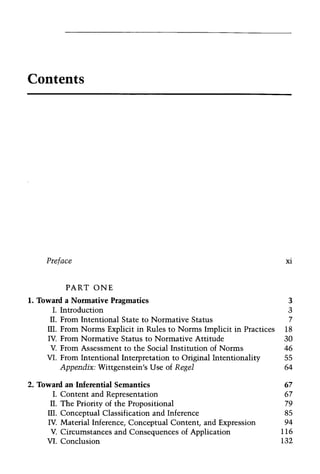
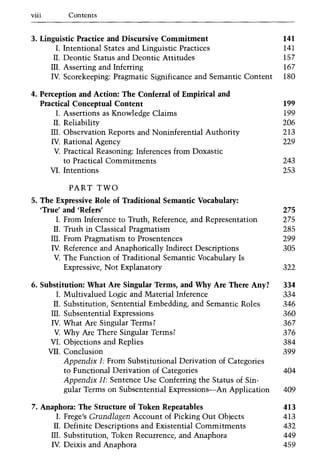
Contents
Preface xi
PART ONE
1. Toward a Nonnative Pragmatics 3
I. Introduction 3
II. From Intentional State to Normative Status 7
III. From Norms Explicit in Rules to Norms Implicit in Practices 18
IV. From Normative Status to Normative Attitude 30
V. From Assessment to the Social Institution of Norms 46
VI. From Intentional Interpretation to Original Intentionality 55
Appendix: Wittgenstein's Use of Regel 64
2. Toward an Inferential Semantics 67
I. Content and Representation 67
II. The Priority of the Propositional 79
ill. Conceptual Classification and Inference 85
IV. Material Inference, Conceptual Content, and Expression 94
V. Circumstances and Consequences of Application 116
VI. Conclusion 132
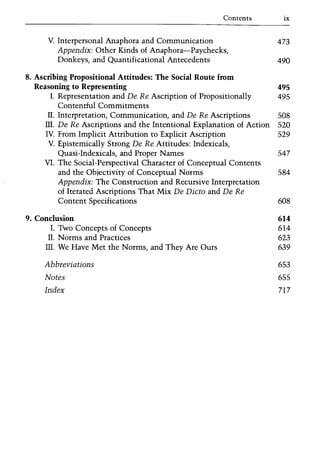
viii Contents
3. Linguistic Practice and Discursive Commitment 141
I. Intentional States and Linguistic Practices 141
II. Deontic Status and Deontic Attitudes 157
III. Asserting and Inferring 167
IV. Scorekeeping: Pragmatic Significance and Semantic Content 180
4. Perception and Action: The Conferral of Empirical and
Practical Conceptual Content 199
I. Assertions as Knowledge Claims 199
II. Reliability 206
III. Observation Reports and Noninferential Authority 213
IV. Rational Agency 229
V. Practical Reasoning: Inferences from Doxastic
to Practical Commitments 243
v.I. Intentions 253
PART TWO
5. The Expressive Role of Traditional Semantic Vocabulary:
'True' and 'Refers' 275
I. From Inference to Truth, Reference, and Representation 275
II. Truth in Classical Pragmatism 285
m. From Pragmatism to Prosentences 299
IV. Reference and Anaphorically Indirect Descriptions 305
V. The Function of Traditional Semantic Vocabulary Is
Expressive, Not Explanatory 322
6. Substitution: What Are Singular Terms, and Why Are There Any? 334
I. Multivalued Logic and Material Inference 334
II. Substitution, Sentential Embedding, and Semantic Roles 346
III. Subsentential Expressions 360
IV. What Are Singular Terms? 367
V. Why Are There Singular Terms? 376
v.I. Objections and Replies 384
v.I1. Conclusion 399
Appendix I: From Substitutional Derivation of Categories
to Functional Derivation of Categories 404
Appendix II: Sentence Use Conferring the Status of Sin-
gular Terms on Subsentential Expressions-An Application 409
7. Anaphora: The Structure of Token Repeatables 413
I. Frege's Grundlagen Account of Picking Out Objects 413
II. Definite Descriptions and Existential Commitments 432
III. Substitution, Token Recurrence, and Anaphora 449
IV. Deixis and Anaphora 459
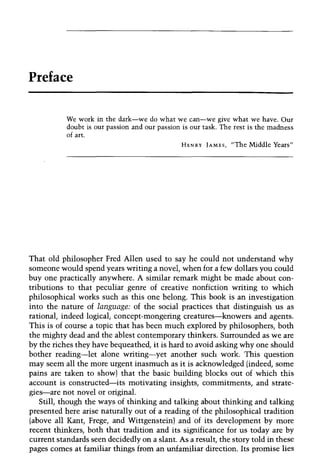
Contents ix
V. Interpersonal Anaphora and Communication 473
Appendix: Other Kinds of Anaphora-Paychecks,
Donkeys, and Quantificational Antecedents 490
8. Ascribing Propositional Attitudes: The Social Route from
Reasoning to Representing 495
I. Representation and De Re Ascription of Propositionally 495
Contentful Commitments
IT. Interpretation, Communication, and De Re Ascriptions 508
ITI. De Re Ascriptions and the Intentional Explanation of Action 520
IV. From Implicit Attribution to Explicit Ascription 529
V. Epistemically Strong De Re Attitudes: Indexicals,
Quasi-Indexicals, and Proper Names 547
VI. The Social-Perspectival Character of Conceptual Contents
and the Objectivity of Conceptual Norms 584
Appendix: The Construction and Recursive Interpretation
of Iterated Ascriptions That Mix De Dicta and De Re
Content Specifications 608
9. Conclusion 614
I. Two Concepts of Concepts 614
IT. Norms and Practices 623
ITI. We Have Met the Norms, and They Are Ours 639
Abbreviations 653
Notes 655
Index 717
Preface
We work in the dark-we do what we can-we give what we have. Our
doubt is our passion and our passion is our task. The rest is the madness
of art.
HENRY JAMES, "The Middle Years"
That old philosopher Fred Allen used to say he could not understand why
someone would spend years writing a novel, when for a few dollars you could
buy one practically anywhere. A similar remark might be made about con-
tributions to that peculiar genre of creative nonfiction writing to which
philosophical works such as this one belong. This book is an investigation
into the nature of language: of the social practices that distinguish us as
rational, indeed logical, concept-mongering creatures-knowers and agents.
This is of course a topic that has been much explored by philosophers, both
the mighty dead and the ablest contemporary thinkers. Surrounded as we are
by the riches they have bequeathed, it is hard to avoid asking why one should
bother reading-let alone writing-yet another such work. This question
may seem all the more urgent inasmuch as it is acknowledged (indeed, some
pains are taken to show) that the basic building blocks out of which this
account is constructed-its motivating insights, commitments, and strate-
gies-are not novel or original.
Still, though the ways of thinking and talking about thinking and talking
presented here arise naturally out of a reading of the philosophical tradition
(above all Kant, Frege, and Wittgenstein) and of its development by more
recent thinkers, both that tradition and its significance for us today are by
current standards seen decidedly on a slant. As a result, the story told in these
pages comes at familiar things from an unfamiliar direction. Its promise lies
xii Preface
in the sort of added depth and dimension that only binocular vision affords;
that is the point of laying a substantially different conceptual perspective
alongside our more accustomed line of sight. In keeping with this under-
standing of the sort of payoff that can be hoped for, the body of the work aims
to set criteria of adequacy for a theory of discursive practice, motivate the
approach adopted, work the model out in detail, and apply it. The idea is to
show what kind of understanding and explanatory power one gets from
talking this way, rather than to argue that one is somehow rationally obliged
to talk this way.
Of course I take it that the claims made in what follows are true; I endorse
those assertions; they express my commitments. One of the central tenets of
the account of linguistic practice put forward here is that the characteristic
authority on which the role of assertions in communication depends is
intelligible only against the background of a correlative responsibility to
vindicate one's entitlement to the commitments such speech acts express. It
is possible to secure entitlement to the commitments (assertional, inferen-
tial, and referential) implicit in an idiom without gainsaying the possibility
of entitlement to a different one. But even such a modest justificatory project
is of interest only to someone who both understands the commitments in
question and has some reason to want to become entitled to talk in ways
that presuppose them.
Both of these ends are served by starting the story with some historical
lessons. Accordingly, Chapters 1 and 2 form an entrance hall to the rest of
the edifice, one whose main architectural features are made more noticeable
by the judicious placement of ancestor portraits. The same figure appears on
many walls, almost always recognizable, but often portrayed from unusual
vantage points (from behind, from above) or highlighting something other
than the familiar face. In particular, the portrait of Frege will seem to some
to be like one of those odd photographs of a reclining figure taken with the
lens so close that the subject's left foot assumes gigantic proportions, dwarf-
ing the rest of the individual, whose head and torso dwindle to the dimen-
sions of insignificant appendages. Nonetheless, the tradition that is retro-
spectively constituted by the unusual emphases and filiations to be found
here is meant to be coherent and compelling in its own terms. It is not just
whatever rewriting of the history of philosophy happens to be needed to
make the waning years of the twentieth century safe for the views I put
forward. Rather, those views have the shape they do because of this reading
of now we got to where we are.
One of the overarching methodological commitments that orients this
project is to explain the meanings of linguistic expressions in terms of their
use-an endorsement of one dimension of Wittgenstein's pragmatism. For
although he drove home the importance of such an approach, other features
of his thought-in particular his theoretical quietism-have discouraged his
admirers from attempting to work out the details of a theory of meaning or,
Preface xiii
for that matter, of use. One result has been a substantial disjunction between
semantic theorizing (about the sorts of contents expressed by various locu-
tions), on the one hand, and pragmatic theorizing (about the linguistic prac-
tices in which those locutions are employed), on the other. The explanatory
strategy pursued here is to begin with an account of social practices, identify
the particular structure they must exhibit in order to qualify as specifically
linguistic practices, and then consider what different sorts of semantic con-
tents those practices can confer on states, performances, and expressions
caught up in them in suitable ways. The result is a new kind of conceptual-
role semantics. It is at once firmly rooted in actual practices of producing and
consuming speech acts, and sufficiently finely articulated to make clear how
those practices are capable of conferring the rich variety of kinds of content
that philosophers of language have revealed and reveled in.
Claims about the relations between meaning and use have a clear sense only
in the context of a specification of the vocabulary in which that use is
described or ascribed. At one extreme, use clearly determines meaning in the
strongest possible sense if admissible specifications of the use can include
such phrases as "using the word 'not' to express negation" or "using the term
'Julius Caesar' to refer to Julius Caesar." At an opposite extreme, if admissi-
ble specifications of use are restricted to descriptions of the movements of
particles expressed in the vocabulary of physics, not only will the use, so
described, fail to settle what is meant or expressed by various noises or
inscriptions, it will fail to settle even that anything is meant or expressed by
them. The specification of use employed here is neither so generous as to
permit semantic or intentional vocabulary nor so parsimonious as to insist
on purely naturalistic vocabulary.
Instead, it makes essential use of normative vocabulary. The practices that
confer propositional and other sorts of conceptual content implicitly contain
norms concerning how it is correct to use expressions, under what circum-
stances it is appropriate to perform various speech acts, and what the appro-
priate consequences of such performances are. Chapter 1 introduces and
motivates this normative pragmatics, which is rooted in considerations ad-
vanced by Kant, Frege, and Wittgenstein. No attempt is made to eliminate,
in favor of nonnormative or naturalistic vocabulary, the normative vocabu-
lary employed in specifying the practices that are the use of a language.
Interpreting states, performances, and expressions as semantically or inten-
tionally contentful is understood as attributing to their occurrence an
inelirninably normative pragmatic significance.
Though this normative dimension of linguistic practice is taken to be
ineliminable, it is not treated as primitive or inexplicable. It is rendered less
mysterious in two ways. First, linguistic norms are understood as instituted
by social-practical activity. The pragmatic significances of different sorts of
speech acts are rendered theoretically in terms of how those performances
xiv Preface
affect the commitments (and entitlements to those commitments) acknow-
ledged or otherwise acquired by those whose performances they are. The
norms implicit in linguistic practice are accordingly presented in a specifi-
cally deontic form. But these deontic statuses are understood in tum as a
form of social status, instituted by the practical attitudes of those who
attribute and acknowledge such statuses.
The natural world does not come with commitments and entitlements in
it; they are products of human activity. In particular, they are creatures of
the attitudes of taking, treating, or responding to someone in practice as
committed or entitled (for instance, to various further performances). Mas-
tering this sort of norm-instituting social practice is a kind of practical
know-how-a matter of keeping deontic score by keeping track of one's own
and others' commitments and entitlements to those commitments, and al-
tering that score in systematic ways based on the performances each practi-
tioner produces. The norms that govern the use of linguistic expressions are
implicit in these deontic scorekeeping practices.
The second way norms are rendered less mysterious is by explaining
exactly what is expressed by normative vocabulary. Beginning with basic
deontic scorekeeping attitudes and the practices that govern them, an ac-
count is offered of how locutions must be used in order to express explic-
itly the very normative notions-is committed, is permitted, ought, and
so on-that are appealed to in laying out the normative pragmatics. This
is an explication of explicitly normative conceptual contents in terms of
implicitly normative practices, rather than a reduction of normative terms
to nonnormative ones. It illuminates the normative dimension of dis-
cursive practice in line with the methodological principle that implicit
structures are often best understood by looking at how they can be made
explicit.
The first step in the project is accordingly the elaboration of a pragmatics
(a theory of the use of language) that is couched in terms of practical score-
keeping attitudes of attributing and acknowledging deontic statuses of
commitment and entitlement. The pragmatic significance of performances-
eventually, speech acts such as assertions-is then understood to consist in
the difference those performances make to the commitments and entitle-
ments attributed by various scorekeepers. The next step is to say what
structure such a set of social practices must have in order to qualify as
specifically discursive practice. This is a matter of moving from pragmatics
to semantics. The defining characteristic of discursive practice is the produc-
tion and consumption of specifically propositional contents. It is argued in
Chapter 2 that propositional contentfulness should be understood in terms
of inferential articulation; propositions are what can serve as premises and
conclusions of inferences, that is, can serve as and stand in need of reasons.
Chapter 3 describes (in deontic scorekeeping terms) a model of social prac-
tices of giving and asking for reasons-specifically linguistic discursive prac-
Preface xv
tices, which suffice to confer propositional contents on states, attitudes,
performances, and expressions that play suitable roles in those practices.
This account of the conferral of semantic content by inferentially articulated,
social scorekeeping practice is further generalized in two different directions.
First, it is shown how this model can be applied in order to understand not
only linguistic meanings but intentional contents generally. The proposi-
tional contentfulness of beliefs, no less than of claims, should be understood
in terms of their role in reasoning of various kinds. The inferentially articu-
lated commitments expressed by assertional speech acts are doxastic com-
mitments. Much of the theoretical work done by the concept of belief can be
done instead by appeal to this sort of deontic status, and to the practical
scorekeeping attitudes of acknowledging or undertaking such commitments.
A social, linguistic account of intentionality is accordingly elaborated in
Chapter 3.
It is extended in Chapter 4 to incorporate treatments of perception and
action and of the contribution those phenomena make to the empirical and
practical dimensions of the propositional contents of the states, acts, and
attitudes involved in them. It is not denied that it makes sense to talk about
nonlinguistic creatures as having intentional states, but it is claimed that our
understanding of such talk is parasitic on our understanding of the sort of
full-blooded linguistic intentionality characteristic of states and attitudes
that only beings who engage in discursive social practices can have. This
story amounts, then, to an account of the relations of mindedness-in the
sense of sapience rather than mere sentience-to behavior. As in the parallel
case of meaning and use, the clarification of these relations must begin with
a determination of what vocabulary it is admissible to use in specifying the
relevant behavior; again there is a spectrum of possibilities, from allowing
intentional vocabulary with semantic locutions, such as /I acting as if one
believed that snow is white," ranging down to restrictions to physicalistic or
other naturalistic vocabulary, such as "one's left wrist rotating twenty de-
grees." The via media pursued here eschews intentional or semantic specifi-
cations of behavior but permits normative and therefore social specifications
of what is in fact linguistic behavior.
Where the first sort of generalization involves moving from consideration
of language to consideration of mind, from talking to thinking and believing,
the second involves moving from an account of the practices that constitute
treating something as propositionally contentful to the practices that consti-
tute treating something as conceptually contentful in a broader sense. In
Chapter 6 the notion of substitution and substitutional inferences is used to
show how expressions such as singular terms and predicates, which cannot
directly play the inferential role of premise or conclusion in an argument,
nonetheless can play an indirectly inferential role in virtue of their system-
atic contributions to the directly inferential roles of sentences in which they
xvi Preface
occur. In Chapter 7 the notion of anaphora (whose paradigm is the relation
between a pronoun and its antecedent) and anaphoric inheritance of substi-
tutional commitment is used to show how even unrepeatable expressions
such as demonstrative tokenings play substitution-inferential roles and
hence express conceptual contents. The result is a kind of conceptual-role
semantics that is distinguished first by the nature of the functional system
with respect to which such roles are individuated and attributed: what is
appealed to is role in the implicitly normative linguistic social practices of a
community, rather than the behavioral economy of a single individual. It is
also different from familiar ways of using the notion of conceptual role in
conceiving of the conceptual in terms of specifically inferential articulation,
and in its elaboration of the fundamental substitutional and anaphoric sub-
structures of that inferential articulation.
This semantic explanatory strategy, which takes inference as its basic
concept, contrasts with the one that has been dominant since the Enlighten-
ment, which takes representation as its basic concept. The inferentialist
approach is by no means without precedent-though it has been largely a
minority platform. Indeed, the distinction canonically drawn between Con-
tinental rationalists such as Spinoza and Leibniz, on the one hand, and British
empiricists such as Locke and Hume, is for many purposes more perspicu-
ously rendered as a distinction between those endorsing an inferentialist
order of explanation and those endorsing a representationalist order of expla-
nation. The elements of the contemporary inferentialist program are ex-
tracted (in Chapter 2) from Frege of the Begriffsschrift, Sellars, and some of
Dummett's writings.
The complementary theoretical semantic strategies of representa-
tionalism and inferentialism are bound by the same pair of general explan-
atory obligations: to explicate the concept treated as primitive, and to offer
an account of other semantic concepts in terms of that primitive. The rep-
resentationalist tradition has developed good answers to the second sort of
concern, primarily by employing a variety of set-theoretic methods to show
how proprieties of inference can be determined by representational properties
of the claims that serve as their premises and conclusions. The explanatory
challenge to that tradition lies rather in the first sort of demand, in saying
what it is for something to have representational content, and in what the
grasp or uptake of that content by speakers and thinkers consists. As the
inferentialist program is pursued here, the proprieties of inference that serve
as semantic primitives are explicated in the pragmatics; they are implicit in
the practices of giving and asking for reasons. The major explanatory chal-
lenge for inferentialists is rather to explain the representational dimension of
semantic content-to construe referential relations in terms of inferential
ones.
The second part of the book responds to this challenge. Chapter 5 explains
the expressive role of traditional representational semantic vocabulary. An
account is offered there of the use of the sort of expression of which 'true'
Preface xvii
and 'refers' are paradigmatic. Following the lead of the prosentential approach
to truth, the key semantic concept employed in that unified account is
anaphora. Chapter 7 then explains anaphoric relations in terms of the sub-
stitution-inferential structure of discursive scorekeeping elaborated in Chap-
ter 6. Chapter 6 also offers an account in those terms of what it is for
claims-which are understood in the first instance (in Chapter 3) as what can
serve as premises and conclusions of inferences-to be and be understood to
be about objects, and to characterize them as having properties and standing
in relations.
The primary treatment of the representational dimension of conceptual
content is reserved for Chapter 8, however. There the representational prop-
erties of semantic contents are explained as consequences of the essentially
social character of inferential practice. Words such as the 'of' that expresses
intentional directedness, and 'about' and 'represents' in their philosophically
significant uses, have the expressive role they do-making representational
relations explicit-in virtue of the way they figure in de re ascriptions of
propositional attitudes. These are the tropes used to say explicitly what
someone is thinking about, what a belief represents, what a claim is true of.
Chapter 8 offers a discursive scorekeeping account of the practices that
constitute using locutions to express such de re ascriptions, and hence of how
expressions must be used in order to mean 'of', 'about', or 'represents'. This
account of what is expressed by the fundamental explicitly representational
locutions makes possible an explanation of the objectivity of concepts. It
takes the form of a specification of the particular sort of inferential structure
social scorekeeping practices must have in order to institute objective norms,
according to which the correctness of an application of a concept answers to
the facts about the object to which it is applied, in such a way that anyone
(indeed everyone) in the linguistic community may be wrong about it.
In summary, in the theoretical place usually occupied by the notion of
intentional states, the pragmatics presented here elaborates a conception of
normative statuses; in the place usually occupied by the notion of inten-
tional interpretation, it puts deontic scorekeeping-that is, the social prac-
tices of attributing and acknowledging commitments and entitlements,
which implicitly institute those statuses. The theoretical work typically
done by semantic assessments according to correctness of representation and
satisfaction of truth conditions is done by assessments of proprieties of
inference. Semantic articulation is attributed and acknowledged by keeping
score not only of directly inferential commitments, which relate sentential
(that is, claimable or believable) contents, but also of indirectly inferential
substitutional and anaphoric commitments, which relate the subsentential
contents of expressions of other grammatical categories.
The pragmatics and semantics maintain particularly intimate relations
throughout. The aim is always to show how some bit of vocabulary must be
used-the significance its utterance must have in various circumstances, the
xviii Preface
practical scorekeeping attitudes its usage must elicit and be elicited by-in
order for it to express a certain kind of semantic content: to be being taken
or treated in practice by the linguistic community as a conditional, a singular
term, a bit of normative vocabulary, a propositional-attitude-ascribing locu-
tion, and so on. A fundamental methodological criterion of adequacy of the
account is that the theorist not attach semantic contents to expressions by
stipulation; it must always be shown how such contents can be conferred on
expressions by the scorekeeping activities the theorist attributes to the lin-
guistic practitioners themselves. That is, the aim is to present conditions on
an interpretation of a community as discursive scorekeepers that are suffi-
cient (though perhaps not necessary) to ensure that interpreting the commu-
nity as engaged in those implicitly normative practices is interpreting them
as taking or treating their speech acts as expressing the sorts of semantic
contents in question.
The obligation to say what it is about the use of locutions in virtue of
which they express various sorts of content dictates that the master concept
articulating the relation between the pragmatic and semantic portions of the
theory is that of expression. To express something is to make it explicit.
What is explicit in the fundamental sense has a propositional content-the
content of a claim, judgment, or belief (claimable, judgeable, believable con-
tents). That is, making something explicit is saying it: putting it into a form
in which it can be given as a reason, and reasons demanded for it. Putting
something forward in the explicit form of a claim is the basic move in the
game of giving and asking for reasons.
The relation of expression between what is implicit in what practitioners
do and what is explicit in what they say structures the story told here at two
different levels. At the basic level, the question is how the capacity to
entertain principles, and so to know that something is the case, arises out of
the capacity to engage in practices-to know how to do something in the
sense of being able to do it. What must practitioners be able to do in order
to be able thereby to say that things are thus and so-that is, to express
something explicitly? The explanatory force of a response to this question
can be judged by the constraints that are acknowledged on the vocabulary in
which those practical capacities are specified; normative vocabulary is em-
ployed here, but intentional vocabulary (which would permit at the outset
the ascription of propositionally contentful states, attitudes, and perfor-
mances) is not. The first level of the account of expression accordingly
consists in explaining-making theoretically explicit-the implicit structure
of linguistic practices in virtue of which they count as making anything
explicit at all.
The second level of the account of expression consists in working out a
theory of the expressive role distinctive of logical vocabulary. The claim is
that logical vocabulary is distinguished by its function of expressing explic-
itly within a language the features of the use of that language that confer
Preface xix
conceptual contents on the states, attitudes, performances, and expressions
whose significances are governed by those practices. Conditionals serve as a
paradigm illustrating this expressive role. According to the inferential ap-
proach to semantics and the deontic scorekeeping approach to pragmatics,
practitioners confer determinate propositional contents on states and expres-
sions in part by their scorekeeping practice of treating the acknowledgment
of one doxastic commitment (typically through assertional utterance of a
sentence) as having the pragmatic significance of an undertaking of further
commitments that are related to the original commitment as its inferential
consequences. At the basic level, treating the claim expressed by one sen-
tence as an inferential consequence of the claim expressed by another sen-
tence is something practitioners can do, and it is because such practical
attitudes can be implicit in the way they respond to each other's perfor-
mances that their sentences come to mean what they do. With the introduc-
tion of conditional locutions linking sentences, however, comes the ex-
pressive power to say explicitly that one claim is a consequence of another.
The expressive role distinctive of conditionals is making implicit inferential
commitments explicit in the form of declarative sentences, the assertion of
which acknowledges a propositionally contentful doxastic commitment. In
a similar way, at the basic level, scorekeepers can treat the claims expressed
by two sentences as incompatible-namely by treating commitment to one
as in practice precluding entitlement to the other. The introduction of a
locution with the expressive power of negation makes it possible to express
such implicit practical scorekeeping attitudes explicitly-by saying that two
claims are incompatible (one entails the negation of the other). Identity and
quantificational expressions are analyzed on this model as making explicit
the substitutional relations characteristic of singular terms and predicates
respectively, and further locutions are considered that playa corresponding
expressive role in making anaphoric relations explicit.
So an expressive theory of logic is presented here. On this view, the
philosophical significance of logic is not that it enables those who master the
use of logical locutions to prove a special class of claims-that is, to entitle
themselves to a class of commitments in a formally privileged fashion. The
significance of logical vocabulary lies rather in what it lets those who master
it say-the special class of claims it enables them to express. Logical vocabu-
lary endows practitioners with the expressive power to make explicit as the
contents of claims just those implicit features of linguistic practice that
confer semantic contents on their utterances in the first place. Logic is the
organ of semantic self-consciousness. It brings out into the light of day the
practical attitudes that determine the conceptual contents members of a
linguistic community are able to express-putting them in the form of ex-
plicit claims, which can be debated, for which reasons can be given and
alternatives proposed and assessed. The formation of concepts-by means of
which practitioners can come to be aware of anything at all-comes itself to
xx Preface
be something of which those who can deploy logical vocabulary can be
aware. Since plans can be addressed to, and intentional practical influence
exercised over, just those features of things of which agents can become
explicitly aware by the application of concepts, the formation of concepts
itself becomes in this way for the first time an object of conscious delibera-
tion and control.
Explaining the features of the use of logical vocabulary that confer its
characteristic sort of semantic content is accordingly explaining how the sort
of expressive power the theorist requires to explain the features of the use of
nonlogical vocabulary that confer semantic content on it can become avail-
able to those whose linguistic practice is being theorized about. It is this fact
that sets the expressive scope of the project pursued here. The aim is twofold:
to make explicit deontic scorekeeping social practices that suffice to confer
conceptual contents on nonlogical sentences, singular terms, and predicates
in general; and to make explicit the deontic scorekeeping social practices in
virtue of which vocabulary can be introduced as playing the expressive roles
characteristic of a variety of particular logical locutions. How much logical
vocabulary is worth reconstructing in this fashion? In this project, neither
more nor less than is required to make explicit within the language the
deontic scorekeeping social practices that suffice to confer conceptual con-
tents on nonlogical vocabulary in general. At that point it will have been
specified what practices a theorist must attribute to a community in order
to be interpreting its members as engaging not just in specifically linguistic
practices but in linguistic practices that endow them with sufficient expres-
sive power to say how their practices confer conceptual content on their
states, attitudes, performances, and expressions. That is, they will be able to
express the theory offered here.
To make the semantic theory explicit requires logical vocabulary capable
of expressing inferential, substitutional, and anaphoric relations. This vo-
cabulary corresponds pretty well to the language of standard first-order logic,
with the addition of classical semantic vocabulary. To make the pragmatic
theory explicit requires logical vocabulary expressing the endorsement of
norms generally, and the attribution and acknowledgment of the deontic
statuses of commitment and entitlement in particular. The discussion of
action in Chapter 4 includes an account of the use of vocabulary that makes
norms explicit, and Chapter 8 explains how the social-practical attitudes of
attributing and acknowledging deontic statuses (paradigmatically doxastic
commitment) are made explicit by the use of propositional-attitude-ascribing
locutions such as the regimented '... is committed to the claim that ... "
which does duty here for '... believes that ...'. Along this expressive dimen-
sion, the project eats its own tail, or lifts itself up by its own bootstraps-
presenting an explanation of what it is to say something that is powerful
enough to explain what it itself is saying.
Interpreting the members of a community as engaging in specifically
Preface xxi
discursive practices, according to the view put forward here, is interpreting
them as engaging in social practices that include treating some performances
as having the pragmatic significance of assertions. For it is in terms of the
constellation of inferentially articulated commitments and entitlements
characteristic of the making (staking) of claims that the notion of specifically
propositional contentfulness is to be understood. Since all other varieties of
conceptual contentfulness derive (substitutionally) from the propositional,
this is to say that the application of concepts is a linguistic affair-not in the
sense that one must be talking in order to do it, but in the sense that one
must be a player of the essentially linguistic game of giving and asking for
reasons in order to be able to do it. There can be sets of practices that are
linguistic in this sense but that do not incorporate the expressive resources
provided by logical vocabulary. Indeed, the way the use of such vocabulary
in making explicit what is implicit in the use of nonlogical vocabulary is
specified is by showing what would be required to introduce vocabulary with
that expressive function into idioms that did not already contain it. The
contribution made by logical locutions to the reflective processes in virtue
of which the evolution of our concepts and commitments qualifies as ra-
tional is so important, however, that linguistic practices that at least permit
their introduction form a special class. In a weak sense, any being that
engages in linguistic practices, and hence applies concepts, is a rational
being; in the strong sense, rational beings are not only linguistic beings but,
at least potentially, also logical beings. This is how we should understand
ourselves: as beings that meet: this dual expressive condition.
It turns out that there is ~ mrprising connection between being a rational
creature-in the sense that Jlcludes the possibility of using the expressive
resources of specifically logical vocabulary to reflect on one's conceptual
content-conferring linguistic practices--{)n the one hand, and the structure
of the facts that make up the world one can become aware of by applying
those concepts, on the other. Rational beings live in a world of propertied
and related particulars. Chapter 6 presents an expressive deduction of the
necessity of this structure; it shows not why there is something rather than
nothing but why what there is must come in the form of things; it shows
why judgments or beliefs-the commitments expressed by claims-must in
the basic case be about particulars (paradigmatically objects) and their prop-
erties and relations.
Particular objects are what is referred to by singular terms, and the dem-
onstration proceeds by showing that the only semantically significant sub-
sentential structure that is compatible with the introduction of logical
vocabulary is one that decomposes basic sentences into singular terms and
predicates. This would not be a surprising result if the logical vocabulary
appealed to included identity and quantificational locutions, for (it will be
argued) these have precisely the expressive role of making explicit in the
form of claims the substitution-inferential commitments characteristic of
xxii Preface
singular terms and predicates. But the result presented here is much stronger:
any discursive practices that permit the introduction even of sententiallogi-
cal operators such as negation and conditionals require that any subsenten-
tial substitutional structure be of the term-predicate variety. Thus the
investigation of the nature and limits of the explicit expression in principles
of what is implicit in discursive practices yields a powerful transcendental
argument-a formal answer to the question, Why are there objects? that
turns on a deep relation between the expressive capacities required to think
critically about the inferential connections among claims and the structures
in virtue of which those claims are properly understood as characterizing
objects as having properties and standing in relations.
This is a long book. Its length is a consequence of the demands made by its
governing methodological aspirations: to eschew representational primitives,
to show how content is related to use, and to achieve self-referential expres-
sive completeness. The first is pursued by elaborating inferentialist and ex-
pressivist alternatives to the representationalist idiom for thinking and
talking about thinking and talking that has been so well worked out over the
last three centuries. The aim is not to replace that familiar idiom but to
enrich it. The promised enrichment is of two sorts. First, there is the greater
depth of field afforded by the stereoscopic vision made available by an alter-
native to familiar ways of talking about intentional phenomena. Second,
there is the grounding and illumination of representational tropes secured by
displaying the implicit features of discursive practice that are expressed
explicitly by their use. Doing this requires that both the pragmatics and the
semantics be developed in a reasonable amount of detail. The account of
norm-instituting social practices must appeal to capacities that are plausibly
available in primitive prelinguistic cases, and yet provide raw materials ade-
quate for the specification of sophisticated linguistic practices, including
logical ones. The account of the semantic contents conferred by those prac-
tices must encompass expressions of grammatical categories that are reason-
ably well understood already within the representationalist tradition-for
example predicates, definite descriptions, proper names, familiar sorts of
logical expressions, and whatever other kinds of locutions are required to
make the processes by which content is conferred explicit within the linguis-
tic practices being modeled.
Chapters 3 and 4 present the core theory-the model according to which
a pragmatics specifying the social practices in which conceptual norms are
implicit and a broadly inferential semantics are combined. It is here that
sufficient conditions are put forward for the practices a community is inter-
preted as engaging in to count as according performances the pragmatic
significance characteristic of assertions-and hence for those practices to
count as conferring specifically propOSitional contents. Everything else in the
book either leads up to the presentation of this model or elaborates and
Preface xxiii
extracts consequences from it. These chapters can be read on their own; the
cost of omitting the first two chapters, which motivate the approach to
pragmatics and semantics pursued here (in part by a rational reconstruction
of the history of discussions of conceptual norms and contents), is that
without this conceptual and historical background, one will not understand
why things are done as they are here, rather than in some more familiar way.
The time spent developing that motivation, however, means that one must
wait a while for the actual theory to show itself.
The cost of missing Part 2 (Chapters 5 through 8) would be largely that
one would then not see what the model can do, what it is good for. The most
essential bit is Chapter 8, for that is where the representational dimension
of discursive practice is explained in terms of the interaction of the social
and the inferential articulation of the communication of reasons for belief
and action. It is this interaction that is appealed to there also to make
intelligible how objective norms come to apply to the essentially social
statuses-paradigmatically the doxastic and practical propositionally con-
tentful commitments that correspond to beliefs and intentions-and so un-
derwrite such fundamental practices as assessing the truth of beliefs and the
success of actions. The next most important part of the second half of the
book is Chapter 6: the substitutional analysis is crucial to understanding how
the inferential approach can generalize beyond sentences. And it would be
truly a shame to miss the transcendental expressive argument for the exist-
ence of objects-the argument that (and why) the only form the world we
talk and think of can take is that of a world of facts about particular objects
and their properties and relations. It is worth keeping in mind Diderot's
thought that one "must have gone deep into art or science to master their
elements ... The darkness of the beginnings lights up only toward the
middle or the end."
The aim throughout is to present a unified vision of language and mind-
one that starts with a relatively clear philosophical rationale and works it
out in convincing detail, addressing a sufficiently wide range of potentially
puzzling phenomena to engender confidence in its adaptability and power. It
is animated by the ideal of the systematic philosophers of old: the invigorat-
ing clarifying prospect achievable by laying alongside our ordinary ways of
talking and thinking an alternate idiom in which everything can be said. I
am sensible, of course, of many ways in which this product falls short of that
ideal. Particularly in matters of detail (but by no means there alone), a myriad
of choices have had to be made at the cost of spurning attractive, perhaps
ultimately superior, alternatives. The approach seldom dictates just one way
of doing things. Yet the choice of which large limb to follow off the trunk of
the tradition must be made on the basis of the tempting fruit to be seen on
the smaller branches it supports. It can only be hoped that where upon closer
inspection some of them are found wanting, the fundamental soundness of
the tree is not impugned, but only the judgment of the gardener, who pruned
xxiv Preface
the better and nurtured the worse. As Johnson says in the Preface to his
Dictionary: II A large work is difficult because it is large, even though all its
parts might singly be performed with facility; where there are many things
to be done, each must be allowed its share of time and labor in the proportion
only which it bears to the whole; nor can it be expected that the stones which
form the dome of the temple should be squared and polished like the dia-
mond of a ring." Truth mayor may not be in the whole, but understanding
surely is.
I am grateful to the copyright holders for permission to reprint the following
excerpts:
From Donald Davidson, Actions and Events (Oxford: Oxford University
Press, 19801, by permission of Oxford University Press.
From Michael Dummett, Frege: Philosophy of Language (Cambridge,
Mass.: Harvard University Press, copyright © 1991 by Michael Dummettl,
reprinted by permission of Harvard University Press and Gerald Duckworth
&. Co. Ltd.
From T. S. Eliot, "Burnt Norton" and "Little Gidding" in Four Quartets,
copyright © 1943 by T. S. Eliot and renewed 1971 by Esme Valerie Eliot,
reprinted by permission of Harcourt Brace &. Company and Faber and Faber
Ltd.
From Gottlob Frege, The Foundations of Arithmetic, trans. J. L. Austin
(Evanston, Ill.: Northwestern University Press, 19781, by permission of the
publisher.
From H. Hermes, F. Kambartel, and F. Kaulbach, eds., Gottlob Frege:
Posthumous Writings (Chicago: University of Chicago Press, 19791, by per-
mission of the University of Chicago Press and Blackwell Publishers.
From Wilfrid Sellars, "Inference and Meaning," Mind 62, no. 247 (19531,
by permission of Oxford University Press.
From Wallace Stevens, "On the Road Home," Collected Poems, copyright
1942 by Wallace Stevens and renewed 1970 by Holly Stevens. Reprinted by
permission of Alfred A. Knopf, Inc., and Faber and Faber Ltd.
Preface xxv
Some of the material presented here has appeared elsewhere, in article form.
In particular, "Inference, Expression, and Induction" (Philosophical Studies
54 [1988]: 257-285, reprinted by permission of Kluwer Academic Publishers)
is essentially incorporated as Sections III-V of Chapter 2; "Asserting" (Naus
17, no. 4 [November 1983]: 637-650) is an early ancestor of the core of
Chapter 3; and "Pragmatism, Phenomenalism, and Truth Talk" (Midwest
Studies in Philosophy 12, "Realism and Antirealism" [1988]: 75-93) and
"Reference Explained Away" (The TournaI of Philosophy 81, no. 9 [September
1984]: 469-492) coincide extensively with the middle sections of Chapter 5.
During the long gestation of this work I have beerrirelped immensely by
discussions of these ideas with many other philosophers, who gave gener-
ously of their time and acumen. The confusions and unclarities they have
talked me through and out of are legion; those that remain belong on my
account alone. It is impossible properly to acknowledge all these contribu-
tions, but some require particular mention. To begin with, I want to thank
those with and to whom I most proximally say 'we': my colleagues in the
Philosophy Department at the University of Pittsburgh, especially John
McDowell, John Haugeland, and Nuel Belnap. The example, encouragement,
and indulgence of this nearly ideal intellectual community made this book
possible. I want also to express my appreciation for the exceptionally talented
group of graduate students at Pitt who have shared this intellectual adventure
over the years, particularly Mark Lance, Marc Lange, Danielle Macbeth, and
Katarzyna Paprzycka. Finally, I am immeasurably grateful to Allan Gibbard
for the gargantuan efforts he expended in mastering the ideas presented here,
and for his suggestions as to how the final product might be improved.
PART ONE
1
Toward a Normative Pragmatics
An ounce of practice is worth a pound of precept.
ENGLISH PROVERB
I. INTRODUCTION
1. Saying 'We'
'We' is said in many ways. We may be thee and me. We may be
all that talks or all that moves, all that minds or all that matters. Since these
boundaries are elastic, we have a task of demarcation: telling who or what
we are, distinguishing ourselves from the other sorts of objects or organisms
we find in our world. Saying who we are can contract to an empty exercise
in self-congratulation-a ritual rehearsal of the endless, pitiable disabilities
of clockworks, carrots, cows, and the clan across the river. Such a mean-spir-
ited version of the demarcational enterprise is not forced on us by the way
things are, however.
For what we are is made as much as found, decided as well as discovered.
The sort of thing we are depends, in part, on what we take ourselves to be.
One characteristic way we develop and make ourselves into what we are is
by expressing, exploring, and clarifying our understanding of what we are.
Arbitrary distinctions of biology, geography, culture, or preference can be and
have been seized on to enforce and make intelligible the crucial distinction
between us and them (or it). But philosophical thought is coeval with the
impulse to understand ourselves according to a more principled, less paro-
chial story-and so to be a more principled, less parochial sort of being.
4 Toward a Normative Pragmatics
The wider perspective enjoined by principle poses the question, Who are
we? in the form: What would have to be true-not only of the quaint folk
across the river, but of chimpanzees, dolphins, gaseous extraterrestrials, or
digital computers (things in many ways quite different from the rest of
us)-for them nonetheless to be correctly counted among us? Putting the
issue this way acknowledges an expansive demarcational commitment to
avoid, as far as possible, requiring the sharing of adventitious stigmata of
origin or material constitution. In understanding ourselves we should look
to conditions at once more abstract and more practical, which concern what
we are able to do, rather than where we come from or what we are made of.
Candidates for recognition as belonging among us should be required to share
only the fundamental abilities that make possible participation in those
central activities by which we (thereby) define ourselves. How should we
think of these?
The most cosmopolitan approach begins with a pluralistic insight. When
we ask, Who are we? or What sort of thing are we? the answers can vary
without competing. Each one defines a different way of saying 'we'j each kind
of 'we'-saying defines a different community, and we find ourselves in many
communities. This thought suggests that we think of ourselves in broadest
terms as the ones who say 'we'. It points to the one great Community
comprising members of all particular communities-the Community of
those who say 'we' with and to someone, whether the members of those
different particular communities recognize each other or not.
The reflexive character of the proposal that we use self-demarcation as the
criterion by which we demarcate ourselves does not suffice to render it purely
formal, however. It does not save us the trouble of contentful self-under-
standing. For until it has been specified in other terms what one must be able
to do in order to count as "saying 'we'," demarcation by appeal to such
attitudes remains an aspiration tacked to a slogan-empty, waiting for us to
fill it. 'We'-saying of the sort that might be of demarcational interest is not
a matter merely of the production of certain vocables-indeed perhaps the
relevant kind of attitude is not a linguistic matter at all. Nor again does it
consist simply in the engendering of warm mammalian fellow-feeling. Mak-
ing explicit to ourselves who we are requires a theoretical account of what
it is in practice to treat another as one of us.
2. Sapience
What is it we do that is so special? The answer to be explored
here-a traditional one, to be sure-is that we are distinguished by capacities
that are broadly cognitive. Our transactions with other things, and with each
other, in a special and characteristic sense mean something to us, they have
a conceptual content for us, we understand them in one way rather than
another. It is this demarcational strategy that underlies the classical iden-
Toward a Normative Pragmatics 5
tification of us as reasonable beings. Reason is as nothing to the beasts of the
field. We are the ones on whom reasons are binding, who are subject to the
peculiar force of the better reason.
This force is a species of normative force, a rational 'ought'. Being rational
is being bound or constrained by these norms, being subject to the authority
of reasons. Saying 'we' in this sense is placing ourselves and each other in
the space of reasons, by giving and asking for reasons for our attitudes and
performances. Adopting this sort of practical stance is taking or treating
ourselves as subjects of cognition and action; for attitudes we adopt in re-
sponse to environing stimuli count as beliefs just insofar as they can serve
as and stand in need of reasons, and the acts we perform count as actions
just insofar as it is proper to offer and inquire after reasons for them. Our
attitudes and acts exhibit an intelligible content, a content that can be
grasped or understood, by being caught up in a web of reasons, by being
inferentially articulated. Understanding in this favored sense is a grasp of
reasons, mastery of proprieties of theoretical and practical inference. To
identify ourselves as rational-as the ones who live and move and have our
being in the space of reasons, and so to whom things can be intelligible-is
to seize demarcationally on a capacity that might well be shared by beings
quite different from us in provenance and demeanor.
Picking us out by our capacity for reason and understanding expresses a
commitment to take sapience, rather than sentience as the constellation of
characteristics that distinguishes us. Sentience is what we share with non-
verbal animals such as cats-the capacity to be aware in the sense of being
awake. Sentience, which so far as our understanding yet reaches is an exclu-
sively biological phenomenon, is in turn to be distinguished from the mere
reliable differential responsiveness we sentients share with artifacts such as
thermostats and land mines. Sapience concerns understanding or intelli-
gence, rather than irritability or arousal. One is treating something as sapient
insofar as one explains its behavior by attributing to it intentional states such
as belief and desire as constituting reasons for that behavior.
Another familiar route to understanding the sort of sapience being consid-
ered here for demarcational duty goes through the concept of truth rather
than that of inference. We are believers, and believing is taking-true. We are
agents, and acting is making-true. To be sapient is to have states such as
belief, deSire, and intention, which are contentful in the sense that the
question can appropriately be raised under what circumstances what is be-
lieved, deSired, or intended would be true. Understanding such a content is
grasping the conditions necessary and sufficient for its truth.
These two ways of conceiving sapience, in terms of inference and in terms
of truth, have as their common explanatory target contents distinguished by
their propositional form. What we can offer as a reason, what we can take or
make true, has a propositional content: a content of the sort that we express
by the use of declarative sentences and ascribe by the use of 'that' clauses.
6 Toward a Normative Pragmatics
Propositional contents stand in inferential relations, and they have truth
conditions. One of the tasks of this work is to explain what it is to grasp
specifically propositional contents, and so to explain who we are as rational
or sapient beings. A central subsidiary task is accordingly to offer an account
of the relation between the concepts of inference and truth, which comple-
ment one another and in some measure compete with one another for ex-
planatory priority in addressing the issue of propositional contentfulness, and
so of rationality.
3. Intentionality
The general self-understanding in view so far identifies us by our
broadly cognitive capacities: We are makers and takers of reasons, seekers
and speakers of truth. The propositional focus of the approach marks this
understanding of intelligible contents as discursive. This conception, hal-
lowed by ancient tradition, was challenged during the Enlightenment by a
rival approach to cognitive contentfulness that centers on the concept of
representation. Descartes's seminal demarcational story distinguishes us as
representers-producers and consumers of representings-from a world of
merely represented and representable things. The states and acts charac-
teristic of us are in a special sense of, about, or directed at things. They are
representings, which is to say that they have representative content. To have
such a content is to be liable to assessments of correctness of representation,
which is a special way of being answerable or responsible to what is repre-
sented.
Another task of this work is accordingly to address the question, How
should the relation between representation-the master concept of Enlight-
enment epistemology-and the discursive concepts of reasons and truth be
understood? One of the great strengths representationalist explanatory strate-
gies have developed is the capacity to offer accounts of truth and goodness
of inference. There are familiar set-theoretic routes that set out from repre-
sentational primitives corresponding to subsentential linguistic expressions
such as singular terms and predicates, lead to assignments of truth conditions
to sentences compounded out of those expressions, and pass from there to
determinations of which inferences are correct. While doubts have been
raised, perhaps legitimately, about nearly every phase of this construction,
no other semantic approach has been worked out so well.
Yet for all that, the primitives involved have never been well understood.
Descartes notoriously fails to offer an account either of the nature of repre-
sentational contents-of what the representingness of representings consists
in-or of what it is to grasp or understand such contents, that is to say, of
their intelligibility to the representer. He does not tell us what makes a
rabbit-idea an idea of (or purporting to be of) rabbits, or of anything at all, nor
what it is for the one whose idea it is to understand or take it as being of or
about something. That things could be represented by and to the mind (have
Toward a Normative Pragmatics 7
"objective reality" in it and for it, for the mind to be "as if of" things) is
treated as a basic property, an unexplained explainer. But an adequate treat-
ment of the representational dimension of discursive sapience should include
an account both of representational purport, and of its uptake.
The topic to be investigated here, then, is intentionality in the sense of
the propositional contentfulness of attitudes, not in the sense (if that should
turn out to be different) of the directedness of sense. The aim is to understand
ourselves as judgers and agents, as concept-users who can reason both theo-
retically and practically. This is not to say that we should understand our-
selves exclusively as sapients rather than sentients, in terms of under-
standing rather than awareness. 'We' is and by rights ought to be said in many
ways. The point is just to register and delineate the way that is to be dis-
cussed here.
This inquiry is directed at the fanciest sort of intentionality, one that
involves expressive capacities that cannot be made sense of apart from par-
ticipation in linguistic practices. The aim is to offer sufficient conditions for
a system of social practices to count as specifically linguistic practices, in the
sense of defining an idiom that confers recognizably propositional contents
on expressions, performances, and attitudes suitably caught up in those
practices. Looking at this sort of high-grade intentionality accordingly risks
being beastly to the beasts-not only by emphasizing sapience over sen-
tience, comprehension over consciousness, but also by unfairly ignoring the
sorts of beliefs and desires that are appropriately attributed to non- or pre-lin-
guistic animals.
So it is a further criterion of adequacy of this explanatory enterprise that
it have something to say about the lower grades of intentionality: not only
as to how the lines should be drawn (corresponding to different senses of
'we'), but also as to how the advent of the favored sort of linguistic intention-
ality can be made less mysterious. How can linguistic abilities arise out of
nonlinguistic ones? Or to ask a related question, What would sentient crea-
tures have to be able to do in order to count as sapient as well? What is
needed is to tell a story about practices that are sufficient to confer proposi-
tionally contentful intentional states on those who engage in them, without
presupposing such states on the part of the practitioners. The hope is that
doing so will offer guidance concerning what would be involved in diagnosing
aliens as exhibiting such states, and programming computers or teaching
merely sentient animals to exhibit them.
II. FROM INTENTIONAL STATE TO NORMATIVE STATUS
1. Kant: Demarcation by Norms
The demarcational proposal being pursued picks us out as the
ones capable of judgment and action. Not only do we respond differentially
to environing stimuli, we respond by forming perceptual judgments. Not
8 Toward a Normative Pragmatics
only do we produce behavior, we perform actions. Various ways of talking
about this fundamental distinction have been put on the table. It can be made
out in terms of truth. In perception what we do is responsively take-true
some propositional content that is intelligible to us. In action what we do is
responsively make-true some propositional content that is intelligible to us.
The distinction can be made out in terms of reasons. The judgments that
are our perceptual responses to what is going on around us differ from
responses that are not propositionally contentful (and so are not in that sense
intelligible) in that they can serve as reasons, as premises from which further
conclusions can be drawn. Actions, which alter what is going on around us
in response to propositionally contentful intentions, differ from perfor-
mances that are merely behavior (and so not intelligible in terms of the
propositionally contentful intentions that elicit them) in that reasons can be
given for them; they can appear as the conclusions of practical inferences.
The distinction can also be made out in terms of the employment of
concepts. To be a perceiver rather than just an irritable organism is to be
disposed to respond reliably and differentially to the perceptible environment
by the application of appropriate concepts. To be an agent rather than just a
behaver is to be disposed to respond reliably and differentially to applications
of appropriate concepts by altering the accessible environment. Intelligibility
in the sense of propositional contentfulness, whether the latter is conceived
in terms of truth conditions or capacity to serve as a reason, is a matter of
conceptual articulation-in the case of perception and action, that the reli-
ably elicited response and the reliably eliciting stimulus, respectively, essen-
tially involve the use of concepts.
So sapience, discursive intentionality, is concept-mongering. What is dis-
tinctive of specifically conceptual activity? Contemporary thought about the
use of concepts owes great debts to Kant. One of his cardinal innovations is
his introduction of the idea that conceptually structured activity is distin-
guished by its normative character. His fundamental insight is that judg-
ments and actions are to be understood to begin with in terms of the special
way in which we are responsible for them.
Kant understands concepts as having the form of rules, which is to say
that they specify how something ought (according to the rule) to be done.l
The understanding, the conceptual faculty, is the faculty of grasping rules-of
appreciating the distinction between correct and incorrect application they
determine. What is distinctive about judgings and doings-acts that have
contents that one can take or make true and for which the demand for
reasons is in order-is the way they are governed by rules. They are concep-
tually contentful and so are subject to evaluation according to the rules that
express those contents. Being in an intentional state or performing an inten-
tional action accordingly has a normative significance. It counts as undertak-
ing (acquiring) an obligation or commitment; the content of the commitment
is determined by the rules that are the concepts in terms of which the act or
Toward a Normative Pragmatics 9
state is articulated. Thus Kant's version of the sort of demarcation criterion
being considered picks us out as distinctively normative, or rule-governed,
creatures.
2. From Cartesian Certainty to Kantian Necessity
This emphasis on the normative significance of attributions of
intentionally contentful states marks a decisive difference between Kantian
and Cartesian ways of conceiving cognition and action. For Kant the impor-
tant line is not that separating the mental and the material as two matter-of-
factually different kinds of stuff. It is rather that separating what is subject
to certain kinds of normative assessment and what is not. For Descartes,
having a mind (grasping intentional contents) is having representings: states
that purport or seem to represent something. Some things in the world
exhibit this sort of property; others do not. Where Descartes puts forward a
descriptive conception of intentionality, Kant puts forward a normative, or
prescriptive, one-what matters is being the subject not of properties of a
certain kind but of proprieties of a certain kind. The key to the conceptual
is to be found not by investigating a special sort of mental substance that
must be manipulated in applying concepts but by investigating the special
sort of authority one becomes subject to in applying concepts-the way in
which conceptually articulated acts are liable to assessments of correctness
and incorrectness according to the concepts they involve.
This approach contrasts sharply with Cartesian demarcations of cognition
and action according to the presence of items of a certain matter-of-factual
kind. The objection is not to the details of Descartes's understanding of the
descriptive features required for intentionally contentful states and acts: his
conception of mental events that are self-intimating cognitions or infallibly
performable volitions, takings-true and makings-true that are minimal in
that they cannot fail to be successful. It is, more radically, that what sets off
the intentional is its liability to assessments of correctness, its being subject
to norms (which are understood as codified in rules), rather than any missing
feature that it could be described as having or lacking.
Descartes inaugurated a new philosophical era by conceiving of what he
took to be the ontological distinction between the mental and the physical
in epistemological terms: in terms of accessibility to cognition-in terms,
ultimately, of certainty. Kant launched a new philosophical epoch by shifting
the center of concern from certainty to necessity. Where Descartes's descrip-
tive conception of intentionality, centering on certainty, picks out as essen-
tial our grip on the concepts employed in cognition and action, Kant's
normative conception of intentionality, centering on necessity, treats their
grip on us as the heart of the matter. The attempt to understand the source,
nature, and significance of the norms implicit in our concepts-both those
that govern the theoretical employment of concepts in inquiry and knowl-
10 Toward a Normative Pragmatics
edge and those that govern their practical employment in deliberation and
action-stands at the very center of Kant's philosophical enterprise. The
most urgent question for Kant is how to understand the rulishness of con-
cepts, how to understand their authority, bindingness, or validity. It is this
normative character that he calls Notwendigkeit (necessity).
The nature and significance of the sea change from Cartesian certainty to
Kantian necessity will be misunderstood unless it is kept in mind that by
'necessary' Kant means 'in accord with a rule'. It is in this sense that he is
entitled to talk about the natural necessity whose recognition is implicit in
cognitive or theoretical activity, and the moral necessity whose recognition
is implicit in practical activity, as species of one genus. The key concept of
each is obligation by a rule. It is tempting, but misleading, to understand
Kant's use of the notion of necessity anachronistically, in terms of contem-
porary discussions of alethic modality. It is misleading because Kant's con-
cerns are at base normative, in the sense that the fundamental categories are
those of deontic modality, of commitment and entitlement, rather than of
alethic modality, of necessity and possibility as those terms are used today.
Kant's commitment to the primacy of the practical consists in seeing both
theoretical and practical consciousness, cognitive and conative activity, in
these ultimately normative terms.
So for Kant, concepts are to be understood by the theorist in terms of the
rules that make them explicit, rules that specify how the concepts are prop-
erly or correctly applied and otherwise employed. Kant's appreciation of this
normative significance of concept use is one of the lenses through which he
views his relationship to his rationalist and empiricist predecessors. With the
wisdom of hindsight, Kant can see a normative strand of concern with
responsibility as fundamental to the Enlightenment.2 Thus the Meditations
is to be read as motivated by the demand that the meditator take personal
responsibility for every claim officially endorsed-be prepared to answer for
it, demonstrate entitlement to that commitment by justifying it. This theme
remained merely implicit in Descartes's theorizing about us (as opposed to
his motivation and methodology), for his explicit theory remains naturalistic
(though not, of course, physicalistic).
Leibniz insists, against the empiricists, that inferential transitions be-
tween representations ought not to be assimilated to matter-of-factual, ha-
bitually acquired causal dispositions. He understands them rather as
applications of general principles that must accordingly be available prior to
any knowledge of empirical matters of fact. Kant takes over from his reading
of Leibniz the general idea of rules as what underwrite cognitive assessments
of inferences and judgments. He understands such a priori principles, how-
ever, not as very general statements of fact (even metaphysical fact), but as
rules of reasoning. They are conceived not as descriptive but as prescriptive-
as (in Sellars's phrase) "fraught with ought."
This lesson dovetails neatly with the moral he draws from Hume's
Toward a Normative Pragmatics 11
thought. On Kant's reading, Hume's contribution is to see that ordinary
empirical discourse involves commitments that reach beyond the sequences
of representations, however regular, in which the concepts deployed in that
discourse are taken to originate. Kant's Hume recognizes that cognitive ex-
perience crucially involves the application and assessment of the correctness
of the application of rules. For Kant, Hume's inquiry after the nature of the
authority for this inferential extension takes the form of a quest for the
nature of the necessity, understood as normative bindingness, exhibited by
the rules implicit in empirical concepts. It is under this conception that Kant
can assimilate Hume's point about the distinction between saying what
happens (describing a regularity) and saying what is causally necessary (pre-
scribing a rule) to his point about the distinction between saying what is and
saying what ought to be. One need not buy the metaphysics that Kant uses
to ground and explain his norms, nor accept his answer to Hume, in order to
appreciate the transformation of perspective made possible by his emphasis
on the normativeness of the conceptual, and hence of cognition and action-
the latter distinguished in the first instance as what we are responsible for.
3. Frege: Justification versus Causation
Kant's lesson is taken over as a central theme by Frege, whose
campaign against psychologism relies on respecting and enforcing the dis-
tinction between the normative significance of applying concepts and the
causal consequences of doing so. For Frege, it is possible to investigate in a
naturalistic way acts of judging or thinking (even thinking conceived in a
dualistic way), but such an investigation inevitably overlooks the normative
dimension that is essential to understanding the propositional contents that
are judged or thought. Sometimes this point is put in terms of reasons,
invoking inferential relations among judgeable contents, as when he com-
plains that psychologism "loses the distinction between the grounds that
justify a conviction and the causes that actually produce it,,,3 or again when
he argues that "the laws in accordance with which we actually draw infer-
ences are not to be identified with the laws of correct [richtigen] inference;
otherwise we could never draw a wrong inference."4 Sometimes the point is
put in terms of truth, as when he says, "It is not the holding something to
be true that concerns us, but the laws of truth. We can also think of these as
prescriptions for making judgments; we must comply with them if our judg-
ments are not to fail of the truth."S
Put either way, the point is that concern
with the propositional contents that are thought or judged is inseparable from
the possibility of assessments of correctness. Besides empirical regularities,
there are also proprieties governing inferring and holding-true. Besides ques-
tions of which judgeable contents are held true, and under what circum-
stances, there is the question of which ones ought to be, and when. Besides
the question of what consequences holding-true or making a judgment with
12 Toward a Normative Pragmatics
a certain content in fact leads to, there is the question of what those conse-
quences ought or must rationally be. Psychology can study the matter-of-fac-
tual properties of contentful acts of judging and inferring, but not the
semantically determined proprieties that govern them, the norms according
to which assessments of truth and rationality are to be made.
Psychologism misunderstands the pragmatic significance of semantic con-
tents. It cannot make intelligible the applicability of norms governing the
acts that exhibit them. The force of those acts is a prescriptive rather than a
descriptive affair; apart from their liability to assessments of judgments as
true and inferences as correct, there is no such thing as judgment or infer-
ence. To try to analyze the conceptual contents of judgments in terms of
habits or dispositions governing sequences of brain states or mentalistically
conceived ideas is to settle on the wrong sort of modality, on causal necessi-
tation rather than rational or cognitive right. Such natural processes"are no
more true than false; they are simply processes, as an eddy in the water is a
process. And if we are to speak of a right, it can only be the right of things
to happen as they do happen. One phantasm contradicts another no more
than one eddy in water contradicts another."6 Contradiction, correct infer-
ence, correct judgment are all normative notions, not natural ones.
The laws of nature do not forbid the making of contradictory judgments.
Such judgments are forbidden in a normative sense. It is incorrect to endorse
incompatible contents: rationally incorrect, incorrect according to rules of
reason, prescriptions governing what is proper in the way of inferring and
judging. The 'must' of justification or good inference is not the 'must' of
causal compulsion. But the possibility of expressing each in terms of rules or
laws, so central to Kant's enterprise, misleads if these two different sorts of
laws are not kept distinct, as they are not by psychologism and association-
ism. "What makes us so prone to embrace such erroneous views is that we
define the task of logic as the investigation of the laws of thought, whilst
understanding by this expression something on the same footing as the laws
of nature ... So if we call them laws of thought, or, better, laws of judgment,
we must not forget we are concerned here with laws which, like the princi-
ples of morals or the laws of the state, prescribe how we are to act, and do
not, like the laws of nature, define the actual course of events.,,7
Frege expresses his views about the normative character of judgeable
contents, which he understands as having truth conditions, and so about the
application of concepts, which he understands as functions whose values are
truth-values, by talking about the nature of logic, which he understands as
the study of the laws of truth.
Logic, like ethics, can also be called a normative science.8
The property 'good' has a significance for the latter analogous to that
which the property 'true' has for the former. Although our actions and
Toward a Normative Pragmatics 13
endeavours are all causally conditioned and explicable in psychological
terms, they do not all deserve to be called good.9 Discussion of just how
these remarks about the normative or prescriptive character of logic
relate to a commitment to the normative or prescriptive significance of
the exhibition of conceptual content by judgments must await more
detailed consideration of Frege's Begriffsscbrift theory of logical vocabu-
lary as expressive of conceptual contents, in Chapter 2.
4. Wittgenstein on tbe Normative Significance of
Intentional Content
Frege emphasizes that concern with the contents of concepts and
judgments is inseparable from concern with the possibility of the concepts
being correctly or incorrectly applied, the judgments correctly or incorrectly
made, whether this correctness is conceived in terms of truth or of the
goodness of inference. Understanding this point requires distinguishing nor-
mative from causal modalities. Beyond enforcing this distinction, however,
Frege has little to say about the nature of the norms that matter for the study
of conceptual contents, and so for logic-though of course he has a great deal
to say about the structure of such contents (some of which will be rehearsed
in subsequent chapters). His concerns are at base semantic rather than prag-
matic. In the twentieth century, the great proponent of the thesis that inten-
tionally contentful states and acts have an essentially normative pragmatic
significance is the later Wittgenstein.
The starting point of his investigations is the insight that our ordinary
understanding of states and acts of meaning, understanding, intending, or
believing something is an understanding of them as states and acts that
commit or oblige us to act and think in various ways. To perform its tradi-
tional role, the meaning of a linguistic expression must determine how it
would be correct to use it in various contexts. To understand or grasp such
a meaning is to be able to distinguish correct from incorrect uses. The view
is not restricted to meaning and understanding but extends as well to such
intentionally contentful states as believing and intending. This is one way of
developing and extending Kant's point that to take what we do as judging and
acting is to treat it as subject to certain kinds of assessments as to its
correctness: truth (corresponding to the world) and success (corresponding to
the intention). A particular belief may actually relate in various ways to how
things are, but its content determines how it is appropriate for it to be
related, according to the belief-namely that the content of the taking-true
should be true. A particular intention mayor may not settle how one will
act, but its content determines how it is appropriate to act, according to the
intention-namely by making-true that content. To say this is in no way to
deny that occurrences of intentional states of meaning, understanding, in-
tending, and believing have causal significances. It is simply to point out that
14 Toward a Normative Pragmatics
understanding them as contentful involves understanding them as also hav-
ing normative significances.lO
The issue constantly before us in Wittgenstein's later works is how to
understand these normative significances of intentional contents-the way
in which they incorporate standards for assessments of correctness. Many of
his most characteristic lines of thought are explorations of the inaptness of
thinking of the normative 'force', which determines how it would be appro-
priate to act, on the model of a special kind of causal 'force'. The sense in
which understanding or grasping a meaning is the source of the correct use
is quite different from the sense in which it is the source of what one in fact
goes on to do.II Enforcing the Kantian and Fregean distinction between
grounds in the order of justification and grounds in the order of causation is
what is behind talk of the "hardness of the logical 'must',,12 and the picture
of the dominion or compulsion intentional states exercise over what counts
as correct performance as a machine whose "super-rigid" construction pre-
cludes any sort of malfunction. "The machine as symbolizing its action ...
We talk as if these parts could only move in this way, as if they could not do
anything else. How is this-do we forget the possibility of their bending,
breaking off, melting, and so on? Yes; in many cases we don't think of that
at all ... And it is quite true: the movement of the machine-as-symbol is
predetermined in a different sense from that in which the movement of any
given actual machine is predetermined.,,13
The relation between the content of an intention and the performances
that would fulfill that intention does not leave any room for misfire, corre-
sponding to the melting or bending of the parts of a mechanism, for it is
already a normative relation. The state is to settle what ought to be done,
what must be done if it is to be realized. What actually does or would happen
is another matter. The images of superrigidity-of being guided by rails that
one cannot fall away from-are what one gets if one assimilates normative
compulsion to causal compulsion, ignoring the Kantian distinction. That is,
if the normative 'must' were a kind of causal 'must', it would have to be a
puzzling, superrigid sort-but the point is not to start with this sort of
naturalistic prejudice.
In fact, by contrast, "The laws of inference can be said to compel us; in
the same sense, that is to say, as other laws in human society.,,14 They
determine, in a sense yet to be specified, what one ought to do. Being com-
pelled in this sense is entirely compatible with failing to act as one 'must'.
Indeed, the physical or causal possibility of making a mistake, or doing what
one is obliged, by what one means, intends, believes, and desires, not to do,
is essential to the conception of such states and shows the essentially nor-
mative nature of their significance. "'But I don't mean that what I do now (in
grasping a sense) determines the future use causally and as a matter of
experience, but that in a queer way, the use itself is already present'.-But of
course it is, 'in some sense'! Really the only thing wrong with what you say
Toward a Normative Pragmatics 15
is the expression 'in a queer way'. The rest is all right; and the sentence only
seems queer when one imagines a different language game for it from the one
in which we actually use it"lS_the different game, namely, of attributing
natural states and properties, rather than normative statuses such as com-
mitments. What is determined is not how one will act but how one ought
to, given the sense or content grasped, or the rule one has endorsed. "'How
am I able to obey a rule?'-if this is not a question about causes, then it is
about the justification for my following the rule in the way I do.,,16 That is,
it is a question about what actions accord with the rule, are obliged or
permitted by it, rather than with what my grasp of it actually makes me do.
5. Norms and Intentional Explanation
Although Wittgenstein often uses specifically linguistic examples,
and some commentators have focused exclusively on these cases, the norma-
tive phenomena he highlights are part and parcel of intentional attribution
generally, whether or not language is in the picture. Ceteris paribus, one who
believes that it is raining, and that moving under the tree is the only way to
stay dry, and who desires to stay dry, ought to move under the tree. The
intentional states make the action appropriate. Indeed, the concept of ration-
ality achieves its paradigmatic application in just such circumstances, as
conduct warranted by the attributed intentional states is characterized as
rationally appropriate. The qualification marks the option being reserved to
deny that the conduct is, say, morally, politically, or aesthetically appropri-
ate. (It is a further question whether this explanatory role of rationality
justifies conceiving of what is rationally appropriate as reducible to what is
prudentially or instrumentally appropriate.) Taking the category of rational-
ity to be essentially involved in intentional explanation, as Dennett and
Davidson for instance do, is one way of recognizing the normative dimension
of intentionality.
It is important to keep this acknowledgment distinct from further theses
one may then want to endorse concerning that normative dimension. If one
keeps one's eye resolutely on the causal dimension of intentional explana-
tion, the normative aspect can be masked. For instance, Dennett conjoins his
recognition of the constitutive role of rationality in intentional explanation
with the claim that such explanation involves a substantive "rationality
assumption," the assumption in effect that the system will by and large in
fact act as it ought rationally to act. There is nothing wrong with considering
explanations of this sort as intentional explanations, but it is important to
distinguish normative intentional explanation from causal intentional expla-
nation. The former explains only what the subject of the intentional states
ought or is obliged or committed (rationally) to do in virtue of its exhibition
of the attributed states. The latter makes the substantive rationality assump-
tion and goes on to explain what in fact happens. Normative intentional
16 Toward a Normative Pragmatics
explanations are more fundamental; they are presupposed and built upon by
causal ones.
The same normative considerations arise if one approaches intentional
states from the direction of their functional roles in mediating perception and
action. Where Wittgenstein, Sellars, and Dummett, for instance, look at
meaning, understanding, believing, or intending something in terms of mas-
tery of the public proprieties governing the use of linguistic expressions,
others would see intentional states as already definable by their role in
accounting for the conduct of rational agents, whether linguistically adept or
not. Both views are functionalist, in a broad sense. They differ over how to
draw the boundaries around the functional systems within which alone
something can have the significance of an intentional state. The issue of the
extent to which mastery of linguistic social practice is a prerequisite for
possession of intentional states of various sorts is of course an important one.
But one need not have settled on one or the other of these explanatory
approaches in order to appreciate that intentional states belong on the nor-
mative side of the Kantian divide. For talk of functional roles is itself already
normative talk.
Specifying the functional role of some state in a system is specifying how
it ought to behave and interact with other states. It is with reference to such
a role that one makes sense of the notion of a malfunctioning component,
something that is not behaving as it is supposed to. One may go on to offer
various stories about the source of the correctnesses involved in functional
roles: invoking the intentions of the designer, the purposes of the user, or the
way the system must function if it is to realize the evolutionary good of
survival, or even the cognitive good of accurately representing its environ-
ment. The point is that all of these are accounts of the source of the norms
of proper functioning that are an integral part of functional explanations. The
job of a designer's drawing of a machine is to specify how the machine is
supposed to work, how it ought to work, according to the intentions of the
designer. It is for this reason that "we forget the possibility of [the pieces]
bending, breaking off, melting, and so on." Wittgenstein is of course con-
cerned to understand how it is possible to understand such normative roles.
But the current point is just that the roles one seeks to specify, in explaining
the significance of intentional states, must, to begin with, be understood in
normative terms of proper or correct functioning. Once again, this is not to
deny that the fact that some component or system ought (functionally) to
behave in a certain way may under many circumstances have a causal sig-
nificance regarding how it will in fact behave. The issues are in principle
distinct, however, and causal functional accounts presuppose normative
functional ones.
The recognition that the consequences of attributing intentionally con-
tentful states must be specified in normative terms may be summed up in
the slogan, "Attributing an intentional state is attributing a normative
Toward a Normative Pragmatics 17
status." This is one of the leading ideas to be pursued in the present investi-
gation. Intentional states and acts have contents in virtue of which they are
essentially liable to evaluations of the "force of the better reason." It is this
mysterious "force"-evidently the core of the social practices of giving and
asking for reasons-that Greek philosophy investigated and appealed to in
demarcating us from the nonrational background of items that we can think
and find out about but that cannot themselves think or find out about other
things. This "force of the better reason" is a normative force. It concerns
what further beliefs one is committed to acknowledge, what one ought to
conclude, what one is committed or entitled to say or do. Talk of what is a
reason for what has to do in the first instance not with how people do or
would act but with how they should act, what they should acknowledge. The
sophist may not in fact respond to this "force," but even the sophist ought
to. To understand rationality and states whose contents are articulated ac-
cording to their role in reasoning, one must understand the force of such
'ought's. The relevance of reasons to the attributing and undertaking of
intentional states and acts is prima facie reason to employ a normative
metalanguage in analyzing such activity.
The normative dimension of intentional attributions is equally apparent
if the propositional contents of the states and acts that are attributed, exhib-
ited, or performed are conceived, not in terms of their accessibility to rea-
sons, but in terms of there being circumstances under which they would be
true. Assessments of truth, no less than assessments of rationality, are nor-
mative assessments. Truth and rationality are both forms of correctness. To
ask whether a belief is true is to ask whether it is in some sense proper, just
as to ask whether there are good reasons for it is to ask whether it is proper
in a different sense. The business of truth talk is to evaluate the extent to
which a state or act has fulfilled a certain kind of responsibility. This norma-
tive aspect of concern with truth can be masked by offering a descriptive,
matter-of-factual account of what truth consists in. But doing so should be
understood as offering a theory about this variety of semantic correctness,
not as a denial that correctness is what is at issue. Thus Dummett argues
that one does not understand the concept of truth when one has only a
method for determining when it correctly applies to a claim or belief-a
practical mastery of its circumstances of application. One must also know
the point of applying it, must understand that truth is the proper goal of
assertion and belief, that the language game of assertion and belief implicitly
but essentially involves the injunction that one ought to speak and believe
the truth. That is what one is supposed to be trying to do. Without an
appreciation of this normative significance of application of the concept
truth, one does not understand that concept.
Raising the question of what a belief or claim represents or is about can
be understood as treating it as in a special way answerable for its correctness
to what is represented, what it is about. I? Thus the claim that semantically
18 Toward a Normative Pragmatics
or intentionally contentful states and acts have, as such, pragmatic sig-
nificances that should be specified in normative terms does not depend upon
what particular model (for instance, reasons, truth conditions, or repre-
sentation) is employed in understanding such contents. The theoretical task
of the intentional content of a state or act is to determine, in context, the
normative significance of acquiring that state or performing that act: when
it is appropriate or correct to do so and what the appropriate consequences
of doing so are. The content is to determine proprieties of use, employment,
or performance for states, acts, and expressions that exhibit or express such
contents. The content must (in context) settle when it is correct to apply a
concept in judging, believing, or claiming, and what correctly follows from
such an application. Correctnesses of application are discussed under the
general headings of assessments of truth or representation; correctnesses of
inference are discussed under the general heading of assessments of rational-
ity.18 To pick out intentional states and acts as ones to which any of these
sorts of assessments-truth, accuracy of representation, or reasonability-are
in principle appropriate is to treat their normative articulation as essential
to them. For this point, it does not matter which sort of assessment is treated
as fundamental, whether the goodness of claiming of the sort concepts of
truth try to capture, the goodness of representation that concepts of corre-
spondence try to capture, or the goodness of reasoning of the sort concepts
of rationality try to capture. All are prima facie normative or evaluative
notions.
III. FROM NORMS EXPLICIT IN RULES TO NORMS IMPLICIT IN
PRACTICES
1. Regulism: Norms as Explicit Rules or Principles
The first commitment being attributed to Wittgenstein, then, is
to taking the significance of attributing intentional states to be normative, a
matter of the difference it makes to the correctness or justification of possible
performances (including the adoption of other intentional states). The second
commitment he undertakes concerns how to understand the normative stat-
uses of correct and incorrect, justified and not justified, which this approach
to intentionality concentrates on. The question of how the normative sig-
nificances of intentional states are to be taken to be related to the matter-of-
factual consequences of those states, which would be one way into this issue,
can be put to one side for the moment. It is a question Wittgenstein is much
interested in, but it ought to be seen as arising at a different point in the
argument. For an account of the normative pole of the Kantian dualism need
not take the form of a specification of how the normative is related to the
nonnormative. Instead, Wittgenstein considers, and rejects, a particular
model of correctness and incorrectness, roughly Kant's, in which what makes
Toward a Normative Pragmatics 19
a performance correct or not is its relation to some explicit rule. To under-
stand his argument and the lesson he draws from it, it is necessary to see
what this model of the normative is, and for what sort of explanatory role he
claims it is unsuitable.
According to this more specific Kantian view,19 norms just are rules of
conduct. Normative assessments of performances are understood as always
having the form of assessments of the extent to which those performances
accord with some rule. Reference to proprieties of performance is taken as
indirect reference to rules, which determine what is proper by explicitly
saying what is proper. On this account, acts are liable to normative assess-
ments insofar as they are governed by propositionally explicit prescriptions,
prohibitions, and permissions. These may be conceived as rules, or alterna-
tively as principles, laws, commands, contracts, or conventions. Each of
these determines what one mayor must do by saying what one mayor must
do. For a performance to be correct is, on this model, for the rules to permit
or require it, for it to be in accord with principle, for the law to allow or
demand it, for it to be commanded or contracted. It is because Kant is
someone for whom the normative always appears in the explicit form of
rules, laws, and commandments that he could see the rationalists' insistence
on the essential role of principles in cognition and action as a dark apprecia-
tion of the fundamentally normative character of those faculties. It is for this
reason that when Kant wants to say that we are creatures distinguished from
others by the normative dimension of our conduct (both cognitive and prac-
tical), he puts this in terms of our being bound by rules.
On an approach according to which normative assessment of conduct-
whether prospectively, in deliberation, or retrospectively, in appraisal-al-
ways begins with the question of what rule is followed in producing the
performances in question, norms are likened to laws in the sense of statutes.
For conduct is legally appropriate or inappropriate just insofar as it is gov-
erned by some explicit law that says it is. Assessments of legal praise and
blame must at least implicitly appeal to the relation of the performance in
question to some law. In this way, the model appeals to a familiar institu-
tional context, in which the norms most in evidence clearly take the form
of explicit principles, commands, and the like.
The influence of the jurisprudential analogy is evident in Kant's concep-
tion of the normative aspect of cognition and action in terms of following
rules. Kant inherits the Enlightenment tradition, handed down from Grotius
and Pufendorf, which first studied the normative in the form of positive and
natural laws, conceived as the explicit commandments of sovereigns or su-
periors of one sort or another. As a result, Kant takes it for granted that it is
appropriate to call a 'rule' or a 'law' whatever it is that determines the
propriety or impropriety of some judgment or performance. For him, as for
most philosophers before this century, explicit rules and principles are not
simply one form among others that the normative might assume. Rules are
20 Toward a Normative Pragmatics
the form of the norm as such. This view, that proprieties of practice are
always and everywhere to be conceived as expressions of the bindingness of
underlying principles, may be called regulism about norms.20
According to this intellectualist, platonist conception of norms, common
to Kant and Frege, to assess correctness is always to make at least implicit
reference to a rule or principle that determines what is correct by explicitly
saying so. In the best-known portion of his discussion of rule-following in
the Philosophical Investigations, Wittgenstein argues that proprieties of per-
formance that are governed by explicit rules do not form an autonomous
stratum of normative statuses, one that could exist though no other did.
Rather, proprieties governed by explicit rules rest on proprieties governed by
practice. Norms that are explicit in the form of rules presuppose norms
implicit in practices.
2. Wittgenstein's Regress Argument
Norms explicit as rules presuppose norms implicit in practices
because a rule specifying how something is correctly done (how a word ought
to be used, how a piano ought to be tuned) must be applied to particulaJ
circumstances, and applying a rule in particular circumstances is itself essen-
tially something that can be done correctly or incorrectly. A rule, principle
or command has normative significance for performances only in the contex1
of practices determining how it is correctly applied. For any particular per
formance and any rule, there will be ways of applying the rule so as to forbic
the performance, and ways of applying it so as to permit or require it. Th{
rule determines proprieties of performance only when correctly applied.
If correctnesses of performance are determined by rules only against th{
background of correctnesses of application of the rule, how are these lattel
correctnesses to be understood? If the regulist understanding of all norms m
rules is right, then applications of a rule should themselves be understood al
correct insofar as they accord with some further rule. Only if this is so car
the rule-conception play the explanatory role of being the model for under·
standing all norms. A rule for applying a rule Wittgenstein calls an "inter·
pretation" (Deutung), "There is an inclination to say: every action according
to the rule is an interpretation. But we ought to restrict the term 'interpre-
tation' to the substitution of one expression of the rule for another.,,21 The
question of the autonomy of the intellectualist conception of norms, presup-
posed by the claim that rules are the form of the normative, is the question
of whether the normative can be understood as "rules all the way down," or
whether rulish proprieties depend on some more primitive sort of practical
propriety. Wittgenstein argues that the latter is the case. Rules do not apply
themselves; they determine correctnesses of performance only in the context
of practices of distinguishing correct from incorrect applications of the rules.
To conceive these practical proprieties of application as themselves rule-gov-
erned is to embark on a regress. Sooner or later the theorist will have to
Toward a Normative Pragmatics 21
acknowledge the existence of practical distinctions between what is appro-
priate and what not, admitting appropriatenesses according to practice as
well as according to rules or explicit principles.
This regress argument shows that the platonist conception of norms as
rules is not an autonomous one, and so does not describe the fundamental
form of norm. "What does a game look like that is everywhere bounded by
rules? whose rules never let a doubt creep in, but stop up all the cracks where
it might?-Can't we imagine a rule determining the application of a rule, and
a doubt which it removes-and so on?,,22 In each case the doubt is the
possibility of a mistake, of going wrong, of acting incorrectly, for instance in
applying a rule. The point is to be that a rule can remove such a doubt, settle
what is correct to do, only insofar as it is itself correctly applied. '''But how
can a rule show me what I have to do at this point? Whatever I do is, on some
interpretation, in accord with the rule.'-That is not what we ought to say,
but rather: any interpretation [Deutung] still hangs in the air along with what
it interprets [dem GedeutetenL and cannot give it any support. Interpreta-
tions by themselves do not determine meaning.,,23 No sequence of interpre-
tations can eliminate the need to apply the final rules, and this is always
itself subject to normative assessment. Applied incorrectly, any interpreta-
tion misleads. The rule says how to do one thing correctly only on the
assumption that one can do something else correctly, namely apply the rule.
This was our paradox: no course of action could be determined by a
rule, because every course of action can be made out to accord with the
rule. The answer was: if everything can be made out to accord with the
rule, then it can also be made out to conflict with it. And so there would
be neither accord nor conflict here. It can be seen that there is a mis-
understanding here from the mere fact that in the course of our argu-
ment we give one interpretation after another; as if each one contented
us for at least a moment, until we thought of yet another standing
behind it. What this shows is that there is a way of grasping a rule [eine
Auffassung einer Regel] which is not an interpretation, but which is
exhibited in what we call "obeying the rule" and "going against it" in
actual cases.24
Absent such a practical way of grasping norms, no sense can be made of the
distinction between correct and incorrect performance-of the difference
between acting according to the norm and acting against it. Norms would
then be unintelligible.
3. Wittgenstein's Pragmatism about Norms
The conclusion of the regress argument is that there is a need for
a pragmatist conception of norms-a notion of primitive correctnesses of
performance implicit in practice that precede and are presupposed by their
explicit formulation in rules and principles. "To use the word without a
22 Toward a Normative Pragmatics
justification does not mean to use it wrongfully [zu Unrecbt gebraucbenJ."2S
There is a kind of correctness that does not depend on explicit justifications,
a kind of correctness of practice.
And hence also 'obeying a rule' is a practice [PraxisJ.26
-To obey a rule, to make a report, to give an order, to playa game of
chess, are customs [GepflogenbeitenJ (uses, institutions).27
The regress argument does not by itself provide such a conception of proprie-
ties of practice; it just shows that without one we cannot understand how
rules can codify the correctnesses that they do.
This argument shares its form with the regress Lewis Carroll invokes in
"The Tortoise and Achilles,,28 but takes that line of thought one level deeper.
That story depends on the fact that in a formal logical system, statements
are inferentially inert. Even conditionals, whose expressive job it is to make
inferential relations explicit as the contents of claims, license inferential
transitions from premises to conclusions only in the context of rules permit-
ting detachment. Rules are needed to give claims, even conditional claims, a
normative significance for action. Rules specify how conditionals are to be
used-how it would be correct to use them. It is the rules that fix the
inference-licensing role of conditionals, and so their significance for what it
is correct to do (infer, assert). Although particular rules can be traded in for
axioms (in the form of conditional claims), one cannot in principle trade in
all rules for axioms. So one cannot express all of the rules that govern
inferences in a logical system in the form of propositionally explicit postu-
lates within that system.
Carroll uses the regress of conditionals that results from the attempt to
replace the rule of conditional detachment by explicitly postulated condi-
tionals as an argument to show this. Wittgenstein's regress-of-rules argument
shows further that, while rules can codify the pragmatic normative sig-
nificance of claims, they do so only against a background of practices permit-
ting the distinguishing of correct from incorrect applications of those rules.
Carroll's point is that the significance of claims for what it is correct to do
must somehow be secured. Logical claims, like others, must have some
normative pragmatic significance. Wittgenstein's point is then that conceiv-
ing such significances in regulist terms, as the invocation of rules of inference
does, is not the whole story. Rule-based proprieties of performance depend
on practice-based ones. The regulist, platonist, intellectualist conception of
norms must be supplemented by that of the pragmatist.
Two commitments have now been attributed to Wittgenstein. The first is
a normative thesis about the pragmatics of intentionality. The second is a
pragmatic thesis about the normativeness of intentionality. In the first case,
pragmatics is distinguished from semantics, as the theory of the significance
of contentful states and performances from the theory of their contents. In
Toward a Normative Pragmatics 23
the second case, pragmatic theories of norms are distinguished from platonist
theories, in treating as fundamental norms implicit in practices rather than
norms explicit in principles. The first point enforces attention to the sig-
nificance of intentional states for what it is correct to do. The second point
is that proprieties of practice must be conceivable antecedently to their being
expressly formulated into propositionally explicit governing rules or princi-
ples. For performances can be rule-governed only insofar as they are governed
as well by practices of applying rules.
It is useful to approach the sort of understanding that is involved in
mastering a practice, for instance a practice of applying or assessing applica-
tions of a rule, by means of Ryle's distinction between knowing how and
knowing that.29 Knowing how to do something is a matter of practical ability.
To know how is just to be reliably able. Thus one knows how to ride a
bicycle, apply a concept, draw an inference, and so on just in case one can
discriminate in one's practice, in the performances one produces and as-
sesses, between correct and incorrect ways of doing these things.
The explicit knowing-that corresponding to such implicit knowing-how is
a theoretical formulation or expression of that practical ability, in a rule or
principle, that says what is correct and what not. The intellectualist picture
underwrites every bit of know-how with a bit of knowledge-that, which may
be only implicit in practical discriminations. "Compare knowing and saying:
how many feet high Mont Blanc is-how the word 'game' is used-how a
clarinet sounds. If you are surprised that one can know something and not
be able to say it, you are perhaps thinking of a case like the first. Certainly
not like the third.,,30 What Wittgenstein shows is that the intellectualist
model will not do as an account of the nature of the normative as such. For
when applied to the norms governing the application of rules and principles,
it generates a regress, which can be halted only by acknowledging the exist-
ence of some more primitive form of norm. The regress is Wittgenstein's
master argument for the appropriateness of the pragmatist, rather than the
regulist-intellectualist, order of explanation.31
4. Sellars against Regulism
Another thinker who, like Wittgenstein, takes his starting point
from Kant's and Frege's appreciation of the normative character of intention-
ality (for him, coeval with language use) is Wilfrid Sellars. He takes up this
theme in one of his earliest papers, published in 1947. The opening section
of that paper is entitled "Behavior, Norm, and Semantic Meta-Language" and
makes this point:
The psychologistic blunder with respect to 'means' is related to another
fundamental error, that, namely, of confusing between (1) language as a
descriptive category for which symbols are empirical classes to which
24 Toward a Normative Pragmatics
certain events belong (and hence are symbol-events) by virtue of per-
forming an empirical function, with (2) language as an epistemological
category for which the relation of type to token is not that of empirical
class to member...
For the moment it will help clarify the epistemological distinction
between symbol-types and symbol-tokens, if we think of the former as
norms or standards, and of the latter as events which satisfy them. We
can therefore, for the moment at least, contrast the above two senses
of 'language' as the descriptive and the normative respectively. Making
use of this distinction, we argue that 'meaning' or, better, 'designation'
is a term belonging to language about languages in the second sense. Its
primary employment is therefore in connection with linguistic expres-
sions as norms.32
Like Wittgenstein, Sellars sees that an adequate conception of these norms
must move beyond the pervasive regulist tradition, which can understand
them only in the form of rules.
Focusing on linguistic intentionality, Sellars in another paper examines
the regulist conception as it applies to the linguistic norms in virtue of which
it is possible to say anything at all. lilt seems plausible to say that a language
is a system of expressions, the use of which is subject to certain rules. It
would seem, thus, that learning to use a language is learning to obey the rules
for the use of its expressions. However, taken as it stands, this thesis is
subject to an obvious and devastating objection.,,33 The objection is that
taking'correct' to mean'correct according to a rule' generates a familiar sort
of regress:
The refutation runs as follows: Thesis. Learning to use a language (L)
is learning to obey the rules of L. But, a rule which enjoins the doing
of an action (A) is a sentence in a language which contains an expres-
sion for A. Hence, a rule which enjoins the using of a linguistic expres-
sion (E) is a sentence in a language which contains an expression for
E-in other words, a sentence in a metalanguage. Consequently, learn-
ing to obey the rules for L presupposes the ability to use the metalan-
guage (ML) in which the rules for L are formulated. So that, learning to
use a language (L) presupposes having learned to use a metalanguage
(ML). And by the same token, having learned to use ML presupposes
having learned to use a metametalanguage (MML) and so on. But, this
is impossible (a vicious regress). Therefore, the thesis is absurd and
must be rejected.34
The metalanguage expresses rules for the proper application of concepts of
the object language. But these rules, too, must be applied. So the
Toward a Normative Pragmatics 25
metametalanguage expresses rules for applying the rules of the metalan-
guage, and so on.
If any talk is to be possible, there must be some meta ... metalevel at
which one has an understanding of rules that does not consist in offering
another interpretation of them (according to rules formulated in a metalan-
guage) but which consists in being able to distinguish correct applications of
the rule in practice. The question is how to understand such practical nor-
mative know-how. Although he, like Wittgenstein, uses 'rule' more broadly
than is here recommended, Sellars is clearly after such a notion of norms
implicit in practice: "We saw that a rule, properly speaking, isn't a rule unless
it lives in behavior, rule-regulated behavior, even rule-violating behavior.
Linguistically we always operate within a framework of living rules. (The
snake which sheds one skin lives within another.) In attempting to grasp
rules as rules from without, we are trying to have our cake and eat it. To
describe rules is to describe the skeletons of rules. A rule is lived, not
described.,,35
This line of thought, common to Wittgenstein and Sellars, raises the key
question of how to understand proprieties of practice, without appealing to
rules, interpretations, justifications, or other explicit claims that something
is appropriate. What does the practical capacity or 'know-how' to distinguish
correct from incorrect performances (for instance-but this is only one ex-
ample-applications of a rule) consist in? This is to ask what it is to take or
treat a performance as correct-according-to-a-practice. It should also be
asked, What is it for an act to be correct-according-to-a-practice? Both ques-
tions are important ones to ask: In what sense can norms (proprieties, cor-
rectnesses) be implicit in a practice? and What is it for someone to
acknowledge those implicit norms as governing or being binding on a range
of performers or performances?
The answers to these questions may be more intimately related to one
another than at first appears. To foreshadow: On the broadly phenomenalist
line about norms that will be defended here, norms are in an important sense
in the eye of the beholder, so that one cannot address the question of what
implicit norms are, independently of the question of what it is to acknow-
ledge them in practice. The direction of explanation to be pursued here first
offers an account of the practical attitude of taking something to be correct-
according-to-a-practice, and then explains the status of being correct-accord-
ing-to-a-practice by appeal to those attitudes. Filling in a story about
normative attitudes as assessments of normative status, and explaining how
such attitudes are related both to those statuses and to what is actually done,
will count as specifying a sense of "norms implicit in practice" just insofar
as the result satisfies the criteria of adequacy imposed on the notion of
practice by the regress-of-rules argument.
Another central explanatory criterion of adequacy for such a conception
of implicit practical normative knowing-how is that it be possible in terms
26 Toward a Normative Pragmatics
of it to understand explicit knowing-that. The effect is to reverse the regulist-
intellectualist order of explanation. The regulist starts with a notion of
norms explicit in principles and is obliged then to develop an account of what
it would be for such things to be implicit in practices. The pragmatist starts
rather with a notion of norms implicit in practice and is obliged then to
develop an account of what it would be for such things to become proposi-
tionally explicit, as claims or rules. One of the primary tasks of this book is
accordingly to offer an account of what it is to take some propriety that is
implicit in a practice and make it explicit in the form of a claim, principle,
or rule.
5. Regularism: Norms as Regularities
The regress-of-rules or regress-of-interpretations argument com-
mon to Wittgenstein and Sellars sets up criteria of adequacy for an account
of contentful states that acknowledges their essentially normative sig-
nificance, their characteristic relevance to assessments of the correctness of
acts (including the adoption of further states). It must be possible to make
sense of a notion of norms implicit in practice-which participants in the
practice are bound by, and can acknowledge being bound by-without appeal
to any explicit rules or capacities on the part of those participants to under-
stand and apply such rules. Since the regress arises when the rule-following
model of being bound by norms is applied to the agent, one strategy for
avoiding it is to shift to a different model. Perhaps rules are relevant only as
describing regularities, and not as being followed in achieving them.
Sellars (who does not endorse it) introduces such an approach this way:
"Now, at first sight there is a simple and straightforward way of preserving
the essential claim of the thesis while freeing it from the refutation. It
consists in substituting the phrase 'learning to conform to the rules ...' for
'learning to obey the rules ...' where 'conforming to a rule enjoining the
doing of A in circumstances C' is to be equated simply with 'doing A when
the circumstances are C'-regardless of how one comes to do it ... A person
who has the habit of doing A in C would then be conforming to the above
rule even though the idea that he was to do A in C never occurred to him,
and even though he had no language for referring to either A or C. 1/36 What
generates the regress is the demand that each practical capacity to act appro-
priately be analyzed as following an explicit rule that says what is appropri-
ate, since understanding what is said by such a rule turns out to involve
further practical mastery of proprieties.
If the practices in which norms are implicit are understood simply as
regularities of performance, then there is nothing the practitioner need al-
ready understand. If such regularities of performance can be treated as prac-
tices governed by implicit norms, then there will be no regress or circularity
in appealing to them as part of an account of knowing-that, of expressing
Random documents with unrelated
content Scribd suggests to you:
the death of poor Lambert», après le récit de la mort du domestique
Lambert, et d'en faire un chapitre spécial.
Même difficulté pour le chapitre de «la première communion», le
dix-huitième de la présente édition. Stendhal l'avait d'abord
incorporé au chapitre X, «le maître Durand»: les deux passages, en
effet, portent la même date, 10 décembre 1835, et l'un devait suivre
l'autre, puisque les deux premiers feuillets du chapitre XVIII ont été
chiffrés 168 et 169; puis un regret est venu, Beyle a continué son
chapitre sans numéroter les pages et, incertain de la place définitive,
il a inscrit dans son manuscrit deux mentions contradictoires; en tête
du chapitre, on lit: «A placer après Amar et Merlinot», et d'autre
part, à la fin du chapitre XVII, après le feuillet 259, une note
indique: « First communion, à 260.» C'est la place que j'ai choisie, et
c'est bien celle que lui attribuait Stendhal, puisqu'il a laissé sans les
numéroter les feuillets 260 à 273, entre lesquels il a fait relier et le
récit de sa première communion et ce hors-d'œuvre intitulé: «
Encyclopédie du XIXe
siècle», que j'ai rejeté parmi les annexes[15].
La Vie de Henri Brulard, telle qu'elle nous est parvenue, est donc
une ébauche, un amoncellement de matériaux ramassés en vue de
la construction d'une œuvre plus parfaite. Stendhal n'a exécuté
qu'une partie du plan qu'il s'était tracé: il a «établi les époques», il a
« couvert la toile», niais il n'a pu «en relisant ajouter les souvenirs »,
ou, plus exactement, tous les souvenirs. La valeur littéraire de
l'ouvrage y perd peut-être, mais de quels avantages cette perte
légère est-elle compensée! Nous y trouvons d'abord un Stendhal
sincère, ou, plus exactement, aussi sincère qu'il peut l'être, car il dit
lui-même: «Je n'ai pas grande confiance, au fond, dans tous les
jugements dont j'ai rempli les 536 pages précédentes. Il n'y a de
sûrement vrai que les sensations; seulement, pour parvenir à la
vérité, il faut mettre quatre dièses à mes impressions. Je les rends
avec la froideur et les sens amortis par l'expérience d'un homme de
quarante ans[16].»
C'est Beyle jugé par Beyle, seulement à trente-cinq ou quarante-cinq
ans de distance! Mais on y trouve aussi le Beyle de cinquante-deux
ans, et celui-là tout entier. Le texte foisonne de jugements
contemporains; de plus, de précieuses notes illustrent le manuscrit,
soit dans les marges, soit en haut des feuillets, soit au verso. Au fur
et à mesure qu'il écrit, Stendhal explique sa pensée, la justifie, et
raconte ses impressions ou ses actions du jour.
C'est ainsi qu'il s'excuse d'écrire ses Mémoires: «Droit que j'ai
d'écrire ces Mémoires: quel être n'aime pas qu'on se souvienne de
lui[17]?» Il s'excuse en même temps d'avoir dit souvent du mal de
ses parents: «Qui pense à eux aujourd'hui que moi, et avec quelle
tendresse, à ma mère, morte depuis quarante-six ans? Je puis donc
parler librement de leurs défauts. La même justification pour Mme
la
baronne de Barckoff, Mme
Alexandrine Petit, Mme
la baronne
Dembowski[18] (que de temps que je n'ai pas écrit ce nom!),
Virginie, deux Victorines, Angela, Mélanie, Alexandrine, Métilde,
Clémentine, Julia, Alberthe de Rubempré, adorée pendant un mois
seulement.»
Il découvre un peu sa méthode d'investigation psychologique: «Je
rumine sans cesse sur ce qui m'intéresse, à force de le regarder
dans des positions d'âmes différentes, je finis par y voir du nouveau,
et je le fais changer d'aspect[19].» Plus loin, c'est un peu de sa
méthode de composition qui transparaît: «Style, ordre des idées.
Préparer l'attention par quelques mots en passant: 1° sur Lambert;
—2° sur mon oncle, dans les premiers chapitres[20]». Et ailleurs: «
Idée: aller passer trois jours à Grenoble, et ne voir Crozet que le
troisième jour. Aller seul, incognito, à Claix, à la Bastille, à La
Tronche[21].»
Son style aussi le préoccupe; il écrit, au hasard d'une marge: «
Style: pas de style soutenu[22].» Cependant, il châtie sa langue, de
nombreuses ratures en témoignent. Et, une fois, il écrit deux phrases
de même sens, et note en face: «Style: choisir des deux
rédactions[23].» Il va jusqu'à juger ses effets: «Style. Ces mots, pour
un instant, sont un repos pour l'esprit; je les eusse effacés en 1830.
mais, en 1835, je regrette de ne pas en trouver de semblables dans
le Rouge[24].» Son ironie s'exerce même à ses propres dépens:
racontant la journée des Tuiles, qui marque le prélude de la
Révolution à Grenoble, la mort de l'ouvrier chapelier et l'agitation de
cette ridicule bonne femme qui se «révolte», il ajoute après coup
cette phrase: «Le soir même, mon grand-père me conta la mort de
Pyrrhus; «et il remarque en note: «Cette queue savante fait-elle
bien[25]?» Il connaît si bien son caractère qu'il écrit en marge du
chapitre VII: «Idée. Peut-être, en ne corrigeant pas ce premier jet,
parviendrai-je à ne pas mentir par vanité[26].»
Le sort de son livre le préoccupe. Il pense à intéresser le public: «
Non laisser cela tel quel. Dorer l'histoire Kably, peut-être ennuyeuse
pour les Pasquier de cinquante ans. Ces gens sont cependant l'élite
des lecteurs[27].» Mais il se décourage parfois, il doute du succès, et
s'écrie mélancoliquement: «Qui diable pourrait s'intéresser aux
simples mouvements d'un cœur, décrits sans rhétorique[28]?» Ou
encore: «J'ai été fort ennemi du mensonge en écrivant, mais n'ai-je
point communiqué au lecteur bénévole l'ennui qui me faisait
m'endormir au milieu du travail, au lieu des battements de cœur du
n° 71, Richelieu[29]?»
Stendhal serait bien rassuré, s'il revenait parmi nous, en voyant avec
quelle passion son récit autobiographique a été étudié et commenté,
et quel cas ses fidèles font de ses confessions!
Le manuscrit de la Vie de Henri Brulard a un autre intérêt encore: il
contient de minutieux détails sur la vie au jour le jour d'Henri Beyle.
Un petit nombre de privilégiés ont eu le bonheur de voir de leurs
yeux le précieux manuscrit, c'est pourquoi nous avons tenu à
reproduire aussi minutieusement que possible, dans les notes
placées à la fin de l'ouvrage, la plupart des observations, réflexions
et «idées» de Stendhal.
L'auteur nous raconte les plus petits détails de son existence, tant à
Rome qu'à Cività-Vecchia. Nous savons qu'il quitta la ville des papes
le 3 ou le 4 décembre 1835 pour rejoindre son poste, qu'il fit un
nouveau séjour à Rome entre le 11 ou le 12 décembre 1835 et le 24
février 1836, et qu'il y revint encore, après un court séjour à Cività-
Vecchia, le 19 mars suivant.
Nous savons aussi que le mois de décembre fut froid, à Rome, en
1835. Le 17, le pauvre Stendhal avoue: «Je souffre du froid, collé
contre ma cheminée. La jambe gauche est gelée.» Le lendemain,
encore, «froid de chien, avec nuages et soleil», et trois jours après,
le 21, «pluie infâme» et «continue». Le 27, la chaleur n'est pas
revenue, Stendhal a «froid aux jambes, surtout aux mollets, un peu
de colique, envie de dormir. Le froid et le café du 24 décembre m'a
donné sur les nerfs. Il faudrait un bain, mais comment, avec ce
froid?» Le 4 janvier 1836, il est auprès de son feu, «se brûlant les
jambes et mourant de froid au dos». La santé, au reste, n'est pas
très bonne: «A trois heures, idée de goutte à la main droite, dessus;
douleur dans un muscle de l'épaule droite.» Puis, c'est de nouveau la
pluie au commencement de février; le 4, Beyle va voir le Tibre qui
«monte au tiers de l'inscription sous le pont Saint-Ange».
La température de Cività-Vecchia est plus clémente, car, le 6
décembre 1835, on peut s'habiller «la fenêtre ouverte, à neuf heures
et demie; impossible à Rome, plus froide l'hiver».
Mais qu'on s'ennuie dans ce triste port de mer! Tout excède
Stendhal: les habitants de Cività-Vecchia, qui ne peuvent soutenir la
moindre conversation spirituelle, le chancelier du consulat,
Lysimaque Tavernier, sa charge elle-même, qu'il appelle avec dédain
le «métier », le «gagne-pain». Aussi, notre consul passe-t-il le plus
clair de son temps à Rome; là, du moins, les distractions ne
manquent pas. Beyle assiste, le 2 décembre, à une messe de Bellini
chantée à San Lorenzo-in-Damaso, admire le pape officiant à Saint-
Pierre le jour de Noël, entend une messe grecque le 6 janvier et
écoute, le 31 mars, les «vieux couplets barbares en latin rimé» du
Stabat Mater, qui, du moins, ne sont pas infestés d'«esprit à la
Marmontel».
Le «métier» l'occupe toujours, mais peu, et il se console en lisant les
œuvres du président de Brosses, le Chatterton d'Alfred de Vigny, le
Scarabée d'Or d'Edgar Poë, en écrivant à ses amis Di Fiore, de
Mareste, Romain Colomb. Il visite musées et expositions de peinture,
et se promène dans les jardins de la villa Aldobrandini ou à San
Pietro-in-Montorio, où l'idée de raconter sa vie lui vint, en 1832. Il
dîne en ville, va au bal et y ébauche même une intrigue avec la
comtesse Sandre, du 8 au 17 février. Quoique la musique romaine
soit mauvaise, le concert l'attire, et le 19 décembre il écoute jouer la
Filarmonia.
Il se garderait de négliger le spectacle, qui l'a toujours passionné, et
fréquente assidûment le théâtre della Valle. Il y entend, notamment,
une «comédie de Scribe, par Bettini»; il y passe la soirée du 31
décembre 1835 et termine l'année, de onze heures trois quarts à
minuit, chez M. Linpra, en devisant devant le feu avec son jeune ami
Don Philippe Caetani.
Cependant, nous l'avons déjà vu, Rome l'ennuie, il aspire à quitter
l'Italie, et reçoit avec joie la lettre ministérielle qui lui accorde un
congé. Des projets de voyage l'occupent: il ira en bateau à vapeur
jusqu'à Marseille et y prendra la malle-poste, fût-ce celle de Toulouse
ou de Bordeaux, afin d'éviter la route de Paris par Valence, Lyon,
Semur et Auxerre, villes trop connues, dont le souvenir le remplit de
dégoût.
Le manuscrit de la Vie de Henri Brulard nous raconte tout cela, et
beaucoup d'autres menus détails encore. Il vit, et de la vie la plus
intense, il nous dit fidèlement les petites joies, les petits soucis du
grand écrivain, il est le témoin le plus sûr d'une tranche de sa vie
pendant quatre mois. Le lecteur ne me reprochera pas, je l'espère,
d'avoir présenté les à-côtés du livre avant de lui en donner le texte
enfin complet et, je veux croire, définitif.
Je dois cependant dire encore quelques mots de ce manuscrit, si
précieux dans l'histoire de la pensée et de la méthode
stendhaliennes. Tout y est particulier, personnel, original: l'écriture,
la ponctuation, l'orthographe, la forme même des noms.
L'écriture, d'abord. Tout le monde connaît cette graphie fantaisiste,
inquiète, élégante parfois mais plus souvent presque illisible, «en
pieds de mouche», comme l'avoue Stendhal lui-même. On en
trouvera des spécimens caractéristiques au cours de ces deux
volumes. Il faut un œil exercé pour lire intégralement le manuscrit
de la Vie de Henri Brulard, encore certains mois échappent-ils même
à ceux qui fréquentent le plus assidûment les papiers stendhaliens.
Beyle mettait d'ailleurs, à écrire mal, une sorte de coquetterie. Il
considérait ses grimoires comme une bastille difficilement
vulnérable, accessible aux seuls initiés. Il dit quelque part à ce sujet:
«La vergogne de voir un indiscret lire dans mon âme en lisant mes
papiers m'empêche, depuis l'âge de raison, ou plutôt pour moi de
passion, d'écrire ce que je sens[30].» Il faut croire qu'il jugea son
écriture suffisamment indéchiffrable en rédigeant la Vie de Henri
Brulard, car une des notes marginales porte: «Ma mauvaise écriture
arrête les indiscrets.» Paroles qu'on jugerait naïves chez un autre
que lui—car, après tout, le meilleur moyen de n'être jamais lu est de
ne pas écrire!—mais qui n'étonnent pas de la part de cet esprit
souvent mystificateur et toujours en contradiction avec lui-même.
La vérité est plus simple, et Beyle n'est pas poussé à mal écrire par
le désir de n'être pas lu. Son écriture a toujours été déplorable; celle
de la jeunesse est déjà très défectueuse, et Stendhal va même
jusqu'à dire que son griffonnage de 1800, du temps qu'il était
commis auxiliaire au ministère de la Guerre, était «bien pire» que
celui de 1836[31]. Affirmation d'ailleurs inexacte: l'écriture de 1800
est, du moins en général, assez lisible.
En fait, Beyle a toujours écrit fort vite[32]. Son esprit vif et mobile
obligeait sa main à suivre le cours rapide de ses idées. Et, constatant
le résultat de cette méthode: «Voilà, s'écrie-t-il, comment j'écris
quand la pensée me talonne. Si j'écris bien, je la perds[33].» Il
répond en ces termes aux reproches de Romain Colomb: «Comment
veut-on que j'écrive bien, forcé d'écrire aussi vite pour ne pas perdre
mes idées[34]?»
Et puis, Stendhal écrit sa Vie de Henri Brulard en hiver: il fait froid,
et le soir tombe vite. Il confesse, le 1er
janvier 1836, en écrivant la
vingt-sixième page de la journée: «Toutes les plumes vont mal, il fait
un froid de chien; au lieu de chercher à bien former mes lettres et
de m'impatienter, io tiro avanti.» La passion d'écrire domine son
impatience. Emporté par son sujet, il est parfois étreint par
l'émotion, il laisse tomber le jour sans s'en apercevoir, et note alors
en marge: «Écrit à la nuit tombante», ou: «Écrit de nuit», ou
encore: «Écrit absolument de nuit.» Il est à remarquer que les
passages les plus particulièrement difficiles à déchiffrer sont
précisément ceux qu'il a écrits avec le plus de passion: le récit de la
mort de sa mère, le premier séjour aux Échelles, le souvenir de
l'arrivée à Milan, et certains passages où il cherche à s'analyser plus
profondément.
Une autre particularité complique les difficultés de lecture: c'est ce
que j'appellerai le jargon de Stendhal. Certains mots paraissent
illisibles d'abord, incompréhensibles ensuite; or, ce sont tout
simplement des anagrammes; l'auteur s'est contenté d'en intervertir
les syllabes ou les lettres.
Le plus connu de ces anagrammes est le mot jésuite, que Stendhal
écrit le plus souvent tejé, ou encore tejésui, tejessui. Cette méthode
est, la plupart du temps, appliquée à des mots d'ordre religieux ou
politique; Beyle, avec sa prudence habituelle et sa crainte maladive
de la police, jargonne alors à plaisir: le jésuitisme devient
tistmejésui, la religion s'écrit gionreli, ou gionré, ou abréviativement,
gion; le prêtre est un reprêt, les prêtres, des trespré, le vicaire, un
cairevi; un dévot est un votdé, une absurde dévotion, surdeab
tiondévo; les pairs sont sairp ou sraip; des opinions républicaines
deviennent kainesrépubli, et le congé qu'a demandé le consul de
France s'appelle un gékon. Les noms propres sont aussi déformés,
puisque Rome est mué en Omar ou Mero, M. Daru en M. Ruda, et le
ministre Molé en Lémo. D'autres fois, Stendhal se contente d'écrire
la première lettre du mot: au lecteur de deviner le reste. Enfin, la
langue anglaise vient à son secours: Dieu est traduit God, et un roi
s'appelle un king.
Ces continuelles transpositions rendent souvent la lecture du texte
assez pénible, aussi ai-je rétabli les formes régulières, et indiqué en
note la forme originale. Mais j'ai conservé les mots en anglais et en
italien, dont Stendhal aimait à charger son style.
Mon respect du texte n'est pas allé non plus jusqu'à reproduire
l'orthographe parfois fantaisiste de l'auteur; outre qu'il emploie des
formes orthographiques maintenant désuètes, il tombe parfois dans
l'irrégularité absolue. Il s'en excuse à plusieurs reprises, et
remarque, par exemple: «Voilà l'orthographe de la passion: orreur! »
Ou bien: «Voilà déjà que j'oublie l'orthographe, comme il m'arrive
dans les grands transports de passion!»
Ce tempérament passionné rend aussi la ponctuation des plus
irrégulières. Stendhal eut rarement le souci de la virgule, du point et
virgule, voire même du point. Il laissait à ses éditeurs le soin de
mettre au net sa rédaction. Je n'ai cru devoir respecter
scrupuleusement que ses coupures d'alinéas. J'estime que l'alinéa
est plus qu'une élégance typographique, il marque les étapes de la
pensée d'un écrivain.
J'aurai donné une idée complète du manuscrit de la Vie de Henri
Brulard en décrivant encore deux de ses particularités.
Il forme, je l'ai déjà dit, trois gros volumes in-quarto, plus deux
cahiers. C'est beaucoup pour 878 pages, même écrites au recto
seulement, et pourvues parfois de bis, de ter et même de quater.
Mais Beyle a laissé de nombreuses pages blanches à la fin, souvent
même au milieu des chapitres. Dans quel but? Cela est difficile à
démêler. Mieux vaut ne rien dire que d'échafauder de hasardeuses
hypothèses.
Enfin, le manuscrit est accompagné d'une vingtaine de gravures au
trait; la plupart ont été insérées dans le premier volume, quelques-
unes ornent le second, et le troisième en est complètement
dépourvu. Ces gravures reproduisent des tableaux de vieux maîtres
italiens aimés de Beyle: Pérugin, Mantegna, Titien, et surtout
Raphaël et le Dominiquin. Certaines proviennent d'une revue d'art
alors en faveur: L'Ape Italiana. Deux d'entre elles portent des notes
au crayon, hâtivement griffonnées par Stendhal. Au bas de la
Vocation des saints Pierre et André, l'auteur a écrit: «A Saint-André
della Valle, admirable Dominiquin»; et, sous la Sainte Famille
d'Annibal Carrache, il note: «Physionomie commune: les grands
peintres ne vivaient qu'avec des ouvriers, Annibal Carrache par
exemple (la Reine de Saba, aux Loges de Raphaël, canaille).»
Outre ces gravures, Stendhal a joint au premier volume un petit
portrait à l'aquarelle, peu poussé, mais de facture large et agréable.
Il note de sa main que ce portrait est celui de Don Philippe Caetani.
Deux ébauches au crayon accompagnent le portrait; des légendes de
Stendhal annoncent le «baron Aulajani» et la «main de la comtesse
Sandre». Une note de Casimir Stryienski attribue le portrait de Don
Philippe—dubitativement d'ailleurs et sans aucune preuve—à
Abraham Constantin, peintre sur porcelaine et miniaturiste, fort lié
avec Beyle, et qui effectivement séjournait à Rome en 1835.
Telle est cette masse touffue et cependant si vivante qui constitue le
manuscrit de la Vie de Henri Brulard.
Avec une piété fidèle, j'ai reproduit ce manuscrit dans son
intégralité. En supprimant certaines parties, en en abrégeant
d'autres, on risque de diminuer l'œuvre et d'égarer soit les
biographes, soit les critiques. Sur la foi de l'édition de Casimir
Stryienski M. Arthur Chuquet, l'auteur de Stendhal-Beyle, s'étonne
(page 5) que Stendhal ait à peine mentionné ses camarades
d'enfance, et n'ait pas dit un mot de Crozet. Étonnement injustifié,
surtout en ce qui concerne Crozet.
A dire vrai, les éditions de Casimir Stryienski, aussi bien celle de
1890 que celle de 1912, ont laissé beaucoup d'inédit dans le texte
de la Vie de Henri Brulard, surtout dans la période de la formation
intellectuelle du jeune Beyle. Elles sont souvent inexactes dans la
lecture et ont même, une fois, ajouté au texte de Stendhal une
réflexion de Romain Colomb.
Loin de moi la pensée d'en faire un grief à Casimir Stryienski. Son
mérite est assez grand, et il a rendu trop de services aux fidèles de
Stendhal, pour qu'on ne puisse lui pardonner des péchés, en
somme, véniels.
Et, grâce à lui, cette Vie de Henri Brulard est bien autre chose
qu'une banale réédition[35].
Henry Debraye.
[1] Par une erreur inconcevable, le premier feuillet a été relié avec le manuscrit R
5.886. tome XII, fol. 3.
[2] Nous ne pouvons, malheureusement, reproduire tous ces dessins. Mais on les
trouvera décrits aussi minutieusement que possible dans les notes et, d'autre part,
résumés en grand nombre, dans deux planches de la présente édition: Grenoble
en 1793 et Plan de l'appartement du docteur Gagnon.
[3] Feuillet de garde, en tête du tome III du manuscrit.
[4] R .900, fol. 09 v° vl 70 v°.
[5] Le Chasseur vert devint Lucien Leuwen, publié pour la première fois, en 1894,
par M. Jean de Mitty.
[6] Tome III du manuscrit, dernier feuillet.
[7] La clef annoncée par Stendhal n'existe pas. Il n'y a plus lieu, d'ailleurs, de
respecter exactement celte volonté du testateur: les noms cités par lui sont
devenus historiques pour la plupart.
[8] Manuscrit R 5.896, vol. XII, fol. 3 v°.—Stendhal ajoute à côté: «Vie de Henri
Brulard. Conditions: 1° N'imprimer qu'après mon décès; 2° Changer absolument
tous les noms de femmes; 3° Ne changer aucun nom d'homme. Cività-Vecchia, le
30 novembre 1835. H. Beyle.»
[9] Tome 1er du manuscrit, feuillet de garde.—Les autres testaments ou fragments
de testaments se trouvent aux feuillets 7 bis, 59 v°, 511 v°, 554 v° et 572 v°. Le
lecteur les trouvera dans les notes de la présente édition correspondant à ces
passages du manuscrit.
[10] Voir chapitre XLII.
[11] Ce plan se trouve dans R 5.896, tome XII, fol. 2.
[12] Ces quarante pages se trouvent clans le cahier R 300. Elles constituent les
chapitres XIII et XV de la présente édition.
[13] Cette note est placée à la fin du cahier R 300, fol. 68 v°.
[14] Le fol. 255 se termine par cette phrase: «Pendant plus d'un mois, je fus fier
de cette vengeance; j'aime cela dans un enfant. » (Tome I, p. 200 de la présente
édition.)
[15] Cf. la note placée en tête du chapitre XVIII, tome II, p. 249.—L'«Encyclopédie
du XIXe siècle» est la deuxième des annexes, tome II, p. 311.
[16] Chapitre XXXIV, tome II, p. 57-58.
[17] Cette note est placée à la fin du cahier R 300, fol. 08 v°.—La note citée un
peu plus loin est écrite sur ce même feuillet.
[18] La seconde est Alexandrine, la troisième Métilde, que Stendhal cite plus loin
dans la même phrase.
[19] Chapitre XXXI.
[20] Chapitre V.
[21] Chapitre XIV.
[22] Chapitre XXV.
[23] Chapitre XXX. La rédaction écartée a été rayée au crayon par Stendhal.
[24] Chapitre XV. Stendhal vient d'écrire: «J'emprunterai pour un instant la langue
de Cabanis.»
[25] Chapitre V.
[26] Chapitre VII.
[27] Chapitre XXV.
[28] Chapitre XXXIV.
[29] Écrit le 6 avril 1830, avant de partir en congé, sur un feuillet de garde du
volume III.
[30] Lettre à Romain Colomb, du 4 novembre 1834.
[31] Chapitre XLI.
[32] J'ai écrit horriblement vite douze ou quinze volumes in-octavo, que M. de
Stendhal a imprimés. (Lettre à Romain Colomb citée ci-dessus.)
[33] Chapitre XXX.
[34] Chapitre XX.—Stendhal écrit encore, un peu plus loin: « Justification de ma
mauvaise écriture: les idées me salopent et s'en vont si je ne les saisis pas.
Souvent, mouvement nerveux de la main.»
[35] J'ai l'agréable devoir de remercier, à cette place, tous ceux qui ont bien voulu
m'assister de leur expérience. J'adresse en particulier l'expression de ma gratitude
à M. Georges Cain, Stendhalien passionné et Parisien érudit, ainsi qu'à mes
aimables concitoyens Grenoblois, M. Edmond Maignien, bibliothécaire municipal, le
dévoué et compétent gardien des manuscrits de Stendhal; M. Samuel Chabert,
professeur à la Faculté des Lettres, dont la notice sur la Maison natale d'Henri
Beyle complète le présent ouvrage, et M. Émile Robert, architecte municipal, un de
ceux qui connaissent le mieux l'ancien Grenoble.
CHAPITRE I[1]
Je me trouvais ce matin, 16 octobre 1832, à San Pietro in Montorio,
sur le mont Janicule, à Rome. Il faisait un soleil magnifique; un léger
vent de sirocco à peine sensible faisait flotter quelques petits nuages
blancs au-dessus du mont Albano; une chaleur délicieuse régnait
dans l'air, j'étais heureux de vivre. Je distinguais parfaitement
Frascati et Castel-Gandolfo, qui sont à quatre lieues d'ici, la villa
Aldobrandini où est cette sublime fresque de Judith du Dominiquin.
Je vois parfaitement le mur blanc qui marque les réparations faites
en dernier lieu par le prince F. Borghèse, celui-là même que je vis à
Wagram colonel du régiment de cuirassiers, le jour où M. de M...,
mon ami, eut la jambe emportée. Bien plus loin, j'aperçois la roche
de Palestrina et la maison blanche de Castel San Pietro, qui fut
autrefois sa forteresse. Au-dessous du mur contre lequel je
m'appuie, sont les grands orangers du verger des Capucins, puis le
Tibre et le prieuré de Malte, et un peu après, sur la droite, le
tombeau de Cecilia Metella, Saint-Paul et la pyramide de Cestius. En
face de moi, je vois[2] Sainte-Marie-Majeure et les longues lignes du
palais de Monte-Cavallo. Toute la Rome ancienne et moderne, depuis
l'ancienne voie Appienne avec les ruines de ses tombeaux et de ses
aqueducs jusqu'au magnifique jardin du Pincio, bâtis par les
Français, se déploie à la vue.
Ce lieu est unique au monde, me disais-je en rêvant; et la Rome
ancienne, malgré moi, l'emportait sur la moderne, tous les souvenirs
de Tite-Live me revenaient en foule. Sur le mont Albano, à gauche
du couvent, j'apercevais les Prés d'Annibal.
Quelle vue magnifique! C'est donc ici que la Transfiguration de
Raphaël a été admirée pendant deux siècles et demi. Quelle
différence avec la triste galerie de marbre gris où elle est enterrée
aujourd'hui au fond du Vatican! Ainsi, pendant deux cent cinquante
ans ce chef-d'œuvre a été ici, deux cent cinquante ans!... Ah! dans
trois mois j'aurai cinquante ans, est-il bien possible! 1783, 93, 1803,
je suis tout le compte sur mes doigts... et 1833, cinquante. Est-il
bien possible! Cinquante! Je vais avoir la cinquantaine: et je chantais
l'air de Grétry:
Quand on a la cinquantaine.
Cette découverte imprévue ne m'irrita point, je venais de songer à
Annibal et aux Romains. De plus grands que moi sont bien morts!...
Après tout, me dis-je, je n'ai pas mal occupé ma vie, occupé! Ah!
c'est-à-dire que le hasard ne m'a pas donné trop de malheurs, car
en vérité ai-je dirigé le moins du monde ma vie?
Aller devenir amoureux de Mlle
de Grisheim! Que pouvais-je espérer
d'une demoiselle noble, fille d'un général en faveur deux mois
auparavant, avant la bataille de Iéna! Brichaud avait bien raison
quand il me disait, avec sa méchanceté habituelle: «Quand on aime
une femme, on se dit: Qu'en veux-je faire?»
Je me suis assis sur les marches de San Pietro et là j'ai rêvé une
heure ou deux à cette idée: je vais avoir cinquante ans, il serait bien
temps de me connaître. Qu'ai-je été, que suis-je, en vérité je serais
bien embarrassé de le dire.
Je passe pour un homme de beaucoup d'esprit et fort insensible,
roué même, et je vois que j'ai été constamment occupé par des
amours malheureuses. J'ai aimé éperdument Mlle
Kably, Mlle
de
Grisheim, Mme
de Diphortz, Métilde, et je ne les ai point eues, et
plusieurs de ces amours ont duré trois ou quatre ans. Métilde a
occupé absolument ma vie de 1818 à 1824. Et je ne suis pas encore
guéri, ai-je ajouté, après avoir rêvé à elle seule pendant un gros
quart d'heure peut-être. M'aimait-elle[3]?
J'étais attendri, en prière, en extase. Et Menti[4], dans quel chagrin
ne m'a-t-elle pas plongé quand elle m'a quitté? Là, j'ai eu un frisson
en pensant au 15 septembre 1826, à San Remo, à mon retour
d'Angleterre. Quelle année ai-je passée du 15 septembre 1826 au 15
septembre 1827! Le jour de ce redoutable anniversaire, j'étais à l'île
d'Ischia. Et je remarquai un mieux sensible; au lieu de songer à mon
malheur directement, comme quelques mois auparavant, je ne
songeais plus qu'au souvenir de l'état malheureux où j'étais plongé
en octobre 1826 par exemple. Cette observation me consola
beaucoup.
Qu'ai-je donc été? Je ne le saurai. A quel ami, quelque éclairé qu'il
soit, puis-je le demander? M. di Fiore lui-même ne pourrait me
donner d'avis. A quel ami ai-je jamais dit un mot de mes chagrins
d'amour?
Et ce qu'il y a de singulier et de bien malheureux, me disais-je ce
matin, c'est que mes victoires (comme je les appelais alors, la tête
remplie de choses militaires) ne m'ont pas fait un plaisir qui fût la
moitié seulement du profond malheur que me causaient mes
défaites.
La victoire étonnante de Menti ne m'a pas fait un plaisir comparable
à la centième partie de la peine qu'elle m'a faite en me quittant pour
M. de Bospier.
Avais-je donc un caractère triste?
... Et là, comme je ne savais que dire, je me suis mis sans y songer
à admirer de nouveau l'aspect sublime des ruines de Rome et de sa
grandeur moderne: le Colysée vis-à-vis de moi et sous mes pieds, le
Palais Farnèse, avec sa belle galerie de choses modernes ouverte en
arceaux, le palais Corsini sous mes pieds.
Ai-je été un homme d'esprit? Ai-je eu du talent pour quelque chose?
M. Daru[5] disait que j'étais ignorant comme une carpe; oui, mais
c'est Besançon qui m'a rapporté cela et la gaieté de mon caractère
rendait fort jalouse la morosité de cet ancien secrétaire-général de
Besançon [6]. Mais ai-je eu le caractère gai?
Enfin, je ne suis descendu du Janicule que lorsque la légère brume
du soir est venue m'avertir que bientôt je serais saisi par le froid
subit et fort désagréable et malsain qui en ce pays suit
immédiatement le coucher du soleil. Je me suis hâté de rentrer au
Palazzo Conti (Piazza Minerva), j'étais harassé. J'étais en pantalon
de...[7] blanc anglais, j'ai écrit sur la ceinture, en dedans: 16 octobre
1832, je vais avoir la cinquantaine, ainsi abrégé pour n'être pas
compris: J. vaisa voir la 5[8].
Le soir, en rentrant assez ennuyé de la soirée de l'ambassadeur, je
me suis dit: Je devrais écrire ma vie, je saurais peut-être enfin,
quand cela sera fini, dans deux ou trois ans, ce que j'ai été, gai ou
triste, homme d'esprit ou sot, homme de courage ou peureux, et
enfin au total heureux ou malheureux, je pourrai faire lire ce
manuscrit à di Fiore.
Cette idée me sourit.—Oui, mais cette effroyable quantité de Je et de
Moi! Il y a de quoi donner de l'humeur au lecteur le plus bénévole.
Je et moi, ce serait, au talent près[9], comme M. de Chateaubriand,
ce roi des égotistes.
De je mis avec moi tu fais la récidive...
Je me dis ce vers à chaque fois que je lis une de ses pages. On
pourrait écrire, il est vrai, en se servant de la troisième personne, il
fit, il dit; oui, mais comment rendre compte des mouvements
intérieurs de l'âme? C'est là-dessus surtout que j'aimerais à consulter
di Fiore.
Je ne continue que le 23 novembre 1835. La même idée d'écrire my
life m'est venue dernièrement pendant mon voyage de Ravenne; à
vrai dire, je l'ai eue bien des fois depuis 1832, mais toujours j'ai été
découragé par cette effroyable difficulté des Je et des Moi, qui fera
prendre l'auteur en grippe; je ne me sens pas le talent pour la
tourner. A vrai dire, je ne suis rien moins que sûr d'avoir quelque
talent pour me faire lire. Je trouve quelquefois beaucoup de plaisir à
écrire, voilà tout[10].
S'il y a un autre monde, je ne manquerai pas d'aller voir
Montesquieu; s'il me dit: «Mon pauvre ami, vous n'avez pas eu de
talent du tout,» j'en serai fâché, mais nullement surpris. Je sens cela
souvent, quel œil peut se voir soi-même? Il n'y a pas trois ans que
j'ai trouvé ce pourquoi.
Je vois clairement que beaucoup d'écrivains qui jouissent d'une
grande renommée sont détestables. Ce qui serait un blasphème à
dire aujourd'hui de M. de Chateaubriand (sorte de Balzac) sera un
truism en 1880. Je n'ai jamais varié sur ce Balzac: en paraissant,
vers 1803, le Génie de Chateaubriand m'a semblé ridicule[11]. Mais
sentir les défauts d'un autre, est-ce avoir du talent? Je vois les plus
mauvais peintres voir très bien les défauts les uns des autres: M.
Ingres a toute raison contre M. Gros, et M. Gros contre M. Ingres (je
choisis ceux dont on parlera peut-être encore en 1835).
Voici le raisonnement qui m'a rassuré à l'égard de ces Mémoires.
Supposons que je continue ce manuscrit et qu'une fois écrit je ne le
brûle pas; je le léguerai non à un ami qui pourrait devenir dévot [12]
ou vendu à un parti, comme ce jeune serin de Thomas Moore, je le
léguerai à un libraire, par exemple à M. Levavasseur (place
Vendôme, Paris).
Voilà donc un libraire qui, après moi, reçoit un gros volume relié de
cette détestable écriture. Il en fera copier quelque peu, et lira; si la
chose lui semble ennuyeuse, si personne ne parle plus de M. de
Stendhal, il laissera là le fatras, qui sera peut-être retrouvé deux
cents ans plus tard, comme les mémoires de Benvenuto Cellini.
S'il imprime, et que la chose semble ennuyeuse, on en parlera au
bout de trente ans comme aujourd'hui l'on parle du poème de la
Navigation de cet espion d'Esménard, dont il était si souvent
question aux déjeuners de M. Daru en 1802. Et encore cet espion
était, ce me semble, censeur ou directeur de tous les journaux qui le
poffaient (de to puff) à outrance toutes les semaines. C'était le
Salvandy de ce temps-là, encore plus impudent, s'il se peut, mais
avec bien plus d'idées.
Mes Confessions n'existeront donc plus trente ans après avoir été
imprimées, si les Je et les Moi assomment trop les lecteurs; et
toutefois j'aurai eu le plaisir de les écrire, et de faire à fond mon
examen de conscience. De plus, s'il y a succès, je cours la chance
d'être lu en 1900 par les âmes que j'aime, les madame Roland, les
Mélanie Guilbert, les...[13]
Par exemple, aujourd'hui 24 novembre 1835, j'arrive de la chapelle
Sixtine, où je n'ai eu aucun plaisir, quoique muni d'une bonne lunette
pour voir la voûte et le Jugement dernier de Michel-Ange; mais un
excès de café commis avant-hier chez les Caetani par la faute d'une
machine que Michel-Ange[14] a rapportée de Londres, m'avait jeté
dans la névralgie. Une machine trop parfaite. Ce café trop excellent,
lettre de change tirée sur le bonheur à venir au profit du moment
présent, m'a rendu mon ancienne névralgie, et j'ai été à la chapelle
Sixtine comme un mouton, id est sans plaisir, jamais l'imagination
n'a pu prendre son vol. J'ai admiré la draperie de brocart d'or, peinte
à fresque à côté du trône, c'est-à-dire du grand fauteuil de bois de
noyer du Pape. Cette, draperie, qui porte le nom de Sixte IV, Pape
(Sixtus IIII, Papa), on peut la toucher de la main, elle est à deux
pieds de l'œil où elle fait illusion après trois cent cinquante quatre
ans.
N'étant bon à rien, pas même à écrire des lettres officielles pour
mon métier, j'ai fait allumer du feu, et j'écris ceci, sans mentir
j'espère, sans me faire illusion, avec plaisir, comme une lettre à un
ami. Quelles seront les idées de cet ami en 1880? Combien
différentes des nôtres! Aujourd'hui c'est une énorme imprudence,
une énormité pour les trois quarts de mes connaissances, que ces
deux idées: le plus fripon des Kings et Tartare hypocrite[15]
appliquées à deux noms que je n'ose écrire; en 1880, ces jugements
seront des truisms que même les Kératry de l'époque n'oseront plus
répéter. Ceci est du nouveau pour moi; parler à des gens dont on
ignore absolument la tournure d'esprit, le genre d'éducation, les
préjugés, la religion [16]! Quel encouragement à être vrai, et
simplement vrai, il n'y a que cela qui tienne. Benvenuto a été vrai, et
on le suit avec plaisir, comme s'il était écrit d'hier, tandis qu'on saute
les feuillets de ce jésuite[17] de Marmontel qui pourtant prend toutes
les précautions possibles pour ne pas déplaire, en véritable
Académicien. J'ai refusé d'acheter ses mémoires à Livourne, à vingt
sous le volume, moi qui adore ce genre d'écrits.
Mais combien ne faut-il pas de précautions pour ne pas mentir!
Par exemple, au commencement du premier chapitre, il y a une
chose qui peut sembler une hâblerie: non, mon lecteur, je n'étais
point soldat à Wagram en 1809.
Il faut que vous sachiez que, quarante-cinq ans avant vous, il était
de mode d'avoir été soldat sous Napoléon. C'est, doue aujourd'hui,
1835, un mensonge tout à fait digne d'être écrit que de faire
entendre indirectement, et sans mensonge absolu (jesuitico[18]
more), qu'on a été soldat à Wagram.
Le fait est que j'ai été maréchal des logis et sous-lieutenant au
sixième dragons à l'arrivée de ce régiment en Italie, mai 1800, je
crois, et que je donnai ma démission à l'époque de la petite paix de
1803. J'étais ennuyé à l'excès de mes camarades, et ne trouvais rien
de si doux que de vivre à Paris, en philosophe, c'était le mot dont je
me servais alors avec moi-même, au moyen de cent cinquante
francs par mois que mon père me donnait. Je supposais qu'après lui
j'aurais le double ou deux fois le double; avec l'ardeur de savoir qui
me brûlait alors, c'était beaucoup trop.
Je ne suis pas devenu colonel, comme je l'aurais été avec la
puissante protection de M. le comte Daru, mon cousin, mais j'ai été,
je crois, bien plus heureux. Je ne songeai bientôt plus à étudier M.
de Turenne et à l'imiter, cette idée avait été mon but fixe pendant les
trois ans que je fus dragon. Quelquefois elle était combattue par
cette autre: faire des comédies comme Molière et vivre avec une
actrice. J'avais déjà alors un dégoût mortel pour les femmes
honnêtes et l'hypocrisie qui leur est indispensable. Ma paresse
énorme l'emporta; une fois à Paris, je passais des six mois entiers
sans faire de visites à ma famille (MM. Daru, Mme
Le Brun, M. et Mme
de Baure), je me disais toujours demain; je passai deux ans ainsi,
dans un cinquième étage de la rue d'Angiviller, avec une belle vue
sur la colonnade du Louvre, et lisant La Bruyère, Montaigne et J.-J.
Rousseau, dont bientôt l'emphase m'offensa. Là se forma mon
caractère. Je lisais beaucoup aussi les tragédies d'Alfieri, m'efforçant
d'y trouver du plaisir, je vénérais Cabanis, Tracy et J.-B. Say, je lisais
souvent Cabanis, dont le style vague me désolait. Je vivais solitaire
et fou comme un Espagnol, à mille lieues de la vie réelle. Le bon
père Jeki, Irlandais, me donnait des leçons d'anglais, mais je ne
faisais aucun progrès, j'étais fou d'Hamlet.
Mais je me laisse emporter, je m'égare, je serai inintelligible si je ne
suis pas l'ordre des temps, et d'ailleurs les circonstances ne me
reviendront pas si bien.
Donc, à Wagram, en 1809, je n'étais pas militaire, mais au contraire
adjoint aux commissaires des Guerres, place où mon cousin, M.
Daru, m'avait mis pour me retirer du vice, suivant le style de ma
famille. Car ma solitude de la rue d'Angiviller avait fini par vivre une
année à Marseille avec une actrice charmante[19] qui avait les
sentiments les plus élevés et à laquelle je n'ai jamais donné un sou.
D'abord, par la grandissime raison que mon père me donnait
toujours cent cinquante francs par mois sur lesquels il fallait vivre, et
cette pension était fort mal payée à Marseille, en 1805.
Mais je m'égare encore. En octobre 1806, après Iéna, je fus adjoint
aux commissaires des Guerres, place honnie par les soldats; en
1810, le 3 août, auditeur au Conseil d'Etat, inspecteur général du
mobilier de la Couronne quelques jours après. Je fus en faveur, non
auprès du maître, Napoléon ne parlait pas à des fous de mon
espèce, mais fort bien vu du meilleur des hommes, M. le duc de
Frioul (Duroc). Mais je m'égare.
[1] Le chapitre I comprend les feuillets 1 à 20.—Écrit les 23 et 24 novembre 1835.
—Le fol. 1 ne fait pas partie du ms. R 299 de la Bibl. mun. de Grenoble. Il a été
relié avec le vol. R 5896. Le fol. 1 du ms. R 299 porte: «Moi, Henri Brulard,
j'écrivais ce qui suit, à Rome, de 1832 à 1836.»
[2] En face de moi, je vois ...—Variante: «J'aperçois.»
[3] M'aimait-elle?—Nous n'adoptons pas la leçon proposée par M. Bédier à M. Paul
Arbelet et adoptée par Stryienski dans sa 2e édition de la Vie de Henri Brulard. Le
manuscrit porte en effet nettement un point entre les mots: peut-être et m'aimait-
elle. (Cf. Casimir Stryienski et Paul Arbelet, Soirées du Stendhal-Club, 2e série, p.
81 note.)
[4] Et Menti ...—Clémentine, que Stendhal appelle plus souvent Menta (Sur Mme
Clémentine C...), voir A. Chuquet, Stendhal-Beyle, p. 180-183.
[5] M. Daru....—Ms.: «Ruda.»—Sur les habitudes anagrammatiques de Stendhal,
voir l'Introduction.
[6] ...cet ancien secrétaire-général de Besançon.—Stendhal surnomme souvent
Besançon son ami de Mareste, qui fut secrétaire-général de la préfecture du
Doubs.
[7] J'étais en pantalon de ...—Le nom est laissé en blanc dans le manuscrit.
[8] J. vaisa voir la 5.—Entre cet alinéa et le suivant, Stendhal a laissé un assez
grand espace dans lequel il a écrit le mot: «Chap.»
[9] ... au talent près ...—Variante: «Moins le talent.»
[10] Je trouve quelquefois beaucoup de plaisir à écrire, voilà tout.—Un feuillet
intercalaire est ainsi conçu: «Au lieu de tant de bavardages, peut-être que ceci
suffit:
Brulard (Marie-Henry), né à Grenoble en 1786 (sic), d'une famille de bonne
bourgeoisie qui prétendait à la noblesse, il n'y eut pas de plus fiers aristocrates
qu'on pût voir dès 1752. Il fut témoin de bonne heure de la méchanceté et de
l'hypocrisie de certaines gens, de là sa haine d'instinct pour la gion. Son enfance
fut heureuse jusqu'à la mort de sa mère, qu'il perdit à sept ans, ensuite les prêtres
en firent un enfer. Pour en sortir, il étudia les mathématiques avec passion et en
1797 ou 98 remporta le premier prix, tandis que cinq élèves reçus le mois après à
l'École polytechnique n'avaient que le second. Il arriva à Paris le lendemain du 18
brumaire (9 novembre 1799), mais se garda bien de se présenter à l'examen pour
l'École polytechnique. Il partit avec l'armée de réserve en amateur et passa le
Saint-Bernard deux jours après le Premier Consul. A son arrivée à Milan, M. Daru,
son cousin, alors inspecteur aux revues de l'armée, le fit entrer comme maréchal
des logis, et bientôt sous-lieutenant, dans le 6e de Dragons, dont M. Le Baron, son
ami, était colonel. Dans son régiment B., qui avait 150 francs de pension par mois
et qui se disait riche, il avait 17 ans, fut envié et pas trop bien reçu; il eut
cependant un beau certificat du Conseil d'administration. Un an après, il fut aide-
de-camp du brave lieutenant-général Michaud, fit la campagne du Mincio contre le
général Bellegarde, jugea la sottise du général Brune et fit des garnisons
charmantes à Brescia et Bergame. Obligé de quitter le général Michaud, car il
fallait être au moins lieutenant pour remplir les fonctions d'aide-de-camp, il
rejoignit le 6e de Dragons à Alba et Savigliano, fièrement, fit une maladie mortelle
à Saluces ...
Ennuyé de ses camarades, culottes de peau, B. vint à Grenoble, devint amoureux
de Mlle Victorine M.; et, profitant de la petite paix, donna sa démission et alla à
Paris, où il passa dix ans dans la solitude, croyant ne faire que s'amuser en lisant
les Lettres Persanes, Montaigne, Cabanis, Tracy, et dans le fait finissant son
éducation.»
[11] ... le Génie de Cha[teaubriand]: m'a semblé ridicule.—Le Génie du
Christianisme parut en 1802.
[12] ... qui pourrait devenir dévot ...—Ms.: «Votdé.»
[13] ... les madame Roland, les Mélanie Guilbert, les ...—La phrase est inachevée.
[14] ... une machine que Michel-Ange ...—Le prince Michel-Ange Caetani, frère de
Don Philippe, ami de Stendhal.
[15] ... le plus fripon des Kings et Tartare hypocrite ...—Le premier est Louis-
Philippe, le second le tsar de Russie, Alexandre Ier.
[16] ... les préjugés, la religion!—Ms.: «Gionreli.»
[17] ... tandis qu'on saute les feuillets de ce jésuite ...—Ms.: «Tejessui.»
[18] ... (jesuitico more) ...—Ms.: «Ticojesui.»
[19] ... vivre une année à Marseille avec une actrice charmante ...—Mélanie
Guilbert, que Stendhal appelle ailleurs Louason.
CHAPITRE II[1]
Je tombai avec Napoléon en avril 1814. Je vins en Italie vivre
comme clans la rue d'Angiviller[2]. En 1821, je quittai Milan, le
désespoir dans l'âme à cause de Métilde, et songeant beaucoup à
me brûler la cervelle. D'abord tout m'ennuya à Paris; plus tard,
j'écrivis pour me distraire; Métilde mourut, donc inutile de retourner
à Milan. J'étais devenu parfaitement heureux; c'est trop dire, mais
enfin fort passablement heureux, en 1830, quand j'écrivais le Rouge
et le Noir.
Je fus ravi par les journées de juillet, je vis les balles sous les
colonnes du Théâtre-Français, fort peu de danger de ma part; je
n'oublierai jamais ce beau soleil, et la première vue du drapeau
tricolore, le 29 ou le 30[3], vers huit heures, après avoir couché chez
le commandeur Pinto, dont la nièce avait peur. Le 25 septembre, je
fus nommé consul à Trieste par M. Molé[4], que je n'avais jamais vu.
De Trieste, je suis venu en 1831 à Cività-Vecchia et Rome[5], où je
suis encore et où je m'ennuie, faute de pouvoir faire échange
d'idées. J'ai besoin de temps en temps de converser le soir avec des
gens d'esprit, faute de quoi je me sens comme asphyxié.
Ainsi, voici les grandes divisions de mon conte: né en 1783, dragon
en 1800, étudiant de 1803 à 1806[6]. En 1806, adjoint aux
commissaires des Guerres, intendant à Brunswick. En 1809, relevant
les blessés à Essling ou à Wagram, remplissant des missions le long
du Danube, sur ses rives couvertes de neige, à Linz et Passau,
amoureux de madame la comtesse Petit, pour la revoir demandant à
aller en Espagne. Le 3 août 1810 nommé par elle, à peu près,
auditeur au Conseil d'Etat. Cette vie de haute faveur et de dépenses
me conduit à Moscou, me fait intendant à Sagan, en Silésie, et enfin
tomber en avril 1814[7]. Qui le croirait! quant à moi
personnellement, la chute me fit plaisir.
Après la chute, étudiant, écrivain, fou d'amour, faisant imprimer[8]
l'Histoire de la Peinture en Italie en 1817; mon père, devenu ultra,
se ruine et meurt en 1819, je crois; je reviens à Paris en juin 1821.
Je suis au désespoir à cause de Métilde, elle meurt, je l'aimais mieux
morte qu'infidèle, j'écris, je me console, je suis heureux. En 1830, au
mois de septembre, je rentre dans la carrière administrative où je
suis encore, regrettant la vie d'écrivain au troisième étage de l'hôtel
de Valois, rue de Richelieu, n° 71.
J'ai été homme d'esprit depuis l'hiver 1826, auparavant je me taisais
par paresse. Je passe, je crois, pour l'homme le plus gai et le plus
insensible, il est vrai que je n'ai jamais dit un seul mot des femmes
que j'aimais. J'ai éprouvé absolument à cet égard tous les
symptômes du tempérament mélancolique décrit par Cabanis. J'ai eu
très peu de succès.
Mais, l'autre jour, rêvant à la vie dans le chemin solitaire au-dessus
du lac d'Albano, je trouvai que ma vie pouvait se résumer par les
noms que voici, et dont j'écrivais les initiales sur la poussière,
comme Zadig, avec ma canne, assis sur le petit banc derrière les
stations du Calvaire des Minori Menzati bâti par le frère d'Urbain
VIII, Barberini, auprès de ces deux beaux arbres enfermés par un
petit mur rond[9]:
Virginie (Kably), Angela (Pietragrua), Adèle (Rebuffel), Mélanie
(Guilbert), Mina (de Grisheim), Alexandrine (Petit), Angelina que je
n'ai jamais aimée (Bereyter), Angela (Pietragrua), Métilde
(Dembowski), Clémentine, Giulia. Et enfin, pendant un mois au plus,
Mme
Azur dont j'ai oublié le nom de baptême[10], et, imprudemment,
hier, Amalia (B.).
La plupart de ces êtres charmants ne m'ont point honoré de leurs
bontés; mais elles ont à la lettre occupé toute ma vie. A elles ont
succédé mes ouvrages. Réellement je n'ai jamais été ambitieux,
mais en 1811 je me croyais ambitieux.
L'état habituel de ma vie a été celui d'amant malheureux, aimant la
musique et la peinture, c'est-à-dire jouir des produits de ces arts et
non les pratiquer gauchement. J'ai recherché avec une sensibilité
exquise la vue des beaux paysages; c'est pour cela uniquement que
j'ai voyagé. Les paysages étaient comme un archet qui jouait sur
mon âme, et des aspects que personne ne citait, la ligne de rochers
en approchant d'Arbois, je crois, en venant de Dole par la grande
route, sont pour moi une image sensible et évidente de l'âme de
Métilde. Je vois que la Rêverie a été ce que j'ai préféré à tout, même
à passer pour homme d'esprit. Je ne me suis donné cette peine, je
n'ai pris cet état d'improviser en dialogue, au profit de la société où
je me trouvais, qu'en 1826, à cause du désespoir où je passai les
premiers mois de cette année fatale.
Dernièrement, j'ai appris, en le lisant dans un livre (les lettres de
Victor Jacquemont, l'Indien) que quelqu'un avait pu me trouver
brillant. Il y a quelques années, j'avais vu la même chose à peu près
dans un livre, alors à la mode, de lady Morgan. J'avais oublié cette
belle qualité qui m'a fait tant d'ennemis. (Ce n'était peut-être que
l'apparence de la qualité, et les ennemis sont des êtres trop
communs pour juger du brillant; par exemple, comment un comte
d'Argout peut-il juger du brillant? Un homme dont le bonheur est de
lire deux ou trois volumes de romans in-12, pour femme de
chambre, par jour! Comment M. de Lamartine jugerait-il de l'esprit?
D'abord il n'en a pas et, en second lieu, il dévore aussi deux volumes
par jour des plus plats ouvrages. Vu à Florence en 1824 ou 1826.)
Le grand drawback (inconvénient) d'avoir de l'esprit, c'est qu'il faut
avoir l'œil fixé sur les demi-sots qui vous entourent, et se pénétrer
de leurs plates sensations. J'ai le défaut de m'attacher au moins
impuissant d'imagination et de devenir inintelligible pour les autres
qui, peut-être, n'en sont que plus contents.
Depuis que je suis à Rome, je n'ai pas d'esprit une fois la semaine et
encore pendant cinq minutes, j'aime mieux rêver. Ces gens-ci ne
comprennent pas assez les finesses de la langue française pour
sentir les finesses de mes observations: il leur faut du gros esprit de
commis-voyageur, comme Mélodrame qui les enchante (exemple:
Michel-Ange Caetani) et est leur véritable pain quotidien. La vue d'un
pareil succès me glace, je ne daigne plus parler aux gens qui ont
applaudi Mélodrame. Je vois tout le néant de la vanité.
Il y a deux mois donc, en septembre 1835, rêvant à écrire ces
mémoires, sur la rive du lac d'Albano (à deux cents pieds du niveau
du lac), j'écrivais sur la poussière, comme Zadig, ces initiales:
V. Aa
. Ad
. M. Mi
. Al
. Aine
. Apg
. Mde
. C. G. Ar
.
1 2 3 4 5 6
(Mme
Azur, dont j'ai oublié le nom de baptême).
Je rêvais profondément à ces noms et aux étonnantes bêtises et
sottises qu'ils m'ont fait faire (je dis étonnantes pour moi, non pour
le lecteur, et d'ailleurs je ne m'en repens pas).
Dans le fait je n ai eu que six femmes que j'ai aimées.
La plus grande passion est à débattre entre
Mélanie, Alexandrine, Métilde et Clémentine.
2 4
Clémentine est celle qui m'a causé la plus grande douleur en me
quittant. Mais cette douleur est-elle comparable à celle occasionnée
par Métilde, qui ne voulait pas me dire qu'elle m'aimait?
Avec toutes celles-là et avec plusieurs autres, j'ai toujours été un
enfant; aussi ai-je eu très peu de succès. Mais, en revanche, elles
m'ont occupé beaucoup et passionnément, et laissé des souvenirs
qui me charment, quelques-uns après vingt-quatre ans, comme le
souvenir de la Madone del Monte, à Varèse, en 1811. Je n'ai point
été galant, pas assez, je n'étais occupé que de la femme que
j'aimais, et quand je n'aimais pas, je rêvais au spectacle des choses
humaines, ou je lisais avec délices Montesquieu ou Walter Scott. Par
ainsi, comme disent les enfants, je suis si loin d'être blasé sur leurs
ruses et petites grâces qu'à mon âge, cinquante-deux[ans][11], et en
écrivant ceci, je suis encore tout charmé d'une longue chiacchierata
qu'Amalia a eue hier avec moi au Th[éâtre] Valle.
Pour les considérer le plus philosophiquement possible et tâcher
ainsi de les dépouiller de l'auréole qui me fait aller les yeux, qui
m'éblouit et m'ôte la faculté de voir distinctement, j'ordonnerai ces
dames (langage mathématique) selon leurs diverses qualités. Je dirai
donc, pour commencer par leur passion habituelle: la vanité, que
deux d'entre elles étaient comtesses et une, baronne.
La plus riche fut Alexandrine Petit, son mari et elle surtout
dépensaient bien 80.000 francs par an. La plus pauvre fut Mina de
Grisheim, fille cadette d'un général sans nulle fortune et favori d'un
prince tombé, dont les app[ointement]s faisaient vivre la famille, ou
Mlle
Bereyter, actrice de l'Opera-Buffa.
Je cherche à distraire le charme, le dazzling des événements, en les
considérant ainsi militairement. C'est ma seule ressource pour arriver
au vrai dans un sujet sur lequel je ne puis converser avec personne.
Par pudeur de tempérament mélancolique (Cabanis), j'ai toujours
été, à cet égard, d'une discrétion incroyable, folle. Quant à l'esprit,
Clémentine l'a emporté sur toutes les autres. Métilde l'a emporté par
les sentiments nobles, espagnols; Giulia, ce me semble, par la force
du caractère, tandis que, au premier moment, elle semblait la plus
faible: Angela P. a été catin sublime à italienne, à la Lucrèce Borgia,
et Mme
Azur, catin non sublime, à la Du Barry.
L'argent ne m'a jamais fait la guerre que deux fois, à la fin de 1805
et en 1806 jusqu'en août, que mon père ne m'envoyait plus
d'argent, et sans m'en prévenir, là était le mal; [il] fut une fois cinq
mois sans payer ma pension de cent cinquante francs. Alors nos
grandes misères avec le vicomte[12], lui recevait exactement sa
pension, mais la jouait régulièrement toute, le jour qu'il la recevait.
En 1829 et 30, j'ai été embarrassé plutôt par manque de soin et
insouciance que par l'absence véritablement de moyen, puisque de
1821 à 1830 j'ai fait trois ou quatre voyages en Italie, en Angleterre,
à Barcelone, et qu'à la fin de cette période je ne devais que quatre
cents francs.
Mon plus grand manque d'argent m'a conduit à la démarche
désagréable d'emprunter cent francs ou, quelquefois, deux cents à
M. Beau. Je rendais après un mois ou deux; et enfin, en septembre
1830, je devais quatre cents francs à mon tailleur Michel. Ceux qui
connaissent la vie des jeunes gens de mon époque trouveront cela
bien modéré. De 1800 à 1830, je n'avais jamais dû un sou à mon
tailleur Léger, ni à son successeur Michel (22, rue Vivienne).
Mes amis d'alors, 1830, MM. de Mareste, Colomb, étaient des amis
d'une singulière espèce, ils auraient fait sans doute des démarches
actives pour me tirer d'un grand danger, mais lorsque je sortais avec
un habit neuf ils auraient donné vingt francs, le premier surtout,
pour qu'on me jetât un verre d'eau sale, (Excepté le vicomte de
Barral et Bigillion (de Saint-Ismier), je n'ai guère eu, en toute ma
vie, que des amis de cette espèce.)
C'étaient de braves gens fort prudents qui avaient réuni 12 ou
15.000 [francs] d'appointements ou de rente par un travail ou une
adresse assidue, et qui ne pouvaient souffrir de me voir allègre,
insouciant, heureux avec un cahier de papier blanc et une plume, et
vivant avec non plus de 4 ou 5.000 francs. Ils m'auraient aimé cent
fois mieux s'ils m'eussent vu attristé et malheureux de n'avoir que la
moitié ou le tiers de leur revenu, moi qui jadis les avais peut-être un
peu choqués quand j'avais un cocher, deux chevaux, une calèche et
un cabriolet, car jusqu'à cette hauteur s'était élevé mon luxe, du
temps de l'Empereur. Alors j'étais ou me croyais ambitieux; ce qui
me gênait dans cette supposition[13], c'est que je ne savais quoi
désirer. J'avais honte d'être amoureux de la comtesse Al. Petit,
j'avais comme maîtresse entretenue Mlle
A. Bereyter, actrice de
l'Opera-Buffa, je déjeunais au café Hardy, j'étais d'une activité
incroyable. Je revenais de Saint-Cloud à Paris exprès pour assister à
un acte du Matrimonio segreto à l'Odéon (Madame Barilli, Barilli,
Tachinardi. Mme
Festa, Mlle
Bereyter). Mon cabriolet attendait à la
porte du café Hardy, voilà ce que mon beau-frère[14] ne m'a jamais
pardonné.
Tout cela pouvait passer pour de la fatuité et pourtant n'en était pas.
Je cherchais à jouir et à agir, mais je ne cherchais nullement à faire
paraître plus de jouissances ou d'action qu'il n'y en avait réellement.
M. Prunelle, médecin, homme d'esprit, dont la raison me plaisait fort,
horriblement laid et depuis célèbre comme député vendu et maire
de Lyon vers 1833, qui était de ma connaissance en ce temps-là, dit
de moi: C'était un fier fat. Ce jugement retentit parmi mes
connaissances. Peut-être au reste avaient-ils raison.
Mon excellent et vrai bourgeois de beau-frère, M. Périer-Lagrange
(ancien négociant qui se ruinait, sans le savoir, en faisant de
l'agriculture près de La Tour-du-Pin), déjeunant avec moi au café
Hardy et me voyant commander ferme aux garçons, car avec tous
mes devoirs à remplir j'étais souvent pressé, fut ravi parce que ces
garçons firent entre eux quelque plaisanterie qui impliquait que
j'étais un fat, ce qui ne me fâcha nullement. J'ai toujours et comme
par instinct (si bien vérifié depuis par les Chambres), profondément
méprisé les bourgeois.
Toutefois, j'entrevoyais aussi que parmi les bourgeois seulement se
trouvaient les hommes énergiques tels que mon cousin Rebuffel[15]
(négociant rue Saint-Denis), le Père Ducros, bibliothécaire de la ville
de Grenoble, l'incomparable Gros (de la rue Saint-Laurent),
géomètre de la haute volée et mon maître, à l'insu de mes parents
mâles, car il était jacobin et toute ma famille bigotement ultra. Ces
trois hommes ont possédé toute mon estime et tout mon cœur,
autant que le respect et la différence d'âge pouvaient admettre ces
communications qui font qu'on aime. Même, je fus avec eux comme
je fus plus tard avec les êtres que j'ai trop aimés, muet, immobile,
stupide, peu aimable et quelquefois offensant à force de
dévouement et d'absence du moi. Mon amour-propre, mon intérêt,
mon moi avaient disparu en présence de la personne aimée, j'étais
transformé en elle. Qu'était-ce quand cette personne était une
coquine comme madame Piétragrua? Mais j'anticipe toujours. Aurai-
je le courage d'écrire ces Confessions d'une façon intelligible? Il faut
narrer, et j'écris des considérations sur des événements bien petits
mais qui, précisément à cause de leur taille microscopique, ont
besoin d'être contés très distinctement. Quelle patience il vous
faudra, ô mon lecteur!
Donc, suivant moi, l'énergie ne se trouvait, même à mes yeux (en
1811), que dans la classe qui est en lutte avec les vrais besoins.
Mes amis nobles. MM. Raymond de Bérenger (tué à Lutzen), de
Saint-Ferréol, de Sinard (dévot mort jeune), Gabriel Du B..........
(sorte de filou ou d'emprunteur peu délicat, aujourd'hui pair de
France et ultra par l'âme), MM. de Monval, m'avaient paru comme
ayant toujours quelque chose de singulier, un respect effroyable pour
les convenances (par exemple, Sinard). Ils cherchaient toujours à
être de bon ton ou comme il faut, ainsi qu'on disait à Grenoble en
1793. Mais cette idée-là, j'étais loin de l'avoir clairement. Il n'y a pas
un an que mon idée sur la noblesse est enfin arrivée à être
complète. Par instinct, ma vie morale s'est passée à considérer
attentivement cinq ou six idées principales, et à tâcher de voir la
vérité sur elles.
Raymond de Bérenger était excellent et un véritable exemple de la
maxime: noblesse oblige, tandis que Monval (mort colonel et
généralement méprisé vers 1829, à Grenoble) était l'idéal d'un
député du centre. Tout cela se voyait déjà fort bien quand ces
Messieurs avaient quinze ans, vers 1798.
Je ne vois la vérité nettement sur la plupart de ces choses qu'en les
écrivant, en 1835, tant elles ont été enveloppées jusqu'ici de
l'auréole de la jeunesse, provenant de l'extrême vivacité des
sensations.
A force d'employer des méthodes philosophiques, par exemple à
force de classer mes amis de jeunesse par genres, comme M. Adrien
de Jussieu fait pour ses plantes (en botanique), je cherche à
atteindre cette vérité qui me fuit. Je m'aperçois que ce que je
prenais pour de hautes montagnes, en 1800, n'étaient la plupart que
des taupinières; mais c'est une découverte que je n'ai faite que bien
tard.
Je vois que j'étais comme un cheval ombrageux, et c'est à un mot
que me dit M. de Tracy (l'illustre comte Destutt de Tracy, pair de
France, membre de l'Académie française et, bien mieux, auteur de la
loi du 3 prairial[16] sur les Écoles centrales), c'est à un mot que me
dit M. de Tracy que je dois cette découverte.
Il me faut un exemple. Pour un rien, par exemple une porte à demi
ouverte, la nuit, je me figurais deux hommes armés m'attendant
pour m'empêcher d'arriver à une fenêtre donnant sur une galerie où
je voyais ma maîtresse. C'était une illusion, qu'un homme sage
comme Abraham Constantin[17], mon ami, n'aurait point eue. Mais
au bout de peu de secondes (quatre ou cinq tout au plus) le sacrifice
de ma vie était fait et parfait, et je me précipitais comme un héros
au devant des deux ennemis, qui se changeaient en une porte à
demi fermée.
Il n'y a pas deux mois qu'une chose de ce genre, au moral toutefois,
m'est encore arrivée. Le sacrifice était fait et tout le courage
nécessaire était présent, quand après vingt heures je me suis
aperçu, en relisant une lettre mal lue (de M. Herrard), que c'était
une illusion. Je lis toujours fort vite ce qui me fait de la peine.
Donc, en classant ma vie comme une collection de plantes, je
trouvai:
Enfance, première éducation, de 1786 à 1800 15 ans.
Service militaire, de 1800 à 1803 3 —
Seconde éducation, amours ridicules avec Mlle
Adèle Clozel et
avec sa mère, qui se donna l'amoureux de sa fille. Vie rue
d'Angiviller. Enfin beau séjour à Marseille avec Mélanie, de 1803
à 1805 2 —
Retour à Paris, fin de l'éducation 1 —
Service sous Napoléon, de 1806 à la fin de 1815 (d'octobre
1806 à l'abdication en 1814) 7 1/2
Mon adhésion, dans le même numéro du Moniteur on se trouva
l'abdication de Napoléon. Voyages, grandes et terribles amours,
consolations en écrivant des livres, de 1814 à 1830 15 1/2
Second service, allant du 15 septembre 1830 au présent quart
d'heure 5 —
J'ai débuté dans le monde par le salon de Mme
de Vaulserre, dévote
à la figure singulière, sans menton, fille de M. le baron des Adrets et
amie de ma mère. C'était probablement vers 1794. J'avais un
tempérament de feu et la timidité décrite par Cabanis. Je fus
excessivement touché de la beauté du bras de Mlle
Bonne de Saint-
Vallier, je pense, je vois la figure et les beaux bras, mais le nom est
incertain, peut-être était-ce Mlle
de Lavalette. M. de Saint-Ferréol,
Welcome to our website – the perfect destination for book lovers and
knowledge seekers. We believe that every book holds a new world,
offering opportunities for learning, discovery, and personal growth.
That’s why we are dedicated to bringing you a diverse collection of
books, ranging from classic literature and specialized publications to
self-development guides and children's books.
More than just a book-buying platform, we strive to be a bridge
connecting you with timeless cultural and intellectual values. With an
elegant, user-friendly interface and a smart search system, you can
quickly find the books that best suit your interests. Additionally,
our special promotions and home delivery services help you save time
and fully enjoy the joy of reading.
Join us on a journey of knowledge exploration, passion nurturing, and
personal growth every day!
ebookbell.com

Making It Explicit Reasoning Representing And Discursive Commitment Robert B Brandom
  • 1.
    Making It ExplicitReasoning Representing And Discursive Commitment Robert B Brandom download https://ebookbell.com/product/making-it-explicit-reasoning- representing-and-discursive-commitment-robert-b-brandom-48116982 Explore and download more ebooks at ebookbell.com

  • 2.
    Here are somerecommended products that we believe you will be interested in. You can click the link to download. Reading Brandom On Making It Explicit 1st Edition Bernhard Weiss https://ebookbell.com/product/reading-brandom-on-making-it- explicit-1st-edition-bernhard-weiss-2014340 The Pragmatics Of Making It Explicit Pirmin Stekelerweithofer https://ebookbell.com/product/the-pragmatics-of-making-it-explicit- pirmin-stekelerweithofer-1395520 Making It Formally Explicit Probability Causality And Indeterminism 1st Edition Gbor Hoferszab https://ebookbell.com/product/making-it-formally-explicit-probability- causality-and-indeterminism-1st-edition-gbor-hoferszab-5883660 Making It In The Art World Brainard Carey https://ebookbell.com/product/making-it-in-the-art-world-brainard- carey-50020760
  • 3.
    Making It HeardA History Of Brazilian Sound Art Rui Chaves https://ebookbell.com/product/making-it-heard-a-history-of-brazilian- sound-art-rui-chaves-50215326 Making It Happen Selected Case Studies Of Institutional Reforms In South Africa 1st Edition Asad Alam Renosi Mokate Kathrin A Plangemann https://ebookbell.com/product/making-it-happen-selected-case-studies- of-institutional-reforms-in-south-africa-1st-edition-asad-alam-renosi- mokate-kathrin-a-plangemann-51568676 Making It Big Why Developing Countries Need More Large Firms 1st Edition Andrea Ciani Marie Caitriona Hyland Nona Karalashvili Jennifer L Keller Alexandros Ragoussis Trang Thu Tran https://ebookbell.com/product/making-it-big-why-developing-countries- need-more-large-firms-1st-edition-andrea-ciani-marie-caitriona-hyland- nona-karalashvili-jennifer-l-keller-alexandros-ragoussis-trang-thu- tran-51688568 Making It Up Together The Art Of Collective Improvisation In Balinese Music And Beyond Leslie A Tilley https://ebookbell.com/product/making-it-up-together-the-art-of- collective-improvisation-in-balinese-music-and-beyond-leslie-a- tilley-51764690 Making It Personal Individualising Activation Services In The Eu Rik Van Berkel Editor Ben Valkenburg Editor https://ebookbell.com/product/making-it-personal-individualising- activation-services-in-the-eu-rik-van-berkel-editor-ben-valkenburg- editor-51808432
  • 5.
    Making It Explicit Reasoning,Representing, and Discursive Commitment Robert B. Brandom Harvard University Press Cambridge, Massachusetts London, England
  • 6.
    To Wilfrid Sellarsand Richard Rorty Without whom most of it would not even be implicit Copyright © 1994 by the President and Fellows of Harvard College All rights reserved Printed in the United States of America Page xxiv constitutes an extension of the copyright page. Fourth printing, 2001 First Harvard University Press paperback edition, 1998 Library of Congress Cataloging-in-Publication Data Brandom, Robert. Making it explicit: reasoning, representing, and discursive commitment / Robert B. Brandom. p. cm. Includes bibliographical references and index. ISBN 0-674-54319-X (cloth) ISBN 0-674-54330-0 (pbk.) 1. Language and languages-Philosophy. 2. Semantics (Philosophy) 3. Pragmatics. 4. Representation (Philosophy) I. Title. P106.B694 1994 121'.68-dc20 93-50631
  • 7.
    · . .both a new world, and the old made explicit ... We shall not cease from exploration And the end of all our exploring Will be to arrive where we started And know the place for the first time. T. S. ELIOT, "Four Quartets"
  • 9.
    Contents Preface xi PART ONE 1.Toward a Nonnative Pragmatics 3 I. Introduction 3 II. From Intentional State to Normative Status 7 III. From Norms Explicit in Rules to Norms Implicit in Practices 18 IV. From Normative Status to Normative Attitude 30 V. From Assessment to the Social Institution of Norms 46 VI. From Intentional Interpretation to Original Intentionality 55 Appendix: Wittgenstein's Use of Regel 64 2. Toward an Inferential Semantics 67 I. Content and Representation 67 II. The Priority of the Propositional 79 ill. Conceptual Classification and Inference 85 IV. Material Inference, Conceptual Content, and Expression 94 V. Circumstances and Consequences of Application 116 VI. Conclusion 132
  • 10.
    viii Contents 3. LinguisticPractice and Discursive Commitment 141 I. Intentional States and Linguistic Practices 141 II. Deontic Status and Deontic Attitudes 157 III. Asserting and Inferring 167 IV. Scorekeeping: Pragmatic Significance and Semantic Content 180 4. Perception and Action: The Conferral of Empirical and Practical Conceptual Content 199 I. Assertions as Knowledge Claims 199 II. Reliability 206 III. Observation Reports and Noninferential Authority 213 IV. Rational Agency 229 V. Practical Reasoning: Inferences from Doxastic to Practical Commitments 243 v.I. Intentions 253 PART TWO 5. The Expressive Role of Traditional Semantic Vocabulary: 'True' and 'Refers' 275 I. From Inference to Truth, Reference, and Representation 275 II. Truth in Classical Pragmatism 285 m. From Pragmatism to Prosentences 299 IV. Reference and Anaphorically Indirect Descriptions 305 V. The Function of Traditional Semantic Vocabulary Is Expressive, Not Explanatory 322 6. Substitution: What Are Singular Terms, and Why Are There Any? 334 I. Multivalued Logic and Material Inference 334 II. Substitution, Sentential Embedding, and Semantic Roles 346 III. Subsentential Expressions 360 IV. What Are Singular Terms? 367 V. Why Are There Singular Terms? 376 v.I. Objections and Replies 384 v.I1. Conclusion 399 Appendix I: From Substitutional Derivation of Categories to Functional Derivation of Categories 404 Appendix II: Sentence Use Conferring the Status of Sin- gular Terms on Subsentential Expressions-An Application 409 7. Anaphora: The Structure of Token Repeatables 413 I. Frege's Grundlagen Account of Picking Out Objects 413 II. Definite Descriptions and Existential Commitments 432 III. Substitution, Token Recurrence, and Anaphora 449 IV. Deixis and Anaphora 459
  • 11.
    Contents ix V. InterpersonalAnaphora and Communication 473 Appendix: Other Kinds of Anaphora-Paychecks, Donkeys, and Quantificational Antecedents 490 8. Ascribing Propositional Attitudes: The Social Route from Reasoning to Representing 495 I. Representation and De Re Ascription of Propositionally 495 Contentful Commitments IT. Interpretation, Communication, and De Re Ascriptions 508 ITI. De Re Ascriptions and the Intentional Explanation of Action 520 IV. From Implicit Attribution to Explicit Ascription 529 V. Epistemically Strong De Re Attitudes: Indexicals, Quasi-Indexicals, and Proper Names 547 VI. The Social-Perspectival Character of Conceptual Contents and the Objectivity of Conceptual Norms 584 Appendix: The Construction and Recursive Interpretation of Iterated Ascriptions That Mix De Dicta and De Re Content Specifications 608 9. Conclusion 614 I. Two Concepts of Concepts 614 IT. Norms and Practices 623 ITI. We Have Met the Norms, and They Are Ours 639 Abbreviations 653 Notes 655 Index 717
  • 13.
    Preface We work inthe dark-we do what we can-we give what we have. Our doubt is our passion and our passion is our task. The rest is the madness of art. HENRY JAMES, "The Middle Years" That old philosopher Fred Allen used to say he could not understand why someone would spend years writing a novel, when for a few dollars you could buy one practically anywhere. A similar remark might be made about con- tributions to that peculiar genre of creative nonfiction writing to which philosophical works such as this one belong. This book is an investigation into the nature of language: of the social practices that distinguish us as rational, indeed logical, concept-mongering creatures-knowers and agents. This is of course a topic that has been much explored by philosophers, both the mighty dead and the ablest contemporary thinkers. Surrounded as we are by the riches they have bequeathed, it is hard to avoid asking why one should bother reading-let alone writing-yet another such work. This question may seem all the more urgent inasmuch as it is acknowledged (indeed, some pains are taken to show) that the basic building blocks out of which this account is constructed-its motivating insights, commitments, and strate- gies-are not novel or original. Still, though the ways of thinking and talking about thinking and talking presented here arise naturally out of a reading of the philosophical tradition (above all Kant, Frege, and Wittgenstein) and of its development by more recent thinkers, both that tradition and its significance for us today are by current standards seen decidedly on a slant. As a result, the story told in these pages comes at familiar things from an unfamiliar direction. Its promise lies
  • 14.
    xii Preface in thesort of added depth and dimension that only binocular vision affords; that is the point of laying a substantially different conceptual perspective alongside our more accustomed line of sight. In keeping with this under- standing of the sort of payoff that can be hoped for, the body of the work aims to set criteria of adequacy for a theory of discursive practice, motivate the approach adopted, work the model out in detail, and apply it. The idea is to show what kind of understanding and explanatory power one gets from talking this way, rather than to argue that one is somehow rationally obliged to talk this way. Of course I take it that the claims made in what follows are true; I endorse those assertions; they express my commitments. One of the central tenets of the account of linguistic practice put forward here is that the characteristic authority on which the role of assertions in communication depends is intelligible only against the background of a correlative responsibility to vindicate one's entitlement to the commitments such speech acts express. It is possible to secure entitlement to the commitments (assertional, inferen- tial, and referential) implicit in an idiom without gainsaying the possibility of entitlement to a different one. But even such a modest justificatory project is of interest only to someone who both understands the commitments in question and has some reason to want to become entitled to talk in ways that presuppose them. Both of these ends are served by starting the story with some historical lessons. Accordingly, Chapters 1 and 2 form an entrance hall to the rest of the edifice, one whose main architectural features are made more noticeable by the judicious placement of ancestor portraits. The same figure appears on many walls, almost always recognizable, but often portrayed from unusual vantage points (from behind, from above) or highlighting something other than the familiar face. In particular, the portrait of Frege will seem to some to be like one of those odd photographs of a reclining figure taken with the lens so close that the subject's left foot assumes gigantic proportions, dwarf- ing the rest of the individual, whose head and torso dwindle to the dimen- sions of insignificant appendages. Nonetheless, the tradition that is retro- spectively constituted by the unusual emphases and filiations to be found here is meant to be coherent and compelling in its own terms. It is not just whatever rewriting of the history of philosophy happens to be needed to make the waning years of the twentieth century safe for the views I put forward. Rather, those views have the shape they do because of this reading of now we got to where we are. One of the overarching methodological commitments that orients this project is to explain the meanings of linguistic expressions in terms of their use-an endorsement of one dimension of Wittgenstein's pragmatism. For although he drove home the importance of such an approach, other features of his thought-in particular his theoretical quietism-have discouraged his admirers from attempting to work out the details of a theory of meaning or,
  • 15.
    Preface xiii for thatmatter, of use. One result has been a substantial disjunction between semantic theorizing (about the sorts of contents expressed by various locu- tions), on the one hand, and pragmatic theorizing (about the linguistic prac- tices in which those locutions are employed), on the other. The explanatory strategy pursued here is to begin with an account of social practices, identify the particular structure they must exhibit in order to qualify as specifically linguistic practices, and then consider what different sorts of semantic con- tents those practices can confer on states, performances, and expressions caught up in them in suitable ways. The result is a new kind of conceptual- role semantics. It is at once firmly rooted in actual practices of producing and consuming speech acts, and sufficiently finely articulated to make clear how those practices are capable of conferring the rich variety of kinds of content that philosophers of language have revealed and reveled in. Claims about the relations between meaning and use have a clear sense only in the context of a specification of the vocabulary in which that use is described or ascribed. At one extreme, use clearly determines meaning in the strongest possible sense if admissible specifications of the use can include such phrases as "using the word 'not' to express negation" or "using the term 'Julius Caesar' to refer to Julius Caesar." At an opposite extreme, if admissi- ble specifications of use are restricted to descriptions of the movements of particles expressed in the vocabulary of physics, not only will the use, so described, fail to settle what is meant or expressed by various noises or inscriptions, it will fail to settle even that anything is meant or expressed by them. The specification of use employed here is neither so generous as to permit semantic or intentional vocabulary nor so parsimonious as to insist on purely naturalistic vocabulary. Instead, it makes essential use of normative vocabulary. The practices that confer propositional and other sorts of conceptual content implicitly contain norms concerning how it is correct to use expressions, under what circum- stances it is appropriate to perform various speech acts, and what the appro- priate consequences of such performances are. Chapter 1 introduces and motivates this normative pragmatics, which is rooted in considerations ad- vanced by Kant, Frege, and Wittgenstein. No attempt is made to eliminate, in favor of nonnormative or naturalistic vocabulary, the normative vocabu- lary employed in specifying the practices that are the use of a language. Interpreting states, performances, and expressions as semantically or inten- tionally contentful is understood as attributing to their occurrence an inelirninably normative pragmatic significance. Though this normative dimension of linguistic practice is taken to be ineliminable, it is not treated as primitive or inexplicable. It is rendered less mysterious in two ways. First, linguistic norms are understood as instituted by social-practical activity. The pragmatic significances of different sorts of speech acts are rendered theoretically in terms of how those performances
  • 16.
    xiv Preface affect thecommitments (and entitlements to those commitments) acknow- ledged or otherwise acquired by those whose performances they are. The norms implicit in linguistic practice are accordingly presented in a specifi- cally deontic form. But these deontic statuses are understood in tum as a form of social status, instituted by the practical attitudes of those who attribute and acknowledge such statuses. The natural world does not come with commitments and entitlements in it; they are products of human activity. In particular, they are creatures of the attitudes of taking, treating, or responding to someone in practice as committed or entitled (for instance, to various further performances). Mas- tering this sort of norm-instituting social practice is a kind of practical know-how-a matter of keeping deontic score by keeping track of one's own and others' commitments and entitlements to those commitments, and al- tering that score in systematic ways based on the performances each practi- tioner produces. The norms that govern the use of linguistic expressions are implicit in these deontic scorekeeping practices. The second way norms are rendered less mysterious is by explaining exactly what is expressed by normative vocabulary. Beginning with basic deontic scorekeeping attitudes and the practices that govern them, an ac- count is offered of how locutions must be used in order to express explic- itly the very normative notions-is committed, is permitted, ought, and so on-that are appealed to in laying out the normative pragmatics. This is an explication of explicitly normative conceptual contents in terms of implicitly normative practices, rather than a reduction of normative terms to nonnormative ones. It illuminates the normative dimension of dis- cursive practice in line with the methodological principle that implicit structures are often best understood by looking at how they can be made explicit. The first step in the project is accordingly the elaboration of a pragmatics (a theory of the use of language) that is couched in terms of practical score- keeping attitudes of attributing and acknowledging deontic statuses of commitment and entitlement. The pragmatic significance of performances- eventually, speech acts such as assertions-is then understood to consist in the difference those performances make to the commitments and entitle- ments attributed by various scorekeepers. The next step is to say what structure such a set of social practices must have in order to qualify as specifically discursive practice. This is a matter of moving from pragmatics to semantics. The defining characteristic of discursive practice is the produc- tion and consumption of specifically propositional contents. It is argued in Chapter 2 that propositional contentfulness should be understood in terms of inferential articulation; propositions are what can serve as premises and conclusions of inferences, that is, can serve as and stand in need of reasons. Chapter 3 describes (in deontic scorekeeping terms) a model of social prac- tices of giving and asking for reasons-specifically linguistic discursive prac-
  • 17.
    Preface xv tices, whichsuffice to confer propositional contents on states, attitudes, performances, and expressions that play suitable roles in those practices. This account of the conferral of semantic content by inferentially articulated, social scorekeeping practice is further generalized in two different directions. First, it is shown how this model can be applied in order to understand not only linguistic meanings but intentional contents generally. The proposi- tional contentfulness of beliefs, no less than of claims, should be understood in terms of their role in reasoning of various kinds. The inferentially articu- lated commitments expressed by assertional speech acts are doxastic com- mitments. Much of the theoretical work done by the concept of belief can be done instead by appeal to this sort of deontic status, and to the practical scorekeeping attitudes of acknowledging or undertaking such commitments. A social, linguistic account of intentionality is accordingly elaborated in Chapter 3. It is extended in Chapter 4 to incorporate treatments of perception and action and of the contribution those phenomena make to the empirical and practical dimensions of the propositional contents of the states, acts, and attitudes involved in them. It is not denied that it makes sense to talk about nonlinguistic creatures as having intentional states, but it is claimed that our understanding of such talk is parasitic on our understanding of the sort of full-blooded linguistic intentionality characteristic of states and attitudes that only beings who engage in discursive social practices can have. This story amounts, then, to an account of the relations of mindedness-in the sense of sapience rather than mere sentience-to behavior. As in the parallel case of meaning and use, the clarification of these relations must begin with a determination of what vocabulary it is admissible to use in specifying the relevant behavior; again there is a spectrum of possibilities, from allowing intentional vocabulary with semantic locutions, such as /I acting as if one believed that snow is white," ranging down to restrictions to physicalistic or other naturalistic vocabulary, such as "one's left wrist rotating twenty de- grees." The via media pursued here eschews intentional or semantic specifi- cations of behavior but permits normative and therefore social specifications of what is in fact linguistic behavior. Where the first sort of generalization involves moving from consideration of language to consideration of mind, from talking to thinking and believing, the second involves moving from an account of the practices that constitute treating something as propositionally contentful to the practices that consti- tute treating something as conceptually contentful in a broader sense. In Chapter 6 the notion of substitution and substitutional inferences is used to show how expressions such as singular terms and predicates, which cannot directly play the inferential role of premise or conclusion in an argument, nonetheless can play an indirectly inferential role in virtue of their system- atic contributions to the directly inferential roles of sentences in which they
  • 18.
    xvi Preface occur. InChapter 7 the notion of anaphora (whose paradigm is the relation between a pronoun and its antecedent) and anaphoric inheritance of substi- tutional commitment is used to show how even unrepeatable expressions such as demonstrative tokenings play substitution-inferential roles and hence express conceptual contents. The result is a kind of conceptual-role semantics that is distinguished first by the nature of the functional system with respect to which such roles are individuated and attributed: what is appealed to is role in the implicitly normative linguistic social practices of a community, rather than the behavioral economy of a single individual. It is also different from familiar ways of using the notion of conceptual role in conceiving of the conceptual in terms of specifically inferential articulation, and in its elaboration of the fundamental substitutional and anaphoric sub- structures of that inferential articulation. This semantic explanatory strategy, which takes inference as its basic concept, contrasts with the one that has been dominant since the Enlighten- ment, which takes representation as its basic concept. The inferentialist approach is by no means without precedent-though it has been largely a minority platform. Indeed, the distinction canonically drawn between Con- tinental rationalists such as Spinoza and Leibniz, on the one hand, and British empiricists such as Locke and Hume, is for many purposes more perspicu- ously rendered as a distinction between those endorsing an inferentialist order of explanation and those endorsing a representationalist order of expla- nation. The elements of the contemporary inferentialist program are ex- tracted (in Chapter 2) from Frege of the Begriffsschrift, Sellars, and some of Dummett's writings. The complementary theoretical semantic strategies of representa- tionalism and inferentialism are bound by the same pair of general explan- atory obligations: to explicate the concept treated as primitive, and to offer an account of other semantic concepts in terms of that primitive. The rep- resentationalist tradition has developed good answers to the second sort of concern, primarily by employing a variety of set-theoretic methods to show how proprieties of inference can be determined by representational properties of the claims that serve as their premises and conclusions. The explanatory challenge to that tradition lies rather in the first sort of demand, in saying what it is for something to have representational content, and in what the grasp or uptake of that content by speakers and thinkers consists. As the inferentialist program is pursued here, the proprieties of inference that serve as semantic primitives are explicated in the pragmatics; they are implicit in the practices of giving and asking for reasons. The major explanatory chal- lenge for inferentialists is rather to explain the representational dimension of semantic content-to construe referential relations in terms of inferential ones. The second part of the book responds to this challenge. Chapter 5 explains the expressive role of traditional representational semantic vocabulary. An account is offered there of the use of the sort of expression of which 'true'
  • 19.
    Preface xvii and 'refers'are paradigmatic. Following the lead of the prosentential approach to truth, the key semantic concept employed in that unified account is anaphora. Chapter 7 then explains anaphoric relations in terms of the sub- stitution-inferential structure of discursive scorekeeping elaborated in Chap- ter 6. Chapter 6 also offers an account in those terms of what it is for claims-which are understood in the first instance (in Chapter 3) as what can serve as premises and conclusions of inferences-to be and be understood to be about objects, and to characterize them as having properties and standing in relations. The primary treatment of the representational dimension of conceptual content is reserved for Chapter 8, however. There the representational prop- erties of semantic contents are explained as consequences of the essentially social character of inferential practice. Words such as the 'of' that expresses intentional directedness, and 'about' and 'represents' in their philosophically significant uses, have the expressive role they do-making representational relations explicit-in virtue of the way they figure in de re ascriptions of propositional attitudes. These are the tropes used to say explicitly what someone is thinking about, what a belief represents, what a claim is true of. Chapter 8 offers a discursive scorekeeping account of the practices that constitute using locutions to express such de re ascriptions, and hence of how expressions must be used in order to mean 'of', 'about', or 'represents'. This account of what is expressed by the fundamental explicitly representational locutions makes possible an explanation of the objectivity of concepts. It takes the form of a specification of the particular sort of inferential structure social scorekeeping practices must have in order to institute objective norms, according to which the correctness of an application of a concept answers to the facts about the object to which it is applied, in such a way that anyone (indeed everyone) in the linguistic community may be wrong about it. In summary, in the theoretical place usually occupied by the notion of intentional states, the pragmatics presented here elaborates a conception of normative statuses; in the place usually occupied by the notion of inten- tional interpretation, it puts deontic scorekeeping-that is, the social prac- tices of attributing and acknowledging commitments and entitlements, which implicitly institute those statuses. The theoretical work typically done by semantic assessments according to correctness of representation and satisfaction of truth conditions is done by assessments of proprieties of inference. Semantic articulation is attributed and acknowledged by keeping score not only of directly inferential commitments, which relate sentential (that is, claimable or believable) contents, but also of indirectly inferential substitutional and anaphoric commitments, which relate the subsentential contents of expressions of other grammatical categories. The pragmatics and semantics maintain particularly intimate relations throughout. The aim is always to show how some bit of vocabulary must be used-the significance its utterance must have in various circumstances, the
  • 20.
    xviii Preface practical scorekeepingattitudes its usage must elicit and be elicited by-in order for it to express a certain kind of semantic content: to be being taken or treated in practice by the linguistic community as a conditional, a singular term, a bit of normative vocabulary, a propositional-attitude-ascribing locu- tion, and so on. A fundamental methodological criterion of adequacy of the account is that the theorist not attach semantic contents to expressions by stipulation; it must always be shown how such contents can be conferred on expressions by the scorekeeping activities the theorist attributes to the lin- guistic practitioners themselves. That is, the aim is to present conditions on an interpretation of a community as discursive scorekeepers that are suffi- cient (though perhaps not necessary) to ensure that interpreting the commu- nity as engaged in those implicitly normative practices is interpreting them as taking or treating their speech acts as expressing the sorts of semantic contents in question. The obligation to say what it is about the use of locutions in virtue of which they express various sorts of content dictates that the master concept articulating the relation between the pragmatic and semantic portions of the theory is that of expression. To express something is to make it explicit. What is explicit in the fundamental sense has a propositional content-the content of a claim, judgment, or belief (claimable, judgeable, believable con- tents). That is, making something explicit is saying it: putting it into a form in which it can be given as a reason, and reasons demanded for it. Putting something forward in the explicit form of a claim is the basic move in the game of giving and asking for reasons. The relation of expression between what is implicit in what practitioners do and what is explicit in what they say structures the story told here at two different levels. At the basic level, the question is how the capacity to entertain principles, and so to know that something is the case, arises out of the capacity to engage in practices-to know how to do something in the sense of being able to do it. What must practitioners be able to do in order to be able thereby to say that things are thus and so-that is, to express something explicitly? The explanatory force of a response to this question can be judged by the constraints that are acknowledged on the vocabulary in which those practical capacities are specified; normative vocabulary is em- ployed here, but intentional vocabulary (which would permit at the outset the ascription of propositionally contentful states, attitudes, and perfor- mances) is not. The first level of the account of expression accordingly consists in explaining-making theoretically explicit-the implicit structure of linguistic practices in virtue of which they count as making anything explicit at all. The second level of the account of expression consists in working out a theory of the expressive role distinctive of logical vocabulary. The claim is that logical vocabulary is distinguished by its function of expressing explic- itly within a language the features of the use of that language that confer
  • 21.
    Preface xix conceptual contentson the states, attitudes, performances, and expressions whose significances are governed by those practices. Conditionals serve as a paradigm illustrating this expressive role. According to the inferential ap- proach to semantics and the deontic scorekeeping approach to pragmatics, practitioners confer determinate propositional contents on states and expres- sions in part by their scorekeeping practice of treating the acknowledgment of one doxastic commitment (typically through assertional utterance of a sentence) as having the pragmatic significance of an undertaking of further commitments that are related to the original commitment as its inferential consequences. At the basic level, treating the claim expressed by one sen- tence as an inferential consequence of the claim expressed by another sen- tence is something practitioners can do, and it is because such practical attitudes can be implicit in the way they respond to each other's perfor- mances that their sentences come to mean what they do. With the introduc- tion of conditional locutions linking sentences, however, comes the ex- pressive power to say explicitly that one claim is a consequence of another. The expressive role distinctive of conditionals is making implicit inferential commitments explicit in the form of declarative sentences, the assertion of which acknowledges a propositionally contentful doxastic commitment. In a similar way, at the basic level, scorekeepers can treat the claims expressed by two sentences as incompatible-namely by treating commitment to one as in practice precluding entitlement to the other. The introduction of a locution with the expressive power of negation makes it possible to express such implicit practical scorekeeping attitudes explicitly-by saying that two claims are incompatible (one entails the negation of the other). Identity and quantificational expressions are analyzed on this model as making explicit the substitutional relations characteristic of singular terms and predicates respectively, and further locutions are considered that playa corresponding expressive role in making anaphoric relations explicit. So an expressive theory of logic is presented here. On this view, the philosophical significance of logic is not that it enables those who master the use of logical locutions to prove a special class of claims-that is, to entitle themselves to a class of commitments in a formally privileged fashion. The significance of logical vocabulary lies rather in what it lets those who master it say-the special class of claims it enables them to express. Logical vocabu- lary endows practitioners with the expressive power to make explicit as the contents of claims just those implicit features of linguistic practice that confer semantic contents on their utterances in the first place. Logic is the organ of semantic self-consciousness. It brings out into the light of day the practical attitudes that determine the conceptual contents members of a linguistic community are able to express-putting them in the form of ex- plicit claims, which can be debated, for which reasons can be given and alternatives proposed and assessed. The formation of concepts-by means of which practitioners can come to be aware of anything at all-comes itself to
  • 22.
    xx Preface be somethingof which those who can deploy logical vocabulary can be aware. Since plans can be addressed to, and intentional practical influence exercised over, just those features of things of which agents can become explicitly aware by the application of concepts, the formation of concepts itself becomes in this way for the first time an object of conscious delibera- tion and control. Explaining the features of the use of logical vocabulary that confer its characteristic sort of semantic content is accordingly explaining how the sort of expressive power the theorist requires to explain the features of the use of nonlogical vocabulary that confer semantic content on it can become avail- able to those whose linguistic practice is being theorized about. It is this fact that sets the expressive scope of the project pursued here. The aim is twofold: to make explicit deontic scorekeeping social practices that suffice to confer conceptual contents on nonlogical sentences, singular terms, and predicates in general; and to make explicit the deontic scorekeeping social practices in virtue of which vocabulary can be introduced as playing the expressive roles characteristic of a variety of particular logical locutions. How much logical vocabulary is worth reconstructing in this fashion? In this project, neither more nor less than is required to make explicit within the language the deontic scorekeeping social practices that suffice to confer conceptual con- tents on nonlogical vocabulary in general. At that point it will have been specified what practices a theorist must attribute to a community in order to be interpreting its members as engaging not just in specifically linguistic practices but in linguistic practices that endow them with sufficient expres- sive power to say how their practices confer conceptual content on their states, attitudes, performances, and expressions. That is, they will be able to express the theory offered here. To make the semantic theory explicit requires logical vocabulary capable of expressing inferential, substitutional, and anaphoric relations. This vo- cabulary corresponds pretty well to the language of standard first-order logic, with the addition of classical semantic vocabulary. To make the pragmatic theory explicit requires logical vocabulary expressing the endorsement of norms generally, and the attribution and acknowledgment of the deontic statuses of commitment and entitlement in particular. The discussion of action in Chapter 4 includes an account of the use of vocabulary that makes norms explicit, and Chapter 8 explains how the social-practical attitudes of attributing and acknowledging deontic statuses (paradigmatically doxastic commitment) are made explicit by the use of propositional-attitude-ascribing locutions such as the regimented '... is committed to the claim that ... " which does duty here for '... believes that ...'. Along this expressive dimen- sion, the project eats its own tail, or lifts itself up by its own bootstraps- presenting an explanation of what it is to say something that is powerful enough to explain what it itself is saying. Interpreting the members of a community as engaging in specifically
  • 23.
    Preface xxi discursive practices,according to the view put forward here, is interpreting them as engaging in social practices that include treating some performances as having the pragmatic significance of assertions. For it is in terms of the constellation of inferentially articulated commitments and entitlements characteristic of the making (staking) of claims that the notion of specifically propositional contentfulness is to be understood. Since all other varieties of conceptual contentfulness derive (substitutionally) from the propositional, this is to say that the application of concepts is a linguistic affair-not in the sense that one must be talking in order to do it, but in the sense that one must be a player of the essentially linguistic game of giving and asking for reasons in order to be able to do it. There can be sets of practices that are linguistic in this sense but that do not incorporate the expressive resources provided by logical vocabulary. Indeed, the way the use of such vocabulary in making explicit what is implicit in the use of nonlogical vocabulary is specified is by showing what would be required to introduce vocabulary with that expressive function into idioms that did not already contain it. The contribution made by logical locutions to the reflective processes in virtue of which the evolution of our concepts and commitments qualifies as ra- tional is so important, however, that linguistic practices that at least permit their introduction form a special class. In a weak sense, any being that engages in linguistic practices, and hence applies concepts, is a rational being; in the strong sense, rational beings are not only linguistic beings but, at least potentially, also logical beings. This is how we should understand ourselves: as beings that meet: this dual expressive condition. It turns out that there is ~ mrprising connection between being a rational creature-in the sense that Jlcludes the possibility of using the expressive resources of specifically logical vocabulary to reflect on one's conceptual content-conferring linguistic practices--{)n the one hand, and the structure of the facts that make up the world one can become aware of by applying those concepts, on the other. Rational beings live in a world of propertied and related particulars. Chapter 6 presents an expressive deduction of the necessity of this structure; it shows not why there is something rather than nothing but why what there is must come in the form of things; it shows why judgments or beliefs-the commitments expressed by claims-must in the basic case be about particulars (paradigmatically objects) and their prop- erties and relations. Particular objects are what is referred to by singular terms, and the dem- onstration proceeds by showing that the only semantically significant sub- sentential structure that is compatible with the introduction of logical vocabulary is one that decomposes basic sentences into singular terms and predicates. This would not be a surprising result if the logical vocabulary appealed to included identity and quantificational locutions, for (it will be argued) these have precisely the expressive role of making explicit in the form of claims the substitution-inferential commitments characteristic of
  • 24.
    xxii Preface singular termsand predicates. But the result presented here is much stronger: any discursive practices that permit the introduction even of sententiallogi- cal operators such as negation and conditionals require that any subsenten- tial substitutional structure be of the term-predicate variety. Thus the investigation of the nature and limits of the explicit expression in principles of what is implicit in discursive practices yields a powerful transcendental argument-a formal answer to the question, Why are there objects? that turns on a deep relation between the expressive capacities required to think critically about the inferential connections among claims and the structures in virtue of which those claims are properly understood as characterizing objects as having properties and standing in relations. This is a long book. Its length is a consequence of the demands made by its governing methodological aspirations: to eschew representational primitives, to show how content is related to use, and to achieve self-referential expres- sive completeness. The first is pursued by elaborating inferentialist and ex- pressivist alternatives to the representationalist idiom for thinking and talking about thinking and talking that has been so well worked out over the last three centuries. The aim is not to replace that familiar idiom but to enrich it. The promised enrichment is of two sorts. First, there is the greater depth of field afforded by the stereoscopic vision made available by an alter- native to familiar ways of talking about intentional phenomena. Second, there is the grounding and illumination of representational tropes secured by displaying the implicit features of discursive practice that are expressed explicitly by their use. Doing this requires that both the pragmatics and the semantics be developed in a reasonable amount of detail. The account of norm-instituting social practices must appeal to capacities that are plausibly available in primitive prelinguistic cases, and yet provide raw materials ade- quate for the specification of sophisticated linguistic practices, including logical ones. The account of the semantic contents conferred by those prac- tices must encompass expressions of grammatical categories that are reason- ably well understood already within the representationalist tradition-for example predicates, definite descriptions, proper names, familiar sorts of logical expressions, and whatever other kinds of locutions are required to make the processes by which content is conferred explicit within the linguis- tic practices being modeled. Chapters 3 and 4 present the core theory-the model according to which a pragmatics specifying the social practices in which conceptual norms are implicit and a broadly inferential semantics are combined. It is here that sufficient conditions are put forward for the practices a community is inter- preted as engaging in to count as according performances the pragmatic significance characteristic of assertions-and hence for those practices to count as conferring specifically propOSitional contents. Everything else in the book either leads up to the presentation of this model or elaborates and
  • 25.
    Preface xxiii extracts consequencesfrom it. These chapters can be read on their own; the cost of omitting the first two chapters, which motivate the approach to pragmatics and semantics pursued here (in part by a rational reconstruction of the history of discussions of conceptual norms and contents), is that without this conceptual and historical background, one will not understand why things are done as they are here, rather than in some more familiar way. The time spent developing that motivation, however, means that one must wait a while for the actual theory to show itself. The cost of missing Part 2 (Chapters 5 through 8) would be largely that one would then not see what the model can do, what it is good for. The most essential bit is Chapter 8, for that is where the representational dimension of discursive practice is explained in terms of the interaction of the social and the inferential articulation of the communication of reasons for belief and action. It is this interaction that is appealed to there also to make intelligible how objective norms come to apply to the essentially social statuses-paradigmatically the doxastic and practical propositionally con- tentful commitments that correspond to beliefs and intentions-and so un- derwrite such fundamental practices as assessing the truth of beliefs and the success of actions. The next most important part of the second half of the book is Chapter 6: the substitutional analysis is crucial to understanding how the inferential approach can generalize beyond sentences. And it would be truly a shame to miss the transcendental expressive argument for the exist- ence of objects-the argument that (and why) the only form the world we talk and think of can take is that of a world of facts about particular objects and their properties and relations. It is worth keeping in mind Diderot's thought that one "must have gone deep into art or science to master their elements ... The darkness of the beginnings lights up only toward the middle or the end." The aim throughout is to present a unified vision of language and mind- one that starts with a relatively clear philosophical rationale and works it out in convincing detail, addressing a sufficiently wide range of potentially puzzling phenomena to engender confidence in its adaptability and power. It is animated by the ideal of the systematic philosophers of old: the invigorat- ing clarifying prospect achievable by laying alongside our ordinary ways of talking and thinking an alternate idiom in which everything can be said. I am sensible, of course, of many ways in which this product falls short of that ideal. Particularly in matters of detail (but by no means there alone), a myriad of choices have had to be made at the cost of spurning attractive, perhaps ultimately superior, alternatives. The approach seldom dictates just one way of doing things. Yet the choice of which large limb to follow off the trunk of the tradition must be made on the basis of the tempting fruit to be seen on the smaller branches it supports. It can only be hoped that where upon closer inspection some of them are found wanting, the fundamental soundness of the tree is not impugned, but only the judgment of the gardener, who pruned
  • 26.
    xxiv Preface the betterand nurtured the worse. As Johnson says in the Preface to his Dictionary: II A large work is difficult because it is large, even though all its parts might singly be performed with facility; where there are many things to be done, each must be allowed its share of time and labor in the proportion only which it bears to the whole; nor can it be expected that the stones which form the dome of the temple should be squared and polished like the dia- mond of a ring." Truth mayor may not be in the whole, but understanding surely is. I am grateful to the copyright holders for permission to reprint the following excerpts: From Donald Davidson, Actions and Events (Oxford: Oxford University Press, 19801, by permission of Oxford University Press. From Michael Dummett, Frege: Philosophy of Language (Cambridge, Mass.: Harvard University Press, copyright © 1991 by Michael Dummettl, reprinted by permission of Harvard University Press and Gerald Duckworth &. Co. Ltd. From T. S. Eliot, "Burnt Norton" and "Little Gidding" in Four Quartets, copyright © 1943 by T. S. Eliot and renewed 1971 by Esme Valerie Eliot, reprinted by permission of Harcourt Brace &. Company and Faber and Faber Ltd. From Gottlob Frege, The Foundations of Arithmetic, trans. J. L. Austin (Evanston, Ill.: Northwestern University Press, 19781, by permission of the publisher. From H. Hermes, F. Kambartel, and F. Kaulbach, eds., Gottlob Frege: Posthumous Writings (Chicago: University of Chicago Press, 19791, by per- mission of the University of Chicago Press and Blackwell Publishers. From Wilfrid Sellars, "Inference and Meaning," Mind 62, no. 247 (19531, by permission of Oxford University Press. From Wallace Stevens, "On the Road Home," Collected Poems, copyright 1942 by Wallace Stevens and renewed 1970 by Holly Stevens. Reprinted by permission of Alfred A. Knopf, Inc., and Faber and Faber Ltd.
  • 27.
    Preface xxv Some ofthe material presented here has appeared elsewhere, in article form. In particular, "Inference, Expression, and Induction" (Philosophical Studies 54 [1988]: 257-285, reprinted by permission of Kluwer Academic Publishers) is essentially incorporated as Sections III-V of Chapter 2; "Asserting" (Naus 17, no. 4 [November 1983]: 637-650) is an early ancestor of the core of Chapter 3; and "Pragmatism, Phenomenalism, and Truth Talk" (Midwest Studies in Philosophy 12, "Realism and Antirealism" [1988]: 75-93) and "Reference Explained Away" (The TournaI of Philosophy 81, no. 9 [September 1984]: 469-492) coincide extensively with the middle sections of Chapter 5. During the long gestation of this work I have beerrirelped immensely by discussions of these ideas with many other philosophers, who gave gener- ously of their time and acumen. The confusions and unclarities they have talked me through and out of are legion; those that remain belong on my account alone. It is impossible properly to acknowledge all these contribu- tions, but some require particular mention. To begin with, I want to thank those with and to whom I most proximally say 'we': my colleagues in the Philosophy Department at the University of Pittsburgh, especially John McDowell, John Haugeland, and Nuel Belnap. The example, encouragement, and indulgence of this nearly ideal intellectual community made this book possible. I want also to express my appreciation for the exceptionally talented group of graduate students at Pitt who have shared this intellectual adventure over the years, particularly Mark Lance, Marc Lange, Danielle Macbeth, and Katarzyna Paprzycka. Finally, I am immeasurably grateful to Allan Gibbard for the gargantuan efforts he expended in mastering the ideas presented here, and for his suggestions as to how the final product might be improved.
  • 29.
  • 31.
    1 Toward a NormativePragmatics An ounce of practice is worth a pound of precept. ENGLISH PROVERB I. INTRODUCTION 1. Saying 'We' 'We' is said in many ways. We may be thee and me. We may be all that talks or all that moves, all that minds or all that matters. Since these boundaries are elastic, we have a task of demarcation: telling who or what we are, distinguishing ourselves from the other sorts of objects or organisms we find in our world. Saying who we are can contract to an empty exercise in self-congratulation-a ritual rehearsal of the endless, pitiable disabilities of clockworks, carrots, cows, and the clan across the river. Such a mean-spir- ited version of the demarcational enterprise is not forced on us by the way things are, however. For what we are is made as much as found, decided as well as discovered. The sort of thing we are depends, in part, on what we take ourselves to be. One characteristic way we develop and make ourselves into what we are is by expressing, exploring, and clarifying our understanding of what we are. Arbitrary distinctions of biology, geography, culture, or preference can be and have been seized on to enforce and make intelligible the crucial distinction between us and them (or it). But philosophical thought is coeval with the impulse to understand ourselves according to a more principled, less paro- chial story-and so to be a more principled, less parochial sort of being.
  • 32.
    4 Toward aNormative Pragmatics The wider perspective enjoined by principle poses the question, Who are we? in the form: What would have to be true-not only of the quaint folk across the river, but of chimpanzees, dolphins, gaseous extraterrestrials, or digital computers (things in many ways quite different from the rest of us)-for them nonetheless to be correctly counted among us? Putting the issue this way acknowledges an expansive demarcational commitment to avoid, as far as possible, requiring the sharing of adventitious stigmata of origin or material constitution. In understanding ourselves we should look to conditions at once more abstract and more practical, which concern what we are able to do, rather than where we come from or what we are made of. Candidates for recognition as belonging among us should be required to share only the fundamental abilities that make possible participation in those central activities by which we (thereby) define ourselves. How should we think of these? The most cosmopolitan approach begins with a pluralistic insight. When we ask, Who are we? or What sort of thing are we? the answers can vary without competing. Each one defines a different way of saying 'we'j each kind of 'we'-saying defines a different community, and we find ourselves in many communities. This thought suggests that we think of ourselves in broadest terms as the ones who say 'we'. It points to the one great Community comprising members of all particular communities-the Community of those who say 'we' with and to someone, whether the members of those different particular communities recognize each other or not. The reflexive character of the proposal that we use self-demarcation as the criterion by which we demarcate ourselves does not suffice to render it purely formal, however. It does not save us the trouble of contentful self-under- standing. For until it has been specified in other terms what one must be able to do in order to count as "saying 'we'," demarcation by appeal to such attitudes remains an aspiration tacked to a slogan-empty, waiting for us to fill it. 'We'-saying of the sort that might be of demarcational interest is not a matter merely of the production of certain vocables-indeed perhaps the relevant kind of attitude is not a linguistic matter at all. Nor again does it consist simply in the engendering of warm mammalian fellow-feeling. Mak- ing explicit to ourselves who we are requires a theoretical account of what it is in practice to treat another as one of us. 2. Sapience What is it we do that is so special? The answer to be explored here-a traditional one, to be sure-is that we are distinguished by capacities that are broadly cognitive. Our transactions with other things, and with each other, in a special and characteristic sense mean something to us, they have a conceptual content for us, we understand them in one way rather than another. It is this demarcational strategy that underlies the classical iden-
  • 33.
    Toward a NormativePragmatics 5 tification of us as reasonable beings. Reason is as nothing to the beasts of the field. We are the ones on whom reasons are binding, who are subject to the peculiar force of the better reason. This force is a species of normative force, a rational 'ought'. Being rational is being bound or constrained by these norms, being subject to the authority of reasons. Saying 'we' in this sense is placing ourselves and each other in the space of reasons, by giving and asking for reasons for our attitudes and performances. Adopting this sort of practical stance is taking or treating ourselves as subjects of cognition and action; for attitudes we adopt in re- sponse to environing stimuli count as beliefs just insofar as they can serve as and stand in need of reasons, and the acts we perform count as actions just insofar as it is proper to offer and inquire after reasons for them. Our attitudes and acts exhibit an intelligible content, a content that can be grasped or understood, by being caught up in a web of reasons, by being inferentially articulated. Understanding in this favored sense is a grasp of reasons, mastery of proprieties of theoretical and practical inference. To identify ourselves as rational-as the ones who live and move and have our being in the space of reasons, and so to whom things can be intelligible-is to seize demarcationally on a capacity that might well be shared by beings quite different from us in provenance and demeanor. Picking us out by our capacity for reason and understanding expresses a commitment to take sapience, rather than sentience as the constellation of characteristics that distinguishes us. Sentience is what we share with non- verbal animals such as cats-the capacity to be aware in the sense of being awake. Sentience, which so far as our understanding yet reaches is an exclu- sively biological phenomenon, is in turn to be distinguished from the mere reliable differential responsiveness we sentients share with artifacts such as thermostats and land mines. Sapience concerns understanding or intelli- gence, rather than irritability or arousal. One is treating something as sapient insofar as one explains its behavior by attributing to it intentional states such as belief and desire as constituting reasons for that behavior. Another familiar route to understanding the sort of sapience being consid- ered here for demarcational duty goes through the concept of truth rather than that of inference. We are believers, and believing is taking-true. We are agents, and acting is making-true. To be sapient is to have states such as belief, deSire, and intention, which are contentful in the sense that the question can appropriately be raised under what circumstances what is be- lieved, deSired, or intended would be true. Understanding such a content is grasping the conditions necessary and sufficient for its truth. These two ways of conceiving sapience, in terms of inference and in terms of truth, have as their common explanatory target contents distinguished by their propositional form. What we can offer as a reason, what we can take or make true, has a propositional content: a content of the sort that we express by the use of declarative sentences and ascribe by the use of 'that' clauses.
  • 34.
    6 Toward aNormative Pragmatics Propositional contents stand in inferential relations, and they have truth conditions. One of the tasks of this work is to explain what it is to grasp specifically propositional contents, and so to explain who we are as rational or sapient beings. A central subsidiary task is accordingly to offer an account of the relation between the concepts of inference and truth, which comple- ment one another and in some measure compete with one another for ex- planatory priority in addressing the issue of propositional contentfulness, and so of rationality. 3. Intentionality The general self-understanding in view so far identifies us by our broadly cognitive capacities: We are makers and takers of reasons, seekers and speakers of truth. The propositional focus of the approach marks this understanding of intelligible contents as discursive. This conception, hal- lowed by ancient tradition, was challenged during the Enlightenment by a rival approach to cognitive contentfulness that centers on the concept of representation. Descartes's seminal demarcational story distinguishes us as representers-producers and consumers of representings-from a world of merely represented and representable things. The states and acts charac- teristic of us are in a special sense of, about, or directed at things. They are representings, which is to say that they have representative content. To have such a content is to be liable to assessments of correctness of representation, which is a special way of being answerable or responsible to what is repre- sented. Another task of this work is accordingly to address the question, How should the relation between representation-the master concept of Enlight- enment epistemology-and the discursive concepts of reasons and truth be understood? One of the great strengths representationalist explanatory strate- gies have developed is the capacity to offer accounts of truth and goodness of inference. There are familiar set-theoretic routes that set out from repre- sentational primitives corresponding to subsentential linguistic expressions such as singular terms and predicates, lead to assignments of truth conditions to sentences compounded out of those expressions, and pass from there to determinations of which inferences are correct. While doubts have been raised, perhaps legitimately, about nearly every phase of this construction, no other semantic approach has been worked out so well. Yet for all that, the primitives involved have never been well understood. Descartes notoriously fails to offer an account either of the nature of repre- sentational contents-of what the representingness of representings consists in-or of what it is to grasp or understand such contents, that is to say, of their intelligibility to the representer. He does not tell us what makes a rabbit-idea an idea of (or purporting to be of) rabbits, or of anything at all, nor what it is for the one whose idea it is to understand or take it as being of or about something. That things could be represented by and to the mind (have
  • 35.
    Toward a NormativePragmatics 7 "objective reality" in it and for it, for the mind to be "as if of" things) is treated as a basic property, an unexplained explainer. But an adequate treat- ment of the representational dimension of discursive sapience should include an account both of representational purport, and of its uptake. The topic to be investigated here, then, is intentionality in the sense of the propositional contentfulness of attitudes, not in the sense (if that should turn out to be different) of the directedness of sense. The aim is to understand ourselves as judgers and agents, as concept-users who can reason both theo- retically and practically. This is not to say that we should understand our- selves exclusively as sapients rather than sentients, in terms of under- standing rather than awareness. 'We' is and by rights ought to be said in many ways. The point is just to register and delineate the way that is to be dis- cussed here. This inquiry is directed at the fanciest sort of intentionality, one that involves expressive capacities that cannot be made sense of apart from par- ticipation in linguistic practices. The aim is to offer sufficient conditions for a system of social practices to count as specifically linguistic practices, in the sense of defining an idiom that confers recognizably propositional contents on expressions, performances, and attitudes suitably caught up in those practices. Looking at this sort of high-grade intentionality accordingly risks being beastly to the beasts-not only by emphasizing sapience over sen- tience, comprehension over consciousness, but also by unfairly ignoring the sorts of beliefs and desires that are appropriately attributed to non- or pre-lin- guistic animals. So it is a further criterion of adequacy of this explanatory enterprise that it have something to say about the lower grades of intentionality: not only as to how the lines should be drawn (corresponding to different senses of 'we'), but also as to how the advent of the favored sort of linguistic intention- ality can be made less mysterious. How can linguistic abilities arise out of nonlinguistic ones? Or to ask a related question, What would sentient crea- tures have to be able to do in order to count as sapient as well? What is needed is to tell a story about practices that are sufficient to confer proposi- tionally contentful intentional states on those who engage in them, without presupposing such states on the part of the practitioners. The hope is that doing so will offer guidance concerning what would be involved in diagnosing aliens as exhibiting such states, and programming computers or teaching merely sentient animals to exhibit them. II. FROM INTENTIONAL STATE TO NORMATIVE STATUS 1. Kant: Demarcation by Norms The demarcational proposal being pursued picks us out as the ones capable of judgment and action. Not only do we respond differentially to environing stimuli, we respond by forming perceptual judgments. Not
  • 36.
    8 Toward aNormative Pragmatics only do we produce behavior, we perform actions. Various ways of talking about this fundamental distinction have been put on the table. It can be made out in terms of truth. In perception what we do is responsively take-true some propositional content that is intelligible to us. In action what we do is responsively make-true some propositional content that is intelligible to us. The distinction can be made out in terms of reasons. The judgments that are our perceptual responses to what is going on around us differ from responses that are not propositionally contentful (and so are not in that sense intelligible) in that they can serve as reasons, as premises from which further conclusions can be drawn. Actions, which alter what is going on around us in response to propositionally contentful intentions, differ from perfor- mances that are merely behavior (and so not intelligible in terms of the propositionally contentful intentions that elicit them) in that reasons can be given for them; they can appear as the conclusions of practical inferences. The distinction can also be made out in terms of the employment of concepts. To be a perceiver rather than just an irritable organism is to be disposed to respond reliably and differentially to the perceptible environment by the application of appropriate concepts. To be an agent rather than just a behaver is to be disposed to respond reliably and differentially to applications of appropriate concepts by altering the accessible environment. Intelligibility in the sense of propositional contentfulness, whether the latter is conceived in terms of truth conditions or capacity to serve as a reason, is a matter of conceptual articulation-in the case of perception and action, that the reli- ably elicited response and the reliably eliciting stimulus, respectively, essen- tially involve the use of concepts. So sapience, discursive intentionality, is concept-mongering. What is dis- tinctive of specifically conceptual activity? Contemporary thought about the use of concepts owes great debts to Kant. One of his cardinal innovations is his introduction of the idea that conceptually structured activity is distin- guished by its normative character. His fundamental insight is that judg- ments and actions are to be understood to begin with in terms of the special way in which we are responsible for them. Kant understands concepts as having the form of rules, which is to say that they specify how something ought (according to the rule) to be done.l The understanding, the conceptual faculty, is the faculty of grasping rules-of appreciating the distinction between correct and incorrect application they determine. What is distinctive about judgings and doings-acts that have contents that one can take or make true and for which the demand for reasons is in order-is the way they are governed by rules. They are concep- tually contentful and so are subject to evaluation according to the rules that express those contents. Being in an intentional state or performing an inten- tional action accordingly has a normative significance. It counts as undertak- ing (acquiring) an obligation or commitment; the content of the commitment is determined by the rules that are the concepts in terms of which the act or
  • 37.
    Toward a NormativePragmatics 9 state is articulated. Thus Kant's version of the sort of demarcation criterion being considered picks us out as distinctively normative, or rule-governed, creatures. 2. From Cartesian Certainty to Kantian Necessity This emphasis on the normative significance of attributions of intentionally contentful states marks a decisive difference between Kantian and Cartesian ways of conceiving cognition and action. For Kant the impor- tant line is not that separating the mental and the material as two matter-of- factually different kinds of stuff. It is rather that separating what is subject to certain kinds of normative assessment and what is not. For Descartes, having a mind (grasping intentional contents) is having representings: states that purport or seem to represent something. Some things in the world exhibit this sort of property; others do not. Where Descartes puts forward a descriptive conception of intentionality, Kant puts forward a normative, or prescriptive, one-what matters is being the subject not of properties of a certain kind but of proprieties of a certain kind. The key to the conceptual is to be found not by investigating a special sort of mental substance that must be manipulated in applying concepts but by investigating the special sort of authority one becomes subject to in applying concepts-the way in which conceptually articulated acts are liable to assessments of correctness and incorrectness according to the concepts they involve. This approach contrasts sharply with Cartesian demarcations of cognition and action according to the presence of items of a certain matter-of-factual kind. The objection is not to the details of Descartes's understanding of the descriptive features required for intentionally contentful states and acts: his conception of mental events that are self-intimating cognitions or infallibly performable volitions, takings-true and makings-true that are minimal in that they cannot fail to be successful. It is, more radically, that what sets off the intentional is its liability to assessments of correctness, its being subject to norms (which are understood as codified in rules), rather than any missing feature that it could be described as having or lacking. Descartes inaugurated a new philosophical era by conceiving of what he took to be the ontological distinction between the mental and the physical in epistemological terms: in terms of accessibility to cognition-in terms, ultimately, of certainty. Kant launched a new philosophical epoch by shifting the center of concern from certainty to necessity. Where Descartes's descrip- tive conception of intentionality, centering on certainty, picks out as essen- tial our grip on the concepts employed in cognition and action, Kant's normative conception of intentionality, centering on necessity, treats their grip on us as the heart of the matter. The attempt to understand the source, nature, and significance of the norms implicit in our concepts-both those that govern the theoretical employment of concepts in inquiry and knowl-
  • 38.
    10 Toward aNormative Pragmatics edge and those that govern their practical employment in deliberation and action-stands at the very center of Kant's philosophical enterprise. The most urgent question for Kant is how to understand the rulishness of con- cepts, how to understand their authority, bindingness, or validity. It is this normative character that he calls Notwendigkeit (necessity). The nature and significance of the sea change from Cartesian certainty to Kantian necessity will be misunderstood unless it is kept in mind that by 'necessary' Kant means 'in accord with a rule'. It is in this sense that he is entitled to talk about the natural necessity whose recognition is implicit in cognitive or theoretical activity, and the moral necessity whose recognition is implicit in practical activity, as species of one genus. The key concept of each is obligation by a rule. It is tempting, but misleading, to understand Kant's use of the notion of necessity anachronistically, in terms of contem- porary discussions of alethic modality. It is misleading because Kant's con- cerns are at base normative, in the sense that the fundamental categories are those of deontic modality, of commitment and entitlement, rather than of alethic modality, of necessity and possibility as those terms are used today. Kant's commitment to the primacy of the practical consists in seeing both theoretical and practical consciousness, cognitive and conative activity, in these ultimately normative terms. So for Kant, concepts are to be understood by the theorist in terms of the rules that make them explicit, rules that specify how the concepts are prop- erly or correctly applied and otherwise employed. Kant's appreciation of this normative significance of concept use is one of the lenses through which he views his relationship to his rationalist and empiricist predecessors. With the wisdom of hindsight, Kant can see a normative strand of concern with responsibility as fundamental to the Enlightenment.2 Thus the Meditations is to be read as motivated by the demand that the meditator take personal responsibility for every claim officially endorsed-be prepared to answer for it, demonstrate entitlement to that commitment by justifying it. This theme remained merely implicit in Descartes's theorizing about us (as opposed to his motivation and methodology), for his explicit theory remains naturalistic (though not, of course, physicalistic). Leibniz insists, against the empiricists, that inferential transitions be- tween representations ought not to be assimilated to matter-of-factual, ha- bitually acquired causal dispositions. He understands them rather as applications of general principles that must accordingly be available prior to any knowledge of empirical matters of fact. Kant takes over from his reading of Leibniz the general idea of rules as what underwrite cognitive assessments of inferences and judgments. He understands such a priori principles, how- ever, not as very general statements of fact (even metaphysical fact), but as rules of reasoning. They are conceived not as descriptive but as prescriptive- as (in Sellars's phrase) "fraught with ought." This lesson dovetails neatly with the moral he draws from Hume's
  • 39.
    Toward a NormativePragmatics 11 thought. On Kant's reading, Hume's contribution is to see that ordinary empirical discourse involves commitments that reach beyond the sequences of representations, however regular, in which the concepts deployed in that discourse are taken to originate. Kant's Hume recognizes that cognitive ex- perience crucially involves the application and assessment of the correctness of the application of rules. For Kant, Hume's inquiry after the nature of the authority for this inferential extension takes the form of a quest for the nature of the necessity, understood as normative bindingness, exhibited by the rules implicit in empirical concepts. It is under this conception that Kant can assimilate Hume's point about the distinction between saying what happens (describing a regularity) and saying what is causally necessary (pre- scribing a rule) to his point about the distinction between saying what is and saying what ought to be. One need not buy the metaphysics that Kant uses to ground and explain his norms, nor accept his answer to Hume, in order to appreciate the transformation of perspective made possible by his emphasis on the normativeness of the conceptual, and hence of cognition and action- the latter distinguished in the first instance as what we are responsible for. 3. Frege: Justification versus Causation Kant's lesson is taken over as a central theme by Frege, whose campaign against psychologism relies on respecting and enforcing the dis- tinction between the normative significance of applying concepts and the causal consequences of doing so. For Frege, it is possible to investigate in a naturalistic way acts of judging or thinking (even thinking conceived in a dualistic way), but such an investigation inevitably overlooks the normative dimension that is essential to understanding the propositional contents that are judged or thought. Sometimes this point is put in terms of reasons, invoking inferential relations among judgeable contents, as when he com- plains that psychologism "loses the distinction between the grounds that justify a conviction and the causes that actually produce it,,,3 or again when he argues that "the laws in accordance with which we actually draw infer- ences are not to be identified with the laws of correct [richtigen] inference; otherwise we could never draw a wrong inference."4 Sometimes the point is put in terms of truth, as when he says, "It is not the holding something to be true that concerns us, but the laws of truth. We can also think of these as prescriptions for making judgments; we must comply with them if our judg- ments are not to fail of the truth."S Put either way, the point is that concern with the propositional contents that are thought or judged is inseparable from the possibility of assessments of correctness. Besides empirical regularities, there are also proprieties governing inferring and holding-true. Besides ques- tions of which judgeable contents are held true, and under what circum- stances, there is the question of which ones ought to be, and when. Besides the question of what consequences holding-true or making a judgment with
  • 40.
    12 Toward aNormative Pragmatics a certain content in fact leads to, there is the question of what those conse- quences ought or must rationally be. Psychology can study the matter-of-fac- tual properties of contentful acts of judging and inferring, but not the semantically determined proprieties that govern them, the norms according to which assessments of truth and rationality are to be made. Psychologism misunderstands the pragmatic significance of semantic con- tents. It cannot make intelligible the applicability of norms governing the acts that exhibit them. The force of those acts is a prescriptive rather than a descriptive affair; apart from their liability to assessments of judgments as true and inferences as correct, there is no such thing as judgment or infer- ence. To try to analyze the conceptual contents of judgments in terms of habits or dispositions governing sequences of brain states or mentalistically conceived ideas is to settle on the wrong sort of modality, on causal necessi- tation rather than rational or cognitive right. Such natural processes"are no more true than false; they are simply processes, as an eddy in the water is a process. And if we are to speak of a right, it can only be the right of things to happen as they do happen. One phantasm contradicts another no more than one eddy in water contradicts another."6 Contradiction, correct infer- ence, correct judgment are all normative notions, not natural ones. The laws of nature do not forbid the making of contradictory judgments. Such judgments are forbidden in a normative sense. It is incorrect to endorse incompatible contents: rationally incorrect, incorrect according to rules of reason, prescriptions governing what is proper in the way of inferring and judging. The 'must' of justification or good inference is not the 'must' of causal compulsion. But the possibility of expressing each in terms of rules or laws, so central to Kant's enterprise, misleads if these two different sorts of laws are not kept distinct, as they are not by psychologism and association- ism. "What makes us so prone to embrace such erroneous views is that we define the task of logic as the investigation of the laws of thought, whilst understanding by this expression something on the same footing as the laws of nature ... So if we call them laws of thought, or, better, laws of judgment, we must not forget we are concerned here with laws which, like the princi- ples of morals or the laws of the state, prescribe how we are to act, and do not, like the laws of nature, define the actual course of events.,,7 Frege expresses his views about the normative character of judgeable contents, which he understands as having truth conditions, and so about the application of concepts, which he understands as functions whose values are truth-values, by talking about the nature of logic, which he understands as the study of the laws of truth. Logic, like ethics, can also be called a normative science.8 The property 'good' has a significance for the latter analogous to that which the property 'true' has for the former. Although our actions and
  • 41.
    Toward a NormativePragmatics 13 endeavours are all causally conditioned and explicable in psychological terms, they do not all deserve to be called good.9 Discussion of just how these remarks about the normative or prescriptive character of logic relate to a commitment to the normative or prescriptive significance of the exhibition of conceptual content by judgments must await more detailed consideration of Frege's Begriffsscbrift theory of logical vocabu- lary as expressive of conceptual contents, in Chapter 2. 4. Wittgenstein on tbe Normative Significance of Intentional Content Frege emphasizes that concern with the contents of concepts and judgments is inseparable from concern with the possibility of the concepts being correctly or incorrectly applied, the judgments correctly or incorrectly made, whether this correctness is conceived in terms of truth or of the goodness of inference. Understanding this point requires distinguishing nor- mative from causal modalities. Beyond enforcing this distinction, however, Frege has little to say about the nature of the norms that matter for the study of conceptual contents, and so for logic-though of course he has a great deal to say about the structure of such contents (some of which will be rehearsed in subsequent chapters). His concerns are at base semantic rather than prag- matic. In the twentieth century, the great proponent of the thesis that inten- tionally contentful states and acts have an essentially normative pragmatic significance is the later Wittgenstein. The starting point of his investigations is the insight that our ordinary understanding of states and acts of meaning, understanding, intending, or believing something is an understanding of them as states and acts that commit or oblige us to act and think in various ways. To perform its tradi- tional role, the meaning of a linguistic expression must determine how it would be correct to use it in various contexts. To understand or grasp such a meaning is to be able to distinguish correct from incorrect uses. The view is not restricted to meaning and understanding but extends as well to such intentionally contentful states as believing and intending. This is one way of developing and extending Kant's point that to take what we do as judging and acting is to treat it as subject to certain kinds of assessments as to its correctness: truth (corresponding to the world) and success (corresponding to the intention). A particular belief may actually relate in various ways to how things are, but its content determines how it is appropriate for it to be related, according to the belief-namely that the content of the taking-true should be true. A particular intention mayor may not settle how one will act, but its content determines how it is appropriate to act, according to the intention-namely by making-true that content. To say this is in no way to deny that occurrences of intentional states of meaning, understanding, in- tending, and believing have causal significances. It is simply to point out that
  • 42.
    14 Toward aNormative Pragmatics understanding them as contentful involves understanding them as also hav- ing normative significances.lO The issue constantly before us in Wittgenstein's later works is how to understand these normative significances of intentional contents-the way in which they incorporate standards for assessments of correctness. Many of his most characteristic lines of thought are explorations of the inaptness of thinking of the normative 'force', which determines how it would be appro- priate to act, on the model of a special kind of causal 'force'. The sense in which understanding or grasping a meaning is the source of the correct use is quite different from the sense in which it is the source of what one in fact goes on to do.II Enforcing the Kantian and Fregean distinction between grounds in the order of justification and grounds in the order of causation is what is behind talk of the "hardness of the logical 'must',,12 and the picture of the dominion or compulsion intentional states exercise over what counts as correct performance as a machine whose "super-rigid" construction pre- cludes any sort of malfunction. "The machine as symbolizing its action ... We talk as if these parts could only move in this way, as if they could not do anything else. How is this-do we forget the possibility of their bending, breaking off, melting, and so on? Yes; in many cases we don't think of that at all ... And it is quite true: the movement of the machine-as-symbol is predetermined in a different sense from that in which the movement of any given actual machine is predetermined.,,13 The relation between the content of an intention and the performances that would fulfill that intention does not leave any room for misfire, corre- sponding to the melting or bending of the parts of a mechanism, for it is already a normative relation. The state is to settle what ought to be done, what must be done if it is to be realized. What actually does or would happen is another matter. The images of superrigidity-of being guided by rails that one cannot fall away from-are what one gets if one assimilates normative compulsion to causal compulsion, ignoring the Kantian distinction. That is, if the normative 'must' were a kind of causal 'must', it would have to be a puzzling, superrigid sort-but the point is not to start with this sort of naturalistic prejudice. In fact, by contrast, "The laws of inference can be said to compel us; in the same sense, that is to say, as other laws in human society.,,14 They determine, in a sense yet to be specified, what one ought to do. Being com- pelled in this sense is entirely compatible with failing to act as one 'must'. Indeed, the physical or causal possibility of making a mistake, or doing what one is obliged, by what one means, intends, believes, and desires, not to do, is essential to the conception of such states and shows the essentially nor- mative nature of their significance. "'But I don't mean that what I do now (in grasping a sense) determines the future use causally and as a matter of experience, but that in a queer way, the use itself is already present'.-But of course it is, 'in some sense'! Really the only thing wrong with what you say
  • 43.
    Toward a NormativePragmatics 15 is the expression 'in a queer way'. The rest is all right; and the sentence only seems queer when one imagines a different language game for it from the one in which we actually use it"lS_the different game, namely, of attributing natural states and properties, rather than normative statuses such as com- mitments. What is determined is not how one will act but how one ought to, given the sense or content grasped, or the rule one has endorsed. "'How am I able to obey a rule?'-if this is not a question about causes, then it is about the justification for my following the rule in the way I do.,,16 That is, it is a question about what actions accord with the rule, are obliged or permitted by it, rather than with what my grasp of it actually makes me do. 5. Norms and Intentional Explanation Although Wittgenstein often uses specifically linguistic examples, and some commentators have focused exclusively on these cases, the norma- tive phenomena he highlights are part and parcel of intentional attribution generally, whether or not language is in the picture. Ceteris paribus, one who believes that it is raining, and that moving under the tree is the only way to stay dry, and who desires to stay dry, ought to move under the tree. The intentional states make the action appropriate. Indeed, the concept of ration- ality achieves its paradigmatic application in just such circumstances, as conduct warranted by the attributed intentional states is characterized as rationally appropriate. The qualification marks the option being reserved to deny that the conduct is, say, morally, politically, or aesthetically appropri- ate. (It is a further question whether this explanatory role of rationality justifies conceiving of what is rationally appropriate as reducible to what is prudentially or instrumentally appropriate.) Taking the category of rational- ity to be essentially involved in intentional explanation, as Dennett and Davidson for instance do, is one way of recognizing the normative dimension of intentionality. It is important to keep this acknowledgment distinct from further theses one may then want to endorse concerning that normative dimension. If one keeps one's eye resolutely on the causal dimension of intentional explana- tion, the normative aspect can be masked. For instance, Dennett conjoins his recognition of the constitutive role of rationality in intentional explanation with the claim that such explanation involves a substantive "rationality assumption," the assumption in effect that the system will by and large in fact act as it ought rationally to act. There is nothing wrong with considering explanations of this sort as intentional explanations, but it is important to distinguish normative intentional explanation from causal intentional expla- nation. The former explains only what the subject of the intentional states ought or is obliged or committed (rationally) to do in virtue of its exhibition of the attributed states. The latter makes the substantive rationality assump- tion and goes on to explain what in fact happens. Normative intentional
  • 44.
    16 Toward aNormative Pragmatics explanations are more fundamental; they are presupposed and built upon by causal ones. The same normative considerations arise if one approaches intentional states from the direction of their functional roles in mediating perception and action. Where Wittgenstein, Sellars, and Dummett, for instance, look at meaning, understanding, believing, or intending something in terms of mas- tery of the public proprieties governing the use of linguistic expressions, others would see intentional states as already definable by their role in accounting for the conduct of rational agents, whether linguistically adept or not. Both views are functionalist, in a broad sense. They differ over how to draw the boundaries around the functional systems within which alone something can have the significance of an intentional state. The issue of the extent to which mastery of linguistic social practice is a prerequisite for possession of intentional states of various sorts is of course an important one. But one need not have settled on one or the other of these explanatory approaches in order to appreciate that intentional states belong on the nor- mative side of the Kantian divide. For talk of functional roles is itself already normative talk. Specifying the functional role of some state in a system is specifying how it ought to behave and interact with other states. It is with reference to such a role that one makes sense of the notion of a malfunctioning component, something that is not behaving as it is supposed to. One may go on to offer various stories about the source of the correctnesses involved in functional roles: invoking the intentions of the designer, the purposes of the user, or the way the system must function if it is to realize the evolutionary good of survival, or even the cognitive good of accurately representing its environ- ment. The point is that all of these are accounts of the source of the norms of proper functioning that are an integral part of functional explanations. The job of a designer's drawing of a machine is to specify how the machine is supposed to work, how it ought to work, according to the intentions of the designer. It is for this reason that "we forget the possibility of [the pieces] bending, breaking off, melting, and so on." Wittgenstein is of course con- cerned to understand how it is possible to understand such normative roles. But the current point is just that the roles one seeks to specify, in explaining the significance of intentional states, must, to begin with, be understood in normative terms of proper or correct functioning. Once again, this is not to deny that the fact that some component or system ought (functionally) to behave in a certain way may under many circumstances have a causal sig- nificance regarding how it will in fact behave. The issues are in principle distinct, however, and causal functional accounts presuppose normative functional ones. The recognition that the consequences of attributing intentionally con- tentful states must be specified in normative terms may be summed up in the slogan, "Attributing an intentional state is attributing a normative
  • 45.
    Toward a NormativePragmatics 17 status." This is one of the leading ideas to be pursued in the present investi- gation. Intentional states and acts have contents in virtue of which they are essentially liable to evaluations of the "force of the better reason." It is this mysterious "force"-evidently the core of the social practices of giving and asking for reasons-that Greek philosophy investigated and appealed to in demarcating us from the nonrational background of items that we can think and find out about but that cannot themselves think or find out about other things. This "force of the better reason" is a normative force. It concerns what further beliefs one is committed to acknowledge, what one ought to conclude, what one is committed or entitled to say or do. Talk of what is a reason for what has to do in the first instance not with how people do or would act but with how they should act, what they should acknowledge. The sophist may not in fact respond to this "force," but even the sophist ought to. To understand rationality and states whose contents are articulated ac- cording to their role in reasoning, one must understand the force of such 'ought's. The relevance of reasons to the attributing and undertaking of intentional states and acts is prima facie reason to employ a normative metalanguage in analyzing such activity. The normative dimension of intentional attributions is equally apparent if the propositional contents of the states and acts that are attributed, exhib- ited, or performed are conceived, not in terms of their accessibility to rea- sons, but in terms of there being circumstances under which they would be true. Assessments of truth, no less than assessments of rationality, are nor- mative assessments. Truth and rationality are both forms of correctness. To ask whether a belief is true is to ask whether it is in some sense proper, just as to ask whether there are good reasons for it is to ask whether it is proper in a different sense. The business of truth talk is to evaluate the extent to which a state or act has fulfilled a certain kind of responsibility. This norma- tive aspect of concern with truth can be masked by offering a descriptive, matter-of-factual account of what truth consists in. But doing so should be understood as offering a theory about this variety of semantic correctness, not as a denial that correctness is what is at issue. Thus Dummett argues that one does not understand the concept of truth when one has only a method for determining when it correctly applies to a claim or belief-a practical mastery of its circumstances of application. One must also know the point of applying it, must understand that truth is the proper goal of assertion and belief, that the language game of assertion and belief implicitly but essentially involves the injunction that one ought to speak and believe the truth. That is what one is supposed to be trying to do. Without an appreciation of this normative significance of application of the concept truth, one does not understand that concept. Raising the question of what a belief or claim represents or is about can be understood as treating it as in a special way answerable for its correctness to what is represented, what it is about. I? Thus the claim that semantically
  • 46.
    18 Toward aNormative Pragmatics or intentionally contentful states and acts have, as such, pragmatic sig- nificances that should be specified in normative terms does not depend upon what particular model (for instance, reasons, truth conditions, or repre- sentation) is employed in understanding such contents. The theoretical task of the intentional content of a state or act is to determine, in context, the normative significance of acquiring that state or performing that act: when it is appropriate or correct to do so and what the appropriate consequences of doing so are. The content is to determine proprieties of use, employment, or performance for states, acts, and expressions that exhibit or express such contents. The content must (in context) settle when it is correct to apply a concept in judging, believing, or claiming, and what correctly follows from such an application. Correctnesses of application are discussed under the general headings of assessments of truth or representation; correctnesses of inference are discussed under the general heading of assessments of rational- ity.18 To pick out intentional states and acts as ones to which any of these sorts of assessments-truth, accuracy of representation, or reasonability-are in principle appropriate is to treat their normative articulation as essential to them. For this point, it does not matter which sort of assessment is treated as fundamental, whether the goodness of claiming of the sort concepts of truth try to capture, the goodness of representation that concepts of corre- spondence try to capture, or the goodness of reasoning of the sort concepts of rationality try to capture. All are prima facie normative or evaluative notions. III. FROM NORMS EXPLICIT IN RULES TO NORMS IMPLICIT IN PRACTICES 1. Regulism: Norms as Explicit Rules or Principles The first commitment being attributed to Wittgenstein, then, is to taking the significance of attributing intentional states to be normative, a matter of the difference it makes to the correctness or justification of possible performances (including the adoption of other intentional states). The second commitment he undertakes concerns how to understand the normative stat- uses of correct and incorrect, justified and not justified, which this approach to intentionality concentrates on. The question of how the normative sig- nificances of intentional states are to be taken to be related to the matter-of- factual consequences of those states, which would be one way into this issue, can be put to one side for the moment. It is a question Wittgenstein is much interested in, but it ought to be seen as arising at a different point in the argument. For an account of the normative pole of the Kantian dualism need not take the form of a specification of how the normative is related to the nonnormative. Instead, Wittgenstein considers, and rejects, a particular model of correctness and incorrectness, roughly Kant's, in which what makes
  • 47.
    Toward a NormativePragmatics 19 a performance correct or not is its relation to some explicit rule. To under- stand his argument and the lesson he draws from it, it is necessary to see what this model of the normative is, and for what sort of explanatory role he claims it is unsuitable. According to this more specific Kantian view,19 norms just are rules of conduct. Normative assessments of performances are understood as always having the form of assessments of the extent to which those performances accord with some rule. Reference to proprieties of performance is taken as indirect reference to rules, which determine what is proper by explicitly saying what is proper. On this account, acts are liable to normative assess- ments insofar as they are governed by propositionally explicit prescriptions, prohibitions, and permissions. These may be conceived as rules, or alterna- tively as principles, laws, commands, contracts, or conventions. Each of these determines what one mayor must do by saying what one mayor must do. For a performance to be correct is, on this model, for the rules to permit or require it, for it to be in accord with principle, for the law to allow or demand it, for it to be commanded or contracted. It is because Kant is someone for whom the normative always appears in the explicit form of rules, laws, and commandments that he could see the rationalists' insistence on the essential role of principles in cognition and action as a dark apprecia- tion of the fundamentally normative character of those faculties. It is for this reason that when Kant wants to say that we are creatures distinguished from others by the normative dimension of our conduct (both cognitive and prac- tical), he puts this in terms of our being bound by rules. On an approach according to which normative assessment of conduct- whether prospectively, in deliberation, or retrospectively, in appraisal-al- ways begins with the question of what rule is followed in producing the performances in question, norms are likened to laws in the sense of statutes. For conduct is legally appropriate or inappropriate just insofar as it is gov- erned by some explicit law that says it is. Assessments of legal praise and blame must at least implicitly appeal to the relation of the performance in question to some law. In this way, the model appeals to a familiar institu- tional context, in which the norms most in evidence clearly take the form of explicit principles, commands, and the like. The influence of the jurisprudential analogy is evident in Kant's concep- tion of the normative aspect of cognition and action in terms of following rules. Kant inherits the Enlightenment tradition, handed down from Grotius and Pufendorf, which first studied the normative in the form of positive and natural laws, conceived as the explicit commandments of sovereigns or su- periors of one sort or another. As a result, Kant takes it for granted that it is appropriate to call a 'rule' or a 'law' whatever it is that determines the propriety or impropriety of some judgment or performance. For him, as for most philosophers before this century, explicit rules and principles are not simply one form among others that the normative might assume. Rules are
  • 48.
    20 Toward aNormative Pragmatics the form of the norm as such. This view, that proprieties of practice are always and everywhere to be conceived as expressions of the bindingness of underlying principles, may be called regulism about norms.20 According to this intellectualist, platonist conception of norms, common to Kant and Frege, to assess correctness is always to make at least implicit reference to a rule or principle that determines what is correct by explicitly saying so. In the best-known portion of his discussion of rule-following in the Philosophical Investigations, Wittgenstein argues that proprieties of per- formance that are governed by explicit rules do not form an autonomous stratum of normative statuses, one that could exist though no other did. Rather, proprieties governed by explicit rules rest on proprieties governed by practice. Norms that are explicit in the form of rules presuppose norms implicit in practices. 2. Wittgenstein's Regress Argument Norms explicit as rules presuppose norms implicit in practices because a rule specifying how something is correctly done (how a word ought to be used, how a piano ought to be tuned) must be applied to particulaJ circumstances, and applying a rule in particular circumstances is itself essen- tially something that can be done correctly or incorrectly. A rule, principle or command has normative significance for performances only in the contex1 of practices determining how it is correctly applied. For any particular per formance and any rule, there will be ways of applying the rule so as to forbic the performance, and ways of applying it so as to permit or require it. Th{ rule determines proprieties of performance only when correctly applied. If correctnesses of performance are determined by rules only against th{ background of correctnesses of application of the rule, how are these lattel correctnesses to be understood? If the regulist understanding of all norms m rules is right, then applications of a rule should themselves be understood al correct insofar as they accord with some further rule. Only if this is so car the rule-conception play the explanatory role of being the model for under· standing all norms. A rule for applying a rule Wittgenstein calls an "inter· pretation" (Deutung), "There is an inclination to say: every action according to the rule is an interpretation. But we ought to restrict the term 'interpre- tation' to the substitution of one expression of the rule for another.,,21 The question of the autonomy of the intellectualist conception of norms, presup- posed by the claim that rules are the form of the normative, is the question of whether the normative can be understood as "rules all the way down," or whether rulish proprieties depend on some more primitive sort of practical propriety. Wittgenstein argues that the latter is the case. Rules do not apply themselves; they determine correctnesses of performance only in the context of practices of distinguishing correct from incorrect applications of the rules. To conceive these practical proprieties of application as themselves rule-gov- erned is to embark on a regress. Sooner or later the theorist will have to
  • 49.
    Toward a NormativePragmatics 21 acknowledge the existence of practical distinctions between what is appro- priate and what not, admitting appropriatenesses according to practice as well as according to rules or explicit principles. This regress argument shows that the platonist conception of norms as rules is not an autonomous one, and so does not describe the fundamental form of norm. "What does a game look like that is everywhere bounded by rules? whose rules never let a doubt creep in, but stop up all the cracks where it might?-Can't we imagine a rule determining the application of a rule, and a doubt which it removes-and so on?,,22 In each case the doubt is the possibility of a mistake, of going wrong, of acting incorrectly, for instance in applying a rule. The point is to be that a rule can remove such a doubt, settle what is correct to do, only insofar as it is itself correctly applied. '''But how can a rule show me what I have to do at this point? Whatever I do is, on some interpretation, in accord with the rule.'-That is not what we ought to say, but rather: any interpretation [Deutung] still hangs in the air along with what it interprets [dem GedeutetenL and cannot give it any support. Interpreta- tions by themselves do not determine meaning.,,23 No sequence of interpre- tations can eliminate the need to apply the final rules, and this is always itself subject to normative assessment. Applied incorrectly, any interpreta- tion misleads. The rule says how to do one thing correctly only on the assumption that one can do something else correctly, namely apply the rule. This was our paradox: no course of action could be determined by a rule, because every course of action can be made out to accord with the rule. The answer was: if everything can be made out to accord with the rule, then it can also be made out to conflict with it. And so there would be neither accord nor conflict here. It can be seen that there is a mis- understanding here from the mere fact that in the course of our argu- ment we give one interpretation after another; as if each one contented us for at least a moment, until we thought of yet another standing behind it. What this shows is that there is a way of grasping a rule [eine Auffassung einer Regel] which is not an interpretation, but which is exhibited in what we call "obeying the rule" and "going against it" in actual cases.24 Absent such a practical way of grasping norms, no sense can be made of the distinction between correct and incorrect performance-of the difference between acting according to the norm and acting against it. Norms would then be unintelligible. 3. Wittgenstein's Pragmatism about Norms The conclusion of the regress argument is that there is a need for a pragmatist conception of norms-a notion of primitive correctnesses of performance implicit in practice that precede and are presupposed by their explicit formulation in rules and principles. "To use the word without a
  • 50.
    22 Toward aNormative Pragmatics justification does not mean to use it wrongfully [zu Unrecbt gebraucbenJ."2S There is a kind of correctness that does not depend on explicit justifications, a kind of correctness of practice. And hence also 'obeying a rule' is a practice [PraxisJ.26 -To obey a rule, to make a report, to give an order, to playa game of chess, are customs [GepflogenbeitenJ (uses, institutions).27 The regress argument does not by itself provide such a conception of proprie- ties of practice; it just shows that without one we cannot understand how rules can codify the correctnesses that they do. This argument shares its form with the regress Lewis Carroll invokes in "The Tortoise and Achilles,,28 but takes that line of thought one level deeper. That story depends on the fact that in a formal logical system, statements are inferentially inert. Even conditionals, whose expressive job it is to make inferential relations explicit as the contents of claims, license inferential transitions from premises to conclusions only in the context of rules permit- ting detachment. Rules are needed to give claims, even conditional claims, a normative significance for action. Rules specify how conditionals are to be used-how it would be correct to use them. It is the rules that fix the inference-licensing role of conditionals, and so their significance for what it is correct to do (infer, assert). Although particular rules can be traded in for axioms (in the form of conditional claims), one cannot in principle trade in all rules for axioms. So one cannot express all of the rules that govern inferences in a logical system in the form of propositionally explicit postu- lates within that system. Carroll uses the regress of conditionals that results from the attempt to replace the rule of conditional detachment by explicitly postulated condi- tionals as an argument to show this. Wittgenstein's regress-of-rules argument shows further that, while rules can codify the pragmatic normative sig- nificance of claims, they do so only against a background of practices permit- ting the distinguishing of correct from incorrect applications of those rules. Carroll's point is that the significance of claims for what it is correct to do must somehow be secured. Logical claims, like others, must have some normative pragmatic significance. Wittgenstein's point is then that conceiv- ing such significances in regulist terms, as the invocation of rules of inference does, is not the whole story. Rule-based proprieties of performance depend on practice-based ones. The regulist, platonist, intellectualist conception of norms must be supplemented by that of the pragmatist. Two commitments have now been attributed to Wittgenstein. The first is a normative thesis about the pragmatics of intentionality. The second is a pragmatic thesis about the normativeness of intentionality. In the first case, pragmatics is distinguished from semantics, as the theory of the significance of contentful states and performances from the theory of their contents. In
  • 51.
    Toward a NormativePragmatics 23 the second case, pragmatic theories of norms are distinguished from platonist theories, in treating as fundamental norms implicit in practices rather than norms explicit in principles. The first point enforces attention to the sig- nificance of intentional states for what it is correct to do. The second point is that proprieties of practice must be conceivable antecedently to their being expressly formulated into propositionally explicit governing rules or princi- ples. For performances can be rule-governed only insofar as they are governed as well by practices of applying rules. It is useful to approach the sort of understanding that is involved in mastering a practice, for instance a practice of applying or assessing applica- tions of a rule, by means of Ryle's distinction between knowing how and knowing that.29 Knowing how to do something is a matter of practical ability. To know how is just to be reliably able. Thus one knows how to ride a bicycle, apply a concept, draw an inference, and so on just in case one can discriminate in one's practice, in the performances one produces and as- sesses, between correct and incorrect ways of doing these things. The explicit knowing-that corresponding to such implicit knowing-how is a theoretical formulation or expression of that practical ability, in a rule or principle, that says what is correct and what not. The intellectualist picture underwrites every bit of know-how with a bit of knowledge-that, which may be only implicit in practical discriminations. "Compare knowing and saying: how many feet high Mont Blanc is-how the word 'game' is used-how a clarinet sounds. If you are surprised that one can know something and not be able to say it, you are perhaps thinking of a case like the first. Certainly not like the third.,,30 What Wittgenstein shows is that the intellectualist model will not do as an account of the nature of the normative as such. For when applied to the norms governing the application of rules and principles, it generates a regress, which can be halted only by acknowledging the exist- ence of some more primitive form of norm. The regress is Wittgenstein's master argument for the appropriateness of the pragmatist, rather than the regulist-intellectualist, order of explanation.31 4. Sellars against Regulism Another thinker who, like Wittgenstein, takes his starting point from Kant's and Frege's appreciation of the normative character of intention- ality (for him, coeval with language use) is Wilfrid Sellars. He takes up this theme in one of his earliest papers, published in 1947. The opening section of that paper is entitled "Behavior, Norm, and Semantic Meta-Language" and makes this point: The psychologistic blunder with respect to 'means' is related to another fundamental error, that, namely, of confusing between (1) language as a descriptive category for which symbols are empirical classes to which
  • 52.
    24 Toward aNormative Pragmatics certain events belong (and hence are symbol-events) by virtue of per- forming an empirical function, with (2) language as an epistemological category for which the relation of type to token is not that of empirical class to member... For the moment it will help clarify the epistemological distinction between symbol-types and symbol-tokens, if we think of the former as norms or standards, and of the latter as events which satisfy them. We can therefore, for the moment at least, contrast the above two senses of 'language' as the descriptive and the normative respectively. Making use of this distinction, we argue that 'meaning' or, better, 'designation' is a term belonging to language about languages in the second sense. Its primary employment is therefore in connection with linguistic expres- sions as norms.32 Like Wittgenstein, Sellars sees that an adequate conception of these norms must move beyond the pervasive regulist tradition, which can understand them only in the form of rules. Focusing on linguistic intentionality, Sellars in another paper examines the regulist conception as it applies to the linguistic norms in virtue of which it is possible to say anything at all. lilt seems plausible to say that a language is a system of expressions, the use of which is subject to certain rules. It would seem, thus, that learning to use a language is learning to obey the rules for the use of its expressions. However, taken as it stands, this thesis is subject to an obvious and devastating objection.,,33 The objection is that taking'correct' to mean'correct according to a rule' generates a familiar sort of regress: The refutation runs as follows: Thesis. Learning to use a language (L) is learning to obey the rules of L. But, a rule which enjoins the doing of an action (A) is a sentence in a language which contains an expres- sion for A. Hence, a rule which enjoins the using of a linguistic expres- sion (E) is a sentence in a language which contains an expression for E-in other words, a sentence in a metalanguage. Consequently, learn- ing to obey the rules for L presupposes the ability to use the metalan- guage (ML) in which the rules for L are formulated. So that, learning to use a language (L) presupposes having learned to use a metalanguage (ML). And by the same token, having learned to use ML presupposes having learned to use a metametalanguage (MML) and so on. But, this is impossible (a vicious regress). Therefore, the thesis is absurd and must be rejected.34 The metalanguage expresses rules for the proper application of concepts of the object language. But these rules, too, must be applied. So the
  • 53.
    Toward a NormativePragmatics 25 metametalanguage expresses rules for applying the rules of the metalan- guage, and so on. If any talk is to be possible, there must be some meta ... metalevel at which one has an understanding of rules that does not consist in offering another interpretation of them (according to rules formulated in a metalan- guage) but which consists in being able to distinguish correct applications of the rule in practice. The question is how to understand such practical nor- mative know-how. Although he, like Wittgenstein, uses 'rule' more broadly than is here recommended, Sellars is clearly after such a notion of norms implicit in practice: "We saw that a rule, properly speaking, isn't a rule unless it lives in behavior, rule-regulated behavior, even rule-violating behavior. Linguistically we always operate within a framework of living rules. (The snake which sheds one skin lives within another.) In attempting to grasp rules as rules from without, we are trying to have our cake and eat it. To describe rules is to describe the skeletons of rules. A rule is lived, not described.,,35 This line of thought, common to Wittgenstein and Sellars, raises the key question of how to understand proprieties of practice, without appealing to rules, interpretations, justifications, or other explicit claims that something is appropriate. What does the practical capacity or 'know-how' to distinguish correct from incorrect performances (for instance-but this is only one ex- ample-applications of a rule) consist in? This is to ask what it is to take or treat a performance as correct-according-to-a-practice. It should also be asked, What is it for an act to be correct-according-to-a-practice? Both ques- tions are important ones to ask: In what sense can norms (proprieties, cor- rectnesses) be implicit in a practice? and What is it for someone to acknowledge those implicit norms as governing or being binding on a range of performers or performances? The answers to these questions may be more intimately related to one another than at first appears. To foreshadow: On the broadly phenomenalist line about norms that will be defended here, norms are in an important sense in the eye of the beholder, so that one cannot address the question of what implicit norms are, independently of the question of what it is to acknow- ledge them in practice. The direction of explanation to be pursued here first offers an account of the practical attitude of taking something to be correct- according-to-a-practice, and then explains the status of being correct-accord- ing-to-a-practice by appeal to those attitudes. Filling in a story about normative attitudes as assessments of normative status, and explaining how such attitudes are related both to those statuses and to what is actually done, will count as specifying a sense of "norms implicit in practice" just insofar as the result satisfies the criteria of adequacy imposed on the notion of practice by the regress-of-rules argument. Another central explanatory criterion of adequacy for such a conception of implicit practical normative knowing-how is that it be possible in terms
  • 54.
    26 Toward aNormative Pragmatics of it to understand explicit knowing-that. The effect is to reverse the regulist- intellectualist order of explanation. The regulist starts with a notion of norms explicit in principles and is obliged then to develop an account of what it would be for such things to be implicit in practices. The pragmatist starts rather with a notion of norms implicit in practice and is obliged then to develop an account of what it would be for such things to become proposi- tionally explicit, as claims or rules. One of the primary tasks of this book is accordingly to offer an account of what it is to take some propriety that is implicit in a practice and make it explicit in the form of a claim, principle, or rule. 5. Regularism: Norms as Regularities The regress-of-rules or regress-of-interpretations argument com- mon to Wittgenstein and Sellars sets up criteria of adequacy for an account of contentful states that acknowledges their essentially normative sig- nificance, their characteristic relevance to assessments of the correctness of acts (including the adoption of further states). It must be possible to make sense of a notion of norms implicit in practice-which participants in the practice are bound by, and can acknowledge being bound by-without appeal to any explicit rules or capacities on the part of those participants to under- stand and apply such rules. Since the regress arises when the rule-following model of being bound by norms is applied to the agent, one strategy for avoiding it is to shift to a different model. Perhaps rules are relevant only as describing regularities, and not as being followed in achieving them. Sellars (who does not endorse it) introduces such an approach this way: "Now, at first sight there is a simple and straightforward way of preserving the essential claim of the thesis while freeing it from the refutation. It consists in substituting the phrase 'learning to conform to the rules ...' for 'learning to obey the rules ...' where 'conforming to a rule enjoining the doing of A in circumstances C' is to be equated simply with 'doing A when the circumstances are C'-regardless of how one comes to do it ... A person who has the habit of doing A in C would then be conforming to the above rule even though the idea that he was to do A in C never occurred to him, and even though he had no language for referring to either A or C. 1/36 What generates the regress is the demand that each practical capacity to act appro- priately be analyzed as following an explicit rule that says what is appropri- ate, since understanding what is said by such a rule turns out to involve further practical mastery of proprieties. If the practices in which norms are implicit are understood simply as regularities of performance, then there is nothing the practitioner need al- ready understand. If such regularities of performance can be treated as prac- tices governed by implicit norms, then there will be no regress or circularity in appealing to them as part of an account of knowing-that, of expressing
  • 55.
    Random documents withunrelated content Scribd suggests to you:
  • 56.
    the death ofpoor Lambert», après le récit de la mort du domestique Lambert, et d'en faire un chapitre spécial. Même difficulté pour le chapitre de «la première communion», le dix-huitième de la présente édition. Stendhal l'avait d'abord incorporé au chapitre X, «le maître Durand»: les deux passages, en effet, portent la même date, 10 décembre 1835, et l'un devait suivre l'autre, puisque les deux premiers feuillets du chapitre XVIII ont été chiffrés 168 et 169; puis un regret est venu, Beyle a continué son chapitre sans numéroter les pages et, incertain de la place définitive, il a inscrit dans son manuscrit deux mentions contradictoires; en tête du chapitre, on lit: «A placer après Amar et Merlinot», et d'autre part, à la fin du chapitre XVII, après le feuillet 259, une note indique: « First communion, à 260.» C'est la place que j'ai choisie, et c'est bien celle que lui attribuait Stendhal, puisqu'il a laissé sans les numéroter les feuillets 260 à 273, entre lesquels il a fait relier et le récit de sa première communion et ce hors-d'œuvre intitulé: « Encyclopédie du XIXe siècle», que j'ai rejeté parmi les annexes[15]. La Vie de Henri Brulard, telle qu'elle nous est parvenue, est donc une ébauche, un amoncellement de matériaux ramassés en vue de la construction d'une œuvre plus parfaite. Stendhal n'a exécuté qu'une partie du plan qu'il s'était tracé: il a «établi les époques», il a « couvert la toile», niais il n'a pu «en relisant ajouter les souvenirs », ou, plus exactement, tous les souvenirs. La valeur littéraire de l'ouvrage y perd peut-être, mais de quels avantages cette perte légère est-elle compensée! Nous y trouvons d'abord un Stendhal sincère, ou, plus exactement, aussi sincère qu'il peut l'être, car il dit lui-même: «Je n'ai pas grande confiance, au fond, dans tous les jugements dont j'ai rempli les 536 pages précédentes. Il n'y a de sûrement vrai que les sensations; seulement, pour parvenir à la vérité, il faut mettre quatre dièses à mes impressions. Je les rends
  • 57.
    avec la froideuret les sens amortis par l'expérience d'un homme de quarante ans[16].» C'est Beyle jugé par Beyle, seulement à trente-cinq ou quarante-cinq ans de distance! Mais on y trouve aussi le Beyle de cinquante-deux ans, et celui-là tout entier. Le texte foisonne de jugements contemporains; de plus, de précieuses notes illustrent le manuscrit, soit dans les marges, soit en haut des feuillets, soit au verso. Au fur et à mesure qu'il écrit, Stendhal explique sa pensée, la justifie, et raconte ses impressions ou ses actions du jour. C'est ainsi qu'il s'excuse d'écrire ses Mémoires: «Droit que j'ai d'écrire ces Mémoires: quel être n'aime pas qu'on se souvienne de lui[17]?» Il s'excuse en même temps d'avoir dit souvent du mal de ses parents: «Qui pense à eux aujourd'hui que moi, et avec quelle tendresse, à ma mère, morte depuis quarante-six ans? Je puis donc parler librement de leurs défauts. La même justification pour Mme la baronne de Barckoff, Mme Alexandrine Petit, Mme la baronne Dembowski[18] (que de temps que je n'ai pas écrit ce nom!), Virginie, deux Victorines, Angela, Mélanie, Alexandrine, Métilde, Clémentine, Julia, Alberthe de Rubempré, adorée pendant un mois seulement.» Il découvre un peu sa méthode d'investigation psychologique: «Je rumine sans cesse sur ce qui m'intéresse, à force de le regarder dans des positions d'âmes différentes, je finis par y voir du nouveau, et je le fais changer d'aspect[19].» Plus loin, c'est un peu de sa méthode de composition qui transparaît: «Style, ordre des idées. Préparer l'attention par quelques mots en passant: 1° sur Lambert; —2° sur mon oncle, dans les premiers chapitres[20]». Et ailleurs: « Idée: aller passer trois jours à Grenoble, et ne voir Crozet que le troisième jour. Aller seul, incognito, à Claix, à la Bastille, à La Tronche[21].» Son style aussi le préoccupe; il écrit, au hasard d'une marge: « Style: pas de style soutenu[22].» Cependant, il châtie sa langue, de
  • 58.
    nombreuses ratures entémoignent. Et, une fois, il écrit deux phrases de même sens, et note en face: «Style: choisir des deux rédactions[23].» Il va jusqu'à juger ses effets: «Style. Ces mots, pour un instant, sont un repos pour l'esprit; je les eusse effacés en 1830. mais, en 1835, je regrette de ne pas en trouver de semblables dans le Rouge[24].» Son ironie s'exerce même à ses propres dépens: racontant la journée des Tuiles, qui marque le prélude de la Révolution à Grenoble, la mort de l'ouvrier chapelier et l'agitation de cette ridicule bonne femme qui se «révolte», il ajoute après coup cette phrase: «Le soir même, mon grand-père me conta la mort de Pyrrhus; «et il remarque en note: «Cette queue savante fait-elle bien[25]?» Il connaît si bien son caractère qu'il écrit en marge du chapitre VII: «Idée. Peut-être, en ne corrigeant pas ce premier jet, parviendrai-je à ne pas mentir par vanité[26].» Le sort de son livre le préoccupe. Il pense à intéresser le public: « Non laisser cela tel quel. Dorer l'histoire Kably, peut-être ennuyeuse pour les Pasquier de cinquante ans. Ces gens sont cependant l'élite des lecteurs[27].» Mais il se décourage parfois, il doute du succès, et s'écrie mélancoliquement: «Qui diable pourrait s'intéresser aux simples mouvements d'un cœur, décrits sans rhétorique[28]?» Ou encore: «J'ai été fort ennemi du mensonge en écrivant, mais n'ai-je point communiqué au lecteur bénévole l'ennui qui me faisait m'endormir au milieu du travail, au lieu des battements de cœur du n° 71, Richelieu[29]?» Stendhal serait bien rassuré, s'il revenait parmi nous, en voyant avec quelle passion son récit autobiographique a été étudié et commenté, et quel cas ses fidèles font de ses confessions! Le manuscrit de la Vie de Henri Brulard a un autre intérêt encore: il contient de minutieux détails sur la vie au jour le jour d'Henri Beyle. Un petit nombre de privilégiés ont eu le bonheur de voir de leurs
  • 59.
    yeux le précieuxmanuscrit, c'est pourquoi nous avons tenu à reproduire aussi minutieusement que possible, dans les notes placées à la fin de l'ouvrage, la plupart des observations, réflexions et «idées» de Stendhal. L'auteur nous raconte les plus petits détails de son existence, tant à Rome qu'à Cività-Vecchia. Nous savons qu'il quitta la ville des papes le 3 ou le 4 décembre 1835 pour rejoindre son poste, qu'il fit un nouveau séjour à Rome entre le 11 ou le 12 décembre 1835 et le 24 février 1836, et qu'il y revint encore, après un court séjour à Cività- Vecchia, le 19 mars suivant. Nous savons aussi que le mois de décembre fut froid, à Rome, en 1835. Le 17, le pauvre Stendhal avoue: «Je souffre du froid, collé contre ma cheminée. La jambe gauche est gelée.» Le lendemain, encore, «froid de chien, avec nuages et soleil», et trois jours après, le 21, «pluie infâme» et «continue». Le 27, la chaleur n'est pas revenue, Stendhal a «froid aux jambes, surtout aux mollets, un peu de colique, envie de dormir. Le froid et le café du 24 décembre m'a donné sur les nerfs. Il faudrait un bain, mais comment, avec ce froid?» Le 4 janvier 1836, il est auprès de son feu, «se brûlant les jambes et mourant de froid au dos». La santé, au reste, n'est pas très bonne: «A trois heures, idée de goutte à la main droite, dessus; douleur dans un muscle de l'épaule droite.» Puis, c'est de nouveau la pluie au commencement de février; le 4, Beyle va voir le Tibre qui «monte au tiers de l'inscription sous le pont Saint-Ange». La température de Cività-Vecchia est plus clémente, car, le 6 décembre 1835, on peut s'habiller «la fenêtre ouverte, à neuf heures et demie; impossible à Rome, plus froide l'hiver». Mais qu'on s'ennuie dans ce triste port de mer! Tout excède Stendhal: les habitants de Cività-Vecchia, qui ne peuvent soutenir la moindre conversation spirituelle, le chancelier du consulat, Lysimaque Tavernier, sa charge elle-même, qu'il appelle avec dédain le «métier », le «gagne-pain». Aussi, notre consul passe-t-il le plus clair de son temps à Rome; là, du moins, les distractions ne manquent pas. Beyle assiste, le 2 décembre, à une messe de Bellini
  • 60.
    chantée à SanLorenzo-in-Damaso, admire le pape officiant à Saint- Pierre le jour de Noël, entend une messe grecque le 6 janvier et écoute, le 31 mars, les «vieux couplets barbares en latin rimé» du Stabat Mater, qui, du moins, ne sont pas infestés d'«esprit à la Marmontel». Le «métier» l'occupe toujours, mais peu, et il se console en lisant les œuvres du président de Brosses, le Chatterton d'Alfred de Vigny, le Scarabée d'Or d'Edgar Poë, en écrivant à ses amis Di Fiore, de Mareste, Romain Colomb. Il visite musées et expositions de peinture, et se promène dans les jardins de la villa Aldobrandini ou à San Pietro-in-Montorio, où l'idée de raconter sa vie lui vint, en 1832. Il dîne en ville, va au bal et y ébauche même une intrigue avec la comtesse Sandre, du 8 au 17 février. Quoique la musique romaine soit mauvaise, le concert l'attire, et le 19 décembre il écoute jouer la Filarmonia. Il se garderait de négliger le spectacle, qui l'a toujours passionné, et fréquente assidûment le théâtre della Valle. Il y entend, notamment, une «comédie de Scribe, par Bettini»; il y passe la soirée du 31 décembre 1835 et termine l'année, de onze heures trois quarts à minuit, chez M. Linpra, en devisant devant le feu avec son jeune ami Don Philippe Caetani. Cependant, nous l'avons déjà vu, Rome l'ennuie, il aspire à quitter l'Italie, et reçoit avec joie la lettre ministérielle qui lui accorde un congé. Des projets de voyage l'occupent: il ira en bateau à vapeur jusqu'à Marseille et y prendra la malle-poste, fût-ce celle de Toulouse ou de Bordeaux, afin d'éviter la route de Paris par Valence, Lyon, Semur et Auxerre, villes trop connues, dont le souvenir le remplit de dégoût. Le manuscrit de la Vie de Henri Brulard nous raconte tout cela, et beaucoup d'autres menus détails encore. Il vit, et de la vie la plus intense, il nous dit fidèlement les petites joies, les petits soucis du
  • 61.
    grand écrivain, ilest le témoin le plus sûr d'une tranche de sa vie pendant quatre mois. Le lecteur ne me reprochera pas, je l'espère, d'avoir présenté les à-côtés du livre avant de lui en donner le texte enfin complet et, je veux croire, définitif. Je dois cependant dire encore quelques mots de ce manuscrit, si précieux dans l'histoire de la pensée et de la méthode stendhaliennes. Tout y est particulier, personnel, original: l'écriture, la ponctuation, l'orthographe, la forme même des noms. L'écriture, d'abord. Tout le monde connaît cette graphie fantaisiste, inquiète, élégante parfois mais plus souvent presque illisible, «en pieds de mouche», comme l'avoue Stendhal lui-même. On en trouvera des spécimens caractéristiques au cours de ces deux volumes. Il faut un œil exercé pour lire intégralement le manuscrit de la Vie de Henri Brulard, encore certains mois échappent-ils même à ceux qui fréquentent le plus assidûment les papiers stendhaliens. Beyle mettait d'ailleurs, à écrire mal, une sorte de coquetterie. Il considérait ses grimoires comme une bastille difficilement vulnérable, accessible aux seuls initiés. Il dit quelque part à ce sujet: «La vergogne de voir un indiscret lire dans mon âme en lisant mes papiers m'empêche, depuis l'âge de raison, ou plutôt pour moi de passion, d'écrire ce que je sens[30].» Il faut croire qu'il jugea son écriture suffisamment indéchiffrable en rédigeant la Vie de Henri Brulard, car une des notes marginales porte: «Ma mauvaise écriture arrête les indiscrets.» Paroles qu'on jugerait naïves chez un autre que lui—car, après tout, le meilleur moyen de n'être jamais lu est de ne pas écrire!—mais qui n'étonnent pas de la part de cet esprit souvent mystificateur et toujours en contradiction avec lui-même. La vérité est plus simple, et Beyle n'est pas poussé à mal écrire par le désir de n'être pas lu. Son écriture a toujours été déplorable; celle de la jeunesse est déjà très défectueuse, et Stendhal va même jusqu'à dire que son griffonnage de 1800, du temps qu'il était commis auxiliaire au ministère de la Guerre, était «bien pire» que
  • 62.
    celui de 1836[31].Affirmation d'ailleurs inexacte: l'écriture de 1800 est, du moins en général, assez lisible. En fait, Beyle a toujours écrit fort vite[32]. Son esprit vif et mobile obligeait sa main à suivre le cours rapide de ses idées. Et, constatant le résultat de cette méthode: «Voilà, s'écrie-t-il, comment j'écris quand la pensée me talonne. Si j'écris bien, je la perds[33].» Il répond en ces termes aux reproches de Romain Colomb: «Comment veut-on que j'écrive bien, forcé d'écrire aussi vite pour ne pas perdre mes idées[34]?» Et puis, Stendhal écrit sa Vie de Henri Brulard en hiver: il fait froid, et le soir tombe vite. Il confesse, le 1er janvier 1836, en écrivant la vingt-sixième page de la journée: «Toutes les plumes vont mal, il fait un froid de chien; au lieu de chercher à bien former mes lettres et de m'impatienter, io tiro avanti.» La passion d'écrire domine son impatience. Emporté par son sujet, il est parfois étreint par l'émotion, il laisse tomber le jour sans s'en apercevoir, et note alors en marge: «Écrit à la nuit tombante», ou: «Écrit de nuit», ou encore: «Écrit absolument de nuit.» Il est à remarquer que les passages les plus particulièrement difficiles à déchiffrer sont précisément ceux qu'il a écrits avec le plus de passion: le récit de la mort de sa mère, le premier séjour aux Échelles, le souvenir de l'arrivée à Milan, et certains passages où il cherche à s'analyser plus profondément. Une autre particularité complique les difficultés de lecture: c'est ce que j'appellerai le jargon de Stendhal. Certains mots paraissent illisibles d'abord, incompréhensibles ensuite; or, ce sont tout simplement des anagrammes; l'auteur s'est contenté d'en intervertir les syllabes ou les lettres. Le plus connu de ces anagrammes est le mot jésuite, que Stendhal écrit le plus souvent tejé, ou encore tejésui, tejessui. Cette méthode est, la plupart du temps, appliquée à des mots d'ordre religieux ou politique; Beyle, avec sa prudence habituelle et sa crainte maladive de la police, jargonne alors à plaisir: le jésuitisme devient
  • 63.
    tistmejésui, la religions'écrit gionreli, ou gionré, ou abréviativement, gion; le prêtre est un reprêt, les prêtres, des trespré, le vicaire, un cairevi; un dévot est un votdé, une absurde dévotion, surdeab tiondévo; les pairs sont sairp ou sraip; des opinions républicaines deviennent kainesrépubli, et le congé qu'a demandé le consul de France s'appelle un gékon. Les noms propres sont aussi déformés, puisque Rome est mué en Omar ou Mero, M. Daru en M. Ruda, et le ministre Molé en Lémo. D'autres fois, Stendhal se contente d'écrire la première lettre du mot: au lecteur de deviner le reste. Enfin, la langue anglaise vient à son secours: Dieu est traduit God, et un roi s'appelle un king. Ces continuelles transpositions rendent souvent la lecture du texte assez pénible, aussi ai-je rétabli les formes régulières, et indiqué en note la forme originale. Mais j'ai conservé les mots en anglais et en italien, dont Stendhal aimait à charger son style. Mon respect du texte n'est pas allé non plus jusqu'à reproduire l'orthographe parfois fantaisiste de l'auteur; outre qu'il emploie des formes orthographiques maintenant désuètes, il tombe parfois dans l'irrégularité absolue. Il s'en excuse à plusieurs reprises, et remarque, par exemple: «Voilà l'orthographe de la passion: orreur! » Ou bien: «Voilà déjà que j'oublie l'orthographe, comme il m'arrive dans les grands transports de passion!» Ce tempérament passionné rend aussi la ponctuation des plus irrégulières. Stendhal eut rarement le souci de la virgule, du point et virgule, voire même du point. Il laissait à ses éditeurs le soin de mettre au net sa rédaction. Je n'ai cru devoir respecter scrupuleusement que ses coupures d'alinéas. J'estime que l'alinéa est plus qu'une élégance typographique, il marque les étapes de la pensée d'un écrivain. J'aurai donné une idée complète du manuscrit de la Vie de Henri Brulard en décrivant encore deux de ses particularités.
  • 64.
    Il forme, jel'ai déjà dit, trois gros volumes in-quarto, plus deux cahiers. C'est beaucoup pour 878 pages, même écrites au recto seulement, et pourvues parfois de bis, de ter et même de quater. Mais Beyle a laissé de nombreuses pages blanches à la fin, souvent même au milieu des chapitres. Dans quel but? Cela est difficile à démêler. Mieux vaut ne rien dire que d'échafauder de hasardeuses hypothèses. Enfin, le manuscrit est accompagné d'une vingtaine de gravures au trait; la plupart ont été insérées dans le premier volume, quelques- unes ornent le second, et le troisième en est complètement dépourvu. Ces gravures reproduisent des tableaux de vieux maîtres italiens aimés de Beyle: Pérugin, Mantegna, Titien, et surtout Raphaël et le Dominiquin. Certaines proviennent d'une revue d'art alors en faveur: L'Ape Italiana. Deux d'entre elles portent des notes au crayon, hâtivement griffonnées par Stendhal. Au bas de la Vocation des saints Pierre et André, l'auteur a écrit: «A Saint-André della Valle, admirable Dominiquin»; et, sous la Sainte Famille d'Annibal Carrache, il note: «Physionomie commune: les grands peintres ne vivaient qu'avec des ouvriers, Annibal Carrache par exemple (la Reine de Saba, aux Loges de Raphaël, canaille).» Outre ces gravures, Stendhal a joint au premier volume un petit portrait à l'aquarelle, peu poussé, mais de facture large et agréable. Il note de sa main que ce portrait est celui de Don Philippe Caetani. Deux ébauches au crayon accompagnent le portrait; des légendes de Stendhal annoncent le «baron Aulajani» et la «main de la comtesse Sandre». Une note de Casimir Stryienski attribue le portrait de Don Philippe—dubitativement d'ailleurs et sans aucune preuve—à Abraham Constantin, peintre sur porcelaine et miniaturiste, fort lié avec Beyle, et qui effectivement séjournait à Rome en 1835. Telle est cette masse touffue et cependant si vivante qui constitue le manuscrit de la Vie de Henri Brulard.
  • 65.
    Avec une piétéfidèle, j'ai reproduit ce manuscrit dans son intégralité. En supprimant certaines parties, en en abrégeant d'autres, on risque de diminuer l'œuvre et d'égarer soit les biographes, soit les critiques. Sur la foi de l'édition de Casimir Stryienski M. Arthur Chuquet, l'auteur de Stendhal-Beyle, s'étonne (page 5) que Stendhal ait à peine mentionné ses camarades d'enfance, et n'ait pas dit un mot de Crozet. Étonnement injustifié, surtout en ce qui concerne Crozet. A dire vrai, les éditions de Casimir Stryienski, aussi bien celle de 1890 que celle de 1912, ont laissé beaucoup d'inédit dans le texte de la Vie de Henri Brulard, surtout dans la période de la formation intellectuelle du jeune Beyle. Elles sont souvent inexactes dans la lecture et ont même, une fois, ajouté au texte de Stendhal une réflexion de Romain Colomb. Loin de moi la pensée d'en faire un grief à Casimir Stryienski. Son mérite est assez grand, et il a rendu trop de services aux fidèles de Stendhal, pour qu'on ne puisse lui pardonner des péchés, en somme, véniels. Et, grâce à lui, cette Vie de Henri Brulard est bien autre chose qu'une banale réédition[35]. Henry Debraye. [1] Par une erreur inconcevable, le premier feuillet a été relié avec le manuscrit R 5.886. tome XII, fol. 3. [2] Nous ne pouvons, malheureusement, reproduire tous ces dessins. Mais on les trouvera décrits aussi minutieusement que possible dans les notes et, d'autre part, résumés en grand nombre, dans deux planches de la présente édition: Grenoble en 1793 et Plan de l'appartement du docteur Gagnon. [3] Feuillet de garde, en tête du tome III du manuscrit. [4] R .900, fol. 09 v° vl 70 v°. [5] Le Chasseur vert devint Lucien Leuwen, publié pour la première fois, en 1894, par M. Jean de Mitty. [6] Tome III du manuscrit, dernier feuillet.
  • 66.
    [7] La clefannoncée par Stendhal n'existe pas. Il n'y a plus lieu, d'ailleurs, de respecter exactement celte volonté du testateur: les noms cités par lui sont devenus historiques pour la plupart. [8] Manuscrit R 5.896, vol. XII, fol. 3 v°.—Stendhal ajoute à côté: «Vie de Henri Brulard. Conditions: 1° N'imprimer qu'après mon décès; 2° Changer absolument tous les noms de femmes; 3° Ne changer aucun nom d'homme. Cività-Vecchia, le 30 novembre 1835. H. Beyle.» [9] Tome 1er du manuscrit, feuillet de garde.—Les autres testaments ou fragments de testaments se trouvent aux feuillets 7 bis, 59 v°, 511 v°, 554 v° et 572 v°. Le lecteur les trouvera dans les notes de la présente édition correspondant à ces passages du manuscrit. [10] Voir chapitre XLII. [11] Ce plan se trouve dans R 5.896, tome XII, fol. 2. [12] Ces quarante pages se trouvent clans le cahier R 300. Elles constituent les chapitres XIII et XV de la présente édition. [13] Cette note est placée à la fin du cahier R 300, fol. 68 v°. [14] Le fol. 255 se termine par cette phrase: «Pendant plus d'un mois, je fus fier de cette vengeance; j'aime cela dans un enfant. » (Tome I, p. 200 de la présente édition.) [15] Cf. la note placée en tête du chapitre XVIII, tome II, p. 249.—L'«Encyclopédie du XIXe siècle» est la deuxième des annexes, tome II, p. 311. [16] Chapitre XXXIV, tome II, p. 57-58. [17] Cette note est placée à la fin du cahier R 300, fol. 08 v°.—La note citée un peu plus loin est écrite sur ce même feuillet. [18] La seconde est Alexandrine, la troisième Métilde, que Stendhal cite plus loin dans la même phrase. [19] Chapitre XXXI. [20] Chapitre V. [21] Chapitre XIV. [22] Chapitre XXV. [23] Chapitre XXX. La rédaction écartée a été rayée au crayon par Stendhal. [24] Chapitre XV. Stendhal vient d'écrire: «J'emprunterai pour un instant la langue de Cabanis.» [25] Chapitre V.
  • 67.
    [26] Chapitre VII. [27]Chapitre XXV. [28] Chapitre XXXIV. [29] Écrit le 6 avril 1830, avant de partir en congé, sur un feuillet de garde du volume III. [30] Lettre à Romain Colomb, du 4 novembre 1834. [31] Chapitre XLI. [32] J'ai écrit horriblement vite douze ou quinze volumes in-octavo, que M. de Stendhal a imprimés. (Lettre à Romain Colomb citée ci-dessus.) [33] Chapitre XXX. [34] Chapitre XX.—Stendhal écrit encore, un peu plus loin: « Justification de ma mauvaise écriture: les idées me salopent et s'en vont si je ne les saisis pas. Souvent, mouvement nerveux de la main.» [35] J'ai l'agréable devoir de remercier, à cette place, tous ceux qui ont bien voulu m'assister de leur expérience. J'adresse en particulier l'expression de ma gratitude à M. Georges Cain, Stendhalien passionné et Parisien érudit, ainsi qu'à mes aimables concitoyens Grenoblois, M. Edmond Maignien, bibliothécaire municipal, le dévoué et compétent gardien des manuscrits de Stendhal; M. Samuel Chabert, professeur à la Faculté des Lettres, dont la notice sur la Maison natale d'Henri Beyle complète le présent ouvrage, et M. Émile Robert, architecte municipal, un de ceux qui connaissent le mieux l'ancien Grenoble. CHAPITRE I[1] Je me trouvais ce matin, 16 octobre 1832, à San Pietro in Montorio, sur le mont Janicule, à Rome. Il faisait un soleil magnifique; un léger vent de sirocco à peine sensible faisait flotter quelques petits nuages blancs au-dessus du mont Albano; une chaleur délicieuse régnait dans l'air, j'étais heureux de vivre. Je distinguais parfaitement Frascati et Castel-Gandolfo, qui sont à quatre lieues d'ici, la villa Aldobrandini où est cette sublime fresque de Judith du Dominiquin. Je vois parfaitement le mur blanc qui marque les réparations faites en dernier lieu par le prince F. Borghèse, celui-là même que je vis à Wagram colonel du régiment de cuirassiers, le jour où M. de M...,
  • 68.
    mon ami, eutla jambe emportée. Bien plus loin, j'aperçois la roche de Palestrina et la maison blanche de Castel San Pietro, qui fut autrefois sa forteresse. Au-dessous du mur contre lequel je m'appuie, sont les grands orangers du verger des Capucins, puis le Tibre et le prieuré de Malte, et un peu après, sur la droite, le tombeau de Cecilia Metella, Saint-Paul et la pyramide de Cestius. En face de moi, je vois[2] Sainte-Marie-Majeure et les longues lignes du palais de Monte-Cavallo. Toute la Rome ancienne et moderne, depuis l'ancienne voie Appienne avec les ruines de ses tombeaux et de ses aqueducs jusqu'au magnifique jardin du Pincio, bâtis par les Français, se déploie à la vue. Ce lieu est unique au monde, me disais-je en rêvant; et la Rome ancienne, malgré moi, l'emportait sur la moderne, tous les souvenirs de Tite-Live me revenaient en foule. Sur le mont Albano, à gauche du couvent, j'apercevais les Prés d'Annibal. Quelle vue magnifique! C'est donc ici que la Transfiguration de Raphaël a été admirée pendant deux siècles et demi. Quelle différence avec la triste galerie de marbre gris où elle est enterrée aujourd'hui au fond du Vatican! Ainsi, pendant deux cent cinquante ans ce chef-d'œuvre a été ici, deux cent cinquante ans!... Ah! dans trois mois j'aurai cinquante ans, est-il bien possible! 1783, 93, 1803, je suis tout le compte sur mes doigts... et 1833, cinquante. Est-il bien possible! Cinquante! Je vais avoir la cinquantaine: et je chantais l'air de Grétry: Quand on a la cinquantaine. Cette découverte imprévue ne m'irrita point, je venais de songer à Annibal et aux Romains. De plus grands que moi sont bien morts!... Après tout, me dis-je, je n'ai pas mal occupé ma vie, occupé! Ah! c'est-à-dire que le hasard ne m'a pas donné trop de malheurs, car en vérité ai-je dirigé le moins du monde ma vie?
  • 69.
    Aller devenir amoureuxde Mlle de Grisheim! Que pouvais-je espérer d'une demoiselle noble, fille d'un général en faveur deux mois auparavant, avant la bataille de Iéna! Brichaud avait bien raison quand il me disait, avec sa méchanceté habituelle: «Quand on aime une femme, on se dit: Qu'en veux-je faire?» Je me suis assis sur les marches de San Pietro et là j'ai rêvé une heure ou deux à cette idée: je vais avoir cinquante ans, il serait bien temps de me connaître. Qu'ai-je été, que suis-je, en vérité je serais bien embarrassé de le dire. Je passe pour un homme de beaucoup d'esprit et fort insensible, roué même, et je vois que j'ai été constamment occupé par des amours malheureuses. J'ai aimé éperdument Mlle Kably, Mlle de Grisheim, Mme de Diphortz, Métilde, et je ne les ai point eues, et plusieurs de ces amours ont duré trois ou quatre ans. Métilde a occupé absolument ma vie de 1818 à 1824. Et je ne suis pas encore guéri, ai-je ajouté, après avoir rêvé à elle seule pendant un gros quart d'heure peut-être. M'aimait-elle[3]? J'étais attendri, en prière, en extase. Et Menti[4], dans quel chagrin ne m'a-t-elle pas plongé quand elle m'a quitté? Là, j'ai eu un frisson en pensant au 15 septembre 1826, à San Remo, à mon retour d'Angleterre. Quelle année ai-je passée du 15 septembre 1826 au 15 septembre 1827! Le jour de ce redoutable anniversaire, j'étais à l'île d'Ischia. Et je remarquai un mieux sensible; au lieu de songer à mon malheur directement, comme quelques mois auparavant, je ne songeais plus qu'au souvenir de l'état malheureux où j'étais plongé en octobre 1826 par exemple. Cette observation me consola beaucoup. Qu'ai-je donc été? Je ne le saurai. A quel ami, quelque éclairé qu'il soit, puis-je le demander? M. di Fiore lui-même ne pourrait me
  • 70.
    donner d'avis. Aquel ami ai-je jamais dit un mot de mes chagrins d'amour? Et ce qu'il y a de singulier et de bien malheureux, me disais-je ce matin, c'est que mes victoires (comme je les appelais alors, la tête remplie de choses militaires) ne m'ont pas fait un plaisir qui fût la moitié seulement du profond malheur que me causaient mes défaites. La victoire étonnante de Menti ne m'a pas fait un plaisir comparable à la centième partie de la peine qu'elle m'a faite en me quittant pour M. de Bospier. Avais-je donc un caractère triste? ... Et là, comme je ne savais que dire, je me suis mis sans y songer à admirer de nouveau l'aspect sublime des ruines de Rome et de sa grandeur moderne: le Colysée vis-à-vis de moi et sous mes pieds, le Palais Farnèse, avec sa belle galerie de choses modernes ouverte en arceaux, le palais Corsini sous mes pieds. Ai-je été un homme d'esprit? Ai-je eu du talent pour quelque chose? M. Daru[5] disait que j'étais ignorant comme une carpe; oui, mais c'est Besançon qui m'a rapporté cela et la gaieté de mon caractère rendait fort jalouse la morosité de cet ancien secrétaire-général de Besançon [6]. Mais ai-je eu le caractère gai? Enfin, je ne suis descendu du Janicule que lorsque la légère brume du soir est venue m'avertir que bientôt je serais saisi par le froid subit et fort désagréable et malsain qui en ce pays suit immédiatement le coucher du soleil. Je me suis hâté de rentrer au Palazzo Conti (Piazza Minerva), j'étais harassé. J'étais en pantalon de...[7] blanc anglais, j'ai écrit sur la ceinture, en dedans: 16 octobre 1832, je vais avoir la cinquantaine, ainsi abrégé pour n'être pas compris: J. vaisa voir la 5[8].
  • 71.
    Le soir, enrentrant assez ennuyé de la soirée de l'ambassadeur, je me suis dit: Je devrais écrire ma vie, je saurais peut-être enfin, quand cela sera fini, dans deux ou trois ans, ce que j'ai été, gai ou triste, homme d'esprit ou sot, homme de courage ou peureux, et enfin au total heureux ou malheureux, je pourrai faire lire ce manuscrit à di Fiore. Cette idée me sourit.—Oui, mais cette effroyable quantité de Je et de Moi! Il y a de quoi donner de l'humeur au lecteur le plus bénévole. Je et moi, ce serait, au talent près[9], comme M. de Chateaubriand, ce roi des égotistes. De je mis avec moi tu fais la récidive... Je me dis ce vers à chaque fois que je lis une de ses pages. On pourrait écrire, il est vrai, en se servant de la troisième personne, il fit, il dit; oui, mais comment rendre compte des mouvements intérieurs de l'âme? C'est là-dessus surtout que j'aimerais à consulter di Fiore. Je ne continue que le 23 novembre 1835. La même idée d'écrire my life m'est venue dernièrement pendant mon voyage de Ravenne; à vrai dire, je l'ai eue bien des fois depuis 1832, mais toujours j'ai été découragé par cette effroyable difficulté des Je et des Moi, qui fera prendre l'auteur en grippe; je ne me sens pas le talent pour la tourner. A vrai dire, je ne suis rien moins que sûr d'avoir quelque talent pour me faire lire. Je trouve quelquefois beaucoup de plaisir à écrire, voilà tout[10]. S'il y a un autre monde, je ne manquerai pas d'aller voir Montesquieu; s'il me dit: «Mon pauvre ami, vous n'avez pas eu de talent du tout,» j'en serai fâché, mais nullement surpris. Je sens cela souvent, quel œil peut se voir soi-même? Il n'y a pas trois ans que j'ai trouvé ce pourquoi. Je vois clairement que beaucoup d'écrivains qui jouissent d'une grande renommée sont détestables. Ce qui serait un blasphème à
  • 72.
    dire aujourd'hui deM. de Chateaubriand (sorte de Balzac) sera un truism en 1880. Je n'ai jamais varié sur ce Balzac: en paraissant, vers 1803, le Génie de Chateaubriand m'a semblé ridicule[11]. Mais sentir les défauts d'un autre, est-ce avoir du talent? Je vois les plus mauvais peintres voir très bien les défauts les uns des autres: M. Ingres a toute raison contre M. Gros, et M. Gros contre M. Ingres (je choisis ceux dont on parlera peut-être encore en 1835). Voici le raisonnement qui m'a rassuré à l'égard de ces Mémoires. Supposons que je continue ce manuscrit et qu'une fois écrit je ne le brûle pas; je le léguerai non à un ami qui pourrait devenir dévot [12] ou vendu à un parti, comme ce jeune serin de Thomas Moore, je le léguerai à un libraire, par exemple à M. Levavasseur (place Vendôme, Paris). Voilà donc un libraire qui, après moi, reçoit un gros volume relié de cette détestable écriture. Il en fera copier quelque peu, et lira; si la chose lui semble ennuyeuse, si personne ne parle plus de M. de Stendhal, il laissera là le fatras, qui sera peut-être retrouvé deux cents ans plus tard, comme les mémoires de Benvenuto Cellini. S'il imprime, et que la chose semble ennuyeuse, on en parlera au bout de trente ans comme aujourd'hui l'on parle du poème de la Navigation de cet espion d'Esménard, dont il était si souvent question aux déjeuners de M. Daru en 1802. Et encore cet espion était, ce me semble, censeur ou directeur de tous les journaux qui le poffaient (de to puff) à outrance toutes les semaines. C'était le Salvandy de ce temps-là, encore plus impudent, s'il se peut, mais avec bien plus d'idées. Mes Confessions n'existeront donc plus trente ans après avoir été imprimées, si les Je et les Moi assomment trop les lecteurs; et toutefois j'aurai eu le plaisir de les écrire, et de faire à fond mon examen de conscience. De plus, s'il y a succès, je cours la chance
  • 73.
    d'être lu en1900 par les âmes que j'aime, les madame Roland, les Mélanie Guilbert, les...[13] Par exemple, aujourd'hui 24 novembre 1835, j'arrive de la chapelle Sixtine, où je n'ai eu aucun plaisir, quoique muni d'une bonne lunette pour voir la voûte et le Jugement dernier de Michel-Ange; mais un excès de café commis avant-hier chez les Caetani par la faute d'une machine que Michel-Ange[14] a rapportée de Londres, m'avait jeté dans la névralgie. Une machine trop parfaite. Ce café trop excellent, lettre de change tirée sur le bonheur à venir au profit du moment présent, m'a rendu mon ancienne névralgie, et j'ai été à la chapelle Sixtine comme un mouton, id est sans plaisir, jamais l'imagination n'a pu prendre son vol. J'ai admiré la draperie de brocart d'or, peinte à fresque à côté du trône, c'est-à-dire du grand fauteuil de bois de noyer du Pape. Cette, draperie, qui porte le nom de Sixte IV, Pape (Sixtus IIII, Papa), on peut la toucher de la main, elle est à deux pieds de l'œil où elle fait illusion après trois cent cinquante quatre ans. N'étant bon à rien, pas même à écrire des lettres officielles pour mon métier, j'ai fait allumer du feu, et j'écris ceci, sans mentir j'espère, sans me faire illusion, avec plaisir, comme une lettre à un ami. Quelles seront les idées de cet ami en 1880? Combien différentes des nôtres! Aujourd'hui c'est une énorme imprudence, une énormité pour les trois quarts de mes connaissances, que ces deux idées: le plus fripon des Kings et Tartare hypocrite[15] appliquées à deux noms que je n'ose écrire; en 1880, ces jugements seront des truisms que même les Kératry de l'époque n'oseront plus répéter. Ceci est du nouveau pour moi; parler à des gens dont on ignore absolument la tournure d'esprit, le genre d'éducation, les préjugés, la religion [16]! Quel encouragement à être vrai, et simplement vrai, il n'y a que cela qui tienne. Benvenuto a été vrai, et on le suit avec plaisir, comme s'il était écrit d'hier, tandis qu'on saute les feuillets de ce jésuite[17] de Marmontel qui pourtant prend toutes les précautions possibles pour ne pas déplaire, en véritable
  • 74.
    Académicien. J'ai refuséd'acheter ses mémoires à Livourne, à vingt sous le volume, moi qui adore ce genre d'écrits. Mais combien ne faut-il pas de précautions pour ne pas mentir! Par exemple, au commencement du premier chapitre, il y a une chose qui peut sembler une hâblerie: non, mon lecteur, je n'étais point soldat à Wagram en 1809. Il faut que vous sachiez que, quarante-cinq ans avant vous, il était de mode d'avoir été soldat sous Napoléon. C'est, doue aujourd'hui, 1835, un mensonge tout à fait digne d'être écrit que de faire entendre indirectement, et sans mensonge absolu (jesuitico[18] more), qu'on a été soldat à Wagram. Le fait est que j'ai été maréchal des logis et sous-lieutenant au sixième dragons à l'arrivée de ce régiment en Italie, mai 1800, je crois, et que je donnai ma démission à l'époque de la petite paix de 1803. J'étais ennuyé à l'excès de mes camarades, et ne trouvais rien de si doux que de vivre à Paris, en philosophe, c'était le mot dont je me servais alors avec moi-même, au moyen de cent cinquante francs par mois que mon père me donnait. Je supposais qu'après lui j'aurais le double ou deux fois le double; avec l'ardeur de savoir qui me brûlait alors, c'était beaucoup trop. Je ne suis pas devenu colonel, comme je l'aurais été avec la puissante protection de M. le comte Daru, mon cousin, mais j'ai été, je crois, bien plus heureux. Je ne songeai bientôt plus à étudier M. de Turenne et à l'imiter, cette idée avait été mon but fixe pendant les trois ans que je fus dragon. Quelquefois elle était combattue par cette autre: faire des comédies comme Molière et vivre avec une actrice. J'avais déjà alors un dégoût mortel pour les femmes honnêtes et l'hypocrisie qui leur est indispensable. Ma paresse énorme l'emporta; une fois à Paris, je passais des six mois entiers sans faire de visites à ma famille (MM. Daru, Mme Le Brun, M. et Mme de Baure), je me disais toujours demain; je passai deux ans ainsi, dans un cinquième étage de la rue d'Angiviller, avec une belle vue sur la colonnade du Louvre, et lisant La Bruyère, Montaigne et J.-J.
  • 75.
    Rousseau, dont bientôtl'emphase m'offensa. Là se forma mon caractère. Je lisais beaucoup aussi les tragédies d'Alfieri, m'efforçant d'y trouver du plaisir, je vénérais Cabanis, Tracy et J.-B. Say, je lisais souvent Cabanis, dont le style vague me désolait. Je vivais solitaire et fou comme un Espagnol, à mille lieues de la vie réelle. Le bon père Jeki, Irlandais, me donnait des leçons d'anglais, mais je ne faisais aucun progrès, j'étais fou d'Hamlet. Mais je me laisse emporter, je m'égare, je serai inintelligible si je ne suis pas l'ordre des temps, et d'ailleurs les circonstances ne me reviendront pas si bien. Donc, à Wagram, en 1809, je n'étais pas militaire, mais au contraire adjoint aux commissaires des Guerres, place où mon cousin, M. Daru, m'avait mis pour me retirer du vice, suivant le style de ma famille. Car ma solitude de la rue d'Angiviller avait fini par vivre une année à Marseille avec une actrice charmante[19] qui avait les sentiments les plus élevés et à laquelle je n'ai jamais donné un sou. D'abord, par la grandissime raison que mon père me donnait toujours cent cinquante francs par mois sur lesquels il fallait vivre, et cette pension était fort mal payée à Marseille, en 1805. Mais je m'égare encore. En octobre 1806, après Iéna, je fus adjoint aux commissaires des Guerres, place honnie par les soldats; en 1810, le 3 août, auditeur au Conseil d'Etat, inspecteur général du mobilier de la Couronne quelques jours après. Je fus en faveur, non auprès du maître, Napoléon ne parlait pas à des fous de mon espèce, mais fort bien vu du meilleur des hommes, M. le duc de Frioul (Duroc). Mais je m'égare. [1] Le chapitre I comprend les feuillets 1 à 20.—Écrit les 23 et 24 novembre 1835. —Le fol. 1 ne fait pas partie du ms. R 299 de la Bibl. mun. de Grenoble. Il a été relié avec le vol. R 5896. Le fol. 1 du ms. R 299 porte: «Moi, Henri Brulard, j'écrivais ce qui suit, à Rome, de 1832 à 1836.» [2] En face de moi, je vois ...—Variante: «J'aperçois.»
  • 76.
    [3] M'aimait-elle?—Nous n'adoptonspas la leçon proposée par M. Bédier à M. Paul Arbelet et adoptée par Stryienski dans sa 2e édition de la Vie de Henri Brulard. Le manuscrit porte en effet nettement un point entre les mots: peut-être et m'aimait- elle. (Cf. Casimir Stryienski et Paul Arbelet, Soirées du Stendhal-Club, 2e série, p. 81 note.) [4] Et Menti ...—Clémentine, que Stendhal appelle plus souvent Menta (Sur Mme Clémentine C...), voir A. Chuquet, Stendhal-Beyle, p. 180-183. [5] M. Daru....—Ms.: «Ruda.»—Sur les habitudes anagrammatiques de Stendhal, voir l'Introduction. [6] ...cet ancien secrétaire-général de Besançon.—Stendhal surnomme souvent Besançon son ami de Mareste, qui fut secrétaire-général de la préfecture du Doubs. [7] J'étais en pantalon de ...—Le nom est laissé en blanc dans le manuscrit. [8] J. vaisa voir la 5.—Entre cet alinéa et le suivant, Stendhal a laissé un assez grand espace dans lequel il a écrit le mot: «Chap.» [9] ... au talent près ...—Variante: «Moins le talent.» [10] Je trouve quelquefois beaucoup de plaisir à écrire, voilà tout.—Un feuillet intercalaire est ainsi conçu: «Au lieu de tant de bavardages, peut-être que ceci suffit: Brulard (Marie-Henry), né à Grenoble en 1786 (sic), d'une famille de bonne bourgeoisie qui prétendait à la noblesse, il n'y eut pas de plus fiers aristocrates qu'on pût voir dès 1752. Il fut témoin de bonne heure de la méchanceté et de l'hypocrisie de certaines gens, de là sa haine d'instinct pour la gion. Son enfance fut heureuse jusqu'à la mort de sa mère, qu'il perdit à sept ans, ensuite les prêtres en firent un enfer. Pour en sortir, il étudia les mathématiques avec passion et en 1797 ou 98 remporta le premier prix, tandis que cinq élèves reçus le mois après à l'École polytechnique n'avaient que le second. Il arriva à Paris le lendemain du 18 brumaire (9 novembre 1799), mais se garda bien de se présenter à l'examen pour l'École polytechnique. Il partit avec l'armée de réserve en amateur et passa le Saint-Bernard deux jours après le Premier Consul. A son arrivée à Milan, M. Daru, son cousin, alors inspecteur aux revues de l'armée, le fit entrer comme maréchal des logis, et bientôt sous-lieutenant, dans le 6e de Dragons, dont M. Le Baron, son ami, était colonel. Dans son régiment B., qui avait 150 francs de pension par mois et qui se disait riche, il avait 17 ans, fut envié et pas trop bien reçu; il eut cependant un beau certificat du Conseil d'administration. Un an après, il fut aide- de-camp du brave lieutenant-général Michaud, fit la campagne du Mincio contre le général Bellegarde, jugea la sottise du général Brune et fit des garnisons charmantes à Brescia et Bergame. Obligé de quitter le général Michaud, car il
  • 77.
    fallait être aumoins lieutenant pour remplir les fonctions d'aide-de-camp, il rejoignit le 6e de Dragons à Alba et Savigliano, fièrement, fit une maladie mortelle à Saluces ... Ennuyé de ses camarades, culottes de peau, B. vint à Grenoble, devint amoureux de Mlle Victorine M.; et, profitant de la petite paix, donna sa démission et alla à Paris, où il passa dix ans dans la solitude, croyant ne faire que s'amuser en lisant les Lettres Persanes, Montaigne, Cabanis, Tracy, et dans le fait finissant son éducation.» [11] ... le Génie de Cha[teaubriand]: m'a semblé ridicule.—Le Génie du Christianisme parut en 1802. [12] ... qui pourrait devenir dévot ...—Ms.: «Votdé.» [13] ... les madame Roland, les Mélanie Guilbert, les ...—La phrase est inachevée. [14] ... une machine que Michel-Ange ...—Le prince Michel-Ange Caetani, frère de Don Philippe, ami de Stendhal. [15] ... le plus fripon des Kings et Tartare hypocrite ...—Le premier est Louis- Philippe, le second le tsar de Russie, Alexandre Ier. [16] ... les préjugés, la religion!—Ms.: «Gionreli.» [17] ... tandis qu'on saute les feuillets de ce jésuite ...—Ms.: «Tejessui.» [18] ... (jesuitico more) ...—Ms.: «Ticojesui.» [19] ... vivre une année à Marseille avec une actrice charmante ...—Mélanie Guilbert, que Stendhal appelle ailleurs Louason. CHAPITRE II[1] Je tombai avec Napoléon en avril 1814. Je vins en Italie vivre comme clans la rue d'Angiviller[2]. En 1821, je quittai Milan, le désespoir dans l'âme à cause de Métilde, et songeant beaucoup à me brûler la cervelle. D'abord tout m'ennuya à Paris; plus tard, j'écrivis pour me distraire; Métilde mourut, donc inutile de retourner à Milan. J'étais devenu parfaitement heureux; c'est trop dire, mais enfin fort passablement heureux, en 1830, quand j'écrivais le Rouge et le Noir.
  • 78.
    Je fus ravipar les journées de juillet, je vis les balles sous les colonnes du Théâtre-Français, fort peu de danger de ma part; je n'oublierai jamais ce beau soleil, et la première vue du drapeau tricolore, le 29 ou le 30[3], vers huit heures, après avoir couché chez le commandeur Pinto, dont la nièce avait peur. Le 25 septembre, je fus nommé consul à Trieste par M. Molé[4], que je n'avais jamais vu. De Trieste, je suis venu en 1831 à Cività-Vecchia et Rome[5], où je suis encore et où je m'ennuie, faute de pouvoir faire échange d'idées. J'ai besoin de temps en temps de converser le soir avec des gens d'esprit, faute de quoi je me sens comme asphyxié. Ainsi, voici les grandes divisions de mon conte: né en 1783, dragon en 1800, étudiant de 1803 à 1806[6]. En 1806, adjoint aux commissaires des Guerres, intendant à Brunswick. En 1809, relevant les blessés à Essling ou à Wagram, remplissant des missions le long du Danube, sur ses rives couvertes de neige, à Linz et Passau, amoureux de madame la comtesse Petit, pour la revoir demandant à aller en Espagne. Le 3 août 1810 nommé par elle, à peu près, auditeur au Conseil d'Etat. Cette vie de haute faveur et de dépenses me conduit à Moscou, me fait intendant à Sagan, en Silésie, et enfin tomber en avril 1814[7]. Qui le croirait! quant à moi personnellement, la chute me fit plaisir. Après la chute, étudiant, écrivain, fou d'amour, faisant imprimer[8] l'Histoire de la Peinture en Italie en 1817; mon père, devenu ultra, se ruine et meurt en 1819, je crois; je reviens à Paris en juin 1821. Je suis au désespoir à cause de Métilde, elle meurt, je l'aimais mieux morte qu'infidèle, j'écris, je me console, je suis heureux. En 1830, au mois de septembre, je rentre dans la carrière administrative où je suis encore, regrettant la vie d'écrivain au troisième étage de l'hôtel de Valois, rue de Richelieu, n° 71. J'ai été homme d'esprit depuis l'hiver 1826, auparavant je me taisais par paresse. Je passe, je crois, pour l'homme le plus gai et le plus insensible, il est vrai que je n'ai jamais dit un seul mot des femmes que j'aimais. J'ai éprouvé absolument à cet égard tous les
  • 79.
    symptômes du tempéramentmélancolique décrit par Cabanis. J'ai eu très peu de succès. Mais, l'autre jour, rêvant à la vie dans le chemin solitaire au-dessus du lac d'Albano, je trouvai que ma vie pouvait se résumer par les noms que voici, et dont j'écrivais les initiales sur la poussière, comme Zadig, avec ma canne, assis sur le petit banc derrière les stations du Calvaire des Minori Menzati bâti par le frère d'Urbain VIII, Barberini, auprès de ces deux beaux arbres enfermés par un petit mur rond[9]: Virginie (Kably), Angela (Pietragrua), Adèle (Rebuffel), Mélanie (Guilbert), Mina (de Grisheim), Alexandrine (Petit), Angelina que je n'ai jamais aimée (Bereyter), Angela (Pietragrua), Métilde (Dembowski), Clémentine, Giulia. Et enfin, pendant un mois au plus, Mme Azur dont j'ai oublié le nom de baptême[10], et, imprudemment, hier, Amalia (B.). La plupart de ces êtres charmants ne m'ont point honoré de leurs bontés; mais elles ont à la lettre occupé toute ma vie. A elles ont succédé mes ouvrages. Réellement je n'ai jamais été ambitieux, mais en 1811 je me croyais ambitieux. L'état habituel de ma vie a été celui d'amant malheureux, aimant la musique et la peinture, c'est-à-dire jouir des produits de ces arts et non les pratiquer gauchement. J'ai recherché avec une sensibilité exquise la vue des beaux paysages; c'est pour cela uniquement que j'ai voyagé. Les paysages étaient comme un archet qui jouait sur mon âme, et des aspects que personne ne citait, la ligne de rochers en approchant d'Arbois, je crois, en venant de Dole par la grande route, sont pour moi une image sensible et évidente de l'âme de Métilde. Je vois que la Rêverie a été ce que j'ai préféré à tout, même à passer pour homme d'esprit. Je ne me suis donné cette peine, je n'ai pris cet état d'improviser en dialogue, au profit de la société où je me trouvais, qu'en 1826, à cause du désespoir où je passai les premiers mois de cette année fatale.
  • 80.
    Dernièrement, j'ai appris,en le lisant dans un livre (les lettres de Victor Jacquemont, l'Indien) que quelqu'un avait pu me trouver brillant. Il y a quelques années, j'avais vu la même chose à peu près dans un livre, alors à la mode, de lady Morgan. J'avais oublié cette belle qualité qui m'a fait tant d'ennemis. (Ce n'était peut-être que l'apparence de la qualité, et les ennemis sont des êtres trop communs pour juger du brillant; par exemple, comment un comte d'Argout peut-il juger du brillant? Un homme dont le bonheur est de lire deux ou trois volumes de romans in-12, pour femme de chambre, par jour! Comment M. de Lamartine jugerait-il de l'esprit? D'abord il n'en a pas et, en second lieu, il dévore aussi deux volumes par jour des plus plats ouvrages. Vu à Florence en 1824 ou 1826.) Le grand drawback (inconvénient) d'avoir de l'esprit, c'est qu'il faut avoir l'œil fixé sur les demi-sots qui vous entourent, et se pénétrer de leurs plates sensations. J'ai le défaut de m'attacher au moins impuissant d'imagination et de devenir inintelligible pour les autres qui, peut-être, n'en sont que plus contents. Depuis que je suis à Rome, je n'ai pas d'esprit une fois la semaine et encore pendant cinq minutes, j'aime mieux rêver. Ces gens-ci ne comprennent pas assez les finesses de la langue française pour sentir les finesses de mes observations: il leur faut du gros esprit de commis-voyageur, comme Mélodrame qui les enchante (exemple: Michel-Ange Caetani) et est leur véritable pain quotidien. La vue d'un pareil succès me glace, je ne daigne plus parler aux gens qui ont applaudi Mélodrame. Je vois tout le néant de la vanité. Il y a deux mois donc, en septembre 1835, rêvant à écrire ces mémoires, sur la rive du lac d'Albano (à deux cents pieds du niveau du lac), j'écrivais sur la poussière, comme Zadig, ces initiales: V. Aa . Ad . M. Mi . Al . Aine . Apg . Mde . C. G. Ar . 1 2 3 4 5 6 (Mme Azur, dont j'ai oublié le nom de baptême). Je rêvais profondément à ces noms et aux étonnantes bêtises et sottises qu'ils m'ont fait faire (je dis étonnantes pour moi, non pour
  • 81.
    le lecteur, etd'ailleurs je ne m'en repens pas). Dans le fait je n ai eu que six femmes que j'ai aimées. La plus grande passion est à débattre entre Mélanie, Alexandrine, Métilde et Clémentine. 2 4 Clémentine est celle qui m'a causé la plus grande douleur en me quittant. Mais cette douleur est-elle comparable à celle occasionnée par Métilde, qui ne voulait pas me dire qu'elle m'aimait? Avec toutes celles-là et avec plusieurs autres, j'ai toujours été un enfant; aussi ai-je eu très peu de succès. Mais, en revanche, elles m'ont occupé beaucoup et passionnément, et laissé des souvenirs qui me charment, quelques-uns après vingt-quatre ans, comme le souvenir de la Madone del Monte, à Varèse, en 1811. Je n'ai point été galant, pas assez, je n'étais occupé que de la femme que j'aimais, et quand je n'aimais pas, je rêvais au spectacle des choses humaines, ou je lisais avec délices Montesquieu ou Walter Scott. Par ainsi, comme disent les enfants, je suis si loin d'être blasé sur leurs ruses et petites grâces qu'à mon âge, cinquante-deux[ans][11], et en écrivant ceci, je suis encore tout charmé d'une longue chiacchierata qu'Amalia a eue hier avec moi au Th[éâtre] Valle. Pour les considérer le plus philosophiquement possible et tâcher ainsi de les dépouiller de l'auréole qui me fait aller les yeux, qui m'éblouit et m'ôte la faculté de voir distinctement, j'ordonnerai ces dames (langage mathématique) selon leurs diverses qualités. Je dirai donc, pour commencer par leur passion habituelle: la vanité, que deux d'entre elles étaient comtesses et une, baronne. La plus riche fut Alexandrine Petit, son mari et elle surtout dépensaient bien 80.000 francs par an. La plus pauvre fut Mina de Grisheim, fille cadette d'un général sans nulle fortune et favori d'un prince tombé, dont les app[ointement]s faisaient vivre la famille, ou Mlle Bereyter, actrice de l'Opera-Buffa.
  • 82.
    Je cherche àdistraire le charme, le dazzling des événements, en les considérant ainsi militairement. C'est ma seule ressource pour arriver au vrai dans un sujet sur lequel je ne puis converser avec personne. Par pudeur de tempérament mélancolique (Cabanis), j'ai toujours été, à cet égard, d'une discrétion incroyable, folle. Quant à l'esprit, Clémentine l'a emporté sur toutes les autres. Métilde l'a emporté par les sentiments nobles, espagnols; Giulia, ce me semble, par la force du caractère, tandis que, au premier moment, elle semblait la plus faible: Angela P. a été catin sublime à italienne, à la Lucrèce Borgia, et Mme Azur, catin non sublime, à la Du Barry. L'argent ne m'a jamais fait la guerre que deux fois, à la fin de 1805 et en 1806 jusqu'en août, que mon père ne m'envoyait plus d'argent, et sans m'en prévenir, là était le mal; [il] fut une fois cinq mois sans payer ma pension de cent cinquante francs. Alors nos grandes misères avec le vicomte[12], lui recevait exactement sa pension, mais la jouait régulièrement toute, le jour qu'il la recevait. En 1829 et 30, j'ai été embarrassé plutôt par manque de soin et insouciance que par l'absence véritablement de moyen, puisque de 1821 à 1830 j'ai fait trois ou quatre voyages en Italie, en Angleterre, à Barcelone, et qu'à la fin de cette période je ne devais que quatre cents francs. Mon plus grand manque d'argent m'a conduit à la démarche désagréable d'emprunter cent francs ou, quelquefois, deux cents à M. Beau. Je rendais après un mois ou deux; et enfin, en septembre 1830, je devais quatre cents francs à mon tailleur Michel. Ceux qui connaissent la vie des jeunes gens de mon époque trouveront cela bien modéré. De 1800 à 1830, je n'avais jamais dû un sou à mon tailleur Léger, ni à son successeur Michel (22, rue Vivienne). Mes amis d'alors, 1830, MM. de Mareste, Colomb, étaient des amis d'une singulière espèce, ils auraient fait sans doute des démarches actives pour me tirer d'un grand danger, mais lorsque je sortais avec un habit neuf ils auraient donné vingt francs, le premier surtout, pour qu'on me jetât un verre d'eau sale, (Excepté le vicomte de
  • 83.
    Barral et Bigillion(de Saint-Ismier), je n'ai guère eu, en toute ma vie, que des amis de cette espèce.) C'étaient de braves gens fort prudents qui avaient réuni 12 ou 15.000 [francs] d'appointements ou de rente par un travail ou une adresse assidue, et qui ne pouvaient souffrir de me voir allègre, insouciant, heureux avec un cahier de papier blanc et une plume, et vivant avec non plus de 4 ou 5.000 francs. Ils m'auraient aimé cent fois mieux s'ils m'eussent vu attristé et malheureux de n'avoir que la moitié ou le tiers de leur revenu, moi qui jadis les avais peut-être un peu choqués quand j'avais un cocher, deux chevaux, une calèche et un cabriolet, car jusqu'à cette hauteur s'était élevé mon luxe, du temps de l'Empereur. Alors j'étais ou me croyais ambitieux; ce qui me gênait dans cette supposition[13], c'est que je ne savais quoi désirer. J'avais honte d'être amoureux de la comtesse Al. Petit, j'avais comme maîtresse entretenue Mlle A. Bereyter, actrice de l'Opera-Buffa, je déjeunais au café Hardy, j'étais d'une activité incroyable. Je revenais de Saint-Cloud à Paris exprès pour assister à un acte du Matrimonio segreto à l'Odéon (Madame Barilli, Barilli, Tachinardi. Mme Festa, Mlle Bereyter). Mon cabriolet attendait à la porte du café Hardy, voilà ce que mon beau-frère[14] ne m'a jamais pardonné. Tout cela pouvait passer pour de la fatuité et pourtant n'en était pas. Je cherchais à jouir et à agir, mais je ne cherchais nullement à faire paraître plus de jouissances ou d'action qu'il n'y en avait réellement. M. Prunelle, médecin, homme d'esprit, dont la raison me plaisait fort, horriblement laid et depuis célèbre comme député vendu et maire de Lyon vers 1833, qui était de ma connaissance en ce temps-là, dit de moi: C'était un fier fat. Ce jugement retentit parmi mes connaissances. Peut-être au reste avaient-ils raison. Mon excellent et vrai bourgeois de beau-frère, M. Périer-Lagrange (ancien négociant qui se ruinait, sans le savoir, en faisant de l'agriculture près de La Tour-du-Pin), déjeunant avec moi au café Hardy et me voyant commander ferme aux garçons, car avec tous mes devoirs à remplir j'étais souvent pressé, fut ravi parce que ces
  • 84.
    garçons firent entreeux quelque plaisanterie qui impliquait que j'étais un fat, ce qui ne me fâcha nullement. J'ai toujours et comme par instinct (si bien vérifié depuis par les Chambres), profondément méprisé les bourgeois. Toutefois, j'entrevoyais aussi que parmi les bourgeois seulement se trouvaient les hommes énergiques tels que mon cousin Rebuffel[15] (négociant rue Saint-Denis), le Père Ducros, bibliothécaire de la ville de Grenoble, l'incomparable Gros (de la rue Saint-Laurent), géomètre de la haute volée et mon maître, à l'insu de mes parents mâles, car il était jacobin et toute ma famille bigotement ultra. Ces trois hommes ont possédé toute mon estime et tout mon cœur, autant que le respect et la différence d'âge pouvaient admettre ces communications qui font qu'on aime. Même, je fus avec eux comme je fus plus tard avec les êtres que j'ai trop aimés, muet, immobile, stupide, peu aimable et quelquefois offensant à force de dévouement et d'absence du moi. Mon amour-propre, mon intérêt, mon moi avaient disparu en présence de la personne aimée, j'étais transformé en elle. Qu'était-ce quand cette personne était une coquine comme madame Piétragrua? Mais j'anticipe toujours. Aurai- je le courage d'écrire ces Confessions d'une façon intelligible? Il faut narrer, et j'écris des considérations sur des événements bien petits mais qui, précisément à cause de leur taille microscopique, ont besoin d'être contés très distinctement. Quelle patience il vous faudra, ô mon lecteur! Donc, suivant moi, l'énergie ne se trouvait, même à mes yeux (en 1811), que dans la classe qui est en lutte avec les vrais besoins. Mes amis nobles. MM. Raymond de Bérenger (tué à Lutzen), de Saint-Ferréol, de Sinard (dévot mort jeune), Gabriel Du B.......... (sorte de filou ou d'emprunteur peu délicat, aujourd'hui pair de France et ultra par l'âme), MM. de Monval, m'avaient paru comme ayant toujours quelque chose de singulier, un respect effroyable pour les convenances (par exemple, Sinard). Ils cherchaient toujours à être de bon ton ou comme il faut, ainsi qu'on disait à Grenoble en 1793. Mais cette idée-là, j'étais loin de l'avoir clairement. Il n'y a pas
  • 85.
    un an quemon idée sur la noblesse est enfin arrivée à être complète. Par instinct, ma vie morale s'est passée à considérer attentivement cinq ou six idées principales, et à tâcher de voir la vérité sur elles. Raymond de Bérenger était excellent et un véritable exemple de la maxime: noblesse oblige, tandis que Monval (mort colonel et généralement méprisé vers 1829, à Grenoble) était l'idéal d'un député du centre. Tout cela se voyait déjà fort bien quand ces Messieurs avaient quinze ans, vers 1798. Je ne vois la vérité nettement sur la plupart de ces choses qu'en les écrivant, en 1835, tant elles ont été enveloppées jusqu'ici de l'auréole de la jeunesse, provenant de l'extrême vivacité des sensations. A force d'employer des méthodes philosophiques, par exemple à force de classer mes amis de jeunesse par genres, comme M. Adrien de Jussieu fait pour ses plantes (en botanique), je cherche à atteindre cette vérité qui me fuit. Je m'aperçois que ce que je prenais pour de hautes montagnes, en 1800, n'étaient la plupart que des taupinières; mais c'est une découverte que je n'ai faite que bien tard. Je vois que j'étais comme un cheval ombrageux, et c'est à un mot que me dit M. de Tracy (l'illustre comte Destutt de Tracy, pair de France, membre de l'Académie française et, bien mieux, auteur de la loi du 3 prairial[16] sur les Écoles centrales), c'est à un mot que me dit M. de Tracy que je dois cette découverte. Il me faut un exemple. Pour un rien, par exemple une porte à demi ouverte, la nuit, je me figurais deux hommes armés m'attendant pour m'empêcher d'arriver à une fenêtre donnant sur une galerie où je voyais ma maîtresse. C'était une illusion, qu'un homme sage comme Abraham Constantin[17], mon ami, n'aurait point eue. Mais au bout de peu de secondes (quatre ou cinq tout au plus) le sacrifice de ma vie était fait et parfait, et je me précipitais comme un héros
  • 86.
    au devant desdeux ennemis, qui se changeaient en une porte à demi fermée. Il n'y a pas deux mois qu'une chose de ce genre, au moral toutefois, m'est encore arrivée. Le sacrifice était fait et tout le courage nécessaire était présent, quand après vingt heures je me suis aperçu, en relisant une lettre mal lue (de M. Herrard), que c'était une illusion. Je lis toujours fort vite ce qui me fait de la peine. Donc, en classant ma vie comme une collection de plantes, je trouvai: Enfance, première éducation, de 1786 à 1800 15 ans. Service militaire, de 1800 à 1803 3 — Seconde éducation, amours ridicules avec Mlle Adèle Clozel et avec sa mère, qui se donna l'amoureux de sa fille. Vie rue d'Angiviller. Enfin beau séjour à Marseille avec Mélanie, de 1803 à 1805 2 — Retour à Paris, fin de l'éducation 1 — Service sous Napoléon, de 1806 à la fin de 1815 (d'octobre 1806 à l'abdication en 1814) 7 1/2 Mon adhésion, dans le même numéro du Moniteur on se trouva l'abdication de Napoléon. Voyages, grandes et terribles amours, consolations en écrivant des livres, de 1814 à 1830 15 1/2 Second service, allant du 15 septembre 1830 au présent quart d'heure 5 — J'ai débuté dans le monde par le salon de Mme de Vaulserre, dévote à la figure singulière, sans menton, fille de M. le baron des Adrets et amie de ma mère. C'était probablement vers 1794. J'avais un tempérament de feu et la timidité décrite par Cabanis. Je fus excessivement touché de la beauté du bras de Mlle Bonne de Saint- Vallier, je pense, je vois la figure et les beaux bras, mais le nom est incertain, peut-être était-ce Mlle de Lavalette. M. de Saint-Ferréol,
  • 87.
    Welcome to ourwebsite – the perfect destination for book lovers and knowledge seekers. We believe that every book holds a new world, offering opportunities for learning, discovery, and personal growth. That’s why we are dedicated to bringing you a diverse collection of books, ranging from classic literature and specialized publications to self-development guides and children's books. More than just a book-buying platform, we strive to be a bridge connecting you with timeless cultural and intellectual values. With an elegant, user-friendly interface and a smart search system, you can quickly find the books that best suit your interests. Additionally, our special promotions and home delivery services help you save time and fully enjoy the joy of reading. Join us on a journey of knowledge exploration, passion nurturing, and personal growth every day! ebookbell.com