The Semanticspragmatics Controversy Kristin Brjesson
The Semanticspragmatics Controversy Kristin Brjesson
The Semanticspragmatics Controversy Kristin Brjesson
The Semanticspragmatics Controversy Kristin Brjesson
The Semanticspragmatics Controversy Kristin Brjesson
1.
The Semanticspragmatics ControversyKristin
Brjesson download
https://ebookbell.com/product/the-semanticspragmatics-
controversy-kristin-brjesson-4915574
Explore and download more ebooks at ebookbell.com
2.
Here are somerecommended products that we believe you will be
interested in. You can click the link to download.
The Semanticspragmatics Controversy Kristin Brjesson
https://ebookbell.com/product/the-semanticspragmatics-controversy-
kristin-brjesson-51009154
The Role Of Data At The Semanticspragmatics Interface Eniko Nmeth T
Editor Karoly Bibok Editor
https://ebookbell.com/product/the-role-of-data-at-the-
semanticspragmatics-interface-eniko-nmeth-t-editor-karoly-bibok-
editor-51007380
Lying At The Semanticspragmatics Interface Jrg Meibauer
https://ebookbell.com/product/lying-at-the-semanticspragmatics-
interface-jrg-meibauer-51007424
Potential Questions At The Semanticspragmatics Interface 1st Edition
Edgar Onea
https://ebookbell.com/product/potential-questions-at-the-
semanticspragmatics-interface-1st-edition-edgar-onea-51569484
3.
Where Semantics MeetsPragmatics Volume 16 Current Research In The
Semantics Pragmatics Interface 1st Edition Klaus Von Heusinger
https://ebookbell.com/product/where-semantics-meets-pragmatics-
volume-16-current-research-in-the-semantics-pragmatics-interface-1st-
edition-klaus-von-heusinger-1769614
Questions In Dynamic Semantics Current Research In The Semantics
Pragmatics Interface Maria Aloni
https://ebookbell.com/product/questions-in-dynamic-semantics-current-
research-in-the-semantics-pragmatics-interface-maria-aloni-2205580
Pragmatic Aspects Of Scalar Modifiers The Semanticspragmatics
Interface 1st Edition Osamu Sawada
https://ebookbell.com/product/pragmatic-aspects-of-scalar-modifiers-
the-semanticspragmatics-interface-1st-edition-osamu-sawada-7019636
Pragmatics And The Flexibility Of Word Meaning Volume 8 Current
Research In The Semantics Pragmatics Interface 1st Edition Eniko
Nemeth T
https://ebookbell.com/product/pragmatics-and-the-flexibility-of-word-
meaning-volume-8-current-research-in-the-semantics-pragmatics-
interface-1st-edition-eniko-nemeth-t-1798824
From Words To Discourse Volume 10 Trends In Spanish Semantics And
Pragmatics Current Research In The Semantics Pragmatics Interface 1st
Edition Javier Gutierrezrexach
https://ebookbell.com/product/from-words-to-discourse-
volume-10-trends-in-spanish-semantics-and-pragmatics-current-research-
in-the-semantics-pragmatics-interface-1st-edition-javier-
gutierrezrexach-1673252
Language, Context,
and Cognition
Editedby
Anita Steube
Editorial Board
Kai Alter, Ulrike Demske, Ewald Lang†,
Rosemarie Lühr, Thomas Pechmann and
Richard Wiese
Volume 14
Acknowledgements
This book grewout of my doctoral thesis, during the writing of which I was sup-
ported in different ways by various people that I would like to thank. First of
all, my thanks go to Johannes Dölling for suggesting the topic to me and super-
vising my thesis. I have profited greatly from his assiduous comments and the
various suggestions he made. I would also like to thank Anita Steube and Robyn
Carston who kindly agreed to act as examiners of the thesis. It was due to Ani-
ta Steube’s initiative that I was enabled to turn my thesis into the actual book
within the Language, Context and Cognition series. I am grateful for that. Robyn
Carston provided a range of valuable comments on my thesis, which lead me to
review and integrate some more recent (mostly relevance-theoretic) literature on
the subjects in question.
I started out working on my thesis in the Graduate School Universality and
Diversity: Linguistic Structures and Processes at the University of Leipzig. I would
like to thank the people involved in the Graduate School for making the three
years I spent there a memorable time, especially my colleagues Christiane Kaden,
Antje Lahne, Matthias Irmer, Susann Zschernitz, Sonja Fleischhauer, Barbara
Sonnenhauser, Petra Augurzky, Andreas Bulk, Olav Müller-Reichau, Torsten An-
dreas, Petr Biskup, Helena Trompelt and Stefan Sudhoff.
I continued to develop my thesis while working first at the Institute for Ger-
man at the TU Braunschweig and later at the Institute for English and Ameri-
can Studies at the FAU Erlangen-Nürnberg. I would like to thank Martin Neef
(TU Braunschweig) and Thomas Herbst as well as Brigitta Mittmann (both FAU
Erlangen-Nürnberg) for making me feel at home at these two institutions, despite
the amount of travelling involved. The final phase of this thesis I was able to
concentrate on back in Leipzig, for which possibility I am very much indebted to
Gereon Müller.
Finally, I want to thank my mother Christine for the continuous support she
gave, not only during the time it took me to write my thesis. Especially the last
year, working on the thesis would not have been possible if it had not been for her
looking after her (then) youngest grandson. At the risk of sounding trite, last but
not least, my thanks go to Christian for supporting me and always keenly provid-
ing examples of how literal/non-literal meaning and various types of ambiguity
are exploited, especially for humorous purposes.
12.
Contents
1 Introduction 1
1.1The Standard Notions and Their Problems 1
1.2 Aim of the Book 7
1.3 Plan of the book 8
2 Against the Standard Notions of Literal Meaning and
Non-literal Meaning 11
2.1 Literal Meaning and Context-Independence 11
2.1.1 Literal Meaning as Compositional Meaning? 12
2.1.2 Literal Meaning as Context-Independent? 17
2.1.3 Literal Meaning as Primary to Non-literal Meaning? 23
2.2 Non-literal Meaning and Conventionality 28
2.2.1 Empirical Evidence 28
2.2.2 Theoretical Considerations 34
2.3 Consequences for Lexical Meaning 42
2.3.1 Problematic Data 43
2.3.2 Approaches to Meaning in the Lexicon 49
2.3.2.1 The Maximalist Approach 50
2.3.2.2 The Intermediate Approach 54
2.3.3 Semantic Underspecification in the Lexicon 61
2.3.3.1 The Minimalist Approach 61
2.3.3.2 Ruhl’s monosemic approach 66
2.3.3.3 A Cognitive Approach 67
2.3.3.4 Underspecification and Conventionality 72
2.3.3.5 Underspecification and Semantic Relations 74
2.3.3.6 More Underspecification in the Lexicon 75
2.3.3.7 Underspecification of Semantic Composition 78
2.4 Empirical Investigations of Aspects of Semantics 80
2.4.1 Polysemy vs. Underspecification in the Lexicon 80
2.4.2 Empirical Evidence for Semantic vs. Pragmatic Processing 86
2.5 Why the Standard Notions? 91
2.6 Summary 95
3 Utterance Meaning and the Literal/Non-literal Distinction 99
3.1 Levels of Meaning 100
3.1.1 Grice’s Four Types of Meaning 100
3.1.2 Bierwisch’s Three Levels of Meaning 105
13.
viii Contents
3.1.3 Summary110
3.2 The Problem of Characterising the Level of Utterance
Meaning 112
3.2.1 Explicit/Implicit Meaning 114
3.2.1.1 Explicatures 114
3.2.1.2 Implicitures 123
3.2.2 Unarticulated Constituents vs. Hidden Indexicals 127
3.2.3 Minimal Semantic Content and Full Propositionality 138
3.2.4 Minimal Proposition vs. Proposition Expressed 147
3.3 Summary 154
4 Utterance Meaning and Communicative Sense –
Two Levels or One? 159
4.1 Problematic Phenomena 161
4.1.1 Metaphor 161
4.1.1.1 Traditional Characterisation and its Problems 161
4.1.1.2 Metaphor and The Similarity of Various Types of Meaning 163
4.1.1.3 Metaphor and Attributive Categories 166
4.1.1.4 Empirical Results Concerning Metaphor Interpretation 168
4.1.1.5 Formal approaches to metaphor interpretation 172
4.1.1.6 Summary 179
4.1.2 Irony 181
4.1.2.1 Traditional Characterisation and its Problems 181
4.1.2.2 Irony as echoic interpretive use 182
4.1.2.3 Irony as a Form of Indirect Negation 185
4.1.2.4 Empirical Results Concerning Irony Interpretation 188
4.1.2.5 Summary 195
4.1.3 Conversational Implicatures 196
4.1.3.1 Generalised vs. Particularised Conversational Implicature –
Theoretical Approaches 196
4.1.3.2 (Mostly) Empirical Evidence Concerning GCIs 207
4.1.3.3 Summary 216
4.1.4 Speech Acts 217
4.2 Differentiating What is Said from What is Meant 222
4.2.1 What is Said/What is Meant and Indirect Speech Reports 224
4.2.2 Primary vs. Secondary Pragmatic Processes 229
4.2.3 What is Said/What is Meant and Distinct Knowledge
Systems 234
4.3 Summary 242
14.
Contents ix
5 Varietiesof Meaning, Context and the Semantics/
Pragmatics Distinction 246
5.1 Towards an Alternative Characterisation of (Non-)Literal
Meaning 246
5.1.1 Literal Meaning and Types of Non-literal Meaning 248
5.1.2 Literal Meaning as ‘Minimal Meaning’ 255
5.1.3 Nature of the Processes Determining (Non)-Literal Meaning 261
5.1.4 (Non-)Literal Meaning as (Non-)Basic Meaning 268
5.2 The Nature of Context in Utterance Interpretation 275
5.2.1 Context and the Interpretation of Implicit Meaning Aspects 276
5.2.1.1 Free Enrichment and Implicit Meaning Aspects 276
5.2.1.2 Discourse Interpretation and Information from Conceptual
Frames 280
5.2.1.3 Free Enrichment and Information from Conceptual Frames 284
5.2.1.4 Consequences 292
5.2.2 Context, Semantic Interpretation and the Semantics/ Pragmatics
Distinction 293
5.3 Summary 304
6 Summary 307
List of Figures 311
Bibliography 313
Index 325
16.
1 Introduction
1.1 TheStandard Notions of Literal Meaning and Non-literal
Meaning and Their Problems
One of the major issues in investigating the relation of language and meaning is
the question of how to characterise and draw the line between what traditional-
ly are called semantics and pragmatics. In describing what they take to be the
characteristics of one or the other system, linguists often make use of the terms
literal meaning and non-literal meaning. For example, Lyons (1987) lists a number
of propositions used in the differentiation of semantics from pragmatics, amongst
which is the following: ‘...that semantics deals with literal, and pragmatics with
non-literal, meaning...’ (ibid., p. 157). Similarly, Cole (1981, p. xi) states that
semantics ‘...is involved in the determination of conventional (or literal) mean-
ing...’, whereas pragmatics is concerned with ‘...the determination of nonconven-
tional (or nonliteral) meaning...’ and Kadmon (2001, p. 3) writes ‘...I think that
roughly, semantics only covers “literal meaning.” Pragmatics has to do with lan-
guage use, and with “going beyond the literal meaning.”’. More recently, Reca-
nati (2004, p. 3) summarised (and criticised) the standard view on the division of
labour between semantics and pragmatics, starting as follows. ‘Semantics deals
with the literal meaning of words and sentences as determined by the rules of the
language, while pragmatics deals with what the users of the language mean by
their utterances of words and sentences’.
For such a characterisation of semantics and pragmatics to be useful, one
has to know how the kinds of meaning the terms literal meaning and non-literal
meaning refer to are characterised. This is problematic in so far as one usually
does not find such characterisations in the literature. Generally, it rather seems
that the two terms literal meaning and non-literal meaning are treated as denot-
ing basic kinds of meaning that are intuitively clear and as such need no further
description.
The pair of terms literal meaning/non-literal meaning actually is only one of
quite a number of dichotomies used in the characterisation of semantics and
pragmatics. Thus, the two systems are often characterised in terms of the dif-
ferentiation between conventional vs. non-conventional meaning, as, e.g. in the
quote from Cole (1981) given above. See also again Lyons (1987), who lists the
proposition ‘...that semantics has to do with conventional, and pragmatics with
the non-conventional, aspects of meaning...’ (ibid., p. 157). Another important
pair of terms traditionally used is context-independent vs. context-dependent
meaning. Thus, Lyons (1987, p. 157) states ‘...that semantics deals with context-
independent, and pragmatics with context-dependent, meaning’. More specifi-
17.
2 Introduction
cally, Katz(1977) introduces the notion of the ‘anonymous letter situation’ to char-
acterise the kind of meaning captured by semantics in contrast to pragmatics.
[I] draw the theoretical line between semantic interpretation and pragmatic interpretation
by taking the semantic component to properly represent only those aspects of the meaning
of the sentence that an ideal speaker-hearer of the language would know in an anonymous
letter situation, ... [where there is] no clue whatever about the motive, circumstances of
transmission, or any other factor relevant to understanding the sentence on the basis of its
context of utterance. (Ibid., p. 14)
In addition, semantics is also characterised as dealing with those aspects of mean-
ing that expressions have, independent of their use. In contrast, pragmatics is
understood as dealing with those aspects of meaning that are determined by the
actual use of language. Thus, compare again Lyons (1987) who mentions the idea
that ‘...semantics has to do with meaning, and pragmatics with use...’ (ibid.,
p. 157). Accordingly, one finds uses of the terms literal meaning and non-literal
meaning which pick up on this view of the difference between semantic and prag-
matic meaning. For instance, Bach (2001a) writes
Words do not have nonliteral meanings [...], but they can be used in nonliteral ways. [...] In
familiar cases, such as metaphor and metonymy, particular expressions are used nonliter-
ally. [...] But there is a different phenomenon which I call “sentence nonliterality,” [...] Here
a whole sentence is used nonliterally, without any of its constituent expressions being so
used. (Ibid., p. 249, my emphasis)
Thus, whereas literal meaning is a feature that expressions are said to have, the
non-literal meaning of an expression results from the particular use of that expres-
sion.
To summarise the standard understanding of semantics and pragmatics:
whereas the former is characterised as dealing with literal, conventional and con-
text-independent meaning, the latter deals with non-literal, non-conventional and
context-dependent meaning. Using the dichotomies in this characterisation sug-
gests that there is a correspondence between literal, conventional and context-
independent meaning, on the one hand, and non-literal, non-conventional and
context-dependent meaning on the other.1
In other words, the fact that the two
terms literal meaning and non-literal meaning are used amongst others in a di-
chotomous characterisation of semantics and pragmatics suggests that these oth-
er terms also may be used in characterising literal meaning and non-literal mean-
1 From the quotes given above, this is especially apparent in Cole’s, who uses the terms literal
and non-literal as synonymous to conventional and non-conventional, respectively.
18.
The Standard Notionsand Their Problems 3
ing as such. In fact, this implicit assumption has led to what might be called
the standard notions of literal meaning and non-literal meaning which are sum-
marised in what follows.
Literal meaning, on the one hand, is assumed to be conventionalised, that is,
it does not take any special interpretation effort to arrive at it. The literal mean-
ing of simple expressions is listed in their lexical entries; the literal meaning of
complex expressions is the result of a principled combination of the literal mean-
ings of their parts. Thus, both the literal meaning of simple as well as complex
expressions is characterised by the fact that it is context-independent. Non-literal
meaning, on the other hand, is assumed to be non-conventionalised, thus, it does
take a special interpretation effort to arrive at it. Intuitively, it is considered as
deviating from some more basic (literal) meaning in a fairly special way. More-
over, in contrast to literal meaning, non-literal meaning crucially is taken to be
context-dependent. Overall, the term non-literal meaning is used to differentiate
from literal meaning a kind of meaning that is derived from the latter and, in a
sense, has a secondary status. Therefore, it is traditionally assumed that in terms
of the enfolding of the interpretation process, the literal meaning of an expres-
sion is processed first, whereas any potential non-literal meanings are processed
afterwards and only if the literal interpretation does not fit the given context.
However, as the extensive debate concerning the proper demarcation of se-
mantics from pragmatics – especially of the last 15 years (cp. Carston 1999, Turner
1999, Dölling 2001, Bianchi 2004, Borg 2004b, Cappelen and Lepore 2005, Horn
2006, Dölling and Zybatow 2007, Carston 2009, Frisson 2009, Recanati 2010,
Borg 2012, Carston and Hall 2012, etc.) – shows: not only is it unclear whether
the standard notions of literal meaning and non-literal meaning actually are use-
ful in the characterisation of distinctive kinds of meaning aspects, what is even
more problematic is the fact that they are based on an understanding of seman-
tics and pragmatics that has come under increasing criticism.
In particular, the question of whether semantics should be taken to be differ-
entiated from pragmatics by the property of context-(in)dependence of meaning
has been – and still is – heavily discussed. This has become a pressing question
since, in addition to the assumption that it deals with context-independent mean-
ing, semantics has also traditionally been characterised as determining the prop-
osition expressed by a sentence. However – and this is implicit already in Grice
(1975, 1989)’s characterisation of the two levels of meaning what is said and what
is meant – it can be argued that semantics alone actually does not determine the
proposition expressed by a sentence. Thus, although Grice characterised the level
of what is said as ‘...closely related to the conventional meaning of the words (the
sentence) [the speaker] has uttered’ (Grice 1989, p. 25), he also recognised that for
a sentence to express a determinate proposition at all, indexicals have to get fixed
19.
4 Introduction
and ambiguitiesand references resolved. Grice himself did not explicitly call the
processes that lead to such specifications of meaning either semantic or pragmat-
ic. However, in the discussion of the two levels of meaning that followed, some
authors have claimed that what is said – or at least a level of meaning very similar
to it – actually IS the semantic content of an utterance (and as such is determined
by a semantics component that does allow the consideration of contextual infor-
mation after all), whereas others have argued that it is a level of meaning that has
already gone beyond the purely semantically determined content (thus keeping
to the traditional view of semantics as independent of contextual information).2
Be that as it may (for now), the important point to note is that – consider-
ing that traditionally semantics is in fact characterised by both the properties of
dealing with context-independent meaning as well as determining the proposi-
tions expressed by sentences and considering that the characterisation of literal
meaning derives from that of semantics – maybe it actually is the latter mentioned
property of semantics that the term literal meaning should be taken to relate to. In
other words, maybe it is not the context-independent meaning that is literal, but
rather the proposition expressed by a sentence. If the latter is the case, then lit-
eral meaning would in fact not be context-independent. Actually, Korta and Perry
(2008) claim that ‘[w]hat is said has been widely identified with the literal content
of the utterance...’ and looking at the quotations below, where the term literal is
indeed used to refer to a context-dependent level of meaning (roughly: Grice’s
what is said), this claim is corroborated. So, for instance, Carston (2007, p. 21)
speaks of the ‘...literal meaning of [a speaker’s] utterance’. Similarly, Recanati
(1995, p. 2) refers to ‘...the literal interpretation of an utterance (the proposition
literally expressed by that utterance)...’ and Sag (1981, p. 274-5) speaks of the
‘...propositional content of an utterance (i.e., its literal meaning)...’. It should
be noted that although these authors reject the standard characterisation of se-
mantics and pragmatics and they use the term literal meaning in a non-standard
understanding, they only do the latter implicitly. That is, these authors do not ex-
plicitly say anything new concerning the properties that characterise literal mean-
ing and non-literal meaning, respectively. In fact, Bierwisch (1979, 1983, 1997) is
the only exception here in that he explicitly uses the term literal meaning with re-
spect to a context-dependent level of meaning he calls utterance meaning, which
2 In fact a third possibility has been proposed, namely that semantics DOES indeed have both
the properties of dealing with context-independent meaning only and for sentences determining
the propositions expressed by them. However, the thus determined level of meaning is taken to
be distinct from Grice’s level of what is said. For a detailed discussion of the various different
approaches to the semantics/pragmatics distinction, see chapter 3.
20.
The Standard Notionsand Their Problems 5
is quite similar to Grice’s what is said. Thus, he says of an expression’s utterance
meaning that it may or may not correspond to the literal meaning this expression
has in that particular utterance context. However, he does not give any details
as to how this particular type of meaning is determined or differentiated from
others.
Generally, what the quotations given so far show is that the term literal mean-
ing is not only used with respect to a context-independent level of meaning. Rather,
and as Bezuidenhout and Cutting (2002, p. 435) note, ‘[t]he phrases “literal mean-
ing” or “literal interpretation” have been used to cover both the literal meaning of
a sentence and what is said by the utterance of a sentence in a context’. In other
words, the term literal is used to refer to quite different types of meaning levels. In
fact, the pair of terms literal and non-literal is even used in the characterisation
of so-called indirect speech acts – usually taken to belong to the pragmatically
determined level of meaning what is meant – which have been analysed as be-
ing associated with two illocutionary forces, where one is the primary and at the
same time non-literal and indirect speech act and the other is the secondary and at
the same time literal and direct speech act. The literal speech act is the illocution-
ary force taken to be conventionally associated with the particular sentence-type
used for the expression of some particular speech act, whereas the non-literal
speech act is the act actually intended by the speaker.
Thus, it seems the two terms literal meaning and non-literal meaning are (most-
ly) used based only on intuitions we have concerning the nature of the relation
between particular types of meaning aspects rather than on an identification of
determinate and contrasting sets of properties those types of meaning aspects
can be shown to exhibit. This becomes apparent when looking in more detail at
the properties used in the standard characterisations of the two terms and the
phenomena intended to be picked out by them, where it turns out that the phe-
nomena do not all show the properties suggested by the standard characterisa-
tion. Thus, there is an argument to be made that literal meaning should not be
viewed as context-independent (as we already saw), always conventional and al-
ways primary in interpretation. Similarly for non-literal meaning, one does not
necessarily have to assume that it is always non-conventional and secondary in
interpretation.3
What complicates matters even further is the fact that the notions traditional-
ly used in the standard characterisations of literal meaning and non-literal mean-
ing – and of semantics and pragmatics, of course – such as (non)-conventionality
and context-(in)dependence, actually are problematic themselves. Thus, the use
3 See chapter 2 for detailed arguments supporting such a view.
21.
6 Introduction
of thepair of terms conventional vs. non-conventional as exemplified above sug-
gests that conventionality is an all-or-nothing property. However, as is suggested
by the results of various experiments investigating the nature of the interpreta-
tion process on the one hand (cf. Giora 1997, 1999, Gibbs 2002), as well as by
theoretical considerations within the field of historical semantics on the other
(cf. Busse 1991), this view is an oversimplification of the facts. Similarly – and as
mentioned above already – not all approaches that are characterised as essential-
ly semantic by their proponents necessarily share the view that what semantics
deals with is context-independent meaning only (cf. Sag 1981, Borg 2004b, Cap-
pelen and Lepore 2005). Having said that, it should be noted that there is no
single concept of what constitutes a context, but rather several. Thus, even if dif-
ferent authors claim that semantics is context-dependent after all, actually they
may not agree on which processes exactly are involved in determining semantic
meaning or on the kind of contextual information that plays a role in that de-
termination. Generally, it is questionable whether the terms literal meaning and
non-literal meaning can be characterised and differentiated in terms of the di-
chotomies traditionally used. The same concern holds for the characterisations
of semantics and pragmatics from which – as we saw – that of the terms literal
meaning and non-literal meaning derives.
Yet another problem is that with only the standard notions of literal mean-
ing and non-literal meaning to rely on, it is no trivial question to ask how these
two meaning aspects are related to other kinds of meaning aspects identified in
the individual approaches, such as e.g., explicit/implicit meaning aspects of an
utterance due to free enrichment, so-called ad-hoc concepts or conversational im-
plicatures. According to the standard characterisation, they should all be cases
of non-literal meaning as all of them are context-dependent. However, it can be
argued that this is stretching the notion of non-literal meaning a bit too far, es-
pecially as it involves the grouping together of meaning aspects which otherwise
are very different in nature.4
To summarise the main points made so far: although there exist some stan-
dard characterisations of the terms literal meaning and non-literal meaning, they
are not always used in accord with these characterisations, indicating that the
latter are not appropriate. Moreover, although there exist alternative approaches
to the standard differentiation of semantics from pragmatics, these approaches
largely remain silent about whether – and if so, how – the standard notions of
literal meaning and non-literal meaning should be revised. In fact, as in the tradi-
tional literature, if the terms literal meaning and non-literal meaning are used, this
4 See chapters 3 and 4 for further details.
22.
Aim of theBook 7
is done under the assumption that it is clear what they refer to and how they can
be differentiated from other types of meaning aspects. However, as already men-
tioned above, this is not at all clear. The only notable exception here is Bierwisch,
who clearly assumes of literal meaning that it is context-dependent but does not
explain why he makes that assumption. Moreover, although Bierwisch charac-
terises literal meaning as a particular type of utterance meaning, he does not say
anything either as to how this particular type of meaning is determined. Thus, the
present book actually ties up to Bierwisch’s assumption concerning the nature of
literal meaning but goes further in that it gives reasons for why this assumption
is reasonble to make and explicitly asks how literal meaning is determined and
how it is differentiated from non-literal meaning, on the one hand, as well as oth-
er types of meaning aspects on the other. More generally, it shows in detail why
the standard notions of literal meaning and non-literal meaning are inadequate.
1.2 Aim of the Book
The problems sketched in the last section led me to the formulation of the three
questions below, which I aim to answer in the present book.
1. What is it that makes the standard notions of literal meaning and non-literal
meaning inadequate and thus in need of revision?
2. What exactly are the properties that characterise and differentiate literal mean-
ing and non-literal meaning and how are these particular types of meaning
related to other types of meaning identified in the semantics/pragmatics lit-
erature (e.g., conversational implicature, implicit meaning aspects)?
3. By which criteria should semantics and pragmatics be characterised and dif-
ferentiated, if not by the dichotomies traditionally used and under the as-
sumption that the two systems are involved in the determination of (at least)
three distinct meaning levels in interpretation?
To answer the first question, I will look at the individual properties standardly
assumed to be exhibited by literal meaning and non-literal meaning and show that
they cannot all simultaneously hold. More specifically, I will give arguments that
actually both literal meaning as well as non-literal meaning are context-dependent
and that they are not differentiated by conventionality of meaning. I will further
argue that the two terms – as well as the dichotomies mentioned above in general
– cannot be used in the characterisation of semantics and pragmatics.
In order to answer the second question – but also as a preliminary for an-
swering the third – I will review and compare different, currently prominent ap-
23.
8 Introduction
proaches toutterance interpretation as well as consider empirical data on vari-
ous relevant phenomena. The focus will be on the identification of the levels of
meaning assumed in the individual approaches and how these are characterised,
as well as on the respective characterisations of the particular types of mean-
ing aspects and interpretation processes identified. Based on the discussion of
the different approaches to utterance interpretation and the various aspects of
meaning as well as on a defence of the appropriateness of differentiating two
context-dependent levels of meaning, I will finally formulate my answer to the
third question.
Generally, the primary aim of this work is not so much to offer a ‘new’ mod-
el of utterance interpretation that integrates semantics and pragmatics. Rather,
I have compared existent theories of utterance interpretation as to the basic no-
tions they make use of and how these relate to semantics or pragmatics.
1.3 Plan of the book
The book is structured as follows. In chapter 2, I will argue against the stan-
dard notions of literal meaning and non-literal meaning. In particular, I will argue
against the traditional characterisation of literal meaning and non-literal mean-
ing, according to which the former is taken to be context-independent and the
latter non-conventional. Having established that literal meaning does not neces-
sarily have to be taken to be context-independent and as such semantic in nature,
I will discuss the consequences this view has for the nature of lexical meaning.
After reviewing a number of different types of approaches to lexical meaning, I
will argue for a view that assumes a high degree of underspecification of lexical
meaning. Generally, in the discussions in chapter 1, I will consider both theoret-
ical viewpoints as well as empirical data. In particular, one section is dedicated
to empirical studies on aspects of the semantics component, namely that lexi-
cal meaning is characterised by underspecification and that, generally, semantic
processes of meaning construction should be differentiated from pragmatically
based plausibility checks. In the last part of chapter 1, I will try to answer the
question of why the standard notions of literal meaning and non-literal meaning
came to be assumed in the first place. Here, the idea of stereotypical interpreta-
tions of linguistic expressions presented ‘out of context’ will be considered.
Having argued against the standard notions in chapter 2, and more specifi-
cally, having argued for viewing literal meaning, similarly to non-literal meaning
as essentially context-dependent as well, chapter 3 is dedicated to looking in de-
tail at the first context-dependent level of meaning called what is said by Grice,
to see how this has been characterised subsequently and to identify the process-
24.
Plan of thebook 9
es potentially involved in determining literal meaning at this level of meaning. I
will start with Grice’s differentiation of four different types of meaning and re-
late them to the two levels of meaning Grice introduced: what is said and what is
meant. Following that, I will present Bierwisch’s threefold differentiation of lev-
els of meaning, based on the different knowledge systems made use of in their de-
termination. In the second part of chapter 3, I will discuss a range of approaches
that give alternative characterisations for Grice’s level of what is said. The overall
aim is to identify the different processes at work in determining what is said, how
these processes are characterised and which types of meaning aspects can be
found at this level of meaning (appart from potentially literal or non-literal mean-
ing). At the same time, the various approaches discussed also all offer slightly
different views on the nature of the semantics and pragmatics components and
how they interact in the process of utterance interpretation. While the greater
part of chapter 3 is taken up by theoretical considerations, towards the end of
that chapter a few empirical results will also be discussed.
Chapter 4, then, is concerned, on the one hand, with phenomena tradition-
ally assumed to arise at Grice’s level of meaning what is meant, and, on the other
hand, with the more basic question of whether a differentiation of two context-
dependent levels of meaning what is said and what is meant actually is neces-
sary/possible. Thus, in the first part of chapter 4, alternative approaches to the
phenomena of metaphor, irony, (primarily generalised) conversational implica-
ture and (primarily indirect) speech acts will be reviewed as well as empirical re-
sults considered that test the predictions following from the individual approach-
es. Here, the aim is to establish, on the one hand, how these different meaning
aspects are determined and, on the other hand, which of the phenomena actu-
ally can be usefully considered as non-literal. More generally, the question is
addressed at which level of meaning (i.e. what is said or what is meant) the in-
dividual phenomena should be taken to arise. In the second part of chapter 4,
various arguments will be presented for and against differentiating the two levels
what is said and what is meant from one another. I hope to make clear that such
a differentiation is useful and necessary, although it might be difficult to decide
on the criteria to be used in this differentiation.
Chapter 5, finally, turns back to the basic question that chapter 2 ends with,
namely how literal meaning and non-literal meaning actually should be charac-
terised if one wants to capture the various uses the two terms are put to. I will
start out with two alternative characterisations of what literal meaning and non-
literal meaning should be taken to be, before presenting my own characterisation,
based on the discussion in the preceding chapters. As a preliminary for my char-
acterisation, I will review the various processes identified in the preceding chap-
ters as involved in the overall interpretation of utterances. The main consequence
25.
10 Introduction
drawn frommy characterisation of literal meaning and non-literal meaning will be
that these two notions actually cannot be used in the characterisation of the dis-
tinction between semantics and pragmatics, if the former, in contrast to the latter,
is essentially taken to be context-independent. The last part of chapter 5 will take
up exactly this point, namely the nature of contextual information in utterance
interpretation and whether the notion of context-(in)dependence actually is use-
ful in differentiating between semantics and pragmatics. Thus, I will first offer a
proposal concerning the nature of the contextual information the process of free
enrichment makes use of. Free enrichment is one of the processes assumed to
contribute to the level of utterance meaning and crucially is taken to depend on
a consideration of potential speaker intentions for its operation. I will show that
this assumption is not necessary, allowing for a differentiation between the lev-
el of utterance meaning and communicative sense based on the assumption that
processes leading to the former do not involve reasoning concerning the speak-
er’s potential intentions in making the utterance she did, whereas the processes
leading to the latter level of meaning do. In the final section of chapter 5, I will
turn back to the characterisation of the semantics/pragmatics distinction and af-
ter discussing a number of views on that characterisation present my own.
26.
2 Against theStandard Notions of Literal
Meaning and Non-literal Meaning
In this chapter, I will argue against the standard notions of literal meaning and
non-literal meaning described in chapter 1 (sections 2.1 and 2.2, respectively). The
main aim of this chapter is to show that the dichotomies traditionally used to dif-
ferentiate literal meaning from non-literal meaning either cannot in fact differenti-
ate the two meanings (as is the case with the feature of context-(in)dependence) or
are not such ‘all-or-nothing’ concepts as traditionally implied (as is the case with
the property of conventionality). Generally, the arguments presented point to the
crucial conclusion that literal meaning and non-literal meaning are in fact not so
different from one another as traditionally assumed. Having argued against view-
ing literal meaning as essentially context-independent and non-literal meaning as
essentially non-conventional, I will consider the consequences this has for the na-
ture of lexical meaning (section 2.3). Moreover, I will consider empirical evidence
supporting the assumption of underspecification of lexical meaning and, more
generally, a distinction between distinctly semantic and pragmatic processes in
interpretation (section 2.4). In addition, I will address the question of why the
standard assumptions came into existence in the first place (section 2.5).
2.1 Literal Meaning and Context-Independence
Traditionally, complex expressions are assumed to have literal meaning in the
form of what formal semantics1
calls sentence meaning, which results from the
process of semantic composition which combines the literal meanings of the sim-
ple expressions that together constitute the complex expression and which cap-
tures the proposition expressed by that sentence.2
Moreover, during interpreta-
tion, the literal meaning of a complex expression is computed first, whereas its
potential non-literal meaning is computed afterwards and only if the literal mean-
ing does not fit the given context (cf. Grice 1975; Searle 1979).
1 Note that in what follows, on the semantics side, I am primarily interested in assumptions
made in the programme of formal semantics.
2 In this section, I will mainly be concerned with two of the three properties literal meaning is
standardly claimed to exhibit, namely that it is context-independent and primary to non-literal
meaning. Also, I will concentrate on complex expressions, leaving the discussion of the nature
of lexical meaning to section 2.3.
27.
12 Against theStandard Notions of Literal Meaning and Non-literal Meaning
Intuitively, these characterisations seem to be sound. They give a fairly gen-
eral description of what we take literal meaning to be with respect to complex ex-
pressions. However, looking at each of the characteristics in more detail reveals
that they are not unproblematic. Thus, it is questionable whether what we usu-
ally take to be a complex expression’s literal meaning does in fact correspond to
its context-independent, compositional meaning. Put differently, the question is
whether the formal semantic notion of sentence meaning can be assumed to both
be the sum of the lexical meanings of the simple expressions involved as well
as having a fully propositional form. Furthermore, in computing the ‘speaker-
intended’ non-literal meaning of an expression, it may not actually be necessary
to first compute the literal meaning of the expression the speaker used as an in-
termediate step.
2.1.1 Literal Meaning as Compositional Meaning?
Concentrating on the traditional characterisation of the programme of formal se-
mantics and the role of literal meaning therein reveals that, in a sense, the char-
acterisation of literal meaning and non-literal meaning is interdependent on the
characterisations of semantics and pragmatics. Thus, basically, formal seman-
tics can be characterised as dealing with the context-independent meaning of
simple and complex expressions.3
More specifically, it aims at formulating truth
conditions for sentences. That is, it takes as a starting point for analysis the lev-
el of sentence meaning, mainly for two reasons. First, it seems that sentences
express propositions, that is, complete thoughts, something of which it makes
sense to ask whether it is true or not. Second, intuitively at least, the meaning
of a sentence can be grasped without any reference to an actual utterance of that
sentence and is thus context-independent. It contrasts with interpretations of a
sentence that can only be derived by considering the actual context in which that
sentence is uttered (e.g., cases of irony or particularised conversational implica-
ture). Thus, sentence meaning is considered literal in the sense that its derivation
is independent of contextual information. Moreover, sentence meaning also is
the level from which the meanings of the individual expressions involved are de-
rived, following the principle of compositionality. And since sentence meaning is
context-independent, the meanings of the simple expressions derived from it are
context-independent too. They are the lexical meanings of the expressions con-
3 See below, however, for formal semantic approaches that also take into account contextual
information.
28.
Literal Meaning andContext-Independence 13
cerned. Thus, primarily, what the term literal meaning refers to is a certain type of
meaning that, intuitively, seems to differ from other types of meaning mainly by
virtue of the fact that it is context-independent and fully propositional (sentence
meaning). Derivatively, the term also refers to types of meaning which are not
propositional, but crucially are context-independent and are derived from a full
proposition via the principle of compositionality (lexical meaning).
meaning
context-independent context-dependent
lexical compositional . . . . . . . . .
l
i
t
e
r
a
l n
o
n
-
l
i
t
e
r
a
l
Fig. 2.1: Traditional differentiation of types of meaning
So far so good. However, the characterisation of formal semantics as stated above
has proven to be problematic. And, as we will see, these problems also extend to
the characterisation given to the notion of literal meaning. Thus, to summarise:
in its traditional form, three of formal semantics’ main assumptions are the fol-
lowing: a) semantics is concerned with the context-independent meaning of nat-
ural language expressions, b) for sentences, what is determined by the semantic
component of a natural language grammar is the proposition expressed by that
sentence and c) for simple expressions their semantics (or lexical meaning) is
whatever aspects of their meaning remain constant across different uses of that
expression.
However, as Sag (1981) points out: a formal semantic theory which does not
allow for any contextual information to be made use of in determining the prop-
osition expressed by a sentence ‘...appears to be falsified by the mere existence
of sentences containing tense morphemes or other indexical expressions.’ (Ibid,
p. 274). Thus, consider the sentence in (1).
(1) He went to the bank yesterday.
For the sentence in example (1), it is clearly not the case, that semantics de-
termines a truth-evaluable proposition, due to the occurrences of the context-
dependent expressions he and yesterday as well as the homonymous noun bank.
As is the case for all indexical expressions, the exact reference of he and yesterday
differs with the contexts in which they are uttered. Thus, for such expressions se-
29.
14 Against theStandard Notions of Literal Meaning and Non-literal Meaning
mantics only gives rules for ’where to look’ in the search for potential referents.
In the case of the occurrence in a sentence of homonymous expressions such as
bank, the assumption is that the process of semantic composition has to build up
as many different structures for the sentence, as there are ambiguous expressions
in it. Thus, for (1) to express a full proposition, the references of the occurring in-
dexical expressions have to be fixed, that is, recourse has to be taken to the con-
text of the utterance. Moreover, the sentence has to be disambiguated, which,
again, is only possible with the help of contextual information. Even then, the
sentence does not express a proposition until the reference of the NP the bank
to some unique location has been fixed. What this shows is that the proposition
expressed by some sentence can only actually be determined once the context in
which it is uttered is taken into consideration. Thus, it seems that the semanti-
cist cannot uphold both assumptions a) and b). If he wants to rescue assumption
a), it seems he has to concede that, in fact, the semantic component does not
determine the truth-evaluable proposition expressed by a sentence; if he wants
to rescue the assumption in b), he has to allow for context-sensitive processes to
take place during the determination of the proposition expressed by a sentence.
However, formal semantic approaches exist which attempt to capture the dif-
ference between context-sensitive and context-insensitive expressions and at the
same time uphold assumptions a) and b). One such approach is proposed by Ka-
plan (1989b). Thus, Kaplan proposes to differentiate between, in a sense, two
meanings of expressions: their character and their content.4
Consider example
(2).
(2) a. Mary: I am hungry.
b. John: I am hungry.
On the one hand, the notion of character captures the intuition that Mary and
John in a way have said the same thing: both used the same sentence. The no-
tion of content, on the other hand, captures the intuition that, at the same time,
Mary and John have not expressed the same idea. Kaplan’s suggestion is that a
sentence’s character is a function that takes a context in order to deliver a proposi-
tion or the content of that sentence in that context. Thus, although Mary and John
use the same sentence, they express different propositions: Mary says that she is
hungry, whereas John says that he is hungry. This difference is due to the charac-
ter of I, which can be glossed as ‘referring to the speaker or writer’. Applying I’s
character to a particular context determines the actual speaker in that context,
4 Cf. Chierchia and McConnell-Ginet (2000), Braun (2010) for accessible introductions to these
notions.
30.
Literal Meaning andContext-Independence 15
i.e., the content (or intension) of I in that particular context. Having determined
the proposition expressed by a sentence in a particular context, the proposition
can then be evaluated with respect to a circumstance of use or possible world.
Thus, the content (or intension) of a sentence in a particular context is a function
from possible worlds to truth values.
In Kaplan’s approach, then, context-sensitive expressions are such that their
character applied to different contexts yields different contents. However, a con-
text-sensitive expression’s content in turn is a constant function from possible
worlds to extensions since regardless of the world at which the content of the ex-
pression is evaluated, it will always have the same extension. For example, the
content of an expression such as I varies depending on the context in which it
is used. However, once the content is determined, it stays the same for all pos-
sible worlds. In contrast, the content of hungry does not depend on the context
in which it is used. It always is the property ‘being-hungry’. However, the actual
extension of this predicate depends on the possible world that is assumed. That
is, the set of individuals to which the predicate applies may differ across differ-
ent worlds. Thus, context-insensitive expressions have varying extensions, while
their characters are such that regardless of the context the respective character is
applied to, the same content will be determined. In a way, for context-insensitive
expressions their character and content fall together.
Kaplan’s approach, thus, allows a differentiation of three levels of meaning:
character, content or intension and extension. For sentences this means one can
differentiate between the context-independent sentence meaning, the proposition
expressed by a sentence in a context and the truth value of a sentence in a context
with respect to a possible world. Thus, implementing these ideas in a model-
theoretic semantic apparatus leads to the truth of a sentence not only being de-
termined with respect to a world and time, but also a context of utterance (cf. Sag
1981).
In a way, within such an approach, both assumptions a) and b) can be main-
tained. That is, what is determined by the semantic component is the context-
independent meaning of a sentence and the conditions under which that sen-
tence is true. Using the indices w, i and c, the instruction of how to determine the
proposition expressed by a sentence is also given. However, it should be noted
that the proposition expressed only actually is determined, once the functions
are applied to a particular world, time and context. In other words, although it is
possible within such an approach to formulate conditions under which a partic-
ular sentence is true, due to the indices used the sentence’s meaning thus given
may be compatible with quite a number of different situations. Thus, it cannot be
taken to represent the proposition expressed in a particular utterance situation.
31.
16 Against theStandard Notions of Literal Meaning and Non-literal Meaning
Traditionally, formal semanticists have assumed that the semantic compo-
nent of the language faculty determines the meaning both of simple and com-
plex expressions and then there are a restricted number of processes (namely,
resolving of reference, fixing of indexicals and disambiguation) that lead to the
proposition expressed by a sentence. However, these processes are not explicitly
referred to as being of a pragmatic nature. This is quite obvious in the works of
Grice, who mentions the processes that lead to what he called what is said, but
does not seem to consider them as pragmatic in the same sense as the process-
es that result in conversational implicatures (Grice 1975) (cf. figure 2.2). However,
if pragmatic processes are characterised by the fact that they take into account
contextual information then, surely, the processes of fixing indexicals, resolving
references and disambiguation are of pragmatic nature.
S
e
ma
n
t
i
c
s lexical meaning
sentence meaning
what is said
P
r
a
g
ma
t
i
c
s
s
e
ma
n
t
i
c
c
o
m
p
o
s
i
t
i
o
n
basis for further
pragmatic inferences
r
e
f
e
r
e
n
c
e
r
e
s
o
l
u
t
i
o
n
f
i
x
i
n
g
i
n
d
e
x
i
c
a
l
s
d
i
s
a
mb
i
g
u
a
t
i
o
n
what is meant
c
o
n
v
e
r
s
a
t
i
o
n
a
l
i
mp
l
i
c
a
t
u
r
e
s
p
e
e
c
h
a
c
t
s
.
.
.
?
Fig. 2.2: Grice’s distinction of what is said and what is meant
Thus, as Strawson (1950) noted, it is not sentences which express something of
which it makes sense to ask whether it is true or false but rather the utterances
of those sentences. Thus, one and the same sentence can be used to express
something true at one point and something false at another. That is, regardless of
whether sentences include indexical or ambiguous expressions, it is not a general
property of sentences, but rather of utterances that they express propositions.
If it is not sentences per se that express propositions and are truth-evaluable
but rather their utterances, what exactly, then, does the concept of sentence mean-
ing capture? This is an important question considering that formal semantics
takes sentence meaning as the starting point from which to deduce the meanings
of simple expressions, which presupposes that the notion of sentence meaning is
clearly defined. A possible answer is to still regard both the meaning of simple
as well as complex expressions, in particular sentences, as essentially context-
32.
Literal Meaning andContext-Independence 17
independent. That is, as traditionally assumed, semantics deals with the mean-
ing of both simple and complex expressions, where the meaning of simple ex-
pressions forms part of their lexical entries and the meaning of complex expres-
sions is a function of the meanings of their parts and their syntactic combination.
However, such a view does not claim that sentence meaning necessarily is propo-
sitional; it simply assumes that sentence meaning is context-independent.
2.1.2 Literal Meaning as Context-Independent?
But what about the correlation between sentence meaning and literal meaning
suggested above? There it was stated that, apparently, literal meaning refers to a
level of meaning identified as sentence meaning by traditional formal semantics
and characterised as being context-independent and fully propositional. The as-
sumption was that the notion of literal meaning mainly captures the fact that sen-
tence meaning is context-independent, thus, with the revised characterisation of
sentence meaning as ‘only’ context-independent but not necessarily fully proposi-
tional, the term literal meaning should still be applicable to that level of meaning.
There are a number of considerations that go against this characterisation.
Thus, recall the uses of the term literal meaning mentioned in chapter 1, where
the term, on the one hand, is used to refer to a kind of context-dependent but
at the same time in some sense ‘basic’ meaning and, on the other hand, is con-
trasted with a kind of meaning that is not only context-dependent but crucially in
some sense ‘derived’ or non-basic (cf. Sag 1981, Recanati 1995, Carston 2007). As
mentioned before, such a use calls into question the adequacy of characterising
literal meaning as context-independent meaning. In fact, already in his (1978) pa-
per, Searle criticised this characterisation of literal meaning. He argues that there
is no such thing as a solely linguistically determined literal meaning of a complex
expression. As regards sentence meaning, one cannot speak of the literal meaning
of a sentence in the standard sense. As Recanati (2004) puts it, Searle holds the
view of contextualism, according to which ‘...there is no level of meaning which
is both (i) propositional (truth-evaluable) and (ii) minimalist, that is, unaffected
by top-down factors.’ (Ibid., p. 90). Thus, Searle assumes that the expression of
a determinate proposition takes place against a set of background assumptions.
To illustrate his point of view, Searle uses the sentence in (3), which, taken out of
context, seems to have a quite obvious literal meaning, which, following Searle
(1978), I depict as in 2.3.
(3) The cat is on the mat.
33.
18 Against theStandard Notions of Literal Meaning and Non-literal Meaning
Fig. 2.3: The typical cat-on-the-mat configuration
The problem with this ‘literal sentence meaning’ is that although speakers or
hearers are not necessarily aware of the fact, a number of preconditions are as-
sumed to hold.5
To show this, Searle constructs a context of utterance for the
sentence in (3), where it is questionable whether one would want to say that the
sentence correctly describes the state of affairs at hand.
suppose the cat and the mat are in exactly the relations depicted only they are floating
freely in outer space, perhaps the Milky Way galaxy altogether. In such a situation the scene
would be just as well depicted if we turn the paper on edge or upside down since there is
no gravitational field relative to which one is above the other. Is the cat still on the mat?
(Searle 1978, cited from Searle 1979, p. 122)
Thus, if what the meaning of a sentence does is determine a set of truth con-
ditions, Searle argues that for most sentences this determination can only take
place against specific background assumptions. These background assumptions
are not part of the semantic structure of the sentence, that is, they are unarticu-
lated. Moreover, due to possible variations in the background assumptions, the
same sentence might have varying truth conditions. For any sentence, there is no
fixed set of background assumptions of which it could be said that it determines
that sentence’s literal meaning. To illustrate this fact, Searle construes a context
of utterance for (3), in which it could be used to truthfully describe a situation
such as depicted in figure 2.4.6
5 Note that Searle is not referring to the fact that the sentence in (3) additionally contains index-
ical elements. That is another matter.
6 This is Searle’s context: ‘The mat is in its stiff angled position, as in [figure 2.4], and it is part of
a row of objects similarly sticking up at odd angles - a board, a fence post, an iron rod, etc. These
facts are known to both speaker and hearer. The cat jumps from one of these objects to another.
It is pretty obvious what the correct answer to the question “Where is the cat?” should be when
the cat is in the attitude depicted in [figure 2.4]: The cat is on the mat.’ (Searle 1978, cited from
Searle 1979, p. 125).
34.
Literal Meaning andContext-Independence 19
Fig. 2.4: A rather unusual cat-on-the-mat configuration
A further example for the fact that the literal meaning of a sentence depends on
background assumptions can be found in Searle (1980). Searle gives a number of
sentences containing the verb to cut; here are the first five.
(4) a. Bill cut the grass.
b. The barber cut Tom’s hair.
c. Sally cut the cake.
d. I just cut my skin.
e. The tailor cut the cloth.
As Searle notes, in each of the example sentences in (4) cut occurs in its literal
meaning. There is nothing in these sentences as such that would lead one to
interpret them as metaphorical or figurative. However, although cut occurs in
its literal meaning, the situations that it is used to describe differ conceptually.
Thus, although cut is used in its literal meaning, for the different sentences in (4),
it determines different truth conditions. This can be seen if one considers what it
would mean to obey an order of cutting something. Searle puts it as follows.
If someone tells me to cut the grass and I rush out and stab it with a knife, or if I am ordered
to cut the cake and I run over it with a lawnmower, in each case I will have failed to obey
the order. That is not what the speaker meant by his literal and serious utterance of the
sentence. (Searle 1980, p. 223)
Thus, again, in the examples in (4), the literal meaning of the individual sen-
tences (and of the word cut) is determined against a set of background assump-
tions, namely what we know about lawns and cakes and so on and what are usual
actions in which we involve with regard to those ‘things’.
Furthermore, in his discussion on the cut examples, Searle points out that it
is not sufficient to assume that the different readings of cut – its different literal
meanings are due to some intrasentential interaction between the verb and its
internal argument. That is, he argues against the view according to which cut
together with the respective argument determines that cut in ‘cut the grass’ will
35.
20 Against theStandard Notions of Literal Meaning and Non-literal Meaning
receive a different interpretation from the one it receives in ‘cut the cake’. His
reasoning is that it is possible to ‘...imagine circumstances in which “cut” in “cut
the grass” would have the same interpretation it has in “cut the cake”...’ (Searle
1980, p. 224).
Suppose you and I run a sod farm where we sell strips of grass turf to people who want a
lawn in a hurry. [...] Suppose I say to you, “Cut half an acre of grass for this customer”; I
might mean not that you should mow it, but that you should slice it into strips as you could
cut a cake or a loaf of bread. (Searle 1980, p. 224–5)
Moreover, he points out that there is a difference to be drawn between what he
calls background assumptions and the special context of utterance for a given
utterance. While background assumptions are involved in determining a sen-
tence’s literal meaning or truth conditions, the context in which a sentence is ut-
tered helps the hearer to decide on whether a speaker intended her utterance to
be taken literally or non-literally. However, since Searle does not explicitly de-
fine what constitutes background assumptions and what is part of the context
of an utterance, the question arises whether this differentiation really is neces-
sary. From the examples Searle uses to defend his view of what constitutes literal
meaning, it could be argued that the background assumptions necessary for de-
termining the literal meaning of a sentence are in fact part of the specific context
in which an utterance takes place. What Searle obviously means by background
assumptions are certain aspects of knowledge that we have, namely those as-
pects which are relevant in the particular utterance situation. Thus, one could al-
so assume that depending on the situation speakers and hearers find themselves
in that situation will make certain aspects of knowledge they have more promi-
nent (or salient). Those aspects, then, constitute what Searle calls background
assumptions in the sense that speakers and hearers are presumably normally not
aware of basing their utterances and interpretations on such assumptions. As
their name implies, background assumptions are in the background; they form
the basis from which speakers formulate their utterances and hearers intepret
them. Thus, background assumptions depend on the particular context of utter-
ance and therefore can be said to form part of the contextual information used in
interpreting. Thus, in order to disambiguate whether the expression cut is used
with the meaning as in ‘cut the grass’ or with the meaning as in ‘cut the cake’,
the hearer needs to take into account contextual information. That is, even if the
background of the utterance is such as Searle gives it, the hearer would still have
to decide that the reading of cut as in ‘cut the cake’ is the one the speaker intend-
ed in that situation. From what has been said about salience of meaning above,
it is of course very likely that the particular utterance situation will speed up the
hearer’s unconscious decision.
36.
Literal Meaning andContext-Independence 21
Furthermore, Searle’s argument that there are possible circumstances in
which cut in ‘cut the grass’ may be interpreted as in ‘cut the cake’ actually does
not constitute an argument against the assumption that the interpretation of cut
is influenced by the intrasentential context. That is, one could assume that the
co-occurrence of particular lexical items does help the hearer to narrow down the
possible sentence meaning. However, this influence on the interpretation might
have a default character. Thus, it only applies where the particular contextual
conditions do not prevent it from applying. In the context Searle supplies, the
interpretation of cut as in ‘cut the grass’ is rendered less likely as being the in-
tended reading, than the reading as in ‘cut the cake’. As Searle argues, this read-
ing of cut in the given context does not seem to be a non-literal reading of cut,
since, intuitively at least, it does not seem to be derived from some clear basic,
underlying meaning. However, assuming that the reading only comes about, or
is interpretable as intended, in a particular context of utterance, suggests once
again that literal meaning should not be taken to be a phenomenon of context-
independent sentence meaning. If that is the case, then the concept of literal
meaning is not applicable at Searle’s level of sentence meaning, but rather at
some context-dependent level of meaning. Be that as it may, Searle still assumes
that literal meaning is the basis for any non-literal meaning. It is speakers who
may use some expression or other non-literally. Thus, non-literal meanings have
to be intended and should be expected to be consciously recognisable as such.
That is, speakers should have no difficulty identifying some reading as being non-
literal, as they have to intentionally use some expression ‘deviantly’ in order for
that expression to get interpreted non-literally.
Although Searle thus argues against the view according to which literal mean-
ing is determined by the linguistic system alone, he does not want to deny that
sentences in fact do have literal meanings. ‘Literal meaning, though relative, is
still literal meaning.’ (Searle 1978, cited from Searle 1979, p. 132). However, he
applies the concept of literal meaning to those cases in which the speaker means
what she says, contrasting them with those cases in which the speaker means
more, or something different from what she said (e.g., cases of irony, conversa-
tional implicature or indirect speech acts). Thus, although Searle identified literal
meaning as belonging to the level of sentence meaning, actually the differentia-
tion between literal and non-literal meaning seems to hold at the level of utter-
ances. However, he also argues that literal meaning is a relative notion. That is,
it is rather likely that what we take to be the literal meaning of the utterance of
some sentence will depend heavily on the specific circumstances in which the ut-
terance of that sentence takes place. This is in agreement with uses of the term
literal meaning where it refers to an utterance’s meaning, in contradistinction to
the meaning intended by the speaker of that utterance.
37.
22 Against theStandard Notions of Literal Meaning and Non-literal Meaning
Similarly to Searle, Bierwisch (1979, 1983) assumes that what is called the
literal meaning of an utterance of some (simple or complex) expression is not
identical to the linguistically determined meaning of that expression. Thus, Bier-
wisch also places literal meaning at a level of meaning that is no longer indepen-
dent of context, namely the level of utterance meaning. Utterance meaning is the
meaning an utterance token of an expression has when it is used in a context.
The utterance meaning can be equivalent to the utterance token’s literal mean-
ing, but it does not necessarily have to be. Therefore, Bierwisch differentiates the
literal meaning of an expression from its utterance meaning. Crucially, an utter-
ance token of an expression can only have literal (or, for that matter, non-literal)
meaning in a context. With respect to this assumption, Bierwisch and Searle hold
similar views. That is, what is called the literal meaning of an expression is not
determined language internally, rather, it is dependent on certain background as-
sumptions (Searle) or a particular context of utterance (Bierwisch). Thus, literal
meaning is a special case of utterance meaning. A consequence of such a view is
the assumption that the lexical semantic representations of simple expressions
do not encode what we take to be their literal meaning.
What has been said sofar, corroborates a suspicion expressed at the begin-
ning of this section. That is, one has to ask whether the particular standard char-
acterisation of literal meaning might not be very much influenced by our char-
acterisation of the field of semantics. Thus, consider again that, traditionally,
semantics takes as its starting point sentence meaning of which it assumes that
it is both context-independent as well as propositional. Because it is taken to be
context-independent, it seems to be what the sentence literally expresses. How-
ever, we saw that, for a large number of sentences, it cannot be said that they ex-
press propositions, unless contextual information is first taken into account (e.g.,
cases of reference resolution, fixing of indexicals and disambiguation)). That is,
sentence meaning and ‘propositional content of an utterance’ are not equivalent.
Furthermore, as we saw from Searle’s remarks, actually, what we take to be the lit-
eral meaning of a complex expression, is dependent on the context in which that
expression is uttered. That is, essentially, literal meaning seems to be context-
dependent after all.
Thus, it seems reasonable to posit a partial new characterisation of the terms
sentence meaning and literal meaning (with respect to sentences). Whereas the
former is the meaning of a certain type of complex expression and characterised
by the facts that it is compositional, context-independent and (more often than
not) sub-propositional, the latter is a certain type of meaning a sentence may have
when used in a context that allows a literal interpretation and in which that sen-
tence expresses a full proposition. What this characterisation of literal meaning
suggests is that whatever differentiates between literal meaning and non-literal
38.
Literal Meaning andContext-Independence 23
meaning cannot be the criterion of context-(in)dependence. Moreover, this char-
acterisation of literal meaning (with respect to sentences) makes it equivalent to
a particular type of proposition. Thus, a new question arises, namely, how this
particular type of proposition is characterised. That is, which conditions does a
proposition have to fulfil for it to be literal in meaning? This is a question which
is very close to the core of the discussion around the semantics/pragmatics dis-
tinction and we will come back to it in the following chapters.
meaning
context-independent context-dependent
lexical m. sentence m. . . . . . . . . .
u
n
d
e
r
s
p
e
c
i
f
i
e
d l
i
t
e
r
a
l n
o
n
-
l
i
t
e
r
a
l
Fig. 2.5: Revised differentiation of types of meaning
2.1.3 Literal Meaning as Primary to Non-literal Meaning?
The traditional view of the interpretation process assumes that an utterance’s
literal meaning is always activated first. Potential non-literal meanings only get
activated as a result of the literal meaning’s not fitting in the respective context.
This view, of course, is based on the traditional assumption about literal mean-
ing being context-independent. Since this allows an interpretation of the literal
meaning of an utterance without taking recourse to contextual information, it
will be computed automatically. If afterwards it becomes apparent that the liter-
al meaning does not fit the contextual circumstances, a reinterpretation will take
place, resulting in a non-literal interpretation of the utterance (call this the stan-
dard pragmatic view).
This is essentially how Grice must have viewed the relation of literal meaning
and non-literal meaning, since he described different kinds of non-literal mean-
ing, such as irony and metapor, as being conversational implicatures, that is, in-
ferences that require a prior recovery of what is said by an utterance. Of this latter
level of meaning, Grice said that it is very closely connected to the convention-
al meaning of the words or the sentence uttered by the speaker. Specifying on
this characterisation, what is said has been taken to be the fully propositional
39.
24 Against theStandard Notions of Literal Meaning and Non-literal Meaning
semantic form of the utterance resulting from the processes of disambiguation,
reference resolution and fixing of indexicals), where these processes already are
of pragmatic nature since they involve contextual information (see figure 2.6).7
S
e
ma
n
t
i
c
s lexical meaning
sentence meaning
what is said
P
r
a
g
ma
t
i
c
s
s
e
ma
n
t
i
c
c
o
mp
o
s
i
t
i
o
n
basis for further
pragmatic inferences
r
e
f
e
r
e
n
c
e
r
e
s
o
l
u
t
i
o
n
f
i
x
i
n
g
i
n
d
e
x
i
c
a
l
s
d
i
s
a
mb
i
g
u
a
t
i
o
n
what is meant
c
o
n
v
e
r
s
a
t
i
o
n
a
l
i
mp
l
i
c
a
t
u
r
e
s
p
e
e
c
h
a
c
t
s
.
.
.
does not involve any
non-literal meaning
may involve
non-literal meaning
Fig. 2.6: (Non-)Literal meaning and Grice’s levels of what is said/what is meant
Thus, what is said, being a full proposition, provides the basis for further infer-
ences about what the speaker actually meant with his utterance. That is, con-
versational implicatures are derived from the fact that the speaker said what he
said in the particular way he did and with respect to a number of conversational
maxims, which are taken to underlie human communication. Since what is said
includes the conventional meanings of expressions, it is traditionally assumed to
be the level at which literal meaning is expressed. And since Grice, similarly to
Searle, viewed non-literal meaning such as irony or metapher, as an aspect of what
the speaker meant – but not of sentence or utterance meaning – what is meant is
the level of meaning at which such non-literal meaning aspects come into play.
Thus, since for the recovery of what the speaker meant we first have to know what
the speaker said, interpretation of the literal meaning of an utterance is prior to
the interpretation of a potential non-literal meaning. Moreover, since non-literal
meaning aspects such as irony or metaphor rest on the violation of a conversa-
tional maxim, they will only get derived if the literal interpretation, that is, what
is said, cannot possibly be construed as the meaning intended by the speaker.
7 Note that this fact is independent of the assumption that what is said constitutes the level of
meaning from which conversational implicatures are determined. That is, even if what is said is
not viewed as wholly semantic, the standard pragmatic view could still hold in that what is said
still forms the basis for drawing further inferences and thus has to be determined first.
40.
Literal Meaning andContext-Independence 25
Interestingly, although arguing against viewing literal meaning as solely lin-
guistically determined, Searle shares the view according to which literal meaning
is prior to non-literal meaning. Thus, in his (1979) paper, Searle says of metaphor-
ical and ironical utterances, that their respective interpretations are arrived at by
going through the literal meaning of the sentences used to make the utterances.
Thus, he seems to assume that although a sentence’s literal meaning can only be
determined against particular background assumptions, in terms of the temporal
progression of the interpretation process, literal meaning is a necessary interme-
diate step in the interpretation of non-literal meaning.
Fortunately, with the methods developed in psycholinguistics, the assump-
tion of the primacy of literal meaning as an assumption about the operational
sequence of the interpretation process has become empirically testable. And in
fact, results of experiments employing different methods in examining the under-
standing of various types of non-literal meaning in comparison to literal meaning
show that the standard pragmatic view makes the wrong predictions. That is, in
terms of cognitive effort, the standard pragmatic view predicts that interpreting
non-literal meaning should be cognitively more exacting than the interpretation
of literal meaning. Given that reaction or reading times mirror the relative cog-
nitive effort involved in interpreting an utterance, results such as the following
suggest that the interpretation of non-literal meaning does not necessarily differ
from that of literal meaning. Thus, Gibbs (1994) mentions an experiment (Ortony
et al. 1978), where subjects were presented with sentences in a context that was
either literal or metaphoric. The hypothesis that was tested in the experiment
was that people may not have to analyse the literal interpretation of a metaphor-
ical utterance before actually deriving the intended metaphorical reading. The
hypothesis was confirmed. Thus, although subjects took longer to read meta-
phorical targets than literal ones in short contexts, in long contexts, there was no
difference in reading times for the metaphorical and the literal target sentences.
These results suggest that the richness of contextual information available dur-
ing the interpretation of an utterance has an effect on how difficult it will be to
give that utterance a non-literal interpretation. Another experiment showed that
utterances may be interpreted non-literally although there are no conditions that
trigger the failure of a literal interpretation, suggesting that people automatical-
ly apprehend the metaphorical meaning of an utterance (Glucksberg et al. 1982).
The task was to judge sentences such as Some jobs are jails as to their literal truth.
Thus, it was not necessary to seek a non-literal interpretation for the sentences,
subjects only were asked for the literal truth of each sentence. Now, if for a non-
literal interpretation of a sentence a pragmatic triggering condition is required,
sentences such as Some jobs are jails should simply be considered as false. If,
however, people automatically interpret the metaphorical meaning of such sen-
41.
26 Against theStandard Notions of Literal Meaning and Non-literal Meaning
tences, then the ‘false’ judgement for the literal reading of the sentence should be
in conflict with the ‘true’ judgement for the non-literal reading of the sentence.
And in fact, although subjects correctly judged sentences such as Some jobs are
jails as literally false, if a metaphorical interpretation for the sentence in ques-
tion was available, subjects took much longer to make that judgement. Thus,
apparently, the metaphorical meanings were automatically interpreted, without
the need for some pragmatic triggering condition (i.e. maxim violation). This sug-
gests that the interpretation of non-literal meaning does not rely on the violation
of some conversational maxims or principles. Moreover, it shows that, although
context may facilitate the interpretation of an utterance as non-literal, it is not
absolutely necessary.
Note, however, that more can be said with respect to such examples as Some
jobs are jails. Thus, although it is true that there does not seem to be a pragmat-
ic triggering condition such as maxim-violation for a metaphoric interpretation,
nevertheless, it can be argued that in cases such as this, there IS some triggering
condition, either semantically or pragmatically induced. To repeat, the standard
pragmatic view assumes the literal meaning of an utterance is interpreted first and
only if this does not fit the contextual circumstances a non-literal interpretation
is determined. The problem with sentences such as Some jobs are jails or, for that
matter, The ham sandwich is sitting at table 7 is that it is not clear what their literal
meaning should be (cp. Stern 2006). Thus, the longer reaction times measured in
the experiment mentioned above might be due to the fact that whatever compo-
nent is responsible for this stage in the interpretation process is having problems
determining a literal interpretation for the sentences in question. This, in turn
may be sufficient to trigger an alternative, non-literal interpretation (cp. Dascal
1987).
Keysar (1989) takes up this criticism and shows that even in contexts were a
particular sentence is understood as literally true, that sentence’s potential but
false metaphorical meaning interfers nevertheless. Thus, subjects were asked to
judge test sentences as true or strongly implied to be true after having read small
texts. The texts consisted of two parts, were one part related to the literal inter-
pretation (L) of the target sentence, rendering it either true (L+) or false (L-), and
one part related to the metaphorical interpretation (M), again rendering this ei-
ther true (M+) or false (M-). Thus, texts were (L+M+), (L-M+), (L+M-) or (L-M-).
For example, one of the test sentences was Bob Jones is a magician. An exam-
ple text for which that sentence is interpreted as literally true but metaphorically
false (L+M-) is given below.
Bob Jones is an expert at such stunts as sawing a woman in half and pulling rabbits out of
hats. He earns his living travelling around the world with an expensive entourage of equip-
42.
Literal Meaning andContext-Independence 27
ment and assistants. Although Bob tries to budget carefully, it seems to him that money
just disappears into thin air. With such huge audiences, why doesn’t he ever break even?
(Keysar 1989, p. 378)
The results show that subjects are quickest in responding after texts that rendered
the target sentence both literally and metaphorically true (L+M+). Generally, they
are quicker in responding in congruent contexts (i.e. L+M+ and L-M-) than in in-
congruent ones. Thus, as in (Glucksberg et al. 1982)’s experiment, subjects take
longer judging literally false but metaphorically true sentences. Crucially, howev-
er, they also take longer judging literally true but metaphorically false sentences,
indicating that even in such a situation the potential metaphorical interpretation
of the sentence is computed. This result shows that the longer reaction time mea-
sured by (Glucksberg et al. 1982) for literally false but metaphorically true sen-
tences is not due to the difficulty of determining a literal interpretation for those
sentences in the first place, as similar results are achieved in situations in which
the target sentence actually is literally true but metaphorically false.
Summing this section up, the conclusion one can draw from examining dif-
ferent empirical studies is that it is not generally necessary to compute the com-
plete literal meaning of an utterance before deriving that utterance’s intended
non-literal meaning (cf. Gibbs 2002). Thus, it seems that the possible but non-
intended literal interpretation of an utterance does not constitute a necessary
intermediate step during the processing of that utterance’s intended non-literal
interpretation. Moreover, contextual information seems to be an important factor
in the non-literal interpretation of utterances. Thus, if the context in which an
utterance takes place points towards a literal interpretation, the utterance will be
interpreted literally. If, however, the context of an utterance points towards a non-
literal interpretation, the utterance will be interpreted non-literally. However, it
seems that context is not always necessary for the non-literal interpretation of an
utterance. Thus, Glucksberg et al. (1982) found that sentences such as Some jobs
are jails are interpreted non-literally, even if there is no context given with which
the literal meaning could be said to be conflicting. The criticism that in such cases
what may underlie the longer time needed for judgements concerning the literal
truth/falsity of such sentences is not a maxim-violation problem, but rather the
problem of determining a literal meaning at all was refuted by Keysar (1989). He
found that even in contexts were a particular sentence gets a straightforward lit-
eral interpretation, a potential but non-fitting metaphorical interpretation inter-
fers leading to longer reaction times in subjects. Thus, non-literal interpretations
seem to get considered without the need of a triggering condition. With such re-
sults as the above, it becomes questionable whether it is warranted to assume a
difference in conventionality for literal meaning and non-literal meaning.
43.
28 Against theStandard Notions of Literal Meaning and Non-literal Meaning
2.2 Non-literal Meaning and Conventionality
Whereas, traditionally, literal meaning was taken to be semantic, that is, context-
independent, conventional and primary, non-literal meaning was characterised
as pragmatic, that is, context-dependent, non-conventional, a feature of the in-
tended speaker meaning arrived at by a reinterpretation process and thus sec-
ondary to literal meaning. Having in the last section mainly argued against the
traditional characterisation of literal meaning as context-independent and thus
primary, in this section, I will argue that non-literal meaning should not be viewed
as necessarily non-conventional and thus secondary. Generally, I want to argue
that conventionality should not be viewed as an ‘all-or-nothing’ property, but
rather as being gradual.
2.2.1 Empirical Evidence
Since non-literal meaning usually is considered a feature of language use, it is not
surprising that the term non-conventional often features in its characterisation,
where its opposite conventional is mostly used in the sense of ‘stored in the lex-
icon’. However, it is not necessarily so that a particular instance of non-literal
meaning may not be considered as conventional. Rather, given that convention-
ality is reflected by familiarity and relative ease of interpretation, cases of con-
ventionalised non-literal meanings of expressions are quite numerous.8
As a con-
sequence, context may not actually play such an important role when it comes
to the interpretation of an expression as literal or non-literal. Moreover, and as
already suggested in the last section, the claim that non-literal meaning is always
the result of a reinterpretation of some earlier composed literal meaning can no
longer be sustained.
Thus, consider the claims Rachel Giora (1997, 1999, 2002, 2012a,b) makes in
the context of her graded salience hypothesis. Although she does not question
the general importance of contextual information for utterance interpretation,
she argues that regardless of the richness of the context, it can be shown that
in particular cases both the literal as well as the non-literal meaning of an ex-
pression may be initially activated, suggesting that in such cases, the two types
of meaning have the same status. More specifically she argues that it is the no-
8 Having said this, one might wonder whether under such circumstances it is actually still pos-
sible and useful to differentiate literal from non-literal meaning. It is if one wants to capture the
fact that non-literal meaning, even if conventionalised, is perceived as in some sense non-basic
or derived.
44.
Non-literal Meaning andConventionality 29
tions of salient vs. non-salient meaning that play a decisive role for the process
of interpreting utterances. The crucial idea is that salient meanings are always
activated, whether they are actually intended or not. Thus, in her (1999) paper,
Giora mentions a number of experiments which, again, show that the non-literal
meaning of an expression is not necessarily activated after its literal meaning has
been. For example, Giora and Fein (1999) showed that reading times for familiar
metaphors9
were equal for literally as well as metaphorically biasing contexts.
That is, for familiar metaphors, both their possible literal and non-literal mean-
ings are activated during interpretation, regardless of whether they are uttered in
literally or metaphorically biasing contexts. This is because both meanings are
familiar (salient) as for instance for to break ones head.
(5) a. In order to solve the math problem, the student broke her head.
b. Because she was so careless when she jumped into the pool, the stu-
dent broke her head.
Thus, the experiments show that in cases of familiar metaphors literal meaning
and non-literal meaning of an expression are computed in parallel. In contrast,
for less familiar metaphors only their literal meaning is salient, thus, it should
be activated prior to the less familiar metaphoric meaning. This hypothesis was
indeed confirmed by longer reading times found for less familiar metaphors in
metaphorically biasing contexts as in contrast to literally biasing contexts. Gio-
ra (1999) cites the following sample contexts and target sentences for a less or
unfamiliar metaphor.10
(6) Mary: My husband is terribly annoyed by his new boss. Every day he
comes home even more depressed than he had been the day before. Some-
how, he cannot adjust himself to the new situation.
Jane: Their bone density is not like ours.
(7) Our granny had a fracture just from falling off a chair and was rushed to
the hospital. I told my sister that I never had fractions falling off a chair.
She explained to me about elders. She said: Their bone density is not like
ours.
9 This is a somewhat sloppy use of the term metaphor. What is meant is that expressions where
investigated that could either be interpreted metaphorically or literally and for which the meta-
phorical interpretation is rather common.
10 It should be mentioned that the original experiment was carried out in Hebrew. Unfortunate-
ly, neither Giora (1999) nor Giora and Fein (1999) give examples for any of the original material.
Thus, the critical points I will make below concerning the material and the differentiation of id-
iom from metaphor could just be an artefact of the English translation. However, as an Hebrew
informant tells me, the criticism also holds when considering the Hebrew equivalents.
45.
30 Against theStandard Notions of Literal Meaning and Non-literal Meaning
Note, however, that at least for the example cited, the longer reading time may
also at least partly result from a further difficulty encountered during the inter-
pretation process. Thus, whereas, arguably, in (5a) and (5b) the binding of the
anaphoric expression her is equally difficult, the case is different for their in (6)
and (7). Whereas in (7) their can be bound to the overt antecedent elders in the
preceding sentence, there is no overt antecedent for their in the preceding sen-
tence in (6). Thus, the longer reading time may reflect the greater difficulty in
binding the anaphoric expression their to an appropriate, not explicitly expressed
antecedent. A similar example of metaphoric material taken from Giora and Fein
(1999) suggests that this is a general problem of the testing material used to inves-
tigate differences in the interpretation of metaphoric vs. literal interpretations.
(8) The Saturday night party went on for hours. Drinks were poured, and we
danced all night. We were probably less than considerate when, the next
evening, we called on our friends who had been partying with us. When
they opened the door, we realised: Only then did they wake up.
(9) A bloody war has been going on in central Europe for a few years. Thou-
sands of innocent women, men and children got massacred, and no one
budged or lifted a finger. At last, a decision was made to intervene in the
fights. Only then did they wake up.
As in the example before, in (8) the anaphoric expression they in the last sentence
can be bound to an appropriate antecedent in the preceding sentence, namely our
friends. This, however is not the case for they in (9), where there, once again, does
not seem to be an appropriate, overt antecedent given. An attendant, general
problem is the fact that the context preceding the target sentence may also prime
the meaning intended in the target sentence. Thus, the fact that in (7) in the sen-
tences preceding the target sentence, such expressions as fracture and fraction
are used, facilitates a literal interpretation of bone density in the target sentence.
There is no such priming effect for the metaphoric interpretation of bone density
in (6).
The results of another experiment employing a word fragment completion
task (Giora and Fein 1999) also suggests that the interpretation process varies
with the familiarity of the metaphor processed. In this experiment, subjects were
instructed to read little texts, the last sentence of which was the target sentence,
involving a metaphor. Depending on the nature of the preceding context, subjects
were intented to be biased either towards a literal interpretation or a metaphor-
ical interpretation of the target sentence. Their task then was to complete two
fragmented words, one of which was related to the literal (or rather composition-
al) interpretation of the target sentence, and one which related to the metaphor-
ical interpretation. The results showed that in the case of familiar metaphors -
46.
Non-literal Meaning andConventionality 31
regardless of the bias induced by the preceding context - both the compositional
as well as the metaphorical meaning were activated. In contrast, for less famil-
iar metaphors, there was near to none activation of the metaphorical meaning in
the literally biasing context, and more activation of the literal meaning than the
metaphoric meaning in the metaphorically biasing context.
Giora and Fein (1999) also tested the activation of meaning during the inter-
pretation of familiar and less or unfamiliar idioms. The assumption was that for
familiar idioms, their idiomatic meaning is more salient than the possible literal
meaning. Thus, the idiomatic meaning should get activated both in idiomatically
biasing as well as literally biasing contexts, whereas the literal meaning should
only get activated in literally biasing contexts. As before, the task was to com-
plete fragmented words with the first word that came to mind after reading an
either literally or idiomatically biasing context with the last sentence being the
target (see example below). This time, however, subjects were asked to complete
only one of the two given fragmentations. Again, the results of the experiment
confirmed this hypothesis.
(10) a. He told me the whole story on one leg.
b. In the zoo, I saw a stork standing on one leg.
Thus, what the results of the different experiments mentioned in this and the
preceding section show is that literal meaning is not necessarily processed first in
interpretation. Moreover, once a non-literal meaning of an expression has grown
familiar, it can be activated in parallel to the literal meaning of that expression,
suggesting that non-literal meaning should not be seen as a type of meaning that
belongs to a level of meaning, necessarily different from the one to which literal
meaning belongs. Thus, the results from psycholinguistic experiments reinforce
the need to rethink the view of the relation between literal meaning and non-literal
meaning. That is, although historically and with respect to new or ad hoc in-
stances of figurative meaning, the latter is derived from literal meaning by certain
processes, such as metaphorical use, synchronically speaking this fact may no
longer play a role. More specifically, in terms of the operational sequence of the
interpretation process, the fact that the non-literal meaning of an expression may
be activated in parallel to its literal meaning rather suggests that they are more
similar in nature than traditionally assumed.
However, the results of experiments such as the above cannot be used as evi-
dence for one view or the other of literal meaning and non-literal meaning without
caution, as there are a number of issues that need careful consideration. Gener-
ally, a lot of psycholinguistic studies are interested in phenomena such as met-
aphor, idioms and irony, none of which are uncontroversial. That is, there is a
lot of debate concerning the appropriate characterisation of these phenomena.
47.
32 Against theStandard Notions of Literal Meaning and Non-literal Meaning
Particularly with respect to metaphor and idioms, it does not seem to be trivial
differentiating the one from the other, especially since one way for idioms to get
the particular meaning they have is through a metaphorical use of the phrase in
question. Thus, looking again at the examples for a metaphor and an idiom from
Giora given above, I would content that it is not intuitively clear by which criteria
one is a metaphor and the other an idiom.
(11) to break ones head
(12) on one leg
Moreover, if metaphor is taken to differ from idiom by the fact that the metaphoric
meaning is related to a single simple expression rather than to a phrase, the ques-
tion arises which expression in to break ones head carries this metaphoric mean-
ing.11
However, judging from the examples Giora gives for metaphors, she does
not seem to assume that metaphoric meanings are related to a single expression,
which makes the question, what, then in her view differentiates between idiom
and metaphor even more pressing. Furthermore, Giora’s use of the terms literal
meaning and non-literal meaning with respect to idioms is rather confusing. It is
generally assumed that idioms are coded in the lexicon as a whole form associ-
ated with the respective (more or less) idiomatic (or in Giora’s sense non-literal)
meaning. This coded meaning is usually taken to be the literal meaning of id-
ioms, simply because the idiom is not taken to be a decomposable phrase, but
as a whole. Idioms are usually not conceived of as having literal meaning in Gio-
ra’s sense. It is the phrasal, compositional counterparts of idioms that can be
said to have literal meaning. The problem is, that it is not totally clear how se-
lection or activation in cases where idioms are involved works. That is, when
a sentence such as He told me the whole story on one leg is read or heard, the
question is at which point the idiomatic meaning is activated. That is, how many
segments must the addressee have heard in order to activate the idiomatic mean-
ing? It seems rather plausible then, that an addressee will initially assume that
he is dealing with a compositional phrase and then revise this assumption as
soon as it becomes clear that the phrase in question is one that is coded in the
lexicon as such. That is, from the phonological surface form only it is not obvi-
ous whether a specific phrase is used with a compositional meaning or with an
idiomatic meaning. In this sense idioms and their compositional counterparts
are similar to homonyms. They have the same surface graphical or phonological
11 One would probably be inclined to say that break carries the metaphoric meaning, however,
then the question arises of whether this reading of break can be described without referring to
the expression head.
48.
Non-literal Meaning andConventionality 33
form, but differ in their meaning and, additionally, in their complexity. Given this
assumption, of course, one would expect that both meanings should be equally
activated, which, according to Giora and Fein (1999), they are not. The results
in that study show that for familiar idioms, in an idiomatically biasing context,
the compositional meaning is only marginally activated. However, since it does
not seem clear on which basis Giora differentiates idioms from metaphors, the re-
sults cannot really be compared, since some of the example expressions that were
classified as metaphors may quite as well be classified as idioms. Moreover, one
cannot rule out that the results for (familiar) metaphors and idioms in the two ex-
periments only differ due to the difference in testing procedure. Thus, recall that
in the experiment on metaphors, subjects were asked to complete both of the two
given fragmented words, whereas in the experiment on idioms, subjects only had
to complete one of the two given words. The fact that for familiar idioms, the
number of activated idiomatic meanings is so much higher than the number of
activated literal meanings probably is due to the fact that the idiomatic meaning
is the most salient, however, for all we know the possible literal meanings might
be activated to some degree as well, but this simply isn’t captured by the design.
In other words, had subjects been asked to complete both given words, the differ-
ence between the extent of activation of the idiomatic and literal meanings might
have been smaller and thus more similar to the difference recorded for familiar
metaphors. In addition, since the experiment involved a task that measures the
activation of concepts after the actual interpretation process has already taken
place, the results do not tell us anything about early, initial processes. In other
words, for all we know, an idiom’s literal meaning (i.e., the compositional mean-
ing of the idiom’s compositional counterpart) may still be activated first during
the interpretation process, but may be suppressed as soon as it is clear that it
does not fit the context. The degree to which such suppression takes place may
have a significant impact on whether the initially activated literal meaning is still
active enough to get accessed by the time the task is being solved.12
Generally, Giora (and Feins)’s results do not tell us what EXACTLY is going on
during the interpretation process.13
Thus, Giora and Fein (1999) used a word frag-
ment completion task, which, it can be argued, is only sensitive to the state of ac-
tivation at a time when the interpretation process has already finished. Although
reading times may be better reflective of difficulties encountered during the inter-
pretation process, it still is not clear what, or which steps, exactly are reflected by
12 Cp. Cacciari and Tabossi (1988).
13 See also Dascal (1989), who also questions the appropriateness of assuming that reaction
times reflect what happens early on during interpretation.
49.
34 Against theStandard Notions of Literal Meaning and Non-literal Meaning
that longer reading time. Vice versa, similar reading times do not tell us anything
either of what exactly is going on during the interpretation process and whether
what we assume to be literal meaning and non-literal meaning are processed sim-
ilarly. A study by Laurent et al. (2006) – testing the graded salience hypothesis
with respect to the activation of meaning for idioms using the EEG methodolgy
– could in principle have tapped into early phases of the interpretation process,
however, the authors only recorded EEGs during presentation of the last word of
the respective idioms and the target words following that. Thus, their results do
not reflect initial processes either. However, although the results of such exper-
iments do not clearly contribute to disentangling the notions of literal meaning
and non-literal meaning, at least they do not provide evidence that the traditional
view of the operational sequence of the interpretation process is accurate. On a
more positive note, ignoring the problematic aspects of such experiments for the
moment, it nevertheless seems significant that all these studies point towards the
same conclusion, namely that literal meaning and non-literal meaning are not so
different in kind as traditionally assumed.
In fact, Mashal et al. (2008)’s study provides evidence for differential process-
ing of salient vs. non-salient meanings, rather than literal vs. non-literal mean-
ings. Although this study, using fMRI, cannot make any claims concerning the
time-course of activation of salient vs. non-salient meanings during interpreta-
tion, it does show a difference in the brain areas involved in interpretation related
to the salience of the interpreted meaning. Thus, Mashal et al. (2008) investigated
the interpretation of highly familiar idioms as compared to their possible compo-
sitional interpretation and the interpretation of matched literal sentences. Recall
that according to the graded salience hypothesis the (idiomatic) meaning of highly
familiar idioms is more salient than the (‘literal’) meaning of their compositional
counterparts. The results show that while for the interpretation of the idiomatic
meaning of idioms and the interpretation of literal sentences – both assumed to
be salient – there is no involvement of the right hemisphere (RH), interpreting the
literal and less-salient compositional counterparts of highly salient idioms does
involve the RH. Thus, in this study, involvement of the RH does not correlate with
literal/non-literal meaning of the sentence interpreted, but rather with the degree
of salience of the meaning interpreted.
2.2.2 Theoretical Considerations
There are also some theoretical considerations supporting the view that liter-
al meaning and non-literal meaning should not be seen as concepts definable
in terms of dichotomies. In particular, literal meaning and non-literal meaning
50.
Non-literal Meaning andConventionality 35
should not be differentiated on the grounds that the former is conventional mean-
ing as opposed to the latter, which is non-conventional meaning. Generally, one
has to ask, what property exactly the concept of conventionality is supposed to
pick out. That is, is an expression’s conventional meaning that which is coded in
the lexicon, or is conventional meaning the reading with which a certain simple
or complex expression is frequently used, regardless of whether that meaning is
pragmatically derived or coded in the lexicon? In this context, the studies men-
tioned above, which showed that there are cases in which a non-literal mean-
ing cannot be supressed, are interesting. Thus, the fact that for highly familiar
metaphors their metaphoric meaning is activated even in contexts, where a liter-
al interpretation is intended, lends credit to the assumption that such metaphoric
meaning is as conventional as literal meaning. In addition to such empirical ev-
idence, there are tendencies in theoretical linguistics, in particular with respect
to meaning change, to view conventionality as a gradual concept instead of as
a binary notion.14
This actually seems to be necessary, if one wants to explain
how meaning change can take place at all, since it does not take place abrupt-
ly, but gradually. Thus, following Morgan (1978), Busse (1991) differentiates be-
tween conventions of language and conventions of language use, which he de-
fines from a functional-pragmatic perspective.15
Thus, conventions of language
are manifest in conventional language use, that is, a use of linguistic items that
is generally and consistently conceived of as an intuitively and thoroughly ‘literal
use’ by the members of a language community (Busse 1991, p. 55). In contrast,
conventions of language use are defined as a costumary and established proce-
dure of use of a particular linguistic expression for a consistent communicative
purpose, where the use of that expression presupposes a still recognisable literal
meaning as a necessary means of arriving at that purpose (Ibid.). Busse (1991)
argues that different degrees of conventionality can be identified on the basis of a
threefold distinction of levels of communicative use of language. At the first lev-
el, language is used ‘literally’, in that the members of the language community
cannot detect any sort of ‘underlying meaning’ (i.e. a use of the conventions of
language). The second level is the so-called ‘indirect’ or ‘deviating’ use, where
that use might also already be conventionalised again in some sense (e.g. idioms
14 Also see Nunberg (1978, esp. ch. 4) for a characterisation of conventionality that is gradient.
15 Note that Busse also argues against an absolute differentiation between literal meaning and
non-literal meaning, which conceals the fact that in most concrete cases, the dividing line cannot
be drawn according to general, objective features. However, he also acknowledges that the dif-
ferentiation is one that is made by normal speakers on an everyday basis. That is, it corresponds
to some intuition about language and thus should not be ignored by theory.
51.
36 Against theStandard Notions of Literal Meaning and Non-literal Meaning
or routine formulas), however, where most speakers may still recognise a ‘literal’
use of the expression in question. Thus, Busse acknowledges the fact that a par-
ticular ‘indirect’ meaning may also be conventionalised to some extent by differ-
entiating between conventions of language and conventions of language use. On
the third level of use, speakers use items from the first and second level or both,
however, this use constitutes a communicative sense that is only comprehend-
able within a particular situation or context of utterance. Referring to the levels
identified above, one can differentiate degrees of conventionality, according to
whether speakers can still differentiate literal or ‘underlying’ meanings from a
given communicative sense.
c
o
n
v
e
n
t
i
o
n
s
o
f
l
a
n
g
u
a
g
e
literal meaning
c
o
n
v
e
n
t
i
o
n
s
o
f
l
a
n
g
u
a
g
e
u
s
e
non-literal meaning
f
u
l
l
y
mo
r
e
l
e
s
s
n
o
t
c
o
n
v
e
n
t
i
o
n
a
l
i
s
e
d
particularised CIs
idioms
u
n
c
o
n
v
e
n
t
i
o
n
a
l
l
a
n
g
u
a
g
e
u
s
e
Fig. 2.7: Busse’s view of degrees of conventionality
Again following Morgan (1978), Busse (1991) recognises three elements of the con-
ventions of language use: situation (here: context), purpose and means. Thus, the
clearer the connection between communicative purpose and linguistic means to
the communication partners, that is, the more obvious it is to the participants
that the literal meaning differs from the intended meaning, the further removed
from a convention of language a particular use is. It then depends on the epis-
temic status of the purpose-means-relation whether what we are dealing with is a
context-dependent pragmatic inference or a form of language use that is already
consolidated to a convention (of use). At the point where the relation between
purpose and means becomes totally obscure, it may be reinterpreted as complete-
ly arbitrary, that is, at this point the convention of language use is reinterpreted
as a convention of language (Busse 1991, p. 57). Thus, Busse (1991) shows that
Grice’s theory of conversational implicature together with his theory of meaning
can be utilised for the explanation of how meaning change proceeds. A conver-
sational implicature is the result of a chain of inferences, which goes from the lit-
eral meaning, context, purpose and further assumptions to the actually intended
meaning. The shorter this chain of inferences becomes, that is, the fewer neces-
52.
Non-literal Meaning andConventionality 37
sary ‘links’ it has, the more conventionalised the expression in question is. This
may happen, e.g., if certain inferences are no longer necessary, because a par-
ticular use has already turned into an established procedure of use (Busse 1991,
p. 58). Busse (1991) argues that meaning change starts at the point where speak-
ers are no longer able to reconstruct all links within a chain of inferences. The
becoming increasingly unnecessary of links within an inference chain then cor-
responds to increasing degrees of conventionality of the expression under con-
sideration (cf. König 1988, Rolf 1995). However, as long as there is some trans-
parency of purpose and linguistic means, we are still in the realm of what Busse
calls convention of language use. Only at the point where the relation between
purpose and means becomes absolutely ‘dark’, does the convention underlying
the use of the expression in question become a convention of language.
Thus, on Busse’s view conventionality and non-conventionality still go along
with the differentiation of literal and non-literal meaning, however, he acknowl-
edges the fact that there is a ‘grey area’, where meanings are to some extent con-
ventionalised (as conventions of language use), but are not yet perceived of as
literal meanings (thus, are not conventions of language). Thus, whereas Busse
would still characterise literal meaning as fully conventional (being part of the
conventions of language), non-literal meaning can be characterised as either be-
ing non-conventional or as being conventionalised to a lesser or greater extent.
These differences in conventionality can be captured by assuming that the process
of conventionalisation is a gradual one, leading to different grades of convention-
ality at different stages of that process.
Looking, once again, at idioms shows that this characterisation still is prob-
lematic. As mentioned above, idioms are usually characterised as being cod-
ed in the lexicon as a whole, since their meaning is not (totally – cf. Nunberg
et al. (1994)) compositionally determined. Thus, idioms may have compositional
counterparts with meanings built up regularly from the meanings of their parts.
Crucially, there are cases of idioms, where (at least synchronically) there is no
transparent connection between the compositionally determined meaning and
the meaning of the idiom, thus, making idioms and their compositional counter-
parts rather similar to homonyms (e.g. kick the bucket). As we saw, such idioms
may still be characterised as having non-literal meaning16
(albeit their meaning is
considered conventional), although this seems a rather irritating use of the term
non-literal meaning. However, the reason for calling the meaning of an idiom non-
literal may simply be that speakers are, in principle, able to recognise that these
expressions have counterparts that have compositional and thus ‘regular’ mean-
16 Cf. e.g. Giora (1999, 2002), Giora et al. (1997)
53.
38 Against theStandard Notions of Literal Meaning and Non-literal Meaning
ings. In that case, the term non-literal is not only used for a meaning of some
expression that is somehow ‘derived’ or based on some ‘underlying’ meaning,
but also for a meaning of what ‘looks like’ a complex expression but is charac-
terised by the fact that it does not have a (totally) compositional meaning. Thus,
it is questionable whether normal speakers of English recognise a connection be-
tween the idiomatic and the compositional meaning of kick the bucket, in the
sense that they take the idiomatic meaning to be derived from the compositional.
One could argue, therefore, that idioms like kick the bucket are to be found on
Busse’s first level of language use, the level where no ‘underlying’ meaning can
be identified.
c
o
n
v
e
n
t
i
o
n
s
o
f
l
a
n
g
u
a
g
e
literal meaning
c
o
n
v
e
n
t
i
o
n
s
o
f
l
a
n
g
u
a
g
e
u
s
e
non-literal meaning
f
u
l
l
y
mo
r
e
l
e
s
s
n
o
t
c
o
n
v
e
n
t
i
o
n
a
l
i
s
e
d
particularised CIs
idioms
u
n
c
o
n
v
e
n
t
i
o
n
a
l
l
a
n
g
u
a
g
e
u
s
e
Fig. 2.8: Idioms in Busse’s framework
In this feature, idioms differ from metaphors in that with metaphors, the ‘under-
lying’ meaning always has to be transparent or accessible for us to be able to call
the phenomenon in question metaphor. Thus, at the point when the underly-
ing meaning of a metaphor is no longer transparent, the metaphor turns into a
dead metaphor, effectively seizing to be a metaphor at all. However, that does not
mean that certain types of metaphor may not be conventional. It simply means
that in order to classify some phenomenon as a metaphor, recognising an ‘under-
lying’ meaning is necessary, whereas for idioms it is not.17, 18
Thus, it seems that
whether we categorise a meaning of an expression as non-literal or literal, does
not only have to do with whether we are consciously aware of some connection
between the meaning in question and some underlying, basic meaning (as in met-
aphor), but also whether we recognise that a certain expression form can be used
17 Cp. Stern (2006, p. 250), who makes a similar point.
18 This is, of course, not to say that there are no idioms which are clearly perceived as ‘derived’
in their meaning.
54.
Non-literal Meaning andConventionality 39
with a different, compositional meaning (as with idioms). Thus, idioms are usu-
ally taken to be coded in the lexicon, since their meanings have to be learned and
since they only superficially look like complex expressions with complex mean-
ings associated with them. That is, in Busse’s terms, they are considered as be-
ing ‘conventions of language’, although according to Busse they should not be,
since their meaning is perceived to be a so-called non-literal meaning – hence his
classification of idioms belonging to the second level, the level of conventions of
language use. However, there does not seem to be any independent reason why
at least some idioms should not be treated similarly to expressions that are per-
ceived as having no ‘underlying’ meaning. On the contrary, as mentioned above,
from a processing perspective, the interpretation of idioms may not be any more
‘costly’ than the interpretation of ‘literal language’, where it seems that the level
of conventionality of the idiomatic meaning plays a decisive role here. Thus, Giora
recognises a type of idiom that she explicitly calls conventional idiom, where the
crucial point is that in terms of activation their meanings are similar, if not priv-
ileged, to the literal (i.e., compositional) meanings of their compositional coun-
terparts. That is, the meanings of highly salient idioms will be activated as early
or even earlier than the meanings of their compositional counterparts, the latter
being the case if the compositional meaning of some complex expression is actu-
ally non-conventional (in the sense of ‘not normally or often used’). Once again,
if ‘earliness of activation’ reflects the level of conventionality of the meaning con-
cerned, then there is no reason why one should assume that the meaning of such
conventional idioms is less conventional than the meaning of their compositional
counterparts.
c
o
n
v
e
n
t
i
o
n
s
o
f
l
a
n
g
u
a
g
e
highly, less & non-
salient literal meaning
c
o
n
v
e
n
t
i
o
n
s
o
f
l
a
n
g
u
a
g
e
u
s
e
highly & less-salient
non-literal meaning
non-salient
non-literal meaning
f
u
l
l
y
mo
r
e
l
e
s
s
n
o
t
c
o
n
v
e
n
t
i
o
n
a
l
i
s
e
d
u
n
c
o
n
v
e
n
t
i
o
n
a
l
l
a
n
g
u
a
g
e
u
s
e
Fig. 2.9: Salient meanings according to Busse’s characterisation
Generally, with respect to different types of what traditionally is called non-literal
meanings such as metaphor or idioms, the experimental results differ with the
grade of salience that these meanings have. However, according to Busse’s char-
Shell subspherical, smooth,equal in length and breadth, with little vaulted,
cap-shaped cephalis. Length of the two joints = 1 : 6, breadth = 4 : 7.
Pores regular, circular, twice as broad as the bars, in nine longitudinal rows.
Mouth constricted, only one-third as broad as the thorax. Peristome with six
strong conical feet, which are slightly curved and convergent.
Dimensions.—Cephalis 0.01 long, 0.04 broad; thorax 0.06 long, 0.07 broad.
Habitat.—Mediterranean (Greece); Tropical Atlantic, Station 348, depth
2450 fathoms.
4. Carpocanium lanceolatum, n. sp.
Shell subspherical, thorny, with perfectly hidden cephalis. Length of the two
joints = 1 : 3, breadth = 1 : 3. Pores regular, circular, hexagonally framed,
half as broad as the bars, in about sixteen longitudinal rows at each side.
Mouth constricted, half as broad as the thorax. Peristome with six large
lanceolate, vertical, lamellar feet, half as long as the shell.
Dimensions.—Cephalis 0.03 long, 0.03 broad; thorax 0.09 long, 0.09 broad.
Habitat.—South Pacific, Station 300, depth 1375 fathoms.
Subgenus 2. Carpocanidium, Haeckel.
Definition.—Peristome-corona composed of nine feet (three primary
perradial and six secondary interradial).
5. Carpocanium diadema, Haeckel.
Carpocanium diadema, Haeckel, 1862, Monogr. d. Radiol., p. 290, Taf. v. fig. 1.
Carpocanium diadema, R. Hertwig, 1879, Organism. d. Radiol., p. 79, Taf. viii. figs. 7,
7a, 8, 8a, 8b.
57.
Shell ovate, withlittle vaulted cephalis. Length of the two joints = 1 : 8,
breadth = 3 : 6. Pores regular, circular, in about twelve longitudinal rows,
twice as broad as the bars. Mouth constricted, half as broad as the thorax.
Peristome with nine vertical, equilateral, triangular feet.
Dimensions.—Cephalis 0.01 long, 0.03 broad; thorax 0.08 long, 0.06 broad.
Habitat.—Cosmopolitan; Mediterranean, Atlantic, Indian, Pacific; many
stations, surface.
6. Carpocanium cylindricum, n. sp.
Shell cylindrical, with hemispherical, flatly vaulted cephalis. Length of the
two joints = 1 : 4, breadth = 3 : 3. Pores regular, circular, double-
contoured, as broad as the bars, in about fifteen longitudinal series. Mouth
constricted, two-thirds as broad as the thorax. Peristome with nine vertical,
slender, triangular, pointed feet.
Dimensions.—Cephalis 0.02 long, 0.06 broad; thorax 0.08 long, 0.06 broad.
Habitat.—Central Pacific, Station 271, depth 2425 fathoms.
7. Carpocanium enneaphyllum, n. sp.
Shell slenderly ovate, at the mouth truncate, thorny, with hemispherical,
vaulted cephalis. Length of the two joints = 1 : 6, breadth = 2 : 4. Pores
regular, circular, hexagonally framed, as broad as the bars, in about thirteen
longitudinal rows. Mouth constricted, about two-thirds as broad as the
thorax. Peristome with nine broad, lamellar, vertical, nearly square feet, half
as long as the shell, with small intervals.
Dimensions.—Cephalis 0.02 long, 0.04 broad; thorax 0.12 long, 0.09 broad.
Habitat.—South Atlantic, Station 332, depth 2200 fathoms.
58.
8. Carpocanium solitarium,Ehrenberg.
Carpocanium solarium, Ehrenberg, 1854, Mikrogeol., Taf. xxii. fig. 28.
Lithocampe solitaria, Ehrenberg, 1844, Monatsber. d. k. preuss. Akad. d. Wiss. Berlin,
p. 65.
Shell slenderly ovate, twice as long as broad, with hidden spherical cephalis,
completely enclosed in the summit of the thorax. Length of the two joints =
1 : 6, breadth = 1 : 4. Pores small, regular, circular, as broad as the bars, in
about eleven longitudinal rows. Mouth gradually constricted, half as broad
as the thorax. Peristome with nine ovate blunt feet, which are as long as
the cephalis, little curved and convergent.
Dimensions.—Cephalis 0.02 long, 0.02 broad; thorax 0.12 long, 0.07 broad.
Habitat.—Fossil in Tertiary rocks of Sicily (Caltanisetta).
9. Carpocanium gemmula, n. sp.
Shell subspherical, smooth, equal in length and breadth, with hemispherical
vaulted cephalis. Length of the two joints = 2 : 7, breadth = 4 : 9. Pores
small, regular, circular, twice as broad as the bars, in about twenty
longitudinal rows. Mouth strongly constricted, only one-fourth as broad as
the thorax. Peristome with nine conical feet, which are twice as long as the
cephalis, curved, and so convergent that their distal ends come nearly in
contact.
Dimensions.—Cephalis 0.02 long, 0.04 broad; thorax 0.07 long, 0.09 broad.
Habitat.—Central Pacific, Station 272, depth 2600 fathoms.
10. Carpocanium microdon, Ehrenberg.
Carpocanium microdon, Ehrenberg, 1858, Monatsber. d. k. preuss. Akad. d. Wiss.
Berlin, p. 30.
59.
Shell broad, ovate,rough, with perfectly hidden cephalis. Length of the two
joints = 2 : 9, breadth = 4 : 7. Pores very small and scarce, smaller than
the bars between them, irregularly scattered. Mouth constricted, one-third
as broad as the thorax. Peristome with nine short, triangular, pointed,
convergent feet.
Dimensions.—Cephalis 0.02 long, 0.04 broad; thorax 0.09 long, 0.07 broad.
Habitat.—Mediterranean (Crete), Atlantic (Canary Islands), Station 354,
surface.
Subgenus 3. Carpocanobium, Haeckel.
Definition.—Peristome-corona composed of twelve or more feet.
11. Carpocanium trepanium, n. sp. (Pl. 52, fig. 18).
Shell subcylindrical, with flatly vaulted cephalis. Length of the two joints =
1 : 6, breadth = 3 : 4. Pores regular, hexagonal, four to six times as broad
as the bars. Mouth little constricted, two-thirds as broad as the thorax.
Peristome with eighteen to twenty-four large, slender, triangular, vertical
feet.
Dimensions.—Cephalis 0.02 long, 0.06 broad; thorax 0.12 long, 0.08 broad.
Habitat.—Indian Ocean, Madagascar (Rabbe), surface.
12. Carpocanium hexagonale, n. sp. (Pl. 52, fig. 15).
Shell broadly ovate or subconical, with vaulted, cap-shaped cephalis. Length
of the two joints = 2 : 7, breadth = 6 : 9. Thorax subglobular, truncate.
Pores subregular, hexagonal, three to four times as broad as the bars.
60.
Mouth constricted, two-thirdsas broad as the thorax. Peristome with twenty
to twenty-five small, triangular, vertical feet.
Dimensions.—Cephalis 0.02 long, 0.05 broad; thorax 0.07 long, 0.09 broad.
Habitat.—Tropical Atlantic, Station 347, surface.
13. Carpocanium petalospyris, n. sp. (Pl. 52, fig. 19).
Shell subspherical, smooth, with perfectly hidden cephalis. Length of the
two joints = 1 : 6, breadth = 3 : 6. Pores regular, circular, hexagonally
framed, twice as broad as the bars, in about sixteen longitudinal rows.
Mouth slightly constricted, little narrower than the thorax. Peristome with
twenty to twenty-four vertical, broad, lamellar feet, which are nearly as long
as the shell, at the distal end truncate, and almost in contact at their edges.
Dimensions.—Cephalis 0.02 long, 0.05 broad; thorax 0.11 long, 0.12 broad.
Habitat.—Central Pacific, Station 271, depth 2425 fathoms.
14. Carpocanium polypterum, Haeckel.
Cryptoprora polyptera, Ehrenberg, 1872, Abhandl. d. k. Akad. d. Wiss. Berlin, p. 287,
Taf. ix. fig. 17.
Carpocanium macropterum, Ehrenberg, 1872, Abhandl. d. k. Akad. d. Wiss. Berlin, p.
302.
Shell campanulate-conical, smooth, with perfectly hidden cephalis. Length
of the two joints = 1 : 6, breadth = 4 : 6. Pores regular, circular, twice as
broad as the bars, in about sixteen longitudinal rows. Mouth wide open, not
constricted. Peristome with twenty to thirty vertical, slender, conical feet,
about as long as the shell.
Dimensions.—Cephalis 0.01 long, 0.04 broad; thorax 0.06 long, 0.06 broad.
61.
Habitat.—Indian Ocean (Zanzibar),depth 2200 fathoms (Pullen).
15. Carpocanium palmipes, n. sp.
Shell ovate, very thick-walled, smooth. Lower half of the subspherical
cephalis hidden in the summit of the thorax, upper half free, with few small
pores. Length of the two joints = 3 : 10, breadth = 3 : 10. Thorax
foveolate, with oblong dimples, each of which encloses a small, circular,
double-contoured pore, half as broad as the bars. Mouth little constricted,
nearly as broad as the thorax. Peristome prolonged into a solid, cylindrical
tube, nearly as long and as broad as the shell; the upper half of the tube is
solid, the lower divided into from twelve to fifteen vertical, lamellar, pointed
feet.
Dimensions.—Cephalis 0.03 long, 0.03 broad; thorax 0.1 long, 0.1 broad.
Habitat.—Western Tropical Pacific, Station 225, depth 4475 fathoms.
16. Carpocanium peristomium, n. sp. (Pl. 52, figs. 16, 17).
Shell ovate, smooth, with perfectly hidden, flat cephalis (fig. 17). Length of
the two joints = 2 : 10, breadth = 5 : 9. Pores small and very numerous,
regular, circular, as broad as the bars, in about twenty longitudinal rows.
Mouth little constricted. Peristome broad; in the upper half a hyaline,
circular ring, in the lower half divided into from eighteen to twenty-four
triangular, curved, little convergent feet.
Dimensions.—Cephalis 0.02 long, 0.05 broad; thorax 0.1 long, 0.09 broad.
Habitat.—Cosmopolitan; Atlantic, Indian, Pacific; many stations, at various
depths.
17. Carpocanium coronatum, Ehrenberg.
62.
Carpocanium coronatum, Ehrenberg,1875, Abhandl. d. k. Akad. d. Wiss. Berlin, p.
66, Taf. v. fig. 7.
Shell ovate, smooth, with perfectly hidden, subspherical cephalis. Length of
the two joints = 2 : 9, breadth = 2 : 8. Pores small and very numerous,
twice as broad as the bars, regular, circular, in about twenty longitudinal
rows. Mouth little constricted, two-thirds as broad as the thorax. Peristome
with twenty-five to thirty short, bristle-shaped feet, which are slightly
curved, convergent, and in the upper half connected by a solid ring.
Dimensions.—Cephalis 0.02 long, 0.02 broad; thorax 0.09 long, 0.08 broad.
Habitat.—Fossil in Barbados.
18. Carpocanium dactylus, n. sp.
Shell slenderly ovate, twice as long as broad, with flat, perfectly hidden
cephalis. Length of the two joints = 1 : 12, breadth = 4 : 8. Pores
subregular, circular, as broad as the bars, in about twelve longitudinal rows,
separated by prominent longitudinal ribs. Mouth constricted, two-thirds as
broad as the thorax. Peristome with twelve large, lanceolate, lamellar,
convergent feet.
Dimensions.—Cephalis 0.01 long, 0.04 broad; thorax 0.12 long, 0.08 broad.
Habitat.—South Pacific, Station 295, depth 1500 fathoms.
19. Carpocanium irregulare, n. sp. (Pl. 52, fig. 14).
Shell irregular, roundish, subovate, with flat and oblique, perfectly hidden
cephalis. Length of the two joints = 1 : 10, breadth = 3 : 9. Pores
irregularly scattered, roundish, about as broad as the bars. Mouth wide
open, not at all or little constricted. Peristome with twenty to thirty long,
lamellar, pointed feet, which are irregularly curved and convergent.
63.
Dimensions.—Cephalis 0.01 to0.02 long, 0.03 to 0.04 broad; thorax 0.09 to
0.11 long, 0.08 to 0.09 broad.
Habitat.—Central Pacific, Station 263 to 274, surface, and at various depths.
20. Carpocanium verecundum, n. sp. (Pl. 52, figs. 12, 13).
Shell ovate, smooth, with flat, perfectly hidden cephalis (fig. 12). Length of
the two joints = 1 : 9, breadth = 4 : 9. Pores subregular, circular, twice as
broad as the bars, in about eighteen, partly interrupted, longitudinal rows,
separated by prominent crests. Mouth little constricted. Peristome with
twenty to twenty-four broad, lamellar, pointed feet, which are about as long
as the shell, little curved, and convergent.
Dimensions.—Cephalis 0.01 long, 0.04 broad; thorax 0.09 long, 0.09 broad.
Habitat.—North Pacific, Station 244, depth 2900 fathoms.
21. Carpocanium virgineum, n. sp. (Pl. 52, fig. 20).
Shell ovate, smooth, with flat perfectly hidden cephalis. Length of the two
joints = 1 : 8, breadth = 3 : 9. Pores regular, circular, hexagonally framed,
as broad as the bars, in about sixteen longitudinal rows on each side. Mouth
little constricted. Peristome with eighteen to twenty-four very large,
lamellar, pointed feet, which are longer than the shell, and so curved and
convergent that their distal points come nearly in contact.
Dimensions.—Cephalis 0.01 long, 0.03 broad; thorax 0.08 long, 0.09 broad.
Habitat.—Central Pacific, Station 272, depth 2600 fathoms.
Subfamily 2. Sethophænida, Haeckel, 1881, Prodromus, p. 433.
64.
Definition.—A n th o c y r t i d a with the basal mouth of the shell fenestrated
(vel Dicyrtida multiradiata clausa).
Genus 570. Sethophæna,[187] Haeckel, 1881, Prodromus, p. 433.
Definition.—S e t h o p h æ n i d a (vel Dicyrtida multiradiata clausa) with
lateral apophyses. Cephalis with a horn.
The genus Sethophæna and the following Clistophæna form together the
small subfamily of Sethophænida, comprising those Dicyrtida in which the
thorax bears numerous radial appendages (four to six or more), and the
mouth is closed by a lattice-plate. In Sethophæna the apophyses are lateral
wings, as in Micromelissa, from which it may be derived by development of
secondary wings, interpolated between the three primary wings.
1. Sethophæna tetraptera, n. sp.
Shell smooth, with deep collar stricture. Length of the two joints = 3 : 10,
breadth = 4 : 9. Cephalis subspherical, without horn. Thorax ovate, with
rounded hemispherical base, and subregular, hexagonal pores. From its
upper half (below the collar stricture) arise four divergent, conical, straight
wings, of half the length, opposite in pairs in two meridional planes,
perpendicular to one another (compare Tetralacorys, Pl. 65, figs. 4, 5).
Dimensions.—Cephalis 0.03 long, 0.04 broad; thorax 0.1 long, 0.09 broad.
Habitat.—South Pacific, Station 300, depth 1375 fathoms.
2. Sethophæna hexaptera, n. sp. (Pl. 97, fig. 13).
Shell rough, pear-shaped, with distinct collar stricture. Length of the two
joints = 1 : 4, breadth = 2 : 4. Cephalis hemispherical, with a conical horn
of the same length. Thorax inflate, inversely ovate, nearly pear-shaped,
65.
with subregular, circularpores. From its upper half arise, by a broad base,
six divergent, strong, conical wings, which are horn-like, curved downwards,
and half as long as the thorax.
Dimensions.—Cephalis 0.025 long, 0.04 broad; thorax 0.09 long, 0.08
broad.
Habitat.—Central Pacific, Station 268, depth 2900 fathoms.
3. Sethophæna enneaptera, n. sp.
Shell rough, with sharp collar stricture. Length of the two joints = 1 : 6,
breadth = 1 : 3. Cephalis subspherical, with a stout conical horn of twice
the length. Thorax inversely ovate, with pointed, conical, basal part, and
irregular, roundish pores. From its middle part arise, by a broad triangular
base, nine compressed, divergent wings, which are a little curved, slender,
and about as long as the thorax.
Dimensions.—Cephalis 0.025 long, 0.03 broad; thorax 0.17 long, 0.1 broad.
Habitat.—Central Pacific, Station 271, depth 2425 fathoms.
4. Sethophæna polyptera, n. sp.
Shell thorny, with slight collar stricture. Length of the two joints = 1 : 10,
breadth = 3 : 8. Cephalis flat, cap-shaped, without horn. Thorax pear-
shaped, with hemispherical base and regular, circular pores. From its lower
half (beyond the equator) arises a corona of numerous short conical wings
(eighteen to twenty-four), which are a little curved, and divergent
downwards, scarcely one-third as long as the thorax.
Dimensions.—Cephalis 0.015 long, 0.04 broad; thorax 0.15 long, 0.12
broad.
66.
Habitat.—North Pacific, Station253, depth 3125 fathoms.
Genus 571. Clistophæna,[188] Haeckel, 1881, Prodromus, p. 433.
Definition.—S e t h o p h æ n i d a (vel Dicyrtida multiradiata clausa) with
terminal apophyses. Cephalis with a horn.
The genus Clistophæna agrees with the preceding Sethophæna in the
mouth of the thorax being closed by a lattice-plate. But the appendages of
the thorax are terminal feet, not lateral wings; their number is commonly
six or nine, rarely more. Clistophæna may be derived either from
Tetrahedrina by interpolation of secondary feet between the three primary,
or from Sethamphora by development of a basal lattice-plate closing the
mouth.
1. Clistophæna rüstiana, n. sp. (Pl. 57, fig. 6).
Shell rough, with distinct collar stricture. Length of the two joints = 3 : 10,
breadth = 4 : 11. Cephalis hemispherical, with small, circular pores and a
stout oblique horn three times the length, which is three-sided prismatic,
and at the top denticulate. Thorax subconical, inflate, with regular, circular,
quincuncial pores, increasing in size towards the base. Margin of the flat
base, with six divergent, stout feet of the same prismatic form as the
cephalic horn, with denticulate distal ends, about as long as the thorax. This
elegant species is dedicated to Dr. Rüst of Freiburg, the discoverer of
numerous fossil Radiolaria in the Liassic and Jurassic formations.
Dimensions.—Cephalis 0.03 long, 0.04 broad; thorax 0.1 long, 0.11 broad.
Habitat.—Central Pacific, Station 265, depth 2900 fathoms.
2. Clistophæna hexolena, n. sp.
67.
Shell smooth, withslight collar stricture. Length of the two joints = 1 : 4,
breadth = 1 : 5. Cephalis subspherical, small, with a large, vertical,
cylindrical horn, about as long as the shell, and small, circular pores. Thorax
nearly three-sided pyramidal or tetrahedral, with three rounded edges and
sub-regular, circular pores. Margin of the flat base with six conical,
divergent, straight feet, somewhat shorter than the thorax. (Three on the
corners, one on the middle of each side of the triangular base.)
Dimensions.—Cephalis 0.03 diameter, thorax 0.12 long, 0.14 broad.
Habitat.—North Pacific, Station 241, depth 2300 fathoms.
3. Clistophæna pyramidalis, n. sp.
Shell smooth, with slight collar stricture. Length of the two joints = 2 : 8,
breadth = 3 : 10. Cephalis hemispherical, with a stout pyramidal horn of
twice the length. Thorax six-sided pyramidal, with regular, circular pores of
equal size, and six prominent, straight edges, which are prolonged into six
divergent, pyramidal feet of half the length.
Dimensions.—Cephalis 0.02 long, 0.03 broad; thorax 0.08 long, 0.1 broad.
Habitat.—Central Pacific, Station 274, depth 2750 fathoms.
4. Clistophæna armata, n. sp. (Pl. 57, fig. 7).
Shell spiny, with deep collar stricture. Length of the two joints = 4 : 18,
breadth = 5 : 15. Cephalis subspherical, with small, circular, hexagonally-
framed pores, and a stout, three-sided prismatic, cuspidate horn of the
same length. Thorax pear-shaped, with regular, circular pores and three
pairs of stout pyramidal wings, placed in the three primary meridional
planes of the collar beams; three of them lie in the upper, and three in the
lower third of the thorax. Margin of the flat base with nine cylindrical,
somewhat club-shaped, divergent feet.
68.
Dimensions.—Cephalis 0.04 long,0.05 broad; thorax 0.18 long, 0.15 broad.
Habitat.—Central Pacific, Station 266, depth 2750 fathoms.
5. Clistophæna enneolena, n. sp.
Shell spiny, with sharp collar stricture. Length of the two joints = 4 : 20,
breadth 5 : 16. Cephalis hemispherical, hyaline, with a stout conical horn of
the same length and some small accessory horns. Thorax ovate, spiny, with
subregular, circular pores. Margin of the vaulted base with nine divergent,
conical feet, half as long as the thorax.
Dimensions.—Cephalis 0.04 long, 0.05 broad; thorax 0.2 long, 0.16 broad.
Habitat.—South Pacific, Station 296, depth 1825 fathoms.
6. Clistophæna polyolena, n. sp.
Shell smooth, conical, with obliterated collar stricture. Length of the two
joints = 1 : 5, breadth = 2 : 5. Cephalis hemispherical, with small, circular
pores and two divergent conical horns (a major occipital and a smaller
frontal horn). Thorax obtusely conical, with regular, hexagonal pores at the
mantle, and circular pores in the basal plate, the margin of which bears
eighteen vertical, parallel, conical feet, as long as the cephalis.
Dimensions.—Cephalis 0.015 long, 0.025 broad; thorax 0.08 long, 0.08
broad.
Habitat.—Central Pacific, Stations 271 to 274, depth 2350 to 2750 fathoms.
Family LXIV.—S e t h o c y r t i d a , n. fam.
69.
Sethocorida et Sethocapsida,Haeckel, 1881, Prodromus, pp. 439,
433.
Definition.—D i c y r t i d a eradiata. (C y r t o i d e a with a two-jointed shell,
divided by a transverse constriction into cephalis and thorax, without radial
apophyses).
The family S e t h o c y r t i d a , composed of the Sethocorida and
Sethocapsida of my Prodromus, comprises those C y r t o i d e a in which the
shell is two-jointed and bears no radial apophyses. The two subfamilies
differ in the shape of the mouth, which in the Sethocorida is a simple wide
opening, and in the Sethocapsida is closed by a lattice-plate. The former are
here divided into eight, the latter into three genera.
Numerous living and fossil forms of Sethocyrtida were previously described
by Ehrenberg, partly in his genera Dictyocephalus and Lophophæna, partly
(intermingled with three-jointed and many-jointed forms) in the genera
Eucyrtidium and Lithocampe. A larger number of new forms has been found
in the Radiolarian ooze collected by the Challenger, and others fossil in
Barbados. Many of these Sethocyrtida are common and widely distributed.
When a new third joint is formed on their basal mouth, they pass over into
Theocyrtida.
The cephalis is usually subspherical or hemispherical, and much smaller
than the thorax, the form of which exhibits all possible intermediate stages
between flat, discoidal, conical, cylindrical, and ovate forms. The wide open
mouth becomes more and more constricted, and finally closed in the
Sethocapsida. The majority of the Sethocyrtida may have been derived
either from the Tripocyrtida, or from the Anthocyrtida by reduction and loss
of the radial apophyses.
Synopsis of the Genera of Sethocyrtida.
70.
I. Subfamily
Sethocorida.
Terminal mouth
ofthe thorax
a simple wide
opening.
Thorax conical
or
campanulate,
gradually
dilated.
Shell simple, without
mantle, 572. Sethoconus.
Shell double, with an
arachnoid mantle, 573. Periarachnium.
Thorax
discoidal,
flatly
expanded.
Cephalis very large,
without horn,
574. Sethocephalus.
Thorax
cylindrical or
ovate, with
truncate,
constricted
or tubular
mouth.
Cephalis
with
a
single
horn.
Mouth simple, 575. Sethocyrtis.
Mouth tubular, 576. Sethocorys.
Cephalis with two horns or
a bunch of horns, 577. Lophophæna.
Cephalis without horn, 578. Dictyocephalus.
II. Subfamily
Sethocapsida.
Terminal mouth
closed by a
lattice-plate.
Cephalis free,
not hidden in
the thorax.
One horn, 579. Sethocapsa.
No horn, 580. Dicolocapsa.
Cephalis
hidden in the
upper part of
the thorax.
No horn,
581. Cryptocapsa.
Subfamily 1. Sethocorida, Haeckel, Prodromus, p. 430.
Definition.—S e t h o c y r t i d a with the basal mouth of the shell open (vel
Dicyrtida eradiata aperta).
71.
Genus 572. Sethoconus,[189]Haeckel, 1881, Prodromus, p. 430.
Definition.—S e t h o c o r i d a (vel Dicyrtida eradiata aperta) with conical or campanulate,
gradually dilated thorax and wide open mouth. Cephalis with one or more horns.
The genus Sethoconus is the oldest and simplest form of the Sethocorida, or of those
Dicyrtida in which the simple thorax bears no apophyses and has the mouth open and not
closed by a basal lattice-plate. Probably all those eradiate Sethocorida have been derived
either from triradiate Sethopilida (Lychnocanium), or from multiradiate Sethophormida
(Sethophormis, Anthocyrtis ?) by loss of the radial ribs and feet. In Sethoconus the thorax
is more or less conical, sometimes more campanulate, commonly smooth, in some species
covered with spines. The cephalis is usually small, with rudimentary collar septum, at
other times large, with distinct cortinar septum. Correspondingly, the genus may be
divided into different groups, which here are enumerated as subgenera.
Subgenus 1. Conarachnium, Haeckel, 1881, Prodromus, p. 430. (= Ceratocyrtis, Bütschli),
1882, loc. cit., p. 536.
Definition.—Cephalis relatively large, with distinct collar septum and numerous pores.
Thorax smooth.
1. Sethoconus trochus, Haeckel.
Eucyrtidium trochus, Ehrenberg, 1872, Abhandl. d. k. Akad. d. Wiss. Berlin, p. 293, Taf. vii, fig. 17.
Conarachnium trochus, Haeckel, 1881, Prodromus, p. 430.
Cephalis ovate, relatively large, with a pyramidal horn of the same length, and three pairs
of large opposite pores, on each side of a vertical septum. Thorax wide, conical, about as
long as broad, with nearly straight outlines; its pores regular, circular, hexagonally framed,
of the same size as the cephalic pores.
Dimensions.—Cephalis 0.03 long, 0.02 broad; thorax 0.06 long, 0.06 broad.
Habitat.—Tropical Pacific, Stations 200 to 281, surface.
2. Sethoconus cucullaris, Haeckel.
Cornutella cucullaris, Ehrenberg, 1875, Abhandl. d. k. Akad. d. Wiss. Berlin, p. 68, Taf. ii. fig. 7.
Ceratocyrtis cucullaris, Bütschli, 1882, Zeitschr. f. wiss Zool., Bd. xxvi. p. 536, Taf. xxxiii. fig. 36, a., b.
72.
Cephalis subspherical, thorny,relatively large, with a conical horn of the same length, and
small circular pores. Thorax wide, conical, enveloping the lower hidden half of the
cephalis, about as long as broad, with slightly convex outlines; its pores subregular,
circular, half as broad as the cephalis.
Dimensions.—Cephalis 0.03 long, 0.02 broad; thorax 0.15 long, 0.14 broad.
Habitat.—Fossil in Barbados.
3. Sethoconus pileus, n. sp.
Cephalis subspherical, free, with distinct collar stricture, a conical oblique horn of the
same length, and small, irregular, roundish pores. Thorax flatly conical, about half as long
as broad, with straight outlines; its pores subregular, hexagonal, half as broad as the
cephalis, with very thin bars.
Dimensions.—Cephalis 0.02 long, 0.02 broad; thorax 0.08 long, 0.16 broad.
Habitat.—Central Pacific, Stations 262 to 274, surface.
4. Sethoconus ampliatus, Haeckel.
Cornutella ampliata, Ehrenberg, 1875, Abhandl. d. k. Akad. d. Wiss. Berlin, p. 68, Taf. ii. fig. 5.
Ceratocyrtis ampliata, Bütschli, 1882, Zeitschr. f. wiss. Zool., Bd. xxxvi. p. 536.
Cephalis, hemispherical, thorny, with a conical horn of twice the length; it is separated
from the thorax by a complete internal collar septum, but without external collar stricture.
Thorax flatly conical, about half as long as broad, with straight outlines; its pores
subregular, hexagonal, about as large as the cephalis, with thin bars.
Dimensions.—Cephalis 0.015 long, 0.03 broad; thorax 0.08 long, 0.18 broad.
Habitat.—Fossil in Barbados.
5. Sethoconus mitra, Haeckel.
Cornutella mitra, Ehrenberg, 1875, Abhandl. d. k. Akad. d. Wiss. Berlin, p. 68, Taf. ii. fig. 8.
Ceratocyrtis mitra, Bütschli, 1882, Zeitschr. f. wiss. Zool., Bd. xxxvi. p. 536.
73.
Cephalis ovate, withslight collar stricture (not distinct enough in Ehrenberg's figure), with
few large pores, and a conical stout horn of the same length. Thorax campanulate,
conical, twice as long as broad, with slightly convex outlines; its pores subregular,
roundish, increasing in size towards the mouth, the largest as broad as the cephalis.
Dimensions.—Cephalis 0.03 long, 0.02 broad; thorax 0.12 long, 0.07 broad.
Habitat.—Tropical Atlantic, Station 347, depth 2250 fathoms; fossil in Barbados.
6. Sethoconus rayianus, n. sp. (Pl. 58, fig. 6).
Conarachnium rayianum, Haeckel, 1881, Prodromus, p. 430.
Cephalis ovate, with obliterated collar stricture (but distinct internal septum), with small,
irregular pores, and two to four divergent horns, which are longer than the cephalis, and
two or three of which are forked. Thorax tent-shaped, conical, two-thirds as long as
broad, with slightly concave outlines, and subregular, hexagonal pores, gradually
increasing towards the mouth, the largest half as broad as the cephalis. This elegant
species is dedicated to Dr. Ray, the discoverer of many rare Radiolarians in the Challenger
collection.
Dimensions.—Cephalis 0.03 long, 0.02 broad; thorax 0.08 long, 0.12 broad.
Habitat.—Central Pacific, Stations 266 to 272, surface.
7. Sethoconus cervus, Haeckel.
? Eucyrtidium cervus, Ehrenberg, 1872, Abhandl. d. k. Akad. d. Wiss. Berlin, p. 291, Taf. ix. fig. 21.
Conarachnium cervus, Haeckel, 1881, Prodromus, p. 430.
Cephalis subspherical, with slight collar stricture, small circular pores, and two to four
divergent horns, one or two of which are forked. Thorax wide, conical, about as long as
broad, with straight outlines and irregular, polygonal pores, gradually increasing towards
the mouth; the largest as broad as the cephalis.
Dimensions.—Cephalis 0.015 long, 0.02 broad; thorax 0.08 long, 0.08 broad.
Habitat.—Indian Ocean; Maldive Islands, surface (Haeckel); Zanzibar, depth 2200 fathoms
(Pullen).
8. Sethoconus lophophæna, n. sp.
74.
Conarachnium lophophæna, Haeckel,1881, Prodromus, p. 430.
Cephalis subspherical, with distinct collar stricture, small circular pores, and numerous
(twelve to sixteen) radial, bristle-shaped horns of different lengths. Thorax wide, conical,
somewhat longer than broad, with slightly convex outlines, and subregular, hexagonal
pores, increasing gradually in size towards the mouth; the largest twice as broad as the
cephalis.
Dimensions.—Cephalis 0.03 long, 0.04 broad; thorax 0.2 long, 0.16 broad.
Habitat.—South Pacific, Station 300, depth 1375 fathoms.
9. Sethoconus larvatus, Haeckel.
Lophophæna larvata, Ehrenberg, 1875, Abhandl. d. k. Akad. d. Wiss. Berlin, p. 78, Taf. viii. fig. 10.
Dictyocephalus larvatus, Bütschli, 1882, Zeitschr. f. wiss. Zool., Bd. xxxvi. p. 535.
Cephalis subspherical, large, with sharp collar stricture, and numerous (five to ten or
more) radial, conical (partly forked) horns of different lengths. Thorax wide, conical,
somewhat broader than long, with straight outlines. Pores of both joints very irregular,
roundish, of very different sizes and form.
Dimensions.—Cephalis 0.04 long, 0.05 broad; thorax 0.1 long, 0.12 broad.
Habitat.—Fossil in Barbados.
10. Sethoconus nassa, Haeckel.
Eucyrtidium nassa, Ehrenberg, 1875, Abhandl. d. k. Akad. d. Wiss. Berlin, p. 72, Taf. ix. fig. 9.
Cephalis slenderly ovate, with sharp collar stricture, few scattered pores, and a very stout,
pyramidal horn of the same length, which is surrounded at the base by three short,
divergent, ascending spines (perhaps the remnants of the three cortinar rods of
Eucecryphalus, &c. ?). Thorax slender, conical, with straight outlines, and small, dense,
regular, circular pores of equal size.
Dimensions.—Cephalis 0.04 long, 0.02 broad; thorax 0.12 long, 0.08 broad.
Habitat.—Fossil in Barbados.
11. Sethoconus tabulatus, Haeckel.
75.
Cycladophora tabulata, Ehrenberg,1872, Abhandl. d. k. Akad. d. Wiss. Berlin, p. 289, Taf. iv. fig. 18.
Cephalis subspherical, with slight collar stricture, and numerous small, irregular pores,
without horn, or with a small conical horn. Thorax slenderly conical, with straight outlines,
and large, regular, hexagonal pores. Mouth truncate. (In the specimen I examined the
thorax was longer and more conically dilated; the cephalis had a distinct small horn.)
Dimensions.—Cephalis 0.02 long, 0.03 broad; thorax 0.08 long, 0.06 broad.
Habitat.—North Atlantic, Antilles, depth 1600 fathoms (Ehrenberg); Station 347, depth
2250 fathoms.
Subgenus 2. Cornutellium (vel Ceratarachnium), Haeckel, 1881, Prodromus, p. 430.
Definition.—Cephalis very small, rudimentary, hyaline, without distinct collar septum, and
without pores (or with scarce, rudimentary pores). Thorax smooth.
12. Sethoconus hexagonalis, Haeckel.
Cornutella trochus, Ehrenberg, 1872, Abhandl. d. k. Akad. d. Wiss. Berlin, p. 287, Taf. ix. fig. 14.
Cephalis very small, subspherical, hyaline, without pores, with a rudimentary horn of half
the length. Thorax slenderly conical, or bottle-shaped, twice to three times as long as
broad; in the lower half nearly cylindrical, with very thin, thread-like bars, and regular,
hexagonal pores, increasing in size towards the mouth.
Dimensions.—Cephalis 0.005 diameter, thorax 0.12 long, 0.05 broad.
Habitat.—Indian Ocean, Zanzibar, depth 2200 fathoms (Pullen).
13. Sethoconus verrucosus, Haeckel.
Cornutella verrucosa, Ehrenberg, 1872, Abhandl. d. k. Akad. d. Wiss. Berlin, p. 287, Taf. ix. fig. 16.
Cephalis very small, subspherical, hyaline, without pores, with a rudimentary horn of half
the length. Thorax slenderly conical, or bottle-shaped, with little convex outlines; three to
four times as long as broad, papillate, with regular, circular pores, which are included by
rhombic frames, and increase in size towards the mouth.
Dimensions.—Cephalis 0.004 diameter, thorax 0.12 long, 0.035 broad.
76.
Habitat.—Indian Ocean (Zanzibar),depth 2200 fathoms (Pullen).
14. Sethoconus orthoceras, n. sp. (Pl. 54, fig. 11).
Cornutella orthoceras, Haeckel, 1879, Atlas, loc. cit.
Cephalis very small, conical, hyaline, without pores, with a double internal stricture, and a
very short, rudimentary horn. Thorax slenderly conical, with undulate outlines, three to
four times as long as broad, with subregular, roundish pores, gradually increasing in size
towards the mouth.
Dimensions.—Cephalis 0.02 long, 0.01 broad; thorax 0.16 long, 0.04 to 0.08 broad.
Habitat.—South Atlantic, Station 325, surface.
15. Sethoconus profundus, Haeckel.
Cornutella profunda, Ehrenberg, 1854, Mikrogeol., Taf. xxxv. B, Nr. B. iv. fig. 21.
Cornutella profunda, Bailey, 1856, Amer. Jour., vol. xxii. pl. i. fig. 23.
Cornutella profunda, Haeckel, 1862 Monogr. d. Radiol., p. 284.
Cephalis very small, spherical, hyaline without pores and internal stricture, with a very
short, rudimentary horn. Thorax slenderly conical with straight outlines, three to four
times as long as broad, with subregular, circular pores, gradually increasing in size
towards the mouth.
Dimensions.—Cephalis 0.004 to 0.008 diameter, thorax 0.08 to 0.12 long, 0.03 to 0.04
broad.
Habitat.—Cosmopolitan; Mediterranean, Atlantic, Indian, Pacific; at various depths.
16. Sethoconus trichostylus, Haeckel.
Cornutella trichostyla, Ehrenberg, 1872, Abhandl. d. k. Akad. d. Wiss. Berlin, p. 287, Taf. vi. fig. 2.
Cephalis very small, conical, hyaline, without pores, with a very long, bristle-shaped,
spirally twisted horn, longer than the whole shell. Thorax slenderly conical, with straight
outlines, and very small, regular, circular pores of nearly equal size, which are separated
by broader bars and spirally ascending oblique crests (according to the figure).
Dimensions.—Cephalis 0.004 long, 0.002 broad; thorax 0.06 long, 0.04 broad.
77.
Habitat.—North Pacific (California),depth 2600 fathoms.
17. Sethoconus longisetus, Haeckel.
Cornutella longiseta, Ehrenberg, 1872, Abhandl. d. k. Akad. d. Wiss. Berlin, p. 287, Taf. ix. fig. 15.
Cephalis very small, spherical, hyaline, without pores, with a very long, bristle-shaped
horn, nearly as long as the shell. Thorax slenderly conical, rough, with straight outlines,
and irregular, roundish pores, gradually increasing in size towards the mouth.
Dimensions.—Cephalis 0.01 diameter, thorax 0.09 long, 0.03 broad.
Habitat.—Indian Ocean (Zanzibar), depth 2200 fathoms (Pullen).
18. Sethoconus gracilis, Haeckel.
Eucyrtidium gracile, Ehrenberg, 1875, Abhandl. d. k. Akad. d. Wiss. Berlin, p. 70, Taf. xi. fig. 15.
Cephalis small, subspherical, with few scarce pores, and a stout, pyramidal horn, of the
same length. Thorax slenderly conical, three to four times as long as broad, with straight
outlines, and very small and numerous circular pores of equal size.
Dimensions.—Cephalis 0.015 diameter, thorax 0.12 long, 0.04 broad.
Habitat.—Fossil in Barbados.
19. Sethoconus bimarginatus, n. sp. (Pl. 54, fig. 12).
Cornutella bimarginata, Haeckel, 1879, Atlas, loc. cit.
Cephalis very small, subspherical, hyaline, without pores, with a rudimentary, conical horn
of the same length. Thorax slenderly conical, three times as long as broad, with
undulated, little convex outlines, and irregular, roundish, double-contoured pores,
arranged in nine longitudinal series, markedly increasing in size towards the mouth.
Dimensions.—Cephalis 0.01 diameter, thorax 0.16 long, 0.05 broad.
Habitat.—South Pacific, Station 300, depth 1375 fathoms.
78.
20. Sethoconus clathratus,Haeckel.
Cornutella clathrata, Ehrenberg, 1854, Mikrogeol., Taf. xxii. fig. 39a, b, c.
Cephalis very small, subspherical, hyaline, without pores, with a rudimentary horn of half
the length. Thorax slenderly conical, three to four times as long as broad, smooth, with
curved axis and small, regular, circular pores, nearly equal in size. This common species
differs from all others of the genus by the curvation of the axis of the shell, which is more
or less crescentic, or curved like a cowherd's horn; it may, therefore, represent a peculiar
genus, Sethodrepanum.
Dimensions.—Cephalis 0.003 to 0.006 diameter, thorax 0.08 to 0.16 long, 0.03 to 0.05
broad.
Habitat.—Cosmopolitan; Atlantic, Pacific, many stations; fossil in Barbados and Sicily.
Subgenus 3. Phlebarachnium, Haeckel (et Cladarachnium, Haeckel), 1881,
Definition.—Cephalis small, with very small pores, and internal collar septum. Thorax spiny
or thorny.
21. Sethoconus facetus, n. sp. (Pl. 55, fig. 1).
Phlebarachnium facetum, Haeckel, 1881, Prodromus, p. 430.
Cephalis small, hemispherical, with distinct collar septum, the same network as the
thorax, and numerous bristle-shaped horns of the same length. Thorax wide, conical,
about as long as broad, with slightly convex outlines; its network extremity delicate, with
very small and numerous, regular, hexagonal pores, disposed in numerous divergent,
longitudinal series, which are convoluted somewhat spirally around the shell axis. Surface
covered with thin, scattered, bristle-shaped spines, about as long as the cephalis.
Dimensions.—Cephalis 0.02 diameter, thorax 0.2 long, 0.22 broad.
Habitat.—Central Pacific, Stations 271 to 274, surface.
22. Sethoconus anthocyrtis, n. sp. (Pl. 62, fig. 21).
Anthocyrtis sethoconus, Haeckel, 1879, Atlas, loc. cit.
79.
Cephalis small, subspherical,with very small pores and numerous radial, bristle-shaped
spines of the same length. Thorax wide, conical, about as long as broad, with parabolic
outlines, its network very delicate, with subregular, hexagonal meshes. Surface with
scarce, bristle-shaped spines (not represented in the figure). Mouth with a corona of
numerous small, vertical spines.
Dimensions.—Cephalis 0.025 diameter, thorax 0.26 long, 0.24 broad.
Habitat.—North Pacific, Station 248, surface.
23. Sethoconus virgultus, n. sp.
Cladarachnium virgultum, Haeckel, 1881, Prodromus, p. 430.
Cephalis and thorax nearly of the same form and stricture as in Sethoconus facetus, but
larger and wider, with the same delicate, hexagonal network (Pl. 55, fig. 1); it differs from
the latter by the wider, more convex and campanulate form, but mainly by the armature
of the surface, which is densely covered with thin, arborescent, bristle-shaped spines,
irregularly branched, and four to eight times as large as the cephalis.
Dimensions.—Cephalis 0.02 diameter, thorax 0.32 long, 0.4 broad.
Habitat.—South Pacific, Station 288, surface.
24. Sethoconus setosus, n. sp.
Phlebarachnium setosum, Haeckel, 1881, Prodromus, p. 430.
Cephalis small, subspherical, with distinct collar septum, and the same network as the
thorax, with numerous bristle-shaped horns of the same length. Thorax slenderly conical,
twice as long as broad, with irregular, polygonal pores of little different sizes, and very thin
bars. Surface covered with perpendicular, simple, bristle-shaped spines, about as long as
the cephalis.
Dimensions.—Cephalis 0.02 diameter, thorax 0.12 long, 0.22 broad.
Habitat.—Central Pacific, Stations 266 to 272, surface.
25. Sethoconus venosus, n. sp. (Pl. 55, fig. 2).
80.
Phlebarachnium venosum, Haeckel,1881, Prodromus, p. 430, et Atlas, loc. cit.
Cephalis subspherical, with a stout prismatic horn twice the length, bearing three
denticulate edges. The uppermost part of the thorax is supported by three diverging,
radial beams arising from the deep collar stricture. Thorax wide, conical, nearly twice as
long as broad, with slightly convex, thorny outlines; its delicate network is composed of
very irregular, polygonal meshes of different sizes, separated by stronger bars, and of
numerous very small polygonal pores separated by very thin bars inside the former. The
central capsule of the figured specimen exhibited in the upper third of the thorax four
large club-shaped lobes, which arose from a very small sphere enclosed in the cephalis
and containing the nucleus.
Dimensions.—Cephalis 0.02 long, 0.03 broad; thorax 0.4 long, 0.3 broad.
Habitat.—Central Pacific, Station 271, surface.
Genus 573. Periarachnium,[190] Haeckel, 1881, Prodromus, p. 430.
Definition.—S e t h o c o r i d a (vel Dicyrtida eradiata aperta) with conical or campanulate,
gradually dilated thorax, and widely open mouth. Primary lattice-shell enveloped by an
external arachnoidal mantle. Cephalis with one or more horns.
The genus Periarachnium has been derived from those forms of the preceding
Sethoconus, in which the conical thorax is covered with simple spines (Phlebarachnium) or
branched spines (Cladarachnium). By communication of the branches of these spines a
second outer shell is formed, which, like an arachnoidal mantle, envelops the inner
primary shell.
1. Periarachnium periplectum, n. sp. (Pl. 55, fig. 11).
Cephalis hemispherical, separated from the thorax by a sharp collar stricture, from which
arise three internal, diverging beams supporting its upper third. Thorax campanulate,
conical, about as long as broad, with slightly convex outlines. The delicate lattice-work of
the entire shell is double; the inner composed of subregular, hexagonal meshes; the outer
of larger, irregular, polygonal meshes. The bars of the inner are much thicker than the thin
threads of the outer. Both shells are connected by numerous bristle-shaped beams. The
central capsule of the figured specimen exhibited in the upper part of the thorax three
club-shaped lobes, which arose from a sphere enclosed in the cephalis and containing the
nucleus.
Dimensions.—Cephalis 0.02 long, 0.03 broad; thorax 0.15 long, 0.12 broad.
81.
Habitat.—Central Pacific, Station271, surface.
Genus 574. Sethocephalus,[191] Haeckel, 1881, Prodromus, p. 430.
Definition.—S e t h o c o r i d a (vel Dicyrtida eradiata aperta) with discoidal, flatly expanded
thorax. Cephalis large, without horn.
The genus Sethocephalus (formerly proposed under the name Platycryphalus) contains
some few and rare Sethocorida, distinguished by the very large cephalis, the collar
opening of which is wide open, not closed by cortinar beams, and surrounded by a very
flat, nearly discoidal thorax, like the brim of a hat. It is possible that this peculiar genus
has been derived from a Tricyrtid (Theocalyptra?) by loss of the original cephalis, and that
the apparent large cephalis is the original thorax.
1. Sethocephalus eucecryphalus, n. sp. (Pl. 56, fig. 13).
Cephalis very large, campanulate-conical, with irregular, polygonal pores and thin bars.
Thorax short, scarcely broader than the cephalis, beyond the sharp collar stricture
expanded like the brim of a hat, with few rows of irregular, polygonal pores. (In the
specimen figured the thorax was only half as broad as in another specimen found
afterwards.)
Dimensions.—Cephalis 0.12 long, 0.09 broad; thorax 0.02 long, 0.12 broad.
Habitat.—South Pacific, Station 285, surface.
2. Sethocephalus platycryphalus, n. sp.
Platycryphalus sethodiscus, Haeckel, 1881, Prodromus, p. 430.
Cephalis large, hemispherical, with irregular square pores and thin bars. Thorax flatly
conical, three to four times as broad as the cephalis, beyond the collar stricture expanded
nearly discoidally, with a delicate network of small, subregular, hexagonal pores. (Similar
in general form to Sethophormis aurelia, Pl. 55, fig. 3, but without any trace of collar
beams or radial ribs.)
Dimensions.—Cephalis 0.04 long, 0.08 broad; thorax 0.04 long, 0.3 broad.
Habitat.—South Pacific, Station 289, surface.
82.
Genus 575. Sethocyrtis,[192]n. gen.
Definition.—S e t h o c o r i d a (vel Dicyrtida eradiata aperta) with ovate or subcylindrical
thorax, the mouth of which is constricted, simple, without prominent hyaline peristome.
Cephalis with an apical horn.
The genus Sethocyrtis and the three following nearly allied genera differ from the three
preceding genera of Sethocorida in the form of the thorax, which is not gradually dilated,
conical, but cylindrical or ovate, with more or less constricted mouth. Sethocyrtis may be
derived from Anthocyrtis by loss of the terminal feet. Its mouth is quite simple, without
tubular or annular peristome.
1. Sethocyrtis oxycephalis, n. sp. (Pl. 62, fig. 9).
Shell rough, subconical, with slight collar stricture. Length of the two joints = 4 : 9,
breadth = 3 : 8. Cephalis ovate, with a pyramidal horn of half the length. Thorax
campanulate, with regular, circular pores, twice as broad as those of the cephalis. Mouth
constricted, scarcely half as broad as the thorax.
Dimensions.—Cephalis 0.04 long, 0.03 broad; thorax 0.09 long, 0.08 broad.
Habitat.—Central Pacific, Stations 263 to 274, depth 2350 to 3000 fathoms.
2. Sethocyrtis cancrina, Haeckel.
Eucyrtidium cancrinum, Ehrenberg, 1875, Abhandl. d. k. Akad. d. Wiss. Berlin, p. 70, Taf. x. fig. 4.
Shell smooth, bottle-shaped, with obliterated collar stricture. Length of the two joints =
4 : 9, breadth = 2 : 7. Cephalis subcylindrical, with a stout conical horn of the same
length, and sometimes a smaller accessory horn at its base. Thorax ovate, truncate, with
regular, circular, quincuncial pores, twice as broad as those of the cephalis. Mouth little
constricted, flat, nearly as broad as the thorax.
Dimensions.—Cephalis 0.04 long, 0.02 broad; thorax 0.09 long, 0.07 broad.
Habitat.—Fossil in Barbados.
3. Sethocyrtis diomedis, n. sp.
83.
Shell thorny, pear-shaped,with slight collar stricture. Length of the two joints = 3 : 16,
breadth = 4 : 20. Cephalis hemispherical, with a conical horn of twice the length. Thorax
inflate, ovate, truncate at both poles, with regular, circular pores, twice as broad as those
of the thorax. Mouth constricted, flat, half as broad as the thorax.
Dimensions.—Cephalis 0.03 long, 0.04 broad; thorax 0.12 to 0.16 long, 0.16 to 0.2 broad.
Habitat.—Central Pacific, Stations 265 to 268, depth 2700 to 2900 fathoms; also fossil in
Barbados.
4. Sethocyrtis menelai, n. sp.
Shell spiny, pear-shaped, with sharp collar stricture. Length of the two joints = 3 : 15,
breadth = 4 : 18. Cephalis subspherical, with a large, cylindro-conical horn, about as long
as the whole shell. Thorax inflate, subspherical, truncate, with large, irregular, roundish
pores, four to six times as large as those of the cephalis. Mouth constricted, flat, one-third
as broad as the thorax.
Dimensions.—Cephalis 0.03 long, 0.04 broad; thorax 0.15 long, 0.18 broad.
Habitat.—Fossil in Barbados.
5. Sethocyrtis subacuta, Haeckel.
Eucyrtidium subacutum, Ehrenberg, 1872, Abhandl. d. k. Akad. d. Wiss. Berlin, p. 293, Taf. vii. fig. 18.
Shell smooth, pear-shaped, with sharp collar stricture. Length of the two joints = 1 : 4,
breadth = 1 : 3. Cephalis subspherical, with small, irregular pores and a rudimentary horn
of half the length. Thorax ovate, with large, subregular, hexagonal pores and thin bars
between them. Mouth constricted, flat, half as broad as the thorax, without prominent
peristome.
Dimensions.—Cephalis 0.02 long, 0.02 broad; thorax 0.08 long, 0.06 broad.
Habitat.—Philippine Sea, depth 3300 fathoms (Ehrenberg).
6. Sethocyrtis pleuracantha, Haeckel.
Eucyrtidium pleuracanthum, Ehrenberg, 1872, Abhandl. d. k. Akad. d. Wiss. Berlin, p. 293, Taf. vii. fig.
21.
84.
Shell smooth, bottle-shaped,with distinct collar stricture. Length of the two joints = 2 : 4,
breadth = 1 : 3. Cephalis slenderly ovate, with an excentric pyramidal horn of the same
length. Thorax inflate, ovate, with irregular, roundish pores and thin bars between them.
Mouth constricted, flat, half as broad as the thorax, without prominent peristome.
Dimensions.—Cephalis 0.04 long, 0.02 broad; thorax 0.08 long, 0.06 broad.
Habitat.—Tropical Pacific, Stations 200, 225, 266, 274, &c., at various depths.
7. Sethocyrtis agamemnonis, n. sp. (Pl. 62, figs. 11, a, b).
Shell pear-shaped, rough, with sharp collar stricture. Length of the two joints = 2 : 10,
breadth = 3 : 8. Cephalis subspherical, with very small pores and a small, pyramidal horn
of half the length. Thorax inflate, ovate; in the uppermost part (beyond the collar
stricture) with a ring of six to nine very large roundish pores, which are twice to four times
as broad as the other irregular, roundish pores. (The shell is seen in fig. 11 from the apical
pole, in fig. 11a with the cephalis, in fig. 11b without it, exhibiting the four central collar
pores of the cortinar septum.) Mouth truncate, without prominent peristome.
Dimensions.—Cephalis 0.02 long, 0.03 broad; thorax 0.1 long, 0.08 broad.
Habitat.—North Pacific, Station 244, depth 2900 fathoms.
8. Sethocyrtis cassis, Haeckel.
Cornutella cassis, Ehrenberg, 1854, Mikrogeol., Taf. xxii. fig. 38.
Cyrtocalpis cassis, Haeckel, 1862, Monogr. d. Radiol., p. 287.
Shell pear-shaped, smooth, with obliterated collar stricture. Length of the two joints =
4 : 13, breadth = 3 : 12. Cephalis ovate, with a conical horn of half the length. Thorax
inflate, ovate, with subregular, circular, quincuncial pores, twice to three times as broad as
the bars. Mouth constricted, truncate, two-thirds as broad as the thorax, without
prominent peristome.
Dimensions.—Cephalis 0.04 long, 0.03 broad; thorax 0.13 long, 0.12 broad.
Habitat.—Fossil in Tertiary rocks of Sicily (Caltanisetta).
Genus 576. Sethocorys,[193] Haeckel, 1881, Prodromus, p. 430.
85.
Definition.—S e th o c o r i d a (vel Dicyrtida eradiata aperta) with ovate or sub-cylindrical
thorax, the mouth of which is constricted and prolonged into a ring-like peristome.
Cephalis with an apical horn.
The genus Sethocorys differs from the preceding Sethocyrtis, its ancestral form, in the
form of the constricted mouth, which is prolonged into a prominent, hyaline, tubular, or
annular peristome.
1. Sethocorys achillis, n. sp. (Pl. 62, fig. 8).
Shell rough, pear-shaped, with distinct collar stricture. Length of the two joints = 4 : 8,
breadth = 3 : 8. Cephalis ovate, with a stout pyramidal horn of half the length. Thorax
nearly spherical, with regular, circular, quincuncial pores of the same breadth as the
cephalic pores. Mouth constricted, half as broad as the thorax, with a broad, smooth,
striated peristome.
Dimensions.—Cephalis 0.04 long, 0.03 broad; thorax 0.08 long, 0.08 broad.
Habitat.—Cosmopolitan; Mediterranean (Corfu), Atlantic, Indian, Pacific; many stations, at
various depths.
2. Sethocorys patrocli, n. sp.
Shell thorny, pear-shaped, with slight collar stricture. Length of the two joints = 4 : 12,
breadth = 3 : 10. Cephalis ovate, with a pyramidal horn of twice the length. Thorax ovate,
truncate at both poles, with regular, circular pores, twice as broad as the cephalic pores.
Mouth constricted, half as broad as the thorax, with a broad, smooth, prominent
peristome.
Dimensions.—Cephalis 0.04 long, 0.03 broad; thorax 0.12 long, 0.1 broad.
Habitat.—Central Pacific, Stations 263 to 274, depth 2350 to 3000 fathoms.
3. Sethocorys armadillo, Haeckel.
Eucyrtidium armadillo, Ehrenberg, 1875, Abhandl. d. k. Akad. d. Wiss. Berlin, p. 70, Taf ix. fig. 10.
Shell slenderly ovate, smooth, with deep collar stricture. Length of the two joints = 3 : 10,
breadth = 4 : 6. Cephalis ovate, at the apex thorny, with a conical horn of the same
length. Thorax smooth, ovate, truncate, with small, regular, circular pores, disposed in
86.
from twelve tofifteen transverse rows of the same breadth as the cephalic pores. Mouth
constricted, half as broad as the thorax, with a broad, hyaline, prominent peristome.
Dimensions.—Cephalis 0.03 long, 0.04 broad; thorax 0.1 long, 0.06 broad.
Habitat.—Fossil in Barbados.
4. Sethocorys odysseus, n. sp. (Pl. 62, fig. 10).
Shell ovate, smooth, with obliterated collar stricture. Length of the two joints = 2 : 9,
breadth = 4 : 8. Cephalis hemispherical, with a slender, conical horn of the same length.
Thorax nearly spherical, with regular, circular pores, of the same breadth as the cephalic
pores, quincuncially disposed. Mouth constricted, only one-third as broad as the thorax,
with a broad, hyaline, prominent peristome.
Dimensions.—Cephalis 0.02 long, 0.04 broad; thorax 0.09 long, 0.08 broad.
Habitat.—Central Pacific, Station 272, depth 2600 fathoms.
5. Sethocorys amphora, Haeckel.
Lophophæna amphora, Stöhr, 1880, Palæontogr., vol. xxvi. p. 99, Taf. iii. fig. 11.
Shell ovate, mouth with distinct collar stricture. Length of the two joints = 1 : 5, breadth
= 2 : 4. Cephalis hemispherical, with a short conical horn of half the length. Thorax ovate,
truncate, with small, regular, circular, quincuncial pores. Mouth constricted, half as broad
as the thorax, with a narrow, prominent, hyaline peristome.
Dimensions.—Cephalis 0.015 long, 0.03 broad; thorax 0.07 long, 0.06 broad.
Habitat.—Fossil in Tertiary rocks of Sicily; Grotte (Stöhr).
6. Sethocorys ajacis, n. sp.
Shell slenderly ovate, smooth, without external collar stricture, but with an internal
septum. Length of the two joints = 1 : 3, breadth = 1 : 2. Cephalis conical, with a large
pyramidal horn of twice the length, and sometimes with a smaller accessory horn at its
base; its pores scarce, irregular. Thorax ovate, truncate, hyaline, in the greater part
without pores, in the smaller part with from two to four transverse rows of small, circular
87.
pores only. Mouthconstricted, with a large cylindrical, tubular, hyaline peristome, half as
long as the shell.
Dimensions.—Cephalis 0.03 long, 0.04 broad; thorax 0.09 long, 0.07 broad.
Habitat.—Western Tropical Pacific, Station 225, depth 4475 fathoms.
Genus 577. Lophophæna,[194] Ehrenberg, 1847, Monatsber. d. k. preuss. Akad. d. Wiss.
Berlin, p. 54.
Definition.—S e t h o c o r i d a (vel Dicyrtida eradiata aperta) with ovate or subcylindrical
thorax, the mouth of which is either truncate or constricted. Cephalis armed with several
large horns.
The genus Lophophæna differs from the nearly allied Sethocorys and Dictyocephalus only
in the armature of the large cephalis, which bears a group of large horns, often arranged
in a corona of radial spines. Sometimes these spines are connected by anastomosing
branches (like Arachnocorys).
Subgenus 1. Lophophænula, Haeckel.
Definition.—Horns of the cephalis simple, free, radial spines, neither branched nor
connected.
1. Lophophæna galea, Ehrenberg.
Lophophæna galea orci, Ehrenberg, 1854, Monatsber. d. k. preuss. Akad. d. Wiss. Berlin p. 245.
Lophophæna apiculata, Ehrenberg, 1875, Abhandl. d. k. Akad. d. Wiss. Berlin, p. 78, Taf. viii. fig. 11.
? Cornutella spiniceps, Ehrenberg, 1875, Abhandl. d. k. Akad. d. Wiss. Berlin, p. 68, Taf. ii. fig. 6.
Shell with slight collar stricture. Length of the two joints = 5 : 4, breadth = 5 : 6. Cephalis
subglobular, with numerous bristle-shaped, radial spines, about as long as its radius.
Thorax about the same size, truncate, conical, smooth, with wide open mouth. Pores in
both joints of equal size, small, regular, circular.
Dimensions.—Cephalis 0.05 long, 0.05 broad; thorax 0.04 long, 0.06 broad.
Habitat.—Tropical Atlantic, Station 348, depth 2450 fathoms; also fossil in Barbados.
88.
Welcome to ourwebsite – the perfect destination for book lovers and
knowledge seekers. We believe that every book holds a new world,
offering opportunities for learning, discovery, and personal growth.
That’s why we are dedicated to bringing you a diverse collection of
books, ranging from classic literature and specialized publications to
self-development guides and children's books.
More than just a book-buying platform, we strive to be a bridge
connecting you with timeless cultural and intellectual values. With an
elegant, user-friendly interface and a smart search system, you can
quickly find the books that best suit your interests. Additionally,
our special promotions and home delivery services help you save time
and fully enjoy the joy of reading.
Join us on a journey of knowledge exploration, passion nurturing, and
personal growth every day!
ebookbell.com







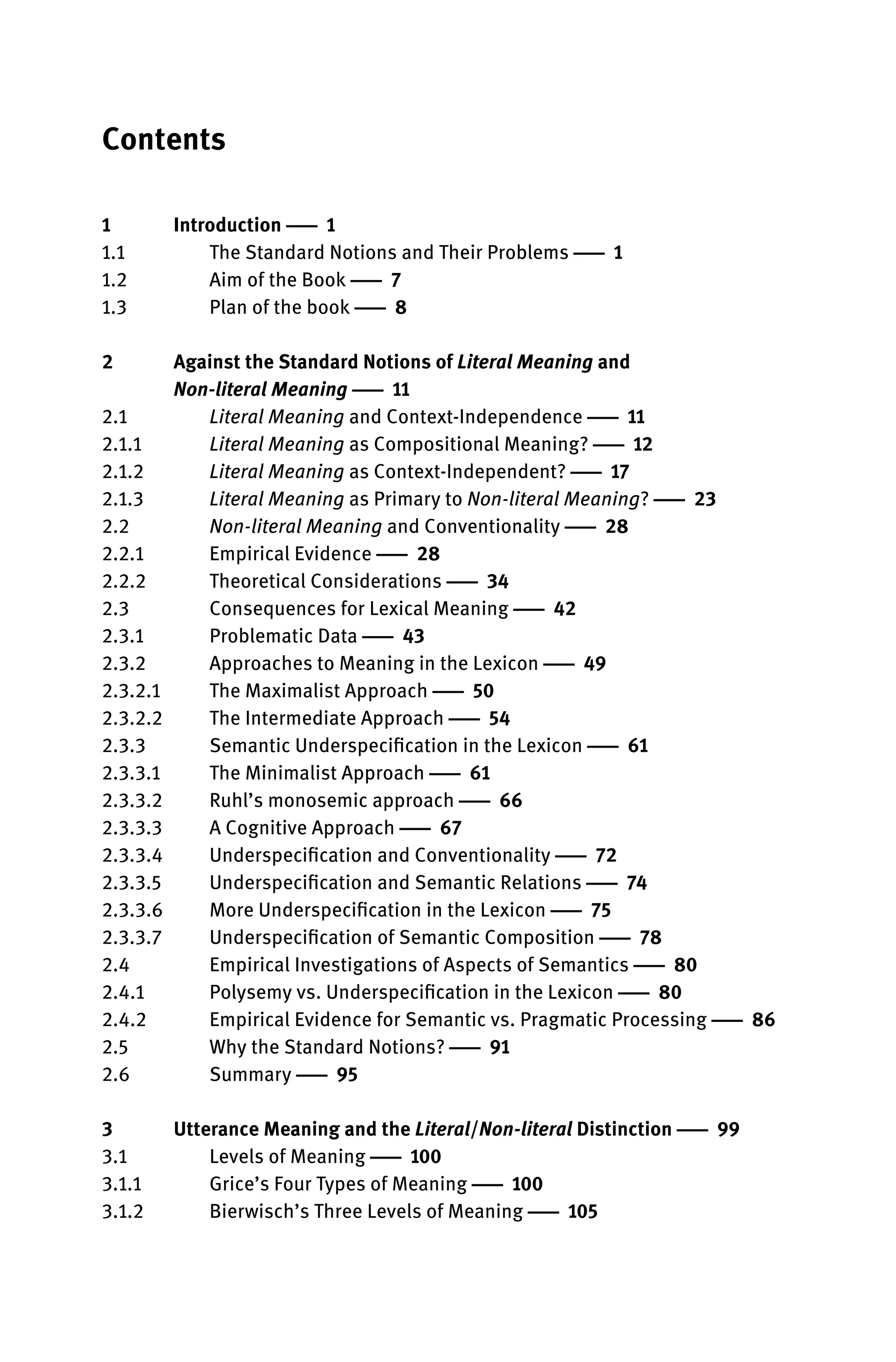


![2 Introduction
cally, Katz (1977) introduces the notion of the ‘anonymous letter situation’ to char-
acterise the kind of meaning captured by semantics in contrast to pragmatics.
[I] draw the theoretical line between semantic interpretation and pragmatic interpretation
by taking the semantic component to properly represent only those aspects of the meaning
of the sentence that an ideal speaker-hearer of the language would know in an anonymous
letter situation, ... [where there is] no clue whatever about the motive, circumstances of
transmission, or any other factor relevant to understanding the sentence on the basis of its
context of utterance. (Ibid., p. 14)
In addition, semantics is also characterised as dealing with those aspects of mean-
ing that expressions have, independent of their use. In contrast, pragmatics is
understood as dealing with those aspects of meaning that are determined by the
actual use of language. Thus, compare again Lyons (1987) who mentions the idea
that ‘...semantics has to do with meaning, and pragmatics with use...’ (ibid.,
p. 157). Accordingly, one finds uses of the terms literal meaning and non-literal
meaning which pick up on this view of the difference between semantic and prag-
matic meaning. For instance, Bach (2001a) writes
Words do not have nonliteral meanings [...], but they can be used in nonliteral ways. [...] In
familiar cases, such as metaphor and metonymy, particular expressions are used nonliter-
ally. [...] But there is a different phenomenon which I call “sentence nonliterality,” [...] Here
a whole sentence is used nonliterally, without any of its constituent expressions being so
used. (Ibid., p. 249, my emphasis)
Thus, whereas literal meaning is a feature that expressions are said to have, the
non-literal meaning of an expression results from the particular use of that expres-
sion.
To summarise the standard understanding of semantics and pragmatics:
whereas the former is characterised as dealing with literal, conventional and con-
text-independent meaning, the latter deals with non-literal, non-conventional and
context-dependent meaning. Using the dichotomies in this characterisation sug-
gests that there is a correspondence between literal, conventional and context-
independent meaning, on the one hand, and non-literal, non-conventional and
context-dependent meaning on the other.1
In other words, the fact that the two
terms literal meaning and non-literal meaning are used amongst others in a di-
chotomous characterisation of semantics and pragmatics suggests that these oth-
er terms also may be used in characterising literal meaning and non-literal mean-
1 From the quotes given above, this is especially apparent in Cole’s, who uses the terms literal
and non-literal as synonymous to conventional and non-conventional, respectively.](https://image.slidesharecdn.com/2457787-250606160622-da34891a/75/The-Semanticspragmatics-Controversy-Kristin-Brjesson-17-2048.jpg)
![The Standard Notions and Their Problems 3
ing as such. In fact, this implicit assumption has led to what might be called
the standard notions of literal meaning and non-literal meaning which are sum-
marised in what follows.
Literal meaning, on the one hand, is assumed to be conventionalised, that is,
it does not take any special interpretation effort to arrive at it. The literal mean-
ing of simple expressions is listed in their lexical entries; the literal meaning of
complex expressions is the result of a principled combination of the literal mean-
ings of their parts. Thus, both the literal meaning of simple as well as complex
expressions is characterised by the fact that it is context-independent. Non-literal
meaning, on the other hand, is assumed to be non-conventionalised, thus, it does
take a special interpretation effort to arrive at it. Intuitively, it is considered as
deviating from some more basic (literal) meaning in a fairly special way. More-
over, in contrast to literal meaning, non-literal meaning crucially is taken to be
context-dependent. Overall, the term non-literal meaning is used to differentiate
from literal meaning a kind of meaning that is derived from the latter and, in a
sense, has a secondary status. Therefore, it is traditionally assumed that in terms
of the enfolding of the interpretation process, the literal meaning of an expres-
sion is processed first, whereas any potential non-literal meanings are processed
afterwards and only if the literal interpretation does not fit the given context.
However, as the extensive debate concerning the proper demarcation of se-
mantics from pragmatics – especially of the last 15 years (cp. Carston 1999, Turner
1999, Dölling 2001, Bianchi 2004, Borg 2004b, Cappelen and Lepore 2005, Horn
2006, Dölling and Zybatow 2007, Carston 2009, Frisson 2009, Recanati 2010,
Borg 2012, Carston and Hall 2012, etc.) – shows: not only is it unclear whether
the standard notions of literal meaning and non-literal meaning actually are use-
ful in the characterisation of distinctive kinds of meaning aspects, what is even
more problematic is the fact that they are based on an understanding of seman-
tics and pragmatics that has come under increasing criticism.
In particular, the question of whether semantics should be taken to be differ-
entiated from pragmatics by the property of context-(in)dependence of meaning
has been – and still is – heavily discussed. This has become a pressing question
since, in addition to the assumption that it deals with context-independent mean-
ing, semantics has also traditionally been characterised as determining the prop-
osition expressed by a sentence. However – and this is implicit already in Grice
(1975, 1989)’s characterisation of the two levels of meaning what is said and what
is meant – it can be argued that semantics alone actually does not determine the
proposition expressed by a sentence. Thus, although Grice characterised the level
of what is said as ‘...closely related to the conventional meaning of the words (the
sentence) [the speaker] has uttered’ (Grice 1989, p. 25), he also recognised that for
a sentence to express a determinate proposition at all, indexicals have to get fixed](https://image.slidesharecdn.com/2457787-250606160622-da34891a/75/The-Semanticspragmatics-Controversy-Kristin-Brjesson-18-2048.jpg)
![4 Introduction
and ambiguities and references resolved. Grice himself did not explicitly call the
processes that lead to such specifications of meaning either semantic or pragmat-
ic. However, in the discussion of the two levels of meaning that followed, some
authors have claimed that what is said – or at least a level of meaning very similar
to it – actually IS the semantic content of an utterance (and as such is determined
by a semantics component that does allow the consideration of contextual infor-
mation after all), whereas others have argued that it is a level of meaning that has
already gone beyond the purely semantically determined content (thus keeping
to the traditional view of semantics as independent of contextual information).2
Be that as it may (for now), the important point to note is that – consider-
ing that traditionally semantics is in fact characterised by both the properties of
dealing with context-independent meaning as well as determining the proposi-
tions expressed by sentences and considering that the characterisation of literal
meaning derives from that of semantics – maybe it actually is the latter mentioned
property of semantics that the term literal meaning should be taken to relate to. In
other words, maybe it is not the context-independent meaning that is literal, but
rather the proposition expressed by a sentence. If the latter is the case, then lit-
eral meaning would in fact not be context-independent. Actually, Korta and Perry
(2008) claim that ‘[w]hat is said has been widely identified with the literal content
of the utterance...’ and looking at the quotations below, where the term literal is
indeed used to refer to a context-dependent level of meaning (roughly: Grice’s
what is said), this claim is corroborated. So, for instance, Carston (2007, p. 21)
speaks of the ‘...literal meaning of [a speaker’s] utterance’. Similarly, Recanati
(1995, p. 2) refers to ‘...the literal interpretation of an utterance (the proposition
literally expressed by that utterance)...’ and Sag (1981, p. 274-5) speaks of the
‘...propositional content of an utterance (i.e., its literal meaning)...’. It should
be noted that although these authors reject the standard characterisation of se-
mantics and pragmatics and they use the term literal meaning in a non-standard
understanding, they only do the latter implicitly. That is, these authors do not ex-
plicitly say anything new concerning the properties that characterise literal mean-
ing and non-literal meaning, respectively. In fact, Bierwisch (1979, 1983, 1997) is
the only exception here in that he explicitly uses the term literal meaning with re-
spect to a context-dependent level of meaning he calls utterance meaning, which
2 In fact a third possibility has been proposed, namely that semantics DOES indeed have both
the properties of dealing with context-independent meaning only and for sentences determining
the propositions expressed by them. However, the thus determined level of meaning is taken to
be distinct from Grice’s level of what is said. For a detailed discussion of the various different
approaches to the semantics/pragmatics distinction, see chapter 3.](https://image.slidesharecdn.com/2457787-250606160622-da34891a/75/The-Semanticspragmatics-Controversy-Kristin-Brjesson-19-2048.jpg)
![The Standard Notions and Their Problems 5
is quite similar to Grice’s what is said. Thus, he says of an expression’s utterance
meaning that it may or may not correspond to the literal meaning this expression
has in that particular utterance context. However, he does not give any details
as to how this particular type of meaning is determined or differentiated from
others.
Generally, what the quotations given so far show is that the term literal mean-
ing is not only used with respect to a context-independent level of meaning. Rather,
and as Bezuidenhout and Cutting (2002, p. 435) note, ‘[t]he phrases “literal mean-
ing” or “literal interpretation” have been used to cover both the literal meaning of
a sentence and what is said by the utterance of a sentence in a context’. In other
words, the term literal is used to refer to quite different types of meaning levels. In
fact, the pair of terms literal and non-literal is even used in the characterisation
of so-called indirect speech acts – usually taken to belong to the pragmatically
determined level of meaning what is meant – which have been analysed as be-
ing associated with two illocutionary forces, where one is the primary and at the
same time non-literal and indirect speech act and the other is the secondary and at
the same time literal and direct speech act. The literal speech act is the illocution-
ary force taken to be conventionally associated with the particular sentence-type
used for the expression of some particular speech act, whereas the non-literal
speech act is the act actually intended by the speaker.
Thus, it seems the two terms literal meaning and non-literal meaning are (most-
ly) used based only on intuitions we have concerning the nature of the relation
between particular types of meaning aspects rather than on an identification of
determinate and contrasting sets of properties those types of meaning aspects
can be shown to exhibit. This becomes apparent when looking in more detail at
the properties used in the standard characterisations of the two terms and the
phenomena intended to be picked out by them, where it turns out that the phe-
nomena do not all show the properties suggested by the standard characterisa-
tion. Thus, there is an argument to be made that literal meaning should not be
viewed as context-independent (as we already saw), always conventional and al-
ways primary in interpretation. Similarly for non-literal meaning, one does not
necessarily have to assume that it is always non-conventional and secondary in
interpretation.3
What complicates matters even further is the fact that the notions traditional-
ly used in the standard characterisations of literal meaning and non-literal mean-
ing – and of semantics and pragmatics, of course – such as (non)-conventionality
and context-(in)dependence, actually are problematic themselves. Thus, the use
3 See chapter 2 for detailed arguments supporting such a view.](https://image.slidesharecdn.com/2457787-250606160622-da34891a/75/The-Semanticspragmatics-Controversy-Kristin-Brjesson-20-2048.jpg)





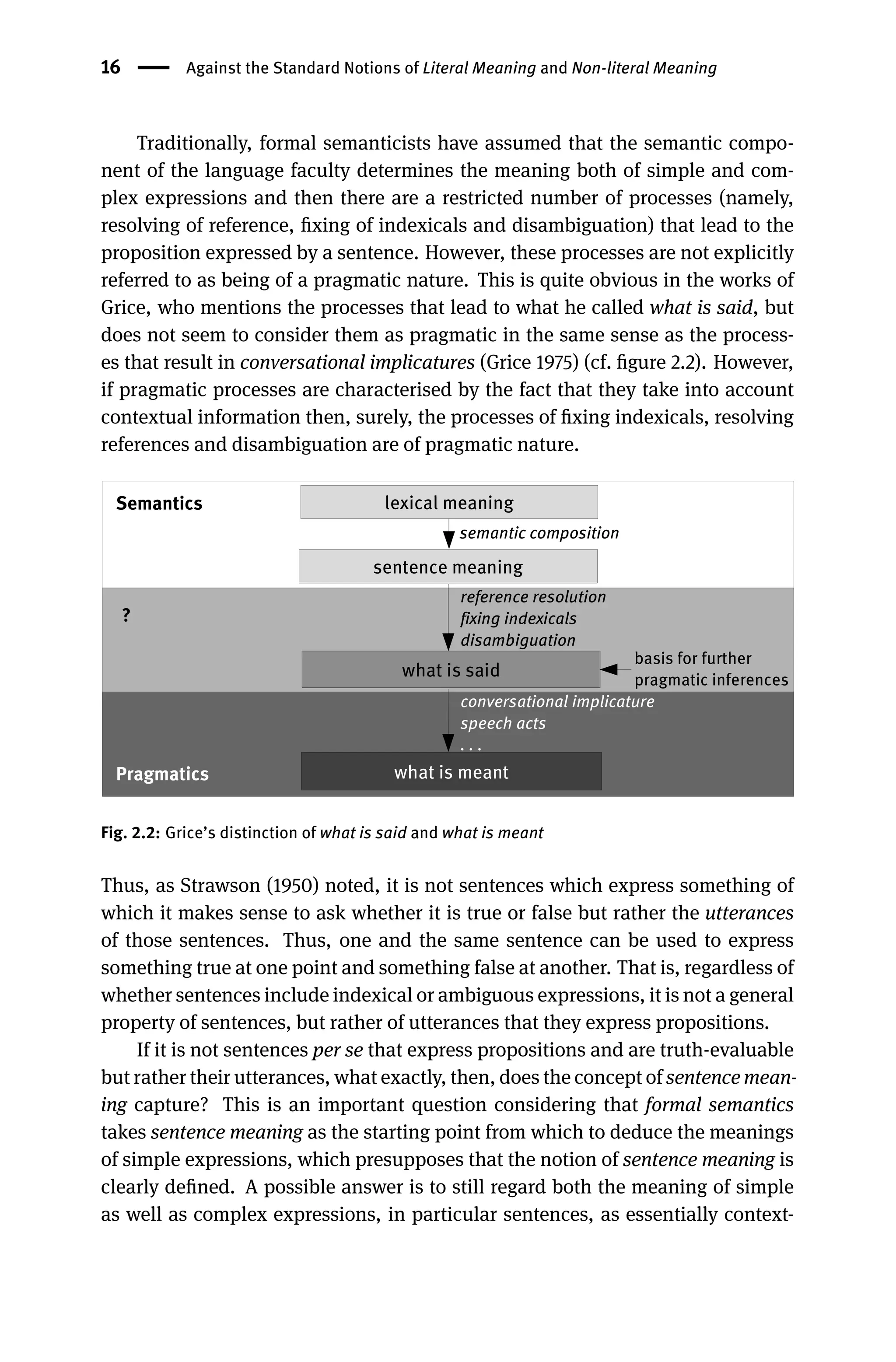

![18 Against the Standard Notions of Literal Meaning and Non-literal Meaning
Fig. 2.3: The typical cat-on-the-mat configuration
The problem with this ‘literal sentence meaning’ is that although speakers or
hearers are not necessarily aware of the fact, a number of preconditions are as-
sumed to hold.5
To show this, Searle constructs a context of utterance for the
sentence in (3), where it is questionable whether one would want to say that the
sentence correctly describes the state of affairs at hand.
suppose the cat and the mat are in exactly the relations depicted only they are floating
freely in outer space, perhaps the Milky Way galaxy altogether. In such a situation the scene
would be just as well depicted if we turn the paper on edge or upside down since there is
no gravitational field relative to which one is above the other. Is the cat still on the mat?
(Searle 1978, cited from Searle 1979, p. 122)
Thus, if what the meaning of a sentence does is determine a set of truth con-
ditions, Searle argues that for most sentences this determination can only take
place against specific background assumptions. These background assumptions
are not part of the semantic structure of the sentence, that is, they are unarticu-
lated. Moreover, due to possible variations in the background assumptions, the
same sentence might have varying truth conditions. For any sentence, there is no
fixed set of background assumptions of which it could be said that it determines
that sentence’s literal meaning. To illustrate this fact, Searle construes a context
of utterance for (3), in which it could be used to truthfully describe a situation
such as depicted in figure 2.4.6
5 Note that Searle is not referring to the fact that the sentence in (3) additionally contains index-
ical elements. That is another matter.
6 This is Searle’s context: ‘The mat is in its stiff angled position, as in [figure 2.4], and it is part of
a row of objects similarly sticking up at odd angles - a board, a fence post, an iron rod, etc. These
facts are known to both speaker and hearer. The cat jumps from one of these objects to another.
It is pretty obvious what the correct answer to the question “Where is the cat?” should be when
the cat is in the attitude depicted in [figure 2.4]: The cat is on the mat.’ (Searle 1978, cited from
Searle 1979, p. 125).](https://image.slidesharecdn.com/2457787-250606160622-da34891a/75/The-Semanticspragmatics-Controversy-Kristin-Brjesson-33-2048.jpg)
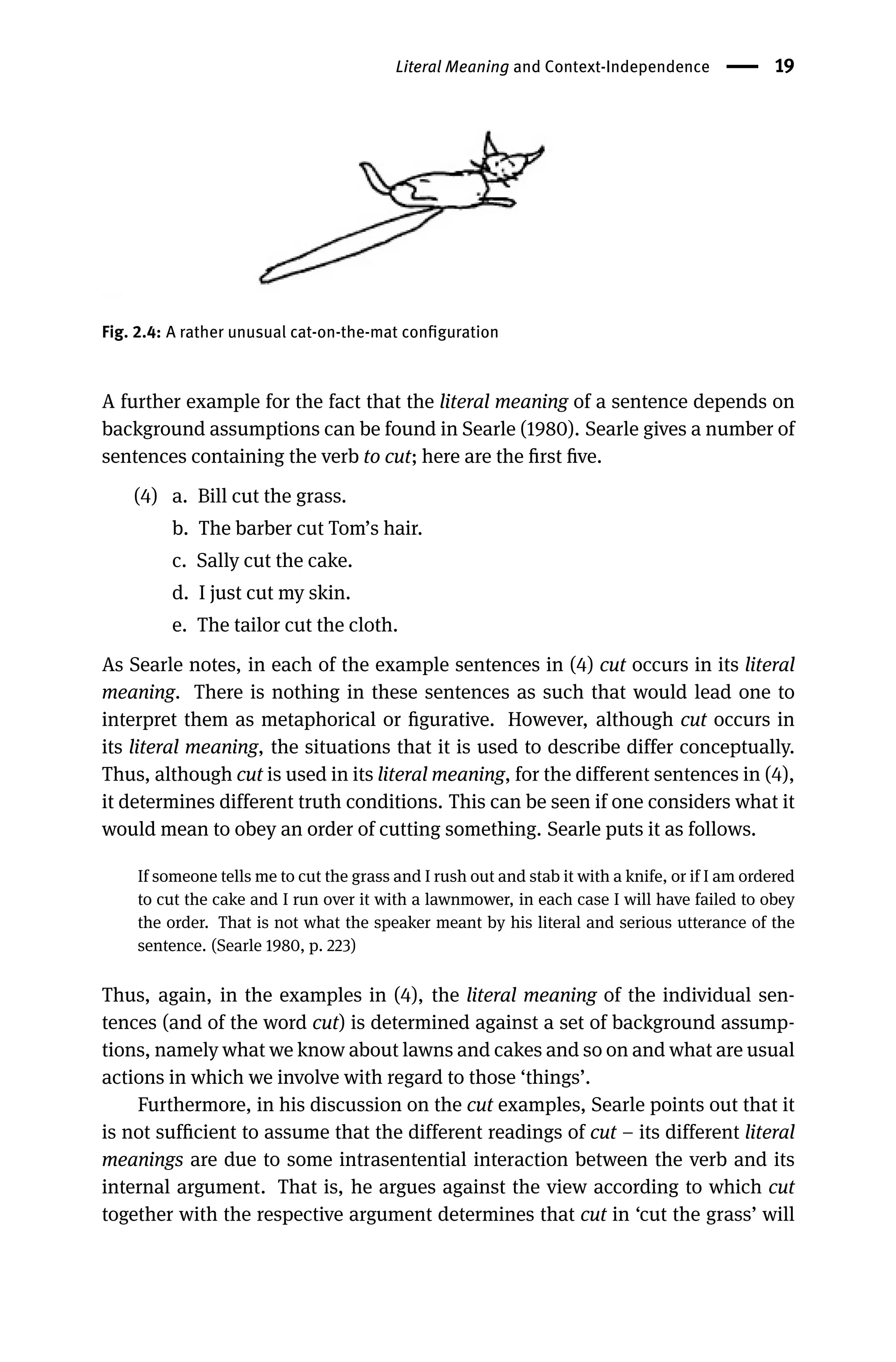
![20 Against the Standard Notions of Literal Meaning and Non-literal Meaning
receive a different interpretation from the one it receives in ‘cut the cake’. His
reasoning is that it is possible to ‘...imagine circumstances in which “cut” in “cut
the grass” would have the same interpretation it has in “cut the cake”...’ (Searle
1980, p. 224).
Suppose you and I run a sod farm where we sell strips of grass turf to people who want a
lawn in a hurry. [...] Suppose I say to you, “Cut half an acre of grass for this customer”; I
might mean not that you should mow it, but that you should slice it into strips as you could
cut a cake or a loaf of bread. (Searle 1980, p. 224–5)
Moreover, he points out that there is a difference to be drawn between what he
calls background assumptions and the special context of utterance for a given
utterance. While background assumptions are involved in determining a sen-
tence’s literal meaning or truth conditions, the context in which a sentence is ut-
tered helps the hearer to decide on whether a speaker intended her utterance to
be taken literally or non-literally. However, since Searle does not explicitly de-
fine what constitutes background assumptions and what is part of the context
of an utterance, the question arises whether this differentiation really is neces-
sary. From the examples Searle uses to defend his view of what constitutes literal
meaning, it could be argued that the background assumptions necessary for de-
termining the literal meaning of a sentence are in fact part of the specific context
in which an utterance takes place. What Searle obviously means by background
assumptions are certain aspects of knowledge that we have, namely those as-
pects which are relevant in the particular utterance situation. Thus, one could al-
so assume that depending on the situation speakers and hearers find themselves
in that situation will make certain aspects of knowledge they have more promi-
nent (or salient). Those aspects, then, constitute what Searle calls background
assumptions in the sense that speakers and hearers are presumably normally not
aware of basing their utterances and interpretations on such assumptions. As
their name implies, background assumptions are in the background; they form
the basis from which speakers formulate their utterances and hearers intepret
them. Thus, background assumptions depend on the particular context of utter-
ance and therefore can be said to form part of the contextual information used in
interpreting. Thus, in order to disambiguate whether the expression cut is used
with the meaning as in ‘cut the grass’ or with the meaning as in ‘cut the cake’,
the hearer needs to take into account contextual information. That is, even if the
background of the utterance is such as Searle gives it, the hearer would still have
to decide that the reading of cut as in ‘cut the cake’ is the one the speaker intend-
ed in that situation. From what has been said about salience of meaning above,
it is of course very likely that the particular utterance situation will speed up the
hearer’s unconscious decision.](https://image.slidesharecdn.com/2457787-250606160622-da34891a/75/The-Semanticspragmatics-Controversy-Kristin-Brjesson-35-2048.jpg)







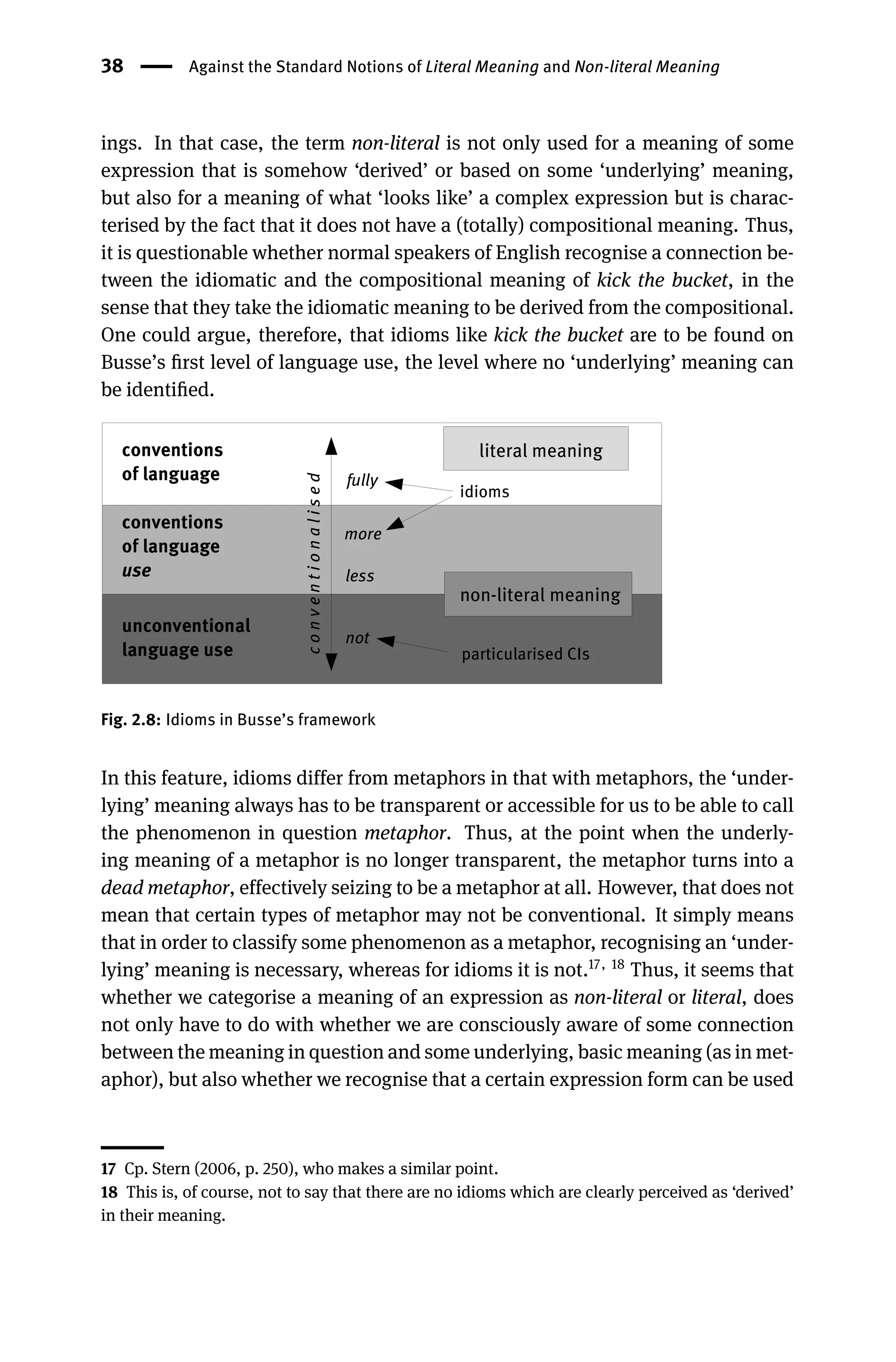
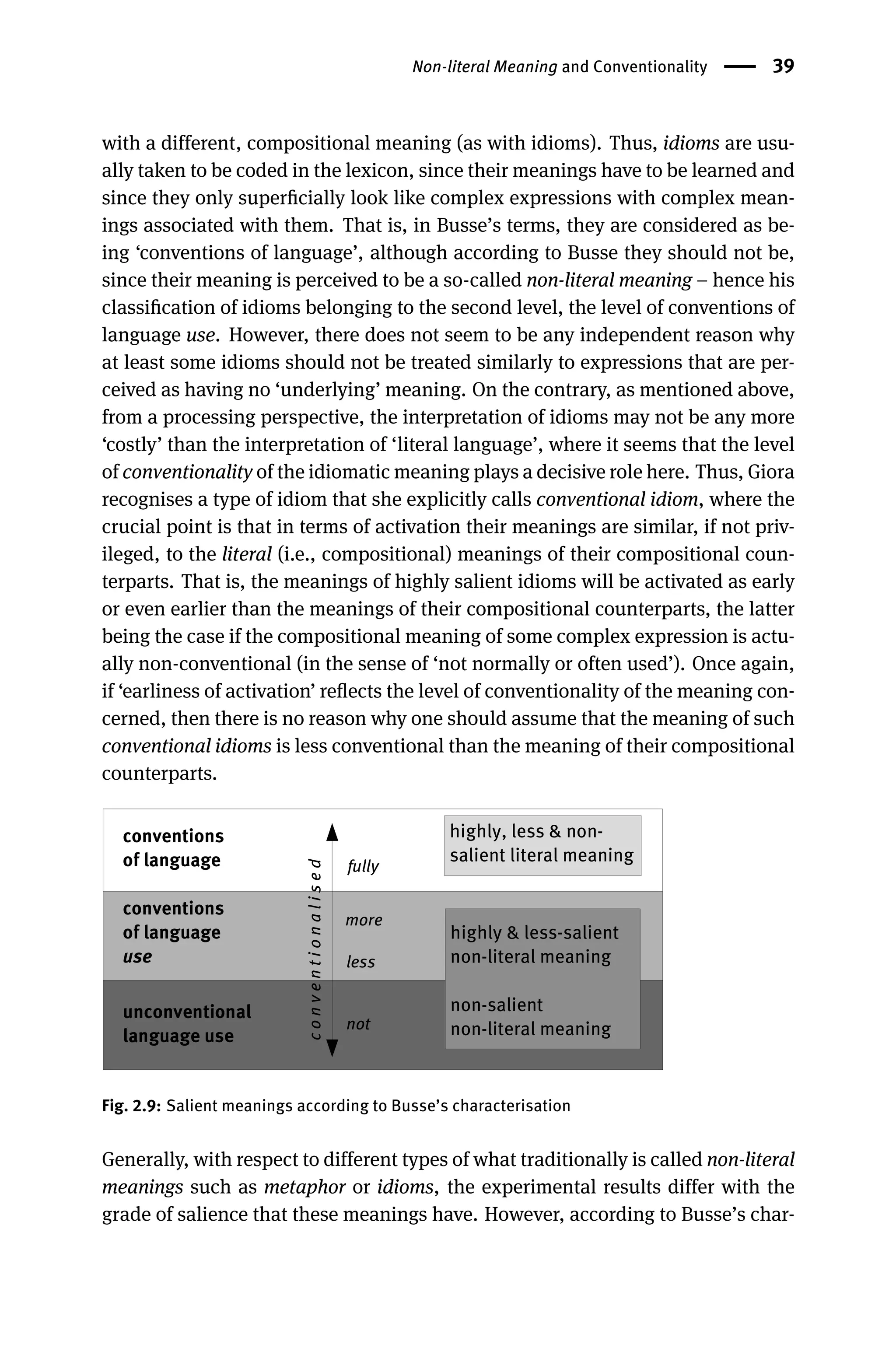






![Definition.—A n t h o c y r t i d a with the basal mouth of the shell fenestrated
(vel Dicyrtida multiradiata clausa).
Genus 570. Sethophæna,[187] Haeckel, 1881, Prodromus, p. 433.
Definition.—S e t h o p h æ n i d a (vel Dicyrtida multiradiata clausa) with
lateral apophyses. Cephalis with a horn.
The genus Sethophæna and the following Clistophæna form together the
small subfamily of Sethophænida, comprising those Dicyrtida in which the
thorax bears numerous radial appendages (four to six or more), and the
mouth is closed by a lattice-plate. In Sethophæna the apophyses are lateral
wings, as in Micromelissa, from which it may be derived by development of
secondary wings, interpolated between the three primary wings.
1. Sethophæna tetraptera, n. sp.
Shell smooth, with deep collar stricture. Length of the two joints = 3 : 10,
breadth = 4 : 9. Cephalis subspherical, without horn. Thorax ovate, with
rounded hemispherical base, and subregular, hexagonal pores. From its
upper half (below the collar stricture) arise four divergent, conical, straight
wings, of half the length, opposite in pairs in two meridional planes,
perpendicular to one another (compare Tetralacorys, Pl. 65, figs. 4, 5).
Dimensions.—Cephalis 0.03 long, 0.04 broad; thorax 0.1 long, 0.09 broad.
Habitat.—South Pacific, Station 300, depth 1375 fathoms.
2. Sethophæna hexaptera, n. sp. (Pl. 97, fig. 13).
Shell rough, pear-shaped, with distinct collar stricture. Length of the two
joints = 1 : 4, breadth = 2 : 4. Cephalis hemispherical, with a conical horn
of the same length. Thorax inflate, inversely ovate, nearly pear-shaped,](https://image.slidesharecdn.com/2457787-250606160622-da34891a/75/The-Semanticspragmatics-Controversy-Kristin-Brjesson-64-2048.jpg)

![Habitat.—North Pacific, Station 253, depth 3125 fathoms.
Genus 571. Clistophæna,[188] Haeckel, 1881, Prodromus, p. 433.
Definition.—S e t h o p h æ n i d a (vel Dicyrtida multiradiata clausa) with
terminal apophyses. Cephalis with a horn.
The genus Clistophæna agrees with the preceding Sethophæna in the
mouth of the thorax being closed by a lattice-plate. But the appendages of
the thorax are terminal feet, not lateral wings; their number is commonly
six or nine, rarely more. Clistophæna may be derived either from
Tetrahedrina by interpolation of secondary feet between the three primary,
or from Sethamphora by development of a basal lattice-plate closing the
mouth.
1. Clistophæna rüstiana, n. sp. (Pl. 57, fig. 6).
Shell rough, with distinct collar stricture. Length of the two joints = 3 : 10,
breadth = 4 : 11. Cephalis hemispherical, with small, circular pores and a
stout oblique horn three times the length, which is three-sided prismatic,
and at the top denticulate. Thorax subconical, inflate, with regular, circular,
quincuncial pores, increasing in size towards the base. Margin of the flat
base, with six divergent, stout feet of the same prismatic form as the
cephalic horn, with denticulate distal ends, about as long as the thorax. This
elegant species is dedicated to Dr. Rüst of Freiburg, the discoverer of
numerous fossil Radiolaria in the Liassic and Jurassic formations.
Dimensions.—Cephalis 0.03 long, 0.04 broad; thorax 0.1 long, 0.11 broad.
Habitat.—Central Pacific, Station 265, depth 2900 fathoms.
2. Clistophæna hexolena, n. sp.](https://image.slidesharecdn.com/2457787-250606160622-da34891a/75/The-Semanticspragmatics-Controversy-Kristin-Brjesson-66-2048.jpg)


![Genus 572. Sethoconus,[189] Haeckel, 1881, Prodromus, p. 430.
Definition.—S e t h o c o r i d a (vel Dicyrtida eradiata aperta) with conical or campanulate,
gradually dilated thorax and wide open mouth. Cephalis with one or more horns.
The genus Sethoconus is the oldest and simplest form of the Sethocorida, or of those
Dicyrtida in which the simple thorax bears no apophyses and has the mouth open and not
closed by a basal lattice-plate. Probably all those eradiate Sethocorida have been derived
either from triradiate Sethopilida (Lychnocanium), or from multiradiate Sethophormida
(Sethophormis, Anthocyrtis ?) by loss of the radial ribs and feet. In Sethoconus the thorax
is more or less conical, sometimes more campanulate, commonly smooth, in some species
covered with spines. The cephalis is usually small, with rudimentary collar septum, at
other times large, with distinct cortinar septum. Correspondingly, the genus may be
divided into different groups, which here are enumerated as subgenera.
Subgenus 1. Conarachnium, Haeckel, 1881, Prodromus, p. 430. (= Ceratocyrtis, Bütschli),
1882, loc. cit., p. 536.
Definition.—Cephalis relatively large, with distinct collar septum and numerous pores.
Thorax smooth.
1. Sethoconus trochus, Haeckel.
Eucyrtidium trochus, Ehrenberg, 1872, Abhandl. d. k. Akad. d. Wiss. Berlin, p. 293, Taf. vii, fig. 17.
Conarachnium trochus, Haeckel, 1881, Prodromus, p. 430.
Cephalis ovate, relatively large, with a pyramidal horn of the same length, and three pairs
of large opposite pores, on each side of a vertical septum. Thorax wide, conical, about as
long as broad, with nearly straight outlines; its pores regular, circular, hexagonally framed,
of the same size as the cephalic pores.
Dimensions.—Cephalis 0.03 long, 0.02 broad; thorax 0.06 long, 0.06 broad.
Habitat.—Tropical Pacific, Stations 200 to 281, surface.
2. Sethoconus cucullaris, Haeckel.
Cornutella cucullaris, Ehrenberg, 1875, Abhandl. d. k. Akad. d. Wiss. Berlin, p. 68, Taf. ii. fig. 7.
Ceratocyrtis cucullaris, Bütschli, 1882, Zeitschr. f. wiss Zool., Bd. xxvi. p. 536, Taf. xxxiii. fig. 36, a., b.](https://image.slidesharecdn.com/2457787-250606160622-da34891a/75/The-Semanticspragmatics-Controversy-Kristin-Brjesson-71-2048.jpg)





![Phlebarachnium venosum, Haeckel, 1881, Prodromus, p. 430, et Atlas, loc. cit.
Cephalis subspherical, with a stout prismatic horn twice the length, bearing three
denticulate edges. The uppermost part of the thorax is supported by three diverging,
radial beams arising from the deep collar stricture. Thorax wide, conical, nearly twice as
long as broad, with slightly convex, thorny outlines; its delicate network is composed of
very irregular, polygonal meshes of different sizes, separated by stronger bars, and of
numerous very small polygonal pores separated by very thin bars inside the former. The
central capsule of the figured specimen exhibited in the upper third of the thorax four
large club-shaped lobes, which arose from a very small sphere enclosed in the cephalis
and containing the nucleus.
Dimensions.—Cephalis 0.02 long, 0.03 broad; thorax 0.4 long, 0.3 broad.
Habitat.—Central Pacific, Station 271, surface.
Genus 573. Periarachnium,[190] Haeckel, 1881, Prodromus, p. 430.
Definition.—S e t h o c o r i d a (vel Dicyrtida eradiata aperta) with conical or campanulate,
gradually dilated thorax, and widely open mouth. Primary lattice-shell enveloped by an
external arachnoidal mantle. Cephalis with one or more horns.
The genus Periarachnium has been derived from those forms of the preceding
Sethoconus, in which the conical thorax is covered with simple spines (Phlebarachnium) or
branched spines (Cladarachnium). By communication of the branches of these spines a
second outer shell is formed, which, like an arachnoidal mantle, envelops the inner
primary shell.
1. Periarachnium periplectum, n. sp. (Pl. 55, fig. 11).
Cephalis hemispherical, separated from the thorax by a sharp collar stricture, from which
arise three internal, diverging beams supporting its upper third. Thorax campanulate,
conical, about as long as broad, with slightly convex outlines. The delicate lattice-work of
the entire shell is double; the inner composed of subregular, hexagonal meshes; the outer
of larger, irregular, polygonal meshes. The bars of the inner are much thicker than the thin
threads of the outer. Both shells are connected by numerous bristle-shaped beams. The
central capsule of the figured specimen exhibited in the upper part of the thorax three
club-shaped lobes, which arose from a sphere enclosed in the cephalis and containing the
nucleus.
Dimensions.—Cephalis 0.02 long, 0.03 broad; thorax 0.15 long, 0.12 broad.](https://image.slidesharecdn.com/2457787-250606160622-da34891a/75/The-Semanticspragmatics-Controversy-Kristin-Brjesson-80-2048.jpg)
![Habitat.—Central Pacific, Station 271, surface.
Genus 574. Sethocephalus,[191] Haeckel, 1881, Prodromus, p. 430.
Definition.—S e t h o c o r i d a (vel Dicyrtida eradiata aperta) with discoidal, flatly expanded
thorax. Cephalis large, without horn.
The genus Sethocephalus (formerly proposed under the name Platycryphalus) contains
some few and rare Sethocorida, distinguished by the very large cephalis, the collar
opening of which is wide open, not closed by cortinar beams, and surrounded by a very
flat, nearly discoidal thorax, like the brim of a hat. It is possible that this peculiar genus
has been derived from a Tricyrtid (Theocalyptra?) by loss of the original cephalis, and that
the apparent large cephalis is the original thorax.
1. Sethocephalus eucecryphalus, n. sp. (Pl. 56, fig. 13).
Cephalis very large, campanulate-conical, with irregular, polygonal pores and thin bars.
Thorax short, scarcely broader than the cephalis, beyond the sharp collar stricture
expanded like the brim of a hat, with few rows of irregular, polygonal pores. (In the
specimen figured the thorax was only half as broad as in another specimen found
afterwards.)
Dimensions.—Cephalis 0.12 long, 0.09 broad; thorax 0.02 long, 0.12 broad.
Habitat.—South Pacific, Station 285, surface.
2. Sethocephalus platycryphalus, n. sp.
Platycryphalus sethodiscus, Haeckel, 1881, Prodromus, p. 430.
Cephalis large, hemispherical, with irregular square pores and thin bars. Thorax flatly
conical, three to four times as broad as the cephalis, beyond the collar stricture expanded
nearly discoidally, with a delicate network of small, subregular, hexagonal pores. (Similar
in general form to Sethophormis aurelia, Pl. 55, fig. 3, but without any trace of collar
beams or radial ribs.)
Dimensions.—Cephalis 0.04 long, 0.08 broad; thorax 0.04 long, 0.3 broad.
Habitat.—South Pacific, Station 289, surface.](https://image.slidesharecdn.com/2457787-250606160622-da34891a/75/The-Semanticspragmatics-Controversy-Kristin-Brjesson-81-2048.jpg)
![Genus 575. Sethocyrtis,[192] n. gen.
Definition.—S e t h o c o r i d a (vel Dicyrtida eradiata aperta) with ovate or subcylindrical
thorax, the mouth of which is constricted, simple, without prominent hyaline peristome.
Cephalis with an apical horn.
The genus Sethocyrtis and the three following nearly allied genera differ from the three
preceding genera of Sethocorida in the form of the thorax, which is not gradually dilated,
conical, but cylindrical or ovate, with more or less constricted mouth. Sethocyrtis may be
derived from Anthocyrtis by loss of the terminal feet. Its mouth is quite simple, without
tubular or annular peristome.
1. Sethocyrtis oxycephalis, n. sp. (Pl. 62, fig. 9).
Shell rough, subconical, with slight collar stricture. Length of the two joints = 4 : 9,
breadth = 3 : 8. Cephalis ovate, with a pyramidal horn of half the length. Thorax
campanulate, with regular, circular pores, twice as broad as those of the cephalis. Mouth
constricted, scarcely half as broad as the thorax.
Dimensions.—Cephalis 0.04 long, 0.03 broad; thorax 0.09 long, 0.08 broad.
Habitat.—Central Pacific, Stations 263 to 274, depth 2350 to 3000 fathoms.
2. Sethocyrtis cancrina, Haeckel.
Eucyrtidium cancrinum, Ehrenberg, 1875, Abhandl. d. k. Akad. d. Wiss. Berlin, p. 70, Taf. x. fig. 4.
Shell smooth, bottle-shaped, with obliterated collar stricture. Length of the two joints =
4 : 9, breadth = 2 : 7. Cephalis subcylindrical, with a stout conical horn of the same
length, and sometimes a smaller accessory horn at its base. Thorax ovate, truncate, with
regular, circular, quincuncial pores, twice as broad as those of the cephalis. Mouth little
constricted, flat, nearly as broad as the thorax.
Dimensions.—Cephalis 0.04 long, 0.02 broad; thorax 0.09 long, 0.07 broad.
Habitat.—Fossil in Barbados.
3. Sethocyrtis diomedis, n. sp.](https://image.slidesharecdn.com/2457787-250606160622-da34891a/75/The-Semanticspragmatics-Controversy-Kristin-Brjesson-82-2048.jpg)

![Shell smooth, bottle-shaped, with distinct collar stricture. Length of the two joints = 2 : 4,
breadth = 1 : 3. Cephalis slenderly ovate, with an excentric pyramidal horn of the same
length. Thorax inflate, ovate, with irregular, roundish pores and thin bars between them.
Mouth constricted, flat, half as broad as the thorax, without prominent peristome.
Dimensions.—Cephalis 0.04 long, 0.02 broad; thorax 0.08 long, 0.06 broad.
Habitat.—Tropical Pacific, Stations 200, 225, 266, 274, &c., at various depths.
7. Sethocyrtis agamemnonis, n. sp. (Pl. 62, figs. 11, a, b).
Shell pear-shaped, rough, with sharp collar stricture. Length of the two joints = 2 : 10,
breadth = 3 : 8. Cephalis subspherical, with very small pores and a small, pyramidal horn
of half the length. Thorax inflate, ovate; in the uppermost part (beyond the collar
stricture) with a ring of six to nine very large roundish pores, which are twice to four times
as broad as the other irregular, roundish pores. (The shell is seen in fig. 11 from the apical
pole, in fig. 11a with the cephalis, in fig. 11b without it, exhibiting the four central collar
pores of the cortinar septum.) Mouth truncate, without prominent peristome.
Dimensions.—Cephalis 0.02 long, 0.03 broad; thorax 0.1 long, 0.08 broad.
Habitat.—North Pacific, Station 244, depth 2900 fathoms.
8. Sethocyrtis cassis, Haeckel.
Cornutella cassis, Ehrenberg, 1854, Mikrogeol., Taf. xxii. fig. 38.
Cyrtocalpis cassis, Haeckel, 1862, Monogr. d. Radiol., p. 287.
Shell pear-shaped, smooth, with obliterated collar stricture. Length of the two joints =
4 : 13, breadth = 3 : 12. Cephalis ovate, with a conical horn of half the length. Thorax
inflate, ovate, with subregular, circular, quincuncial pores, twice to three times as broad as
the bars. Mouth constricted, truncate, two-thirds as broad as the thorax, without
prominent peristome.
Dimensions.—Cephalis 0.04 long, 0.03 broad; thorax 0.13 long, 0.12 broad.
Habitat.—Fossil in Tertiary rocks of Sicily (Caltanisetta).
Genus 576. Sethocorys,[193] Haeckel, 1881, Prodromus, p. 430.](https://image.slidesharecdn.com/2457787-250606160622-da34891a/75/The-Semanticspragmatics-Controversy-Kristin-Brjesson-84-2048.jpg)


![pores only. Mouth constricted, with a large cylindrical, tubular, hyaline peristome, half as
long as the shell.
Dimensions.—Cephalis 0.03 long, 0.04 broad; thorax 0.09 long, 0.07 broad.
Habitat.—Western Tropical Pacific, Station 225, depth 4475 fathoms.
Genus 577. Lophophæna,[194] Ehrenberg, 1847, Monatsber. d. k. preuss. Akad. d. Wiss.
Berlin, p. 54.
Definition.—S e t h o c o r i d a (vel Dicyrtida eradiata aperta) with ovate or subcylindrical
thorax, the mouth of which is either truncate or constricted. Cephalis armed with several
large horns.
The genus Lophophæna differs from the nearly allied Sethocorys and Dictyocephalus only
in the armature of the large cephalis, which bears a group of large horns, often arranged
in a corona of radial spines. Sometimes these spines are connected by anastomosing
branches (like Arachnocorys).
Subgenus 1. Lophophænula, Haeckel.
Definition.—Horns of the cephalis simple, free, radial spines, neither branched nor
connected.
1. Lophophæna galea, Ehrenberg.
Lophophæna galea orci, Ehrenberg, 1854, Monatsber. d. k. preuss. Akad. d. Wiss. Berlin p. 245.
Lophophæna apiculata, Ehrenberg, 1875, Abhandl. d. k. Akad. d. Wiss. Berlin, p. 78, Taf. viii. fig. 11.
? Cornutella spiniceps, Ehrenberg, 1875, Abhandl. d. k. Akad. d. Wiss. Berlin, p. 68, Taf. ii. fig. 6.
Shell with slight collar stricture. Length of the two joints = 5 : 4, breadth = 5 : 6. Cephalis
subglobular, with numerous bristle-shaped, radial spines, about as long as its radius.
Thorax about the same size, truncate, conical, smooth, with wide open mouth. Pores in
both joints of equal size, small, regular, circular.
Dimensions.—Cephalis 0.05 long, 0.05 broad; thorax 0.04 long, 0.06 broad.
Habitat.—Tropical Atlantic, Station 348, depth 2450 fathoms; also fossil in Barbados.](https://image.slidesharecdn.com/2457787-250606160622-da34891a/75/The-Semanticspragmatics-Controversy-Kristin-Brjesson-87-2048.jpg)