Making College Affordable


                  597C Platform Skills
                         April 6, 2010
                     Sung Youn Kwon
                    suk225@psu.edu
Purpose
                 Making College Affordable

Tuition rise beyond                       Tuition rise within
      inflation                                inflation


1. Mandate a limit on tuition raise
2. Mandate 1 as a required qualification for federal aids
            At the Level of Federal Government
Content

I.   Background

II. Cause and Effect

III. Recent Policies

IV. Proposal

V. Strategy for Implementation
“College tuition is up
 sharply amid recession”
In 2009, tuition rise in public college 6.5%, private 4.4%,
                  consumer prices -2.1%
        Sources : http://www.collegeboard.com/press/releases/208962.html
Cumulative Percentage Increases
                   from 1990-1 to 2006-7
140%

120%

100%
                                                                                 Tuition and Fees
80%
                                                                                 Consumer Prices
60%

40%                                                                              Median Household
                                                                                 Income
20%

 0%
            1990-91         1995-96          2000-01          2006-7
       Sources: Tuition and fees are from the Department of Education, consumer price index from
       the Bureau of Labor Statistics, median household incomes are from the U.S. Census Bureau.
Student Aid and Loans
                       from 1998-9 to 2008-9
90,000
80,000
70,000
60,000
                                                                      Federal Loan
50,000
40,000                                                                Federal Grant
30,000                                                                Nonfederal Loan
20,000
10,000
    -
          98-9       00-01      02-03      04-05      06-07   08-09
         Sources: College Board, Trends in Student Aid 2009
Why?
What is the Major Cause?
Decline of State
Appropriation
What is the Major Cause?
Growth in Staff

  For recent 2 decades, support staff doubled
    - Student enrollment increased 40%
     Sources: Center for College Affordability and Productivity, 1987 to 2007


Constructions

  Buildings, library, convention center, gym….
   - “Gym is a top priority for parents and prospective students”
     Sources: The New York Times, April 21, 2009, Freakonomics
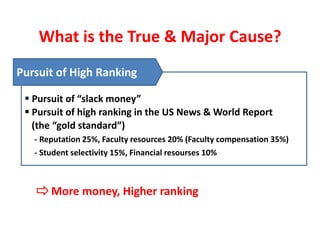
What is the True & Major Cause?
Pursuit of High Ranking

  Pursuit of “slack money”
  Pursuit of high ranking in the US News & World Report
   (the “gold standard”)
   - Reputation 25%, Faculty resources 20% (Faculty compensation 35%)
   - Student selectivity 15%, Financial resourses 10%


       More money, Higher ranking
“Virtuous circle” – Martin Trow (1984)
   Higher
   Compensation       High        Distinguished
                   compensation      Faculty
                                                  Higher Reputation
Higher Financial
Resources


              More                        Higher
              Money                      Ranking

      Higher                  More
      Student Selectivity
                            Students
What is the Effect?
Power Shift
  Market Characteristic
    - Oligopoly, supply leads demand
    - Higher competition, higher price
  High-tuition/High-aid Policy
   - High tuition does not guarantee high aid


       Power shifts from consumer to enterprise
College Affordability


 “Financial Barriers will prevent at least 4.4 million
   high school graduates from attending four-year public
   colleges over the next decade, and prevent another
   two million high school graduates from attending any
   colleges at all.”
  (The Congressional Advisory Committee on Student Financial Assistance, 2006)
College Affordability


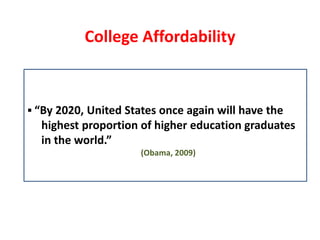
 “By 2020, United States once again will have the
  highest proportion of higher education graduates
  in the world.”
                      (Obama, 2009)
Who Should Pay?
Recent Policies (Federal)
The Higher Education Opportunity Act 0f 2008

  Pressure    to high tuition by making the list public
  - Colleges of highest 5% & lowest 10% tuitions & fees
    (exemption : increase is less than $600 for 3 years)

 Obligation to disclose for federal funding
  - tuition and fees for recent 3 years
  - annual % , $ change for recent 3 years

  Incentive   grants
  - lowest 20% of annual increase, lowest quartile (public), less than $600
Proposal
Put a limit on Tuition Increase
In the Higher Education Opportunity Act
  Do not increase tuition beyond average inflation rate of
   recent 3 years
  If not, the college will be disqualified for all federal funds for
    following 5 years
  - Exemption : increase less than $600 or tuition less than $6,000
  * 24% students attending in 4-year colleges with below $6,000 a year
     (Sources : College Board, 2009)
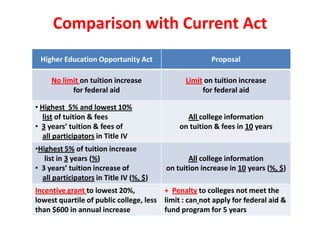
Comparison with Current Act
 Higher Education Opportunity Act                      Proposal

     No limit on tuition increase              Limit on tuition increase
           for federal aid                          for federal aid

• Highest 5% and lowest 10%
   list of tuition & fees                      All college information
• 3 years’ tuition & fees of                 on tuition & fees in 10 years
   all participators in Title IV
•Highest 5% of tuition increase
   list in 3 years (%)                          All college information
• 3 years’ tuition increase of           on tuition increase in 10 years (%, $)
  all participators in Title IV (%, $)
Incentive grant to lowest 20%,          + Penalty to colleges not meet the
lowest quartile of public college, less limit : can not apply for federal aid &
than $600 in annual increase            fund program for 5 years
Howard P.Mckeon’s Proposal

Howard P. (Buck) Mckeon’s Proposal

  Original (Mar., 2003) : colleges increasing tuition by twice (or more) the
                           rate of inflation for two years will lose eligibility
                           for all federal student-aid programs immediately

  Revised (Oct., 2003) : “alert system” of 3 steps before losing eligibility for
                           campus-based federal aid programs

  Dropped (Mar., 2004) :
       “I’m delighted to send a strong message to colleges”
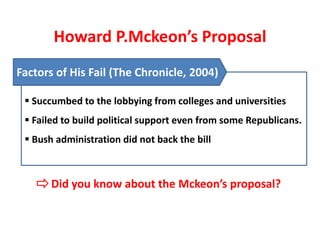
Howard P.Mckeon’s Proposal
Factors of His Fail (The Chronicle, 2004)

  Succumbed to the lobbying from colleges and universities
  Failed to build political support even from some Republicans.
  Bush administration did not back the bill


       Did you know about the Mckeon’s proposal?
Strategy for Implementation

                President Obama’s
                  Determination


     People’s                  Colleges & Universities’
Awareness & Support                  Agreement
Why the Federal Government ?
            Total Funds Used to Finance Postsecondary Education

            private and               nonfederal loans
          employer grants                   6%
                7%
institutional
   grants                                                    total
     17%                                                 federal aids
                                                        (grants, loans
                                                           & work-
                                                          study, tax
                                                           benefits)
                                                             65%

 state grants
     5%

                  Sources: College Board, Trends in Student Aid 2009
Thank you !

Making college affordable

  • 1.
    Making College Affordable 597C Platform Skills April 6, 2010 Sung Youn Kwon suk225@psu.edu
  • 2.
    Purpose Making College Affordable Tuition rise beyond Tuition rise within inflation inflation 1. Mandate a limit on tuition raise 2. Mandate 1 as a required qualification for federal aids At the Level of Federal Government
  • 3.
    Content I. Background II. Cause and Effect III. Recent Policies IV. Proposal V. Strategy for Implementation
  • 4.
    “College tuition isup sharply amid recession” In 2009, tuition rise in public college 6.5%, private 4.4%, consumer prices -2.1% Sources : http://www.collegeboard.com/press/releases/208962.html
  • 5.
    Cumulative Percentage Increases from 1990-1 to 2006-7 140% 120% 100% Tuition and Fees 80% Consumer Prices 60% 40% Median Household Income 20% 0% 1990-91 1995-96 2000-01 2006-7 Sources: Tuition and fees are from the Department of Education, consumer price index from the Bureau of Labor Statistics, median household incomes are from the U.S. Census Bureau.
  • 6.
    Student Aid andLoans from 1998-9 to 2008-9 90,000 80,000 70,000 60,000 Federal Loan 50,000 40,000 Federal Grant 30,000 Nonfederal Loan 20,000 10,000 - 98-9 00-01 02-03 04-05 06-07 08-09 Sources: College Board, Trends in Student Aid 2009
  • 7.
  • 8.
    What is theMajor Cause? Decline of State Appropriation
  • 9.
    What is theMajor Cause? Growth in Staff  For recent 2 decades, support staff doubled - Student enrollment increased 40% Sources: Center for College Affordability and Productivity, 1987 to 2007 Constructions  Buildings, library, convention center, gym…. - “Gym is a top priority for parents and prospective students” Sources: The New York Times, April 21, 2009, Freakonomics
  • 10.
    What is theTrue & Major Cause? Pursuit of High Ranking  Pursuit of “slack money”  Pursuit of high ranking in the US News & World Report (the “gold standard”) - Reputation 25%, Faculty resources 20% (Faculty compensation 35%) - Student selectivity 15%, Financial resourses 10% More money, Higher ranking
  • 11.
    “Virtuous circle” –Martin Trow (1984) Higher Compensation High Distinguished compensation Faculty Higher Reputation Higher Financial Resources More Higher Money Ranking Higher More Student Selectivity Students
  • 12.
    What is theEffect? Power Shift  Market Characteristic - Oligopoly, supply leads demand - Higher competition, higher price  High-tuition/High-aid Policy - High tuition does not guarantee high aid Power shifts from consumer to enterprise
  • 13.
    College Affordability  “FinancialBarriers will prevent at least 4.4 million high school graduates from attending four-year public colleges over the next decade, and prevent another two million high school graduates from attending any colleges at all.” (The Congressional Advisory Committee on Student Financial Assistance, 2006)
  • 14.
    College Affordability  “By2020, United States once again will have the highest proportion of higher education graduates in the world.” (Obama, 2009)
  • 15.
  • 16.
    Recent Policies (Federal) TheHigher Education Opportunity Act 0f 2008  Pressure to high tuition by making the list public - Colleges of highest 5% & lowest 10% tuitions & fees (exemption : increase is less than $600 for 3 years) Obligation to disclose for federal funding - tuition and fees for recent 3 years - annual % , $ change for recent 3 years  Incentive grants - lowest 20% of annual increase, lowest quartile (public), less than $600
  • 17.
    Proposal Put a limiton Tuition Increase In the Higher Education Opportunity Act  Do not increase tuition beyond average inflation rate of recent 3 years  If not, the college will be disqualified for all federal funds for following 5 years - Exemption : increase less than $600 or tuition less than $6,000 * 24% students attending in 4-year colleges with below $6,000 a year (Sources : College Board, 2009)
  • 18.
    Comparison with CurrentAct Higher Education Opportunity Act Proposal No limit on tuition increase Limit on tuition increase for federal aid for federal aid • Highest 5% and lowest 10% list of tuition & fees All college information • 3 years’ tuition & fees of on tuition & fees in 10 years all participators in Title IV •Highest 5% of tuition increase list in 3 years (%) All college information • 3 years’ tuition increase of on tuition increase in 10 years (%, $) all participators in Title IV (%, $) Incentive grant to lowest 20%, + Penalty to colleges not meet the lowest quartile of public college, less limit : can not apply for federal aid & than $600 in annual increase fund program for 5 years
  • 19.
    Howard P.Mckeon’s Proposal HowardP. (Buck) Mckeon’s Proposal  Original (Mar., 2003) : colleges increasing tuition by twice (or more) the rate of inflation for two years will lose eligibility for all federal student-aid programs immediately  Revised (Oct., 2003) : “alert system” of 3 steps before losing eligibility for campus-based federal aid programs  Dropped (Mar., 2004) : “I’m delighted to send a strong message to colleges”
  • 20.
    Howard P.Mckeon’s Proposal Factorsof His Fail (The Chronicle, 2004)  Succumbed to the lobbying from colleges and universities  Failed to build political support even from some Republicans.  Bush administration did not back the bill Did you know about the Mckeon’s proposal?
  • 21.
    Strategy for Implementation President Obama’s Determination People’s Colleges & Universities’ Awareness & Support Agreement
  • 22.
    Why the FederalGovernment ? Total Funds Used to Finance Postsecondary Education private and nonfederal loans employer grants 6% 7% institutional grants total 17% federal aids (grants, loans & work- study, tax benefits) 65% state grants 5% Sources: College Board, Trends in Student Aid 2009
  • 23.