Maintenance
Planning and
Scheduling
Overview
2
Maintenance Planning and Scheduling Agenda
• Overview
• The Plan
• The Methods
• SAP Guidelines
3
Acknowledgements
• Agrium Inc. Maintenance Planning Course:
• Dick Olver
• Brent Tews
• Al Pieper
• Val Christie
• Brian Ellis
• Maintenance Planning and Scheduling Handbook by Doc (Richard)
Palmer © 1999
• John Day, Jr., P.E. – HSB Reliability Technologies to 2002 SMRP
• PwC Physical Asset Management Practice
• Al Johnson Clearpass Inc.
4
Overview
• Mission of Maintenance
• “Repair” versus “Maintain”
• “Reactive” versus “Proactive” Maintenance
• Maintenance Planning
• Why Plan?
• The Leverage of Planning
• Planning Principles
• Planning Pitfalls
• Role Of A Planner
• Maintenance Scheduling Principles
• Summary
5
Mission of Maintenance
• Mission of Maintenance is to “maintain” an efficient,
continuously operating facility
• “Proactive”, Reliability based maintenance, not “Reactive”,
“Repair” based
• Identify and eliminate “defects” before they cause a failure
(role shared with Operations)
• Maintenance is a Process that produces capacity
Planning and Scheduling are essential components in the
process!
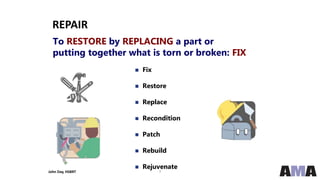
Repair
Versus
Maintain
7
 Fix
 Restore
 Replace
 Recondition
 Patch
 Rebuild
 Rejuvenate
To RESTORE by REPLACING a part or
putting together what is torn or broken: FIX
REPAIR
John Day, HSBRT
8
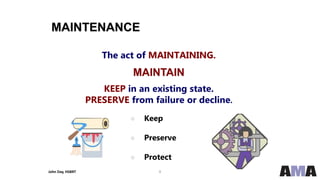
 Keep
 Preserve
 Protect
MAINTENANCE
MAINTAIN
The act of MAINTAINING.
KEEP in an existing state.
PRESERVE from failure or decline.
John Day, HSBRT
9
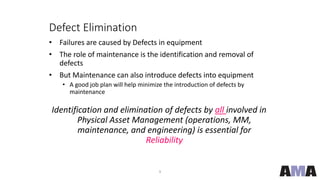
Defect Elimination
• Failures are caused by Defects in equipment
• The role of maintenance is the identification and removal of
defects
• But Maintenance can also introduce defects into equipment
• A good job plan will help minimize the introduction of defects by
maintenance
Identification and elimination of defects by all involved in
Physical Asset Management (operations, MM,
maintenance, and engineering) is essential for
Reliability
Reactive
Versus
Proactive
Maintenance
11
Reactive Maintenance
Characteristics Of Reactive Maintenance:
• The equipment manages the work
• An event happens and we react
• Equipment is “repaired”
• Planning happens “on the fly” based on limited
information
• Inefficient and costly
• High inventory, lots of “hot shots”
12
WORK ORDER FIX
COMPLETE
INFORMATION PARTS
TOOLS
ENGINEERING
FILE CABINET
TOOL BOX
"JOE"
SUPERVISOR
PRODUCTION
WAREHOUSE
VENDOR
FABRICATE
IDENTIFY
TEST
CLEAN
DISASSEMBLE
MEASURE
PLAN
GENERAL PURPOSE
SPECIAL PURPOSE
PERSONAL
TOOL CRIB
CONTRACTOR
EVENT
OCCURRENCE
TIME
MECHANIC
ASSESS
JOB
Reactive Maintenance
John Day, HSBRT
13
Characteristics of Proactive Maintenance
• We manage the work
• Events are largely controlled/predicted
• Equipment is “maintained”
• Planning is done effectively based on good information
sources
• Work is scheduled when planned and ready
• Efficient and effective
• Low inventory, minimal stock-outs
14
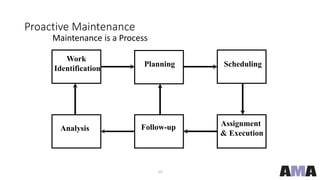
Proactive Maintenance
Maintenance is a Process
Work
Identification
Planning Scheduling
Follow-up Assignment
& Execution
Analysis
15
INSPECTION
LUBRICATION
PREDICTIVE
PM WO
PM
PERFORMANCE
EVALUATION
WORK
REQUEST
USUALLY
PRODUCTION
MATERIALS
WAREHOUSE
TOOLS
PROBLEM
SOLVING
TEAM
PRODUCTION
COORDINATION
MEETING
WORK ORDER
CORRECTIVE
PREVENTIVE
MODIFICATION
EMERGENCY
WORK
ORDER
TIME
EVENT
OCCURRENCE
PRODUCTION
REQUESTED
WEEKLY
DAILY
SCHEDULE
WORK
EXECUTION
HISTORY
RESULTS
1. PERFORMANCE TO SPECIFICATION
2. MAINTAIN CAPACITY
3. CONTINUOUS IMPROVEMENT
Proactive Maintenance
PLANNING
PREDICTED - PLANNED - SCHEDULED – PREVENTED
16
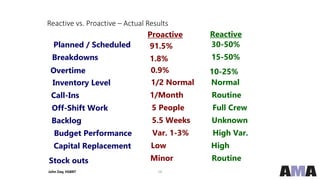
Reactive vs. Proactive – Actual Results
Planned / Scheduled
Breakdowns
Overtime
Inventory Level
Call-Ins
Off-Shift Work
Backlog
Budget Performance
Capital Replacement
Stock outs
91.5%
1.8%
0.9%
1/2 Normal
1/Month
5 People
5.5 Weeks
Var. 1-3%
Low
Minor
30-50%
15-50%
10-25%
Normal
Routine
Full Crew
Unknown
High Var.
High
Routine
Proactive Reactive
John Day, HSBRT
Maintenance
Planning
18
Maintenance Planning
Maintenance planning is:
• “The formal identification of the individual task details
and the determination of the skills, tools, materials and
the time required to accomplish the identified
(approved) maintenance work”
OR
• “The art and science of getting your act together
before starting the job and spending the money”
Al Johnson 2002 - Clearpass Inc.
19
Why Plan?
• Planning reduces Reactive Maintenance and increases Proactive
Maintenance:
• Ability to manage the work backlog and resources
• Increases trade/craft productivity:
• Reduce time deciding what needs doing
• Reduce time arranging for/collecting parts
• Reduce time looking for information
• Provides work goals/targets
• Reduces chance of introducing defects
• Optimal material usage
• It’s core to the maintenance process, especially the
continuous improvement loop
20
Why Plan?
• To do the work efficiently
• To reduce the risk of adding defects, effectiveness
• To allow scheduling which improves efficiency and
effectiveness
Any job that is not a true emergency should be planned!
21
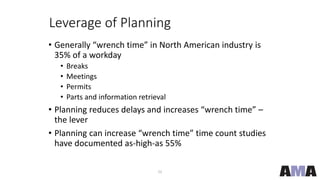
Leverage of Planning
• Generally “wrench time” in North American industry is
35% of a workday
• Breaks
• Meetings
• Permits
• Parts and information retrieval
• Planning reduces delays and increases “wrench time” –
the lever
• Planning can increase “wrench time” time count studies
have documented as-high-as 55%
22
Leverage of Planning Example
• Three technicians without “Planning”
• 3 x 35% = 105%
• One planner, two technicians
• 1 x 0% + 2 x 55% = 110%
• Ratio planner to technicians 1:20 – 30
• 55% / 35% = 1.57 (57% improvement)
• 30 technicians x 1.57 = 47 technicians
Palmer 1999
23
Benefits Leverage Of Planning
• Reduced overtime
• Reduced costs
• Maintenance resources can be allocated to reliability initiatives
• Increased plant capacity
24
Planning Principles
Doc Palmer’s six principles of maintenance planning are:
1. Planners/schedulers are organized into a separate department
from the craft maintenance crews
2. Planners focus on future work
3. The Planning department maintains simple, secure files at the
equipment level
25
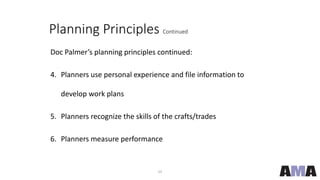
Planning Principles Continued
Doc Palmer’s planning principles continued:
4. Planners use personal experience and file information to
develop work plans
5. Planners recognize the skills of the crafts/trades
6. Planners measure performance
26
Planning Principle 1
• Planners/schedulers are organized into a separate
department from the craft maintenance crews:
• Less likely to get drawn into “today’s” work
• Ability to focus on planning
• Specialize in planning skills
• Build quality information sources
• Continuously improve
• Manage PM/PdM tasks
• Current Long Lake organization structure supports this model
27
Planning Principle 2
• Planners focus on future work:
• Make the right work ready to be completed effectively in the
future
• Trade supervision and trades people focus on this week’s
work
• Trades provide feedback to improve the plans in the future
(follow-up)
• Planners manage information for continuous improvement
28
Planning Principle 3
• The Planning department maintains simple, secure
files:
• Information at the equipment level
• Most work is repetitive, plans can be done once and
continuously improved
• Utilize equipment information and information from previous
work to improve plans
• Paper, SAP (functional location, equipment and classification),
and document management system
29
Planning Principle 4
• Planners use personal experience and file information
to develop work plans:
• Planner should be experienced, top level trades person
• Knows the site culture and how work gets done best
• Knows the equipment and process
• Knows who has best knowledge and actively seeks input
• Develops planning skills through training and experience
30
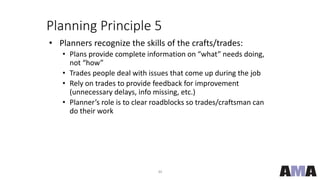
Planning Principle 5
• Planners recognize the skills of the crafts/trades:
• Plans provide complete information on “what” needs doing,
not “how”
• Trades people deal with issues that come up during the job
• Rely on trades to provide feedback for improvement
(unnecessary delays, info missing, etc.)
• Planner’s role is to clear roadblocks so trades/craftsman can
do their work
31
Planning Principle 6
• Planners measure performance:
• What gets measured gets improved
• Percent reactive work
• Duration of backlog
• Planning effectiveness
• Unanticipated delays
• “Wrench” time is the ultimate measure for efficiency
• Reliability and uptime ultimate measures for effectiveness
32
Planning Pitfalls
1. Planners get pulled off planning to do other
work
2. Planners get pulled into the current days work
and problems
33
Planning Pitfalls Continued
3. Plans become too detailed and rigid
4. Craftsmen develop the attitude; “I don’t have
to think because the planner plans the job”
34
Planning Pitfalls Continued
5. Planners become considered as glorified clerks
6. Planner becomes a purchasing agent and
expeditor for material, parts and contactors
35
What Is The Role Of A Planner?
“The planner's primary role is to gather and
assemble all necessary information from all
available sources to provide a package that
allows for the smooth execution of scheduled
work activities”
Al Johnson, Clearpass Inc. 2002
36
Planners Role
• To plan work, including routine work, preventive work,
predictive tasks
• To manage maintenance file content (both paper and
electronic) to ensure accurate information is available
on which to base plans
• To prepare future work so it’s ready to go
• To continuously improve
Maintenance
Scheduling
38
Scheduling Principles
Doc Palmer’s six principles of scheduling:
1. Job plans providing number of persons required, craft
work hours per skill, and job duration information are
necessary for advance scheduling
2. Weekly and daily schedules must be adhered to as
closely as possible. Proper priorities must be placed
on new work orders to prevent undue interruption of
the schedule
39
Scheduling Principles
3. A scheduler develops a one week schedule for each
crew based on forecast hours available, job priorities,
and job plans. Consideration is also made of multiple
jobs on the same equipment or system and of
proactive versus reactive work available
40
Scheduling Principles
4. The one week schedule assigns work for every
available work hour. The schedule allows for
emergencies and high priority, reactive jobs by
scheduling a sufficient amount of work hours on
easily interrupted tasks.
5. Operations, maintenance and engineering must
agree that the weekly schedule is the right work
to be done.
41
Scheduling Principles
6. The crew supervisor develops a daily schedule
one day in advance using current job progress,
the one week schedule, and new high priority
jobs as a guide. The crew supervisor matches
personnel skills and tasks.
The Planner and Scheduler are not part of the
daily work.
42
Benefits of Scheduling
• The objective is efficiency and effectiveness of
maintenance work. Work that is planned before
assignment reduces unnecessary delays during jobs
and work that is scheduled reduces delays between
jobs and ensures the right work is being done.
• Organized and planned work = a safer plant!
43
Scheduling Principles
Scheduling performance measures:
• Daily schedule compliance measure is essential to
develop maintenance credibility with operations
• Weekly schedule compliance is the measure of
adherence to the one week schedule and it’s
effectiveness
44
Summary
• Approach is to move to Proactive maintenance
• Maintenance is a process that produces capacity
• Maintenance planning will leverage the workforce
• A planner for 15 craftsman can leverage the productivity to 19 people
• Maintenance Planning and Schedule are cornerstones of the
Proactive Maintenance Process but that’s not all there is to it
• Optimum PM/PdM programs, quality execution, analysis of
failures, process and hardware redesign, reliable designs, good
materials management, and good operating practices are
extremely important contributors
• Physical Asset Management and eliminating defects/improving
reliability involves a complete team, not just maintenance

Maintenance-Planning-and-Scheduling-Overview.pptx

  • 1.
  • 2.
    2 Maintenance Planning andScheduling Agenda • Overview • The Plan • The Methods • SAP Guidelines
  • 3.
    3 Acknowledgements • Agrium Inc.Maintenance Planning Course: • Dick Olver • Brent Tews • Al Pieper • Val Christie • Brian Ellis • Maintenance Planning and Scheduling Handbook by Doc (Richard) Palmer © 1999 • John Day, Jr., P.E. – HSB Reliability Technologies to 2002 SMRP • PwC Physical Asset Management Practice • Al Johnson Clearpass Inc.
  • 4.
    4 Overview • Mission ofMaintenance • “Repair” versus “Maintain” • “Reactive” versus “Proactive” Maintenance • Maintenance Planning • Why Plan? • The Leverage of Planning • Planning Principles • Planning Pitfalls • Role Of A Planner • Maintenance Scheduling Principles • Summary
  • 5.
    5 Mission of Maintenance •Mission of Maintenance is to “maintain” an efficient, continuously operating facility • “Proactive”, Reliability based maintenance, not “Reactive”, “Repair” based • Identify and eliminate “defects” before they cause a failure (role shared with Operations) • Maintenance is a Process that produces capacity Planning and Scheduling are essential components in the process!
  • 6.
  • 7.
    7  Fix  Restore Replace  Recondition  Patch  Rebuild  Rejuvenate To RESTORE by REPLACING a part or putting together what is torn or broken: FIX REPAIR John Day, HSBRT
  • 8.
    8  Keep  Preserve Protect MAINTENANCE MAINTAIN The act of MAINTAINING. KEEP in an existing state. PRESERVE from failure or decline. John Day, HSBRT
  • 9.
    9 Defect Elimination • Failuresare caused by Defects in equipment • The role of maintenance is the identification and removal of defects • But Maintenance can also introduce defects into equipment • A good job plan will help minimize the introduction of defects by maintenance Identification and elimination of defects by all involved in Physical Asset Management (operations, MM, maintenance, and engineering) is essential for Reliability
  • 10.
  • 11.
    11 Reactive Maintenance Characteristics OfReactive Maintenance: • The equipment manages the work • An event happens and we react • Equipment is “repaired” • Planning happens “on the fly” based on limited information • Inefficient and costly • High inventory, lots of “hot shots”
  • 12.
    12 WORK ORDER FIX COMPLETE INFORMATIONPARTS TOOLS ENGINEERING FILE CABINET TOOL BOX "JOE" SUPERVISOR PRODUCTION WAREHOUSE VENDOR FABRICATE IDENTIFY TEST CLEAN DISASSEMBLE MEASURE PLAN GENERAL PURPOSE SPECIAL PURPOSE PERSONAL TOOL CRIB CONTRACTOR EVENT OCCURRENCE TIME MECHANIC ASSESS JOB Reactive Maintenance John Day, HSBRT
  • 13.
    13 Characteristics of ProactiveMaintenance • We manage the work • Events are largely controlled/predicted • Equipment is “maintained” • Planning is done effectively based on good information sources • Work is scheduled when planned and ready • Efficient and effective • Low inventory, minimal stock-outs
  • 14.
    14 Proactive Maintenance Maintenance isa Process Work Identification Planning Scheduling Follow-up Assignment & Execution Analysis
  • 15.
  • 16.
    16 Reactive vs. Proactive– Actual Results Planned / Scheduled Breakdowns Overtime Inventory Level Call-Ins Off-Shift Work Backlog Budget Performance Capital Replacement Stock outs 91.5% 1.8% 0.9% 1/2 Normal 1/Month 5 People 5.5 Weeks Var. 1-3% Low Minor 30-50% 15-50% 10-25% Normal Routine Full Crew Unknown High Var. High Routine Proactive Reactive John Day, HSBRT
  • 17.
  • 18.
    18 Maintenance Planning Maintenance planningis: • “The formal identification of the individual task details and the determination of the skills, tools, materials and the time required to accomplish the identified (approved) maintenance work” OR • “The art and science of getting your act together before starting the job and spending the money” Al Johnson 2002 - Clearpass Inc.
  • 19.
    19 Why Plan? • Planningreduces Reactive Maintenance and increases Proactive Maintenance: • Ability to manage the work backlog and resources • Increases trade/craft productivity: • Reduce time deciding what needs doing • Reduce time arranging for/collecting parts • Reduce time looking for information • Provides work goals/targets • Reduces chance of introducing defects • Optimal material usage • It’s core to the maintenance process, especially the continuous improvement loop
  • 20.
    20 Why Plan? • Todo the work efficiently • To reduce the risk of adding defects, effectiveness • To allow scheduling which improves efficiency and effectiveness Any job that is not a true emergency should be planned!
  • 21.
    21 Leverage of Planning •Generally “wrench time” in North American industry is 35% of a workday • Breaks • Meetings • Permits • Parts and information retrieval • Planning reduces delays and increases “wrench time” – the lever • Planning can increase “wrench time” time count studies have documented as-high-as 55%
  • 22.
    22 Leverage of PlanningExample • Three technicians without “Planning” • 3 x 35% = 105% • One planner, two technicians • 1 x 0% + 2 x 55% = 110% • Ratio planner to technicians 1:20 – 30 • 55% / 35% = 1.57 (57% improvement) • 30 technicians x 1.57 = 47 technicians Palmer 1999
  • 23.
    23 Benefits Leverage OfPlanning • Reduced overtime • Reduced costs • Maintenance resources can be allocated to reliability initiatives • Increased plant capacity
  • 24.
    24 Planning Principles Doc Palmer’ssix principles of maintenance planning are: 1. Planners/schedulers are organized into a separate department from the craft maintenance crews 2. Planners focus on future work 3. The Planning department maintains simple, secure files at the equipment level
  • 25.
    25 Planning Principles Continued DocPalmer’s planning principles continued: 4. Planners use personal experience and file information to develop work plans 5. Planners recognize the skills of the crafts/trades 6. Planners measure performance
  • 26.
    26 Planning Principle 1 •Planners/schedulers are organized into a separate department from the craft maintenance crews: • Less likely to get drawn into “today’s” work • Ability to focus on planning • Specialize in planning skills • Build quality information sources • Continuously improve • Manage PM/PdM tasks • Current Long Lake organization structure supports this model
  • 27.
    27 Planning Principle 2 •Planners focus on future work: • Make the right work ready to be completed effectively in the future • Trade supervision and trades people focus on this week’s work • Trades provide feedback to improve the plans in the future (follow-up) • Planners manage information for continuous improvement
  • 28.
    28 Planning Principle 3 •The Planning department maintains simple, secure files: • Information at the equipment level • Most work is repetitive, plans can be done once and continuously improved • Utilize equipment information and information from previous work to improve plans • Paper, SAP (functional location, equipment and classification), and document management system
  • 29.
    29 Planning Principle 4 •Planners use personal experience and file information to develop work plans: • Planner should be experienced, top level trades person • Knows the site culture and how work gets done best • Knows the equipment and process • Knows who has best knowledge and actively seeks input • Develops planning skills through training and experience
  • 30.
    30 Planning Principle 5 •Planners recognize the skills of the crafts/trades: • Plans provide complete information on “what” needs doing, not “how” • Trades people deal with issues that come up during the job • Rely on trades to provide feedback for improvement (unnecessary delays, info missing, etc.) • Planner’s role is to clear roadblocks so trades/craftsman can do their work
  • 31.
    31 Planning Principle 6 •Planners measure performance: • What gets measured gets improved • Percent reactive work • Duration of backlog • Planning effectiveness • Unanticipated delays • “Wrench” time is the ultimate measure for efficiency • Reliability and uptime ultimate measures for effectiveness
  • 32.
    32 Planning Pitfalls 1. Plannersget pulled off planning to do other work 2. Planners get pulled into the current days work and problems
  • 33.
    33 Planning Pitfalls Continued 3.Plans become too detailed and rigid 4. Craftsmen develop the attitude; “I don’t have to think because the planner plans the job”
  • 34.
    34 Planning Pitfalls Continued 5.Planners become considered as glorified clerks 6. Planner becomes a purchasing agent and expeditor for material, parts and contactors
  • 35.
    35 What Is TheRole Of A Planner? “The planner's primary role is to gather and assemble all necessary information from all available sources to provide a package that allows for the smooth execution of scheduled work activities” Al Johnson, Clearpass Inc. 2002
  • 36.
    36 Planners Role • Toplan work, including routine work, preventive work, predictive tasks • To manage maintenance file content (both paper and electronic) to ensure accurate information is available on which to base plans • To prepare future work so it’s ready to go • To continuously improve
  • 37.
  • 38.
    38 Scheduling Principles Doc Palmer’ssix principles of scheduling: 1. Job plans providing number of persons required, craft work hours per skill, and job duration information are necessary for advance scheduling 2. Weekly and daily schedules must be adhered to as closely as possible. Proper priorities must be placed on new work orders to prevent undue interruption of the schedule
  • 39.
    39 Scheduling Principles 3. Ascheduler develops a one week schedule for each crew based on forecast hours available, job priorities, and job plans. Consideration is also made of multiple jobs on the same equipment or system and of proactive versus reactive work available
  • 40.
    40 Scheduling Principles 4. Theone week schedule assigns work for every available work hour. The schedule allows for emergencies and high priority, reactive jobs by scheduling a sufficient amount of work hours on easily interrupted tasks. 5. Operations, maintenance and engineering must agree that the weekly schedule is the right work to be done.
  • 41.
    41 Scheduling Principles 6. Thecrew supervisor develops a daily schedule one day in advance using current job progress, the one week schedule, and new high priority jobs as a guide. The crew supervisor matches personnel skills and tasks. The Planner and Scheduler are not part of the daily work.
  • 42.
    42 Benefits of Scheduling •The objective is efficiency and effectiveness of maintenance work. Work that is planned before assignment reduces unnecessary delays during jobs and work that is scheduled reduces delays between jobs and ensures the right work is being done. • Organized and planned work = a safer plant!
  • 43.
    43 Scheduling Principles Scheduling performancemeasures: • Daily schedule compliance measure is essential to develop maintenance credibility with operations • Weekly schedule compliance is the measure of adherence to the one week schedule and it’s effectiveness
  • 44.
    44 Summary • Approach isto move to Proactive maintenance • Maintenance is a process that produces capacity • Maintenance planning will leverage the workforce • A planner for 15 craftsman can leverage the productivity to 19 people • Maintenance Planning and Schedule are cornerstones of the Proactive Maintenance Process but that’s not all there is to it • Optimum PM/PdM programs, quality execution, analysis of failures, process and hardware redesign, reliable designs, good materials management, and good operating practices are extremely important contributors • Physical Asset Management and eliminating defects/improving reliability involves a complete team, not just maintenance