PRESENTATION OF MAHARASHTRA
SUBMITTED TO- PRAMENDRA SIR
PRESENTED BY- GOURAV BAJHAIYA &
ASHISH VERMA
CLASS- B.T.M. 2ND SEM
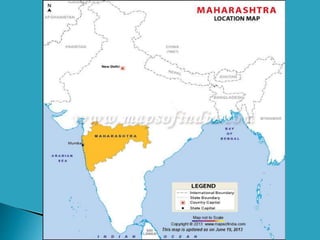
 Maharashtra is a state in the western region
of India and is India's second-most populous
state and third-largest state by area.
 Ancient and medieval Maharashtra included
the empires of the Satavahana
dynasty, Rashtrakuta dynasty , Western
Chalukya , Mughals and Marathas .It is
bordered by the Arabian Sea to the west and
the Indian states of Karnataka , Telangana
, Goa , Gujarat , Chhattisgarh , Madhya
Pradesh and the Union territory of Dadra and
Nagar Haveli. The major rivers of the state
are Godavari, and Krishna.
 Capital and largest City -: Mumbai
 Area -: 307,713 sq km
 Area rank -: 3rd
 Population[2011] -: 112,372,972( 2nd )
 Districts -: 36
 Chief Minister -: Devendra Fadnavis
 Tourism Minister :- Jayakumar Jitendrasinh
Rawal
 Literacy Rate -: 82.9% (2011 census)
 Formation -: 1 May 1960
 Language :- Hindi , Marathi , English
 Animal :- Indian giant squirrel
 Bird :- Yellow-footed green pigeon
 Tree :- Mango
 Flower :- Lagerstroemia speciosa
 Dance :- Lavani
 Sport :- Kabaddi
 Butterfly :- Blue Mormon
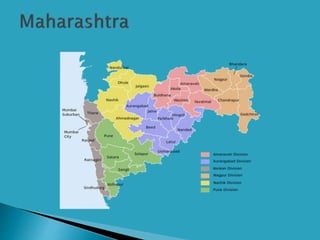
Maharashtra consists of six
administrative divisions :-
1. Amravati
2. Aurangabad
3. Konkan
4. Nagpur
5. Nashik
6. Pune
 Maharashtra has typical monsoon climate,
with hot, rainy and cold weather seasons.
 Summer :- march – may(22-39 degree)
 Monsoon :- june – sept(22-27 degree)
 Post monsoon :- Oct – nov(23-33 degree)
 Winter :- Nov – feb(12-14 degree)
 Spring :- jan – march
 Best time to visit :- sept - feb
Ajanta Caves
Ellora caves
Elephanta Caves
Chatrapati Shivaji
Terminus (victoria
terminus)
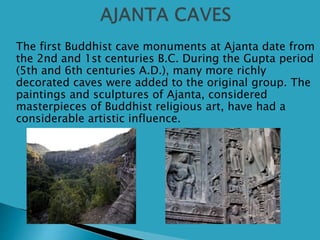
 The first Buddhist cave monuments at Ajanta date from
the 2nd and 1st centuries B.C. During the Gupta period
(5th and 6th centuries A.D.), many more richly
decorated caves were added to the original group. The
paintings and sculptures of Ajanta, considered
masterpieces of Buddhist religious art, have had a
considerable artistic influence.
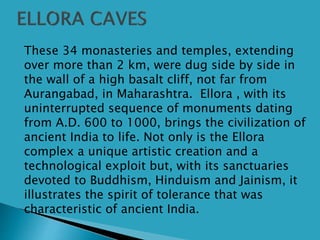
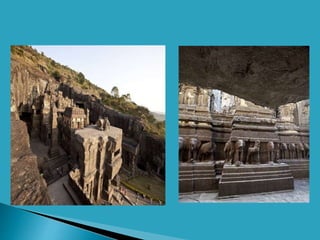
 These 34 monasteries and temples, extending
over more than 2 km, were dug side by side in
the wall of a high basalt cliff, not far from
Aurangabad, in Maharashtra. Ellora , with its
uninterrupted sequence of monuments dating
from A.D. 600 to 1000, brings the civilization of
ancient India to life. Not only is the Ellora
complex a unique artistic creation and a
technological exploit but, with its sanctuaries
devoted to Buddhism, Hinduism and Jainism, it
illustrates the spirit of tolerance that was
characteristic of ancient India.
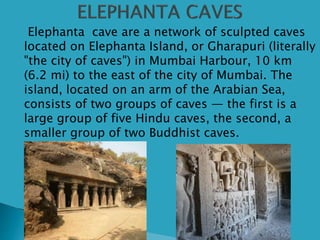
 Elephanta cave are a network of sculpted caves
located on Elephanta Island, or Gharapuri (literally
"the city of caves") in Mumbai Harbour, 10 km
(6.2 mi) to the east of the city of Mumbai. The
island, located on an arm of the Arabian Sea,
consists of two groups of caves — the first is a
large group of five Hindu caves, the second, a
smaller group of two Buddhist caves.
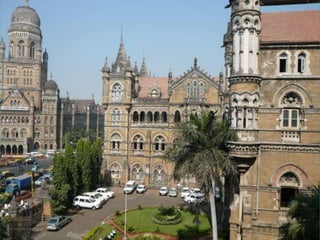
 Chhatrapati Shivaji Terminus (CSTM), is a historic
railway station and a UNESCO World Heritage
Site in Mumbai, Maharashtra, India which serves as
the headquarters of the Central Railways. Designed
by Frederick William Stevens with the concept of
Victorian Italianate Gothic Revival architecture and
meant to be a similar revival of Indian Goth (classical
era) architecture, the station was built in 1887 in
the Bori Bunder area of Mumbai to commemorate
the Golden Jubilee of Queen Victoria. The new railway
station was built on the location of the Bori Bunder
railway station and is one of the busiest railway
stations in India, serving as a terminal for both long-
distance trains and commuter trains of the Mumbai
Suburban Railway. The station's name was changed to
Chhatrapati Shivaji Terminus in March 1996.
 Shree Siddhivinayak Ganesh Temple
 Shree Mumbadevi Temple
 Haji Ali Dargah
 Shirdi Sai temple
 Takhat Sachkhand Shri Hazur Sahib
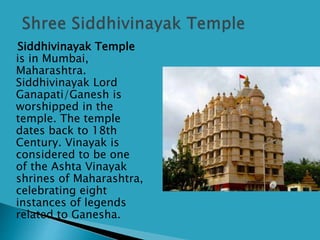
Siddhivinayak Temple
is in Mumbai,
Maharashtra.
Siddhivinayak Lord
Ganapati/Ganesh is
worshipped in the
temple. The temple
dates back to 18th
Century. Vinayak is
considered to be one
of the Ashta Vinayak
shrines of Maharashtra,
celebrating eight
instances of legends
related to Ganesha.
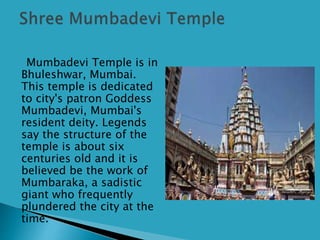
Mumbadevi Temple is in
Bhuleshwar, Mumbai.
This temple is dedicated
to city's patron Goddess
Mumbadevi, Mumbai's
resident deity. Legends
say the structure of the
temple is about six
centuries old and it is
believed be the work of
Mumbaraka, a sadistic
giant who frequently
plundered the city at the
time.
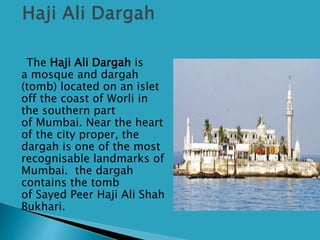
The Haji Ali Dargah is
a mosque and dargah
(tomb) located on an islet
off the coast of Worli in
the southern part
of Mumbai. Near the heart
of the city proper, the
dargah is one of the most
recognisable landmarks of
Mumbai. the dargah
contains the tomb
of Sayed Peer Haji Ali Shah
Bukhari.
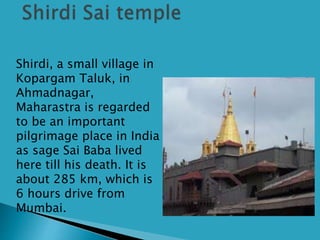
 Shirdi, a small village in
Kopargam Taluk, in
Ahmadnagar,
Maharastra is regarded
to be an important
pilgrimage place in India
as sage Sai Baba lived
here till his death. It is
about 285 km, which is
6 hours drive from
Mumbai.
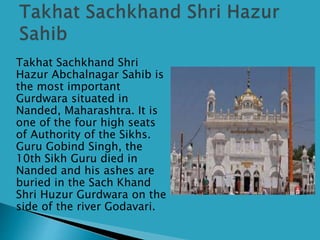
 Takhat Sachkhand Shri
Hazur Abchalnagar Sahib is
the most important
Gurdwara situated in
Nanded, Maharashtra. It is
one of the four high seats
of Authority of the Sikhs.
Guru Gobind Singh, the
10th Sikh Guru died in
Nanded and his ashes are
buried in the Sach Khand
Shri Huzur Gurdwara on the
side of the river Godavari.
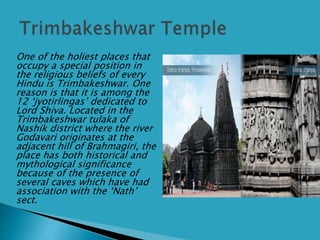
 One of the holiest places that
occupy a special position in
the religious beliefs of every
Hindu is Trimbakeshwar. One
reason is that it is among the
12 ‘jyotirlingas’ dedicated to
Lord Shiva. Located in the
Trimbakeshwar tulaka of
Nashik district where the river
Godavari originates at the
adjacent hill of Brahmagiri, the
place has both historical and
mythological significance
because of the presence of
several caves which have had
association with the ‘Nath’
sect.
Panghani Hill Station
Lonar crater lake
Kaas plateau
Tarkarli beach
Lonavala
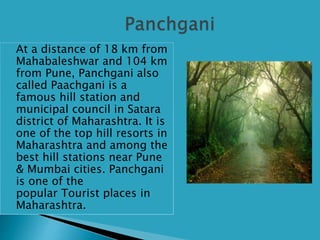
 At a distance of 18 km from
Mahabaleshwar and 104 km
from Pune, Panchgani also
called Paachgani is a
famous hill station and
municipal council in Satara
district of Maharashtra. It is
one of the top hill resorts in
Maharashtra and among the
best hill stations near Pune
& Mumbai cities. Panchgani
is one of the
popular Tourist places in
Maharashtra.
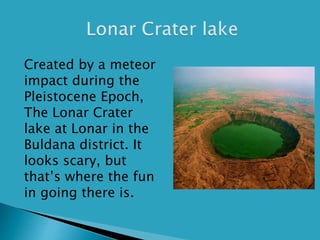
 Created by a meteor
impact during the
Pleistocene Epoch,
The Lonar Crater
lake at Lonar in the
Buldana district. It
looks scary, but
that’s where the fun
in going there is.
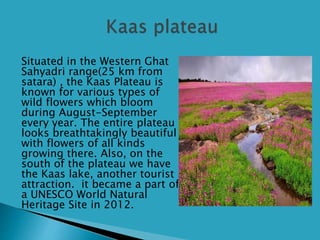
 Situated in the Western Ghat
Sahyadri range(25 km from
satara) , the Kaas Plateau is
known for various types of
wild flowers which bloom
during August-September
every year. The entire plateau
looks breathtakingly beautiful
with flowers of all kinds
growing there. Also, on the
south of the plateau we have
the Kaas lake, another tourist
attraction. it became a part of
a UNESCO World Natural
Heritage Site in 2012.
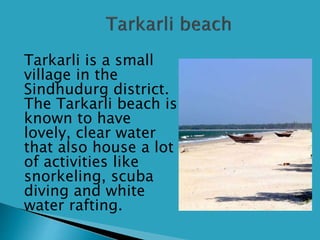
 Tarkarli is a small
village in the
Sindhudurg district.
The Tarkarli beach is
known to have
lovely, clear water
that also house a lot
of activities like
snorkeling, scuba
diving and white
water rafting.
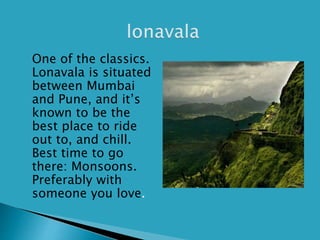
 One of the classics.
Lonavala is situated
between Mumbai
and Pune, and it’s
known to be the
best place to ride
out to, and chill.
Best time to go
there: Monsoons.
Preferably with
someone you love.
 The Lavani dance is a blend
of traditional dance and
song, which is specifically
meant to enchant the beats
of 'Dholak', which is an
instrument similar to the
drum. The dance is being
performed by gorgeous
ladies wearing 9-yard saris.
These women move their
bodies on the pulsating
beats of the traditional
music. Lavani is a word
which originated from
‘Lavanya’, which means
beauty.
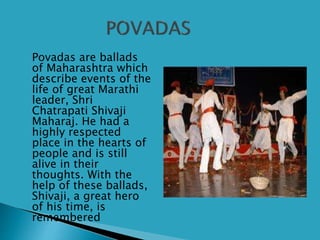
 Povadas are ballads
of Maharashtra which
describe events of the
life of great Marathi
leader, Shri
Chatrapati Shivaji
Maharaj. He had a
highly respected
place in the hearts of
people and is still
alive in their
thoughts. With the
help of these ballads,
Shivaji, a great hero
of his time, is
remembered
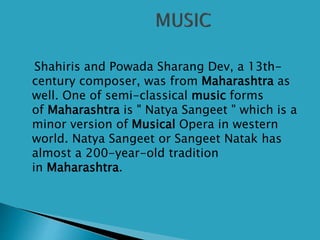
Shahiris and Powada Sharang Dev, a 13th-
century composer, was from Maharashtra as
well. One of semi-classical music forms
of Maharashtra is " Natya Sangeet " which is a
minor version of Musical Opera in western
world. Natya Sangeet or Sangeet Natak has
almost a 200-year-old tradition
in Maharashtra.
 The fine art and craft of Maharashtra is evident
through the crafts like, Bidriware, Kolhapuri
Chappals, Kolhapur Jewelry, Mashru & Himroo,
Narayan Peth, Paithani Sarees and Warli Painting.
The hand-made leather chappals and sandals
from the district of Kolhapur are known as the
Kolhapuri chappals. They come in various styles,
quality of leather and design for both men and
women. Another famous craft from the same
district is the Kolhapur Jewelry and the special
type of necklace called Kolhapur saaj.
 Nasik Kumbh Mela :- is the most important Hindu
spiritual gathering in India that comes once every
three years, rotating between four major Hindu
pilgrim centers of India - Allahabad, Haridwar,
Ujjain and Nasik.
 Ganesh Chaturthi :- Ganesha festival, also known
as 'Ganesh Utsav' is the biggest festival in Sangli
and the nearby areas of Maharashtra.
 Rath Yatra :- A festival called Janmotsava is
celebrated at Sansthan Shri Kalaram Mandir,
Panchavati, Nashik every year. The festival, which
spans 15 days begin from the first day of Chaitra
till Chaitra Purnima.
 Navaratra Mahalaxmi Fair :- Navaratra Mahalaxmi
Fair is celebrated for ten days from Ashvina Sud.1
to Ashvina Sud. 10 at Navaratra Mahalaxmi
Temple of Jalgaon district in Maharashtra.
 Narali Poornima :- Narali Poornima marks the end of
monsoon season in Maharashtra. It is celebrated on the
full moon day of the month of Shravan. People offer
coconuts to the sea. The festival also marks the
beginning of the new fishing season.
 Shivaji Jayanti :- Shivaji Maharaj was the greatest ruler of
Maharashtra. So, Maharashtrians have a great regard for
this Maratha ruler. To give a respect, the birthday of
Chatrapati Shivaji Maharaj.
 Elephanta And Ellora festival :- are another festival for
dance and music organised by the Maharashtra Tourism
Development Corporation (MTDC). It is organised in the
month of February.
 Vat Pournima :- Wat Pournima is the festival for
Maharashtrian women, which is celebrated in the month
of Jeshth (May-June). Women observe a fast and tie
threads around a banyan tree and pray for the same
husband in every birth.
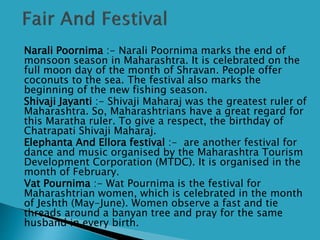
1. Kaju Kothimbir Vadi:-A
classic Maharashtrian
snack made of gram flour,
spices and an addition of
cashew nuts.
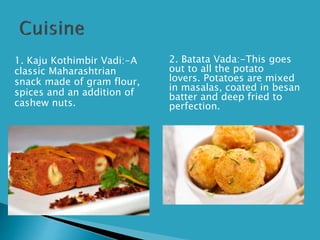
2. Batata Vada:-This goes
out to all the potato
lovers. Potatoes are mixed
in masalas, coated in besan
batter and deep fried to
perfection.
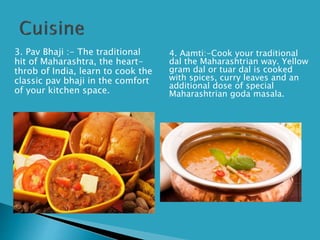
3. Pav Bhaji :- The traditional
hit of Maharashtra, the heart-
throb of India, learn to cook the
classic pav bhaji in the comfort
of your kitchen space.
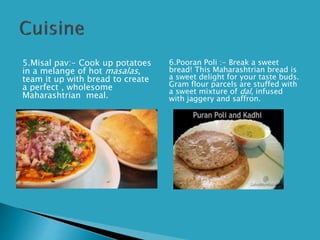
4. Aamti:-Cook your traditional
dal the Maharashtrian way. Yellow
gram dal or tuar dal is cooked
with spices, curry leaves and an
additional dose of special
Maharashtrian goda masala.
5.Misal pav:- Cook up potatoes
in a melange of hot masalas,
team it up with bread to create
a perfect , wholesome
Maharashtrian meal.
6.Pooran Poli :- Break a sweet
bread! This Maharashtrian bread is
a sweet delight for your taste buds.
Gram flour parcels are stuffed with
a sweet mixture of dal, infused
with jaggery and saffron.
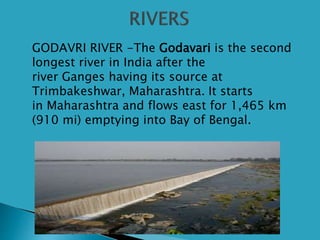
 GODAVRI RIVER -The Godavari is the second
longest river in India after the
river Ganges having its source at
Trimbakeshwar, Maharashtra. It starts
in Maharashtra and flows east for 1,465 km
(910 mi) emptying into Bay of Bengal.
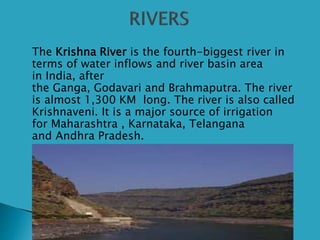
 The Krishna River is the fourth-biggest river in
terms of water inflows and river basin area
in India, after
the Ganga, Godavari and Brahmaputra. The river
is almost 1,300 KM long. The river is also called
Krishnaveni. It is a major source of irrigation
for Maharashtra , Karnataka, Telangana
and Andhra Pradesh.
 Chandoli National Park
 Gugumal National Park
 Tadoba Andhari Tiger Reserve
 Sanjay Gandhi National Park
 By Air :- There is basically one
major international airport in
Maharashtra i.e. the
Chhatrapati Shivaji
International Airport of
Mumbai. Apart from that, the
city also has a domestic
airport - Santa Cruz Domestic
Airport. The airports at
Nagpur and Pune also operate
a few international flights,
apart from the usual domestic
ones. The cities of Kolhapur
and Aurangabad also have a
domestic airport of their own.
 By road :- There are a
number of National
Highways and State
Highways crisscrossing
Maharashtra, which make it
easier for any visitor to
visit the state by road.
Infact, through these
highways, you can easily
approach the state from
any and every part of the
country. Apart from that,
you can easily get buses
and taxis from the
numerous cities in
Maharashtra to travel
within as well as outside
the state.
 By Sea :- Since a
number of cities in
Maharashtra are
situated on sea banks,
you can also go there
via ship from the
neighboring countries.
Apart from the
international naval port
at Mumbai, there are a
number of other minor
ports in the state. Thus,
reaching Maharashtra
by presents no
problems for the
tourists.
 By Rail :- The largest as well
as the most important
railway station of
Maharashtra is situated in
Mumbai and is known as
Chhatrapati Shivaji
Terminus. From there, you
can get trains to almost
every part of India. Apart
from that, there are railway
stations in Pune, Nashik,
Nagpur, Kolhapur,
Aurangabad, Amravati, etc.
In short, Maharashtra is
well connected with the
other states via railways.
Similarly, in terms of top ten States to get
foreign visitors during 2016, Maharashtra stood
second with 44.0 lakh visitors. Tamil Nadu with
46.8 lakh stood ahead of Maharashtra. Uttar
Pradesh (31.0 lakh), Delhi (23.7 lakh), Rajasthan
(14.8 lakh), West Bengal (14.7 lakh), Kerala (9.7
lakh), Bihar (9.2 lakh), Karnataka (6.3 lakh) and
Goa (5.4 lakh) were the other states in the top
ten ranking. These top ten states accounted for
88.4% of the total number of foreign tourists in
the country during 2014.
Maharashtra tourism

Maharashtra tourism

  • 1.
    PRESENTATION OF MAHARASHTRA SUBMITTEDTO- PRAMENDRA SIR PRESENTED BY- GOURAV BAJHAIYA & ASHISH VERMA CLASS- B.T.M. 2ND SEM
  • 4.
     Maharashtra isa state in the western region of India and is India's second-most populous state and third-largest state by area.  Ancient and medieval Maharashtra included the empires of the Satavahana dynasty, Rashtrakuta dynasty , Western Chalukya , Mughals and Marathas .It is bordered by the Arabian Sea to the west and the Indian states of Karnataka , Telangana , Goa , Gujarat , Chhattisgarh , Madhya Pradesh and the Union territory of Dadra and Nagar Haveli. The major rivers of the state are Godavari, and Krishna.
  • 5.
     Capital andlargest City -: Mumbai  Area -: 307,713 sq km  Area rank -: 3rd  Population[2011] -: 112,372,972( 2nd )  Districts -: 36  Chief Minister -: Devendra Fadnavis  Tourism Minister :- Jayakumar Jitendrasinh Rawal  Literacy Rate -: 82.9% (2011 census)
  • 6.
     Formation -:1 May 1960  Language :- Hindi , Marathi , English  Animal :- Indian giant squirrel  Bird :- Yellow-footed green pigeon  Tree :- Mango  Flower :- Lagerstroemia speciosa  Dance :- Lavani  Sport :- Kabaddi  Butterfly :- Blue Mormon
  • 7.
    Maharashtra consists ofsix administrative divisions :- 1. Amravati 2. Aurangabad 3. Konkan 4. Nagpur 5. Nashik 6. Pune
  • 9.
     Maharashtra hastypical monsoon climate, with hot, rainy and cold weather seasons.  Summer :- march – may(22-39 degree)  Monsoon :- june – sept(22-27 degree)  Post monsoon :- Oct – nov(23-33 degree)  Winter :- Nov – feb(12-14 degree)  Spring :- jan – march  Best time to visit :- sept - feb
  • 10.
    Ajanta Caves Ellora caves ElephantaCaves Chatrapati Shivaji Terminus (victoria terminus)
  • 11.
     The firstBuddhist cave monuments at Ajanta date from the 2nd and 1st centuries B.C. During the Gupta period (5th and 6th centuries A.D.), many more richly decorated caves were added to the original group. The paintings and sculptures of Ajanta, considered masterpieces of Buddhist religious art, have had a considerable artistic influence.
  • 12.
     These 34monasteries and temples, extending over more than 2 km, were dug side by side in the wall of a high basalt cliff, not far from Aurangabad, in Maharashtra. Ellora , with its uninterrupted sequence of monuments dating from A.D. 600 to 1000, brings the civilization of ancient India to life. Not only is the Ellora complex a unique artistic creation and a technological exploit but, with its sanctuaries devoted to Buddhism, Hinduism and Jainism, it illustrates the spirit of tolerance that was characteristic of ancient India.
  • 14.
     Elephanta caveare a network of sculpted caves located on Elephanta Island, or Gharapuri (literally "the city of caves") in Mumbai Harbour, 10 km (6.2 mi) to the east of the city of Mumbai. The island, located on an arm of the Arabian Sea, consists of two groups of caves — the first is a large group of five Hindu caves, the second, a smaller group of two Buddhist caves.
  • 15.
     Chhatrapati ShivajiTerminus (CSTM), is a historic railway station and a UNESCO World Heritage Site in Mumbai, Maharashtra, India which serves as the headquarters of the Central Railways. Designed by Frederick William Stevens with the concept of Victorian Italianate Gothic Revival architecture and meant to be a similar revival of Indian Goth (classical era) architecture, the station was built in 1887 in the Bori Bunder area of Mumbai to commemorate the Golden Jubilee of Queen Victoria. The new railway station was built on the location of the Bori Bunder railway station and is one of the busiest railway stations in India, serving as a terminal for both long- distance trains and commuter trains of the Mumbai Suburban Railway. The station's name was changed to Chhatrapati Shivaji Terminus in March 1996.
  • 17.
     Shree SiddhivinayakGanesh Temple  Shree Mumbadevi Temple  Haji Ali Dargah  Shirdi Sai temple  Takhat Sachkhand Shri Hazur Sahib
  • 18.
    Siddhivinayak Temple is inMumbai, Maharashtra. Siddhivinayak Lord Ganapati/Ganesh is worshipped in the temple. The temple dates back to 18th Century. Vinayak is considered to be one of the Ashta Vinayak shrines of Maharashtra, celebrating eight instances of legends related to Ganesha.
  • 19.
    Mumbadevi Temple isin Bhuleshwar, Mumbai. This temple is dedicated to city's patron Goddess Mumbadevi, Mumbai's resident deity. Legends say the structure of the temple is about six centuries old and it is believed be the work of Mumbaraka, a sadistic giant who frequently plundered the city at the time.
  • 20.
    The Haji AliDargah is a mosque and dargah (tomb) located on an islet off the coast of Worli in the southern part of Mumbai. Near the heart of the city proper, the dargah is one of the most recognisable landmarks of Mumbai. the dargah contains the tomb of Sayed Peer Haji Ali Shah Bukhari.
  • 21.
     Shirdi, asmall village in Kopargam Taluk, in Ahmadnagar, Maharastra is regarded to be an important pilgrimage place in India as sage Sai Baba lived here till his death. It is about 285 km, which is 6 hours drive from Mumbai.
  • 22.
     Takhat SachkhandShri Hazur Abchalnagar Sahib is the most important Gurdwara situated in Nanded, Maharashtra. It is one of the four high seats of Authority of the Sikhs. Guru Gobind Singh, the 10th Sikh Guru died in Nanded and his ashes are buried in the Sach Khand Shri Huzur Gurdwara on the side of the river Godavari.
  • 23.
     One ofthe holiest places that occupy a special position in the religious beliefs of every Hindu is Trimbakeshwar. One reason is that it is among the 12 ‘jyotirlingas’ dedicated to Lord Shiva. Located in the Trimbakeshwar tulaka of Nashik district where the river Godavari originates at the adjacent hill of Brahmagiri, the place has both historical and mythological significance because of the presence of several caves which have had association with the ‘Nath’ sect.
  • 24.
    Panghani Hill Station Lonarcrater lake Kaas plateau Tarkarli beach Lonavala
  • 25.
     At adistance of 18 km from Mahabaleshwar and 104 km from Pune, Panchgani also called Paachgani is a famous hill station and municipal council in Satara district of Maharashtra. It is one of the top hill resorts in Maharashtra and among the best hill stations near Pune & Mumbai cities. Panchgani is one of the popular Tourist places in Maharashtra.
  • 26.
     Created bya meteor impact during the Pleistocene Epoch, The Lonar Crater lake at Lonar in the Buldana district. It looks scary, but that’s where the fun in going there is.
  • 27.
     Situated inthe Western Ghat Sahyadri range(25 km from satara) , the Kaas Plateau is known for various types of wild flowers which bloom during August-September every year. The entire plateau looks breathtakingly beautiful with flowers of all kinds growing there. Also, on the south of the plateau we have the Kaas lake, another tourist attraction. it became a part of a UNESCO World Natural Heritage Site in 2012.
  • 28.
     Tarkarli isa small village in the Sindhudurg district. The Tarkarli beach is known to have lovely, clear water that also house a lot of activities like snorkeling, scuba diving and white water rafting.
  • 29.
     One ofthe classics. Lonavala is situated between Mumbai and Pune, and it’s known to be the best place to ride out to, and chill. Best time to go there: Monsoons. Preferably with someone you love.
  • 31.
     The Lavanidance is a blend of traditional dance and song, which is specifically meant to enchant the beats of 'Dholak', which is an instrument similar to the drum. The dance is being performed by gorgeous ladies wearing 9-yard saris. These women move their bodies on the pulsating beats of the traditional music. Lavani is a word which originated from ‘Lavanya’, which means beauty.
  • 32.
     Povadas areballads of Maharashtra which describe events of the life of great Marathi leader, Shri Chatrapati Shivaji Maharaj. He had a highly respected place in the hearts of people and is still alive in their thoughts. With the help of these ballads, Shivaji, a great hero of his time, is remembered
  • 33.
    Shahiris and PowadaSharang Dev, a 13th- century composer, was from Maharashtra as well. One of semi-classical music forms of Maharashtra is " Natya Sangeet " which is a minor version of Musical Opera in western world. Natya Sangeet or Sangeet Natak has almost a 200-year-old tradition in Maharashtra.
  • 34.
     The fineart and craft of Maharashtra is evident through the crafts like, Bidriware, Kolhapuri Chappals, Kolhapur Jewelry, Mashru & Himroo, Narayan Peth, Paithani Sarees and Warli Painting. The hand-made leather chappals and sandals from the district of Kolhapur are known as the Kolhapuri chappals. They come in various styles, quality of leather and design for both men and women. Another famous craft from the same district is the Kolhapur Jewelry and the special type of necklace called Kolhapur saaj.
  • 35.
     Nasik KumbhMela :- is the most important Hindu spiritual gathering in India that comes once every three years, rotating between four major Hindu pilgrim centers of India - Allahabad, Haridwar, Ujjain and Nasik.  Ganesh Chaturthi :- Ganesha festival, also known as 'Ganesh Utsav' is the biggest festival in Sangli and the nearby areas of Maharashtra.  Rath Yatra :- A festival called Janmotsava is celebrated at Sansthan Shri Kalaram Mandir, Panchavati, Nashik every year. The festival, which spans 15 days begin from the first day of Chaitra till Chaitra Purnima.  Navaratra Mahalaxmi Fair :- Navaratra Mahalaxmi Fair is celebrated for ten days from Ashvina Sud.1 to Ashvina Sud. 10 at Navaratra Mahalaxmi Temple of Jalgaon district in Maharashtra.
  • 36.
     Narali Poornima:- Narali Poornima marks the end of monsoon season in Maharashtra. It is celebrated on the full moon day of the month of Shravan. People offer coconuts to the sea. The festival also marks the beginning of the new fishing season.  Shivaji Jayanti :- Shivaji Maharaj was the greatest ruler of Maharashtra. So, Maharashtrians have a great regard for this Maratha ruler. To give a respect, the birthday of Chatrapati Shivaji Maharaj.  Elephanta And Ellora festival :- are another festival for dance and music organised by the Maharashtra Tourism Development Corporation (MTDC). It is organised in the month of February.  Vat Pournima :- Wat Pournima is the festival for Maharashtrian women, which is celebrated in the month of Jeshth (May-June). Women observe a fast and tie threads around a banyan tree and pray for the same husband in every birth.
  • 37.
    1. Kaju KothimbirVadi:-A classic Maharashtrian snack made of gram flour, spices and an addition of cashew nuts. 2. Batata Vada:-This goes out to all the potato lovers. Potatoes are mixed in masalas, coated in besan batter and deep fried to perfection.
  • 38.
    3. Pav Bhaji:- The traditional hit of Maharashtra, the heart- throb of India, learn to cook the classic pav bhaji in the comfort of your kitchen space. 4. Aamti:-Cook your traditional dal the Maharashtrian way. Yellow gram dal or tuar dal is cooked with spices, curry leaves and an additional dose of special Maharashtrian goda masala.
  • 39.
    5.Misal pav:- Cookup potatoes in a melange of hot masalas, team it up with bread to create a perfect , wholesome Maharashtrian meal. 6.Pooran Poli :- Break a sweet bread! This Maharashtrian bread is a sweet delight for your taste buds. Gram flour parcels are stuffed with a sweet mixture of dal, infused with jaggery and saffron.
  • 41.
     GODAVRI RIVER-The Godavari is the second longest river in India after the river Ganges having its source at Trimbakeshwar, Maharashtra. It starts in Maharashtra and flows east for 1,465 km (910 mi) emptying into Bay of Bengal.
  • 42.
     The KrishnaRiver is the fourth-biggest river in terms of water inflows and river basin area in India, after the Ganga, Godavari and Brahmaputra. The river is almost 1,300 KM long. The river is also called Krishnaveni. It is a major source of irrigation for Maharashtra , Karnataka, Telangana and Andhra Pradesh.
  • 43.
     Chandoli NationalPark  Gugumal National Park  Tadoba Andhari Tiger Reserve  Sanjay Gandhi National Park
  • 44.
     By Air:- There is basically one major international airport in Maharashtra i.e. the Chhatrapati Shivaji International Airport of Mumbai. Apart from that, the city also has a domestic airport - Santa Cruz Domestic Airport. The airports at Nagpur and Pune also operate a few international flights, apart from the usual domestic ones. The cities of Kolhapur and Aurangabad also have a domestic airport of their own.  By road :- There are a number of National Highways and State Highways crisscrossing Maharashtra, which make it easier for any visitor to visit the state by road. Infact, through these highways, you can easily approach the state from any and every part of the country. Apart from that, you can easily get buses and taxis from the numerous cities in Maharashtra to travel within as well as outside the state.
  • 45.
     By Sea:- Since a number of cities in Maharashtra are situated on sea banks, you can also go there via ship from the neighboring countries. Apart from the international naval port at Mumbai, there are a number of other minor ports in the state. Thus, reaching Maharashtra by presents no problems for the tourists.  By Rail :- The largest as well as the most important railway station of Maharashtra is situated in Mumbai and is known as Chhatrapati Shivaji Terminus. From there, you can get trains to almost every part of India. Apart from that, there are railway stations in Pune, Nashik, Nagpur, Kolhapur, Aurangabad, Amravati, etc. In short, Maharashtra is well connected with the other states via railways.
  • 46.
    Similarly, in termsof top ten States to get foreign visitors during 2016, Maharashtra stood second with 44.0 lakh visitors. Tamil Nadu with 46.8 lakh stood ahead of Maharashtra. Uttar Pradesh (31.0 lakh), Delhi (23.7 lakh), Rajasthan (14.8 lakh), West Bengal (14.7 lakh), Kerala (9.7 lakh), Bihar (9.2 lakh), Karnataka (6.3 lakh) and Goa (5.4 lakh) were the other states in the top ten ranking. These top ten states accounted for 88.4% of the total number of foreign tourists in the country during 2014.