Using them in college & professional life
Stella Baker, Librarian ▬ College of the Desert Library
Health Sciences & Education Liaison
Fall 2013
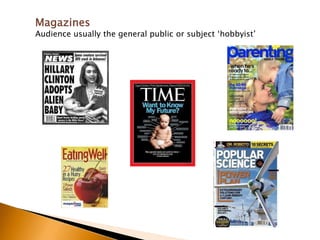
Magazines
Audience usually the general public or subject „hobbyist‟
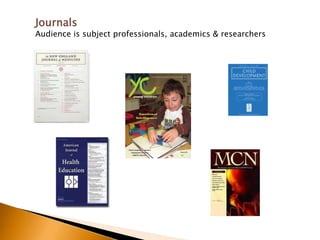
Journals
Audience is subject professionals, academics & researchers
Magazines
• Article authors generally professional writers, not topic specialists
• Motivation of author is primarily a paycheck
• Motivation of publisher is to sell magazines to everyone
• Articles accepted by publisher w/focus on sales (to anyone)
Journals
• Article authors generally professionals in the subject
• Motivation of author is to publish (i.e. professional reasons)
• Motivation of publisher is to sell to profession/libraries/etc.
• Articles are accepted by publisher, often via a peer review process,
w/focus on selling to professionals interested in subject body of
knowledge
Advantages of magazines
• Usually fast, easy reads that are often entertaining
• Can be a „place to start‟ when nothing is known about the topic
• Sometimes, but not often, only place your topic is covered.
Advantages of journals
• Information is accurate/based on scientific/research principles
• Higher level of confidence that using information from journal is an
academically and professionally wise thing to do
When it really matters
quality information
beats
easy entertainment
But how can you tell the difference?
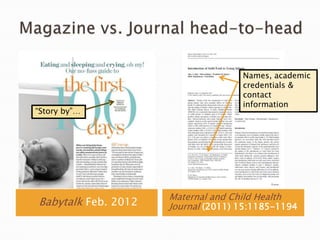
Babytalk Feb. 2012
Maternal and Child Health
Journal (2011) 15:1185-1194
“Story by”…
Names, academic
credentials &
contact
information
Babytalk Feb. 2012
Maternal and Child Health
Journal (2011) 15:1185-1194
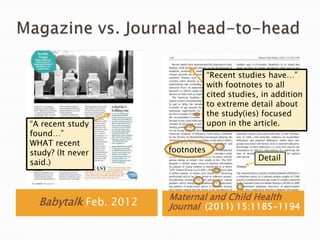
“A recent study
found…”
WHAT recent
study? (It never
said.)
“Recent studies have…”
with footnotes to all
cited studies, in addition
to extreme detail about
the study(ies) focused
upon in the article.
footnotes
Detail
Babytalk Feb. 2012
Maternal and Child Health
Journal (2011) 15:1185-1194
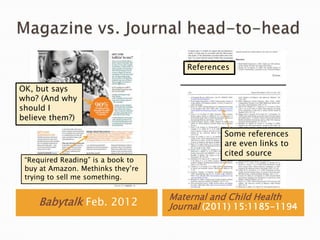
OK, but says
who? (And why
should I
believe them?)
“Required Reading” is a book to
buy at Amazon. Methinks they‟re
trying to sell me something.
References
Some references
are even links to
cited source
Journals—college and professional tools—are
characterized by:
• Author expertise in subject (usually a professional)
• Author education
• Research
• Cites sources
• Publication not trying to sell you something (except an idea)
• Can generally be regarded with higher level of confidence
But always bring your common sense to the party…
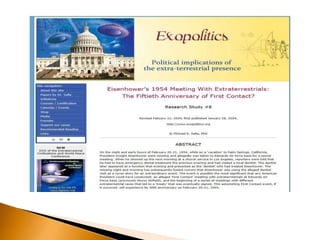
Research Study #8 by
Michael E. Salla, PhD
Research Study #8 by
Michael E. Salla, PhD
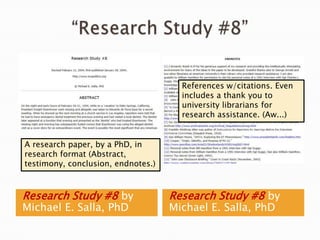
A research paper, by a PhD, in
research format (Abstract,
testimony, conclusion, endnotes.)
References w/citations. Even
includes a thank you to
university librarians for
research assistance. (Aw...)
But…
let‟s look more closely at
“Research Study #8”
Magazines vs journals

Magazines vs journals

  • 1.
    Using them incollege & professional life Stella Baker, Librarian ▬ College of the Desert Library Health Sciences & Education Liaison Fall 2013
  • 2.
    Magazines Audience usually thegeneral public or subject „hobbyist‟
  • 3.
    Journals Audience is subjectprofessionals, academics & researchers
  • 4.
    Magazines • Article authorsgenerally professional writers, not topic specialists • Motivation of author is primarily a paycheck • Motivation of publisher is to sell magazines to everyone • Articles accepted by publisher w/focus on sales (to anyone) Journals • Article authors generally professionals in the subject • Motivation of author is to publish (i.e. professional reasons) • Motivation of publisher is to sell to profession/libraries/etc. • Articles are accepted by publisher, often via a peer review process, w/focus on selling to professionals interested in subject body of knowledge
  • 5.
    Advantages of magazines •Usually fast, easy reads that are often entertaining • Can be a „place to start‟ when nothing is known about the topic • Sometimes, but not often, only place your topic is covered.
  • 6.
    Advantages of journals •Information is accurate/based on scientific/research principles • Higher level of confidence that using information from journal is an academically and professionally wise thing to do When it really matters quality information beats easy entertainment
  • 7.
    But how canyou tell the difference?
  • 8.
    Babytalk Feb. 2012 Maternaland Child Health Journal (2011) 15:1185-1194 “Story by”… Names, academic credentials & contact information
  • 9.
    Babytalk Feb. 2012 Maternaland Child Health Journal (2011) 15:1185-1194 “A recent study found…” WHAT recent study? (It never said.) “Recent studies have…” with footnotes to all cited studies, in addition to extreme detail about the study(ies) focused upon in the article. footnotes Detail
  • 10.
    Babytalk Feb. 2012 Maternaland Child Health Journal (2011) 15:1185-1194 OK, but says who? (And why should I believe them?) “Required Reading” is a book to buy at Amazon. Methinks they‟re trying to sell me something. References Some references are even links to cited source
  • 11.
    Journals—college and professionaltools—are characterized by: • Author expertise in subject (usually a professional) • Author education • Research • Cites sources • Publication not trying to sell you something (except an idea) • Can generally be regarded with higher level of confidence But always bring your common sense to the party…
  • 12.
    Research Study #8by Michael E. Salla, PhD Research Study #8 by Michael E. Salla, PhD A research paper, by a PhD, in research format (Abstract, testimony, conclusion, endnotes.) References w/citations. Even includes a thank you to university librarians for research assistance. (Aw...)
  • 13.
    But… let‟s look moreclosely at “Research Study #8”