MAE501MATLAB-ANYBODY INTERFACE FOR ANALYSIS OF LEG EXERCISEBy:Hrishi ShahAnirudh S.Advisor: Dr. VenkatKroviSUNY BUFFALOSPRING-200918 May '09
AimTo construct an application for finding the forces developed during a normal leg-weight lifting exercise.To design an exo-skeleton model for simulating the effect of a weightlifting exercise to help in rehabilitation.2
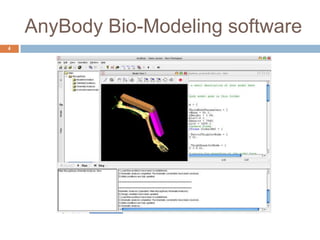
MaterialAnyBody Bio-Modeling softwareMATLAB (version 2008 a)Pro-E (for construction of STL files)3
AnyBody Bio-Modeling software4
ApproachDevelopment of Leg ModelDevelopment of Exo-skeleton modelDevelopment of MATLAB functions for “.any” file generation and running analysisDevelopment of Overall GUIAnalysis of various models and refinement5
Construction of AnyBody ModelsPart A: Construction of Leg ModelLeg Model with two segments constructedTwo revolute jointsHip joint (frozen)Knee jointVertical force applied at ankle to simulate weight lifting exercise6
Construction of AnyBody ModelsPart B- Construction of Exo-ModelTwo parallel segments added to leg modelThree revolute joints added(including two freezed joints and one exo-knee joint)Knee joint removed.Moment applied at exo-knee joint and foot-force removed.7
Comparison using MATLAB InterfaceMATLAB writes all parameters to “.any” files and runs them using “.anymcr” files.Forces in both models are compared after each iteration and changes proportional to these errors are made in the moment profile to be applied for the next iteration.8
MATLAB GUIJust a method of making the parameter changes and result overview easy and convenient.Muscle wise displayModel wise displayParameter variation9
Parameters in MATLABFoot LoadBody MassMode of Solving (Exoskeleton/Exercise)Start AngleEnd AngleSimulation TimeNumber of Intermediate stepsModel in consideration (Leg/Exo/Difference)Muscles to be displayed10
Optimization Results11
Animation in MATLAB12
Sensitivity AnalysisAimsTo develop a better understanding of the systemTo validate the formulation and methodsTypes of AnalysesFoot LoadBody MassStart AngleSimulation Time13
Foot Load Sensitivity Analysis14
Body Mass Sensitivity Analysis15
Start Angle Sensitivity Analysis16
Simulation Time Sensitivity Analysis17
Future ScopeChanging the model to incorporate other exercises.A Mo-CAP analysis for creating an actual movement profile to be followed.A Muscle force study to validate the analyses and their results by comparison with forces developed in real-time exercises.Development of a proper correction method that would be more realistic and practical for full body scale models.18
Questions???19
THANK YOU20

MAE501 Independent Study

  • 1.
    MAE501MATLAB-ANYBODY INTERFACE FORANALYSIS OF LEG EXERCISEBy:Hrishi ShahAnirudh S.Advisor: Dr. VenkatKroviSUNY BUFFALOSPRING-200918 May '09
  • 2.
    AimTo construct anapplication for finding the forces developed during a normal leg-weight lifting exercise.To design an exo-skeleton model for simulating the effect of a weightlifting exercise to help in rehabilitation.2
  • 3.
    MaterialAnyBody Bio-Modeling softwareMATLAB(version 2008 a)Pro-E (for construction of STL files)3
  • 4.
  • 5.
    ApproachDevelopment of LegModelDevelopment of Exo-skeleton modelDevelopment of MATLAB functions for “.any” file generation and running analysisDevelopment of Overall GUIAnalysis of various models and refinement5
  • 6.
    Construction of AnyBodyModelsPart A: Construction of Leg ModelLeg Model with two segments constructedTwo revolute jointsHip joint (frozen)Knee jointVertical force applied at ankle to simulate weight lifting exercise6
  • 7.
    Construction of AnyBodyModelsPart B- Construction of Exo-ModelTwo parallel segments added to leg modelThree revolute joints added(including two freezed joints and one exo-knee joint)Knee joint removed.Moment applied at exo-knee joint and foot-force removed.7
  • 8.
    Comparison using MATLABInterfaceMATLAB writes all parameters to “.any” files and runs them using “.anymcr” files.Forces in both models are compared after each iteration and changes proportional to these errors are made in the moment profile to be applied for the next iteration.8
  • 9.
    MATLAB GUIJust amethod of making the parameter changes and result overview easy and convenient.Muscle wise displayModel wise displayParameter variation9
  • 10.
    Parameters in MATLABFootLoadBody MassMode of Solving (Exoskeleton/Exercise)Start AngleEnd AngleSimulation TimeNumber of Intermediate stepsModel in consideration (Leg/Exo/Difference)Muscles to be displayed10
  • 11.
  • 12.
  • 13.
    Sensitivity AnalysisAimsTo developa better understanding of the systemTo validate the formulation and methodsTypes of AnalysesFoot LoadBody MassStart AngleSimulation Time13
  • 14.
  • 15.
  • 16.
  • 17.
  • 18.
    Future ScopeChanging themodel to incorporate other exercises.A Mo-CAP analysis for creating an actual movement profile to be followed.A Muscle force study to validate the analyses and their results by comparison with forces developed in real-time exercises.Development of a proper correction method that would be more realistic and practical for full body scale models.18
  • 19.
  • 20.