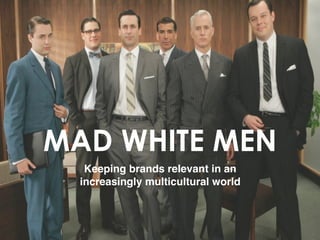
MAD WHITE MEN
Keeping brands relevant in an
increasingly multicultural world
HEY, HONKY!
Chances are most of you reading this are white. If you aren’t, please beg our pardons. We are merely
stating a fact. Most people who work in advertising and marketing are white. If you work in a creative
department of an ad agency or sit on the executive floor of any corporation really, just pick your head
up and look around you. Are you surrounded by white faces or brown ones? Are you adrift amongst a
sea of sameness that only exists at work, but not when you step out onto the street? If so, you may be
suffering from sheltered honkey syndrome. It’s okay. Rest assured you are not alone.
We are living in an increasingly diverse country, but you wouldn’t know by looking at our media. White
people may make up 63% of the population today, but that number is changing fast with non-white
populations booming in population size and spending power. Much has been written on the browning of
America. Our president is half black.
Yet, we are surrounded by white people propaganda in an increasingly non white America. Whether it’s
advertisements or the media or even Hallmark cards, non-white consumers feel it. They feel when you are
not talking to them and when you are trying too hard. The problem is, most people in advertising don’t
know how to talk to ethnic groups because most people in advertising are white. That’s why we’ve done
some research with non white people to gauge how brands can better speak to them and their families.
!
We learned there are a lot of myths about how white people think about race and ethnicity when it comes
to advertising and brands. This report sets out to dispel some of them, while offering recommendations on
how to move forward. Because not addressing these groups or addressing them in the wrong ways can
and will have some pretty big implications for brands, now and in the future. So let’s unite, white people.
It’s time to put down our lattes and look up from our navels. The revolution has already begun.
Disclaimer: this report is written by a white person.
CONTENTS
Myth - We market to white people because they’re the
majority
!
Myth - Ad agencies are melting pots
!
Myth - Advertising isn’t racist
Myth - Brands don’t discriminate
!
Myth - White people are aspirational
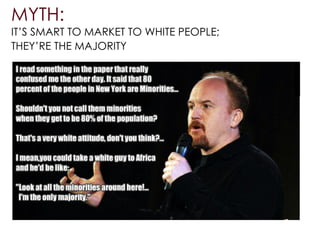
MYTH:
IT’S SMART TO MARKET TO WHITE PEOPLE;
THEY’RE THE MAJORITY
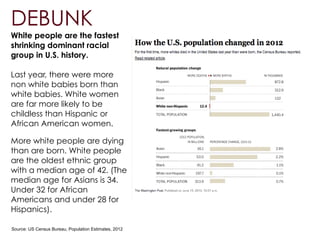
Source: US Census Bureau, Population Estimates, 2012
DEBUNK
White people are the fastest
shrinking dominant racial
group in U.S. history.
!
Last year, there were more
non white babies born than
white babies. White women
are far more likely to be
childless than Hispanic or
African American women.
!
More white people are dying
than are born. White people
are the oldest ethnic group
with a median age of 42. (The
median age for Asians is 34.
Under 32 for African
Americans and under 28 for
Hispanics).
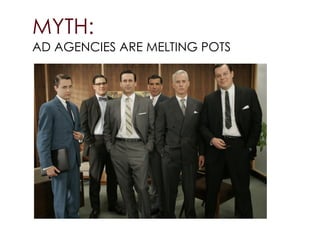
MYTH:
AD AGENCIES ARE MELTING POTS
DEBUNK
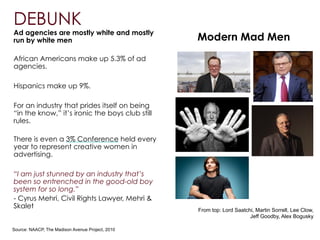
Ad agencies are mostly white and mostly
run by white men
African Americans make up 5.3% of ad
agencies.
!
Hispanics make up 9%.
!
For an industry that prides itself on being
“in the know,” it’s ironic the boys club still
rules.
!
There is even a 3% Conference held every
year to represent creative women in
advertising.
!
“I am just stunned by an industry that’s
been so entrenched in the good-old boy
system for so long.”
- Cyrus Mehri, Civil Rights Lawyer, Mehri &
Skalet
Source: NAACP, The Madison Avenue Project, 2010
From top: Lord Saatchi, Martin Sorrell, Lee Clow,
Jeff Goodby, Alex Bogusky
Modern Mad Men
IMPLICATIONS
Brands that have the potential to
capture growing multicultural
markets will benefit greatly from a
deeper understanding of these
consumers.
!
Brands who do not embrace
diversity in an authentic way now
will only become irrelevant to
consumers in the future.
“Urban youth is a huge market. A
40 year old white man can’t
relate.”
- Filipino Creative Director
RECOMMENDATIONS
Identify multicultural opportunity
targets for your brand. Conduct
qualitative ethnographic research
that uncovers authentic insights for
these targets.
!
Embrace diversity from top to bottom
- not only in external
communications, but also internally
in the hiring and promoting practices
within your organization as well
affiliated agencies who handle
communications for the brand.
!
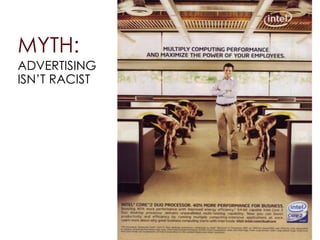
MYTH:
ADVERTISING
ISN’T RACIST
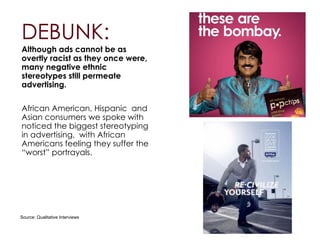
DEBUNK:
Although ads cannot be as
overtly racist as they once were,
many negative ethnic
stereotypes still permeate
advertising.
!
African American, Hispanic and
Asian consumers we spoke with
noticed the biggest stereotyping
in advertising, with African
Americans feeling they suffer the
“worst” portrayals.
Source: Qualitative Interviews
Black Women With Attitude
Whether it’s being portrayed as
angry, domineering or just wild -
black women recognize they are
heavily stereotyped in advertising.
!
77% of African American women are
concerned about their portrayal in
the media.
!
71% say they are portrayed “worse”
than other racial groups.
!
“I feel like the angry,‘crazy ass
black chick’ is still everywhere [in
advertising]. It’s like if people
don’t realize we can be calm.
Yes, there are calm, rational
black women. We do exist.”
Sources: Qualitative Interviews, 2007 Essence/P&G poll
STEREOTYPES
The Big Black Stud
Oftentimes in advertising, black men
are portrayed as big, strong, athletic,
combative and virile. Rarely are they
given intellectual or more human roles.
Source: Qualitative Interviews, Online posts
STEREOTYPES
“How about a picture of LeBron with a
hammer and nail in his hand
surrounded by children as he donates
some of the NIKE money to build homes
for his lost brothers and sisters? Show a
side of LeBron nobody sees, one that
cares. Beat back the stereotypes.” 
"The media depict [African-Americans] as
more aggressive, athletic and combative.
The biggest challenge I have with boys is to
build their understanding that there's more
to achieve than being a football player,
basketball player or rap star.”
- Stanley Miller, Executive Director, NAACP
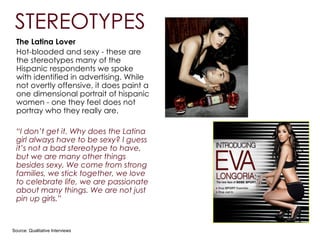
The Latina Lover
Hot-blooded and sexy - these are
the stereotypes many of the
Hispanic respondents we spoke
with identified in advertising. While
not overtly offensive, it does paint a
one dimensional portrait of hispanic
women - one they feel does not
portray who they really are.
!
“I don’t get it. Why does the Latina
girl always have to be sexy? I guess
it’s not a bad stereotype to have,
but we are many other things
besides sexy. We come from strong
families, we stick together, we love
to celebrate life, we are passionate
about many things. We are not just
pin up girls.”
Source: Qualitative Interviews
STEREOTYPES
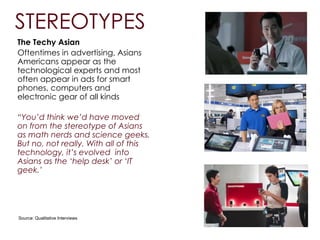
The Techy Asian
Oftentimes in advertising, Asians
Americans appear as the
technological experts and most
often appear in ads for smart
phones, computers and
electronic gear of all kinds
“You’d think we’d have moved
on from the stereotype of Asians
as math nerds and science geeks.
But no, not really. With all of this
technology, it’s evolved into
Asians as the ‘help desk’ or ‘IT
geek.’
Source: Qualitative Interviews
STEREOTYPES
IMPLICATIONS:
Whether black or blonde, yellow
or brown - no one likes to be
stereotyped. Advertising that
does so only risks alienating
ethnicities and genders.
!
Some races are more sensitive
to stereotyping than others, with
African Americans
understandably being more
sensitive than other groups.
RECOMMENDATIONS:
Check your creative department. How
culturally relevant is the talent at your
advertising agency based on the
brands in your portfolio?
Be sensitive to stereotyping when
casting. Avoid adding token ethnicities
to represent multiculturalism.
!
Debunk racial stereotypes in
advertising to better resonate with
ethnicities.
!
Dimensionalize your consumer.
Consider ethnographic research that
finds ways to humanize racial groups
within your target.
MYTH:
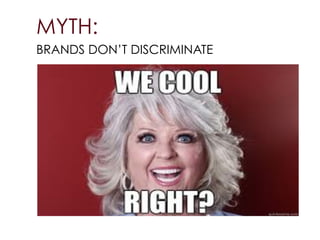
BRANDS DON’T DISCRIMINATE
DEBUNK:
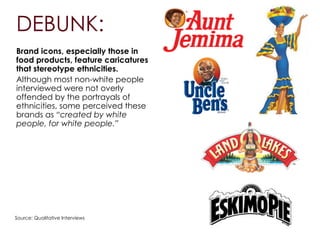
Brand icons, especially those in
food products, feature caricatures
that stereotype ethnicities.
Although most non-white people
interviewed were not overly
offended by the portrayals of
ethnicities, some perceived these
brands as “created by white
people, for white people.”
Source: Qualitative Interviews
DEBUNK:
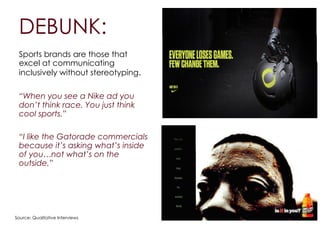
Sports brands are those that
excel at communicating
inclusively without stereotyping.
!
“When you see a Nike ad you
don’t think race. You just think
cool sports.”
!
“I like the Gatorade commercials
because it’s asking what’s inside
of you…not what’s on the
outside.”
Source: Qualitative Interviews
IMPLICATIONS:
Brands with years of equity in
an icon may want to rethink
changing their logo.
!
Brands that represent ideals
stereotype less than those that
represent ethnicities.
RECOMMENDATIONS
Stand for ideals over icons. Most
people can identify with what the
Nike swoosh stands for. But not
everyone can identify with what the
Chiquita Banana lady stands for.
Consider ways to infuse ideals into
your icon that go beyond ethnic
portrayals.
!
Uncover the universal human truth of
your brand - one everyone
connects with regardless of age,
race, gender or color.
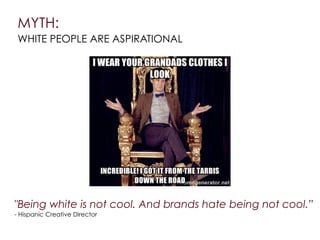
MYTH:
WHITE PEOPLE ARE ASPIRATIONAL
"Being white is not cool. And brands hate being not cool.”
- Hispanic Creative Director
DEBUNK:
Each generation has a different relationship to brands. Brands seen as
'for white people' are perceived as more aspirational to older
generations than they are to younger generations.
!
For those older generations in the household born before the civil rights
movement of the late 60’s, brand name products are more
aspirational because they were inaccessible to them as children.
“When I was a kid, all the white kids had the brand name things. You'd
look at their lunch boxes at school and they'd all have their Wonder
Bread. So in a way it was something I always wanted. I’ll never forget
the first time I ate Wonder Bread. One of the little white girls in my class
had a birthday party and they served Wonder Bread and Oscar Meyer
bologna. It was like a dream when I bit into it. To this day, if I make a
bologna sandwich it’s only with Oscar Meyer and Wonder Bread.”
- African American woman, age 62
Source: One on One Qualitative Interviews
DEBUNK:
As people grow younger, brands as "for white people" are perceived as
less aspirational. It's more about disposable income and less about skin
color. Children see even less of a difference between black and white.
!
“It’s funny how they advertise Corona as ‘the Mexican beer.’ Mexicans
don’t even drink it! It’s Mexican beer for white people…kind of like how
Taco Bell is Mexican food for white people.”
- Hispanic woman, 22 years old
!
“I don't see brands as for white people or as 'white people brands.’ I
see it more as a socio-economic issue.”
- Japanese American woman, age 35
!
"Dove is the best because it's the best at helping your skin. It doesn’t
matter what color [your skin] is. We all have skin that's dry."
- Hispanic girl, age 9
Source: One on One Qualitative Interviews
IMPLICATIONS:
Older consumers may have
more of an aspirational affinity to
established brand names.
!
Younger consumers may find
brands less appealing that
pigeonhole them by ethnicity.
!
People may aspire towards white
brands…but they don’t aspire to
be white.
!
RECOMMENDATIONS
Identify the aspirational qualities in
your brand that have nothing to do
with being white.
!
Research what other ethnicities find
aspirational. Newsflash honkies, not
everyone wants to be white or
aspires to the things that white
people do.
!
Research what makes other
ethnicities aspirational. Are there
“black people” qualities white
people aspire to; Asian qualities that
African Americans aspire to, Hispanic
qualities that Asians aspire to?
!FIN
!
Thanks for your time. We hope you learned something. If you’re
white, we assume you took copious notes in a neat book with a
special pen that you will pass off to your manager as your ideas. Ha.
Only kidding. We didn’t make that last point to hurt your feelings,
but to reinforce the idea that nobody likes to be stereotyped.
!
So let’s start implementing change, now. Demographics cannot be
denied. Agencies and marketers who don’t affect change now will
only find a rude awakening in the future as they are stuck with
outdated brands that do not resonate with the voice of modern
America. Let’s be part of embracing the revolution. After all, we are
the fortunate ones in the position to really make a difference.
!
Go white people. Go.

Mad white men

  • 1.
    MAD WHITE MEN Keepingbrands relevant in an increasingly multicultural world
  • 2.
    HEY, HONKY! Chances aremost of you reading this are white. If you aren’t, please beg our pardons. We are merely stating a fact. Most people who work in advertising and marketing are white. If you work in a creative department of an ad agency or sit on the executive floor of any corporation really, just pick your head up and look around you. Are you surrounded by white faces or brown ones? Are you adrift amongst a sea of sameness that only exists at work, but not when you step out onto the street? If so, you may be suffering from sheltered honkey syndrome. It’s okay. Rest assured you are not alone. We are living in an increasingly diverse country, but you wouldn’t know by looking at our media. White people may make up 63% of the population today, but that number is changing fast with non-white populations booming in population size and spending power. Much has been written on the browning of America. Our president is half black. Yet, we are surrounded by white people propaganda in an increasingly non white America. Whether it’s advertisements or the media or even Hallmark cards, non-white consumers feel it. They feel when you are not talking to them and when you are trying too hard. The problem is, most people in advertising don’t know how to talk to ethnic groups because most people in advertising are white. That’s why we’ve done some research with non white people to gauge how brands can better speak to them and their families. ! We learned there are a lot of myths about how white people think about race and ethnicity when it comes to advertising and brands. This report sets out to dispel some of them, while offering recommendations on how to move forward. Because not addressing these groups or addressing them in the wrong ways can and will have some pretty big implications for brands, now and in the future. So let’s unite, white people. It’s time to put down our lattes and look up from our navels. The revolution has already begun. Disclaimer: this report is written by a white person.
  • 3.
    CONTENTS Myth - Wemarket to white people because they’re the majority ! Myth - Ad agencies are melting pots ! Myth - Advertising isn’t racist Myth - Brands don’t discriminate ! Myth - White people are aspirational
  • 4.
    MYTH: IT’S SMART TOMARKET TO WHITE PEOPLE; THEY’RE THE MAJORITY
  • 5.
    Source: US CensusBureau, Population Estimates, 2012 DEBUNK White people are the fastest shrinking dominant racial group in U.S. history. ! Last year, there were more non white babies born than white babies. White women are far more likely to be childless than Hispanic or African American women. ! More white people are dying than are born. White people are the oldest ethnic group with a median age of 42. (The median age for Asians is 34. Under 32 for African Americans and under 28 for Hispanics).
  • 6.
  • 7.
    DEBUNK Ad agencies aremostly white and mostly run by white men African Americans make up 5.3% of ad agencies. ! Hispanics make up 9%. ! For an industry that prides itself on being “in the know,” it’s ironic the boys club still rules. ! There is even a 3% Conference held every year to represent creative women in advertising. ! “I am just stunned by an industry that’s been so entrenched in the good-old boy system for so long.” - Cyrus Mehri, Civil Rights Lawyer, Mehri & Skalet Source: NAACP, The Madison Avenue Project, 2010 From top: Lord Saatchi, Martin Sorrell, Lee Clow, Jeff Goodby, Alex Bogusky Modern Mad Men
  • 8.
    IMPLICATIONS Brands that havethe potential to capture growing multicultural markets will benefit greatly from a deeper understanding of these consumers. ! Brands who do not embrace diversity in an authentic way now will only become irrelevant to consumers in the future. “Urban youth is a huge market. A 40 year old white man can’t relate.” - Filipino Creative Director RECOMMENDATIONS Identify multicultural opportunity targets for your brand. Conduct qualitative ethnographic research that uncovers authentic insights for these targets. ! Embrace diversity from top to bottom - not only in external communications, but also internally in the hiring and promoting practices within your organization as well affiliated agencies who handle communications for the brand. !
  • 9.
  • 10.
    DEBUNK: Although ads cannotbe as overtly racist as they once were, many negative ethnic stereotypes still permeate advertising. ! African American, Hispanic and Asian consumers we spoke with noticed the biggest stereotyping in advertising, with African Americans feeling they suffer the “worst” portrayals. Source: Qualitative Interviews
  • 11.
    Black Women WithAttitude Whether it’s being portrayed as angry, domineering or just wild - black women recognize they are heavily stereotyped in advertising. ! 77% of African American women are concerned about their portrayal in the media. ! 71% say they are portrayed “worse” than other racial groups. ! “I feel like the angry,‘crazy ass black chick’ is still everywhere [in advertising]. It’s like if people don’t realize we can be calm. Yes, there are calm, rational black women. We do exist.” Sources: Qualitative Interviews, 2007 Essence/P&G poll STEREOTYPES
  • 12.
    The Big BlackStud Oftentimes in advertising, black men are portrayed as big, strong, athletic, combative and virile. Rarely are they given intellectual or more human roles. Source: Qualitative Interviews, Online posts STEREOTYPES “How about a picture of LeBron with a hammer and nail in his hand surrounded by children as he donates some of the NIKE money to build homes for his lost brothers and sisters? Show a side of LeBron nobody sees, one that cares. Beat back the stereotypes.”  "The media depict [African-Americans] as more aggressive, athletic and combative. The biggest challenge I have with boys is to build their understanding that there's more to achieve than being a football player, basketball player or rap star.” - Stanley Miller, Executive Director, NAACP
  • 13.
    The Latina Lover Hot-bloodedand sexy - these are the stereotypes many of the Hispanic respondents we spoke with identified in advertising. While not overtly offensive, it does paint a one dimensional portrait of hispanic women - one they feel does not portray who they really are. ! “I don’t get it. Why does the Latina girl always have to be sexy? I guess it’s not a bad stereotype to have, but we are many other things besides sexy. We come from strong families, we stick together, we love to celebrate life, we are passionate about many things. We are not just pin up girls.” Source: Qualitative Interviews STEREOTYPES
  • 14.
    The Techy Asian Oftentimesin advertising, Asians Americans appear as the technological experts and most often appear in ads for smart phones, computers and electronic gear of all kinds “You’d think we’d have moved on from the stereotype of Asians as math nerds and science geeks. But no, not really. With all of this technology, it’s evolved into Asians as the ‘help desk’ or ‘IT geek.’ Source: Qualitative Interviews STEREOTYPES
  • 15.
    IMPLICATIONS: Whether black orblonde, yellow or brown - no one likes to be stereotyped. Advertising that does so only risks alienating ethnicities and genders. ! Some races are more sensitive to stereotyping than others, with African Americans understandably being more sensitive than other groups. RECOMMENDATIONS: Check your creative department. How culturally relevant is the talent at your advertising agency based on the brands in your portfolio? Be sensitive to stereotyping when casting. Avoid adding token ethnicities to represent multiculturalism. ! Debunk racial stereotypes in advertising to better resonate with ethnicities. ! Dimensionalize your consumer. Consider ethnographic research that finds ways to humanize racial groups within your target.
  • 16.
  • 17.
    DEBUNK: Brand icons, especiallythose in food products, feature caricatures that stereotype ethnicities. Although most non-white people interviewed were not overly offended by the portrayals of ethnicities, some perceived these brands as “created by white people, for white people.” Source: Qualitative Interviews
  • 18.
    DEBUNK: Sports brands arethose that excel at communicating inclusively without stereotyping. ! “When you see a Nike ad you don’t think race. You just think cool sports.” ! “I like the Gatorade commercials because it’s asking what’s inside of you…not what’s on the outside.” Source: Qualitative Interviews
  • 19.
    IMPLICATIONS: Brands with yearsof equity in an icon may want to rethink changing their logo. ! Brands that represent ideals stereotype less than those that represent ethnicities. RECOMMENDATIONS Stand for ideals over icons. Most people can identify with what the Nike swoosh stands for. But not everyone can identify with what the Chiquita Banana lady stands for. Consider ways to infuse ideals into your icon that go beyond ethnic portrayals. ! Uncover the universal human truth of your brand - one everyone connects with regardless of age, race, gender or color.
  • 20.
    MYTH: WHITE PEOPLE AREASPIRATIONAL "Being white is not cool. And brands hate being not cool.” - Hispanic Creative Director
  • 21.
    DEBUNK: Each generation hasa different relationship to brands. Brands seen as 'for white people' are perceived as more aspirational to older generations than they are to younger generations. ! For those older generations in the household born before the civil rights movement of the late 60’s, brand name products are more aspirational because they were inaccessible to them as children. “When I was a kid, all the white kids had the brand name things. You'd look at their lunch boxes at school and they'd all have their Wonder Bread. So in a way it was something I always wanted. I’ll never forget the first time I ate Wonder Bread. One of the little white girls in my class had a birthday party and they served Wonder Bread and Oscar Meyer bologna. It was like a dream when I bit into it. To this day, if I make a bologna sandwich it’s only with Oscar Meyer and Wonder Bread.” - African American woman, age 62 Source: One on One Qualitative Interviews
  • 22.
    DEBUNK: As people growyounger, brands as "for white people" are perceived as less aspirational. It's more about disposable income and less about skin color. Children see even less of a difference between black and white. ! “It’s funny how they advertise Corona as ‘the Mexican beer.’ Mexicans don’t even drink it! It’s Mexican beer for white people…kind of like how Taco Bell is Mexican food for white people.” - Hispanic woman, 22 years old ! “I don't see brands as for white people or as 'white people brands.’ I see it more as a socio-economic issue.” - Japanese American woman, age 35 ! "Dove is the best because it's the best at helping your skin. It doesn’t matter what color [your skin] is. We all have skin that's dry." - Hispanic girl, age 9 Source: One on One Qualitative Interviews
  • 23.
    IMPLICATIONS: Older consumers mayhave more of an aspirational affinity to established brand names. ! Younger consumers may find brands less appealing that pigeonhole them by ethnicity. ! People may aspire towards white brands…but they don’t aspire to be white. ! RECOMMENDATIONS Identify the aspirational qualities in your brand that have nothing to do with being white. ! Research what other ethnicities find aspirational. Newsflash honkies, not everyone wants to be white or aspires to the things that white people do. ! Research what makes other ethnicities aspirational. Are there “black people” qualities white people aspire to; Asian qualities that African Americans aspire to, Hispanic qualities that Asians aspire to?
  • 24.
    !FIN ! Thanks for yourtime. We hope you learned something. If you’re white, we assume you took copious notes in a neat book with a special pen that you will pass off to your manager as your ideas. Ha. Only kidding. We didn’t make that last point to hurt your feelings, but to reinforce the idea that nobody likes to be stereotyped. ! So let’s start implementing change, now. Demographics cannot be denied. Agencies and marketers who don’t affect change now will only find a rude awakening in the future as they are stuck with outdated brands that do not resonate with the voice of modern America. Let’s be part of embracing the revolution. After all, we are the fortunate ones in the position to really make a difference. ! Go white people. Go.