TIMELINEOF MACINTOSH
MODELS
Apple Inc.
What is Macintosh?
◦ The Macintosh (mainly Mac since 1998) is a family of personal
computers designed, manufactured, and sold by Apple Inc. since
January 1984.
◦ The original Macintosh is the first successful mass-market personal
computer to have featured a graphical user interface, built-in screen,
and mouse.Apple sold the Macintosh alongside its popular Apple
II, Apple III, and Apple Lisa families of computers until the other models
were discontinued in the 1990s.
MAC COMPUTERS
The History
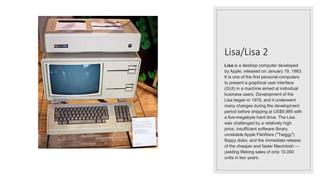
Lisa/Lisa 2
Lisa is a desktop computer developed
by Apple, released on January 19, 1983.
It is one of the first personal computers
to present a graphical user interface
(GUI) in a machine aimed at individual
business users. Development of the
Lisa began in 1978, and it underwent
many changes during the development
period before shipping at US$9,995 with
a five-megabyte hard drive. The Lisa
was challenged by a relatively high
price, insufficient software library,
unreliable Apple FileWare ("Twiggy")
floppy disks, and the immediate release
of the cheaper and faster Macintosh —
yielding lifelong sales of only 10,000
units in two years.
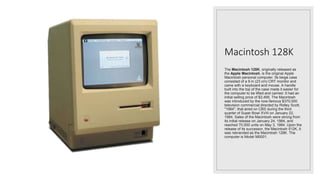
Macintosh 128K
The Macintosh 128K, originally released as
the Apple Macintosh, is the original Apple
Macintosh personal computer. Its beige case
consisted of a 9 in (23 cm) CRT monitor and
came with a keyboard and mouse. A handle
built into the top of the case made it easier for
the computer to be lifted and carried. It had an
initial selling price of $2,495. The Macintosh
was introduced by the now-famous $370,000
television commercial directed by Ridley Scott,
"1984", that aired on CBS during the third
quarter of Super Bowl XVIII on January 22,
1984. Sales of the Macintosh were strong from
its initial release on January 24, 1984, and
reached 70,000 units on May 3, 1984. Upon the
release of its successor, the Macintosh 512K, it
was rebranded as the Macintosh 128K. The
computer is Model M0001.
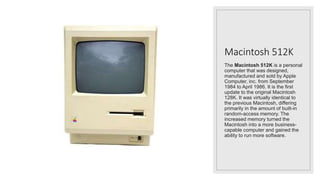
Macintosh 512K
The Macintosh 512K is a personal
computer that was designed,
manufactured and sold by Apple
Computer, inc. from September
1984 to April 1986. It is the first
update to the original Macintosh
128K. It was virtually identical to
the previous Macintosh, differing
primarily in the amount of built-in
random-access memory. The
increased memory turned the
Macintosh into a more business-
capable computer and gained the
ability to run more software.
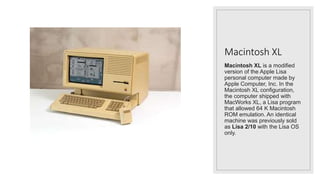
Macintosh XL
Macintosh XL is a modified
version of the Apple Lisa
personal computer made by
Apple Computer, Inc. In the
Macintosh XL configuration,
the computer shipped with
MacWorks XL, a Lisa program
that allowed 64 K Macintosh
ROM emulation. An identical
machine was previously sold
as Lisa 2/10 with the Lisa OS
only.
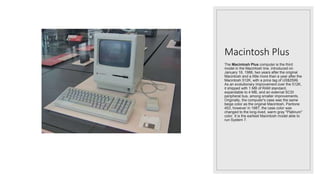
Macintosh Plus
The Macintosh Plus computer is the third
model in the Macintosh line, introduced on
January 16, 1986, two years after the original
Macintosh and a little more than a year after the
Macintosh 512K, with a price tag of US$2599.
As an evolutionary improvement over the 512K,
it shipped with 1 MB of RAM standard,
expandable to 4 MB, and an external SCSI
peripheral bus, among smaller improvements.
Originally, the computer's case was the same
beige color as the original Macintosh, Pantone
453, however in 1987, the case color was
changed to the long-lived, warm gray "Platinum"
color. It is the earliest Macintosh model able to
run System 7.
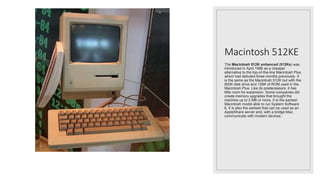
Macintosh 512KE
The Macintosh 512K enhanced (512Ke) was
introduced in April 1986 as a cheaper
alternative to the top-of-the-line Macintosh Plus,
which had debuted three months previously. It
is the same as the Macintosh 512K but with the
800K disk drive and 128K of ROM used in the
Macintosh Plus. Like its predecessors, it has
little room for expansion. Some companies did
create memory upgrades that brought the
machine up to 2 MB or more. It is the earliest
Macintosh model able to run System Software
6. It is also the earliest that can be used as an
AppleShare server and, with a bridge Mac,
communicate with modern devices.
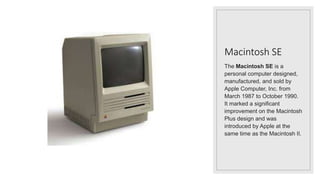
Macintosh SE
The Macintosh SE is a
personal computer designed,
manufactured, and sold by
Apple Computer, Inc. from
March 1987 to October 1990.
It marked a significant
improvement on the Macintosh
Plus design and was
introduced by Apple at the
same time as the Macintosh II.
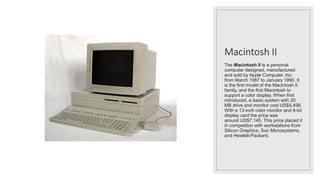
Macintosh II
The Macintosh II is a personal
computer designed, manufactured
and sold by Apple Computer, Inc.
from March 1987 to January 1990. It
is the first model of the Macintosh II
family, and the first Macintosh to
support a color display. When first
introduced, a basic system with 20
MB drive and monitor cost US$5,498.
With a 13-inch color monitor and 8-bit
display card the price was
around US$7,145. This price placed it
in competition with workstations from
Silicon Graphics, Sun Microsystems,
and Hewlett-Packard.
Macintosh IIx
The Macintosh IIx is a desktop
computer designed, manufactured,
and sold by Apple Computer, Inc.
from September 1988 to October
1990. This model was introduced
as an update to the original
Macintosh II, replacing the 16 MHz
Motorola 68020 CPU and 68881
FPU with a 68030 CPU and 68882
FPU running at the same clock
speed. The initial price of the IIx
was US$7,769 or US$9,369 for the
version with a 40 MB hard drive.
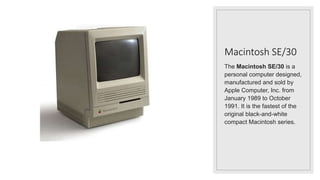
Macintosh SE/30
The Macintosh SE/30 is a
personal computer designed,
manufactured and sold by
Apple Computer, Inc. from
January 1989 to October
1991. It is the fastest of the
original black-and-white
compact Macintosh series.
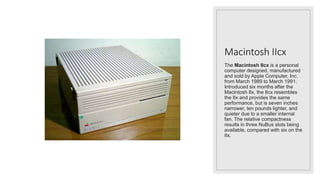
Macintosh IIcx
The Macintosh IIcx is a personal
computer designed, manufactured
and sold by Apple Computer, Inc.
from March 1989 to March 1991.
Introduced six months after the
Macintosh IIx, the IIcx resembles
the IIx and provides the same
performance, but is seven inches
narrower, ten pounds lighter, and
quieter due to a smaller internal
fan. The relative compactness
results in three NuBus slots being
available, compared with six on the
IIx.
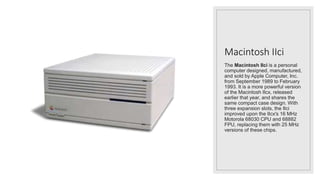
Macintosh IIci
The Macintosh IIci is a personal
computer designed, manufactured,
and sold by Apple Computer, Inc.
from September 1989 to February
1993. It is a more powerful version
of the Macintosh IIcx, released
earlier that year, and shares the
same compact case design. With
three expansion slots, the IIci
improved upon the IIcx's 16 MHz
Motorola 68030 CPU and 68882
FPU, replacing them with 25 MHz
versions of these chips.
Macintosh
Portable
Macintosh Portable is a portable computer
designed, manufactured, and sold by Apple
Computer, Inc. from September 1989 to
October 1991. It is the first battery-powered
Macintosh, which garnered significant
excitement from critics, but sales to customers
were quite low. It featured a fast, sharp, and
expensive black-and-white active matrix LCD
screen in a hinged design that covered the
keyboard when the machine was not in use.
The Portable was one of the early consumer
laptops to employ an active matrix panel, and
only the most expensive of the initial
PowerBook line, the PowerBook 170, used one,
due to the high cost. The machine was
designed to deliver high performance, at the
cost of increased price and weight. The
Portable was discontinued in October 1991.
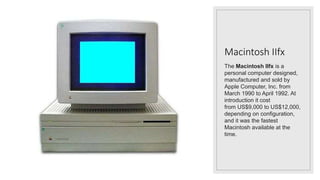
Macintosh IIfx
The Macintosh IIfx is a
personal computer designed,
manufactured and sold by
Apple Computer, Inc. from
March 1990 to April 1992. At
introduction it cost
from US$9,000 to US$12,000,
depending on configuration,
and it was the fastest
Macintosh available at the
time.
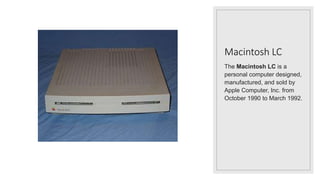
Macintosh LC
The Macintosh LC is a
personal computer designed,
manufactured, and sold by
Apple Computer, Inc. from
October 1990 to March 1992.
Macintosh Classic
II
The Macintosh Classic II is a
personal computer designed,
manufactured and sold by Apple
Computer, Inc. from October 1991
to September 1993. Like the
Macintosh SE/30 it replaces, the
Classic II was powered by a 16
MHz Motorola 68030 CPU and 40
or 80 MB hard disk, but in contrast
to its predecessor, it was limited by
a 16-bit data bus and a 10 MB
memory ceiling. The slower data
bus resulted in the Classic II being
30% slower than the SE/30.
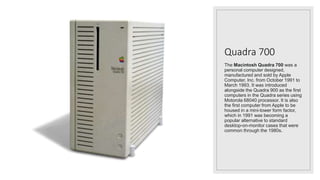
Quadra 700
The Macintosh Quadra 700 was a
personal computer designed,
manufactured and sold by Apple
Computer, Inc. from October 1991 to
March 1993. It was introduced
alongside the Quadra 900 as the first
computers in the Quadra series using
Motorola 68040 processor. It is also
the first computer from Apple to be
housed in a mini-tower form factor,
which in 1991 was becoming a
popular alternative to standard
desktop-on-monitor cases that were
common through the 1980s.
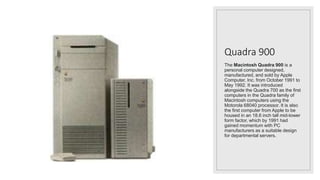
Quadra 900
The Macintosh Quadra 900 is a
personal computer designed,
manufactured, and sold by Apple
Computer, Inc. from October 1991 to
May 1992. It was introduced
alongside the Quadra 700 as the first
computers in the Quadra family of
Macintosh computers using the
Motorola 68040 processor. It is also
the first computer from Apple to be
housed in an 18.6 inch tall mid-tower
form factor, which by 1991 had
gained momentum with PC
manufacturers as a suitable design
for departmental servers.
Here’s the link to see others(I can’t write it down
anymore)
https://en.wikipedia.org/wiki/Timeline_of_Macintosh_
models

Macintosh Timeline

  • 1.
  • 2.
    What is Macintosh? ◦The Macintosh (mainly Mac since 1998) is a family of personal computers designed, manufactured, and sold by Apple Inc. since January 1984. ◦ The original Macintosh is the first successful mass-market personal computer to have featured a graphical user interface, built-in screen, and mouse.Apple sold the Macintosh alongside its popular Apple II, Apple III, and Apple Lisa families of computers until the other models were discontinued in the 1990s.
  • 3.
  • 4.
    Lisa/Lisa 2 Lisa isa desktop computer developed by Apple, released on January 19, 1983. It is one of the first personal computers to present a graphical user interface (GUI) in a machine aimed at individual business users. Development of the Lisa began in 1978, and it underwent many changes during the development period before shipping at US$9,995 with a five-megabyte hard drive. The Lisa was challenged by a relatively high price, insufficient software library, unreliable Apple FileWare ("Twiggy") floppy disks, and the immediate release of the cheaper and faster Macintosh — yielding lifelong sales of only 10,000 units in two years.
  • 5.
    Macintosh 128K The Macintosh128K, originally released as the Apple Macintosh, is the original Apple Macintosh personal computer. Its beige case consisted of a 9 in (23 cm) CRT monitor and came with a keyboard and mouse. A handle built into the top of the case made it easier for the computer to be lifted and carried. It had an initial selling price of $2,495. The Macintosh was introduced by the now-famous $370,000 television commercial directed by Ridley Scott, "1984", that aired on CBS during the third quarter of Super Bowl XVIII on January 22, 1984. Sales of the Macintosh were strong from its initial release on January 24, 1984, and reached 70,000 units on May 3, 1984. Upon the release of its successor, the Macintosh 512K, it was rebranded as the Macintosh 128K. The computer is Model M0001.
  • 6.
    Macintosh 512K The Macintosh512K is a personal computer that was designed, manufactured and sold by Apple Computer, inc. from September 1984 to April 1986. It is the first update to the original Macintosh 128K. It was virtually identical to the previous Macintosh, differing primarily in the amount of built-in random-access memory. The increased memory turned the Macintosh into a more business- capable computer and gained the ability to run more software.
  • 7.
    Macintosh XL Macintosh XLis a modified version of the Apple Lisa personal computer made by Apple Computer, Inc. In the Macintosh XL configuration, the computer shipped with MacWorks XL, a Lisa program that allowed 64 K Macintosh ROM emulation. An identical machine was previously sold as Lisa 2/10 with the Lisa OS only.
  • 8.
    Macintosh Plus The MacintoshPlus computer is the third model in the Macintosh line, introduced on January 16, 1986, two years after the original Macintosh and a little more than a year after the Macintosh 512K, with a price tag of US$2599. As an evolutionary improvement over the 512K, it shipped with 1 MB of RAM standard, expandable to 4 MB, and an external SCSI peripheral bus, among smaller improvements. Originally, the computer's case was the same beige color as the original Macintosh, Pantone 453, however in 1987, the case color was changed to the long-lived, warm gray "Platinum" color. It is the earliest Macintosh model able to run System 7.
  • 9.
    Macintosh 512KE The Macintosh512K enhanced (512Ke) was introduced in April 1986 as a cheaper alternative to the top-of-the-line Macintosh Plus, which had debuted three months previously. It is the same as the Macintosh 512K but with the 800K disk drive and 128K of ROM used in the Macintosh Plus. Like its predecessors, it has little room for expansion. Some companies did create memory upgrades that brought the machine up to 2 MB or more. It is the earliest Macintosh model able to run System Software 6. It is also the earliest that can be used as an AppleShare server and, with a bridge Mac, communicate with modern devices.
  • 10.
    Macintosh SE The MacintoshSE is a personal computer designed, manufactured, and sold by Apple Computer, Inc. from March 1987 to October 1990. It marked a significant improvement on the Macintosh Plus design and was introduced by Apple at the same time as the Macintosh II.
  • 11.
    Macintosh II The MacintoshII is a personal computer designed, manufactured and sold by Apple Computer, Inc. from March 1987 to January 1990. It is the first model of the Macintosh II family, and the first Macintosh to support a color display. When first introduced, a basic system with 20 MB drive and monitor cost US$5,498. With a 13-inch color monitor and 8-bit display card the price was around US$7,145. This price placed it in competition with workstations from Silicon Graphics, Sun Microsystems, and Hewlett-Packard.
  • 12.
    Macintosh IIx The MacintoshIIx is a desktop computer designed, manufactured, and sold by Apple Computer, Inc. from September 1988 to October 1990. This model was introduced as an update to the original Macintosh II, replacing the 16 MHz Motorola 68020 CPU and 68881 FPU with a 68030 CPU and 68882 FPU running at the same clock speed. The initial price of the IIx was US$7,769 or US$9,369 for the version with a 40 MB hard drive.
  • 13.
    Macintosh SE/30 The MacintoshSE/30 is a personal computer designed, manufactured and sold by Apple Computer, Inc. from January 1989 to October 1991. It is the fastest of the original black-and-white compact Macintosh series.
  • 14.
    Macintosh IIcx The MacintoshIIcx is a personal computer designed, manufactured and sold by Apple Computer, Inc. from March 1989 to March 1991. Introduced six months after the Macintosh IIx, the IIcx resembles the IIx and provides the same performance, but is seven inches narrower, ten pounds lighter, and quieter due to a smaller internal fan. The relative compactness results in three NuBus slots being available, compared with six on the IIx.
  • 15.
    Macintosh IIci The MacintoshIIci is a personal computer designed, manufactured, and sold by Apple Computer, Inc. from September 1989 to February 1993. It is a more powerful version of the Macintosh IIcx, released earlier that year, and shares the same compact case design. With three expansion slots, the IIci improved upon the IIcx's 16 MHz Motorola 68030 CPU and 68882 FPU, replacing them with 25 MHz versions of these chips.
  • 16.
    Macintosh Portable Macintosh Portable isa portable computer designed, manufactured, and sold by Apple Computer, Inc. from September 1989 to October 1991. It is the first battery-powered Macintosh, which garnered significant excitement from critics, but sales to customers were quite low. It featured a fast, sharp, and expensive black-and-white active matrix LCD screen in a hinged design that covered the keyboard when the machine was not in use. The Portable was one of the early consumer laptops to employ an active matrix panel, and only the most expensive of the initial PowerBook line, the PowerBook 170, used one, due to the high cost. The machine was designed to deliver high performance, at the cost of increased price and weight. The Portable was discontinued in October 1991.
  • 17.
    Macintosh IIfx The MacintoshIIfx is a personal computer designed, manufactured and sold by Apple Computer, Inc. from March 1990 to April 1992. At introduction it cost from US$9,000 to US$12,000, depending on configuration, and it was the fastest Macintosh available at the time.
  • 18.
    Macintosh LC The MacintoshLC is a personal computer designed, manufactured, and sold by Apple Computer, Inc. from October 1990 to March 1992.
  • 19.
    Macintosh Classic II The MacintoshClassic II is a personal computer designed, manufactured and sold by Apple Computer, Inc. from October 1991 to September 1993. Like the Macintosh SE/30 it replaces, the Classic II was powered by a 16 MHz Motorola 68030 CPU and 40 or 80 MB hard disk, but in contrast to its predecessor, it was limited by a 16-bit data bus and a 10 MB memory ceiling. The slower data bus resulted in the Classic II being 30% slower than the SE/30.
  • 20.
    Quadra 700 The MacintoshQuadra 700 was a personal computer designed, manufactured and sold by Apple Computer, Inc. from October 1991 to March 1993. It was introduced alongside the Quadra 900 as the first computers in the Quadra series using Motorola 68040 processor. It is also the first computer from Apple to be housed in a mini-tower form factor, which in 1991 was becoming a popular alternative to standard desktop-on-monitor cases that were common through the 1980s.
  • 21.
    Quadra 900 The MacintoshQuadra 900 is a personal computer designed, manufactured, and sold by Apple Computer, Inc. from October 1991 to May 1992. It was introduced alongside the Quadra 700 as the first computers in the Quadra family of Macintosh computers using the Motorola 68040 processor. It is also the first computer from Apple to be housed in an 18.6 inch tall mid-tower form factor, which by 1991 had gained momentum with PC manufacturers as a suitable design for departmental servers.
  • 22.
    Here’s the linkto see others(I can’t write it down anymore) https://en.wikipedia.org/wiki/Timeline_of_Macintosh_ models