TIMELINE EXPOSURE
TO TRADITIONAL TO
NEW MEDIA
BY: BEDA , IBRAHIM , FEROLINO
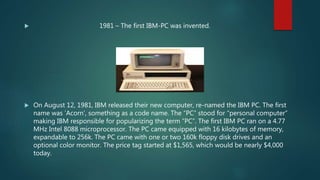
 1981 – The first IBM-PC was invented.
 On August 12, 1981, IBM released their new computer, re-named the IBM PC. The first
name was ‘Acorn’, something as a code name. The “PC” stood for “personal computer”
making IBM responsible for popularizing the term “PC”. The first IBM PC ran on a 4.77
MHz Intel 8088 microprocessor. The PC came equipped with 16 kilobytes of memory,
expandable to 256k. The PC came with one or two 160k floppy disk drives and an
optional color monitor. The price tag started at $1,565, which would be nearly $4,000
today.
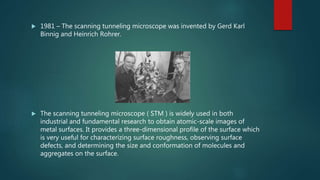
 1981 – The scanning tunneling microscope was invented by Gerd Karl
Binnig and Heinrich Rohrer.
 The scanning tunneling microscope ( STM ) is widely used in both
industrial and fundamental research to obtain atomic-scale images of
metal surfaces. It provides a three-dimensional profile of the surface which
is very useful for characterizing surface roughness, observing surface
defects, and determining the size and conformation of molecules and
aggregates on the surface.
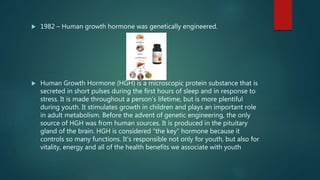
 1982 – Human growth hormone was genetically engineered.
 Human Growth Hormone (HGH) is a microscopic protein substance that is
secreted in short pulses during the first hours of sleep and in response to
stress. It is made throughout a person’s lifetime, but is more plentiful
during youth. It stimulates growth in children and plays an important role
in adult metabolism. Before the advent of genetic engineering, the only
source of HGH was from human sources. It is produced in the pituitary
gland of the brain. HGH is considered “the key” hormone because it
controls so many functions. It’s responsible not only for youth, but also for
vitality, energy and all of the health benefits we associate with youth
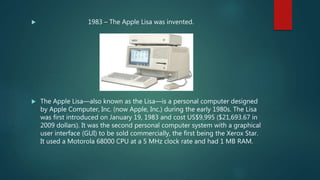
 1983 – The Apple Lisa was invented.
 The Apple Lisa—also known as the Lisa—is a personal computer designed
by Apple Computer, Inc. (now Apple, Inc.) during the early 1980s. The Lisa
was first introduced on January 19, 1983 and cost US$9,995 ($21,693.67 in
2009 dollars). It was the second personal computer system with a graphical
user interface (GUI) to be sold commercially, the first being the Xerox Star.
It used a Motorola 68000 CPU at a 5 MHz clock rate and had 1 MB RAM.
 1983 – Soft bifocal contact lens was invented.
 Contact lenses were created earlier than people think. But in 1983, bifocal
daily wear soft contact lenses became available for commercial
distribution. Bifocal contact lenses are designed to provide good vision to
people who have a condition called presbyopia. In addition all soft bifocal
contact lenses are considered “simultaneous vision” because both far and
near vision corrections are presented simultaneously to the retina,
regardless of the position of the eye. Of course, only one correction is
correct, the incorrect correction causes blur. Commonly these are designed
with distance correction in the center of the lens and near correction in the
periphery, or vice versa.
 1984 – The Apple Macintosh was invented.
 On January 24, 1984, Apple announced the Macintosh to its Board of Directors – and to the
world. The tiny computer was a radical departure from the large Lisa with it’s 12″ screen, just
as the Lisa itself had been a huge departure from the Apple II series and the growing family of
MS-DOS computers on the market. In 1984 most computers on the computer market, even
DOS ones, shipped with 64 KB or 128 KB of memory and had one or two 5.25″ floppy drives.
Hard drives, when available, where $1,500 options. The Macintosh was different. First, there
was the mouse, just like Lisa had. In fact, Apple was so adamant that you use the mouse that
the original Macintosh keyboard had no arrow keys. Then there was that 3.5″ floppy drive
storing 400 KB of date – 25% more than the 320 KB 5.25″ disks in the IBM world. But when
you turned it on, the Macintosh showed it’s greatest difference, a graphical user interface
(GUI). Although similar to the interface from the Lisa, the Mac used square pixels instead of
rectangular ones, making it far easier to accurately map graphics to the screen.
 With the 1984 Apple Macintosh Steve Jobs made sure developers created software for the
new Macintosh Computer. Jobs figured that software was the way to win the consumer over
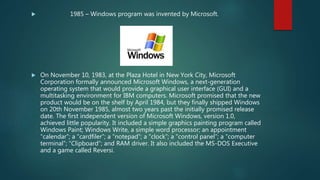
 1985 – Windows program was invented by Microsoft.
 On November 10, 1983, at the Plaza Hotel in New York City, Microsoft
Corporation formally announced Microsoft Windows, a next-generation
operating system that would provide a graphical user interface (GUI) and a
multitasking environment for IBM computers. Microsoft promised that the new
product would be on the shelf by April 1984, but they finally shipped Windows
on 20th November 1985, almost two years past the initially promised release
date. The first independent version of Microsoft Windows, version 1.0,
achieved little popularity. It included a simple graphics painting program called
Windows Paint; Windows Write, a simple word processor; an appointment
“calendar”; a “cardfiler”; a “notepad”; a “clock”; a “control panel”; a “computer
terminal”; “Clipboard”; and RAM driver. It also included the MS-DOS Executive
and a game called Reversi.
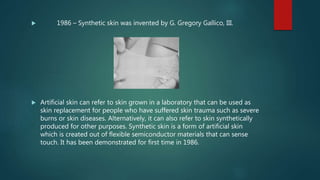
 1986 – Synthetic skin was invented by G. Gregory Gallico, III.
 Artificial skin can refer to skin grown in a laboratory that can be used as
skin replacement for people who have suffered skin trauma such as severe
burns or skin diseases. Alternatively, it can also refer to skin synthetically
produced for other purposes. Synthetic skin is a form of artificial skin
which is created out of flexible semiconductor materials that can sense
touch. It has been demonstrated for first time in 1986.
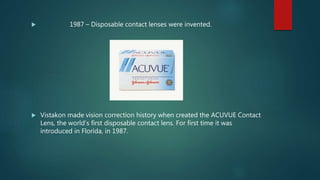
 1987 – Disposable contact lenses were invented.
 Vistakon made vision correction history when created the ACUVUE Contact
Lens, the world’s first disposable contact lens. For first time it was
introduced in Florida, in 1987.
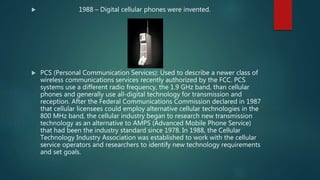
 1988 – Digital cellular phones were invented.
 PCS (Personal Communication Services): Used to describe a newer class of
wireless communications services recently authorized by the FCC. PCS
systems use a different radio frequency, the 1.9 GHz band, than cellular
phones and generally use all-digital technology for transmission and
reception. After the Federal Communications Commission declared in 1987
that cellular licensees could employ alternative cellular technologies in the
800 MHz band, the cellular industry began to research new transmission
technology as an alternative to AMPS (Advanced Mobile Phone Service)
that had been the industry standard since 1978. In 1988, the Cellular
Technology Industry Association was established to work with the cellular
service operators and researchers to identify new technology requirements
and set goals.
 1989 – High-definition television was invented.
 High-definition television (HDTV) is video that has resolution substantially
higher than that of traditional television systems (standard-definition
television). HDTV has one or two million pixels per frame, roughly five
times that of SD (1280 x 720 = 921,600 for 720p, or 1920 x 1080 =
2,073,600 for 1080p). Early HDTV broadcasting used analog techniques,
but today HDTV is digitally broadcast using video compression.
 1990 – The World Wide Web and Internet protocol (HTTP) and WWW
language (HTML) were created by Tim Berners-Lee.
 Before there was the public internet there was the internet’s forerunner
ARPAnet or Advanced Research Projects Agency Networks. ARPAnet was
funded by the United States military after the cold war with the aim of
having a military command and control center that could withstand
nuclear attack.
 The World Wide Web is a global information medium which users can read
and write via computers connected to the Internet. Tim Berners-Lee was
the man leading the development of the World Wide Web (with help of
course), the defining of HTML (HyperText Markup Language) used to
create web pages, HTTP (Hyper Text Transfer Protocol) and URLs (Universal
Resource Locators). All of those developments took place between 1989
and 1991.

1981 to 1990 timeline exposure

  • 1.
    TIMELINE EXPOSURE TO TRADITIONALTO NEW MEDIA BY: BEDA , IBRAHIM , FEROLINO
  • 2.
     1981 –The first IBM-PC was invented.  On August 12, 1981, IBM released their new computer, re-named the IBM PC. The first name was ‘Acorn’, something as a code name. The “PC” stood for “personal computer” making IBM responsible for popularizing the term “PC”. The first IBM PC ran on a 4.77 MHz Intel 8088 microprocessor. The PC came equipped with 16 kilobytes of memory, expandable to 256k. The PC came with one or two 160k floppy disk drives and an optional color monitor. The price tag started at $1,565, which would be nearly $4,000 today.
  • 3.
     1981 –The scanning tunneling microscope was invented by Gerd Karl Binnig and Heinrich Rohrer.  The scanning tunneling microscope ( STM ) is widely used in both industrial and fundamental research to obtain atomic-scale images of metal surfaces. It provides a three-dimensional profile of the surface which is very useful for characterizing surface roughness, observing surface defects, and determining the size and conformation of molecules and aggregates on the surface.
  • 4.
     1982 –Human growth hormone was genetically engineered.  Human Growth Hormone (HGH) is a microscopic protein substance that is secreted in short pulses during the first hours of sleep and in response to stress. It is made throughout a person’s lifetime, but is more plentiful during youth. It stimulates growth in children and plays an important role in adult metabolism. Before the advent of genetic engineering, the only source of HGH was from human sources. It is produced in the pituitary gland of the brain. HGH is considered “the key” hormone because it controls so many functions. It’s responsible not only for youth, but also for vitality, energy and all of the health benefits we associate with youth
  • 5.
     1983 –The Apple Lisa was invented.  The Apple Lisa—also known as the Lisa—is a personal computer designed by Apple Computer, Inc. (now Apple, Inc.) during the early 1980s. The Lisa was first introduced on January 19, 1983 and cost US$9,995 ($21,693.67 in 2009 dollars). It was the second personal computer system with a graphical user interface (GUI) to be sold commercially, the first being the Xerox Star. It used a Motorola 68000 CPU at a 5 MHz clock rate and had 1 MB RAM.
  • 6.
     1983 –Soft bifocal contact lens was invented.  Contact lenses were created earlier than people think. But in 1983, bifocal daily wear soft contact lenses became available for commercial distribution. Bifocal contact lenses are designed to provide good vision to people who have a condition called presbyopia. In addition all soft bifocal contact lenses are considered “simultaneous vision” because both far and near vision corrections are presented simultaneously to the retina, regardless of the position of the eye. Of course, only one correction is correct, the incorrect correction causes blur. Commonly these are designed with distance correction in the center of the lens and near correction in the periphery, or vice versa.
  • 7.
     1984 –The Apple Macintosh was invented.  On January 24, 1984, Apple announced the Macintosh to its Board of Directors – and to the world. The tiny computer was a radical departure from the large Lisa with it’s 12″ screen, just as the Lisa itself had been a huge departure from the Apple II series and the growing family of MS-DOS computers on the market. In 1984 most computers on the computer market, even DOS ones, shipped with 64 KB or 128 KB of memory and had one or two 5.25″ floppy drives. Hard drives, when available, where $1,500 options. The Macintosh was different. First, there was the mouse, just like Lisa had. In fact, Apple was so adamant that you use the mouse that the original Macintosh keyboard had no arrow keys. Then there was that 3.5″ floppy drive storing 400 KB of date – 25% more than the 320 KB 5.25″ disks in the IBM world. But when you turned it on, the Macintosh showed it’s greatest difference, a graphical user interface (GUI). Although similar to the interface from the Lisa, the Mac used square pixels instead of rectangular ones, making it far easier to accurately map graphics to the screen.  With the 1984 Apple Macintosh Steve Jobs made sure developers created software for the new Macintosh Computer. Jobs figured that software was the way to win the consumer over
  • 8.
     1985 –Windows program was invented by Microsoft.  On November 10, 1983, at the Plaza Hotel in New York City, Microsoft Corporation formally announced Microsoft Windows, a next-generation operating system that would provide a graphical user interface (GUI) and a multitasking environment for IBM computers. Microsoft promised that the new product would be on the shelf by April 1984, but they finally shipped Windows on 20th November 1985, almost two years past the initially promised release date. The first independent version of Microsoft Windows, version 1.0, achieved little popularity. It included a simple graphics painting program called Windows Paint; Windows Write, a simple word processor; an appointment “calendar”; a “cardfiler”; a “notepad”; a “clock”; a “control panel”; a “computer terminal”; “Clipboard”; and RAM driver. It also included the MS-DOS Executive and a game called Reversi.
  • 9.
     1986 –Synthetic skin was invented by G. Gregory Gallico, III.  Artificial skin can refer to skin grown in a laboratory that can be used as skin replacement for people who have suffered skin trauma such as severe burns or skin diseases. Alternatively, it can also refer to skin synthetically produced for other purposes. Synthetic skin is a form of artificial skin which is created out of flexible semiconductor materials that can sense touch. It has been demonstrated for first time in 1986.
  • 10.
     1987 –Disposable contact lenses were invented.  Vistakon made vision correction history when created the ACUVUE Contact Lens, the world’s first disposable contact lens. For first time it was introduced in Florida, in 1987.
  • 11.
     1988 –Digital cellular phones were invented.  PCS (Personal Communication Services): Used to describe a newer class of wireless communications services recently authorized by the FCC. PCS systems use a different radio frequency, the 1.9 GHz band, than cellular phones and generally use all-digital technology for transmission and reception. After the Federal Communications Commission declared in 1987 that cellular licensees could employ alternative cellular technologies in the 800 MHz band, the cellular industry began to research new transmission technology as an alternative to AMPS (Advanced Mobile Phone Service) that had been the industry standard since 1978. In 1988, the Cellular Technology Industry Association was established to work with the cellular service operators and researchers to identify new technology requirements and set goals.
  • 12.
     1989 –High-definition television was invented.  High-definition television (HDTV) is video that has resolution substantially higher than that of traditional television systems (standard-definition television). HDTV has one or two million pixels per frame, roughly five times that of SD (1280 x 720 = 921,600 for 720p, or 1920 x 1080 = 2,073,600 for 1080p). Early HDTV broadcasting used analog techniques, but today HDTV is digitally broadcast using video compression.
  • 13.
     1990 –The World Wide Web and Internet protocol (HTTP) and WWW language (HTML) were created by Tim Berners-Lee.  Before there was the public internet there was the internet’s forerunner ARPAnet or Advanced Research Projects Agency Networks. ARPAnet was funded by the United States military after the cold war with the aim of having a military command and control center that could withstand nuclear attack.  The World Wide Web is a global information medium which users can read and write via computers connected to the Internet. Tim Berners-Lee was the man leading the development of the World Wide Web (with help of course), the defining of HTML (HyperText Markup Language) used to create web pages, HTTP (Hyper Text Transfer Protocol) and URLs (Universal Resource Locators). All of those developments took place between 1989 and 1991.