MACHINE
LEARNING
BY SHRUTHIKA.M
2
INTRODUCTION
Machine learning is a subfield of that uses algorithms trained on data sets to create models that enable
machines to perform tasks that would otherwise only be possible for humans, such as categorizing images,
analyzing data, or predicting price fluctuations.
Today, machine learning is one of the most common forms of artificial intelligence and often powers many of
the digital goods and services we use every day.
In this article, you’ll learn more about what machine learning is, including how it works, different types of it,
and how it's actually used in the real world. We’ll take a look at the benefits and dangers that machine
learning poses, and in the end, you’ll find some cost-effective, flexible courses that can help you learn even
more about machine learning.
2
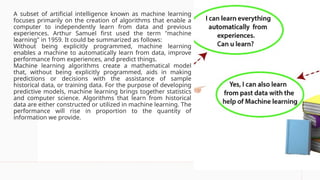
A subset of artificial intelligence known as machine learning
focuses primarily on the creation of algorithms that enable a
computer to independently learn from data and previous
experiences. Arthur Samuel first used the term "machine
learning" in 1959. It could be summarized as follows:
Without being explicitly programmed, machine learning
enables a machine to automatically learn from data, improve
performance from experiences, and predict things.
Machine learning algorithms create a mathematical model
that, without being explicitly programmed, aids in making
predictions or decisions with the assistance of sample
historical data, or training data. For the purpose of developing
predictive models, machine learning brings together statistics
and computer science. Algorithms that learn from historical
data are either constructed or utilized in machine learning. The
performance will rise in proportion to the quantity of
information we provide.
How does Machine
Learning work?
machine learning system builds prediction models,
learns from previous data, and predicts the output of
new data whenever it receives it. The amount of data
helps to build a better model that accurately predicts the
output, which in turn affects the accuracy of the
predicted output
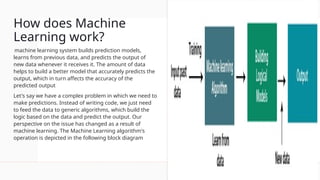
Let's say we have a complex problem in which we need to
make predictions. Instead of writing code, we just need
to feed the data to generic algorithms, which build the
logic based on the data and predict the output. Our
perspective on the issue has changed as a result of
machine learning. The Machine Learning algorithm's
operation is depicted in the following block diagram
5
TYPES OF MACHINE LEARNING
Supervised Learning
In supervised learning, sample labeled data are provided to the machine learning system for
training, and the system then predicts the output based on the training data.
Unsupervised Learning
Unsupervised learning is a learning method in which a machine learns without any supervision.
The training is provided to the machine with the set of data that has not been labeled, classified, or
categorized, and the algorithm needs to act on that data without any supervision
5
HISTORY OF
MACHINE LEARNING
Before some years (about 40-50 years), machine learning
was science fiction, but today it is the part of our daily life.
Machine learning is making our day to day life easy
from self-driving cars to Amazon virtual assistant
"Alexa". However, the idea behind machine learning is so
old and has a long history. Below some milestones are given
which have occurred in the history of machine learning
The early history of Machine Learning (Pre-1940):
• 1834: In 1834, Charles Babbage, the father of the
computer, conceived a device that could be programmed
with punch cards. However, the machine was never built,
but all modern computers rely on its logical structure.
• 1936: In 1936, Alan Turing gave a theory that how a
machine can determine and execute a set of instructions.
7
How does machine learning help us in daily life
Social networking
Use of the appropriate emoticons, suggestions about friend
tags on Facebook, filtered on Instagram, content
recommendations and suggested followers on social media
platforms, etc., are examples of how machine learning helps
us in social networking.
Personal finance and banking
solutions
Whether it’s fraud prevention, credit decisions, or checking
deposits on our smartphones machine learning does it all.
Commute estimation
Identification of the route to our selected destination,
estimation of the time required to reach that destination using
different transportation modes, calculating traffic time, and so
on are all made by machine learning.
8
. Healthcare and medical diagnosis
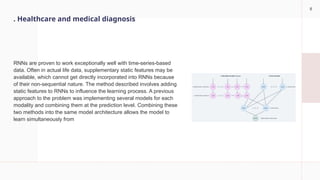
RNNs are proven to work exceptionally well with time-series-based
data. Often in actual life data, supplementary static features may be
available, which cannot get directly incorporated into RNNs because
of their non-sequential nature. The method described involves adding
static features to RNNs to influence the learning process. A previous
approach to the problem was implementing several models for each
modality and combining them at the prediction level. Combining these
two methods into the same model architecture allows the model to
learn simultaneously from
9
ADVANTAGE AND DISADVANTAGE
 Results Interpretations One of the
biggest advantages of Machine learning is
that interpreted data that we get from the
cannot be hundred percent accurate. It
will have some degree of inaccuracy. For a
high degree of accuracy, algorithms
should be developed so that they give
reliable results
By automating processes and improving efficiency, machine
learning can lead to significant cost reductions. In manufacturing, ML-
driven predictive maintenance helps identify equipment issues before
they become costly failures, reducing downtime and maintenance
costs.
Thank You

Presentations on machine learning in engineering.pptx

  • 1.
  • 2.
    2 INTRODUCTION Machine learning isa subfield of that uses algorithms trained on data sets to create models that enable machines to perform tasks that would otherwise only be possible for humans, such as categorizing images, analyzing data, or predicting price fluctuations. Today, machine learning is one of the most common forms of artificial intelligence and often powers many of the digital goods and services we use every day. In this article, you’ll learn more about what machine learning is, including how it works, different types of it, and how it's actually used in the real world. We’ll take a look at the benefits and dangers that machine learning poses, and in the end, you’ll find some cost-effective, flexible courses that can help you learn even more about machine learning. 2
  • 3.
    A subset ofartificial intelligence known as machine learning focuses primarily on the creation of algorithms that enable a computer to independently learn from data and previous experiences. Arthur Samuel first used the term "machine learning" in 1959. It could be summarized as follows: Without being explicitly programmed, machine learning enables a machine to automatically learn from data, improve performance from experiences, and predict things. Machine learning algorithms create a mathematical model that, without being explicitly programmed, aids in making predictions or decisions with the assistance of sample historical data, or training data. For the purpose of developing predictive models, machine learning brings together statistics and computer science. Algorithms that learn from historical data are either constructed or utilized in machine learning. The performance will rise in proportion to the quantity of information we provide.
  • 4.
    How does Machine Learningwork? machine learning system builds prediction models, learns from previous data, and predicts the output of new data whenever it receives it. The amount of data helps to build a better model that accurately predicts the output, which in turn affects the accuracy of the predicted output Let's say we have a complex problem in which we need to make predictions. Instead of writing code, we just need to feed the data to generic algorithms, which build the logic based on the data and predict the output. Our perspective on the issue has changed as a result of machine learning. The Machine Learning algorithm's operation is depicted in the following block diagram
  • 5.
    5 TYPES OF MACHINELEARNING Supervised Learning In supervised learning, sample labeled data are provided to the machine learning system for training, and the system then predicts the output based on the training data. Unsupervised Learning Unsupervised learning is a learning method in which a machine learns without any supervision. The training is provided to the machine with the set of data that has not been labeled, classified, or categorized, and the algorithm needs to act on that data without any supervision 5
  • 6.
    HISTORY OF MACHINE LEARNING Beforesome years (about 40-50 years), machine learning was science fiction, but today it is the part of our daily life. Machine learning is making our day to day life easy from self-driving cars to Amazon virtual assistant "Alexa". However, the idea behind machine learning is so old and has a long history. Below some milestones are given which have occurred in the history of machine learning The early history of Machine Learning (Pre-1940): • 1834: In 1834, Charles Babbage, the father of the computer, conceived a device that could be programmed with punch cards. However, the machine was never built, but all modern computers rely on its logical structure. • 1936: In 1936, Alan Turing gave a theory that how a machine can determine and execute a set of instructions.
  • 7.
    7 How does machinelearning help us in daily life Social networking Use of the appropriate emoticons, suggestions about friend tags on Facebook, filtered on Instagram, content recommendations and suggested followers on social media platforms, etc., are examples of how machine learning helps us in social networking. Personal finance and banking solutions Whether it’s fraud prevention, credit decisions, or checking deposits on our smartphones machine learning does it all. Commute estimation Identification of the route to our selected destination, estimation of the time required to reach that destination using different transportation modes, calculating traffic time, and so on are all made by machine learning.
  • 8.
    8 . Healthcare andmedical diagnosis RNNs are proven to work exceptionally well with time-series-based data. Often in actual life data, supplementary static features may be available, which cannot get directly incorporated into RNNs because of their non-sequential nature. The method described involves adding static features to RNNs to influence the learning process. A previous approach to the problem was implementing several models for each modality and combining them at the prediction level. Combining these two methods into the same model architecture allows the model to learn simultaneously from
  • 9.
    9 ADVANTAGE AND DISADVANTAGE Results Interpretations One of the biggest advantages of Machine learning is that interpreted data that we get from the cannot be hundred percent accurate. It will have some degree of inaccuracy. For a high degree of accuracy, algorithms should be developed so that they give reliable results By automating processes and improving efficiency, machine learning can lead to significant cost reductions. In manufacturing, ML- driven predictive maintenance helps identify equipment issues before they become costly failures, reducing downtime and maintenance costs.
  • 10.