Gokul K S, M.Sc., M.Phil.
P.hD. Scholar, Department of Forest Management and Remote Sensing, Faculty
Faculty of Forestry and Wood Sciences, Czech University of Life Sciences (CZU),
(CZU), Prague, Czechia
Supervisor:
Ing. Martin Mokros, Ph.D.
Department of Geography, University College London (UCL), London, UK
1
Introduction to Machine Learning
2
Copyrights @GifDB
Artificial Intelligence (AI)
3
Artificial Intelligence
■ AI is a branch of Computer Science, that aims to develop computers and
Machines that can act or mimic human like behavours (or Think intelligently)
- Can be Doing some intelligent tasks like Image classification (e.g. person,
objects etc.)
or
Performing complex calculations or analysing the data and providing insights,
Predictions and so on.
4
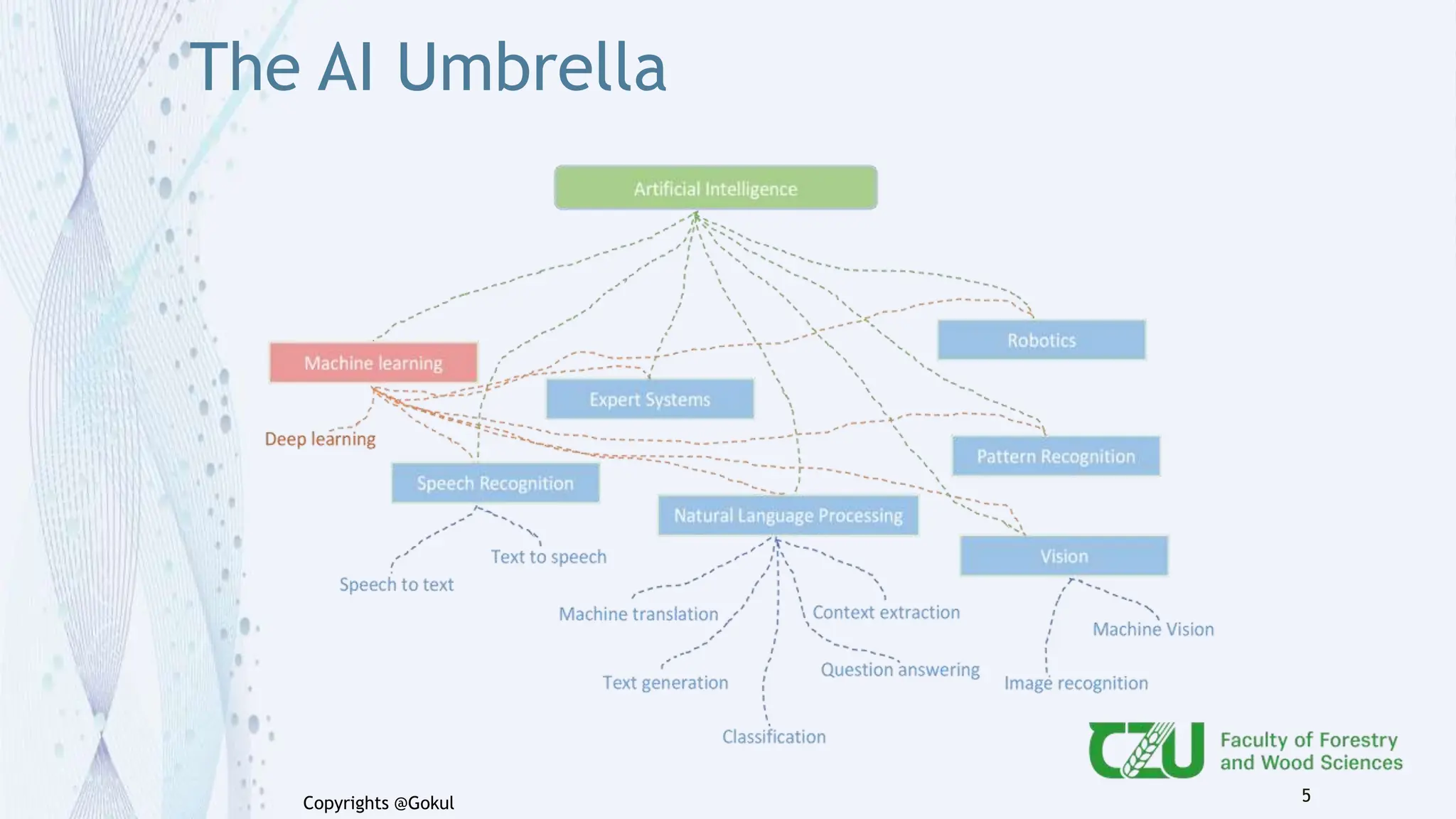
The AI Umbrella
5
Copyrights @Gokul
Machine Learning (ML)
Learning : Is the act of acquiring new or reinforcing existing Knowledge,
Behaviours, Skills or Values
Learners can be Humans, birds, animals
Types of Learning :
 Learning Under expert guidance
 Learning guided by Knowledge gained from experts
 Learning by Self
6
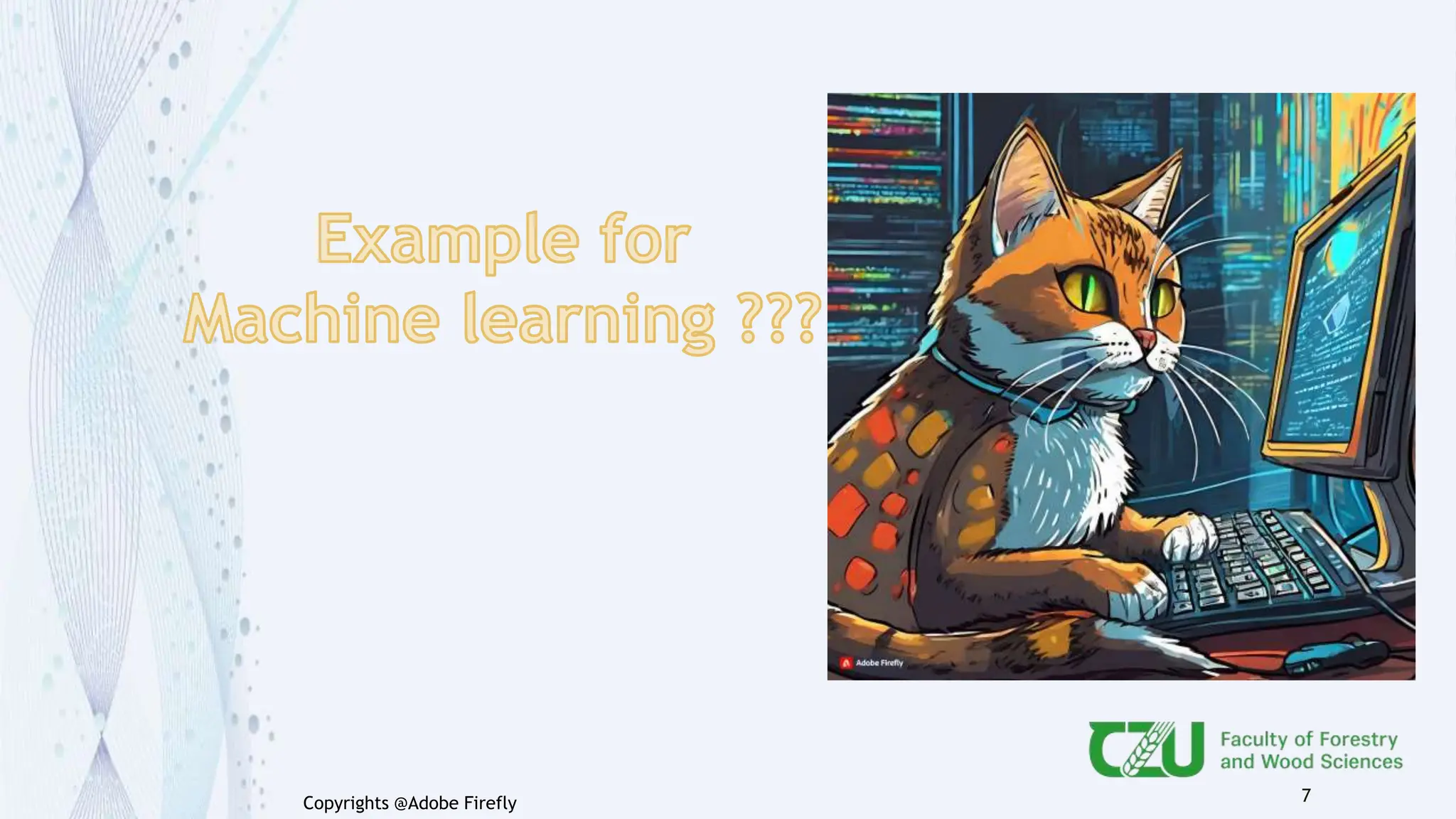
7
Copyrights @Adobe Firefly
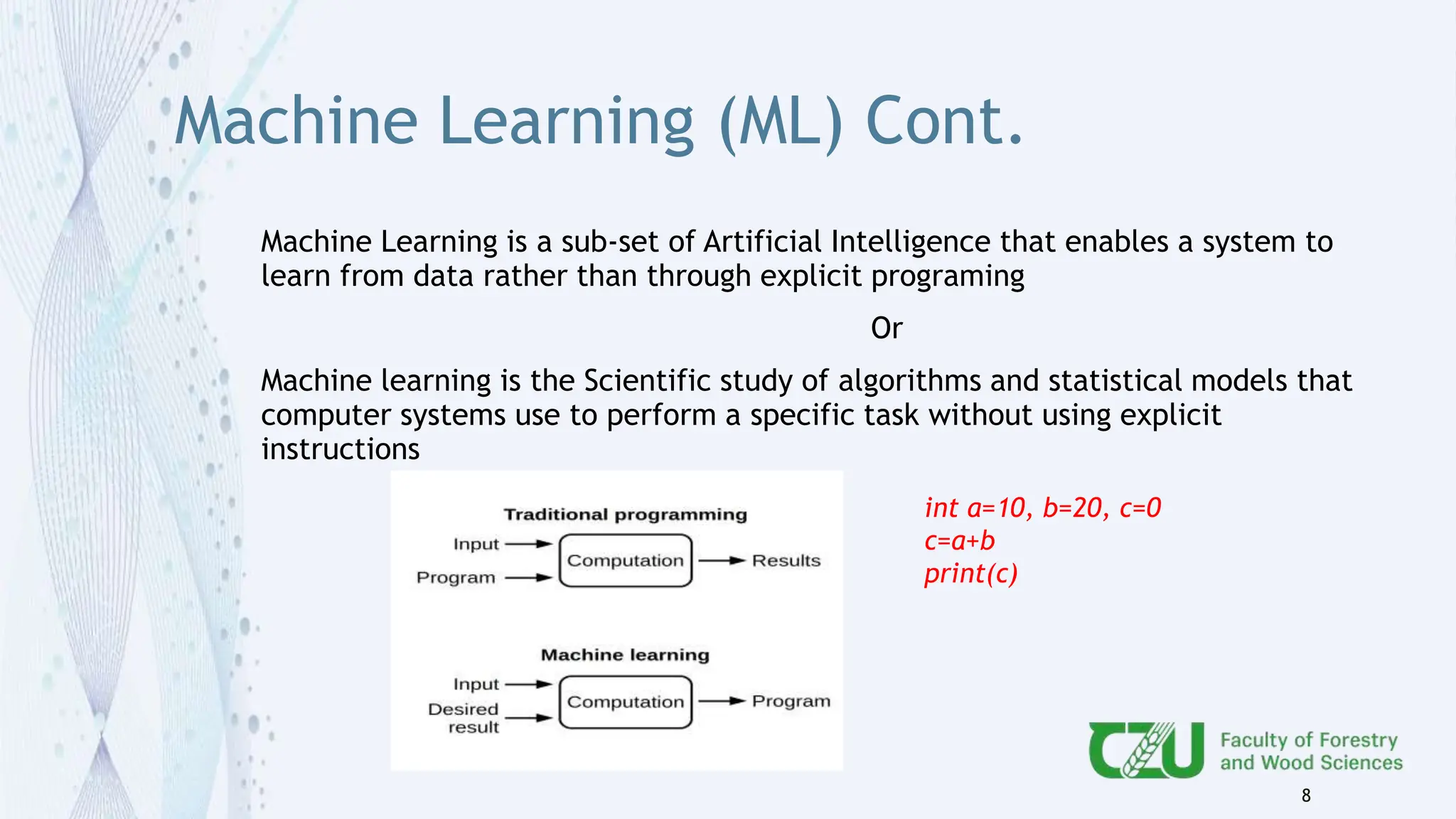
Machine Learning (ML) Cont.
Machine Learning is a sub-set of Artificial Intelligence that enables a system to
learn from data rather than through explicit programing
Or
Machine learning is the Scientific study of algorithms and statistical models that
computer systems use to perform a specific task without using explicit
instructions
8
int a=10, b=20, c=0
c=a+b
print(c)
Supervised learning
Learning can be Supervised, Semi-supervised, Unsupervised and reinforcement
 Supervised Learning:
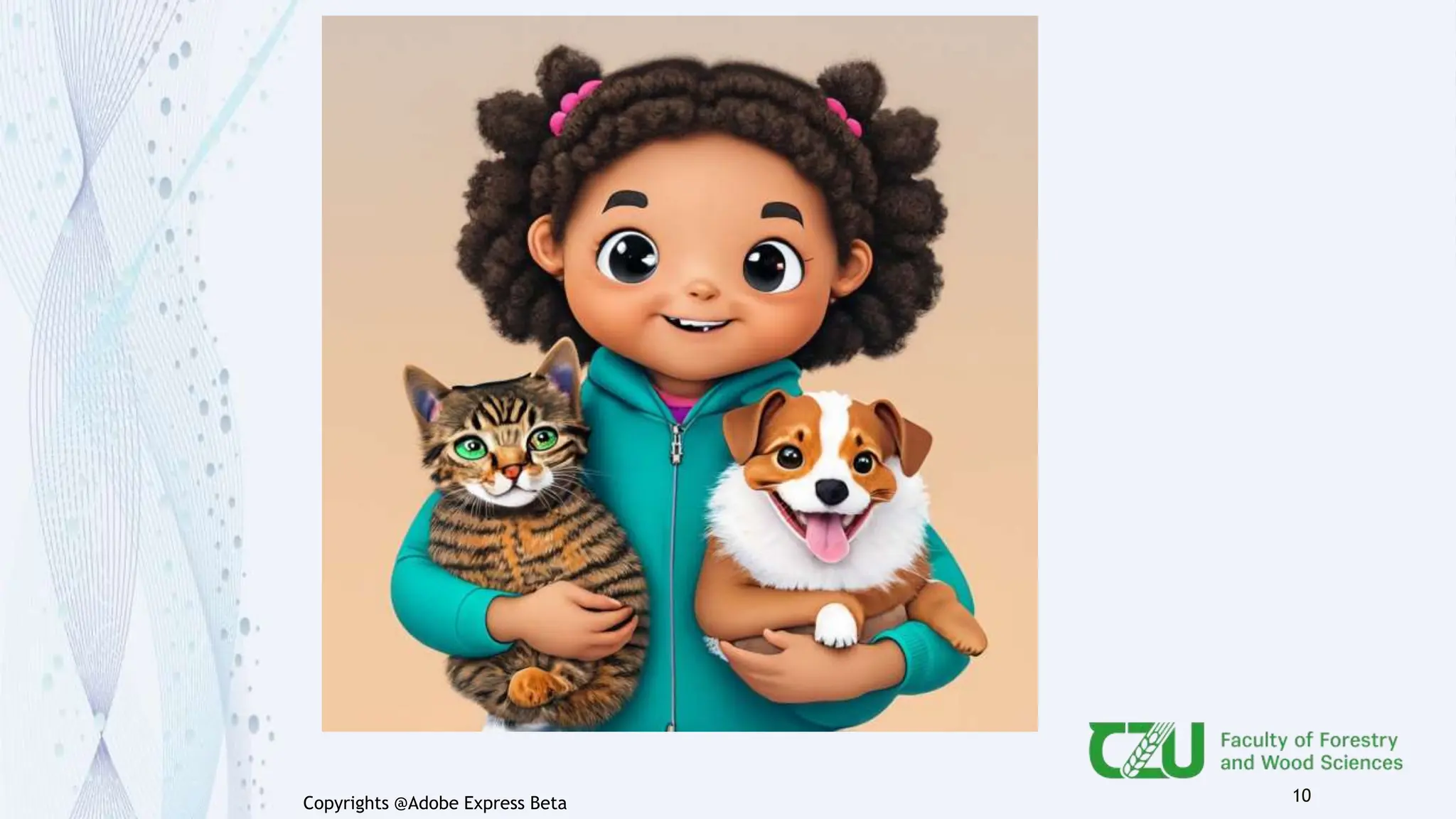
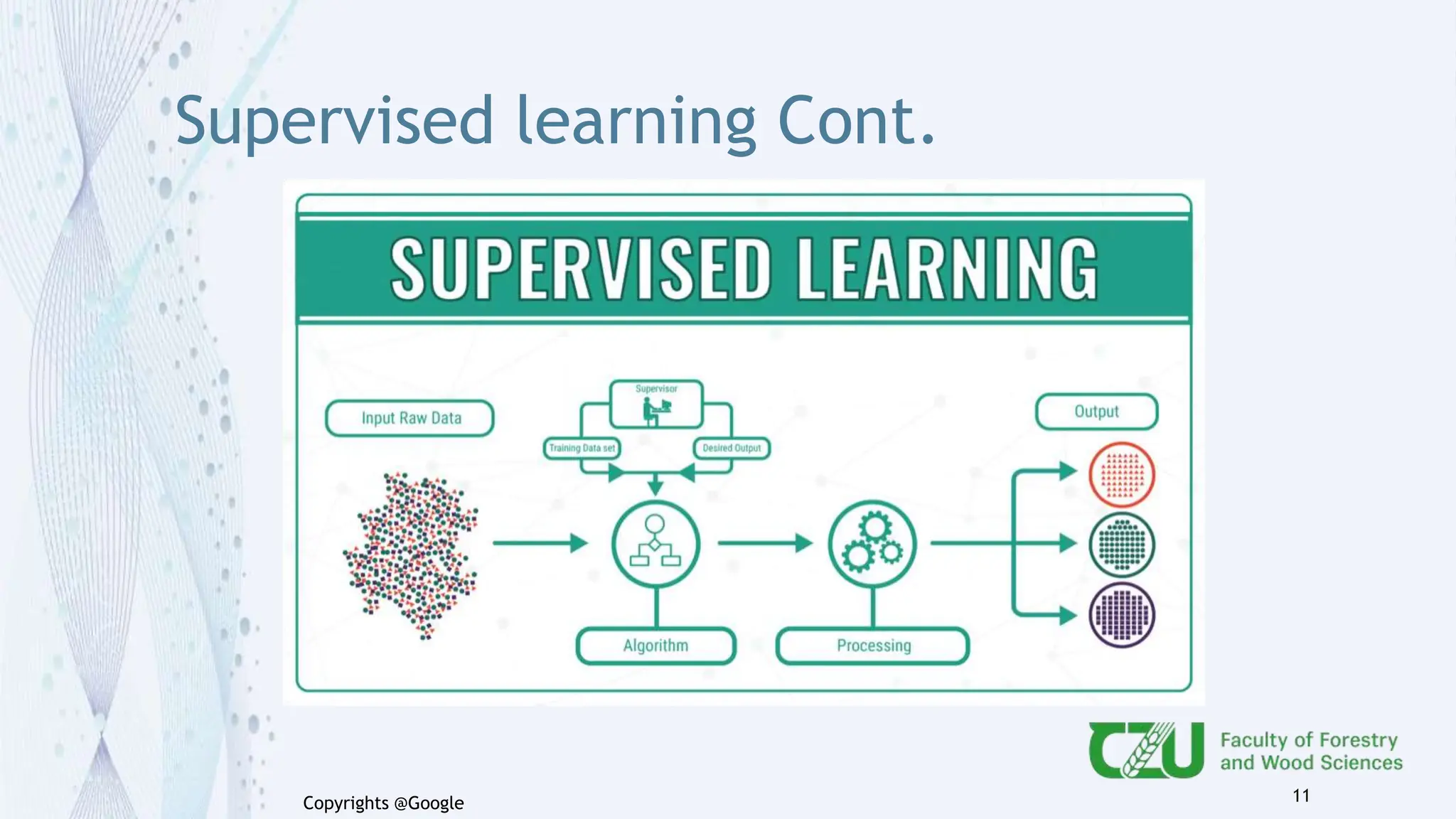
Supervised learning is a learning in which we teach or train the machine using
data which is well labelled that means some data is already tagged with the
correct answer
(Training & Testing)
9
10
Copyrights @Adobe Express Beta
Supervised learning Cont.
11
Copyrights @Google
Supervised learning Cont.
Supervised learning classified into two categories of algorithms:
 Classification:
A classification problem is when the output variable is a category. Such as “Red”
or “Green” and “Disease” or “No disease”
 Regression:
A regression problem is when the output variable is a real value, such as “Dollars”
or “Weight” / Time series data
12
Supervised learning Cont.
Supervised learning algorithms:
 Classification:
o Decision Trees
o Random Forest
o Support Vector Machines (SVM)
o Logistic Regression
o K-Nearest Neighbors (k-NN)
o Naïve Bayes
o Gradient Boosting Machines (GBM)
13
 Regression:
o Linear Regression
o Polynomial Regression
o Lasso Regression
o Decision Trees (for regression)
o Random Forest (for regression)
Unsupervised learning
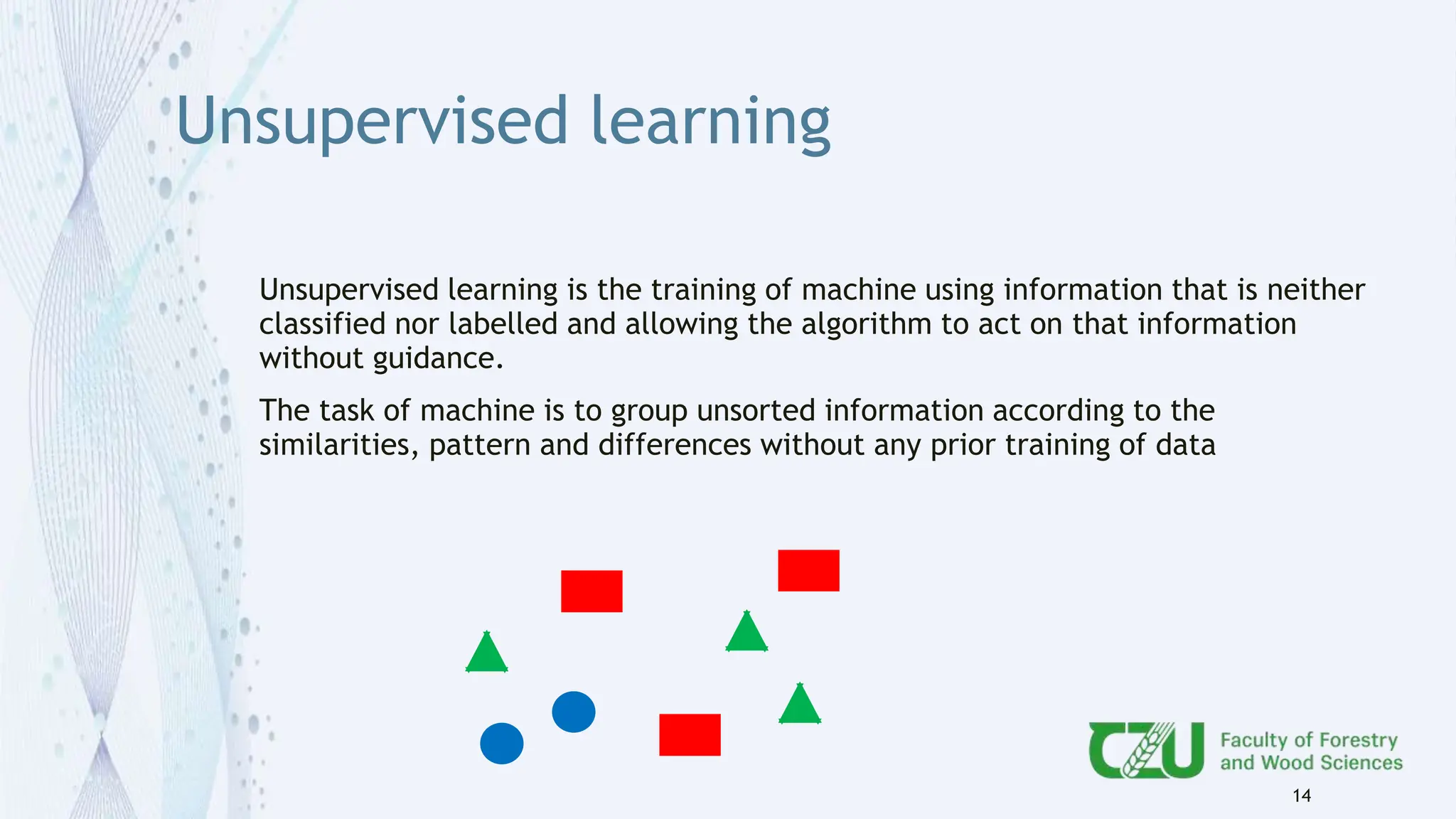
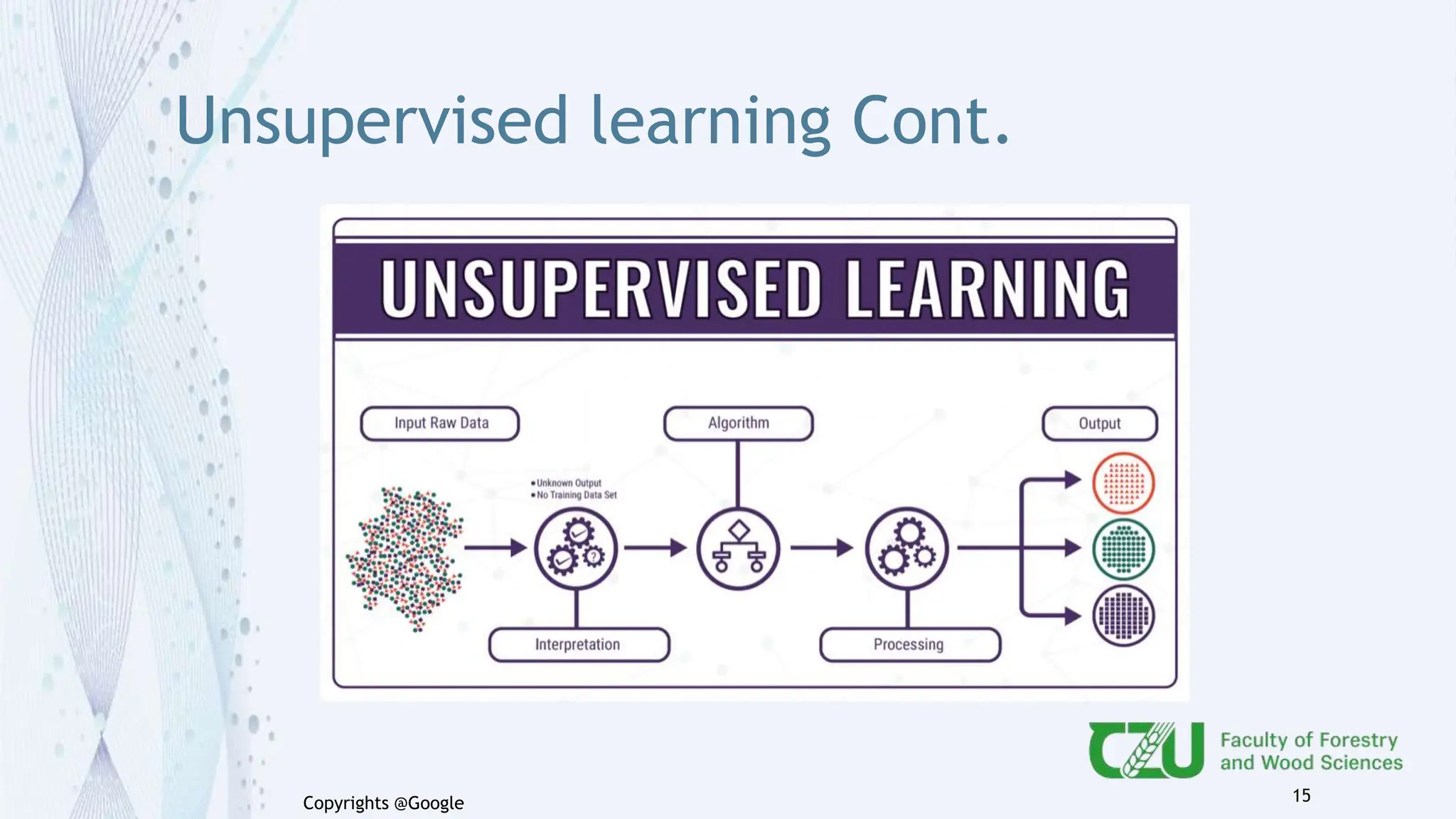
Unsupervised learning is the training of machine using information that is neither
classified nor labelled and allowing the algorithm to act on that information
without guidance.
The task of machine is to group unsorted information according to the
similarities, pattern and differences without any prior training of data
14
Unsupervised learning Cont.
15
Copyrights @Google
Unsupervised learning Cont.
16
Unsupervised learning classified into two categories of algorithms:
 Clustering:
A clustering problem is where you want to discover the inherent groupings in the
data, such as grouping customers by purchasing behaviour
 Association:
An association rule learning problem is where you want to discover rules that
describe large portions of your data, such as people that buy X also tend buy Y
Unsupervised learning Cont.
Unsupervised learning algorithms:
 Clustering:
o K-Means Clustering
o Hierarchical Clustering (Agglomerative
and Divisive)
o DBSCAN (Density-Based Spatial
Clustering of Applications with Noise)
17
 Association:
o Apriori Algorithm
o FP-Growth (Frequent Pattern Growth)
o PrefixSpan Algorithm
18
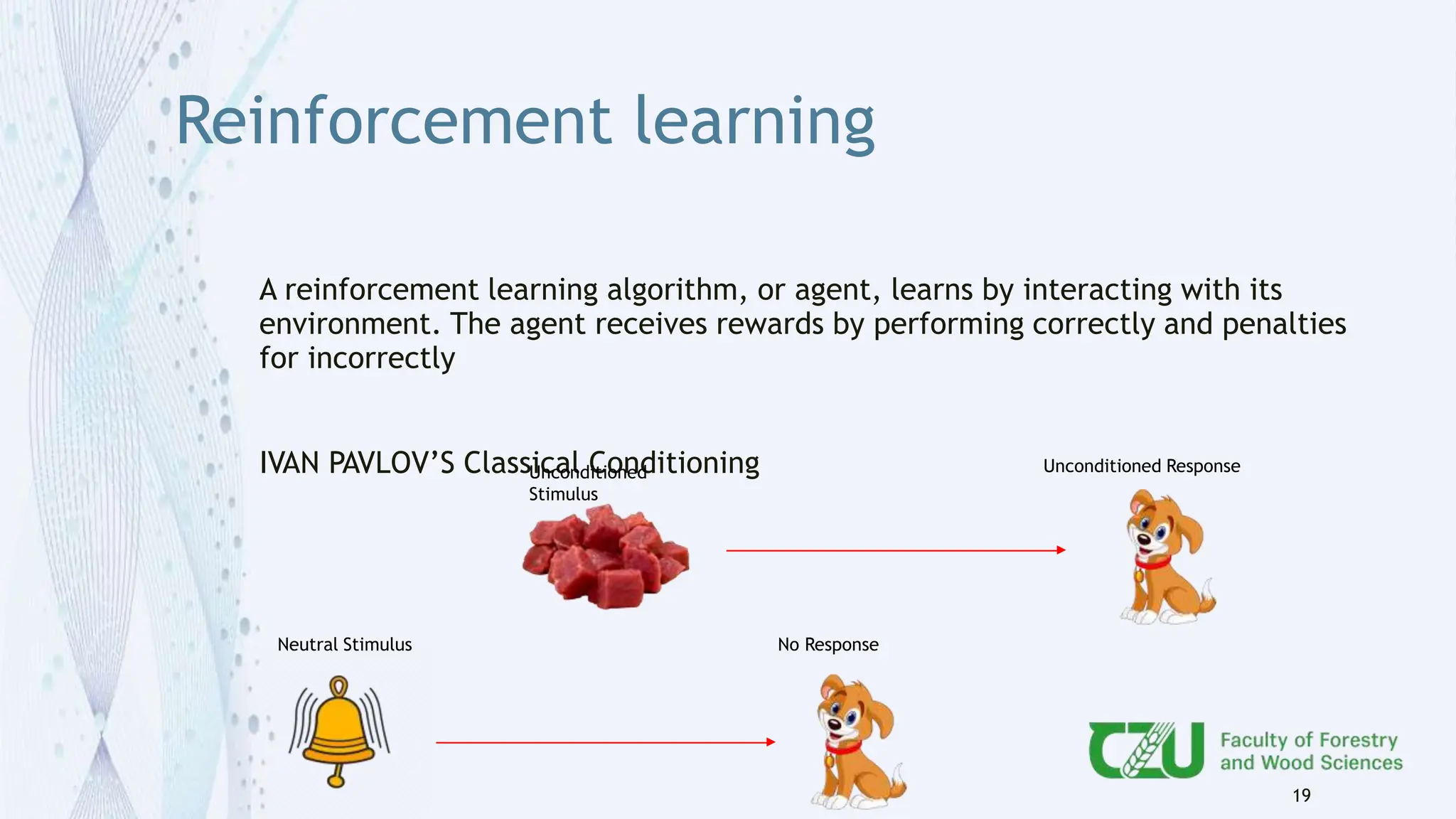
Reinforcement learning
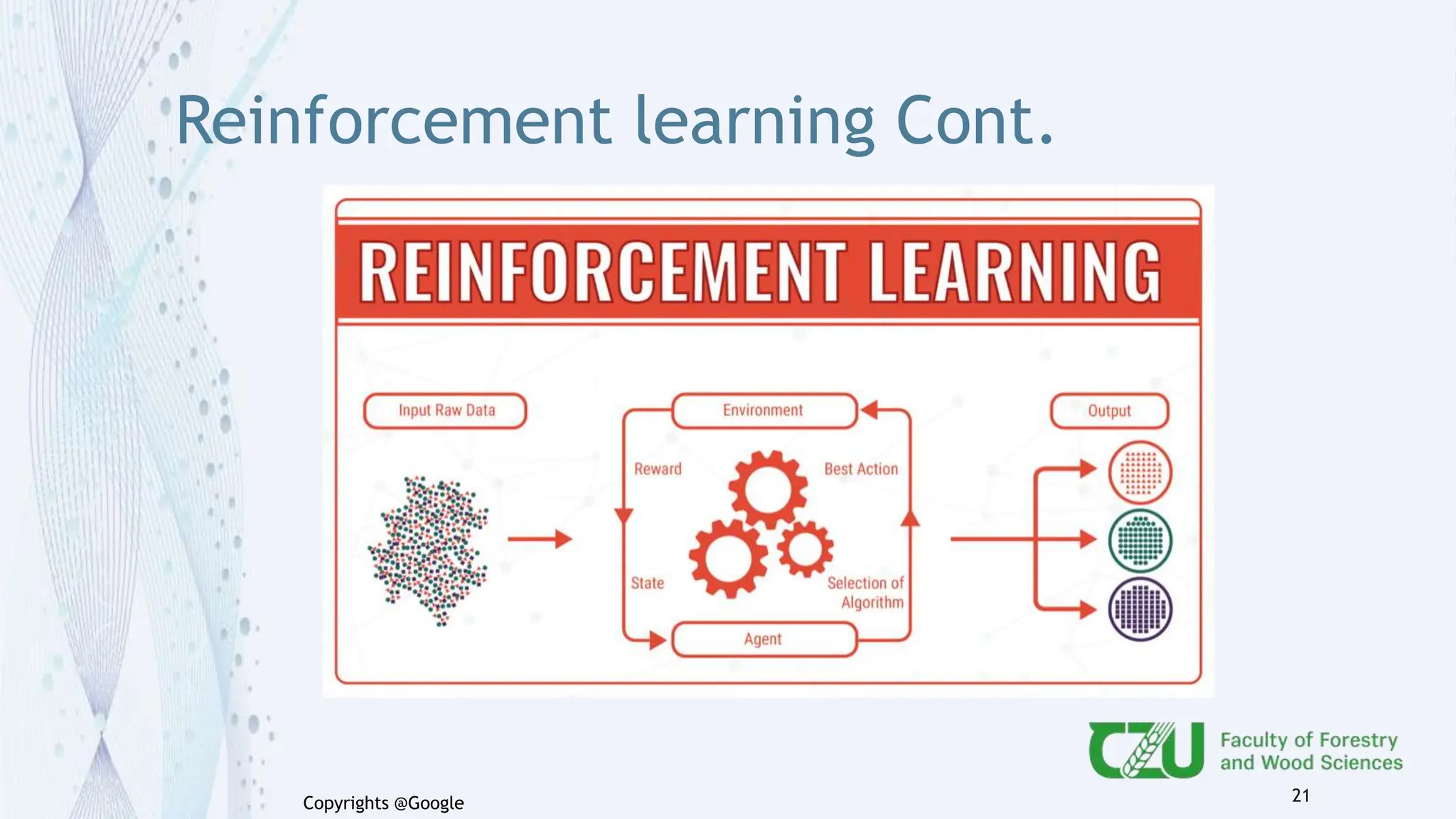
A reinforcement learning algorithm, or agent, learns by interacting with its
environment. The agent receives rewards by performing correctly and penalties
for incorrectly
IVAN PAVLOV’S Classical Conditioning
19
Unconditioned
Stimulus
Unconditioned Response
Neutral Stimulus No Response
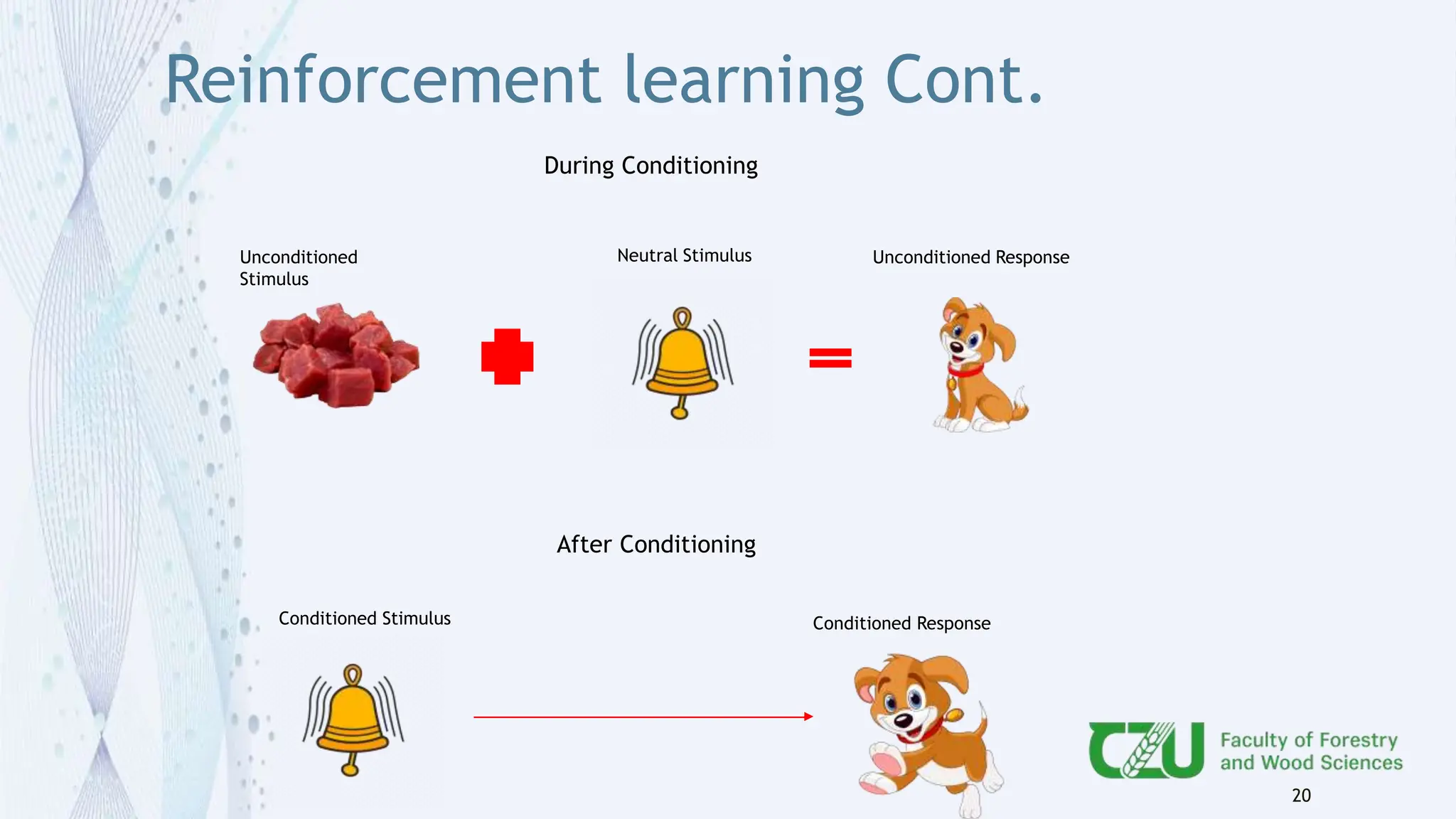
Reinforcement learning Cont.
20
Unconditioned
Stimulus
Unconditioned Response
Neutral Stimulus
Conditioned Response
During Conditioning
After Conditioning
Conditioned Stimulus
Reinforcement learning Cont.
21
Copyrights @Google
Reinforcement learning Cont.
Reinforcement learning algorithms:
o Q-Learning
o Deep Q-Networks (DQN)
o Policy Gradient Methods
22
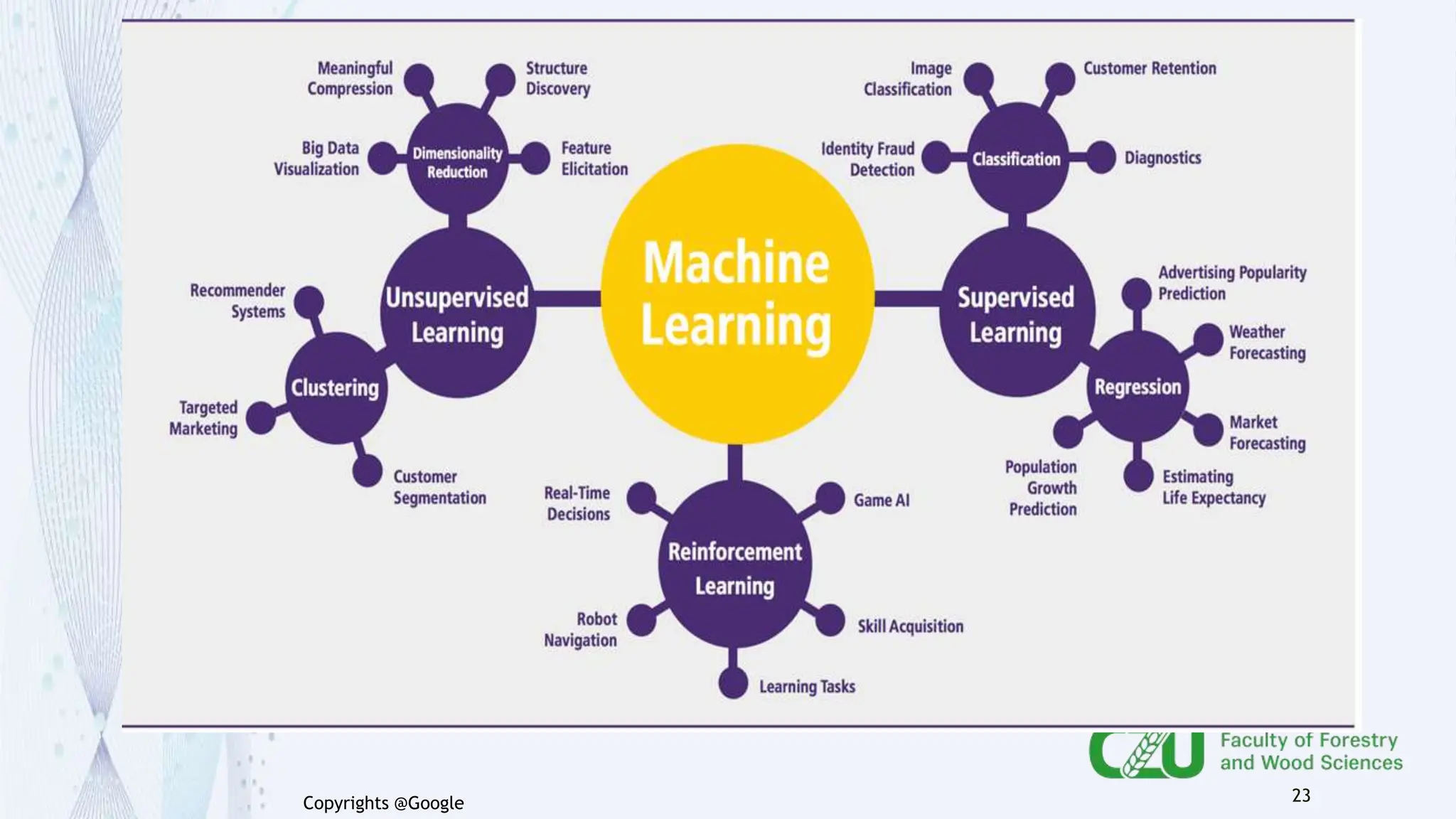
23
Copyrights @Google
Application’s in Forestry
o Forest Monitoring and Management: (analyse satellite imagery, drones, or
ground based sensors to monitor forest health and so on)
o Precision Forestry: (Optimal Planting locations, Timber harvesting schedules,
forest inventory management etc.)
o Wildlife Monitoring and Conservations
o Forest Disease and Pest Detection
o Forest Fire Prediction and Management
24
Issues in Machine Learning
o Focusing more on Algorithms and theories
o Changing Tools and Packages
o Getting bad predictions and Biases
o Making the wrong assumptions
o Having bad data convert into bad results
25
Questions ????
26
Thank You 
27
ksg@fld.czu.cz
LinkedIn GitHub

Machine learning workshop, CZU Prague 2024

  • 1.
    Gokul K S,M.Sc., M.Phil. P.hD. Scholar, Department of Forest Management and Remote Sensing, Faculty Faculty of Forestry and Wood Sciences, Czech University of Life Sciences (CZU), (CZU), Prague, Czechia Supervisor: Ing. Martin Mokros, Ph.D. Department of Geography, University College London (UCL), London, UK 1 Introduction to Machine Learning
  • 2.
  • 3.
  • 4.
    Artificial Intelligence ■ AIis a branch of Computer Science, that aims to develop computers and Machines that can act or mimic human like behavours (or Think intelligently) - Can be Doing some intelligent tasks like Image classification (e.g. person, objects etc.) or Performing complex calculations or analysing the data and providing insights, Predictions and so on. 4
  • 5.
  • 6.
    Machine Learning (ML) Learning: Is the act of acquiring new or reinforcing existing Knowledge, Behaviours, Skills or Values Learners can be Humans, birds, animals Types of Learning :  Learning Under expert guidance  Learning guided by Knowledge gained from experts  Learning by Self 6
  • 7.
  • 8.
    Machine Learning (ML)Cont. Machine Learning is a sub-set of Artificial Intelligence that enables a system to learn from data rather than through explicit programing Or Machine learning is the Scientific study of algorithms and statistical models that computer systems use to perform a specific task without using explicit instructions 8 int a=10, b=20, c=0 c=a+b print(c)
  • 9.
    Supervised learning Learning canbe Supervised, Semi-supervised, Unsupervised and reinforcement  Supervised Learning: Supervised learning is a learning in which we teach or train the machine using data which is well labelled that means some data is already tagged with the correct answer (Training & Testing) 9
  • 10.
  • 11.
  • 12.
    Supervised learning Cont. Supervisedlearning classified into two categories of algorithms:  Classification: A classification problem is when the output variable is a category. Such as “Red” or “Green” and “Disease” or “No disease”  Regression: A regression problem is when the output variable is a real value, such as “Dollars” or “Weight” / Time series data 12
  • 13.
    Supervised learning Cont. Supervisedlearning algorithms:  Classification: o Decision Trees o Random Forest o Support Vector Machines (SVM) o Logistic Regression o K-Nearest Neighbors (k-NN) o Naïve Bayes o Gradient Boosting Machines (GBM) 13  Regression: o Linear Regression o Polynomial Regression o Lasso Regression o Decision Trees (for regression) o Random Forest (for regression)
  • 14.
    Unsupervised learning Unsupervised learningis the training of machine using information that is neither classified nor labelled and allowing the algorithm to act on that information without guidance. The task of machine is to group unsorted information according to the similarities, pattern and differences without any prior training of data 14
  • 15.
  • 16.
    Unsupervised learning Cont. 16 Unsupervisedlearning classified into two categories of algorithms:  Clustering: A clustering problem is where you want to discover the inherent groupings in the data, such as grouping customers by purchasing behaviour  Association: An association rule learning problem is where you want to discover rules that describe large portions of your data, such as people that buy X also tend buy Y
  • 17.
    Unsupervised learning Cont. Unsupervisedlearning algorithms:  Clustering: o K-Means Clustering o Hierarchical Clustering (Agglomerative and Divisive) o DBSCAN (Density-Based Spatial Clustering of Applications with Noise) 17  Association: o Apriori Algorithm o FP-Growth (Frequent Pattern Growth) o PrefixSpan Algorithm
  • 18.
  • 19.
    Reinforcement learning A reinforcementlearning algorithm, or agent, learns by interacting with its environment. The agent receives rewards by performing correctly and penalties for incorrectly IVAN PAVLOV’S Classical Conditioning 19 Unconditioned Stimulus Unconditioned Response Neutral Stimulus No Response
  • 20.
    Reinforcement learning Cont. 20 Unconditioned Stimulus UnconditionedResponse Neutral Stimulus Conditioned Response During Conditioning After Conditioning Conditioned Stimulus
  • 21.
  • 22.
    Reinforcement learning Cont. Reinforcementlearning algorithms: o Q-Learning o Deep Q-Networks (DQN) o Policy Gradient Methods 22
  • 23.
  • 24.
    Application’s in Forestry oForest Monitoring and Management: (analyse satellite imagery, drones, or ground based sensors to monitor forest health and so on) o Precision Forestry: (Optimal Planting locations, Timber harvesting schedules, forest inventory management etc.) o Wildlife Monitoring and Conservations o Forest Disease and Pest Detection o Forest Fire Prediction and Management 24
  • 25.
    Issues in MachineLearning o Focusing more on Algorithms and theories o Changing Tools and Packages o Getting bad predictions and Biases o Making the wrong assumptions o Having bad data convert into bad results 25
  • 26.
  • 27.