Heterogeneous Catalysis
Opportunities and challenges
• Challenges
–Societal needs
–Developing the basic understanding
• Opportunities
–Designing at the nano-scale
J. K. Nørskov
Center for Atomic-scale Materials Physics
Technical University of Denmark
norskov@fysik.dtu.dk
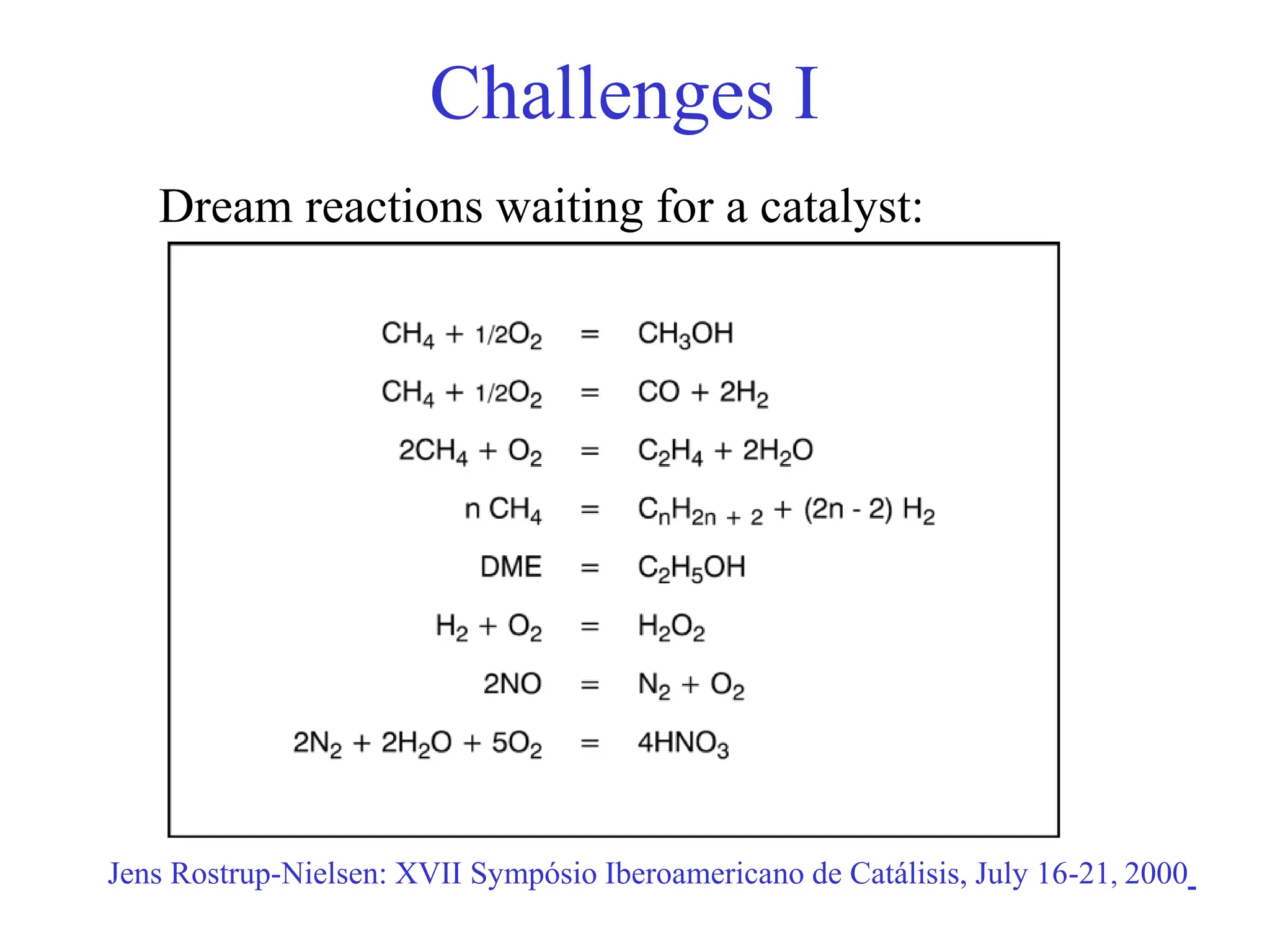
Challenges I
Jens Rostrup-Nielsen: XVII Sympósio Iberoamericano de Catálisis, July 16-21, 2000
Dream reactions waiting for a catalyst:
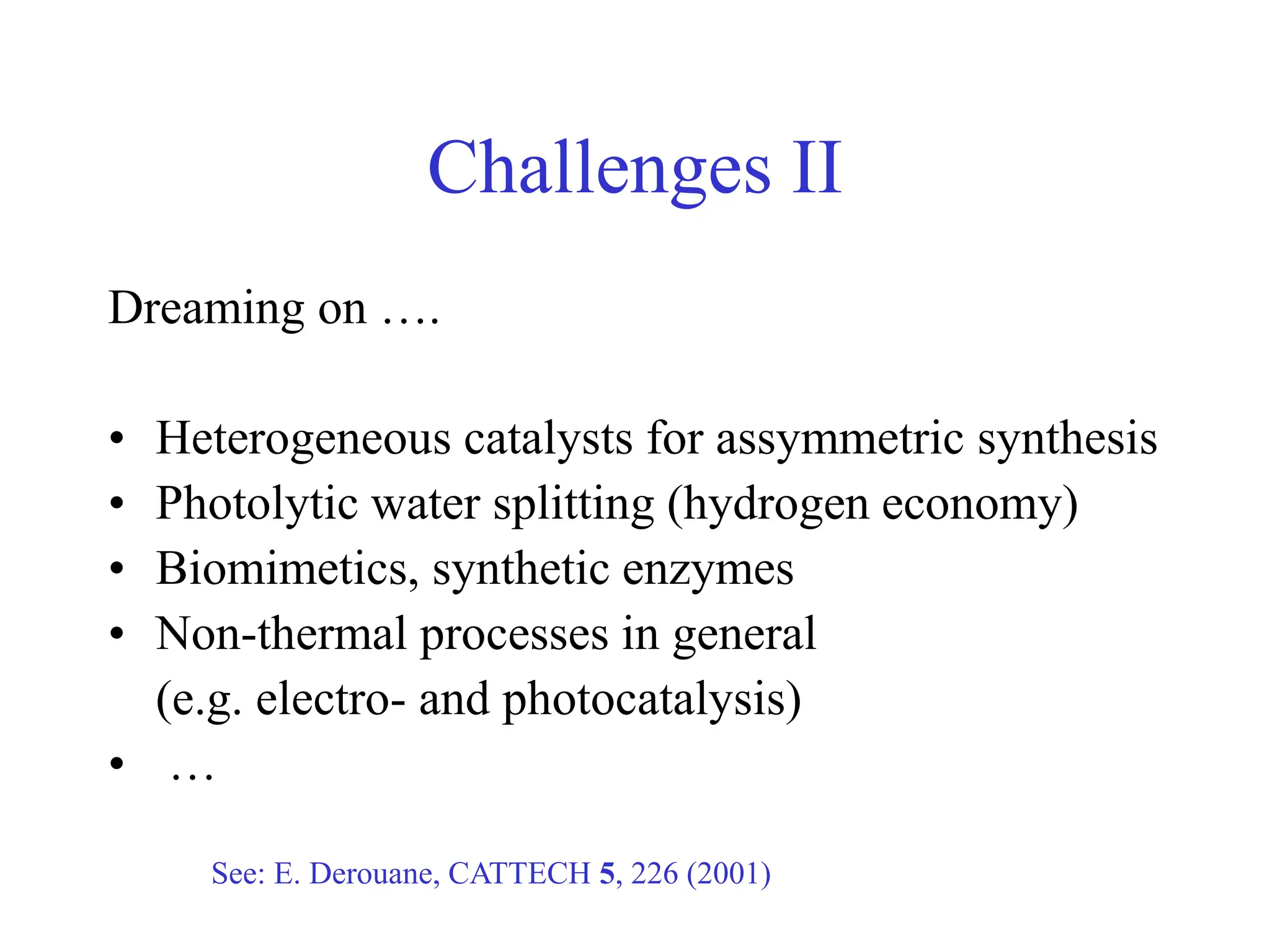
Dreaming on ….
• Heterogeneous catalysts for assymmetric synthesis
• Photolytic water splitting (hydrogen economy)
• Biomimetics, synthetic enzymes
• Non-thermal processes in general
(e.g. electro- and photocatalysis)
• …
See: E. Derouane, CATTECH 5, 226 (2001)
Challenges II
Challenges III
The science of heterogeneous catalysis:
• A comprehensive scientific basis
– Much has been done
– Much more is needed (oxides, size effects,
photocatalysis, electrocatalysis, relation to
homogeneous and enzyme catalysis …)
• Making the insight useful!
– The ultimate test
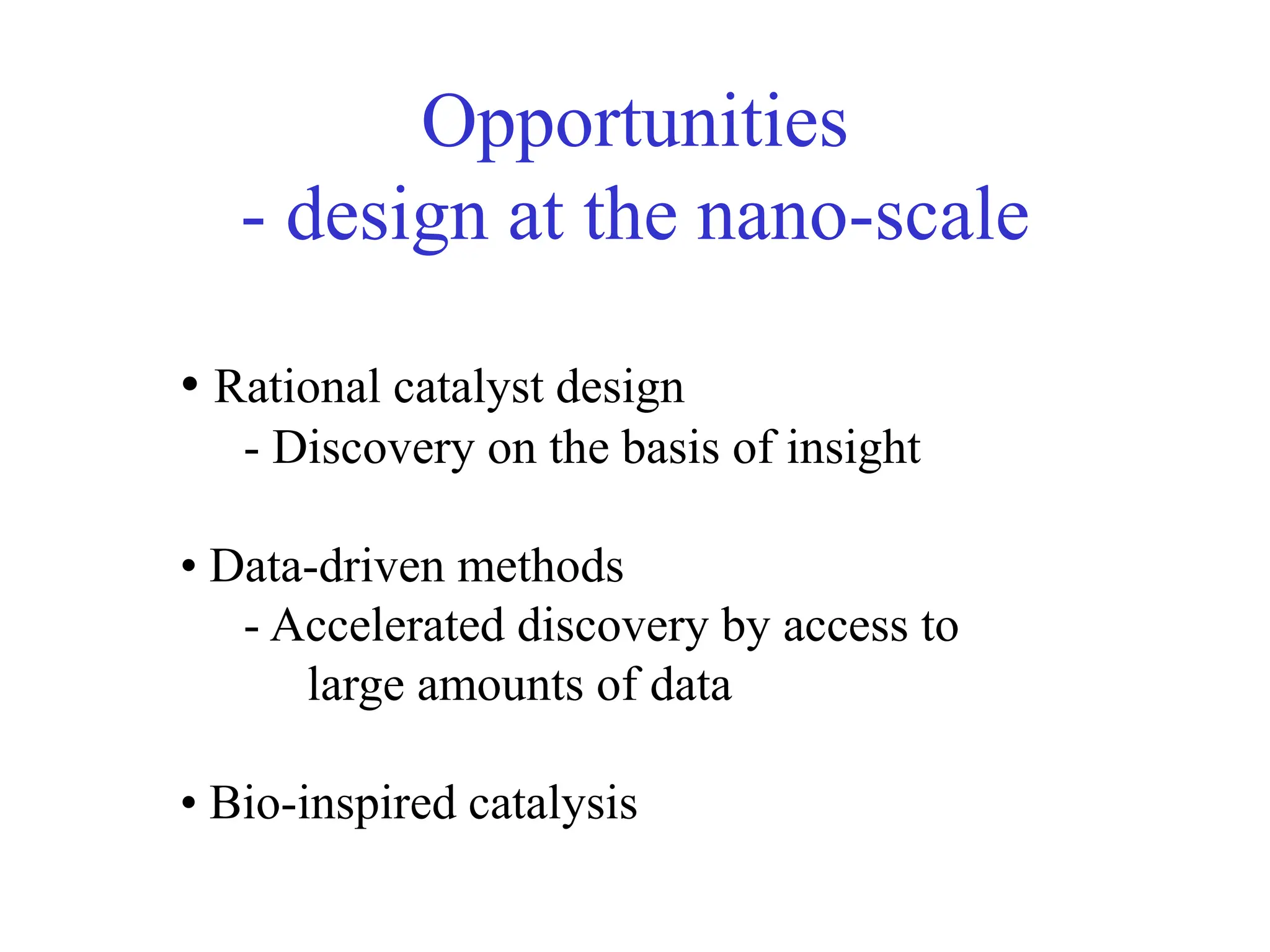
Opportunities
- design at the nano-scale
• Rational catalyst design
- Discovery on the basis of insight
• Data-driven methods
- Accelerated discovery by access to
large amounts of data
• Bio-inspired catalysis
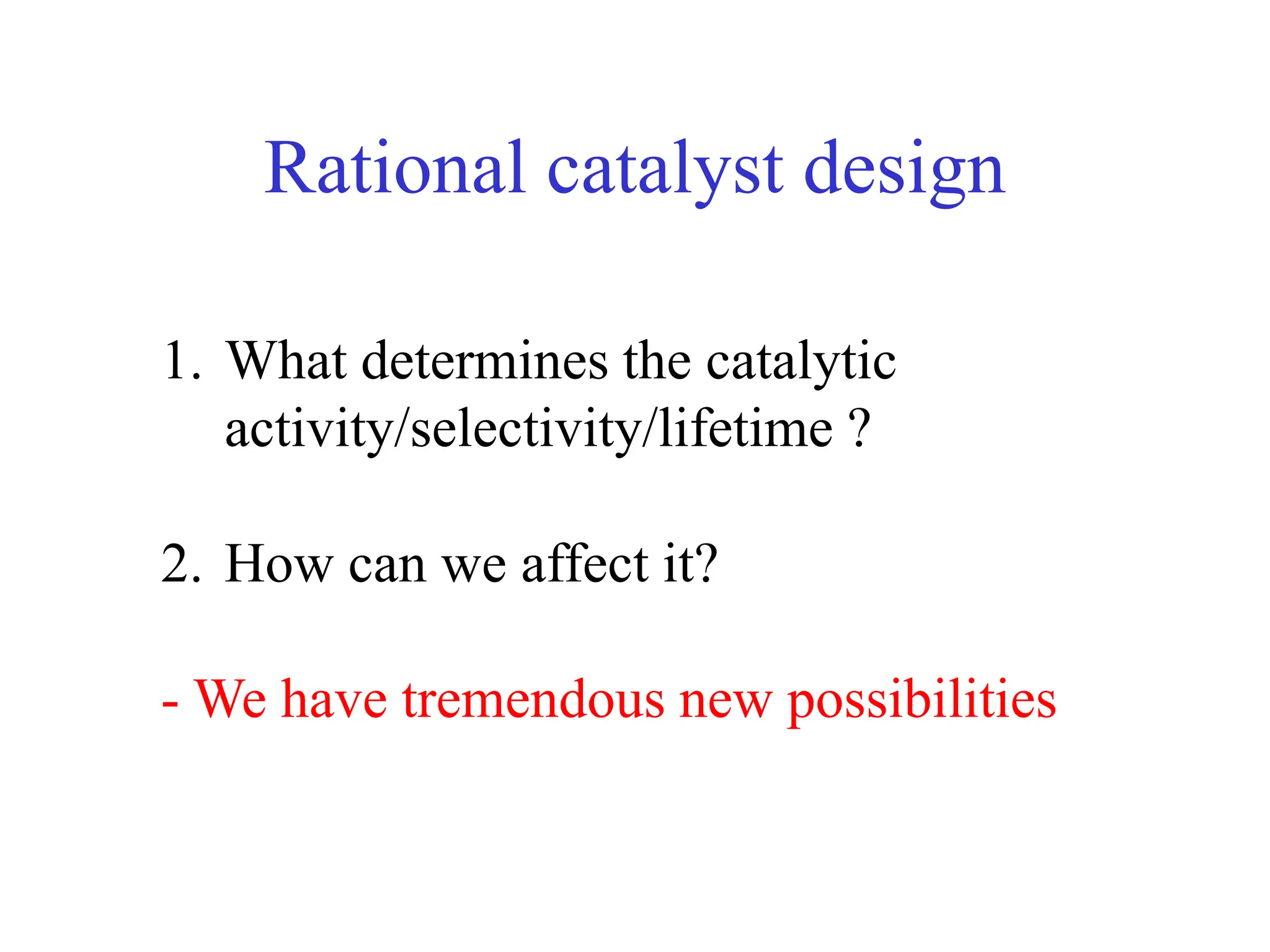
Rational catalyst design
1. What determines the catalytic
activity/selectivity/lifetime ?
2. How can we affect it?
- We have tremendous new possibilities
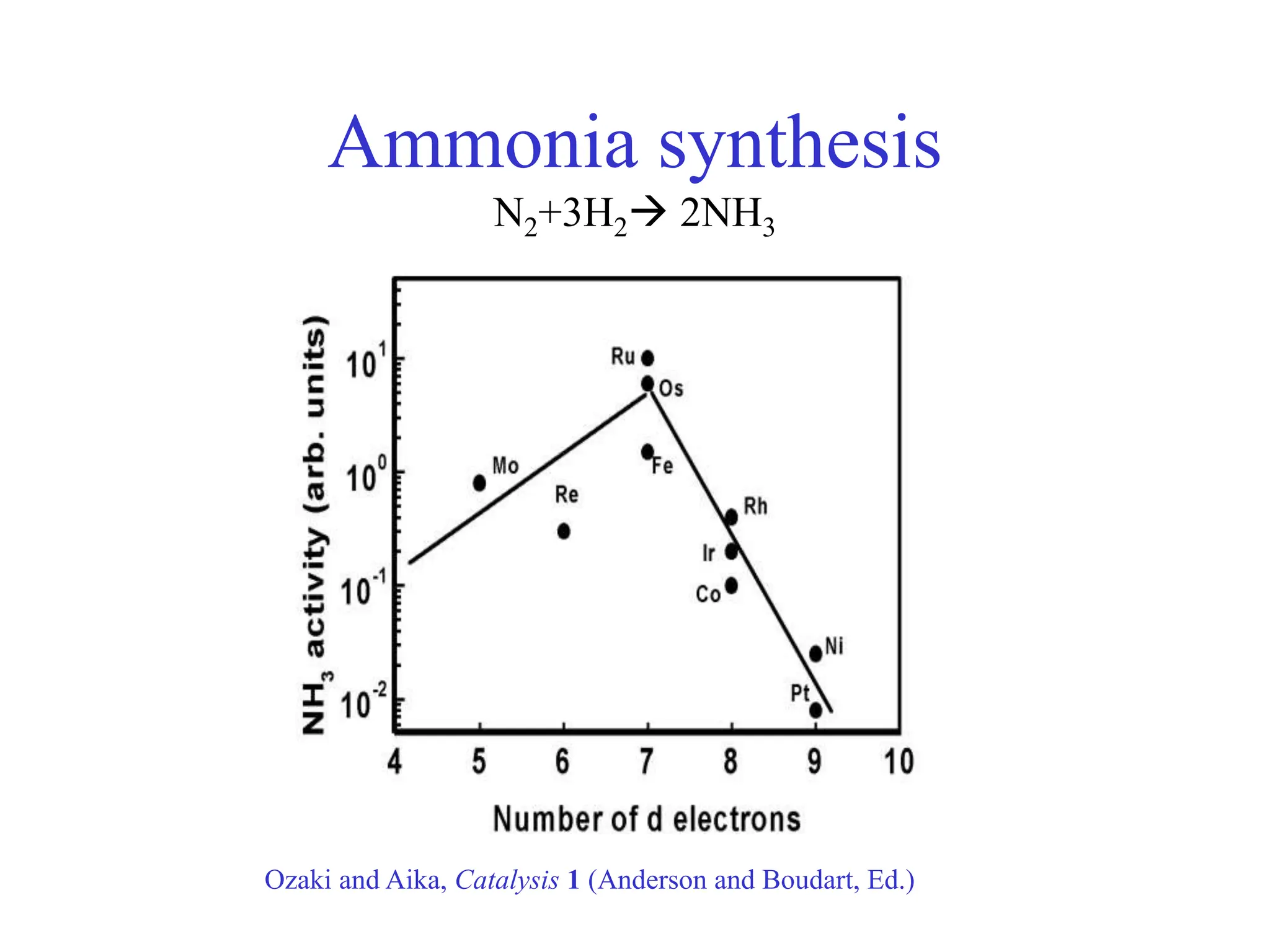
Ammonia synthesis
N2+3H2 2NH3
Ozaki and Aika, Catalysis 1 (Anderson and Boudart, Ed.)
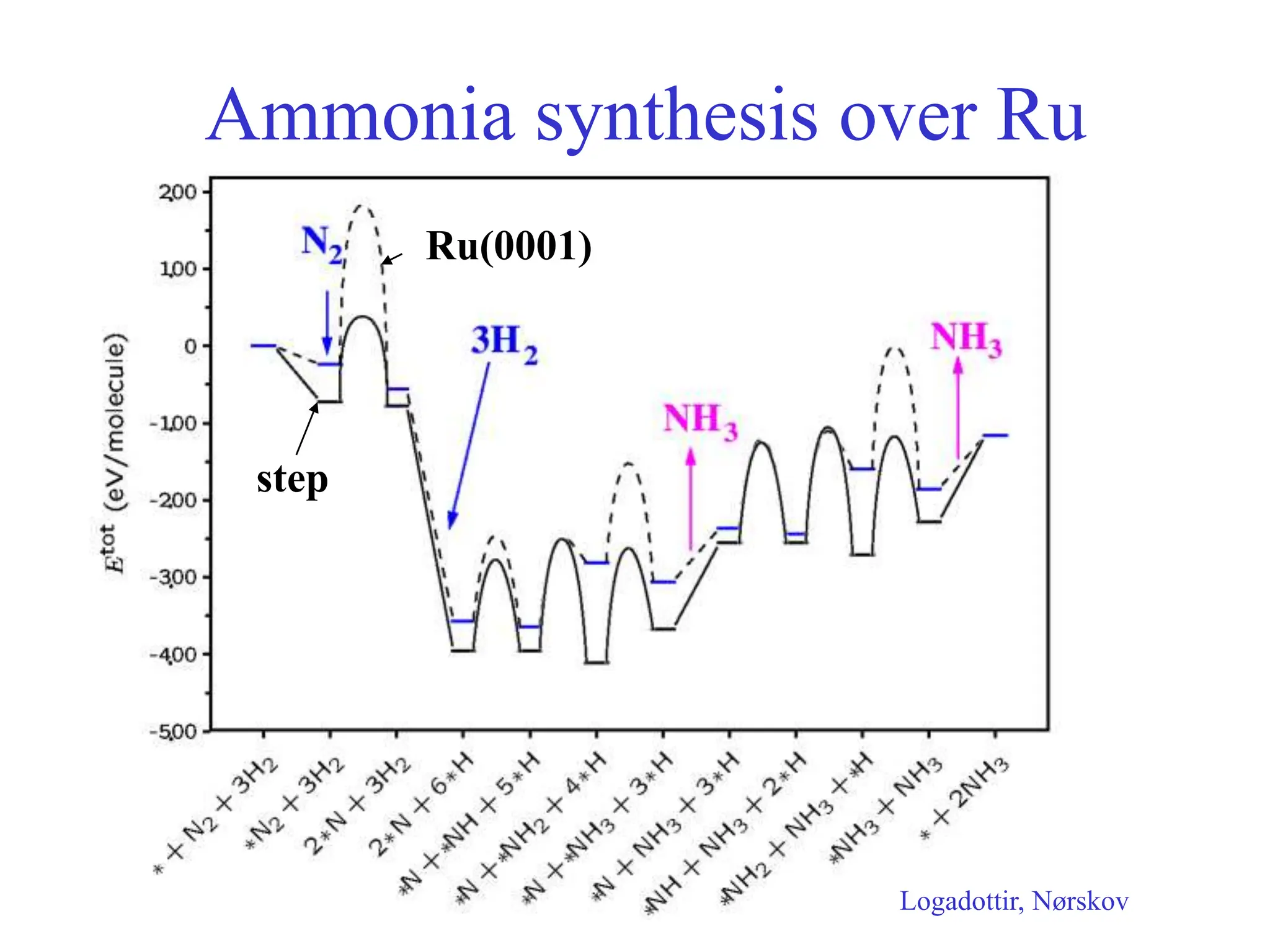
Ammonia synthesis over Ru
Ru(0001)
step
Logadottir, Nørskov
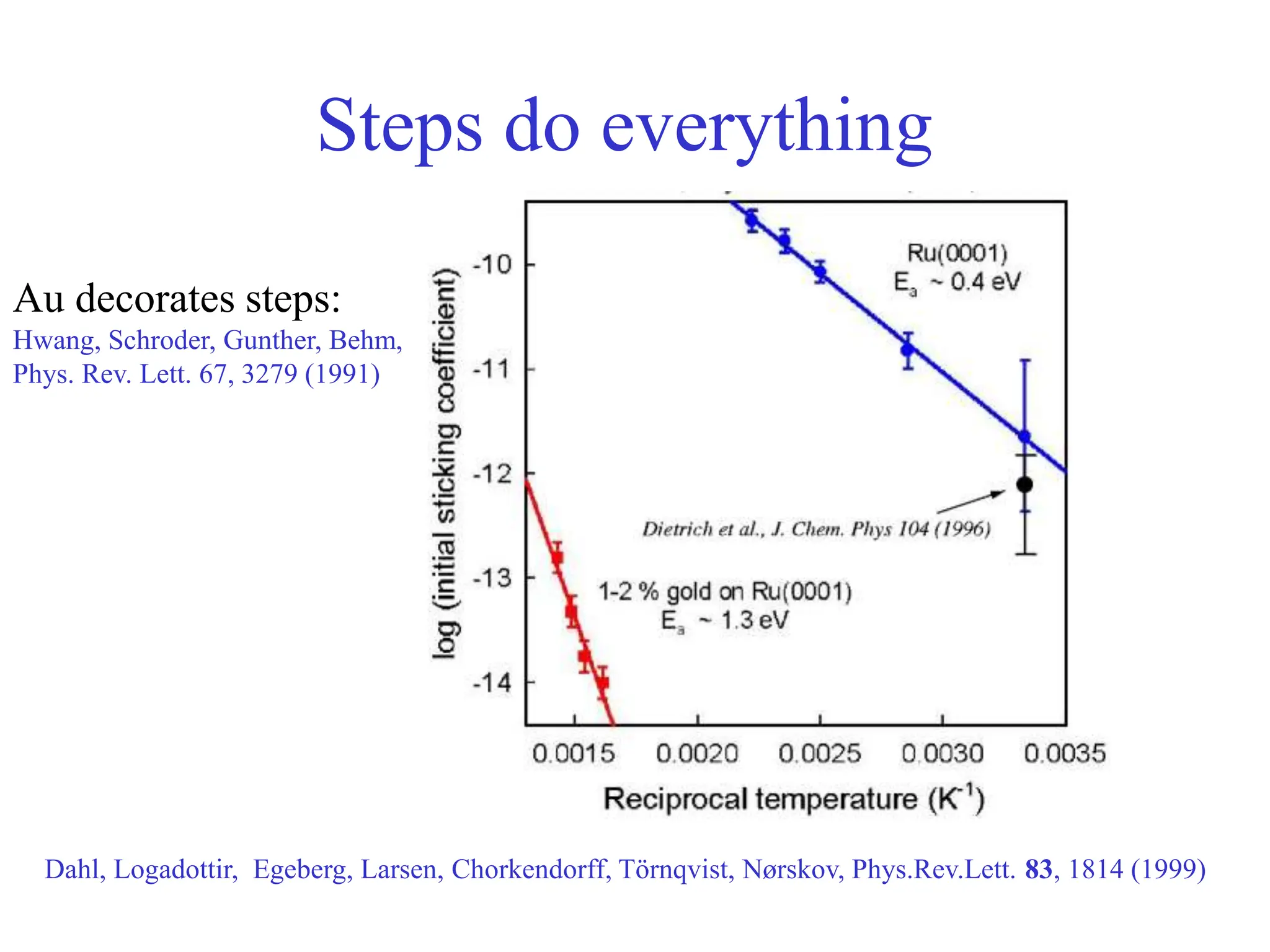
Steps do everything
Dahl, Logadottir, Egeberg, Larsen, Chorkendorff, Törnqvist, Nørskov, Phys.Rev.Lett. 83, 1814 (1999)
Au decorates steps:
Hwang, Schroder, Gunther, Behm,
Phys. Rev. Lett. 67, 3279 (1991)
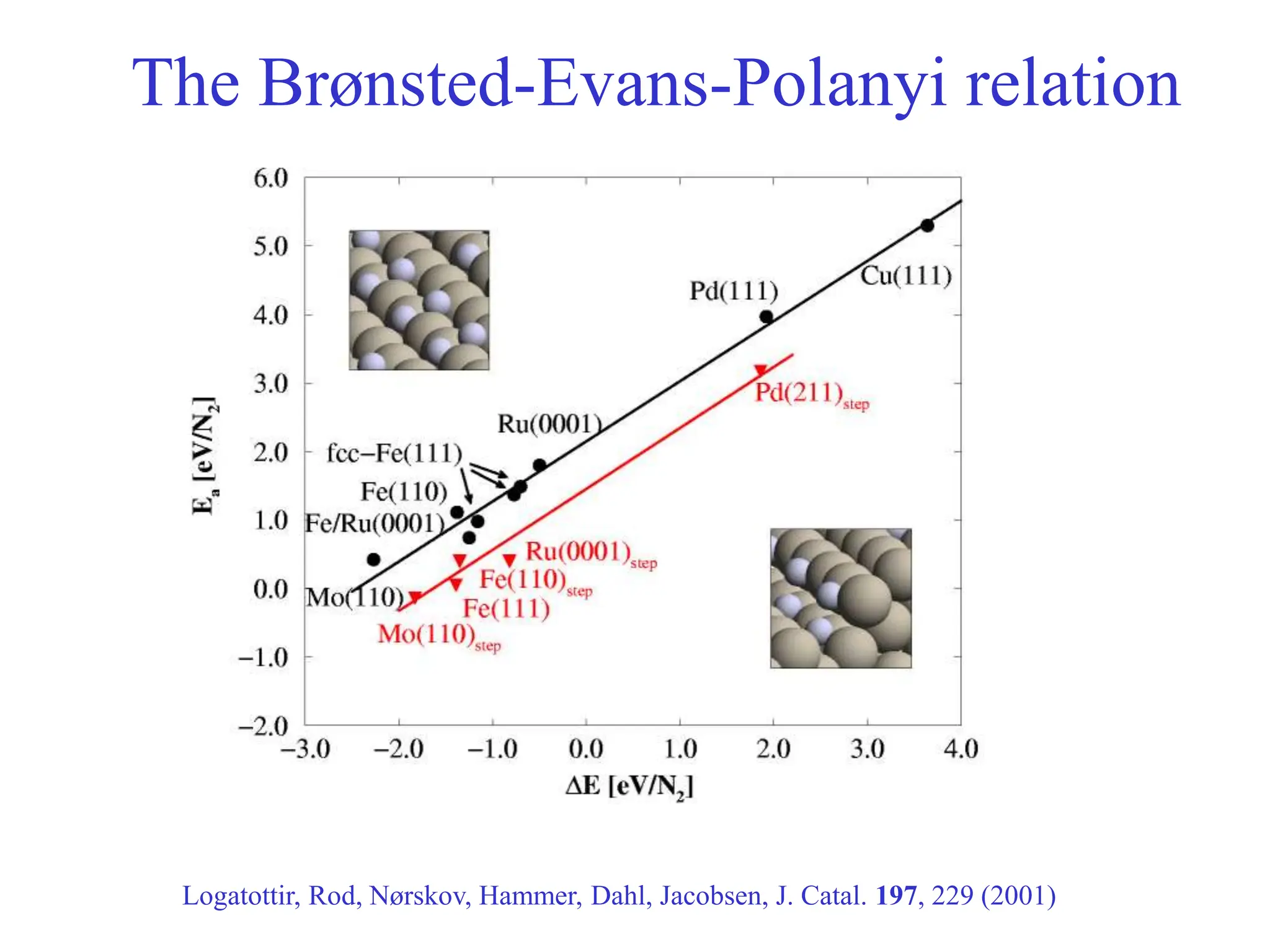
Logatottir, Rod, Nørskov, Hammer, Dahl, Jacobsen, J. Catal. 197, 229 (2001)
The Brønsted-Evans-Polanyi relation
-
0
.
8
-
0
.
40
.
00
.
40
.
8
[

E
-

E
(
R
u
)
]
(
e
V
/
N
2
)
1
0
-
5
1
0
-
4
1
0
-
3
1
0
-
2
1
0
-
1
1
0
0
1
0
1
T
O
F
(
s
-
1
)
F
e
M
o
R
u
C
o
N
i
O
s
Calculated ammonia synthesis rates
400 C, 50 bar, H2:N2=3:1, 5% NH3
Logatottir, Rod, Nørskov, Hammer, Dahl, Jacobsen, J. Catal. 197, 229 (2001)
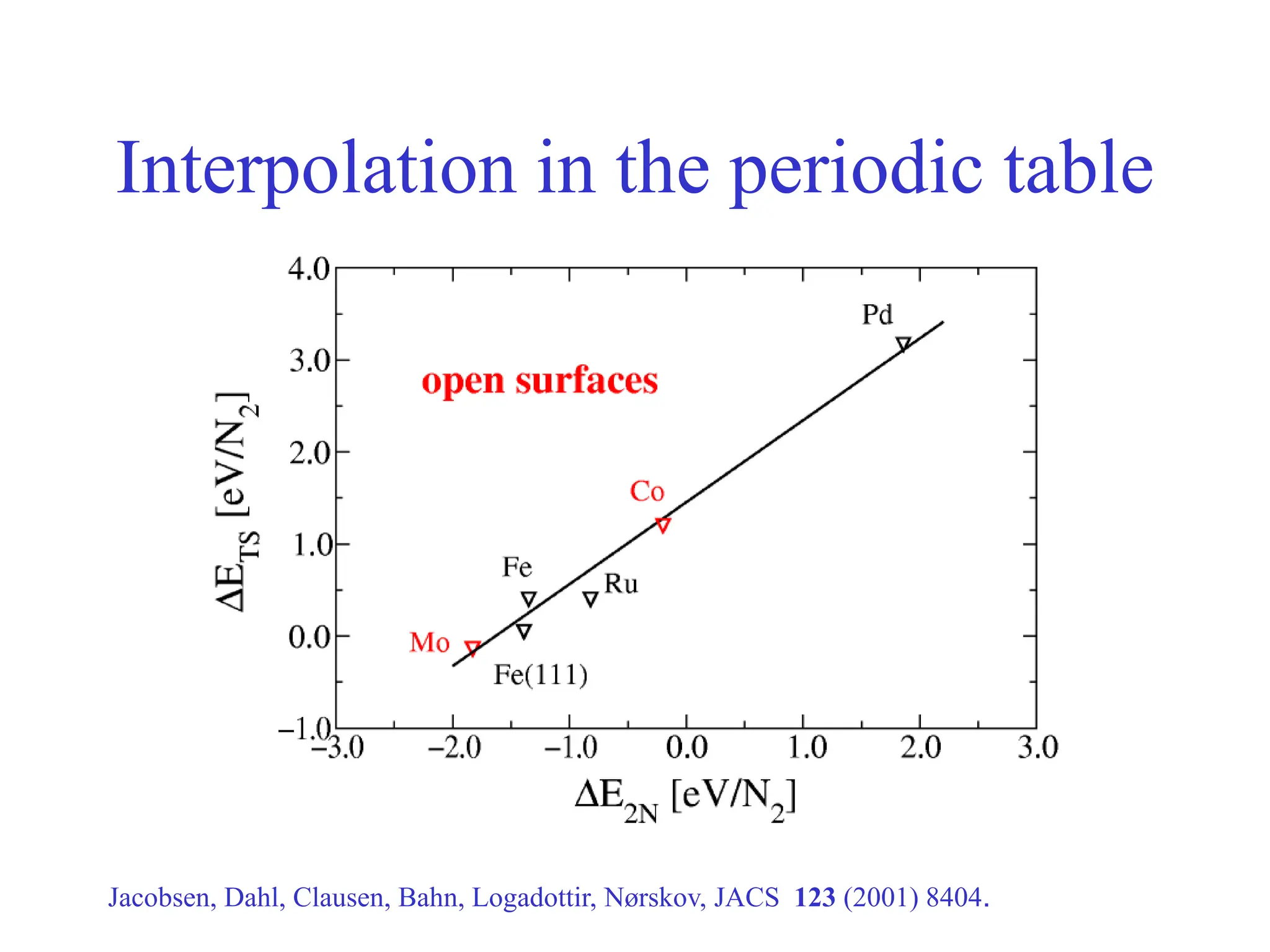
Interpolation in the periodic table
Jacobsen, Dahl, Clausen, Bahn, Logadottir, Nørskov, JACS 123 (2001) 8404.
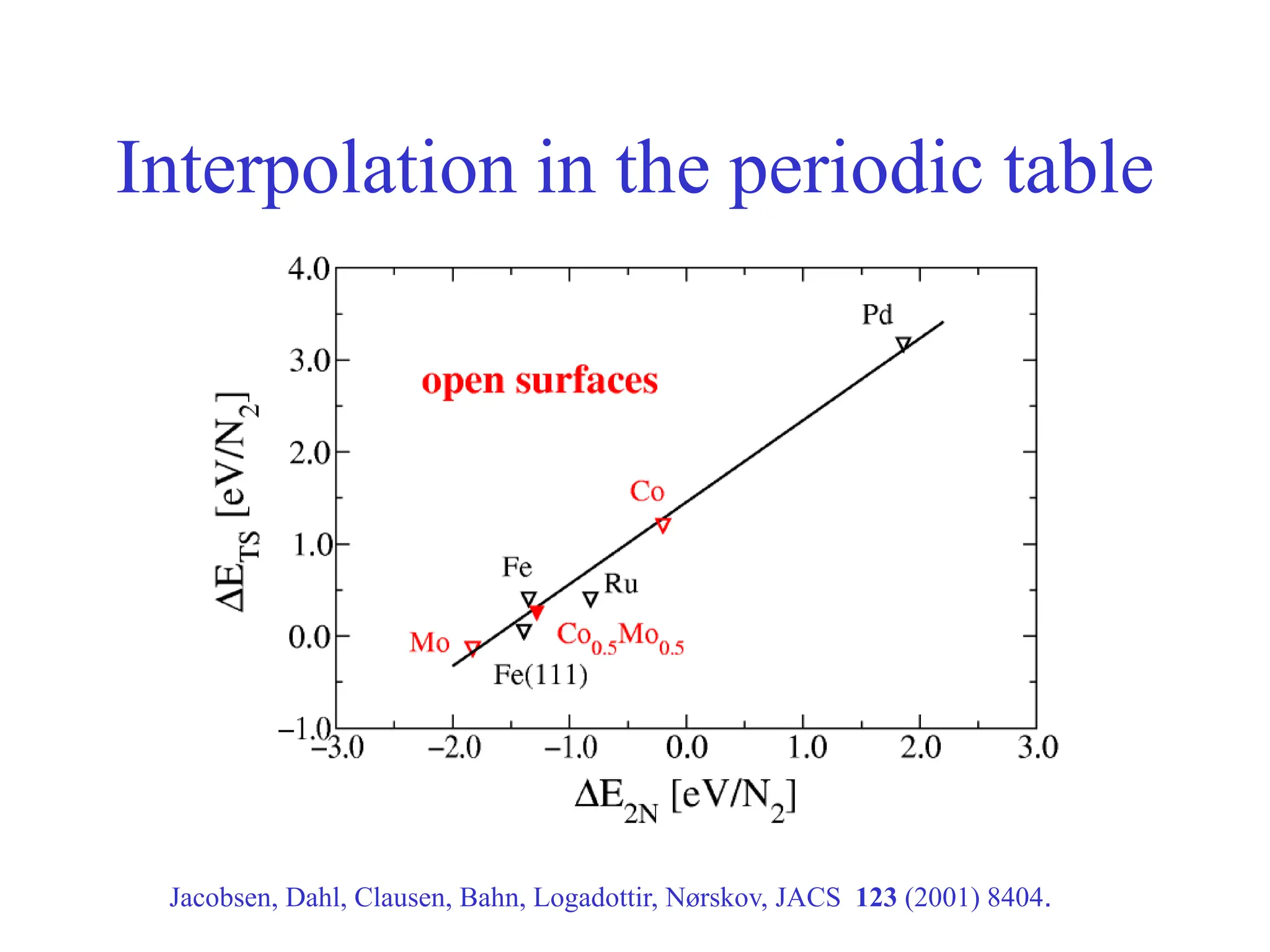
Interpolation in the periodic table
Jacobsen, Dahl, Clausen, Bahn, Logadottir, Nørskov, JACS 123 (2001) 8404.
Measured ammonia synthesis rates
400 C, 50 bar, H2:N2=3:1
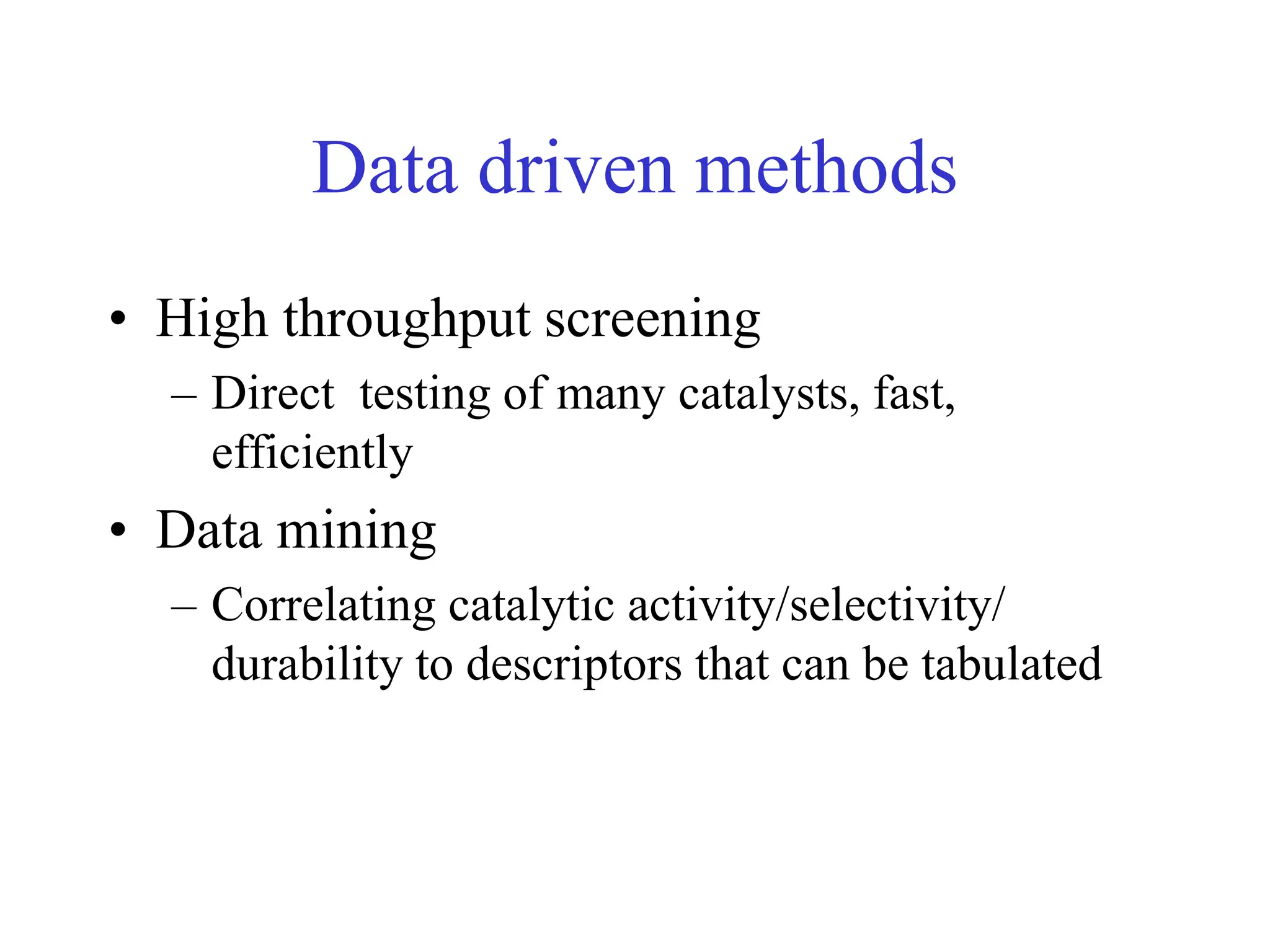
Data driven methods
• High throughput screening
– Direct testing of many catalysts, fast,
efficiently
• Data mining
– Correlating catalytic activity/selectivity/
durability to descriptors that can be tabulated
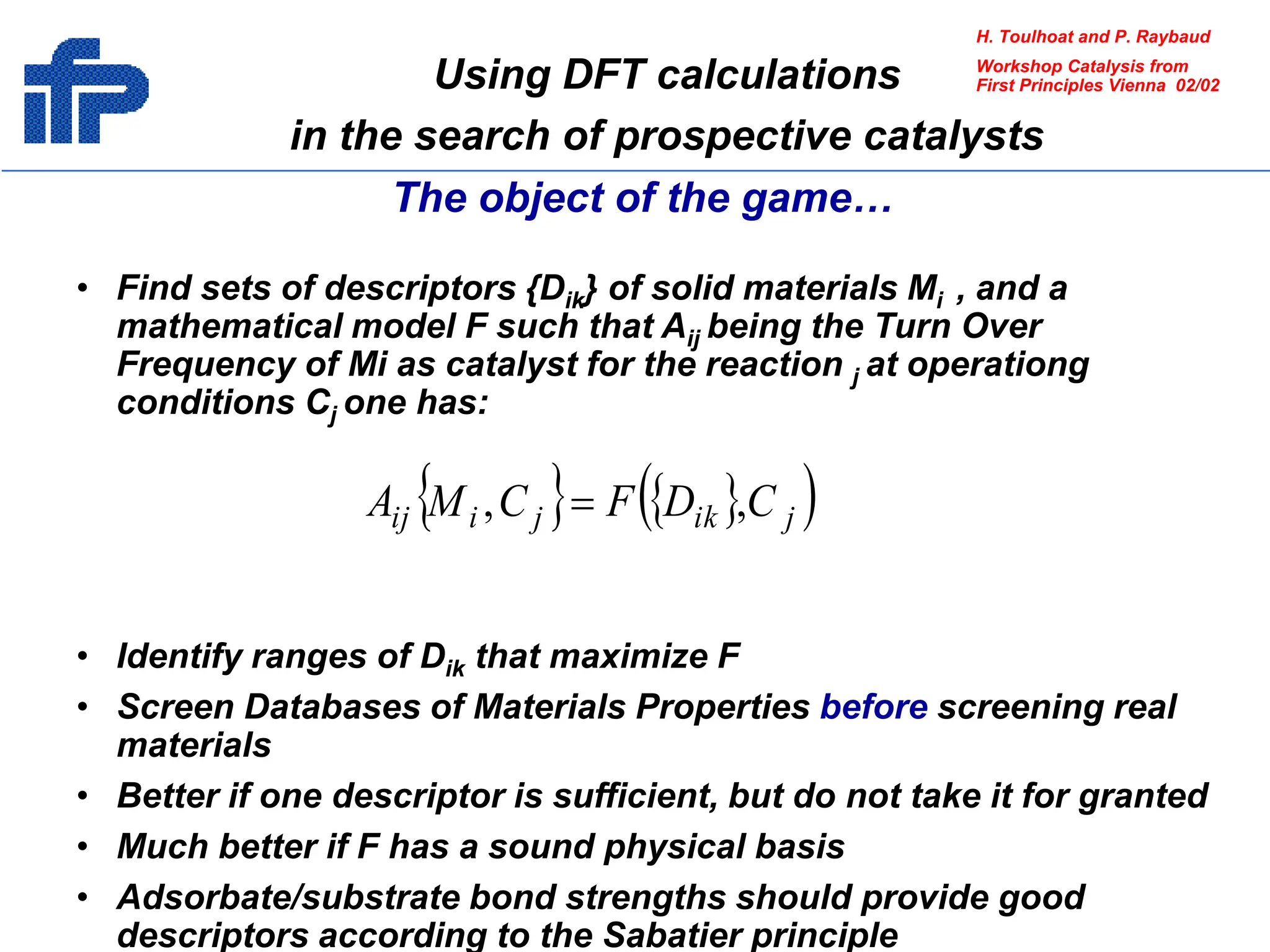
The object of the game…
• Find sets of descriptors {Dik} of solid materials Mi , and a
mathematical model F such that Aij being the Turn Over
Frequency of Mi as catalyst for the reaction j at operationg
conditions Cj one has:
• Identify ranges of Dik that maximize F
• Screen Databases of Materials Properties before screening real
materials
• Better if one descriptor is sufficient, but do not take it for granted
• Much better if F has a sound physical basis
• Adsorbate/substrate bond strengths should provide good
descriptors according to the Sabatier principle
   
 
j
ik
j
i
ij C
D
F
C
M
A ,
, 
Using DFT calculations
in the search of prospective catalysts
H. Toulhoat and P. Raybaud
Workshop Catalysis from
First Principles Vienna 02/02
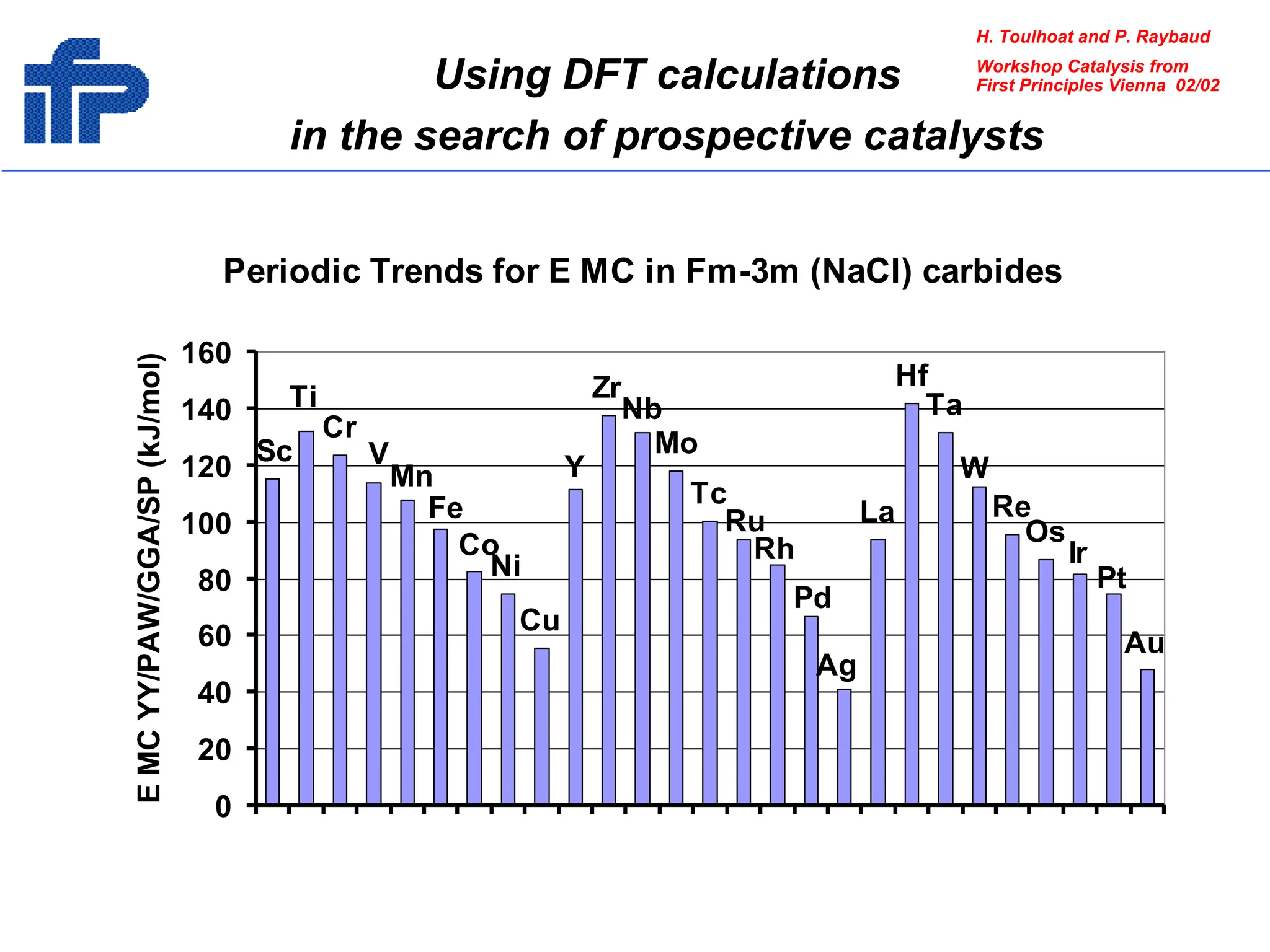
Periodic Trends for E MC in Fm-3m (NaCl) carbides
Sc
Cr
V
Mn
Co
Ni
Y
Zr
Tc
Ru
Rh
Pd
Ta
Re
Os
Ir
Ti
Fe
Cu
Nb
Mo
La
Hf
W
Pt
Au
Ag
0
20
40
60
80
100
120
140
160
E
MC
YY/PAW/GGA/SP
(kJ/mol)
Using DFT calculations
in the search of prospective catalysts
H. Toulhoat and P. Raybaud
Workshop Catalysis from
First Principles Vienna 02/02
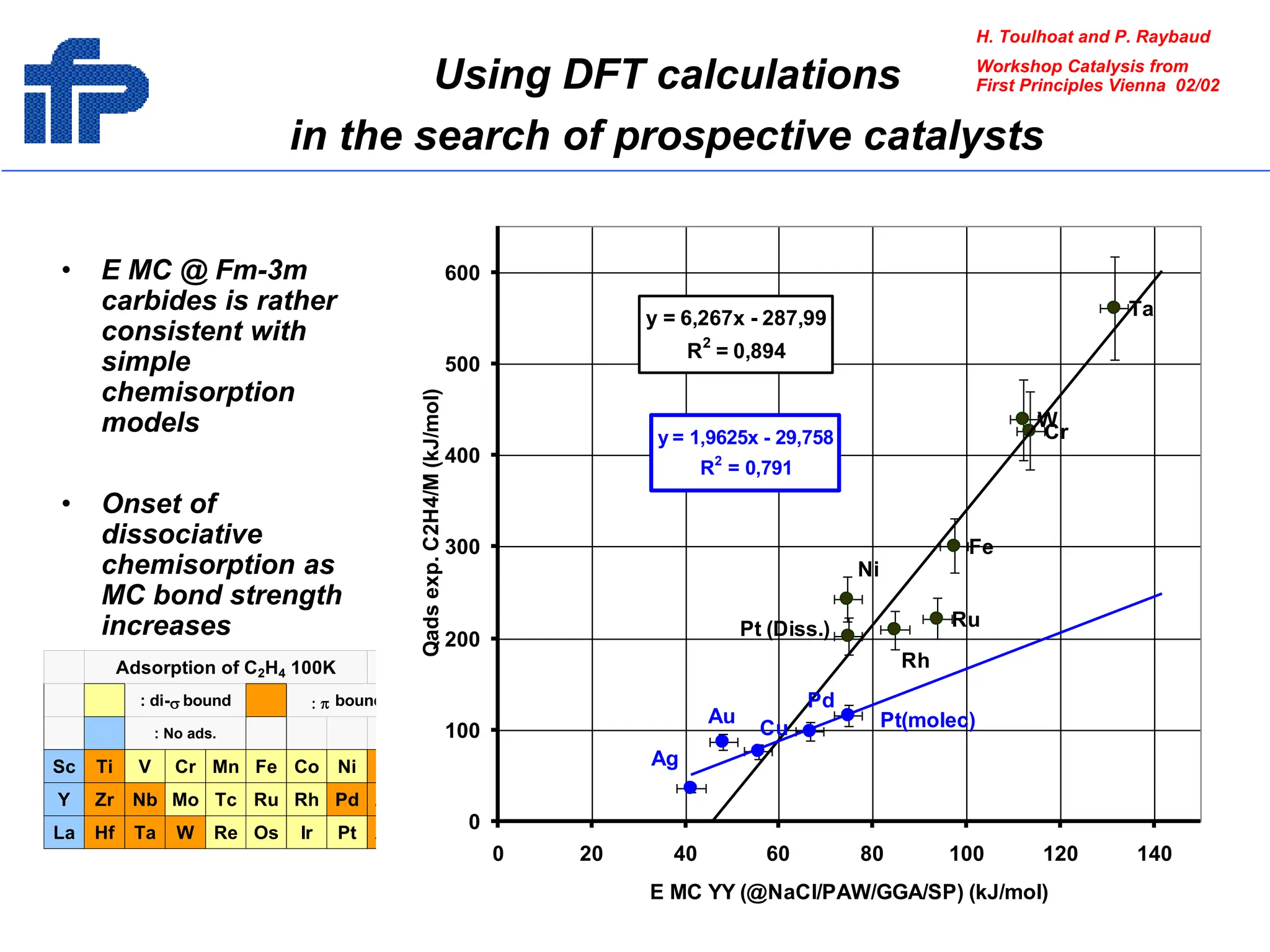
Adsorption of C2H4 100K
: di-s bound : p bound
: No ads.
Sc Ti V Cr Mn Fe Co Ni Cu
Y Zr Nb Mo Tc Ru Rh Pd Ag
La Hf Ta W Re Os Ir Pt Au
Ru
Rh
Fe
Cr
W
Ni
Ta
Pt (Diss.)
Ag
Au
Cu Pt(molec)
Pd
y = 6,267x - 287,99
R2
= 0,894
y = 1,9625x - 29,758
R2
= 0,791
0
100
200
300
400
500
600
0 20 40 60 80 100 120 140
E MC YY (@NaCl/PAW/GGA/SP) (kJ/mol)
Qads
exp.
C2H4/M
(kJ/mol)
• E MC @ Fm-3m
carbides is rather
consistent with
simple
chemisorption
models
• Onset of
dissociative
chemisorption as
MC bond strength
increases
Using DFT calculations
in the search of prospective catalysts
H. Toulhoat and P. Raybaud
Workshop Catalysis from
First Principles Vienna 02/02
Re3Ir
Ir3Re
Ir3Cu
Cu3Ir
Cu
Pd
Ru
Ir
Pt
Os
Re
Co
Ni
1,E+00
1,E+01
1,E+02
1,E+03
1,E+04
1,E+05
10 12 14 16 18 20 22 24 26 28 30
E MC YY (kCal.mol-1)
Rate
in
Hydrogenation
of
C6H6
(s
-1
)
TOF@30°C (M/Al2O3
Brunelle et al., 1977)
V théor.
• The
experimental
Alloying
effects is
correctly
predicted
Using DFT calculations
in the search of prospective catalysts
H. Toulhoat and P. Raybaud
Workshop Catalysis from
First Principles Vienna 02/02
Getting data/descriptors
• Structure (in situ)
• Spectroscopy (in situ)
• Surface thermochemistry
• Calculations
• …
There is a large need for systematic data
- and for good descriptors
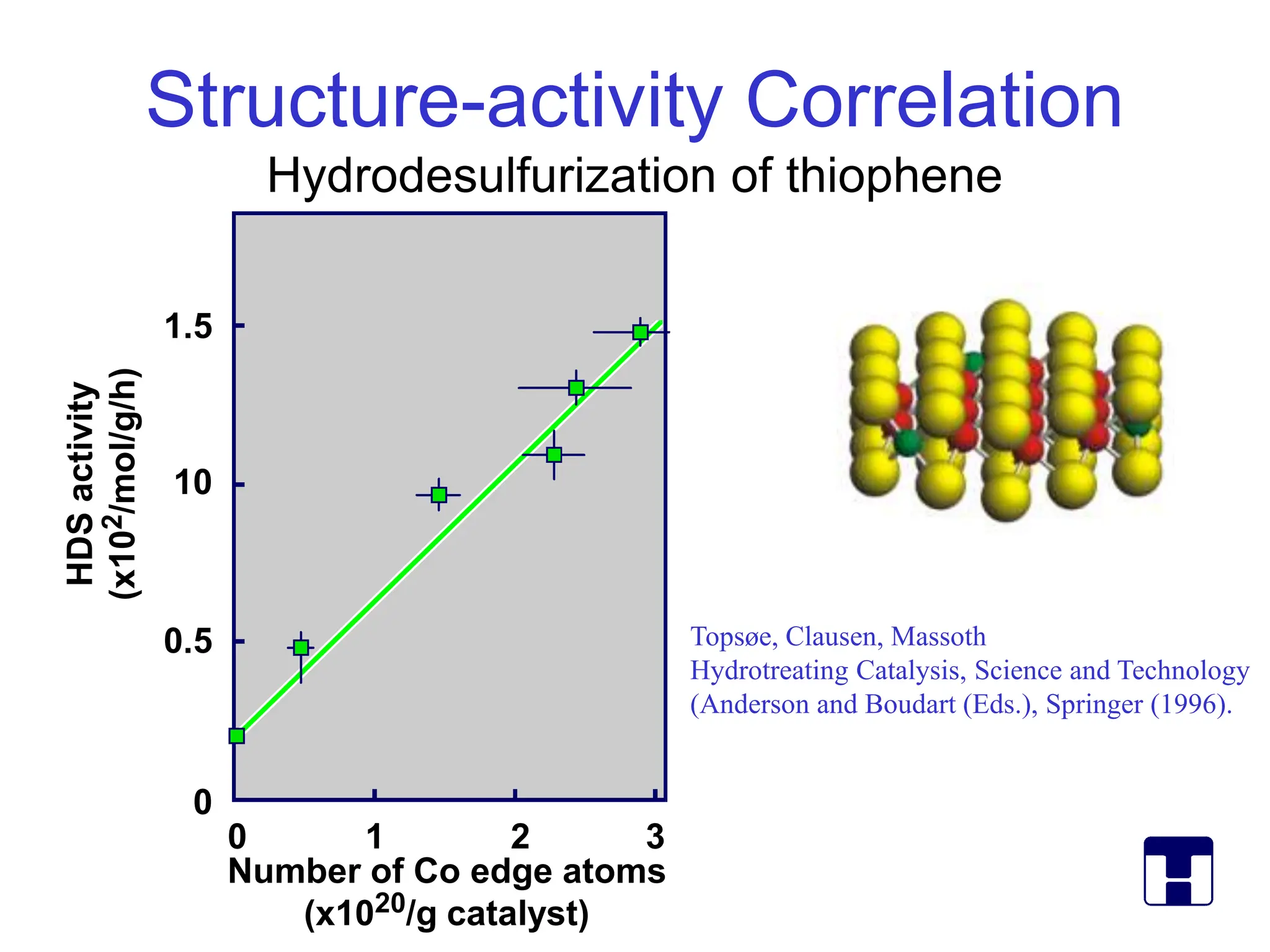
Structure-activity Correlation
Hydrodesulfurization of thiophene
1.5
10
0.5
0
0 1 2 3
Number of Co edge atoms
(x1020/g catalyst)
HDS
activity
(x10
2
/mol/g/h)
Topsøe, Clausen, Massoth
Hydrotreating Catalysis, Science and Technology
(Anderson and Boudart (Eds.), Springer (1996).
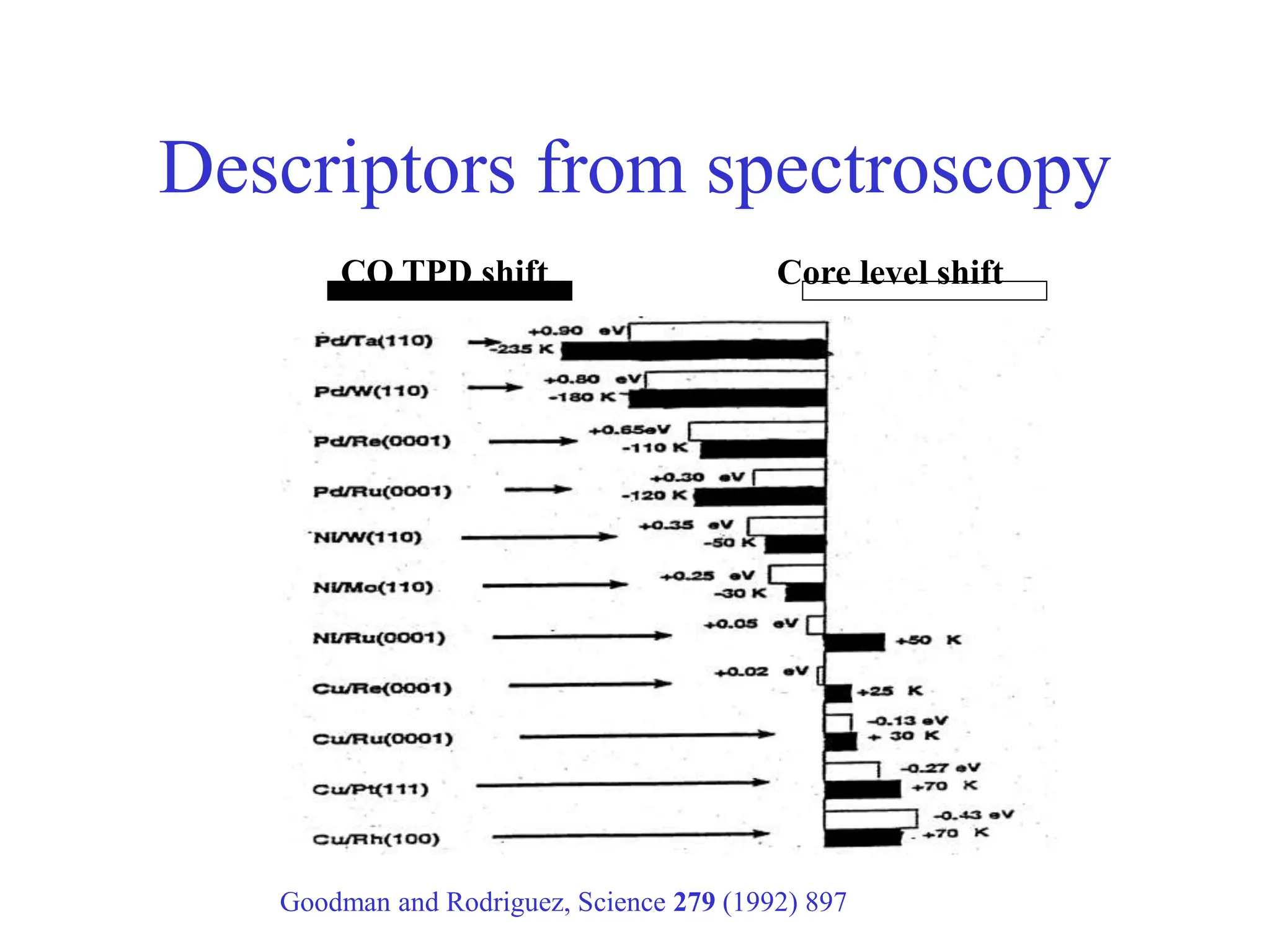
Descriptors from spectroscopy
CO TPD shift Core level shift
Goodman and Rodriguez, Science 279 (1992) 897
Single crystal microcalorimerty
Metal coverage [ML]
0 1 2 3 4 5 6 7 8
Heat
of
adsorption
[kJ/mol]
0
50
100
150
200
250
300
350
400
Cu/MgO
Ag/MgO
Pb/MgO
Larsen, Starr, Campbell, Chem.Thermodyn. 33, 333 (2001)
Brown, Kose, King, Chem. Rev. 98, 797 (1998).
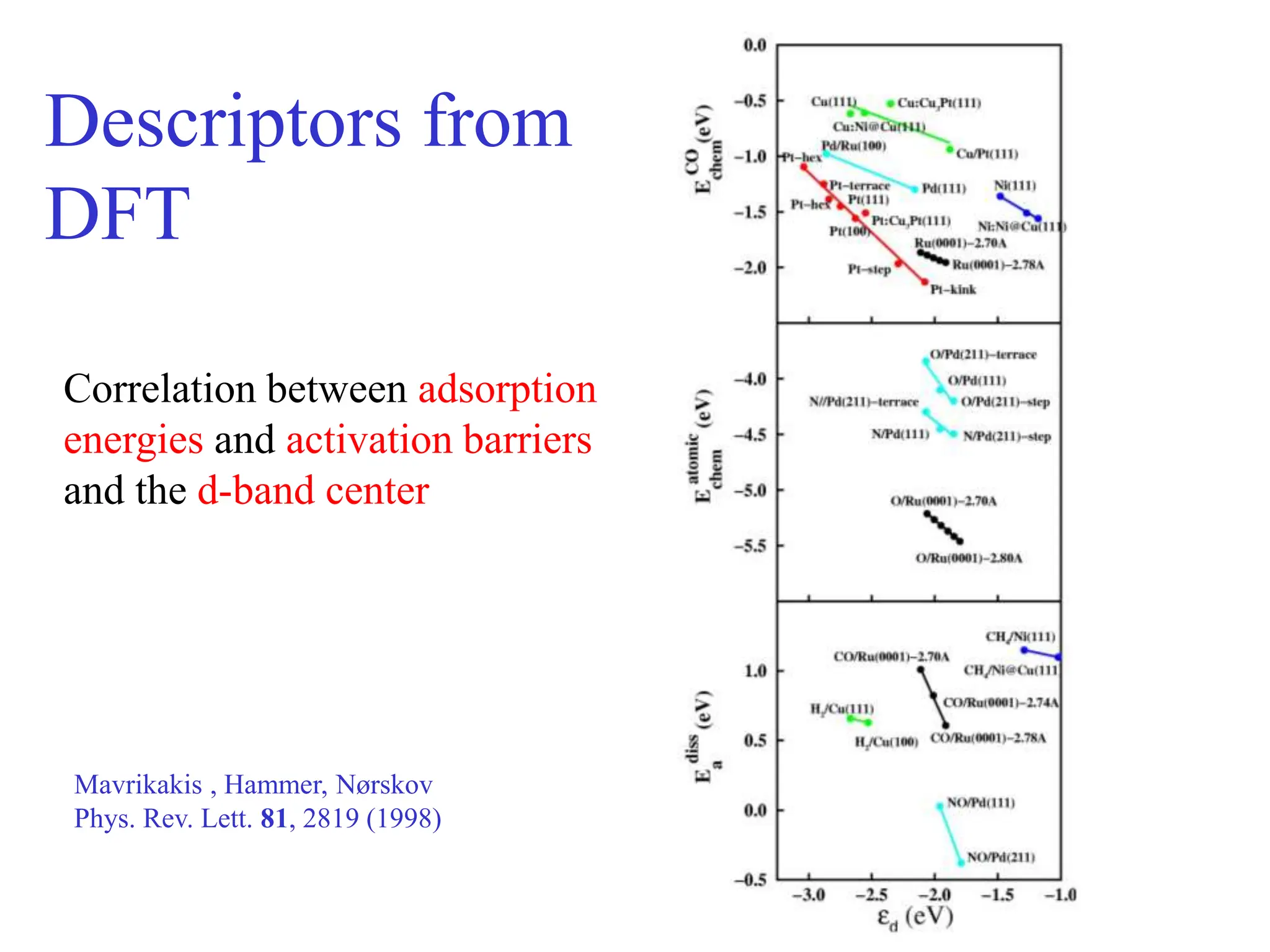
Descriptors from
DFT
Correlation between adsorption
energies and activation barriers
and the d-band center
Mavrikakis , Hammer, Nørskov
Phys. Rev. Lett. 81, 2819 (1998)
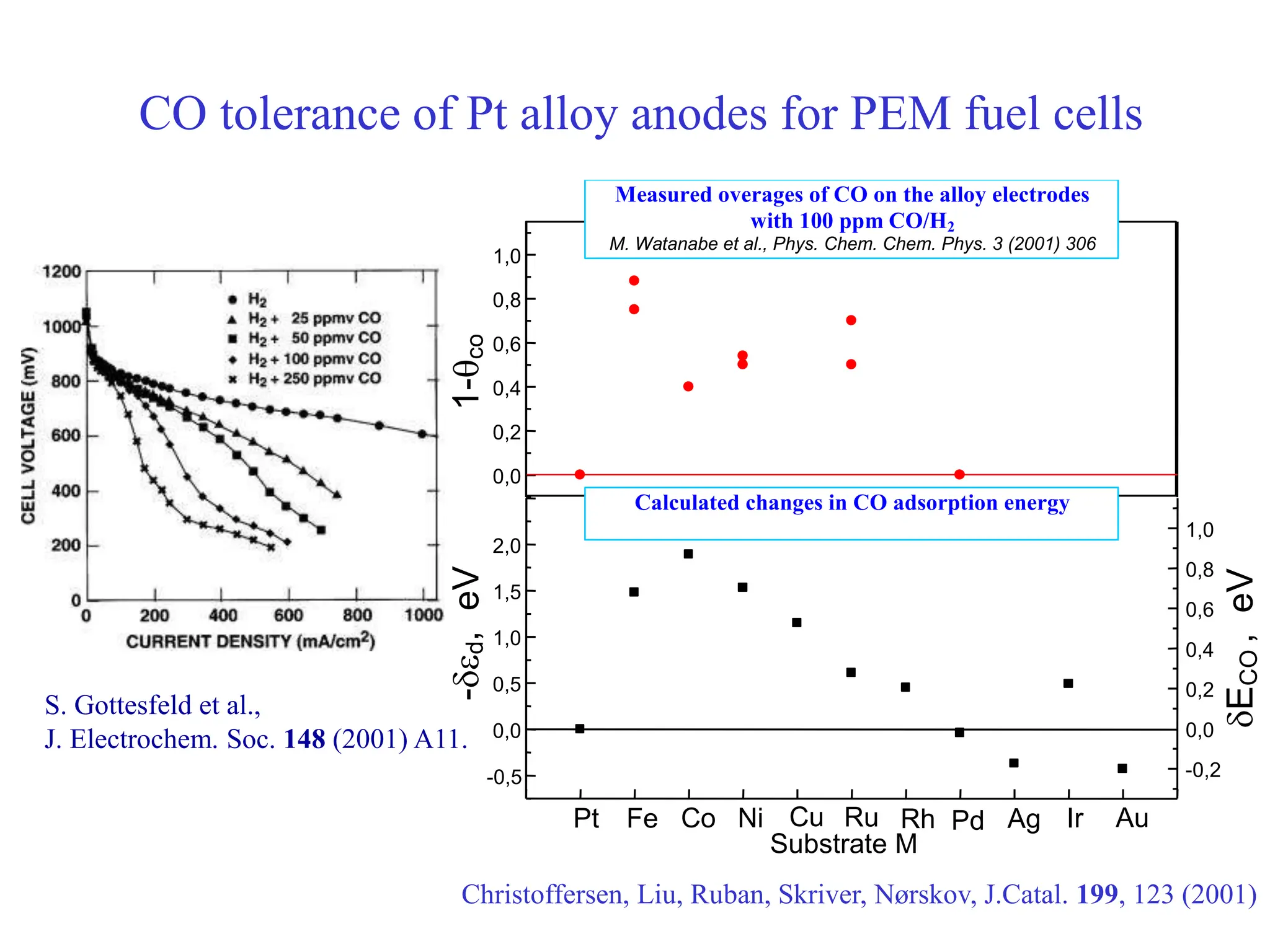
CO tolerance of Pt alloy anodes for PEM fuel cells
Pt
M
-0,5
0,0
0,5
1,0
1,5
2,0
Au
Ir
Ag
Pd
Rh
Ru
Cu
Ni
Co
Fe
Pt
E
CO
,
eV
-
d
,
eV
Substrate M
-0,2
0,0
0,2
0,4
0,6
0,8
1,0
0,0
0,2
0,4
0,6
0,8
1,0
Measured overages of CO on the alloy electrodes
with 100 ppm CO/H2
M. Watanabe et al., Phys. Chem. Chem. Phys. 3 (2001) 306
1-
co
Calculated changes in CO adsorption energy
S. Gottesfeld et al.,
J. Electrochem. Soc. 148 (2001) A11.
Christoffersen, Liu, Ruban, Skriver, Nørskov, J.Catal. 199, 123 (2001)
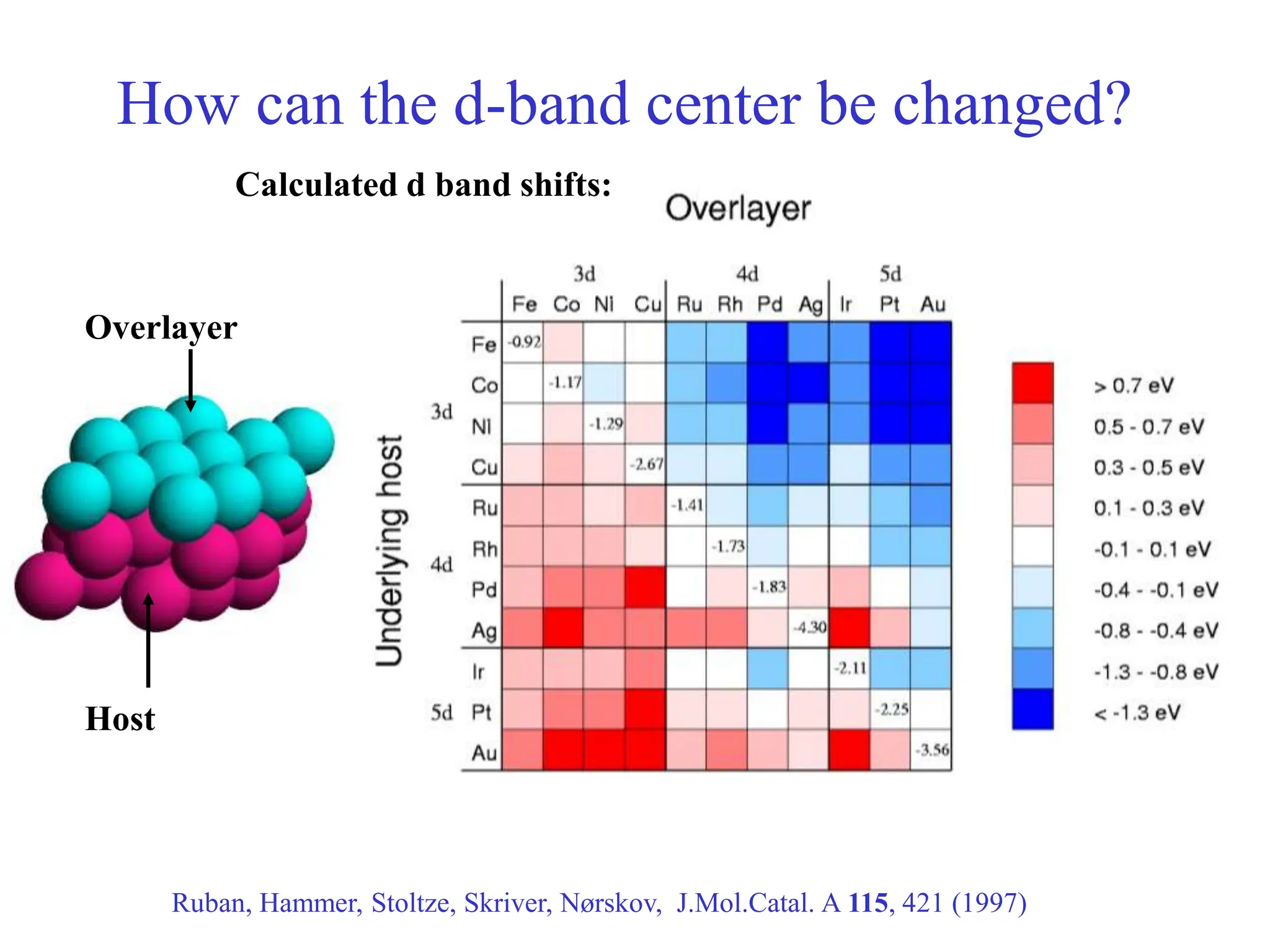
How can the d-band center be changed?
Calculated d band shifts:
Ruban, Hammer, Stoltze, Skriver, Nørskov, J.Mol.Catal. A 115, 421 (1997)
Overlayer
Host
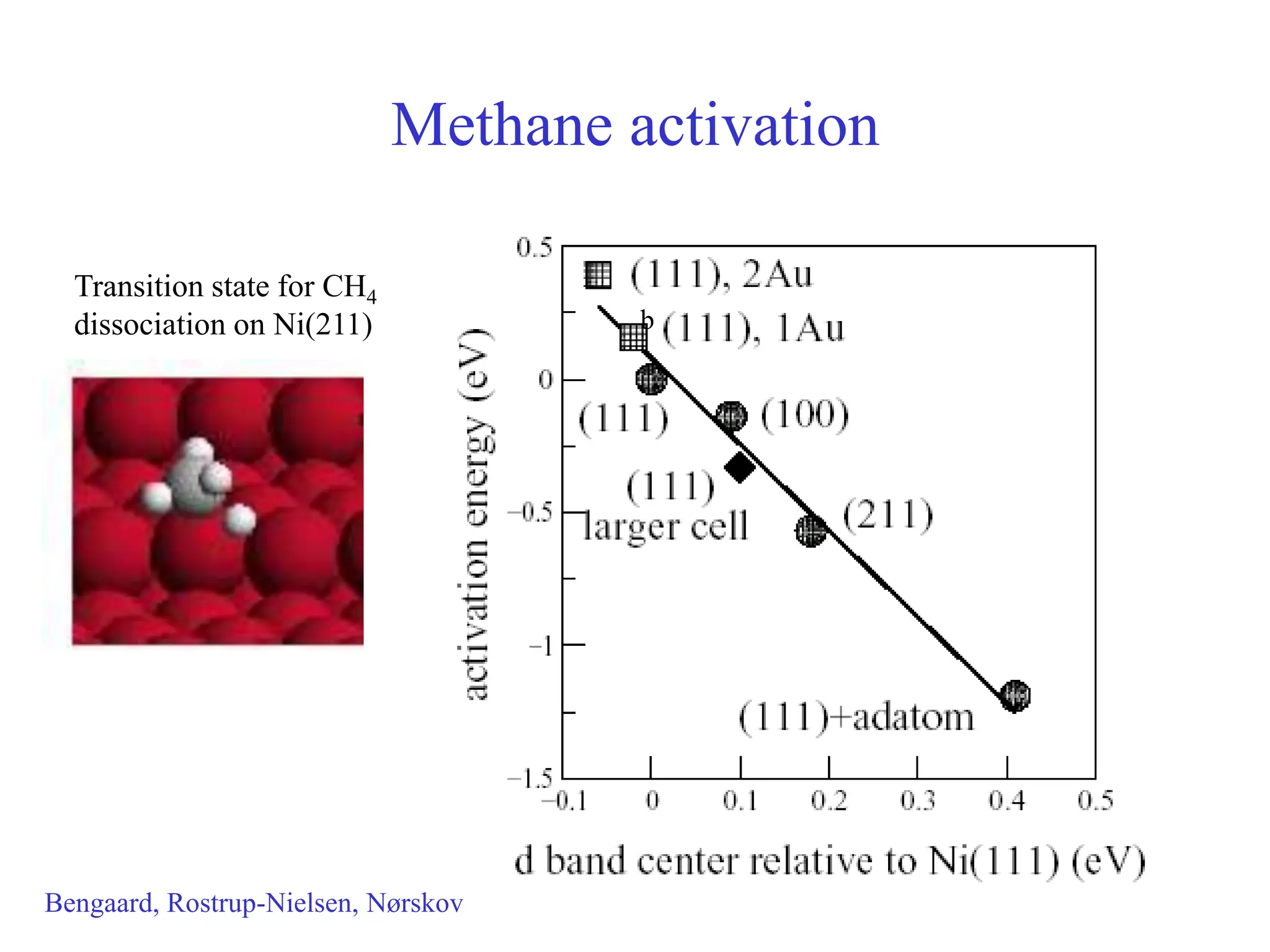
Methane activation
Bengaard, Rostrup-Nielsen, Nørskov
b
Transition state for CH4
dissociation on Ni(211)
Methane activation on Ni/Ru
Ni Coverage [ML]
0 1 2
Initial
sticking
probability
0
1e-7
2e-7
3e-7
4e-7
5e-7
Thermal dissociation of CH4
at T = 530 K
Egeberg, Chorkendorff, Catal. Lett. 77, 207 (2001)
Lessons from biology
• Catalysis at ambient temperature and
pressure
• Extreme selectivity
• Direct coupling of energy into the important
reaction coordinate (non-thermal catalysis)
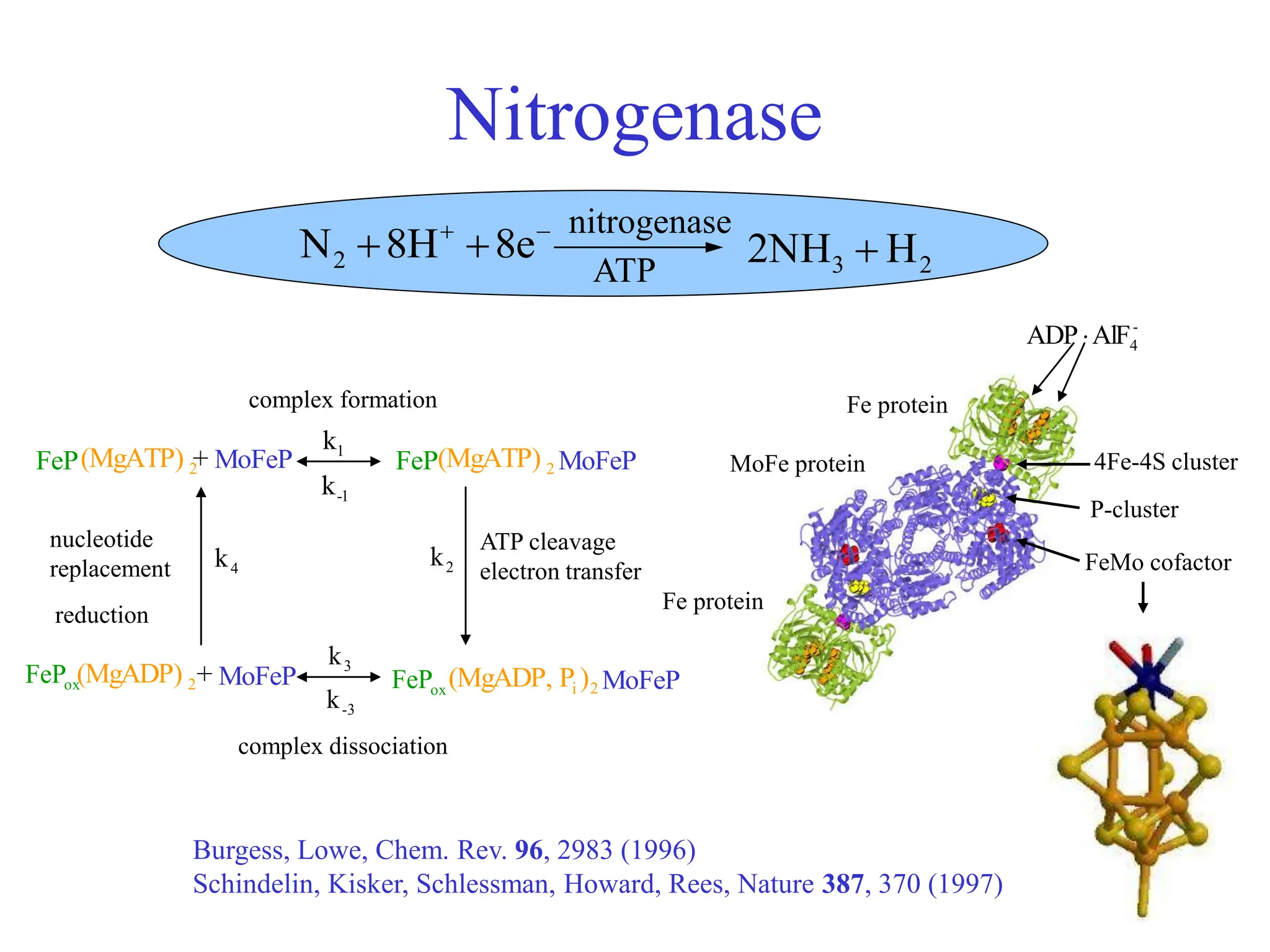
Nitrogenase



 8e
8H
N2 2
3 H
2NH 
nitrogenase
ATP
FeP +
2
(MgATP) MoFeP 1
k
1
-
k
FeP 2
(MgATP) MoFeP
4
k 2
k
nucleotide
replacement
ATP cleavage
electron transfer
ox
FeP 2
(MgADP) + MoFeP
3
k
3
-
k ox
FeP 2
i )
P
(MgADP, MoFeP
reduction
complex formation
complex dissociation
-
4
AlF
ADP
Fe protein
Fe protein
MoFe protein 4Fe-4S cluster
P-cluster
FeMo cofactor
Burgess, Lowe, Chem. Rev. 96, 2983 (1996)
Schindelin, Kisker, Schlessman, Howard, Rees, Nature 387, 370 (1997)
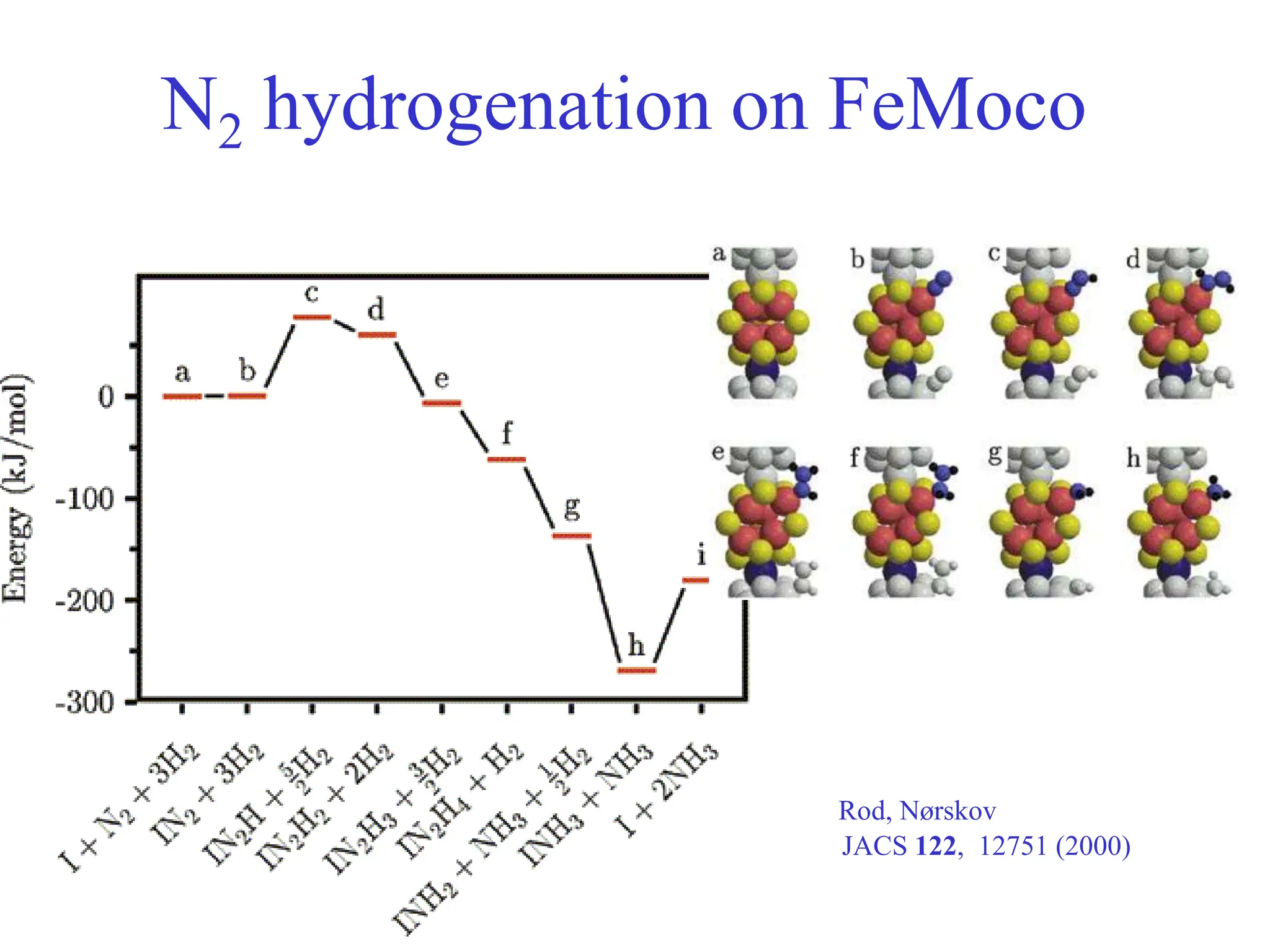
N2 hydrogenation on FeMoco
Rod, Nørskov
JACS 122, 12751 (2000)
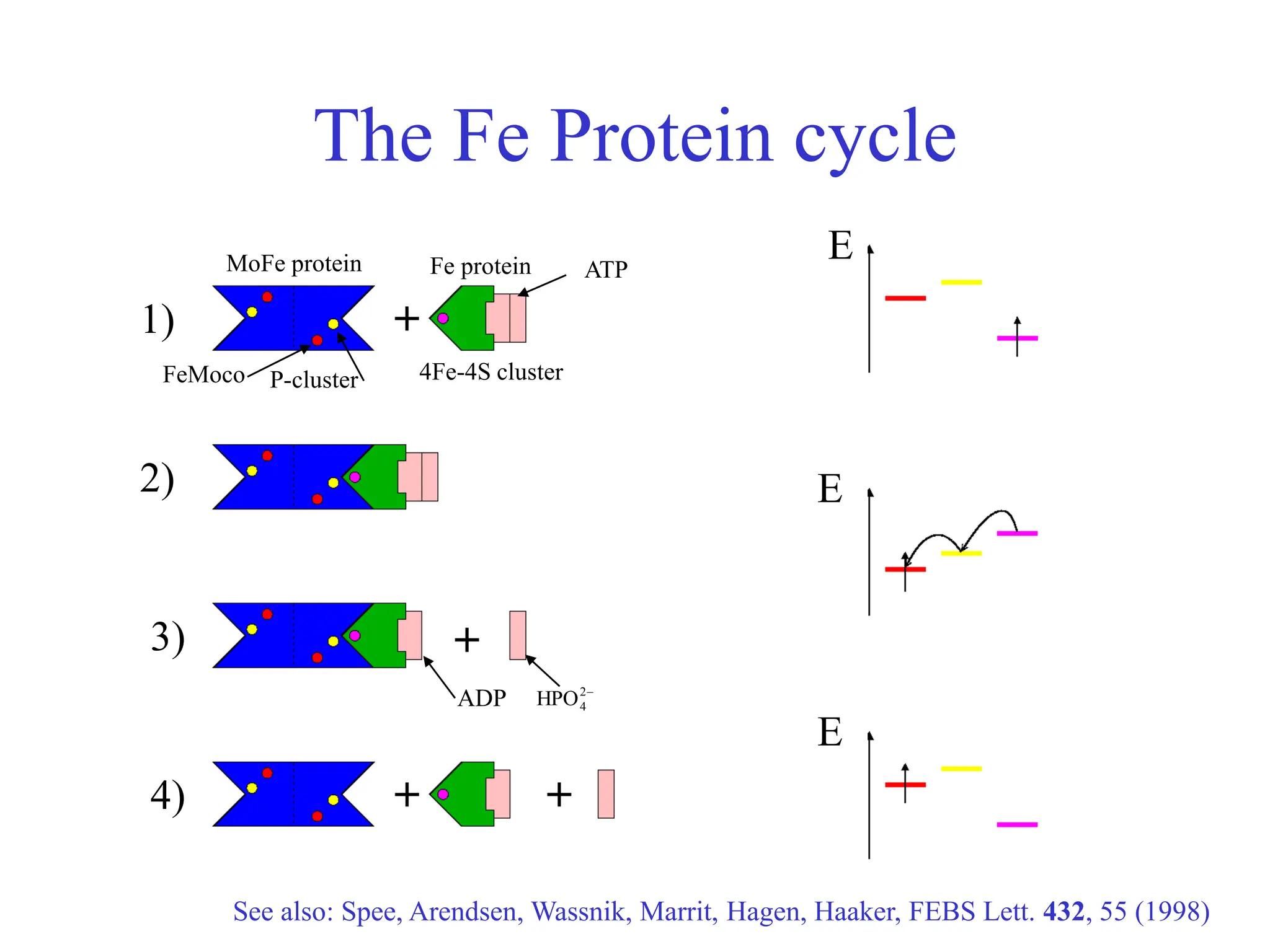
The Fe Protein cycle
1)
2)
3)
4)
E
E
E
MoFe protein
FeMoco P-cluster
Fe protein
4Fe-4S cluster
ATP
ADP 
2
4
HPO
See also: Spee, Arendsen, Wassnik, Marrit, Hagen, Haaker, FEBS Lett. 432, 55 (1998)
Comparing the FeMoco and Ru(0001)
Rod, Logadottir, Nørskov
J.Chem.Phys. 112, 5343 (2000)
Status
• Well developed basic understanding – theory-experiment
• Beginning to be able to use it directly in catalyst design
• Some activity-descriptor correlations
• Host of new in situ methods for catalyst characterization
• New very powerful screening methods
• We have a starting point which is radically different from
the situation 5 or 10 years ago!
Moving forward
• More basic understanding –theory-experiment
• Integration of the conceptual framework for
heterogeneous, homogeneous and enzyme catalysis
• More systematic data (descriptors)
• Better synthesis methods
• Better coupling of catalyst design and process engineering
• INTEGRATION
Promoting development
Synthesis
testing
characterization
Experiments, models
Theory
An integrated approach:

Heterogeneous Catalysis - Opportunities and Challenges

  • 1.
    Heterogeneous Catalysis Opportunities andchallenges • Challenges –Societal needs –Developing the basic understanding • Opportunities –Designing at the nano-scale J. K. Nørskov Center for Atomic-scale Materials Physics Technical University of Denmark norskov@fysik.dtu.dk
  • 2.
    Challenges I Jens Rostrup-Nielsen:XVII Sympósio Iberoamericano de Catálisis, July 16-21, 2000 Dream reactions waiting for a catalyst:
  • 3.
    Dreaming on …. •Heterogeneous catalysts for assymmetric synthesis • Photolytic water splitting (hydrogen economy) • Biomimetics, synthetic enzymes • Non-thermal processes in general (e.g. electro- and photocatalysis) • … See: E. Derouane, CATTECH 5, 226 (2001) Challenges II
  • 4.
    Challenges III The scienceof heterogeneous catalysis: • A comprehensive scientific basis – Much has been done – Much more is needed (oxides, size effects, photocatalysis, electrocatalysis, relation to homogeneous and enzyme catalysis …) • Making the insight useful! – The ultimate test
  • 5.
    Opportunities - design atthe nano-scale • Rational catalyst design - Discovery on the basis of insight • Data-driven methods - Accelerated discovery by access to large amounts of data • Bio-inspired catalysis
  • 6.
    Rational catalyst design 1.What determines the catalytic activity/selectivity/lifetime ? 2. How can we affect it? - We have tremendous new possibilities
  • 7.
    Ammonia synthesis N2+3H2 2NH3 Ozakiand Aika, Catalysis 1 (Anderson and Boudart, Ed.)
  • 8.
    Ammonia synthesis overRu Ru(0001) step Logadottir, Nørskov
  • 9.
    Steps do everything Dahl,Logadottir, Egeberg, Larsen, Chorkendorff, Törnqvist, Nørskov, Phys.Rev.Lett. 83, 1814 (1999) Au decorates steps: Hwang, Schroder, Gunther, Behm, Phys. Rev. Lett. 67, 3279 (1991)
  • 10.
    Logatottir, Rod, Nørskov,Hammer, Dahl, Jacobsen, J. Catal. 197, 229 (2001) The Brønsted-Evans-Polanyi relation
  • 11.
  • 12.
    Interpolation in theperiodic table Jacobsen, Dahl, Clausen, Bahn, Logadottir, Nørskov, JACS 123 (2001) 8404.
  • 13.
    Jacobsen, Dahl, Clausen,Bahn, Logadottir, Nørskov, JACS 123 (2001) 8404. Interpolation in the periodic table
  • 14.
    Jacobsen, Dahl, Clausen,Bahn, Logadottir, Nørskov, JACS 123 (2001) 8404. Measured ammonia synthesis rates 400 C, 50 bar, H2:N2=3:1
  • 15.
    Data driven methods •High throughput screening – Direct testing of many catalysts, fast, efficiently • Data mining – Correlating catalytic activity/selectivity/ durability to descriptors that can be tabulated
  • 16.
    The object ofthe game… • Find sets of descriptors {Dik} of solid materials Mi , and a mathematical model F such that Aij being the Turn Over Frequency of Mi as catalyst for the reaction j at operationg conditions Cj one has: • Identify ranges of Dik that maximize F • Screen Databases of Materials Properties before screening real materials • Better if one descriptor is sufficient, but do not take it for granted • Much better if F has a sound physical basis • Adsorbate/substrate bond strengths should provide good descriptors according to the Sabatier principle       j ik j i ij C D F C M A , ,  Using DFT calculations in the search of prospective catalysts H. Toulhoat and P. Raybaud Workshop Catalysis from First Principles Vienna 02/02
  • 17.
    Periodic Trends forE MC in Fm-3m (NaCl) carbides Sc Cr V Mn Co Ni Y Zr Tc Ru Rh Pd Ta Re Os Ir Ti Fe Cu Nb Mo La Hf W Pt Au Ag 0 20 40 60 80 100 120 140 160 E MC YY/PAW/GGA/SP (kJ/mol) Using DFT calculations in the search of prospective catalysts H. Toulhoat and P. Raybaud Workshop Catalysis from First Principles Vienna 02/02
  • 18.
    Adsorption of C2H4100K : di-s bound : p bound : No ads. Sc Ti V Cr Mn Fe Co Ni Cu Y Zr Nb Mo Tc Ru Rh Pd Ag La Hf Ta W Re Os Ir Pt Au Ru Rh Fe Cr W Ni Ta Pt (Diss.) Ag Au Cu Pt(molec) Pd y = 6,267x - 287,99 R2 = 0,894 y = 1,9625x - 29,758 R2 = 0,791 0 100 200 300 400 500 600 0 20 40 60 80 100 120 140 E MC YY (@NaCl/PAW/GGA/SP) (kJ/mol) Qads exp. C2H4/M (kJ/mol) • E MC @ Fm-3m carbides is rather consistent with simple chemisorption models • Onset of dissociative chemisorption as MC bond strength increases Using DFT calculations in the search of prospective catalysts H. Toulhoat and P. Raybaud Workshop Catalysis from First Principles Vienna 02/02
  • 19.
    Re3Ir Ir3Re Ir3Cu Cu3Ir Cu Pd Ru Ir Pt Os Re Co Ni 1,E+00 1,E+01 1,E+02 1,E+03 1,E+04 1,E+05 10 12 1416 18 20 22 24 26 28 30 E MC YY (kCal.mol-1) Rate in Hydrogenation of C6H6 (s -1 ) TOF@30°C (M/Al2O3 Brunelle et al., 1977) V théor. • The experimental Alloying effects is correctly predicted Using DFT calculations in the search of prospective catalysts H. Toulhoat and P. Raybaud Workshop Catalysis from First Principles Vienna 02/02
  • 20.
    Getting data/descriptors • Structure(in situ) • Spectroscopy (in situ) • Surface thermochemistry • Calculations • … There is a large need for systematic data - and for good descriptors
  • 21.
    Structure-activity Correlation Hydrodesulfurization ofthiophene 1.5 10 0.5 0 0 1 2 3 Number of Co edge atoms (x1020/g catalyst) HDS activity (x10 2 /mol/g/h) Topsøe, Clausen, Massoth Hydrotreating Catalysis, Science and Technology (Anderson and Boudart (Eds.), Springer (1996).
  • 22.
    Descriptors from spectroscopy COTPD shift Core level shift Goodman and Rodriguez, Science 279 (1992) 897
  • 23.
    Single crystal microcalorimerty Metalcoverage [ML] 0 1 2 3 4 5 6 7 8 Heat of adsorption [kJ/mol] 0 50 100 150 200 250 300 350 400 Cu/MgO Ag/MgO Pb/MgO Larsen, Starr, Campbell, Chem.Thermodyn. 33, 333 (2001) Brown, Kose, King, Chem. Rev. 98, 797 (1998).
  • 24.
    Descriptors from DFT Correlation betweenadsorption energies and activation barriers and the d-band center Mavrikakis , Hammer, Nørskov Phys. Rev. Lett. 81, 2819 (1998)
  • 25.
    CO tolerance ofPt alloy anodes for PEM fuel cells Pt M -0,5 0,0 0,5 1,0 1,5 2,0 Au Ir Ag Pd Rh Ru Cu Ni Co Fe Pt E CO , eV - d , eV Substrate M -0,2 0,0 0,2 0,4 0,6 0,8 1,0 0,0 0,2 0,4 0,6 0,8 1,0 Measured overages of CO on the alloy electrodes with 100 ppm CO/H2 M. Watanabe et al., Phys. Chem. Chem. Phys. 3 (2001) 306 1- co Calculated changes in CO adsorption energy S. Gottesfeld et al., J. Electrochem. Soc. 148 (2001) A11. Christoffersen, Liu, Ruban, Skriver, Nørskov, J.Catal. 199, 123 (2001)
  • 26.
    How can thed-band center be changed? Calculated d band shifts: Ruban, Hammer, Stoltze, Skriver, Nørskov, J.Mol.Catal. A 115, 421 (1997) Overlayer Host
  • 27.
    Methane activation Bengaard, Rostrup-Nielsen,Nørskov b Transition state for CH4 dissociation on Ni(211)
  • 28.
    Methane activation onNi/Ru Ni Coverage [ML] 0 1 2 Initial sticking probability 0 1e-7 2e-7 3e-7 4e-7 5e-7 Thermal dissociation of CH4 at T = 530 K Egeberg, Chorkendorff, Catal. Lett. 77, 207 (2001)
  • 29.
    Lessons from biology •Catalysis at ambient temperature and pressure • Extreme selectivity • Direct coupling of energy into the important reaction coordinate (non-thermal catalysis)
  • 30.
    Nitrogenase     8e 8H N2 2 3H 2NH  nitrogenase ATP FeP + 2 (MgATP) MoFeP 1 k 1 - k FeP 2 (MgATP) MoFeP 4 k 2 k nucleotide replacement ATP cleavage electron transfer ox FeP 2 (MgADP) + MoFeP 3 k 3 - k ox FeP 2 i ) P (MgADP, MoFeP reduction complex formation complex dissociation - 4 AlF ADP Fe protein Fe protein MoFe protein 4Fe-4S cluster P-cluster FeMo cofactor Burgess, Lowe, Chem. Rev. 96, 2983 (1996) Schindelin, Kisker, Schlessman, Howard, Rees, Nature 387, 370 (1997)
  • 31.
    N2 hydrogenation onFeMoco Rod, Nørskov JACS 122, 12751 (2000)
  • 32.
    The Fe Proteincycle 1) 2) 3) 4) E E E MoFe protein FeMoco P-cluster Fe protein 4Fe-4S cluster ATP ADP  2 4 HPO See also: Spee, Arendsen, Wassnik, Marrit, Hagen, Haaker, FEBS Lett. 432, 55 (1998)
  • 33.
    Comparing the FeMocoand Ru(0001) Rod, Logadottir, Nørskov J.Chem.Phys. 112, 5343 (2000)
  • 34.
    Status • Well developedbasic understanding – theory-experiment • Beginning to be able to use it directly in catalyst design • Some activity-descriptor correlations • Host of new in situ methods for catalyst characterization • New very powerful screening methods • We have a starting point which is radically different from the situation 5 or 10 years ago!
  • 35.
    Moving forward • Morebasic understanding –theory-experiment • Integration of the conceptual framework for heterogeneous, homogeneous and enzyme catalysis • More systematic data (descriptors) • Better synthesis methods • Better coupling of catalyst design and process engineering • INTEGRATION
  • 36.