Machine Intelligence in
Manufacturing Industries
About Createsi
• Founded in 2014
• Headquarters in Horgen, Switzerland
• R&D office in Nis, Serbia
• Specialized in solving business problems using advanced machine
learning techniques
• Focuses on solving operational problems in various industrial
domains.
• Image and Video Processing
• Natural Language Processing and Chat Bots
• Time series data Processing
• Connecting different machine intelligence frameworks and APIs
from different vendors
• End to end software development services
• Integration of various public and private data sources
• Offering customized trainings on machine learning tools and
techniques
Key Competences
Selected References
• ABB Switzerland - www.abb.com
• Voith Germany - www.voith.com
• European Respiratory Society Switzerland - www.ersnet.org
• Image Informatics US - www.imageinformatics.com
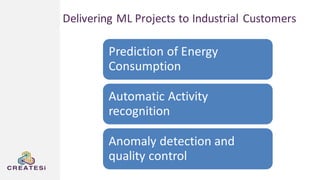
Prediction of Energy
Consumption
Automatic Activity
recognition
Anomaly detection and
quality control
Delivering ML Projects to Industrial Customers
Predicting levels of energy
consumption in some foreseeable
future is of huge benefit to both
consumers and energy producers
We designed a machine learning
system to be able to predict long and
short term energy consumption
levels with different time resolution
based on historical data
Prediction of Energy Consumption
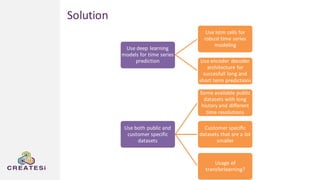
Use deep learning
models for time series
prediction
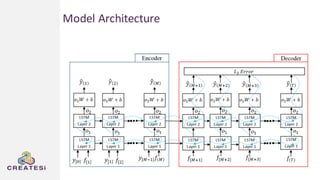
Use lstm cells for
robust time series
modeling
Use encoder decoder
architecture for
succesfull long and
short term predictions
Use both public and
customer specific
datasets
Some available public
datasets with long
history and different
time resolutions
Customer specific
datasets that are a lot
smaller
Usage of
transferlearning?
Solution
Model Architecture
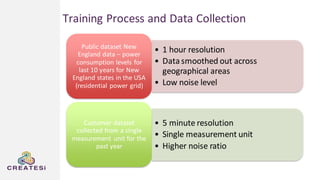
• 1 hour resolution
• Datasmoothed out across
geographical areas
• Low noise level
Public dataset New
England data – power
consumption levels for
last 10 years for New
England states in the USA
(residential power grid)
• 5 minute resolution
• Single measurement unit
• Higher noise ratio
Customer dataset
collected from a single
measurement unit for the
past year
Training Process and Data Collection
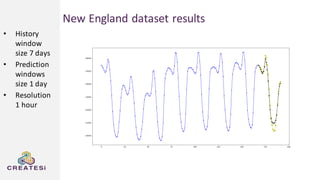
New England dataset results
• History
window
size 7 days
• Prediction
windows
size 1 day
• Resolution
1 hour
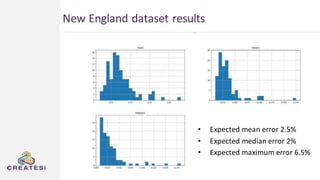
New England dataset results
• Expected mean error 2.5%
• Expected median error 2%
• Expected maximum error 6.5%
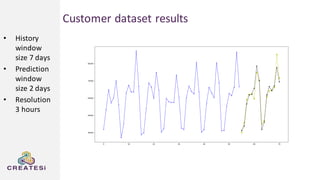
Customer dataset results
• History
window
size 7 days
• Prediction
window
size 2 days
• Resolution
3 hours
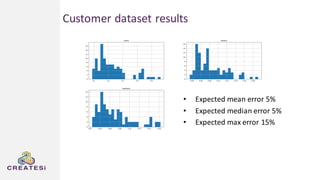
Customer dataset results
• Expected mean error 5%
• Expected median error 5%
• Expected max error 15%
Lessons learned
• Transfer learning not always applicable
• Customer expectations should be managed
according to the data quality in the concrete case
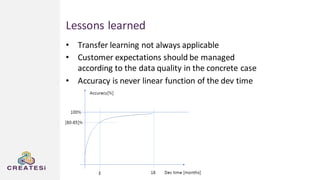
• Accuracy is never linear function of the dev time
Activity recognition
Usage of machine learningtechniques to
improve manufacturingprocess by
automaticlurecognizinguser actions
Manufacturingexecution system enables
end2end trackingof the productionprocess
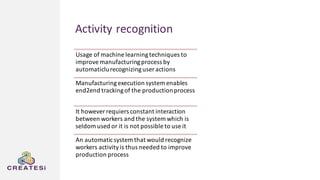
It however requiers constant interaction
between workers and the system which is
seldom used or it is not possible to use it
An automaticsystem that would recognize
workers activityis thus needed to improve
production process
Activity recognition – machine learning
solution
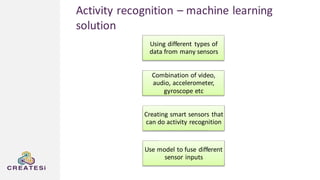
Using different types of
data from many sensors
Combination of video,
audio, accelerometer,
gyroscope etc
Creating smart sensors that
can do activity recognition
Use model to fuse different
sensor inputs
Wearable sensors
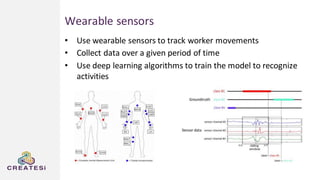
• Use wearable sensors to track worker movements
• Collect data over a given period of time
• Use deep learning algorithms to train the model to recognize
activities
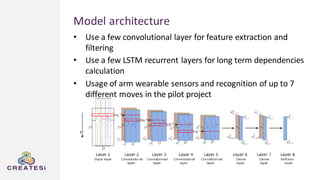
Model architecture
• Use a few convolutional layer for feature extraction and
filtering
• Use a few LSTM recurrent layers for long term dependencies
calculation
• Usage of arm wearable sensors and recognition of up to 7
different moves in the pilot project
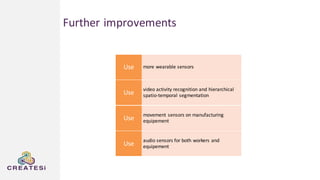
Further improvements
more wearable sensorsUse
video activity recognition and hierarchical
spatio-temporal segmentationUse
movement sensors on manufacturing
equipementUse
audio sensors for both workers and
equipementUse
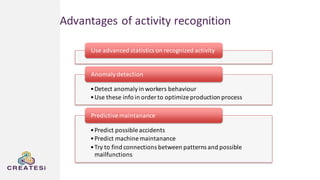
Advantages of activity recognition
Use advanced statistics on recognized activity
•Detect anomalyin workers behaviour
•Use these info in order to optimize production process
Anomalydetection
•Predict possible accidents
•Predict machine maintanance
•Try to find connections between patterns and possible
mailfunctions
Predictive maintanance
Lessons learned
• Projects mustbe done in multiple iteration
• Creating infrastructure for data acquisition is usually the first step
• Workers may need to accommodate to the new infrastructure
• Potential long period of time before results are seen
• Create a minimal viable solution on a controled env to
demonstrate capabilities before going all in!!
Anomaly detection and quality control
• Detection of scrap items in production
• Quality control of the production process
• Analyzing differetn steps of the production
process and correlating them to the quaility of the
final product
• Example of the surge arrestor production in the
wettingem factory
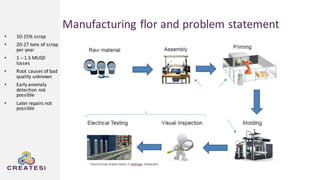
Manufacturing flor and problem statement
• 10-15% scrap
• 20-27 tons of scrap
per year
• 1 – 1.5 MUSD
losses
• Root causes of bad
quality unknown
• Early anomaly
detection not
possible
• Later repairs not
possible
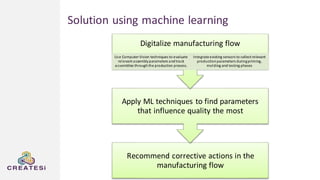
Solution using machine learning
Recommend corrective actions in the
manufacturing flow
Apply ML techniques to find parameters
that influence quality the most
Digitalize manufacturing flow
Use ComputerVision techniques to evaluate
relevant assemblyparameters andtrack
assemblies throughthe production process.
Integrate existing sensors to collect relevant
productionparameters duringpriming,
molding and testing phases
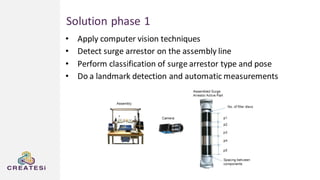
Solution phase 1
• Apply computer vision techniques
• Detect surge arrestor on the assembly line
• Perform classification of surge arrestor type and pose
• Do a landmark detection and automatic measurements
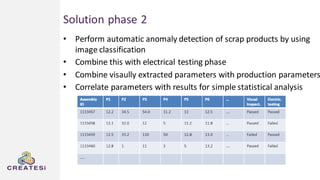
Solution phase 2
• Perform automatic anomaly detection of scrap products by using
image classification
• Combine this with electrical testing phase
• Combine visaully extracted parameters with production parameters
• Correlate parameters with results for simple statistical analysis
Solution phase 3
• Use deep neural network algorithm to
predict anomalies at early production
stages
• Add attention mechanism to detect
features that could affect bad results
• Produce a heatmap over input features
as well as anomaly prediction
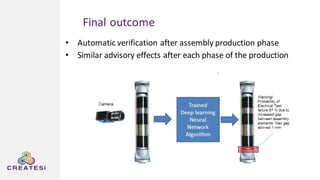
Final outcome
• Automatic verification after assembly production phase
• Similar advisory effects after each phase of the production
Key Learnings
• Vertical and horizontal integration are the key aspects of application
of ML in the industrial domain.
• Many communicationprotocolsand standardsavailablein the field
complicate integration.
• Integration costs typicallytake up to 80% of total project cost and
implementationtime, while remaining 20% bring the actual benefits
to the customer.
• Customers willingto pay for the benefits, but don’t like to pay just
to get the data into a cloud.
• The key is in providing productized end-to-end solution for concrete
use cases.
Key Learnings
• Intense computing on Edge devices necessary to scale the immense
amount of data down to the level manageableby limited cloud
communicationchannels.
• Use cases typicallyoriented to asset maintenance,loss prevention,
operationaloptimizations.
• Not enough labeleddata available
• Labeling and data acquisitionexpensive and disruptive
• Mixture of semi-supervised and unsupervised techniques are required.
• Security and end-to-end encryption are must and represent a special
challenge.
Igor Mihajlovic
Createsi GmbH
Kummruetistrasse 103
8810 Horgen
e-mail: igor.mihajlovic@createsi.com

Machine Intelligence in Manufacturing Industry - Igor Mihajlovic

  • 1.
  • 2.
    About Createsi • Foundedin 2014 • Headquarters in Horgen, Switzerland • R&D office in Nis, Serbia • Specialized in solving business problems using advanced machine learning techniques • Focuses on solving operational problems in various industrial domains.
  • 3.
    • Image andVideo Processing • Natural Language Processing and Chat Bots • Time series data Processing • Connecting different machine intelligence frameworks and APIs from different vendors • End to end software development services • Integration of various public and private data sources • Offering customized trainings on machine learning tools and techniques Key Competences
  • 4.
    Selected References • ABBSwitzerland - www.abb.com • Voith Germany - www.voith.com • European Respiratory Society Switzerland - www.ersnet.org • Image Informatics US - www.imageinformatics.com
  • 5.
    Prediction of Energy Consumption AutomaticActivity recognition Anomaly detection and quality control Delivering ML Projects to Industrial Customers
  • 6.
    Predicting levels ofenergy consumption in some foreseeable future is of huge benefit to both consumers and energy producers We designed a machine learning system to be able to predict long and short term energy consumption levels with different time resolution based on historical data Prediction of Energy Consumption
  • 7.
    Use deep learning modelsfor time series prediction Use lstm cells for robust time series modeling Use encoder decoder architecture for succesfull long and short term predictions Use both public and customer specific datasets Some available public datasets with long history and different time resolutions Customer specific datasets that are a lot smaller Usage of transferlearning? Solution
  • 8.
  • 9.
    • 1 hourresolution • Datasmoothed out across geographical areas • Low noise level Public dataset New England data – power consumption levels for last 10 years for New England states in the USA (residential power grid) • 5 minute resolution • Single measurement unit • Higher noise ratio Customer dataset collected from a single measurement unit for the past year Training Process and Data Collection
  • 10.
    New England datasetresults • History window size 7 days • Prediction windows size 1 day • Resolution 1 hour
  • 11.
    New England datasetresults • Expected mean error 2.5% • Expected median error 2% • Expected maximum error 6.5%
  • 12.
    Customer dataset results •History window size 7 days • Prediction window size 2 days • Resolution 3 hours
  • 13.
    Customer dataset results •Expected mean error 5% • Expected median error 5% • Expected max error 15%
  • 14.
    Lessons learned • Transferlearning not always applicable • Customer expectations should be managed according to the data quality in the concrete case • Accuracy is never linear function of the dev time
  • 15.
    Activity recognition Usage ofmachine learningtechniques to improve manufacturingprocess by automaticlurecognizinguser actions Manufacturingexecution system enables end2end trackingof the productionprocess It however requiers constant interaction between workers and the system which is seldom used or it is not possible to use it An automaticsystem that would recognize workers activityis thus needed to improve production process
  • 16.
    Activity recognition –machine learning solution Using different types of data from many sensors Combination of video, audio, accelerometer, gyroscope etc Creating smart sensors that can do activity recognition Use model to fuse different sensor inputs
  • 17.
    Wearable sensors • Usewearable sensors to track worker movements • Collect data over a given period of time • Use deep learning algorithms to train the model to recognize activities
  • 18.
    Model architecture • Usea few convolutional layer for feature extraction and filtering • Use a few LSTM recurrent layers for long term dependencies calculation • Usage of arm wearable sensors and recognition of up to 7 different moves in the pilot project
  • 19.
    Further improvements more wearablesensorsUse video activity recognition and hierarchical spatio-temporal segmentationUse movement sensors on manufacturing equipementUse audio sensors for both workers and equipementUse
  • 20.
    Advantages of activityrecognition Use advanced statistics on recognized activity •Detect anomalyin workers behaviour •Use these info in order to optimize production process Anomalydetection •Predict possible accidents •Predict machine maintanance •Try to find connections between patterns and possible mailfunctions Predictive maintanance
  • 21.
    Lessons learned • Projectsmustbe done in multiple iteration • Creating infrastructure for data acquisition is usually the first step • Workers may need to accommodate to the new infrastructure • Potential long period of time before results are seen • Create a minimal viable solution on a controled env to demonstrate capabilities before going all in!!
  • 22.
    Anomaly detection andquality control • Detection of scrap items in production • Quality control of the production process • Analyzing differetn steps of the production process and correlating them to the quaility of the final product • Example of the surge arrestor production in the wettingem factory
  • 23.
    Manufacturing flor andproblem statement • 10-15% scrap • 20-27 tons of scrap per year • 1 – 1.5 MUSD losses • Root causes of bad quality unknown • Early anomaly detection not possible • Later repairs not possible
  • 24.
    Solution using machinelearning Recommend corrective actions in the manufacturing flow Apply ML techniques to find parameters that influence quality the most Digitalize manufacturing flow Use ComputerVision techniques to evaluate relevant assemblyparameters andtrack assemblies throughthe production process. Integrate existing sensors to collect relevant productionparameters duringpriming, molding and testing phases
  • 25.
    Solution phase 1 •Apply computer vision techniques • Detect surge arrestor on the assembly line • Perform classification of surge arrestor type and pose • Do a landmark detection and automatic measurements
  • 26.
    Solution phase 2 •Perform automatic anomaly detection of scrap products by using image classification • Combine this with electrical testing phase • Combine visaully extracted parameters with production parameters • Correlate parameters with results for simple statistical analysis
  • 27.
    Solution phase 3 •Use deep neural network algorithm to predict anomalies at early production stages • Add attention mechanism to detect features that could affect bad results • Produce a heatmap over input features as well as anomaly prediction
  • 28.
    Final outcome • Automaticverification after assembly production phase • Similar advisory effects after each phase of the production
  • 29.
    Key Learnings • Verticaland horizontal integration are the key aspects of application of ML in the industrial domain. • Many communicationprotocolsand standardsavailablein the field complicate integration. • Integration costs typicallytake up to 80% of total project cost and implementationtime, while remaining 20% bring the actual benefits to the customer. • Customers willingto pay for the benefits, but don’t like to pay just to get the data into a cloud. • The key is in providing productized end-to-end solution for concrete use cases.
  • 30.
    Key Learnings • Intensecomputing on Edge devices necessary to scale the immense amount of data down to the level manageableby limited cloud communicationchannels. • Use cases typicallyoriented to asset maintenance,loss prevention, operationaloptimizations. • Not enough labeleddata available • Labeling and data acquisitionexpensive and disruptive • Mixture of semi-supervised and unsupervised techniques are required. • Security and end-to-end encryption are must and represent a special challenge.
  • 31.
    Igor Mihajlovic Createsi GmbH Kummruetistrasse103 8810 Horgen e-mail: igor.mihajlovic@createsi.com