Focused Inquiry
Dr. Marx
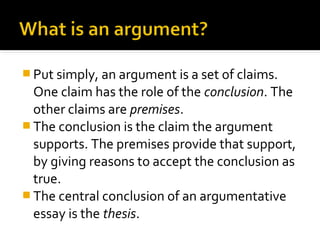
 Put simply, an argument is a set of claims.
One claim has the role of the conclusion. The
other claims are premises.
 The conclusion is the claim the argument
supports. The premises provide that support,
by giving reasons to accept the conclusion as
true.
 The central conclusion of an argumentative
essay is the thesis.
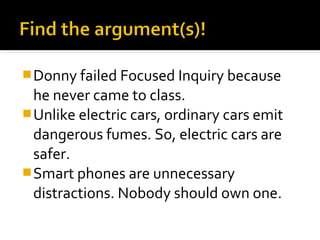
Donny failed Focused Inquiry because
he never came to class.
Unlike electric cars, ordinary cars emit
dangerous fumes. So, electric cars are
safer.
Smart phones are unnecessary
distractions. Nobody should own one.
 In general, we understand a single argument
to have a single conclusion. If you have a text
where two conclusions are drawn, then you
can identify two separate arguments, even if
they share premises.
 Conclusions are often (but not always)
marked with key terms or phrases such as
“Thus,…”, “So,…”, “It follows that…”, etc.
 The premises of an argument offer reasons to
accept the conclusion.
 Premises are often (but not always) marked with
key terms or phrases such as “Because…”,
“Since…”, “On account of…”, “Due to…”, etc.
 The strength of an argument depends on its
premises, and their relation to the conclusion:
 Are the premises true?
 If they are true, is it still plausible to deny the
conclusion?
 Ralph Nader won nearly 100,000 votes in
Florida in the 2000 presidential election.
 In that election, George W. Bush defeated Al
Gore in Florida by less than 600 votes.
 Therefore, if Ralph Nader had not run for
President in 2000, Al Gore would have won
that election.
 Most arguments rely on unstated
assumptions.
 These are conditions that must be true for the
premises to provide strong support for the
conclusion.
 Example:
This car is brand new and in perfect working
order. So, it’s ready to drive off the lot.
 What does this argument assume?
 Many unstated assumptions are so obvious
that they “go without saying”:
Today is Tuesday. It’s not a holiday, it’s not
summer vacation,and the weather is perfect.
Thus, school will be in session today.
 This argument assumes that the school didn’t
burn down, but that goes without saying!
 Finding the flaw in an argument is often a
matter of identifying questionable
assumptions.
VCU has many expenses. The university’s income from
government funding and student tuition and fees is not
enough to cover those expenses. Therefore, VCU will have to
reduce its expenses, or lose money.
 What does this argument assume?
 To identify an assumption, imagine how the
conclusion could be false, even if the premises are
true. What would also have to be true for the
conclusion to be false?
VCU has huge expenses each year. The university’s income from government
funding and student tuition and fees is not enough to cover those expenses.
Therefore, VCU will have to reduce its expenses, or lose money.
 Here, the conclusion could be false if VCU has
another significant source of revenue.
 So, the argument assumes that VCU has no other
significant source of revenue.
 To criticize an argument is to question
whether the conclusion gains any real
support from its premises
 There are two fundamental approaches to
criticizing arguments
 Showing that one or more of the premises is false
 Showing that the conclusion does not follow from
the premises
▪ Frequently, this will involve demonstrating that a key
assumption is false.
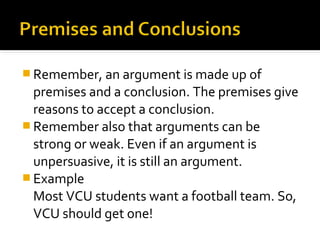
 Remember, an argument is made up of
premises and a conclusion. The premises give
reasons to accept a conclusion.
 Remember also that arguments can be
strong or weak. Even if an argument is
unpersuasive, it is still an argument.
 Example
Most VCU students want a football team. So,
VCU should get one!
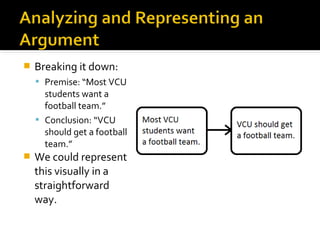
 Breaking it down:
 Premise: “Most VCU
students want a
football team.”
 Conclusion: “VCU
should get a football
team.”
 We could represent
this visually in a
straightforward
way.
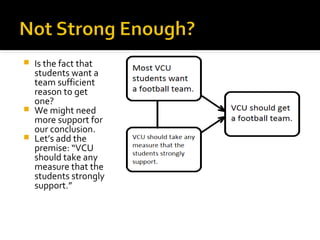
 Is the fact that
students want a
team sufficient
reason to get
one?
 We might need
more support for
our conclusion.
 Let’s add the
premise: “VCU
should take any
measure that the
students strongly
support.”
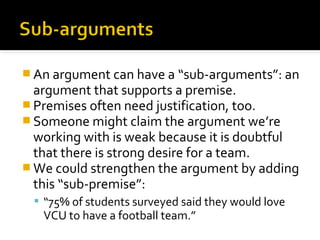
 An argument can have a “sub-arguments”: an
argument that supports a premise.
 Premises often need justification, too.
 Someone might claim the argument we’re
working with is weak because it is doubtful
that there is strong desire for a team.
 We could strengthen the argument by adding
this “sub-premise”:
 “75% of students surveyed said they would love
VCU to have a football team.”
Why the Difference in Organization?
[Answer: The bar indicates that the premises are intended
to work together. When there’s no bar, it means that the
premises are independent.]

Notes on making arguments

  • 1.
  • 2.
     Put simply,an argument is a set of claims. One claim has the role of the conclusion. The other claims are premises.  The conclusion is the claim the argument supports. The premises provide that support, by giving reasons to accept the conclusion as true.  The central conclusion of an argumentative essay is the thesis.
  • 3.
    Donny failed FocusedInquiry because he never came to class. Unlike electric cars, ordinary cars emit dangerous fumes. So, electric cars are safer. Smart phones are unnecessary distractions. Nobody should own one.
  • 4.
     In general,we understand a single argument to have a single conclusion. If you have a text where two conclusions are drawn, then you can identify two separate arguments, even if they share premises.  Conclusions are often (but not always) marked with key terms or phrases such as “Thus,…”, “So,…”, “It follows that…”, etc.
  • 5.
     The premisesof an argument offer reasons to accept the conclusion.  Premises are often (but not always) marked with key terms or phrases such as “Because…”, “Since…”, “On account of…”, “Due to…”, etc.  The strength of an argument depends on its premises, and their relation to the conclusion:  Are the premises true?  If they are true, is it still plausible to deny the conclusion?
  • 6.
     Ralph Naderwon nearly 100,000 votes in Florida in the 2000 presidential election.  In that election, George W. Bush defeated Al Gore in Florida by less than 600 votes.  Therefore, if Ralph Nader had not run for President in 2000, Al Gore would have won that election.
  • 7.
     Most argumentsrely on unstated assumptions.  These are conditions that must be true for the premises to provide strong support for the conclusion.  Example: This car is brand new and in perfect working order. So, it’s ready to drive off the lot.  What does this argument assume?
  • 8.
     Many unstatedassumptions are so obvious that they “go without saying”: Today is Tuesday. It’s not a holiday, it’s not summer vacation,and the weather is perfect. Thus, school will be in session today.  This argument assumes that the school didn’t burn down, but that goes without saying!
  • 9.
     Finding theflaw in an argument is often a matter of identifying questionable assumptions. VCU has many expenses. The university’s income from government funding and student tuition and fees is not enough to cover those expenses. Therefore, VCU will have to reduce its expenses, or lose money.  What does this argument assume?
  • 10.
     To identifyan assumption, imagine how the conclusion could be false, even if the premises are true. What would also have to be true for the conclusion to be false? VCU has huge expenses each year. The university’s income from government funding and student tuition and fees is not enough to cover those expenses. Therefore, VCU will have to reduce its expenses, or lose money.  Here, the conclusion could be false if VCU has another significant source of revenue.  So, the argument assumes that VCU has no other significant source of revenue.
  • 11.
     To criticizean argument is to question whether the conclusion gains any real support from its premises  There are two fundamental approaches to criticizing arguments  Showing that one or more of the premises is false  Showing that the conclusion does not follow from the premises ▪ Frequently, this will involve demonstrating that a key assumption is false.
  • 13.
     Remember, anargument is made up of premises and a conclusion. The premises give reasons to accept a conclusion.  Remember also that arguments can be strong or weak. Even if an argument is unpersuasive, it is still an argument.  Example Most VCU students want a football team. So, VCU should get one!
  • 14.
     Breaking itdown:  Premise: “Most VCU students want a football team.”  Conclusion: “VCU should get a football team.”  We could represent this visually in a straightforward way.
  • 15.
     Is thefact that students want a team sufficient reason to get one?  We might need more support for our conclusion.  Let’s add the premise: “VCU should take any measure that the students strongly support.”
  • 16.
     An argumentcan have a “sub-arguments”: an argument that supports a premise.  Premises often need justification, too.  Someone might claim the argument we’re working with is weak because it is doubtful that there is strong desire for a team.  We could strengthen the argument by adding this “sub-premise”:  “75% of students surveyed said they would love VCU to have a football team.”
  • 18.
    Why the Differencein Organization? [Answer: The bar indicates that the premises are intended to work together. When there’s no bar, it means that the premises are independent.]