2
Overview
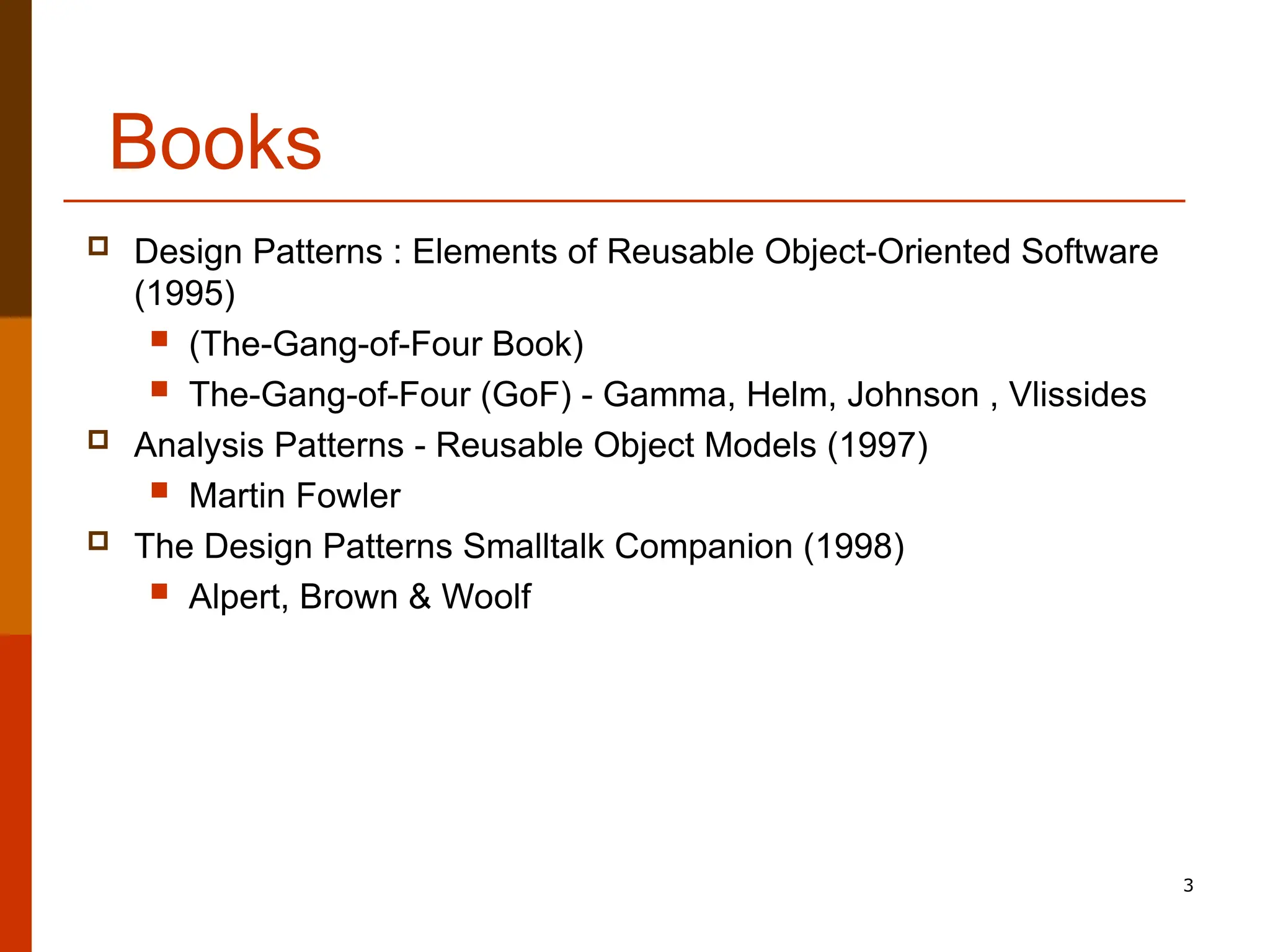
Books
DesignPatterns – Basics
Structural Design Patterns
Behavioral Design Patterns
Appendix: More on the Observer Pattern
More on the Strategy Pattern
3.
3
Books
Design Patterns: Elements of Reusable Object-Oriented Software
(1995)
(The-Gang-of-Four Book)
The-Gang-of-Four (GoF) - Gamma, Helm, Johnson , Vlissides
Analysis Patterns - Reusable Object Models (1997)
Martin Fowler
The Design Patterns Smalltalk Companion (1998)
Alpert, Brown & Woolf
4.
4
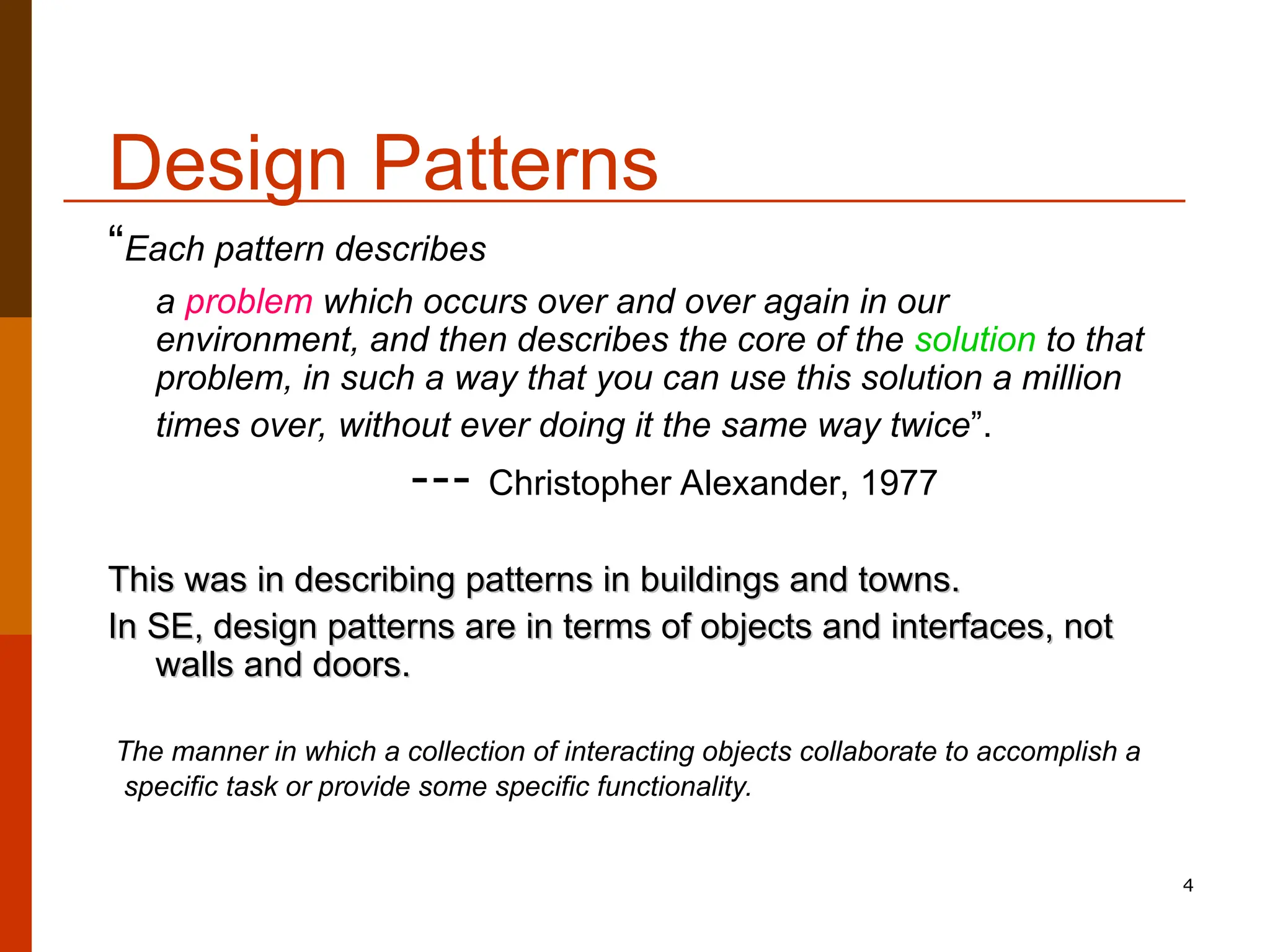
Design Patterns
“Each patterndescribes
a problem which occurs over and over again in our
environment, and then describes the core of the solution to that
problem, in such a way that you can use this solution a million
times over, without ever doing it the same way twice”.
--- Christopher Alexander, 1977
This was in describing patterns in buildings and towns.
This was in describing patterns in buildings and towns.
In SE, design patterns are in terms of objects and interfaces, not
In SE, design patterns are in terms of objects and interfaces, not
walls and doors.
walls and doors.
The manner in which a collection of interacting objects collaborate to accomplish a
specific task or provide some specific functionality.
5.
5
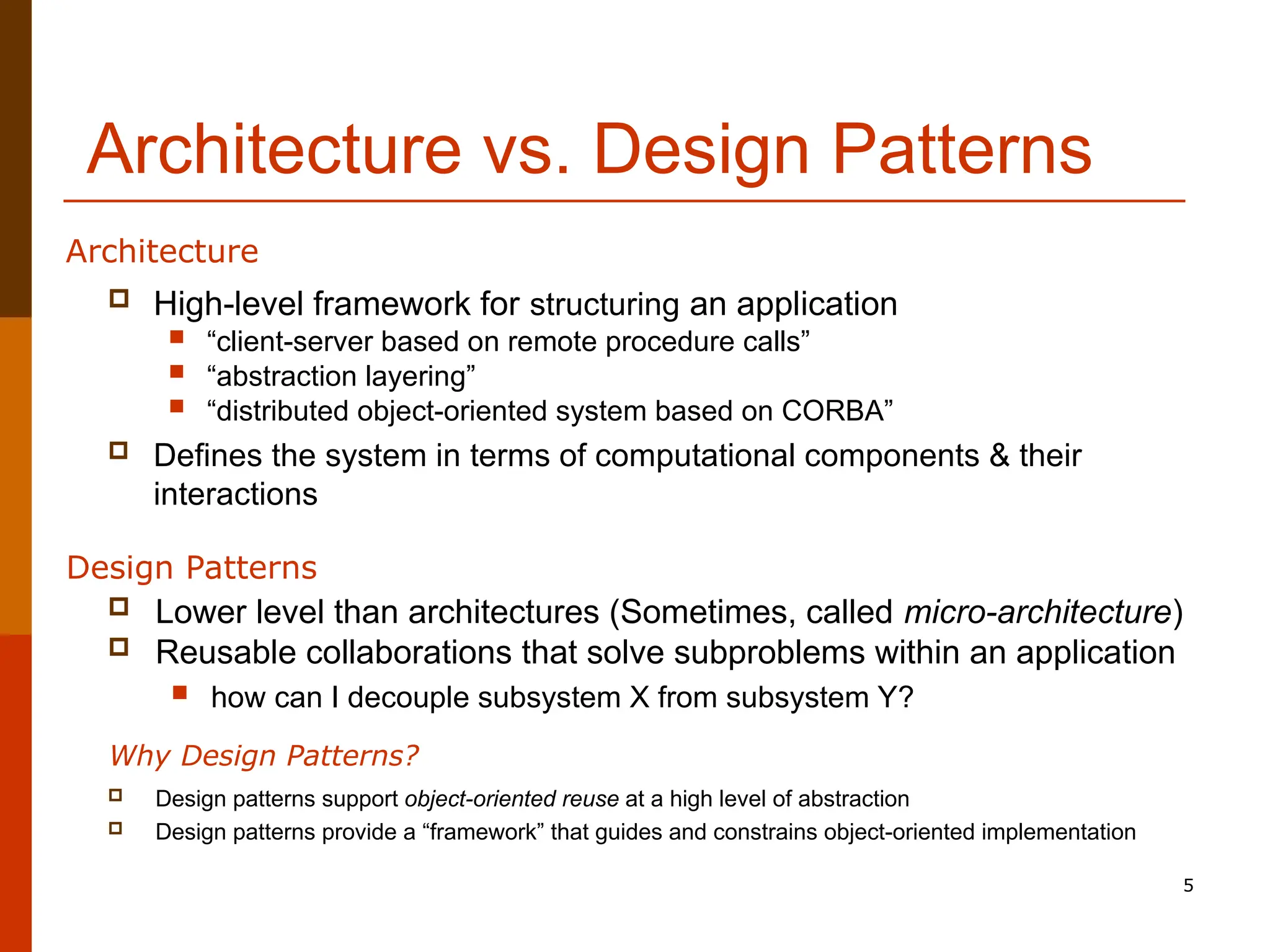
Architecture vs. DesignPatterns
High-level framework for structuring an application
“client-server based on remote procedure calls”
“abstraction layering”
“distributed object-oriented system based on CORBA”
Defines the system in terms of computational components & their
interactions
Architecture
Design Patterns
Lower level than architectures (Sometimes, called micro-architecture)
Reusable collaborations that solve subproblems within an application
how can I decouple subsystem X from subsystem Y?
Design patterns support object-oriented reuse at a high level of abstraction
Design patterns provide a “framework” that guides and constrains object-oriented implementation
Why Design Patterns?
6.
6
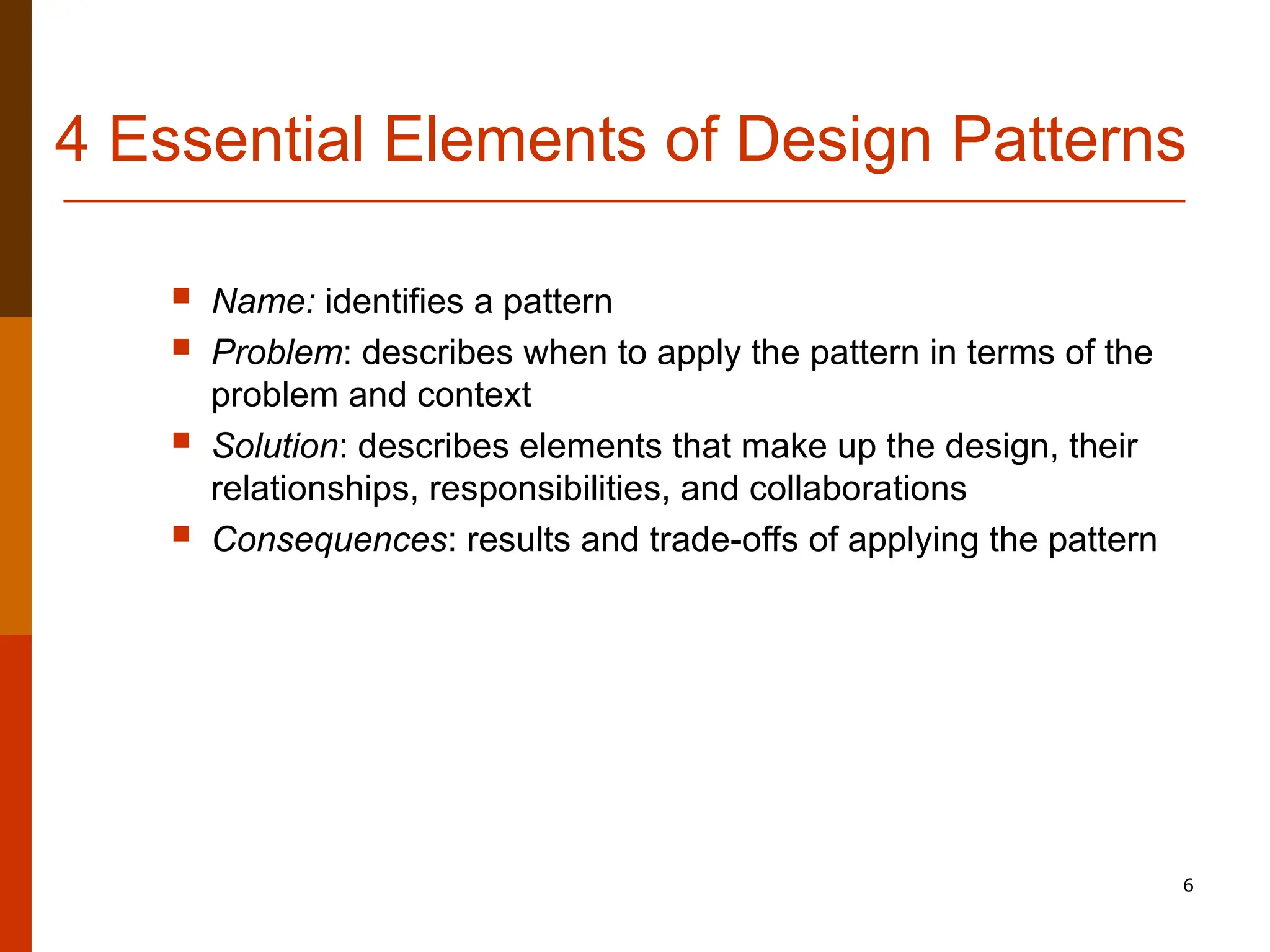
4 Essential Elementsof Design Patterns
Name: identifies a pattern
Problem: describes when to apply the pattern in terms of the
problem and context
Solution: describes elements that make up the design, their
relationships, responsibilities, and collaborations
Consequences: results and trade-offs of applying the pattern
7.
7
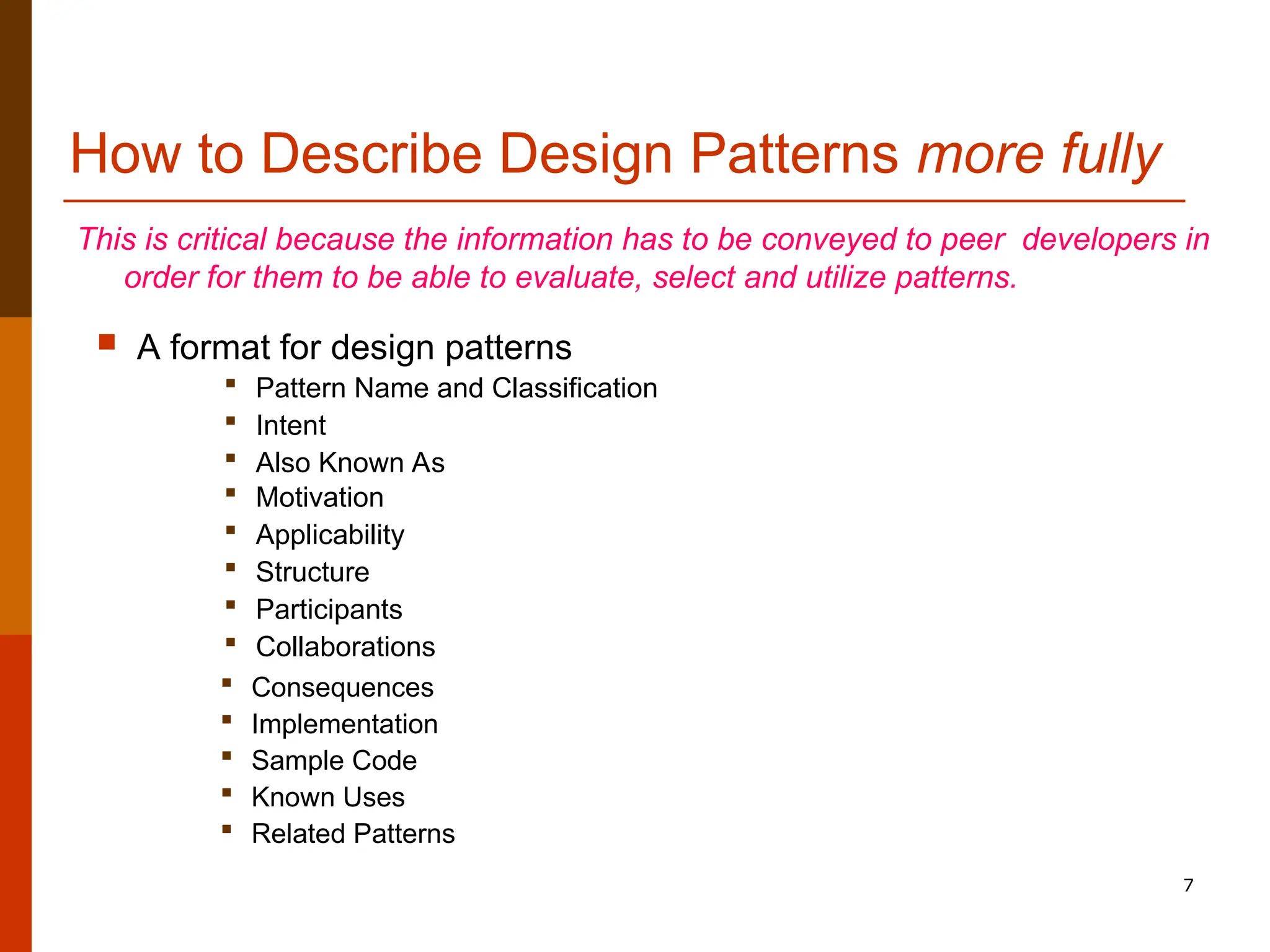
How to DescribeDesign Patterns more fully
This is critical because the information has to be conveyed to peer developers in
order for them to be able to evaluate, select and utilize patterns.
A format for design patterns
Pattern Name and Classification
Intent
Also Known As
Motivation
Applicability
Structure
Participants
Collaborations
Consequences
Implementation
Sample Code
Known Uses
Related Patterns
8.
8
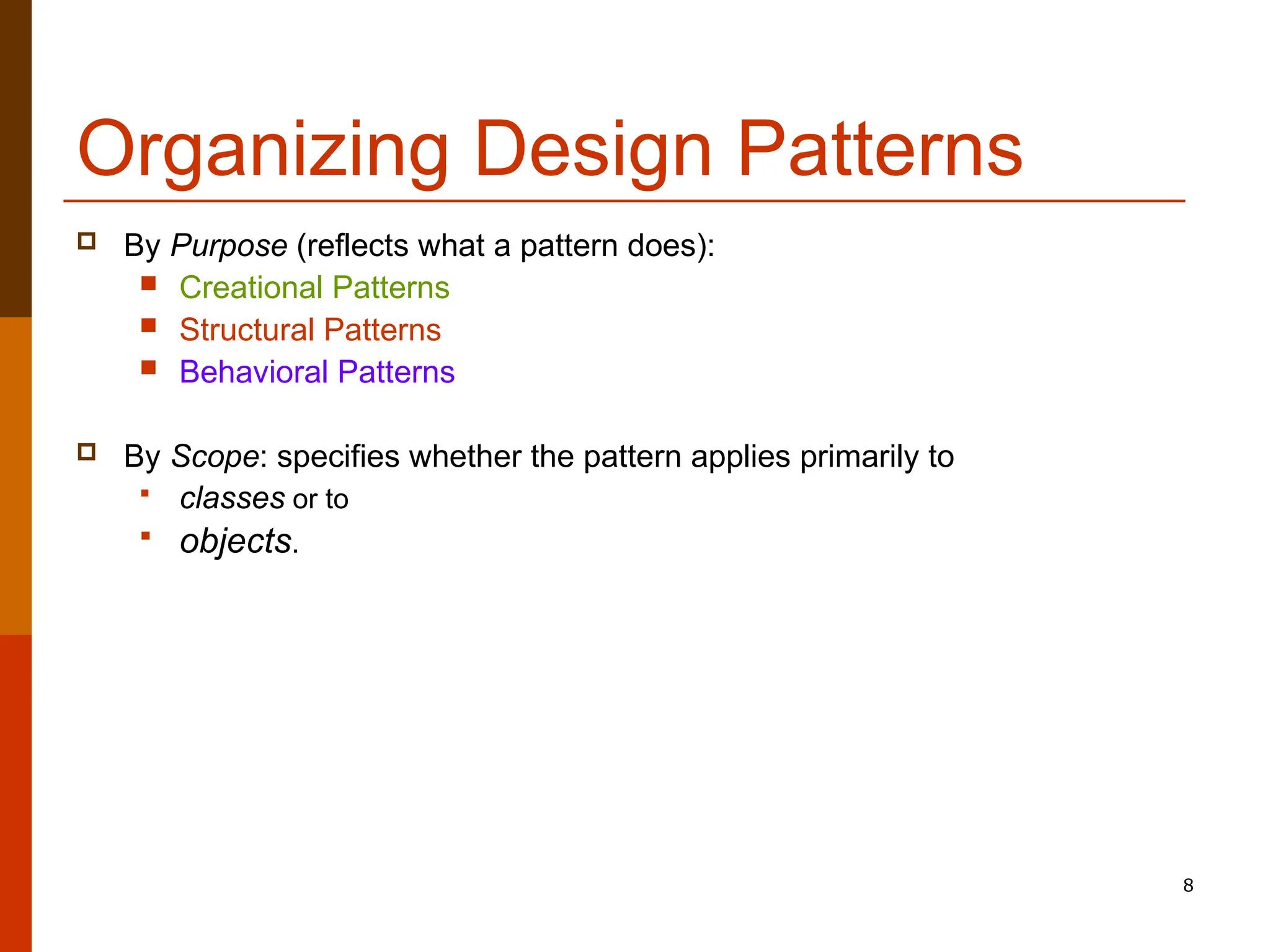
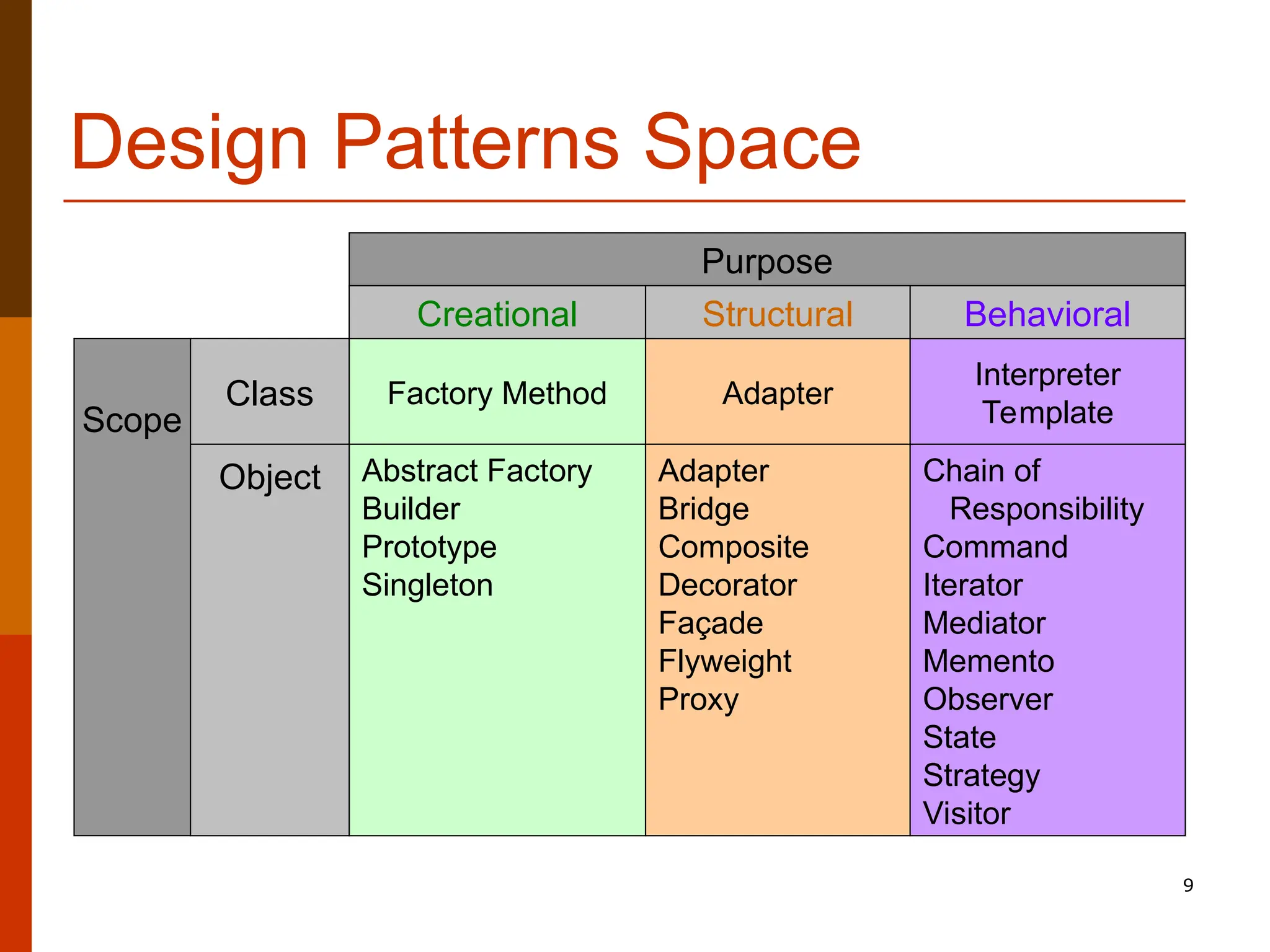
Organizing Design Patterns
By Purpose (reflects what a pattern does):
Creational Patterns
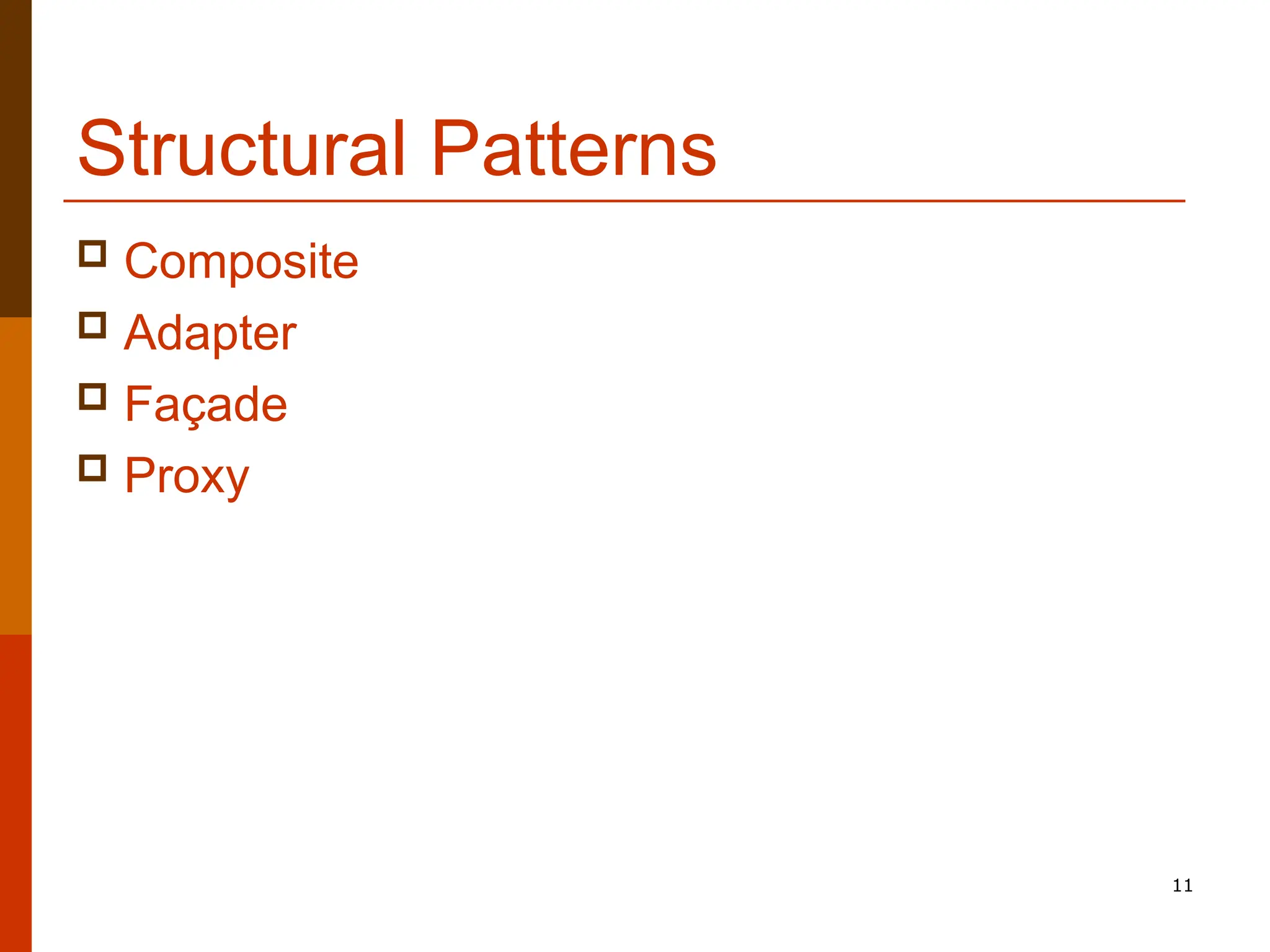
Structural Patterns
Behavioral Patterns
By Scope: specifies whether the pattern applies primarily to
classes or to
objects.
9.
9
Design Patterns Space
AbstractFactory
Builder
Prototype
Singleton
Adapter
Bridge
Composite
Decorator
Façade
Flyweight
Proxy
Chain of
Responsibility
Command
Iterator
Mediator
Memento
Observer
State
Strategy
Visitor
Factory Method Adapter
Interpreter
Template
Creational Structural Behavioral
Object
Class
Scope
Purpose
10.
10
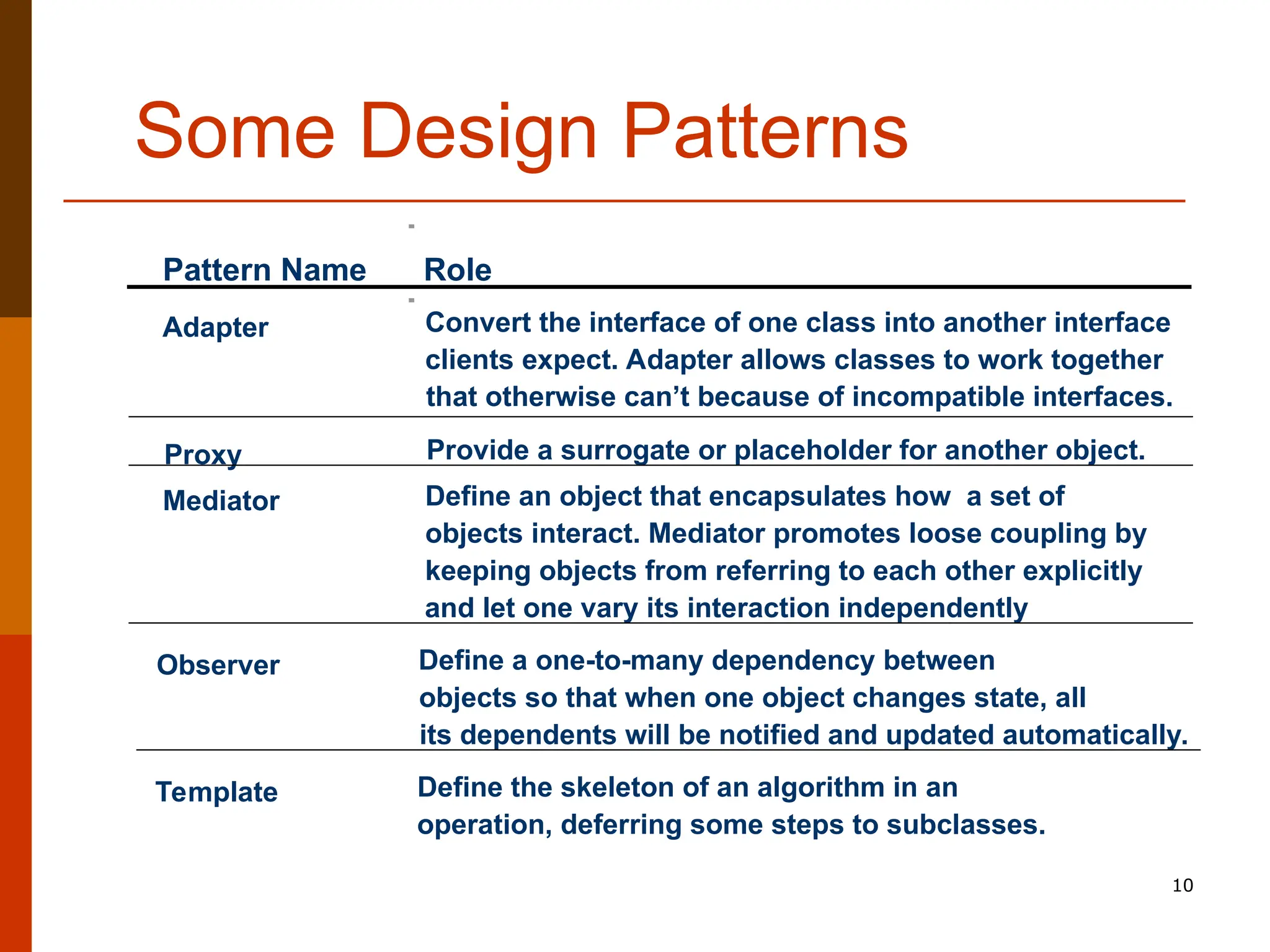
Some Design Patterns
PatternName Role
Adapter Convert the interface of one class into another interface
clients expect. Adapter allows classes to work together
that otherwise can’t because of incompatible interfaces.
Proxy Provide a surrogate or placeholder for another object.
Mediator Define an object that encapsulates how a set of
objects interact. Mediator promotes loose coupling by
keeping objects from referring to each other explicitly
and let one vary its interaction independently
Observer Define a one-to-many dependency between
objects so that when one object changes state, all
its dependents will be notified and updated automatically.
Template Define the skeleton of an algorithm in an
operation, deferring some steps to subclasses.
12
Structural Patterns -Composite
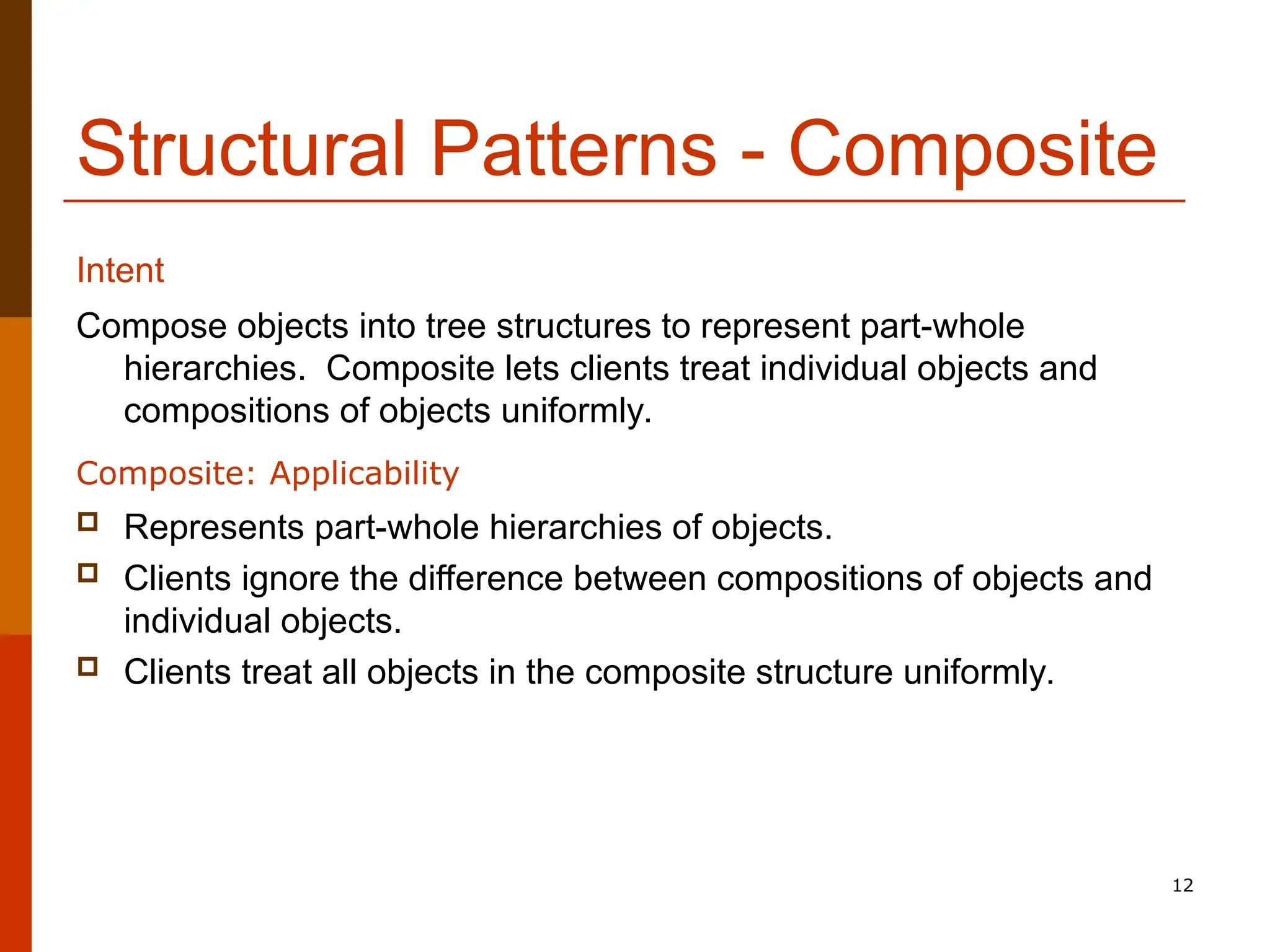
Compose objects into tree structures to represent part-whole
hierarchies. Composite lets clients treat individual objects and
compositions of objects uniformly.
Composite: Applicability
Represents part-whole hierarchies of objects.
Clients ignore the difference between compositions of objects and
individual objects.
Clients treat all objects in the composite structure uniformly.
Intent
13.
13
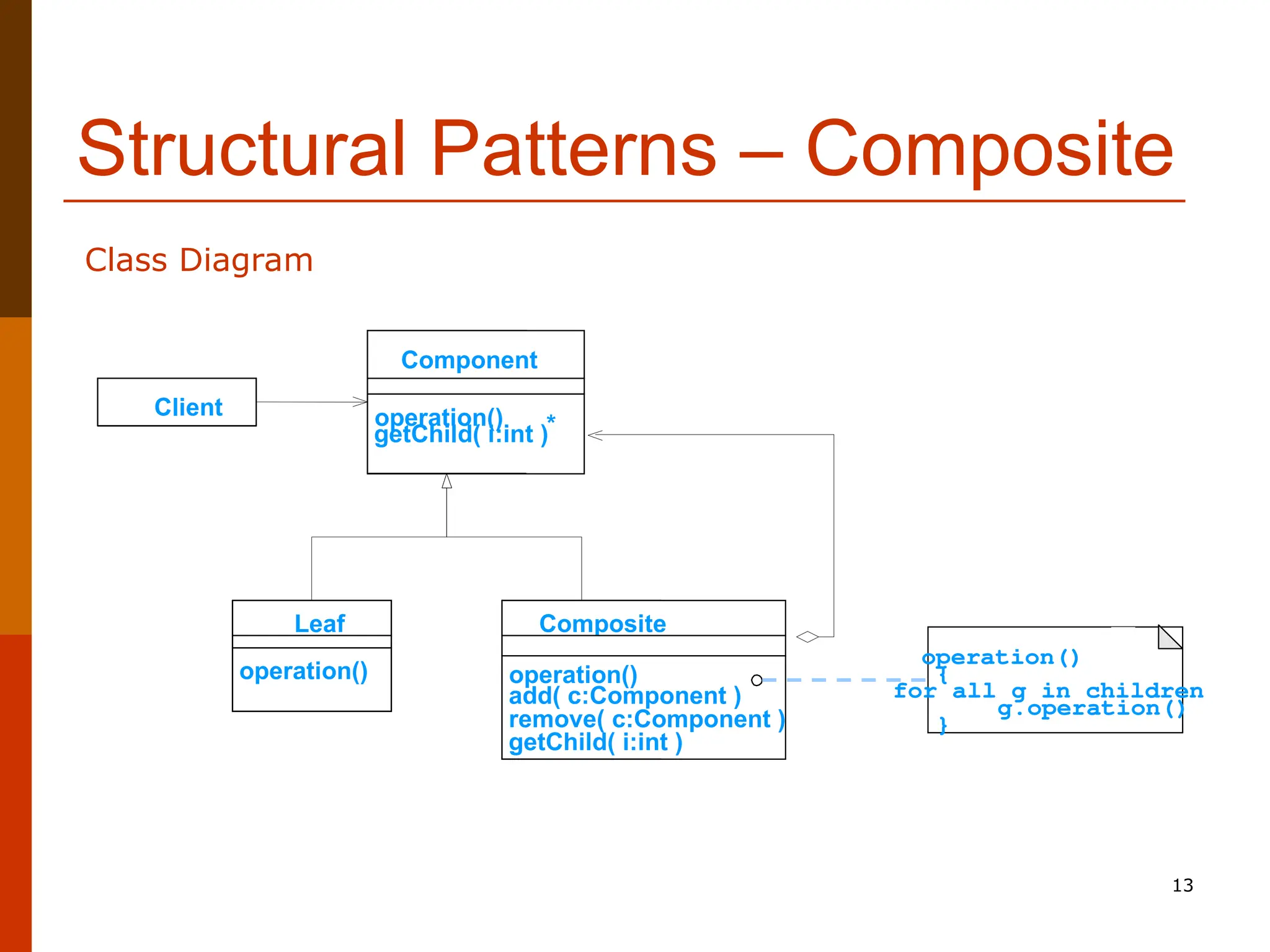
Structural Patterns –Composite
Class Diagram
Client
Component
operation()
getChild( i:int )
Leaf
operation()
Composite
operation()
add( c:Component )
remove( c:Component )
getChild( i:int )
operation()
{
for all g in children
g.operation()
}
*
14.
14
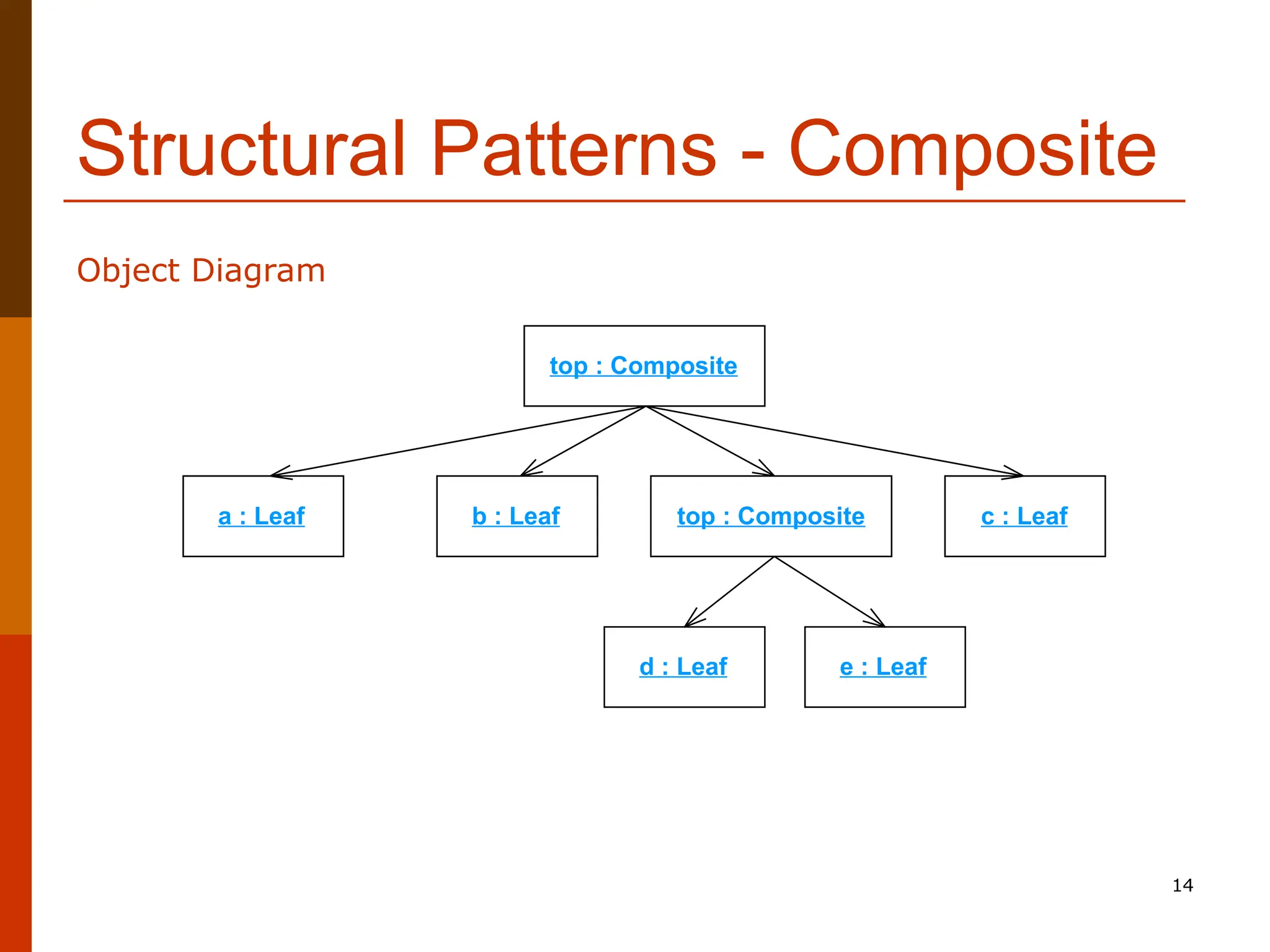
Structural Patterns -Composite
Object Diagram
top : Composite
top : Composite
a : Leaf b : Leaf c : Leaf
d : Leaf e : Leaf
15.
15
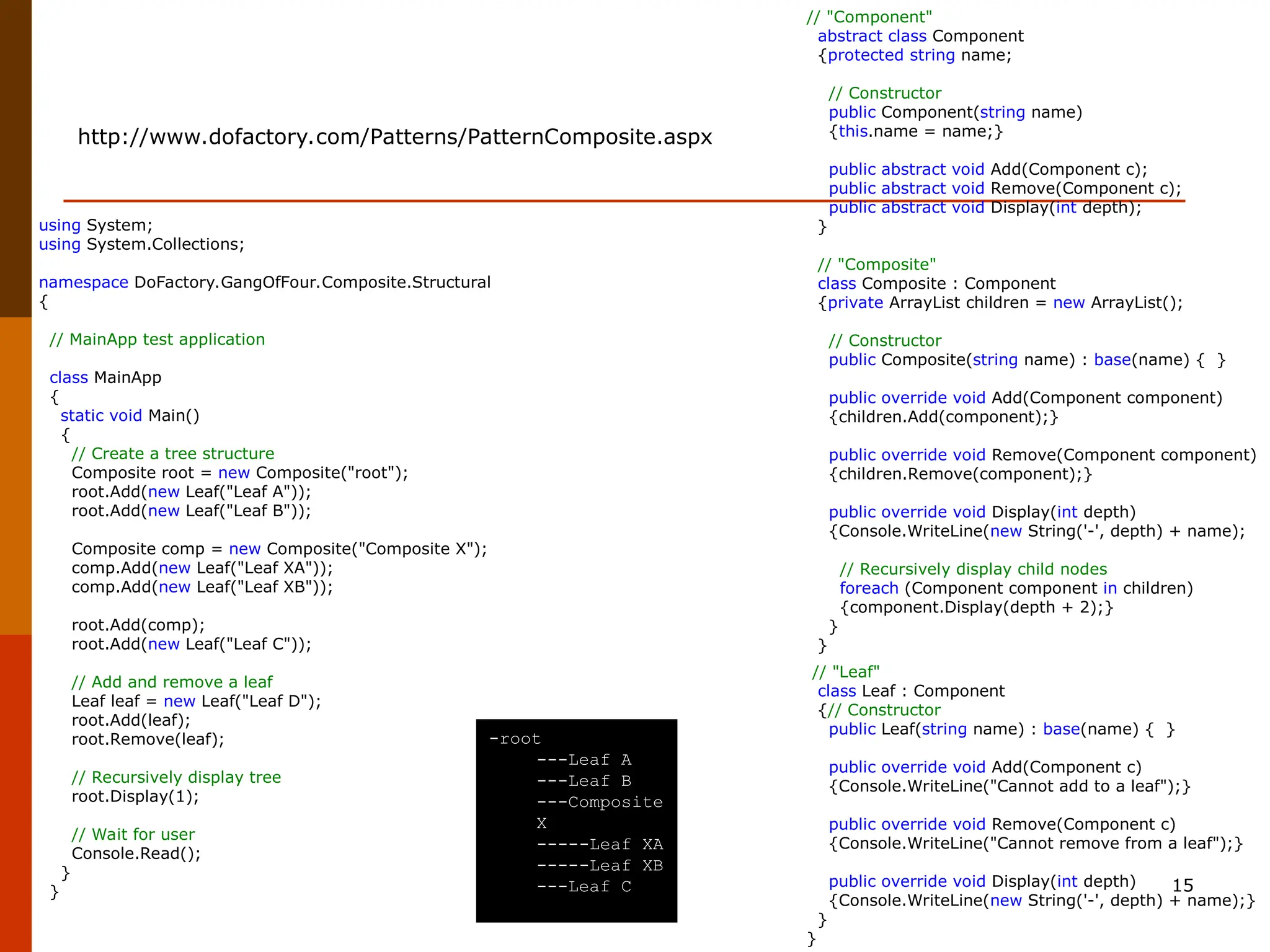
-root
---Leaf A
---Leaf B
---Composite
X
-----LeafXA
-----Leaf XB
---Leaf C
using System;
using System.Collections;
namespace DoFactory.GangOfFour.Composite.Structural
{
// MainApp test application
class MainApp
{
static void Main()
{
// Create a tree structure
Composite root = new Composite("root");
root.Add(new Leaf("Leaf A"));
root.Add(new Leaf("Leaf B"));
Composite comp = new Composite("Composite X");
comp.Add(new Leaf("Leaf XA"));
comp.Add(new Leaf("Leaf XB"));
root.Add(comp);
root.Add(new Leaf("Leaf C"));
// Add and remove a leaf
Leaf leaf = new Leaf("Leaf D");
root.Add(leaf);
root.Remove(leaf);
// Recursively display tree
root.Display(1);
// Wait for user
Console.Read();
}
}
// "Component"
abstract class Component
{protected string name;
// Constructor
public Component(string name)
{this.name = name;}
public abstract void Add(Component c);
public abstract void Remove(Component c);
public abstract void Display(int depth);
}
// "Composite"
class Composite : Component
{private ArrayList children = new ArrayList();
// Constructor
public Composite(string name) : base(name) { }
public override void Add(Component component)
{children.Add(component);}
public override void Remove(Component component)
{children.Remove(component);}
public override void Display(int depth)
{Console.WriteLine(new String('-', depth) + name);
// Recursively display child nodes
foreach (Component component in children)
{component.Display(depth + 2);}
}
}
// "Leaf"
class Leaf : Component
{// Constructor
public Leaf(string name) : base(name) { }
public override void Add(Component c)
{Console.WriteLine("Cannot add to a leaf");}
public override void Remove(Component c)
{Console.WriteLine("Cannot remove from a leaf");}
public override void Display(int depth)
{Console.WriteLine(new String('-', depth) + name);}
}
}
http://www.dofactory.com/Patterns/PatternComposite.aspx
16.
16
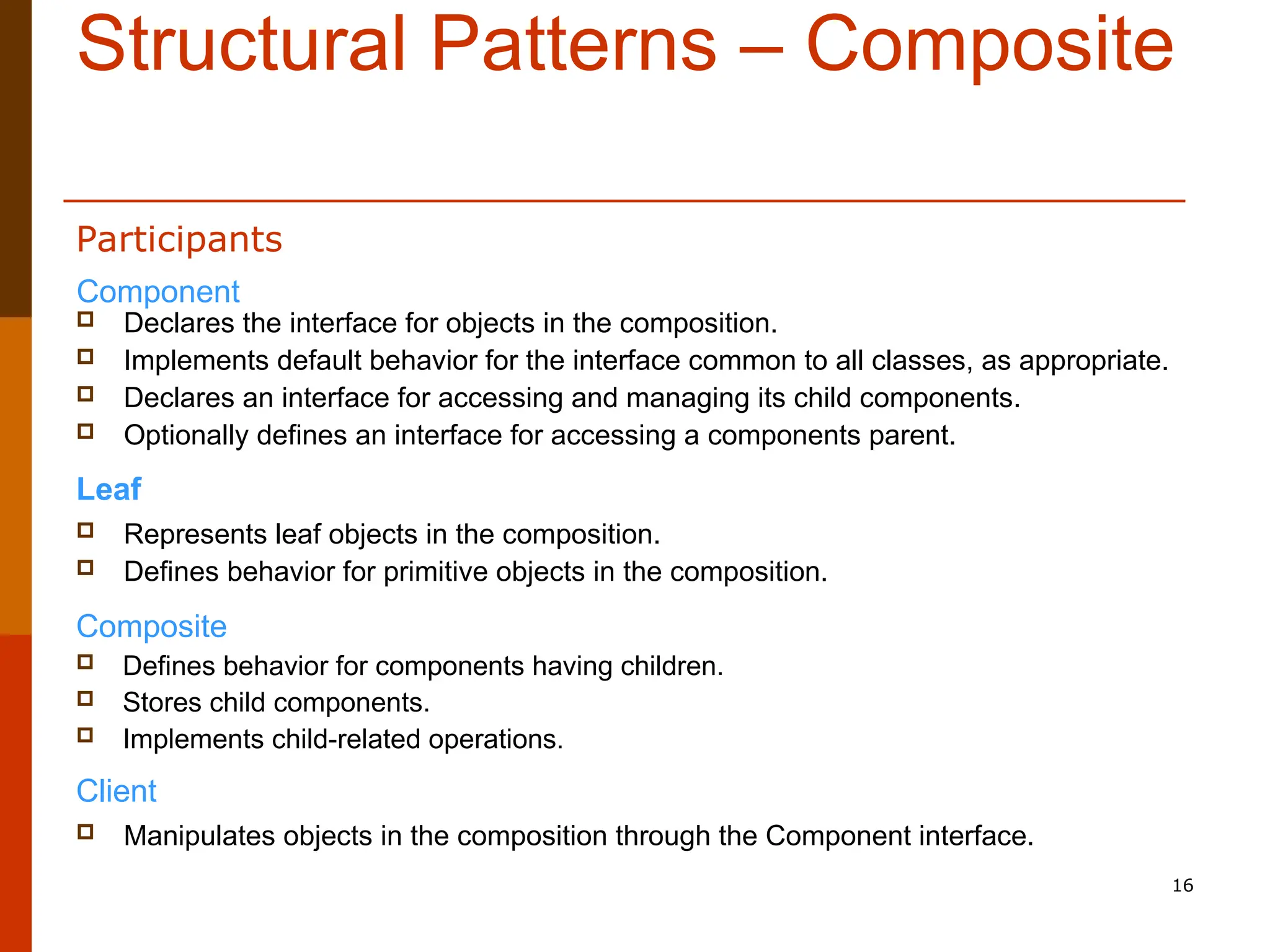
Structural Patterns –Composite
Declares the interface for objects in the composition.
Implements default behavior for the interface common to all classes, as appropriate.
Declares an interface for accessing and managing its child components.
Optionally defines an interface for accessing a components parent.
Leaf
Represents leaf objects in the composition.
Defines behavior for primitive objects in the composition.
Composite
Defines behavior for components having children.
Stores child components.
Implements child-related operations.
Client
Manipulates objects in the composition through the Component interface.
Component
Participants
17.
17
Structural Patterns –Composite
Clients use the Component class interface to interact with objects in
the composite structure.
If the recipient is a Leaf, then the request is handled directly.
If the recipient is a Composite, then it usually forwards requests to
its child components, possibly performing additional operations
before and/or after forwarding.
Collaborations
18.
18
Structural Patterns -Adapter
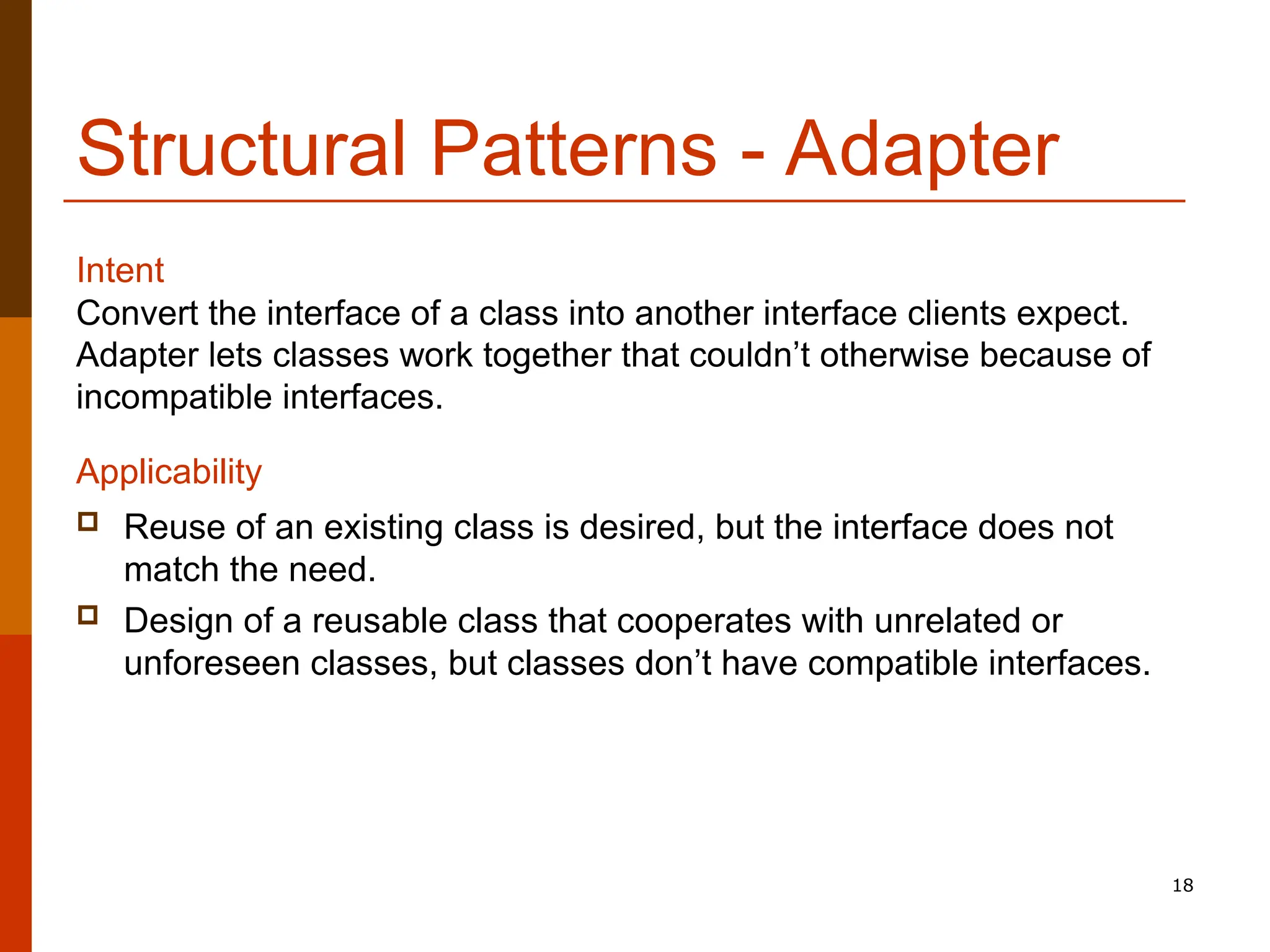
Convert the interface of a class into another interface clients expect.
Adapter lets classes work together that couldn’t otherwise because of
incompatible interfaces.
Applicability
Reuse of an existing class is desired, but the interface does not
match the need.
Design of a reusable class that cooperates with unrelated or
unforeseen classes, but classes don’t have compatible interfaces.
Intent
20
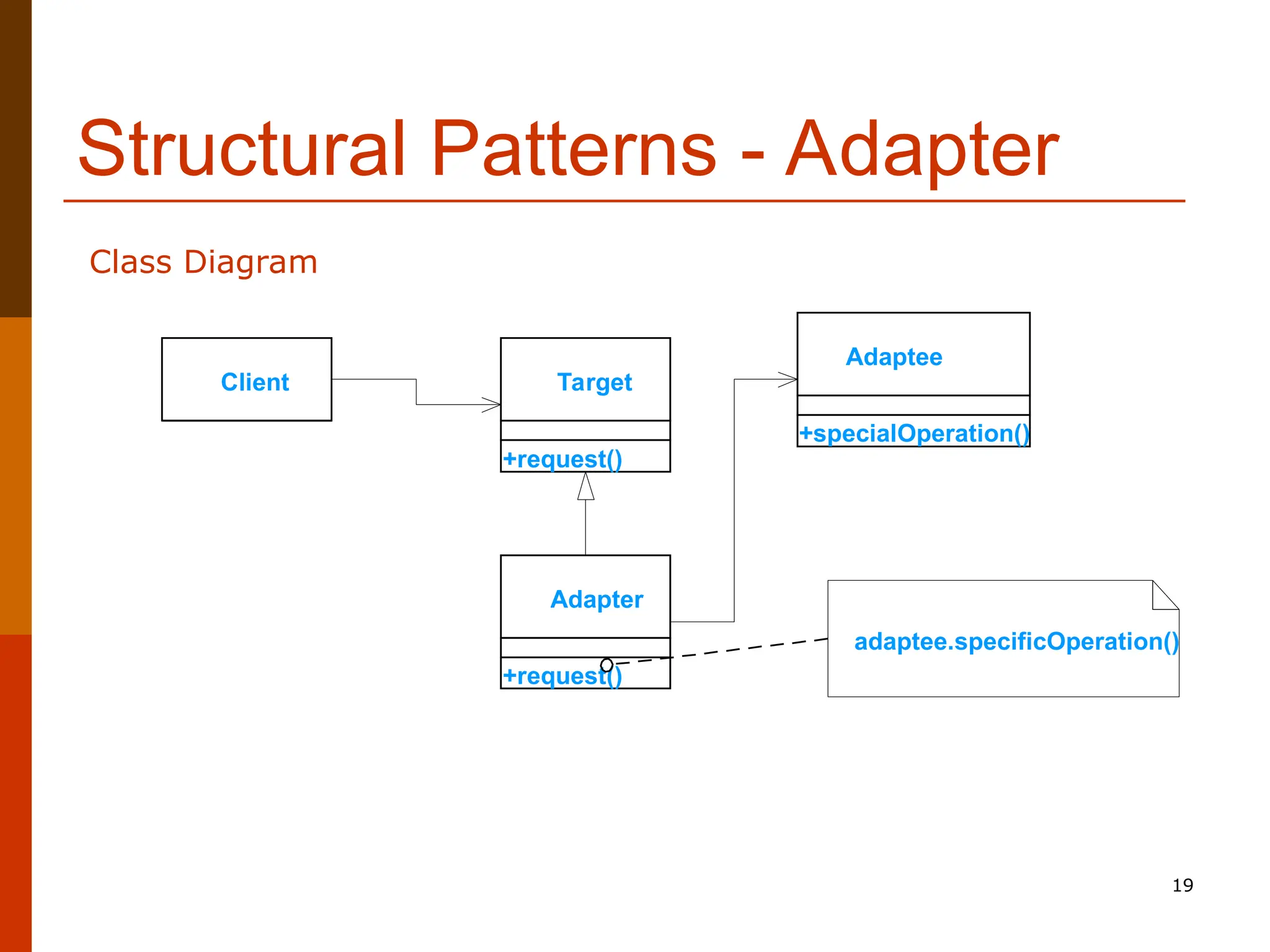
Structural Patterns -Adapter
Target — defines the domain-specific interface that the client uses.
Client — collaborates with objects conforming to the Target interface.
Adaptee — defines an existing interface that needs adapting.
Adapter — adapts the interface of Adaptee to the Target interface.
Participants
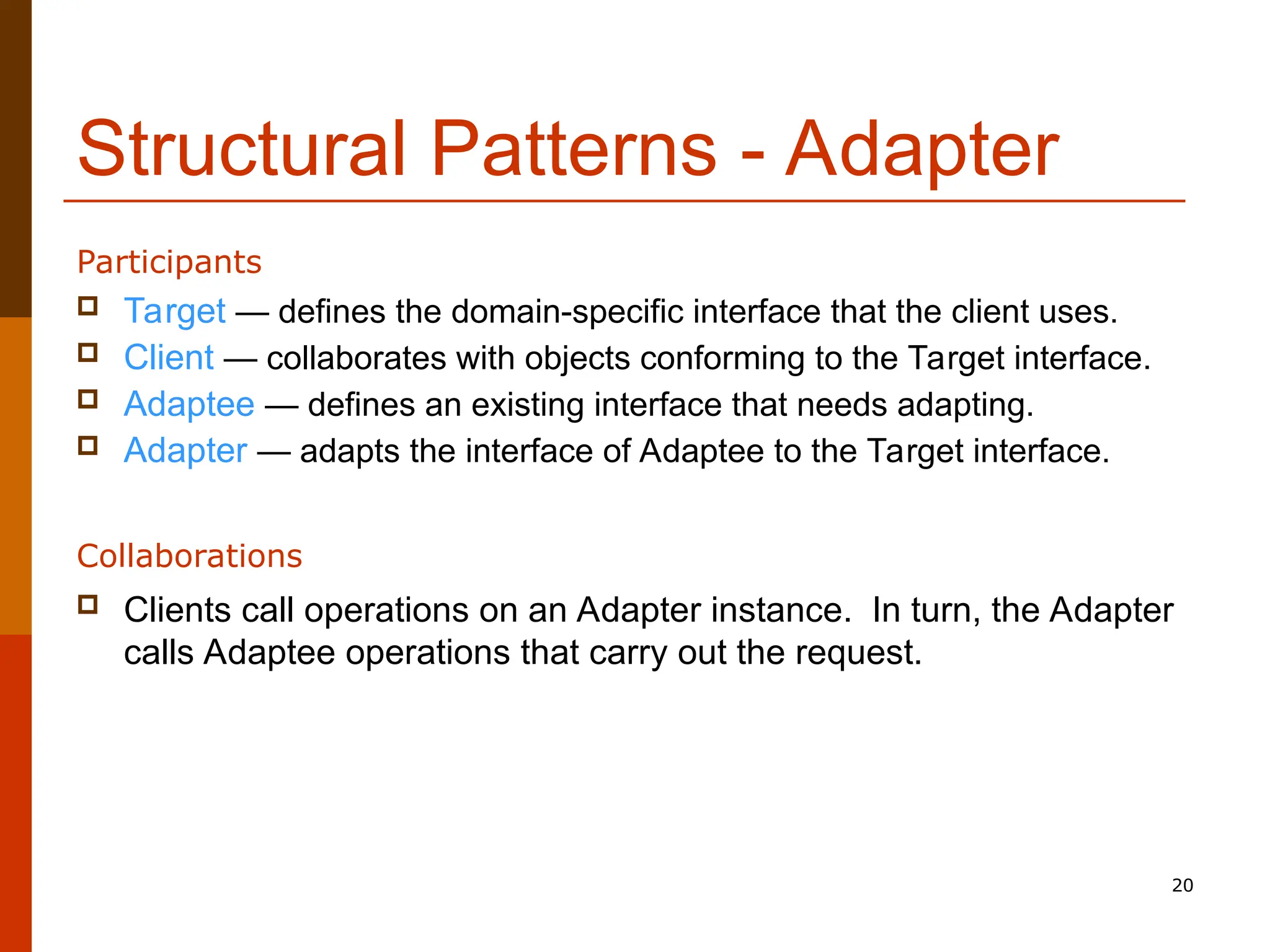
Clients call operations on an Adapter instance. In turn, the Adapter
calls Adaptee operations that carry out the request.
Collaborations
21.
21
Structural Patterns -Façade
Provide a unified interface to a set of interfaces in a subsystem.
Façade defines a higher-level interface that makes the subsystem
easier to use.
Applicability
Provides a simple interface to a complex subsystem.
Decouples the details of a subsystem from clients and other
subsystems.
Provides a layered approach to subsystems.
Intent
23
Structural Patterns -Façade
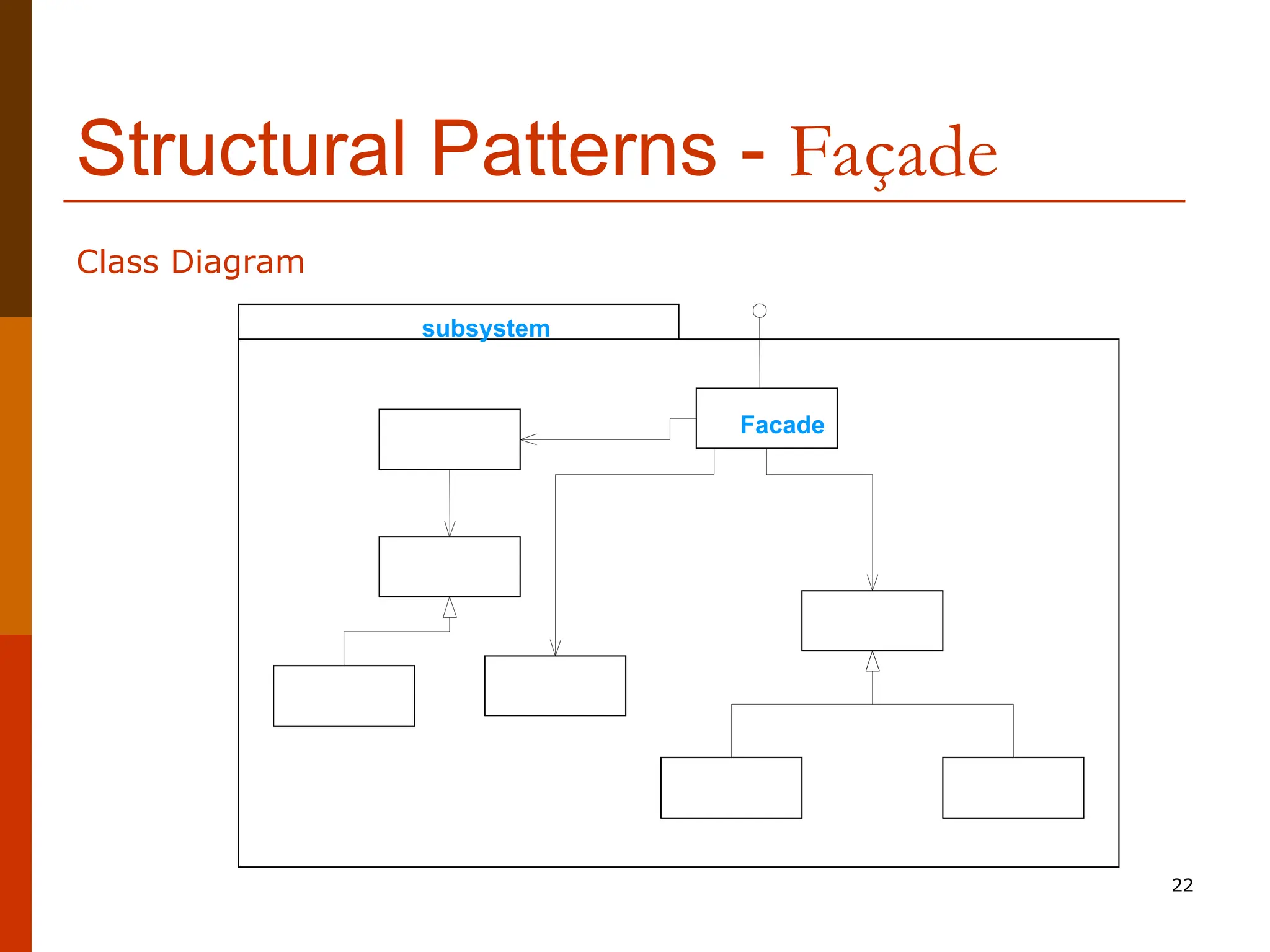
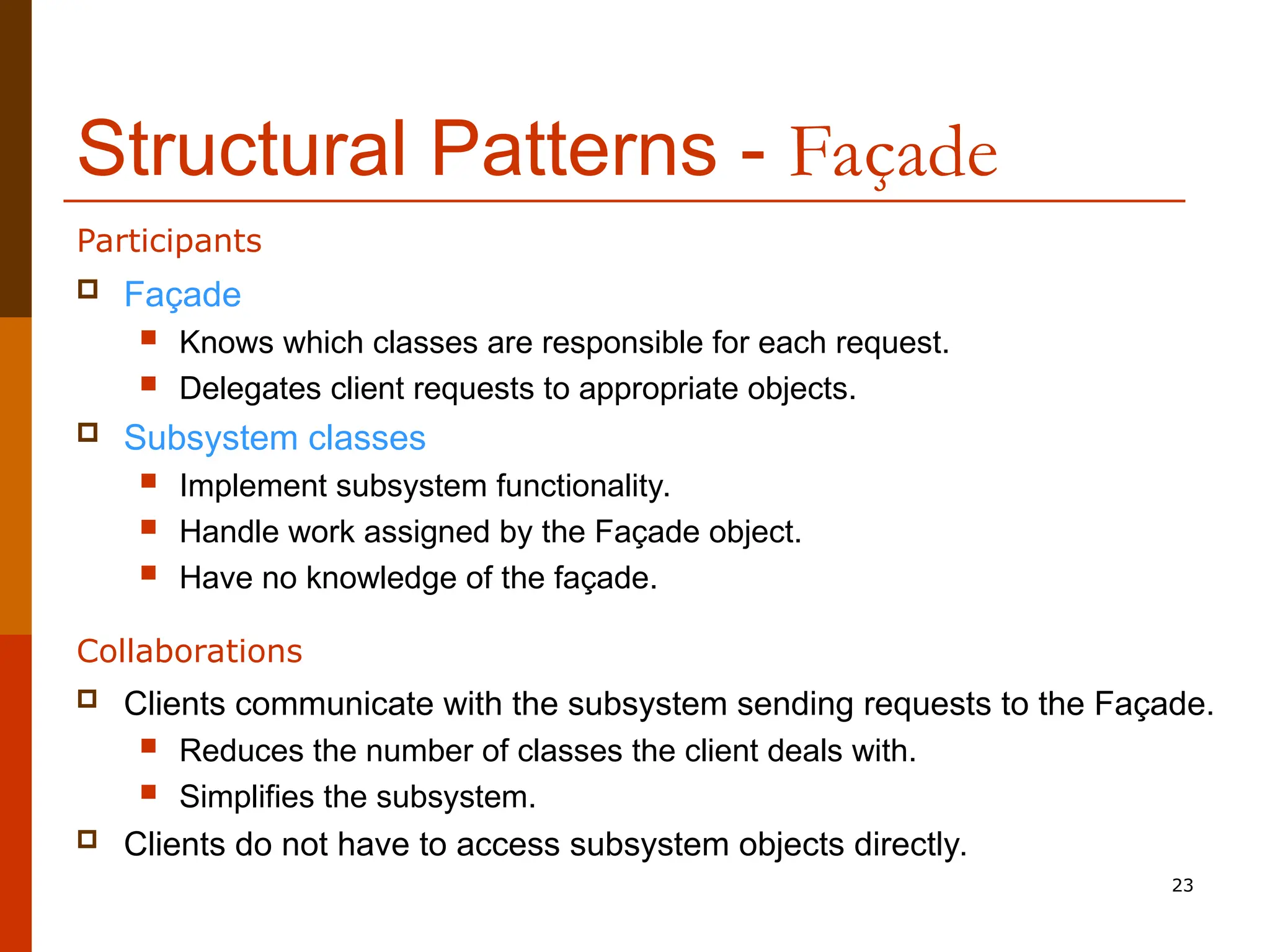
Façade
Knows which classes are responsible for each request.
Delegates client requests to appropriate objects.
Subsystem classes
Implement subsystem functionality.
Handle work assigned by the Façade object.
Have no knowledge of the façade.
Participants
Clients communicate with the subsystem sending requests to the Façade.
Reduces the number of classes the client deals with.
Simplifies the subsystem.
Clients do not have to access subsystem objects directly.
Collaborations
24.
24
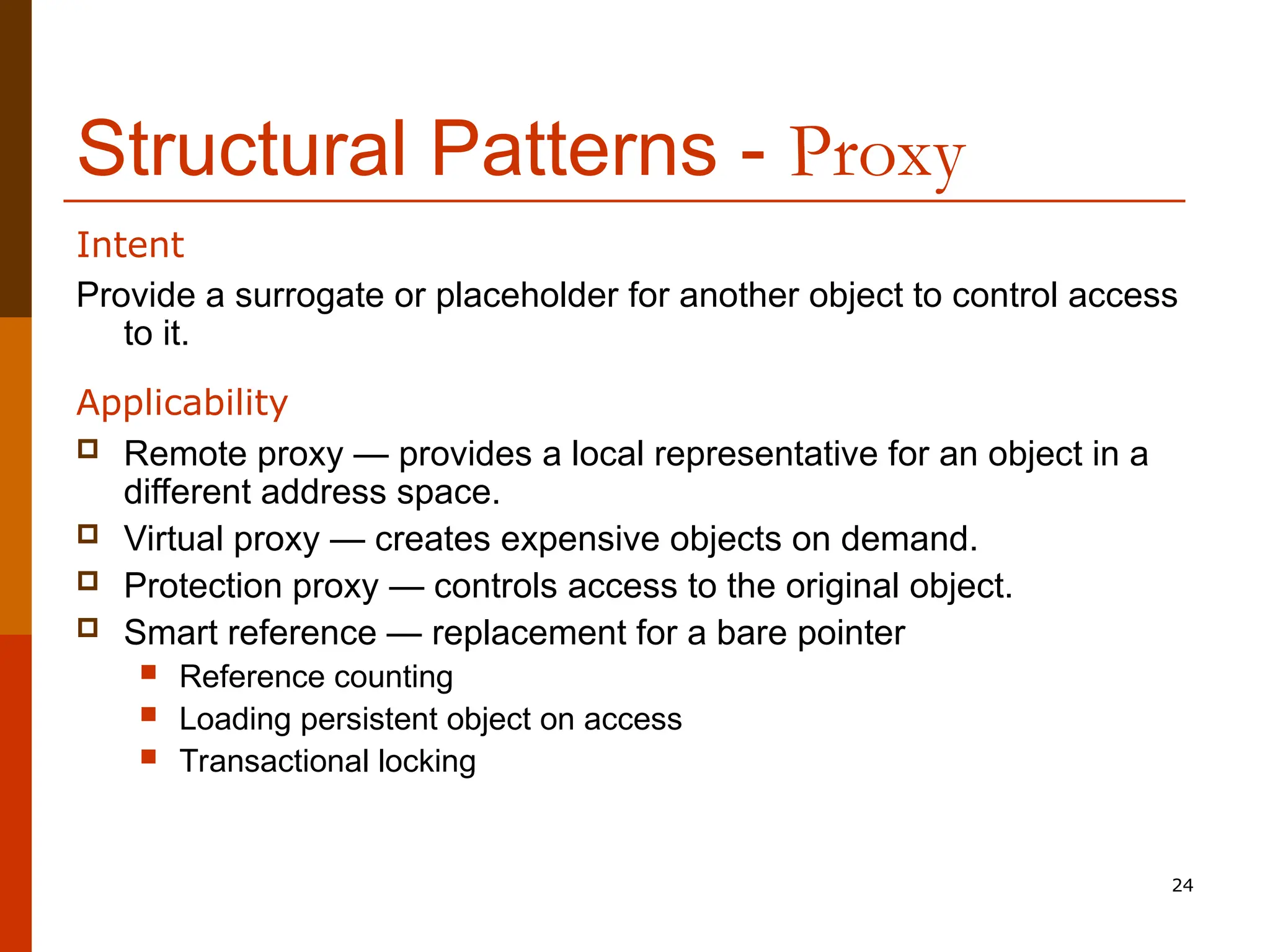
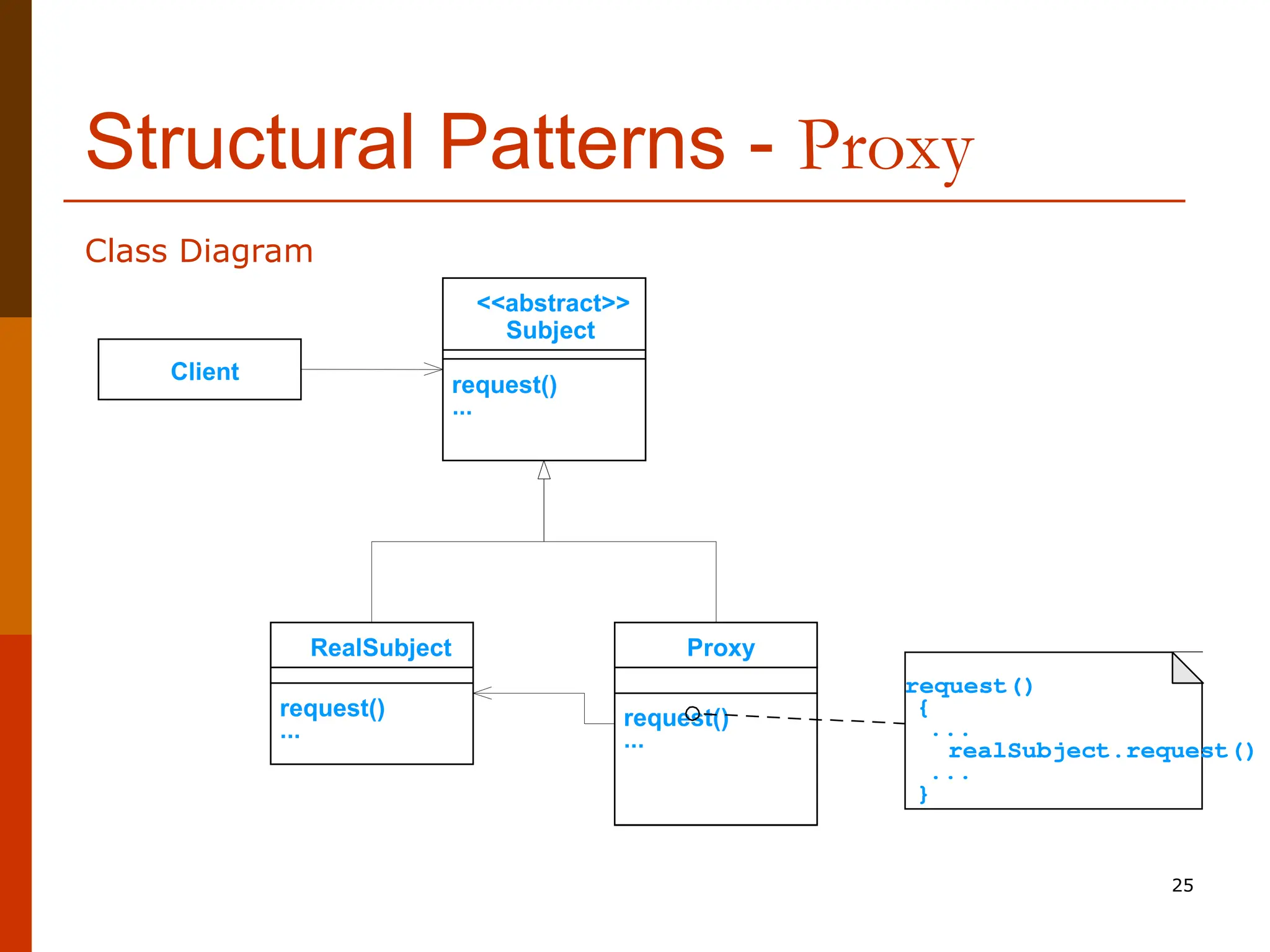
Structural Patterns -Proxy
Provide a surrogate or placeholder for another object to control access
to it.
Applicability
Remote proxy — provides a local representative for an object in a
different address space.
Virtual proxy — creates expensive objects on demand.
Protection proxy — controls access to the original object.
Smart reference — replacement for a bare pointer
Reference counting
Loading persistent object on access
Transactional locking
Intent
27
Structural Patterns -Proxy
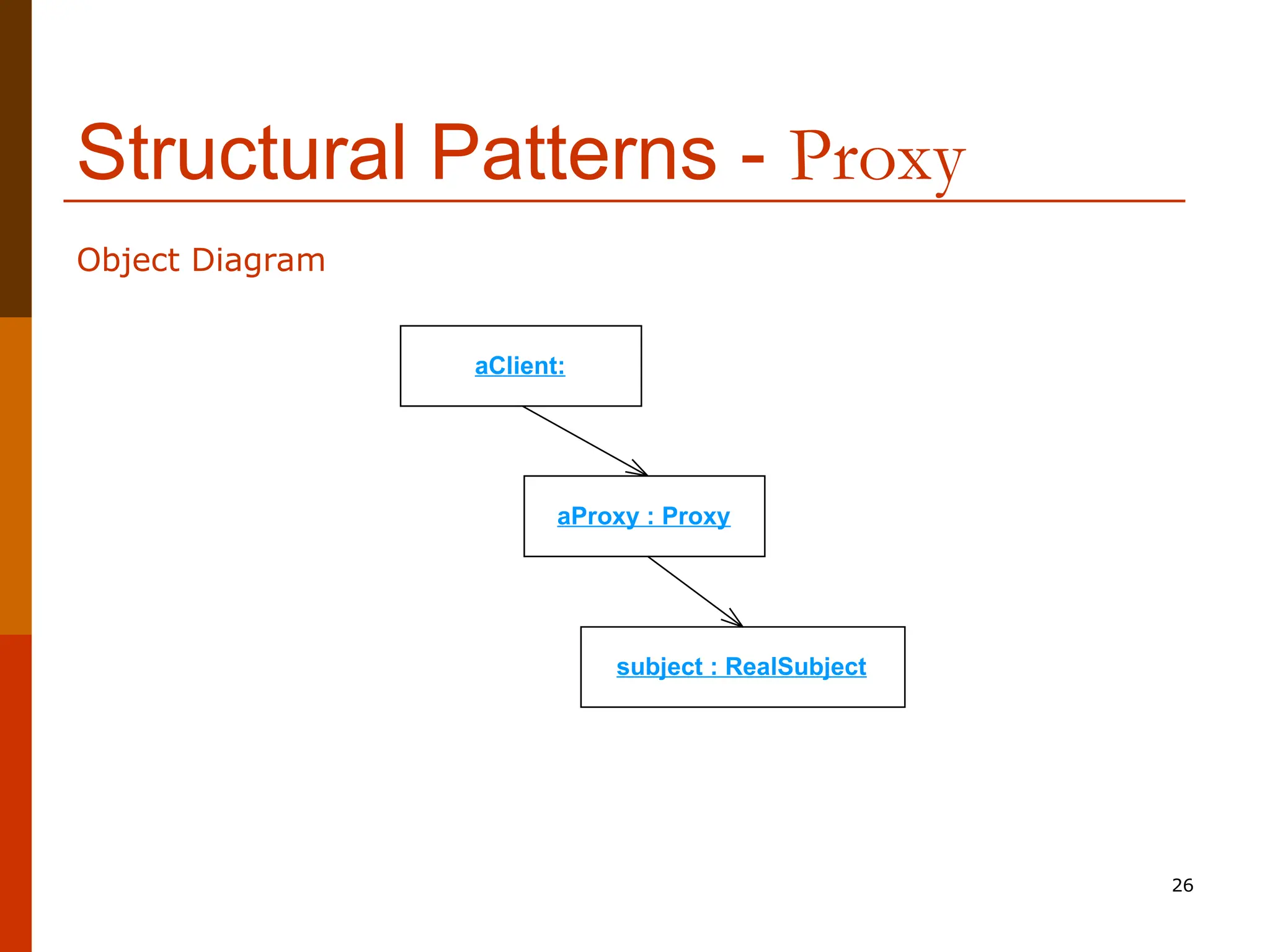
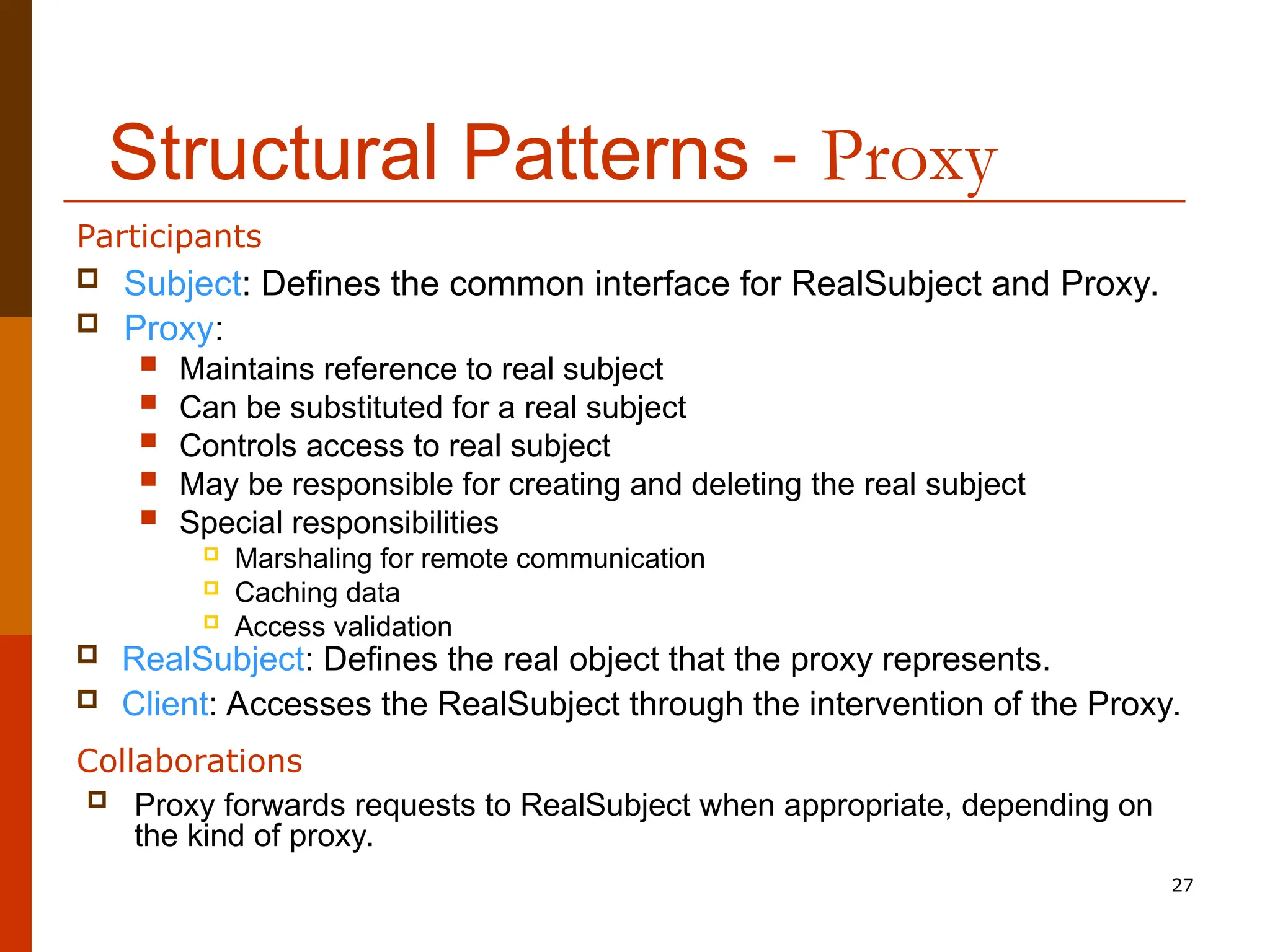
Subject: Defines the common interface for RealSubject and Proxy.
Proxy:
Maintains reference to real subject
Can be substituted for a real subject
Controls access to real subject
May be responsible for creating and deleting the real subject
Special responsibilities
Marshaling for remote communication
Caching data
Access validation
RealSubject: Defines the real object that the proxy represents.
Client: Accesses the RealSubject through the intervention of the Proxy.
Participants
Proxy forwards requests to RealSubject when appropriate, depending on
the kind of proxy.
Collaborations
29
Behavioral Patterns -Observer
Define a one-to-many dependency between objects so that when
one object changes state, all its dependents are notified and
updated automatically.
Intent
An abstraction has two aspects, one dependent on the other.
When changing one object requires changing others, and you don’t
know how many objects need changed.
When an object needs to notify others without knowledge about who
they are.
Applicability
30.
30
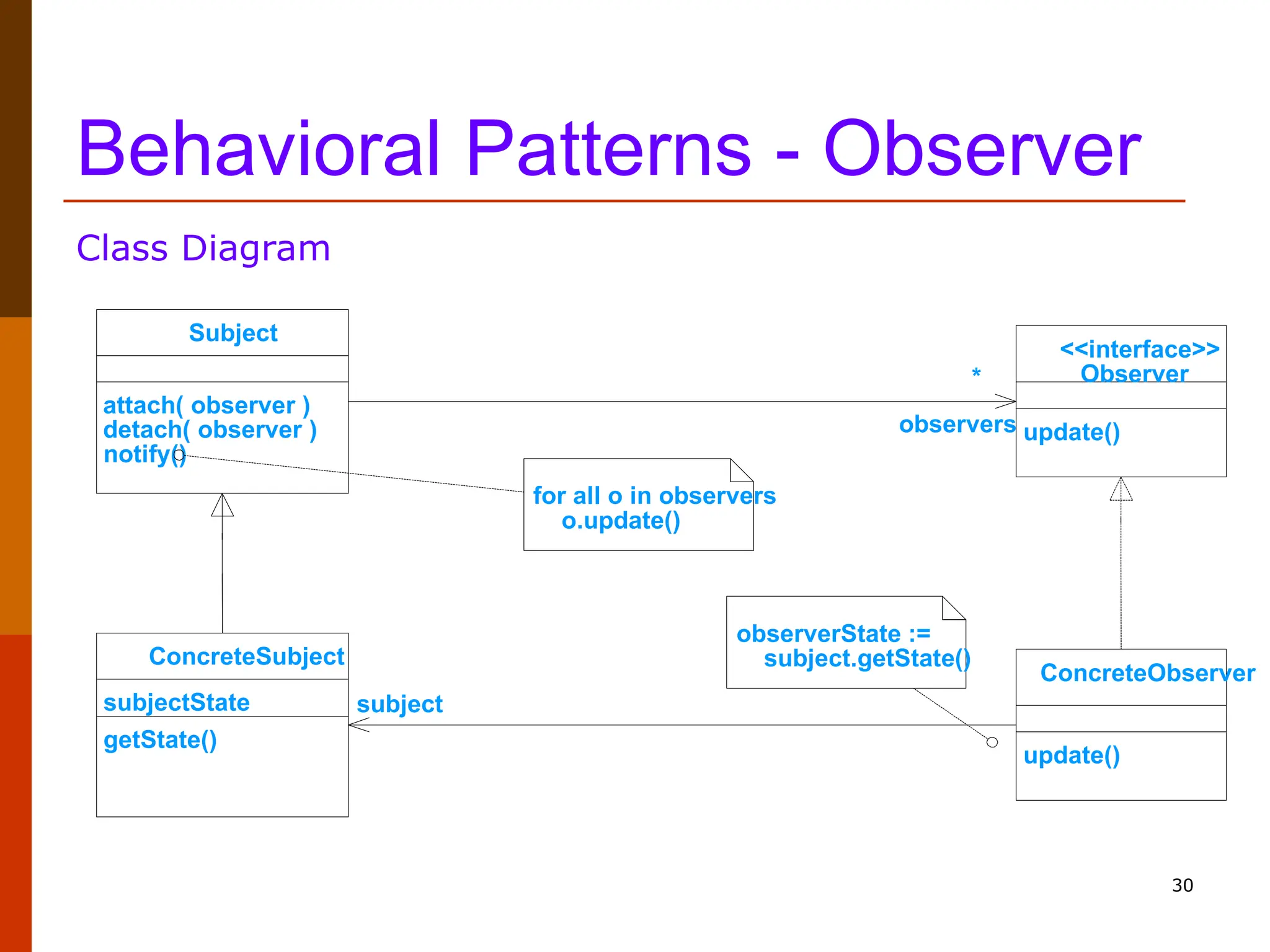
Behavioral Patterns -Observer
Class Diagram
subject
observers
*
update()
ConcreteObserver
attach( observer )
detach( observer )
notify()
Subject
for all o in observers
o.update()
getState()
subjectState
ConcreteSubject
update()
<<interface>>
Observer
observerState :=
subject.getState()
31.
31
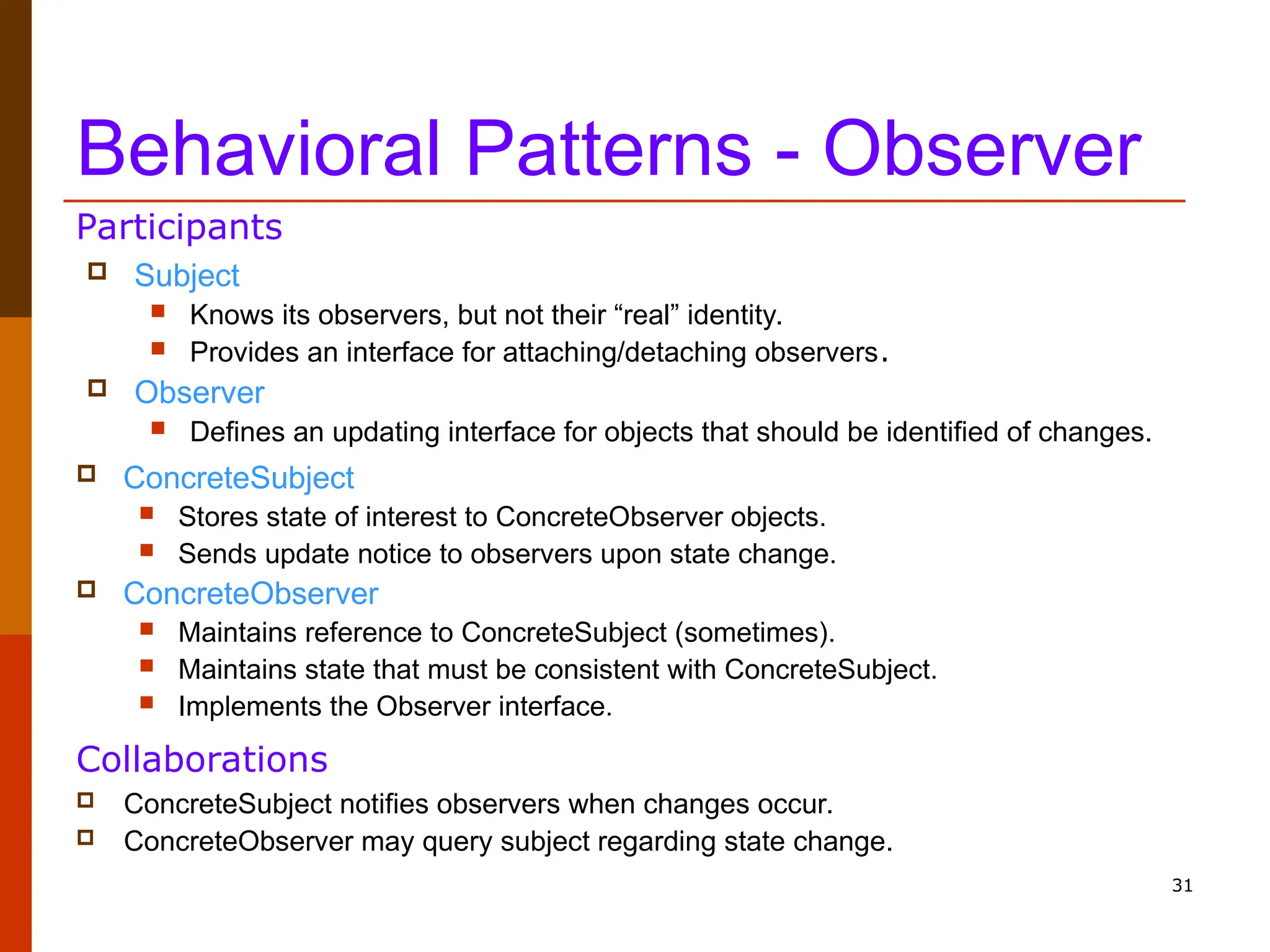
Behavioral Patterns -Observer
Subject
Knows its observers, but not their “real” identity.
Provides an interface for attaching/detaching observers.
Observer
Defines an updating interface for objects that should be identified of changes.
ConcreteSubject
Stores state of interest to ConcreteObserver objects.
Sends update notice to observers upon state change.
ConcreteObserver
Maintains reference to ConcreteSubject (sometimes).
Maintains state that must be consistent with ConcreteSubject.
Implements the Observer interface.
Participants
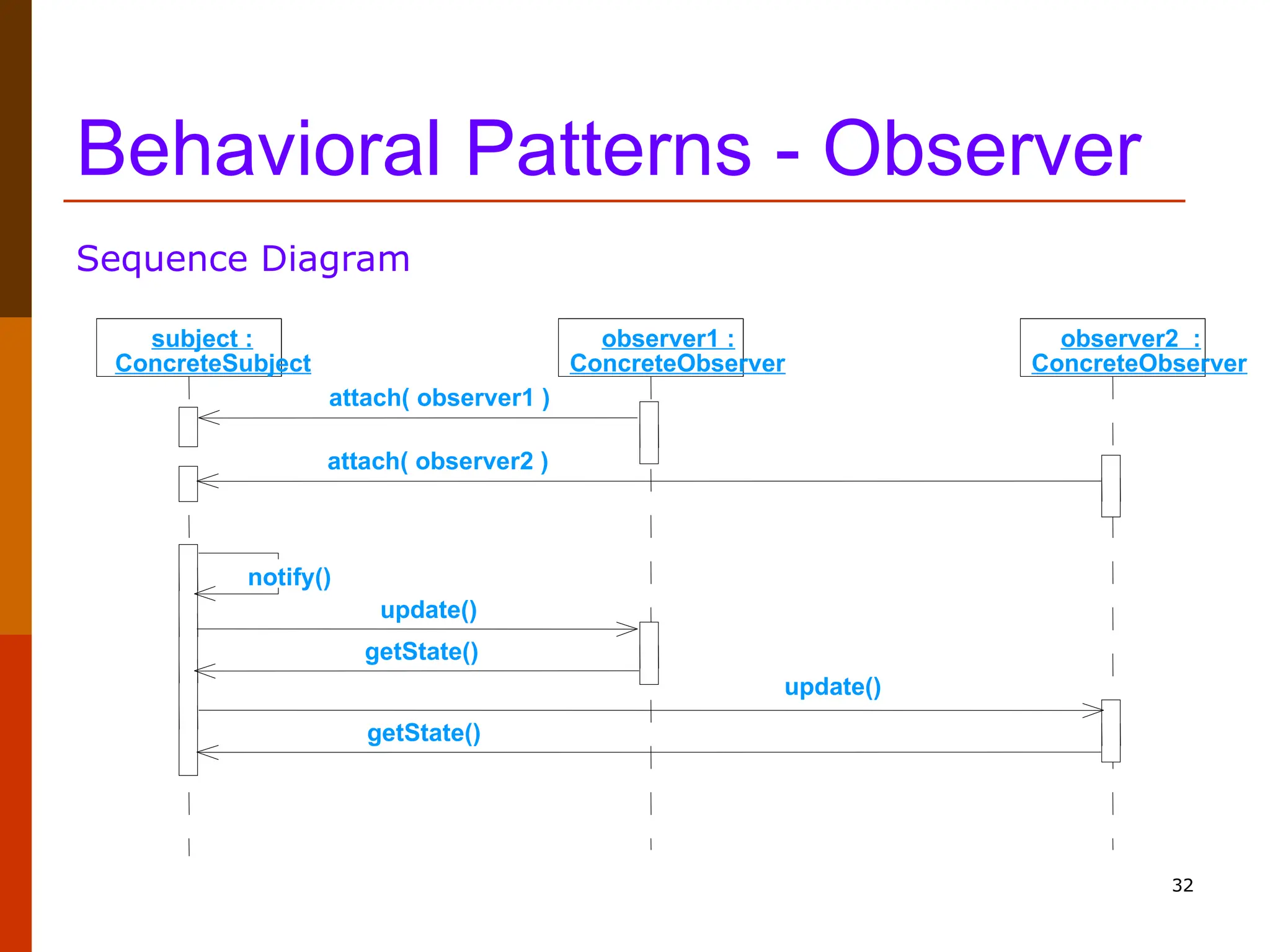
ConcreteSubject notifies observers when changes occur.
ConcreteObserver may query subject regarding state change.
Collaborations
33
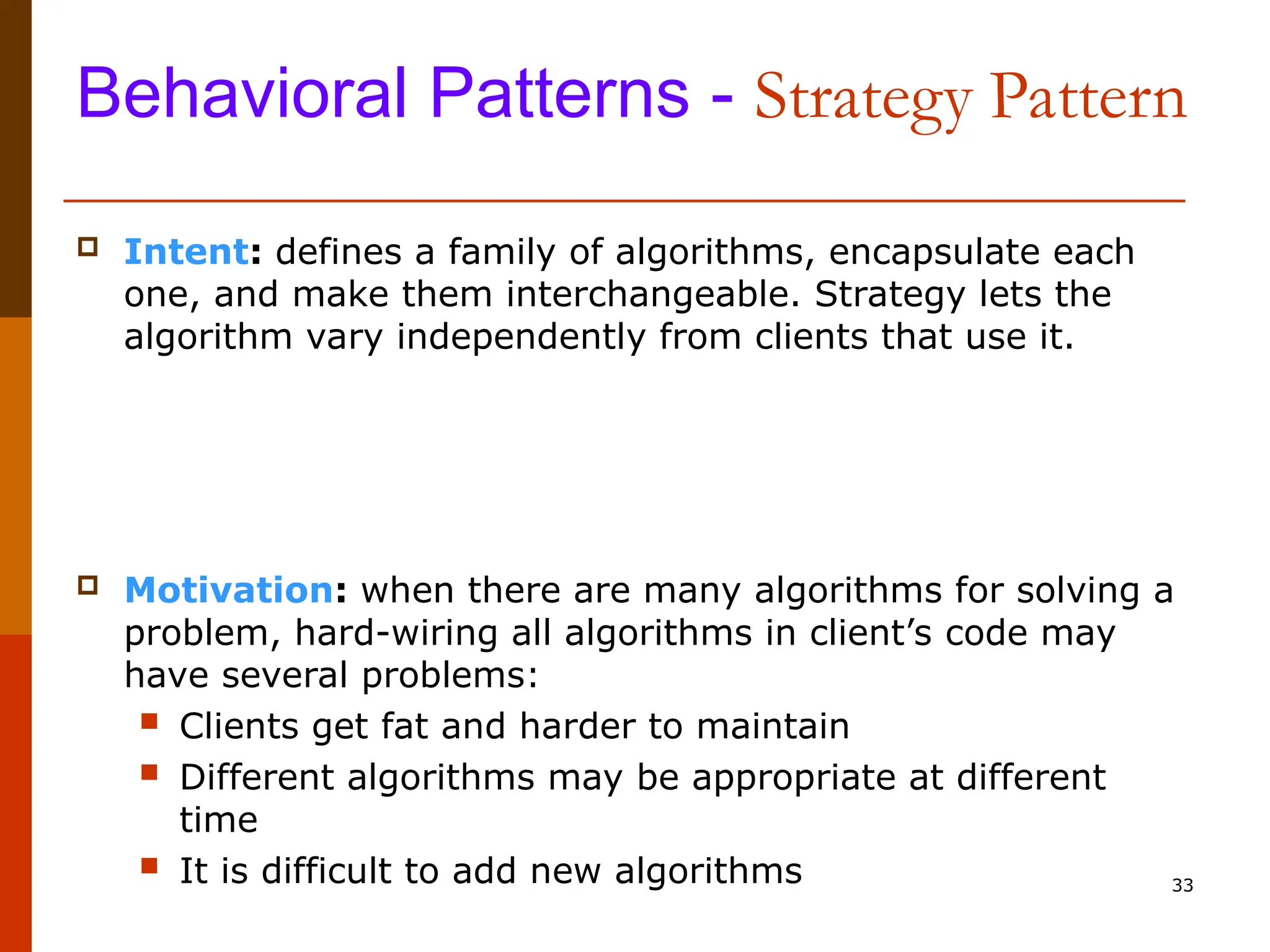
Behavioral Patterns -Strategy Pattern
Intent: defines a family of algorithms, encapsulate each
one, and make them interchangeable. Strategy lets the
algorithm vary independently from clients that use it.
Motivation: when there are many algorithms for solving a
problem, hard-wiring all algorithms in client’s code may
have several problems:
Clients get fat and harder to maintain
Different algorithms may be appropriate at different
time
It is difficult to add new algorithms
35
Behavioral Patterns -Participants of Strategy
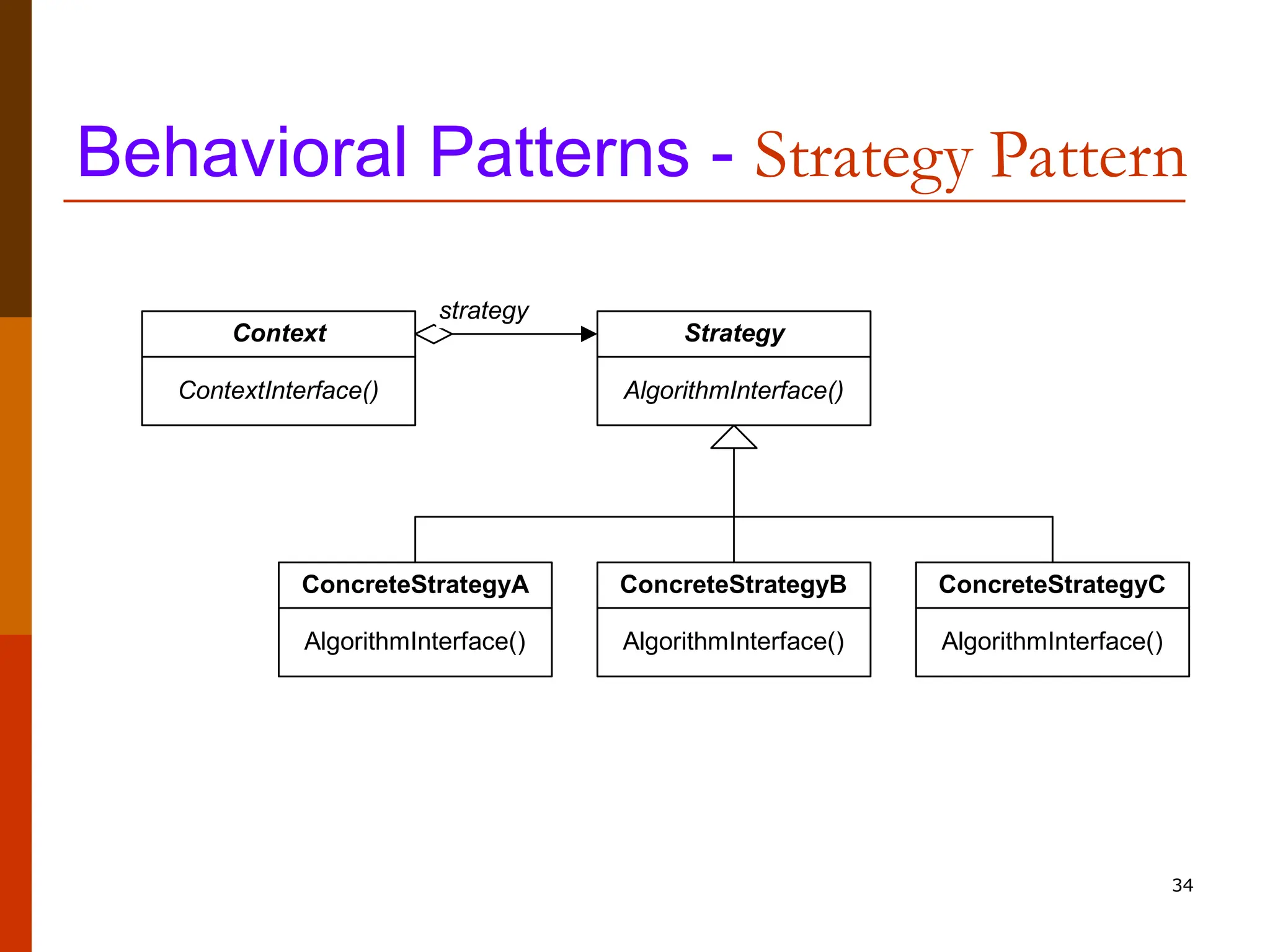
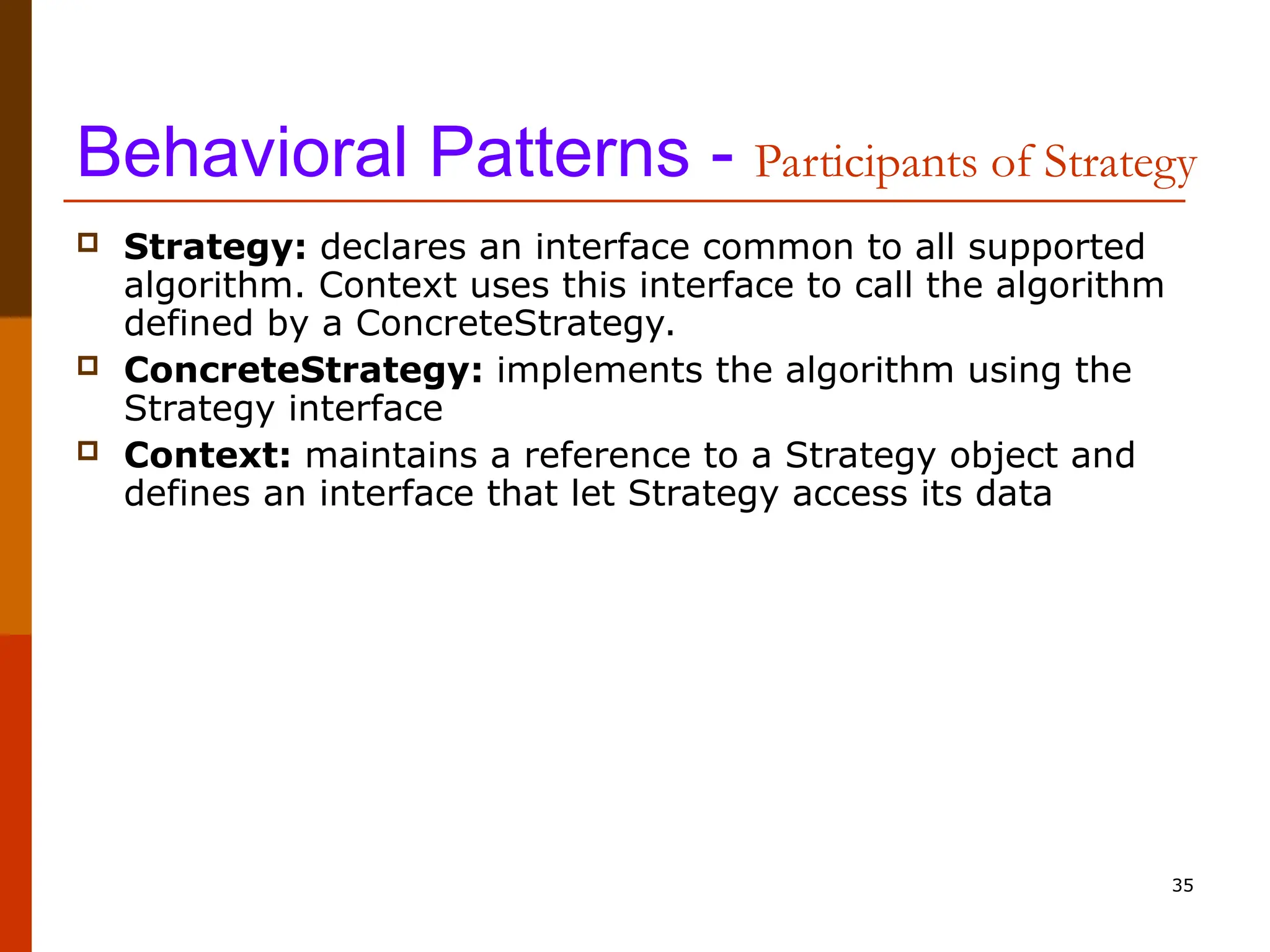
Strategy: declares an interface common to all supported
algorithm. Context uses this interface to call the algorithm
defined by a ConcreteStrategy.
ConcreteStrategy: implements the algorithm using the
Strategy interface
Context: maintains a reference to a Strategy object and
defines an interface that let Strategy access its data
36.
36
Behavioral Patterns -Sorting Example
Requirement: we want to sort a list of integers using
different sorting algorithms, e.g. quick sort, selection sort,
insertion sort, etc.
E.g., {3, 5, 6, 2, 44, 67, 1, 344, ... }
{1, 2, 3, 5, 6, 44, 67, 344, ... }
One way to solve this problem is to write a function for each
sorting algorithm, e.g.
quicksort(int[] in, int[] res)
insertionsort(int[] in, int[] res)
mergesort(int[] in, int[] res)
A better way is to use the Strategy pattern
37.
37
Behavioral Patterns -Strategy Pattern
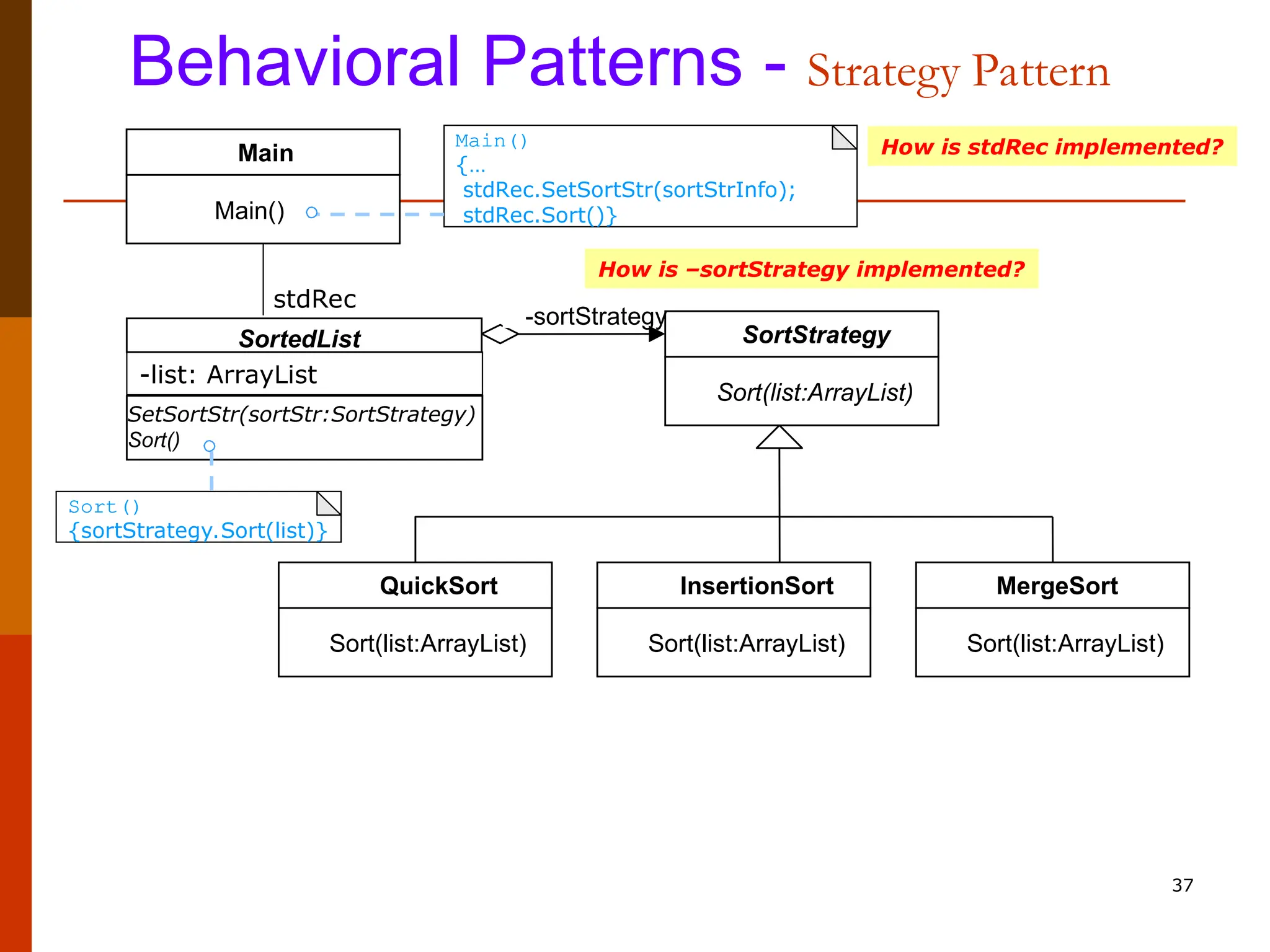
SortedList
SetSortStr(sortStr:SortStrategy)
Sort()
SortStrategy
Sort(list:ArrayList)
InsertionSort
Sort(list:ArrayList)
QuickSort
Sort(list:ArrayList)
MergeSort
Sort(list:ArrayList)
-sortStrategy
Main
Main()
stdRec
-list: ArrayList
Sort()
{sortStrategy.Sort(list)}
How is –sortStrategy implemented?
Main()
{…
stdRec.SetSortStr(sortStrInfo);
stdRec.Sort()}
How is stdRec implemented?
38.
38
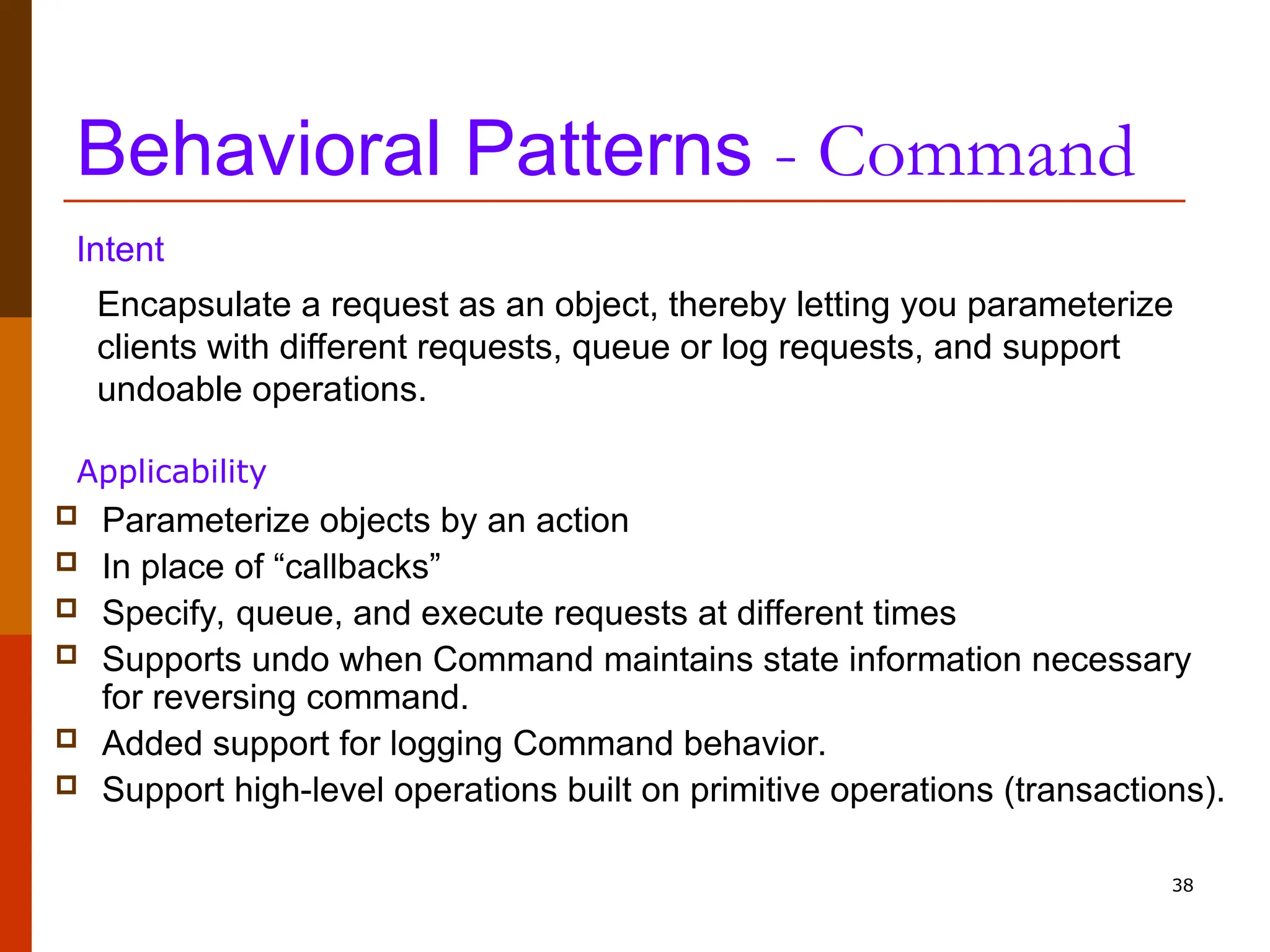
Behavioral Patterns -Command
Encapsulate a request as an object, thereby letting you parameterize
clients with different requests, queue or log requests, and support
undoable operations.
Intent
Parameterize objects by an action
In place of “callbacks”
Specify, queue, and execute requests at different times
Supports undo when Command maintains state information necessary
for reversing command.
Added support for logging Command behavior.
Support high-level operations built on primitive operations (transactions).
Applicability
39.
39
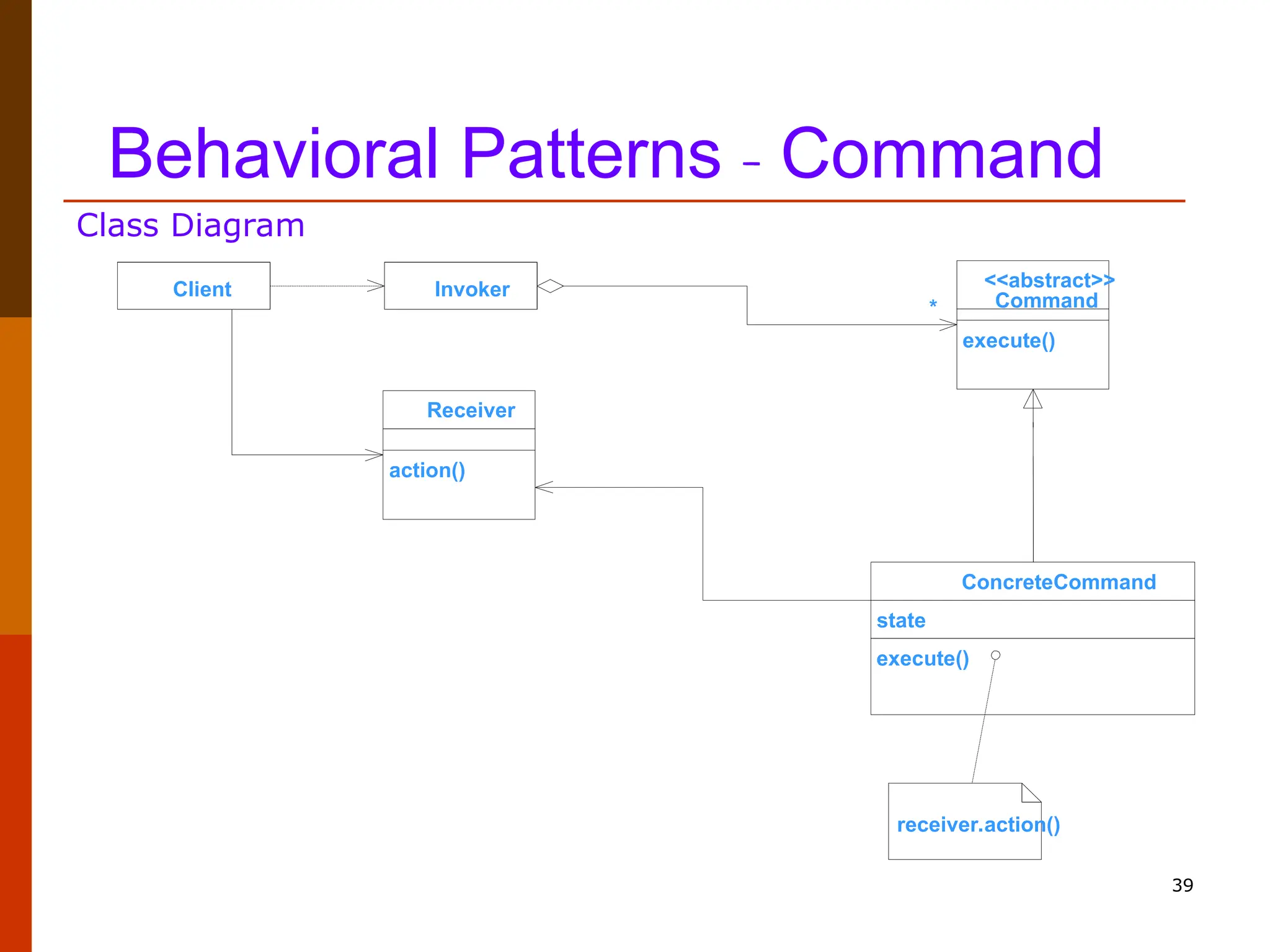
Behavioral Patterns -Command
Class Diagram
*
Client Invoker
action()
Receiver
execute()
<<abstract>>
Command
execute()
state
ConcreteCommand
receiver.action()
40.
40
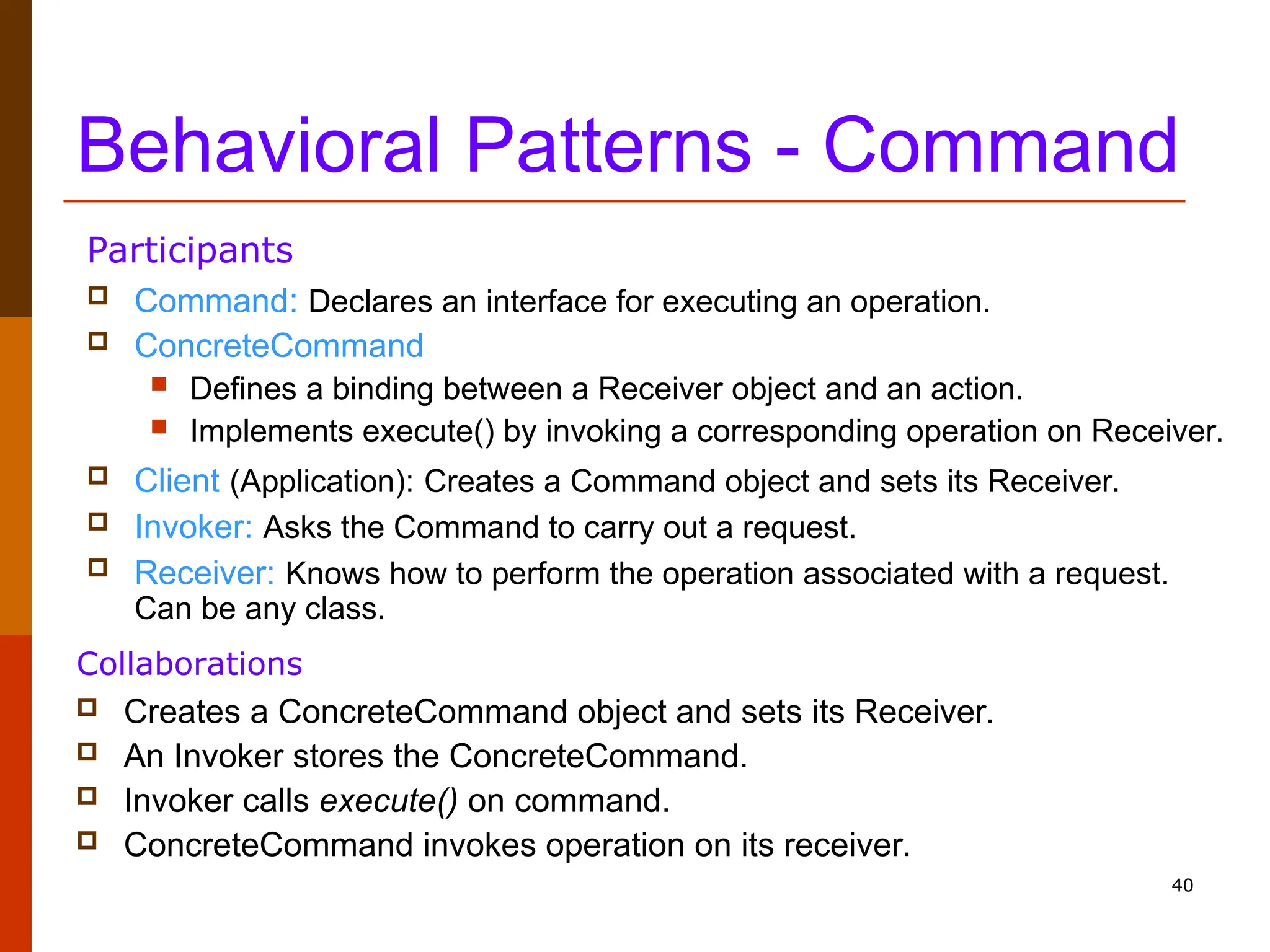
Behavioral Patterns -Command
Command: Declares an interface for executing an operation.
ConcreteCommand
Defines a binding between a Receiver object and an action.
Implements execute() by invoking a corresponding operation on Receiver.
Client (Application): Creates a Command object and sets its Receiver.
Invoker: Asks the Command to carry out a request.
Receiver: Knows how to perform the operation associated with a request.
Can be any class.
Participants
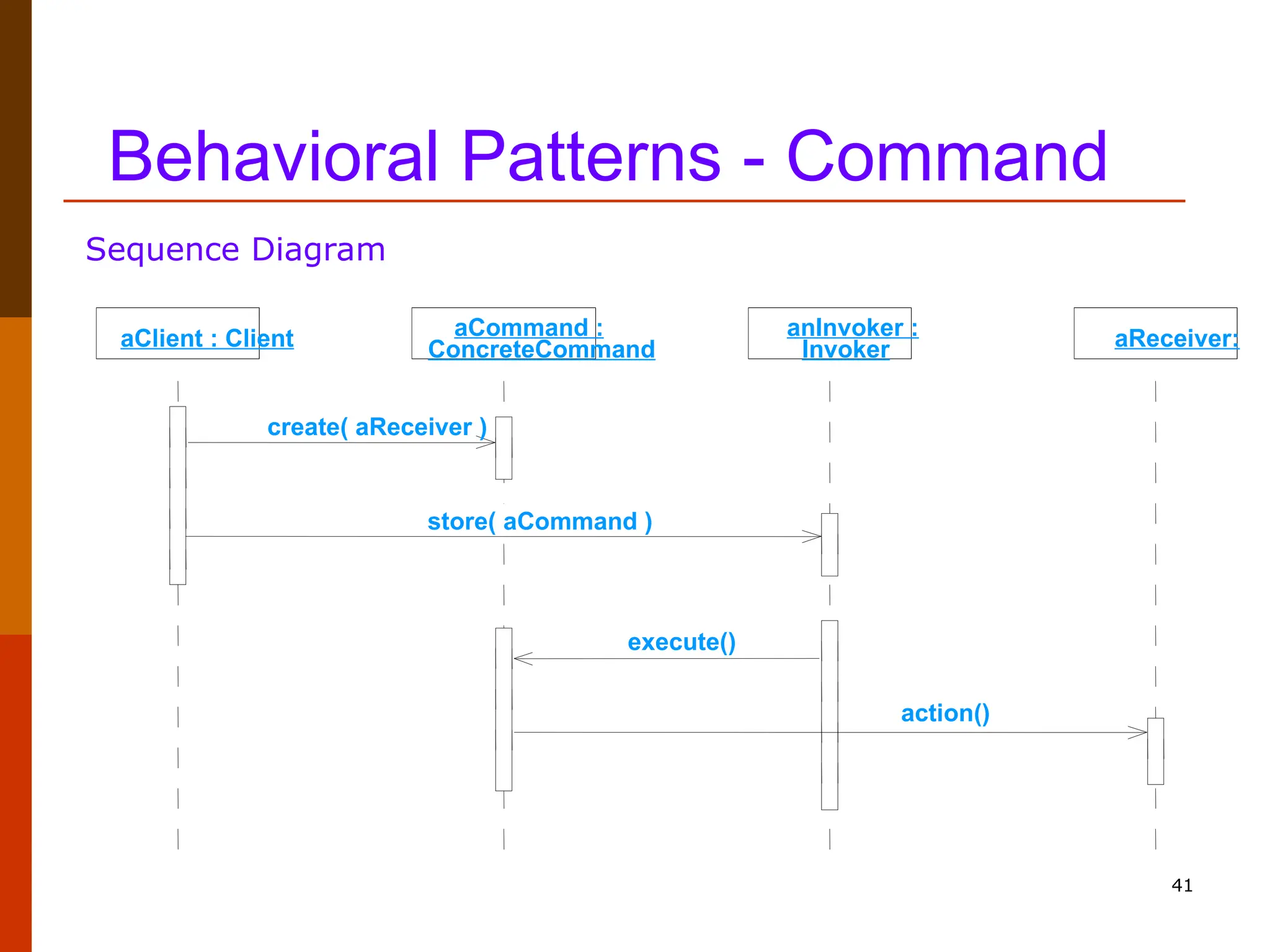
Creates a ConcreteCommand object and sets its Receiver.
An Invoker stores the ConcreteCommand.
Invoker calls execute() on command.
ConcreteCommand invokes operation on its receiver.
Collaborations
42
Behavioral Patterns -State
Allow an object to alter its behavior when its internal state changes.
The object will appear to change its class.
Intent
An object’s behavior depends on its state, and it must change its
behavior at run-time depending on its state.
Operations have large, multipart conditional statements that depend
on the object’s state.
Usually represented by constants.
Some times, the same conditional structure is repeated.
Applicability
43.
43
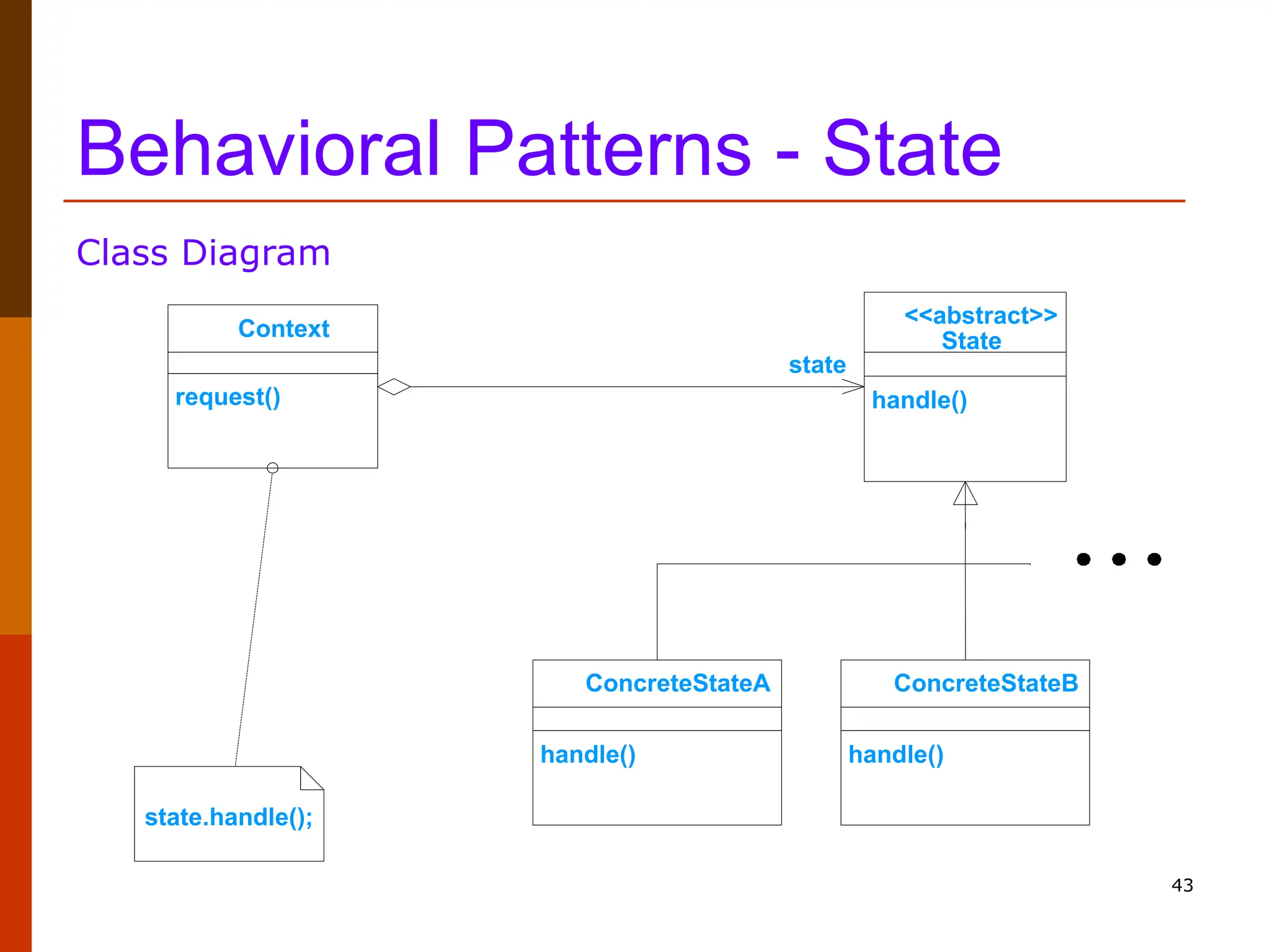
Behavioral Patterns -State
Class Diagram
state
request()
Context
state.handle();
handle()
<<abstract>>
State
handle()
ConcreteStateA
handle()
ConcreteStateB
44.
44
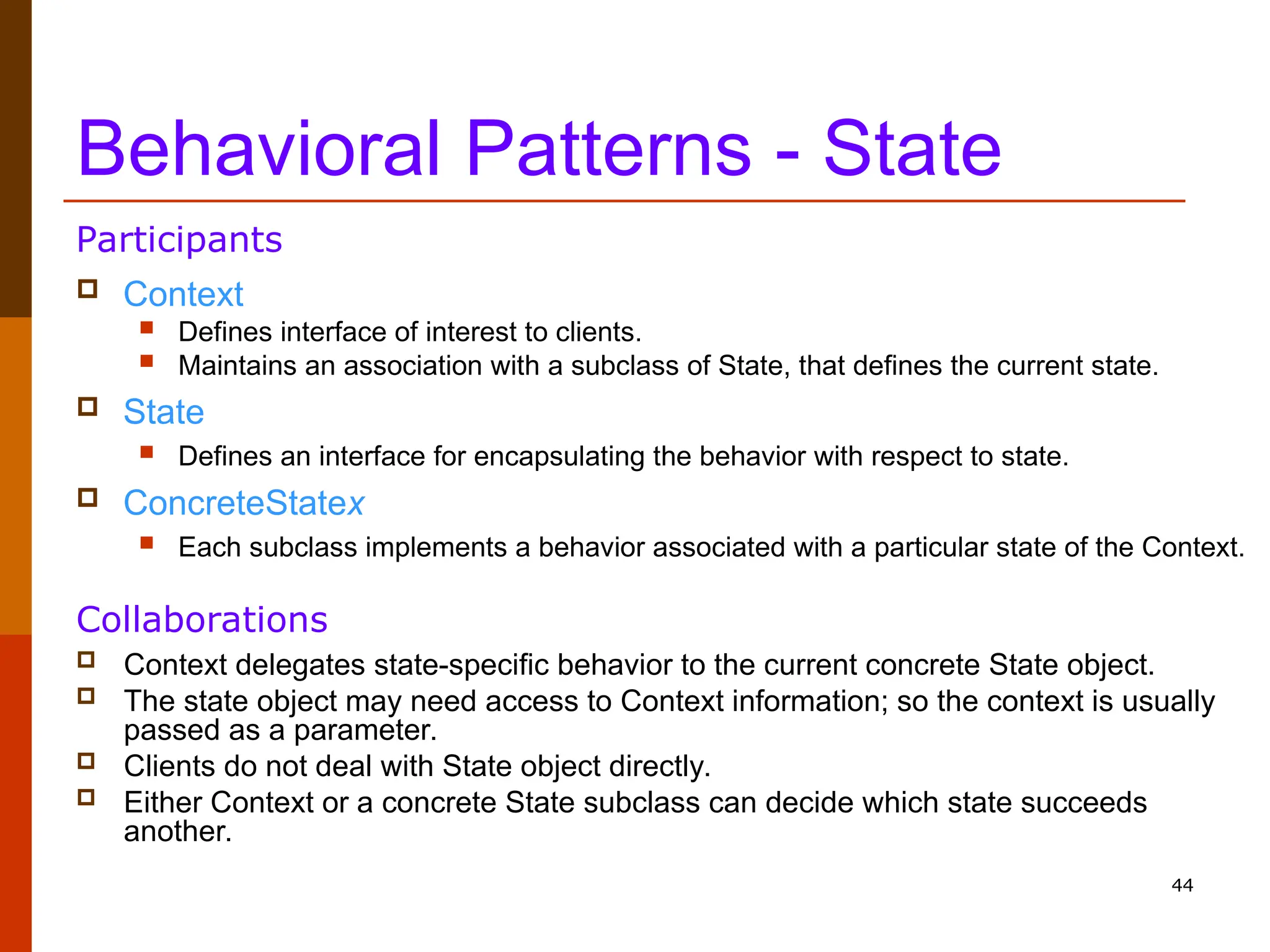
Behavioral Patterns -State
Context
Defines interface of interest to clients.
Maintains an association with a subclass of State, that defines the current state.
State
Defines an interface for encapsulating the behavior with respect to state.
ConcreteStatex
Each subclass implements a behavior associated with a particular state of the Context.
Participants
Context delegates state-specific behavior to the current concrete State object.
The state object may need access to Context information; so the context is usually
passed as a parameter.
Clients do not deal with State object directly.
Either Context or a concrete State subclass can decide which state succeeds
another.
Collaborations
45.
45
Behavioral Patterns -Visitor
Represent an operation to be performed on the elements of an object
structure. Visitor lets you define a new operation without changing
the classes of the elements on which it operates.
Intent
An object structure contains many disparate classes, and operations
need to be performed based on concrete classes.
Many distinct operations need to be performed on an object
structure.
An object structure rarely changes, but new operations need to be
defined over the structure.
Applicability
46.
46
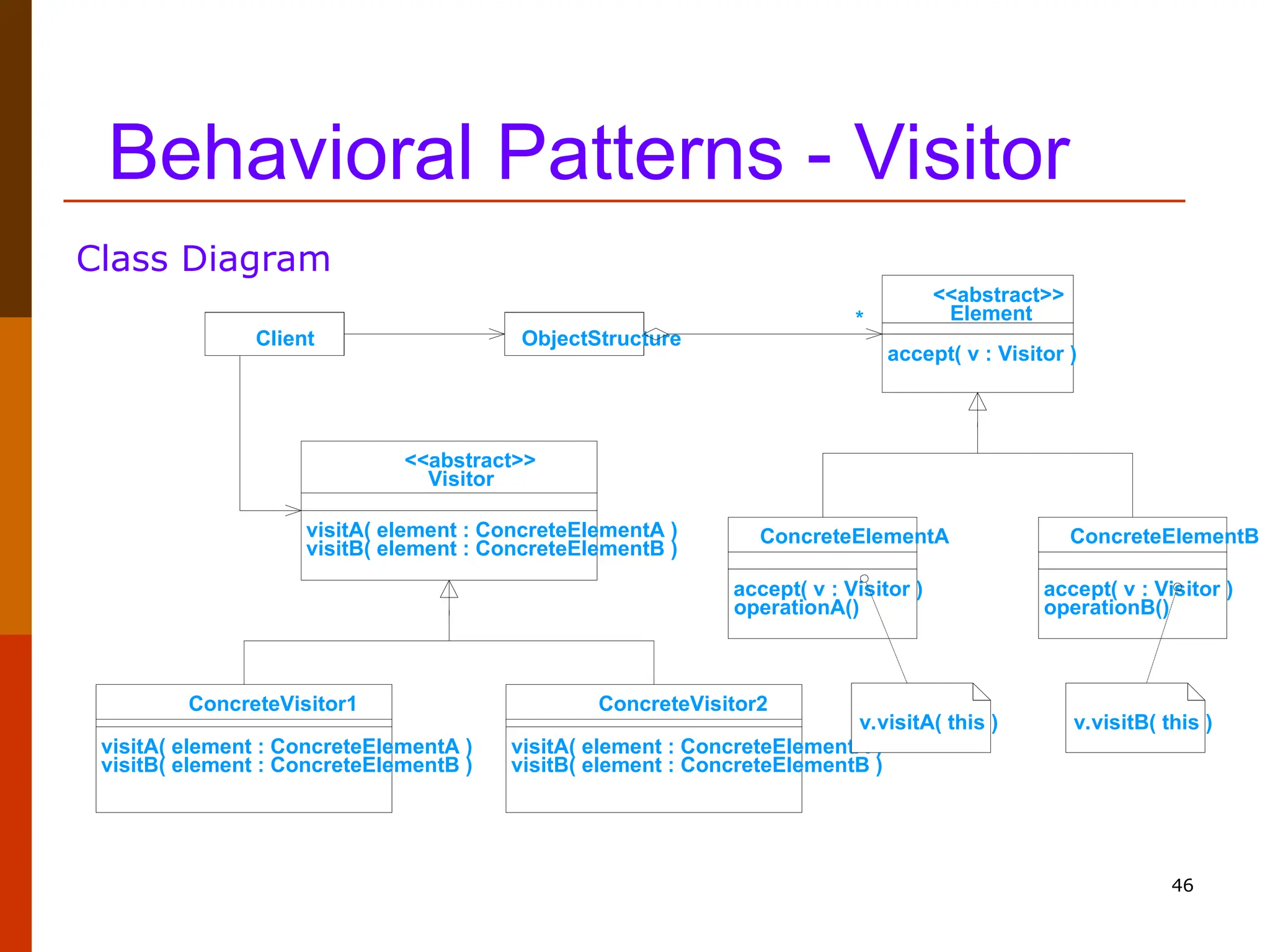
Behavioral Patterns -Visitor
Class Diagram
*
Client
visitA( element : ConcreteElementA )
visitB( element : ConcreteElementB )
<<abstract>>
Visitor
visitA( element : ConcreteElementA )
visitB( element : ConcreteElementB )
ConcreteVisitor1
visitA( element : ConcreteElementA )
visitB( element : ConcreteElementB )
ConcreteVisitor2
ObjectStructure
accept( v : Visitor )
<<abstract>>
Element
accept( v : Visitor )
operationA()
ConcreteElementA
accept( v : Visitor )
operationB()
ConcreteElementB
v.visitA( this ) v.visitB( this )
47.
47
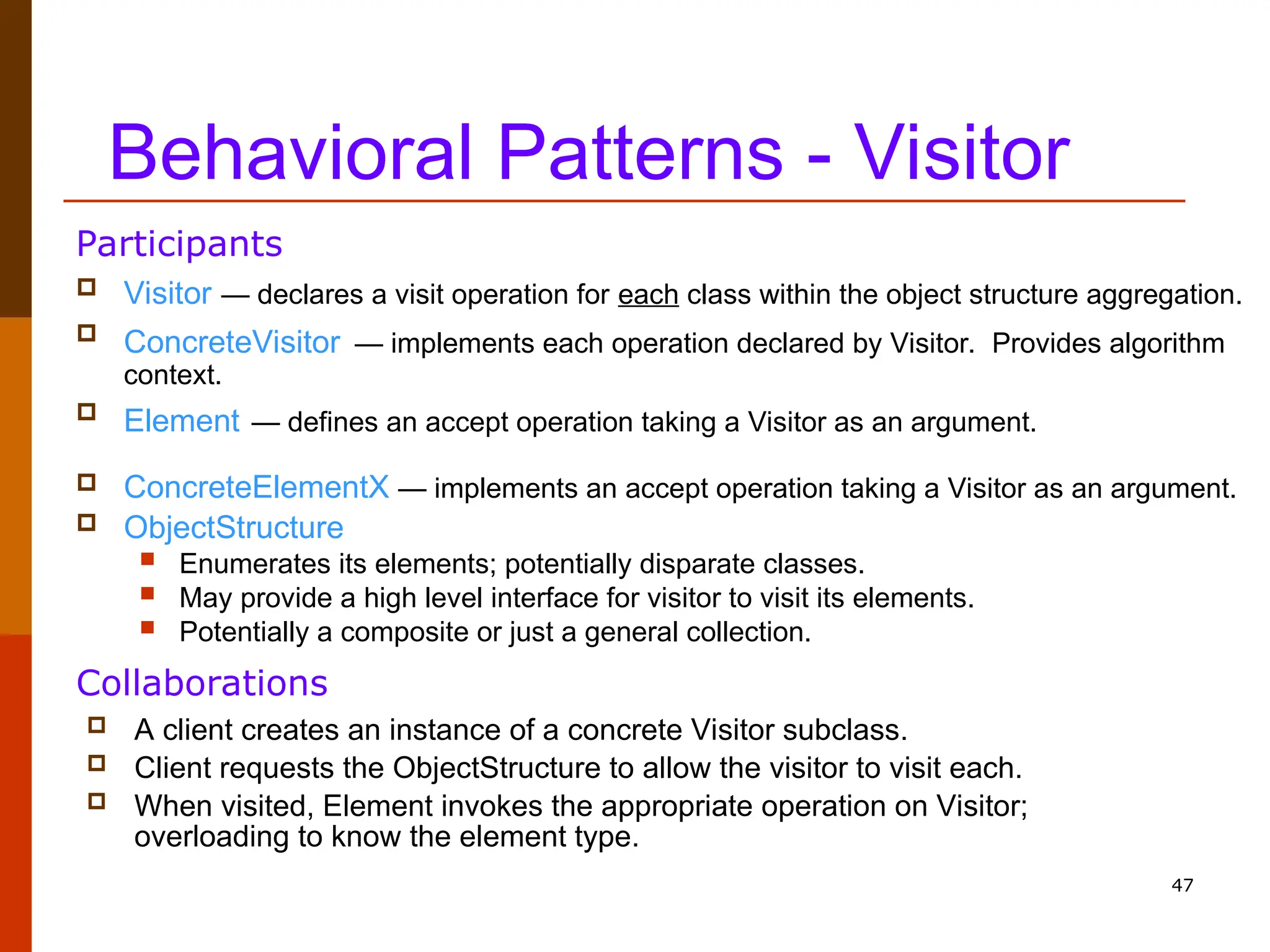
Behavioral Patterns -Visitor
Visitor — declares a visit operation for each class within the object structure aggregation.
ConcreteVisitor — implements each operation declared by Visitor. Provides algorithm
context.
Element — defines an accept operation taking a Visitor as an argument.
ConcreteElementX — implements an accept operation taking a Visitor as an argument.
ObjectStructure
Enumerates its elements; potentially disparate classes.
May provide a high level interface for visitor to visit its elements.
Potentially a composite or just a general collection.
Participants
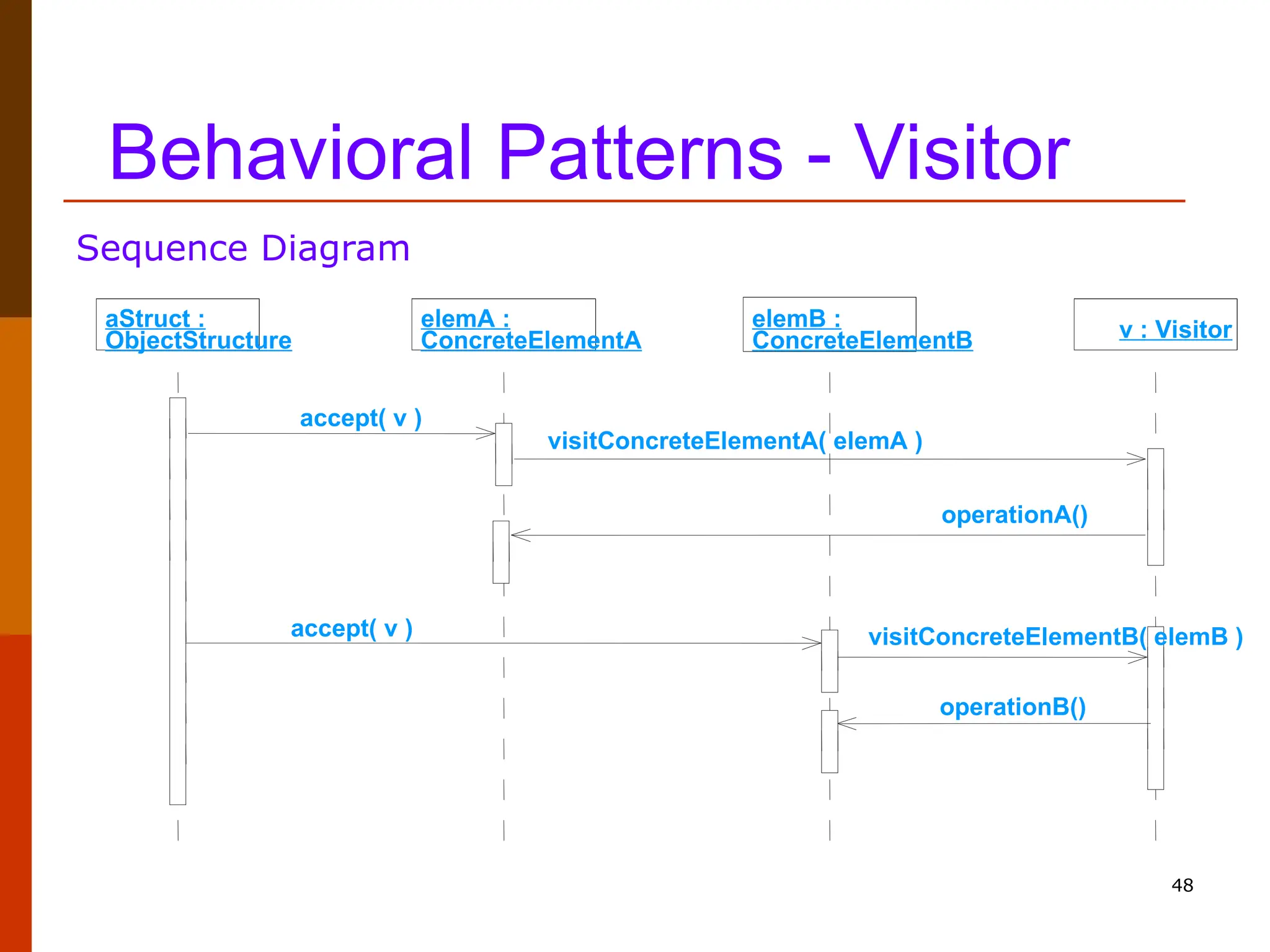
A client creates an instance of a concrete Visitor subclass.
Client requests the ObjectStructure to allow the visitor to visit each.
When visited, Element invokes the appropriate operation on Visitor;
overloading to know the element type.
Collaborations
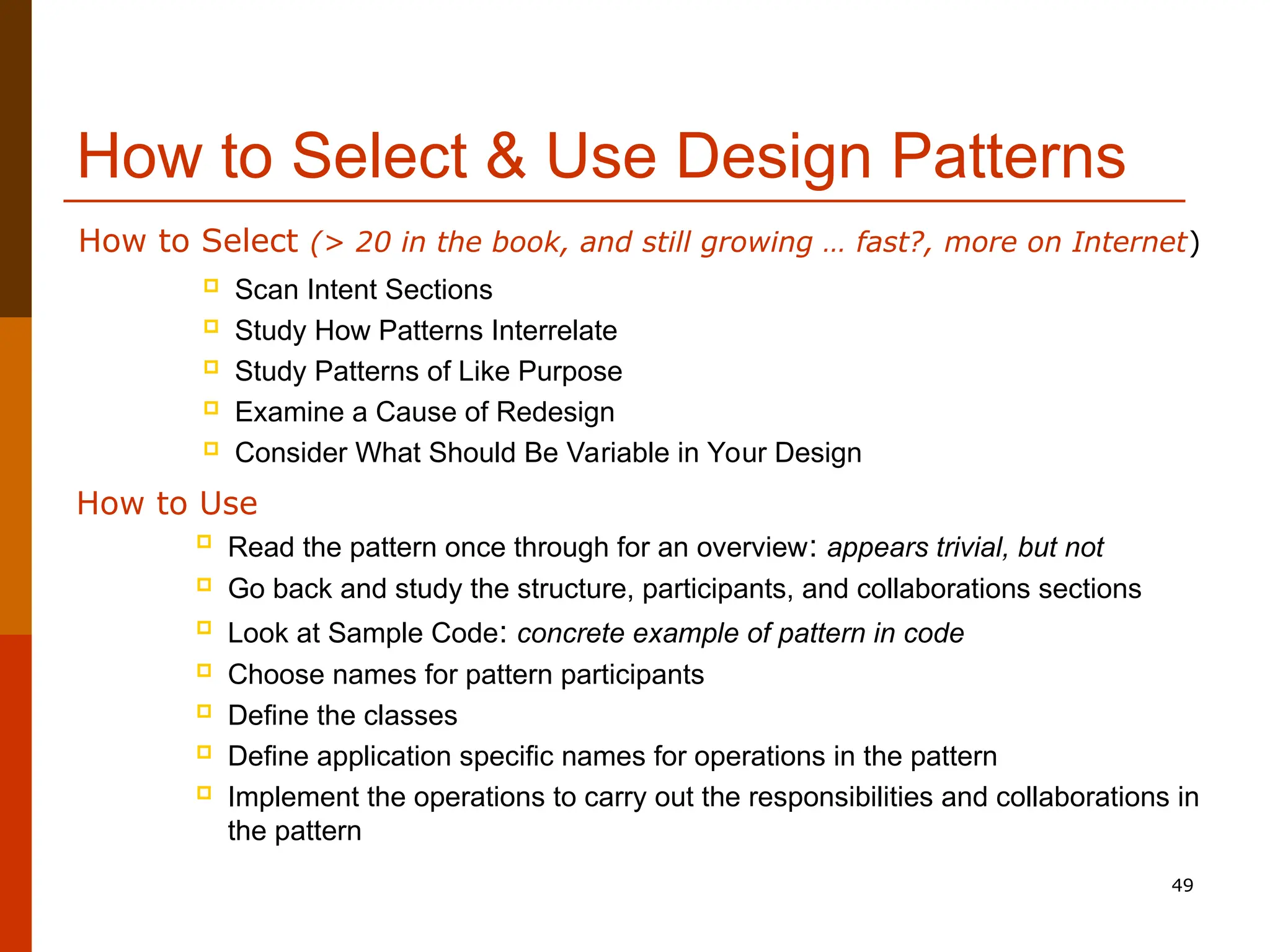
49
How to Select& Use Design Patterns
Scan Intent Sections
Study How Patterns Interrelate
Study Patterns of Like Purpose
Examine a Cause of Redesign
Consider What Should Be Variable in Your Design
Read the pattern once through for an overview: appears trivial, but not
Go back and study the structure, participants, and collaborations sections
Look at Sample Code: concrete example of pattern in code
Choose names for pattern participants
Define the classes
Define application specific names for operations in the pattern
Implement the operations to carry out the responsibilities and collaborations in
the pattern
How to Use
How to Select (> 20 in the book, and still growing … fast?, more on Internet)
50.
50
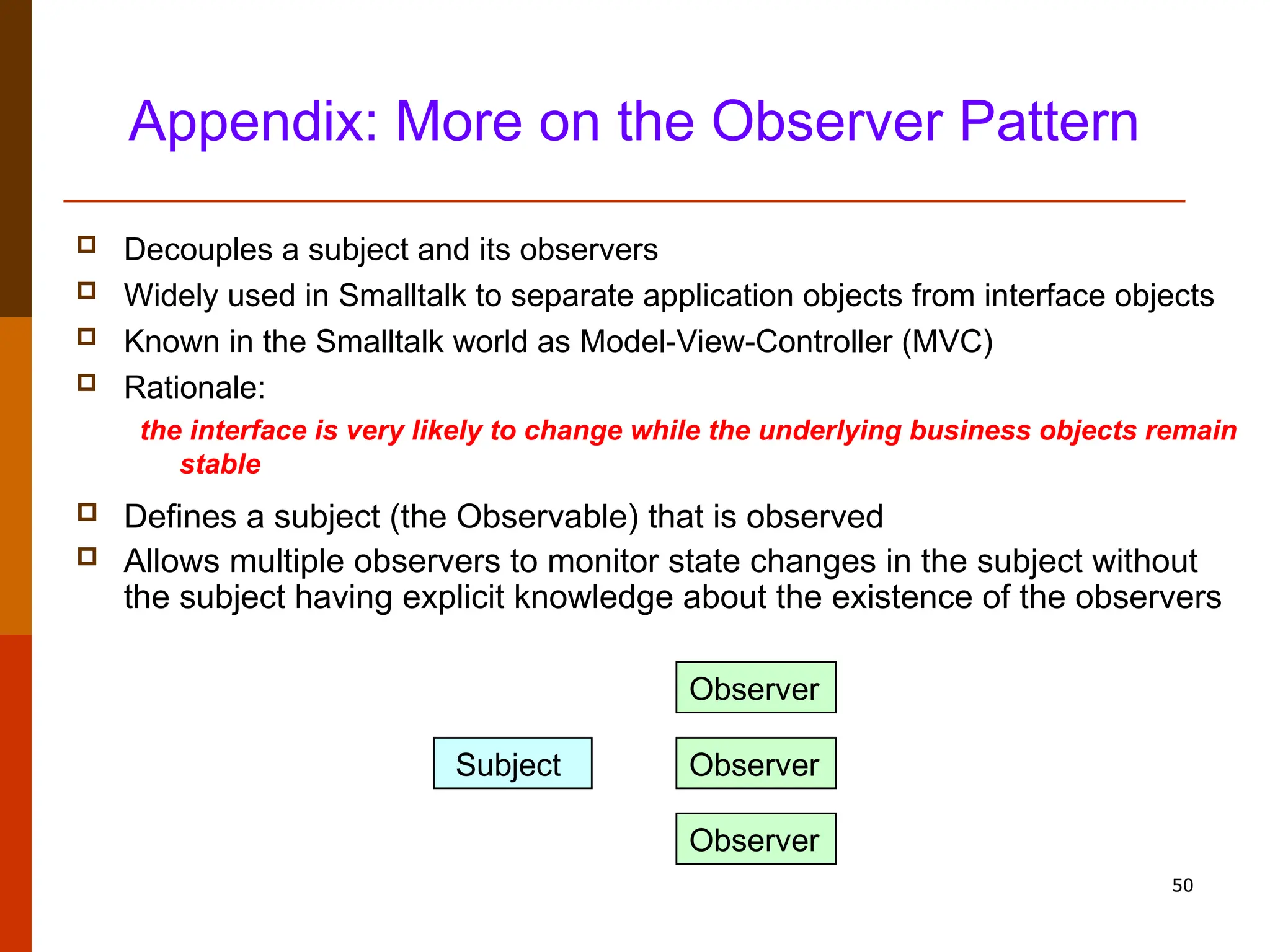
Appendix: More onthe Observer Pattern
Decouples a subject and its observers
Widely used in Smalltalk to separate application objects from interface objects
Known in the Smalltalk world as Model-View-Controller (MVC)
Rationale:
the interface is very likely to change while the underlying business objects remain
stable
Defines a subject (the Observable) that is observed
Allows multiple observers to monitor state changes in the subject without
the subject having explicit knowledge about the existence of the observers
Subject
Observer
Observer
Observer
51.
51
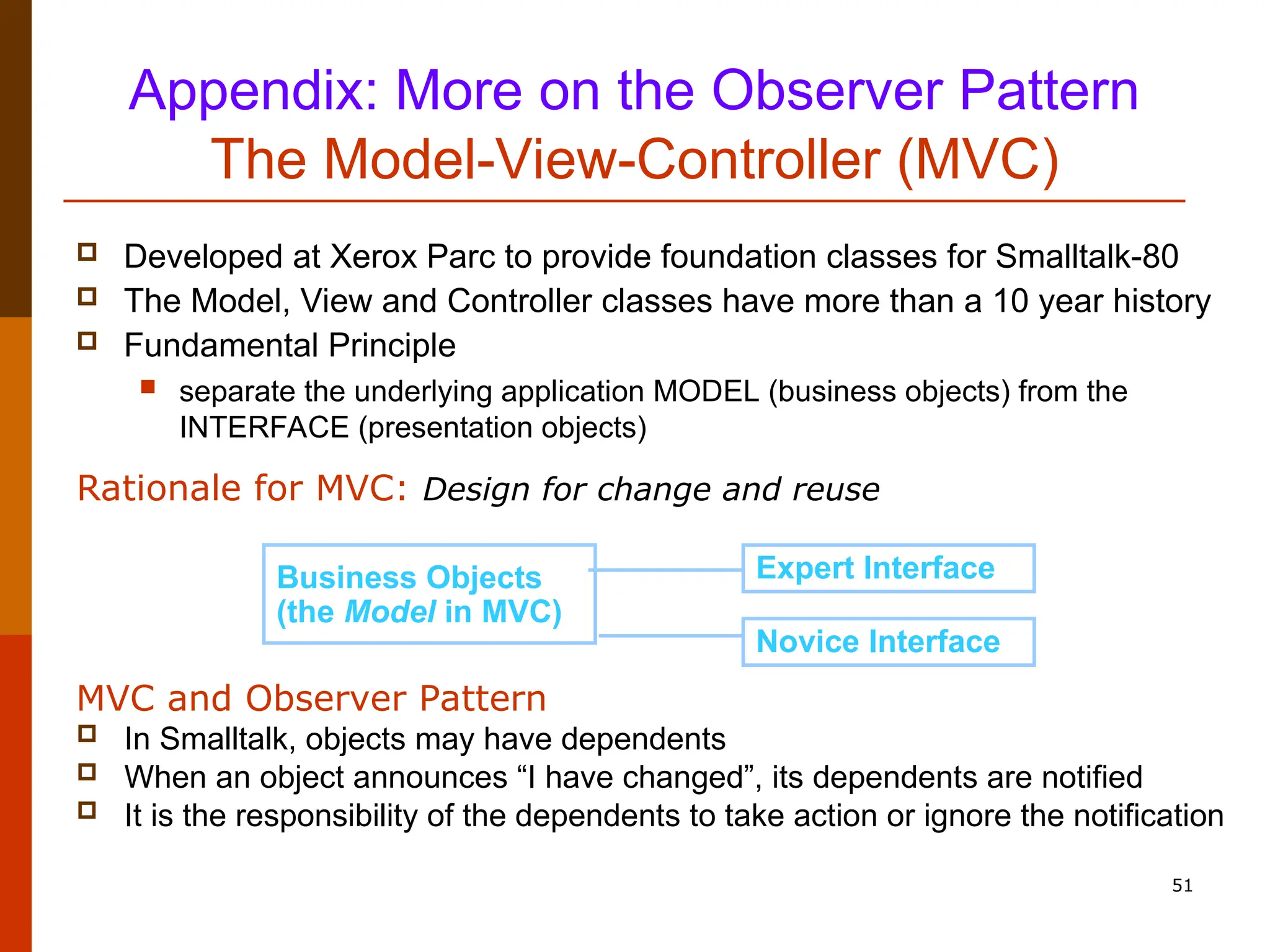
Appendix: More onthe Observer Pattern
The Model-View-Controller (MVC)
Developed at Xerox Parc to provide foundation classes for Smalltalk-80
The Model, View and Controller classes have more than a 10 year history
Fundamental Principle
separate the underlying application MODEL (business objects) from the
INTERFACE (presentation objects)
Business Objects
(the Model in MVC)
Expert Interface
Novice Interface
Rationale for MVC: Design for change and reuse
MVC and Observer Pattern
In Smalltalk, objects may have dependents
When an object announces “I have changed”, its dependents are notified
It is the responsibility of the dependents to take action or ignore the notification
52.
52
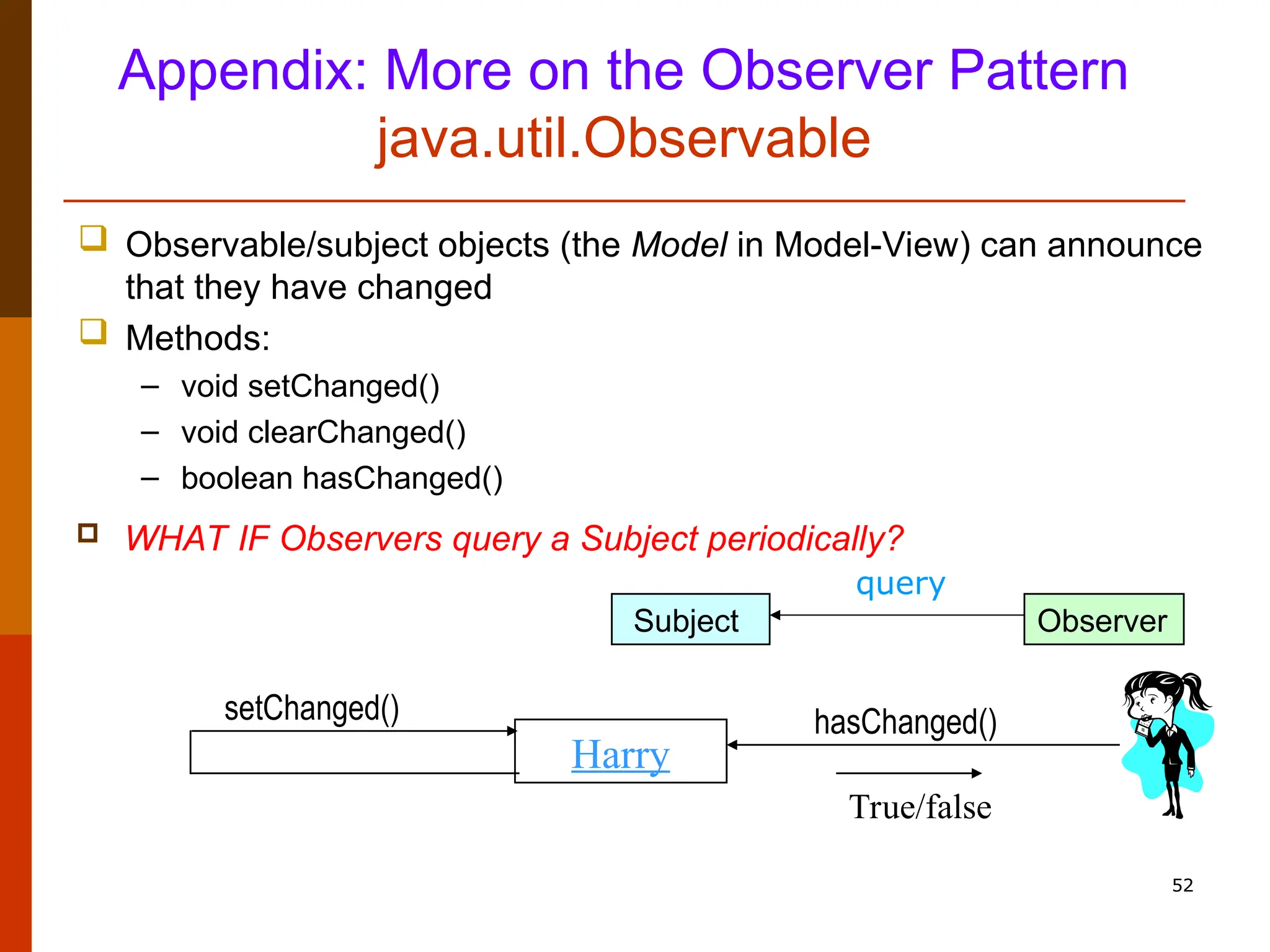
Appendix: More onthe Observer Pattern
java.util.Observable
Observable/subject objects (the Model in Model-View) can announce
that they have changed
Methods:
– void setChanged()
– void clearChanged()
– boolean hasChanged()
Harry
setChanged() hasChanged()
True/false
WHAT IF Observers query a Subject periodically?
Subject Observer
query
53.
53
Appendix: More onthe Observer Pattern
Implementing & Checking an Observable
import java.util.*;
import java.io.*;
public class Harry extends Observable {
private boolean maritalStatus = false;
public Harry (boolean isMarried) {
maritalStatus = isMarried;
}
public void updateMaritalStatus (boolean change) {
maritalStatus = change;
// set flag for anyone interested to check
this.setChanged();
}
Implementing an Observable
public static void main (String args [ ] ) {
Harry harry = new Harry (false);
harry.updateMaritalStatus (true);
if (harry.hasChanged() )
System.out.println ("Time to call harry");
}
Checking an Observable
54.
55
Appendix: More onthe Observer Pattern
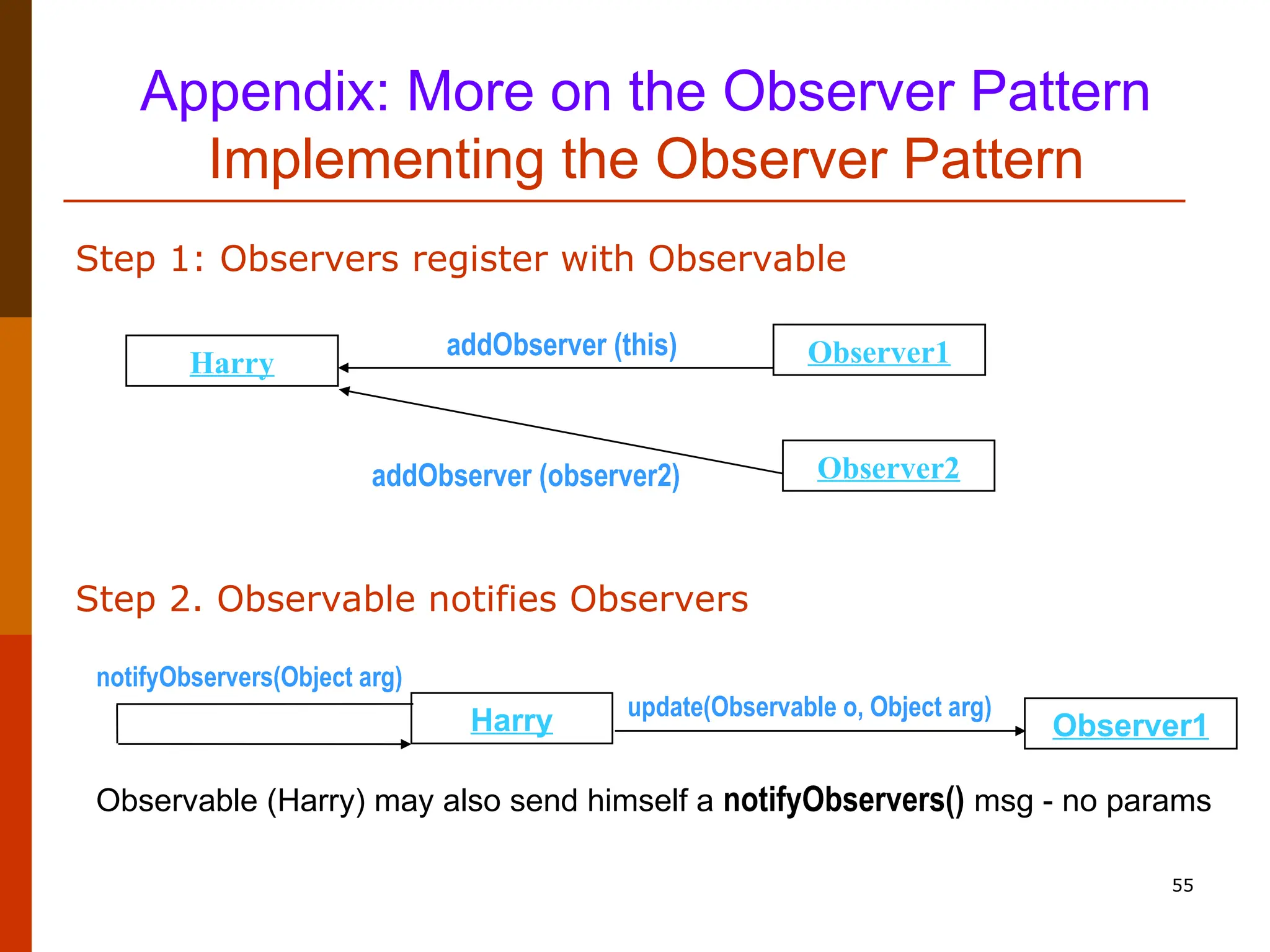
Implementing the Observer Pattern
Harry Observer1
Observer2
addObserver (this)
addObserver (observer2)
Step 1: Observers register with Observable
update(Observable o, Object arg)
Harry
notifyObservers(Object arg)
Observer1
Observable (Harry) may also send himself a notifyObservers() msg - no params
Step 2. Observable notifies Observers
55.
56
Appendix: More onthe Observer Pattern
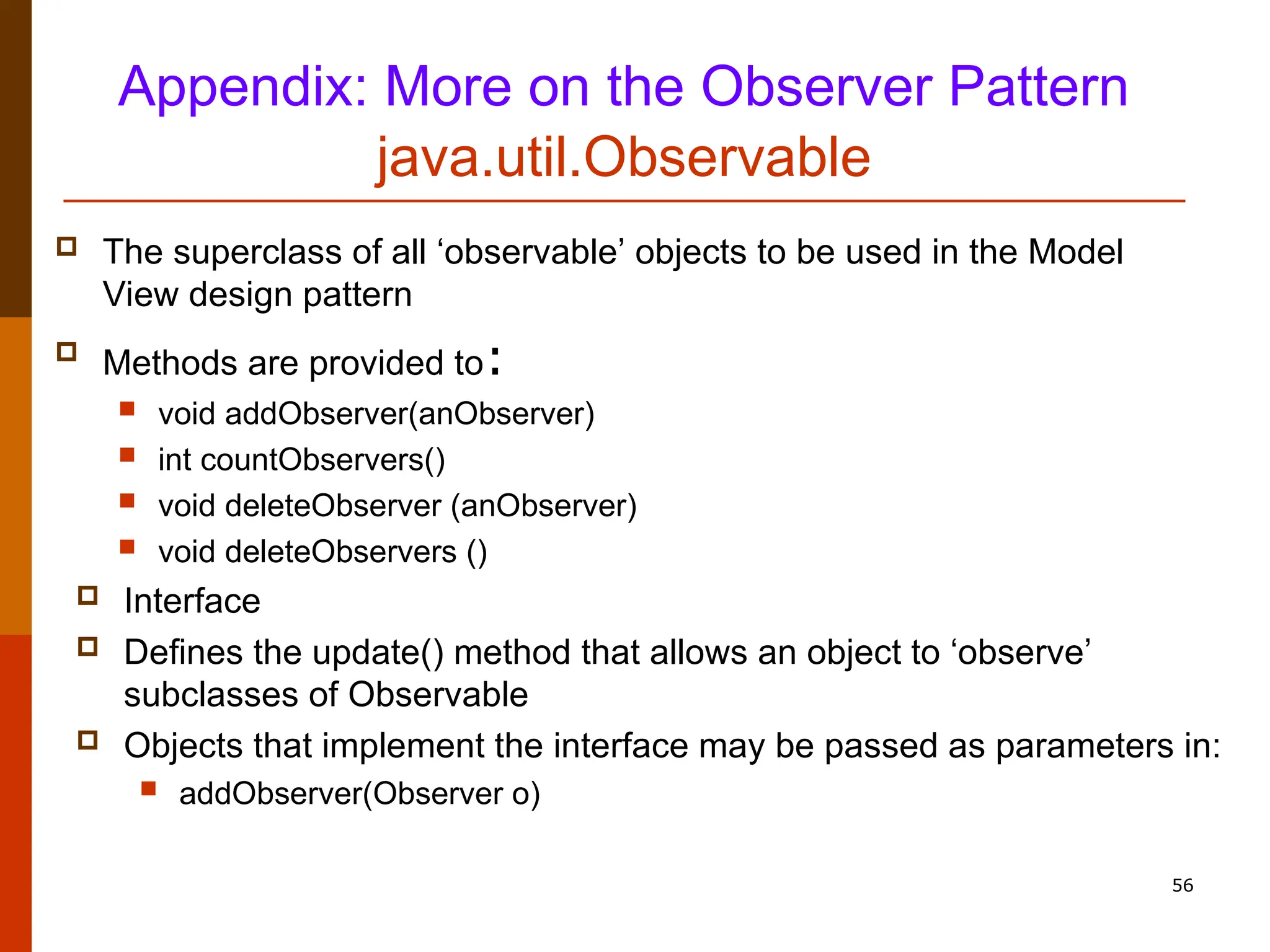
java.util.Observable
The superclass of all ‘observable’ objects to be used in the Model
View design pattern
Methods are provided to:
void addObserver(anObserver)
int countObservers()
void deleteObserver (anObserver)
void deleteObservers ()
Interface
Defines the update() method that allows an object to ‘observe’
subclasses of Observable
Objects that implement the interface may be passed as parameters in:
addObserver(Observer o)
56.
57
Summary
Design Patterns
Creational Patterns
Structural Patterns: Adapter, Composite, Façade, Proxy
Behavioral Patterns: Command, Observer, State, Visitor
Appendix: More on the Observer Pattern
The Model-View-Controller (MVC)
java.util.Observable
57.
58
Points to Ponder
List as many design patterns as you can think of in the Model-View-
Controller (MVC).
How many design patterns can exist? In the order of tens?
hundreds? or thousands? Justify your reasoning.
What would be the major differences between design patterns and
architectural patterns?
What style of architecture is closest to the Observer pattern in the
manner objects interact with each other?
Map the Observer pattern into the Java Event Model.
What are the essential tradeoffs between
1) Observers query a Subject periodically and
2) using the Observer pattern?
Editor's Notes
#50 Useful ... When you have two objects, 1 is going to change and 1 is going to change over time. Example, GUI’s. The underlying model of UI was stable and the GUI’s were not
![36
Behavioral Patterns - Sorting Example
Requirement: we want to sort a list of integers using
different sorting algorithms, e.g. quick sort, selection sort,
insertion sort, etc.
E.g., {3, 5, 6, 2, 44, 67, 1, 344, ... }
{1, 2, 3, 5, 6, 44, 67, 344, ... }
One way to solve this problem is to write a function for each
sorting algorithm, e.g.
quicksort(int[] in, int[] res)
insertionsort(int[] in, int[] res)
mergesort(int[] in, int[] res)
A better way is to use the Strategy pattern](https://image.slidesharecdn.com/m04designpatterns-250405135307-1e4c0347/75/M04_DesignPatterns-software-engineering-ppt-36-2048.jpg)
![53
Appendix: More on the Observer Pattern
Implementing & Checking an Observable
import java.util.*;
import java.io.*;
public class Harry extends Observable {
private boolean maritalStatus = false;
public Harry (boolean isMarried) {
maritalStatus = isMarried;
}
public void updateMaritalStatus (boolean change) {
maritalStatus = change;
// set flag for anyone interested to check
this.setChanged();
}
Implementing an Observable
public static void main (String args [ ] ) {
Harry harry = new Harry (false);
harry.updateMaritalStatus (true);
if (harry.hasChanged() )
System.out.println ("Time to call harry");
}
Checking an Observable](https://image.slidesharecdn.com/m04designpatterns-250405135307-1e4c0347/75/M04_DesignPatterns-software-engineering-ppt-53-2048.jpg)