These courseware materials are to be used in conjunction with Software Engineering: A Practitioner’s Approach, 6/e and are provided
with permission by R.S. Pressman & Associates, Inc., copyright © 1996, 2001, 2005 1
Supplementary Slides for
Software Engineering:
A Practitioner's Approach, 6/e
Part 1
copyright © 1996, 2001, 2005
R.S. Pressman & Associates, Inc.
For University Use Only
May be reproduced ONLY for student use at the university level
when used in conjunction with Software Engineering: A Practitioner's Approach.
Any other reproduction or use is expressly prohibited.
This presentation, slides, or hardcopy may NOT be used for
short courses, industry seminars, or consulting purposes.
These courseware materials are to be used in conjunction with Software Engineering: A Practitioner’s Approach, 6/e and are provided
with permission by R.S. Pressman & Associates, Inc., copyright © 1996, 2001, 2005 2
Software Engineering: A Practitioner’s Approach, 6/e
Chapter 1
Software and Software Engineering
copyright © 1996, 2001, 2005
R.S. Pressman & Associates, Inc.
For University Use Only
May be reproduced ONLY for student use at the university level
when used in conjunction with Software Engineering: A Practitioner's Approach.
Any other reproduction or use is expressly prohibited.
These courseware materials are to be used in conjunction with Software Engineering: A Practitioner’s Approach, 6/e and are provided
with permission by R.S. Pressman & Associates, Inc., copyright © 1996, 2001, 2005 3
Software’s Dual Role
 Software is a product
 Delivers computing potential
 Produces, manages, acquires, modifies, displays, or transmits
information
 Software is a vehicle for delivering a product
 Supports or directly provides system functionality
 Controls other programs (e.g., an operating system)
 Effects communications (e.g., networking software)
 Helps build other software (e.g., software tools)
These courseware materials are to be used in conjunction with Software Engineering: A Practitioner’s Approach, 6/e and are provided
with permission by R.S. Pressman & Associates, Inc., copyright © 1996, 2001, 2005 4
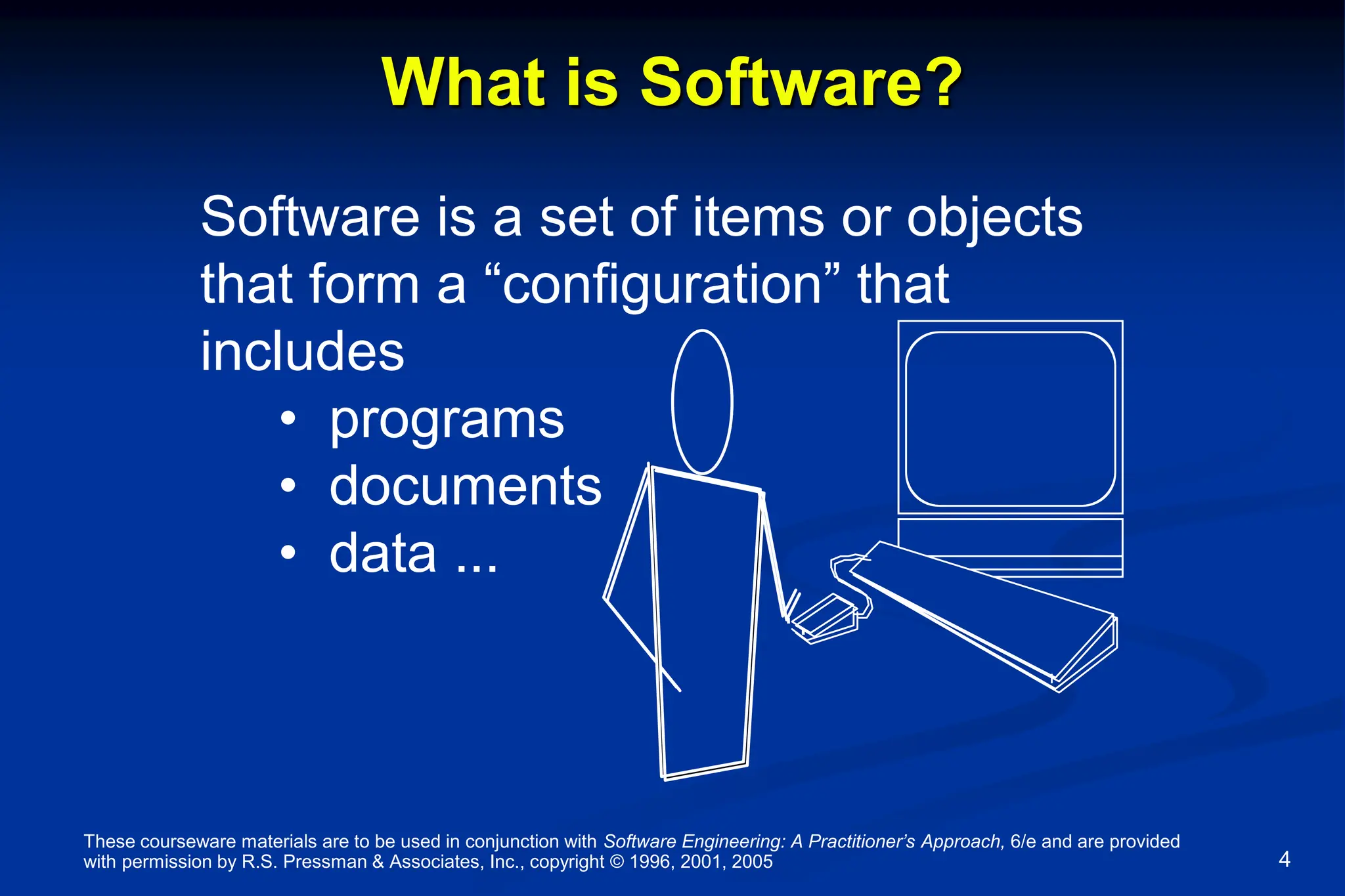
What is Software?
Software is a set of items or objects
that form a “configuration” that
includes
• programs
• documents
• data ...
These courseware materials are to be used in conjunction with Software Engineering: A Practitioner’s Approach, 6/e and are provided
with permission by R.S. Pressman & Associates, Inc., copyright © 1996, 2001, 2005 5
What is Software?
 software is engineered
 software doesn’t wear out
 software is complex
These courseware materials are to be used in conjunction with Software Engineering: A Practitioner’s Approach, 6/e and are provided
with permission by R.S. Pressman & Associates, Inc., copyright © 1996, 2001, 2005 6
Wear vs. Deterioration
These courseware materials are to be used in conjunction with Software Engineering: A Practitioner’s Approach, 6/e and are provided
with permission by R.S. Pressman & Associates, Inc., copyright © 1996, 2001, 2005 7
Software Applications
 system software
 application software
 engineering/scientific software
 embedded software
 product-line software
 WebApps (Web applications)
 AI software
These courseware materials are to be used in conjunction with Software Engineering: A Practitioner’s Approach, 6/e and are provided
with permission by R.S. Pressman & Associates, Inc., copyright © 1996, 2001, 2005 8
Software—New Categories
 Ubiquitous computing—wireless networks
 Netsourcing—the Web as a computing engine
 Open source—”free” source code open to the computing
community (a blessing, but also a potential curse!)
 Also … (see Chapter 32)
 Data mining
 Grid computing
 Cognitive machines
 Software for nanotechnologies
These courseware materials are to be used in conjunction with Software Engineering: A Practitioner’s Approach, 6/e and are provided
with permission by R.S. Pressman & Associates, Inc., copyright © 1996, 2001, 2005 9
Legacy Software
 software must be adapted to meet the needs of new
computing environments or technology.
 software must be enhanced to implement new
business requirements.
 software must be extended to make it interoperable
with other more modern systems or databases.
 software must be re-architected to make it viable
within a network environment.
Why must it change?
These courseware materials are to be used in conjunction with Software Engineering: A Practitioner’s Approach, 6/e and are provided
with permission by R.S. Pressman & Associates, Inc., copyright © 1996, 2001, 2005 10
Software Evolution
 The Law of Continuing Change (1974): E-type systems must be continually adapted else they
become progressively less satisfactory.
 The Law of Increasing Complexity (1974): As an E-type system evolves its complexity increases
unless work is done to maintain or reduce it.
 The Law of Self Regulation (1974): The E-type system evolution process is self-regulating with
distribution of product and process measures close to normal.
 The Law of Conservation of Organizational Stability (1980): The average effective global activity
rate in an evolving E-type system is invariant over product lifetime.
 The Law of Conservation of Familiarity (1980): As an E-type system evolves all associated with it,
developers, sales personnel, users, for example, must maintain mastery of its content and
behavior to achieve satisfactory evolution.
 The Law of Continuing Growth (1980): The functional content of E-type systems must be
continually increased to maintain user satisfaction over their lifetime.
 The Law of Declining Quality (1996): The quality of E-type systems will appear to be declining
unless they are rigorously maintained and adapted to operational environment changes.
 The Feedback System Law (1996): E-type evolution processes constitute multi-level, multi-loop,
multi-agent feedback systems and must be treated as such to achieve significant improvement
over any reasonable base.
Source: Lehman, M., et al, “Metrics and Laws of Software Evolution—The Nineties View,”
Proceedings of the 4th International Software Metrics Symposium (METRICS '97), IEEE, 1997, can be
downloaded from: http://www.ece.utexas.edu/~perry/work/papers/feast1.pdf
These courseware materials are to be used in conjunction with Software Engineering: A Practitioner’s Approach, 6/e and are provided
with permission by R.S. Pressman & Associates, Inc., copyright © 1996, 2001, 2005 11
Software Myths
 Affect managers, customers (and other non-technical
stakeholders) and practitioners
 Are believable because they often have elements of
truth,
but …
 Invariably lead to bad decisions,
therefore …
 Insist on reality as you navigate your way through
software engineering

software

  • 1.
    These courseware materialsare to be used in conjunction with Software Engineering: A Practitioner’s Approach, 6/e and are provided with permission by R.S. Pressman & Associates, Inc., copyright © 1996, 2001, 2005 1 Supplementary Slides for Software Engineering: A Practitioner's Approach, 6/e Part 1 copyright © 1996, 2001, 2005 R.S. Pressman & Associates, Inc. For University Use Only May be reproduced ONLY for student use at the university level when used in conjunction with Software Engineering: A Practitioner's Approach. Any other reproduction or use is expressly prohibited. This presentation, slides, or hardcopy may NOT be used for short courses, industry seminars, or consulting purposes.
  • 2.
    These courseware materialsare to be used in conjunction with Software Engineering: A Practitioner’s Approach, 6/e and are provided with permission by R.S. Pressman & Associates, Inc., copyright © 1996, 2001, 2005 2 Software Engineering: A Practitioner’s Approach, 6/e Chapter 1 Software and Software Engineering copyright © 1996, 2001, 2005 R.S. Pressman & Associates, Inc. For University Use Only May be reproduced ONLY for student use at the university level when used in conjunction with Software Engineering: A Practitioner's Approach. Any other reproduction or use is expressly prohibited.
  • 3.
    These courseware materialsare to be used in conjunction with Software Engineering: A Practitioner’s Approach, 6/e and are provided with permission by R.S. Pressman & Associates, Inc., copyright © 1996, 2001, 2005 3 Software’s Dual Role  Software is a product  Delivers computing potential  Produces, manages, acquires, modifies, displays, or transmits information  Software is a vehicle for delivering a product  Supports or directly provides system functionality  Controls other programs (e.g., an operating system)  Effects communications (e.g., networking software)  Helps build other software (e.g., software tools)
  • 4.
    These courseware materialsare to be used in conjunction with Software Engineering: A Practitioner’s Approach, 6/e and are provided with permission by R.S. Pressman & Associates, Inc., copyright © 1996, 2001, 2005 4 What is Software? Software is a set of items or objects that form a “configuration” that includes • programs • documents • data ...
  • 5.
    These courseware materialsare to be used in conjunction with Software Engineering: A Practitioner’s Approach, 6/e and are provided with permission by R.S. Pressman & Associates, Inc., copyright © 1996, 2001, 2005 5 What is Software?  software is engineered  software doesn’t wear out  software is complex
  • 6.
    These courseware materialsare to be used in conjunction with Software Engineering: A Practitioner’s Approach, 6/e and are provided with permission by R.S. Pressman & Associates, Inc., copyright © 1996, 2001, 2005 6 Wear vs. Deterioration
  • 7.
    These courseware materialsare to be used in conjunction with Software Engineering: A Practitioner’s Approach, 6/e and are provided with permission by R.S. Pressman & Associates, Inc., copyright © 1996, 2001, 2005 7 Software Applications  system software  application software  engineering/scientific software  embedded software  product-line software  WebApps (Web applications)  AI software
  • 8.
    These courseware materialsare to be used in conjunction with Software Engineering: A Practitioner’s Approach, 6/e and are provided with permission by R.S. Pressman & Associates, Inc., copyright © 1996, 2001, 2005 8 Software—New Categories  Ubiquitous computing—wireless networks  Netsourcing—the Web as a computing engine  Open source—”free” source code open to the computing community (a blessing, but also a potential curse!)  Also … (see Chapter 32)  Data mining  Grid computing  Cognitive machines  Software for nanotechnologies
  • 9.
    These courseware materialsare to be used in conjunction with Software Engineering: A Practitioner’s Approach, 6/e and are provided with permission by R.S. Pressman & Associates, Inc., copyright © 1996, 2001, 2005 9 Legacy Software  software must be adapted to meet the needs of new computing environments or technology.  software must be enhanced to implement new business requirements.  software must be extended to make it interoperable with other more modern systems or databases.  software must be re-architected to make it viable within a network environment. Why must it change?
  • 10.
    These courseware materialsare to be used in conjunction with Software Engineering: A Practitioner’s Approach, 6/e and are provided with permission by R.S. Pressman & Associates, Inc., copyright © 1996, 2001, 2005 10 Software Evolution  The Law of Continuing Change (1974): E-type systems must be continually adapted else they become progressively less satisfactory.  The Law of Increasing Complexity (1974): As an E-type system evolves its complexity increases unless work is done to maintain or reduce it.  The Law of Self Regulation (1974): The E-type system evolution process is self-regulating with distribution of product and process measures close to normal.  The Law of Conservation of Organizational Stability (1980): The average effective global activity rate in an evolving E-type system is invariant over product lifetime.  The Law of Conservation of Familiarity (1980): As an E-type system evolves all associated with it, developers, sales personnel, users, for example, must maintain mastery of its content and behavior to achieve satisfactory evolution.  The Law of Continuing Growth (1980): The functional content of E-type systems must be continually increased to maintain user satisfaction over their lifetime.  The Law of Declining Quality (1996): The quality of E-type systems will appear to be declining unless they are rigorously maintained and adapted to operational environment changes.  The Feedback System Law (1996): E-type evolution processes constitute multi-level, multi-loop, multi-agent feedback systems and must be treated as such to achieve significant improvement over any reasonable base. Source: Lehman, M., et al, “Metrics and Laws of Software Evolution—The Nineties View,” Proceedings of the 4th International Software Metrics Symposium (METRICS '97), IEEE, 1997, can be downloaded from: http://www.ece.utexas.edu/~perry/work/papers/feast1.pdf
  • 11.
    These courseware materialsare to be used in conjunction with Software Engineering: A Practitioner’s Approach, 6/e and are provided with permission by R.S. Pressman & Associates, Inc., copyright © 1996, 2001, 2005 11 Software Myths  Affect managers, customers (and other non-technical stakeholders) and practitioners  Are believable because they often have elements of truth, but …  Invariably lead to bad decisions, therefore …  Insist on reality as you navigate your way through software engineering