Scaling Big Data
Interactive Workloads
across Kubernetes Cluster
Luciano Resende
Codemotion Berlin - 2018
1© 2018 IBM Corporation
© 2018 IBM Corporation
About me - Luciano Resende
2
Open Source AI Platform Architect – IBM – CODAIT
• Senior Technical Staff Member at IBM, contributing to open source for over 10 years
• Currently contributing to : Jupyter Notebook ecosystem, Apache Bahir, Apache
Toree, Apache Spark among other projects related to AI/ML platforms
lresende@us.ibm.com
https://www.linkedin.com/in/lresende
@lresende1975
https://github.com/lresende
© 2018 IBM Corporation
3
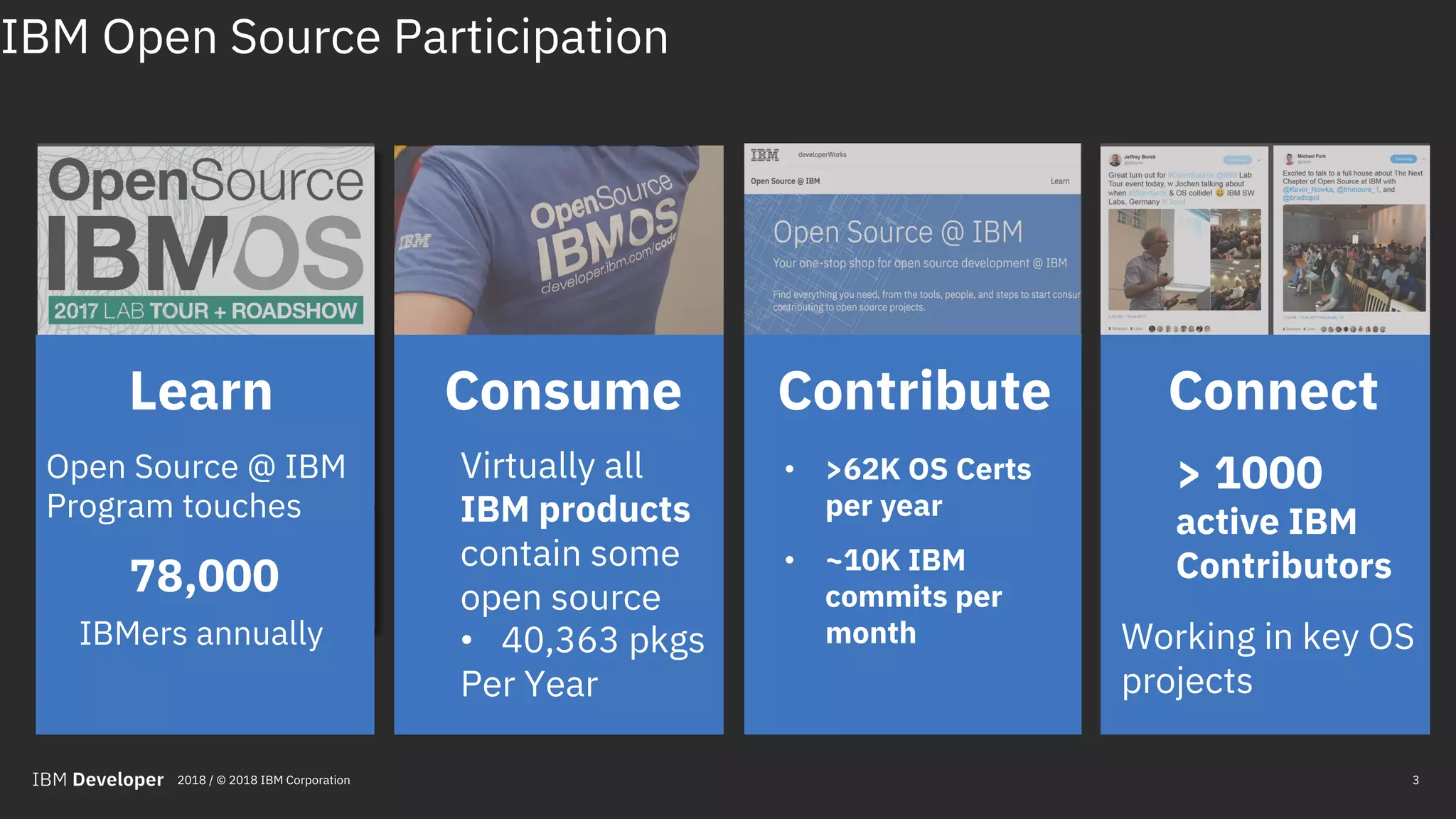
Learn
Open Source @ IBM
Program touches
78,000
IBMers annually
Consume
Virtually all
IBM products
contain some
open source
• 40,363 pkgs
Per Year
Contribute
• >62K OS Certs
per year
• ~10K IBM
commits per
month
Connect
> 1000
active IBM
Contributors
Working in key OS
projects
2018 / © 2018 IBM Corporation
IBM Open Source Participation
4
IBM Open Source Participation
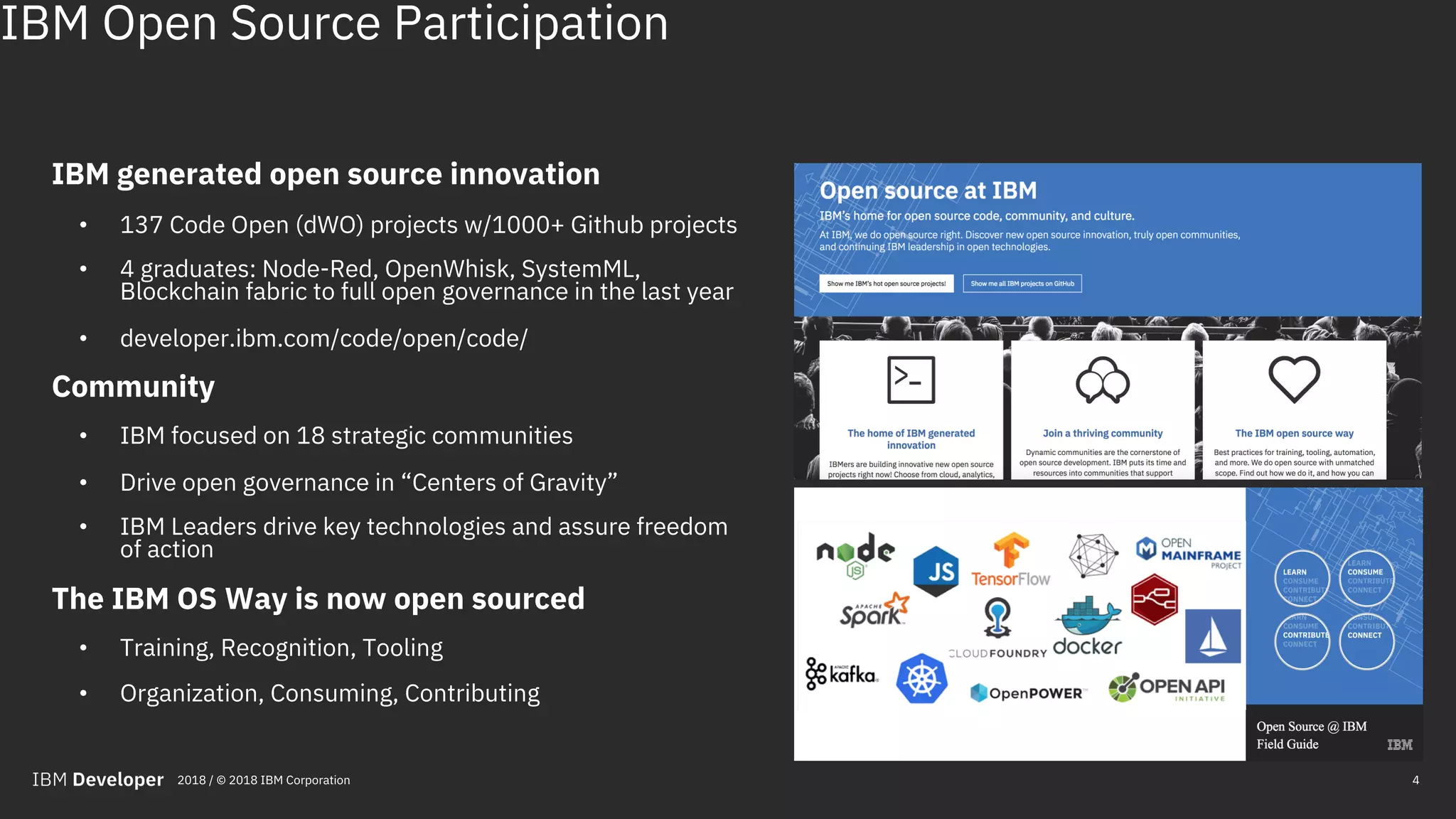
IBM generated open source innovation
• 137 Code Open (dWO) projects w/1000+ Github projects
• 4 graduates: Node-Red, OpenWhisk, SystemML,
Blockchain fabric to full open governance in the last year
• developer.ibm.com/code/open/code/
Community
• IBM focused on 18 strategic communities
• Drive open governance in “Centers of Gravity”
• IBM Leaders drive key technologies and assure freedom
of action
The IBM OS Way is now open sourced
• Training, Recognition, Tooling
• Organization, Consuming, Contributing
2018 / © 2018 IBM Corporation
Center for Open Source
Data and AI Technologies
CODAIT
codait.org
2018 / © 2018 IBM Corporation
codait (French)
= coder/coded
https://m.interglot.com/fr/en/codait
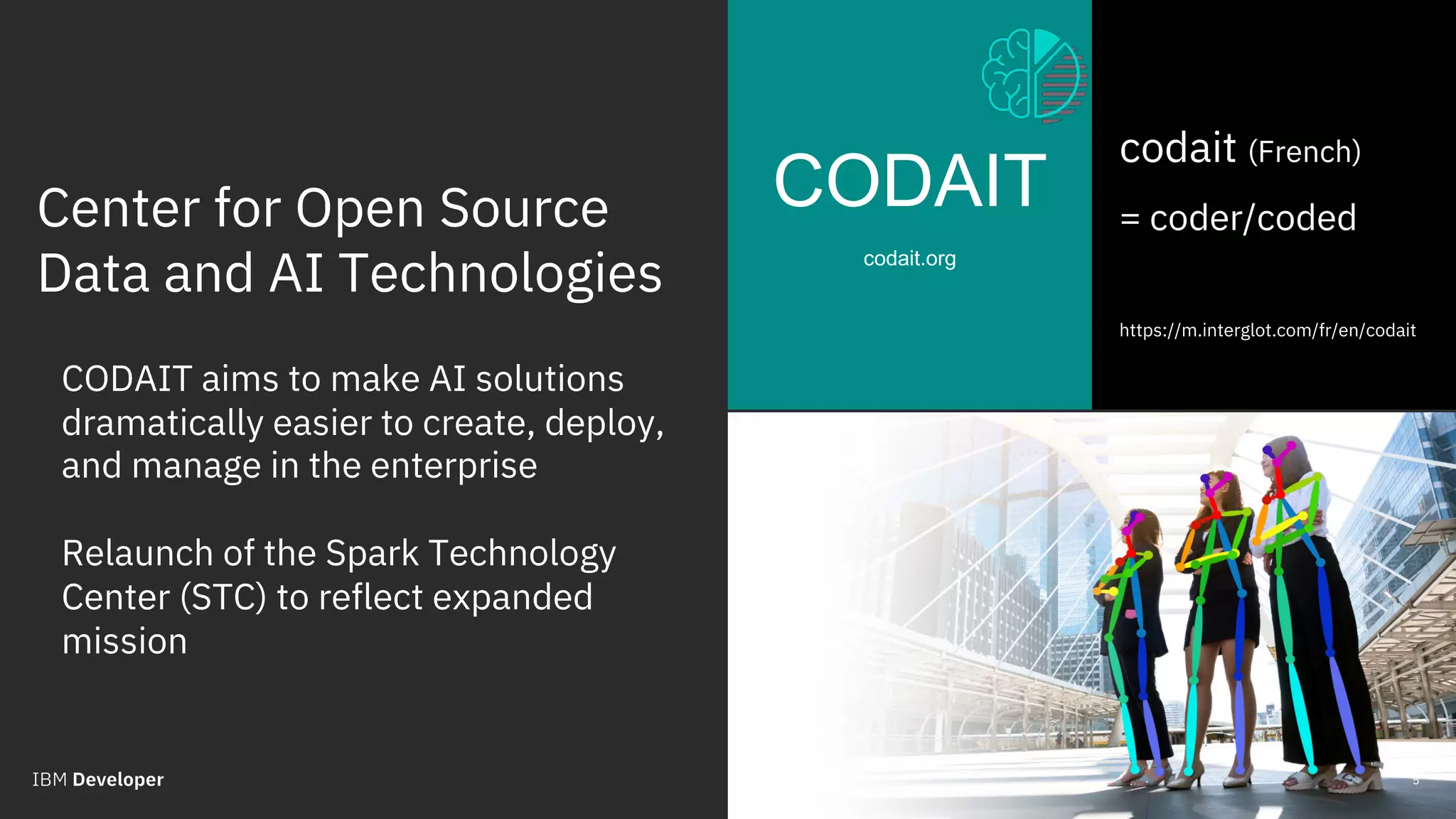
CODAIT aims to make AI solutions
dramatically easier to create, deploy,
and manage in the enterprise
Relaunch of the Spark Technology
Center (STC) to reflect expanded
mission
5
© 2018 IBM Corporation
Interactive
Development with
Jupyter Notebooks
6© 2018 IBM Corporation
Jupyter Notebooks
© 2018 IBM Corporation
7
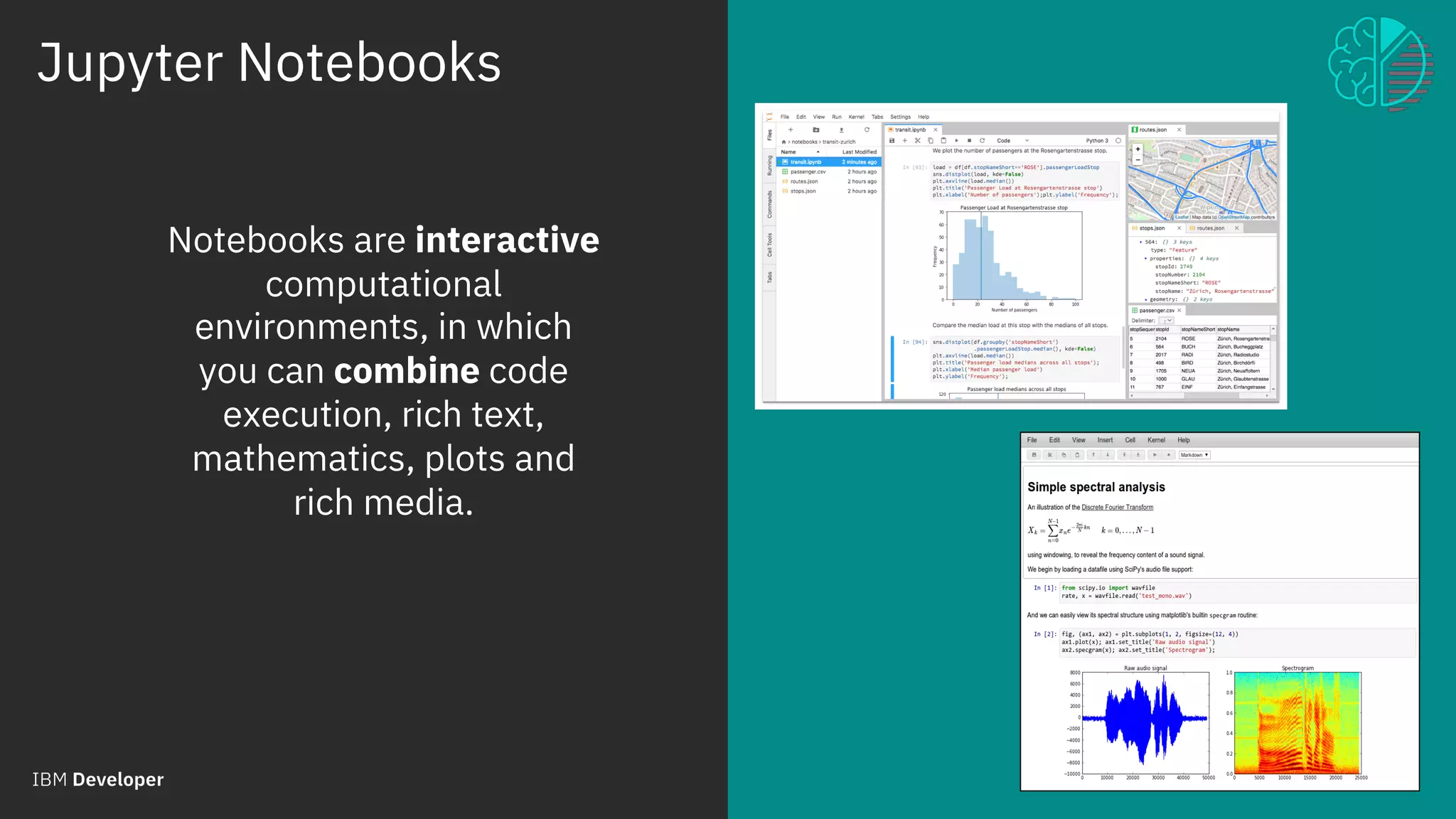
Notebooks are interactive
computational
environments, in which
you can combine code
execution, rich text,
mathematics, plots and
rich media.
Jupyter Notebooks
© 2018 IBM Corporation
8
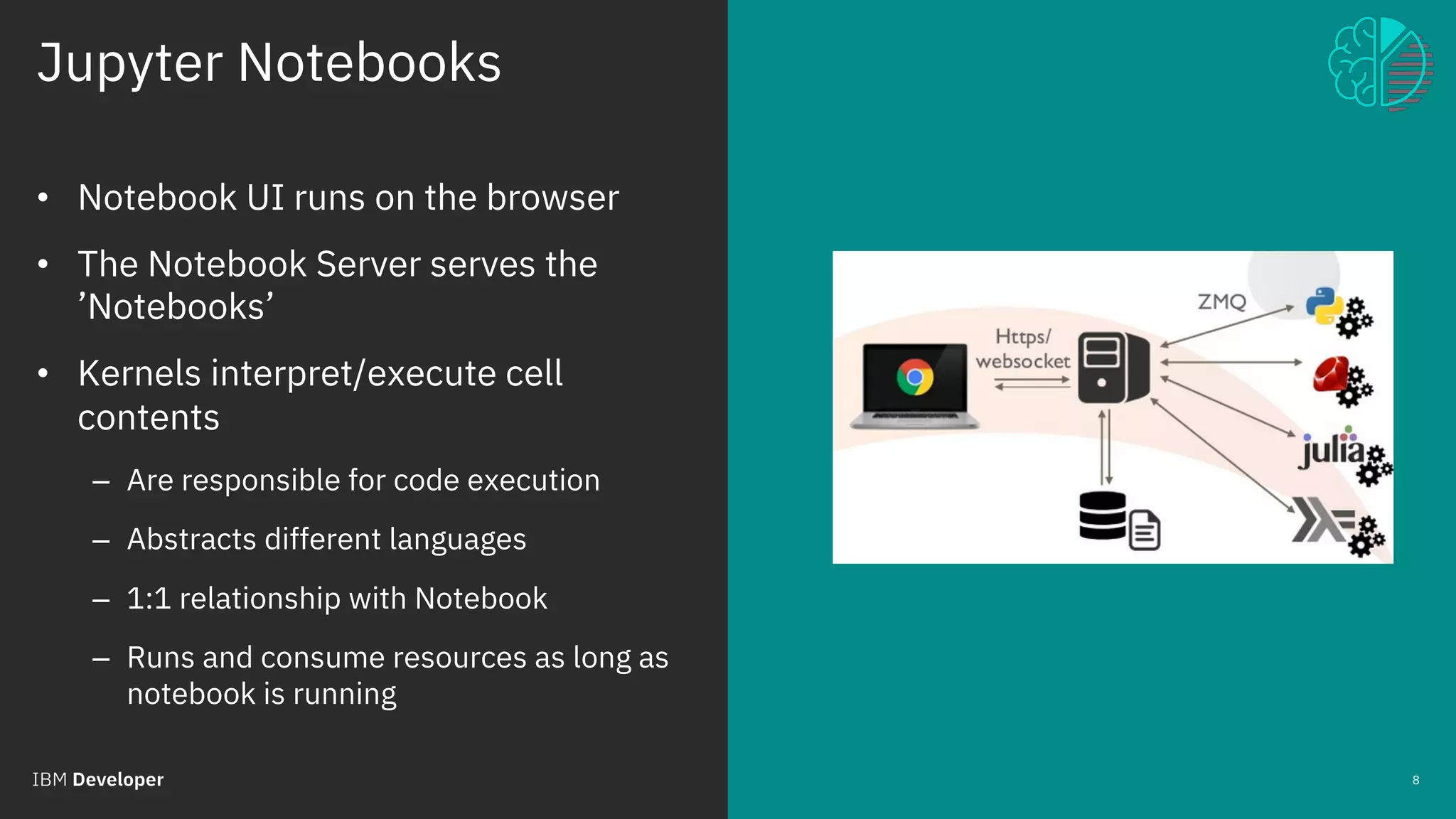
• Notebook UI runs on the browser
• The Notebook Server serves the
’Notebooks’
• Kernels interpret/execute cell
contents
– Are responsible for code execution
– Abstracts different languages
– 1:1 relationship with Notebook
– Runs and consume resources as long as
notebook is running
© 2018 IBM Corporation
Analytics and Deep Learning
Workloads
9© 2018 IBM Corporation
Analytics Workloads
© 2018 IBM Corporation
10
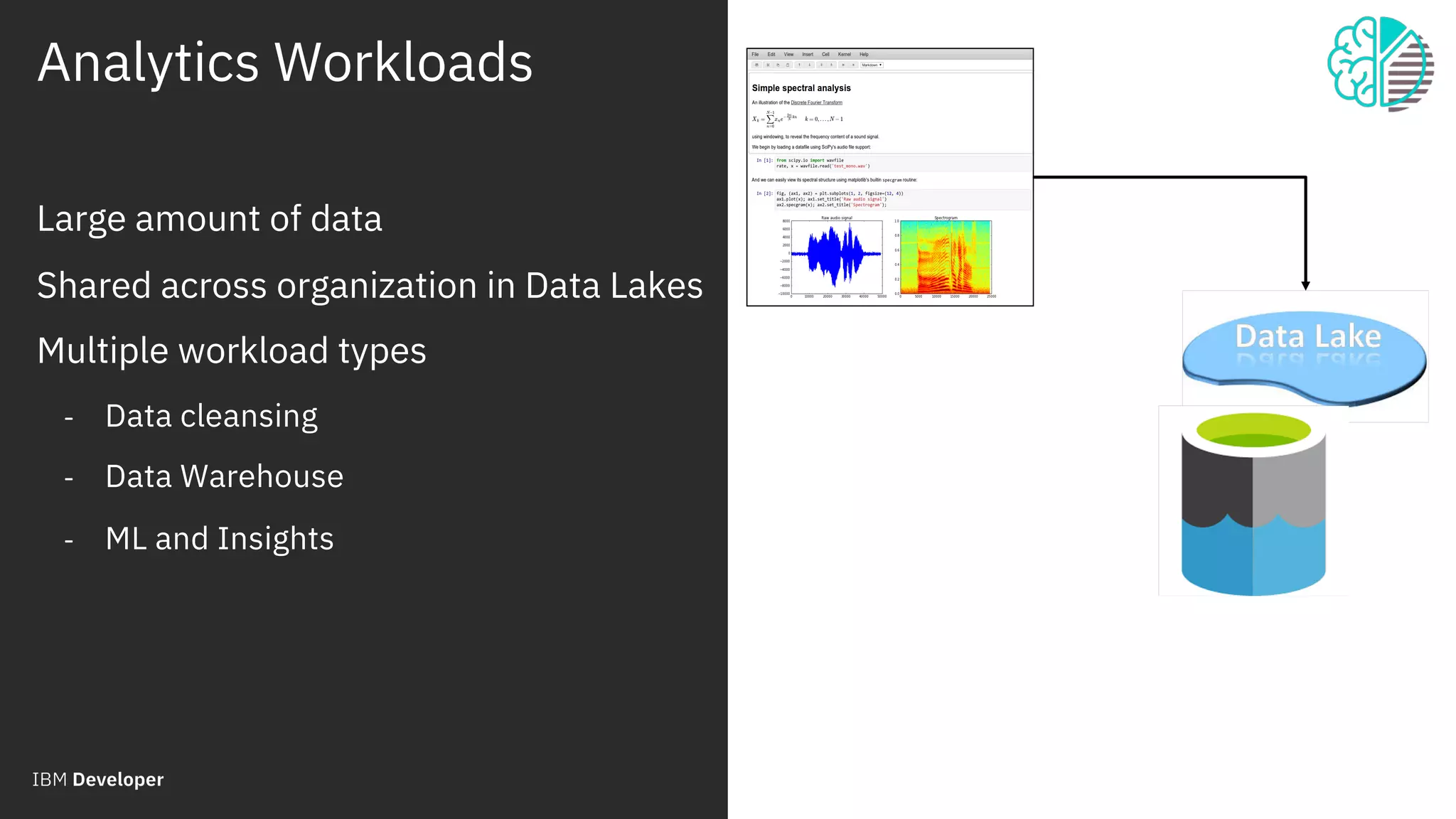
Large amount of data
Shared across organization in Data Lakes
Multiple workload types
- Data cleansing
- Data Warehouse
- ML and Insights
Deep Learning Workloads
© 2018 IBM Corporation
11
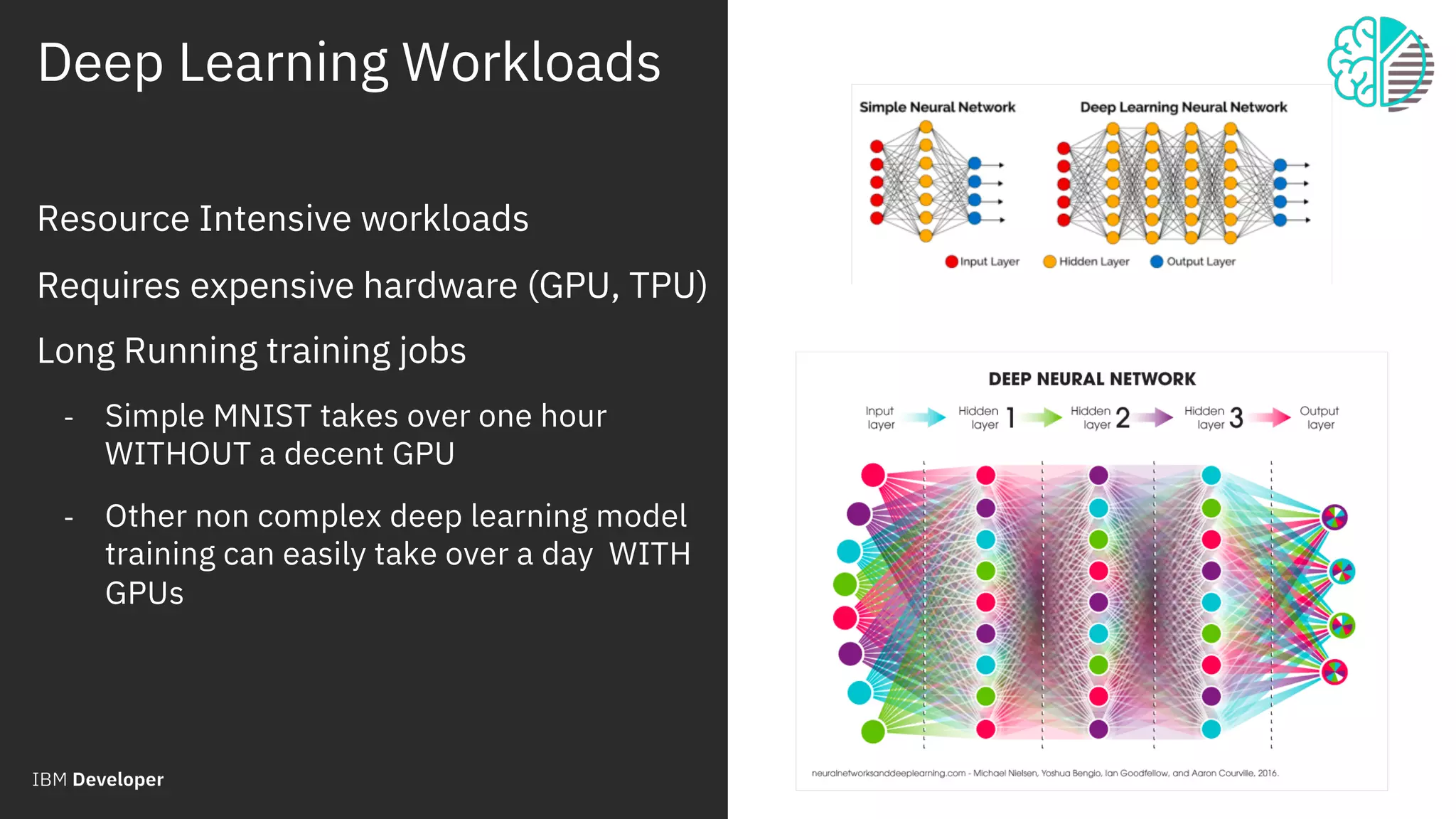
Resource Intensive workloads
Requires expensive hardware (GPU, TPU)
Long Running training jobs
- Simple MNIST takes over one hour
WITHOUT a decent GPU
- Other non complex deep learning model
training can easily take over a day WITH
GPUs
Local Development Environment
© 2018 IBM Corporation
12
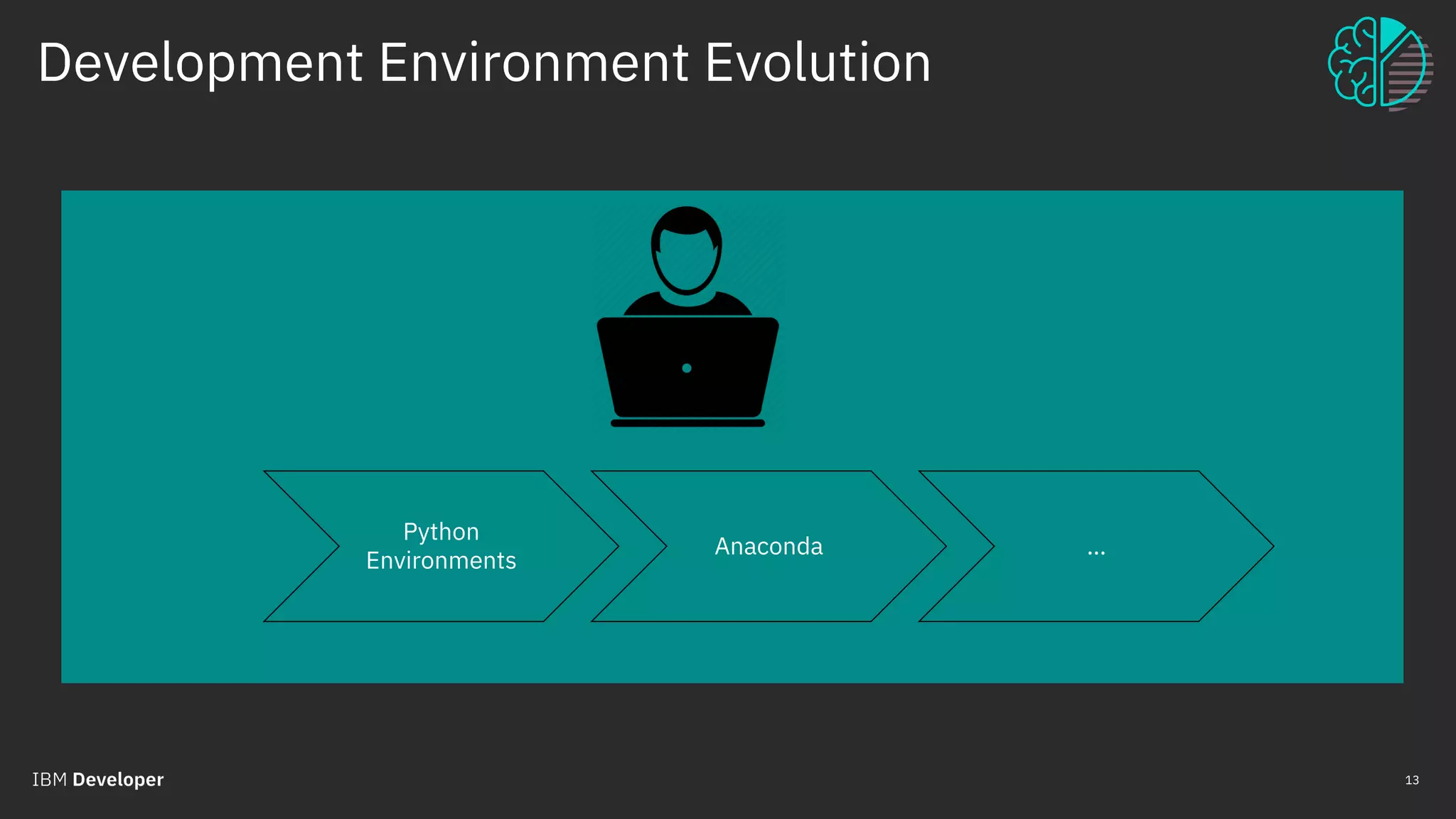
Development Environment Evolution
© 2018 IBM Corporation
13
Python
Environments
Anaconda …
Analytic and AI Platforms
© 2018 IBM Corporation
14
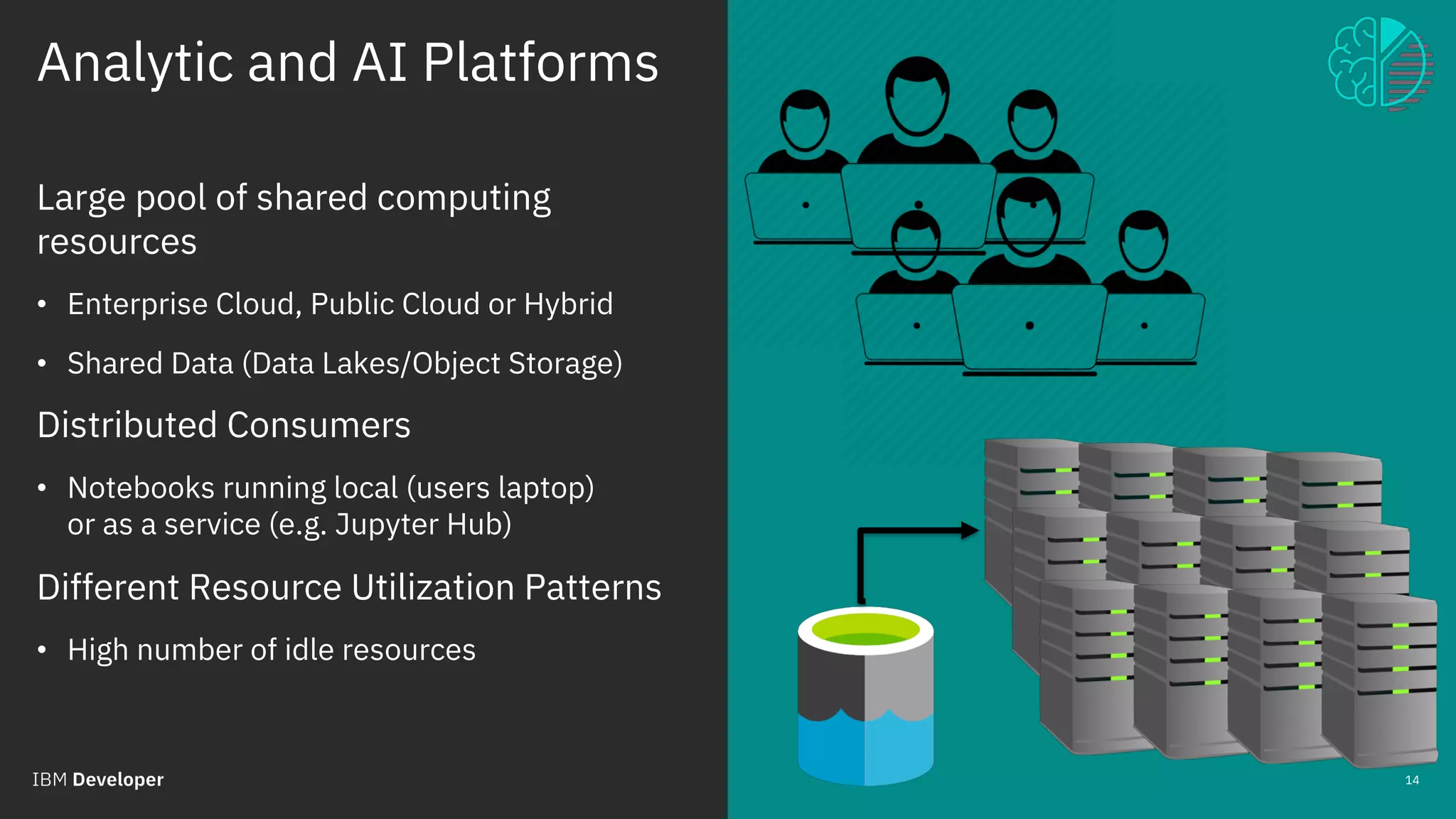
Large pool of shared computing
resources
• Enterprise Cloud, Public Cloud or Hybrid
• Shared Data (Data Lakes/Object Storage)
Distributed Consumers
• Notebooks running local (users laptop)
or as a service (e.g. Jupyter Hub)
Different Resource Utilization Patterns
• High number of idle resources
Limitations of Jupyter Notebook Stack
© 2018 IBM Corporation
Gather
Data
Analyze
Data
Machine
Learning
Deep
Learning
Deploy
Model
Maintain
Model
Python
Data Science
Stack
Fabric for
Deep Learning
(FfDL)
Mleap +
PFA
Scikit-LearnPandas
Apache
Spark
Apache
Spark
Jupyter
Model
Asset
eXchange
Keras +
Tensorflow
15
8 8 8 8
0
10
20
30
40
50
60
70
80
4 Nodes 8 Nodes 12 Nodes 16 NodesMaxKernels(4GBHeap)
Cluster Size (32GB Nodes)
MAXIMUM NUMBER OF
SIMULTANEOUS KERNELS
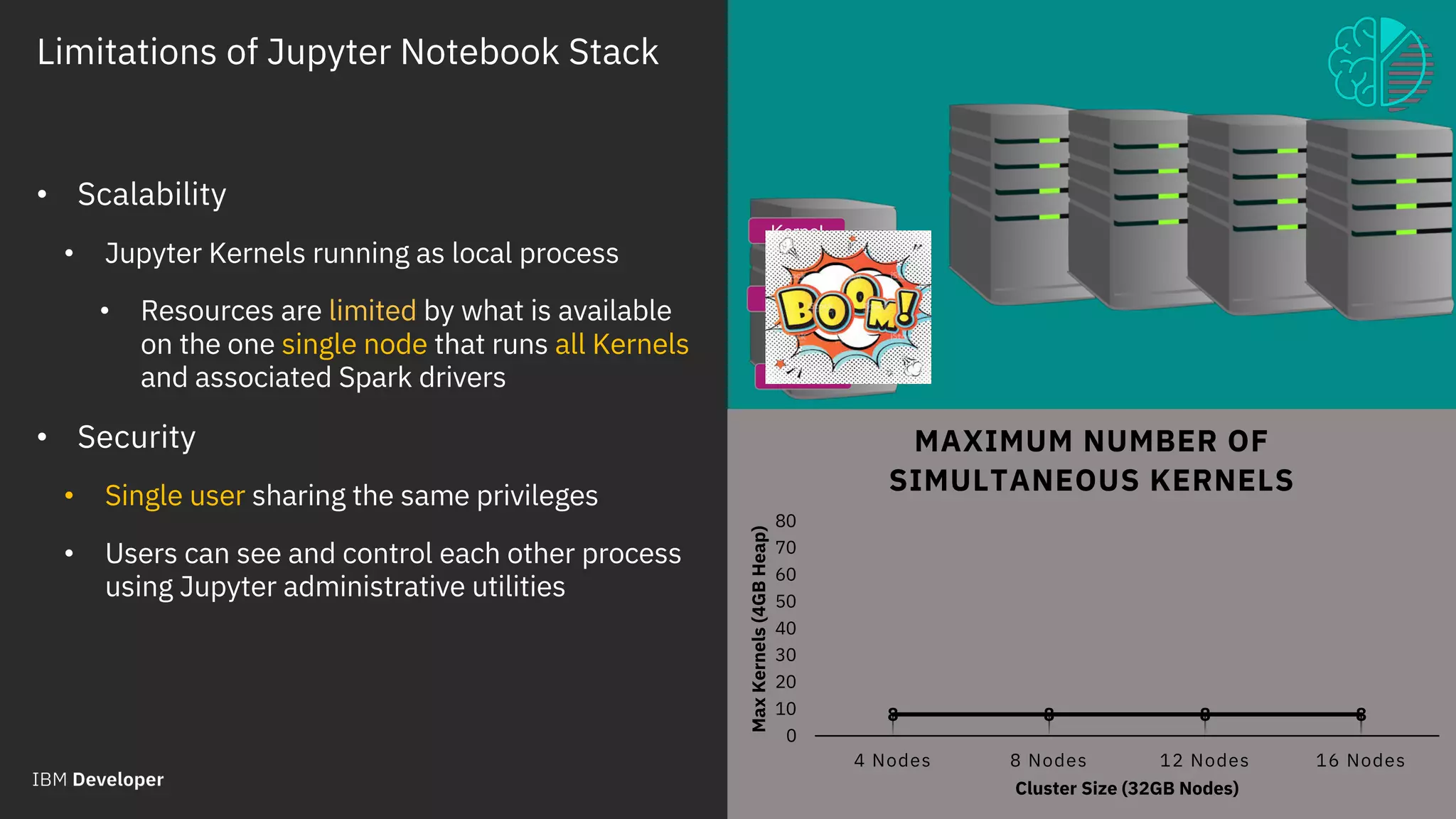
• Scalability
• Jupyter Kernels running as local process
• Resources are limited by what is available
on the one single node that runs all Kernels
and associated Spark drivers
• Security
• Single user sharing the same privileges
• Users can see and control each other process
using Jupyter administrative utilities
Kernel
Kernel
Kernel
Kernel
Kernel
© 2018 IBM Corporation
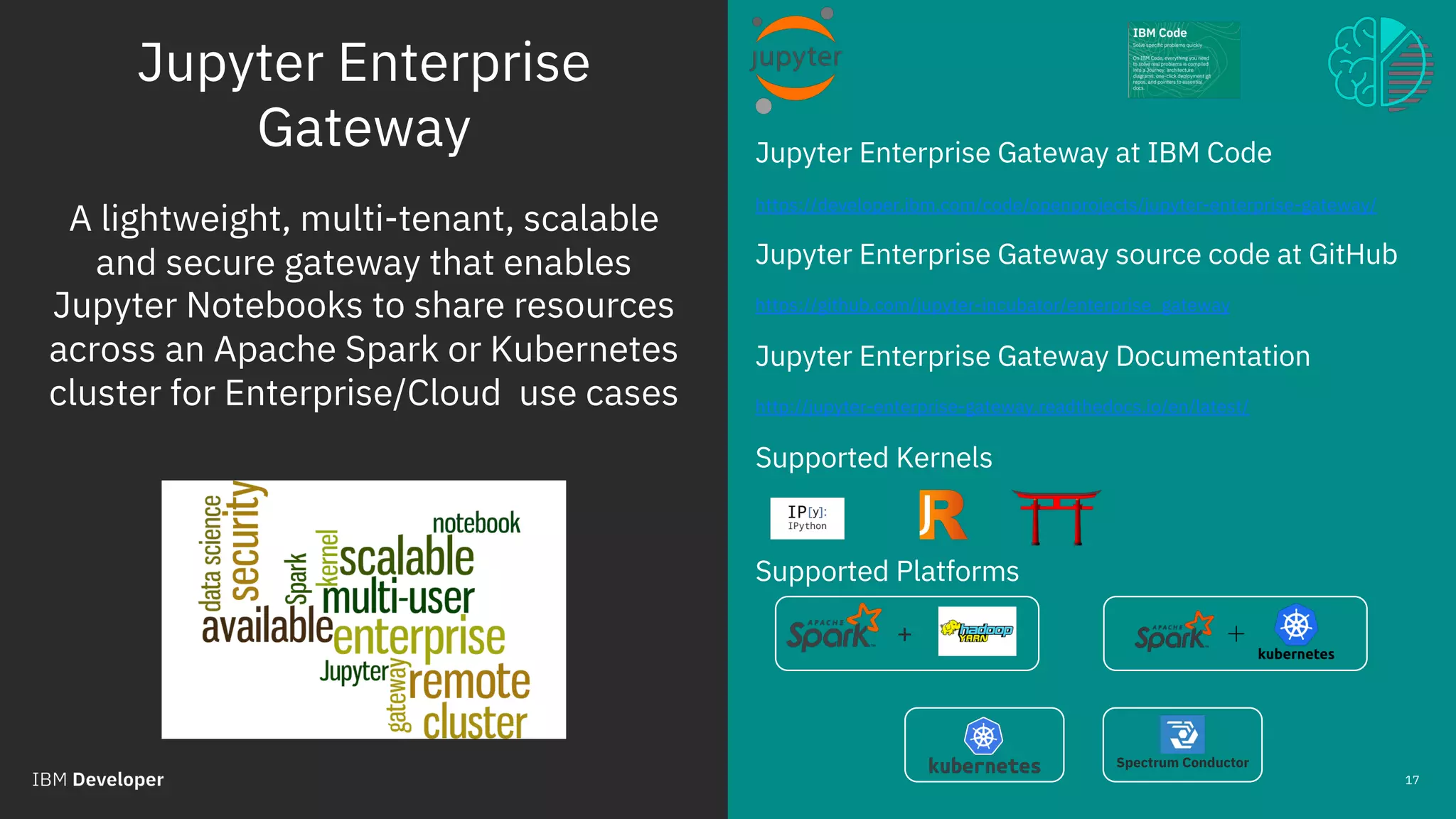
Jupyter Enterprise Gateway
16© 2018 IBM Corporation
Jupyter Enterprise
Gateway
© 2018 IBM Corporation
Jupyter Enterprise Gateway at IBM Code
https://developer.ibm.com/code/openprojects/jupyter-enterprise-gateway/
Jupyter Enterprise Gateway source code at GitHub
https://github.com/jupyter-incubator/enterprise_gateway
Jupyter Enterprise Gateway Documentation
http://jupyter-enterprise-gateway.readthedocs.io/en/latest/
Supported Kernels
Supported Platforms
17
A lightweight, multi-tenant, scalable
and secure gateway that enables
Jupyter Notebooks to share resources
across an Apache Spark or Kubernetes
cluster for Enterprise/Cloud use cases
Spectrum Conductor
+
Jupyter Enterprise Gateway Features
© 2018 IBM Corporation
Gather
Data
Analyze
Data
Machine
Learning
Deep
Learning
Deploy
Model
Maintain
Model
Python
Data Science
Stack
Fabric for
Deep Learning
(FfDL)
Mleap +
PFA
Scikit-LearnPandas
Apache
Spark
Apache
Spark
Jupyter
Model
Asset
eXchange
Keras +
Tensorflow
18
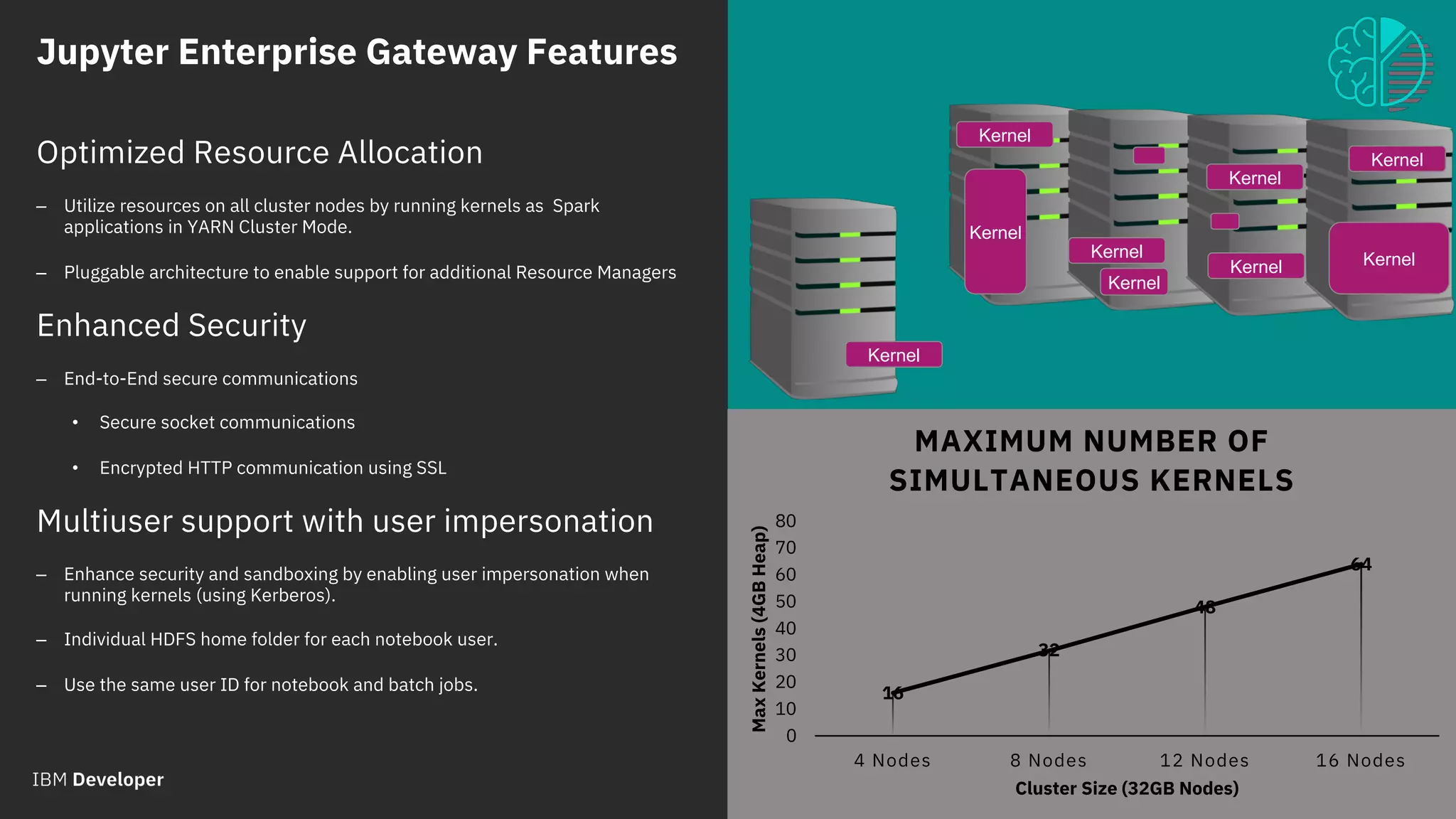
16
32
48
64
0
10
20
30
40
50
60
70
80
4 Nodes 8 Nodes 12 Nodes 16 NodesMaxKernels(4GBHeap)
Cluster Size (32GB Nodes)
MAXIMUM NUMBER OF
SIMULTANEOUS KERNELS
Optimized Resource Allocation
– Utilize resources on all cluster nodes by running kernels as Spark
applications in YARN Cluster Mode.
– Pluggable architecture to enable support for additional Resource Managers
Enhanced Security
– End-to-End secure communications
• Secure socket communications
• Encrypted HTTP communication using SSL
Multiuser support with user impersonation
– Enhance security and sandboxing by enabling user impersonation when
running kernels (using Kerberos).
– Individual HDFS home folder for each notebook user.
– Use the same user ID for notebook and batch jobs.
Kernel
Kernel
Kernel
Kernel
Kernel
Kernel
Kernel
Kernel
Kernel
© 2018 IBM Corporation
Jupyter Notebooks
and Kubernetes
19© 2018 IBM Corporation
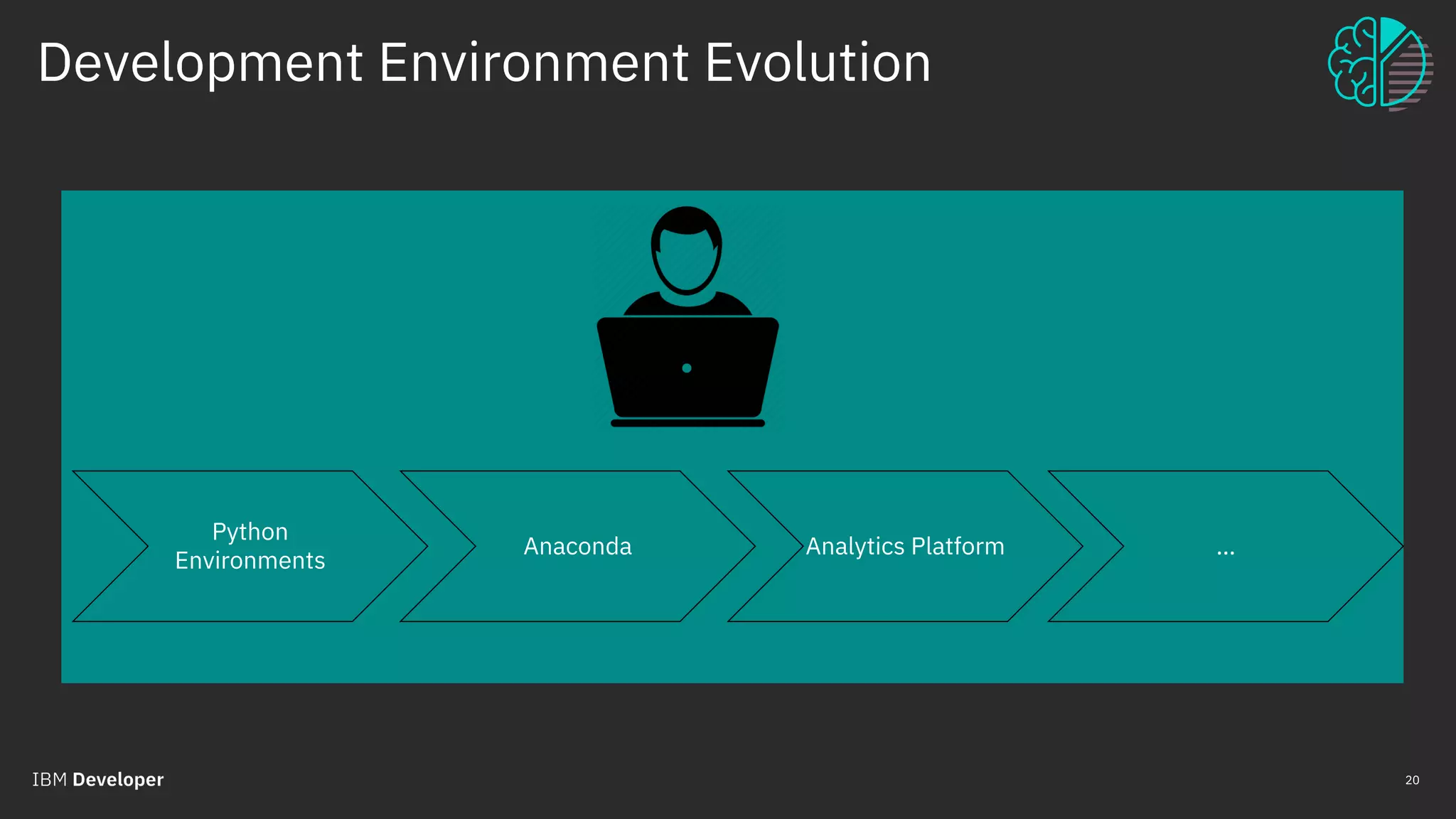
Development Environment Evolution
© 2018 IBM Corporation
20
Python
Environments
Anaconda Analytics Platform …
Jupyter & Kubernetes
© 2018 IBM Corporation
21
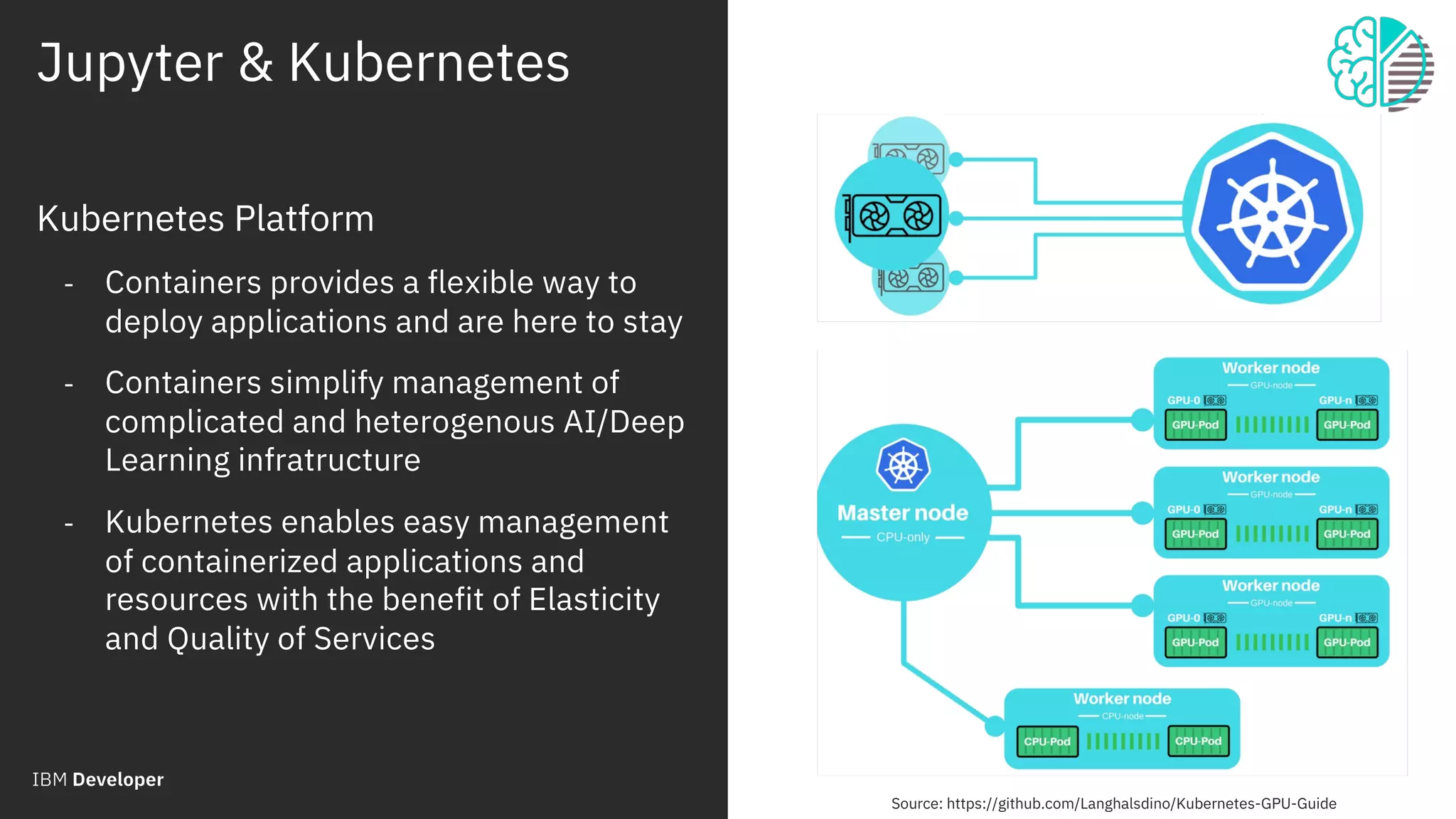
Kubernetes Platform
- Containers provides a flexible way to
deploy applications and are here to stay
- Containers simplify management of
complicated and heterogenous AI/Deep
Learning infratructure
- Kubernetes enables easy management
of containerized applications and
resources with the benefit of Elasticity
and Quality of Services
Source: https://github.com/Langhalsdino/Kubernetes-GPU-Guide
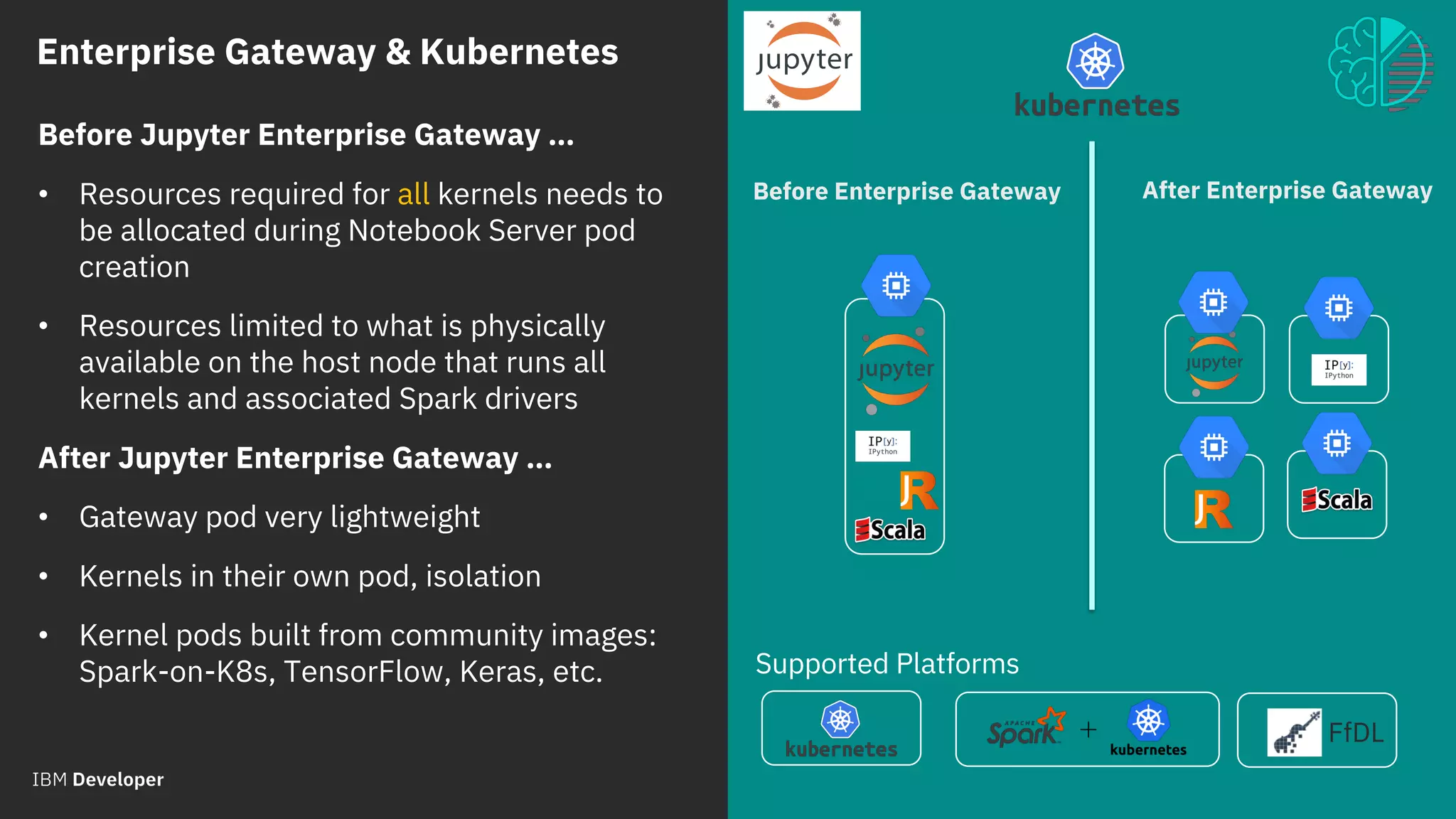
Enterprise Gateway & Kubernetes
© 2018 IBM Corporation
Supported Platforms
FfDL
Before Enterprise Gateway After Enterprise Gateway
Before Jupyter Enterprise Gateway …
• Resources required for all kernels needs to
be allocated during Notebook Server pod
creation
• Resources limited to what is physically
available on the host node that runs all
kernels and associated Spark drivers
After Jupyter Enterprise Gateway …
• Gateway pod very lightweight
• Kernels in their own pod, isolation
• Kernel pods built from community images:
Spark-on-K8s, TensorFlow, Keras, etc.
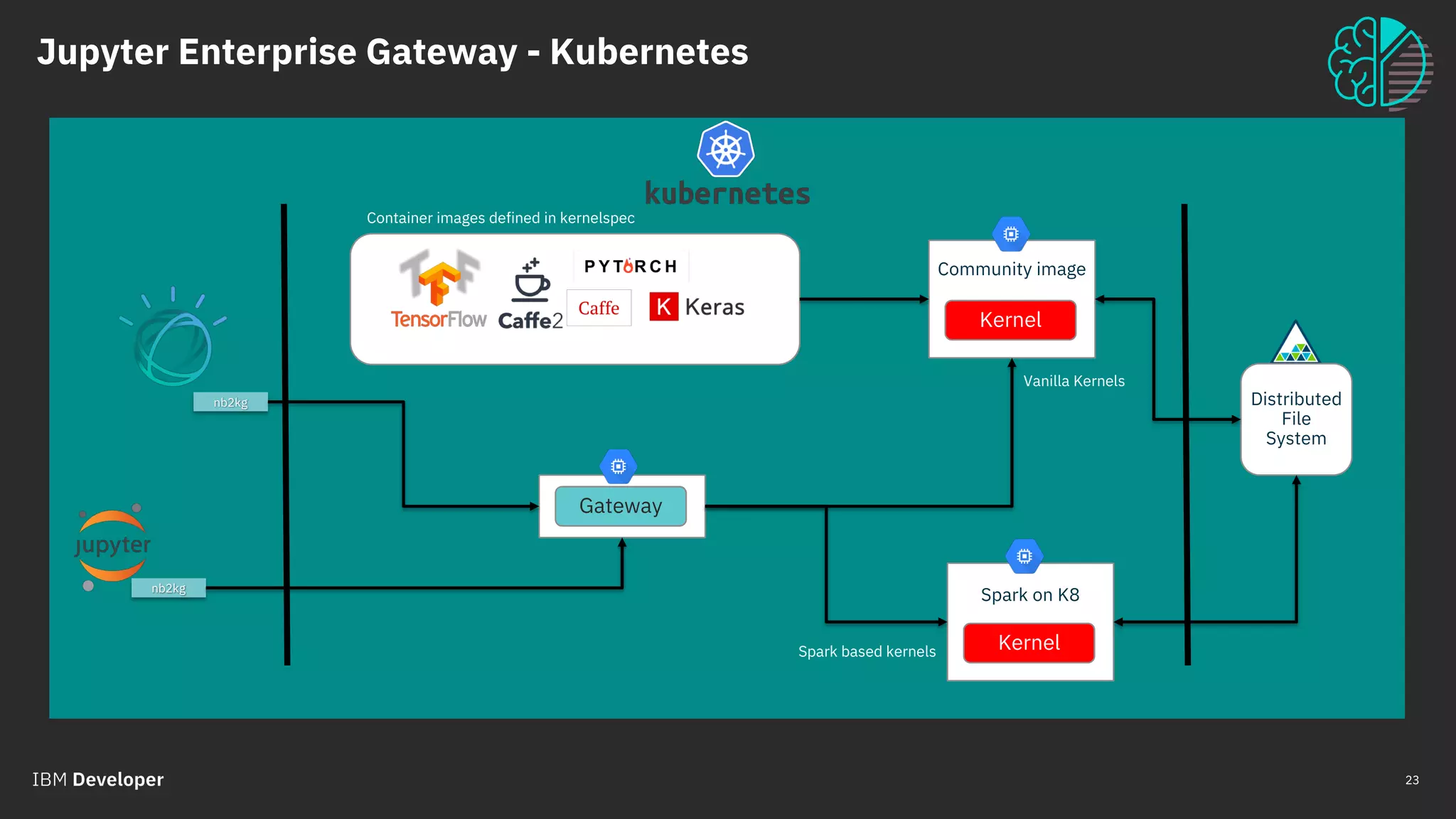
Jupyter Enterprise Gateway - Kubernetes
© 2018 IBM Corporation
23
Container images defined in kernelspec
Community image
Kernel
Spark on K8
Kernel
Distributed
File
System
Vanilla Kernels
Spark based kernels
Gateway
nb2kg
nb2kg
© 2018 IBM Corporation
24March 30 2018 / © 2018 IBM Corporation
March 30 2018 / © 2018 IBM Corporation
25
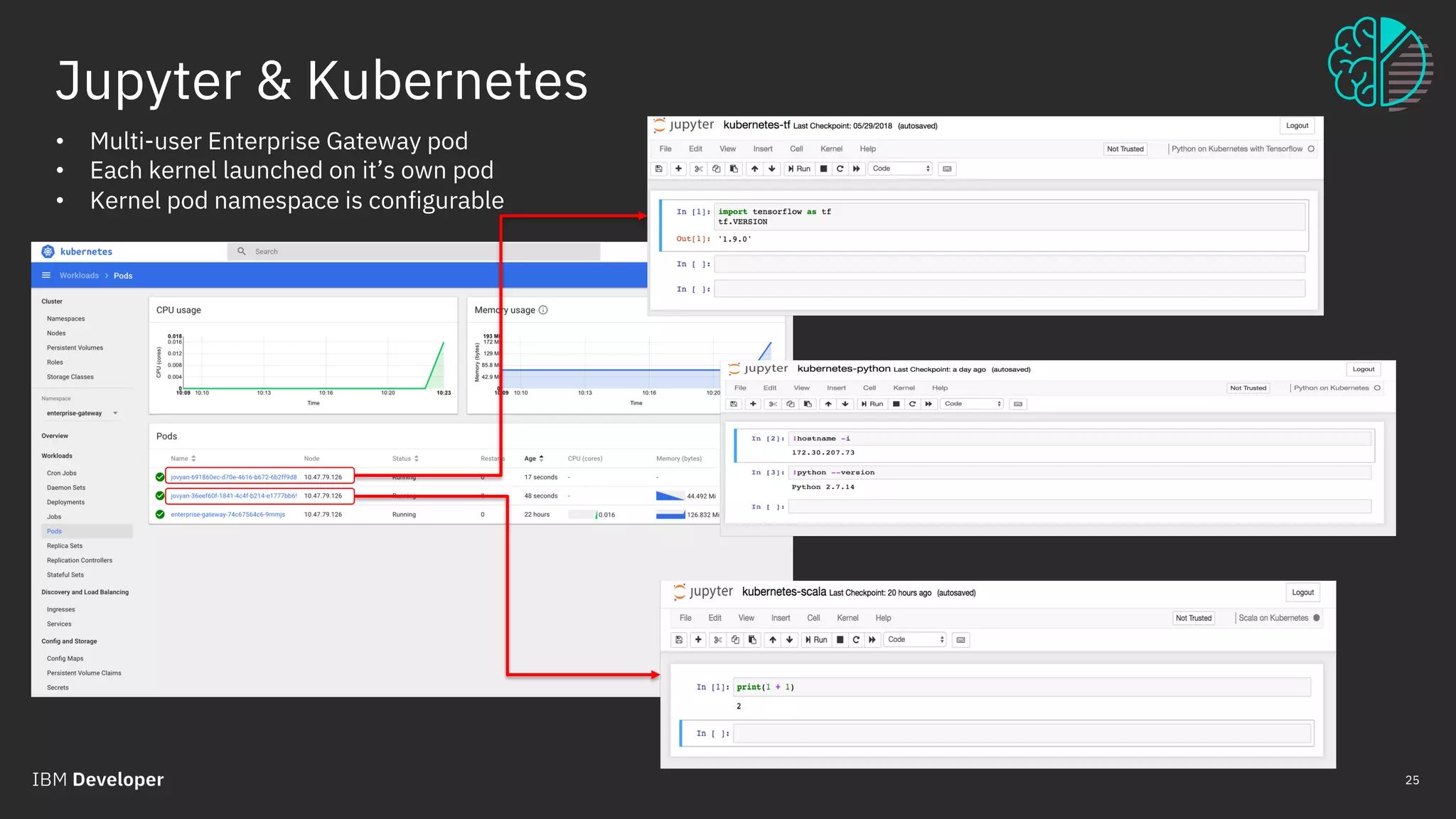
• Multi-user Enterprise Gateway pod
• Each kernel launched on it’s own pod
• Kernel pod namespace is configurable
Jupyter & Kubernetes
© 2018 IBM Corporation
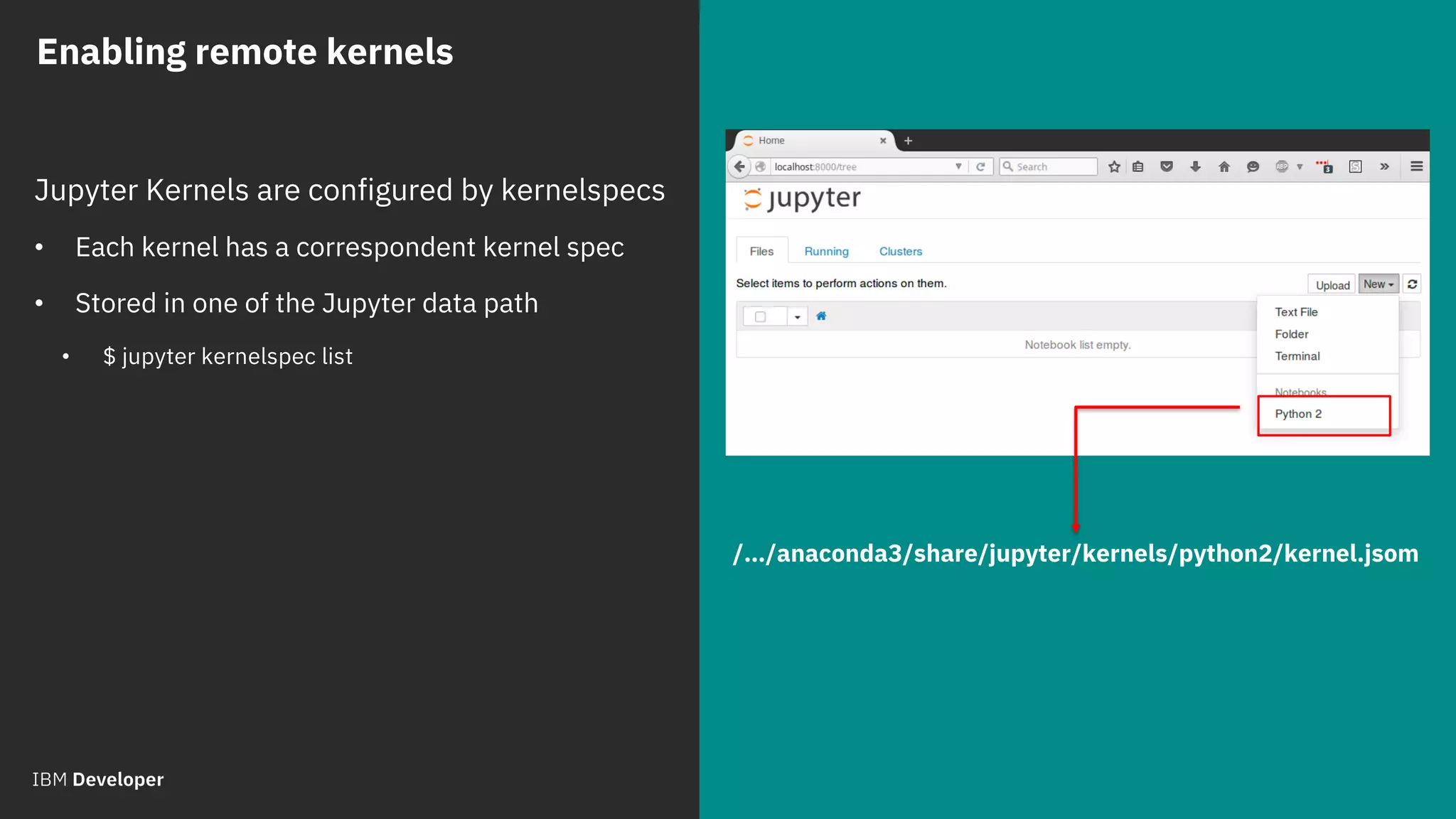
Jupyter Kernels are configured by kernelspecs
• Each kernel has a correspondent kernel spec
• Stored in one of the Jupyter data path
• $ jupyter kernelspec list
Enabling remote kernels
/…/anaconda3/share/jupyter/kernels/python2/kernel.jsom
© 2018 IBM Corporation
Process Proxy:
• Abstracts kernel process represented by Jupyter
framework
• Pluggable class definition identified in kernelspec
(kernel.json)
• Manages kernel lifecycle
Kernel Launcher:
• Embeds target kernel
• Listens on gateway communication port
• Conveys interrupt requests (via local signal)
• Could be extended for additional communications
{
"language": "python",
"display_name": "Spark - Python (Kubernetes Mode)",
"process_proxy": {
"class_name":
"enterprise_gateway.services.processproxies.k8s.KubernetesProcessP
roxy",
"config": {
"image_name": "elyra/kubernetes-kernel-py:dev",
"executor_image_name": "elyra/kubernetes-kernel-py:dev”,
"port_range" : "40000..42000"
}
},
"env": {
"SPARK_HOME": "/opt/spark",
"SPARK_OPTS": "--master k8s://https://${KUBERNETES_SERVICE_HOST
--deploy-mode cluster --name …",
…
},
"argv": [
"/usr/local/share/jupyter/kernels/spark_python_kubernetes/bin/run.
sh",
"{connection_file}",
"--RemoteProcessProxy.response-address",
"{response_address}",
"--RemoteProcessProxy.spark-context-initialization-mode",
"lazy"
]
}
Enabling remote kernels
Process Proxies mixed with Kernel Launchers
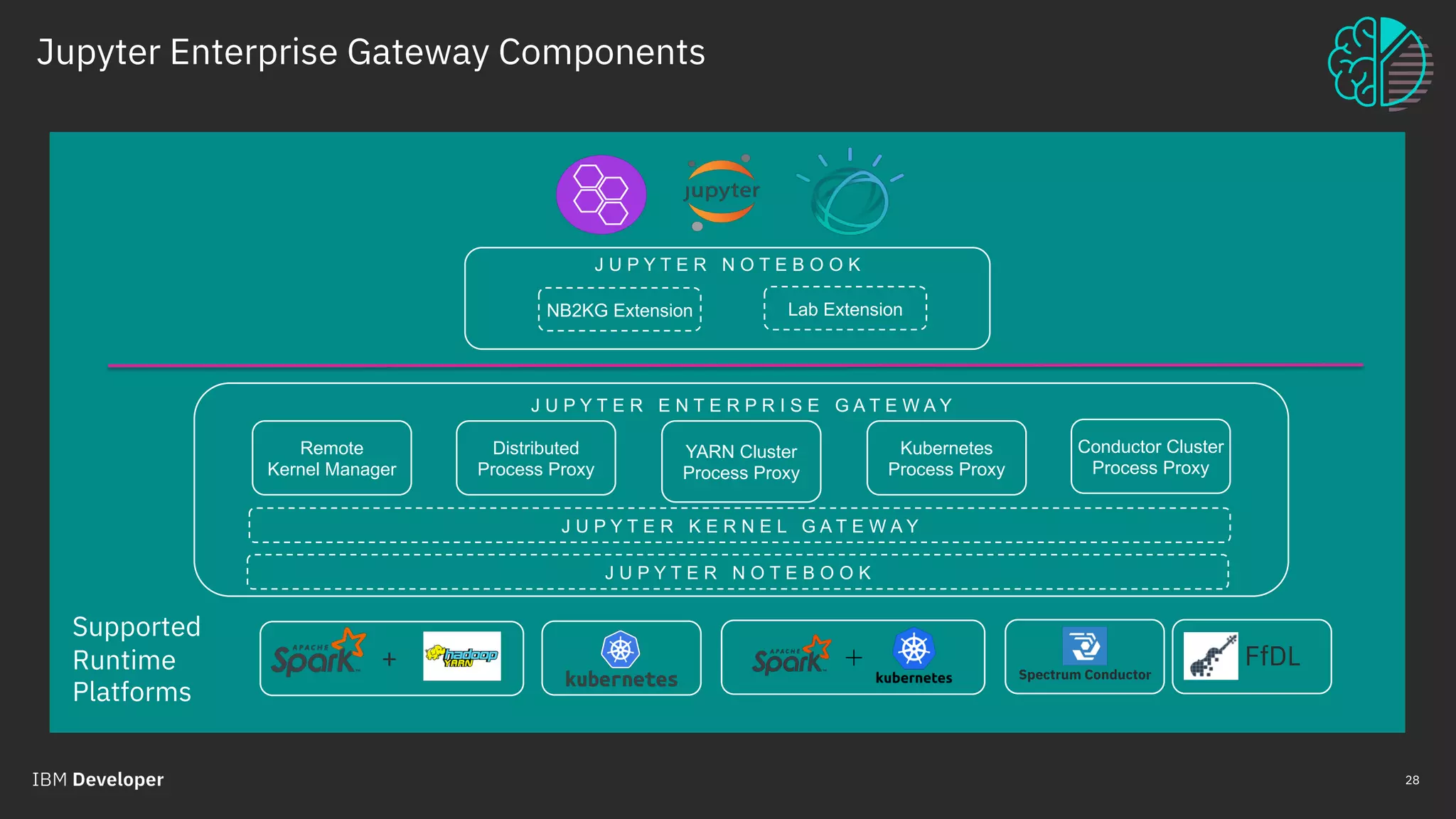
Jupyter Enterprise Gateway Components
© 2018 IBM Corporation
28
Spectrum Conductor
+
Supported
Runtime
Platforms
J U P Y T E R E N T E R P R I S E G A T E W A Y
Remote
Kernel Manager
Distributed
Process Proxy
YARN Cluster
Process Proxy
Kubernetes
Process Proxy
Conductor Cluster
Process Proxy
J U P Y T E R N O T E B O O K
NB2KG Extension Lab Extension
J U P Y T E R K E R N E L G A T E W A Y
J U P Y T E R N O T E B O O K
FfDL
© 2018 IBM Corporation
Jupyter Notebooks
and Deep Learning Platforms
29© 2018 IBM Corporation
Deep Learning Platforms
© 2018 IBM Corporation
30
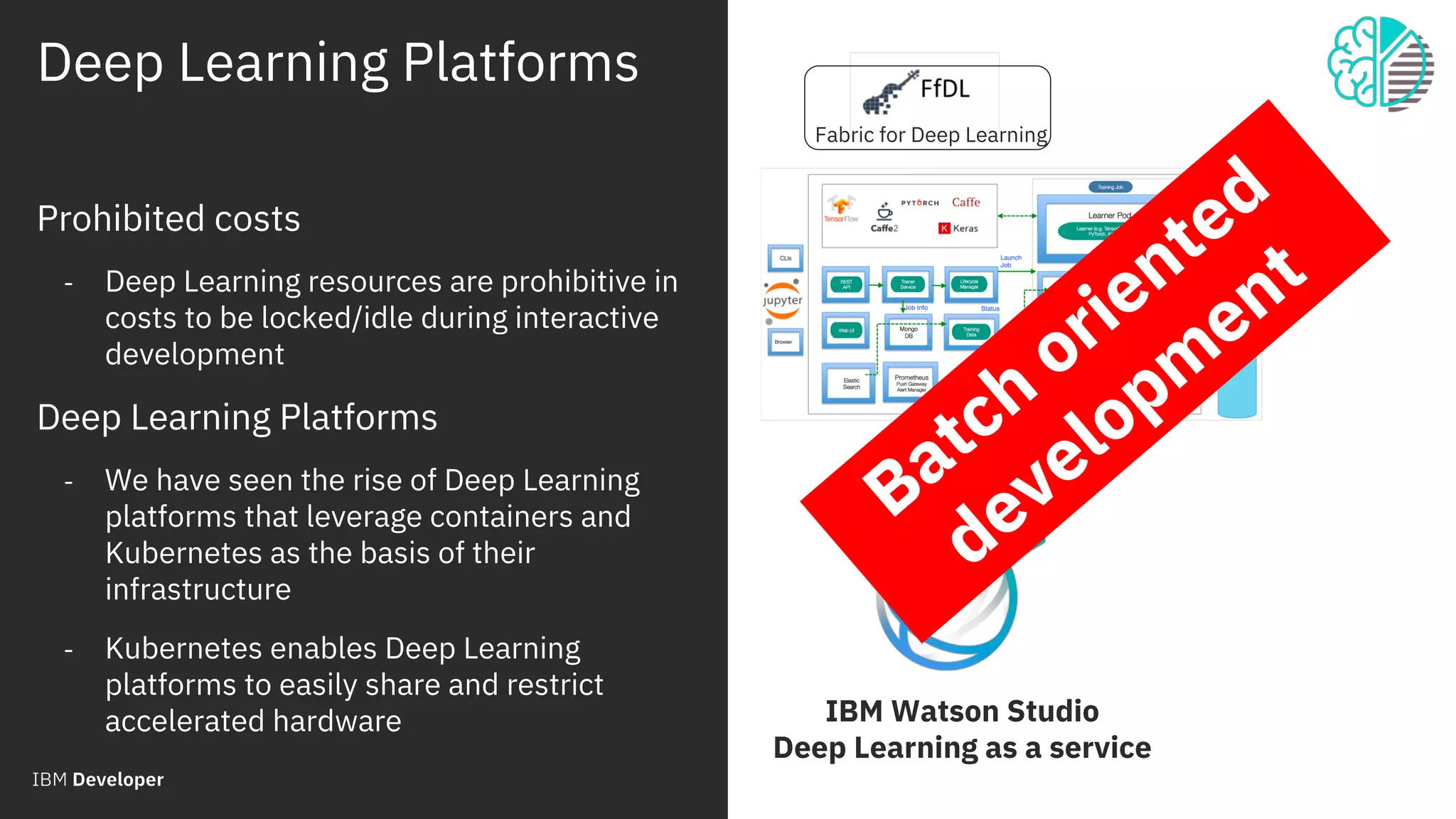
Prohibited costs
- Deep Learning resources are prohibitive in
costs to be locked/idle during interactive
development
Deep Learning Platforms
- We have seen the rise of Deep Learning
platforms that leverage containers and
Kubernetes as the basis of their
infrastructure
- Kubernetes enables Deep Learning
platforms to easily share and restrict
accelerated hardware
Fabric for Deep Learning
IBM Watson Studio
Deep Learning as a service
Batch
oriented
developm
ent
Deep Learning Workspace
March 30 2018 / © 2018 IBM Corporation
31
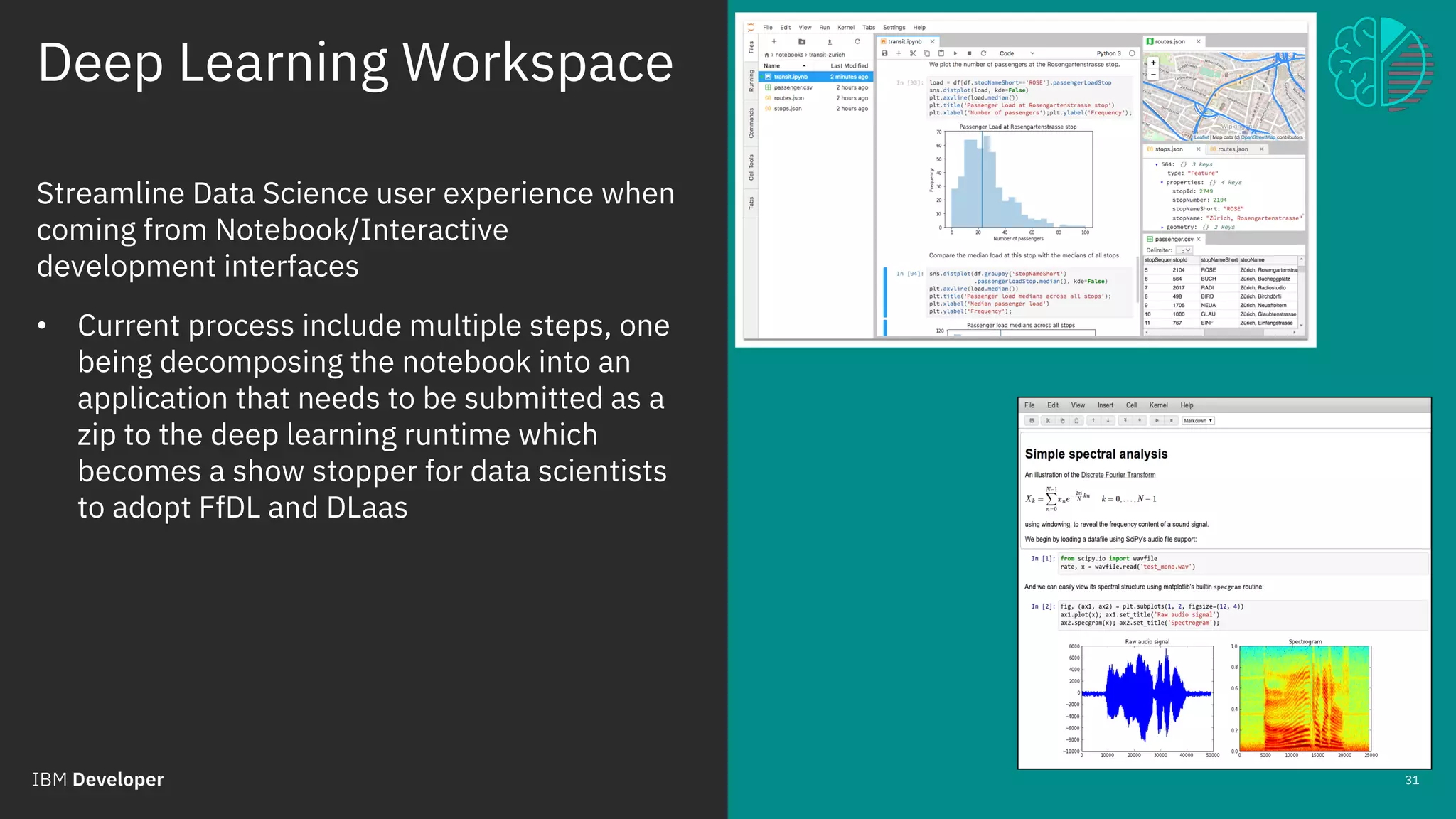
Streamline Data Science user experience when
coming from Notebook/Interactive
development interfaces
• Current process include multiple steps, one
being decomposing the notebook into an
application that needs to be submitted as a
zip to the deep learning runtime which
becomes a show stopper for data scientists
to adopt FfDL and DLaas
March 30 2018 / © 2018 IBM Corporation
32
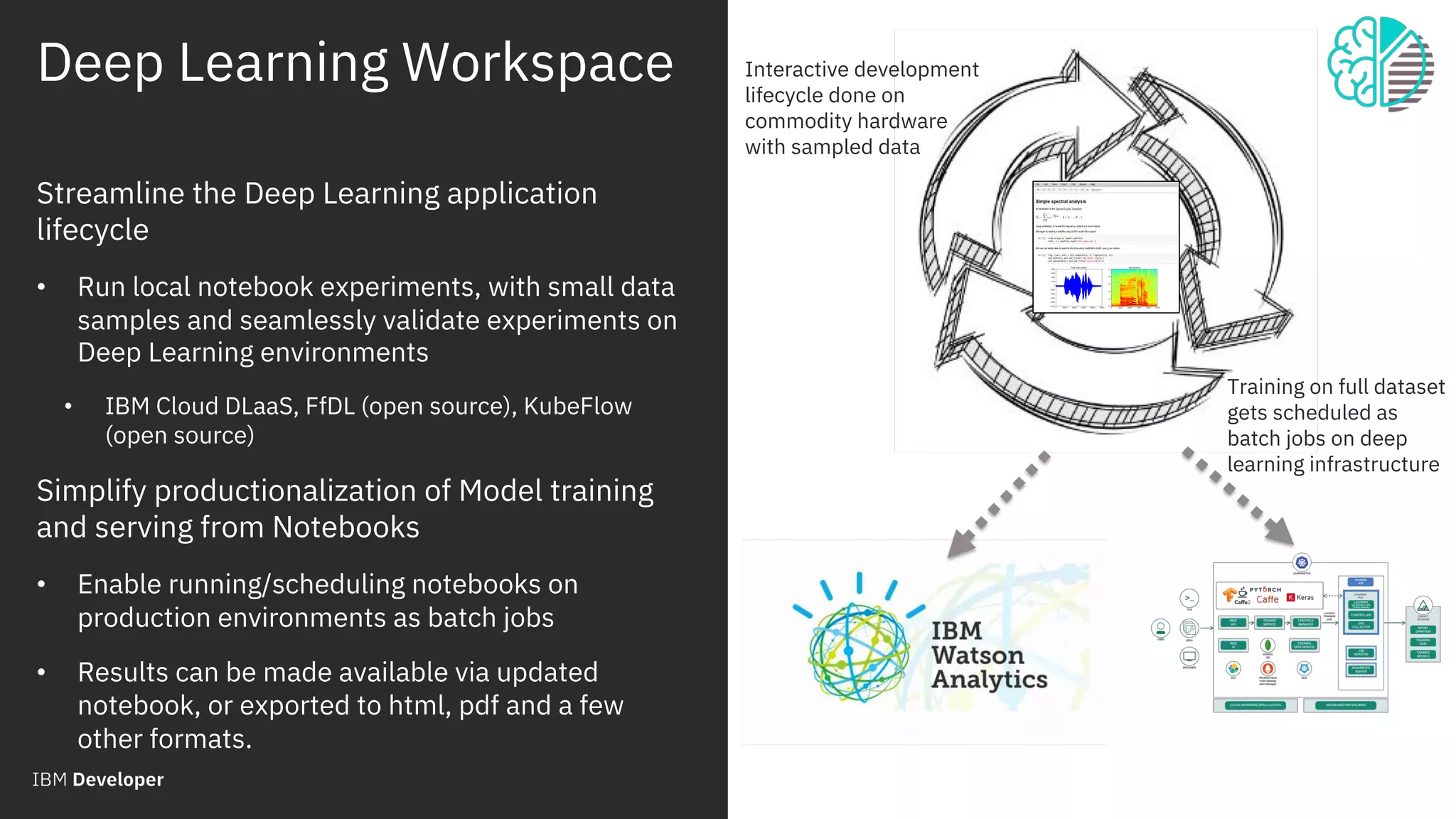
Streamline the Deep Learning application
lifecycle
• Run local notebook experiments, with small data
samples and seamlessly validate experiments on
Deep Learning environments
• IBM Cloud DLaaS, FfDL (open source), KubeFlow
(open source)
Simplify productionalization of Model training
and serving from Notebooks
• Enable running/scheduling notebooks on
production environments as batch jobs
• Results can be made available via updated
notebook, or exported to html, pdf and a few
other formats.
Interactive development
lifecycle done on
commodity hardware
with sampled data
Training on full dataset
gets scheduled as
batch jobs on deep
learning infrastructure
Deep Learning Workspace
© 2018 IBM Corporation
33March 30 2018 / © 2018 IBM Corporation
March 30 2018 / © 2018 IBM Corporation
34
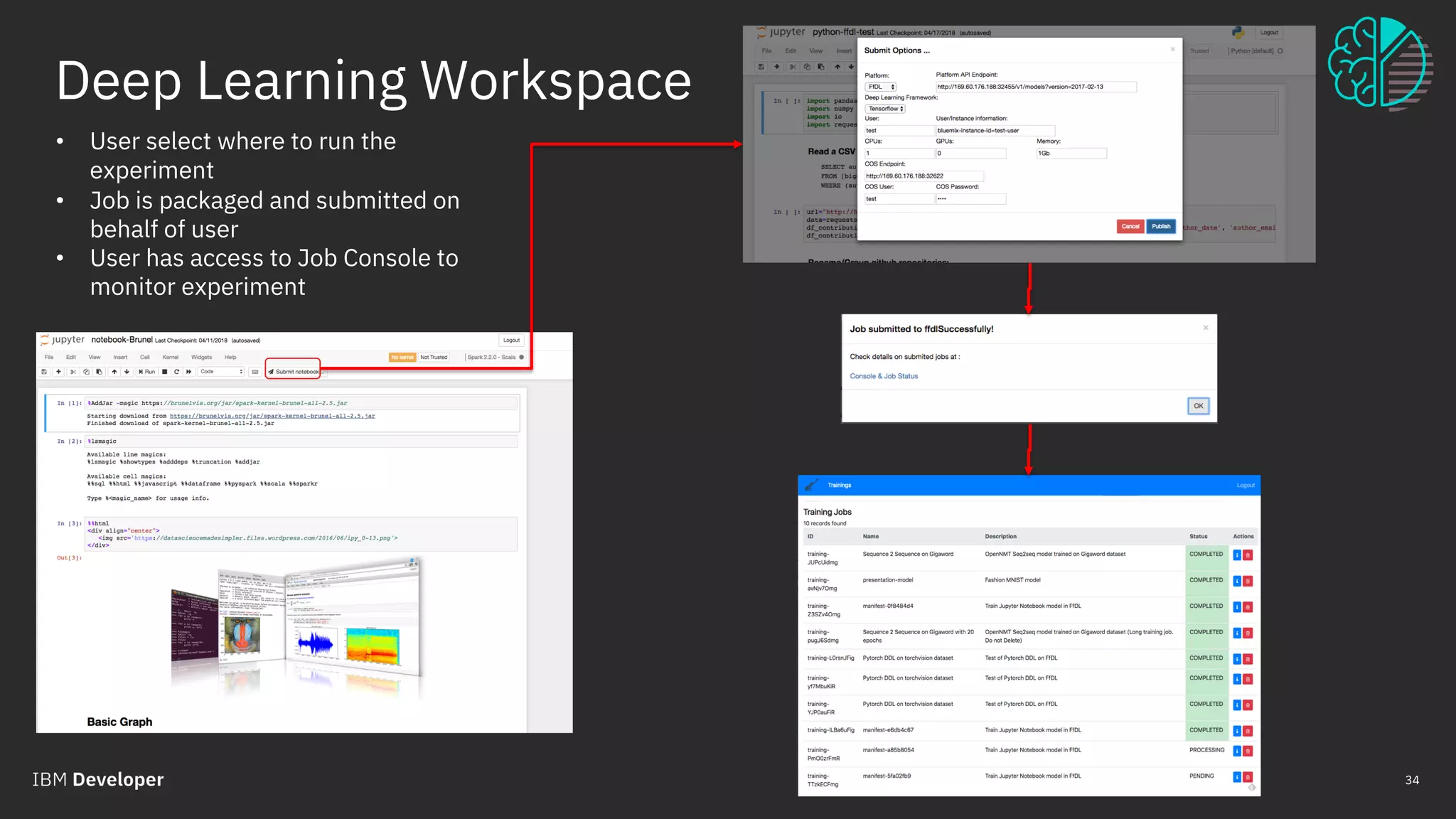
• User select where to run the
experiment
• Job is packaged and submitted on
behalf of user
• User has access to Job Console to
monitor experiment
Deep Learning Workspace
© 2018 IBM Corporation
Thank you!
@lresende1975
© 2018 IBM Corporation 36

Luciano Resende - Scaling Big Data Interactive Workloads across Kubernetes Cluster - Codemotion Berlin 2018

  • 1.
    Scaling Big Data InteractiveWorkloads across Kubernetes Cluster Luciano Resende Codemotion Berlin - 2018 1© 2018 IBM Corporation
  • 2.
    © 2018 IBMCorporation About me - Luciano Resende 2 Open Source AI Platform Architect – IBM – CODAIT • Senior Technical Staff Member at IBM, contributing to open source for over 10 years • Currently contributing to : Jupyter Notebook ecosystem, Apache Bahir, Apache Toree, Apache Spark among other projects related to AI/ML platforms lresende@us.ibm.com https://www.linkedin.com/in/lresende @lresende1975 https://github.com/lresende © 2018 IBM Corporation
  • 3.
    3 Learn Open Source @IBM Program touches 78,000 IBMers annually Consume Virtually all IBM products contain some open source • 40,363 pkgs Per Year Contribute • >62K OS Certs per year • ~10K IBM commits per month Connect > 1000 active IBM Contributors Working in key OS projects 2018 / © 2018 IBM Corporation IBM Open Source Participation
  • 4.
    4 IBM Open SourceParticipation IBM generated open source innovation • 137 Code Open (dWO) projects w/1000+ Github projects • 4 graduates: Node-Red, OpenWhisk, SystemML, Blockchain fabric to full open governance in the last year • developer.ibm.com/code/open/code/ Community • IBM focused on 18 strategic communities • Drive open governance in “Centers of Gravity” • IBM Leaders drive key technologies and assure freedom of action The IBM OS Way is now open sourced • Training, Recognition, Tooling • Organization, Consuming, Contributing 2018 / © 2018 IBM Corporation
  • 5.
    Center for OpenSource Data and AI Technologies CODAIT codait.org 2018 / © 2018 IBM Corporation codait (French) = coder/coded https://m.interglot.com/fr/en/codait CODAIT aims to make AI solutions dramatically easier to create, deploy, and manage in the enterprise Relaunch of the Spark Technology Center (STC) to reflect expanded mission 5
  • 6.
    © 2018 IBMCorporation Interactive Development with Jupyter Notebooks 6© 2018 IBM Corporation
  • 7.
    Jupyter Notebooks © 2018IBM Corporation 7 Notebooks are interactive computational environments, in which you can combine code execution, rich text, mathematics, plots and rich media.
  • 8.
    Jupyter Notebooks © 2018IBM Corporation 8 • Notebook UI runs on the browser • The Notebook Server serves the ’Notebooks’ • Kernels interpret/execute cell contents – Are responsible for code execution – Abstracts different languages – 1:1 relationship with Notebook – Runs and consume resources as long as notebook is running
  • 9.
    © 2018 IBMCorporation Analytics and Deep Learning Workloads 9© 2018 IBM Corporation
  • 10.
    Analytics Workloads © 2018IBM Corporation 10 Large amount of data Shared across organization in Data Lakes Multiple workload types - Data cleansing - Data Warehouse - ML and Insights
  • 11.
    Deep Learning Workloads ©2018 IBM Corporation 11 Resource Intensive workloads Requires expensive hardware (GPU, TPU) Long Running training jobs - Simple MNIST takes over one hour WITHOUT a decent GPU - Other non complex deep learning model training can easily take over a day WITH GPUs
  • 12.
    Local Development Environment ©2018 IBM Corporation 12
  • 13.
    Development Environment Evolution ©2018 IBM Corporation 13 Python Environments Anaconda …
  • 14.
    Analytic and AIPlatforms © 2018 IBM Corporation 14 Large pool of shared computing resources • Enterprise Cloud, Public Cloud or Hybrid • Shared Data (Data Lakes/Object Storage) Distributed Consumers • Notebooks running local (users laptop) or as a service (e.g. Jupyter Hub) Different Resource Utilization Patterns • High number of idle resources
  • 15.
    Limitations of JupyterNotebook Stack © 2018 IBM Corporation Gather Data Analyze Data Machine Learning Deep Learning Deploy Model Maintain Model Python Data Science Stack Fabric for Deep Learning (FfDL) Mleap + PFA Scikit-LearnPandas Apache Spark Apache Spark Jupyter Model Asset eXchange Keras + Tensorflow 15 8 8 8 8 0 10 20 30 40 50 60 70 80 4 Nodes 8 Nodes 12 Nodes 16 NodesMaxKernels(4GBHeap) Cluster Size (32GB Nodes) MAXIMUM NUMBER OF SIMULTANEOUS KERNELS • Scalability • Jupyter Kernels running as local process • Resources are limited by what is available on the one single node that runs all Kernels and associated Spark drivers • Security • Single user sharing the same privileges • Users can see and control each other process using Jupyter administrative utilities Kernel Kernel Kernel Kernel Kernel
  • 16.
    © 2018 IBMCorporation Jupyter Enterprise Gateway 16© 2018 IBM Corporation
  • 17.
    Jupyter Enterprise Gateway © 2018IBM Corporation Jupyter Enterprise Gateway at IBM Code https://developer.ibm.com/code/openprojects/jupyter-enterprise-gateway/ Jupyter Enterprise Gateway source code at GitHub https://github.com/jupyter-incubator/enterprise_gateway Jupyter Enterprise Gateway Documentation http://jupyter-enterprise-gateway.readthedocs.io/en/latest/ Supported Kernels Supported Platforms 17 A lightweight, multi-tenant, scalable and secure gateway that enables Jupyter Notebooks to share resources across an Apache Spark or Kubernetes cluster for Enterprise/Cloud use cases Spectrum Conductor +
  • 18.
    Jupyter Enterprise GatewayFeatures © 2018 IBM Corporation Gather Data Analyze Data Machine Learning Deep Learning Deploy Model Maintain Model Python Data Science Stack Fabric for Deep Learning (FfDL) Mleap + PFA Scikit-LearnPandas Apache Spark Apache Spark Jupyter Model Asset eXchange Keras + Tensorflow 18 16 32 48 64 0 10 20 30 40 50 60 70 80 4 Nodes 8 Nodes 12 Nodes 16 NodesMaxKernels(4GBHeap) Cluster Size (32GB Nodes) MAXIMUM NUMBER OF SIMULTANEOUS KERNELS Optimized Resource Allocation – Utilize resources on all cluster nodes by running kernels as Spark applications in YARN Cluster Mode. – Pluggable architecture to enable support for additional Resource Managers Enhanced Security – End-to-End secure communications • Secure socket communications • Encrypted HTTP communication using SSL Multiuser support with user impersonation – Enhance security and sandboxing by enabling user impersonation when running kernels (using Kerberos). – Individual HDFS home folder for each notebook user. – Use the same user ID for notebook and batch jobs. Kernel Kernel Kernel Kernel Kernel Kernel Kernel Kernel Kernel
  • 19.
    © 2018 IBMCorporation Jupyter Notebooks and Kubernetes 19© 2018 IBM Corporation
  • 20.
    Development Environment Evolution ©2018 IBM Corporation 20 Python Environments Anaconda Analytics Platform …
  • 21.
    Jupyter & Kubernetes ©2018 IBM Corporation 21 Kubernetes Platform - Containers provides a flexible way to deploy applications and are here to stay - Containers simplify management of complicated and heterogenous AI/Deep Learning infratructure - Kubernetes enables easy management of containerized applications and resources with the benefit of Elasticity and Quality of Services Source: https://github.com/Langhalsdino/Kubernetes-GPU-Guide
  • 22.
    Enterprise Gateway &Kubernetes © 2018 IBM Corporation Supported Platforms FfDL Before Enterprise Gateway After Enterprise Gateway Before Jupyter Enterprise Gateway … • Resources required for all kernels needs to be allocated during Notebook Server pod creation • Resources limited to what is physically available on the host node that runs all kernels and associated Spark drivers After Jupyter Enterprise Gateway … • Gateway pod very lightweight • Kernels in their own pod, isolation • Kernel pods built from community images: Spark-on-K8s, TensorFlow, Keras, etc.
  • 23.
    Jupyter Enterprise Gateway- Kubernetes © 2018 IBM Corporation 23 Container images defined in kernelspec Community image Kernel Spark on K8 Kernel Distributed File System Vanilla Kernels Spark based kernels Gateway nb2kg nb2kg
  • 24.
    © 2018 IBMCorporation 24March 30 2018 / © 2018 IBM Corporation
  • 25.
    March 30 2018/ © 2018 IBM Corporation 25 • Multi-user Enterprise Gateway pod • Each kernel launched on it’s own pod • Kernel pod namespace is configurable Jupyter & Kubernetes
  • 26.
    © 2018 IBMCorporation Jupyter Kernels are configured by kernelspecs • Each kernel has a correspondent kernel spec • Stored in one of the Jupyter data path • $ jupyter kernelspec list Enabling remote kernels /…/anaconda3/share/jupyter/kernels/python2/kernel.jsom
  • 27.
    © 2018 IBMCorporation Process Proxy: • Abstracts kernel process represented by Jupyter framework • Pluggable class definition identified in kernelspec (kernel.json) • Manages kernel lifecycle Kernel Launcher: • Embeds target kernel • Listens on gateway communication port • Conveys interrupt requests (via local signal) • Could be extended for additional communications { "language": "python", "display_name": "Spark - Python (Kubernetes Mode)", "process_proxy": { "class_name": "enterprise_gateway.services.processproxies.k8s.KubernetesProcessP roxy", "config": { "image_name": "elyra/kubernetes-kernel-py:dev", "executor_image_name": "elyra/kubernetes-kernel-py:dev”, "port_range" : "40000..42000" } }, "env": { "SPARK_HOME": "/opt/spark", "SPARK_OPTS": "--master k8s://https://${KUBERNETES_SERVICE_HOST --deploy-mode cluster --name …", … }, "argv": [ "/usr/local/share/jupyter/kernels/spark_python_kubernetes/bin/run. sh", "{connection_file}", "--RemoteProcessProxy.response-address", "{response_address}", "--RemoteProcessProxy.spark-context-initialization-mode", "lazy" ] } Enabling remote kernels Process Proxies mixed with Kernel Launchers
  • 28.
    Jupyter Enterprise GatewayComponents © 2018 IBM Corporation 28 Spectrum Conductor + Supported Runtime Platforms J U P Y T E R E N T E R P R I S E G A T E W A Y Remote Kernel Manager Distributed Process Proxy YARN Cluster Process Proxy Kubernetes Process Proxy Conductor Cluster Process Proxy J U P Y T E R N O T E B O O K NB2KG Extension Lab Extension J U P Y T E R K E R N E L G A T E W A Y J U P Y T E R N O T E B O O K FfDL
  • 29.
    © 2018 IBMCorporation Jupyter Notebooks and Deep Learning Platforms 29© 2018 IBM Corporation
  • 30.
    Deep Learning Platforms ©2018 IBM Corporation 30 Prohibited costs - Deep Learning resources are prohibitive in costs to be locked/idle during interactive development Deep Learning Platforms - We have seen the rise of Deep Learning platforms that leverage containers and Kubernetes as the basis of their infrastructure - Kubernetes enables Deep Learning platforms to easily share and restrict accelerated hardware Fabric for Deep Learning IBM Watson Studio Deep Learning as a service Batch oriented developm ent
  • 31.
    Deep Learning Workspace March30 2018 / © 2018 IBM Corporation 31 Streamline Data Science user experience when coming from Notebook/Interactive development interfaces • Current process include multiple steps, one being decomposing the notebook into an application that needs to be submitted as a zip to the deep learning runtime which becomes a show stopper for data scientists to adopt FfDL and DLaas
  • 32.
    March 30 2018/ © 2018 IBM Corporation 32 Streamline the Deep Learning application lifecycle • Run local notebook experiments, with small data samples and seamlessly validate experiments on Deep Learning environments • IBM Cloud DLaaS, FfDL (open source), KubeFlow (open source) Simplify productionalization of Model training and serving from Notebooks • Enable running/scheduling notebooks on production environments as batch jobs • Results can be made available via updated notebook, or exported to html, pdf and a few other formats. Interactive development lifecycle done on commodity hardware with sampled data Training on full dataset gets scheduled as batch jobs on deep learning infrastructure Deep Learning Workspace
  • 33.
    © 2018 IBMCorporation 33March 30 2018 / © 2018 IBM Corporation
  • 34.
    March 30 2018/ © 2018 IBM Corporation 34 • User select where to run the experiment • Job is packaged and submitted on behalf of user • User has access to Job Console to monitor experiment Deep Learning Workspace
  • 35.
    © 2018 IBMCorporation Thank you! @lresende1975
  • 36.
    © 2018 IBMCorporation 36