2015 NEBRASKA
CIVIC HEALTH INDEX
A Project Funded by the Weitz Family Foundation
ABOUT THE PARTNERS
NEBRASKANS FOR CIVIC REFORM
Nebraskans for Civic Reform is a nonpartisan nonprofit organization
dedicated to creating a more modern and robust democracy for all
Nebraskans. We achieve our mission through youth community
engagement and service learning programming, veteran job readiness
and community engagement, and nonpartisan election observation
and voting rights advocacy.
NEBRASKA COMMUNITY FOUNDATION
Nebraska Community Foundation is a statewide 501(c)(3) organization
using charitable giving to build prosperous communities. NCF works
with volunteer leaders serving more than 250 communities by
providing training, strategic development, gift planning assistance
and financial management for its affiliated funds located throughout
the state. In the last five years more than 35,000 contributions have
been made to NCF affiliated funds, and more than $126 million
has been reinvested to benefit Nebraska communities. For more
information visit www.NebraskaHometown.org.
NEBRASKA PUBLIC POLICY CENTER
The University of Nebraska Public Policy Center provides a unique
opportunity for policy makers and researchers to work together to
address the challenges of local, state, and federal policy. Center
researchers combine professional expertise with rigorous academic
methods and stakeholder involvement. The Center brings commitment
to collaborations as well as timely processes and outcomes.
UNO SERVICE LEARNING ACADEMY
The University of Nebraska at Omaha is Nebraska’s premier
metropolitan university and is committed to the needs of our
community through teaching, research and service. The university
is committed to and engaged with the city surrounding it, allowing
students unique, hands-on opportunities, internships, service
learning, applied research and other collaborative activities that
enhance time in the classroom. Our students graduate ready to
contribute to the workforce and the community.
UNL CENTER FOR CIVIC ENGAGEMENT
The UNL Center for Civic Engagement encourages students to
connect curricular and co-curricular learning with opportunities to
address critical human need through service, civic-related research
and social change leadership. Through programs and services offered
by the Center, students acquire the skills, knowledge and experience
necessary to advance community priorities and inspire a lifelong
commitment to personal and social responsibility.
NEBRASKA STATE BAR FOUNDATION
The Nebraska State Bar Foundation is dedicated to serving the citizens
of Nebraska and the Legal Profession through the administration
and funding of innovative and creative programs directed toward the
improvement of the administration of justice and the fulfillment of the
American vision of equal justice for all.
NATIONAL CONFERENCE ON CITIZENSHIP
The National Conference on Citizenship (NCoC) is a congressionally
chartered organization dedicated to strengthening civic life in America.
We pursue our mission through a nationwide network of partners
involved in a cutting-edge civic health initiative, an innovative national
service project, and our cross-sector conferences. At the core of our
joint efforts is the belief that every person has the ability to help their
community and country thrive.
Above Photo Credit: Nebraska Community Foundation
Left Cover Photo Credit: Steve and Bobbi Olson
TABLE OF CONTENTS
Executive Summary....................................................................................................................................................................................................................4
Introduction...........................................................................................................................................................................................................................................6
Nebraska’s Civic Health: At-a-Glance.................................................................................................................................................................8
Nebraskans and Social Connectedness......................................................................................................................................................10
Interacting with Family and Friends....................................................................................................................................................................10
Trusting Neighbors...................................................................................................................................................................................................................11
Doing Favors for Neighbors...........................................................................................................................................................................................12
The Road Ahead for Social Connectedness..............................................................................................................................................12
Nebraskans and Confidence in Institutions...........................................................................................................................................12
Nebraskans and Community Engagement...............................................................................................................................................13
Volunteering.....................................................................................................................................................................................................................................14
Charitable Giving........................................................................................................................................................................................................................16
Engagement with Neighbors and Groups.................................................................................................................................................... 17
The Road Ahead for Community Engagement........................................................................................................................................19
Nebraskans and Political Engagement........................................................................................................................................................20
Voting and Voter Registration.....................................................................................................................................................................................21
Local Voting......................................................................................................................................................................................................................................22
Contacting or Visiting Public Officials................................................................................................................................................................23
Discussing Politics...................................................................................................................................................................................................................24
The Road Ahead for Poltical Engagement...................................................................................................................................................26
Nebraska’s Civic Health Legacy.............................................................................................................................................................................28
What Can You Do to Impact the Future of Nebraska’s Civic Health?....................................................................30
Conclusion...........................................................................................................................................................................................................................................32
Endnotes................................................................................................................................................................................................................................................33
Word About Recommendations..............................................................................................................................................................................34
Technical Note...............................................................................................................................................................................................................................35
AUTHORS:
Kelsey Arends, Nebraskans for Civic Reform
Adam Morfeld, J.D, Nebraskans for Civic
Reform
Kent Day, M.A., Nebraskans for Civic Reform
Robert McEntarffer, Ph.D., Lincoln Public
Schools
Randal M. Ernst, Ed. D., Lincoln Public Schools
Karl Shaddock, Nebraska Community
Foundation
Jeff Yost, Nebraska Community Foundation
Lisa Pytlik Zillig, Ph.D., University of Nebraska
Public Policy Center
Mitchel N. Herian, Ph.D., University of Nebraska
Public Policy Center
Linda Major, University of Nebraska-Lincoln
Julie Dierberger, M.A., University of Nebraska
Omaha Service Learning Academy
Doris J. Huffman, MPA, Nebraska State Bar
Foundation
Harris C. Payne, Nebraska Department of
Education
A Project Funded by the Weitz Family Foundation
4 NEBRASK A CIVIC HEALTH INDEX
EXECUTIVE SUMMARY
Robust civic health leads to many benefits for communities, such as resilient economies, representative
and accountable governments, and higher social capital. This report – the first-ever Civic Health Index
for the state of Nebraska – documents Nebraskans’ rates of interacting with neighbors, communicating
with family and friends, having confidence in public institutions, being members of groups, volunteering
and giving, registering and voting, and being involved in politics. These indicators give us a picture of
the state of civic health in Nebraska and this report provides a data-based roadmap for strengthening
engagement throughout the state.
The results show that in relation to other states, Nebraskans perform well in many indicators of civic
health, particularly in activities related to social connectedness (e.g. eating dinner with household
members) and confidence in institutions. The state’s weakest area of civic health is political involvement
(e.g. voting, contacting public officials).
This report posits five critical action steps to strengthen civic health in Nebraska:
The Data: Nebraskans display strong social connectedness, particularly in interpersonal
relationships. The vast majority of Nebraskans (92.7%) report eating dinner with
other members of their household frequently, a rate that is second highest in the
nation. And, 82.3% of Nebraskans reported seeing or hearing from friends or family
frequently.
The Goal: Social connectedness ranks among Nebraska’s strongest areas of civic health.
Ensuring that social connections remain strong and growing to include all Nebraskans
is critical to the future of civic health in our state.
The Data: The youngest Nebraskans have the lowest rates of participation in most indicators
of community engagement. More than 50% of all Nebraskans 25 and older report
donating to a charity; however, only 19.5% of 18-24 year-olds report charitable giving.
Only 3.4% of 18-24 year-olds reported attending a public meeting. The data show that
the youngest Nebraskans – a generation that tends to use new and modern methods
of communication – are the least engaged in their communities of all age groups.
The Goal: Volunteering, attending community meetings, and even working with neighbors looks
different today than ever before. Not only are community members increasingly
accessible via social media, many go online to search for news, entertainment,
and activities. Communities need to adopt the strategies and cultural changes to
create inviting opportunities for 21st century participation. This means putting in
place the baseline technologies and messaging platforms that enable utilization of
powerful online social media resources. These resources can then be used to target
community members for civic activities. But, this is just the first step.
ACTI0N #
1 Continue to grow the strong tradition of connecting all Nebraskans.
ACTI0N #
2	
Create and promote accessible networks for community engagement. Use
online social media to connect community members and projects.
Successful communities will use new channels for engagement to create and design
programs with 21st century Nebraskans, not just for them. This includes seeking
active participation in unique ways from young and diverse groups, and then listening
to what they have to say. The ultimate goal is to promote leadership, service, and
transformational opportunities for emerging generations to create the communities
of their dreams that will attract and retain young people for generations to come.
The ultimate goal is to
promote leadership, service,
and transformational
opportunities for emerging
generations to create the
communities of their dreams
that will attract and retain
young people for generations
to come.
5
The Data: In the 2012 election, only 69.5% of Nebraskans registered and only 61.6% voted.
These rates rank Nebraska 32nd and 36th, respectively, compared to other states
and the District of Columbia.
The Goal: Increase voter registration and voting rates in both local and national elections,
primarily within groups that show lower rates of civic participation. Voting and
registration are among Nebraska’s weakest areas of civic health. These critical
elements of participatory democracy are only fully realized if as many citizens 18
and older participate as possible. As a state, raising rates of voting and registration
among all Nebraskans and particularly among the youngest voters, whom data show
have participated the least, will strengthen civic health.
ACTI0N #
3 Activate Nebraskans to register and vote by modernizing the process.
The Data: Only 12.2% of Nebraskans reported contacting or visiting a public official, ranking
the state 27th compared to other states and the District of Columbia.
The Goal: Public officials should provide electronic and in-person means of connecting
with other Nebraskans. Just as family and individual schedules can be barriers
to Nebraskans attending and participating in community engagement, those
restrictions can limit their access to public officials. Being accessible online and
using social media to promote in-person interaction will increase participation in this
type of civic engagement.
The Data: Participation in most indicators of civic health, particularly those related to political
involvement, increases with education. 84.0% of Nebraskans with a bachelor’s
degree or higher reported voting in local elections sometimes or always. Similarly,
Nebraskans with a bachelor’s degree or higher voted at a rate of 74.6% in 2012,
compared to the state average of 61.6%. The data show that education can provide
critical tools that enable individuals to fully engage in their communities, and these
types of opportunities should be available to all Nebraskans.
The Goal: Many indicators of civic health, especially those of political involvement and
community engagement, require knowledge about the power of citizens in a
democracy. Educational attainment is shown to be a predictor of higher rates of
participation in a number of indicators of civic health. This suggests education
powerfully influences a person’s willingness to engage in civic life. K-12 and higher
education institutions should provide civic education opportunities that engage
all students with civic participation, supplying students with the real-world tools to
continue to take civic action into the future. Nebraska schools and state leaders
should continue to prioritize this type of civic learning.
Nebraska Civic Health Partnership (NCHP) is dedicated to addressing and strengthening civic
health and education throughout the state. For more information on civic data or resources
for strengthening civic health in your community, contact NCHP manager Kelsey Arends at
Nebraskans for Civic Reform - (402) 904-5191.
ACTI0N #
4 Increase interaction between elected representatives and constituents.
ACTI0N #
5 Prioritize civic education that fosters civic action for all students in Nebraska.
6 NEBRASK A CIVIC HEALTH INDEX
INTRODUCTION
What is Civic Health?
A community’s civic health is defined by the degree to which individuals are engaged in civic
activities. To gauge Nebraska’s civic health, this report examines Nebraskans’ engagement
in activities such as volunteering and giving, voter registration and participation, interactions
with neighbors, communication with family or friends, political involvement, group membership,
and confidence in public institutions. We also outline a roadmap for community stakeholders
to promote the future of civic health throughout the state. This report finds five action steps to
promote stronger civic health in Nebraska:
ACTI0N #
1 Continue to grow the strong tradition of connecting of all Nebraskans.
ACTI0N #
3 Activate Nebraskans to register and vote by modernizing the process.
ACTI0N #
4 Increase interaction between elected representatives and constituents.
ACTI0N #
5 Prioritize civic education that fosters civic action for all students in Nebraska.
ACTI0N #
2	
Create and promote accessible networks for community engagement. Use
online social media to connect community members and projects.
Why Does Civic Health Matter?
Communities that have stronger civic health enjoy many benefits – resilient economies,
representative and accountable governments, and higher social capital.1
Therefore, it is in the
best interest of individuals, cities and towns, and the state as a whole to monitor and improve
Nebraska’s civic health.
One motivation to invest in civic health is the economic rewards it affords. Below are three key
reasons why civic health matters to our economy:
■■ Trust: Multiple indicators of civic health examine levels of trust among community
members, such as trust in neighbors and confidence in public institutions. Trust is
critical for economic success: it is a precursor to individuals entering into contracts
and partnerships, investing, hiring, and innovating in business.2
■■ Workforce: Civic activities are critical to the development of an effective workforce.
Individuals who volunteer are 27% more likely to find a job after being out of work as
compared to non-volunteers. The likelihood of employment for people who volunteer
increases to 55% in rural areas.3
■■ Attachment: Civic engagement cultivates relationships and attachment among
community members. Volunteering, charitable giving, voting in local elections, joining
groups, and other civic activities not only display an individual’s attachment to the
community, but also deepen connections. Attachment can in turn predict economic
growth, as people who are attached to a community are more likely to invest, spend,
and hire within that community and less likely to participate in out-migration.4
Civic activities are critical
to the development of an
effective workforce.
7
Nebraska’s past and future trends not only make a case for the need to strengthen our state’s
civic health, but also give good reason to expect stronger civic health in the future. For the past
several decades, many Nebraska counties have faced population decline.5
Because people are
the greatest assets to a community, population loss can be damaging. However, recent research
also shows that some counties, especially the least populated, are experiencing increasing in-
migration of young professionals and families.6
Aspects of civic health are powerful contributing
factors to attract individuals and families to a community. The sustainability of communities of all
sizes lies in the investment and dedication of multiple generations of people.
Utilizing technology to connect community members, public leaders, and civic institutions is a
common theme throughout the results and action steps presented in the following pages. Most
American adults are online: 87% reported using the Internet or email at least occasionally in
January 2014.7
While online, many adults visit social networking sites, for example, 71% of online
adults use Facebook.8
Though social media platforms quickly develop, rise, and sometimes wane,
research shows that use of social networking sites has exploded in recent years, with growing
numbers of online adults using more than one site.9
Younger adults show particularly significant use of social media – 87% of 18-29 year-olds reported
using Facebook in 2014.10
However, the most dramatic increase in use of Facebook occurred
amongst the oldest demographic between 2013 and 2014. Those 65 and older increased
usage by 11 percentage points, to a rate of 56%.11
Facebook is just one example of a long and
growing list of social media platforms. Research shows that social media is no replacement for
in-person interaction; for example, adults were found to be less willing to discuss controversial
social or political issues in social media than in person. Social media also did not provide an
alternative for those reluctant to discuss the issue in person.12
Instead, social media can be a
conduit to increased awareness and an avenue to increased interaction.
The following report discusses these and other critical components of civic health and the action
steps ahead to strengthen engagement in Nebraska. By modernizing the ways we interact with
each other and our democracy while building on the social connectedness and trust that bind us,
the road ahead for civic health in Nebraska shows great promise.
By modernizing the ways we
interact with each other and
our democracy, while building
on the social connectedness
and trust that bind us, the
road ahead for civic health
in Nebraska shows great
promise.
Photo Credit: Nebraska Community Foundation
8 NEBRASK A CIVIC HEALTH INDEX
NEBRASKA’S CIVIC HEALTH: At-a-Glance
While Nebraska excels in many civic health indicators, current data also suggest our state has
considerable room for improvement. This report documents Nebraska’s latest performance on
measures of civic health and provides a roadmap to strengthen civic health in the future.
The following table provides the state estimates, national estimates, and rankings in relation to other
states for every indicator of civic health. Results are calculated from the Census Bureau’s Current
Population Survey, part of the monthly labor statistics survey that collects data from approximately
150,000 households across the 50 states and District of Columbia. This report uses data from the
2013 September Volunteering Supplement, 2012 November Voting and Registration Supplement,
and 2013 Civic Engagement Supplement. All of these data are the latest available, and Nebraska
percentages and rankings reflect calculations of survey respondents from across the state.
NE* US Avg.* Ranking
SOCIAL
CONNECTEDNESS
Eat dinner with household members frequently** 92.7% 87.8% 2nd
Saw or heard from family/friends frequently** 82.3% 75.7% 7th
Trust in most or all of neighbors 68.2% 55.8% 11th
Do favors for neighbors frequently** 11.2% 12.1% 41st
CONFIDENCEIN
INSTITUTIONS
Confidence in schools (some/a great deal) 90.1% 84.5% 5th
Confidence in media (some/a great deal) 62.5% 55.0% 4th
Confidence in corporations (some/a great deal) 69.2% 64.5% 13th
COMMUNITYENGAGEMENT
Volunteering 32.8% 25.4% 11th
Working with neighbors 10.3% 7.6% 12th
Charitable giving ($25 or more) 54.5% 50.1% 17th
Attended a public meeting 10.3% 8.3% 20th
Group membership1
42.5% 36.3% 15th
Leadership role in an organization1
14.6% 9.7% 9th
POLITICALINVOLVEMENT
Voting (2012) 61.6% 61.8% 32nd
Registration (2012) 69.5% 71.2% 36th
Discuss politics with friends/family frequently** 30.8% 27.0% 15th
Voted in local elections (always or sometimes) 65.0% 58.5% 16th
Contacted or visited a public official 12.2% 10.8% 27th
Bought or boycotted a product 11.9% 12.8% 32nd
Table 1. Nebraska’s Civic Health vs. US Averages
*2013 findings, unless otherwise noted, all rankings include the 50 states and District of Columbia
1
The percentage point estimate refers to the portion of people who said they belong to any of the groups presented (religious, school, neighborhood,
civic or sports/recreation).
**Frequently is a few times per week or more
Ranking Key:
Top 10
Top 25
Bottom 25
9
CIVIC HEALTH in
NEBRASKA
Photo Credit: Nebraska Life Magazine
10 NEBRASK A CIVIC HEALTH INDEX
2ndNebraska ranks 2nd in the
nation for eating dinner
with family or friends
frequently.
CIVIC HEALTH IN NEBRASKA
Many aspects of civic life in Nebraska are healthy. Compared to residents in other states, Nebraskans
are socially connected, place trust in public institutions, and tend to be engaged in their communities.
However, Nebraska’s civic health shows deficiencies in areas of formal community engagement and
political participation.
Strong areas of civic life in Nebraska, such as volunteering, social connectedness, and confidence
in institutions should be celebrated and strengthened. Moving forward, we need to be conscious of
what we’re doing well and how best to improve as our communities grow and change. Given that
different indicators tell different stories of civic engagement in different communities, the following
pages dig deeper into Nebraska’s particular strengths and challenges. Community leaders and groups
can improve outreach and activate more community members to bolster low-scoring civic activities in
Nebraska.
NEBRASKANS AND SOCIAL CONNECTEDNESS
Indicators of social connectedness such as relationships with family and friends, trusting other
community members, and exchanging favors with neighbors are important gauges of civic health.
Interpersonal relationships and actions serve as building blocks for other civic activities. Elements of
social connectedness are also powerful motivators that draw individuals and families to communities
and keep them there. Additionally, high rates of social connectedness are associated with lower crime
rates and improved community health.13,14
Interacting With Family and Friends
Nebraskans show strong social connectivity, particularly in interpersonal relationships. The percentage
of Nebraskans who frequently eat dinner with members of their household (92.7%) ranks second
among all 50 states and the District of Columbia. Nebraskans are also leaders among other states
in regularly communicating with family and friends. 82.3% of Nebraskans see or hear from family or
friends frequently; this ranks 7th in the nation. Even in comparison with neighboring states, Nebraska
is a leader in rates of interacting with family and friends. As compared to peer states Colorado, Iowa,
Kansas, Missouri, South Dakota, and Wyoming, Nebraska’s ranks first in hearing from family and
friends frequently and second in eating dinner with other household members frequently.
Geographically, rural Nebraskans interact with family and friends most often, 86.0% reported seeing
or hearing from family and friends frequently, while 79.0% of urban residents reported doing so, and
78.4% of suburban residents. This report uses the Census Bureau’s definitions for population densities
– urban areas have a population of 50,000 or more, suburban populations range from 2,500-50,000,
and, rural areas are defined as having a population less than 2,500.
100%
90%
80%
70%
60%
50%
40%
30%
20%
10%
0%
Chart 1. Interacting with Family and Friends Frequently in Nebraska by Geography
Urban
79.0
Suburban Rural
78.4
86.0
11
Trusting Neighbors
Trust in neighbors is a critical component of civic health – and an indicator Nebraskans display
particularly strongly. Trust is critical in large part because it predicates civic action. If an individual
has trust in their community members, they are much more likely to be willing to volunteer, make
a donation, join a group, or participate in a number of other habits of civic health. Trust is a critical
component in business contracts and partnerships. Just as trust is a precursor to civic action, it is
necessary prior to investing, hiring, and business innovation.15
Data from the Census Bureau shows that 68.2% of Nebraskans report trusting all or most of their
neighbors. The national average for this indicator is significantly lower, at 55.8%. Recent Nebraska-
specific studies show similar trends of high trust. According to the most recent Rural Poll, about 64%
of Nebraskans living in rural areas rate their communities as trusting.16
Similarly, the Metro Poll found
that in metro counties throughout the state (Cass, Douglas, Lancaster, Sarpy, Saunders, Seward, and
Washington), approximately two-thirds (66.6%) of Nebraskans rated their community as trusting.17
The Nebraska Rural Poll has collected data, including information on social connectedness, in rural
communities in Nebraska since 1996. Below is a longitudinal look at the changes in perception of
support, trust, and friendliness in different sizes of rural communities.18
The Rural Poll aggregates
responses into groups to represent four types of Nebraska nonmetropolitan counties: counties with a
micropolitan core with a population of at least 10,000, but fewer than 50,000 (micro core); counties
with a trade center larger than 2,500 residents (small trade); counties with no trade center larger
than 2,500 (small town); and, counties with population densities of fewer than six people per square
mile (frontier).19
The poll then aggregates years of observation into five-year totals, each following
observation being such a five-year total with 4 years overlapping.20
The data show that the smallest communities consistently respond with the highest rates of trust,
support, and friendliness in their communities.
25%
20%
15%
10%
5%
Chart 2. Rating of Community as Trusting (% of Respondents Giving Highest Rating)
16.8
2000 2001 2002 2003 2004 2005 2006 2007 2008 2009 2010 2011 2012 2013 2014
20.6
15.4
9.7
13.7
18.6
11.3
9.1
30%
25%
20%
15%
10%
Chart 4. Rating of Community Friendliness (% of Respondents Giving Highest Rating)
24.1
2000 2001 2002 2003 2004 2005 2006 2007 2008 2009 2010 2011 2012 2013 2014
30.1
22.4
16.1
20.3
25.6
18.1
14.6
25%
20%
15%
10%
Chart 3. Rating of Community as Supporting (% of Respondents Giving Highest Rating)
17.3
2000 2001 2002 2003 2004 2005 2006 2007 2008 2009 2010 2011 2012 2013 2014
21.8
15.9
10.6
18.1
20.6
14.4
11.0
KEY:
Frontier
Small Town
Small Trade
Micro Core
If an individual has trust
in their community
members, they are much
more likely to be willing
to volunteer, make a
donation, join a group, or
participate in a number
of other habits of civic
health.
12 NEBRASK A CIVIC HEALTH INDEX
Doing Favors For Neighbors
The least common indicator of social connectedness in Nebraska is how often individuals report
exchangingfavorsforoneanother.Exchangingfavorsstandsoutasanindicatorofsocialconnectedness
because of its active nature. Only 11.2% of Nebraskans said they frequently exchange favors with one
another, which ranks us 41st among the states.
Among the rates that neighboring states report exchanging favors, Nebraskans are the least likely
to do favors for their neighbors frequently, but are almost the least likely to say that they never do
favors. Nebraskans are first in reporting doing favors infrequently, so it seems that Nebraska falls to
the middle of the road in comparison to peer states (Colorado, Iowa, Kansas, Missouri, South Dakota,
and Wyoming).
Being connected with our neighbors to the point of exchanging favors with them may be indicative of
broader trends in social connectedness, such as greater empathy for our neighbors, willingness to
advocate for neighbors, and attachment to our communities as a whole. As Nebraska faces a future
with changing demographics and new generations at the helm of community leadership, strengthening
this type of social connection will be critical to preserving social connectedness across the state.
THE ROAD AHEAD FOR SOCIAL CONNECTEDNESS
The Goal:
Social connectedness ranks among Nebraska’s strongest areas of civic health. Ensuring that
social connections remain strong and growing to include all Nebraskans is critical to the future of
civic health in our state.
Moving Forward:
As Nebraska’s demographics change and as generations inherit wealth and leadership, it will
be increasingly important to prioritize interactions and develop trust among all our community
members, particularly young Nebraskans. Interacting, trusting, and exchanging favors with others
is critical to the sustained civic health of our state and ensures strong civic health for the future.
ACTI0N #
1	 Continue to grow the strong tradition of connecting all Nebraskans
NEBRASKANS AND CONFIDENCE IN INSTITUTIONS
Across the nation, confidence in public institutions has plummeted in recent decades. This trend has
appeared to accelerate in recent years with confidence in Congress and other institutions reaching
historic lows. Confidence in government is a critical component of civic health, as it is a necessary
ingredient for maintaining the legitimacy of political systems and for keeping citizens engaged in
governing. Thus, in order to understand how individuals might interact with government in the future,
this report examines current levels of trust and confidence in public institutions.
Recent data show that Nebraskans display a relatively high rate of trust in public institutions in the
state. For example, in 2013, 90.1% of people reported some or a great deal of confidence in the
public school system, compared to a national average of 84.5%, ranking the state 5th nationally. It
is important to point out that the rate for this indicator has declined since 2011, however, 92.6% of
Nebraskans indicated this level of confidence in public schools. Notably, in comparison to neighboring
states, Nebraska still ranks the highest in confidence in public schools.
Nebraskans also show high rates of trust in corporations and media. In 2013, 69.2% of Nebraskans
reported that they had some or a great deal of confidence in corporations, ranking the state 13th. This
relatively high number may be due to the fact that Nebraska is home to one of the nation’s highest
rates of Fortune 500 companies per capita.
That same year, Nebraska ranked 4th nationally in confidence in the media. Here, 62.5% of individuals
reported they had some or a great deal of confidence in the media. It is also worth mentioning that
when asked how much confidence they have in media, only about 14.1% of Nebraskans answered
“none.” This is the lowest in the nation. Together, the results suggest that Nebraskans place relatively
high trust in the media.
90.2%of Nebraskans have
some or a great deal
of confidence in public
schools, ranking 5th
nationally.
13
NEBRASKANS and
COMMUNITY
ENGAGEMENT
University of Nebraska-Lincoln students volunteer while participating in an alternative service break trip.
Photo Credit: UNL Center for Civic Engagement
14 NEBRASK A CIVIC HEALTH INDEX
NEBRASKANS AND COMMUNITY ENGAGEMENT
Indicators of community engagement include volunteering, charitable giving, working with neighbors,
attending public meetings, group membership, and group leadership. In each of these indicators,
Nebraska performs above average, with particular strength in volunteering, working with neighbors, and
group leadership. However, every indicator of community engagement declined from 2012 to 2013.
Recent Past
Estimates
2013
Estimates Change
Volunteering 34.8% 32.8% -2.0%
Charitable giving ($25 or more) 58.5% 54.5% -4.0%
Working with neighbors 10.7% 10.3% -0.4%
Attended public meetings 11.1% 10.3% -0.8%
Group membership 45.4% 42.5% -2.9%
Group leadership 16.4% 14.6% -1.8%
Table 2. Communiy Engagement in Nebraska
Volunteering
In 2013, 32.8% of Nebraskans volunteered. Volunteers invest critical social and economic resources
in communities. Through volunteering, communities solve problems, improve and transform lives, and
connect individuals.21
Research shows that volunteering influences physical health and is associated
with lower mortality rates, particularly among older adults. It is associated with a greater sense of
purpose, which influences mental health.22
Volunteering also builds social capital. Developed networks
of invested community members also contribute to the attractiveness of a community.
Volunteering provides significant economic benefits to communities. In 2013, the estimated value of an
hour of volunteer service in Nebraska was $20.13. That same year, Nebraskans served 58.5 million hours
of volunteer work, totaling $1.3 billion of service contributed to communities throughout the state.23
While more than 32% of Nebraskans volunteered their time in 2013, more than 67% did not. Faced with
the benefits of volunteering both on an individual and community-wide scale, there is more to achieve.
The estimated total of Nebraskan volunteers (16 years and older) in 2013 was 468,000. If the additional
980,000 Nebraskans who didn’t volunteer in 2013 volunteered for one hour, the equivalent of more than
$19.6 million would be invested in Nebraska’s communities.
Though volunteering rates in Nebraska have consistently been above the national average in the past
decade, there are key demographics that, if activated, would help to achieve higher levels of volunteerism
across the state. While rates of volunteering have been decreasing among all age demographics in the
past decade, Millennials have consistently been volunteering the least. Developing a habit of service
among young people could lead to decades of more invested volunteers.
Photo Credit: UNL Center for Civic Engagement
15
On a macro-scale, social media can be a powerful tool likely to spread volunteer opportunities and
specifically reach young Nebraskans. Organizations and groups can create useful and accessible profiles
on social media platforms and strategically advertise opportunities to increase volunteerism. In terms of
micro-scale actions, individual community members should invest in volunteering as a way to own and
improve civic health in the state.
40.2%
65-74 year-olds
36.4%
55-64 year-olds
35.9%
45-54 year-olds
35.2%
35-44 year-olds
31.0%
75 years and older
29.7%
25-34 year-olds
20.0%
18-24 year-olds
Figure 3. 2013 Volunteering
by Age
60%
50%
40%
30%
20%
Chart 5. Nebraska’s Volunteering Rates by Generation (2004-2013)
Millennials (born 1981 or later) Generation X (born 1965-1980)
Baby Boomers (born 1946-1964) Silent Generation (born 1931-1945).
2004 2005 2006 2007 2008 2009 2010 2011 2012 2013
44%
34%
43%
50%
37%
24%
42%
35%
As the data show, the youngest Nebraskans – a generation that tends to use new and modern methods of
communication – are volunteering the least. This is an opportunity for community leaders and organizations to
better activate young volunteers by investing in modern ways of connecting. Below are tips for organizations and
groups to effectively garner the support and action of young Nebraskans, based on research released in the 2013
Millennial Impact Report:24
■■ Understand Millennials’ motivation to support a cause. Young Nebraskans typically volunteer to
support an issue rather than an organization. This distinction drives them to move beyond browsing
channels and get active. This generation wants to support a cause, help other people, and become part
of a community that is eager to make a difference. To get young Nebraskans engaged, organizations
can develop meaningful and productive opportunities for contributors and share the outcomes of
each activity or hour spent. This sharing might take place on social media, in-person presentations,
or any other means of sharing volunteer progress.
■■ Use opportunities for activism as a starting place to target Millennial support. These actions require
little time or commitment and lend themselves to impulsive involvement. Examples include signing
petitions, contacting legislators, and sharing social media posts. Though the input is light, it shows
that the action-taker is beginning to take interest in the cause and holds the potential to be set on a
path of deeper involvement. Ultimately, young activists may want to lend their knowledge, expertise,
and time to help in meaningful ways – and when they form long-term volunteer relationships, they
tend to give larger gifts, as well as encourage their friends and family to contribute too.
■■ Provide a variety of options for young people to get involved. Young Nebraskans volunteer along
a continuum of support. They are most likely to get hands-on with causes they care about when
organizations offer a range of volunteer opportunities, from one-time commitments to long-term
skills-based opportunities. Successful organizations will identify a variety of ways that supporters
can help their cause by sharing content, volunteering for events and giving to their work. As much
as possible, they will show volunteers how they are helping to make a difference and thank them for
their support and time.
■■ Market service as a way to build social capital. Young Nebraskans view volunteer opportunities as a
way to socially connect with like-minded peers, which moves them beyond technology to in-person
action. Organizations can craft volunteer marketing messages that highlight peer involvement – for
example, “join 24 other people at Clean-Up the Park Day this Saturday.” Young Nebraskans tend to
prefer socializing while doing, rather than more traditional models of separating the two components
– for example, holding a banquet to thank volunteers after a service opportunity.
A FOCUS ON MILLENNIALS
16 NEBRASK A CIVIC HEALTH INDEX
Charitable Giving
Charitable giving is a personal and powerful way Nebraskans contribute to tackling some of
society’s largest issues. In 2013, 54.5% of Nebraskans reported giving $25 or more to nonprofit
organizations, ranking 17th in the nation in this type of giving. Nonprofit organizations are driven
by a mission-based bottom line and contribute to communities across the state. In fact, 1 in 11
employees in Nebraska works for a nonprofit organization.25
These organizations provide services
impacting human services, health, arts, culture and humanities, education, the environment,
animals, religious organizations, and others.26
By geography, Nebraskans in suburban areas (with population centers between 2,500-50,000)
had the highest rate of charitable giving in 2013 (63.5%). Nebraskans in rural communities
reported the next highest charitable giving rate (54.0%), and less than half of urban residents
gave in 2013 (47.7%). Recent research shows that nonprofit organizations also display differing
trends by geography. The capacity of nonprofits (measured by 990 filings and revenues) is highest
among metropolitan counties and decreases with population.27
However, the least populated
counties support the densest concentration of nonprofit organizations per capita – 1.23 per 100
residents.28
By generation, charitable giving seems to increase with age, with 18-24-year-olds giving the
least (19.5%) in 2013. In fact, more than 50% of Nebraskans in every other age group reported
charitable giving.
100%
90%
80%
70%
60%
50%
40%
30%
20%
10%
0%
Chart 6. Charitable Giving by Geography in Nebraska
Urban
47.7
Suburban Rural
63.5
54.0
100%
90%
80%
70%
60%
50%
40%
30%
20%
10%
0%
Chart 7. Chartiable Giving by Age in Nebraska
18-24
19.5%
59.1%
68.4%
52.0%
54.4%
68.5% 69.9%
25-34 45-54 65-74 75+35-44 55-64
17thAt 54.5%, Nebraska ranks
17th for charitable giving
($25 or more).
17
Engagement With Neighbors and Groups
In 2013, 10.3% of Nebraskans reported working with neighbors to fix or improve something in their
community. This compares to the national average of 7.6%, giving Nebraska a rank of 12 out of the
50 states and the District of Columbia.
Nebraskans do reasonably well in participating in formal groups, with 42.5% of Nebraskans belonging
to a group and 14.6% holding a leadership position in an organization. Both of these indicators are
above the national averages of 36.3% and 9.7%, respectively. However, Nebraska’s numbers have
been declining on this indicator as well: in 2011, 45.4% of Nebraskans belonged to at least one type
of organization, 16.4% had a leadership role.
Below are tips to unlock the giving capacity of this lagging demographic, based on research from the 2013
Millennial Impact Report:29
■■ The key to activating new or young donors for an organization is to understand the process of
building toward future giving. Organizations can provide a range of giving options to better meet
new and young donors where they are and show how any and every amount makes a difference.
There are four keys to spark a new giving relationship in the 21st century: inspiration, monthly
giving options, transparency, and peer-to-peer engagement.
■■ Show donor impact. To develop new donors, organizations first need to focus on inspiring
interested individuals by sharing specific examples of how their gifts will impact the
organization’s mission. Spotlighting accomplishments, sharing positive firsthand accounts of
the organization’s work, and demonstrating how gifts lead to results are all effective ways of
communicating impact.
■■ Offer Millennial-friendly giving options. New and young donors may not be prospects for major
gifts, either because the organization has not yet built a sufficient level of trust or because
the individuals are not well positioned to give large amounts. However, they may be willing
to give what they have, and to give often. Smaller, regular gifts can lead to higher amounts
donated over time. Organizations should highlight giving options such as automatic monthly
donations while showing supporters that ongoing commitment is impactful. Additionally, young
Nebraskans overwhelmingly give or want to give via websites. Having a secure, easy to access
online giving platform is key to seizing potential new donors when they are inspired by an
organization’s work.
■■ Peer-to-peer fundraising may be particularly attractive to young Nebraskans. A new wrinkle
in charitable giving for young Nebraskans is their willingness to raise money on behalf of
causes they care about. There is high potential for organizations to leverage young Nebraskans’
networked lives to maximize giving. Peer-to-peer fundraising is highly attractive to this
generation. Whether by fundraising for a walk/run or other active events, asking people to
donate to a designated nonprofit in lieu of birthday/holiday/wedding gifts, or asking family and
friends via electronic social networks to support a cause they feel strongly about, organizations
can facilitate this generation’s ability to give and encourage gifts with greater reach and speed
than ever before.
A FOCUS ON MILLENNIALS
Millennials want
to support a cause,
help other people,
and become part of a
community that is eager
to make a difference.
Individuals’ choices to donate time and money are both the result of attachment to a community
and are also actions that deepen attachment to that community. Attachment and investment in
communities manifest in stronger senses of ownership, leading to greater involvement in local civic
infrastructure, all of which can predict economic growth and lower out-migration.30
18 NEBRASK A CIVIC HEALTH INDEX
Recent research gives good reason for Nebraskans’ willingness to belong to groups and take on
leadership rolls. In a survey of rural Nebraskans, 54% defined “effective community leadership”
as an absolutely essential characteristic in their community.31
Community groups can strengthen
these indicators by seeking additional community members to be involved in formal groups and
hold leadership roles.
The lowest-performing community engagement indicator in Nebraska is that of attending a public
meeting – in 2013, only 10.3% of Nebraskans participated in this sort of engagement. Public
meetings are defined as meetings where political issues are discussed; taking part in a march,
rally, protest, or demonstration; or attending an event in support of a candidate or party. The
most recent data shows that by geography, Nebraskans have converged on similar recent levels
of involvement in public meetings. While this means different things for different geographies – a
dip in long-term engagement from rural communities, a recent dip in engagement from urban
communities, and a steady increase in recent years from suburban communities – the common
finding is that Nebraskans in every community can engage more fully in public meetings.
Generationally, the youngest Nebraskans are the lagging demographic in attending public
meetings. In 2013, 18-24 year-olds were nearly three times less likely to attend public meetings
than the next age group. The 35-44 year-old group attended public meetings at the highest rate,
13.3%.
A consistent factor among indicators in the engaging with neighbors and groups category is that
the youngest Nebraskans are the least likely to participate. The chart below depicts Nebraskans
by age group ranked against each other in participation in these indicators in 2013. While the
lower rankings tend to be associated with younger respondents and higher rankings with older
respondents, all age groups could improve participation in all indicators.
AGE
GROUP
WORKING WITH
NEIGHBORS
GROUP
PARTICIPATION
GROUP
LEADERSHIP*
ATTENDED A
PUBLIC MEETING
Percent Rank Percent Rank Percent Rank Percent Rank
18-24 4.4% 7th 31.6% 7th 9.5% 6th 3.4% 7th
25-34 7.4% 6th 40.4% 6th 8.9% 7th 10.0% 5th
35-44 11.1% 4th 48.3% 2nd 17.2% 5th 13.3% 1st
45-54 9.0% 5th 45.5% 4th 19.3% 2nd 9.5% 6th
55-64 13.7% 2nd 47.8% 3rd 19.4% 1st 12.9% 2nd
65-74 14.8% 1st 45.5% 4th 17.5% 4th 12.6% 3rd
75+ 13.7% 2nd 54.2% 1st 18.9% 3rd 10.8% 4th
Table 3. Engagement with Neighbors and Groups by Age in Nebraska
20%
15%
10%
5%
0%
Chart 8. Nebraska’s Attending Public Meetings by Geography (2006-2013)
Urban Suburban Rural
2006 2007 2008 2009 2010 2011 2012 2013
14%
8%
13% 12.6%
11.8%
*pooled data: 2010, 2011, 2013
10.9%
19
Communities can strengthen participation in these indicators by attracting more Nebraskans,
particularly young Nebraskans, to community engagement events like volunteering and public
meetings. Providing flexible ways of interacting at such meetings will allow more individuals in all
generational groups to increase this type of engagement. Recent research shows that families are
increasingly diverse in terms of which family members live in the same household, which family
members work, and how many jobs they hold.32
Simply put, there is no such thing as a prototypical
family structure today. The diversity of family and work structures sometimes makes it difficult
for individuals to effectively participate in public meetings and necessitates multiple options for
engagement.
THE ROAD AHEAD FOR COMMUNITY ENGAGEMENT
The Goal: 
Volunteering, attending community meetings, and even working with neighbors looks different
today than ever before. Not only are community members increasingly accessible via social media,
many go online to search for news, entertainment, and activities. Communities need to adopt the
strategies and cultural changes to create inviting opportunities for 21st century participation. This
means putting in place the baseline technologies and messaging platforms that enable utilization
of powerful online social media resources. These resources can then be used to target community
members for civic activities. But this is just the first step.
Successful communities will use new channels for engagement to create and design programs
with 21st century Nebraskans, not just for them. This includes seeking active participation in
unique ways from young and diverse groups, and then listening to what they have to say. The
ultimate goal is to promote leadership, service, and transformational opportunities for
emerging generations to create the communities of their dreams that will attract and retain
young people for generations to come.
Moving Forward:
■■ Community organizations and groups should select a logical social media platform
to alert community members to opportunities to volunteer, attend meetings, or help
in the neighborhood. Organizations and communities should utilize social media to
effectively market opportunities for all community members to take action together.
Effectiveness may look like a number of different things, some examples may include:
■■ Create and maintain relevant and up-to-date social media profiles.
■■ Post issue-based opportunities for community members to volunteer, give,
or take action.
■■ Provide live-streamed, podcast, and/or recorded versions of public meetings
with accompanying discussion boards for community members to interact,
even if they are unable to attend a meeting in-person at the scheduled time.
■■ Community members should hold these alerts accountable, and take advantage of
the opportunity to increase community engagement.
ACTI0N #
2	
Create and promote accessible networks for community engagement. Use
online social media to connect community members and projects.
Top 5 Most Popular
Social Media Platforms*
1. Facebook
2. LinkedIn
3. Pinterest
4. Twitter
5. Instagram
Source: Duggan, Maeve, Nicole B. Ellison,
Cliff Lampe, Amana Lenhart, and Mary
Madden. “Social Media Update 2014.” Pew
Research Center. 09 Jan. 2015.
20 NEBRASK A CIVIC HEALTH INDEX
NEBRASKANS and
POLITICAL
ENGAGEMENT
21
NEBRASKANS AND POLITICAL ENGAGEMENT
Political engagement is the category of civic health in which Nebraska shows the most concentrated
deficiency. Nebraskans who are involved in formal civic participation - like voting, registering to vote, and
contacting public officials - are principally responsible for creating a democracy in the state and holding
government accountable. At the heart of a conversation about political engagement and representative
democracy is the need to not only increase participation among Nebraskans as a whole, but to specifically
engage traditionally marginalized community members. Specifically targeting Nebraskans who are less
likely to engage will make Nebraska’s government more accurately representative and also increase our
participation rates statewide.
Voting and Voter Registration
In the 2012 presidential election, 69.5% of Nebraskans 18 and older were registered to vote and 61.6%
turned out to the polls. Rates of both registration and voting were below the national average of 71.2%
and 61.8%, ranking the state 36th and 32nd in registration and voting, respectively.
From 2000 to 2008, urban, suburban, and rural Nebraska residents turned out to vote at increasing
rates. However, each demographic dropped off in 2012.
In the 2012 election, examining voting and registration by age shows that voter turnout increases with
age until the 75+ age group. Only 47.0% of Nebraskans ages 18-24 registered to vote, and only 40.3%
cast a ballot. As is shown on the graph below, more than half of Nebraskans in both youngest age
ranges, 18-24 and 25-34, did not show up to the polls on Election Day in 2012.
80%
70%
60%
50%
40%
30%
20%
10%
0%
Chart 9. Voting in Presidential Elections by Geography
2000
64.9
67.9
60.0
2004 2008 2012
67.9 68.6
61.862.0
64.0
60.9
65.0
70.0
66.4
Urban Suburban Rural
100%
90%
80%
70%
60%
50%
40%
30%
20%
10%
0%
Chart 10. Voting and Voter Registration by Age in Nebraska
18-24
40.3
47.0
25-34 55-6435-44 65-74 75+
49.0
69.6
58.7
80.5
73.5
61.0
74.3
66.6
85.8
81.4
45-54
65.5
74.6
Voting (2012) Registration (2012)
Political engagement
is the category of
civic health in which
Nebraska shows the most
concentrated deficiency.
22 NEBRASK A CIVIC HEALTH INDEX
Among 2012 voters, the data also show that voter registration and turnout increase with
educational attainment. While 59.5% of Nebraskans with a high school diploma voted, 64.2%
of residents with some college turned out, and 74.6% of individuals with a bachelor’s degree or
higher cast a ballot.
Groups in Nebraska are taking action to activate Nebraska voters that have been missed in past
elections. During the 2012 election, the University of Nebraska-Lincoln partnered with the Center
for Information and Research on Civic Learning and Engagement (CIRCLE) at Tufts University
to monitor voter registration and voting among students. The study found that of the 22,488
students enrolled at UNL, 15,529 registered and 10,743 voted in 2012.33
In order to improve on this
strong baseline, UNL partnered with TurboVote, a nonpartisan, nonprofit voter registration project
to launch an intensive student get-out the vote campaign during the 2014 midterm election.
Critical elements of this registration effort at UNL included the use of portable technology to reach
students and electronic reminders sent by TurboVote to show up on Election Day. Through the
online TurboVote portal, 1,134 UNL students registered to vote, 1,049 requested voter registration
forms, 854 requested vote-by-mail ballots, and 894 signed up for email or text reminders about
when and where to vote in the 2014 midterm election.34
Similar efforts to activate student voters
should be implemented at educational institutions throughout the state, both for higher education
students, and for voting-age students in Nebraska high schools.
Nebraska’s state government has also taken steps to increase voter registration and participation.
Online voter registration was passed by the state legislature and signed into law by the governor
in 2014. This change in registration procedures will allow voters with a Nebraska Driver’s License
or state ID card to register or update their registration on a site hosted by the Nebraska Secretary
of State’s office starting in 2015. Utilizing technology to further modernize the voter registration
process in the future could increase registration and turnout for all Nebraskans.
Voting and registration are among Nebraska’s lowest civic health rankings compared to other
states. Critical steps have already been taken to address these deficiencies in our civic health,
and building on the actions already taken by the University of Nebraska and the Nebraska State
Legislature, Governor, and Secretary of State will further develop Nebraska’s performance in these
indicators of civic health. Nebraska should capitalize on recent advances in using technology and
other modern methods of voter registration and voting in the state, and continue to do so in the
future. For example, our state could accompany online voter registration with online requests for
early or absentee ballots could make our elections more accessible to more Nebraskans.
100%
90%
80%
70%
60%
50%
40%
30%
20%
10%
0%
Chart 11. Voting and Registration by Educational Attainment in Nebraska
High School Diploma
59.5
Some College Bachelor’s Degree or
Higher
64.2
74.6
Voting (2012) Registration (2012)
68.2
73.0
80.7
CASE STUDY: STUDENT VOTING
CASE STUDY: ONLINE VOTER REGISTRATION
23
In examining local voting trends by geographic region, voters from rural communities are the clear
leaders in voter turnout in local elections. In 2013, 69.9% of voters in rural communities reported
that they sometimes or always vote in local elections as compared to 62.3% of Nebraskans in
urban areas and 60.5% in suburban areas.
Local Voting
Local elections are some of the best examples of participating in direct democracy. By selecting
representatives for offices like mayor, school board, or state legislature, individual votes can
count the most. In 2013, 65.0% of Nebraskans reported that they sometimes or always vote in
local elections, ranking the state 16th compared to other states. In comparing rates of voting with
neighboring states, Nebraskans rank first in reporting that they always vote in local elections.
Voting in local elections follows similar trends as voting in national elections – turnout tends to
increase with educational attainment. In 2013, 65.5% of Nebraskans with a high school diploma
voted sometimes or always in local elections as compared to 68.3% of Nebraskans with some
college experience and 84.0% of Nebraskans with a bachelor’s degree or higher.
100%
90%
80%
70%
60%
50%
40%
30%
20%
10%
0%
Chart 12. Voting in Local Elections by Educational Attainment
High School Diploma
65.5
Some College Bachelor’s Degree or
Higher
68.3
84.0
100%
90%
80%
70%
60%
50%
40%
30%
20%
10%
0%
Chart 13. Voting in Local Elections by Geography
Urban
62.3
Suburban Rural
60.5
69.9
65%of Nebraskans reported
that they sometimes
or always vote in local
elections.
24 NEBRASK A CIVIC HEALTH INDEX
Contacting or Visiting Public Officials
Holding government officials accountable post-election is critical to the civic health of a community.
Interacting with elected officials is one of the most direct ways Nebraskans can participate in
formal political engagement. In 2013 only 12.2% of Nebraskans reported interacting with a
public official, ranking 27th among the other states. In 2011, Nebraskans contacted government
officials at a rate of 17.8%.
Rates of contacting public officials* seem consistent among geographic groups in Nebraska,
15.7% of urban residents, 14.1% of suburban residents, and 15.4% of rural residents reported
participating in this civic activity.
By generation, the youngest Nebraskans are the least likely to contact public officials. Only 10.6%
of 25-34 year-olds reported contacting public officials. Nebraskans in the 55-64 year-old age
group reported contacting public officials the most frequently, at a rate of 21.4%.
Rates of contacting public officials increase with educational attainment. Nebraskans with a
bachelor’s degree or higher (23.0%) are about twice as likely as those with a high school diploma
(11.0%) and about ten times as likely as those without a high school diploma (2.2%) to contact a
public official.
Public officials should make themselves as accessible as possible to constituents. One of the
most effective ways is creating and maintaining an accessible, interactive, and responsive
presence online. In the same ways organizations can appeal to volunteers and donors, public
officials should promote engagement with constituents by modernizing their outreach.
Successful officials will connect with constituents around issues that matter, use social media as
flexible means of connecting with constituents and as a conduit to in-person engagement, and
will meaningfully consider feedback and impact from constituents online and in person.
Buying or Boycotting Products or Services
Buying or boycotting products or services because of a social or political reason is a way to
engage economically with political actors. Nebraska ranked 32nd in this indicator in 2013, when
11.9% of individuals bought or boycotted products or services. In 2011, 13.9% of Nebraskans
participated in this type of engagement. In this indicator, Nebraskans are the second least likely
to buy or boycott in comparison to neighboring states.
21.4%
55-64 year-olds
17.4%
45-54 year-olds
15.5%
65-74 year-olds
14.6%
35-44 year-olds
13.2%
75 years and older
10.6%
25-34 year-olds
Figure 4. Contacting Public
Officials by Age
23.0%
Bachelor’s Degree
or Higher
17.0%
Some College
11.0%
HS Diploma
2.2%
Less than HS
Figure 5. Contacting Public
Officials by Education
Nebraska Court of Appeals Judge Riko Bishop visits with students about the judiciary. Photo credit: Nebraska Supreme Court
*Rates of contacting public officials in this section are pooled from 2010, 2011, 2013
25
Discussing Politics
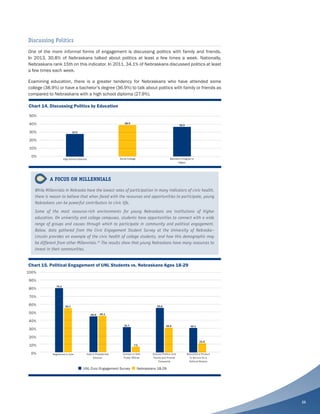
One of the more informal forms of engagement is discussing politics with family and friends.
In 2013, 30.8% of Nebraskans talked about politics at least a few times a week. Nationally,
Nebraskans rank 15th on this indicator. In 2011, 34.1% of Nebraskans discussed politics at least
a few times each week.
Examining education, there is a greater tendency for Nebraskans who have attended some
college (38.9%) or have a bachelor’s degree (36.9%) to talk about politics with family or friends as
compared to Nebraskans with a high school diploma (27.9%).
While Millennials in Nebraska have the lowest rates of participation in many indicators of civic health,
there is reason to believe that when faced with the resources and opportunities to participate, young
Nebraskans can be powerful contributors to civic life.
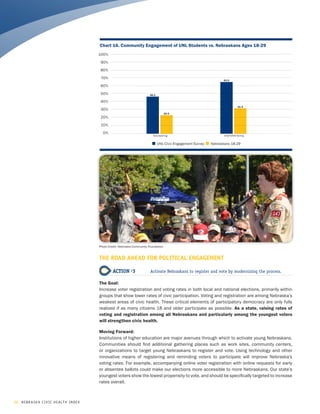
Some of the most resource-rich environments for young Nebraskans are institutions of higher
education. On university and college campuses, students have opportunities to connect with a wide
range of groups and causes through which to participate in community and political engagement.
Below, data gathered from the Civic Engagement Student Survey at the University of Nebraska–
Lincoln provides an example of the civic health of college students, and how this demographic may
be different from other Millennials.35
The results show that young Nebraskans have many resources to
invest in their communities.
50%
40%
30%
20%
10%
0%
Chart 14. Discussing Politics by Education
High School Diploma
27.9
Some College Bachelor’s Degree or
Higher
38.9
36.9
100%
90%
80%
70%
60%
50%
40%
30%
20%
10%
0%
Chart 15. Political Engagement of UNL Students vs. Nebraskans Ages 18-29
Registered to Vote
79.3
55.7
Vote in Presidential
Election
44.4
31.7
45.1
7.1
UNL Civic Engagement Survey Nebraskans 18-29
55.0
30.130.9
11.6
Contact or Visit
Public Official
Discuss Politics with
Family and Friends
Frequently
Boycotted a Product
or Service for a
Political Reason
A FOCUS ON MILLENNIALS
26 NEBRASK A CIVIC HEALTH INDEX
ACTI0N #
3	 Activate Nebraskans to register and vote by modernizing the process.
The Goal:
Increase voter registration and voting rates in both local and national elections, primarily within
groups that show lower rates of civic participation. Voting and registration are among Nebraska’s
weakest areas of civic health. These critical elements of participatory democracy are only fully
realized if as many citizens 18 and older participate as possible. As a state, raising rates of
voting and registration among all Nebraskans and particularly among the youngest voters
will strengthen civic health.
Moving Forward:
Institutions of higher education are major avenues through which to activate young Nebraskans.
Communities should find additional gathering places such as work sites, community centers,
or organizations to target young Nebraskans to register and vote. Using technology and other
innovative means of registering and reminding voters to participate will improve Nebraska’s
voting rates. For example, accompanying online voter registration with online requests for early
or absentee ballots could make our elections more accessible to more Nebraskans. Our state’s
youngest voters show the lowest propensity to vote, and should be specifically targeted to increase
rates overall.
THE ROAD AHEAD FOR POLITICAL ENGAGEMENT
100%
90%
80%
70%
60%
50%
40%
30%
20%
10%
0%
Chart 16. Community Engagement of UNL Students vs. Nebraskans Ages 18-29
Volunteering
46.1
UNL Civic Engagement Survey Nebraskans 18-29
22.5
Charitable Giving
63.5
31.4
Photo Credit: Nebraska Community Foundation
27
ACTI0N #
4 Increase interaction between elected representatives and constituents.
ACTI0N #
5 Prioritize civic education that fosters civic action for all students in Nebraska.
The Goal: 
Public officials should provide electronic and in-person means of connecting with other Nebraskans.
Just as family and individual schedules can be barriers to Nebraskans attending and participating in
community engagement, those restrictions can limit their access to public officials. Being accessible
online and using social media to promote in-person interaction will increase participation in this
type of civic engagement.
Moving Forward: 
Many elected representatives, government offices, and organizations have existing means of interaction
with constituents. Ensuring that in-person interaction is accessible and electronic communication
is effective, up-to-date, and interactive will better facilitate interaction between constituents and
representatives. Examples of effective interaction may include actions like:
■■ Advertise a town hall meeting both in the local paper and on a Facebook page and posting
video, photos, or action items afterward to facilitate follow-up or share information with
constituents who were unable to attend.
■■ Invite constituents to weigh-in or participate in issue-based work. Representatives can
advertise these opportunities on social and print media or any other outlet.
■■ Share opportunities for activism widely – petitions, boycotts, rallies can be shared online
and activate individuals’ personal networks in political engagement.
■■ Create a mobile app that allows Nebraskans to access the online voter registration system
from a smartphone or tablet.
The Goal:
Many indicators of civic health, especially those of political involvement and community engagement
require knowledge of the power of citizens in a democracy. The data show that educational attainment is
a predictor of higher rates of participation in a number of indicators of civic health, suggesting education
powerfully influences a person’s willingness to engage in civic life. Providing civic education that leads
to civic action in K-12 and higher education settings should provide civic education opportunities that
engage all students with civic participation and supply them with the tools to continue to participate
into the future. Nebraska schools and state leaders should continue to prioritize this type of active
and participatory civic learning.
Moving Forward:
Research shows that students who participate in experiential learning opportunities like service
learning are more likely to believe they can make a difference in their community, to take interest
in current events and politics, to continue on a pathway of service and volunteerism in the future,
and to grow in overall civic engagement.36
Students are critical assets to communities: A place-based
education platform for civics that incorporates skills like deliberation, engagement, and organization
into a curriculum that looks at the unique characteristics, virtues, and challenges of the community in
which the school is located may provide students with a greater foundation of skills to strengthen their
communities from within.37
Educators at all levels can implement these kinds of substantive learning opportunities to enhance
student civic action into the future. State education standards for social studies require that
“students will address local, state, national or international issues and policies through meaningful
civic participation.38
” Fulfilling this standard in a meaningful way, and applying similar approaches in
classrooms across the spectrum of K-12 and higher education levels, various subjects, as well as after
school programming will increase civic participation among Nebraska students.
Top 5 Most Popular
Social Media Platforms
1. Facebook
2. LinkedIn
3. Pinterest
4. Twitter
5. Instagram
Source: Duggan, Maeve, Nicole B. Ellison,
Cliff Lampe, Amana Lenhart, and Mary
Madden. “Social Media Update 2014.”
Pew Research Center. 09 Jan. 2015.
Research shows that
students who participate
in service learning
are more likely to
believe they can make
a difference in their
community and continue
to civically engage.
28 NEBRASK A CIVIC HEALTH INDEX
NEBRASKA’S
CIVIC HEALTH
LEGACY
Heartland of America Park - Photo Credit: Rick A. Anderson
29
NEBRASKA’S CIVIC HEALTH LEGACY
The graphs below display a consistent characteristic in Nebraska’s civic
health. Longitudinally, Nebraskans’ performance in indicators of civic health
displays two consistent trends. First, many indicators are consistently
above the national average. Second, in recent years, almost all indicators
of civic health have declined.
Interestingly, working with neighbors is an indicator where participation has slightly increased in
recent years, while other indicators have been decreasing longitudinally.
The future of civic health in Nebraska should prioritize climbing to levels of civic health
increasingly above the national average and also work to reverse the trend of declining rates of
civic engagement in recent years in our own state.
50%
40%
30%
20%
Chart 17. Nebraska’s Volunteering Rates vs. US Averages (2002-2013)
Nebraska US Avg.
38.9
2002 2003 2004 2005 2006 2007 2008 2009 2010 2011 2012 2013
39.6
44.4 42.4
40.4
36.7
39.4
36.1 36.6 36.7 34.8 32.8
27.6
26.4
28.8 28.8
26.7 26.2 26.3 26.8 26.3 26.8 26.5 25.4
15%
10%
5%
0%
Chart 18. Nebraskans Working With Neigbhors vs. US Averages (2002-2013)
Nebraska US Avg.
8.0
2006 2007 2008 2009 2010 2011 2012 2013
8.3
10.6
9.2 9.7 9.7
10.7 10.3
6.5 6.5
8.5
8.8
8.1
8.4
7.68.7
20%
15%
10%
5%
Chart 19. Nebraskans Attending Community Meetings vs. US Averages (2002-2013)
Nebraska US Avg.
12.0
2006 2007 2008 2009 2010 2011 2012 2013
9.8
14.1
13.0
11.7 11.5 11.1 10.3
8.8 8.2
9.6 9.9 9.2 9.0
8.3
9.1
70%
60%
50%
40%
Chart 20. Nebraskans Charitable Giving ($25 or More) vs. US Averages (2002-2013)
Nebraska US Avg.
57.0
2006 2007 2008 2009 2010 2011 2012 2013
51.1
49.0 50.0 50.0 50.0 50.151.8
62.8
54.7
60.2
57.6
61.5
58.5
54.5
52.0
30 NEBRASK A CIVIC HEALTH INDEX
Community Members
■■ What comes to mind when you think about the civic health of your community and how do you participate in
efforts to improve civic health?
■■ How do you ensure that voices and choices from within your community are heard by government officials
and other decision makers? What are the ways in which you engage civically as an active member of your
community?
■■ What civic leadership roles are available to you and what are the benefits and/or barriers to taking on those
roles?
■■ If you see a need in your community, what is your response?
■■ How do you engage with friends, family, and neighbors to ensure that your community is civically healthy?
■■ In what ways do you reach out to community members, leaders, and institutions?
Public Officials
■■ How do you and your staff work with community groups and individuals to allow for informal civic engagement
to meaningfully impact local and statewide decision-making?
■■ What forms of communication are most effective and inclusive to ensure that all Nebraskans have equal
access to information regarding policymaking?
■■ In what ways are you working to foster greater voter participation by traditionally underrepresented groups?
■■ Through what mechanisms can more Nebraskans from all walks of life be encouraged to run for public
office?”
■■ How can public officials, education leadership, community-based organizations, and individuals work
together to support a civic challenge focused on an area of need within the state?
Private Business
■■ How does your business support civic health in Nebraska?
■■ Are there ways in which your employees are able to engage with their local community, whether through
sponsored volunteerism, matching donations, the use of space or other business resources, etc.?
■■ How do you encourage or incentivize employee engagement in the community?
Civic Organizations and Community-Based Groups
■■ Does your organization meaningfully offer members of underrepresented groups opportunities to take civic
leadership roles?
■■ How does working with a diverse group of community members strengthen your organization’s work and your
community as a whole?
■■ In what ways does your organization allow for both formal and informal civic participation by Nebraskans,
whether through board participation, one-time volunteer projects, etc.?
■■ What resources exist to compile and disseminate a directory of promising practices for statewide civic
engagement?
WHAT CAN YOU DO TO IMPACT THE FUTURE OF
CIVIC HEALTH IN NEBRASKA?
Nebraskans play many roles in our communities. The following questions provide a good framework for examining
how community members can take ownership of civic health through various stakeholder roles. Many of these
questions were originally posited in the 2014 Colorado Civic Health Index (http://ncoc.net/COCHI2013).
31
Higher Education
■■ In what ways can colleges and universities strengthen access to and success within higher education for
first generation, low income, rural, and native Nebraska students?
■■ What types of learning support increased and ongoing civic engagement for students, and how are those
practices endorsed by institutions of higher education? What research, scholarship, and other higher
education resources are focused on civic engagement and measuring local and statewide civic trends and
impacts to students, communities, and institutions?
■■ What unique roles do colleges and universities play in Nebraska’s civic health?
K-12 Education
■■ Given the growing income disparity between those with a high school diploma and those with some level of
college, how can we create accessibility to higher education for all students?
■■ In what ways is civic learning integrated into the K-12 curriculum, and in what ways can civics be strength-
ened throughout course content?
■■ How does our current civics content help to foster civic engagement and leadership at the local level?
■■ What skills could we provide students that would empower them to strengthen their communities from
within rather than feeling the need to flee to a “greener pasture?”
■■ Are community service and volunteerism critical components of the K-12 experience, and if so, what do they
add to student access and success?
■■ How do K-12 educators partner with civic and community-based organizations to leverage community
resources in support of civic learning for students?
Media
■■ How can media outlets participate in sharing the powerful stories of civic engagement and health in
Nebraska?
■■ Are there platforms that support diverse ways of communicating about civic health with the many communi-
ties within the state? Specifically how can we use media most effectively to appeal to a diverse citizenry?
■■ In what ways can media assist in humanizing and personalizing civic participation?
LIMITS AND SUGGESTIONS FOR FUTURE RESEARCH
The results discussed in this report depict the results of research on civic health in Nebraska communities. However,
there are limits to the data presented and scope of results. Future research on civic health in Nebraska will likely find
interesting civic health results on a community level within the state. Examining young adults who identify as students
versus non-student young adults could yield different results. Current data was also unable to provide reliable results
for communities that may face additional barriers to engagement, e.g. racial or ethnic groups, LGBT Nebraskans, or
groups of varying socioeconomic status. This report examines current civic health throughout Nebraska and outlines
a roadmap for community stakeholders to promote the future of civic health throughout the state. Further research
on civic health in Nebraska could find additional results among more groups of Nebraskans.
32 NEBRASK A CIVIC HEALTH INDEX
CONCLUSION
Nebraska’s civic health index identifies many areas of strength and also
some opportunities for improvement. After examining the current levels
of civic engagement, this report posits five action steps to increase civic
health in the state.
ACTI0N #
1 Continue to grow the strong tradition of all Nebraskans.
ACTI0N #
3 Activate Nebraskans to register and vote by modernizing the process.
ACTI0N #
4 Increase interaction between elected representatives and constituents.
ACTI0N #
5 Prioritize civic education that fosters civic action for all students in Nebraska.
ACTI0N #
2	
Create and promote accessible networks for community engagement. Use
online social media to connect community members and projects.
Photo Credit: Nebraska Community Foundation
Nebraska Civic Health Partnership (NCHP) is dedicated to addressing and strengthening civic
health and education throughout the state. For more information on civic data or resources for
strengthening civic health in your community, contact NCHP manager Kelsey Arends at Nebraskans
for Civic Reform - (402) 904-5191.
33
ENDNOTES
1  National Conference on Citizenship. Civic Health and the Economy: Making
the Connection. 2013.
2  Ibid.
3  Corporation for National and Community Service. Volunteering as a Pathway
to Employment: Does Volunteering Increase Odds of Finding a Job for the Out of
Work? June 2013. http://www.nationalservice.gov/sites/default/files/upload/
employment_research_report.pdf.
4  National Conference on Citizenship. Civic Health and the Economy: Making
the Connection. 2013.
5  Guo, Jeff. “The Areas of the U.S. with a Troubling Shortage of Young People.”
The Washington Post, 25 Aug. 2014. http://www.washingtonpost.com/news/
storyline/wp/2014/08/25/the-areas-of-the-u-s-with-a-troubling-shortage-of-
young-people.
6  Cantrell, Randy. Is This a Rural Brain Gain? A Cohort Examination of
Migration in Nebraska. Institute of Agriculture and Natural Resources,
Department of Agricultural Economics, U of Nebraska - Lincoln, 2014.
Cornhusker Economics.
7  Duggan, M., Ellison, N.B., Lampe, C., Lenhart, A,. and Madden, M. “Social
Media Update 2014,” Pew Research Center, January 2015. Available at: http://
www.pewinternet.org/2015/01/09/social-media-update-2014/
8  Ibid.
9  Ibid.
10  Ibid.
11  Ibid.
12  Hampton, K.N., Rainie, L., Lu, W., Dwyer, M., Shin, I.,  Purcell, K. (2014).
“Social Media and the ‘Spiral of Silence.’ Pew Research Center, Washington,
DC. Available at http://www.pewinternet.org/2014/08/26/social-media-and-
the-spiral-of-silence/
13  Galea, S., Karpati, A., Kennedy, B. (2002). Social Capital and Violence in
the United States, 1974-1993. Social Science and Medicine, 55, 1373-1383.
14  Herian, M. N., Tay, L., Hamm, J. A., Diener, E. (2014). Social Capital,
Ideology, and Health in the United States. Social Science and Medicine, 105,
30-37.
15  National Conference on Citizenship. Civic Health and the Economy: Making
the Connection. 2013.
16  Vogt, Rebecca, Cheryl Burkhart-Kriesel, Randolph Cantrell, and Bradley
Lubben. Nebraska Rural Poll - Life in Nonmetropolitan Nebraska: Perceptions
of Well-Being. Nebraska Rural Poll Results, 2014.
17  Drozd, David, Jerry Deichert, Abby Heithoff, and Pavlin Netsov. Nebraska
Metro Poll: Perceptions of Community, Personal Well-Being, and Outlook on the
Future. 2014 Nebraska Metro Poll Results, 2014.
18  Cantrell, Randy. Twenty Years of the Nebraska Rural Poll. Institute of
Agriculture and Natural Resources, Department of Agricultural Economics, U of
Nebraska – Lincoln, 2013. Cornhusker Economics.
19  Ibid.
20  Ibid.
21  Corporation for National and Community Service. “Benefits of
Volunteering.” http://www.nationalservice.gov/serve-your-community/
benefits-volunteering.
22  Corporation for National and Community Service. Health Benefits of
Volunteering: A Review of Recent Research. 2007.
23  Independent Sector. “Value of Volunteer Time.” http://www.
independentsector.org/volunteer_time.
24  Achieve, and The Case Foundation. The 2013 Millennial Impact Report.
Rep. 2013. http://www.themillennialimpact.com.
25  Nonprofit Association of the Midlands. “Nebraska Nonprofits: Essential
and Vibrant Economic Impact Report 2012.” 2013. www.nonprofitam.org/
resource/resmgr/docs/economic_report_2013_finalpd.pdf.
26  Ibid.
27  Cantrell, Randy. Social Capital, Civic Capacity and Leadership in Rural
Nebraska. Institute of Agriculture and Natural Resources, Department of
Agricultural Economics, U of Nebraska - Lincoln, 2013. Cornhusker Economics.
28  Cantrell, Randy. Social Capital, Civic Capacity and Leadership in Rural
Nebraska. Institute of Agriculture and Natural Resources, Department
of Agricultural Economics, U of Nebraska - Lincoln, 2013. Cornhusker
Economics.
29  Achieve, and The Case Foundation. The 2013 Millennial Impact Report.
Rep. 2013. http://www.themillennialimpact.com.
30  National Conference on Citizenship. Civic Health and the Economy:
Making the Connection. 2013.
31  Vogt, Rebecca, Cheryl Burkhart-Kriesel, Randolph Cantrell, and Bradley
Lubben. Nebraska Rural Poll: Successful Communities - What Is Desired and
What Is Present in Nonmetropolitan Nebraska. Institute for Agriculture and
Natural Resources, U of Nebraska, 2014. 2014 Nebraska Rural Poll Results.
32  Cohen, Philip. Family Diversity Is the New Normal for America’s Children:
A Briefing Paper Prepared for the Council on Contemporary Families. 2014.
33  The Center for Information and Research on Civic Learning and
Engagement, Tufts University. National Study of Learning, Voting, and
Engagement (NSLVE) Student Voting Rates for University of Nebraska-
Lincoln. 2014.
34  Fedderson, Troy. “UNL Student Voting Numbers Among Nation’s Best.”
University of Nebraska-Lincoln, 10 Nov. 2014. http://news.unl.edu/
newsrooms/unltoday/article/unl-student-voting-numbers-among-nations-
best/.
35  Civic Engagement Student Survey Spring 2012. Center for Civic
Engagement, University of Nebraska-Lincoln.
36  Education Commission of the States. “Service Learning: Why it Matters.”
The Progress of Education Reform 10.6 (2009). http://www.ecs.org/html/
educationissues/ProgressofReform.asp
37  Maloyed, Christie L., Ph.D., and J. Kelton Williams, Ph.D. “Place-Based
Civic Education and the Rural Leadership Crisis in Nebraska.” Great Plains
Research 23.2 (Fall 2013): 130.
38  Nebraska State Board of Education. “Social Studies Standards.” 7 Dec.
2012. http://www.education.ne.gov/AcademicStandards/Documents/
NE_SocialStudiesStandardsApproved.pdf
34 NEBRASKA CIVIC HEALTH INDEX
A WORD ABOUT RECOMMENDATIONS
NCoC encourages our partners to consider how civic health data can inform dialogue and action in their communities, and to take
an evidence-based approach to helping our communities and country thrive. While we encourage our partners to consider and offer
specific recommendations and calls to action in our reports, we are not involved in shaping these recommendations. The opinions and
recommendations expressed by our partners do not necessarily reflect those of NCoC.
This report should be a conversation-starter. The data and ideas presented here raise as many questions as they answer. We encourage
government entities, community groups, business people, leaders of all kinds, and individual citizens to treat this report as a first step
toward building more robust civic health in Nebraska.
Photo Credit: Nebraska Community Foundation
CONTRIBUTORS:
Ben Thrutchley, Communications Director,
National Conference on Citizenship
Jeff Coates, Research  Evaluation Director,
National Conference on Citizenship
Rachael Weiker, Program Manager, Civic Health
Initiative, National Conference on Citizenship
Cameron Blossom, Communications Associate,
National Conference on Citizenship
35
TECHNICAL NOTE
Unless otherwise noted, findings presented in this Report are based
on CIRCLE’s analysis of the Census Current Population Survey (CPS)
data. Any and all errors are our own. Volunteering estimates are
from CPS September Volunteering Supplement, voting estimates
from 2012 November Voting and Registration Supplement, and all
other civic engagement indicators, such as discussion of political
information and connection to neighbors, come from the 2013 CPS
Civic Engagement Supplement.
Using a probability selected sample of about 150,000 occupied
households, the CPS collects monthly data on employment and
demographic characteristics of the nation. Depending on the CPS
supplement, the single-year Nebraska CPS sample size used for
this report ranges from 356 to 531 (civic engagement supplement)
to 1,231 (volunteer supplement), and to 1,413 (voting supplement)
residents from across Nebraska. This sample is then weighted to
representative population demographics for the district. Estimates
for the volunteering indicators (e.g., volunteering, working with
neighbors, making donations) are based on US residents ages 16
and older. Estimates for civic engagement and social connection
indicators (e.g., favors with neighbors, discuss politics) are based on
US residents ages 18 and older. Voting and registration statistics are
based on US citizens who are 18 and older (eligible voters). When
we examined the relationship between educational attainment and
engagement, estimates are based on adults ages 25 and older,
based on the assumption younger people may be completing their
education.
Because multiple sources of data with varying sample sizes are used,
the report is not able to compute one margin of error for Nebraska
across all indicators. Any analysis that breaks down the sample into
smaller groups (e.g., gender, education) will have smaller samples
and therefore the margin of error will increase. Data for some
indicators are pooled from multiple years (2010-2013) for a more
reliable estimate when sample sizes for certain cross tabulations
may have been small. Furthermore, national rankings, while useful
in benchmarking, may be small in range, with one to two percentage
points separating the state/district ranked first from the state/
district ranked last.
It is also important that our margin of error estimates are approximate,
as CPS sampling is highly complex and accurate estimation of error
rates involves many parameters that are not publicly available.
36 NEBRASKA CIVIC HEALTH INDEX
NOTES
37
NOTES
38 NEBRASKA CIVIC HEALTH INDEX
CIVIC HEALTH INDEX
State and Local Partnerships
NCoC began America’s Civic Health Index in 2006 to measure the level of civic engagement and health of our democracy. In 2009,
NCoC was incorporated into the Edward M. Kennedy Serve America Act and directed to expand this civic health assessment in
partnership with the Corporation for National and Community Service and the US Census Bureau.
NCoC now works with partners in more than 30 communities nationwide to use civic data to lead and inspire a public dialogue about
the future of citizenship in America and to drive sustainable civic strategies.
Alabama
University of Alabama
David Mathews Center for Civic Life
Auburn University
Arizona
Center for the Future of Arizona
California
California Forward
Center for Civic Education
Center for Individual and
Institutional Renewal
Davenport Institute
Colorado
Metropolitan State University of Denver
The Civic Canopy
Denver Metro Chamber Leadership
Campus Compact of Mountain West
History Colorado
Institute on Common Good
Connecticut
Everyday Democracy
Secretary of the State of Connecticut
District of Columbia
ServeDC
Florida
Florida Joint Center for Citizenship
Bob Graham Center for Public Service
Lou Frey Institute of Politics
and Government
Georgia
GeorgiaForward
Carl Vinson Institute of Government,
The University of Georgia
Georgia Family Connection Partnership
Illinois
McCormick Foundation
Indiana
Center on Congress at Indiana University
Indiana Bar Foundation
Indiana Supreme Court
Indiana University Northwest
IU Center for Civic Literacy
IUPUI
Kentucky
Commonwealth of Kentucky,
Secretary of State’s Office
Institute for Citizenship
 Social Responsibility,
Western Kentucky University
Kentucky Advocates for Civic Education
McConnell Center, University of Louisville
Maryland
Mannakee Circle Group
Center for Civic Education
Common Cause-Maryland
Maryland Civic Literacy Commission
Massachusetts
Harvard Institute of Politics
Michigan
Michigan Nonprofit Association
Michigan Campus Compact
Michigan Community Service Commission
Volunteer Centers of Michigan
Council of Michigan Foundations
Minnesota
Center for Democracy and Citizenship
Missouri
Missouri State University
Park University
Saint Louis University
University of Missouri Kansas City
University of Missouri Saint Louis
Washington University
Nebraska
Nebraskans for Civic Reform
Nebraska Community Foundation
University of Nebraska Public Policy Center
UNL Center for Civic Engagement
UNO Service Learning Academy
Nebraska State Bar Foundation
New Hampshire
Carsey Institute
Campus Compact of New Hampshire
University System of New Hampshire
New Hampshire College  University
Council
New York
Siena College Research Institute
New York State Commission on National
and Community Service
North Carolina
Institute for Emerging Issues
Ohio
Miami University Hamilton Center for
Civic Engagement
Oklahoma
University of Central Oklahoma
Oklahoma Campus Compact
Pennsylvania
Center for Democratic Deliberation
National Constitution Center
South Carolina
University of South Carolina Upstate
Texas
The Annette Strauss Institute for Civic Life,
University of Texas at Austin
Virginia
Center for the Constitution at James
Madison’s Montpelier
Colonial Williamsburg Foundation
STATES
ISSUE SPECIFIC
Latinos Civic Health Index
Carnegie Corporation
Veterans Civic Health Index
Got Your 6
Millennials Civic Health Index
Mobilize.org
Harvard Institute of Politics
CIRCLE
Economic Health
Knight Foundation
Corporation for National  Community
Service (CNCS)
CIRCLE
39
Atlanta
Community Foundation of Greater Atlanta
Chicago
McCormick Foundation
Kansas City  Saint Louis
Missouri State University
Park University
Saint Louis University
University of Missouri Kansas City
University of Missouri Saint Louis
Washington University
Miami
Florida Joint Center for Citizenship
John S. and James L. Knight Foundation
Miami Foundation
Pittsburgh
University of Pittsburgh
Carnegie Mellon University
Seattle
Seattle City Club
Boeing Company
Seattle Foundation
Twin Cities
Center for Democracy and Citizenship
Citizens League
John S. and James L. Knight Foundation
CITIES
CIVIC HEALTH ADVISORY GROUP
John Bridgeland
CEO, Civic Enterprises
Chairman, Board of Advisors, National
Conference on Citizenship
Former Assistant to the President of the
United States  Director, Domestic Policy
Council  US Freedom Corps
Kristen Cambell
Former Chief Program Officer,
National Conference on Citizenship
Jeff Coates
Research and Evaluation Director,
National Conference on Citizenship
Lattie Coor
Chairman  CEO, Center for the Future of
Arizona
Nathan Dietz
Senior Research Associate, The Urban
Institute
Doug Dobson
Executive Director, Florida Joint Center for
Citizenship
Jennifer Domagal-Goldman
National Manager, American Democracy
Project
Diane Douglas
Executive Director, Seattle CityClub
Paula Ellis
Former Vice President, Strategic Initiatives,
John S. and James L. Knight Foundation
William Galston
Senior Fellow, Brookings Institution
Former Deputy Assistant to the President
of the United States for Domestic Policy
Hon. Bob Graham
Former Senator of Florida
Former Governor of Florida
Robert Grimm, Jr.
Director of the Center for Philanthropy
and Nonprofit Leadership,
University of Maryland
Shawn Healy
Resident Scholar, McCormick Foundation
Kei Kawashima-Ginsberg
Deputy Director, Center for Information
and Research on Civic Learning and
Engagement (CIRCLE) at the Jonathan M.
Tisch College of Citizenship and Public
Service at Tufts University
Peter Levine
Director, Center for Information and
Research on Civic Learning and
Engagement (CIRCLE) at the Jonathan M.
Tisch College of Citizenship and Public
Service at Tufts University
Mark Hugo Lopez
Director of Hispanic Research, Pew
Research Center
Ted McConnell
Executive Director, Campaign for the Civic
Mission of Schools
Martha McCoy
President, Everyday Democracy
Kenneth Prewitt
Former Director of the United States
Census Bureau
Carnegie Professor of Public Affairs and
the Vice-President for Global Centers at
Columbia University
Robert Putnam
Peter and Isabel Malkin Professor of Public
Policy, Kennedy School of Government at
Harvard University
Founder, Saguaro Seminar
Author of Bowling Alone: The Collapse and
Revival of American Community
Stella Rouse
Assistant Director, Center for American
Politics and Citizenship
Shirley Sagawa
Chief Service Officer, National Conference
on Citizenship
Co-founder, Sagawa/Jospin, LLP.
Thomas Sander
Executive Director, the Saguaro Seminar,
Harvard University
David B. Smith
Chief of Programs and Strategy,
National Center for Service and
Innovative Leadership
Founder, Mobilize.org
Drew Steijles
Assistant Vice President for Student
Engagement and Leadership and Director
Office of Community Engagement, College
of William  Mary
Michael Stout
Associate Professor of Sociology,
Missouri State University
Kristi Tate
Partnership Development Director,
National Conference on Citizenship
Michael Weiser
Chairman, National Conference on
Citizenship
Ilir Zherka
Executive Director, National Conference on
Citizenship
Connecting People. Strengthening Our Country.
Data Made Possible By:A Project Funded by the Weitz Family Foundation

NECHI_2015_FINAL

  • 1.
    2015 NEBRASKA CIVIC HEALTHINDEX A Project Funded by the Weitz Family Foundation
  • 2.
    ABOUT THE PARTNERS NEBRASKANSFOR CIVIC REFORM Nebraskans for Civic Reform is a nonpartisan nonprofit organization dedicated to creating a more modern and robust democracy for all Nebraskans. We achieve our mission through youth community engagement and service learning programming, veteran job readiness and community engagement, and nonpartisan election observation and voting rights advocacy. NEBRASKA COMMUNITY FOUNDATION Nebraska Community Foundation is a statewide 501(c)(3) organization using charitable giving to build prosperous communities. NCF works with volunteer leaders serving more than 250 communities by providing training, strategic development, gift planning assistance and financial management for its affiliated funds located throughout the state. In the last five years more than 35,000 contributions have been made to NCF affiliated funds, and more than $126 million has been reinvested to benefit Nebraska communities. For more information visit www.NebraskaHometown.org. NEBRASKA PUBLIC POLICY CENTER The University of Nebraska Public Policy Center provides a unique opportunity for policy makers and researchers to work together to address the challenges of local, state, and federal policy. Center researchers combine professional expertise with rigorous academic methods and stakeholder involvement. The Center brings commitment to collaborations as well as timely processes and outcomes. UNO SERVICE LEARNING ACADEMY The University of Nebraska at Omaha is Nebraska’s premier metropolitan university and is committed to the needs of our community through teaching, research and service. The university is committed to and engaged with the city surrounding it, allowing students unique, hands-on opportunities, internships, service learning, applied research and other collaborative activities that enhance time in the classroom. Our students graduate ready to contribute to the workforce and the community. UNL CENTER FOR CIVIC ENGAGEMENT The UNL Center for Civic Engagement encourages students to connect curricular and co-curricular learning with opportunities to address critical human need through service, civic-related research and social change leadership. Through programs and services offered by the Center, students acquire the skills, knowledge and experience necessary to advance community priorities and inspire a lifelong commitment to personal and social responsibility. NEBRASKA STATE BAR FOUNDATION The Nebraska State Bar Foundation is dedicated to serving the citizens of Nebraska and the Legal Profession through the administration and funding of innovative and creative programs directed toward the improvement of the administration of justice and the fulfillment of the American vision of equal justice for all. NATIONAL CONFERENCE ON CITIZENSHIP The National Conference on Citizenship (NCoC) is a congressionally chartered organization dedicated to strengthening civic life in America. We pursue our mission through a nationwide network of partners involved in a cutting-edge civic health initiative, an innovative national service project, and our cross-sector conferences. At the core of our joint efforts is the belief that every person has the ability to help their community and country thrive. Above Photo Credit: Nebraska Community Foundation Left Cover Photo Credit: Steve and Bobbi Olson
  • 3.
    TABLE OF CONTENTS ExecutiveSummary....................................................................................................................................................................................................................4 Introduction...........................................................................................................................................................................................................................................6 Nebraska’s Civic Health: At-a-Glance.................................................................................................................................................................8 Nebraskans and Social Connectedness......................................................................................................................................................10 Interacting with Family and Friends....................................................................................................................................................................10 Trusting Neighbors...................................................................................................................................................................................................................11 Doing Favors for Neighbors...........................................................................................................................................................................................12 The Road Ahead for Social Connectedness..............................................................................................................................................12 Nebraskans and Confidence in Institutions...........................................................................................................................................12 Nebraskans and Community Engagement...............................................................................................................................................13 Volunteering.....................................................................................................................................................................................................................................14 Charitable Giving........................................................................................................................................................................................................................16 Engagement with Neighbors and Groups.................................................................................................................................................... 17 The Road Ahead for Community Engagement........................................................................................................................................19 Nebraskans and Political Engagement........................................................................................................................................................20 Voting and Voter Registration.....................................................................................................................................................................................21 Local Voting......................................................................................................................................................................................................................................22 Contacting or Visiting Public Officials................................................................................................................................................................23 Discussing Politics...................................................................................................................................................................................................................24 The Road Ahead for Poltical Engagement...................................................................................................................................................26 Nebraska’s Civic Health Legacy.............................................................................................................................................................................28 What Can You Do to Impact the Future of Nebraska’s Civic Health?....................................................................30 Conclusion...........................................................................................................................................................................................................................................32 Endnotes................................................................................................................................................................................................................................................33 Word About Recommendations..............................................................................................................................................................................34 Technical Note...............................................................................................................................................................................................................................35 AUTHORS: Kelsey Arends, Nebraskans for Civic Reform Adam Morfeld, J.D, Nebraskans for Civic Reform Kent Day, M.A., Nebraskans for Civic Reform Robert McEntarffer, Ph.D., Lincoln Public Schools Randal M. Ernst, Ed. D., Lincoln Public Schools Karl Shaddock, Nebraska Community Foundation Jeff Yost, Nebraska Community Foundation Lisa Pytlik Zillig, Ph.D., University of Nebraska Public Policy Center Mitchel N. Herian, Ph.D., University of Nebraska Public Policy Center Linda Major, University of Nebraska-Lincoln Julie Dierberger, M.A., University of Nebraska Omaha Service Learning Academy Doris J. Huffman, MPA, Nebraska State Bar Foundation Harris C. Payne, Nebraska Department of Education A Project Funded by the Weitz Family Foundation
  • 4.
    4 NEBRASK ACIVIC HEALTH INDEX EXECUTIVE SUMMARY Robust civic health leads to many benefits for communities, such as resilient economies, representative and accountable governments, and higher social capital. This report – the first-ever Civic Health Index for the state of Nebraska – documents Nebraskans’ rates of interacting with neighbors, communicating with family and friends, having confidence in public institutions, being members of groups, volunteering and giving, registering and voting, and being involved in politics. These indicators give us a picture of the state of civic health in Nebraska and this report provides a data-based roadmap for strengthening engagement throughout the state. The results show that in relation to other states, Nebraskans perform well in many indicators of civic health, particularly in activities related to social connectedness (e.g. eating dinner with household members) and confidence in institutions. The state’s weakest area of civic health is political involvement (e.g. voting, contacting public officials). This report posits five critical action steps to strengthen civic health in Nebraska: The Data: Nebraskans display strong social connectedness, particularly in interpersonal relationships. The vast majority of Nebraskans (92.7%) report eating dinner with other members of their household frequently, a rate that is second highest in the nation. And, 82.3% of Nebraskans reported seeing or hearing from friends or family frequently. The Goal: Social connectedness ranks among Nebraska’s strongest areas of civic health. Ensuring that social connections remain strong and growing to include all Nebraskans is critical to the future of civic health in our state. The Data: The youngest Nebraskans have the lowest rates of participation in most indicators of community engagement. More than 50% of all Nebraskans 25 and older report donating to a charity; however, only 19.5% of 18-24 year-olds report charitable giving. Only 3.4% of 18-24 year-olds reported attending a public meeting. The data show that the youngest Nebraskans – a generation that tends to use new and modern methods of communication – are the least engaged in their communities of all age groups. The Goal: Volunteering, attending community meetings, and even working with neighbors looks different today than ever before. Not only are community members increasingly accessible via social media, many go online to search for news, entertainment, and activities. Communities need to adopt the strategies and cultural changes to create inviting opportunities for 21st century participation. This means putting in place the baseline technologies and messaging platforms that enable utilization of powerful online social media resources. These resources can then be used to target community members for civic activities. But, this is just the first step. ACTI0N # 1 Continue to grow the strong tradition of connecting all Nebraskans. ACTI0N # 2 Create and promote accessible networks for community engagement. Use online social media to connect community members and projects. Successful communities will use new channels for engagement to create and design programs with 21st century Nebraskans, not just for them. This includes seeking active participation in unique ways from young and diverse groups, and then listening to what they have to say. The ultimate goal is to promote leadership, service, and transformational opportunities for emerging generations to create the communities of their dreams that will attract and retain young people for generations to come. The ultimate goal is to promote leadership, service, and transformational opportunities for emerging generations to create the communities of their dreams that will attract and retain young people for generations to come.
  • 5.
    5 The Data: Inthe 2012 election, only 69.5% of Nebraskans registered and only 61.6% voted. These rates rank Nebraska 32nd and 36th, respectively, compared to other states and the District of Columbia. The Goal: Increase voter registration and voting rates in both local and national elections, primarily within groups that show lower rates of civic participation. Voting and registration are among Nebraska’s weakest areas of civic health. These critical elements of participatory democracy are only fully realized if as many citizens 18 and older participate as possible. As a state, raising rates of voting and registration among all Nebraskans and particularly among the youngest voters, whom data show have participated the least, will strengthen civic health. ACTI0N # 3 Activate Nebraskans to register and vote by modernizing the process. The Data: Only 12.2% of Nebraskans reported contacting or visiting a public official, ranking the state 27th compared to other states and the District of Columbia. The Goal: Public officials should provide electronic and in-person means of connecting with other Nebraskans. Just as family and individual schedules can be barriers to Nebraskans attending and participating in community engagement, those restrictions can limit their access to public officials. Being accessible online and using social media to promote in-person interaction will increase participation in this type of civic engagement. The Data: Participation in most indicators of civic health, particularly those related to political involvement, increases with education. 84.0% of Nebraskans with a bachelor’s degree or higher reported voting in local elections sometimes or always. Similarly, Nebraskans with a bachelor’s degree or higher voted at a rate of 74.6% in 2012, compared to the state average of 61.6%. The data show that education can provide critical tools that enable individuals to fully engage in their communities, and these types of opportunities should be available to all Nebraskans. The Goal: Many indicators of civic health, especially those of political involvement and community engagement, require knowledge about the power of citizens in a democracy. Educational attainment is shown to be a predictor of higher rates of participation in a number of indicators of civic health. This suggests education powerfully influences a person’s willingness to engage in civic life. K-12 and higher education institutions should provide civic education opportunities that engage all students with civic participation, supplying students with the real-world tools to continue to take civic action into the future. Nebraska schools and state leaders should continue to prioritize this type of civic learning. Nebraska Civic Health Partnership (NCHP) is dedicated to addressing and strengthening civic health and education throughout the state. For more information on civic data or resources for strengthening civic health in your community, contact NCHP manager Kelsey Arends at Nebraskans for Civic Reform - (402) 904-5191. ACTI0N # 4 Increase interaction between elected representatives and constituents. ACTI0N # 5 Prioritize civic education that fosters civic action for all students in Nebraska.
  • 6.
    6 NEBRASK ACIVIC HEALTH INDEX INTRODUCTION What is Civic Health? A community’s civic health is defined by the degree to which individuals are engaged in civic activities. To gauge Nebraska’s civic health, this report examines Nebraskans’ engagement in activities such as volunteering and giving, voter registration and participation, interactions with neighbors, communication with family or friends, political involvement, group membership, and confidence in public institutions. We also outline a roadmap for community stakeholders to promote the future of civic health throughout the state. This report finds five action steps to promote stronger civic health in Nebraska: ACTI0N # 1 Continue to grow the strong tradition of connecting of all Nebraskans. ACTI0N # 3 Activate Nebraskans to register and vote by modernizing the process. ACTI0N # 4 Increase interaction between elected representatives and constituents. ACTI0N # 5 Prioritize civic education that fosters civic action for all students in Nebraska. ACTI0N # 2 Create and promote accessible networks for community engagement. Use online social media to connect community members and projects. Why Does Civic Health Matter? Communities that have stronger civic health enjoy many benefits – resilient economies, representative and accountable governments, and higher social capital.1 Therefore, it is in the best interest of individuals, cities and towns, and the state as a whole to monitor and improve Nebraska’s civic health. One motivation to invest in civic health is the economic rewards it affords. Below are three key reasons why civic health matters to our economy: ■■ Trust: Multiple indicators of civic health examine levels of trust among community members, such as trust in neighbors and confidence in public institutions. Trust is critical for economic success: it is a precursor to individuals entering into contracts and partnerships, investing, hiring, and innovating in business.2 ■■ Workforce: Civic activities are critical to the development of an effective workforce. Individuals who volunteer are 27% more likely to find a job after being out of work as compared to non-volunteers. The likelihood of employment for people who volunteer increases to 55% in rural areas.3 ■■ Attachment: Civic engagement cultivates relationships and attachment among community members. Volunteering, charitable giving, voting in local elections, joining groups, and other civic activities not only display an individual’s attachment to the community, but also deepen connections. Attachment can in turn predict economic growth, as people who are attached to a community are more likely to invest, spend, and hire within that community and less likely to participate in out-migration.4 Civic activities are critical to the development of an effective workforce.
  • 7.
    7 Nebraska’s past andfuture trends not only make a case for the need to strengthen our state’s civic health, but also give good reason to expect stronger civic health in the future. For the past several decades, many Nebraska counties have faced population decline.5 Because people are the greatest assets to a community, population loss can be damaging. However, recent research also shows that some counties, especially the least populated, are experiencing increasing in- migration of young professionals and families.6 Aspects of civic health are powerful contributing factors to attract individuals and families to a community. The sustainability of communities of all sizes lies in the investment and dedication of multiple generations of people. Utilizing technology to connect community members, public leaders, and civic institutions is a common theme throughout the results and action steps presented in the following pages. Most American adults are online: 87% reported using the Internet or email at least occasionally in January 2014.7 While online, many adults visit social networking sites, for example, 71% of online adults use Facebook.8 Though social media platforms quickly develop, rise, and sometimes wane, research shows that use of social networking sites has exploded in recent years, with growing numbers of online adults using more than one site.9 Younger adults show particularly significant use of social media – 87% of 18-29 year-olds reported using Facebook in 2014.10 However, the most dramatic increase in use of Facebook occurred amongst the oldest demographic between 2013 and 2014. Those 65 and older increased usage by 11 percentage points, to a rate of 56%.11 Facebook is just one example of a long and growing list of social media platforms. Research shows that social media is no replacement for in-person interaction; for example, adults were found to be less willing to discuss controversial social or political issues in social media than in person. Social media also did not provide an alternative for those reluctant to discuss the issue in person.12 Instead, social media can be a conduit to increased awareness and an avenue to increased interaction. The following report discusses these and other critical components of civic health and the action steps ahead to strengthen engagement in Nebraska. By modernizing the ways we interact with each other and our democracy while building on the social connectedness and trust that bind us, the road ahead for civic health in Nebraska shows great promise. By modernizing the ways we interact with each other and our democracy, while building on the social connectedness and trust that bind us, the road ahead for civic health in Nebraska shows great promise. Photo Credit: Nebraska Community Foundation
  • 8.
    8 NEBRASK ACIVIC HEALTH INDEX NEBRASKA’S CIVIC HEALTH: At-a-Glance While Nebraska excels in many civic health indicators, current data also suggest our state has considerable room for improvement. This report documents Nebraska’s latest performance on measures of civic health and provides a roadmap to strengthen civic health in the future. The following table provides the state estimates, national estimates, and rankings in relation to other states for every indicator of civic health. Results are calculated from the Census Bureau’s Current Population Survey, part of the monthly labor statistics survey that collects data from approximately 150,000 households across the 50 states and District of Columbia. This report uses data from the 2013 September Volunteering Supplement, 2012 November Voting and Registration Supplement, and 2013 Civic Engagement Supplement. All of these data are the latest available, and Nebraska percentages and rankings reflect calculations of survey respondents from across the state. NE* US Avg.* Ranking SOCIAL CONNECTEDNESS Eat dinner with household members frequently** 92.7% 87.8% 2nd Saw or heard from family/friends frequently** 82.3% 75.7% 7th Trust in most or all of neighbors 68.2% 55.8% 11th Do favors for neighbors frequently** 11.2% 12.1% 41st CONFIDENCEIN INSTITUTIONS Confidence in schools (some/a great deal) 90.1% 84.5% 5th Confidence in media (some/a great deal) 62.5% 55.0% 4th Confidence in corporations (some/a great deal) 69.2% 64.5% 13th COMMUNITYENGAGEMENT Volunteering 32.8% 25.4% 11th Working with neighbors 10.3% 7.6% 12th Charitable giving ($25 or more) 54.5% 50.1% 17th Attended a public meeting 10.3% 8.3% 20th Group membership1 42.5% 36.3% 15th Leadership role in an organization1 14.6% 9.7% 9th POLITICALINVOLVEMENT Voting (2012) 61.6% 61.8% 32nd Registration (2012) 69.5% 71.2% 36th Discuss politics with friends/family frequently** 30.8% 27.0% 15th Voted in local elections (always or sometimes) 65.0% 58.5% 16th Contacted or visited a public official 12.2% 10.8% 27th Bought or boycotted a product 11.9% 12.8% 32nd Table 1. Nebraska’s Civic Health vs. US Averages *2013 findings, unless otherwise noted, all rankings include the 50 states and District of Columbia 1 The percentage point estimate refers to the portion of people who said they belong to any of the groups presented (religious, school, neighborhood, civic or sports/recreation). **Frequently is a few times per week or more Ranking Key: Top 10 Top 25 Bottom 25
  • 9.
    9 CIVIC HEALTH in NEBRASKA PhotoCredit: Nebraska Life Magazine
  • 10.
    10 NEBRASK ACIVIC HEALTH INDEX 2ndNebraska ranks 2nd in the nation for eating dinner with family or friends frequently. CIVIC HEALTH IN NEBRASKA Many aspects of civic life in Nebraska are healthy. Compared to residents in other states, Nebraskans are socially connected, place trust in public institutions, and tend to be engaged in their communities. However, Nebraska’s civic health shows deficiencies in areas of formal community engagement and political participation. Strong areas of civic life in Nebraska, such as volunteering, social connectedness, and confidence in institutions should be celebrated and strengthened. Moving forward, we need to be conscious of what we’re doing well and how best to improve as our communities grow and change. Given that different indicators tell different stories of civic engagement in different communities, the following pages dig deeper into Nebraska’s particular strengths and challenges. Community leaders and groups can improve outreach and activate more community members to bolster low-scoring civic activities in Nebraska. NEBRASKANS AND SOCIAL CONNECTEDNESS Indicators of social connectedness such as relationships with family and friends, trusting other community members, and exchanging favors with neighbors are important gauges of civic health. Interpersonal relationships and actions serve as building blocks for other civic activities. Elements of social connectedness are also powerful motivators that draw individuals and families to communities and keep them there. Additionally, high rates of social connectedness are associated with lower crime rates and improved community health.13,14 Interacting With Family and Friends Nebraskans show strong social connectivity, particularly in interpersonal relationships. The percentage of Nebraskans who frequently eat dinner with members of their household (92.7%) ranks second among all 50 states and the District of Columbia. Nebraskans are also leaders among other states in regularly communicating with family and friends. 82.3% of Nebraskans see or hear from family or friends frequently; this ranks 7th in the nation. Even in comparison with neighboring states, Nebraska is a leader in rates of interacting with family and friends. As compared to peer states Colorado, Iowa, Kansas, Missouri, South Dakota, and Wyoming, Nebraska’s ranks first in hearing from family and friends frequently and second in eating dinner with other household members frequently. Geographically, rural Nebraskans interact with family and friends most often, 86.0% reported seeing or hearing from family and friends frequently, while 79.0% of urban residents reported doing so, and 78.4% of suburban residents. This report uses the Census Bureau’s definitions for population densities – urban areas have a population of 50,000 or more, suburban populations range from 2,500-50,000, and, rural areas are defined as having a population less than 2,500. 100% 90% 80% 70% 60% 50% 40% 30% 20% 10% 0% Chart 1. Interacting with Family and Friends Frequently in Nebraska by Geography Urban 79.0 Suburban Rural 78.4 86.0
  • 11.
    11 Trusting Neighbors Trust inneighbors is a critical component of civic health – and an indicator Nebraskans display particularly strongly. Trust is critical in large part because it predicates civic action. If an individual has trust in their community members, they are much more likely to be willing to volunteer, make a donation, join a group, or participate in a number of other habits of civic health. Trust is a critical component in business contracts and partnerships. Just as trust is a precursor to civic action, it is necessary prior to investing, hiring, and business innovation.15 Data from the Census Bureau shows that 68.2% of Nebraskans report trusting all or most of their neighbors. The national average for this indicator is significantly lower, at 55.8%. Recent Nebraska- specific studies show similar trends of high trust. According to the most recent Rural Poll, about 64% of Nebraskans living in rural areas rate their communities as trusting.16 Similarly, the Metro Poll found that in metro counties throughout the state (Cass, Douglas, Lancaster, Sarpy, Saunders, Seward, and Washington), approximately two-thirds (66.6%) of Nebraskans rated their community as trusting.17 The Nebraska Rural Poll has collected data, including information on social connectedness, in rural communities in Nebraska since 1996. Below is a longitudinal look at the changes in perception of support, trust, and friendliness in different sizes of rural communities.18 The Rural Poll aggregates responses into groups to represent four types of Nebraska nonmetropolitan counties: counties with a micropolitan core with a population of at least 10,000, but fewer than 50,000 (micro core); counties with a trade center larger than 2,500 residents (small trade); counties with no trade center larger than 2,500 (small town); and, counties with population densities of fewer than six people per square mile (frontier).19 The poll then aggregates years of observation into five-year totals, each following observation being such a five-year total with 4 years overlapping.20 The data show that the smallest communities consistently respond with the highest rates of trust, support, and friendliness in their communities. 25% 20% 15% 10% 5% Chart 2. Rating of Community as Trusting (% of Respondents Giving Highest Rating) 16.8 2000 2001 2002 2003 2004 2005 2006 2007 2008 2009 2010 2011 2012 2013 2014 20.6 15.4 9.7 13.7 18.6 11.3 9.1 30% 25% 20% 15% 10% Chart 4. Rating of Community Friendliness (% of Respondents Giving Highest Rating) 24.1 2000 2001 2002 2003 2004 2005 2006 2007 2008 2009 2010 2011 2012 2013 2014 30.1 22.4 16.1 20.3 25.6 18.1 14.6 25% 20% 15% 10% Chart 3. Rating of Community as Supporting (% of Respondents Giving Highest Rating) 17.3 2000 2001 2002 2003 2004 2005 2006 2007 2008 2009 2010 2011 2012 2013 2014 21.8 15.9 10.6 18.1 20.6 14.4 11.0 KEY: Frontier Small Town Small Trade Micro Core If an individual has trust in their community members, they are much more likely to be willing to volunteer, make a donation, join a group, or participate in a number of other habits of civic health.
  • 12.
    12 NEBRASK ACIVIC HEALTH INDEX Doing Favors For Neighbors The least common indicator of social connectedness in Nebraska is how often individuals report exchangingfavorsforoneanother.Exchangingfavorsstandsoutasanindicatorofsocialconnectedness because of its active nature. Only 11.2% of Nebraskans said they frequently exchange favors with one another, which ranks us 41st among the states. Among the rates that neighboring states report exchanging favors, Nebraskans are the least likely to do favors for their neighbors frequently, but are almost the least likely to say that they never do favors. Nebraskans are first in reporting doing favors infrequently, so it seems that Nebraska falls to the middle of the road in comparison to peer states (Colorado, Iowa, Kansas, Missouri, South Dakota, and Wyoming). Being connected with our neighbors to the point of exchanging favors with them may be indicative of broader trends in social connectedness, such as greater empathy for our neighbors, willingness to advocate for neighbors, and attachment to our communities as a whole. As Nebraska faces a future with changing demographics and new generations at the helm of community leadership, strengthening this type of social connection will be critical to preserving social connectedness across the state. THE ROAD AHEAD FOR SOCIAL CONNECTEDNESS The Goal: Social connectedness ranks among Nebraska’s strongest areas of civic health. Ensuring that social connections remain strong and growing to include all Nebraskans is critical to the future of civic health in our state. Moving Forward: As Nebraska’s demographics change and as generations inherit wealth and leadership, it will be increasingly important to prioritize interactions and develop trust among all our community members, particularly young Nebraskans. Interacting, trusting, and exchanging favors with others is critical to the sustained civic health of our state and ensures strong civic health for the future. ACTI0N # 1 Continue to grow the strong tradition of connecting all Nebraskans NEBRASKANS AND CONFIDENCE IN INSTITUTIONS Across the nation, confidence in public institutions has plummeted in recent decades. This trend has appeared to accelerate in recent years with confidence in Congress and other institutions reaching historic lows. Confidence in government is a critical component of civic health, as it is a necessary ingredient for maintaining the legitimacy of political systems and for keeping citizens engaged in governing. Thus, in order to understand how individuals might interact with government in the future, this report examines current levels of trust and confidence in public institutions. Recent data show that Nebraskans display a relatively high rate of trust in public institutions in the state. For example, in 2013, 90.1% of people reported some or a great deal of confidence in the public school system, compared to a national average of 84.5%, ranking the state 5th nationally. It is important to point out that the rate for this indicator has declined since 2011, however, 92.6% of Nebraskans indicated this level of confidence in public schools. Notably, in comparison to neighboring states, Nebraska still ranks the highest in confidence in public schools. Nebraskans also show high rates of trust in corporations and media. In 2013, 69.2% of Nebraskans reported that they had some or a great deal of confidence in corporations, ranking the state 13th. This relatively high number may be due to the fact that Nebraska is home to one of the nation’s highest rates of Fortune 500 companies per capita. That same year, Nebraska ranked 4th nationally in confidence in the media. Here, 62.5% of individuals reported they had some or a great deal of confidence in the media. It is also worth mentioning that when asked how much confidence they have in media, only about 14.1% of Nebraskans answered “none.” This is the lowest in the nation. Together, the results suggest that Nebraskans place relatively high trust in the media. 90.2%of Nebraskans have some or a great deal of confidence in public schools, ranking 5th nationally.
  • 13.
    13 NEBRASKANS and COMMUNITY ENGAGEMENT University ofNebraska-Lincoln students volunteer while participating in an alternative service break trip. Photo Credit: UNL Center for Civic Engagement
  • 14.
    14 NEBRASK ACIVIC HEALTH INDEX NEBRASKANS AND COMMUNITY ENGAGEMENT Indicators of community engagement include volunteering, charitable giving, working with neighbors, attending public meetings, group membership, and group leadership. In each of these indicators, Nebraska performs above average, with particular strength in volunteering, working with neighbors, and group leadership. However, every indicator of community engagement declined from 2012 to 2013. Recent Past Estimates 2013 Estimates Change Volunteering 34.8% 32.8% -2.0% Charitable giving ($25 or more) 58.5% 54.5% -4.0% Working with neighbors 10.7% 10.3% -0.4% Attended public meetings 11.1% 10.3% -0.8% Group membership 45.4% 42.5% -2.9% Group leadership 16.4% 14.6% -1.8% Table 2. Communiy Engagement in Nebraska Volunteering In 2013, 32.8% of Nebraskans volunteered. Volunteers invest critical social and economic resources in communities. Through volunteering, communities solve problems, improve and transform lives, and connect individuals.21 Research shows that volunteering influences physical health and is associated with lower mortality rates, particularly among older adults. It is associated with a greater sense of purpose, which influences mental health.22 Volunteering also builds social capital. Developed networks of invested community members also contribute to the attractiveness of a community. Volunteering provides significant economic benefits to communities. In 2013, the estimated value of an hour of volunteer service in Nebraska was $20.13. That same year, Nebraskans served 58.5 million hours of volunteer work, totaling $1.3 billion of service contributed to communities throughout the state.23 While more than 32% of Nebraskans volunteered their time in 2013, more than 67% did not. Faced with the benefits of volunteering both on an individual and community-wide scale, there is more to achieve. The estimated total of Nebraskan volunteers (16 years and older) in 2013 was 468,000. If the additional 980,000 Nebraskans who didn’t volunteer in 2013 volunteered for one hour, the equivalent of more than $19.6 million would be invested in Nebraska’s communities. Though volunteering rates in Nebraska have consistently been above the national average in the past decade, there are key demographics that, if activated, would help to achieve higher levels of volunteerism across the state. While rates of volunteering have been decreasing among all age demographics in the past decade, Millennials have consistently been volunteering the least. Developing a habit of service among young people could lead to decades of more invested volunteers. Photo Credit: UNL Center for Civic Engagement
  • 15.
    15 On a macro-scale,social media can be a powerful tool likely to spread volunteer opportunities and specifically reach young Nebraskans. Organizations and groups can create useful and accessible profiles on social media platforms and strategically advertise opportunities to increase volunteerism. In terms of micro-scale actions, individual community members should invest in volunteering as a way to own and improve civic health in the state. 40.2% 65-74 year-olds 36.4% 55-64 year-olds 35.9% 45-54 year-olds 35.2% 35-44 year-olds 31.0% 75 years and older 29.7% 25-34 year-olds 20.0% 18-24 year-olds Figure 3. 2013 Volunteering by Age 60% 50% 40% 30% 20% Chart 5. Nebraska’s Volunteering Rates by Generation (2004-2013) Millennials (born 1981 or later) Generation X (born 1965-1980) Baby Boomers (born 1946-1964) Silent Generation (born 1931-1945). 2004 2005 2006 2007 2008 2009 2010 2011 2012 2013 44% 34% 43% 50% 37% 24% 42% 35% As the data show, the youngest Nebraskans – a generation that tends to use new and modern methods of communication – are volunteering the least. This is an opportunity for community leaders and organizations to better activate young volunteers by investing in modern ways of connecting. Below are tips for organizations and groups to effectively garner the support and action of young Nebraskans, based on research released in the 2013 Millennial Impact Report:24 ■■ Understand Millennials’ motivation to support a cause. Young Nebraskans typically volunteer to support an issue rather than an organization. This distinction drives them to move beyond browsing channels and get active. This generation wants to support a cause, help other people, and become part of a community that is eager to make a difference. To get young Nebraskans engaged, organizations can develop meaningful and productive opportunities for contributors and share the outcomes of each activity or hour spent. This sharing might take place on social media, in-person presentations, or any other means of sharing volunteer progress. ■■ Use opportunities for activism as a starting place to target Millennial support. These actions require little time or commitment and lend themselves to impulsive involvement. Examples include signing petitions, contacting legislators, and sharing social media posts. Though the input is light, it shows that the action-taker is beginning to take interest in the cause and holds the potential to be set on a path of deeper involvement. Ultimately, young activists may want to lend their knowledge, expertise, and time to help in meaningful ways – and when they form long-term volunteer relationships, they tend to give larger gifts, as well as encourage their friends and family to contribute too. ■■ Provide a variety of options for young people to get involved. Young Nebraskans volunteer along a continuum of support. They are most likely to get hands-on with causes they care about when organizations offer a range of volunteer opportunities, from one-time commitments to long-term skills-based opportunities. Successful organizations will identify a variety of ways that supporters can help their cause by sharing content, volunteering for events and giving to their work. As much as possible, they will show volunteers how they are helping to make a difference and thank them for their support and time. ■■ Market service as a way to build social capital. Young Nebraskans view volunteer opportunities as a way to socially connect with like-minded peers, which moves them beyond technology to in-person action. Organizations can craft volunteer marketing messages that highlight peer involvement – for example, “join 24 other people at Clean-Up the Park Day this Saturday.” Young Nebraskans tend to prefer socializing while doing, rather than more traditional models of separating the two components – for example, holding a banquet to thank volunteers after a service opportunity. A FOCUS ON MILLENNIALS
  • 16.
    16 NEBRASK ACIVIC HEALTH INDEX Charitable Giving Charitable giving is a personal and powerful way Nebraskans contribute to tackling some of society’s largest issues. In 2013, 54.5% of Nebraskans reported giving $25 or more to nonprofit organizations, ranking 17th in the nation in this type of giving. Nonprofit organizations are driven by a mission-based bottom line and contribute to communities across the state. In fact, 1 in 11 employees in Nebraska works for a nonprofit organization.25 These organizations provide services impacting human services, health, arts, culture and humanities, education, the environment, animals, religious organizations, and others.26 By geography, Nebraskans in suburban areas (with population centers between 2,500-50,000) had the highest rate of charitable giving in 2013 (63.5%). Nebraskans in rural communities reported the next highest charitable giving rate (54.0%), and less than half of urban residents gave in 2013 (47.7%). Recent research shows that nonprofit organizations also display differing trends by geography. The capacity of nonprofits (measured by 990 filings and revenues) is highest among metropolitan counties and decreases with population.27 However, the least populated counties support the densest concentration of nonprofit organizations per capita – 1.23 per 100 residents.28 By generation, charitable giving seems to increase with age, with 18-24-year-olds giving the least (19.5%) in 2013. In fact, more than 50% of Nebraskans in every other age group reported charitable giving. 100% 90% 80% 70% 60% 50% 40% 30% 20% 10% 0% Chart 6. Charitable Giving by Geography in Nebraska Urban 47.7 Suburban Rural 63.5 54.0 100% 90% 80% 70% 60% 50% 40% 30% 20% 10% 0% Chart 7. Chartiable Giving by Age in Nebraska 18-24 19.5% 59.1% 68.4% 52.0% 54.4% 68.5% 69.9% 25-34 45-54 65-74 75+35-44 55-64 17thAt 54.5%, Nebraska ranks 17th for charitable giving ($25 or more).
  • 17.
    17 Engagement With Neighborsand Groups In 2013, 10.3% of Nebraskans reported working with neighbors to fix or improve something in their community. This compares to the national average of 7.6%, giving Nebraska a rank of 12 out of the 50 states and the District of Columbia. Nebraskans do reasonably well in participating in formal groups, with 42.5% of Nebraskans belonging to a group and 14.6% holding a leadership position in an organization. Both of these indicators are above the national averages of 36.3% and 9.7%, respectively. However, Nebraska’s numbers have been declining on this indicator as well: in 2011, 45.4% of Nebraskans belonged to at least one type of organization, 16.4% had a leadership role. Below are tips to unlock the giving capacity of this lagging demographic, based on research from the 2013 Millennial Impact Report:29 ■■ The key to activating new or young donors for an organization is to understand the process of building toward future giving. Organizations can provide a range of giving options to better meet new and young donors where they are and show how any and every amount makes a difference. There are four keys to spark a new giving relationship in the 21st century: inspiration, monthly giving options, transparency, and peer-to-peer engagement. ■■ Show donor impact. To develop new donors, organizations first need to focus on inspiring interested individuals by sharing specific examples of how their gifts will impact the organization’s mission. Spotlighting accomplishments, sharing positive firsthand accounts of the organization’s work, and demonstrating how gifts lead to results are all effective ways of communicating impact. ■■ Offer Millennial-friendly giving options. New and young donors may not be prospects for major gifts, either because the organization has not yet built a sufficient level of trust or because the individuals are not well positioned to give large amounts. However, they may be willing to give what they have, and to give often. Smaller, regular gifts can lead to higher amounts donated over time. Organizations should highlight giving options such as automatic monthly donations while showing supporters that ongoing commitment is impactful. Additionally, young Nebraskans overwhelmingly give or want to give via websites. Having a secure, easy to access online giving platform is key to seizing potential new donors when they are inspired by an organization’s work. ■■ Peer-to-peer fundraising may be particularly attractive to young Nebraskans. A new wrinkle in charitable giving for young Nebraskans is their willingness to raise money on behalf of causes they care about. There is high potential for organizations to leverage young Nebraskans’ networked lives to maximize giving. Peer-to-peer fundraising is highly attractive to this generation. Whether by fundraising for a walk/run or other active events, asking people to donate to a designated nonprofit in lieu of birthday/holiday/wedding gifts, or asking family and friends via electronic social networks to support a cause they feel strongly about, organizations can facilitate this generation’s ability to give and encourage gifts with greater reach and speed than ever before. A FOCUS ON MILLENNIALS Millennials want to support a cause, help other people, and become part of a community that is eager to make a difference. Individuals’ choices to donate time and money are both the result of attachment to a community and are also actions that deepen attachment to that community. Attachment and investment in communities manifest in stronger senses of ownership, leading to greater involvement in local civic infrastructure, all of which can predict economic growth and lower out-migration.30
  • 18.
    18 NEBRASK ACIVIC HEALTH INDEX Recent research gives good reason for Nebraskans’ willingness to belong to groups and take on leadership rolls. In a survey of rural Nebraskans, 54% defined “effective community leadership” as an absolutely essential characteristic in their community.31 Community groups can strengthen these indicators by seeking additional community members to be involved in formal groups and hold leadership roles. The lowest-performing community engagement indicator in Nebraska is that of attending a public meeting – in 2013, only 10.3% of Nebraskans participated in this sort of engagement. Public meetings are defined as meetings where political issues are discussed; taking part in a march, rally, protest, or demonstration; or attending an event in support of a candidate or party. The most recent data shows that by geography, Nebraskans have converged on similar recent levels of involvement in public meetings. While this means different things for different geographies – a dip in long-term engagement from rural communities, a recent dip in engagement from urban communities, and a steady increase in recent years from suburban communities – the common finding is that Nebraskans in every community can engage more fully in public meetings. Generationally, the youngest Nebraskans are the lagging demographic in attending public meetings. In 2013, 18-24 year-olds were nearly three times less likely to attend public meetings than the next age group. The 35-44 year-old group attended public meetings at the highest rate, 13.3%. A consistent factor among indicators in the engaging with neighbors and groups category is that the youngest Nebraskans are the least likely to participate. The chart below depicts Nebraskans by age group ranked against each other in participation in these indicators in 2013. While the lower rankings tend to be associated with younger respondents and higher rankings with older respondents, all age groups could improve participation in all indicators. AGE GROUP WORKING WITH NEIGHBORS GROUP PARTICIPATION GROUP LEADERSHIP* ATTENDED A PUBLIC MEETING Percent Rank Percent Rank Percent Rank Percent Rank 18-24 4.4% 7th 31.6% 7th 9.5% 6th 3.4% 7th 25-34 7.4% 6th 40.4% 6th 8.9% 7th 10.0% 5th 35-44 11.1% 4th 48.3% 2nd 17.2% 5th 13.3% 1st 45-54 9.0% 5th 45.5% 4th 19.3% 2nd 9.5% 6th 55-64 13.7% 2nd 47.8% 3rd 19.4% 1st 12.9% 2nd 65-74 14.8% 1st 45.5% 4th 17.5% 4th 12.6% 3rd 75+ 13.7% 2nd 54.2% 1st 18.9% 3rd 10.8% 4th Table 3. Engagement with Neighbors and Groups by Age in Nebraska 20% 15% 10% 5% 0% Chart 8. Nebraska’s Attending Public Meetings by Geography (2006-2013) Urban Suburban Rural 2006 2007 2008 2009 2010 2011 2012 2013 14% 8% 13% 12.6% 11.8% *pooled data: 2010, 2011, 2013 10.9%
  • 19.
    19 Communities can strengthenparticipation in these indicators by attracting more Nebraskans, particularly young Nebraskans, to community engagement events like volunteering and public meetings. Providing flexible ways of interacting at such meetings will allow more individuals in all generational groups to increase this type of engagement. Recent research shows that families are increasingly diverse in terms of which family members live in the same household, which family members work, and how many jobs they hold.32 Simply put, there is no such thing as a prototypical family structure today. The diversity of family and work structures sometimes makes it difficult for individuals to effectively participate in public meetings and necessitates multiple options for engagement. THE ROAD AHEAD FOR COMMUNITY ENGAGEMENT The Goal: Volunteering, attending community meetings, and even working with neighbors looks different today than ever before. Not only are community members increasingly accessible via social media, many go online to search for news, entertainment, and activities. Communities need to adopt the strategies and cultural changes to create inviting opportunities for 21st century participation. This means putting in place the baseline technologies and messaging platforms that enable utilization of powerful online social media resources. These resources can then be used to target community members for civic activities. But this is just the first step. Successful communities will use new channels for engagement to create and design programs with 21st century Nebraskans, not just for them. This includes seeking active participation in unique ways from young and diverse groups, and then listening to what they have to say. The ultimate goal is to promote leadership, service, and transformational opportunities for emerging generations to create the communities of their dreams that will attract and retain young people for generations to come. Moving Forward: ■■ Community organizations and groups should select a logical social media platform to alert community members to opportunities to volunteer, attend meetings, or help in the neighborhood. Organizations and communities should utilize social media to effectively market opportunities for all community members to take action together. Effectiveness may look like a number of different things, some examples may include: ■■ Create and maintain relevant and up-to-date social media profiles. ■■ Post issue-based opportunities for community members to volunteer, give, or take action. ■■ Provide live-streamed, podcast, and/or recorded versions of public meetings with accompanying discussion boards for community members to interact, even if they are unable to attend a meeting in-person at the scheduled time. ■■ Community members should hold these alerts accountable, and take advantage of the opportunity to increase community engagement. ACTI0N # 2 Create and promote accessible networks for community engagement. Use online social media to connect community members and projects. Top 5 Most Popular Social Media Platforms* 1. Facebook 2. LinkedIn 3. Pinterest 4. Twitter 5. Instagram Source: Duggan, Maeve, Nicole B. Ellison, Cliff Lampe, Amana Lenhart, and Mary Madden. “Social Media Update 2014.” Pew Research Center. 09 Jan. 2015.
  • 20.
    20 NEBRASK ACIVIC HEALTH INDEX NEBRASKANS and POLITICAL ENGAGEMENT
  • 21.
    21 NEBRASKANS AND POLITICALENGAGEMENT Political engagement is the category of civic health in which Nebraska shows the most concentrated deficiency. Nebraskans who are involved in formal civic participation - like voting, registering to vote, and contacting public officials - are principally responsible for creating a democracy in the state and holding government accountable. At the heart of a conversation about political engagement and representative democracy is the need to not only increase participation among Nebraskans as a whole, but to specifically engage traditionally marginalized community members. Specifically targeting Nebraskans who are less likely to engage will make Nebraska’s government more accurately representative and also increase our participation rates statewide. Voting and Voter Registration In the 2012 presidential election, 69.5% of Nebraskans 18 and older were registered to vote and 61.6% turned out to the polls. Rates of both registration and voting were below the national average of 71.2% and 61.8%, ranking the state 36th and 32nd in registration and voting, respectively. From 2000 to 2008, urban, suburban, and rural Nebraska residents turned out to vote at increasing rates. However, each demographic dropped off in 2012. In the 2012 election, examining voting and registration by age shows that voter turnout increases with age until the 75+ age group. Only 47.0% of Nebraskans ages 18-24 registered to vote, and only 40.3% cast a ballot. As is shown on the graph below, more than half of Nebraskans in both youngest age ranges, 18-24 and 25-34, did not show up to the polls on Election Day in 2012. 80% 70% 60% 50% 40% 30% 20% 10% 0% Chart 9. Voting in Presidential Elections by Geography 2000 64.9 67.9 60.0 2004 2008 2012 67.9 68.6 61.862.0 64.0 60.9 65.0 70.0 66.4 Urban Suburban Rural 100% 90% 80% 70% 60% 50% 40% 30% 20% 10% 0% Chart 10. Voting and Voter Registration by Age in Nebraska 18-24 40.3 47.0 25-34 55-6435-44 65-74 75+ 49.0 69.6 58.7 80.5 73.5 61.0 74.3 66.6 85.8 81.4 45-54 65.5 74.6 Voting (2012) Registration (2012) Political engagement is the category of civic health in which Nebraska shows the most concentrated deficiency.
  • 22.
    22 NEBRASK ACIVIC HEALTH INDEX Among 2012 voters, the data also show that voter registration and turnout increase with educational attainment. While 59.5% of Nebraskans with a high school diploma voted, 64.2% of residents with some college turned out, and 74.6% of individuals with a bachelor’s degree or higher cast a ballot. Groups in Nebraska are taking action to activate Nebraska voters that have been missed in past elections. During the 2012 election, the University of Nebraska-Lincoln partnered with the Center for Information and Research on Civic Learning and Engagement (CIRCLE) at Tufts University to monitor voter registration and voting among students. The study found that of the 22,488 students enrolled at UNL, 15,529 registered and 10,743 voted in 2012.33 In order to improve on this strong baseline, UNL partnered with TurboVote, a nonpartisan, nonprofit voter registration project to launch an intensive student get-out the vote campaign during the 2014 midterm election. Critical elements of this registration effort at UNL included the use of portable technology to reach students and electronic reminders sent by TurboVote to show up on Election Day. Through the online TurboVote portal, 1,134 UNL students registered to vote, 1,049 requested voter registration forms, 854 requested vote-by-mail ballots, and 894 signed up for email or text reminders about when and where to vote in the 2014 midterm election.34 Similar efforts to activate student voters should be implemented at educational institutions throughout the state, both for higher education students, and for voting-age students in Nebraska high schools. Nebraska’s state government has also taken steps to increase voter registration and participation. Online voter registration was passed by the state legislature and signed into law by the governor in 2014. This change in registration procedures will allow voters with a Nebraska Driver’s License or state ID card to register or update their registration on a site hosted by the Nebraska Secretary of State’s office starting in 2015. Utilizing technology to further modernize the voter registration process in the future could increase registration and turnout for all Nebraskans. Voting and registration are among Nebraska’s lowest civic health rankings compared to other states. Critical steps have already been taken to address these deficiencies in our civic health, and building on the actions already taken by the University of Nebraska and the Nebraska State Legislature, Governor, and Secretary of State will further develop Nebraska’s performance in these indicators of civic health. Nebraska should capitalize on recent advances in using technology and other modern methods of voter registration and voting in the state, and continue to do so in the future. For example, our state could accompany online voter registration with online requests for early or absentee ballots could make our elections more accessible to more Nebraskans. 100% 90% 80% 70% 60% 50% 40% 30% 20% 10% 0% Chart 11. Voting and Registration by Educational Attainment in Nebraska High School Diploma 59.5 Some College Bachelor’s Degree or Higher 64.2 74.6 Voting (2012) Registration (2012) 68.2 73.0 80.7 CASE STUDY: STUDENT VOTING CASE STUDY: ONLINE VOTER REGISTRATION
  • 23.
    23 In examining localvoting trends by geographic region, voters from rural communities are the clear leaders in voter turnout in local elections. In 2013, 69.9% of voters in rural communities reported that they sometimes or always vote in local elections as compared to 62.3% of Nebraskans in urban areas and 60.5% in suburban areas. Local Voting Local elections are some of the best examples of participating in direct democracy. By selecting representatives for offices like mayor, school board, or state legislature, individual votes can count the most. In 2013, 65.0% of Nebraskans reported that they sometimes or always vote in local elections, ranking the state 16th compared to other states. In comparing rates of voting with neighboring states, Nebraskans rank first in reporting that they always vote in local elections. Voting in local elections follows similar trends as voting in national elections – turnout tends to increase with educational attainment. In 2013, 65.5% of Nebraskans with a high school diploma voted sometimes or always in local elections as compared to 68.3% of Nebraskans with some college experience and 84.0% of Nebraskans with a bachelor’s degree or higher. 100% 90% 80% 70% 60% 50% 40% 30% 20% 10% 0% Chart 12. Voting in Local Elections by Educational Attainment High School Diploma 65.5 Some College Bachelor’s Degree or Higher 68.3 84.0 100% 90% 80% 70% 60% 50% 40% 30% 20% 10% 0% Chart 13. Voting in Local Elections by Geography Urban 62.3 Suburban Rural 60.5 69.9 65%of Nebraskans reported that they sometimes or always vote in local elections.
  • 24.
    24 NEBRASK ACIVIC HEALTH INDEX Contacting or Visiting Public Officials Holding government officials accountable post-election is critical to the civic health of a community. Interacting with elected officials is one of the most direct ways Nebraskans can participate in formal political engagement. In 2013 only 12.2% of Nebraskans reported interacting with a public official, ranking 27th among the other states. In 2011, Nebraskans contacted government officials at a rate of 17.8%. Rates of contacting public officials* seem consistent among geographic groups in Nebraska, 15.7% of urban residents, 14.1% of suburban residents, and 15.4% of rural residents reported participating in this civic activity. By generation, the youngest Nebraskans are the least likely to contact public officials. Only 10.6% of 25-34 year-olds reported contacting public officials. Nebraskans in the 55-64 year-old age group reported contacting public officials the most frequently, at a rate of 21.4%. Rates of contacting public officials increase with educational attainment. Nebraskans with a bachelor’s degree or higher (23.0%) are about twice as likely as those with a high school diploma (11.0%) and about ten times as likely as those without a high school diploma (2.2%) to contact a public official. Public officials should make themselves as accessible as possible to constituents. One of the most effective ways is creating and maintaining an accessible, interactive, and responsive presence online. In the same ways organizations can appeal to volunteers and donors, public officials should promote engagement with constituents by modernizing their outreach. Successful officials will connect with constituents around issues that matter, use social media as flexible means of connecting with constituents and as a conduit to in-person engagement, and will meaningfully consider feedback and impact from constituents online and in person. Buying or Boycotting Products or Services Buying or boycotting products or services because of a social or political reason is a way to engage economically with political actors. Nebraska ranked 32nd in this indicator in 2013, when 11.9% of individuals bought or boycotted products or services. In 2011, 13.9% of Nebraskans participated in this type of engagement. In this indicator, Nebraskans are the second least likely to buy or boycott in comparison to neighboring states. 21.4% 55-64 year-olds 17.4% 45-54 year-olds 15.5% 65-74 year-olds 14.6% 35-44 year-olds 13.2% 75 years and older 10.6% 25-34 year-olds Figure 4. Contacting Public Officials by Age 23.0% Bachelor’s Degree or Higher 17.0% Some College 11.0% HS Diploma 2.2% Less than HS Figure 5. Contacting Public Officials by Education Nebraska Court of Appeals Judge Riko Bishop visits with students about the judiciary. Photo credit: Nebraska Supreme Court *Rates of contacting public officials in this section are pooled from 2010, 2011, 2013
  • 25.
    25 Discussing Politics One ofthe more informal forms of engagement is discussing politics with family and friends. In 2013, 30.8% of Nebraskans talked about politics at least a few times a week. Nationally, Nebraskans rank 15th on this indicator. In 2011, 34.1% of Nebraskans discussed politics at least a few times each week. Examining education, there is a greater tendency for Nebraskans who have attended some college (38.9%) or have a bachelor’s degree (36.9%) to talk about politics with family or friends as compared to Nebraskans with a high school diploma (27.9%). While Millennials in Nebraska have the lowest rates of participation in many indicators of civic health, there is reason to believe that when faced with the resources and opportunities to participate, young Nebraskans can be powerful contributors to civic life. Some of the most resource-rich environments for young Nebraskans are institutions of higher education. On university and college campuses, students have opportunities to connect with a wide range of groups and causes through which to participate in community and political engagement. Below, data gathered from the Civic Engagement Student Survey at the University of Nebraska– Lincoln provides an example of the civic health of college students, and how this demographic may be different from other Millennials.35 The results show that young Nebraskans have many resources to invest in their communities. 50% 40% 30% 20% 10% 0% Chart 14. Discussing Politics by Education High School Diploma 27.9 Some College Bachelor’s Degree or Higher 38.9 36.9 100% 90% 80% 70% 60% 50% 40% 30% 20% 10% 0% Chart 15. Political Engagement of UNL Students vs. Nebraskans Ages 18-29 Registered to Vote 79.3 55.7 Vote in Presidential Election 44.4 31.7 45.1 7.1 UNL Civic Engagement Survey Nebraskans 18-29 55.0 30.130.9 11.6 Contact or Visit Public Official Discuss Politics with Family and Friends Frequently Boycotted a Product or Service for a Political Reason A FOCUS ON MILLENNIALS
  • 26.
    26 NEBRASK ACIVIC HEALTH INDEX ACTI0N # 3 Activate Nebraskans to register and vote by modernizing the process. The Goal: Increase voter registration and voting rates in both local and national elections, primarily within groups that show lower rates of civic participation. Voting and registration are among Nebraska’s weakest areas of civic health. These critical elements of participatory democracy are only fully realized if as many citizens 18 and older participate as possible. As a state, raising rates of voting and registration among all Nebraskans and particularly among the youngest voters will strengthen civic health. Moving Forward: Institutions of higher education are major avenues through which to activate young Nebraskans. Communities should find additional gathering places such as work sites, community centers, or organizations to target young Nebraskans to register and vote. Using technology and other innovative means of registering and reminding voters to participate will improve Nebraska’s voting rates. For example, accompanying online voter registration with online requests for early or absentee ballots could make our elections more accessible to more Nebraskans. Our state’s youngest voters show the lowest propensity to vote, and should be specifically targeted to increase rates overall. THE ROAD AHEAD FOR POLITICAL ENGAGEMENT 100% 90% 80% 70% 60% 50% 40% 30% 20% 10% 0% Chart 16. Community Engagement of UNL Students vs. Nebraskans Ages 18-29 Volunteering 46.1 UNL Civic Engagement Survey Nebraskans 18-29 22.5 Charitable Giving 63.5 31.4 Photo Credit: Nebraska Community Foundation
  • 27.
    27 ACTI0N # 4 Increaseinteraction between elected representatives and constituents. ACTI0N # 5 Prioritize civic education that fosters civic action for all students in Nebraska. The Goal: Public officials should provide electronic and in-person means of connecting with other Nebraskans. Just as family and individual schedules can be barriers to Nebraskans attending and participating in community engagement, those restrictions can limit their access to public officials. Being accessible online and using social media to promote in-person interaction will increase participation in this type of civic engagement. Moving Forward: Many elected representatives, government offices, and organizations have existing means of interaction with constituents. Ensuring that in-person interaction is accessible and electronic communication is effective, up-to-date, and interactive will better facilitate interaction between constituents and representatives. Examples of effective interaction may include actions like: ■■ Advertise a town hall meeting both in the local paper and on a Facebook page and posting video, photos, or action items afterward to facilitate follow-up or share information with constituents who were unable to attend. ■■ Invite constituents to weigh-in or participate in issue-based work. Representatives can advertise these opportunities on social and print media or any other outlet. ■■ Share opportunities for activism widely – petitions, boycotts, rallies can be shared online and activate individuals’ personal networks in political engagement. ■■ Create a mobile app that allows Nebraskans to access the online voter registration system from a smartphone or tablet. The Goal: Many indicators of civic health, especially those of political involvement and community engagement require knowledge of the power of citizens in a democracy. The data show that educational attainment is a predictor of higher rates of participation in a number of indicators of civic health, suggesting education powerfully influences a person’s willingness to engage in civic life. Providing civic education that leads to civic action in K-12 and higher education settings should provide civic education opportunities that engage all students with civic participation and supply them with the tools to continue to participate into the future. Nebraska schools and state leaders should continue to prioritize this type of active and participatory civic learning. Moving Forward: Research shows that students who participate in experiential learning opportunities like service learning are more likely to believe they can make a difference in their community, to take interest in current events and politics, to continue on a pathway of service and volunteerism in the future, and to grow in overall civic engagement.36 Students are critical assets to communities: A place-based education platform for civics that incorporates skills like deliberation, engagement, and organization into a curriculum that looks at the unique characteristics, virtues, and challenges of the community in which the school is located may provide students with a greater foundation of skills to strengthen their communities from within.37 Educators at all levels can implement these kinds of substantive learning opportunities to enhance student civic action into the future. State education standards for social studies require that “students will address local, state, national or international issues and policies through meaningful civic participation.38 ” Fulfilling this standard in a meaningful way, and applying similar approaches in classrooms across the spectrum of K-12 and higher education levels, various subjects, as well as after school programming will increase civic participation among Nebraska students. Top 5 Most Popular Social Media Platforms 1. Facebook 2. LinkedIn 3. Pinterest 4. Twitter 5. Instagram Source: Duggan, Maeve, Nicole B. Ellison, Cliff Lampe, Amana Lenhart, and Mary Madden. “Social Media Update 2014.” Pew Research Center. 09 Jan. 2015. Research shows that students who participate in service learning are more likely to believe they can make a difference in their community and continue to civically engage.
  • 28.
    28 NEBRASK ACIVIC HEALTH INDEX NEBRASKA’S CIVIC HEALTH LEGACY Heartland of America Park - Photo Credit: Rick A. Anderson
  • 29.
    29 NEBRASKA’S CIVIC HEALTHLEGACY The graphs below display a consistent characteristic in Nebraska’s civic health. Longitudinally, Nebraskans’ performance in indicators of civic health displays two consistent trends. First, many indicators are consistently above the national average. Second, in recent years, almost all indicators of civic health have declined. Interestingly, working with neighbors is an indicator where participation has slightly increased in recent years, while other indicators have been decreasing longitudinally. The future of civic health in Nebraska should prioritize climbing to levels of civic health increasingly above the national average and also work to reverse the trend of declining rates of civic engagement in recent years in our own state. 50% 40% 30% 20% Chart 17. Nebraska’s Volunteering Rates vs. US Averages (2002-2013) Nebraska US Avg. 38.9 2002 2003 2004 2005 2006 2007 2008 2009 2010 2011 2012 2013 39.6 44.4 42.4 40.4 36.7 39.4 36.1 36.6 36.7 34.8 32.8 27.6 26.4 28.8 28.8 26.7 26.2 26.3 26.8 26.3 26.8 26.5 25.4 15% 10% 5% 0% Chart 18. Nebraskans Working With Neigbhors vs. US Averages (2002-2013) Nebraska US Avg. 8.0 2006 2007 2008 2009 2010 2011 2012 2013 8.3 10.6 9.2 9.7 9.7 10.7 10.3 6.5 6.5 8.5 8.8 8.1 8.4 7.68.7 20% 15% 10% 5% Chart 19. Nebraskans Attending Community Meetings vs. US Averages (2002-2013) Nebraska US Avg. 12.0 2006 2007 2008 2009 2010 2011 2012 2013 9.8 14.1 13.0 11.7 11.5 11.1 10.3 8.8 8.2 9.6 9.9 9.2 9.0 8.3 9.1 70% 60% 50% 40% Chart 20. Nebraskans Charitable Giving ($25 or More) vs. US Averages (2002-2013) Nebraska US Avg. 57.0 2006 2007 2008 2009 2010 2011 2012 2013 51.1 49.0 50.0 50.0 50.0 50.151.8 62.8 54.7 60.2 57.6 61.5 58.5 54.5 52.0
  • 30.
    30 NEBRASK ACIVIC HEALTH INDEX Community Members ■■ What comes to mind when you think about the civic health of your community and how do you participate in efforts to improve civic health? ■■ How do you ensure that voices and choices from within your community are heard by government officials and other decision makers? What are the ways in which you engage civically as an active member of your community? ■■ What civic leadership roles are available to you and what are the benefits and/or barriers to taking on those roles? ■■ If you see a need in your community, what is your response? ■■ How do you engage with friends, family, and neighbors to ensure that your community is civically healthy? ■■ In what ways do you reach out to community members, leaders, and institutions? Public Officials ■■ How do you and your staff work with community groups and individuals to allow for informal civic engagement to meaningfully impact local and statewide decision-making? ■■ What forms of communication are most effective and inclusive to ensure that all Nebraskans have equal access to information regarding policymaking? ■■ In what ways are you working to foster greater voter participation by traditionally underrepresented groups? ■■ Through what mechanisms can more Nebraskans from all walks of life be encouraged to run for public office?” ■■ How can public officials, education leadership, community-based organizations, and individuals work together to support a civic challenge focused on an area of need within the state? Private Business ■■ How does your business support civic health in Nebraska? ■■ Are there ways in which your employees are able to engage with their local community, whether through sponsored volunteerism, matching donations, the use of space or other business resources, etc.? ■■ How do you encourage or incentivize employee engagement in the community? Civic Organizations and Community-Based Groups ■■ Does your organization meaningfully offer members of underrepresented groups opportunities to take civic leadership roles? ■■ How does working with a diverse group of community members strengthen your organization’s work and your community as a whole? ■■ In what ways does your organization allow for both formal and informal civic participation by Nebraskans, whether through board participation, one-time volunteer projects, etc.? ■■ What resources exist to compile and disseminate a directory of promising practices for statewide civic engagement? WHAT CAN YOU DO TO IMPACT THE FUTURE OF CIVIC HEALTH IN NEBRASKA? Nebraskans play many roles in our communities. The following questions provide a good framework for examining how community members can take ownership of civic health through various stakeholder roles. Many of these questions were originally posited in the 2014 Colorado Civic Health Index (http://ncoc.net/COCHI2013).
  • 31.
    31 Higher Education ■■ Inwhat ways can colleges and universities strengthen access to and success within higher education for first generation, low income, rural, and native Nebraska students? ■■ What types of learning support increased and ongoing civic engagement for students, and how are those practices endorsed by institutions of higher education? What research, scholarship, and other higher education resources are focused on civic engagement and measuring local and statewide civic trends and impacts to students, communities, and institutions? ■■ What unique roles do colleges and universities play in Nebraska’s civic health? K-12 Education ■■ Given the growing income disparity between those with a high school diploma and those with some level of college, how can we create accessibility to higher education for all students? ■■ In what ways is civic learning integrated into the K-12 curriculum, and in what ways can civics be strength- ened throughout course content? ■■ How does our current civics content help to foster civic engagement and leadership at the local level? ■■ What skills could we provide students that would empower them to strengthen their communities from within rather than feeling the need to flee to a “greener pasture?” ■■ Are community service and volunteerism critical components of the K-12 experience, and if so, what do they add to student access and success? ■■ How do K-12 educators partner with civic and community-based organizations to leverage community resources in support of civic learning for students? Media ■■ How can media outlets participate in sharing the powerful stories of civic engagement and health in Nebraska? ■■ Are there platforms that support diverse ways of communicating about civic health with the many communi- ties within the state? Specifically how can we use media most effectively to appeal to a diverse citizenry? ■■ In what ways can media assist in humanizing and personalizing civic participation? LIMITS AND SUGGESTIONS FOR FUTURE RESEARCH The results discussed in this report depict the results of research on civic health in Nebraska communities. However, there are limits to the data presented and scope of results. Future research on civic health in Nebraska will likely find interesting civic health results on a community level within the state. Examining young adults who identify as students versus non-student young adults could yield different results. Current data was also unable to provide reliable results for communities that may face additional barriers to engagement, e.g. racial or ethnic groups, LGBT Nebraskans, or groups of varying socioeconomic status. This report examines current civic health throughout Nebraska and outlines a roadmap for community stakeholders to promote the future of civic health throughout the state. Further research on civic health in Nebraska could find additional results among more groups of Nebraskans.
  • 32.
    32 NEBRASK ACIVIC HEALTH INDEX CONCLUSION Nebraska’s civic health index identifies many areas of strength and also some opportunities for improvement. After examining the current levels of civic engagement, this report posits five action steps to increase civic health in the state. ACTI0N # 1 Continue to grow the strong tradition of all Nebraskans. ACTI0N # 3 Activate Nebraskans to register and vote by modernizing the process. ACTI0N # 4 Increase interaction between elected representatives and constituents. ACTI0N # 5 Prioritize civic education that fosters civic action for all students in Nebraska. ACTI0N # 2 Create and promote accessible networks for community engagement. Use online social media to connect community members and projects. Photo Credit: Nebraska Community Foundation Nebraska Civic Health Partnership (NCHP) is dedicated to addressing and strengthening civic health and education throughout the state. For more information on civic data or resources for strengthening civic health in your community, contact NCHP manager Kelsey Arends at Nebraskans for Civic Reform - (402) 904-5191.
  • 33.
    33 ENDNOTES 1  National Conferenceon Citizenship. Civic Health and the Economy: Making the Connection. 2013. 2  Ibid. 3  Corporation for National and Community Service. Volunteering as a Pathway to Employment: Does Volunteering Increase Odds of Finding a Job for the Out of Work? June 2013. http://www.nationalservice.gov/sites/default/files/upload/ employment_research_report.pdf. 4  National Conference on Citizenship. Civic Health and the Economy: Making the Connection. 2013. 5  Guo, Jeff. “The Areas of the U.S. with a Troubling Shortage of Young People.” The Washington Post, 25 Aug. 2014. http://www.washingtonpost.com/news/ storyline/wp/2014/08/25/the-areas-of-the-u-s-with-a-troubling-shortage-of- young-people. 6  Cantrell, Randy. Is This a Rural Brain Gain? A Cohort Examination of Migration in Nebraska. Institute of Agriculture and Natural Resources, Department of Agricultural Economics, U of Nebraska - Lincoln, 2014. Cornhusker Economics. 7  Duggan, M., Ellison, N.B., Lampe, C., Lenhart, A,. and Madden, M. “Social Media Update 2014,” Pew Research Center, January 2015. Available at: http:// www.pewinternet.org/2015/01/09/social-media-update-2014/ 8  Ibid. 9  Ibid. 10  Ibid. 11  Ibid. 12  Hampton, K.N., Rainie, L., Lu, W., Dwyer, M., Shin, I., Purcell, K. (2014). “Social Media and the ‘Spiral of Silence.’ Pew Research Center, Washington, DC. Available at http://www.pewinternet.org/2014/08/26/social-media-and- the-spiral-of-silence/ 13  Galea, S., Karpati, A., Kennedy, B. (2002). Social Capital and Violence in the United States, 1974-1993. Social Science and Medicine, 55, 1373-1383. 14  Herian, M. N., Tay, L., Hamm, J. A., Diener, E. (2014). Social Capital, Ideology, and Health in the United States. Social Science and Medicine, 105, 30-37. 15  National Conference on Citizenship. Civic Health and the Economy: Making the Connection. 2013. 16  Vogt, Rebecca, Cheryl Burkhart-Kriesel, Randolph Cantrell, and Bradley Lubben. Nebraska Rural Poll - Life in Nonmetropolitan Nebraska: Perceptions of Well-Being. Nebraska Rural Poll Results, 2014. 17  Drozd, David, Jerry Deichert, Abby Heithoff, and Pavlin Netsov. Nebraska Metro Poll: Perceptions of Community, Personal Well-Being, and Outlook on the Future. 2014 Nebraska Metro Poll Results, 2014. 18  Cantrell, Randy. Twenty Years of the Nebraska Rural Poll. Institute of Agriculture and Natural Resources, Department of Agricultural Economics, U of Nebraska – Lincoln, 2013. Cornhusker Economics. 19  Ibid. 20  Ibid. 21  Corporation for National and Community Service. “Benefits of Volunteering.” http://www.nationalservice.gov/serve-your-community/ benefits-volunteering. 22  Corporation for National and Community Service. Health Benefits of Volunteering: A Review of Recent Research. 2007. 23  Independent Sector. “Value of Volunteer Time.” http://www. independentsector.org/volunteer_time. 24  Achieve, and The Case Foundation. The 2013 Millennial Impact Report. Rep. 2013. http://www.themillennialimpact.com. 25  Nonprofit Association of the Midlands. “Nebraska Nonprofits: Essential and Vibrant Economic Impact Report 2012.” 2013. www.nonprofitam.org/ resource/resmgr/docs/economic_report_2013_finalpd.pdf. 26  Ibid. 27  Cantrell, Randy. Social Capital, Civic Capacity and Leadership in Rural Nebraska. Institute of Agriculture and Natural Resources, Department of Agricultural Economics, U of Nebraska - Lincoln, 2013. Cornhusker Economics. 28  Cantrell, Randy. Social Capital, Civic Capacity and Leadership in Rural Nebraska. Institute of Agriculture and Natural Resources, Department of Agricultural Economics, U of Nebraska - Lincoln, 2013. Cornhusker Economics. 29  Achieve, and The Case Foundation. The 2013 Millennial Impact Report. Rep. 2013. http://www.themillennialimpact.com. 30  National Conference on Citizenship. Civic Health and the Economy: Making the Connection. 2013. 31  Vogt, Rebecca, Cheryl Burkhart-Kriesel, Randolph Cantrell, and Bradley Lubben. Nebraska Rural Poll: Successful Communities - What Is Desired and What Is Present in Nonmetropolitan Nebraska. Institute for Agriculture and Natural Resources, U of Nebraska, 2014. 2014 Nebraska Rural Poll Results. 32  Cohen, Philip. Family Diversity Is the New Normal for America’s Children: A Briefing Paper Prepared for the Council on Contemporary Families. 2014. 33  The Center for Information and Research on Civic Learning and Engagement, Tufts University. National Study of Learning, Voting, and Engagement (NSLVE) Student Voting Rates for University of Nebraska- Lincoln. 2014. 34  Fedderson, Troy. “UNL Student Voting Numbers Among Nation’s Best.” University of Nebraska-Lincoln, 10 Nov. 2014. http://news.unl.edu/ newsrooms/unltoday/article/unl-student-voting-numbers-among-nations- best/. 35  Civic Engagement Student Survey Spring 2012. Center for Civic Engagement, University of Nebraska-Lincoln. 36  Education Commission of the States. “Service Learning: Why it Matters.” The Progress of Education Reform 10.6 (2009). http://www.ecs.org/html/ educationissues/ProgressofReform.asp 37  Maloyed, Christie L., Ph.D., and J. Kelton Williams, Ph.D. “Place-Based Civic Education and the Rural Leadership Crisis in Nebraska.” Great Plains Research 23.2 (Fall 2013): 130. 38  Nebraska State Board of Education. “Social Studies Standards.” 7 Dec. 2012. http://www.education.ne.gov/AcademicStandards/Documents/ NE_SocialStudiesStandardsApproved.pdf
  • 34.
    34 NEBRASKA CIVICHEALTH INDEX A WORD ABOUT RECOMMENDATIONS NCoC encourages our partners to consider how civic health data can inform dialogue and action in their communities, and to take an evidence-based approach to helping our communities and country thrive. While we encourage our partners to consider and offer specific recommendations and calls to action in our reports, we are not involved in shaping these recommendations. The opinions and recommendations expressed by our partners do not necessarily reflect those of NCoC. This report should be a conversation-starter. The data and ideas presented here raise as many questions as they answer. We encourage government entities, community groups, business people, leaders of all kinds, and individual citizens to treat this report as a first step toward building more robust civic health in Nebraska. Photo Credit: Nebraska Community Foundation CONTRIBUTORS: Ben Thrutchley, Communications Director, National Conference on Citizenship Jeff Coates, Research Evaluation Director, National Conference on Citizenship Rachael Weiker, Program Manager, Civic Health Initiative, National Conference on Citizenship Cameron Blossom, Communications Associate, National Conference on Citizenship
  • 35.
    35 TECHNICAL NOTE Unless otherwisenoted, findings presented in this Report are based on CIRCLE’s analysis of the Census Current Population Survey (CPS) data. Any and all errors are our own. Volunteering estimates are from CPS September Volunteering Supplement, voting estimates from 2012 November Voting and Registration Supplement, and all other civic engagement indicators, such as discussion of political information and connection to neighbors, come from the 2013 CPS Civic Engagement Supplement. Using a probability selected sample of about 150,000 occupied households, the CPS collects monthly data on employment and demographic characteristics of the nation. Depending on the CPS supplement, the single-year Nebraska CPS sample size used for this report ranges from 356 to 531 (civic engagement supplement) to 1,231 (volunteer supplement), and to 1,413 (voting supplement) residents from across Nebraska. This sample is then weighted to representative population demographics for the district. Estimates for the volunteering indicators (e.g., volunteering, working with neighbors, making donations) are based on US residents ages 16 and older. Estimates for civic engagement and social connection indicators (e.g., favors with neighbors, discuss politics) are based on US residents ages 18 and older. Voting and registration statistics are based on US citizens who are 18 and older (eligible voters). When we examined the relationship between educational attainment and engagement, estimates are based on adults ages 25 and older, based on the assumption younger people may be completing their education. Because multiple sources of data with varying sample sizes are used, the report is not able to compute one margin of error for Nebraska across all indicators. Any analysis that breaks down the sample into smaller groups (e.g., gender, education) will have smaller samples and therefore the margin of error will increase. Data for some indicators are pooled from multiple years (2010-2013) for a more reliable estimate when sample sizes for certain cross tabulations may have been small. Furthermore, national rankings, while useful in benchmarking, may be small in range, with one to two percentage points separating the state/district ranked first from the state/ district ranked last. It is also important that our margin of error estimates are approximate, as CPS sampling is highly complex and accurate estimation of error rates involves many parameters that are not publicly available.
  • 36.
    36 NEBRASKA CIVICHEALTH INDEX NOTES
  • 37.
  • 38.
    38 NEBRASKA CIVICHEALTH INDEX CIVIC HEALTH INDEX State and Local Partnerships NCoC began America’s Civic Health Index in 2006 to measure the level of civic engagement and health of our democracy. In 2009, NCoC was incorporated into the Edward M. Kennedy Serve America Act and directed to expand this civic health assessment in partnership with the Corporation for National and Community Service and the US Census Bureau. NCoC now works with partners in more than 30 communities nationwide to use civic data to lead and inspire a public dialogue about the future of citizenship in America and to drive sustainable civic strategies. Alabama University of Alabama David Mathews Center for Civic Life Auburn University Arizona Center for the Future of Arizona California California Forward Center for Civic Education Center for Individual and Institutional Renewal Davenport Institute Colorado Metropolitan State University of Denver The Civic Canopy Denver Metro Chamber Leadership Campus Compact of Mountain West History Colorado Institute on Common Good Connecticut Everyday Democracy Secretary of the State of Connecticut District of Columbia ServeDC Florida Florida Joint Center for Citizenship Bob Graham Center for Public Service Lou Frey Institute of Politics and Government Georgia GeorgiaForward Carl Vinson Institute of Government, The University of Georgia Georgia Family Connection Partnership Illinois McCormick Foundation Indiana Center on Congress at Indiana University Indiana Bar Foundation Indiana Supreme Court Indiana University Northwest IU Center for Civic Literacy IUPUI Kentucky Commonwealth of Kentucky, Secretary of State’s Office Institute for Citizenship Social Responsibility, Western Kentucky University Kentucky Advocates for Civic Education McConnell Center, University of Louisville Maryland Mannakee Circle Group Center for Civic Education Common Cause-Maryland Maryland Civic Literacy Commission Massachusetts Harvard Institute of Politics Michigan Michigan Nonprofit Association Michigan Campus Compact Michigan Community Service Commission Volunteer Centers of Michigan Council of Michigan Foundations Minnesota Center for Democracy and Citizenship Missouri Missouri State University Park University Saint Louis University University of Missouri Kansas City University of Missouri Saint Louis Washington University Nebraska Nebraskans for Civic Reform Nebraska Community Foundation University of Nebraska Public Policy Center UNL Center for Civic Engagement UNO Service Learning Academy Nebraska State Bar Foundation New Hampshire Carsey Institute Campus Compact of New Hampshire University System of New Hampshire New Hampshire College University Council New York Siena College Research Institute New York State Commission on National and Community Service North Carolina Institute for Emerging Issues Ohio Miami University Hamilton Center for Civic Engagement Oklahoma University of Central Oklahoma Oklahoma Campus Compact Pennsylvania Center for Democratic Deliberation National Constitution Center South Carolina University of South Carolina Upstate Texas The Annette Strauss Institute for Civic Life, University of Texas at Austin Virginia Center for the Constitution at James Madison’s Montpelier Colonial Williamsburg Foundation STATES ISSUE SPECIFIC Latinos Civic Health Index Carnegie Corporation Veterans Civic Health Index Got Your 6 Millennials Civic Health Index Mobilize.org Harvard Institute of Politics CIRCLE Economic Health Knight Foundation Corporation for National Community Service (CNCS) CIRCLE
  • 39.
    39 Atlanta Community Foundation ofGreater Atlanta Chicago McCormick Foundation Kansas City Saint Louis Missouri State University Park University Saint Louis University University of Missouri Kansas City University of Missouri Saint Louis Washington University Miami Florida Joint Center for Citizenship John S. and James L. Knight Foundation Miami Foundation Pittsburgh University of Pittsburgh Carnegie Mellon University Seattle Seattle City Club Boeing Company Seattle Foundation Twin Cities Center for Democracy and Citizenship Citizens League John S. and James L. Knight Foundation CITIES CIVIC HEALTH ADVISORY GROUP John Bridgeland CEO, Civic Enterprises Chairman, Board of Advisors, National Conference on Citizenship Former Assistant to the President of the United States Director, Domestic Policy Council US Freedom Corps Kristen Cambell Former Chief Program Officer, National Conference on Citizenship Jeff Coates Research and Evaluation Director, National Conference on Citizenship Lattie Coor Chairman CEO, Center for the Future of Arizona Nathan Dietz Senior Research Associate, The Urban Institute Doug Dobson Executive Director, Florida Joint Center for Citizenship Jennifer Domagal-Goldman National Manager, American Democracy Project Diane Douglas Executive Director, Seattle CityClub Paula Ellis Former Vice President, Strategic Initiatives, John S. and James L. Knight Foundation William Galston Senior Fellow, Brookings Institution Former Deputy Assistant to the President of the United States for Domestic Policy Hon. Bob Graham Former Senator of Florida Former Governor of Florida Robert Grimm, Jr. Director of the Center for Philanthropy and Nonprofit Leadership, University of Maryland Shawn Healy Resident Scholar, McCormick Foundation Kei Kawashima-Ginsberg Deputy Director, Center for Information and Research on Civic Learning and Engagement (CIRCLE) at the Jonathan M. Tisch College of Citizenship and Public Service at Tufts University Peter Levine Director, Center for Information and Research on Civic Learning and Engagement (CIRCLE) at the Jonathan M. Tisch College of Citizenship and Public Service at Tufts University Mark Hugo Lopez Director of Hispanic Research, Pew Research Center Ted McConnell Executive Director, Campaign for the Civic Mission of Schools Martha McCoy President, Everyday Democracy Kenneth Prewitt Former Director of the United States Census Bureau Carnegie Professor of Public Affairs and the Vice-President for Global Centers at Columbia University Robert Putnam Peter and Isabel Malkin Professor of Public Policy, Kennedy School of Government at Harvard University Founder, Saguaro Seminar Author of Bowling Alone: The Collapse and Revival of American Community Stella Rouse Assistant Director, Center for American Politics and Citizenship Shirley Sagawa Chief Service Officer, National Conference on Citizenship Co-founder, Sagawa/Jospin, LLP. Thomas Sander Executive Director, the Saguaro Seminar, Harvard University David B. Smith Chief of Programs and Strategy, National Center for Service and Innovative Leadership Founder, Mobilize.org Drew Steijles Assistant Vice President for Student Engagement and Leadership and Director Office of Community Engagement, College of William Mary Michael Stout Associate Professor of Sociology, Missouri State University Kristi Tate Partnership Development Director, National Conference on Citizenship Michael Weiser Chairman, National Conference on Citizenship Ilir Zherka Executive Director, National Conference on Citizenship
  • 40.
    Connecting People. StrengtheningOur Country. Data Made Possible By:A Project Funded by the Weitz Family Foundation