C
And
Objective - C
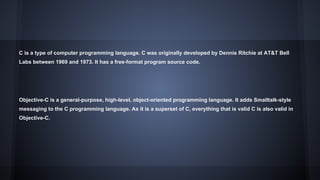
C is a type of computer programming language. C was originally developed by Dennis Ritchie at AT&T Bell
Labs between 1969 and 1973. It has a free-format program source code.
Objective-C is a general-purpose, high-level, object-oriented programming language. It adds Smalltalk-style
messaging to the C programming language. As it is a superset of C, everything that is valid C is also valid in
Objective-C.
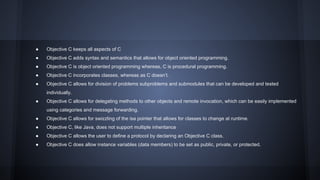
● Objective C keeps all aspects of C
● Objective C adds syntax and semantics that allows for object oriented programming.
● Objective C is object oriented programming whereas, C is procedural programming.
● Objective C incorporates classes, whereas as C doesn’t.
● Objective C allows for division of problems subproblems and submodules that can be developed and tested
individually.
● Objective C allows for delegating methods to other objects and remote invocation, which can be easily implemented
using categories and message forwarding.
● Objective C allows for swizzling of the isa pointer that allows for classes to change at runtime.
● Objective C, like Java, does not support multiple inheritance
● Objective C allows the user to define a protocol by declaring an Objective C class.
● Objective C does allow instance variables (data members) to be set as public, private, or protected.

C and objective-C

  • 1.
  • 2.
    C is atype of computer programming language. C was originally developed by Dennis Ritchie at AT&T Bell Labs between 1969 and 1973. It has a free-format program source code. Objective-C is a general-purpose, high-level, object-oriented programming language. It adds Smalltalk-style messaging to the C programming language. As it is a superset of C, everything that is valid C is also valid in Objective-C.
  • 3.
    ● Objective Ckeeps all aspects of C ● Objective C adds syntax and semantics that allows for object oriented programming. ● Objective C is object oriented programming whereas, C is procedural programming. ● Objective C incorporates classes, whereas as C doesn’t. ● Objective C allows for division of problems subproblems and submodules that can be developed and tested individually. ● Objective C allows for delegating methods to other objects and remote invocation, which can be easily implemented using categories and message forwarding. ● Objective C allows for swizzling of the isa pointer that allows for classes to change at runtime. ● Objective C, like Java, does not support multiple inheritance ● Objective C allows the user to define a protocol by declaring an Objective C class. ● Objective C does allow instance variables (data members) to be set as public, private, or protected.