Blood Supply of Lower Limb
Prepared by: Muzzamil Khan
Demonstrator Surgical KMU IHS SWABI
Arteries of the Gluteal Region
Superior Gluteal Artery
The superior gluteal artery is a branch from the internal iliac artery and enters
the gluteal region through the upper part of the greater sciatic foramen above
the piriformis . It divides into branches that are distributed throughout the gluteal
region.
Inferior Gluteal
Artery
The inferior gluteal artery is a branch of the internal iliac artery and enters the
gluteal region through the lower part of the greater sciatic foramen, below the
piriformis . It divides into numerous branches that are distributed throughout the
gluteal region.
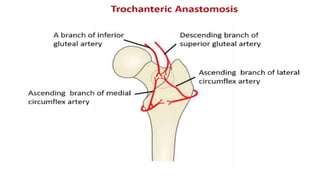
The Trochanteric Anastomosis
The trochanteric anastomosis provides the main blood supply to the head of the
femur. The nutrient arteries pass along the femoral neck beneath the capsule .
The following arteries take part in the anastomosis: the superior gluteal artery,
the inferior gluteal artery, the medial femoral circumflex artery, and the lateral
femoral circumflex artery.
The Cruciate Anastomosis
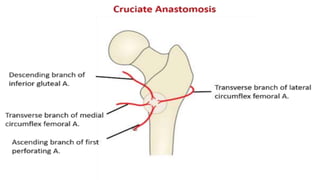
The cruciate anastomosis is situated at the level of the lesser trochanter of the
femur and, together with the trochanteric anastomosis, provides a connection
between the internal iliac and the femoral arteries. The following arteries take
part in the anastomosis: the inferior gluteal artery, the medial femoral circumflex
artery, the lateral femoral circumflex artery, and the first perforating artery, a
branch of the profunda artery.
Blood Supply of the Anterior Fascial Compartment of the Thigh
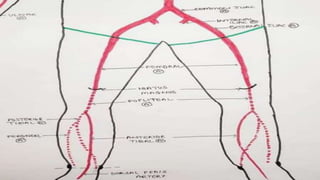
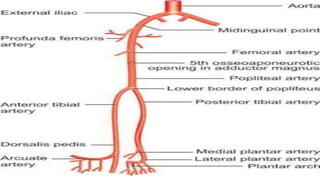
Femoral Artery
The femoral artery enters the thigh from behind the inguinal ligament, as a
continuation of the external iliac artery . Here, it lies midway between the
anterior superior iliac spine and the symphysis pubis. The femoral artery is the
main arterial supply to the lower limb. It descends almost vertically toward the
adductor tubercle of the femur and ends at the opening in the adductor magnus
muscle by entering the popliteal space as the popliteal artery .
Relations
■ Anteriorly: In the upper part of its course, it is superficial and is
covered by skin and fascia. In the lower part of its course, it passes
behind the sartorius muscle .
■ Posteriorly: The artery lies on the psoas, which separates it from the
hip joint, the pectineus, and the adductor longus . The femoral vein
intervenes between the artery and the adductor longus.
■ Medially: It is related to the femoral vein in the upper part of its
course .
■ Laterally: The femoral nerve and its branches .
Branches
■ The superficial circumflex iliac artery is a small branch that runs up to the region
of the anterior superior iliac spine.
■ The superficial epigastric artery is a small branch that crosses the inguinal ligament
and runs to the region of the umbilicus .
■ The superficial external pudendal artery is a small branch that runs medially to
supply the skin of the scrotum (or labium majus).
■ The deep external pudendal artery runs medially and supplies the skin of the
scrotum (or labium majus).
The profunda femoris artery is a large and important branch that arises from the
lateral side of the femoral artery about 1.5 in. (4 cm) below the inguinal ligament . It
passes medially behind the femoral vessels and enters the medial fascial compartment of
the thigh .
It ends by becoming the fourth perforating artery. At its origin, it gives off the medial
and lateral femoral circumflex arteries, and during its course it gives off three
perforating arteries.
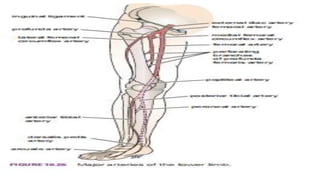
The descending genicular artery is a small branch that arises from the femoral artery
near its termination (Fig. 10.24). It assists in supplying the knee joint.
Femoral Vein
The femoral vein enters the thigh by passing through the opening in the
adductor magnus as a continuation of the popliteal vein . It ascends through the
thigh, lying at first on the lateral side of the artery, thenposterior to it, and finally
on its medial side . It leaves the thigh in the intermediate compartment of the
femoral sheath and passes behind the inguinal ligament to become the external
iliac vein.
Tributaries:The tributaries of the femoral vein are the great saphenous vein
and veins that correspond to the branches of the femoral artery . The superficial
circumflex iliac vein, the superficial epigastric vein, and the external pudendal
veins drain into the great saphenous vein.
Blood Supply of the Medial Fascial Compartment
of the Thigh
Profunda Femoris Artery
The profunda femoris is a large artery that arises from the lateral side of the femoral
artery in the femoral triangle,about 1.5 in. (4 cm) below the inguinal ligament . It
descends in the interval between the adductor longus and adductor brevis and then lies
on the adductor magnus, where it ends as the fourth perforating artery .
Branches
■ Medial femoral circumflex artery: This passes backward between the muscles
that form the floor of the femoral triangle and gives off muscular branches in the
medial fascial compartment of the thigh . It takes part in the formation of the
cruciate anastomosis.
■ Lateral femoral circumflex artery: This passes laterally between the terminal
branches of the femoral nerve . It breaks up into branches that supply the muscles of
the region and takes part in the formation of the cruciate anastomosis.
■ Four perforating arteries: Three of these arise as branches of the profunda femoris
artery; the fourth perforating artery is the terminal part of the profunda artery . The
perforating arteries run backward, piercing the various muscle layers as they go. They
supply the muscles and terminate by anastomosing with one another and with the
inferior gluteal artery and the circumflex femoral arteries above and the muscular
branches of the popliteal artery below.
Profunda Femoris Vein
The profunda femoris vein receives tributaries that correspond to the
branches of the artery. It drains into the femoral vein.
Obturator Artery
The obturator artery is a branch of the internal iliac artery . It passes forward on the
lateral wall of the pelvis and accompanies the obturator nerve through the obturator
canal (i.e., the upper part of the obturator foramen) . On entering the medial fascial
compartment of the thigh, it divides into medial and lateral branches, which pass around
the margin of the outer surface of the obturator membrane. It gives off muscular
branches and an articular branch to the hip joint.
Obturator Vein
The obturator vein receives tributaries that correspond to the branches of the
artery. It drains into the internal iliac.
Blood Supply of the Posterior Compartment of the Thigh
• The four perforating branches of the profunda femoris artery provide a rich blood
supply to this compartment . The profunda femoris vein drains the greater part of the
blood from the compartment.
Lower limb 7_101921.pptx

Lower limb 7_101921.pptx

  • 1.
    Blood Supply ofLower Limb Prepared by: Muzzamil Khan Demonstrator Surgical KMU IHS SWABI
  • 6.
    Arteries of theGluteal Region Superior Gluteal Artery The superior gluteal artery is a branch from the internal iliac artery and enters the gluteal region through the upper part of the greater sciatic foramen above the piriformis . It divides into branches that are distributed throughout the gluteal region.
  • 7.
    Inferior Gluteal Artery The inferiorgluteal artery is a branch of the internal iliac artery and enters the gluteal region through the lower part of the greater sciatic foramen, below the piriformis . It divides into numerous branches that are distributed throughout the gluteal region.
  • 8.
    The Trochanteric Anastomosis Thetrochanteric anastomosis provides the main blood supply to the head of the femur. The nutrient arteries pass along the femoral neck beneath the capsule . The following arteries take part in the anastomosis: the superior gluteal artery, the inferior gluteal artery, the medial femoral circumflex artery, and the lateral femoral circumflex artery.
  • 10.
    The Cruciate Anastomosis Thecruciate anastomosis is situated at the level of the lesser trochanter of the femur and, together with the trochanteric anastomosis, provides a connection between the internal iliac and the femoral arteries. The following arteries take part in the anastomosis: the inferior gluteal artery, the medial femoral circumflex artery, the lateral femoral circumflex artery, and the first perforating artery, a branch of the profunda artery.
  • 12.
    Blood Supply ofthe Anterior Fascial Compartment of the Thigh Femoral Artery The femoral artery enters the thigh from behind the inguinal ligament, as a continuation of the external iliac artery . Here, it lies midway between the anterior superior iliac spine and the symphysis pubis. The femoral artery is the main arterial supply to the lower limb. It descends almost vertically toward the adductor tubercle of the femur and ends at the opening in the adductor magnus muscle by entering the popliteal space as the popliteal artery .
  • 13.
    Relations ■ Anteriorly: Inthe upper part of its course, it is superficial and is covered by skin and fascia. In the lower part of its course, it passes behind the sartorius muscle . ■ Posteriorly: The artery lies on the psoas, which separates it from the hip joint, the pectineus, and the adductor longus . The femoral vein intervenes between the artery and the adductor longus. ■ Medially: It is related to the femoral vein in the upper part of its course . ■ Laterally: The femoral nerve and its branches .
  • 14.
    Branches ■ The superficialcircumflex iliac artery is a small branch that runs up to the region of the anterior superior iliac spine. ■ The superficial epigastric artery is a small branch that crosses the inguinal ligament and runs to the region of the umbilicus . ■ The superficial external pudendal artery is a small branch that runs medially to supply the skin of the scrotum (or labium majus). ■ The deep external pudendal artery runs medially and supplies the skin of the scrotum (or labium majus).
  • 15.
    The profunda femorisartery is a large and important branch that arises from the lateral side of the femoral artery about 1.5 in. (4 cm) below the inguinal ligament . It passes medially behind the femoral vessels and enters the medial fascial compartment of the thigh . It ends by becoming the fourth perforating artery. At its origin, it gives off the medial and lateral femoral circumflex arteries, and during its course it gives off three perforating arteries. The descending genicular artery is a small branch that arises from the femoral artery near its termination (Fig. 10.24). It assists in supplying the knee joint.
  • 17.
    Femoral Vein The femoralvein enters the thigh by passing through the opening in the adductor magnus as a continuation of the popliteal vein . It ascends through the thigh, lying at first on the lateral side of the artery, thenposterior to it, and finally on its medial side . It leaves the thigh in the intermediate compartment of the femoral sheath and passes behind the inguinal ligament to become the external iliac vein. Tributaries:The tributaries of the femoral vein are the great saphenous vein and veins that correspond to the branches of the femoral artery . The superficial circumflex iliac vein, the superficial epigastric vein, and the external pudendal veins drain into the great saphenous vein.
  • 18.
    Blood Supply ofthe Medial Fascial Compartment of the Thigh Profunda Femoris Artery The profunda femoris is a large artery that arises from the lateral side of the femoral artery in the femoral triangle,about 1.5 in. (4 cm) below the inguinal ligament . It descends in the interval between the adductor longus and adductor brevis and then lies on the adductor magnus, where it ends as the fourth perforating artery .
  • 19.
    Branches ■ Medial femoralcircumflex artery: This passes backward between the muscles that form the floor of the femoral triangle and gives off muscular branches in the medial fascial compartment of the thigh . It takes part in the formation of the cruciate anastomosis. ■ Lateral femoral circumflex artery: This passes laterally between the terminal branches of the femoral nerve . It breaks up into branches that supply the muscles of the region and takes part in the formation of the cruciate anastomosis.
  • 20.
    ■ Four perforatingarteries: Three of these arise as branches of the profunda femoris artery; the fourth perforating artery is the terminal part of the profunda artery . The perforating arteries run backward, piercing the various muscle layers as they go. They supply the muscles and terminate by anastomosing with one another and with the inferior gluteal artery and the circumflex femoral arteries above and the muscular branches of the popliteal artery below.
  • 21.
    Profunda Femoris Vein Theprofunda femoris vein receives tributaries that correspond to the branches of the artery. It drains into the femoral vein.
  • 22.
    Obturator Artery The obturatorartery is a branch of the internal iliac artery . It passes forward on the lateral wall of the pelvis and accompanies the obturator nerve through the obturator canal (i.e., the upper part of the obturator foramen) . On entering the medial fascial compartment of the thigh, it divides into medial and lateral branches, which pass around the margin of the outer surface of the obturator membrane. It gives off muscular branches and an articular branch to the hip joint.
  • 23.
    Obturator Vein The obturatorvein receives tributaries that correspond to the branches of the artery. It drains into the internal iliac.
  • 24.
    Blood Supply ofthe Posterior Compartment of the Thigh • The four perforating branches of the profunda femoris artery provide a rich blood supply to this compartment . The profunda femoris vein drains the greater part of the blood from the compartment.