Lottery Scam
 A lottery scam is a type of advance-fee fraud which begins with an unexpected
email notification, phone call, or mailing explaining that "You have won!" a large
sum of money in a lottery. The recipient of the message—the target of the scam—
is usually told to keep the notice secret, "due to a mix-up in some of the names
and numbers," and to contact a "claims agent." After contacting the agent, the
target of the scam will be asked to pay "processing fees" or "transfer charges" so
that the winnings can be distributed, but will never receive any lottery
payment.[1] Many email lottery scams use the names of legitimate lottery
organizations or other legitimate corporations/companies, but this does not mean
the legitimate organizations are in any way involved with the scams.
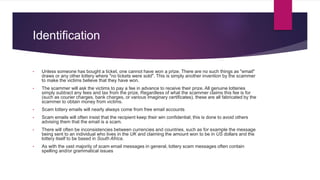
Identification
• Unless someone has bought a ticket, one cannot have won a prize. There are no such things as "email"
draws or any other lottery where "no tickets were sold". This is simply another invention by the scammer
to make the victims believe that they have won.
• The scammer will ask the victims to pay a fee in advance to receive their prize. All genuine lotteries
simply subtract any fees and tax from the prize. Regardless of what the scammer claims this fee is for
(such as courier charges, bank charges, or various imaginary certificates), these are all fabricated by the
scammer to obtain money from victims.
• Scam lottery emails will nearly always come from free email accounts
• Scam emails will often insist that the recipient keep their win confidential; this is done to avoid others
advising them that the email is a scam.
• There will often be inconsistencies between currencies and countries, such as for example the message
being sent to an individual who lives in the UK and claiming the amount won to be in US dollars and the
lottery itself to be based in South Africa.
• As with the vast majority of scam email messages in general, lottery scam messages often contain
spelling and/or grammatical issues
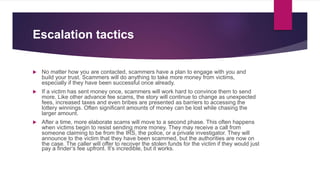
Escalation tactics
 No matter how you are contacted, scammers have a plan to engage with you and
build your trust. Scammers will do anything to take more money from victims,
especially if they have been successful once already.
 If a victim has sent money once, scammers will work hard to convince them to send
more. Like other advance fee scams, the story will continue to change as unexpected
fees, increased taxes and even bribes are presented as barriers to accessing the
lottery winnings. Often significant amounts of money can be lost while chasing the
larger amount.
 After a time, more elaborate scams will move to a second phase. This often happens
when victims begin to resist sending more money. They may receive a call from
someone claiming to be from the IRS, the police, or a private investigator. They will
announce to the victim that they have been scammed, but the authorities are now on
the case. The caller will offer to recover the stolen funds for the victim if they would just
pay a finder’s fee upfront. It’s incredible, but it works.
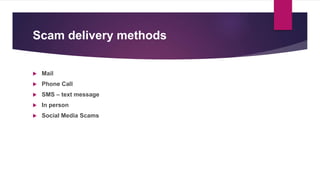
Scam delivery methods
 Mail
 Phone Call
 SMS – text message
 In person
 Social Media Scams
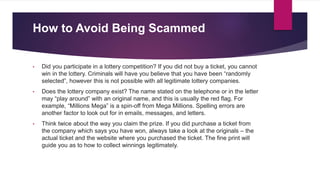
How to Avoid Being Scammed
• Did you participate in a lottery competition? If you did not buy a ticket, you cannot
win in the lottery. Criminals will have you believe that you have been “randomly
selected”, however this is not possible with all legitimate lottery companies.
• Does the lottery company exist? The name stated on the telephone or in the letter
may “play around” with an original name, and this is usually the red flag. For
example, “Millions Mega” is a spin-off from Mega Millions. Spelling errors are
another factor to look out for in emails, messages, and letters.
• Think twice about the way you claim the prize. If you did purchase a ticket from
the company which says you have won, always take a look at the originals – the
actual ticket and the website where you purchased the ticket. The fine print will
guide you as to how to collect winnings legitimately.
Case Study
https://www.deccanherald.com/city/bengaluru-man-turns-cyber-conman-after-
losing-money-in-online-lottery-scam-963621.html
Lottery scam

Lottery scam

  • 2.
    Lottery Scam  Alottery scam is a type of advance-fee fraud which begins with an unexpected email notification, phone call, or mailing explaining that "You have won!" a large sum of money in a lottery. The recipient of the message—the target of the scam— is usually told to keep the notice secret, "due to a mix-up in some of the names and numbers," and to contact a "claims agent." After contacting the agent, the target of the scam will be asked to pay "processing fees" or "transfer charges" so that the winnings can be distributed, but will never receive any lottery payment.[1] Many email lottery scams use the names of legitimate lottery organizations or other legitimate corporations/companies, but this does not mean the legitimate organizations are in any way involved with the scams.
  • 3.
    Identification • Unless someonehas bought a ticket, one cannot have won a prize. There are no such things as "email" draws or any other lottery where "no tickets were sold". This is simply another invention by the scammer to make the victims believe that they have won. • The scammer will ask the victims to pay a fee in advance to receive their prize. All genuine lotteries simply subtract any fees and tax from the prize. Regardless of what the scammer claims this fee is for (such as courier charges, bank charges, or various imaginary certificates), these are all fabricated by the scammer to obtain money from victims. • Scam lottery emails will nearly always come from free email accounts • Scam emails will often insist that the recipient keep their win confidential; this is done to avoid others advising them that the email is a scam. • There will often be inconsistencies between currencies and countries, such as for example the message being sent to an individual who lives in the UK and claiming the amount won to be in US dollars and the lottery itself to be based in South Africa. • As with the vast majority of scam email messages in general, lottery scam messages often contain spelling and/or grammatical issues
  • 4.
    Escalation tactics  Nomatter how you are contacted, scammers have a plan to engage with you and build your trust. Scammers will do anything to take more money from victims, especially if they have been successful once already.  If a victim has sent money once, scammers will work hard to convince them to send more. Like other advance fee scams, the story will continue to change as unexpected fees, increased taxes and even bribes are presented as barriers to accessing the lottery winnings. Often significant amounts of money can be lost while chasing the larger amount.  After a time, more elaborate scams will move to a second phase. This often happens when victims begin to resist sending more money. They may receive a call from someone claiming to be from the IRS, the police, or a private investigator. They will announce to the victim that they have been scammed, but the authorities are now on the case. The caller will offer to recover the stolen funds for the victim if they would just pay a finder’s fee upfront. It’s incredible, but it works.
  • 5.
    Scam delivery methods Mail  Phone Call  SMS – text message  In person  Social Media Scams
  • 6.
    How to AvoidBeing Scammed • Did you participate in a lottery competition? If you did not buy a ticket, you cannot win in the lottery. Criminals will have you believe that you have been “randomly selected”, however this is not possible with all legitimate lottery companies. • Does the lottery company exist? The name stated on the telephone or in the letter may “play around” with an original name, and this is usually the red flag. For example, “Millions Mega” is a spin-off from Mega Millions. Spelling errors are another factor to look out for in emails, messages, and letters. • Think twice about the way you claim the prize. If you did purchase a ticket from the company which says you have won, always take a look at the originals – the actual ticket and the website where you purchased the ticket. The fine print will guide you as to how to collect winnings legitimately.
  • 7.