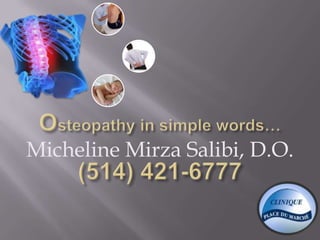
Osteopathy in simple words…(514) 421-6777Micheline Mirza Salibi, D.O.
What is Osteopathy?It works to relieve pain, improves mobility and restores health, allowing the body to function more efficiently.
What is OSTEOPATHY?Osteopathy is a treatment philosophy which seeks to identify areas of the body that are restricted or constricted, then gently ease these restrictions so that normal function can resume.
Osteopathy versus other alternative medicineOsteopathy is allied with, but not the same as, chiropractic or physiotherapy. A chiropractor or physiotherapist use some different methods of assessing and treating a patient. Osteopathy has its own unique philosophy. This states that the body is a unified whole. On a practical level, this means that problems in any one part of the body will affect other parts.  This is why osteopathy doesn’t just treat a problem locally, it looksat the body as a wholeto find and treatThe cause of a problem!
What do I treat?Autism, AsthmaArthritisAttention Deficit Disorder (ADD)Chronic Fatigue VertigoHerniated DisksScoliosis, Tennis ElbowLymphedemaProstatitisUrinary dysfunctionsIrritable Bowel and Incontinence
How does Osteopathy work?Osteopathy applies the knowledge of the structure (anatomy) and function (physiology) of the body, to all diseases, disorders and dysfunctions.
How does Osteopathy work?The tools Osteopathic manual practitioners use a gentle “hands-on” or “manual” approach, applied through osteopathic philosophy, to identify the causative factor of the problem and restore order to all of the systems: musculoskeletal, respiratory, cardiovascular, digestive, reproductive, or nervous system.
How does Osteopathy work?A key part of osteopathic medicine is a technique called OMT, or osteopathic manipulative treatment. OMT allows the osteopath to use their hands as a primary tool to diagnose and treat illness and injury. This form of manual medicine lets osteopaths examine the back and other parts of the body, such as joints, tendons, ligaments, and muscles, for pain and restriction during motion that could signal an injury or impaired function.
What do I treat?I treat most musculo-skeletal, visceral and cranial conditions such as those listed below. My patients are of all ages: from newborns to school age to adults andseniors. I treat people with a range of occupations and lifestyles from the sedentary to the very active.
I treat conditions such as:Arthritis, joint problems, whiplash
Migraines, headaches
Muscle, tendon, ligament injuries
Sports and work related injuries
TMJ/jaw problems and post-dental trauma
Post-operative pain
Digestive, menstrual and other body system problems
A range of breathing problems What do I treat?Spinal curvature (scoliosis)
Nerve pain, e.g. sciatica, tingling arms/fingers
Unsettled, colicky baby
Behavioural problems and learning difficulties

L’OstéOpathie Tout Simplement Linkedin

  • 1.
    Osteopathy in simplewords…(514) 421-6777Micheline Mirza Salibi, D.O.
  • 2.
    What is Osteopathy?Itworks to relieve pain, improves mobility and restores health, allowing the body to function more efficiently.
  • 3.
    What is OSTEOPATHY?Osteopathyis a treatment philosophy which seeks to identify areas of the body that are restricted or constricted, then gently ease these restrictions so that normal function can resume.
  • 4.
    Osteopathy versus otheralternative medicineOsteopathy is allied with, but not the same as, chiropractic or physiotherapy. A chiropractor or physiotherapist use some different methods of assessing and treating a patient. Osteopathy has its own unique philosophy. This states that the body is a unified whole. On a practical level, this means that problems in any one part of the body will affect other parts.  This is why osteopathy doesn’t just treat a problem locally, it looksat the body as a wholeto find and treatThe cause of a problem!
  • 5.
    What do Itreat?Autism, AsthmaArthritisAttention Deficit Disorder (ADD)Chronic Fatigue VertigoHerniated DisksScoliosis, Tennis ElbowLymphedemaProstatitisUrinary dysfunctionsIrritable Bowel and Incontinence
  • 6.
    How does Osteopathywork?Osteopathy applies the knowledge of the structure (anatomy) and function (physiology) of the body, to all diseases, disorders and dysfunctions.
  • 7.
    How does Osteopathywork?The tools Osteopathic manual practitioners use a gentle “hands-on” or “manual” approach, applied through osteopathic philosophy, to identify the causative factor of the problem and restore order to all of the systems: musculoskeletal, respiratory, cardiovascular, digestive, reproductive, or nervous system.
  • 8.
    How does Osteopathywork?A key part of osteopathic medicine is a technique called OMT, or osteopathic manipulative treatment. OMT allows the osteopath to use their hands as a primary tool to diagnose and treat illness and injury. This form of manual medicine lets osteopaths examine the back and other parts of the body, such as joints, tendons, ligaments, and muscles, for pain and restriction during motion that could signal an injury or impaired function.
  • 9.
    What do Itreat?I treat most musculo-skeletal, visceral and cranial conditions such as those listed below. My patients are of all ages: from newborns to school age to adults andseniors. I treat people with a range of occupations and lifestyles from the sedentary to the very active.
  • 10.
    I treat conditionssuch as:Arthritis, joint problems, whiplash
  • 11.
  • 12.
  • 13.
    Sports and workrelated injuries
  • 14.
    TMJ/jaw problems andpost-dental trauma
  • 15.
  • 16.
    Digestive, menstrual andother body system problems
  • 17.
    A range ofbreathing problems What do I treat?Spinal curvature (scoliosis)
  • 18.
    Nerve pain, e.g.sciatica, tingling arms/fingers
  • 19.
  • 20.
    Behavioural problems andlearning difficulties