Lock Out/Tag Out
2
 OSHA 1910.147
 Protects Employees
 Written Procedures
 Affordable preventive measure
 Best Practice for farm – not difficult
Best Practice!
Lock Out/Tag Out
3
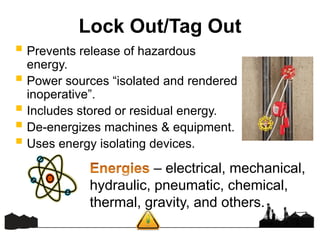
 Prevents release of hazardous
energy.
 Power sources “isolated and rendered
inoperative”.
 Includes stored or residual energy.
 De-energizes machines & equipment.
 Uses energy isolating devices.
– electrical, mechanical,
hydraulic, pneumatic, chemical,
thermal, gravity, and others.
Lock Out/Tag Out
Protects Employees & You:
 From injury.
 From unexpected startup.
 During service & maintenance work.
 Working near exposed electrical conductors &
parts of electrical equipment.
4
Keeps others from turning machines on!
Lock Out/Tag Out Requirements
5
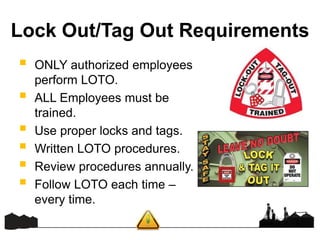
 ONLY authorized employees
perform LOTO.
 ALL Employees must be
trained.
 Use proper locks and tags.
 Written LOTO procedures.
 Review procedures annually.
 Follow LOTO each time –
every time.
Lock Out Requirements
6
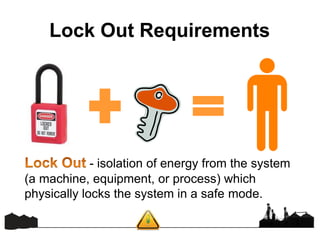
- isolation of energy from the system
(a machine, equipment, or process) which
physically locks the system in a safe mode.
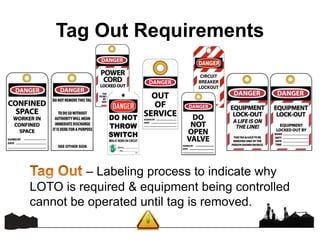
Tag Out Requirements
7
– Labeling process to indicate why
LOTO is required & equipment being controlled
cannot be operated until tag is removed.
Lock out/Tag out – Try Out!
8
All Procedures include:
 Tell how to use procedures.
 Specific steps
• To shut down, isolate, block, & secure machine.
• Safely place, remove, & transfer of LOTO devices
• To test machine & verify energy is Locked out.
 Identify responsible person for LOTO.
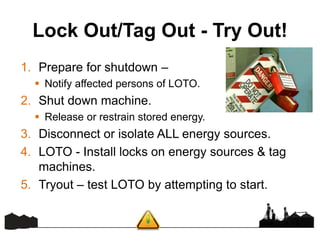
Lock Out/Tag Out - Try Out!
9
1. Prepare for shutdown –
 Notify affected persons of LOTO.
2. Shut down machine.
 Release or restrain stored energy.
3. Disconnect or isolate ALL energy sources.
4. LOTO - Install locks on energy sources & tag
machines.
5. Tryout – test LOTO by attempting to start.
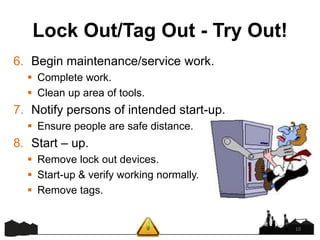
6. Begin maintenance/service work.
 Complete work.
 Clean up area of tools.
7. Notify persons of intended start-up.
 Ensure people are safe distance.
8. Start – up.
 Remove lock out devices.
 Start-up & verify working normally.
 Remove tags.
Lock Out/Tag Out - Try Out!
10
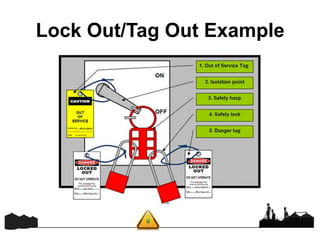
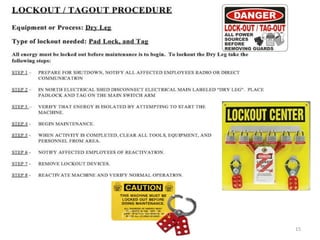
Lock Out/Tag Out Example
11
Type of LOTO Locks
Pole Breaker
Lockout
Padlock
Valve
Lockouts
Lockout
Hasp
Wall Switch
Lockout Breaker Lockout
Why LOTO for Farms
13
• Father & son discussed need to check a cross
auger on top of a bin.
• No responsibility assigned.
• Dad checked auger; did not like what he heard.
• Dad got on top of bin & stuck his arm in the auger.
• Son decided to check the auger.
• Father lost his forearm.
Why LOTO for Farms
14
If they had a system in place –– dad would
still have his arm and son wouldn’t have
his GUILT.
Use of OSHA procedures is strongly recommended.
What a farm can do:
 Put a tag on it – Warning.
 Use locks.
 Use a hairpin cotter key.
15

Lock-Out-Tag-Out-mini-module-PDF-FINAL-Jan-2014-2.pdf

  • 2.
    Lock Out/Tag Out 2 OSHA 1910.147  Protects Employees  Written Procedures  Affordable preventive measure  Best Practice for farm – not difficult Best Practice!
  • 3.
    Lock Out/Tag Out 3 Prevents release of hazardous energy.  Power sources “isolated and rendered inoperative”.  Includes stored or residual energy.  De-energizes machines & equipment.  Uses energy isolating devices. – electrical, mechanical, hydraulic, pneumatic, chemical, thermal, gravity, and others.
  • 4.
    Lock Out/Tag Out ProtectsEmployees & You:  From injury.  From unexpected startup.  During service & maintenance work.  Working near exposed electrical conductors & parts of electrical equipment. 4 Keeps others from turning machines on!
  • 5.
    Lock Out/Tag OutRequirements 5  ONLY authorized employees perform LOTO.  ALL Employees must be trained.  Use proper locks and tags.  Written LOTO procedures.  Review procedures annually.  Follow LOTO each time – every time.
  • 6.
    Lock Out Requirements 6 -isolation of energy from the system (a machine, equipment, or process) which physically locks the system in a safe mode.
  • 7.
    Tag Out Requirements 7 –Labeling process to indicate why LOTO is required & equipment being controlled cannot be operated until tag is removed.
  • 8.
    Lock out/Tag out– Try Out! 8 All Procedures include:  Tell how to use procedures.  Specific steps • To shut down, isolate, block, & secure machine. • Safely place, remove, & transfer of LOTO devices • To test machine & verify energy is Locked out.  Identify responsible person for LOTO.
  • 9.
    Lock Out/Tag Out- Try Out! 9 1. Prepare for shutdown –  Notify affected persons of LOTO. 2. Shut down machine.  Release or restrain stored energy. 3. Disconnect or isolate ALL energy sources. 4. LOTO - Install locks on energy sources & tag machines. 5. Tryout – test LOTO by attempting to start.
  • 10.
    6. Begin maintenance/servicework.  Complete work.  Clean up area of tools. 7. Notify persons of intended start-up.  Ensure people are safe distance. 8. Start – up.  Remove lock out devices.  Start-up & verify working normally.  Remove tags. Lock Out/Tag Out - Try Out! 10
  • 11.
    Lock Out/Tag OutExample 11
  • 12.
    Type of LOTOLocks Pole Breaker Lockout Padlock Valve Lockouts Lockout Hasp Wall Switch Lockout Breaker Lockout
  • 13.
    Why LOTO forFarms 13 • Father & son discussed need to check a cross auger on top of a bin. • No responsibility assigned. • Dad checked auger; did not like what he heard. • Dad got on top of bin & stuck his arm in the auger. • Son decided to check the auger. • Father lost his forearm.
  • 14.
    Why LOTO forFarms 14 If they had a system in place –– dad would still have his arm and son wouldn’t have his GUILT. Use of OSHA procedures is strongly recommended. What a farm can do:  Put a tag on it – Warning.  Use locks.  Use a hairpin cotter key.
  • 15.