Local
Volunteer
1 What is it ?
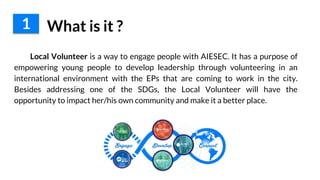
Local Volunteer is a way to engage people with AIESEC. It has a purpose of
empowering young people to develop leadership through volunteering in an
international environment with the EPs that are coming to work in the city.
Besides addressing one of the SDGs, the Local Volunteer will have the
opportunity to impact her/his own community and make it a better place.
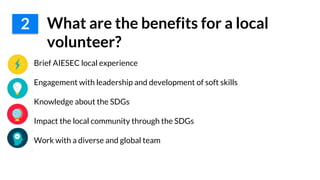
•Brief AIESEC local experience
•
•Engagement with leadership and development of soft skills
•
•Knowledge about the SDGs
•
•Impact the local community through the SDGs
•
•Work with a diverse and global team
•
2 What are the benefits for a local
volunteer?
3 How this program works?
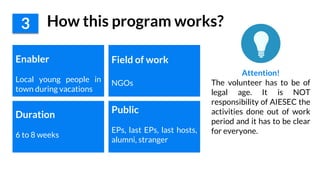
Enabler
Local young people in
town during vacations
Field of work
NGOs
Duration
6 to 8 weeks
Public
EPs, last EPs, last hosts,
alumni, stranger
Attention!
The volunteer has to be of
legal age. It is NOT
responsibility of AIESEC the
activities done out of work
period and it has to be clear
for everyone.
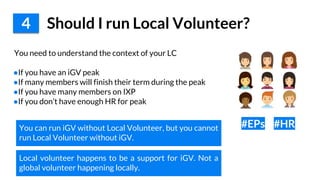
You need to understand the context of your LC
●If you have an iGV peak
●If many members will finish their term during the peak
●If you have many members on IXP
●If you don’t have enough HR for peak
4 Should I run Local Volunteer?
#EPs #HRYou can run iGV without Local Volunteer, but you cannot
run Local Volunteer without iGV.
Local volunteer happens to be a support for iGV. Not a
global volunteer happening locally.
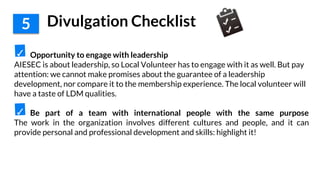
Opportunity to engage with leadership
AIESEC is about leadership, so Local Volunteer has to engage with it as well. But pay
attention: we cannot make promises about the guarantee of a leadership
development, nor compare it to the membership experience. The local volunteer will
have a taste of LDM qualities.
Be part of a team with international people with the same purpose
The work in the organization involves different cultures and people, and it can
provide personal and professional development and skills: highlight it!
5 Divulgation Checklist
✓
✓
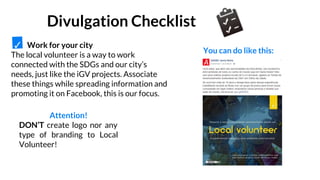
Work for your city
The local volunteer is a way to work
connected with the SDGs and our city’s
needs, just like the iGV projects. Associate
these things while spreading information and
promoting it on Facebook, this is our focus.
Attention!
DON’T create logo nor any
type of branding to Local
Volunteer!
You can do like this:
Divulgation Checklist
✓
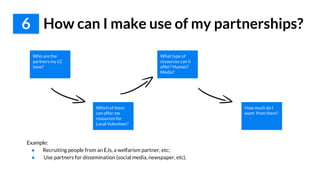
6 How can I make use of my partnerships?
Which of them
can offer me
resources for
Local Volunteer?
Who are the
partners my LC
have?
What type of
resources can it
offer? Human?
Media?
How much do I
want from them?
Example:
● Recruiting people from an EJs, a welfarism partner, etc;
● Use partners for dissemination (social media, newspaper, etc).
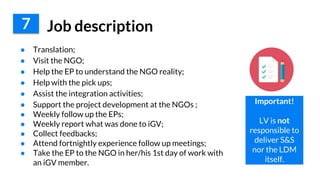
● Translation;
● Visit the NGO;
● Help the EP to understand the NGO reality;
● Help with the pick ups;
● Assist the integration activities;
● Support the project development at the NGOs ;
● Weekly follow up the EPs;
● Weekly report what was done to iGV;
● Collect feedbacks;
● Attend fortnightly experience follow up meetings;
● Take the EP to the NGO in her/his 1st day of work with
an iGV member.
7 Job description
Important!
LV is not
responsible to
deliver S&S
nor the LDM
itself.
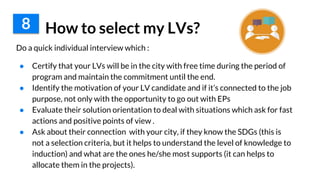
How to select my LVs?
Do a quick individual interview which :
● Certify that your LVs will be in the city with free time during the period of
program and maintain the commitment until the end.
● Identify the motivation of your LV candidate and if it’s connected to the job
purpose, not only with the opportunity to go out with EPs
● Evaluate their solution orientation to deal with situations which ask for fast
actions and positive points of view .
● Ask about their connection with your city, if they know the SDGs (this is
not a selection criteria, but it helps to understand the level of knowledge to
induction) and what are the ones he/she most supports (it can helps to
allocate them in the projects).
8
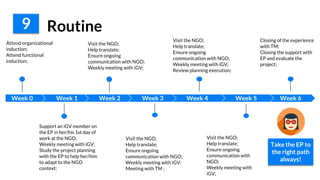
9 Routine
Week 0 Week 1 Week 2 Week 3 Week 4
Support an iGV member on
the EP in her/his 1st day of
work at the NGO;
Weekly meeting with iGV;
Study the project planning
with the EP to help her/him
to adapt to the NGO
context;
Visit the NGO;
Help translate;
Ensure ongoing
communication with NGO;
Weekly meeting with iGV;
Attend organizational
induction;
Attend functional
induction;
Week 5 Week 6
Closing of the experience
with TM;
Closing the support with
EP and evaluate the
project;
Visit the NGO;
Help translate;
Ensure ongoing
communication with NGO;
Weekly meeting with iGV;
Meeting with TM ;
Visit the NGO;
Help translate;
Ensure ongoing
communication with NGO;
Weekly meeting with iGV;
Review planning execution;
Visit the NGO;
Help translate;
Ensure ongoing
communication with
NGO;
Weekly meeting with
iGV;
Take the EP to
the right path
always!
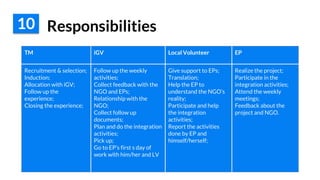
10 Responsibilities
TM iGV Local Volunteer EP
Recruitment & selection;
Induction;
Allocation with iGV;
Follow up the
experience;
Closing the experience;
Follow up the weekly
activities;
Collect feedback with the
NGO and EPs;
Relationship with the
NGO;
Collect follow up
documents;
Plan and do the integration
activities;
Pick up;
Go to EP’s first s day of
work with him/her and LV
Give support to EPs;
Translation;
Help the EP to
understand the NGO’s
reality;
Participate and help
the integration
activities;
Report the activities
done by EP and
himself/herself;
Realize the project;
Participate in the
integration activities;
Attend the weekly
meetings;
Feedback about the
project and NGO.
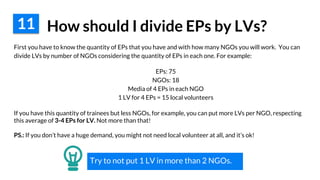
11 How should I divide EPs by LVs?
First you have to know the quantity of EPs that you have and with how many NGOs you will work. You can
divide LVs by number of NGOs considering the quantity of EPs in each one. For example:
● EPs: 75
● NGOs: 18
● Media of 4 EPs in each NGO
● 1 LV for 4 EPs = 15 local volunteers
If you have this quantity of trainees but less NGOs, for example, you can put more LVs per NGO, respecting
this average of 3-4 EPs for LV. Not more than that!
PS.: If you don’t have a huge demand, you might not need local volunteer at all, and it’s ok!
Try to not put 1 LV in more than 2 NGOs.
Agenda
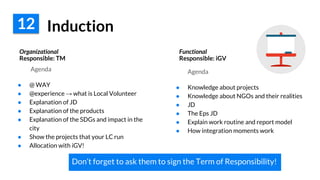
● @ WAY
● @experience → what is Local Volunteer
● Explanation of JD
● Explanation of the products
● Explanation of the SDGs and impact in the
city
● Show the projects that your LC run
● Allocation with iGV!
12 Induction
Agenda
● Knowledge about projects
● Knowledge about NGOs and their realities
● JD
● The Eps JD
● Explain work routine and report model
● How integration moments work
Organizational
Responsible: TM
Functional
Responsible: iGV
Don’t forget to ask them to sign the Term of Responsibility!
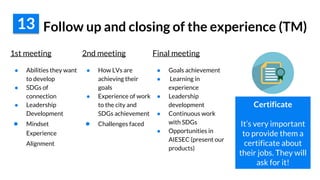
Follow up and closing of the experience (TM)
1st meeting
● Abilities they want
to develop
● SDGs of
connection
● Leadership
Development
● Mindset
Experience
Alignment
13
Certificate
It’s very important
to provide them a
certificate about
their jobs. They will
ask for it!
2nd meeting
● How LVs are
achieving their
goals
● Experience of work
to the city and
SDGs achievement
● Challenges faced
Final meeting
● Goals achievement
● Learning in
experience
● Leadership
development
● Continuous work
with SDGs
● Opportunities in
AIESEC (present our
products)
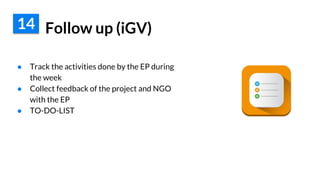
Follow up (iGV)
● Track the activities done by the EP during
the week
● Collect feedback of the project and NGO
with the EP
● TO-DO-LIST
14
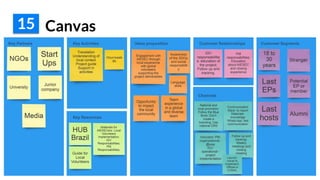
Canvas15
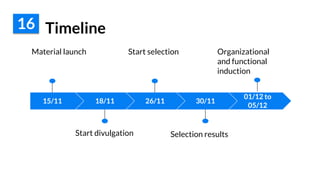
Timeline16
15/11 18/11 26/11 30/11
01/12 to
05/12
Start divulgation
Start selection
Selection results
Organizational
and functional
induction
Material launch
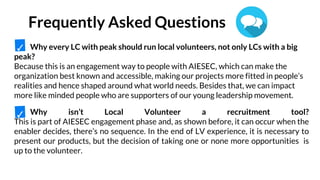
Why every LC with peak should run local volunteers, not only LCs with a big
peak?
Because this is an engagement way to people with AIESEC, which can make the
organization best known and accessible, making our projects more fitted in people’s
realities and hence shaped around what world needs. Besides that, we can impact
more like minded people who are supporters of our young leadership movement.
Why isn’t Local Volunteer a recruitment tool?
This is part of AIESEC engagement phase and, as shown before, it can occur when the
enabler decides, there’s no sequence. In the end of LV experience, it is necessary to
present our products, but the decision of taking one or none more opportunities is
up to the volunteer.
Frequently Asked Questions
✓
✓
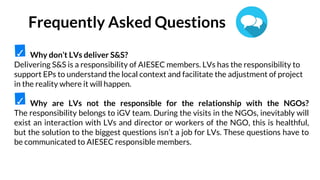
Why don’t LVs deliver S&S?
Delivering S&S is a responsibility of AIESEC members. LVs has the responsibility to
support EPs to understand the local context and facilitate the adjustment of project
in the reality where it will happen.
Why are LVs not the responsible for the relationship with the NGOs?
The responsibility belongs to iGV team. During the visits in the NGOs, inevitably will
exist an interaction with LVs and director or workers of the NGO, this is healthful,
but the solution to the biggest questions isn’t a job for LVs. These questions have to
be communicated to AIESEC responsible members.
✓
✓
Frequently Asked Questions
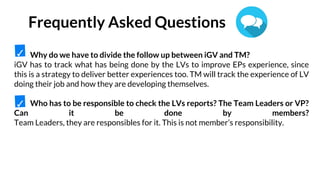
Why do we have to divide the follow up between iGV and TM?
iGV has to track what has being done by the LVs to improve EPs experience, since
this is a strategy to deliver better experiences too. TM will track the experience of LV
doing their job and how they are developing themselves.
Who has to be responsible to check the LVs reports? The Team Leaders or VP?
Can it be done by members?
Team Leaders, they are responsibles for it. This is not member’s responsibility.
✓
✓
Frequently Asked Questions
Why doesn’t Local Volunteer have a brand like the others products?
Currently, the name “Local Volunteer” is not officially branded or registered. The
brand of Local Volunteer product as EwA will be defined by 2017.
What can I do if my LC doesn’t have a good timeline to do the divulgation of LV
opportunity? Or if I don’t have the necessary quantity of enrolled?
You can work with member’s indications, contact of hosts, last hosts, EPs who will
travel later or that have travelled before. You can also work with more than one
strategy, an internal and other external.
✓
✓
Frequently Asked Questions
Local Volunteer

Local Volunteer

  • 1.
  • 2.
    1 What isit ? Local Volunteer is a way to engage people with AIESEC. It has a purpose of empowering young people to develop leadership through volunteering in an international environment with the EPs that are coming to work in the city. Besides addressing one of the SDGs, the Local Volunteer will have the opportunity to impact her/his own community and make it a better place.
  • 3.
    •Brief AIESEC localexperience • •Engagement with leadership and development of soft skills • •Knowledge about the SDGs • •Impact the local community through the SDGs • •Work with a diverse and global team • 2 What are the benefits for a local volunteer?
  • 4.
    3 How thisprogram works? Enabler Local young people in town during vacations Field of work NGOs Duration 6 to 8 weeks Public EPs, last EPs, last hosts, alumni, stranger Attention! The volunteer has to be of legal age. It is NOT responsibility of AIESEC the activities done out of work period and it has to be clear for everyone.
  • 5.
    You need tounderstand the context of your LC ●If you have an iGV peak ●If many members will finish their term during the peak ●If you have many members on IXP ●If you don’t have enough HR for peak 4 Should I run Local Volunteer? #EPs #HRYou can run iGV without Local Volunteer, but you cannot run Local Volunteer without iGV. Local volunteer happens to be a support for iGV. Not a global volunteer happening locally.
  • 6.
    Opportunity to engagewith leadership AIESEC is about leadership, so Local Volunteer has to engage with it as well. But pay attention: we cannot make promises about the guarantee of a leadership development, nor compare it to the membership experience. The local volunteer will have a taste of LDM qualities. Be part of a team with international people with the same purpose The work in the organization involves different cultures and people, and it can provide personal and professional development and skills: highlight it! 5 Divulgation Checklist ✓ ✓
  • 7.
    Work for yourcity The local volunteer is a way to work connected with the SDGs and our city’s needs, just like the iGV projects. Associate these things while spreading information and promoting it on Facebook, this is our focus. Attention! DON’T create logo nor any type of branding to Local Volunteer! You can do like this: Divulgation Checklist ✓
  • 8.
    6 How canI make use of my partnerships? Which of them can offer me resources for Local Volunteer? Who are the partners my LC have? What type of resources can it offer? Human? Media? How much do I want from them? Example: ● Recruiting people from an EJs, a welfarism partner, etc; ● Use partners for dissemination (social media, newspaper, etc).
  • 9.
    ● Translation; ● Visitthe NGO; ● Help the EP to understand the NGO reality; ● Help with the pick ups; ● Assist the integration activities; ● Support the project development at the NGOs ; ● Weekly follow up the EPs; ● Weekly report what was done to iGV; ● Collect feedbacks; ● Attend fortnightly experience follow up meetings; ● Take the EP to the NGO in her/his 1st day of work with an iGV member. 7 Job description Important! LV is not responsible to deliver S&S nor the LDM itself.
  • 10.
    How to selectmy LVs? Do a quick individual interview which : ● Certify that your LVs will be in the city with free time during the period of program and maintain the commitment until the end. ● Identify the motivation of your LV candidate and if it’s connected to the job purpose, not only with the opportunity to go out with EPs ● Evaluate their solution orientation to deal with situations which ask for fast actions and positive points of view . ● Ask about their connection with your city, if they know the SDGs (this is not a selection criteria, but it helps to understand the level of knowledge to induction) and what are the ones he/she most supports (it can helps to allocate them in the projects). 8
  • 11.
    9 Routine Week 0Week 1 Week 2 Week 3 Week 4 Support an iGV member on the EP in her/his 1st day of work at the NGO; Weekly meeting with iGV; Study the project planning with the EP to help her/him to adapt to the NGO context; Visit the NGO; Help translate; Ensure ongoing communication with NGO; Weekly meeting with iGV; Attend organizational induction; Attend functional induction; Week 5 Week 6 Closing of the experience with TM; Closing the support with EP and evaluate the project; Visit the NGO; Help translate; Ensure ongoing communication with NGO; Weekly meeting with iGV; Meeting with TM ; Visit the NGO; Help translate; Ensure ongoing communication with NGO; Weekly meeting with iGV; Review planning execution; Visit the NGO; Help translate; Ensure ongoing communication with NGO; Weekly meeting with iGV; Take the EP to the right path always!
  • 12.
    10 Responsibilities TM iGVLocal Volunteer EP Recruitment & selection; Induction; Allocation with iGV; Follow up the experience; Closing the experience; Follow up the weekly activities; Collect feedback with the NGO and EPs; Relationship with the NGO; Collect follow up documents; Plan and do the integration activities; Pick up; Go to EP’s first s day of work with him/her and LV Give support to EPs; Translation; Help the EP to understand the NGO’s reality; Participate and help the integration activities; Report the activities done by EP and himself/herself; Realize the project; Participate in the integration activities; Attend the weekly meetings; Feedback about the project and NGO.
  • 13.
    11 How shouldI divide EPs by LVs? First you have to know the quantity of EPs that you have and with how many NGOs you will work. You can divide LVs by number of NGOs considering the quantity of EPs in each one. For example: ● EPs: 75 ● NGOs: 18 ● Media of 4 EPs in each NGO ● 1 LV for 4 EPs = 15 local volunteers If you have this quantity of trainees but less NGOs, for example, you can put more LVs per NGO, respecting this average of 3-4 EPs for LV. Not more than that! PS.: If you don’t have a huge demand, you might not need local volunteer at all, and it’s ok! Try to not put 1 LV in more than 2 NGOs.
  • 14.
    Agenda ● @ WAY ●@experience → what is Local Volunteer ● Explanation of JD ● Explanation of the products ● Explanation of the SDGs and impact in the city ● Show the projects that your LC run ● Allocation with iGV! 12 Induction Agenda ● Knowledge about projects ● Knowledge about NGOs and their realities ● JD ● The Eps JD ● Explain work routine and report model ● How integration moments work Organizational Responsible: TM Functional Responsible: iGV Don’t forget to ask them to sign the Term of Responsibility!
  • 15.
    Follow up andclosing of the experience (TM) 1st meeting ● Abilities they want to develop ● SDGs of connection ● Leadership Development ● Mindset Experience Alignment 13 Certificate It’s very important to provide them a certificate about their jobs. They will ask for it! 2nd meeting ● How LVs are achieving their goals ● Experience of work to the city and SDGs achievement ● Challenges faced Final meeting ● Goals achievement ● Learning in experience ● Leadership development ● Continuous work with SDGs ● Opportunities in AIESEC (present our products)
  • 16.
    Follow up (iGV) ●Track the activities done by the EP during the week ● Collect feedback of the project and NGO with the EP ● TO-DO-LIST 14
  • 17.
  • 18.
    Timeline16 15/11 18/11 26/1130/11 01/12 to 05/12 Start divulgation Start selection Selection results Organizational and functional induction Material launch
  • 19.
    Why every LCwith peak should run local volunteers, not only LCs with a big peak? Because this is an engagement way to people with AIESEC, which can make the organization best known and accessible, making our projects more fitted in people’s realities and hence shaped around what world needs. Besides that, we can impact more like minded people who are supporters of our young leadership movement. Why isn’t Local Volunteer a recruitment tool? This is part of AIESEC engagement phase and, as shown before, it can occur when the enabler decides, there’s no sequence. In the end of LV experience, it is necessary to present our products, but the decision of taking one or none more opportunities is up to the volunteer. Frequently Asked Questions ✓ ✓
  • 20.
    Why don’t LVsdeliver S&S? Delivering S&S is a responsibility of AIESEC members. LVs has the responsibility to support EPs to understand the local context and facilitate the adjustment of project in the reality where it will happen. Why are LVs not the responsible for the relationship with the NGOs? The responsibility belongs to iGV team. During the visits in the NGOs, inevitably will exist an interaction with LVs and director or workers of the NGO, this is healthful, but the solution to the biggest questions isn’t a job for LVs. These questions have to be communicated to AIESEC responsible members. ✓ ✓ Frequently Asked Questions
  • 21.
    Why do wehave to divide the follow up between iGV and TM? iGV has to track what has being done by the LVs to improve EPs experience, since this is a strategy to deliver better experiences too. TM will track the experience of LV doing their job and how they are developing themselves. Who has to be responsible to check the LVs reports? The Team Leaders or VP? Can it be done by members? Team Leaders, they are responsibles for it. This is not member’s responsibility. ✓ ✓ Frequently Asked Questions
  • 22.
    Why doesn’t LocalVolunteer have a brand like the others products? Currently, the name “Local Volunteer” is not officially branded or registered. The brand of Local Volunteer product as EwA will be defined by 2017. What can I do if my LC doesn’t have a good timeline to do the divulgation of LV opportunity? Or if I don’t have the necessary quantity of enrolled? You can work with member’s indications, contact of hosts, last hosts, EPs who will travel later or that have travelled before. You can also work with more than one strategy, an internal and other external. ✓ ✓ Frequently Asked Questions