Long-answer question
A solid metal disk is suspended from a spring that is attached
to a flat roof, which extends downwards with a distance Y.
Note that the mass of the metal disk is given as C. A stone
with the same mass descends from altitude D on the disk and
stays attached to it. All answers must be in terms of given
consonants. Diagram is given below.
Diagram of the
situation:
a. What is the speed of the rock as soon as it falls into the
disk?
b. Figure out the period T of the SHM that takes place.
c. At the disk’s maximum speed, what will the stretch
distance of the spring be from its initial position?
d. Now the stone is taken out from the top of the disk,
which then restores back to its equilibrium position. A
bouncy ball, with the same mass as the stone, is then
dropped from the same height D, which sticks to the
disk. Will the disk’s SHM period that occurs increase,
decrease, or remain the same?
solution
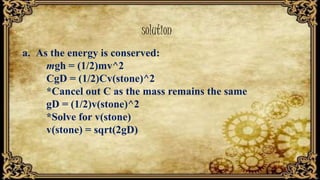
a. As the energy is conserved:
mgh = (1/2)mv^2
CgD = (1/2)Cv(stone)^2
*Cancel out C as the mass remains the same
gD = (1/2)v(stone)^2
*Solve for v(stone)
v(stone) = sqrt(2gD)
b. Period of a mass on a spring:
T = 2π(sqrt(m/k))
In this case: m = 2C
To solve for k, use the force equation for
the spring’s initial stretch:
mg = kY, gives k = (mg)/Y
Substitute m and k in the period
equation:
T = 2π(sqrt(2Y/g))
As m cancels out.
c. The stretch distance from initial position:
The speed is maximum at equilibrium point:
F = 0, a = 0, Kinetic Energy is maximum,
midpoint of the oscillation.
At new equilibrium point: kx = 2Cg
(x being the distance of the spring stretched
from its initial (unstretched) position.
Substitute k (found in part b.) value:
((Cg)/Y)x = 2Cg
x = 2Y
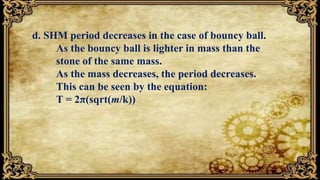
d. SHM period decreases in the case of bouncy ball.
As the bouncy ball is lighter in mass than the
stone of the same mass.
As the mass decreases, the period decreases.
This can be seen by the equation:
T = 2π(sqrt(m/k))

LO 1

  • 2.
    Long-answer question A solidmetal disk is suspended from a spring that is attached to a flat roof, which extends downwards with a distance Y. Note that the mass of the metal disk is given as C. A stone with the same mass descends from altitude D on the disk and stays attached to it. All answers must be in terms of given consonants. Diagram is given below.
  • 3.
  • 4.
    a. What isthe speed of the rock as soon as it falls into the disk? b. Figure out the period T of the SHM that takes place. c. At the disk’s maximum speed, what will the stretch distance of the spring be from its initial position? d. Now the stone is taken out from the top of the disk, which then restores back to its equilibrium position. A bouncy ball, with the same mass as the stone, is then dropped from the same height D, which sticks to the disk. Will the disk’s SHM period that occurs increase, decrease, or remain the same?
  • 5.
    solution a. As theenergy is conserved: mgh = (1/2)mv^2 CgD = (1/2)Cv(stone)^2 *Cancel out C as the mass remains the same gD = (1/2)v(stone)^2 *Solve for v(stone) v(stone) = sqrt(2gD)
  • 6.
    b. Period ofa mass on a spring: T = 2π(sqrt(m/k)) In this case: m = 2C To solve for k, use the force equation for the spring’s initial stretch: mg = kY, gives k = (mg)/Y Substitute m and k in the period equation: T = 2π(sqrt(2Y/g)) As m cancels out.
  • 7.
    c. The stretchdistance from initial position: The speed is maximum at equilibrium point: F = 0, a = 0, Kinetic Energy is maximum, midpoint of the oscillation. At new equilibrium point: kx = 2Cg (x being the distance of the spring stretched from its initial (unstretched) position. Substitute k (found in part b.) value: ((Cg)/Y)x = 2Cg x = 2Y
  • 8.
    d. SHM perioddecreases in the case of bouncy ball. As the bouncy ball is lighter in mass than the stone of the same mass. As the mass decreases, the period decreases. This can be seen by the equation: T = 2π(sqrt(m/k))