
- A Distinct Comparison
- By Sahana.G and Co.,
Ph No: 099642-18244
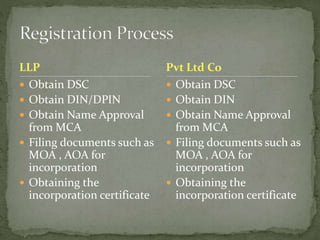
LLP
 Obtain DSC
 Obtain DIN/DPIN
 Obtain Name Approval
from MCA
 Filing documents such as
MOA , AOA for
incorporation
 Obtaining the
incorporation certificate
 Obtain DSC
 Obtain DIN
 Obtain Name Approval
from MCA
 Filing documents such as
MOA , AOA for
incorporation
 Obtaining the
incorporation certificate
Pvt Ltd Co
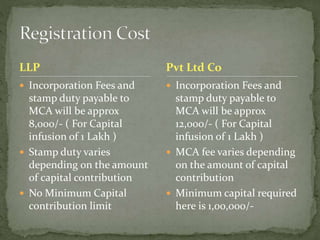
LLP
 Incorporation Fees and
stamp duty payable to
MCA will be approx
8,000/- ( For Capital
infusion of 1 Lakh )
 Stamp duty varies
depending on the amount
of capital contribution
 No Minimum Capital
contribution limit
 Incorporation Fees and
stamp duty payable to
MCA will be approx
12,000/- ( For Capital
infusion of 1 Lakh )
 MCA fee varies depending
on the amount of capital
contribution
 Minimum capital required
here is 1,00,000/-
Pvt Ltd Co
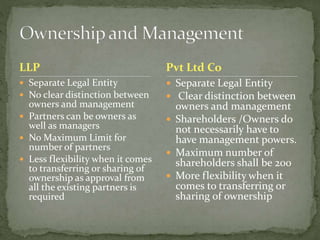
LLP
 Separate Legal Entity
 No clear distinction between
owners and management
 Partners can be owners as
well as managers
 No Maximum Limit for
number of partners
 Less flexibility when it comes
to transferring or sharing of
ownership as approval from
all the existing partners is
required
 Separate Legal Entity
 Clear distinction between
owners and management
 Shareholders /Owners do
not necessarily have to
have management powers.
 Maximum number of
shareholders shall be 200
 More flexibility when it
comes to transferring or
sharing of ownership
Pvt Ltd Co
LLP
 Tax Compliances are
similar
 Statutory Audit is not
compulsory until LLP
reaches the turnover of 40
Lacs and Capital of 25 lacs
 Penalty for non filing of
annual returns with MCA
is higher compared to a
Company. Rs.100 flat fee is
levied per day from the
date of non-compliance
 Tax Compliances are
similar
 Statutory Audit is
compulsory from date of
inception itself
 Penalty for non filing of
annual returns with
MCA is lesser compared
to a LLP. It depends on
the Authorized Capital
Pvt Ltd Co
LLP
 Only Approval route of
FDI ( Prior approval of
RBI ) is permissible.
 Relatively new concept.
Rules , regulations and
procedures are yet to
evolve
 Both automatic ( Prior
Approval not required )
and approval routes of
FDI is allowed. Better
access of funding from
banks also
 Widespread recognition
in India. Well
established procedures
Pvt Ltd Co
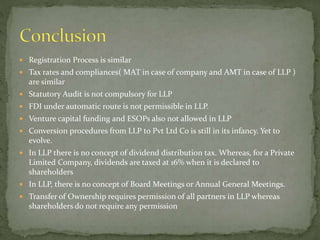
 Registration Process is similar
 Tax rates and compliances( MAT in case of company and AMT in case of LLP )
are similar
 Statutory Audit is not compulsory for LLP
 FDI under automatic route is not permissible in LLP.
 Venture capital funding and ESOPs also not allowed in LLP
 Conversion procedures from LLP to Pvt Ltd Co is still in its infancy. Yet to
evolve.
 In LLP there is no concept of dividend distribution tax. Whereas, for a Private
Limited Company, dividends are taxed at 16% when it is declared to
shareholders
 In LLP, there is no concept of Board Meetings or Annual General Meetings.
 Transfer of Ownership requires permission of all partners in LLP whereas
shareholders do not require any permission
If a person has expansion plans in future and expecting
funding in future through FDI, FII, Venture Capital, ESOP
etc., it is better to opt for a Private Limited company with
a slightly higher cost and dividend tax ( Again cost
depends on the Authorized capital of the company ).
By Sahana.G and Co,
Chartered Accountants
Firm Reg No : 015931S

Llp vs pvt ltd co

  • 1.
    - A DistinctComparison - By Sahana.G and Co., Ph No: 099642-18244
  • 2.
    LLP  Obtain DSC Obtain DIN/DPIN  Obtain Name Approval from MCA  Filing documents such as MOA , AOA for incorporation  Obtaining the incorporation certificate  Obtain DSC  Obtain DIN  Obtain Name Approval from MCA  Filing documents such as MOA , AOA for incorporation  Obtaining the incorporation certificate Pvt Ltd Co
  • 3.
    LLP  Incorporation Feesand stamp duty payable to MCA will be approx 8,000/- ( For Capital infusion of 1 Lakh )  Stamp duty varies depending on the amount of capital contribution  No Minimum Capital contribution limit  Incorporation Fees and stamp duty payable to MCA will be approx 12,000/- ( For Capital infusion of 1 Lakh )  MCA fee varies depending on the amount of capital contribution  Minimum capital required here is 1,00,000/- Pvt Ltd Co
  • 4.
    LLP  Separate LegalEntity  No clear distinction between owners and management  Partners can be owners as well as managers  No Maximum Limit for number of partners  Less flexibility when it comes to transferring or sharing of ownership as approval from all the existing partners is required  Separate Legal Entity  Clear distinction between owners and management  Shareholders /Owners do not necessarily have to have management powers.  Maximum number of shareholders shall be 200  More flexibility when it comes to transferring or sharing of ownership Pvt Ltd Co
  • 5.
    LLP  Tax Compliancesare similar  Statutory Audit is not compulsory until LLP reaches the turnover of 40 Lacs and Capital of 25 lacs  Penalty for non filing of annual returns with MCA is higher compared to a Company. Rs.100 flat fee is levied per day from the date of non-compliance  Tax Compliances are similar  Statutory Audit is compulsory from date of inception itself  Penalty for non filing of annual returns with MCA is lesser compared to a LLP. It depends on the Authorized Capital Pvt Ltd Co
  • 6.
    LLP  Only Approvalroute of FDI ( Prior approval of RBI ) is permissible.  Relatively new concept. Rules , regulations and procedures are yet to evolve  Both automatic ( Prior Approval not required ) and approval routes of FDI is allowed. Better access of funding from banks also  Widespread recognition in India. Well established procedures Pvt Ltd Co
  • 7.
     Registration Processis similar  Tax rates and compliances( MAT in case of company and AMT in case of LLP ) are similar  Statutory Audit is not compulsory for LLP  FDI under automatic route is not permissible in LLP.  Venture capital funding and ESOPs also not allowed in LLP  Conversion procedures from LLP to Pvt Ltd Co is still in its infancy. Yet to evolve.  In LLP there is no concept of dividend distribution tax. Whereas, for a Private Limited Company, dividends are taxed at 16% when it is declared to shareholders  In LLP, there is no concept of Board Meetings or Annual General Meetings.  Transfer of Ownership requires permission of all partners in LLP whereas shareholders do not require any permission
  • 8.
    If a personhas expansion plans in future and expecting funding in future through FDI, FII, Venture Capital, ESOP etc., it is better to opt for a Private Limited company with a slightly higher cost and dividend tax ( Again cost depends on the Authorized capital of the company ).
  • 9.
    By Sahana.G andCo, Chartered Accountants Firm Reg No : 015931S