Time to catch up?
Living standards in the downturn and recovery
Matthew Whittaker
March 2015
@resfoundation
1
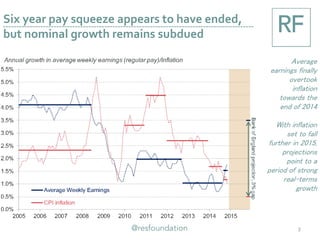
Six year pay squeeze appears to have ended,
but nominal growth remains subdued
2
Average
earnings finally
overtook
inflation
towards the
end of 2014
With inflation
set to fall
further in 2015,
projections
point to a
period of strong
real-terms
growth
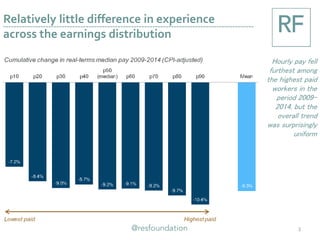
Relatively little difference in experience
across the earnings distribution
3
Hourly pay fell
furthest among
the highest paid
workers in the
period 2009-
2014, but the
overall trend
was surprisingly
uniform
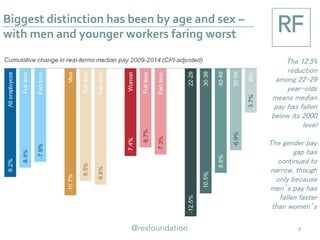
Biggest distinction has been by age and sex –
with men and younger workers faring worst
4
The 12.5%
reduction
among 22-29
year-olds
means median
pay has fallen
below its 2000
level
The gender pay
gap has
continued to
narrow, though
only because
men’s pay has
fallen faster
than women’s
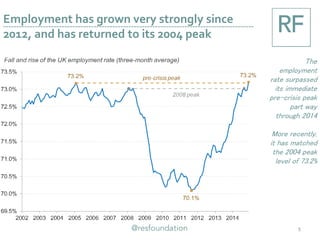
Employment has grown very strongly since
2012, and has returned to its 2004 peak
5
The
employment
rate surpassed
its immediate
pre-crisis peak
part way
through 2014
More recently,
it has matched
the 2004 peak
level of 73.2%
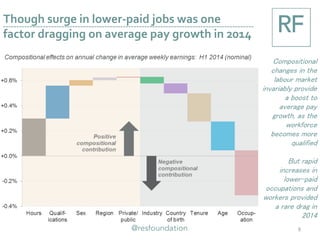
Though surge in lower-paid jobs was one
factor dragging on average pay growth in 2014
6
Compositional
changes in the
labour market
invariably provide
a boost to
average pay
growth, as the
workforce
becomes more
qualified
But rapid
increases in
lower-paid
occupations and
workers provided
a rare drag in
2014
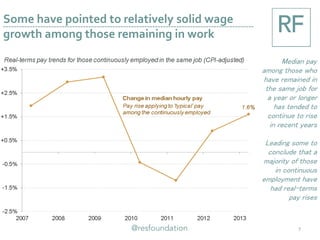
Some have pointed to relatively solid wage
growth among those remaining in work
7
Median pay
among those who
have remained in
the same job for
a year or longer
has tended to
continue to rise
in recent years
Leading some to
conclude that a
majority of those
in continuous
employment have
had real-terms
pay rises
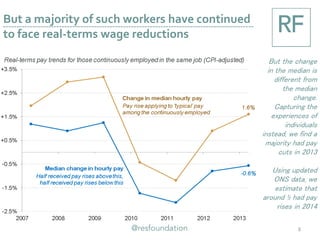
But a majority of such workers have continued
to face real-terms wage reductions
8
But the change
in the median is
different from
the median
change.
Capturing the
experiences of
individuals
instead, we find a
majority had pay
cuts in 2013
Using updated
ONS data, we
estimate that
around ½ had pay
rises in 2014
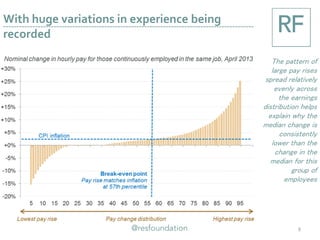
With huge variations in experience being
recorded
9
The pattern of
large pay rises
spread relatively
evenly across
the earnings
distribution helps
explain why the
median change is
consistently
lower than the
change in the
median for this
group of
employees
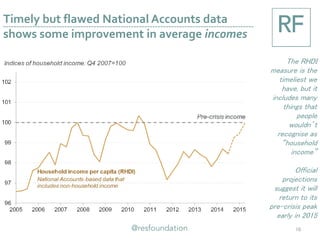
Timely but flawed National Accounts data
shows some improvement in average incomes
10
The RHDI
measure is the
timeliest we
have, but it
includes many
things that
people
wouldn’t
recognise as
“household
income”
Official
projections
suggest it will
return to its
pre-crisis peak
early in 2015
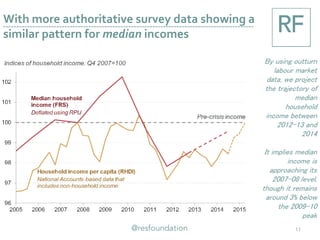
With more authoritative survey data showing a
similar pattern for median incomes
11
By using outturn
labour market
data, we project
the trajectory of
median
household
income between
2012-13 and
2014
It implies median
income is
approaching its
2007-08 level,
though it remains
around 3% below
the 2009-10
peak
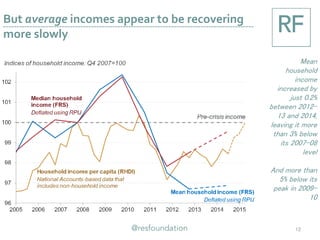
But average incomes appear to be recovering
more slowly
12
Mean
household
income
increased by
just 0.2%
between 2012-
13 and 2014,
leaving it more
than 3% below
its 2007-08
level
And more than
5% below its
peak in 2009-
10
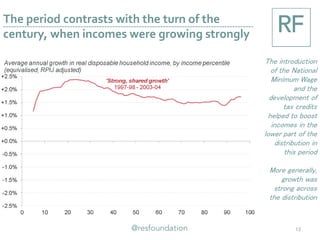
The period contrasts with the turn of the
century, when incomes were growing strongly
13
The introduction
of the National
Minimum Wage
and the
development of
tax credits
helped to boost
incomes in the
lower part of the
distribution in
this period
More generally,
growth was
strong across
the distribution
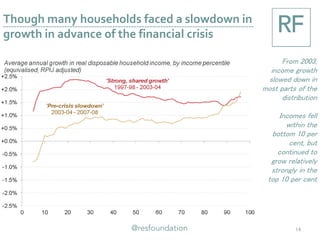
Though many households faced a slowdown in
growth in advance of the financial crisis
14
From 2003,
income growth
slowed down in
most parts of the
distribution
Incomes fell
within the
bottom 10 per
cent, but
continued to
grow relatively
strongly in the
top 10 per cent
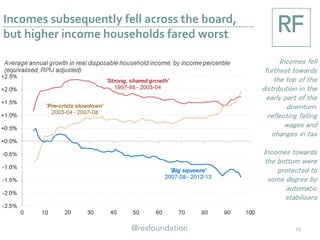
Incomes subsequently fell across the board,
but higher income households fared worst
15
Incomes fell
furthest towards
the top of the
distribution in the
early part of the
downturn,
reflecting falling
wages and
changes in tax
Incomes towards
the bottom were
protected to
some degree by
automatic
stabilisers
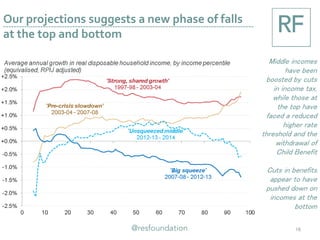
Our projections suggests a new phase of falls
at the top and bottom
16
Middle incomes
have been
boosted by cuts
in income tax,
while those at
the top have
faced a reduced
higher rate
threshold and the
withdrawal of
Child Benefit
Cuts in benefits
appear to have
pushed down on
incomes at the
bottom
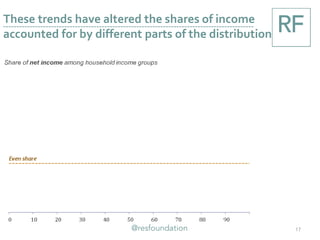
These trends have altered the shares of income
accounted for by different parts of the distribution
17
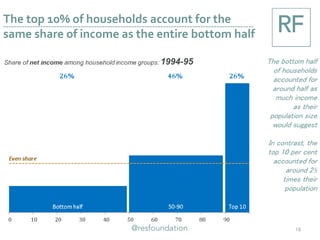
The top 10% of households account for the
same share of income as the entire bottom half
18
The bottom half
of households
accounted for
around half as
much income
as their
population size
would suggest
In contrast, the
top 10 per cent
accounted for
around 2½
times their
population
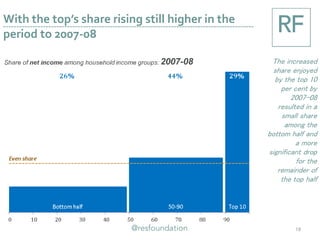
With the top’s share rising still higher in the
period to 2007-08
19
The increased
share enjoyed
by the top 10
per cent by
2007-08
resulted in a
small share
among the
bottom half and
a more
significant drop
for the
remainder of
the top half
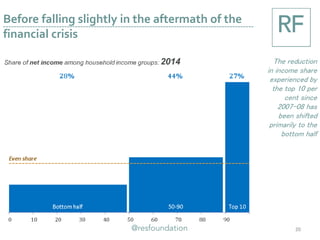
Before falling slightly in the aftermath of the
financial crisis
20
The reduction
in income share
experienced by
the top 10 per
cent since
2007-08 has
been shifted
primarily to the
bottom half
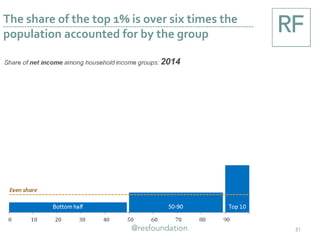
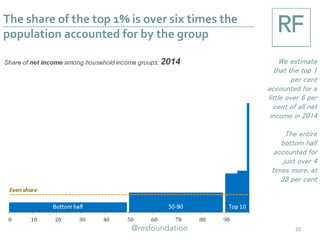
The share of the top 1% is over six times the
population accounted for by the group
21
The share of the top 1% is over six times the
population accounted for by the group
22
We estimate
that the top 1
per cent
accounted for a
little over 6 per
cent of all net
income in 2014
The entire
bottom half
accounted for
just over 4
times more, at
28 per cent
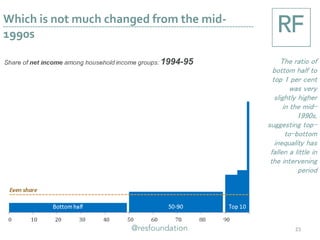
Which is not much changed from the mid-
1990s
23
The ratio of
bottom half to
top 1 per cent
was very
slightly higher
in the mid-
1990s,
suggesting top-
to-bottom
inequality has
fallen a little in
the intervening
period
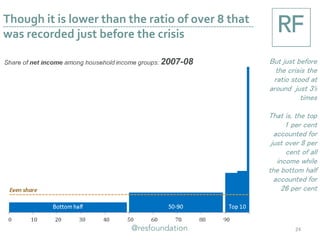
Though it is lower than the ratio of over 8 that
was recorded just before the crisis
24
But just before
the crisis the
ratio stood at
around just 3½
times
That is, the top
1 per cent
accounted for
just over 8 per
cent of all
income while
the bottom half
accounted for
26 per cent
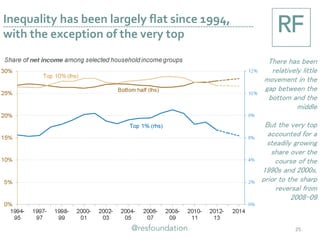
Inequality has been largely flat since 1994,
with the exception of the very top
25
There has been
relatively little
movement in the
gap between the
bottom and the
middle
But the very top
accounted for a
steadily growing
share over the
course of the
1990s and 2000s,
prior to the sharp
reversal from
2008-09
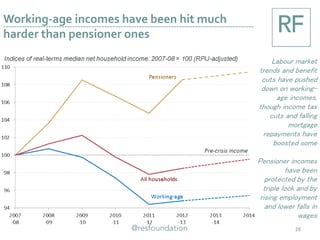
Working-age incomes have been hit much
harder than pensioner ones
26
Labour market
trends and benefit
cuts have pushed
down on working-
age incomes,
though income tax
cuts and falling
mortgage
repayments have
boosted some
Pensioner incomes
have been
protected by the
triple lock and by
rising employment
and lower falls in
wages
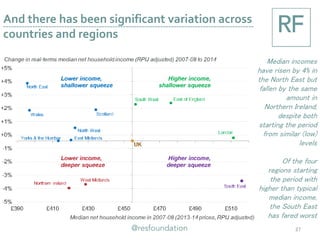
And there has been significant variation across
countries and regions
27
Median incomes
have risen by 4% in
the North East but
fallen by the same
amount in
Northern Ireland,
despite both
starting the period
from similar (low)
levels
Of the four
regions starting
the period with
higher than typical
median income,
the South East
has fared worst
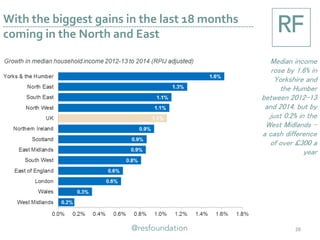
With the biggest gains in the last 18 months
coming in the North and East
28
Median income
rose by 1.6% in
Yorkshire and
the Humber
between 2012-13
and 2014, but by
just 0.2% in the
West Midlands –
a cash difference
of over £300 a
year
• Pay falls have been relatively uniform across
the earnings distribution, but have hit men
and the young hardest
• With inflation falling, there are clear signs of
improvement in average pay
• But a significant number continue to face
pay cuts and it will take a number of years to
restore pre-crisis earnings levels
29
Living standards in the downturn and
recovery: pay
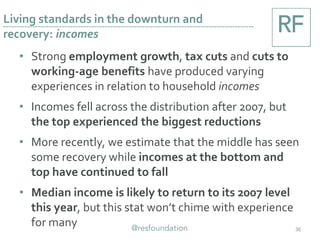
• Strong employment growth, tax cuts and cuts to
working-age benefits have produced varying
experiences in relation to household incomes
• Incomes fell across the distribution after 2007, but
the top experienced the biggest reductions
• More recently, we estimate that the middle has seen
some recovery while incomes at the bottom and
top have continued to fall
• Median income is likely to return to its 2007 level
this year, but this stat won’t chime with experience
for many 30
Living standards in the downturn and
recovery: incomes
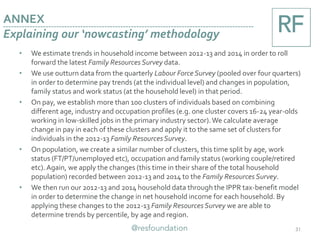
• We estimate trends in household income between 2012-13 and 2014 in order to roll
forward the latest Family Resources Survey data.
• We use outturn data from the quarterly Labour Force Survey (pooled over four quarters)
in order to determine pay trends (at the individual level) and changes in population,
family status and work status (at the household level) in that period.
• On pay, we establish more than 100 clusters of individuals based on combining
different age, industry and occupation profiles (e.g. one cluster covers 16-24 year-olds
working in low-skilled jobs in the primary industry sector).We calculate average
change in pay in each of these clusters and apply it to the same set of clusters for
individuals in the 2012-13 Family ResourcesSurvey.
• On population, we create a similar number of clusters, this time split by age, work
status (FT/PT/unemployed etc), occupation and family status (working couple/retired
etc). Again, we apply the changes (this time in their share of the total household
population) recorded between 2012-13 and 2014 to the Family Resources Survey.
• We then run our 2012-13 and 2014 household data through the IPPR tax-benefit model
in order to determine the change in net household income for each household. By
applying these changes to the 2012-13 Family Resources Survey we are able to
determine trends by percentile, by age and region.
31
ANNEX
Explaining our ‘nowcasting’ methodology

Time to catch up? Living standards in the downturn and recovery

  • 1.
    Time to catchup? Living standards in the downturn and recovery Matthew Whittaker March 2015 @resfoundation 1
  • 2.
    Six year paysqueeze appears to have ended, but nominal growth remains subdued 2 Average earnings finally overtook inflation towards the end of 2014 With inflation set to fall further in 2015, projections point to a period of strong real-terms growth
  • 3.
    Relatively little differencein experience across the earnings distribution 3 Hourly pay fell furthest among the highest paid workers in the period 2009- 2014, but the overall trend was surprisingly uniform
  • 4.
    Biggest distinction hasbeen by age and sex – with men and younger workers faring worst 4 The 12.5% reduction among 22-29 year-olds means median pay has fallen below its 2000 level The gender pay gap has continued to narrow, though only because men’s pay has fallen faster than women’s
  • 5.
    Employment has grownvery strongly since 2012, and has returned to its 2004 peak 5 The employment rate surpassed its immediate pre-crisis peak part way through 2014 More recently, it has matched the 2004 peak level of 73.2%
  • 6.
    Though surge inlower-paid jobs was one factor dragging on average pay growth in 2014 6 Compositional changes in the labour market invariably provide a boost to average pay growth, as the workforce becomes more qualified But rapid increases in lower-paid occupations and workers provided a rare drag in 2014
  • 7.
    Some have pointedto relatively solid wage growth among those remaining in work 7 Median pay among those who have remained in the same job for a year or longer has tended to continue to rise in recent years Leading some to conclude that a majority of those in continuous employment have had real-terms pay rises
  • 8.
    But a majorityof such workers have continued to face real-terms wage reductions 8 But the change in the median is different from the median change. Capturing the experiences of individuals instead, we find a majority had pay cuts in 2013 Using updated ONS data, we estimate that around ½ had pay rises in 2014
  • 9.
    With huge variationsin experience being recorded 9 The pattern of large pay rises spread relatively evenly across the earnings distribution helps explain why the median change is consistently lower than the change in the median for this group of employees
  • 10.
    Timely but flawedNational Accounts data shows some improvement in average incomes 10 The RHDI measure is the timeliest we have, but it includes many things that people wouldn’t recognise as “household income” Official projections suggest it will return to its pre-crisis peak early in 2015
  • 11.
    With more authoritativesurvey data showing a similar pattern for median incomes 11 By using outturn labour market data, we project the trajectory of median household income between 2012-13 and 2014 It implies median income is approaching its 2007-08 level, though it remains around 3% below the 2009-10 peak
  • 12.
    But average incomesappear to be recovering more slowly 12 Mean household income increased by just 0.2% between 2012- 13 and 2014, leaving it more than 3% below its 2007-08 level And more than 5% below its peak in 2009- 10
  • 13.
    The period contrastswith the turn of the century, when incomes were growing strongly 13 The introduction of the National Minimum Wage and the development of tax credits helped to boost incomes in the lower part of the distribution in this period More generally, growth was strong across the distribution
  • 14.
    Though many householdsfaced a slowdown in growth in advance of the financial crisis 14 From 2003, income growth slowed down in most parts of the distribution Incomes fell within the bottom 10 per cent, but continued to grow relatively strongly in the top 10 per cent
  • 15.
    Incomes subsequently fellacross the board, but higher income households fared worst 15 Incomes fell furthest towards the top of the distribution in the early part of the downturn, reflecting falling wages and changes in tax Incomes towards the bottom were protected to some degree by automatic stabilisers
  • 16.
    Our projections suggestsa new phase of falls at the top and bottom 16 Middle incomes have been boosted by cuts in income tax, while those at the top have faced a reduced higher rate threshold and the withdrawal of Child Benefit Cuts in benefits appear to have pushed down on incomes at the bottom
  • 17.
    These trends havealtered the shares of income accounted for by different parts of the distribution 17
  • 18.
    The top 10%of households account for the same share of income as the entire bottom half 18 The bottom half of households accounted for around half as much income as their population size would suggest In contrast, the top 10 per cent accounted for around 2½ times their population
  • 19.
    With the top’sshare rising still higher in the period to 2007-08 19 The increased share enjoyed by the top 10 per cent by 2007-08 resulted in a small share among the bottom half and a more significant drop for the remainder of the top half
  • 20.
    Before falling slightlyin the aftermath of the financial crisis 20 The reduction in income share experienced by the top 10 per cent since 2007-08 has been shifted primarily to the bottom half
  • 21.
    The share ofthe top 1% is over six times the population accounted for by the group 21
  • 22.
    The share ofthe top 1% is over six times the population accounted for by the group 22 We estimate that the top 1 per cent accounted for a little over 6 per cent of all net income in 2014 The entire bottom half accounted for just over 4 times more, at 28 per cent
  • 23.
    Which is notmuch changed from the mid- 1990s 23 The ratio of bottom half to top 1 per cent was very slightly higher in the mid- 1990s, suggesting top- to-bottom inequality has fallen a little in the intervening period
  • 24.
    Though it islower than the ratio of over 8 that was recorded just before the crisis 24 But just before the crisis the ratio stood at around just 3½ times That is, the top 1 per cent accounted for just over 8 per cent of all income while the bottom half accounted for 26 per cent
  • 25.
    Inequality has beenlargely flat since 1994, with the exception of the very top 25 There has been relatively little movement in the gap between the bottom and the middle But the very top accounted for a steadily growing share over the course of the 1990s and 2000s, prior to the sharp reversal from 2008-09
  • 26.
    Working-age incomes havebeen hit much harder than pensioner ones 26 Labour market trends and benefit cuts have pushed down on working- age incomes, though income tax cuts and falling mortgage repayments have boosted some Pensioner incomes have been protected by the triple lock and by rising employment and lower falls in wages
  • 27.
    And there hasbeen significant variation across countries and regions 27 Median incomes have risen by 4% in the North East but fallen by the same amount in Northern Ireland, despite both starting the period from similar (low) levels Of the four regions starting the period with higher than typical median income, the South East has fared worst
  • 28.
    With the biggestgains in the last 18 months coming in the North and East 28 Median income rose by 1.6% in Yorkshire and the Humber between 2012-13 and 2014, but by just 0.2% in the West Midlands – a cash difference of over £300 a year
  • 29.
    • Pay fallshave been relatively uniform across the earnings distribution, but have hit men and the young hardest • With inflation falling, there are clear signs of improvement in average pay • But a significant number continue to face pay cuts and it will take a number of years to restore pre-crisis earnings levels 29 Living standards in the downturn and recovery: pay
  • 30.
    • Strong employmentgrowth, tax cuts and cuts to working-age benefits have produced varying experiences in relation to household incomes • Incomes fell across the distribution after 2007, but the top experienced the biggest reductions • More recently, we estimate that the middle has seen some recovery while incomes at the bottom and top have continued to fall • Median income is likely to return to its 2007 level this year, but this stat won’t chime with experience for many 30 Living standards in the downturn and recovery: incomes
  • 31.
    • We estimatetrends in household income between 2012-13 and 2014 in order to roll forward the latest Family Resources Survey data. • We use outturn data from the quarterly Labour Force Survey (pooled over four quarters) in order to determine pay trends (at the individual level) and changes in population, family status and work status (at the household level) in that period. • On pay, we establish more than 100 clusters of individuals based on combining different age, industry and occupation profiles (e.g. one cluster covers 16-24 year-olds working in low-skilled jobs in the primary industry sector).We calculate average change in pay in each of these clusters and apply it to the same set of clusters for individuals in the 2012-13 Family ResourcesSurvey. • On population, we create a similar number of clusters, this time split by age, work status (FT/PT/unemployed etc), occupation and family status (working couple/retired etc). Again, we apply the changes (this time in their share of the total household population) recorded between 2012-13 and 2014 to the Family Resources Survey. • We then run our 2012-13 and 2014 household data through the IPPR tax-benefit model in order to determine the change in net household income for each household. By applying these changes to the 2012-13 Family Resources Survey we are able to determine trends by percentile, by age and region. 31 ANNEX Explaining our ‘nowcasting’ methodology