Olivier Plas
Specializing in B2B and B2C
e-commerce and omni-channel
marketing, Intershop.
2
Today with you.
D-B2B Göteborg - Mauro Boffardi, Accenture
Interactive · 2018
Mauro Boffardi
Technical and Digital Architect
at Accenture Interactive
Simply
designing
websites or apps
is not enough
anymore.
D-B2B Göteborg - Mauro Boffardi, Accenture
Interactive · 2018
4
Cooking up
inspiration
online
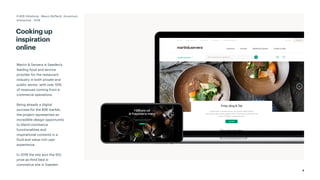
Martin & Servera is Sweden’s
leading food and service
provider for the restaurant
industry in both private and
public sector, with over 55%
of revenues coming from e-
commerce operations.
Being already a digital
success for the B2B market,
the project represented an
incredible design opportunity
to blend commerce
functionalities and
inspirational contents in a
fluid and value-rich user
experience.
In 2018 the site won the IDG
prize as third best e-
commerce site in Sweden.
D-B2B Göteborg - Mauro Boffardi, Accenture
Interactive · 2018
5
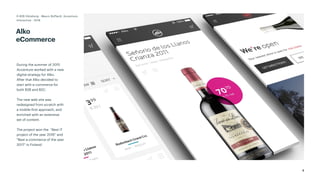
Alko
eCommerce
During the summer of 2015
Accenture worked with a new
digital strategy for Alko.
After that Alko decided to
start with e-commerce for
both B2B and B2C.
The new web site was
redesigned from scratch with
a mobile-first approach, and
enriched with an extensive
set of content.
The project won the “Best IT
project of the year 2016” and
"Best e-commerce of the year
2017" in Finland
D-B2B Göteborg - Mauro Boffardi, Accenture
Interactive · 2018
CX
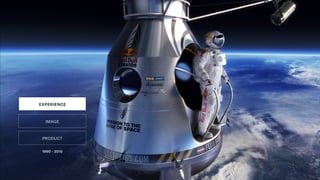
PRODUCT PRODUCT
IMAGE
RELATIONSHIP
Uninformed consumer Informed consumer
IMAGE
EXPERIENCE EXPERIENCE
PRODUCT
IMAGE
PRODUCT
1800 - 1920 1950 - 1990 1990 - 2010 2010 - Now
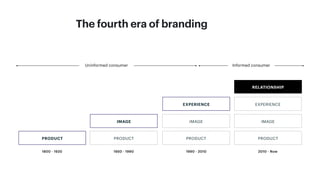
The fourth era of branding
PRODUCT
1800 - 1920
IMAGE
PRODUCT
1950 - 1990
EXPERIENCE
PRODUCT
IMAGE
1990 - 2010
PRODUCT
RELATIONSHIP
IMAGE
EXPERIENCE
2010 - Now
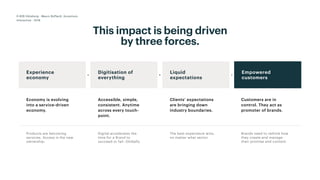
Experience
economy
This impact is being driven
by three forces.
Economy is evolving
into a service-driven
economy.
Products are becoming
services. Access is the new
ownership.
Digitisation of
everything
Accessible, simple,
consistent. Anytime
across every touch-
point.
Digital accelerates the
time for a Brand to
succeed or fail. Globally.
Empowered

customers
Customers are in
control. They act as
promoter of brands.
Brands need to rethink how
they create and manage
their promise and content.
+
+
=
Liquid

expectations
Clients’ expectations
are bringing down
industry boundaries.
The best experience wins,
no matter what sector.
D-B2B Göteborg - Mauro Boffardi, Accenture
Interactive · 2018
B2H
D-B2B Göteborg - Mauro Boffardi, Accenture
Interactive · 2018
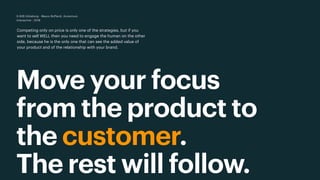
Move your focus
from the product to
the customer.
The rest will follow.
D-B2B Göteborg - Mauro Boffardi, Accenture
Interactive · 2018
Competing only on price is only one of the strategies, but if you
want to sell WELL then you need to engage the human on the other
side, because he is the only one that can see the added value of
your product and of the relationship with your brand.


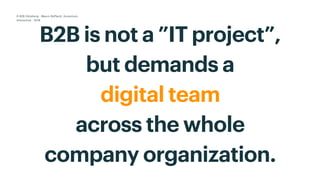
B2B is not a ”IT project”,
but demands a
digital team
across the whole
company organization.
D-B2B Göteborg - Mauro Boffardi, Accenture
Interactive · 2018
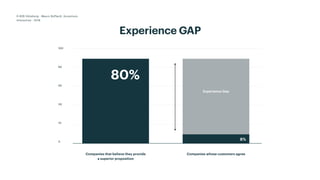
Companies that believe they provide
a superior proposition
8%
Companies whose customers agree
Experience Gap
100
80
50
30
10
0
80%
Experience GAP
D-B2B Göteborg - Mauro Boffardi, Accenture
Interactive · 2018
17
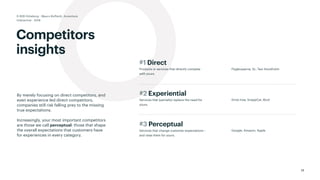
Competitors
insights
D-B2B Göteborg - Mauro Boffardi, Accenture
Interactive · 2018
By merely focusing on direct competitors, and
even experience led direct competitors,
companies still risk falling prey to the missing
true expectations. 
Increasingly, your most important competitors
are those we call perceptual: those that shape
the overall expectations that customers have
for experiences in every category.
#1 Direct
Products or services that directly compete
with yours.
#2 Experiential
Services that (partially) replace the need for
yours.
#3 Perceptual
Services that change customer expectations –
and raise them for yours.
Flygbussarna, SL, Taxi Stockholm
Drive now, SnappCar, Bizzt
Google, Amazon, Apple
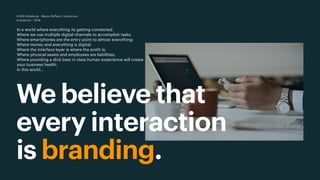
We believe that
every interaction
is branding.
D-B2B Göteborg - Mauro Boffardi, Accenture
Interactive · 2018
In a world where everything its getting connected.
Where we use multiple digital channels to accomplish tasks,
Where smartphones are the entry point to almost everything;
Where money and everything is digital;
Where the interface layer is where the profit is;
Where physical assets and employees are liabilities;
Where providing a slick best in class human experience will create
your business health.
In this world…
Hourglass
D-B2B Göteborg - Mauro Boffardi, Accenture
Interactive · 2018
Which side of the
brand hourglass
are you on?
D-B2B Göteborg - Mauro Boffardi, Accenture
Interactive · 2018
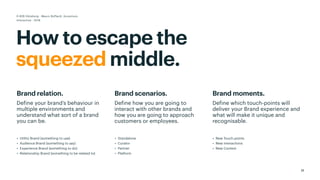
Brand relation.
Define your brand’s behaviour in
multiple environments and
understand what sort of a brand
you can be.
21
How to escape the
squeezed middle.
D-B2B Göteborg - Mauro Boffardi, Accenture
Interactive · 2018
Brand scenarios.
Define how you are going to
interact with other brands and
how you are going to approach
customers or employees.
• Utility Brand (something to use)
• Audience Brand (something to say)
• Experience Brand (something to do)
• Relationship Brand (something to be related to)
• Standalone
• Curator
• Partner
• Platform
Brand moments.
Define which touch-points will
deliver your Brand experience and
what will make it unique and
recognisable.
• New Touch.points
• New interactions
• New Context
22
The journey towards a living brand is
made of changes. We want to discuss
some of those changes with you.
Change.
D-B2B Göteborg - Mauro Boffardi, Accenture
Interactive · 2018
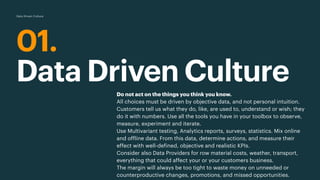
01.
Data Driven Culture
Data Driven Culture
Do not act on the things you think you know.
All choices must be driven by objective data, and not personal intuition.
Customers tell us what they do, like, are used to, understand or wish; they
do it with numbers. Use all the tools you have in your toolbox to observe,
measure, experiment and iterate.
Use Multivariant testing, Analytics reports, surveys, statistics. Mix online
and offline data. From this data, determine actions, and measure their
effect with well-defined, objective and realistic KPIs.
Consider also Data Providers for row material costs, weather, transport,
everything that could affect your or your customers business.
The margin will always be too tight to waste money on unneeded or
counterproductive changes, promotions, and missed opportunities.
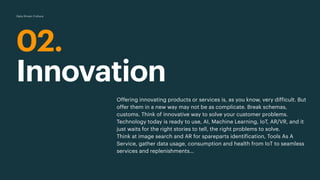
02.
Innovation
Data Driven Culture
Offering innovating products or services is, as you know, very difficult. But
offer them in a new way may not be as complicate. Break schemas,
customs. Think of innovative way to solve your customer problems.
Technology today is ready to use, AI, Machine Learning, IoT, AR/VR, and it
just waits for the right stories to tell, the right problems to solve.
Think at image search and AR for spareparts identification, Tools As A
Service, gather data usage, consumption and health from IoT to seamless
services and replenishments…
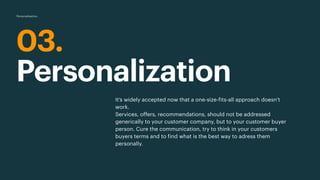
03.
Personalization
It’s widely accepted now that a one-size-fits-all approach doesn’t
work.
Services, offers, recommendations, should not be addressed
generically to your customer company, but to your customer buyer
person. Cure the communication, try to think in your customers
buyers terms and to find what is the best way to adress them
personally.
Personalisation
04.
Branded Content
Days of conventional brand storytelling are over.
It is important investing in specialized content creation that could help
describe your products and services, and provide more information on how
to use them and order them.
Find the story telling that explains what the quality of the products should
be from the point of view of the customers, and then make the transition to
the purchase phase as frictionless as possible.
See the example of Martin & Servera and their online recipes.
Branded Content
05.
Radical transparency
The customer does not need to know or understand your internal processes or
organizational structures. The customer does not WANT to know them.
For the customer the brand is one and it expects to have the same experience and the
same service in every possible touchpoint.
OmniChannel may be an old buzzword, but a lot still has to be done.
Reshape your business and take away all ”walls” between your sale and after sal structure,
bring all the data together, do not build touchpoint specific experiences.


Organizations will need to prepare for an inevitable shift from “touch points” to “trust
points.”
To earn trust, an organization must be transparent. It will be important to design new
navigation systems that simplify complex business processes and demonstrate
transparency.
Radical transparency
06.
Context-Awareness
Use the modern technologies to built context-aware touch points,
proposing different content, products, prices and services depending on
the context the customer is in that exact moment. As first contact on your
touchpoints serve for instance detailed content on desktop experience,
fast offer purchases on a mobile phone, customer service interactions on
the mobile while the customer is on the move or at a working site different
than usual.
Context-Aware
07.
Marketplace
Marketplace
Use in integrated marketplace as a complement of your ecommerce.
Integrate a marketplace platform to expand your product offering very
quickly and respond to the constantly shorter cycles and hypes of the
market.
Use the marketplace to offer complementary products that complete your
offering and that are difficult to handle with your current supply chain.
Use the marketplace to offer of markets completely different than yours,
and provide an unique proposition and value for a customer. You sell
hiking boots, why not offer a complimentary travel packet to the alps?
Make your site automatically adapt to your brand standards, hide the less
performant players and reward the profitable ones.
Complements
08.
Complements
In the era of empowered customer is difficult to create fidelization.
The main offer of your brand is fundamental, but if you can bring it one
step further by offering services that actually solve customer problems.
The effort in implementing the service can pay back a lot in terms of
increased sales.
Think as a customer: what could make my life easier? An automated
shopping list based on my previous purchase, a contact with a technician,
a way to keep track of your consumption or budget, a recipe book,
replenishment program?
Most of those ”complementary services” are common in B2B, and are
expected also in B2C.
09.
Customer Orientation
It is normal to categorize products based on the hierarchy that we use also
with our supply chain; while this categorization often make sense and must
be provided in the site, it may not be the most relevant for the customers.
Provide different ways to find your products, search and filtration are the first
obvious step, but think as a customer, not as a seller.
Sell plants not in base of their scientific taxonomy, but for size of the flowers,
whether they require or not special cares, how often should it water it, if they
can live in apartment or not.
If you sell a TV, ask not the number of inches, but how big is the room,
whether you will use it for playing videogames, whether you like action
movies and documentary….
10.
Post-Purchase
Post-Purchase
You people to connect your brand to a positive experience for the whole
life of the product, not just for getting something for the right price.
Engage your customers right from the order confirmation, do not be
bureaucratic or boring, challenge customers to come back with a
personalized promotion. Offer cross/up selling in your communication,
send replenishment reminder or ask how the customer liked the purchase.
Use time to provide relevant services or up/cross selling. Selling a tool?
Provide service or replacement after its usual lifespan.
33
If you want to continue the
discussion, please contact
me on LinkedIn
https://www.linkedin.com/
in/mauroboffardi/
Thank you

Living brands in B2B

  • 2.
    Olivier Plas Specializing inB2B and B2C e-commerce and omni-channel marketing, Intershop. 2 Today with you. D-B2B Göteborg - Mauro Boffardi, Accenture Interactive · 2018 Mauro Boffardi Technical and Digital Architect at Accenture Interactive
  • 3.
    Simply designing websites or apps isnot enough anymore. D-B2B Göteborg - Mauro Boffardi, Accenture Interactive · 2018
  • 4.
    4 Cooking up inspiration online Martin &Servera is Sweden’s leading food and service provider for the restaurant industry in both private and public sector, with over 55% of revenues coming from e- commerce operations. Being already a digital success for the B2B market, the project represented an incredible design opportunity to blend commerce functionalities and inspirational contents in a fluid and value-rich user experience. In 2018 the site won the IDG prize as third best e- commerce site in Sweden. D-B2B Göteborg - Mauro Boffardi, Accenture Interactive · 2018
  • 5.
    5 Alko eCommerce During the summerof 2015 Accenture worked with a new digital strategy for Alko. After that Alko decided to start with e-commerce for both B2B and B2C. The new web site was redesigned from scratch with a mobile-first approach, and enriched with an extensive set of content. The project won the “Best IT project of the year 2016” and "Best e-commerce of the year 2017" in Finland D-B2B Göteborg - Mauro Boffardi, Accenture Interactive · 2018
  • 6.
  • 7.
    PRODUCT PRODUCT IMAGE RELATIONSHIP Uninformed consumerInformed consumer IMAGE EXPERIENCE EXPERIENCE PRODUCT IMAGE PRODUCT 1800 - 1920 1950 - 1990 1990 - 2010 2010 - Now The fourth era of branding
  • 8.
  • 9.
  • 10.
  • 11.
  • 12.
    Experience economy This impact isbeing driven by three forces. Economy is evolving into a service-driven economy. Products are becoming services. Access is the new ownership. Digitisation of everything Accessible, simple, consistent. Anytime across every touch- point. Digital accelerates the time for a Brand to succeed or fail. Globally. Empowered
 customers Customers are in control. They act as promoter of brands. Brands need to rethink how they create and manage their promise and content. + + = Liquid
 expectations Clients’ expectations are bringing down industry boundaries. The best experience wins, no matter what sector. D-B2B Göteborg - Mauro Boffardi, Accenture Interactive · 2018
  • 13.
    B2H D-B2B Göteborg -Mauro Boffardi, Accenture Interactive · 2018
  • 14.
    Move your focus fromthe product to the customer. The rest will follow. D-B2B Göteborg - Mauro Boffardi, Accenture Interactive · 2018 Competing only on price is only one of the strategies, but if you want to sell WELL then you need to engage the human on the other side, because he is the only one that can see the added value of your product and of the relationship with your brand.
  • 15.
    
 B2B is nota ”IT project”, but demands a digital team across the whole company organization. D-B2B Göteborg - Mauro Boffardi, Accenture Interactive · 2018
  • 16.
    Companies that believethey provide a superior proposition 8% Companies whose customers agree Experience Gap 100 80 50 30 10 0 80% Experience GAP D-B2B Göteborg - Mauro Boffardi, Accenture Interactive · 2018
  • 17.
    17 Competitors insights D-B2B Göteborg -Mauro Boffardi, Accenture Interactive · 2018 By merely focusing on direct competitors, and even experience led direct competitors, companies still risk falling prey to the missing true expectations.  Increasingly, your most important competitors are those we call perceptual: those that shape the overall expectations that customers have for experiences in every category. #1 Direct Products or services that directly compete with yours. #2 Experiential Services that (partially) replace the need for yours. #3 Perceptual Services that change customer expectations – and raise them for yours. Flygbussarna, SL, Taxi Stockholm Drive now, SnappCar, Bizzt Google, Amazon, Apple
  • 18.
    We believe that everyinteraction is branding. D-B2B Göteborg - Mauro Boffardi, Accenture Interactive · 2018 In a world where everything its getting connected. Where we use multiple digital channels to accomplish tasks, Where smartphones are the entry point to almost everything; Where money and everything is digital; Where the interface layer is where the profit is; Where physical assets and employees are liabilities; Where providing a slick best in class human experience will create your business health. In this world…
  • 19.
    Hourglass D-B2B Göteborg -Mauro Boffardi, Accenture Interactive · 2018
  • 20.
    Which side ofthe brand hourglass are you on? D-B2B Göteborg - Mauro Boffardi, Accenture Interactive · 2018
  • 21.
    Brand relation. Define yourbrand’s behaviour in multiple environments and understand what sort of a brand you can be. 21 How to escape the squeezed middle. D-B2B Göteborg - Mauro Boffardi, Accenture Interactive · 2018 Brand scenarios. Define how you are going to interact with other brands and how you are going to approach customers or employees. • Utility Brand (something to use) • Audience Brand (something to say) • Experience Brand (something to do) • Relationship Brand (something to be related to) • Standalone • Curator • Partner • Platform Brand moments. Define which touch-points will deliver your Brand experience and what will make it unique and recognisable. • New Touch.points • New interactions • New Context
  • 22.
    22 The journey towardsa living brand is made of changes. We want to discuss some of those changes with you. Change. D-B2B Göteborg - Mauro Boffardi, Accenture Interactive · 2018
  • 23.
    01. Data Driven Culture DataDriven Culture Do not act on the things you think you know. All choices must be driven by objective data, and not personal intuition. Customers tell us what they do, like, are used to, understand or wish; they do it with numbers. Use all the tools you have in your toolbox to observe, measure, experiment and iterate. Use Multivariant testing, Analytics reports, surveys, statistics. Mix online and offline data. From this data, determine actions, and measure their effect with well-defined, objective and realistic KPIs. Consider also Data Providers for row material costs, weather, transport, everything that could affect your or your customers business. The margin will always be too tight to waste money on unneeded or counterproductive changes, promotions, and missed opportunities.
  • 24.
    02. Innovation Data Driven Culture Offeringinnovating products or services is, as you know, very difficult. But offer them in a new way may not be as complicate. Break schemas, customs. Think of innovative way to solve your customer problems. Technology today is ready to use, AI, Machine Learning, IoT, AR/VR, and it just waits for the right stories to tell, the right problems to solve. Think at image search and AR for spareparts identification, Tools As A Service, gather data usage, consumption and health from IoT to seamless services and replenishments…
  • 25.
    03. Personalization It’s widely acceptednow that a one-size-fits-all approach doesn’t work. Services, offers, recommendations, should not be addressed generically to your customer company, but to your customer buyer person. Cure the communication, try to think in your customers buyers terms and to find what is the best way to adress them personally. Personalisation
  • 26.
    04. Branded Content Days ofconventional brand storytelling are over. It is important investing in specialized content creation that could help describe your products and services, and provide more information on how to use them and order them. Find the story telling that explains what the quality of the products should be from the point of view of the customers, and then make the transition to the purchase phase as frictionless as possible. See the example of Martin & Servera and their online recipes. Branded Content
  • 27.
    05. Radical transparency The customerdoes not need to know or understand your internal processes or organizational structures. The customer does not WANT to know them. For the customer the brand is one and it expects to have the same experience and the same service in every possible touchpoint. OmniChannel may be an old buzzword, but a lot still has to be done. Reshape your business and take away all ”walls” between your sale and after sal structure, bring all the data together, do not build touchpoint specific experiences. 
 Organizations will need to prepare for an inevitable shift from “touch points” to “trust points.” To earn trust, an organization must be transparent. It will be important to design new navigation systems that simplify complex business processes and demonstrate transparency. Radical transparency
  • 28.
    06. Context-Awareness Use the moderntechnologies to built context-aware touch points, proposing different content, products, prices and services depending on the context the customer is in that exact moment. As first contact on your touchpoints serve for instance detailed content on desktop experience, fast offer purchases on a mobile phone, customer service interactions on the mobile while the customer is on the move or at a working site different than usual. Context-Aware
  • 29.
    07. Marketplace Marketplace Use in integratedmarketplace as a complement of your ecommerce. Integrate a marketplace platform to expand your product offering very quickly and respond to the constantly shorter cycles and hypes of the market. Use the marketplace to offer complementary products that complete your offering and that are difficult to handle with your current supply chain. Use the marketplace to offer of markets completely different than yours, and provide an unique proposition and value for a customer. You sell hiking boots, why not offer a complimentary travel packet to the alps? Make your site automatically adapt to your brand standards, hide the less performant players and reward the profitable ones.
  • 30.
    Complements 08. Complements In the eraof empowered customer is difficult to create fidelization. The main offer of your brand is fundamental, but if you can bring it one step further by offering services that actually solve customer problems. The effort in implementing the service can pay back a lot in terms of increased sales. Think as a customer: what could make my life easier? An automated shopping list based on my previous purchase, a contact with a technician, a way to keep track of your consumption or budget, a recipe book, replenishment program? Most of those ”complementary services” are common in B2B, and are expected also in B2C.
  • 31.
    09. Customer Orientation Customer Orientation Itis normal to categorize products based on the hierarchy that we use also with our supply chain; while this categorization often make sense and must be provided in the site, it may not be the most relevant for the customers. Provide different ways to find your products, search and filtration are the first obvious step, but think as a customer, not as a seller. Sell plants not in base of their scientific taxonomy, but for size of the flowers, whether they require or not special cares, how often should it water it, if they can live in apartment or not. If you sell a TV, ask not the number of inches, but how big is the room, whether you will use it for playing videogames, whether you like action movies and documentary….
  • 32.
    10. Post-Purchase Post-Purchase You people toconnect your brand to a positive experience for the whole life of the product, not just for getting something for the right price. Engage your customers right from the order confirmation, do not be bureaucratic or boring, challenge customers to come back with a personalized promotion. Offer cross/up selling in your communication, send replenishment reminder or ask how the customer liked the purchase. Use time to provide relevant services or up/cross selling. Selling a tool? Provide service or replacement after its usual lifespan.
  • 33.
    33 If you wantto continue the discussion, please contact me on LinkedIn https://www.linkedin.com/ in/mauroboffardi/ Thank you